Chapter I · (continued 2)
Reading edition
These, for instance, are some of the reforms necessary:—
(1) To arrange definite national routes of travel, and settle the migration stations along these routes, including ration stations (unless mid-day ration is given on leaving a station).[64]
(2) To close unnecessary tramp wards, and publicly notify the available routes.[65]
(3) To arrange for centres of population some plan by which a man may make use of the tramp ward for three or five nights, and search for employment.[66]
(4) To arrange a national system of Labour Bureaux.[67]
(5) To arrange the incidence of taxation for support of the stations. The Poor-law Unions might be debited in proportion to percentage of vagrants over last 10 years, and deficiency nationalised, or tramp wards transferred to police.[68] (Appendix I.)
(6) To secure sufficient sanitary accommodation in every large centre and on national routes, both for the destitute and for the bonâ fide working man.
(7) To make uniform the supply of rations, the accommodation, and the task of work, and see that the latter is on a proper business footing.[69]
(8) To arrange for public charity to flow into authorised channels, and discourage promiscuous almsgiving.[70]
(9) To provide detention colonies for the confirmed idler, vagrant, and habitual drunkard, if committed by the magistrate.[71]
(10) To arrange a system to distinguish between the idle and the "willing to work" unemployed.[72]
In addition to this, the facts in relation to unemployment show, that there are periods of good and bad trade, leading to wane and flux of employment.
Thus the wave from 1886 to 1893 in skilled trades was as follows:—
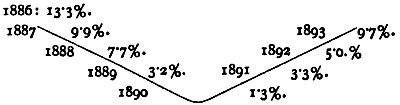
It will be seen that unemployment almost disappeared in 1890. There are also seasonal waves, summer and winter. It is for the equalisation of such differences that some provision must be made, as well as for the care of the "industrial invalid." In times of depression individuals are thrust out who become a burden on the country all the rest of their lives, either by idleness, beggary or crime. It must not be forgotten that each of these at present costs the community a far greater sum than they would cost if provided with labour. Therefore:—
(11) Arrangements should be made whereby, by work specially arranged to coincide with seasonal unemployment, the national cost of the incapable, the inefficient, and the temporarily unemployed could be minimised. (See "How to Deal with the Unemployed": Chap. V., "The Labour Market," by the author.) (Brown, Langham & Co.)
(12) It would only be possible for Government to carry out such large schemes of afforestation or of reclamation of waste lands as would effectually grapple with the whole problem.
There is, however, one question we must briefly deal with in considering either private or public action.
It is said that if employment is found for the unemployed, if vagrant and other colonies are formed, the result will only be to displace by their products other workers. There is, it seems, a kind of vicious circle, by which, for example, if prisoners made brushes, other brushmakers are displaced, and so on.
It is forgotten that every day new and extensive businesses arise, and their competition with others is not regarded as an evil. (These often undersell, colonies need not.) But besides this it has been found by investigation into the working of German labour colonies that their products do not disturb the labour market. To a great extent the colonists are engaged in supplying their own need.[73] Kropatkin also shows how the more careful cultivation of the land enables it to maintain a larger population. To place the waste man on the waste land seems to be true social economy. It must be remembered also that, to the extent to which a pauper is made self-supporting, the money that before supported him is set free. If, for instance, the cost of a pauper could be reduced from £12 (English workhouse) to £5 (Belgian labour colony), £7 would be set free for other expenditure. The weight of the Poor Law is heavy upon us. In London alone indoor paupers rose from 29,458 in 1857 to 61,545 in 1891. Besides this, enormous sums are spent in charity,[74] which forms as it were an additional tax on the well-disposed. An effective law dealing with idleness would tone up our whole population, and dispose many to work. The home market would improve as taxation was lightened. We must go to the root of social disease.
The Continental system of providing an incentive to labour in the shape of a very small wage is well worth consideration.[75] It makes government easy and provides for sifting one class from another. It is not sufficiently recognised that undesirables act as social microbes. If they can be got to live under restraint, much evil is averted. The modern organization of labour is such that it ought to be possible to place our Poor Law on a sound economic basis, instead of the present haphazard system. The cost of administration as it is, goes up by leaps and bounds without adequate return.[76]
I have outlined above the national reforms necessary. But we are slow reformers, and it may be well to indicate reforms immediately possible. These are outlined in a series of articles published last March in the Poor Law Officers' Journal. They include changes in administration of the tramp ward, such as the provision of a diet equal to the lowest prison fare, suitable drink, and a mid-day ration, a proper bed or hammock, absolute prevention of overcrowding, clean water for the bath, and thorough carrying out of Local Government Board precautions for cleanliness.[77] With regard to women, I strongly advise admission to the workhouse proper, detention of children, and the appointment of a lady protectress in connection with each workhouse, whose duty it would be to investigate cases of need. Women should not be allowed to tramp the country. A detention colony is badly needed, and proper provision for the feeble-minded. In the case of women the moral danger is a grave additional reason for prevention of vagrancy.[78]
I also recommend an immediate modification of our tramp-ward system, which would sort vagrants into two classes. By early admission and a half-task of work, the wayfarer might be enabled to earn one night's bed and board and go on his way, having a way-bill for his route. The unemployed town-dweller might be given an identification note enabling him to return for from two to three nights and to seek work meanwhile. If he did not find it he could have a way-bill to another town. The idle man who came late would be detained two nights with double task. Identification marks would be taken. If a man fell into the hands of the police for offences against the law he would be deported to a vagrancy colony.[79]
These changes would only need:
(1) The formation of one experimental vagrancy colony.
(2) Local Government Orders modifying the present tramp ward regulations.
They are therefore immediately possible, pending a further national reform movement.[80]
As, however, even this would require a good deal of discussion and delay, it would be well if the admirable suggestions made by Mr. J. H. Jenner-Fust at the Conference on Vagrancy, held at Lancaster on Sept. 1st, 1905, could be carried forward. He suggests a combination of unions, for relief of the casual poor, (under sect. 8, Poor Law Act, 1879). A joint committee holding office three years could be formed. This committee would have power to acquire land and erect buildings, and maintain inmates, etc. If a combination of several counties were effected, a 1d. rate on No. 11 district and Cheshire would produce £129,000. Such a committee could arrange to dispense with certain workhouses and rent or lease others, to arrange for rules of travel, uniform administration, keeping children from vagrancy, the way-ticket system. Also for "test-houses" for the "work-shy" able-bodied. Perhaps also for a labour colony, as experiments must be tried.
The Conference passed a resolution in favour of farm or labour colonies under State control, or under control of the guardians of a county, for detention of the habitual tramp, and also in favour of the provision of a mid-day meal.
A committee was appointed to give effect to the resolutions, to consist of representatives from each union in the conference district.
XII. CONCLUSION.
It remains now to place on a scientific basis the facts related and the reforms proposed.
Mankind has evolved from the nomad to the pastoral, from the pastoral to the agricultural, from the agricultural to the industrial. These stages represent also the development of the individual, and are expressions of an underlying psychical development.
The child is at first unable to fix his attention long on any one object. He roves from one thing to another, and is essentially nomad.
By degrees certain objects become centres of consciousness with memories attached. He cares for these, they are to him what flocks and herds are to the pastoral, but he is still restless, unable to concentrate long on one object. By degrees, as he unifies, some one object becomes supreme, or rather he himself assumes the supremacy of his environment. He arranges it so as to minister to his dominant passion. The girl craves for the doll, the whole nursery ministers to the beloved object. The child in this stage is essentially agricultural. In the next stage, the industrial, he or she becomes plastic to educational influences, and is "educed" or drawn out in the direction of natural specialised ability.
This is the normal development. But multitudes stay in one or other stage. There are grown-up people incapable of concentration or of true industrialism. Yet they may be efficient examples of "a lower type," i.e., capable of toil in a limited environment under direction.
Multitudes again are incapable of fixity of occupation continued over long periods. Yet alternation of employment will keep them busy and happy.
Others again cannot fix their attention any more than a child, only the simplest of occupations is possible to them, yet they can be restrained from evil.
It must be noted also that human nature degenerates down this ladder. The industrial highly skilled loses his trade. He is quite "at sea" out of his usual environment. But at first he has no desire to rove. He would cling to any environment that found him sustenance; and take eager interest in a new trade. Thus in the Lancashire cotton famine many industrials became skilled out-door workers. But if he cannot get employment he roves to find it, and becomes "unsettled." It is hard then for him to "settle down," he becomes fond of a day or two's work and a day or two's play alternating. Finally, he becomes a true vagrant—a nomad. It will be seen then that the arrest of vagrancy depends on the application of scientific principles. Habitual and hereditary vagrancy could soon be suppressed, or might even be neglected and allowed to die, by gradual absorption of the children of vagrants into the ranks of the more developed population. It is the constant recruiting of vagrancy that is such an evil. It would seem as if the free leave given in Germany for a man to enter and leave a colony, and then enter and leave another, but at the same time to be under compulsion to earn his living, is adapted to the "pastoral" class, who cannot easily settle yet will intermittently work. To let them degenerate into "loafers" is fatal.
Then again the slum dweller clings to his environment, and it is useless to force him to wander, and so send him down the ladder. For such populations as West Ham, work on the land in return for sustenance seems to be the way out. They are essentially "agricultural" in attachment to environment, and would no doubt be suitable subjects for schemes of Home colonisation.
A fully developed industrial, on the other hand, is best employed as an industrial. In connection with new developments, there will be need for such industrials. Therefore, if, as in Belgium, the needs of the colony were supplied by "industrial" inmates, but the more untrained were kept to farm work, on some form of simple manual labour, it would seem as if the right organisation would be arrived at.[81]
It is probable that in our towns many forms of social waste occur, and that new industries might be developed in connection with Labour Bureaux, for temporary employment over crises. Much lies in the power of the municipality. An interesting new industry for utilisation of old tins (waste) has arisen in connection with Central Hall, Manchester. In the cotton famine the laying out of building plots gave employment to many Lancashire weavers, and was ultimately remunerative.
It will be seen that the Tramp Ward, though in itself apparently only a minor provision in our complicated poor law, is really a foundation stone for our national treatment of destitution. Unless we get back to the sound principles that underlie organised society, that if a man will not work he must be made to do so, and that to enforce honest toil is a social duty, we shall see national evils accumulate to national destruction. Let me now pass in review the personal investigations which led me to these conclusions.