Chapter XIV · HABIT OF GROWTH IN PLANTS
Reading edition
“Some clothe the soil that feeds them, far diffused And lowly creeping, modest and yet fair, Like virtue, thriving most where little seen; Some, more aspiring, catch the neighbour shrub With clasping tendrils, and invest his branch, Else unadorn’d, with many a gay festoon And fragrant chaplet, recompensing well The strength they borrow with the grace they lend.”
Cowper.
CHAPTER XIV HABIT OF GROWTH IN PLANTS
My readers have possibly noticed that in the previous chapters my aim has been to describe the various organs of a plant, and that I have tried to show not merely the botanical meaning of the many differences in the organs of allied species, but to point out also how these structures are adapted to help the plant to multiply itself. The object of this final chapter is to take a more general view of plant-life, and to give some idea of the different habits of plants; how in their struggle to grow and reproduce themselves they form such habits as tend to assist them in this effort, and also how entirely, in some cases, they differ from our ordinary conception of plant-growth.
We have already seen how beautifully plants are adapted to the life they have to lead, how they are specially fitted to grow in some particular place and climate, and now I will ask my readers to study with me certain of the varying habits of plant-life. A typical plant of an ordinary kind grows, of course, in the earth, produces root, stem, and leaves, and finally flowers, which are the origin of fruits and seed; by the latter the plant is again produced, and by this circular action the continuity of that particular plant is maintained.
Let us now, in imagination, peep into a tropical forest. On its outskirts we shall see the prototypes of our typical plant; but inside there are also others of quite a different aspect, and the first to attract our attention would probably be the curious orchids perched upon the tree-branches. Their mode of growth differs greatly from that of a normal plant, for they are merely attached to the branches by means of clasping rootlets, which do not in any way extract sap from the tree to which they are clinging.
The moisture they need is collected by the leaves and hanging rootlets from the humid atmosphere of the forest. These plants that have acquired a perching habit sometimes grow to an immense size, and where they do so vegetable débris accumulates about their lower leaves and roots to such an extent that it serves to supply them with needful food.
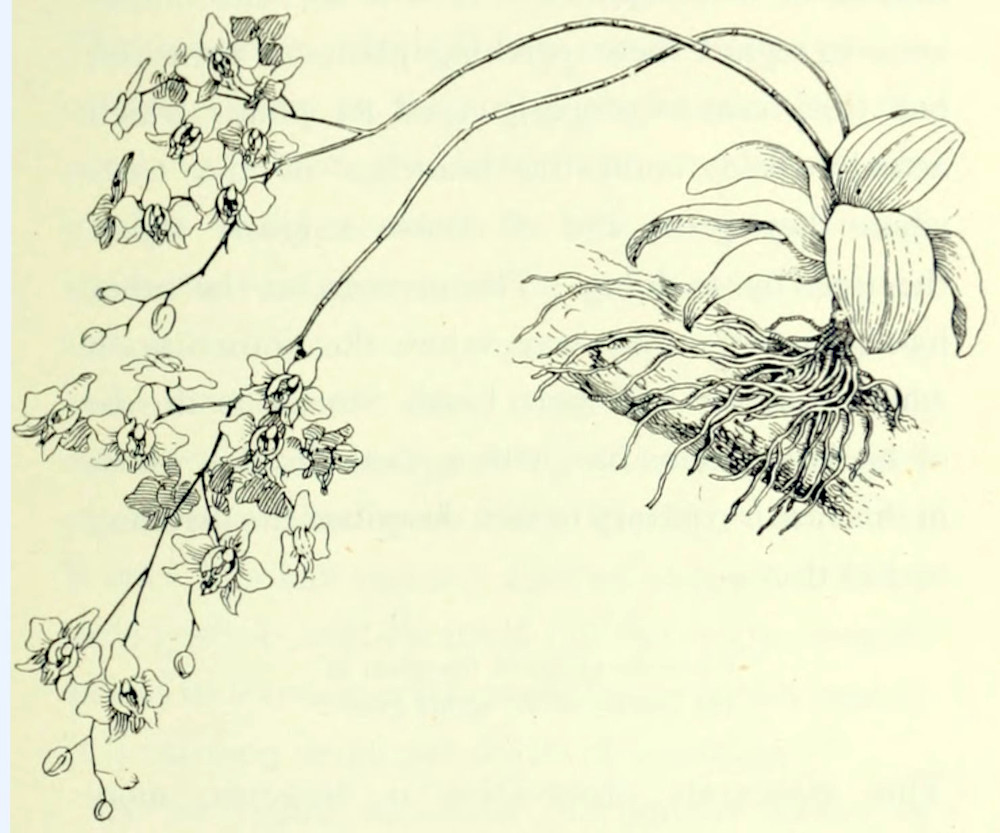
PERCHING ORCHID.
This habit of growth is not confined to the lovely orchids; mosses, lichens, ferns, and many other plants have acquired a similar mode of growth, and the various ways by which they attach themselves to the bearer plants would form an interesting subject of investigation. It is a not uncommon error to regard these perching plants as parasites, but this term is properly used for plants which actually feed upon the branches of the trees where they grow, and of course seriously injure the trees by so doing. The orchids, on the other hand, do not in any way injure the branch upon which they rest. Robert Louis Stevenson in one of his later poems has, with a poet’s license, which in this case is contrary to fact, described the perching orchid thus—
“For in the groins of branches, lo! The cancers of the orchid grow.”
This inaccurate observation is, however, more than atoned for by the wonderful impression Stevenson has given us of the character of woodland strife, the ceaseless struggle for light and air which goes on in tropical forests.
In studying the parasites as a group of plants associated by the same habit of growth, we are led to the conclusion that there is some difference after all in the morality of plants! Here, for example, we are confronted with a group of plants that differ entirely from those we have hitherto examined. The mistletoe, which is the commonest type, is certainly lower in the social plant-scale than the perching orchid, the latter with its leaves and rootlets being enabled to earn its own living, while the mistletoe sends its roots down into the soft sap of the branch upon which it is growing and—there is no other name for it—steals its means of living and growing from the substance of the poor tree upon which it preys. It is true it does, in a half-hearted kind of way, assimilate a little gaseous food for itself, but the sickly metallic hue of its leaves is evidence that even in this respect it is shirking its proper duties of nutrition.
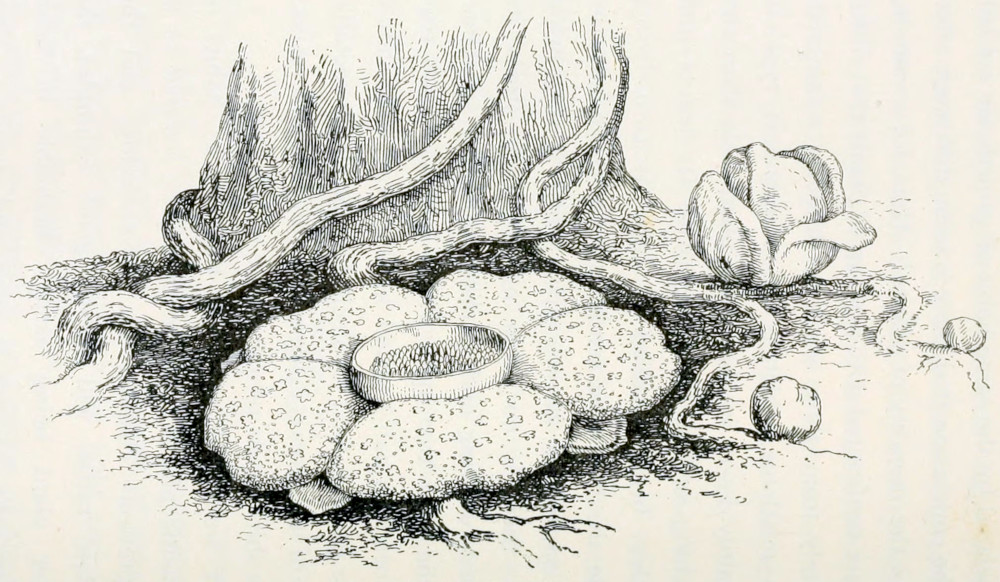
RAFFLESIA ARNOLDII.
If we desire to study the curious habits of parasitic plants, the two examples referred to in a previous chapter, the clover-dodder and the yellow rattle, will afford good examples, the latter plant being easily obtainable in fields where the pasture is poor and scanty. Very curious are the modifications and contrivances developed by plants which have acquired this habit of parasitism, especially amongst such weird tropical species as Rafflesia, a huge parasite growing on the Cissus in Sumatra. When the leaves and flowers of the cissus have withered, then here and there a huge knob protrudes from the stem or root, and this grows in time to an immense stemless flower, measuring more than three feet across, its cup frequently containing as much as twelve pints of liquid, and the weight of the whole flower being said to be about fifteen pounds.
Differing a little in habit from the parasites are the saprophyte plants, which live on decaying vegetation. The little brown leafless orchid called the bird’s-nest orchis is of this character, as well as the equally curious coral-root orchis. These plants, as well as many other parasites, are destitute of chlorophyll, and are therefore dependent on organic material for food; this they obtain either as we have seen from living plants or from decaying organic matter. In their efforts to obtain a needful supply of light and air, some plants assume climbing habits, using as supports other trees and plants, to the very obvious disadvantage of the latter. We can well understand how, in a tropical forest, the weak-climbing plants strive to pass out of the shaded recesses and force their way to the tops of the slower growing trees, in order to obtain the share of light, moisture, and air which are essential to their existence. Very vividly has the late Mr. Louis Stevenson described such a scene in a tropical forest—
“The hooked liana in his gin Noosed his reluctant neighbours in; There the green murderer throve and spread, Upon his smothering victims fed, And wantoned on his climbing coil. Contending roots fought for the soil Like frighted demons; with despair Competing branches pushed for air.” “So hushed the woodland warfare goes Unceasing; and the silent foes Grapple and smother, strain and clasp Without a cry, without a gasp.”
I may explain that the “murderer” alluded to is a species of fig-tree which, in its early youth climbs up the trunks of other trees, and by means of its clasping roots so constricts their stems that they ultimately perish.
In pleasing contrast to this phase of vegetable growth is the habit which indicates to us something of mutual help and co-operation. In the Compositæ we find many instances of a habit of growth that bears distinctly upon this “help-one-another” mode of life. A common daisy will serve as a type-flower of this kind. The little head is a colony of flowers, but so close is the association of its individual florets that it is usual to regard it as one flower rather than a distinct inflorescence composed of numerous separate and distinct flowers.
In order to understand the mutualism displayed by this little flower, we must remember that it is an insect-fertilised blossom, and, therefore, insects must be attracted to it. If we carefully dissect a flower-head we shall find first a ring of strap-shaped flowers on the outside, constituting the ray florets—these are imperfect;[29] but placed side by side on the outer edge they become conspicuous; then we find in the centre of the flower-head a number of tiny yellow flowers, each one containing stamens and pistils. What wee things they are, and if they were developed singly how inconspicuous they would be! When, however, they are grouped side by side in the centre, and further, when the outer florets are of a different colour and shape, what a beautiful and symmetrical whole they make! Truly this is another rendering of the maxim, Union is strength. From a different point of view the arrangement is equally interesting. The white and pink tipped florets of the ray are not capable of bearing seed, and yet we see how they help those florets that are perfect by their attractive appearance; then at night or on a cold rainy day these same ray florets bend over and completely cover up the florets in the centre which are busy producing seed. My readers will find a rich field of investigation open before them in studying the flowers of the daisy family, and finding out for themselves how the florets are grouped together, and to what extent this principle of co-operation can be traced.[30]
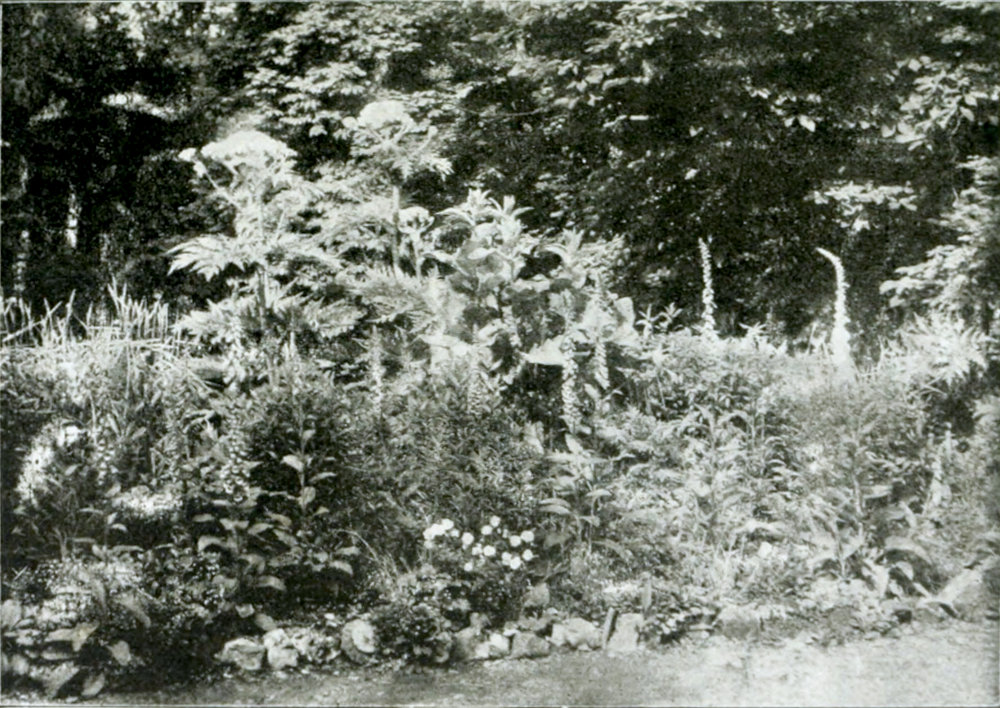
GIANT COW-PARSNIP (Heracleum Giganteum).
Students will find the corn blue-bottle especially interesting; the large outer florets contain no organs of reproduction, but still they are brightly coloured and highly attractive to bees; the inner florets with their protruding stigmas and anthers, are much smaller; they are the seed-bearers, and cannot fail to receive pollination when the bee alights on the flower-head, allured by the showy outer florets, which apparently exist solely that they may draw insects to visit the unattractive flowers of the disc.
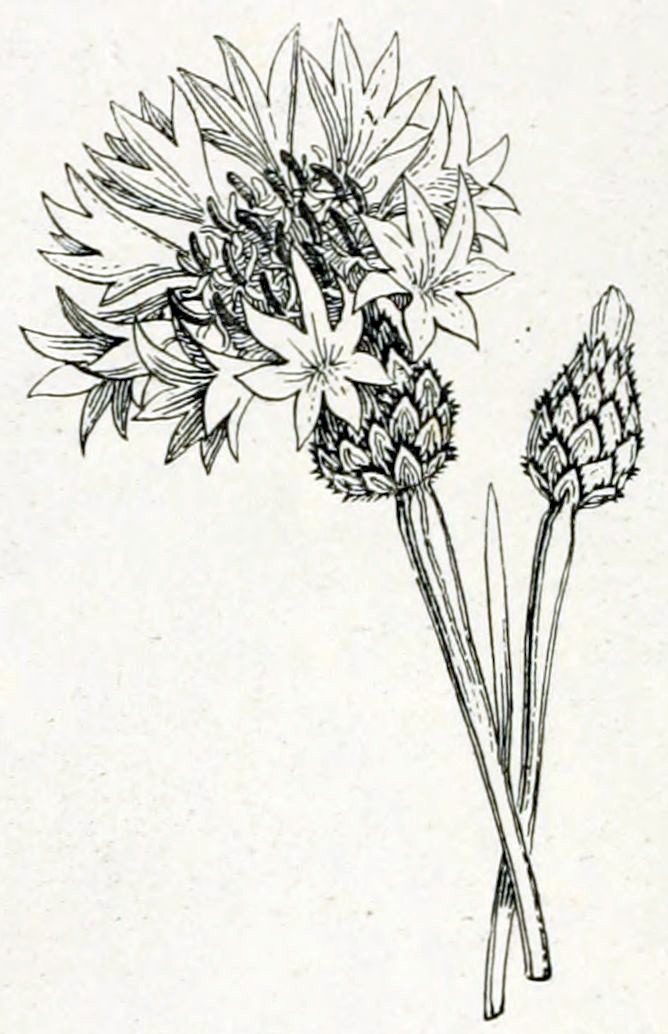
CORN BLUE-BOTTLE.
The direct influence of the separate parts of a plant upon one another, and the very distinct habit of associating together that they may attain some end such as the visits of insects, leads us to consider two other aspects of plant-life, both of which are so full of interest that no botanical work can now be considered complete without some reference to the matter. If we carefully dig up a clover plant or a broad bean and examine the little rootlets we shall observe some small knobs or swellings upon them. These swellings are only found here and there on some of the roots, so that their presence is not a normal condition. Placing one of these knobs under a powerful microscope, we shall find it to be not ordinary root tissue but a substance teeming with countless numbers of rod-like or rounded atoms which botanists who have investigated the subject tell us are bacteria, i.e., inconceivably small one-celled plants which are often the cause of terrible diseases. But some of these mysterious organisms, on the other hand, are capable of beneficial results. It has of late been clearly proved that leguminous plants having these colonies of bacteria on their roots possess the power of assimilating the free nitrogen that forms such a large proportion of atmospheric air. When therefore a farmer sows his wheat in a field previously occupied by clover he finds the clover roots left in the soil contribute the best possible supply of nitrogen to the wheat crop. This seems a remarkable fact, since vegetable physiologists have hitherto insisted upon the fact that plant-life is unable to make use of the free nitrogen of the air. The other instance of strange habit is that of a symbiosis,[31] which exists between certain trees on the one hand and the threads of spawn of some fungi on the other. If the roots of the white poplar are examined minutely, quite a mantle of whitish threads will be found covering the growing point. It is said by that eminent botanist, Professor Kerner, and by others that, as the roots are developed from the young seedling-tree, they are enclosed in the meshes of the fungus, and that this particular fungus is always a close associate of the roots as they grow in all directions. This fact we can see when we dig up the roots, but the most striking part of the story is this, that between this fungus root and the roots of the tree there is an organic connection, a division of labour which results in the tree receiving from the thread-like filaments of the fungus (hyphæ) both moisture and certain food stuffs from the ground, whilst the fungus gets in return such organic food as the tree has produced by means of its green leaves. Such cases as these present to us a manner of growth that is akin to social habit, and, strange as the union may appear, the circumstance is by no means uncommon in the vegetable kingdom. Stranger still perhaps is the union that is sometimes to be found between plants and some member of the animal world, of which union I shall give an example. On one of the larger species of sea-anemones (Anthea cereus) are small yellowish spots, which at one time were supposed to form part of the animal itself. But now the spots turn out to be vegetable cells, which can be isolated and induced to continue growing after the death of the anemone. The yellow spots are small algæ, and are furnished with chlorophyll. We must not regard the algæ as parasites on the sea-anemone, because they split up the carbon-dioxide under the influence of sunlight, and by so doing supply the anemone with oxygen for respiration, whilst the starch formed in the protoplasm of the algæ passes by diffusion into the anatomy of the animal. The transaction does not end here; the algæ in all probability receives nitrogenous substances in return, so that there is a mutual interchange.
These are but one or two of the many wonderful phases of vegetable life, and I hope by thus briefly sketching a few of them my readers will be stimulated into a greater desire to explore God’s marvellous works in nature. There is an endless succession of such wonders to be investigated, but in order to find them we need a careful spirit of observation, passing nothing by without trying to learn something of its life history. Every hedgerow is full of delightful problems which will reward the interested student. A single field has been found to contain as many as fifty different species of plants, and every month of the year will present a new aspect of life. In the early spring we have the germinating seed and the tiny growing moss. A little later the opening buds with their wealth of interesting points to study, then the unfolding of the leaves and the gradual development of the flower. Here and there a climbing plant will engage our attention, its mode of climbing, its modification of part or parts to enable it successfully to overcome difficulties, its acceptance of help by the way—as in the case of a bryony tendril I once came across which cleverly attached itself to a minute hole in a laurel leaf—these and many other items will interest us in our walks if we keep our eyes open.
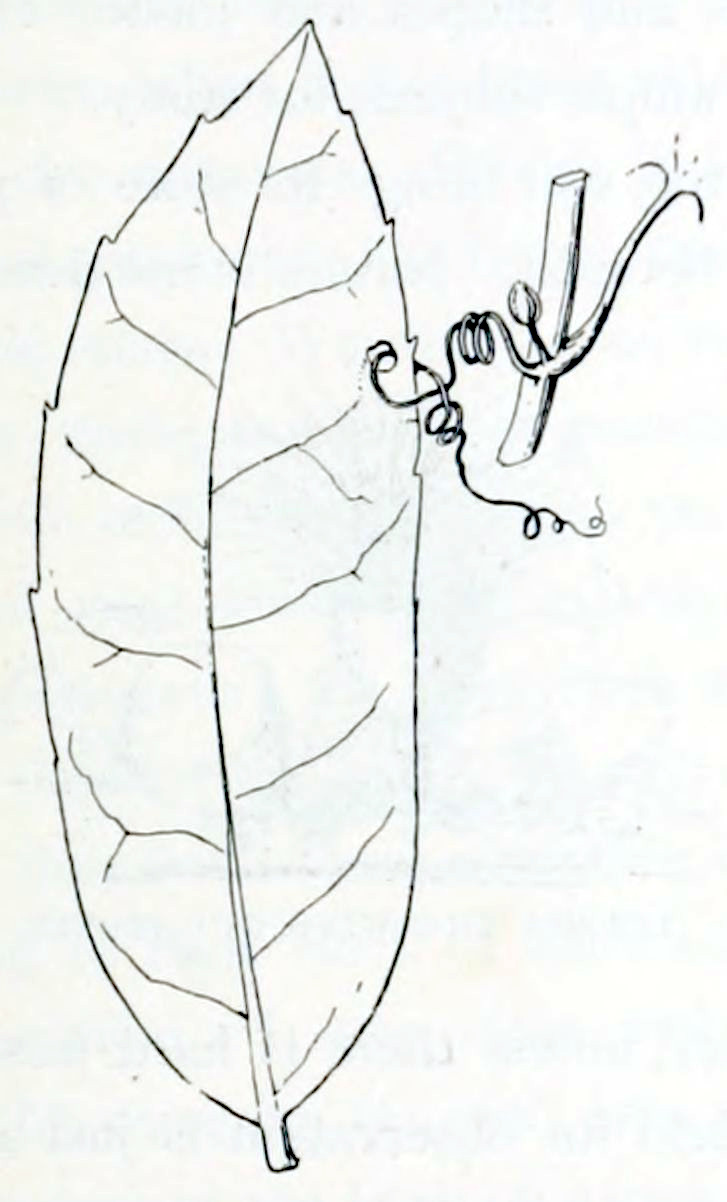
BRYONY TENDRIL.
Then, as summer slowly passes away and autumn approaches, the fruits will engage our attention; their forms and shapes and modes of dispersion will afford ample subjects for study.
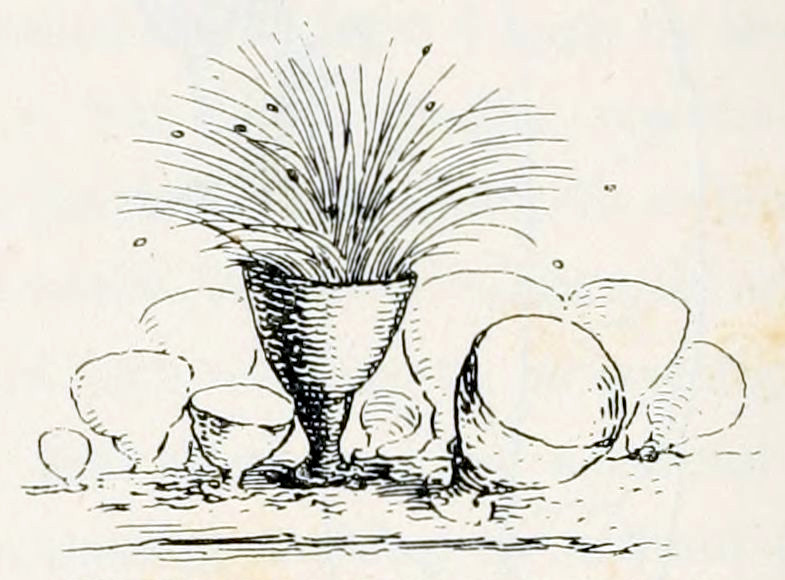
TRICHIA THROWING OUT SPORES.
Winter, too, still brings its store of pleasure for the young botanist. Nature is not dead—she only sleeps. Nay, unless there is hard frost and deep snow the field for observation is just as wide and the harvest as plentiful as at any other season. Look on the old apple-trees and see what a host of tiny plantlets there is there to glean. Here are pale-green bearded moss and lichens, there a branch, perhaps, lies on the ground dead and decaying, under whose mouldering bark, if we have keen eyes, we may discover tiny tufts of the Mycetozoa, whose capsules, under the microscope (and in some cases even with the naked eye) are seen to give off clouds of spores, actually thrown out by the active movements of fine waving threads, a sight never to be forgotten when it has been watched under favourable circumstances. Winter is also rich in its harvest of mushroom-like fungi; these will well repay a little study. We shall be led to note their form, colour, mode, and habit of growth, how they affect certain trees and soils, and the important difference of some kinds being eatable and others virulently poisonous; the mere book student can know very little of the keen pleasure enjoyed by those who thus think about what they see, and are ever adding to their stock of knowledge by personal observation. I may close with some true and beautiful thoughts by one[32] who is herself a reverent student of the book of nature.
“No pleasure is more sure and none less costly than that of watching day by day the signs of the coming spring; than the delight of seeing unexpectedly the first primrose, and of finding that the anemones and hyacinths are pushing their way to the sunshine. Year by year the miracle of springtime, when the green leaves are shaken forth from the hard bud is more miraculous. Summer after summer the lilies are fairer, the wild roses more exquisite, and on through the seasons the varying pleasures succeed one another. These things never pall; and if the time should come when we can no longer go out to the hills and woods to welcome the spring and revel in the bounty of summer we know that the past is not lost. The fair remembrance of the flowers of the field is safe in our hearts, and will ‘flash upon that inward eye which is the bliss of solitude.’”