Chapter IX · FAREWELL TO GIBRALTAR—LEAVING FOR AFRICA.
Reading edition
All too swiftly the days flew by, and the time of my visit to Gibraltar was coming to an end. But in travel I have often found that the last taste was the sweetest. It is only when you have come to know a place well that you can fully enjoy it; when emancipated from guides, with no self-appointed cicerone to dog your footsteps and intrude his stereotyped observations; when, in short, you have obtained "the freedom of the place" by right of familiar acquaintance, and can wander about alone, sauntering slowly in favorite walks, or sitting under the shade of the trees, and looking off upon the purple mountains or the rippling sea, that you are fully master of the situation. "Days of idleness," as they are called, are sometimes, of all days, at once the busiest and the happiest, when, having finished up all regular and routine work, and thus done his duty as a traveller, one devotes himself to "odds and ends," and gathers up his varied impressions into one delightful whole. These are delicious moments, when the pleasure of a foreign clime—
"Blest be the time, the clime, the spot!"—
becomes so intense that we are reluctant to let it go, and linger still, clinging to that which is nearly exhausted, as if we would drain the cup to the very last drop.
Such is the feeling that comes in these last days, as I go wandering about, full of moods and fancies born of the place and the hour. There is a strange spell and fascination in the Rock itself. If it be proper ever to speak of respect for inanimate things, next to a great mountain, I have a profound respect for a great rock. It is the emblem of strength and power, which by its very height shelters and protects the feebleness of man. How often on the desert, under the burning sun, have I espied afar off a huge cliff rising above the plain, and urging on my wearied camel, thrown myself from it, and found the inexpressible relief of "the shadow of a great rock in a weary land!" So here this mountain wall that rises above me, does not awe and overwhelm so much as it shelters and protects; the higher it lifts its head, the more it carries me upward, and gives me an outlook over a wider horizon. If I were a dweller in Gibraltar, I would seek out every sequestered nook upon its side, where I could be away from the haunts of men, and could "dream dreams and see visions." Often would I climb to the Signal Station, or O'Hara's Tower, to see the glory of the sunrisings and sunsettings; and, as the evening comes on, to see the African mountains casting their shadows over the broad line of coast and the broader sea.
Next to the Rock itself, the oldest thing in Gibraltar—the very oldest that man has made—is the Moorish Castle, on which the Moslem invader planted the standard of the Crescent near twelve centuries ago, making this his first stronghold in the land which he was to conquer. And now I must look upon its face again, because of its very age. American as I am, coming from a country where everything is supposed to be "brand new," I feel a strange delight in these old castles and towers, and even in ruins, gray with the moss of centuries. I know it is a "far cry" to the time of the Moors, but we must not think of it as a time of barbarism. The period in which the Moors held Gibraltar was that of the Moorish rule in Spain, when they were the most highly civilized people in Europe, and the Goths were the barbarians. In that day the old Moorish town must have been a very picturesque place, with the domes of its mosques, and the slender minarets rising above them, from which at the sunset hour voices called the faithful to prayer; and very picturesque figures were those of the turbaned Moors, as they reverently turned toward Mecca, and bowed themselves and worshipped.
Nor did the romance die when the Spaniards followed in the procession of races, for they were only less picturesque than the Moors. They too had their good times. A life which would seem tame and dull to the modern Englishman had its charms for the children of the sun, whether they were children of Europe or of Africa. When the church took the place of the mosque, mollahs and ulemas were replaced by priests and monks; and the old Franciscan friars, whose Convent is now the residence of the Governor, marched in sombre procession through the streets, and instead of the call from the minaret, the evening was made holy by the sound of the Ave Maria or the Angelus bell. And these Spaniards had their gayeties as well as their solemnities. They danced as well as prayed. When their prayers were ended, the same dark-eyed senoritas who had knelt in the churches sat on balconies in the moonlight, while gallant cavaliers sang their songs and tinkled their guitars—diversions which filled the intervals of stern and savage war. Out of all this strange old history, with many a heroic episode that still lives in Spanish song and story, might be wrought, if there were another Irving to tell the tale, an historical romance as fascinating as that of the Conquest of Granada. The materials are abundant; all that is wanting is that they be touched by the wand of the enchanter.
But as I have just now more freshly in mind the English history of Gibraltar, I leave the Spaniards and the Moors, and betake me to the King's Bastion, on which "Old Eliott" stood on the greatest day that Gibraltar ever saw. And here we must not forget the second in command, his brave companion-in-arms, General Boyd, who built the Bastion in 1773, and who, on laying the first stone, prayed "that he might live to see it resist the united fleets of France and Spain"—a wish that was gloriously fulfilled nine years later, when he took part in the immortal defence; and it is fitting that his body should sleep under his own work, at once the instrument and the monument of that great victory. Even the trees have a historic air, as they are old—at least many of them have a look of age. One would think that the constant firing of guns, the shock and "sulphurous canopy," would kill vegetation or stunt it in its growth. But there are many fine old trees in Gibraltar. Near the Alameda stands a magnificent bella sombra (so named because its wide-spreading branches are dark and sombre, and yet strangely beautiful), which must be very old. Perhaps it was standing a century ago, and heard all the guns fired in the Great Siege, as possibly a few years later it may have heard, across the bay and away over the Spanish hills, even the thunder of Nelson at Trafalgar.
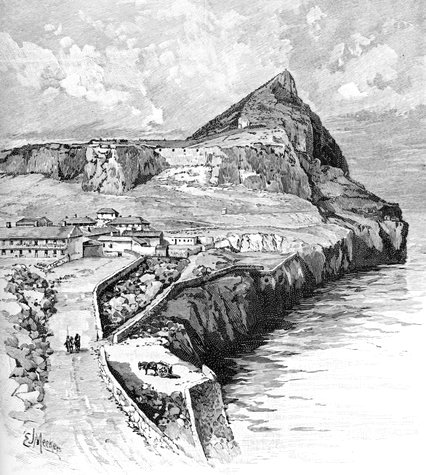
WINDMILL HILL AND O'HARA'S TOWER.
On one of the last days I had engaged to take a midday dinner with the pastor of the Scotch Church, who lives in the southern part of the town. It is a pleasant walk beyond the Alameda over the hill, where you can but stop now and then to look down on the long breakwater of the New Mole, or into the quiet dock of Rosia Bay; or to hear the bugles waken the echoes of the hills. After dinner my friend proposed a stroll, in which I was glad to join him, especially as it took me to new points of view, from which I could look up at the Rock on its southern side, as I had already seen it on the north. Taking our way across the level plateau of Windmill Hill, past barracks and hospitals that are here somewhat retired from the shore, we descended toward the sea.
This end of Gibraltar is a great resort of the people in the summer time, and furnishes the only drive, unless they go out of the gates and crossing the Neutral Ground enter the Spanish lines. Here they are wholly within the Peninsula, and yet in a space so limited is a drive such as one might find along the Riviera. The road is beautifully kept, and winds in and out among the rocks, in one place crossing a deep gorge, which makes you almost dizzy as you look over the parapet of the little bridge which spans it. At each turn you get some new glimpse of the sea, and whenever you raise your eyes to look across the Strait, there is the long line of the African Coast. This is the favorite drive of officers and ladies on summer afternoons, since here they can escape the blistering sun, and get into the cool shadows.
As we come to Europa Point we are at the very foot of the Rock, and must stop to look upward; for above us rises the highest point of Gibraltar, O'Hara's Tower, which, as it is also nearest to the sea, is the one that first catches the eye of the mariner sailing up or down the Mediterranean. Here the old Phœnicians sacrificed to Hercules, as they were approaching what was to them the end of the habitable globe; and here, in later ages, a lamp was always hung before the shrine of the Virgin, and the devout sailor crossed himself and repeated his Ave Maria as he floated by.
Winding round Europa Point, we found our progress barred by an iron gateway; but rattling at the gate brought a sentinel, who, seeing nothing suspicious in our appearance, allowed us to enter the guarded enclosure. Here in this quiet spot, on a shelf of rock which hangs above the road, and is itself overhung by the mighty cliff which rises behind it and above it, is the cottage which is the Governor's summer retreat. The Convent answers very well for a winter residence; but in summer Gibraltar is a very hot place, as it has the reflection of the sun both from the sea in front and the Rock behind; and the Convent, standing on the shore of the bay, gets the full force of both. But there are cool retreats both north and south. On the north the townsfolk pour out of the gates to get under the giant cliff which casts its mighty shadow across the Neutral Ground. A little farther to the east, they come to the sands of a beach, which seems so like a watering-place in dear Old England that they have christened it Margate. So also, turning the corner at the south end of the Rock, one is sheltered from the heat in the long summer afternoon. The cottage is without any pretension to ornament; but as it has a somewhat elevated perch, like a Swiss chalet, it is a sort of eyrie, in which one can look down upon the sea and catch every wind that comes from the Mediterranean.
Just now this little eyrie was turned to another purpose—a place of confinement for Zebehr Pasha, a name that brings back memories of Egypt. An Arab sheikh, at the head of one of the most powerful tribes on the Upper Nile, he was at the same time one of the most famous slave-hunters of Africa. And yet such was his influence in the Soudan, that he was the one man to whom Gordon turned in his isolation at Khartoum, when neither England nor Egypt came to the rescue; and his one message to the authorities at Cairo was: "Send me Zebehr Pasha!" The request was refused, and we know the rest. Had it been granted, the result might have been different. But the British Government seemed to have a great fear of letting him return to the scene of his old exploits lest he should turn against them, and after the English occupation of Egypt, had him remanded for safe-keeping to Gibraltar. His detention is made as little irksome as possible. He is not confined in a prison. He is even the occupant of the Governor's cottage, and has his family with him. Looking up at the windows, I saw dark faces (perhaps those of his wives), that moved away as soon as they were observed. But to be comfortably housed is nothing without liberty. To the lion in captivity it matters little whether he is in a barred cage, or has the most luxurious quarters in a Royal Zoölogical Garden. Zebehr Pasha is a lion of the desert that has never been tamed. How he must chafe at the gilded bars of his prison, and look out wistfully upon the blue waves that separate him from his beloved Africa! He envies the eagles that he sees soaring and screaming over the sea. If they would but lend him their wings, he would "homeward fly," and mounting the swiftest dromedary, taste once more the wild freedom of the desert.[12]
But all things must have an end, and my stay in Gibraltar, delightful as it was, must be brought to a close. I was not eager to depart. So quickly does one become at home in new surroundings, that a place which I never saw till a few days before, now seemed like an old friend. My new acquaintances said I "ought to stay a month at least," and I was sure that it would pass quickly and delightfully. But travellers, like city tramps, must "move on," and it is certainly better to go regretting and regretted, than to carry away only disagreeable memories. I had taken passage for Oran on the Barbary Coast, when the Colonial Secretary, kind to the last, proposed to send me off to the ship in a government launch, an offer which my modesty compelled me to decline. But he insisted (for these Englishmen, when they do a thing, must do it handsomely) till I had to submit. That evening, while dining at the Hotel, a servant brought me word that a messenger had a special message for me, and when I presented myself, he put into my hands the following:
"Memorandum from the Colonial Secretary to the Captain of the Port.
"Dr. Field, an American gentleman, introduced here by Sir Clare Ford, is now staying at the Royal Hotel, and leaving Friday evening by the steamer for Algiers.
"His Excellency wishes every attention to be shown him: so you will send a Boarding Officer to-morrow at 6 P.M., and ask him at what hour he desires to leave from Waterport, and have a launch ready for him: the Boarding Officer making all arrangements for Dr. Field and his friends passing through the gates.
Gifford."
On the back of the above order was written in red ink, in very large letters:
"Boarding Officer: Comply with His Excellency's wishes.
"G. B. Bassadone, "For the Captain of the Port."
This was the first time in my life that I had been waited upon for orders! Having this greatness thrust upon me, I did not betray my unfamiliarity with such things by any light and trivial conduct, but kept my dignity with a sober face, and graciously announced my sovereign pleasure to depart the following evening at eight o'clock. This was really a great convenience, as it gave me a few hours more on shore, whereas otherwise I must leave before sunset, when the gates are shut, not to be opened till morning. Appreciating not only the courtesy, but the distinction, I invited an American party at the Hotel to keep me company. But they had already made their arrangements, and went off ingloriously before "gun-fire"; while His Republican Highness took his dinner quietly, and awaited the coming of his escort. One young lady, however, (a cousin of Mr. Joseph H. Choate, of New York, my friend and neighbor at our summer homes in the Berkshire Hills,) stood by me, and at eight o'clock in the evening we walked down Waterport Street, attended by two stalwart defenders. The street was strangely silent, for as the outsiders leave at sunset when the gates are closed, the town is very quiet. It was dark as we approached the first gate, which had been shut hours before; but the guard, having "received orders," instantly appeared to unlock it, a form which was repeated at the second line of fortifications. At the quay we found the launch ready, with steam up, and as we took our places in the stern of the boat, on the cushioned seat provided for distinguished guests, I felt as if I were a Lord High Admiral. It was a beautiful night. The moon was up, though half hidden by clouds, from which now and then she burst forth, covering the bay with a flood of light. At that moment—stern Puritan as I am, and impassible as my friends know me to be—if I had been put upon my oath, or my honor, I should have been compelled to confess, that to be floating over a moonlit sea, with a fair countrywoman at my side, was not altogether the most miserable position in which I have ever been placed in my wanderings up and down in this world.
Once on the deck, the whole broadside of the Rock was before us, with the lights glimmering far up and down the heights. At half-past nine the last gun was fired, and in another half hour the lights in the barracks were put out, and all was dark and still.
It was midnight when the steamer began to move. The moon had now flung off her misty veil, and risen to the zenith, where she hung over the very crest of the Rock, her soft light falling on every projecting crag. The ship itself seemed to feel the holy stillness of the night, and glided like a phantom-ship, almost without a sound, over the unruffled sea. As we crept past the long line of batteries, the great Fortress, with its hundreds of guns, was silent; the Lion was sleeping, with all his thunders muffled in his rocky breast. Thus our last glimpse of Gibraltar was a vision not of War, but of Peace, as we rounded Europa Point and set our faces toward Africa.
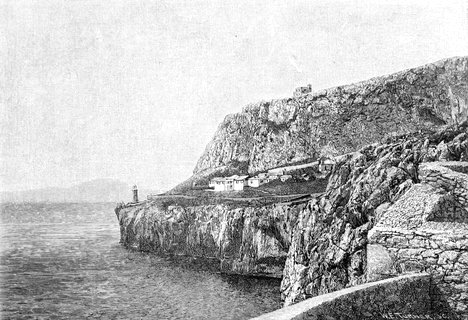
EUROPA POINT.
Footnotes
"Zebehr Pasha was released August 3, 1887, on signing a certain document sent from the Home Government relative to his future conduct. This was an engagement 'to remain in the place which should be chosen by the Egyptian Government; to place himself under its surveillance; and to abstain from interference in political or military questions relating to the Soudan or otherwise.' This he signed in the presence of two British staff officers. He had arrived in Gibraltar in March, 1885, and from that time had been a prisoner in the Governor's cottage for about two years and a half, under charge at different times of several officers of the garrison. He left Gibraltar August 16th, for Port Said, accompanied by his household, which included two women and three men, and was attended by three male and two female servants. He also took back to his African home an infant born in the Governor's cottage at Europa."