Chapter X · THE MOTHER’S CARE OF HER BABY (continued 2)
Reading edition
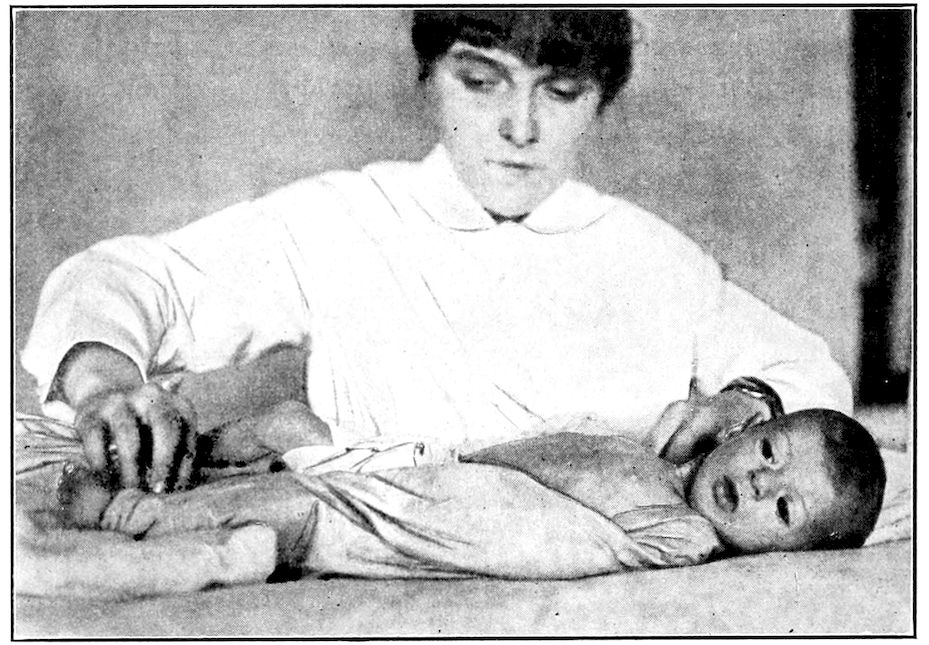
Fig. 61.—Putting the baby into a wet pack.
If the baby has frequent loose movements; seems feverish; vomits and cries as though he had pain, stop all food and give nothing by mouth but water, until the doctor comes.
If you care for your baby, yourself, through an attack of summer complaint you will find that the doctor’s instructions are directed toward keeping the baby cool, clean and quiet, while he, himself, gives very careful attention to the question of feeding.
It is clear, then, that the baby should be lightly clad and kept quiet and undisturbed, in a cool shady place, out 211of doors as much as possible. During the warmest part of the day, however, he will often he better off in the house, in a room with the shutters closed. But while keeping the baby cool, you must bear in mind the harm that may be done by chilling him or exposing him to a cold draft or wind. The doctor may want him to have several baths daily, possibly tub baths, at a temperature of 100° F., or cool sponge baths. Packs, also, are given, for they not only cool the baby but quiet him as well, if he is restless. These packs may be cool (80° F.); tepid (100° F.) or hot (105° to 108° F.) according to the baby’s needs.
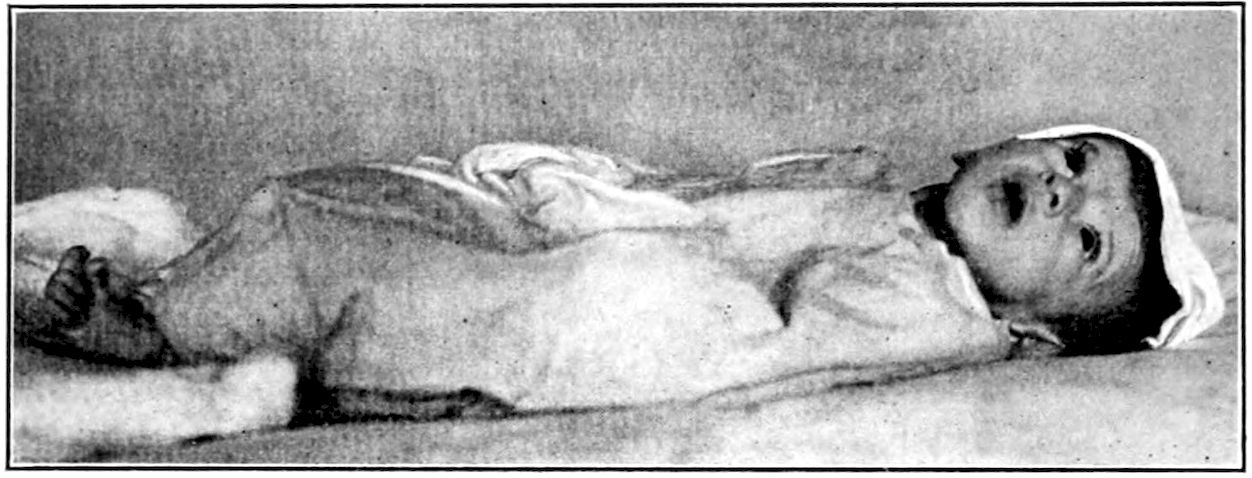
Fig. 62.—The baby in a wet pack with a hot water bag at his feet and cold compress on his head.
It is a simple matter to give a pack and you will enjoy doing it for you will actually see that your baby will grow quieter and more comfortable as you give it. Cover the bed with a rubber and sheet and bring to the bedside a basin containing a sheet wrung from water of the specified temperature; a basin containing ice and compresses for the baby’s head and a flannel covered hot water bottle at 125° F., for his feet. The baby is laid on the upper half of the folded wet sheet, and an upper corner wrapped about each arm, as in Fig. 61, and the sides folded around his legs. The lower half is brought up between his feet and used to 212cover his entire body, being tucked around his shoulders. The hot water bottle is placed at his feet and an ice compress on his head, as in Fig. 62. If the sheets are wrung from warm or hot water, the baby is covered with a blanket after he is put into the pack.
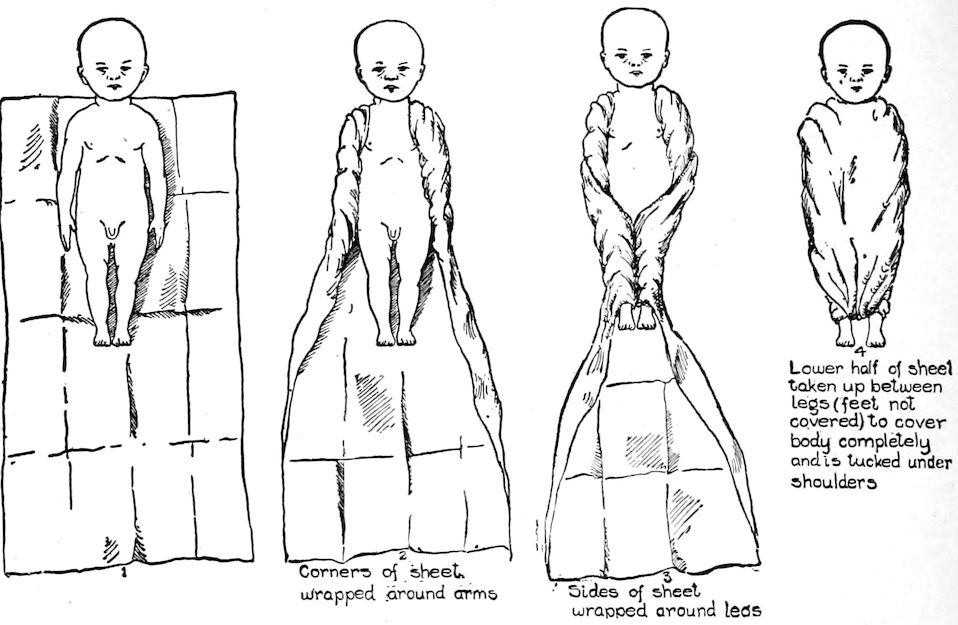
Fig. 63.—Diagrams shoving the successive steps in putting the baby in a pack.
Should your baby have summer complaint, remember that even a mild attack predisposes to another and you will have to be even more watchful and painstaking than ever, in your care of him. He will have to return to his customary diet very slowly, or he may not be able to take his usual amount of nourishment at all until the weather turns cool. Even though he gains no weight it is important to avoid taxing his digestion since it is already being threatened by the heat.
213
KEEPING YOUR BABY WELL IN WINTER
There are certain evils that beset the baby’s way during the winter just as there are seasonal pitfalls in summer, but the truth is that if you care for yourself and him according to the suggestions that have been set down in the foregoing pages, you are doing practically everything necessary to make his way safe and comfortable. A baby who has proper food, plenty of fresh air, is kept clean and whose daily life is regular, is not likely to be ill during the winter or any other time.
The chief baby ills that come with the blustery weather are colds and the troubles that are likely to follow in their wake, such as bronchitis and pneumonia. Colds are infectious, you know, so keep the baby away from sneezy people and out of crowds and dusty places. If he should take cold in spite of you, send for the doctor at once. It may amount to nothing and clear up in a day or two, but if you let it run on, the dreaded bronchitis or pneumonia may result.
RELIEVING COLIC, CONSTIPATION AND CONVULSIONS
I have tried to impress upon you, at every step, that it is very unwise for you to delay in sending for the doctor when your baby seems ill, or to attempt to treat him according to your own ideas or those of your neighbors. But if the baby should begin to scream with colic or have a spasm, you would want to know what to do at the moment, and in case of constipation there are a few simple nursing procedures that you may employ to the baby’s advantage.
Colic is always due to indigestion, whether the baby is breast-fed or bottle-fed, because of the food itself being wrong in some respect or because it is not properly given. 214The milk may contain too much of the material that forms the curd, or so much starch and sugar that fermentation takes place, the pain itself usually being due to undigested food or gas in the intestines. This condition may also result from the baby’s being fed too rapidly or too frequently, or from his swallowing air while sucking on a pacifier or an empty bottle. Colic may be caused, too, by chilling the baby as this is likely to disturb his digestion.
Most babies have colic at some time during the first year, usually before the fifth month. The attacks may occur several times a day, after feeding, or they may not come on until the late afternoon or evening when the baby is tired. Colic is so common that most people are familiar with the symptoms: violent crying and a flushed drawn face; cold hands and feet; tightly clenched fists and a hard, swollen abdomen. As the pain is cramp-like, the baby stops crying every little while, and then suddenly begins again, drawing up his legs, doubling up his body and then straightening out with a jerk.
For immediate relief, you may give the baby a tablespoonful of hot water in which half a soda mint tablet has been dissolved, and an enema of half a pint of water, at 110° F., containing one half teaspoonful of salt, given through a small rubber tube introduced about six inches. This empties the lower bowel and enables the baby to expel a good deal of the gas that is troubling him so. Rub his abdomen with a little oil and apply a compress of several thicknesses of flannel, wrung from hot water, covering this with a larger piece of dry flannel, and change it every three or four minutes for a while. Place a flannel covered hot water bottle (at 125° F.) at his feet, cover him warmly, darken the room and he will almost certainly go to sleep. It is often a good plan to substitute barley water for one 215or two feedings, after an attack of colic, in order to give the disturbed digestive tract a rest.
Quite naturally, you must tell your doctor if your baby has colic for the cause may lie in the character of his food. But it may lie in some error on your part. Go over all the details of your share of the baby’s care and see if you can discover anything to correct.
With breast-fed babies, prevention is often accomplished by the mother’s nursing her baby more slowly, lengthening the intervals between nursings and by improving her own hygiene, particularly by relieving constipation and increasing her recreation and out-of-door exercise. Nursing mothers who lead sedentary lives and eat rich food very often have colicky babies as do those who are nervous, irritable and inclined to worry.
If the baby is bottle-fed he may be taking his food too fast because of an over-large hole in the nipple; he may not pause often enough during his meal or he may take in air as he nurses because the bottle is not properly held, as shown in Fig. 48.
In any event do not stop until you get at the cause of the trouble for though the colic itself may not necessarily be serious, a continuation of the cause may result in a run down condition or even in malnutrition.
Don’t forget the importance of holding the baby upright over your shoulder after each feeding, to help him bring up gas, and of placing him immediately in his crib to be left quiet and undisturbed. And ask your doctor about drinking water. Very often the tendency toward colic is lessened by increasing the amount of cool boiled water given between meals.
Constipation is very common among babies and may be manifest by the stools being too small, too dry or too infrequent. It is more difficult to cope with than colic, though it, 216too, may have its origin solely in unsuitable food. In some cases, however, the constipation is due to absence of habit in emptying the bowels regularly; to weakness of the intestinal muscles; to long-continued undernourishment or to some such disease as rickets.
It becomes apparent that the prevention of this troublesome condition is accomplished largely by giving suitable food; constant fresh air; regularity in the daily routine and training the baby to empty his bowels at the same time every day.
When constipation is due to insufficient fat in the food, cod-liver oil is sometimes given, 15 to 30 drops three or four times a day; or a teaspoonful of olive oil two or three times a day. Maltose, malt soup, malted milk, milk of magnesia, mineral oil, oatmeal water and orange juice are all found among the remedies for constipation; while soap sticks, suppositories and enemas of oil or soapsuds sometimes have to be resorted to.
In giving an enema to relieve constipation, the baby should be protected from chilling, laid on a pillow and the bed-pan so placed that he will be comfortable and not inclined to move, and from half a cup to a cup of soapsuds, at 105° F., given with a small hard-rubber nozzle, as in Fig. 64. When warm olive oil is given at night (2 to 4 tablespoonfuls slowly through a small rubber tube introduced about six inches), it is very often retained until morning when the baby empties his bowels freely with little or no assistance.
Abdominal massage will often relieve constipation by strengthening the intestinal muscles, this in turn tending to make the bowels move. The abdomen should be rubbed with a firm but not hard, circular stroke, beginning in the right groin and working up to the margin of the ribs, across to the left side and down to the groin. This massage is 217often given for about ten minutes every day, preferably at night, but never just after feeding.
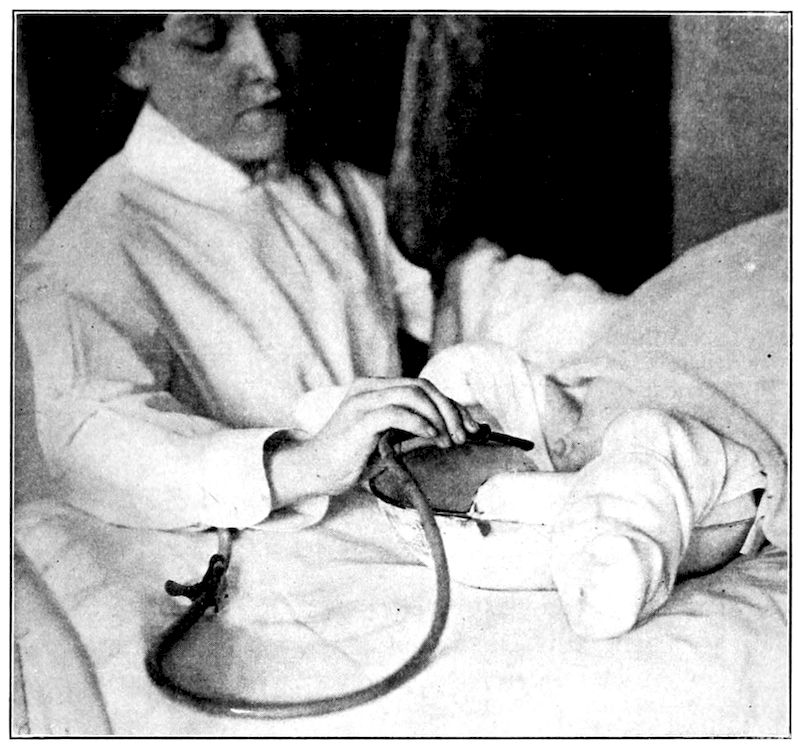
Fig. 64.—Giving the baby an enema. He is well protected, to prevent chilling, and lies comfortably on a pillow which reaches to the bed-pan, the latter being covered with a diaper where he rests upon it.
Constipation is sometimes entirely cured by nothing more than a suitable dietary; an abundance of drinking water; an out-of-door life; massage, and above all, the unceasing effort to establish a regular habit. These are all things which you, yourself, may do for the baby. The longer constipation persists, the harder it is to cure, so do 218all in your power to prevent it and if it develops, try to end it at once.
Convulsions are a symptom of several disorders of infancy and they may occur unexpectedly. Although at the moment, they are more distressing than serious, you should notify your doctor at once. If he cannot come promptly you may end the seizure by employing measures that will quiet and relax the struggling baby. The room should be darkened, kept absolutely quiet and the baby handled with the utmost gentleness. As a rule the most satisfactory course is to immerse the baby in water at 100° F. and keep him there for five or ten minutes, supporting his head above the level of the water as shown in Fig. 60. (See p. 209.) Have some member of the household place cloths, wrung from cold or iced water, on the baby’s head and change them frequently. When removed from the bath, the baby should be wrapped in a blanket, kept very quiet and the cold applications to his head continued.
If the baby often has convulsions the doctor may instruct you to give him either a mustard bath or pack whenever he has an attack.
For a bath, one ounce, or six level tablespoonfuls of dry mustard is added to one gallon of water at 105° F. and the baby kept in it for about ten minutes, or until the skin is well reddened. He is then wrapped in a warm blanket and surrounded by hot water bottles, with cold compresses applied to his head. The mustard pack is given in the manner shown in Figs. 61 and 62, with a sheet wrung from mustard water which is possibly a little warmer and stronger than that for the bath, care being taken that the sheet is not cooled before it is wrapped about the baby. He is usually left in the pack for about ten minutes or until his skin is reddened, and then wrapped in warm blankets, with cold compresses to his head.
219
THE PREMATURE BABY
All of the precautions and gentleness which are necessary in the care of the normal baby, born at term, must be greatly increased in caring for the baby who is born prematurely. The premature baby is not only small, but in general is imperfectly developed, having slenderer powers than the full term baby, and at the same time much greater needs. His respiratory and digestive organs are less ready to act than those of the normal baby; his muscles and nerves are feeble; his heat-producing machinery is unstable and yet he loses an excessive amount of body heat.
Accordingly, the baby who has been deprived of those valuable last weeks of growth and development within the uterus, is small and limp; lies quietly most of the time; moves very feebly, if at all, and needs special care. To help him in maintaining a normal body temperature it is usually necessary for him to be oiled with warm olive oil and entirely wrapped in cotton batting or flannel or enveloped in a quilted garment, with hood attached, made of cheesecloth or flannel and cotton batting, such as is shown in Fig. 65. Diapers are often omitted in caring for very feeble babies, a pad of cotton, instead, being slipped under the buttocks, as this may be changed with less disturbance to the baby than a diaper.
A satisfactory bed may be devised from a basket or box with the bottom well padded with several inches of cotton, a small pillow or a soft blanket folded to the proper size, covered with rubber or oiled muslin and a cotton sheet. The sides of the basket may be lined with heavy quilted material, to shut out drafts and help to preserve an even temperature of the air immediately around the baby, or such a basket as is shown in Fig. 66 may be used. A flannel covered hot water bag at 110° F. may be placed 220beside the baby, or two, three or four glass bottles, each holding about a pint, containing water at 100° F. and securely stoppered, may be hung in the corners of the basket. A thermometer, also, should hang in the basket and the temperature kept between 80° F. and 90° F. The temperature varies less if the bottles are filled in rotation than if all are reheated at the same time.
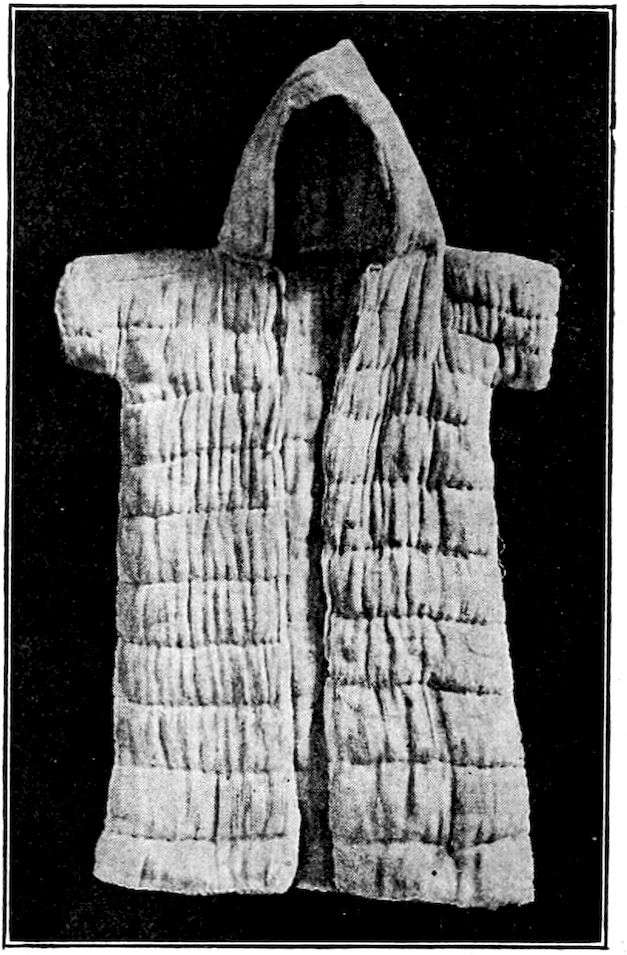
Fig. 65.—Quilted robe, with hood, for the premature baby. It may be made of flannel or cheesecloth with cotton batting for the padding.
The amount of heat needed around the baby is decided by taking his temperature (by rectum) at regular intervals; supplying more heat if the temperature is low and less if it is at or above normal. Some doctors have the temperature taken every four hours; others twice daily. As the baby grows able to maintain a temperature of 98° F. to 100° F., unassisted, the surrounding heat is gradually reduced and finally removed, and flannel clothing replaces the quilted robe.
221
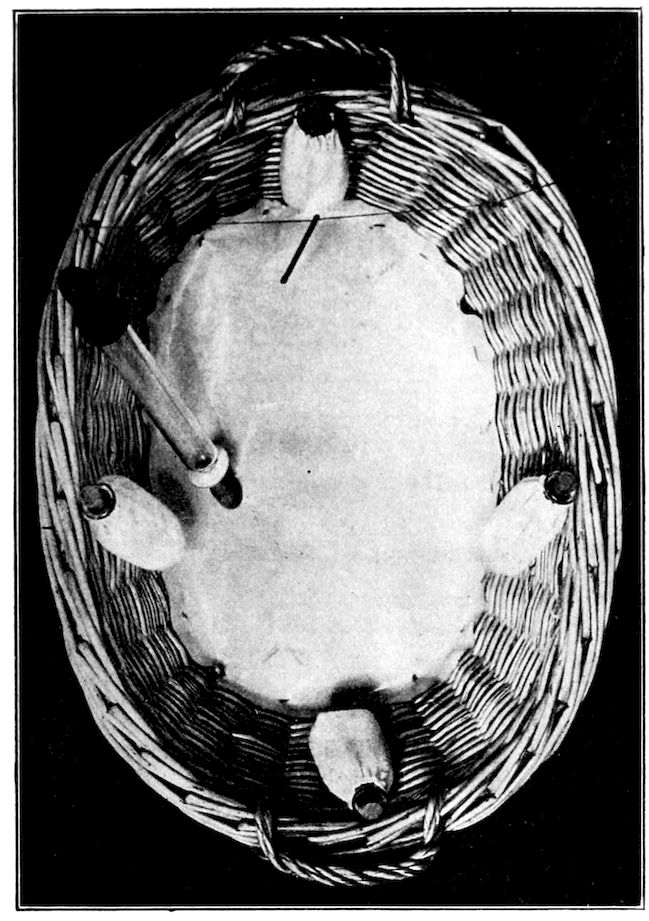
Fig. 66.—An improvised bed for the premature baby, consisting of a closely woven clothes basket with padded bottom and four flannel covered bottles of hot water, attached to the sides. The necessary thermometer and special feeder are shown in the basket. (By courtesy of Dr. Alan Brown, Hospital for Sick Children, Toronto.)
222The basket in which the baby lies should be placed in a darkened, well ventilated room and should be carefully screened from drafts. As the baby needs moist air there should be a large, open vessel of water in the room.
Since the premature baby’s lungs are not fully expanded, respirations are likely to be shallow and irregular, thus failing to supply the amount of oxygen which he needs. And as crying always causes deep breathing, it is a common practice to make the baby cry at regular intervals during the day.
In feeding the premature baby, breast milk is the most desirable food. In fact, many doctors feel that his life virtually depends upon it. If the baby is too feeble to nurse, the milk may be expressed from the mother’s breast, being immediately covered and placed in the refrigerator unless used at once. Breast milk is sometimes used whole and sometimes diluted with sterile water and is often given from a medicine dropper or through a special feeder. Such a feeder consists of a glass tube with a small nipple on one end and a rubber bulb on the other, by means of which the milk may be gently expressed into the baby’s mouth. (See Fig. 66.)
The premature baby’s bath is of considerable importance. It almost always consists of sponging him with warm olive oil as he lies in his bed and with the least possible exposure and turning. It is given every day or every second or third day, according to his condition. The eyes are wiped with boric pledgets and the nostrils with spirals of cotton dipped in oil. The buttocks are wiped with an oil sponge each time the diaper is changed.
223It must be borne in mind constantly that the premature baby is particularly susceptible to infection. He should be safeguarded by having everything that comes in contact with him scrupulously clean; being protected from drafts, chilling and dust, and allowing no one with a trace of a cold to come near him. The person who cares for him should wear a freshly laundered gown and protect her nose and mouth with a gauze mask while attending him.
TRAVELING WITH YOUR BABY
Babies should not travel; that is obvious. But if a journey is unavoidable, the attendant difficulties and disadvantages may be greatly lessened by making certain preparations. If the baby is bottle-fed, the preparations will depend upon the length of the journey and whether or not it will be possible to have freshly prepared feedings, for each twenty-four hours, put on the train from laboratories along the way. If this is not possible and the journey is not to take more than twenty-four hours, the entire quantity of food, ice-cold, may be carried in a thermos bottle. The requisite number of sterile nursing bottles may be taken or one bottle which is boiled before each feeding. Or the milk may be prepared as usual and the bottles packed in a portable refrigerator. Such a refrigerator may be bought or one may be improvised. The bottles are placed in a covered pail and packed solidly in crushed ice; this is placed in a second pail or a box with a diameter which is at least two inches larger than the inner pail and the space between the two packed firmly with sawdust. Several thicknesses of newspapers should be pressed down over the top and a tight cover fitted to the outer receptacle.
The sterile nipples may be taken in a sterile jar and a deep cup or kettle will be needed in which to warm the 224bottle before each feeding. It is usually possible to obtain water on the train which is hot enough for this, or cans of solid alcohol, a stand and a metal tray may be added to the traveling outfit. If fresh formulæ cannot be delivered to the train, daily, and the journey is to last more than twenty-four hours, one of the proprietary foods or a powdered milk will often prove to be a satisfactory solution to the problem of feeding the baby while traveling. The course to be followed, however, should be selected by your doctor.
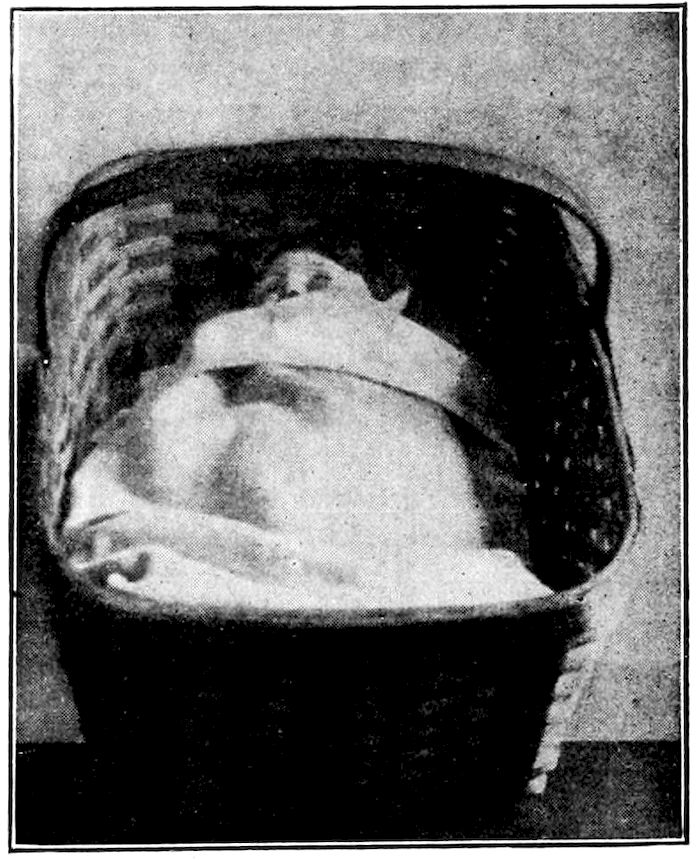
Fig. 67.—If traveling is unavoidable the baby will be comfortable and undisturbed in a basket converted into a bed. (By courtesy of the Maternity Centre Association.)
The baby will usually travel more comfortably and sleep better if he is carried in a basket. A large market basket with a handle or a small clothes basket will serve. It may be lined with a sheet or a blanket; have a small hair pillow or folded blanket in the bottom and be made up like a crib. (Fig. 67.) If this basket stands on the car seat during the 225day, and on the foot of your berth at night, the baby will be cleaner, quieter and less exposed to drafts than if carried in the arms.
As we look back over these pages of somewhat detailed description of the baby’s care it is borne in upon us that the nursing of this unfailingly delightful and engaging little person has special adjustments and adaptations for different seasons and circumstances. But that on the whole the care of all babies, the year round, resolves itself into the observation of a few general principles, namely: proper feeding; fresh air, rest and quiet; regularity in the daily routine; cleanliness of food, clothing and surroundings; preservation of an even body temperature; consultation with the doctor at regular intervals and also whenever the baby seems ever so little ill.
If you are guided constantly by these general principles and apply them conscientiously, you may revel in the satisfying consciousness that you are keeping your pledge to your baby by giving him the best possible start on his life’s journey.
226