APPENDIX
Reading edition
(SELECTED DATA FOR MINING MEN)
TO FIND LOST PART OF VEIN
Zimmermann’s rule for finding the lost part of a vein on the other side of a vein, is as follows:—
Lay down upon paper the line of strike of lode and the line of strike of the fault (cross-course), and by construction ascertain the horizontal projection of the line of their intersection; from the point where the cross-course was struck by the lode, draw a line at right angles to the strike of the former and directed to its opposite wall. Notice on which side of the line of intersection this perpendicular falls, and after cutting through the cross-course, seek the “heaved” part of the lode on that side.
Fig. 49.
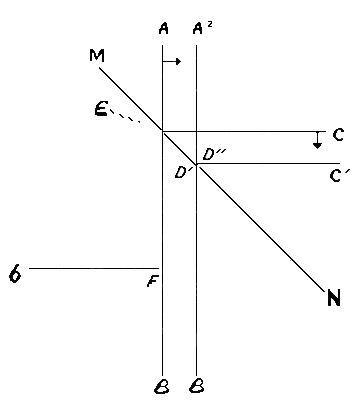
Thus let AB (Fig. 49) represent, at any depth, the line of strike of a fault or cross-course dipping east, and CD the line of strike of a lode dipping south, and we will suppose that in driving from C to D in a westerly direction, the fault has been met with at D. Knowing the dip of the lode and that of the fault, it is easy to lay down on any given scale, AₖBₖ and CₖDₖ, the lines of strike of the fault and lode respectively at a certain depth, say 10 fathoms, below AB. The point Dₗ, where AₖBₖ and CₖDₖ meet, is one point of the line of intersection. Join D and Dₗ, and prolong on both sides. The line MN represents the horizontal projection of the line of intersection of the two planes. At D erect DE at right angles and directed towards the opposite wall of the fault. As DE falls south of MN, the miner, after cutting through the fault, would drive in a southerly direction and eventually strike the lode again at F. It will be at once understood that if the miner were following the lode from b to F, the perpendicular would lie to the north of the line of intersection, and following the rule, he would drive in that direction, after cutting through the fault. When several faults in succession dislocate a lode, very great complications may arise.
THE CALCULATION OF ORE RESERVES.[4]
Having finished the survey of a metalliferous mine, the surveyor is sometimes called upon to calculate the quantity of ore reserves in that mine. Various methods are employed for this purpose.
Indeed, different surveyors will not agree within wide limits as to the amount of ore reserves in the same mine. Sometimes the amount of ore in sight will be considered to be a rectangular block, limited by the outcrop of the vein, the depth of the shaft, and the extreme points of the levels, diminished by the amount extracted. Other surveyors would avoid so excessive an amount, and take but one-third of that amount.
The following method is recommended by Mr. J. G. Murphy, an experienced American mining engineer, as the fairest and most trustworthy:—
Let it be required to calculate the ore reserves in a mine opened up on a vein with a mean cross section of 6 feet; a cubic foot of the vein matter in place weighing 150 lb. The ore stopes are generally very irregular. In this case, however, it may be supposed that the stope faces are 11 feet apart and 8 feet high. There is an inclined shaft, 10 feet by 6 feet, following the dip of the vein, and six levels, each 7 feet by 6 feet, 100 feet apart. The lengths of the levels are—
I. 200 feet west 150 feet east.
II. 160 feet west 100 feet east.
III. 120 feet west 400 feet east.
IV. 100 feet west 140 feet east.
V. 165 feet west 180 feet east.
VI. 350 feet west 150 feet east.
The longest level west is 350 feet, and the shortest 100 feet.
Assuming the bounding line of the area of available ore to be at a distance west of the shaft—

If the longest level east is 400 feet, and the shortest 100 feet, the bounding line in this direction, calculated in a similar way, will be at a distance of 250 feet from the shaft.
The inclined shaft has opened up the vein for 670 feet. Deducting, say, 15 feet for the irregularity of the surface, the quantity of ore in sight will be a rectangular block 655 feet deep, 225 + 250, or 475 feet long and 6 feet wide, that is 1,866,750 cubic feet.
From this quantity, however, must be deducted the quantity of ore extracted, namely:—
Cubic Feet
Inclined shaft 665 x 10 x 6 = 39,900
Level I. 350 x 7 x 6 = 14,700
Level II. 260 x 7 x 6 = 10,920
Level III. 520 x 7 x 6 = 21,840
Level IV. 240 x 7 x 6 = 10,080
Level V. 345 x 7 x 6 = 14,490
Level VI. 500 x 7 x 6 = 21,000
Level I. Stopped east (rough estimate) 3,400
Level I. ” ” west 6,500
Level II. ” ” west 7,000
Level III. ” ” east 20,000
Level VI. ” ” west 12,000
-----------
Total 181,530
Or in round numbers 182,000
This quantity, deducted from 1,866,750 cubic feet, leave 1,684,750 cubic feet. Divided by 13½, the number of cubic feet required for a ton, this gives 124,797 tons of ore in sight.
The quantity of ore discovered in a mine may be estimated from its specific gravity and the average size of the vein. The specific gravity of the ore, with that of water taken at 1000 for standard is equal to the number of ounces in a cubic foot. Great caution is necessary to determine the proportion of the vein which may be considered solid ore. A vein 6 feet square and 1 inch thick, contains 3 cubic feet, therefore, in order to find the number of cubic feet per square fathom of a vein, it is merely necessary to multiply the thickness in inches by three.
The following example illustrates the method of finding the weight of any ore per square fathom in a vein. What quantity of galena will be produced per square fathom from a mineral vein 6 inches in width? One quarter of the vein consists of galena, the remainder of zinc-blende. One-twentieth must be allowed for cavities in the vein. The specific gravity of galena is 7·5, and a cubic foot of water weighs 1000 ounces; therefore a cubic foot of galena weighs 7500 ounces.
The vein being 6 inches thick, there are 18 cubic feet in a square fathom. One quarter of that amount, or 4·5 cubic feet, consists of galena. The weight of galena in ounces is therefore:
7500 × 4·5 = 33,750 = 2109·375 lb.
From this one-twentieth or 105·468 lb.
-------------
must be deducted, leaving 2003·907 lb.
or 17 cwt. 3 qr. 15 lb. as the weight of lead ore per square fathom.
ESTIMATING ORE VALUES.
In testing a gold mine with a view to purchase, it should be remembered that as a rule the intersections of leaders or small veins with the main ore body are usually the richest portions of the lode. This the experienced prospector knows, and generally his shafts and cuttings are made at such points. For the ordinary mining investor, when inspecting with a view to purchase, these are places to avoid if endeavouring to form a correct estimate of the value of the ore in bulk. Take samples across the lode from place to place, break down and bag personally, and mark bags. Test the rich portions separately and average, estimating quantity of both.
Plate VII.—California Pump.
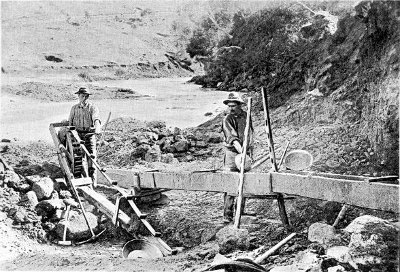
CALIFORNIA PUMP.
Any handy man or rough bush carpenter can make a California Pump. The prospectors in the illustration (Plate VII.) are using a home-made contrivance, which is quite effective for raising water from shallow depths for “long tom,” or ground sluicing—a wooden frame-work and open wooden wheel with handle. Over the wheel is run a belt of canvas, say, six inches wide, with wood stops about a foot apart—a long sloping box, dipping into the water, up which the stopped belt travels—and you have a California Pump which, if not a highly scientific device, is at least very serviceable.
HYDRAULICS.
General Data Regarding Water.
An imperial gallon of water weighs, at 62° F., 10 lbs. avoirdupois. Gallons × ·1606 = cubic feet. Cubic feet × 6·288 = number of gallons.
Gallons × 277·46 = cubic inches. Cubic inches × 0·003604 = gallons. Cubic feet of water × 62·28 = number of pounds weight. Pounds of water × 0·0166 = cubic feet. Gallons of water × 0·004464 = number of tons. Tons of water × 224 = gallons of water. Cubic feet of water × 0·0278 = number of tons. Tons of water × 35·97 = cubic feet of water.
A pipe 1 yard long holds approximately (actually, 1·52 per cent. less) as many pounds of water as the square of its diameter in inches; thus a 6-inch pipe holds approximately 36 lbs. of water in each yard length.
Water Pressure.
Ten feet head of water gives a pressure of 4⅓ lbs. per square inch approximately.
If H = head of water in feet, P = pounds pressure per square inch:
H = P × 2·311 P = H × ·4326
Horse-power required to Pump Water.—One h.-p. indicated will raise about 3000 gallons of water per hour 50 feet high.
To pump 1 gallon of water per minute against a pressure of 4 lb. per square inch, requires:
p × ·0007 H.-P.
BORING.
Rock is bored with jumpers of 10 lb. to 18 lb., used alone, or with boring bars and hammer. The former are more effective, but can only be used perpendicularly, or nearly so, and with rock of moderate hardness; they require more skill.
18 lb. hammers are used for 3 in. boring bars.
16 lb. ” ” ” 2½ in. ”
14 lb. ” ” ” 2 & 1¾ in. ”
5-7 lb. ” ” ” 1 in. ”
The boring bars may be made of 1¹∕₈ inch bar iron of various lengths, with steel bits up to 3 inches. A bit should bore from 18 feet to 24 feet with each steeling, and requires to be sharpened once for every foot bored.
3 men with a 3-inch bar should bore 4 feet.
3 ” 2½ ” ” 6 ”
3 ” 2 ” ” 8 ”
3 ” 1¾ ” ” 12 ”
2 ” 1 ” ” 8 ”
per day of 10 hours in hard granite.
Power, etc., Required To Work Rock Drills.
H-P. Diameter of Air Cylinder. Diameter of Steam Cylinder. Stroke.No. of 3-inch Drills driven.
Inches. Inches. Inches.
6 8 8½ 12 1
10 10 10½ 16 2
12 12 12¼ 22 3
16 13 13 24 4
20 14½ 14½ 28 5
30 17½ 17½ 36 8
40 20 20 36 11
60 22 24 60 15
Power Required to Work Double Steam and Air Cylinders.
H-P. Diameter of Air Cylinder. Diameter of Steam Cylinder. Stroke. No. of 3-inch Rock Drills driven.
Inches. Inches. Inches.
28 12 12 22 7
32 13 13 24 8
40 14½ 14½ 28 10
60 17½ 17½ 36 15
80 20 20 36 22
120 22 24 60 30
DURABILITY OF ROPES.
The average duration of flat, wire ropes is usually taken at one year, and that of round ropes at half a year.
DIAMOND DRILLING.
This drill is applicable to sinking a borehole for prospecting for minerals or water, shafts, &c., or blasting under water.
It consists of a circular row of “carbonados,” a species of diamond, set in a circular steel ring. This is attached to a hollow steel tube which is kept rotating at about 250 revolutions per minute, pressed forward by a force varying from 400 to 800 lb. according to the nature of the rock. Water is supplied through the tube which washes out the débris and cools the diamonds.
Granite and the hardest limestones are penetrated at the rate of 2 to 3 inches per minute, sandstones 4 inches, quartz 1 inch.
The diamond drill is not effective in soft strata such as clay, sand, and alluvial deposits.
Boreholes have been made at the following rates:
In Ironstone formation:
A depth of 902 feet in 54 working days
641 ” 48 ”
434 ” 54 ”
640 ” 60 ”
Or an average of 12 feet a day.
In Coal measures:
A depth of 1008 feet in 146 days
802 ” 168 ”
700 ” 48 ”
558 ” 42 ”
Or an average of 7½ feet a day.
TIMBER.
To find Solidity of Round Timber.
When all dimensions are in feet: Length × (¼ mean girth)² = cubic feet.
When length in feet, girth in inches: Length × (¼ mean girth) ÷ 144 = cubic feet.
When all dimensions are in inches: Length × (¼ mean girth)² ÷ 1728 = cubic feet.
To find Solidity of Square Timber.
When all dimensions are in feet: Length × breadth × depth ﹦ cubic feet.
When one dimension is in inches: Length × breadth × depth ÷ 12 ﹦ cubic feet.
When two dimensions are in inches: Length × breadth × depth ÷ 144 ﹦ cubic feet.
For board measure, depth always equal 1 inch.
To find surface in square feet, proceed as per rules for solidity of square timber.
LAYING OUT OF AREAS.
1. In Squares.—Extract the square root of the desired content, reduced to square chains (ten square chains equal one acre). The result will be the length of the required side in chains.
Thus if we wish to find the side of a square block containing 25 acres, we first reduce the acres to square chains: 25 × 10 = 250, the square root of which is 15·81, or 15 chains 81 links; the side required.
By reference to the tables of square roots on page 189, the required sides of square block for a large number of acres can be read off at once.
One acre laid out as a square must have its side made 316¼ links, or 208-71/100 feet, or 69-57/100 yards, 70 paces being a near approximation.
2. In Rectangles.—Divide the content by the length or breadth, according to which factor is known, and the result will be the required side.
Thus 5 acres, or 50 square chains, if 10 chains long, will require to be 5 chains wide.
If the content only is given, and the length is to be a certain number of times the breadth, the content in square chains divided by the ratio of the length to the breadth, and the square root of the quotient, will give the length of the shorter side. Thus, if we wish to lay out 72 acres as a rectangle twice as long as broad: 72 acres = 720 square chains, divided by 2, the ratio given, = 360, the square root of which is 18·97 chains, the length of the shorter side. The length of the other side is therefore 18·97 × 2 = 37·94 chains, or 3794 links.
MENSURATION.
To find the area of a triangle when the base and perpendicular height are given: Multiply the base by half the height, or vice versâ.
To find the area of a triangle when the three sides are given: Take half the sum of the sides, subtract each severally from this sum, then multiply this and the three remainders together, and take the square root for the area.
To find the area of a rectangular figure: Multiply the length by the breadth, the product will be the area.
To find the area of a trapezoid: Multiply half the sum of the two parallel sides by the distance between them.
To find the area of a parallelogram whose angles are not right angles: Multiply the length of any one of the sides by the perpendicular.
To find the area of a trapezium: Divide it into two triangles and find the areas of the latter by the first rule.
To find the area of an irregular polygon: Divide the polygon into triangles and find the area of the latter.
To find the area of an irregular figure: Draw the figure on fine cardboard or thin sheet metal, cut the same carefully out and weigh with an accurate balance. Then this weight, compared with the weight of a piece of the cardboard or metal of a definite size, say one square inch, gives at once the area required.
MINE SURVEYING PROBLEMS.
It would be futile to profess, in the limits of a small work of this kind, to instruct the beginner fully in the principles and practice of mine surveying, especially as the most elaborate treatise can only be of service when some actual practical experience and knowledge of instruments have been obtained.
For an exhaustive and well-arranged work on the subject, Brough’s “Treatise on Mine Surveying” can be strongly recommended, and should be carefully studied by all wishing to learn the best methods of accomplishing the accurate results that any mine-surveying worth the name demands.
The following methods of connecting underground and surface work are therefore addressed to such as are thoroughly acquainted with a dial and the method of traversing.
1. To find where a shaft should be sunk to connect with any part of the underground workings.
Should the mine be one opened by an adit, there is no difficulty in doing this, as the dial can be set up at the mouth and a sight taken to a light; this can then, by means of the vertical arc, be prolonged up the hill, and the remaining bearings and distances are then easily laid down to the desired point. When a starting-point has been obtained, the chief difficulty in these cases has been overcome. If a single shaft is the only connection to the underground workings, the magnetic bearing of the first line at bottom must first be carefully ascertained, and the position of the first station brought to the surface by means of a plumb-line, made of copper wire preferably, the plummet being put into a dish of water to steady it. The dial is then set exactly over the end of the line at the surface, and the first bearing and distance laid off.
Should it be impossible to set the instrument over the point at surface, a spot must be found by trial outside the shaft which is in the correct course. The dial is set up in the supposed direction of the line and repeated sights taken to the first point till the instrument and it are exactly in the required line, when the length of the first line can be measured along it, and the new lines proceeded with.
As local attraction frequently affects the needle at the bottom of the shaft, and so vitiates the surface survey that depends on its swinging the same at both points, a method of dispensing with the needle must be resorted to. This is the suspension of two plumb-lines from opposite sides of the shaft, the plummets hanging exactly over as much of the first underground line as the width of the shaft will allow.
The two plummet lines at surface then give the direction, and by trial the dial must be put exactly in line with them in order to prolong it correctly.
If there are two or more shafts sunk on the workings, it will be an easy matter to ascertain if the needle can be depended on for laying out any further surface work, as the underground survey connecting the shafts can be laid down on the surface, or the direct bearing and distance calculated, when its correctness is tested by the terminating point of the survey.
2. To find depth of shaft at any point, to cut a vein whose dip is known.
Rule:—Multiply natural tangent of angle of dip C (Fig. 50.) by the distance from outcrop to proposed shaft AC. The result is the depth required, AB.
By Protractor and Scale.—Rule on paper a line AC of the required distance, then at C set off the angle of dip and draw AB at right angles to AC. Then scale off AB = depth of shafts.
Fig. 50.
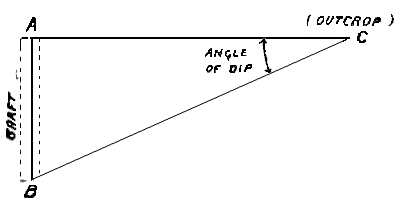
3. Given Depth of Shaft and Angle of Dip to find where it outcrops.—Then AC = AB × natural tangent of angle ABC. Or by scale and protractor by inspection.
4. Given Depth of Shaft AB and Dip of Vein Angle CB to find Distance BC between Bottom of Shaft and Outcrop.—BC = AC × natural sine ACB. Or by scale and protractor by inspection.
RAINFALL.
One inch of rain = 22,680 gallons, or 102·35 tons of water per acre.
NOTES ON BELTING.
Co-efficient of friction between ordinary leather belting and cast-iron pulleys or drums = ·423. Ultimate strength of ordinary leather belting = 3086 lb. per square inch. Belts vary from ³∕₁₆ in. to ¼in. thick, average ⁷∕₃₂ in.
Power of Single Leather Belts.
To calculate the power of single leather belts, the following formula may be used: Let HP = actual horse-power. W = width of belt. F = driving force. T = working tension from 70 to 150 lb. V = velocity of belt in feet per minute.
Then F = W × T. HP = V × F. W = 33,000 × HP.
2 33,000 F × V
Example:—A 10-inch belt running 2500 feet per minute, what horse-power will it transmit? Assuming the working tension to be 100 lb.,
F = 10 × 100 HP = 25,000 × 500 = 378 horse-power.
2 33,000
Nystrom gives this rule:—HP = V × F⁄₅₅₀. V = velocity of belt in feet per second. F = force in pounds transmitted by belt.
The first rule gives good practical results where there is no great inequality in the diameter of the pulleys.
Double Belts transmit 1½ times as much as single belts.
Splicing Belts.
Width of Belts 1 2 3 3 to 6 6 to 8 above 8 in.
Lap in inches 2 4½ 5½ 6 8 10
Rules for Double Leather Belting.
A = covered area of driven pulley in square inches.
V = speed of belt in feet per minute.
H = indicated horse-power.
W = width in inches.
H = AV⁄66,000 A = 66,000 H⁄V. W = A/L, where L = length of belt on driven pulley in inches.
Another authority simply says H = {70 to 80} × WV⁄33,000.
And a third says W = 36,000 H⁄6VL, where L is here in feet.
Evan Leigh’s rule is W = 66,000 x IHP⁄L x V.
L = length of arc of contact upon smaller pulley in inches.
V = velocity of rim in feet per minute.
A belt transmits its motion solely through frictional contact with the surfaces of the pulley. The lower side of the belt should be made the driving side when possible, as the arc of contact is thereby increased by the sagging of the following side. Increase of power will be obtained by increasing the size of pulleys, the same ratio being retained. Wide belts are less effective per unit of sectional area than narrow belts. Long belts are more effective than short ones. The proportion between the diameters of two pulleys working together should not exceed six to one. Convexity of pulleys to receive belt = ½ inch per foot wide. The width of pulley should equal 1·2 times width of belt.
Speed of Belts.
Belts have been employed running over 5000 feet per minute. Nothing, however, is gained by running belts much over 4000 feet per minute. About 3500 feet per minute for main belts agrees with good practice; lathe belts from 1500 to 2000 feet per minute. The life of a belt may be prolonged and its driving powers increased by keeping it in good working order. To ensure this it should be dressed on the back with castor oil every few weeks, more or less according the dryness of the atmosphere in which it works.
WEIGHT AND BULK OF MATERIALS.
The weight of a cubic foot of any material is its specific gravity multiplied by 62·425, or the weight of a cubic foot of water in pounds. To find the specific gravity of a stone, divide its weight in air by loss of weight in water of temperature of 60° F. = specific gravity.
Thus:
Quartz crystal weighs in air 293·7 grains
” ” water 180·1 ” ”
------
Loss in weight 113·6 ” ”
Then:
293·7⁄113·6 = 2·59 = Specific gravity of quartz.
One ton of quartz when solid occupies 13 cubic feet, but when broken, about 20. Rocks when solid, as compared to the same when broken, usually increase in volume in the ratio of 1 to 1·5 or 1 to 1·18, the increase depending on size and form of fragments.
A dwt. of gold in a cwt. of ore = 1 oz. of gold per ton of ore.
For approximate calculation a grain of gold = two pence, and a dwt., four shillings.
In the following table of the chemical elements the standard of sp. gr. is hydrogen for the gaseous elements (hydrogen, oxygen, &c.) and water for the others.
The Chemical Elements, their Symbols, Equivalents, and Specific Gravities.
Name. Symbol. Atomic Weight. Specific Gravity.
Aluminium Al 27·5 2·56
Antimony Sb 122·0 6·70
Arsenic As 75·0 5·7
Barium Ba 137·0 4·00
Bismuth Bi 210·0 9·7
Boron B 11·0 2·63
Bromine Br 80·0 5·54
Cadmium Cd 112·0 8·60
Caesium Cs 133·0 1·88
Calcium Ca 40·0 1·58
Carbon C 12·0 3·50
Cerium Ce 92·0 6·68
Chlorine Cl 35·5 2·45
Chromium Cr 52·5 6·81
Cobalt Co 58·8 7·7
Columbium Cb 184·8 6·00
Copper Cu 63·5 8·96
Didymium Di 96·0 6·54
Erbium E 112·6 —
Fluorine F 19·0 1·32
Gallium Ga 69·9 5·9
Glucinum Gl 9·5 2·1
Gold (Aurum) Au 196·7 19·3
Hydrogen H 1·0 0·069
Indium In 113·4 7·4
Iodine I 127·0 4·94
Iridium Ir 198·0 21·15
Iron (Ferrum) Fe 56·0 7·79
Lanthanum La 90·2 11·37
Lead (Plumbum) Pb 207·0 11·44
Lithium Li 7·0 0·59
Magnesium Mg 24·0 1·75
Manganese Mn 55·0 8·01
Mercury (Hydrargyrum) Hg 200·0 13·59
Molybdenum Mb 96·0 8·60
Nickel Ni 58·8 8·60
Niobium Nb 94·0 6·27
Nitrogen N 14·0 0·972
Osmium Os 199·0 21·40
Oxygen O 16·0 1·105
Palladium Pd 106·5 11·60
Phosphorus P 31·0 1·83
Platinum Pt 197·4 21·53
Potassium (Kalium) K 39·0 0·865
Rhodium Rh 104·3 12·1
Rubidium Rb 85·4 1·52
Ruthenium Ru 104·4 11·4
Selenium Se 79·5 4·78
Silicon Si 28·0 2·49
Silver (Argentum) Ag 108·0 10·5
Sodium (Natrium) Na 23·0 0·972
Strontium Sr 87·6 2·54
Sulphur S 32·0 2·05
Tantalium Ta 182·0 10·78
Tellurium Te 129·0 6·02
Thallium Tl 204·0 11·91
Thorium Th 115·7 7·8
Tin (Stannum) Sn 118·0 7·28
Titanium Ti 50·0 4·3
Tungsten (Wolfram) W 184·0 7·5
Uranium U 120·0 18·4
Vanadium V 51·3 5·50
Yttrium Y 61·7 —
Zinc Zn 65·0 7·14
Zirconium Zr 89·5 4·15
The figures indicating the proportions by weight in which the elements unite with one another are called the combining or atomic weights, because they represent the relative weights of the atoms of the different elements. Since hydrogen is the lightest element, it is taken as the standard, and its combining or atomic weight = 1.
To find the proportional parts by weight of the elements of any substance whose chemical formula is known:
Rule.—Multiply together the equivalent and the exponent of each element of the compound; the product will be the proportion by weight of that element in the substance.
Example:—Find the proportional weights of the elements of Alcohol C₂H₆O.
Carbon C₂ = equivalent 12 × exponent 2 = 24
Hydrogen H₆ = ” 1 × ” 6 = 6
Oxygen O = ” 16 × ” 1 = 16
Of every 46 lb. of Alcohol, 6 lb. will be H; 16, O; 24, C.
To find the proportions by volume, divide by the specific gravity.
Common Names of Chemical Substances.
Common Names. Chemical Names.
Aqua fortis Nitric acid.
Aqua regia Nitro-hydrochloric acid.
Blue vitriol Sulphate of copper.
Cream of tartar Bi-tartrate of potassium.
Calomel Chloride of mercury.
Chalk Carbonate of calcium.
Caustic potash Hydrate of potassium
Chloroform Chloride of formyl.
Common salt Chloride of sodium.
Copperas, or green vitriol Sulphate of iron.
Corrosive sublimate Bi-chloride of mercury.
Dry alum Sulphate of aluminium and potassium.
Epsom salts Sulphate of magnesium.
Ethiops mineral Black sulphide of mercury.
Galena Sulphide of lead.
Glauber’s salt Sulphate of sodium.
Glucose Grape sugar.
Iron pyrites Bi-sulphide of iron.
Jeweller’s putty Oxide of tin.
King’s yellow Sulphide of arsenic.
Laughing gas Protoxide of nitrogen.
Lime Oxide of calcium.
Lunar caustic Nitrate of silver.
Mosaic gold Bi-sulphide of tin.
Muriate of lime Chloride of calcium.
Nitre, or saltpetre Nitrate of potash.
Oil of vitriol Sulphuric acid.
Potash Oxide of potassium.
Realgar Sulphide of arsenic.
Red lead Oxide of lead.
Rust of iron Oxide of iron.
Sal ammoniac Chloride of ammonia.
Salt of tartar Carbonate of potassium.
Slacked lime Hydrate of calcium.
Soda Oxide of sodium.
Spirits of hartshorn Ammonia.
Spirits of salt Hydrochloric acid.
Stucco, or plaster of Paris Sulphate of lime.
Sugar of lead Acetate of lead.
Verdigris Basic acetate of copper.
Vermilion Sulphide of mercury.
Vinegar Acetic acid (diluted).
Volatile alkali Ammonia.
Water Oxide of hydrogen.
White precipitate Ammoniated mercury.
White vitriol Sulphate of zinc.
Thermometer.
The following are the formulæ for the conversion of degrees of one scale to those of another:—
Centigrade° × 9 + 32 = Fahr.° Fahr.° - 32 × 4 = Réaumur°.
5 9
Réaumur° × 9 + 32 = Fahr.° Centigrade° × 4 = Réaumur°.
4 5
Fahr.° - 32 × 5 = Cent.° Réaumur° × 5 = Centigrade°.
9 4
Freezing, Fusing, and Boiling Points.
Substances. Réaumur. Centigrade. Fahrenheit.
Bromine freezes at -17·6° = -22° = -7·6°
Oil, Anise ” ” 8 = 10 = 50
Oil, Olive ” ” 8 = 10 = 50
Oil, Rose ” ” 12 = 15 = 60
Quicksilver ” ” -31·5 = -39·4 = -39°
Water ” ” 0 = 0 = 32°
Bismuth metal fuses at 211 = 264 = 507°
Copper ” ” 963 = 1204 = 2200
Gold ” ” 963 = 1204 = 2200
Iodine ” ” 95·6 = 107° = 224·6°
Iron ” ” 1230 = 1538 = 2800
Lead ” ” 260 = 325 = 617
Potassium ” ” 50° = 62·5° = 144·5°
Silver ” ” 530 = 537·70 = 1000
Sodium ” ” 76·5° = 95·6 = 204°
Steel melts at a lower
temperature than malleable
iron - - -
Sulphur fuses at 54 = 120 = 248°
Tin ” ” 189·6° = 237 = 459°
Zinc ” ” 329·6° = 412 = 773°
Alcohol boils at 59·5° = 74·4 = 173·1
Bromine ” ” 46·4 = 58 = 136
Ether ” ” 28·4 = 35·5 = 96
Iodine ” ” 140 = 175 = 347
Quicksilver ” ” 288 = 360 = 680
Water ” ” 80 = 100 = 212
Heat Values of Fuels.
Pounds of water evaporated by 1 lb. of fuel as follows:—
Straw 1·9
Wood 3·1
Peat 3·8
Coke or Charcoal 6·4
Coal 7·9
Petroleum 14·6
SIGNS AND SYMBOLS USED IN EXPRESSING FORMULAS.
= Sign of equality, denoting that quantities so connected are equal to one another; thus, 3 feet = 1 yard.
+ Sign of addition, signifying plus or more; thus, 4 + 3 = 7.
- Sign of subtraction, signifying minus or less; thus, 4-3 = 1.
× Sign of multiplication, signifying multiplied by or into; thus, 4 × 3 = 12.
÷ Sign of division, signifying divided by; thus, 4 ÷ 2 = 2.
{} () [] Brackets, denoting that the quantities between them are to be treated as one quantity; thus, 5 {3(4 + 2)-6(3-2) = 5 (18-6) = 60.
Letters are used to shorten or simplify a formula. Supposing we wish to express length × breadth × depth, we may put the initial letters only, thus, l × b × d, or, as is usual when algebraical symbols are employed, leave out the sign × between the factors, and write the formula lbd.
When division is to be expressed in simple form, the divisor is written under the dividend; thus (x + y) ÷ z = (x + y) / z
° ’ ” are signs used to express certain angles in degrees, minutes, and seconds; thus 25 degrees 4 minutes 21 seconds would be expressed 25° 4’ 21”.
√ This sign is called the radical sign, and placed before a quantity indicates that some root of it is to be taken, and a small figure placed over the sign, called the exponent of the root, shows what root is to be extracted.
Thus ²√ a or √ a means the square root of a ∛ a ” cube ” ∜ a ” fourth ”
ρ This sign is used to denote the force of gravity at any given latitude.
π The Greek letter pi is invariably used to denote 3·14159, that is, the ratio borne by the diameter of a circle to its circumference.
When the figure 2 is affixed to any number, as diameter² or 12², the number is to be squared, as 12 × 12 = 144, the square; and with ³ affixed, the number is to be cubed—i.e., multiplied twice by itself, as 6³ = 6 × 6 × 6 = 316, the cube of 6.
ENGLISH WEIGHTS AND MEASURES.
Measures of Length.
12 lines = 1 inch.
12 inches = 1 foot.
3 feet = 1 yard.
6 feet = 1 fathom.
16½ feet = 1 pole.
220 yards = 1 furlong.
}
8 furlongs
1760 yards = 1 statute mile.
5280 feet
6086 feet = 1 naut. mile.
7·92 inches = 1 link.
}
100 links
66 feet = 1 chain.
22 yards
Square Measure.
144 sq. inches = 1 sq. foot.
9 sq. feet = 1 sq. yard.
}
30¼ sq. yards = 1 sq. rod or pole.
272¼ feet
40 rods = 1 sq. rood.
}
4 roods
160 rods
4840 yards = 1 acre.
43560 feet
10 sq. chains = 1 acre.
1 hectare = 2·471 acres.
640 acres = 1 sq. mile.
30 sq. acres = 1 yard of land.
Sq. ins. × 0·007 = square foot nearly.
Sq. yds. × 0·00021 = acres nearly.
113·0977 sq. ins. = 1 circular foot.
183·46 circular ins. = 1 square foot.
Solid or Cubic Measure.
1728 cubic inches = 1 cubic foot.
27 cubic feet = 1 cubic yard.
}
40 cub. ft. of rough, or = 1 ton or load.
50 cub. ft. of hwn. tmbr.
}
128 cub. ft. of timber = 1 cord of wood.
Avoirdupois Weight.
16 drachms = 1 ounce.
16 ounces = 1 lb.
14 lb. = 1 stone.
28 lb. = 1 qr. cwt.
112 lb. = 1 cwt.
20 cwt = 1 ton.
lbs. × 0·009 = cwt. nearly.
lbs. × 0·00045 = tons.
7000 grains = 1 lb. avdp.
437½ grains = 1 oz.
Troy Weight.
24 grains = 1 dwt.
20 dwt. = 1 ounce.
12 oz. = 1 lb.
5760 grains = 1 lb. troy.
480 grains = 1 oz. ”
Apothecaries’ Fluid Measure.
Gallon (C) = 8 pints (O); 1 pint = 20 fluid ounces (oz. weight of water). Ounce (f ℥) = 8 drachms (f ʒ) = 480 minims (♏) = 720 drops (gtt.).
One wine glass = 4 tablespoonfuls = 16 tablespoonfuls = 2 ounces.
Symbols.—f. or fl. fluid; s.s. one half; a.a. for each. Thus f℥ss. ½ a fluid ounce.
Apothecaries’ weight, formerly used for dispensing medicines, superseded in 1864. 20 grains = 1 scruple; 3 scruples = 1 drachm; 8 drachms = 1 ounce; 12 ounces = 1 lb. (troy).
Liquid Measure.
Cubic in. nearly.
4 gills = 1 pint = 34¾
2 pints = 1 quart = 69⅓
4 quarts = 1 gallon = 277·123
FRENCH WEIGHTS AND MEASURES.
Weights.
Gramme15·432349 grams troy.
Décagramme (= 10 grammes)5·6438 drachms av.
Hectogramme (= 100 grammes)3·527 oz. av.
Kilogramme (= 1000 grammes)2·204621 lbs. av., or
2·679227 lbs. troy.
Quintal (= 100 kilogrammes)220·462 lbs. av.
Tonne (= 1000 kilogrammes)2204·621 lbs. av.
Decigramme (= ¹∕₁₀th of a gramme)1·5432 grain.
Centigramme (= ¹∕₁₀₀th of a gramme)0·15432 grain.
Milligramme (= ¹∕₁₀₀₀th of a gramme)0·015432 grain.
Lineal Measure.
Mètre3·2808992 feet.
Décamètre (= 10 mètres)32·808992 feet.
Hectomètre (= 100 mètres)328·08992 feet.
Kilomètre (= 1000 mètres)1093·633 yards.
Myriamètre (= 10,000 mètres)6·2138 miles.
Decimètre (= ¹∕₁₀th of a mètre)3·937079 inches.
Centimètre (= ¹∕₁₀₀th of a mètre)0·39371 inch.
Millimètre (= ¹∕₁₀₀₀th of a mètre)0·03937 inch.
Superficial Measure
Centiare (= 1 square mètre)1·196033 square yard.
Are(= 100 square mètres)0·098845 rood.
Hectare (= 10,000 square mètres) 2·471143 acres.
Measures of Capacity.
Litre(= 1 décimétre cube)1·760773pint (61·027 cubic inches).
Décalitre(= 10 litres)2·2009668gallons.
Hectolitre(= 100 litres)22·009668”
Kilolitre(= 1000 litres)220·09668”
Décilitre(= ¹∕₁₀th of a litre)·17607pint.
Centilitre(= ¹∕₁₀₀th of a litre)·017607pint.
Solid Measure.
Stère(= 1 cubic mètre)1·31 cubic yard.
Décastère(= 10 stères)13 cubic yards, 2 feet, 21 inches.
Décistère(= ¹∕₁₀th of a stère)3 cubic feet, 918·7 cubic inches.
FRESH AND SALT WATER COMPARED.
Fresh.Salt.
1 cubic foot at 40° weighs 62·425 lbs.64 lbs.
1 cubic inch at 40° weighs·036,126 lbs.·037,037 lbs.
1 cubic foot at 40° equals6·242 gallons6·2 gallons.
1 ton equals35·943 cubic ft.35 cubic ft.
1 ton contains at 62°224 gallons217 gallons.
VELOCITY OF FALLING FLUIDS.
Falling fluids are governed by the same laws as falling bodies.
Fluid falls 1 foot in a ¼ of a second, 4 feet in ½ of a second, 9 feet in ¾ of a second, and so on.
The velocity of a fluid, flowing through an aperture in the side of a reservoir, is the same that a heavy body would acquire by falling from a height equal to that between the surface of the fluid and the middle of the opening.
The velocity of a fluid flowing out of an aperture is as the square root of the height of the head of the fluid. The theoretical velocity, therefore, in feet per second is as the square root of the product of the space fallen through in feet and 64·333; consequently, for 1 foot it is √64·333 = 8·02 feet. The mean velocity is about 5·4 feet, or 0·673.
PRESSURE OF WATER AT DIFFERENT HEADS.
H. = head in feet. P. = pressure in lbs. per sq. foot. p. = pressure in lbs. per sq. inch.
H.P.p.H.P.p.
162·4 ·4333 9 561·6 3·9
1·2578 ·541610 624 4·3333
1·593·6 ·65201248 8·6666
1·75109·2 ·753830187213
2124·8 ·866640249617·3333
3187·21·350312021·6666
4249·61·733360374426
53122·166670436830·3333
6374·42·680499234·6666
7436·83·033390561639
8499·23·4666
TO FIND THE CONTENTS OF A TANK.
To find the number of gallons contained in a tank, multiply the length, width, and depth together, in feet. This gives the contents in cubic feet; multiply by 6·24, and the result is the number of gallons contained. If the dimensions are in inches, use ·003607 in place of 6·24.
SIZES AND WEIGHT OF CORRUGATED GALVANISED IRON SHEETS.
Thickness B.W.G. Size of Sheets Weight Per Square Foot. Square Foot per Ton.
Feet. lb. oz.
16 6 × 2 to 8 × 3 2 1 800
17 × 18 6 × 2 ” 8 × 3 2 4 1050
19 × 20 6 × 2 ” 8 × 3 1 12 1300
21 × 22 6 × 2 ” 7 × 2½ 1 7 1600
23 × 24 6 × 2 ” 7 × 2½ 1 3 1900
25 × 26 6 × 2 ” 7 × 2½ 1 0 2250
THICKNESS AND WEIGHT OF GALVANISED SHEET IRON.
Size of sheet, 2 feet in width by from 6 to 9 feet in length.
Wire Gauge. Weight Per Square Foot. Wire Gauge. Weight Per Square Foot.
No. Oz. No. Oz.
30 10 22 21
29 11 21 24
28 12 20 28
27 14 19 33
26 15 18 37
25 16 17 43
24 17 16 48
23 19 14 60
QUALITIES OF DIFFERENT ROPES EXPRESSED RELATIVELY.
Strength. Rigidity. Weight Dry. Stretching.
Italian Hemp — 1 1 }
Baltic ” 0·7 ·9 0·8 to 0·9 1 } ¹∕₇ to ¹∕₁₂
Manilla ” 0·9 to 1 0·75 0·88 }
Flax 0·9 low — ¹∕₇₅
Iron Wire 3 high 4 —
Steel 6 high 4 —
Steel wire rope stretches about ¹∕₃₆₀, ¹∕₂₅₀, and ¹∕₁₃₀, of ¼, ⅓, and ½ the breaking weight.
THE ATMOSPHERE.
The composition of the atmosphere is by volume, oxygen 20·8, nitrogen 79·2; by weight, oxygen 23, nitrogen 77. There are also minute quantities of carbon dioxide, aqueous vapour, and ammonia.
The barometer falls about ½” for each 500’ increase of altitude the mean temperature being 50° Fahr.
Weight or Pressure.
= 14·706 lbs. per square inch.
= 29·92 inches of mercury.
= 33·7 feet of water.
Squares, Cubes, Square Roots, and Cube Roots.
No. Square. Cube. Square Root √ Cube Root ∛
1 1 1 1·0 1·0
2 4 8 1·414 1·259
3 9 27 1·732 1·442
4 16 64 2·0 1·587
5 25 125 2·236 1·709
6 36 216 2·449 1·817
7 49 343 2·645 1·912
8 64 512 2·828 2·0
9 81 729 3·0 2·080
10 100 1000 3·162 2·154
11 121 1331 3·316 2·223
12 144 1728 3·464 2·289
13 169 2197 3·60 2·35
14 196 2744 3·74 2·41
15 225 3375 3·87 2·46
16 256 4096 4·0 2·51
17 289 4913 4·12 2·58
18 324 5832 4·24 2·62
19 361 6859 4·35 2·66
20 400 8000 4·47 2·71
25 625 15625 5·0 2·92
30 900 27000 5·47 3·10
35 1225 42875 5·91 3·27
40 1600 64000 6·32 3·41
45 2025 91125 6·70 3·55
50 2500 125000 7·07 3·68
55 3025 166375 7·41 3·80
60 3600 216000 7·24 3·91
65 4225 274625 8·06 4·02
70 4900 343000 8·36 4·12
75 5625 421875 8·66 4·41
80 6400 512000 8·94 4·30
85 7225 614125 9·21 4·39
90 8100 729000 9·48 4·48
95 9025 857375 9·74 4·56
100 10000 1000000 10·0 4·64
110 12100 1331000 10·48 4·79
120 14400 1728000 10·95 4·93
130 16900 2197000 11·40 5·06
140 19600 2744000 11·83 5·19
150 22500 3375000 12·24 5·31
160 25600 4096000 12·64 5·42
170 28900 4913000 13·03 5·53
180 32400 5832000 13·41 5·64
190 36100 6859000 13·78 5·74
200 40000 8000000 14·14 5·84
210 44100 9261000 14·49 5·94
220 48400 10648000 14·83 6·03
230 52900 12167000 15·16 6·12
240 57600 13824000 15·49 6·21
250 62500 15625000 15·81 6·29
260 67600 17576000 16·12 6·38
270 72900 19683000 16·43 6·46
280 78400 21952000 16·73 6·54
290 84100 24389000 17·02 6·61
300 90000 27000000 17·32 6·69
310 96100 29791000 17·60 6·76
320 102400 32768000 17·88 6·83
330 108900 35937000 18·16 6·91
340 115600 39304000 18·43 6·97
350 122500 42875000 18·17 7·04
360 129600 46656000 18·97 7·11
370 136900 50653000 19·23 7·17
380 144400 54872000 19·49 7·24
390 152100 59319000 19·74 7·30
400 160000 64000000 20·0 7·36
410 168100 68921000 20·24 7·42
420 176400 74088000 20·49 7·48
430 184900 79507000 20·73 7·54
440 193600 85184000 20·97 7·60
450 202500 91125000 21·21 7·66
460 211600 97336000 21·44 7·71
470 220900 103823000 21·67 7·77
480 230400 110592000 21·90 7·82
490 240100 117649000 22·13 7·88
500 250000 125000000 22·36 7·93
510 260100 132651000 22·58 7·98
520 270400 140608000 22·80 8·04
530 280900 148877000 23·02 8·09
540 291600 157464000 23·23 8·14
550 302500 166375000 23·45 8·19
560 313600 175616000 23·66 8·24
570 324900 185193000 23·87 8·29
580 336400 195192000 24·08 8·33
590 348100 205379000 24·29 8·38
600 360000 216000000 24·49 8·43
610 372100 226981000 24·69 8·48
620 384400 238328000 24·90 8·52
Table to Calculate Wages and other Payments.
Year. Per Month. Per Week. Per Day.
£ £ s. d. £ s. d. s. d.
1 0 1 8 0 0 4½ 0 0¾
2 0 3 4 0 0 9¼ 0 1¼
3 0 5 0 0 1 1¾ 0 2
4 0 6 8 0 1 6½ 0 2¾
5 0 8 4 0 1 11 0 3¼
6 0 10 0 0 2 1¾ 0 4
7 0 11 8 0 2 8¼ 0 4½
8 0 13 4 0 3 1 0 5¼
9 0 15 0 0 3 5½ 0 6
10 0 16 8 0 3 10¼ 0 6½
11 0 18 4 0 4 3¾ 0 7¼
12 1 0 0 0 4 7½ 0 8
13 1 1 8 0 5 0 0 8½
14 1 3 4 0 5 4½ 0 9¼
15 1 5 0 0 5 9¼ 0 9¾
16 1 6 8 0 6 1¾ 0 10½
17 1 8 4 0 6 6½ 0 11¼
18 1 10 0 0 6 11 0 11¾
19 1 11 8 0 7 3½ 1 0½
20 1 13 4 0 7 8¼ 1 1¼
30 2 10 0 0 11 6½ 1 7¾
40 3 6 8 0 15 4½ 2 2¼
50 4 3 4 0 19 2¾ 2 9
60 5 0 0 1 3 1 3 3½
70 5 16 8 1 6 11 3 10
80 6 13 4 1 10 9¼ 4 4½
90 7 10 0 1 14 7½ 4 11½
100 8 6 8 1 18 5½ 5 5¾
If the Wages be Guineas instead of Pounds, for each Guinea add 1d. to each month, or ¼d. to each week.
Handy Universal Interest Table.
(By Alfred Fryer.)
Showing the Interest, to the 100th part of a farthing, on any Sum from £1 to £1,000,000, for any number of days, at any rate per cent.
£ s. d. f. 100ths. £ s. d. f. 100ths.
1 0 0 1 2 3 50,000 136 19 8 2 85
2 0 0 1 1 26 60,000 164 7 8 0 22
3 0 0 1 3 89 70,000 191 15 7 1 59
4 0 0 2 2 52 80,000 219 3 6 0 96
5 0 0 3 1 15 90,000 246 11 6 0 32
6 0 0 3 3 78 100,000 273 19 5 1 70
7 0 0 4 2 41 200,000 547 18 10 3 40
8 0 0 5 1 4 300,000 821 18 4 1 9
9 0 0 5 3 67 400,000 1095 17 9 2 79
10 0 0 6 2 30 500,000 1369 17 3 0 49
20 0 1 1 0 60 600,000 1643 16 8 2 19
30 0 1 7 2 90 700,000 1917 16 1 3 89
40 0 2 2 1 21 800,000 2191 15 7 1 59
50 0 2 8 3 51 900,000 2465 15 0 3 29
60 0 3 3 1 81 1,000,000 2739 14 6 0 99
70 0 3 10 0 11 The Rule.—Multiply the number of £ upon which the interest is to be calculated by the number of days, and then multiply this product by the rate of interest, strike out the last two figures to the right hand, and find from the table the interest on the remaining figures.
80 0 4 4 2 41
90 0 4 11 0 11
100 0 5 5 3 1
200 0 10 11 2 3
300 0 16 5 1 4
400 1 1 11 0 5 Example.—What is the interest of £271 for 90 days at 7 per cent. per ann.?
500 1 7 4 3 7
600 1 12 10 2 8 Multiply £271
700 1 18 4 1 10 by 90 number of days
800 2 3 10 0 11 then multiply 24390
900 2 9 3 3 12 by 7 rate of interest
1,000 2 14 9 2 14 171730
2,000 5 9 7 0 27
3,000 8 4 4 2 41
4,000 10 19 2 0 55
5,000 13 13 11 2 68
6,000 16 8 9 0 82
7,000 19 3 6 2 96 strike out last 2 figures,
8,000 21 18 4 1 10 viz.: 30, and in the table £ s. d. f. 100ths.
9,000 24 13 1 3 23 against 1000 you find 2 14 9 2 14
10,000 27 7 11 1 37 aga”nst 700 you”find 1 18 4 1 10
20,000 54 15 10 2 74 aga”nst 7 you”find 0 0 4 2 41
30,000 82 3 10 0 11 £4 13 6 1 65
40,000 109 11 9 1 48
If the product of the number of £ on which the interest be calculated × number of days × rate of interest is, after elision of the last two figures, a multiple of a million, multiply the figures in table against 1,000,000 by the number of that multiple.