Front matter (continued 3)
Reading edition
"A pretty young lady, indeed! That is a story for old folks, not me. And where should a pretty young lady in Our Lady's convent get red bead necklaces to throw around to whoever will pick them up? Tell me where you got it, Phoebe, and I'll not be hard on you."
"I said but the truth, mother--I did, indeed," said poor Phoebe, only bent on proving her innocence, and, forgetting a strict rule which forbade what was seen or heard indoors being repeated without, she told her mother--for the latter still appeared incredulous--all she knew of Lady Katharine Hyde. She also told her, in the hope of distracting attention from the subject in hand, about the arrival of the two heretic boys who were said to have done very wicked things, and were shut up safely in the dungeon under the east tower.
The dame was getting the very information she most wanted, so she demanded, forgetting her caution: "And have ye seen the lads? And is one pale and sickly, with light hair?"
"Nay, mother, I cannot tell: Sister Ursula never sends me with their food. I only saw them the day father brought them here, and then there were so many in the court-yard, and such a trampling of horses, and I had to bring so many tankards of beer for the soldiers, that I minded naught beside."
At this moment there was another summons at the gate, and when Phoebe had opened it a poor woman entered, bearing in her arms a sick baby, and leading by the hand a miserable-looking child just able to walk. They had come for medical assistance from the nuns, who were famous as leeches in those days. A few moments after one of the nuns appeared with Lady Katharine, who was herself well skilled in the art for one of her age, as it was then every lady's duty to be able to order, as well as prepare, the simple medicines then in use, for her family and peasantry; and this was a part of the education which a convent was expected to bestow on those brought up within its walls.
While the two were standing behind the grated window where they received all such applications, Lady Katharine's eyes were wandering round the busy scene in the court-yard, whose occupants had been increased by the arrival of other peasants--some beggars, more sick. This little glimpse of the world was a rare favor for her, and a great treat, so she resolved to make the most of it. Sister Agnes was deaf herself, and was talking to a deaf old woman, so she felt wonderfully at liberty. She noticed dame Redwood, and with her natural quick perception of character determined that she was a person she could trust. In a moment she had devised a plan of operations. She called to her a little child who was standing near.
"Dost thou see yonder stout woman, little one, standing by the gray pony?"
"Ay, lady," said the child; "she is talking to my mother."
"Then run and tell her I have somewhat for the pain in her back."
When her astonished patient came at the summons, she drew her to the farthest corner of the window.
"Good woman, are you a mother?"
The woman looked down at the bright face, now pale with excitement, which was lifted up so beseechingly to her, and a tear glistened in her black eyes, for she easily recognized her from her daughter's story.
"Ay, lady, that am I. Two knaves and two lassies at home, beside a well-grown wench that serves here under Sister Ursula."
"Are you Phoebe's mother? Oh! then think how you would long to see her or the others, if they were shut up in a dreary castle far away from you and all that love them! Would not your heart be very sad for them, and would not you pray to God that some one in that distant place might be kind to them, help them in their troubles, and nurse them when they were sick?"
"That would I, indeed!" said the dame, her motherly heart quite overflowing at this appeal; "and none the less gladly would I help them, lady," she continued, lowering her voice, "if they are of the new faith, for by our Lady, I think not so much of the old as I did a few weeks ago."
"Say you so?" said the young girl joyfully. "Then I have found the very friend I want; but it is not so much for myself that I need your aid as for two poor lads who are shut up here. One is sick, and cannot eat the food they give them, though even that is little enough, and I fear he will die here all alone. He has no mother, but only a father, who knows not what has become of his children."
"Can you see them and talk with them, lady?"
"Not so often as I used; they watch me more closely. It is through great danger that, when I walk in the garden, I can speak to them at a window." She went on to tell her in as few words as possible, how they had become acquainted, for she feared interruption, and she received in reply the welcome news that Bertrand was actually at her cottage plotting their release.
"I will bring the best I have for the poor child to-morrow," said the dame; "but how shall I get leave to see you, lady, when I come?"
"Might not the pain in your back be rather worse to-morrow morn?" replied Lady Katharine mischievously, "and who but Kate Hyde can fit a plaster for it? See also that you bring a bottle for the medicine."
"Hear her now!" laughed the merry dame, delighted at this little bit of diplomacy. "Thou'lt never die for want of wit to know the way to live. The saints preserve me, but the pain shall be bad enough, and the bottle big enough, and the holy Mother Beatrice none the wiser for the business. And be sure, pretty lady, that naught would cure a pain in my back, if I had one in earnest, so soon as carrying you on it out of this dismal place."
The plotters were now obliged to separate, but each retired well pleased with her interview.
As for Lady Katharine, she could hardly conceal her triumph as she took her tapestry frame and sat down as demurely as possible at the Mother Superior's side in the convent parlor. "There!" she said to herself as she stitched away diligently at the eyes of a St. George whom she was trying to make look fiercely at a flaming dragon which lay, as yet, only in outline, at his feet. "There now! I have found out not only a weak point in the garrison, but a standpoint beyond; and what with friends within and friends without, and a messenger to go between the two, out upon you for a silly thing, Kate Hyde, if with all this you cannot balk Mother Beatrice in all her well-laid plans!"
CHAPTER XVI.
The Convent Ghost.
Dame Redwood hastened home with light panniers and a lighter heart; and so eager was she to tell her tale, that she made poor pony trot at a rate to which his old legs were quite unaccustomed. When she entered the cottage door and presented herself to her husband and his guest, her cheeks were several shades rosier than usual with exercise and excitement. Nevertheless, she would not vouchsafe them a word till she had scolded the children all round, brushed up the hearth, and put the dinner on the fire; after which she began, but would always stop at the most interesting points in her story to stir the porridge, or drive the dogs from the door. The little woman felt her importance, and was determined to make the most of it.
"Was ever man so plagued by woman!" was poor Dick's exclamation when she went off to get some water just as she had begun to tell how the boys had broken through the old door in their dungeon.
"Now there is an ungrateful man!" said the dame on her return. "Better say, never was man better served by woman. What would ye have done, I'd like to know, if it had been left in your hands? Ye would have blurted it out at the gate, and had the whole convent at your heels. I warrant ye would never have come home with whole bones, let alone the knowledge ye were seeking."
"A truce to your tongue, woman," said her husband impatiently. "Where did you say was the door the lad broke through?"
When she had told him he sat for a moment in deep thought, then brought his great fist down on the table with a blow which made every platter on the shelves rattle.
"How now, man!" said his wife with a start. "Wouldst thou bring the house down around our ears?"
"I mind not of the house now," he replied eagerly; "but this I know--if they are in the dungeon under the east tower, and have opened the door into the old cellarer's vault, by our Lady, there is not ten feet of solid earth betwixt us and them, as sure as I am Dick Redwood!"
Both of his auditors were much surprised at this sudden declaration, and the dame even forgot her stew-pans in her curiosity.
"Twenty-five years ago," continued the soldier, turning to his guest, "before ever I knew Joan Gilfoy yonder, I was ever ready for a light job that was well paid for, and knew how to hold my tongue about it when it was done. Often one would come to me and say: 'Dick, here is a bit of work and a noble for thee, and if thou forgettest all about it, at the end of the year thou shalt have another.' So I know many a thing about this country that few, if any, others do; but never did anything come to hand so well as this."
"How is it? Tell us now, for mercy's sake," said Bertrand as the soldier paused.
"Why, you see," replied the Captain, "in the old time, before Mother Beatrice's day, they led a different life at the convent from what they do now. But though the prioress was easy herself, she was not enough so for some of the sisters. They wanted to come out sometimes and take a walk in the woods by moonlight; so they got me and two others--dead and gone long ago in the French wars,--to mine a way for them, opening by one end into the entrance to the cellarer's vault, under the east tower, and by the other under the bank at the spring, where the convent wall runs along the edge of the precipice. It is many years now since they made the beer-vault on the other side for fear of the damp, and when the new prioress came, all the nuns' fine walks were stopped; so I warrant you there is not one in the convent now who knows aught of it. If the way be not too much stopped up with rubbish, I could walk, in half an hour, from here straight into the lads' prison--that is, if they know how to open the door, for the spring is on the other side."
"We will see to that matter at once," cried Bertrand, rising and snatching his cap; and in a few moments they were striding along, as if on a race, down one of the forest paths. They went on for some time till they came almost directly under the grim-looking convent walls rising from the top of a steep bank. They could see plainly the spot where the entrance had been, but to their great chagrin, found it was impossible to try whether it were still there, for the drifting snow had been piled up in the little dell in such huge drifts that they had to abandon all hope of removing them.
This was a great disappointment, but they both knew that the only thing to do was to wait for a thaw, and meanwhile Bertrand determined to send word to Sir John of the state of affairs, and make what preparations he could for conveying them to London as soon as they could escape.
The next morning, there was an unwonted confusion in the ordinarily quiet convent of Our Lady of the Seven Sorrows. In spite of all the strictness of Mother Beatrice's rule, there was an audible hum of voices in the refectory, and a look, half of terror, half of delight, on every face. For what earthly power could keep still the tongues of fifty women, when such an excellent subject for gossip had arisen in their very midst? Some told the story one way, and some another, but one thing was plain--a ghost had appeared to several of the inmates of the convent the preceding night. Sister Hilda, who had fallen behind-hand with some aves and paters which had been given her by way of penance, had been in the chapel on her knees before the figure of the Virgin at midnight, and she declared that just as the last stroke of the bell died away, she lifted her head, and saw a very tall, white figure pass through the choir, and out at the door behind the altar. Sister Ann had been passing down the corridor leading to the infirmary, as it was her duty to watch Sister Agnes, who was ill, when the apparition had brushed by her and passed up the tower stairway.
Poor Phoebe was the most frightened of all, though she did not dare to relate the horrible encounter she had had with the spectre, for reasons which will shortly appear. It was her duty to hand the great bunch of keys to the abbess every night, and on the preceding evening when she got into bed, she suddenly remembered that she had left the key of the garden-door hanging in its lock. In great terror lest her forgetfulness should draw upon her some severe punishment, she had stolen softly down-stairs to recover it before it should be found in the morning; but just as she came to the door and had taken the key out, a tall white figure approached, and laid a deathly cold hand on hers. She had shrieked with fright, dropped the key, and run as if for her life; and now the key could not be found anywhere. The prioress had not yet missed it--that was the only comfort; the weather was not pleasant enough to make the garden an agreeable resort, and it might be some days before she was disgraced, but it must come at last; so she did not care to give her experiences with the ghost.
When dame Redwood appeared at the grate to ask for the plaster Lady Katharine had been so kind as to promise her, she noticed her daughter's pale face, but was too much occupied with her particular business to ask her many questions. It seemed so long to her before the lady came that she feared lest something should have happened to prevent their meeting altogether; but at last she appeared, walking as demurely as Mother Beatrice herself. As soon as she was sure of being free from observation, however, she raised her hood and showed to the dame a face so expressive of hardly repressed fun, that the good woman could not help catching the infection.
"Ah! my poor afflicted sister!" said Kate, imitating the nuns' tone, "how is that emaciated back of thine to-day?"
Fortunately the dame never laughed very loud; she only screwed up her round face and shook her fat sides for a minute or two, and as soon as she had indulged in this irresistible fit of merriment, she answered:
"Ah! lady, it is not so much about me as about the bottle you'll be asking, and here it is, and a little meat in this package, if you can hide so much."
"That can I," replied Kate, opening her cloak and showing some ingeniously arranged pockets. "A nun's garb is good for hiding, if for naught else. But here is another matter: do you think your good man could make another key like that? Phoebe told me he had replaced one once that had been lost, but that he needed a copy." Here she produced, with a mischievous twinkle in her eye, the identical key which had caused the poor under-porteress such trouble and fright. "It is the key of the garden-gate, and it is very necessary for my comfort that Mother Beatrice and I should each have a means of entrance there."
"The saints preserve me, lady! but how got you hold of a key that not even my Phoebe herself would dare use without Sister Ursula's permission? She has told me as much herself."
"Ah! I have a way," said Kate, her mouth twitching with fun; "and as to daring, I dare anything--for those I love," she added to herself; but the very thought sent a flush of color to her cheek, and moisture to her eye.
"As to the key," said the dame, turning it over and over in her hands, "it is as like as a twin to the one that opens the big oak chest at home. I know it well, for I have handled it now nigh upon forty years."
"That is good news," replied the young schemer. "I am to go into the garden to-day, but with Mother Beatrice. When she turns her back I think I can throw a string with a stone at the end over the east side, close by the tower turret. Could not Bertrand fasten the key to it then, so that I could draw it up at the next turn? They would not notice such a little thing from the windows."
This led to a full account of the hidden entrance, and when they parted, it was with the agreement that a note should be thrown over the wall by a string in case of any emergency, and, until Bertrand and Dick could clear out the passage, the prisoners should remain quiet, and be, above all, particular to excite no suspicion.
Mother Beatrice being now pretty well assured that her prisoners were subdued by hunger and long confinement, thought it high time to begin the work of their conversion, and on this very day she had sent Father Paul, one of the confessors of the convent, to have a conversation with them.
When he entered the room it was afternoon, and some sunbeams which had lost their way among these grim walls and towers, shot through the grated window and rested on the face of a pale, thin boy, who was reclining on the straw in the corner, partly supported by the wall, while with his long, thin fingers he was braiding some straw into fancy shapes. Beside him knelt his brother, trying to pin around him a tattered cloak in such a way as to keep off the cold air from the window. He sprang to his feet as the door opened, and placed himself as if for a shield in front of the sick child.
"Do not be afraid, my sons," said the monk, softening his tones involuntarily at the sight of such suffering. He drew a wooden stool to the side of the bed, and laid his hand on the boy's high forehead with such a tender touch that Geoffrey's fears were for the moment disarmed.
"Thou art very ill, my son. Wouldst thou not like to leave this sad place and go out into the bright world? It is almost spring now--the flowers will soon be out in the woods."
The boy did not answer for a moment; he only gave a long, deep sigh, but it was such a longing and yet patient sigh, that Geoffrey's brow waxed dark with indignation, and he walked away toward the window to conceal his feelings.
"Ah! Father, if you had been a prisoner all these weary months, you would not ask that question."
"Then, my son, all thou hast to do is to kneel down here at my knee and confess thy sins, and then thou shalt go free out into the sunshine; for I think thou hast borne penance enough for all the wrong thou canst have committed, poor child!"
Geoffrey turned with an angry answer on his lips, but Hubert's quiet voice was already replying:
"I shrive me to God morning and evening, and Christ hath long since borne my penance. He only stands betwixt my God and me."
"How!" said Father Paul, amazed at finding such opposition at the very outset. "So young, and a heretic already! Dost thou set thyself against the holy mother church and all her teachings?"
"By all the saints ye worship, sir priest!" Geoffrey burst out, no longer able to restrain himself, "your holy mother church hath showed herself but a sorry jade of a step-mother to us. What obedience do we owe to one who has robbed us of our home and our friends, and who thirsts for our blood? You had better choose another place to preach the papistrie in than this foul dungeon!"
"Boy!" said the monk sternly, "I came to bring you a message of peace, but you will make me turn it to one of wrath and justice. If you are old enough thus to brave authority, you are old enough for the rack to force from you more seemly speech."
Geoffrey was cooler now, but none the less determined. He stood before his visitor with such resolution in his hollow eyes, and stern contempt in the rigid lines about his mouth, that the monk involuntarily stepped back a space. He spoke in a low, deep tone:
"Look you, sir priest, ye and your fellows have razed to the ground the home of my ancestors; ye have made my father a penniless exile; ye have slain with fire and sword our dearest friends; ye seized us when we were living quietly and peaceably, not even seeking to teach to others these doctrines which you call heresy; ye have shut us up here in this noisome place, having done no wrong, and having never even had a trial; ye have taken away from us the light and air of heaven, and I wot well ye think never to let us forth again. So be it. Hunger and thirst and weariness will soon open for us gates which ye cannot shut, and give to us a home which ye can neither destroy nor ever inhabit."
The boy's highly-wrought feelings had proved too much for his feeble frame, for though his voice rang clear and high to the end, he sank down the moment he had finished and burst into a violent fit of sobbing. Hubert, excited by the interview, had become flushed with fever, and he seemed to have partly lost consciousness of the subject of discourse; but, catching the last words, he began in a weak and wandering way to talk:
"Home? Oh! yes, I think it is time we went home, Geoffrey; they want us home, and it is warm and bright and beautiful there. Take hold of my hand, brother, and let us go home together!"
The monk turned again to the bedside, and drawing from under his robe an illuminated missal, held up before the child's face one of the pictures.
"My son, seest thou this Agnus Dei, the Lamb of God?"
"God's lamb?" said the child dreamily. "I know he is the Good Shepherd; but tell me, doesn't a shepherd sometimes forget one poor little lamb, and leave it out on the mountains alone, with the wind roaring, and the snow falling, to die?"
The monk only shook his head, and turned to a picture of the crucifixion.
"I know! I know!" cried Hubert, roused almost to eagerness. "He died for you and me, for us all, and so we are safe; his precious blood is on me, and all my sins are forgiven; nothing else is wanted. I am his little lamb, as he is the Lamb of God; and he cannot forget one for whom he suffered so much. He will soon turn back on his way and take me up in his bosom, and I shall be so warm while he is carrying me home! But the rocks are so cold and hard! Do you think he will soon remember me, and come?"
Father Paul's stern features were working with emotion; perhaps it was to hide this that he bent lower down over the child and felt again his forehead and hands.
"Are you a minister?" said Hubert, suddenly looking up into his face. "I wish you would tell me some of Jesus' words, you know so much better than I do. Tell me about the Bridegroom coming in the night, and being all ready."
Poor Father Paul! In all his long life--for the hair left by the tonsure was already beginning to turn gray--he had never heard those sweet, solemn words in his mother tongue, and so hastily and carelessly had he repeated them in Latin when the service required it, that he could not recollect them now. Instead, he commenced a prayer in Latin but Hubert interrupted him:
"Not now, please; my head is so bad I cannot say my Latin task now. Geoffrey, just say one verse before I go to sleep."
Geoffrey rose in an instant, and pushing the monk away, knelt at his brother's side and repeated the whole passage.
"Ready, ready," murmured the boy; "yes, I think I am ready. I wish he would come to-night. I know it is only to trust in Jesus, and I think I do that. I am very glad, for that brings peace now, when everything else is so full of pain and weariness. Are you ready too?" He lifted his large, earnest eyes full in the face of the ecclesiastic.
Father Paul turned abruptly and left the room. He drew each bolt and bar with energy as he fastened the door behind him, as though by closing that oaken portal he could shut out certain new and very painful thoughts which had arisen in his mind; but it had no such effect; and thinking perhaps that a little fresh air might blow away such dungeon damps, he procured the key which Phoebe had just found suspended in its usual place, and with his cowl drawn over his face paced for some time the little garden.
The truth was, that a mighty problem had come up before his mind, and would allow him no rest till he had solved it. If that Master should come, whose advent might even then be nigh at hand--if he, as Judge, were suddenly to appear, was he ready for his coming? Paul Hyde had not entered the church merely as a matter of taste, as did many of his companions, but as the only means of escaping the consequences of a wild and wicked youth. He was the brother of Lady Eleanor; but so completely had he withdrawn himself from his family, especially after rumors of his sister's Lollardism began to float about, that though he knew somewhat of their movements, he was to them as one dead, and Mother Beatrice was entirely unaware that her favorite confessor was also the uncle of her troublesome charge.
He was a man of rather a contemplative than active disposition, and not so inclined to cruelty as many of his brethren. He had studied thoroughly the business he had undertaken. His prayers were numerous, his penances and mortifications incessant, his fasts frequent and severe, and all this discipline he had been taught, and learned to believe, had atoned for all the evil of his former life, and made him not only pure, but worthy in the sight of God. But, strange to say, a few words from the lips of a sick child had shown him, as by a lightning-flash, that all this sin had only been covered, not driven out--concealed, but never canceled, and that all the sins of his youth were ready to spring up and confront him--ay, and confound him in the great day of account.
In vain he considered, again and again, his austere and holy life; he could not see that one sin had been lessened in its enormity by it all. Father Paul had a clear, vigorous mind; it had been slumbering for many years under the influence of the sleeping-draught which Popery always administers so skillfully to its victims; but now that it was aroused, it grasped, systematically, the arguments, and rapidly drew its conclusions. Sin and its punishment, man's utter depravity and God's just wrath, were painted in glowing colors before his eyes. His natural sense of justice told him that we only perform our duty in living the holiest of lives, for we cannot be more perfect than his laws. How then can we lay up any righteousness in one part of our lives, to balance the wickedness of another portion?
Lower and lower sank the monk's head on his bosom, wilder and fiercer rushed through his mind thoughts of remorse, horror, and despair. He gave one glance toward Heaven for aid, but the thick leaden clouds seemed placed there for a sign that Heaven was barred against his prayers, and the words of supplication to which he was accustomed, seemed as though they would pass from the lips of a wretch so utterly, so hopelessly vile!
Just at that moment the convent bell tolled, but he had to pass his hand several times across his brow before he could remember that he must perform vespers in the chapel. He turned his steps toward the vestry door; there was no escape for him from that duty, though the thought seemed pressing him down to the earth that he, with such a fearful weight of unforgiven sin hanging over him, was to kneel at God's holy altar, and lead the devotions of yonder band of simple, dependent women. All noticed his haggard look and abstracted air, and the weak, almost tottering step with which he mounted the chancel steps; but it was Easter Eve--doubtless the holy Father had sunk under the austerities he had been inflicting on himself during the Lent just passing away, and they gazed on him almost with awe, as a being elevated above the world by his voluntary sufferings--so little do we know each other in this world!
Easter Eve! a day full of deep and holy thoughts for thinking minds. Sad, as it brings over our minds the shadow of the garden tomb; joyful, as it points to the glories of the coming morrow.
Father Paul never thought of seeking his couch that night. Back and forth he strode the length of his cell; rest seemed banished from him forever. Again and again he passed each argument in review--those which justified God grew more and more powerful; those which justified himself broke one by one like a flaxen band in the flame. More than once he flung himself at full length on the stone floor, and groaned aloud in his anguish.
At length, almost unconsciously, he took up his missal which lay on the table beside him, and opened it. The faint gray streaks of the coming daylight revealed to him the very picture he had been showing the sick boy, and with the sight came back the child's words:
"He died for you and me, and so we are safe. His precious blood is on my head, and all my sins are forgiven; nothing else is wanted."
He laid the book down softly, then seated himself and buried his face in his hands. That one thought, like the command of Christ, had driven out the demons who were tormenting and mocking his soul. Like Christian, he had come to the foot of the cross, and his burden had fallen into the open sepulchre. Self-righteousness he saw must be exchanged for Christ's righteousness, and, as in a vision, he beheld the Lamb of God submitting to the punishment due to his sins, and saw how beneath the cross God's justice might clasp hands with his mercy, how God might be justified, and yet the sinner be pardoned. The morning had dawned, the Easter sun was lifting itself from the horizon, and climbing by golden ropes toward the zenith; but far more gloriously was the risen Sun of Righteousness shining in the long benighted heart of the Benedictine monk!
Again the convent bell sounded, but this time he joyfully obeyed its summons. If all had wondered at the priest's appearance the preceding evening, they wondered still more at his conduct in the morning. As he passed up the choir, through the crowd of country folk who had gathered to keep the holy day, his "Benedicite" had a depth and fervor of tone in it which none had ever heard before from the stern, cold man. His very face was changed. It was very, very pale, with deep lines and furrows around the compressed mouth, and eyes sunken deep in their sockets; but the expression of joy, peace, and thanksgiving that rested upon it was unmistakable. When the service was over, he mounted the pulpit and began his sermon.
Never had such a discourse been delivered within the time-worn walls of Our Lady's church. He took no text--his theme was the story of the cross. Never had it seemed so wonderful, so simple, and yet so majestic before. He drew such a picture of divine love and compassion, the slain Lamb washing away sin with his own blood, God smiling at the sinner over Calvary, that there was scarcely a head in the whole assembly that was not bowed down to hide the falling tears. Then he bade them notice the snow which, under the bright beams of a returning sun, was melting away to be replaced by flowers and fruits, and he compared it to their dead faith and affections which Christ's resurrection should rouse to life and activity.
Lower sank his voice, more solemn, more thrilling grew his tone as he spoke to them of the second coming of that Lord and Master who had risen from his tomb more than fourteen hundred years before, and he seemed so to realize in his own mind the fact that at any moment, even that very day, the angel's trumpet might call priest and people to the judgment, that his eloquence fell with irresistible force on even his most careless or ignorant hearers; and when at last he descended the pulpit-steps, his last words were ringing like a death-knell in many a trembling heart, for they were spoken for the first time in their own tongue:
"Be ye also ready, for in such an hour as ye think not the Son of Man cometh. What I say unto you, I say unto all, Watch!"
Mother Beatrice met her confessor in the convent parlor soon after the sermon. She stood more in awe of him than of any one else with whom she came in contact. Perhaps it was because she could not understand him: we are generally afraid of characters whose depths we cannot fathom, unless we are exceedingly ignorant or conceited--then we despise them. But however this was, she feared and reverenced him, and these feelings were not likely to be lessened by the new expression of his countenance.
"Well, Father, how have you found our prisoners? I have strong hopes for the younger; he is but a child, and not yet hardened in iniquity, perhaps. Think you he is yet convinced of his folly? I heard such tales of Lollard wiles and witchcraft, that it behooved me to put them in safe keeping."
Only yesterday had Father Paul talked with those children. Could it be possible that between one sunset and the succeeding one, so fearful a conflict could have been fought, so glorious a victory won?
"Daughter," he replied, as soon as he could arrange his thoughts, "no bolts or bars can keep that younger child with us. There is a Deliverer approaching before whom we must all bow."
"How, Father?" said the startled lady; "who is it will take them from my guardianship? Has the archbishop sent----"
"Nay, daughter," said the priest solemnly; "the deliverer I spoke of is greater than he, and will pass through yonder dungeon walls without asking our favor. The lad is dying."
"Dying!" Mother Beatrice appeared really shocked. "I meant not that; I may have kept them over strictly; they are but children."
It may have been the kindly influences of Eastertide, it may have been the result of thoughts stirred up by the sermon she had just heard--whatever it was, the abbess was strangely softened. Father Paul saw this, and took advantage of it.
"What shall I do, Father? They are heretics--enemies of our holy church."
"Then, daughter," replied the monk very gravely, "think how Christ forgave his torturers, and let this be your Easter sacrifice, far more acceptable in his sight than the rushes with which you have strewn the chapel in memory of his resurrection. Let us forgive as we have been forgiven."
CHAPTER XVII.
A Midnight Supper.
At midnight on the preceding night, when the convent was still, and even the inmates of the dungeon under the east tower were sleeping, Geoffrey was aroused by a tap at the door which led into the inner cell. He did not seem at all surprised, but arose and opened it. As he expected, Kate stood on the other side, a white sheet thrown around her, and a lamp in one hand. The brilliancy of the light seemed to dazzle him for a moment, but perhaps it was Kate's own bright face, looking in so suddenly on his loneliness.
"I come, you see, as I promised," she said, passing him into the room, and setting down her lamp on the shelf occupied by the crucifix, which she pushed aside without scruple to make room. Then, with nimble fingers, she pinned a dark cloth over the window, lest the light shining without should betray them, and continued, as she unburdened herself of several packages:
"I have not been a very bad purveyor, I think. This bottle of wine our good friend dame Redwood brought, and the chicken, too; but see here, now, this is what I call fair spoil. This piece of venison is cut from the haunch prepared for the abbess' own dinner to-morrow, and this pastry was meant as a tid-bit for Sister Ursula's breakfast, to reward her for the privations of Lent."
Even Geoffrey, who did not smile often now, was moved to laughter at this history of their feast, and Hubert tried to raise himself at the mention of such luxuries. They had no plates; but she, like a dainty housewife as she was, contrived to set it out quite tastily on the floor beside the bed, using the sheet for a table cloth. The pastry and the venison she put one at each end, the bottle of wine in the middle, the chicken and bread and cheese by way of side-dishes.
"We might as well do it in style," she said, laughing. "I am Lady Katharine Hyde of Estly Court, and you are the heir of Forest Tower."
But her gayety was mostly put on to hide the tears which would come welling up in her eyes, as she saw the famished looks with which the two boys regarded the provision.
"Let us say grace first," said Hubert. And slowly, and reverently, the sick child thanked God for his great benefits to such unworthy children, and prayed that if it were his will, they might soon all go home. This over, they began their meal, and it was touching to mark how Geoffrey pressed each bit upon his brother, unwilling to taste any himself till he had seen him satisfied, and how Hubert watched each dish lest he should receive more than his share. It was but little, after all, that the younger could eat; the wine seemed most refreshing, and brought a little color to his cheeks; but to Geoffrey the food was life itself. He went on eating and eating, hardly looking up at Katharine till he was quite satisfied, while she watched him with smiles playing about her lips, but tears glistening in her eyes. At last the boy stopped, actually unable to eat another mouthful.
"There, now, you have left a little, after all. I began to think that the very cloth would not be left to take me back in safety. Now, do you not want to know how your supper got here?"
"That would I, indeed," replied Geoffrey with some compunction in his tone. "Forgive me; I think I have forgotten what courtly manners I ever had since I came here, and I was so hungry. But how could you enter the garden at this time, and how could you get at the abbess' own larder?"
"Ah!" said Lady Kate, roguishly, "you may thank the convent ghost for that, or, as it will be called by future generations of nuns, the walking lady of the convent."
"What do you mean--a ghost?" said both boys, surprised.
"That is just it: a ghost, but with a substantial body attached. But I must begin at the beginning," and she settled herself comfortably, ready to begin her tale, for dearly Lady Katharine loved to talk, and she seldom had a chance in the convent.
"You see, it just came into my wise head, that though it would never do for me to walk about the house and pry into things a little, there was no law against a ghost doing it; so I wrapped myself up in this cloth. It was so funny to see Sister Hilda's look when I passed her in the chapel! I guess she forgot after that how many aves and paters she had to say. But I did not think of meeting any one there. I went in to practise gliding on the pavement, and she frightened me almost as much as I did her. But Phoebe was the best of all. I was in the garden refreshing myself, when she came stealing along, ready to jump at her own shadow. I meant to try to speak with you after I had secured the key; but when she screamed, I was afraid it might arouse the house, and hasted back to my room. The next night I had to try it again, in order to put back the key. That silly Phoebe thinks it must be one of the saints, to whom she prayed so earnestly, who brought it back and hung it on its own nail, and who kept Mother Beatrice from wanting to go in the garden that whole day. Now, I do it for the fun of the thing, and, as you see, I have made famous pockets in my robe, and go foraging, as the soldiers say, for truly I think we are in an enemy's country, and if they won't give us enough to eat, and won't let us go where we might have it gladly, I think we have a right to take it wherever we can find it. But now that I have brought you a supper, will you help me in a bit of work?"
"Ay, that I will gladly," replied Geoffrey, with a look of admiring wonder. "Kate, I always thought it was a man's place to provide for the ladies, but you are taking care of us."
"Never mind that," replied the girl, blushing partly from confusion and a feeling as if she might have been too bold, and partly from pleasure. "The time will soon come, I hope, when you and I can take our proper places, and then I will be more ladylike and useless, and then"--she hesitated, then finished her sentence with a laugh--"then you may take care of me if you wish. But come, I think I can show you somewhat in your lodging that you never knew before."
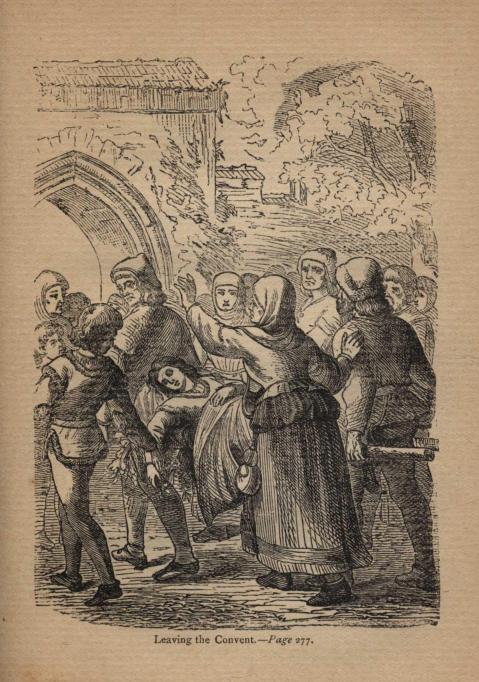
Leaving the Convent.--Page 277.
With lamp in hand she led the way to the inner room, and began examining carefully the stones in the wall under where the steps had formerly led down from the closed doorway. Geoffrey meanwhile, his curiosity roused to its greatest height, watched her every movement. At last she found a little stone let into the wall, and slightly marked with a triangle at one corner. On this corner she pressed with all her strength, at first unsuccessfully, but at last it rolled back, and with it a part of the wall, disclosing a narrow doorway leading to some steps; beyond, all was darkness.
In her delight she would have entered at once, but Geoffrey drew her back. He was far better acquainted with such places than she was, and conjectured that since it had evidently been closed so long, the steps might be in too dilapidated a condition to bear her weight. He therefore insisted on trying them by blows with a stick, and on being the first to descend; but, except for the dust, and a confined smell, they appeared as if they might have been in daily use. Down some twenty feet they descended, Geoffrey leading, and carrying the lamp, Kate breathless with excitement, yet talking as fast as possible, explaining the secret entrance and its former object. Soon they found themselves stopped; the passage was filled with rubbish; from this part they must depend on their friends outside. And hark! even now they could distinguish a dull, thumping noise. Dick was at his work in the midnight; at every blow deliverance was coming nearer.
According to Kate's direction, he measured with some cord the distance from the foot of the steps to the obstruction, in order that Dick, who knew exactly the length of the passage when it was first made, might be able to judge whether it were possible to remove the rocks and earth. They then returned to tell the news to Hubert.
He was suffering from great oppression and exhaustion, so that he did not appear either as surprised or as delighted as they supposed he would. His breath came in hard, short gasps, and Kate seated herself so that his head could rest on her shoulder, while Geoffrey bathed his face and moistened his parched lips.
"Sing to me, Kate--the song you sang the other night about Jesus."
"I will," she replied. And her voice, though at first trembling and husky with emotion, soon rose, as she became roused with her theme, to that clear, calm tone which is so soothing to the sick. She sang a Latin hymn, written by a monk in a far southern land, but sounding none the less sweet to those three Lollard children in their cold and gloomy dungeon.
"Jesu dulcis memoria
Dans vera cordi gaudia;
Sed super mel et omnia
Ejus dulcis præsentia.
"Nil cantitur suavius,
Nil auditur jocundius,
Nil cogitatur dulcius,
Quam Jesus, Dei Filius.
"Jesus, spes poenitentibus,
Quam pius es petentibus,
Quam bonus te quærentibus,
Sed quis invenientibus!
"Nec lingua videt dicere,
Nec littera exprimere;
Expertus potest credere
Quid sit Jesum diligere!"
"Sweet memories of thee impart
True joy, dear Jesus, to my heart;
But far beyond all sweets will be
Thy holy presence, Lord, to me.
"No sweeter song can chanted be,
More joyful news be brought to me,
Or sweeter thoughts to think upon
Than Jesus Christ, God's only Son.
"Thou hope of every contrite heart,
Since them so very glorious art,
To those who SEEK so good, so kind,
What must thou be to those who FIND?
"No language can the story hold,
No words the mystery unfold;
Experience alone can prove
How good it is our Christ to love."
There was silence for several minutes after the hymn was finished, then the sick boy seemed quite revived.
"Thank you; how good that is! I feel stronger now, and I would like to talk with you both. Sit close to me, Geoffrey, and wrap my cloak around you; you are shivering."
Geoffrey was shivering, but not with bodily cold--it was that chill that creeps over us when Death suddenly appears, and dropping all disguise, shows us his stern features. He had long felt that this great sorrow was approaching, but since he had had so strong a hope of restoration to liberty, he had imagined the fresh air and bright sunshine bringing back a healthy glow to those pale cheeks and vigor to that wasted frame. But now he saw, all at once, his mistake. Death would not thus be robbed of its victim. The bolts and bars through which he was to break were such as no man could fasten; the sunshine in which he was to bask would be the light of his much-loved Saviour's face.
"Do you remember, Geoffrey, that day before we left dear old Forest Tower, how Lord Cobham told me I might have to die for the truth's sake? I am very glad to go. I did not think it would be so easy; but I would have liked to be able to preach Christ before I went. I am sorry to leave you, brother, but perhaps when I am gone they will take pity on you, and let you go. When you are free, you will go away together, you and Kate--I have prayed God for that. And when you are happy together, you will think often, won't you, of the days we have passed together in our prison? See, I have made these for you; they are not much, but it is all I could do, and father will like to see them, and you will tell him about to-night, and how I loved you both." He drew out from under the straw two little bags, or flat cases, made of plaited straw, and placed them in Kate's and Geoffrey's hands.
"There are some texts written on parchment in each; I wrote them last summer because they are so beautiful. I wanted to tell you more, but I am very sleepy now. Good night!"
The low, faint voice had grown fainter from exhaustion, and he sank down in a deep sleep on Kate's shoulder as he finished. She laid him carefully down, for the convent-bell was warning her that it was time to go. Wrapped in her sheet again, she passed, with Geoffrey's aid, through the narrow window, and as he stood and watched her by the white gleam of her drapery among the leafless trees, it seemed as though all the light that was left for him in this world had departed with the bright words and kindly smile of Lady Katharine Hyde.
CHAPTER XVIII.
Free Again.
Very much surprised was dame Redwood when, the week after Easter, she received a message that the abbess of the convent of Our Lady of the Seven Sorrows wished to see her on particular business, that very morning.
"I have been at no tricks, mother," said poor frightened Phoebe, who was the messenger, "unless it might be about the key, but that has been hanging on its nail ever since. Do you think she means about me, mother?"
"And why should she not be meaning you, you heedless thing?" replied her mother, though in her inmost heart she believed it was for her own tricks she was to be called before that high dignitary, and foresaw nothing but the loss of her farm, if not something worse. But she would not let her daughter see this; so she went on scolding her with all the breath she could spare while running round to get ready for her departure.
It was a pair of very frightened women who presented themselves to Mother Beatrice as she sat erect and stately in the convent parlor. The good dame, however, was thinking less of her own safety than how she could manage to keep from criminating Lady Katharine in case her part of the plot had been discovered.
"You may go to your work, girl," said the abbess in an unusually gracious manner, when they had made their courtesies to her. "Dame Redwood, your daughter will make a good porteress if she is as prompt in her duty as you are."
This took a load off both their hearts, and the dame could listen quietly to the long speech which the Mother Superior addressed to her as soon as Phoebe had closed the door. She told her how she had there with her for safe keeping, and, if possible, for restoring to the church, two young heretics, committed to her care by his grace Chichely, archbishop of Canterbury. She told how the younger was ill, and that she was about to show the extreme clemency of the church toward its wayward, by letting them go free on condition that they should leave the country, and never set foot on English soil again. Moreover, as the one was ill, and the other not strong, it might be necessary for them to rest and recover before their departure, for which she would allow them the space of one week, which time she wished them to pass under the roof of so faithful a tenant of the convent as dame Joan Redwood. Furthermore, she would hold her and her husband responsible if, during that time, they held communication with any other Lollards, and if at the end of that period they were allowed any further shelter.
The dame had great difficulty in concealing her delight at this turn of affairs; but she managed to account for her smiles and agitation on the ground of the unexpected favor just bestowed.
"And now, think you," continued Mother Beatrice, "your good husband could bring some one with him and come this evening while we are at chapel? Phoebe shall have them ready to go."
In her delight, happy Joan managed to get down on her knees and kiss the hem of the abbess' robe, which gratified her, and made her so condescending that it was with difficulty they could conclude their respective blessings and courtesies, and have the door fairly shut between them.
Never had the road appeared so long between the convent and her home, though the good woman trudged along it almost on a run. When she imparted the news to her husband, his delight almost exceeded hers, for the demon of remorse had been tormenting him again since he had heard of Hubert's sufferings. Now, however, it seemed as if his sin had been expiated, and he was to be certified of this by having the boys placed in his hands to minister to their wants, and serve them in every possible way.
It seemed also a most favorable coincidence that Bertrand had just arrived that morning, having appointed that the boys should meet their father, if it were possible for them to escape, at the house of Philip Naseby the trader, which had been their asylum soon after they left home. Bertrand and Redwood employed themselves in making a rude litter of boughs, cushioned with all the dame's skill, and furnished with many a soft wrap to shield the sick boy from contact with the cold air.
They had hardly finished their preparations before the hour designated by the abbess; but as the bells were tolling for vespers they stood in the convent court-yard eagerly waiting for their expected guests. Bertrand and Dick waited without, while the dame and her daughter went with Sister Ursula to bring them out; but when they at last appeared, the men could hardly recognize in the gaunt, haggard-looking boy who came feebly along, with a bewildered look in the hollow eyes which he was trying to shield from the light with his hand, the young master whom they had seen so fresh, and ruddy, and vigorous six months before.
But the thoughts of all were concentrated on the little form borne, as though lifeless, in dame Redwood's arms. He had fainted from sudden exposure to the air; but the good woman had been so horror-struck at the scene of misery which met her eyes when Sister Ursula opened the dungeon-door, that she would not now suffer them to wait to restore him, but for once speechless with indignation, hurried the whole party out of the gates. It was not until she had heard them clash behind her, and saw the grim old towers disappearing behind the hill, that she felt at all secure, but kept all the while looking back, as if in fear of pursuit.
The little figure in the litter lay so still that more than once Bertrand bent down to catch the sound of the faint breathing which alone gave token of life. Geoffrey, mounted on the pony, was so bewildered that he could neither ask questions nor answer them. He seemed troubled if the narrowness of the way caused the dame to lead the horse either in front of or behind the litter; the only sign he gave of being conscious of his change of position being a dread of being separated from his brother. All felt relieved when they reached the cottage. Not that the bearers were weary; that little emaciated form would scarcely have been felt in Bertrand's strong arms; but his heart was bearing a load of grief such as it had never borne before. Until then, hope had buoyed him up, and supported him through all the toil and danger which he had undergone for his master and his sons: even hope seemed dead now.
But it was worse still with poor Dick. The demons of remorse which he hoped had been driven out forever returned with renewed power. "We have thee again, Judas!" they seemed to say to the wretched man. "Didst thou think to escape us, poor fool? He too threw down the money, and tried to save, but it was too late, TOO LATE! The blood was on his head, and on yours too. Come, why not do as that famous namesake of thine did? His work and thine can never be undone, and there is no repentance or forgiveness for either!"
It was only because he held one end of the litter that he did not obey his tormentors' suggestions, and more than once he looked shudderingly, but almost wistfully, as they passed some gloomy-looking dells, where the newly-loosened brooks were rushing like mountain torrents or lying in deep, dark pools under the shadow of the oaks.
Poor man! He sadly needed a comforter then, some one to tell him that now was the time to prove his belief in the creed that had been nominally his from childhood, to show him that the words, "I believe in the forgiveness of sins," were just as necessary to believe as the preceding, "I believe in God the Father." But, alas! for poor Dick. His creed was locked up, as well as his Bible, in an unknown tongue, and the God whom he had been taught to worship was one to be feared and dreaded, not reverenced and loved; a God whose vengeance must be turned aside by costly offerings and pilgrimages, whose highest favor could only be obtained by renouncing all pleasures and enduring all pains. "Cursed is every one that keepeth not all the words of the law to do them," taught the purest of the priesthood; they never declared: "God is merciful and just to forgive us our sins and to cleanse us from all unrighteousness."
They could indeed gloss over the foulest crimes, and calling vices by the names of virtues, think they had changed their nature; but when an awakened spirit was aroused to a sense of its lost condition, and cried to the successors of the apostles for help, they could give the agonized soul no aid, no comfort, no hope. If penance and mortification and priestly absolution failed to satisfy the guilty spirit, it must perish, for Christ's atonement was utterly rejected.
CHAPTER XIX.
From Darkness to Light.
When Geoffrey was roused from the bewilderment caused by this sudden change in his fortunes, his first thought was for Lady Katharine Hyde, who, when she visited them in her ghostly attire that night as she had promised, would wonder what had become of them. Bertrand reassured him, however, by telling him that Dick had almost completed the work of digging out the old underground passage to the convent vaults, and that by an hour's work that night he could enter their late prison, meet Kate, and bring her forth to freedom. Even had the abbess not been so unexpectedly merciful their captivity need not have lasted over that night.
"God has been very good to us, Bertrand," said the young Lollard, his pale cheek flushing with emotion, and his eyes by the light of the blazing fire showing full of tears; "for if we had come out that way, we should have had to escape immediately; but now we have a whole week for Hubert----" He stopped; he had meant to say, "for Hubert to get strong in;" but even his love could not thus deceive itself. His lips would not utter the words, but they both finished it for themselves: "That Hubert may die in peace."
For the end was evidently approaching. Cold, and damp, and hunger had done their work as effectually on the Lollard heretic as if the archbishop had immediately sentenced him to the stake. The warmth, and food, and motherly care which had been longed for during those weary months were bestowed in abundance now: but it was too late; all dame Redwood's tender nursing could not keep alive the glimmering spark which was all that persecution and tyranny had left of the flame of that young life. He still lay in the same dull stupor which had been on him when he left his dungeon. He had only replied to their caresses and services by a few wandering words about the shepherd coming back for his sheep in the mountains, and being warm at home.
Poor Dick had stood the whole evening, never moving his eyes from his young guests, but, in his misery, so unconscious of what was going on around him, that he was in every one's way, and of no use at all. It was therefore no small relief to himself, as well as the others, when Bertrand bade him shoulder his tools and go off to his work. For a while the two men marched along in silence, till they came to one of the deep, dark pools into which the soldier had looked so wistfully that afternoon. Here he stopped, flung down his burden, and turned toward his companion with the reckless look of a wild beast brought to bay on the brink of a precipice, preferring to leap from the dizzy height to certain destruction rather than fall into the hands of its enemies. Bertrand was startled at the change in the man's face.
"I tell you, 'tis of no use; they are after me again, and there is no driving them off, He saved me, and I have killed them both. There is no changing it--the devils may as well have me first as last. The other Judas hanged himself, but I think it was because there was no pool near. Ha! how they would dance around me if I were dangling to yon branch! No; this is better. Fare thee well, comrade!"
He turned, and was pushing aside the branches to take the fatal leap, when he felt himself seized from behind in a powerful grasp.
"Hold, Dick Redwood! What meanest thou, man? Art thou mad?"
"Let me alone!" said the soldier, struggling with his captor. "It is the only place for peace; I shall be one of them there, and there they cannot torment so. Take off thy hand, man, or it will be the worse for thee!"
"Not so fast," replied Bertrand coolly. "Dost think I will see murder committed before my eyes--ay, and the worst of murder, the murder of a soul? We will try a bout for that first, my man."
Then began a fierce struggle, in which the soldier's strength and military knowledge were well matched by the supple limbs and clear, cool eye of the forester. It was truly a conflict for life or death on which the calm moonbeams looked down that lovely spring night. Hither and thither went the combatants over the fallen trees and stones, and through the brushwood, the object of Bertrand being to get as far as possible from the brink of the fatal precipice. Sometimes one party gained a slight advantage, sometimes the other; but both were evidently becoming exhausted. It seemed an even chance whether the Lollard would succeed in his benevolent object of saving his comrade's life from his own violent hands, or would be obliged to yield, in order to preserve his own. The struggle was carried on, however, in the utmost silence, neither caring to waste strength in outcries, so that the only sounds to be heard during the combat were the crackling of the branches, the trampling of feet, and the panting breath of the wrestlers.
Just at the moment when Bertrand had the other in a position to give him a heavy fling on the grass, his foot slipped, and they rolled together to the ground; the forester's head struck heavily, and he lay for a moment stunned.
In that moment the soldier disengaged himself from Bertrand's relaxed grasp, and, with a yell of triumph, sprang toward the pool. A few strides, and he was at the brink, parting the bushes with a trembling hand.
The moon cast a shimmer of light on some inky-black water--a rush of a heavy body, a shriek, a plunge--and the smooth surface, broken into a thousand points of light, was settling itself once more into tranquillity.
Just then there appeared another figure on the scene: a man was flinging himself from point to point down the steep descent Bertrand, who arrived at the spot only to find himself too late, watched him; but his head was so confused by his fall, that he could not have told whether it took hours or minutes for this unexpected actor in the scene to throw off his outer garment, plunge in the pool, and drag the drowning man to land. By that time he became roused enough to go to his aid, and the two bore the soldier up the bank, and seated him with his back against the trunk of a tree, the water dripping from his garments, and the scared, bewildered expression changing to the old look of dogged, sullen defiance, as his senses returned.
When the forester found that the soldier was not injured by his cold bath, he turned to look at the man who had stepped in so opportunely to the rescue, and the sight did not at all delight him, for the tonsured head, the cowl, and the knotted-rope girdle all proclaimed him an individual whom a Lollard disliked especially to meet, namely, a Benedictine monk.
Dick recognized him further, and springing up, flung himself at the stranger's feet, his teeth chattering with cold and terror as he tried to speak.
"Father Paul! Father Paul! drive them out, drive them away, for heaven's sake, for the blessed saints' sake drive them away! You are holy, and they will fear you. Bring the book and candle, and say a prayer! Oh! they dragged me down"--and the man shuddered through all his frame--"they clutched me so under the water! Good Father! holy Father! save me from the devils!"
"My son," replied the monk kindly, "I wish to help thee in thy distress, but I am neither holy nor good--only a weak sinner like thyself. If thou hast committed sin, there is One that can pardon and absolve. What is it that lies so heavy on thy conscience?"
"Absolve a Judas!" shrieked the wretched man. "Ay, Father, I will tell you all, that you may know what a devil you have saved to curse the world."
He began and told the whole story, still crouching down at the Benedictine's feet, while Bertrand gave all up for lost, for he could not stop him, and could only look for one result from the disclosure of the tale to one whom he had every reason to suppose their deadliest foe. But, to his utter astonishment, when the confession was finished and he expected to hear the monk comfort his penitent by pronouncing the deed to be commendable rather than sinful, he began in a way directly opposite to the teachings of the order to which he seemed to belong.
"My son, thou hast indeed greatly sinned; but since thou hast so well remembered the story of the betrayer, hast thou pondered as well on the history of the Betrayed? Hast thou heard of him who forgave his murderers even while they were nailing him on his cross? I make no doubt but that he had a pardon ready even for Judas, had he asked it. Remember this, my son, the betrayal was not the crime which destroyed Judas utterly, but his despair of Christ's mercy. He was never forgiven, because he never asked for forgiveness. When that blessed Saviour said, 'Whoso cometh unto me I will in no wise cast out,' he did not add, 'except Dick Redwood.' When the apostle says, 'The blood of Jesus Christ cleanseth from all sin,' he did not finish, 'except the sin of ingratitude.' Dick, there is pardon there--free, full, absolute pardon for thee and for me; all that is required is that we ask for it, that we believe in it, that we trust in nothing else, and that we have a steadfast purpose to live hereafter a better and holier life. Art thou willing so to do? Is it thy purpose henceforth to give up thy wicked desires and do that heavenly Master's will, loving thy brother man and forgiving him, even as he hath loved and forgiven thee?"
The penitent was sobbing like a child as he crouched at the monk's feet and clung to his robe. "O Father! if I could but show you! I would do any penance."
"There is none required," said Father Paul, "none at all. Christ hath borne our penance in his sufferings on the tree; nothing that we can do would be of any avail; it is free grace that saves, remember that--never, never forget it; that is the good tidings, the glorious Easter gospel!"
The monk paused, as if overcome by emotion; then laying his hand on the head of the kneeling man, he added very solemnly:
"Not as though I had any power, not in my own name, but in the name of the Lord Jesus Christ, whose servant I am, I pronounce that thou, being penitent, art released from thy sins and made a partaker of his kingdom. Go in peace, and sin no more."
Dick sprang to his feet when the gentle touch was removed. The dull, sullen look had vanished from his face, the frightened, staring eyes were calm; but his voice, when he tried to speak, was husky and choked, and he turned aside a moment into the bushes. They had no need to follow him now, for with his tormentors had departed all thoughts of self-murder.
The Benedictine advanced toward Bertrand and held out his hand.
"I think I can recognize you from our friend's story," he said kindly; "but do not be afraid; it is not often, I know, that a garb like mine covers a heart friendly to your faith; but I too have a story to tell."
He then explained in a few words to the still astounded Bertrand the marvelous effect of the few words uttered by Hubert.
"Thus you see," he concluded, "that where I expected to teach, I was taught; and where I went to convert, I was myself converted. But what are you doing here at this hour with these tools?"
Bertrand's fear was quite gone by this time, and he related how nearly they had liberated the captives, and were now on their way to meet the remaining one, and bring her also away.
But Father Paul strongly urged upon them the danger of withdrawing Lady Katharine from the convent until they had made preparations for her escape from the neighborhood, as a search would be made for her as soon as she was missed which would endanger the safety of all parties; but he said there might be no danger in her coming by night to visit the dying boy, and offered himself to assist in arranging a plan for her removal to her home. This he could the more easily do, as it was not yet known that he had changed his faith.
CHAPTER XX.
One more Lamb safe in the Fold.
The sun had risen and set again upon the cottage in the wood and its quiet household. It had been a lovely spring day, such a day as makes the violets and anemones lift their graceful heads in many a sunny spot in the forest; but the evening had closed in much colder. Heavy clouds were gliding across the moon, throwing weird shadows upon sea and land, and the wind was rising almost to a tempest.
Within, the scene was different. The fire in the great chimney was blazing merrily, for Moll and Meg seemed to think it was their duty to keep it as large as though it were Christmas-time; and little Dick was continually running in with his apron full of dried sticks and leaves to add to the flame.
Hubert lay on an oaken settle, which the dame had converted into a bed, and drawn up close to the hearth. There had been a change that day, that mysterious, indescribable change which all know so well, but which no one can define--the shadow of the dark mountains falling on the pilgrim's face as he enters the valley of death. Not a painful change. The lines of suffering were passing away, the dark blue eyes were beaming with a holy light, the high white forehead looked more like chiseled marble, and about the lips was playing a smile, not gay or mirthful, but full of contentment and peace. The stupor had passed away, and his mind seemed perfectly clear. He recognized those about him, and was very grateful for every little service rendered him; but he spoke little, and seemed worried by any noise or bustle in the room. Perhaps it was because he had been so long accustomed to the stillness of his prison; it may have been that sounds were breaking on his ear with which earth's noises formed jarring discord.
Geoffrey never left him, but sat on a little bench, handing him anything he wanted, and holding the little thin hand tight in his grasp. Another who rarely took his eyes from the dying boy was the soldier. He had received from them both freely the pardon which was alone needed to make his heart lighter, notwithstanding the present grief, than it had ever been before in his life. An atmosphere of love filled the little dwelling; pardon and peace enlightening each heart, as the glowing coals on the hearth lightened the rough walls of the cottage.
There was a little stir at the door--a whispered question and answer; then Geoffrey bent his face to his brother's:
"Hubert, Kate is come, and Father Paul!"
He raised himself a little, and as Kate approached, put both his arms around her neck and drew her down close to him.
"I am so glad you have come," he said; "now Geoffrey will not be alone. You will never leave each other any more, will you? You will take her to father, and tell him I loved you both so much! You will all have happy days together in some far-off land, and then when you are so happy, you will sometimes think and talk about to-night."
Here the elder boy's stout heart broke down. To look forward to a future which was not to be shared by Hubert, his second self--the only one with whom he had taken sweet counsel through all his childhood--dearer still for the sufferings they had borne side by side!
"O Hubert! you will not be there!"
"I would rather not be, I am so tired, so very, very weary; I am not strong to battle for the truth, as you are, Geoffrey. It is so nice to lie here and think that all the work and toil is over, and I am only waiting for him to come. He is coming fast now; when it is quiet, I can hear his footsteps and his voice. He will take me right up in his arms, and I will put my head on his breast while he is carrying me home. Isn't he come yet? Don't you hear him calling? Don't you see him coming? He is very, very near now."
They did perceive his coming; they saw his approaches in the fast glazing eye, in the death-damp on the forehead; they heard him in the gasping breath.
Father Paul stepped forward and bent over him.
"Yes, my child, he is coming; he is almost here. Hast thou no fear?"
A look of surprise passed over the child's face.
"Why, it is Jesus! I cannot fear Jesus! I love him so, and I have waited for him so long! I am so glad that you love him too! Now we will all meet in the Beautiful Land--kind Dick and all, all, every one!" And his eye glanced at each in turn, resting lovingly, but searchingly, on every face, as if he would read there the secret of the heart, and know if that soul were at peace with its Maker.
Coming, coming, faster and faster, nearer and nearer, the footsteps were at the door; they had entered; the unbidden guest was in their midst. He would not depart alone. All felt his presence, and there was silence, only broken by the gasping breath, each moment growing shorter. The very wind had lulled, and listened with them.
Then they came--those last words which echo so long in desolate hearts, which we remember so much longer than any other utterances of our beloved. Low, but clear and distinct, they sounded in the stillness. There was awe, joy, and great wonder in the tone:
"Hush! hark! see!"
They were hushed; no sound was heard, save the gentle crackle and hiss of the logs on the hearth; they saw--the little white form lying on its pillows, with the red firelight beaming on opened, sightless eyes, parted breathless lips.
He hearkened, and heard 'the angels' song of welcome--he looked, and beheld the face of his Saviour!
CHAPTER XXI.
Father Paul.
There was no noisy grief, no boisterous lamentation when, one lovely spring morning, the small funeral-train left the soldier's cottage, and passed through the forest-paths toward the last resting-place of the little Lollard martyr. Dick and Bertrand had dug the grave in just such a spot as a child might choose to rest in after a long day of happiness--a glade with a southern slope, purpled with violets, and enlivened by a little brook, which leaped out of a thicket of wild roses, and, after dancing awhile in the sunshine, and hugging the worn rocks as though it loved them, plunged again into obscurity, under the arms of a great overspreading willow, and went dancing on to the sea.
There were no chanting monks with flaming tapers, but the returning sun spoke to them of nature--awake again after its long sleep--and of little brown seeds, hidden away in the ground all winter, now bursting forth into beauty and fragrance, every seed having its own body. "I am the resurrection and the life"--how glorious those words sounded as echoed by a thousand voices in that grand cathedral of God's own handiwork! Every budding branch, every flower, every tiny blade of grass the mourners crushed beneath their feet was to them a witness of that fact.
We, who have all our lives been used to the consolation which the pure gospel gives to all thoughts connected with death, can hardly imagine what were the Benedictine's feelings when he stood by that little grave, and read that glorious funeral anthem, the fifteenth chapter of Corinthians, for the first time in his mother tongue. It was all new and striking to him. He had now no need to let his mind dwell on a fearful purgatory, from which the departed soul could only be released by the prayers and penances of living friends. He now knew that all connection had ceased between the disembodied spirit and those it had left behind. In due time they might go to it, but it was at that very moment safe in its Saviour's bosom, whence none could pluck it away.
The soothing effect of the scene and the simple service was felt in every heart; and when at last they saw Bertrand arrange the last sod that covered the dear one from their eyes, there were no outbursts of grief; for the peace which is not of this world, and therefore over which the prince of this world has no power, was upon them, and rested in each soul.
No tombstone marked the spot; they did not even dare to raise a mound, lest the precious remains should be desecrated; but each, as he passed by, laid on it a handful of the sweet spring flowers. Those who loved him knew where he lay, and God would guard the ashes of his saint.
Their preparations must now be made speedily, for only two days remained of the time granted them by the abbess. While they were looking for a fishing-boat, the master of which might be induced, by the promise of a large reward, to convey them to London, they were also busy contriving how they might best take Lady Katharine Hyde without endangering the safety of any who had aided them in their flight. Fortunately, the abbess had never seen her young charge hold any communication with her other prisoners; she was also entirely unaware that the young lady possessed means of access to the garden, and indeed to the outer world, whenever she was pleased to avail herself of them. The ghost also had never been laid, but remained as great a mystery as ghosts generally do. All this greatly favored their plans. It was at last arranged that she should come down to the garden at as early an hour as possible in the evening, locking the door behind her; that she should then enter the little room under the tower, where Bertrand would meet her with her disguise, which was to be that of a monk of Father Paul's order. They were then to fasten up the entrance to the secret passage, and meet the others at the designated spot on the coast. The others were to pretend to start at sunset, that afterward, when Lady Katharine should be missed, the abbess would not imagine that she had joined them. It would be very easy for them, when it was dark, to turn back and take up the rest of their load.
Geoffrey had been gaining strength rapidly the last few days, and his spirits rose also. Not that Hubert was forgotten: there was not a moment in which he did not miss that dear brother, rendered doubly dear by the trials they had undergone together for their mutual faith, and who had been for so long the object of his care; but though he was not gay, he could not be sad. Hope was awake again, and that calm, peaceful death-scene had left no bitterness behind. The little grave in the forest glade, with the golden light flickering through the elm-branches on its violets and snow-drops, was not brighter than the sunny memories the child had left behind him. Life was not so very precious a thing to a Lollard in that age of oppression and tyranny, that he should grieve deeply over one who had laid aside its burden, and received the reward. During the weary hours of his imprisonment, Geoffrey had learned many a lesson of unselfishness and self-sacrifice, and besides, heaven had grown nearer and more real to him--more real in fact, than the world from which he had been so long separated. From his tomb in the convent-dungeon he had arisen to a new spiritual life, he who had entered his prison a haughty, passionate boy, fired, it is true, by many noble impulses, but with an untamed spirit and unsanctified will, came forth a calm, collected young man, disciplined in soul and mind, older by many years than he had been six months before. He had learned to read in a different way the history of his past life, as well as that which opened before him day by day. He had also learned in his loneliness to comprehend and to trust more fully that pure gospel truth which he had until then received more as a political than a religious creed, as intended to lead to freedom from worldly tyranny, rather than from the dominion of sin and death.
He held several conversations with Father Paul about his future plans. The ecclesiastic had the best means of judging concerning the spiritual state of the kingdom, and its readiness for the reception of the reformed doctrines, and he pronounced the movement premature. The people were not, as a general thing, ready for any change in religion. Papistry had too firm a hold on the lives and property of every class to be dislodged, except by a combined movement of the masses, and that could not be hoped for until the superstition and bigotry which now enshrouded the whole land had been driven away by the diffusion of education and a pure gospel. But how could the gospel be diffused when not one in a hundred could read or write their mother tongue? And how could education be brought to bear on the common people when it would cost the laborer all he received for months of toil to purchase a single book?
"I tell you," said the priest emphatically, "that as long as the Bible is locked up from men, and men are shut out from the Bible, we can have no general reformation in the church. When the Word of God shall be so multiplied that every man may have it if he will, and every man's mind is so enlightened that he may read it if he will, then let Rome tremble, for her power over the nations will be gone."
"Has all this blood been expended, then, in vain?" asked Geoffrey.
"No," replied the monk; "that cannot be. God in his providence wastes nothing; certainly not human suffering. Those who shall live after us in future ages, and look back on the history of these times, will understand how God is working with this land and its inhabitants; we cannot; we can only trust. A thousand years are but a day in his sight, and one day as a thousand years. We must only labor on, seeking to lead, here and there a soul out of darkness into light. Do you know that I intend to be your fellow-traveller to-morrow?"
"No," said Geoffrey, joyfully; "but whither and for how long?"
"I cannot answer the last question," replied Father Paul, "and the first only in part. I am now, like yourself, an exile, for my life will not be worth an hour's purchase when the archbishop hears of my heresy. My plan is first to go with you to London, see my sister, Lady Katharine's mother, and convey her and her children to a place of safety; then to join Lord Cobham in Wales, and there, under him and other godly men, learn more of these glorious truths, for I am but a child in the true knowledge, and have much to unlearn, as well as to learn. After that, if God will grant to me, so unworthy, the privilege of preaching his good tidings, I will go about the country and seek to lead home some of his lost sheep by telling them how I was restored."
"That was Hubert's great desire," said Geoffrey rather sadly; "but God thought otherwise."
"Nay, there you mistake," replied the Father with emotion. "I have stood in many pulpits and pronounced many discourses, for men say I have the gift of an eloquent tongue; but as I look back on them all, I cannot remember that one has been the means of saving a single soul. I have bidden men subdue the flesh by penance--never the spirit by penitence; I have taught sinners to seek a release from the consequences of their crimes in the cloister, in pilgrimages, in costly offerings, but I have never directed them to the Lamb of God that taketh away the sin of the world. I have taught my people to fear the wrath of the church, but never warned them to prepare for the judgment of God. Oh! my burden is heavy, heavy! Be thankful, my son, that you are spared from knowing that thousands have gone down to the grave depending on your false teaching. A blind leader of the blind I had been for nearly half a century, until a few words from the lips of a child taught me myself. What I now am, whatever hereafter God will permit me to do for my fellow-sinners, will all be owing to your brother.
"And not to me alone has he unfolded the truth as it is in Jesus. His holy life and death have left lessons behind whose effects only God can know. Even Mother Beatrice seems softened, and I have left with her a few simple truths and searching questions which may, through God's blessing, work to her eternal profit. And poor Dick, how changed he seems! How wonderful is this doctrine of Christ's righteousness atoning for sin without any effort on our part but that of accepting it! That is the only thing which can heal the festering, cankering wounds of remorse. How glorious is the liberty wherewith Christ has made us free!"
CHAPTER XXII.
Meeting and Parting.
The sun was shining brightly on the garden of a pretty Gothic mansion near the Thames, one glorious spring morning, about a week after the Lollard exiles had sailed from the Yorkshire coast. The house seemed to have fallen somewhat out of repair, and the garden looked as if a dozen gardeners might find employment in putting it in order for the summer. But still, nothing had an untidy aspect; there was rather a bright look about it, as if it were trying to put the very best face possible on the matter, and conceal the ravages of time by a veil of ivy and spring flowers.
In one of the grassy paths, just where it divided to embrace a fallen sun-dial, stood a group matching well with the surrounding scene. The venerableness of the old mansion, the nobleness of the clinging ivy, and the bright freshness of the flowers had each its counterpart in the animate objects. The most prominent figure, perhaps, was that of an old white war-horse in faded trappings, but still retaining a trace of his former glories in the way he arched his neck and lifted his stiffened limbs. Leading him by the bridle was a fine-looking, weather-beaten old man, with somewhat of the old war-horse's disposition, if one might judge from the piercing eyes which looked out from under shaggy gray brows, and the grim though kindly smile lighting up a face that would have been handsome if it had not been for the deep scar of a sword-cut which disfigured his brow and cheek. His smile was occasioned by the merry sallies of a little child of some four or five summers who was mounted on the horse's back, but giving little heed to the management of his steed, and rather intent on ornamenting him with the flowers with which his lap was filled. He had thrown down his plumed cap on the grass, that he might have more space to bestow his treasures, and the sunbeams and the violets nestled together in the golden curls which the wind was sweeping back from his broad white brow, and rolling in shaded masses on his crimson velvet-dress. Two laughing blue eyes followed the motions of a pair of fat baby hands, as they tried to twine some primroses in the old charger's stiff mane, where they were determined not to stay, but kept dropping out as fast as he put them in, strewing the ground beneath them.
Sometimes, when he found a prettier one than usual, he would hold it out to a tall, noble-looking lady who walked at his side. "For you, mamma!" he would say, and the lady would receive the child's gifts in her hand, but would not suffer him to put them in her hair. Her dress was that of a widow; and her pale, sad face and abstracted look, as if she were dwelling on a dreary past rather than a cheerful present, told that her grief was still fresh in her mind. All the little one's merry shouts and loving speeches could only draw from her a faint, sad smile, that vanished again almost as soon as it appeared.
"Dress old Rollo's head with flowers if you will, little Guy, but not mine; they would only wither there."
"Well, then, mamma," said the little one, "Rollo has enough; see how he shakes them out of his ears! I will now make a wreath for sister Kate to wear when she comes home. Has she gone to find papa, and will she bring him back with her? How long will it be before we are together and happy again? Tell me mamma."
The tears rose in the lady's eyes; she threw one arm around her child, and drawing him toward her, pressed kisses fast and thick on lip and cheek and brow.
"Papa cannot come again, my child; he has gone to another world, and would not wish to come back to one so full of care and trouble; and sister Kate is far away; perhaps she has gone to papa, and some day we will go to meet them, but they cannot come to us again. You and I must love each other dearly now, Guy, for I have no one left but you."
"Dear mamma, don't cry," said the boy stoutly, though his own lip was curling as he spoke, and dropping all his treasures, he flung both arms around her neck.
The old servant, as though he wished the privacy of the mother and child to be undisturbed, had gone forward a few paces; but now he returned with a face expressive of both surprise and anxiety; and interrupted them:
"My lady, the boat! It has stopped at the water-gate, and several persons are landing from it."