Chapter XVIII
Reading edition
1904-1906
ABYSSINIA
Although Gatacre undoubtedly indulged hopes of further employment, he had not much confidence in such expectations. While prepared to move onwards should his desires be fulfilled, he was simultaneously safeguarding his retreat.
During the manoeuvres he had made inquiries about the working of the Remount Department in the counties, and had discovered that there was a post open to him which would provide both congenial occupation and reasonable remuneration, namely £500 a year in addition to pension.
He bought a little house in the Cotswold Hills, and for the first few weeks enjoyed the leisure, as he had always enjoyed the leisure of his sixty days' leave.
Although the post he coveted was vacant, and although similar posts were being worked by retired officers of his rank, unaccountable difficulties arose in securing it. In the hope of wearing down these obstacles, whatever might be their origin, Gatacre got permission to hold the post for eight months, but the pay attached was withheld, the arrangement being that he was to draw allowances only, on the scale fixed by Government for all such duty, which is calculated to cover actual travelling expenses. The work consisted mainly of overhauling and replenishing the list of registered horses, over an area of twenty-two counties. These included Wales and Cornwall to the west, while on the east a line drawn from Cheshire to Hampshire inclusive of these two counties would form a rough boundary. He very soon got profoundly interested in his task.
He invented a new system of tabulating all sorts of information useful to the Department. He found that to complete what was properly a year's work in eight months involved working under more pressure than could justly be expected, more especially as his services were voluntary; but the old incentive of reaching his own self-imposed standard would not let him leave his work unfinished. The facts he had collected were useless, his labour would be in vain, unless he could record them in a form that would be handy for reference. His reports were to be the vade mecum of the Remount and Yeomanry Officer in each county; there was one little volume for each county, and a General Directory for use at Headquarters. Permission was obtained from Sir Evelyn Wood, commanding the Second Army Corps, to employ an army clerk and two typewriting clerks (women) in an office in Salisbury, and there Gatacre worked for six weeks in July and August 1904. In order to complete his task in the allotted time, he had to stick so closely to his desk that he grudged the loss of working hours which would be the consequence of a Sunday at home. But it occurred to him that as the nights were short and cool he could save the time that would be wasted in the train by doing the journey by night on his bicycle. The distance was sixty-four miles; the first time it worked very well and he met with no mishap, but on the return journey he punctured at 2 a.m., and as it was too dark to do his own repairs, he had to complete the last twenty-four miles on foot.
On the road
A fortnight later he was on the road again, but decided to come by day. He telegraphed to me that he was leaving Salisbury at noon on Saturday. Having remonstrated with him about making this journey in one stretch, as he had done previously, I wired that I would meet him at Malmesbury at 5 p.m., reckoning that he could not complete his forty-eight miles in less than five hours, and that my presence would ensure a break in the long spin. He arrived five minutes before time, but we did not start off again till six. On another occasion he started at daybreak, and we met at nine o'clock for breakfast at Malmesbury. His age was then sixty; the story is told in order to show not only that he still possessed staying powers above the average, but that he still found the highest delight in using such powers.
In September he was informed that the Remount Department had no longer any use for his services. Across the letter to this effect I find written in his own hand "Disappointing, very!" Once more it seemed to him that his devotion and exertion counted for naught; he had done good work, but he had mysteriously failed to make it of any account.
1905
There was, however, an interpretation of the situation which, though hidden from his eyes, can be read between the lines of the file of correspondence. He could see and could gauge the usefulness of his services and ideas, but his humble-mindedness hid from him the fact that it was his own value that stood in his way. His highly trained administrative faculties immediately grasped all the bearings and possibilities of the problem before him, and he could not resist the desire to improve upon existing methods. This was not what the Department wanted. Although willing to admit the intrinsic merits of his scheme, the authorities were not prepared to put in force such a comprehensive measure of reorganisation; so that while they could honestly say that his "work would serve as a model," they had no option but to discontinue using a tool that was too powerful, too keen, for their purpose. His military rank and his administrative ability made it impossible to employ him in the subordinate position that he coveted.
Retired
Yet another blow was hanging over him. On March 22,1905, he went to London to attend the Memorial Service to His Royal Highness the Duke of Cambridge in Westminster Abbey. At such a gathering he naturally found many friends (more especially as the Duke had been Colonel-in-Chief of the Middlesex Regiment), and, according to one who was amongst the number, it was a pleasure to see how many distinguished men came to greet him, civilians as well as soldiers, and among them men of political standing who knew him more by reputation than in person. This was the last flicker of his public life, for when he returned to the country that evening the intimation of his immediate retirement lay among his correspondence. By contrast to his mood when a few hours earlier he had stood honoured among his peers, this letter seemed a stinging blow, and I can confidently say that he did not expect it. There were still eight months to run before he reached the age of sixty-two, at which point he would (in the event of his not having been promoted to the rank of Lieutenant-General) have had to "retire" under the regulations.
The one thing that we had vaguely dreaded had come to pass. The thing was unthinkable, but it was true—the words in his friend's letter had become prophecy: he was to "have no opportunity of justifying himself," no chance of obliterating the slur that had been cast on his name. His career was at an end, and it had closed a dishonoured career, when to have held one more appointment, however insignificant, would have implied recognition of the facts of the case and compensation for the hasty judgment.
It was some time in the summer of 1905 that the late Sir Lepel Griffin invited Gatacre to sit on the board of the Kordofan Trading Company. We welcomed the new interest. I thought that the pretext for regular visits to London was a desirable thing; I liked to think of his moving amongst busy men, and having something to occupy his mind. There was no idea of making a fortune; we had very little spare capital, and he only invested the small amount necessary to qualify as a Director.
From the first he foresaw the opportunity that might arise of visiting the territory specified in the concession. The prospect attracted him wildly. As the season approached when such a proposition could be seriously entertained, his spirits rose, and he revelled in the idea of starting off for the desert; he took the keenest pleasure in preparing every contrivance for his comfort that his experience of camp-life could suggest; he set about getting books and pamphlets in which he could learn the history of the trade in rubber and the chemical processes of its manufacture.
A telegram which reached us on November 10, asking whether he could be ready to start by the Peninsular and Oriental night mail of the 17th, lifted him into the highest spirits: from that moment he talked of nothing but tents, rifles, and such-like necessities, and thought of nothing but the valuable report that he would prepare for his co-Directors.
To those who have been inclined to blame me for letting him go, I would reply that it still appears to me that any attempt to stop him would have been dictated by selfish motives. He was offered a delightful trip, one that would afford him all those arduous pleasures that his soul loved. Why should I stand in his way? I did desire greatly to accompany him, but in such a short space it would have been impossible to wind up his affairs and so set me free to go.
Up the Nile
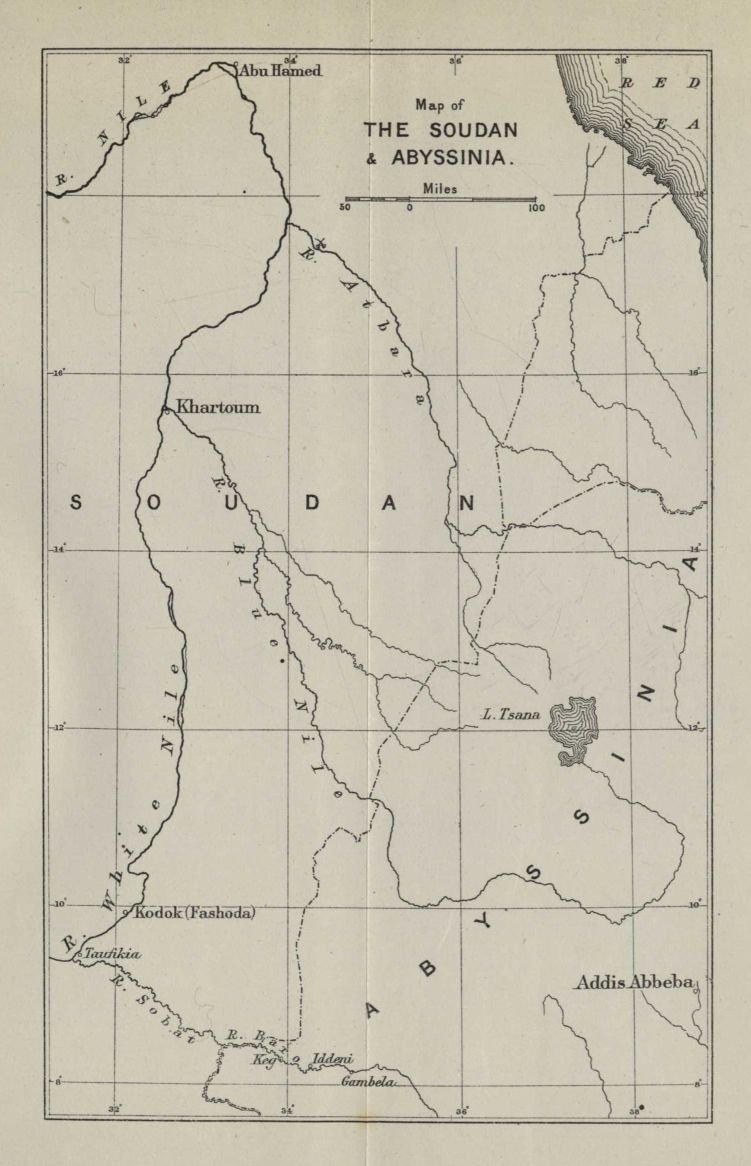
The rubber forests that were the objective of the trip lay in Abyssinia, east and south of Addis Abeba. The party consisted of the General, in command; an experienced Syrian trader named Idlibi, who had acted as his interpreter during the Egyptian Campaign of 1898; one or two men of a similar class, and a suitable number of servants and porters. Amongst Sir William's three personal servants, one was a Mahommedan bearer from India, with whom he could talk freely in Hindustani, and who could therefore act as interpreter to the Arab servants. The route selected involved a trip in steamers of about 500 miles up the White Nile to Taufikia, and then, turning eastward, a further 250 miles up the tributary river Sobat, which in its upper reaches is called the Baro, to Gambela, from which it is 300 miles by a good caravan track to Addis Abeba.
At Fashoda, which is now officially called Kodok, the party came across an English missionary boat. Gatacre went on board and had tea with the five missionaries a few days before Christmas.
It was hoped that there would have been enough water in the river to float the shallow craft right on to Gambela, but first one boat and then the two smaller craft ran aground. It was therefore necessary to open communications from Keg, where the last barge stranded, to Gambela by road, a distance of about thirty-eight miles. Leaving Idlibi in charge of the caravan, Sir William accomplished this march on foot in three days, accompanied by his servants and a few porters.
1906
Gambela is an important trading centre, and was the first objective of the journey. Politically it is known as an Enclave—that is, a tract of country leased by the King of Abyssinia to the Soudan Government. It thus becomes a frontier post of the Soudan, and has a small Soudanese garrison, which in January 1906 was under the command of the Memour Mehined Riad Effendi.
The Memour was exceedingly hospitable to Sir William, receiving him as a guest in his house, and doing everything in his power to facilitate his journey. Gatacre's letters speak most gratefully of the kindness he received at this officer's hands. At Gambela he discovered the Company's agent, and arranged with him to procure three hundred coolies, who should march to Keg, and then carry the merchandise from the boats along the track by which Sir William himself had just travelled.
His death in the desert
Having completed his business, Gatacre started back to join Idlibi, and report progress. On this return journey he was unfortunate in his camping-grounds. Tents being superfluous in such a climate, the party just bivouacked where they halted when the sudden darkness of the tropics fell upon them. In a small notebook of daily jottings, which at his leisure Gatacre worked up into a more formal journal, I find the following entry on January 11, 1906: "Camped in a swamp—horrible water." He reached Keg next day, and was pleased to find that Idlibi had disembarked all the stuff and divided it into suitable loads for the men to carry. A few days later, being impatient at the non-arrival of the coolies, Gatacre decided again to make his way to Gambela, but was attacked with fever on the road, and died at a place known as Iddeni.
His body was conveyed in a canoe to Gambela, where Mehined Riad Effendi saw to its burial in the Abyssinian Christian Cemetery, with due formality.
On Idlibi's arrival with the merchandise a court of inquiry was held, at which the Memour presided. The depositions of all the servants were formally taken, and a translation of their words was forwarded through the British Consul at Addis Abeba to the Foreign Office in London. It appears therein that there was another Englishman moving to and fro during that week, and that he passed the General on the Tuesday previous to his death, which took place on Thursday, January 18, 1906. I mention this to show that the locality was not unknown to civilisation, and that Gatacre was not the only one to brave the climate.
It is clear that darkness overtook him on the 11th while on swampy ground, so that he was compelled to pass the night exposed to dangerous miasmas. I am convinced that had it not been for this misfortune, or some similar accidental misadventure, he would have returned with the rest of the mission on June 10 as young and high-spirited as he was on his departure.
*****
Lofty designs must close in like effects: Loftily lying, Leave him—still loftier than the world suspects, Living and dying.
*****
The key-note to Gatacre's character may be said to be willingness—an eager and fearless willingness to follow the right, the best, an unconditional spending of himself in carrying out the lofty conceptions of duty and service with which he was gifted. Everything he undertook, everything he accomplished, was done with an eager gallantry and a joyful zeal. The effect of these qualities was enhanced by a proud indifference to the cost to himself.
His soldierly heedlessness in risking his life had its moral counterpart in his willingness to accept to the full all responsibility for his actions. How should one who feared not the Hand of God—"the arrow that flieth by day, nor the pestilence that walketh in darkness"—how should such a one fear the judgment of man?
It is to the remarkable association of an exalted sense of duty with exceptional physical powers that Gatacre owes much of his distinction. His standard of efficiency and discipline was as far above the average as were his powers of bodily endurance. His lowliness of mind, however, hid from him the true measure of his endowments, and led him to try to inspire all men with his own lofty ideals. During his long services as staff officer he was always ready to show to his Chief the enthusiastic co-operation that he expected from those who were serving under him. Though some officers may have smarted under his sarcasms, though they may have thought that he overtaxed his troops, it is admitted on all sides that his exactions were prompted solely by the interests of the service, and that his life was the expression of the precepts that he instilled. In the final act of his military career Gatacre proved that he was ready to do as he would be done by—to submit himself without question to the word of authority. Many a time had he been face to face with death; when something more precious than life itself was demanded he laid aside his reputation without a murmur.
The broken arcs
*****
Therefore to whom do I turn but to Thee, the ineffable Name? Builder and Maker, Thou, of houses not made with hands! What, have fear of change from Thee who art ever the same? Doubt that Thy power can fill the heart that Thy power expands? There shall never be one lost good! What was, shall live as before; The evil is null, is nought, is silence implying sound; What was good, shall be good, with, for evil, so much good more; On the earth the broken arcs; in the heaven a perfect round.
*****
Finis
In a sense Gatacre was but the fulfilment of an everlasting type. It is this quality in him, this spark of the eternal Quixotic, of the eternal Heroic, of the eternal Tragic, that redeems his life from the commonplace, that has made him an example to some of his own generation, and may yet make him an example to some that are to come. Death has put an end to controversy. His fair fame remains; he is crowned with the halo of the departed, and his name is written on the long roll of true knights, sans peur et sans reproche.
In Memoriam
On Saturday, May 26, 1906, an alabaster tablet bearing the inscription given below was dedicated by the Rev. H. Hensley Henson, Canon of Westminster, in Claverley Church, Shropshire.
IN LOVING MEMORY OF
SIR WILLIAM FORBES GATACRE
MAJOR-GENERAL KNIGHT COMMANDER OF THE BATH A MEMBER OF THE DISTINGUISHED SERVICE ORDER HOLDING THE KAISER-I-HIND GOLD MEDAL AND OF THE ORDER OF THE MEDJIDIEH AND KNIGHT OF GRACE OF THE ORDER OF SAINT JOHN OF JERUSALEM
THIRD SON OF EDWARD LLOYD GATACRE ESQ OF GATACRE IN THIS PARISH BORN AT HERBERTSHIRE CASTLE 3 DECEMBER 1843 DIED NEAR GAMBELLA ABYSSINIA 18 JANUARY 1906
HE SERVED WITH DISTINCTION IN THE HAZARA CAMPAIGN 1888 IN THE TON-HON EXPEDITION 1889-90 IN THE CHITRAL RELIEF FORCE 1895 HE COMMANDED THE BRITISH DIVISION IN THE ADVANCE ON KHARTOUM 1898 AND THE THIRD DIVISION OF THE SOUTH AFRICAN FIELD FORCE 1899-1900 NOT LESS MEMORABLE WAS HIS SERVICE AS PRESIDENT OF THE BOMBAY PLAGUE COMMITTEE 1897
STRENUOUS IN ACTION AND GIFTED WITH AN EXALTED SENSE OF EFFICIENCY AND DISCIPLINE HE TROD HIS PATH IN LIFE WITH AN UNSWERVING DEVOTION TO DUTY HIS SIMPLICITY OF CHARACTER HIS GREAT COURAGE AND POWERS OF ENDURANCE HIS MANLY TENDERNESS OF HEART WON HIM THE ADMIRATION AND AFFECTION OF ALL WHO KNEW HIM
"WHOM GOD LOVETH HE CHASTENETH"
REASONS FOR THE REMOVAL OF LIEUT.-GENERAL GATACRE[1]
[1] See Official History, vol. ii. p. 614.
In a memorandum to the Secretary of State for War, dated April 16, 1900, Lord Roberts set forth his reasons for the step he had taken in removing Lieut.-General Sir William Gatacre from the command of the 3rd Division.
With reference to the defeat at Stormberg, Lord Roberts explained the view he had taken as follows:
"In my opinion, Lieut.-General Gatacre on this occasion showed a want of care, judgment, and even of ordinary military precautions, which rendered it impossible for me, in justice to those who might be called on to serve under him, to employ him in any position where serious fighting might be looked for. I was, however, most anxious to avoid, if it were possible, the infliction on him of the slur which necessarily attaches itself to a General who is removed from his command while on active service. I, therefore, refused to supersede him at the time when I assumed the chief command in South Africa, believing that I might safely employ him on the lines of communication or in any position not actually in the front.
"On March 28 I telegraphed to Lieut.-General Gatacre as follows:
"'No. C. 696. If you have enough troops at your disposal I should like you to occupy Dewetsdorp. It would make the road to Maseru safe, and prevent the enemy from using the telegraph line to the south. Let me know what you can do to this end.'
"To the question italicised above, Lieut.-General Gatacre gave me no reply. In answer to my telegram he sent a list of movements then in progress in the southern part of the Orange Free State, east of the railway, which included a movement of two companies Royal Irish Rifles towards Dewetsdorp, where they were due to arrive on Sunday (April 1).
"On March 30 he wired that two companies mounted infantry and three companies Royal Irish Rifles were moving on Dewetsdorp.
"On March 31 I wired to Lieut.-General Gatacre that I considered Dewetsdorp too far advanced for security, and on April 1 he informed me that he had sent a despatch rider to Dewetsdorp with orders for the troops there to fall back on Reddersburg.
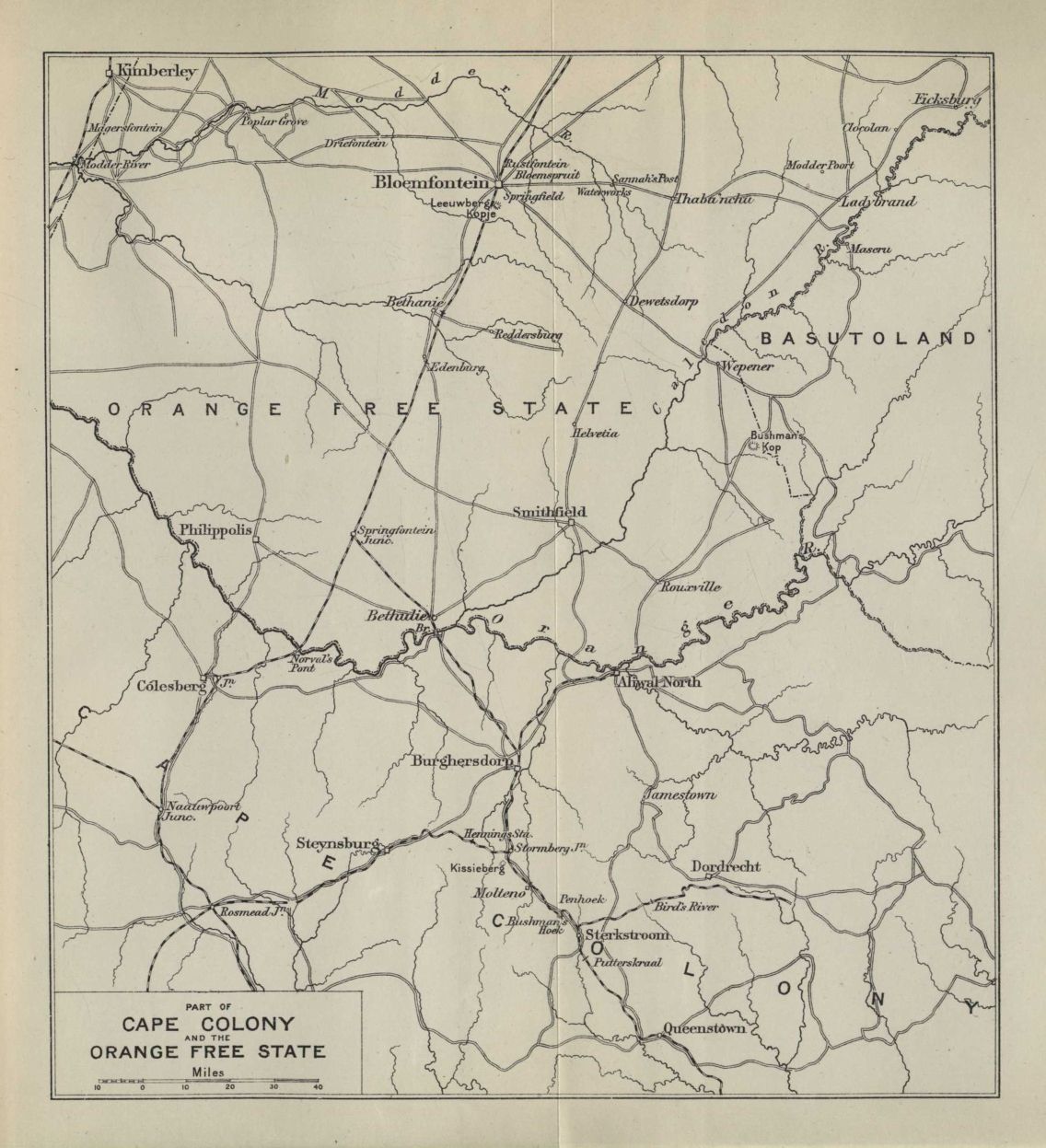
"The result of these movements was that in falling back these companies were surrounded east of Reddersburg and, being without food or water, were eventually compelled to surrender. For this result I must hold Lieut.-General Gatacre responsible. Dewetsdorp is some forty-five miles by road east of the railway on which the mass of the troops were stationed, and is therefore a position in which a small force is much isolated and might be in great danger if attacked. It appears, however, that Lieut.-General Gatacre ordered two companies mounted infantry and three companies Royal Irish Rifles to Dewetsdorp on his own responsibility, and failed to give me the information I asked for as to what he could do with the troops at his disposal as regards holding the place, which, if supplied, would have enabled me to judge of its adequacy or otherwise, and therefore whether Dewetsdorp should or should not be occupied. The small force he actually sent was entirely incapable of holding its own so far from sufficient force, and being partly composed of infantry was unable to move rapidly when a retirement became necessary. I consider that in thus isolating a small detachment, Lieut.-General Gatacre has shown a grave want of judgment which must necessarily shake the confidence of those under his orders and have a bad effect on the moral of his troops. I am therefore unable to retain him in command of his division and have given orders for his relief and return to England.
"ROBERTS, Field-Marshal"
"BLOEMFONTEIN, "April 16, 1900."
INDEX
Addis Abeba, Abyssinia: W. F. G. starts for, Nov. 1905, 278 Adjutant-General Bombay Army. See Staff Services. Aldershot: W. F. G. serves there as D.A.Q.M.G. in 1879, 37 serves as G.O.C. Third Infantry Brigade, 1897, 184 Aldershot Conservative Club: telegram of welcome from, 1900, 264 Allahabad: W. F. G. quartered there, 1862, 14 Allen, Colonel E., R.I.R., withdraws detachments to Aliwal North, 258 Aliwal North, O.F.S.: headquarters of Colonial Corps, 1900, 244 Appointments held by W. F. G. See Staff Services and War Services. Arnott, Colonel James: recollections of 1894, 121 Assault-at-Arms, Bombay, 1894, 122-5 Atbara: events leading to engagement on banks of, 1898, 199-202 battle of, April 8, 1898, 203-6 Aylmer, Maj.-Gen. F. J., V.C., C.B.: served with Royal Engineers on Chitral Relief Force, 1895, 131 Baird, Captain A. McD.: killed during siege of Chitral, 1895, 141 Bannu: letter written from, by W.F.G. while on tour, 1887, 67 Barnardiston, Col. N. W., M.V.O., adjutant to 77th Regt.: recollections of, 55-9 Battye, Col. L. R., 5th Goorkhas, killed near Oghi, 1888, 73 Beluohistan. See Quetta, Fort Sandeman, etc. Bengough, Maj.-Gen. Sir Harcourt, K.C.B., late Middlesex Regt.: recollections of, 15 Bethulie Bridge: saved by scouts of Third Division, 241 removal of explosives by W. F. G. and Lieut. Grant, R. E., March, 1900, 241 Black Mountain Expedition, or Hazara Field Force, 1888, 72-81 Tribes: historical sketch of, 71-2 Bloemfontein, O.F.S.: occupied by F.-M. Lord Roberts, March, 1900, 240 garrison of, April 1900, 249 W. F. G. proceeds to, for interview of, April 2, 1900, 254 Bolan-Mushkaf Railroad: first mail train Nov. 30, 1896, 160 Bombay: W. F. G. commands mil. district, 1894, 110-26 testimonials by citizens of, 182 Boots: unsatisfactory nature of, Egypt, 1898, 190 Brabant, Maj.-Gen. Sir E. Y., K.C.B., commanding Colonial Corps, South Africa, 1899, 240 headquarters of, at Aliwal North, 244 his detachment at Wepener to be reinforced, March 1900, 250 sends waggons to meet infantry detachments, 258 Broadwood, Maj.-Gen. R. G., C.B., A.D.C.: operations near Thaba' Nchu, 252 at Sannah's Post, 253 Brooke, Bt.-Lieut.-Col. R. G., D.S.O.: Orderly Officer Third Brigade, Chitral Relief Force, 1895, 142 A.D.C. to W. F. G. in Egypt, 1898, 188 Brooke, Robert, of Madeley Court: effigy of, in Claverley Church, 4 Browne, Col. H. L., late 77th Regt, : recollections of, 29 Buffs, the, 1st Batt. East Kent Regt.: form part of Third Brigade Chitral Relief Force, 1895, 129 Buller, Gen. Sir Redvers, V.C., G.C.B., etc: sent to the Cape in command of Army Corps, Oct. 1899, 220 dispositions made on arrival, 221 telegrams sent for W. F. G.'s guidance, 223 suggests night attack, 227 approves unsuccessful attempt on Stormberg, 237 anxious position of, Dec. 1899, 239 relieves Ladysmith, March 1900, 240 Bullets: unsatisfactory nature of, Egypt 1898, 191 Burma, Lower: historical sketch of, 43-4 Upper: under Mindon-min and King Theebaw, 44 annexed by Proclamation, Jan. 1, 1886, 84 Cambridge, H.R.H. the Duke of, K.G., G.C.B., etc.: Memorial Service to, March 22, 1905, 276 Cameron Highlanders: 1st batt. in Egypt, 1898, 187 march on Reddersburg, April 1900, 255 Camp of Exercise, at Bangalore, 1884, 53 at Delhi, 1885, 63-4 Cape Colony: W. F. G. sent to reassure eastern portion of, Oct. 1899, 221 invasion by Boers, Nov. 1899, 224 Channer, Lt.-Gen., V.C., C.B.; commanding No. 1 Column, Hazara Field Force, 1888, 75 occupies Thakot, 80 Chapman, Gen. Sir Edward, K.C.B.: Q.M.G. India, 1885, 64 Chermside, Hon. Lt.-Gen. Sir H. C., G.C.M.G., K.C.B., takes over command, of Third Division, South Africa Field Force, 1900, 259 Chitral Relief Force: See Chapter IX., 127-44 W. F. G. to command Third Brigade, March 1895, 128 advance over the Lowari Pass, 134-40 reaches Chitral Fort, 141 Churchill, the Right Hon. Winston Spencer, author of The River War, cited, 202, 209 Clarke, Gen. Sir Charles Mansfield, G.C.B., G.C.V.O.: Director of manoeuvres on Salisbury Plain, 1899, 218 Claverley: church of, ancient tombs therein, 4 Manor of, mentioned in Domesday Book, 1 Clements, Maj.-Gen. R. A. P., C.B., D.S.O.: commanding brigade on Salisbury Plain, 1899, 218 orders given to, re Norval's Pont Bridge, 242 Colchester: headquarters of Eastern District; W. F. G. takes up command, Dec. 1898, 216 departs for South Africa, Oct. 1899, 219 resumes command, May 1900, 262 hands over, Dec. 1903, 271 Colenso: battle of, Dec. 1899, compared with attempt on Stormberg, 236 Colville, Maj.-Gen. Sir Henry, K.C.B., 253 Connaught, H.R.H. the Duke of, K.G., G.C.B., etc.; at Aldershot, 1874, 34 Crosthwaite, Sir Charles, K.C.S.I.: Chief Commissioner, Burma, 1887, 87 report on administration by, cited, 90 Dacoity: difficulties of suppression, 85 Decorations worn by W. F. G.: D.S.O., 1889 C.B., 1895 Jubilee, 1897 K.C.B., 1898 Order of the Medjidieh, 2nd class, 1898 Kaiser-i-Hind Gold Medal, 1900 Coronation Medal, 1902 War Medals: Indian Frontier, 2 clasps. Chitral 1895, 1 clasp. British Soudan. South Africa, Queen's medal, 2 clasps. Egyptian Soudan, 2 clasps. Delhi: Camp of Exercise at, 1884, 63-4 Deputy Assistant Quartermaster-General, Aldershot, 1879. See Staff Services. Deputy Quartermaster-General, India, 1885. See Staff Services Derbyshire Regt.: with Third Division in South Africa, 1900, 237 called up to headquarters, 245 Dewetsdorp: telegram regarding occupation of, March 1900, 246 geographical position of, 247 party of occupation strengthened, 248 arrival of detachment, 251 anxiety about safety of detachment, 255 Dimmock, Col. H. P., M.D., I.M.S.: recollections of, 1897, 167 Dufferin and Ava, First Marquess of, Viceroy of India, 1885, 63 receives Freedom of the City of Edinburgh, 1898, 215 Eager, Lieut.-Col., R.I.R.; mortally wounded at Stormberg, 1899, 233 East London, C.C.: W. F. G. disembarks at, Nov. 1899, 222 Elles, Lieut.-Gen. Sir Edmond, G.C.I.E., K.C.B.: serves with Hazara Field Force, 1888, 76 Egypt: campaign of 1898. See Chapters XII., XIII., 186-213 Eyton, R. W.: author of Antiquities of Shropshire, cited, 1-3 Forbes, William, Esq., of Callendar: maternal grandfather to W. F. G., 7 William, son of above, M.P. for Stirlingshire, 7 Jessie, sister to above: married Edward Lloyd Gatacre, Esq.; mother of W. F. G., 7 Forced march on Berber, Feb. 1898, 191-7 Forestier-Walker, Gen. Sir Frederick, G.C.M.G., K.C.B.: commanded Lines of Communication, South Africa, 1899, 222 Fort Sandeman: official visit to, 1896, 150 murderous outrage at, 1896, 151 Franco-Prussian War: W. F. G. visits battlefields, 1870, 30 Free Lance, steeplechase pony, Rangoon, 1882, 50 French, Gen. Sir John, G.C.V.O., K.C.B., etc.: operations round Colesberg, C.C., 1899, 225 operations round Thaba 'Nchu, O.F.S., 1900, 252 Fryer, Sir Frederick, K.C.S.I.; Financial Commissioner, Burma, 1888, 89 Galbraith, Maj.-Gen. Sir William, K.C.B.: commanding the River Column, Hazara Field Force, 1888, 74 hands over Quetta District to W. F. G., while on leave for eight months, 1896, 148 Gambela, Abyssinia: visited by W. F. G., 1906, 280 W. F. G. buried at, 1906, 281 Gatacre, feoffment held by royal grant, 2 house at, curious specimen of domestic architecture, 5 township of, 1 Gatacre, ancestors and others, as named in text, in chronological order: Sir William de, suit subject to Wager of Battle, 2 Sir Robert de, sat on jury, Grand Assizes, 1200, 2 Sir Thomas de, estate escheated unjustly, 1368, 3 Alice, his wife, appeals to King in Chancery, 3 John, Groom of the Body to Henry VI.: High Sheriff of Shropshire, 1409, 3 John, son of above, M.P. for Bridgnorth, 12th year of Edward IV., 3 William, died 1577, interesting monument in Claverley Church, 4 Francis, died 1599, his son, similar tablet, 4 Thomas, brother to above, died 1593, distinguished divine, 4 Thomas, his son (1574-1654), member of Westminster Assembly, 4 Colonel Edward (1768-1849), grandfather to W. F. G., 6 Edward Lloyd, Esq., the Squire (1806-1891), father of W. F. G., 6 he died, Nov. 1891, 107 Gatacre, Maj.-Gen. Sir John, K.C.B., late Indian Army: leaves home for India, 1867, 9 serves in Burma, 1885, 81 G.O.C. Nagpur District, 1891, 103 Gatacre, William Forbes: For career of, see Promotions, Staff Services, War Services, and Decorations Ghazis: Marri outrage at Sunari Station, Beluchistan, 1896, 155 W. F. G. conducts search-party, 156 Goorkhas, 2nd batt. 4th Goorkha Rifles, part of Third Brigade Chitral Relief Force, 1895, 129 Gordon, Gen. Charles, C.B.: fall of Khartoum, 1885, 187 Memorial Service to, Sept. 1898, 212 Graham, Maj.-Gen. Sir Thomas, K.C.B.: re Sikkim, 1888, 68 Grant, Major P. G., R.E.: removes explosives from Bethulie Bridge, 1900, 241 Grant, Sir Francis, P.R.A., portrait by, 6 Greaves, Gen. Sir George, G.C.B., K.C.M.G.: C.-in-C. Bombay Army, 1890, 96 in railway accident, 1891, 105 Hamilton, Gen Sir Ian, K.C.B., D.S.O.: commanding a Brigade on Salisbury Plain, 1899, 218 Hardinge, Gen. the Hon. Sir Arthur, K.C.B.: C.-in-C. Bombay Army, 1881, 40 visits W. F. G. in camp, 1884, 54 Harris, Lord, G.C.S.I., etc.; Governor of Bombay, 1890, 108 Hazara Field Force, 1888: W. F. G. as A.A. and Q.M.G., 70-81 Hazaribagh, Bengal: W. F. G. joins 77th Regt. at, 1862, 14 Hemis, monastery at. See Kashmir Herbertshire Castle, Stirlingshire: W. F. G. born at, Dec. 3, 1843, 7 Hudson, Gen. Sir John D., K.C.B.: his death while C.-in-C. Bombay Army, 107 Idlibi, Syrian trader and interpreter, with W. F. G. in Abyssinia, 1905, 279 gives evidence, 1906, 281 returns to England, June 1906, 282 Iolanthe: performed by officers, 77th Regt., 1883, 51 Kamptee, headquarters of Nagpur District: railway accident near, 1891, 103 Kashmir: W. F. G. takes trip to, 1867, 17 crosses the Zoji-La to Leh, 19 visits Hemis, 20 sees Burra Lama, 22 visits Skardo, 25 Kelly, Col. J. G., C.B.: advances from Gilgit, 1895, 129 raises the siege of Chitral, 1895, 134 on parade at Chitral, 141 Kent, Gen. Henry, C.B., late 77th Regt.: at Allahabad, 1862, 14 at Aldershot, 1874, 34 Keyes, Gen. Sir Charles, K.C.B.: commanding First Division, Bangalore Camp of Exercise, 1884, 53 Khaim Gali: headquarter camp on Black Mountain, 1888: W. F. G. marched from Khaim Gali to Indus and back, 75-8 Kitchener, Gen. Viscount, G.C.B., etc.: Sirdar of Egyptian Army, 1898, 187 orders advance of British Brigade, 192 sends trophies to W. F. G., 206 receives Freedom of City of Edinburgh, 1898, 215 appointed C.S.O. to F.-M. Lord Roberts, 1899, 239 Kunhar: headquarters of River Column, Hazara Field Force, 1888, 75 Ladak, Leh. See Kashmir. Lahore: Durbar at, 1894, 120 Leach, Col. H. P., C.B., D.S.O.: Mil. Sec. to C.-in-C., Bombay; in railway accident, 1891, 106 with Sir John Hudson, 1893, 107 Leeuwberg Kopje, O.F.S.: batt. of infantry called up to, 1900, 250 Leir-Carleton, Maj.-Gen. R. L.: Master of Staff College Draghounds, 1873, 35 Lincolnshire Regt., 1st Batt.: in Egypt, 1898, 193 Lorelai, Beluchistan: official visit to, 150 display by 15th Bengal Lancers, 1896, 151 assassination of Col. Gaisford, 152 Low, Gen. Sir Robert, G.C.B.: commanding Chitral Relief Force, 1895, 128 dispatches quoted, 131-2 parade at Chitral, 141 Lowari Pass: description of, 135 Lyttelton, Gen. Sir Neville, G.C.B., in Egypt, 1898, 208 Magersfontein, battle of: compared with attack on Stormberg, 1899, 236 Mahmoud, Dervish Emir: advance of, 1898, 197 defeat and capture of, 202 Malakand Pass: action during advance on Chitral, 1895, 128 Mamugai: action during advance on Chitral, 1896, 131 Mandalay: visited by W. F. G. in 1882, 46 W. F. G. officiates in command of brigade, 1889, 86-97 Manser, Surgeon-Major Robert: died of plague, 1897, 163 Marris: outrage at Sunari Station, 1896, 155 Maymyo, Upper Burma: W. F. G. makes flying visit to, 1890, 89-90 McQueen, Lieut.-Gen. Sir John, G.C.B.: commanding Hazara Field Force, 1888, 74 Memour Mehined Riad Effendi: Egyptian officer at Gambela, 1906, 280 holds court of inquiry there, 281 Methuen, Gen. Lord, G.C.B., etc.: marches to the relief of Kimberley, 221 Middlesex Regt. See Seventy-seventh. Military Secretary: W.F.G. as. See Staff Services Nairne, Gen. Sir Charles, G.C.B.: C.-in-C. Bombay Army, 1893, 109 telegram of congratulation from, 1896, 148 Napier, Gen. Sir Robert, G.C.B., etc.: Mil. Member of Council, 1862: story of French Eagle, 14 Northumberland Fusiliers: at Stormberg, 1899, 232 M.I. Company sent to Dewetsdorp, 1900, 248 Norval's Pont Bridge: telegram regarding tenure of, 1900, 242 Norwich: Royal visit to, 1900, 265 Official History of the War in South Africa, 1899 quoted as under: account of attack on Stormberg, Dec. 1899, 231-3 justification for ditto, 236 re deliberation of Gatacre's movements, 242 telegram ordering occupation of Smithfield, 244 telegram regarding occupation of Dewetsdorp, 246 marginal note re above cited, 247 telegram re movements of units of the Third Division, 248 arrival of detachment at Dewetsdorp, 251 results of action at Sannah's Post, March 31, 1900, 253 cautionary telegram to W. F. G., 256 situation subsequent to Sannah's Post, 259 Omdurman: capture of, Sept. 2, 1898, 209 letter describing same, 209-12 Panjkora River: rescue of Private Hall, 1895, 131 Pembroke Dock: W. F. G. with Depot Batt. there, 1868, 29 Pig-sticking: while Mil. Sec., 1881, 41-2 near Cutch-Bhuj, 1896, 146-8 Pilcher, Maj.-Gen. T. D., C.B.: operations round Ladybrand, 1900, 252 Plague, bubonic, at Bombay, 1897: See Chapter XI., 161-83 total mortality from, 161 cause of Surgeon-Major Manser's death, 163 subject of two anonymous articles by W. F. G., 164 appointment of Plague Committee, 166 policy instituted by above, 168 incidents of house-to-house visitation, 171-5 opposition of Sunni Mahommedans, 177 President of Poona Committee shot, 181 Pole-Carew, Lt.-Gen. Sir Reginald, K.C.B., C.V.O.: movements and recommendations of, March 1900, 242 Poona: W. F. G. as Adjutant-General there, 1890. See Chapter VII., 98-109 outrage after Queen's birthday dinner, 1897, 181-3 Prendergast, Gen. Sir H. N. D., V.C., G.C.B.: commanding Burmese Division, 1882, 43 commanding Second Division Bangalore Camp of Exercise, 1884, 53 asks for W. F. G. as Special Service Officer, 1885, 61 account of his expedition to Mandalay, 1885, 82-4 Promotions: William Forbes Gatacre: gazetted Ensign 77th Foot, Feb. 18, 1862 Lieutenant 77th Foot, Dec. 23, 1864 Captain 77th Foot, Dec. 7, 1870 Major Middlesex Regt., March 23, 1881 Lieut.-Col. Middlesex Regt., April 23, 1884 Colonel, April 29, 1886 Colonel substantive, Nov. 25, 1890 Major-General, June 25, 1898 retired March, 1904 Punjab Infantry, 25th Regt.: part of Third Brigade Chitral Relief Force, 1895, 129 Putter's Kraal, C.C.: W. F. G. advances to, Nov. 1899, 225 Quetta: visits while on tour as D.Q.M.G., 1887, 66 W. F. G. officiates in command of District, 1896, 145-60 Rangoon: history of occupation of, 43-4 W. F. G. quartered there as A.Q.M.G., 1882, 43 Reddersburg, O.F.S.: surrender near, April 1900, 257 Remount Department: W. F. G. temporarily works for, 1903, 273-6 River War, The: by the Right Hon. W. S. Churchill, quoted as under: re efficiency of British Brigade Egypt, 1898, 190 re assault of zariba by above, 202 re position of G. O. C., cited, 202 Roberts, Field-Marshal Earl, V.C., K.P., G.C.B., etc.; visits W. F. G. in camp at Bangalore, 54 becomes C.-in-C. India, 1885, 63 his covering letter to Dispatches (pubd. March 1900), cited, 235 reaches Capetown as C.-in-C. South African Field Force, 239 telegram to W.O. re Proclamation, 243 orders occupation of Smithfield, 244 orders occupation of Wepener, 245 telegram re occupation of Dewetsdorp, 246 summons W. F. G. to Bloemfontein, and forecasts his plans for the advance, 254 expresses anxiety about the detachment at Dewetsdorp, 255 sends 5 cos. Cameron Highlanders to Bethanie, 255 orders the return of the Relief Column from Reddersburg, 257 sends official letter instructing W. F. G. to proceed to England, April 1900, 259 quotation from private letter re recall, 263 his official visit to the Eastern District, 1903, 270 Robertson, Sir George Scott, K.C.S.I., M.P.: defended the Fort at Chitral, 129 Royal Irish Rifles, 2nd Batt.: reaches Queenstown, C.C., 222 quotation from officers' reports re Stormberg, 233, 235 sent to Smithfield, O.F.S., 245 2 cos. pushed on to Dewetsdorp, 248 the O.C. directed to retire on Reddersburg, 251 column surrenders at Mostert's Hoek, 257 splendid marching by detachments from Smithfield, Helvetia, and Rouxville, 258 Royal Military College, Sandhurst: W. F. G. there as cadet, 1860, 12 W. F. G. there as professor, 1875, 36-7 "Run amok": W. F. G. attempts to disarm man with pistol at Simla, 1887, 69 letter re above, 213 Rundle, Lieut.-Gen. Sir Leslie, K.C.B., K.C.M.G.: commanding a Division on Salisbury Plain, 1899, 218 Salisbury: W. F. G. works there on remount duty, 1904, 275 bicycles to and fro, 275 Salisbury Plain: W. F. G. commands a Division, 1899, 217-18 Chief Umpire, Blue Army, 1903, 271 Salt Lakes, Bupshu. See Kashmir Sandhurst. See Royal Military College Sandhurst, Lord, G.C.I.E. etc.: Governor of Bombay, 1895, 164, 166, 180 Sannah's Post, O.F.S.; engagement at, 1900, 251 material results of engagement at, 253 change brought about by engagement at, 259 Seaforth Highlanders: 1st Batt. in Egypt, 1898, 188 2nd Batt. in Chitral, 1895, 129 Seton, Col. H. J.: wounded at Stormberg, 1899, 233 Seventy-seventh Regt., afterwards 2nd Batt. (D.C.O.) Middlesex Regt.: raised 1787, 13 services and movements of, 14 at Hazaribagh, Allahabad, Barreilly, and Peshawur, 14-17 reaches Portsmouth, 1870, 29 leaves Dover for Rangoon, 1880, 38 moves to Secunderabad, 1883, 51 W. F. G. in command, June 1884 to Dec. 1885, 55-61 Shaw, F. B., Esq.: Resident at Mandalay, 1879, 46 Sikkim: W. F. G. sketches Fort at Lingtu, 1887, 68 Simla: W. F. G. and the servant "run amok, " 1887, 69 rapid ride to Umballa and back, 1887, 70 Sirdar, the: See Kitchener Sniping: during advance on Chitral, 1895, 143-4 Snow, Brig.-Gen. T. D'O., C.B.: Brigade-Major, Egypt, 1898, 186 South African War Commission, Report of, quoted, 247 and again, 270 Springfontein, O.F.S.: occupied by Third Division troops, 241 troops at, April 3, 1900, 40 scouts and 25 M.I., 255 Staff College, Camberley: W. F. G. admitted, 1873, 33 Drag-hounds, W. F. G. as First Whip, 34 Staff Services, W. F. G.: Instructor in Surveying, B.M.C., 1875, 36 D.A.A. and Q.M.G. Aldershot, 1879, 37 A.A.G. (officiating) Secunderabad, 1880, 39 Mil. Sec. (officiating) to C.-in-C. Bombay, 1881, 40 A.Q.M.G. (officiating) Rangoon, 1882, 43 D.Q.M.G., Bengal, 1885, 61-97 G.O.C. (officiating), Mandalay, 81-96 A.-G. Bombay, 1890, 98-109 G.O.C. Bombay, 1894, 110-82 G.O.C. (officiating), Quetta, 1896, 148-60 G.O.C. Third Infantry Brigade, Aldershot, 1897, 184-6 G.O.C. Eastern District, 1898, 216-71 Stormberg, C.C.: Sir R. Buller suggests advance to, 223 occupied by Boers, Nov. 1899, 224 W. F. G. makes arrangements for the attack, 229 description of the advance and assault, Dec. 10, 1899, 231-5 casualties, 235 compared with Magersfontein and Colenso, 236 Sunari Station, Beluchistan: outrage at, 1896, 155 Supya-lat, wife to King Theebaw, 45 deported, 1885, 84 Swann, Brig.-Gen. J. C., C.B.: A.A.G. to W. F. G. while commanding Bombay district; letter re procedure quoted, 115 recollections of, 119 Thaba 'Nchu, O.F.S.: Sir John French's operations near, 247 movements of troops preceding Sannah's Post, 251 Theebaw, King of Burma: succeeds Mindon-Min, 1879, 44 as owner of "Free Lance" (?), 50 surrender of Mandalay, 1885, 83 "Times" History of the War, quoted, as under: re Col. Pole-Carew's movements, 1900, 243 re telegram about spreading proclamations, 244 re Col. Broadwood's position at Thaba 'Nchu, 252 Transport officer, the: at Mandalay, 88-89 Transport Service, the: P. and O. vessels, 122-5 Toba Plateau, Beluchistan: Camp of Exercise at, 1896, 153 Ton-Hon Expedition, 1889, 90-92 Tournament at Bombay, 1894, 122-5 Umballa: rapid ride from Simla, and back, 1887, 70 War Services, W. F. G.: Hazara Field Force, 1888, as A.A. and Q.M.G., 70-81 Ton-Hon Expedition, 1889 as Brig.-Gen., 90-92 Chitral Relief Force, 1895, G.O.C. Third Brigade, 128-44 Egypt, advance on Khartoum, 1898, G.O.C. commanding British Brigade and (subsequently) Division, 186-213! South African Field Force 1899, G.O.C. Third Division, 219-60 Warwickshire Regt. (Royal): 1st Batt. in Egypt, 1898 Wauchope, Maj.-Gen. Andrew. C.B., C.M.G.; commanding First Brigade, Egypt, 1898, 208 his brigade sent forward, 211 Wepener, O.F.S.: telegram ordering occupation of, March 1900, 245 W. F. G.'s anxiety as to safety of detachment, 246 besieged by Boers, 258 de Wet, Christian, Boer General; lays his plans for capture of Waterworks guard, March 1900, 252 value of his victory at Sannah's Post, 253 White, F.-M. Sir George, V.C., G.C.B., etc.: in Burma, 1885, 85 entertains W. F. G. at Lahore, 1894, 120 appoints W. F. G. to command Third Brigade, Chitral Relief Force, 1894, 128 letter from, re Marri Raid, 1896, 159 starts for Natal, Sept. 1899, 219 at Ladysmith, 221 relief of Ladysmith, 240 Wolseley, Gen. Sir George, G.C.B.: commanding Mandalay Brigade, 86 returns to his command, 96
Printed by Hazell, Watson & Viney, Ld., London and Aylesbury.
********
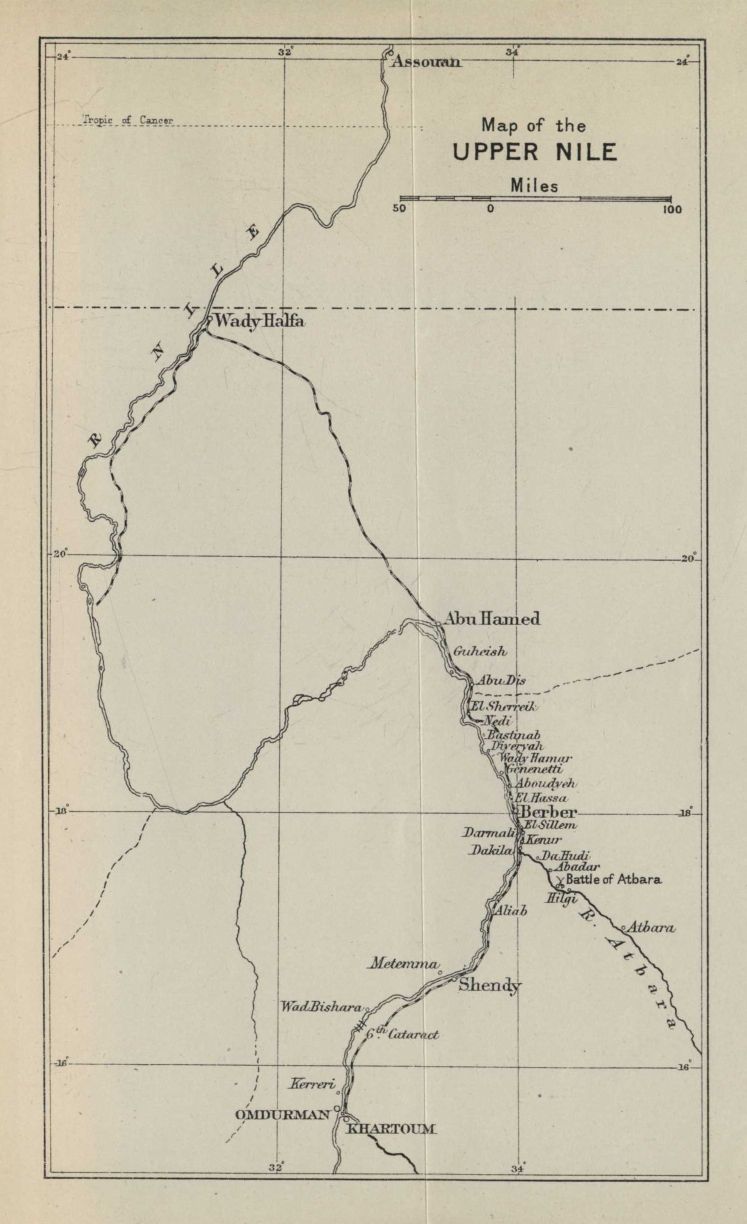
Map of the UPPER NILE
Part of CAPE COLONY and the ORANGE FREE STATE
Map of THE SOUDAN & ABYSSINIA
THE MILITARY MEMOIRS OF LIEUT.-GEN. SIR JOSEPH THACKWELL, G.C.B., K.H., Colonel 16th Lancers.
Arranged from Diaries and Correspondence by Colonel H. C. Wylly, C.B. With Portraits, Maps, and other Illustrations. Demy 8vo. 15s. net.
"The Memoirs of this fine old soldier, whose lot it was to see a vast amount of very hard fighting in many notable campaigns, are of quite exceptional interest.... Not only well worth reading on account of its general interest, but from which there is a very great deal to be learned."—United Service Magazine.
A MARINER OF ENGLAND. An Account of the Career of William Richardson from Cabin-Boy in the Merchant Service to Warrant Officer in the Royal Navy (1780 to 1817), told in his own words. Edited by Colonel Spencer Childers, R.B., C.B. Demy 8vo. 10s. 6d. net.
"Worth a dozen of the ordinary memoirs with which the market is flooded. For it is a genuine human document, a revelation of the thoughts and doings of a typical English sailorman during the most stirring years in our naval history.... We have found the book delightful reading."—Spectator.
"... Such excellent stuff, and in such racy, straightforward English ... uncommonly good reading. It makes us think of some of Captain Marryat's pictures of what they did at sea in the brave days of old."—Standard.
TWO ADMIRALS: SIR FAIRFAX MORESBY, G.C.B. (1786 to 1877), and his son, JOHN MORESBY. A Record of Life and Service in the British Navy for a hundred years. By Admiral John Moresby. Illustrated. Demy 8vo. 14s. net.
"This deeply interesting and delightfully entertaining volume."—Daily Telegraph.
"One of the most entertaining and instructive books in modern naval literature.... In every line the book smacks of the sea and of the breezy nature of the British sailor."—The Globe.
THE LIFE OF ADMIRAL SIR LEOPOLD MCCLINTOCK. By Sir Clements Markham, K.C.B., F.R.S With Maps and Illustrations. Demy 8vo. 15s. net.
"No living sailor was so worthy to be the biographer of Sir Leopold McClintock as Sir Clements Markham.... Sir Clements Markham has written with much of the simplicity and reserve of the great explorer himself. Never for a moment does he diverge from quiet narrative ... it is an inspiring record of one who did his duty as he saw it, and found the path to fame by his own fine qualities of character."—Westminster Gazette.
THE LIFE OF MAJOR-GENERAL SIR CHARLES W. WILSON, Royal Engineers. By Colonel Sir Charles M. Watson, K.C.M.G., C.B., R.E., M.A. With Illustrations. Demy 8vo. 15s. net.
"There is a most interesting account of the circumstances of the time in this admirable biography, and those who would know the true story of the failure to relieve Gordon should by all means read it. He was a good soldier and a good man, and we are glad to commend this biography to soldiers who know how to appreciate the service that men like Sir Charles Wilson render to their country."—Army and Navy Gasette.
THE LIFE OF MAJOR-GENERAL SIR JOHN ARDAGH. By His Wife, Susan, Countess of Malmesbury (Lady Ardagh). With Illustrations. Demy 8vo. 15s. net.
"... Lady Malmesbury has written her husband's life with rare discrimination and reticence ... exhilarating record of a splendidly strenuous life ... an admirable record of the work of a great servant of the State and it should be in the hands of every young soldier."—Athenaum.
THE LIFE AND LETTERS OF SIR JAMES GRAHAM, 1792-1861. First Lord of the Admiralty in the Ministries of Lord Grey and Lord Aberdeen, and Home Secretary in the Administration of Sir Robert Peel. By Charles Stuart Parker, Editor of "Life of Sir Robert Peel." With Portraits and other Illustrations. Two Vols. Demy 8vo. 24s. net.
LORD DUNRAVEN'S THE OUTLOOK IN IRELAND. The Case for Devolution and Conciliation. Demy 8vo. 7s. 6d. net.
LORD MILNER'S WORK IN SOUTH AFRICA. From its Commencement in 1897 to the Peace of Vereeniging in 1902. Containing hitherto Unpublished Information. By W. Basil Worsfold. With Portraits and a Map. Demy 8vo. 15s. net.
FURTHER MEMOIRS OF THE WHIG PARTY, 1807-21. By Henry Richard Vassall, 3rd Lord Holland (1773-1840). With which is Incorporated a Chapter termed "Miscellaneous Reminiscences." Edited by Lord Stavordale, Editor of "The Letters of Lady Sarah Lennox." With Portraits. Demy 8vo. 18s. net.
LENNOX, LADY SARAH, THE CORRESPONDENCE OF. 1745-1826. Edited by the Countess of Ilchester and Lord Stavordale. With Photogravure Frontispiece and other Illustrations. One Vol. 10s. 6d. net.
THE HATZFELDT LETTERS. Letters of Count Paul Hatzfeldt to his Wife, written from the Headquarters of the King of Prussia, 1870-71. Translated from the French by J. L. Bashford, M.A. With Illustrations. Demy 8vo. 15s. net.
CHARLES JAMES FOX. A Commentary on his Life and Character. By Walter Savage Landor. Edited by Stephen Wheeler. With Photogravure Portrait. Demy 8vo. 9s. net.
THE FIRST BRITISH AMBASSADOR TO CHINA.
THE LIFE AND CORRESPONDENCE OF GEORGE FIRST EARL MACARTNEY, 1737-1806. From hitherto Unpublished Correspondence and Documents. By Mrs. A. G. Robbins. With Portraits and other Illutrations. Demy 8vo. 16s. net.
MOLTKE IN HIS HOME. By Friedrich August Dressier. Authorised Translation by Mrs. C. E. Barrett-Lennard. With an Introduction by Lieut.-General Lord Methuen. With Illustrations. Demy 8vo. 6s. net.
This does not attempt to give a biography of the great Field-Marshal, but contains a series of sketches and incidents of his life, and of the characteristics and surroundings of one of the greatest soldiers of the nineteenth century.
NELSON'S HARDY. His Life, Letters, and Friends. By A. M. Broadley and the Rev. R. G. Bartelot. Many Illustrations and Portraits, 10s. 6d. net.
"A record of the beautiful human friendship which existed between the two men, and should be read by everybody interested in one of England's greatest heroes and in the historical incidents of his time."—The Tatler.
"The importance of this Life and Letters of Hardy is undeniable.... That Hardy is worthy of a complete biography is undoubted, and this book is a desirable possession to all who care for England's naval glories."—Daily Chronicle.
LETTERS FROM THE PENINSULA (1808-1812). Written by Lieut.-General Sir William Warre, C.B., K.T.S. Edited by the Rev. Edmond Warre, D.D., C.B. With Portrait and Map. Demy 8vo. 10s. 6d. net.
"If we wanted to choose the sort of testimony that would make the circumstances of a well-known campaign more real to us than ever before, we should undoubtedly choose the private letters of an officer to his friends.... We advise the general reader to try William Warre's letters. They will find revealed in them a stout and loyal heart, and a careful and intelligent mind which had a singular ability for discerning the drift and significance of things."—Spectator.
A WEEK AT WATERLOO IN 1815. Lady De Lancey's Narrative. Being an account of how she nursed her husband, Colonel Sir William H. De Lancey, mortally wounded in the great battle. With Photogravure Portraits and other Illustrations. Square crown 8vo. 6s. net.
"A vastly interesting human document.... We need not trouble to praise where Sir Walter Scott and Charles Dickens have so fervently belauded."—Daily Telegraph.
"Pages of writing of terrible beauty, subtlety, delicacy, and power describe her nursing of him and his death. It is not a jagged series of poignant notes.... There is no heroine in English history or literature more worshipful than Lady De Lancey."—World.
THE BOOK OF WAR. Translated into English by Captain E. F. Calthrop, R.A. Crown 8vo. 2s. 6d. net.
This work, the writings of Suntzu and Wutzu, Chinese Strategists of about the 5th century B.C., is the most famous work on the art of war in the Far East. It deals with operations of war, statecraft, moral and training of troops, stratagem, the use of spies, etc., and for 25 centuries it has been the Bible of the Chinese or Japanese ruler. The book is distinguished alike by the poetry and grandeur of its language and the modernity of its spirit.
THE LETTERS OF QUEEN VICTORIA. A Selection from Her Majesty's Correspondence between the Years 1837 and 1861. Published by Authority of His Majesty the King. Edited by Arthur Christopher Benson, MLA., C.V.O., and Viscount Esher, G.C.V.O., K.C.B. With numerous Photogravures. Medium 8vo. Three Vols. £3 3s. net. Also Crown 8vo. Three Vols. 6s. net.
FOURTEEN YEARS IN PARLIAMENT, 1892 TO 1906. By A. S. T. Griffith-Boscawen, formerly M.P. for the Tonbridge Division of Kent. Demy 8vo. 10s. 6d. net.
LIFE OF THE MARQUIS OF DUFFERIN AND AVA. By Sir Alfred Lyall, P.C. Third Impression. With Portraits, etc. Demy 8vo. Two Vols. 36s. net.
THE DUKE OF ARGYLL, 1823-1900. Comprising his Autobiography down to 1857, and his Life from that Date onwards, based on his Correspondence and Diaries. Edited by the Dowager Duchess of Argyll. With Portraits and other Illustrations. Two Vols. Medium 8vo. 36s. net.
LIFE OF SIR ROBERT PEEL. Based on his Correspondence and Private Documents. Edited by Charles Stuart Parker. With a Summary of Peel's Life by his Grandson, the Hon. George Peel. With Portraits. Three Vols. Demy 8vo.
VOL. I. FROM HIS BIRTH TO 1827. 16s. VOLS. II. AND III. FROM 1827 TO HIS DEATH IN 1852. 32s.
THE CREEVEY PAPERS. A Selection from the Diaries and Correspondence of Thomas Creevey (1768-1838) from Family Papers hitherto unpublished. Edited by the Rt. Hon. Sir Herbert Maxwell, Bart., M.P. With Portraits. One Vol. Demy 8vo. 10s. 6d. net.
SIDNEY HERBERT (LORD HERBERT OF LEA). A Memoir. By Lord Stanmore. With Portraits and other Illustrations. Two Vols. Demy 8vo. 24s. net. No Life of Sidney Herbert has hitherto been published.
THE LIFE AND LETTERS OF GEORG JOACHIM GOSCHEN, 1752-1829. By Viscount Goschen. With Portraits and Illustrations. Demy 8vo. 36s. net.
NELSON AND OTHER NAVAL STUDIES. By James R. Thursfield. With Illustrations. Demy 8vo. 12s. net.
"Few other writers except Mahan possess Mr. Thursfield's faculty of combining the romance of the sea with the science of naval warfare, and in both alike the cult of Nelson gives life and warmth to their studies.... The merit of Mr. Thursfield's writing is the firm hold which he has of the central principles of a maritime defensive policy. His writing is effective, and at times even brilliant; but this it is which gives it force and lucidity."—Westminster Gazette.
A SHORT HISTORY OF THE CHIEF CAMPAIGNS IN EUROPE SINCE 1792. By General A. von Horsetzky, G.O.C. the 1st Austro-Hungarian Army Corps and the Troops in Cracow. Translated by Lieutenant K. B. Ferguson, R.G.A. With numerous Maps and Plans. Demy Svo. 18s. net.
"We have nothing but praise for Gen. von Horsetzky's book. It is a valuable addition to military literature, for we do not know where else, in such form, records of so many campaigns can be studied. The work of translation and condensation has been admirably done. The merit of the book is its extreme clearness and known accuracy ... those who desire to gain a correct idea of modern military history will find the book invaluable."—Army and Navy Gazette.
RASPLATA (The Reckoning). By Commander Wladimir Semenoff. His Diary during the Blockade of Port Arthur and the Voyage of the Fleets under Admiral Rojdestvensky. With Maps. Demy Svo. 10s. 6d. net.
"Commander Semenoff writes only of what he knows and has seen. His simple candour and cool intrepidity enable him to record his experiences at the moment in the most appalling scenes of naval conflict that modern times have known."—Times.
"An authentic record of the highest value, which is likely to become a classic among naval annals."—Westminster Gazette.
THE RUSSIAN ARMY AND THE JAPANESE WAR. Being Historical and Critical Comments on the Military Policy and Power of Russia and on the Campaign in the Far East. By General Kuropatkin. Translated by Captain A. B. Lindsay. Edited by Major E. D. Swinton, D.S.O., R.E. With Maps and Illustrations. 2 Vols. Demy 8vo. 28s. net.
"... We doubt if a more virile or sincere document was ever put before the public, and it says little for the official wisdom of General Kuropatkin's fellow-countrymen that such a record should have been suppressed in the land of its origin. In England, at any rate, the patent honesty and abundant good feeling of these measured criticisms will be valued at their proper worth."—Daily Telegraph.
THE TRUTH ABOUT PORT ARTHUR. By Monsieur E. K. Nojine, accredited Russian War Correspondent during the Siege. Translated and Abridged by Captain A. B. Lindsay. Edited by Major E. D. Swinton, D.S.O. With Map and Illustrations. Demy 8vo. 15s. net.
"M. Nojine is unusually well qualified to offer testimony on the long beleaguerment. He writes with vivacity and force, and the translation is competent and spirited, both on account of its vivid narrative and by reason of the extraordinary revelations it contains.... It is the most remarkable book about the war yet issued."—Times.
OFFICIAL ACCOUNT OF THE SECOND AFGHAN WAR, 1878-1880. Produced in the Intelligence Branch, Army Headquarters, India. Abridged Official Account. With numerous Maps and Illustrations. Medium 8vo. 21s. net.
"An excellent compendium of the whole war, clearly written and amply illustrated by photographs, maps, and diagrams.... It is a narrative that will fascinate the many who love to read about war-like movements.... It is a story of wise and patient preparation, carefully arranged generalship, supreme daring, amazing tenacity. Undoubtedly the right thing has been done in giving to the world a stiring story, which has remained too long, many will think, a secret record."—The Sheffield Independent.
CAVALRY IN FUTURE WARS. By His Excellency Lt.-General Frederick von Bernhardi, Commander of the 7th Division of the German Army. Translated by Charles Sydney Goldman, Editor of "The Empire and the Century." With an Introduction by General Sir John French, K.C.M.G., K.C.B., G.C.V.O. Demy 8vo. 10s. 6d. net.
"Here at last, in the English language, we have a really important work on the German cavalry at first hand."—Broad Arrow.
"General Von Bernhardi most certainly knows what he is talking about, and is equally at home when discussing matters of the highest import or others of comparatively trifling details; he displays a sound knowledge and judgment concerning all things of organization, strategy, tactics, and training; and moreover, he thoroughly understands horses, so that he is enabled to offer very valuable service on every subject connected with them, from training of the remount to the economical use of horseflesh in war."—Westminster Gazette.
THE GERMAN OFFICIAL ACCOUNT OF THE WAR IN SOUTH AFRICA. Prepared in the Historical Section of the Great General Staff, Berlin. Translated by Colonel W. H. H. Waters, R.A., C.V.O., and Colonel Hubert Du Cane, R.A., M.V.O. 2 Vols. With Maps and Plans. Demy 8vo. 15s. net each.
"The most valuable work in which, since its close, the war has been discussed. It stands alone, because it is the only work in which the war has been surveyed by trained and competent students of war, the only one of which the judgments are based on a familiarity with the modern theory of war. The best book that has yet appeared on the South African War."—The Morning Post.
FROM LIBAU TO TSU-SHIMA. A Narrative of the Voyage of Admiral Rojdestvensky's Squadron to the East, including a detailed Account of the Dogger Bank Incident. By the late Eugene Politovsky, Chief Engineer of the Squadron. Translated by Major F. R. Godfrey, R.M.L.I. Crown 8vo. 6s.
"A painful book, but a deeply interesting and a really valuable one, which will have a place of permanent value among the documents of the Russo-Japanese war."—Daily Telegraph.
BEFORE PORT ARTHUR IN A DESTROYER. The Personal Diary of a Japanese Naval Officer. Translated from the Spanish Edition by Captain R. Grant, D.S.O., Rifle Brigade. With Maps and Illustrations. Cheap Edition. Square 8vo. 3s. 6d. net.
"It is pre-eminently a book to be read for enjoyment as well as instruction; but it will fall short of its more immediate value if measures are not devised for bringing it before the attention of those responsible for the education of 'youngsters' in training for a sea life."—Pall Mall Gazette.
THE BATTLE OF TSU-SHIMA. Between the Japanese and Russian Fleets, fought on the 27th May, 1905. By Captain Vladimir Semenoff (one of the survivors). Translated by Captain A. B. Lindsay. With a Preface by Sir George Sydenham Clarke. Crown 8vo. 3s. 6d. net.
"It is one of the most thrilling and touching records of naval warfare that we have ever read."—The Westminster Gazette.
FORTIFICATION: Its Past Achievements, Recent Developments, Future Progress. By Colonel Sir George S. Clarke, R.E., K.C.M.G., F.R.S. New Edition Enlarged. With numerous Illustrations. Medium 8vo. 18s. net.
ARTILLERY AND EXPLOSIVES. Essays and Lectures written and delivered at various times. By Sir Andrew Noble, K.C.B., D.C.L., F.R.S. With numerous diagrams and Illustrations. Medium 8vo. 21s. net.
"No one can speak on the subject of modern artillery and explosives with greater authority than Sir Andrew Noble."—Engineering.
THE ARMY IN 1906. A Policy and a Vindication. By the Rt. Hon. H. O. Arnold-Forster, M.P. Demy 8vo. 15s. net.
"Mr. Arnold-Forster's remarkable work will be read with the deepest attention and respect by all who have the interest of the Army at heart; and though many may differ from him, now as formerly, in reference to matters of detail, few will be found to deny that the principles he enunciates are in themselves absolutely sound.... However much any may disagree with Mr. Arnold-Forster's proposals, few will deny that he has given very strong reasons in support of them all."—Westminster Gazette.
IMPERIAL OUTPOSTS. From a Strategical and Commercial Aspect. With Special Reference to the Japanese Alliance. By Colonel A. M. Murray. With a Preface by Field-Marshal The Earl Roberts, V.C., K.G. With Maps and Illustrations. Demy 8vo. 12s. net.
"We should like to see every officer in the British Army with the wide vision and interest in the strategical and commercial organization of the Empire which Colonel Murray displays."—Spectator.
"Colonel Murray deals with subjects of the highest interest. If we note those opinions from which we differ, it must be with the preliminary remarks that there is still more in the book with which we thoroughly agree, and that the whole of it is suggestive and worthy of the most careful consideration."—Athenaum.
THE ART OF RECONNAISSANCE. By Colonel David Henderson, D.S.O. With Diagrams. Small crown 8vo. 5s. net.
PRINCIPLES AND METHODS—PROTECTION AND SECURITY—CONTACT—INDEPENDENT RECONNAISSANCE—THE SCOUT—THE PATROL—RECONNAISSANCE OF GROUND—TRANSMISSION OF INFORMATION.
This work is a guide to the study of reconnaissance in the field under modern conditions of war, and deals with the practical details as well as with the theoretical principles of the subject. It has been printed in clear type on special paper and so bound that it can be conveniently carried in the pocket by military students.
IMPERIAL STRATEGY. By the Military Correspondent of "The Times." With Maps. Medium 8vo. 21s. net.
"The book is a most valuable and timely aid to the cause of national security, and should be read by all those who are in a position to influence the destinies of the Empire."—Morning Post.
A NATION IN ARMS. Speeches on the Maintenance of the British Army. Delivered by Field-Marshal The Earl Roberts, V.C., K.G. Crown 8vo. Cloth, 2s. 6d. net; paper, 1s. net.
The Spectator says:—"It is with no small satisfaction that we note the republication, under the title of 'A Nation in Arms,' of the speeches on the question of National Service delivered by Lord Roberts.... It is not the creation of a military caste for which he pleads, but the building up of the highest type of citizen—the citizen who is able to protect his native land and his rights and liberties himself and without external aid, and who believes that national safety is not to be hired, but to be achieved by self-sacrifice.... It is hardly necessary to say that Lord Roberts and those who agree with him ask for national training such as is willingly and cheerfully undergone by the citizens of Switzerland, not for that which is imposed on the German population. We have one more word to say—that is, to ask our readers to study carefully Lord Roberts' book. We would specially ask this of those who dread, and, as we hold, are right in dreading, militarism, and who look forward to universal peace as the ultimate goal for mankind. They will find that Lord Roberts has not a word to say in praise of war.... What he does desire is that as long as war continues—and no sane man can, unfortunately, doubt its continuance in our generation—the British people shall, when it comes, be prepared to meet it."
THE RISE AND EXPANSION OF THE BRITISH DOMINION IN INDIA. By Sir Alfred Lyall. Fourth Edition, with a new Chapter bringing the History down to 1907. With Maps. Demy 8vo. 5s. net.
OVER-SEA BRITAIN. A Descriptive Record of the Geography, the Historical, Ethnological, and Political Development, and the Economic Resources of the Empire.
THE NEARER EMPIRE.—The Mediterranean, British Africa, and British America. By E. F. Knight. Author of "Where Three Empires Meet," "Small Boat Sailing," etc. With 9 Coloured Maps. Crown 8vo. 6s.
Mr. E. F. Knight, the well-known traveller and war correspondent, in this volume gives a description of what he calls the Nearer Empire—i.e., the British possessions in the Mediterranean, Africa, and America. The book is no mere collection of geographical facts. It seeks to show what the Empire is, how it came to be, and what is the history of its growth. It deals also with the political development and the economic resources of the Colonies. The descriptive parts have an additional charm through being to a large extent a record of personal observation. To quote from the Preface:—"The author has travelled in most of the countries over which the British flag flies. He has witnessed, and on some occasions taken part in the making of several portions of that Empire in times both of peace and war, and has therefore been able to draw on his own personal experiences and observations when writing this short account of Britain beyond the seas."