Chapter XVII · AN OLD SARCOPHAGUS AT GAZA[41]
Reading edition
CHAPTER XVII AN OLD SARCOPHAGUS AT GAZA[41]
The Jerusalem paper, El-Kuds, in its issue of February 25, 1910, gave an interesting account of a discovery made at Gaza, and Prof. R. A. S. Macalister has kindly forwarded a translation of the relevant portions of the description. After some remarks on the history of Gaza, the paper proceeds as follows—
"We have been induced to record the above by our having heard that Musa el-Burtu and his partner, Ibn Halaweh, of the people of Gaza, bought land at Gaza for six hundred dollars; and that when Musa went to his land, and was working and digging in it, he found a little door. He entered by it into a cave divided into two chambers, and, entering through the second door, he found a coffin of hard wood. And he opened it, and in the coffin was another of crystal. And he broke this, and inside it he found one of the old queens embalmed, and on her head a crown adorned with precious stones, and on her neck a necklace of pearls, and three chains besides on her breast; and above her head was a candlestick of gold with a spout, a metre and a half long, and another at her foot a metre long. And he collected all these things and brought them to Beirût, and thence to Egypt; and we have learnt that he sent to his partner in Gaza to pay to the workmen a sum of five hundred napoleons.
"And when the Government heard of this they sent, on their part, a number of people to the said place to preserve and protect it, because the tomb in which the queen was found is of marble, and her portrait is carved on it. And there are other graves besides."
We are, fortunately, able to supplement this by an account sent to us by Mr. Emil G. Knesevich, of Gaza, who has also kindly forwarded a photograph of the sarcophagus.
"At the commencement of 1910, some men were digging out stones in their orange garden, about two miles to the north-west of Gaza, and after reaching a depth of six metres, came upon the ruins of an old door, which led to a big cave about five metres by six metres, and about three metres in height. In the floor and walls of this cave, some tombs were found containing bones, the remains of dead bodies, and a number of idols resembling men, monkeys, eagles, and dogs. These were made of clay and plaster of Paris, and were tinged with a beautiful green tint. In the cave another door was observed; this led to another small cave about two metres by three metres, and two metres in height, in which was found the sarcophagus, of which the following is a description—
"The sarcophagus was by itself in the inner cave, strongly fortified by a sort of a vault built over it of huge stones and plaster of Paris, to prevent it from being damaged. When the stones were removed there appeared this beautiful and remarkable sarcophagus. It was made of pure white marble, and was composed of two pieces, the lid and the coffin. When the lid was taken away, there was found the mummy of a female in a fine state of preservation. The coffin was two hundred and twenty centimetres long, seventy centimetres wide, and seventy-two centimetres high. Unfortunately, the men who found the mummy destroyed it in searching the coffin, hoping to find precious antiques, but they assert that they found nothing, save an artificial tooth attached to a golden wire. Some people say, however, that a book and some precious things were discovered. No inscription of any kind was upon the sarcophagus.
"The lid was beautifully and artistically carved in the exact form of the mummy. Nothing except the head, neck, and shoes were seen, and the rest of the body was carved so as to appear swathed in bandages of linen. The head was neatly fashioned, and the eyes and lips were painted their natural colour. The head was bound with a fillet, the hair was loose and thrown on both sides of the chest. The head, fillet, and the nose suggest that the mummy was a Roman, but the shoes, as carved on the lid, are Egyptian.
"The lower part of the coffin also was cut in the shape of the body, as shown in the photograph. The place that supported the head was carved to resemble the head and neck, and the lower part of the coffin, that rested on the ground, is carved in the shape of the back part of the body. The local government got possession of the sarcophagus, and dispatched it to Constantinople, together with the remains of the mummy, and the above-mentioned idols, on the 26th of May last."[42]
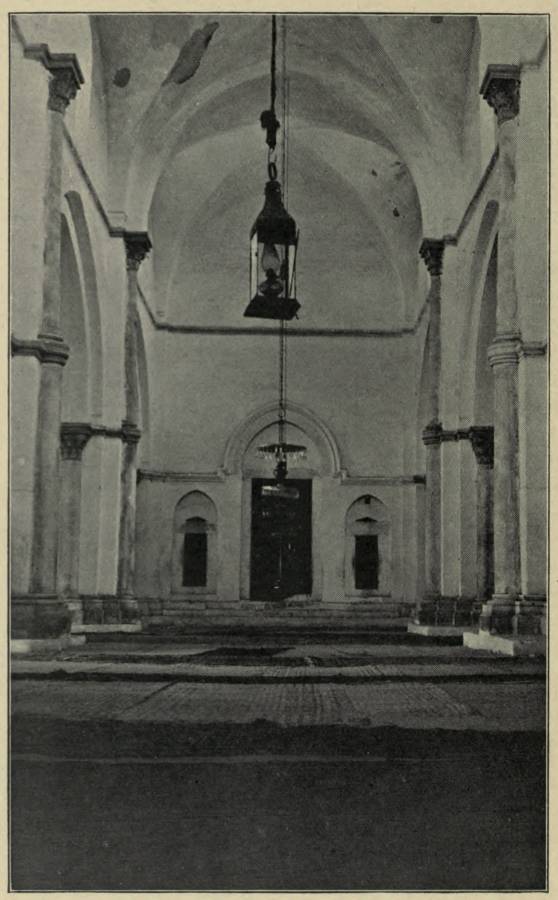
THE MUSLIM MOSQUE—ONCE THE CRUSADERS' CHURCH