THE “NEW PROCESS” VAPOR STOVE. The Original Evaporating Stove.
Reading edition
It is with the feeling of great assurance and satisfaction that we offer to the trade our “New Process” Vapor Stove, shown on pages following. It is the Original Evaporating Stove that has revolutionized the Gasoline Stove business.
For more than a decade it has demonstrated its superiority over every other stove, in Safety, Simplicity and Economy of operation, and has won for itself a place in the hearts and homes of many thousands of housewives, whose burdens have been made lighter and lives happier by its use.
It lights like gas! A feature that makes it popular, as without heat, smoke or delay, the stove can be instantly started in operation; turn the valve wheel and apply the match; the stove is ready for work. Could anything be more simple? No carrying in coal or wood; no smoke, soot or dirt; no ashes to carry out; the ceilings of the kitchens are not covered with black smoke and soot where the “New Process” Gasoline Stove is used.
The tank, or gasoline reservoir, is not connected to the stove and can be easily lifted from it and carried to an outer room for filling or cleaning, thus insuring safety.
In operation, the fluid drips drop by drop (never runs) on the perforated brass evaporator, where it is divided into fine particles, which, passing through the air, evaporate; the gas thus made being heavier than air, passes down through the evaporator tubes, mixing with and carburetting a current of air, which is lighted at the burner, producing a smokeless blue flame of great intensity and heating power.
Thus it will be seen that the “New Process” is a veritable gas machine and a gas stove combined, entirely under the control of the user, who can increase or decrease the supply of fuel at will, securing the requisite amount of heat without waste; starting or stopping the fire according to requirement, thereby securing the greatest possible convenience, safety and economy of operation.
The “New Process” solves the problem of economical cooking in all country homes and suburban residences where gas for fuel cannot be obtained, giving to the user every advantage, convenience and comfort which the use of gas stoves and other modern appliances afford.
The general construction of all our stoves is thoroughly first-class. The design is new, attractive and well planned for convenience. The frames of all “New Process” Stoves are made in cabinet style and are strong and rigid. The tops are of ample width and provided with removable grates; the burner drums are of polished brass. The burner caps are removable. The sub-fire device is removable with the burner cap for inspection and cleaning, a point of great advantage. The stove is provided with a sight feed, so that the dropping of the gasoline can at all times be seen when the stove is in operation. The valves are provided with needles, having non-corrosive points; the tank is provided with a float which automatically equalizes and regulates the flow of gasoline at all times, consequently the tank works as well with a small amount of gasoline in it as it does when full. Parts exposed to the fire are cast iron and imperishable. All parts are so constructed that they can easily be cleaned; the stoves are handsomely enameled and ornamented. All stoves are carefully tested before shipping.
Improvement is the “watch word” of the age, and the “New Process” will not be found in the rear guard, in the “onward march to the goal of perfection.” Early in its history its unqualified efficiency and success were demonstrated and it sprang at once into popular favor, where it still remains in advance of every competitor.
The “New Process” Vapor Stove is the original evaporating stove; it offers valuable features that are not to be found in any other gasoline stove. With the new features and improvements for 1901, it is farther in the lead than ever before.
4
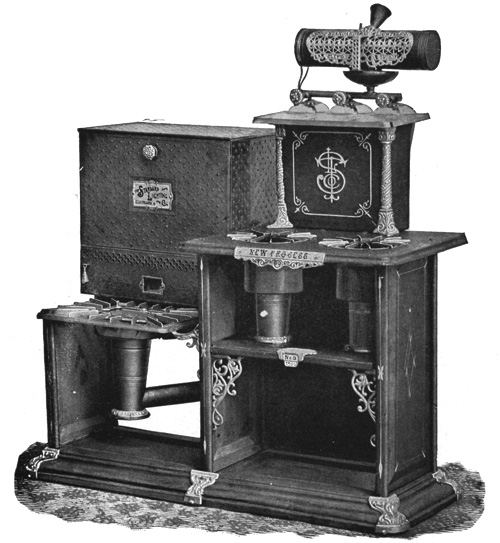
No. 3. “New Process” Semi-Cabinet. Price $23.00. Code Word “Lion.”
TOP HEIGHT STEP LENGTH OVEN SHIPPING WEIGHT WITH OVEN
26″ × 21″ 28½″ 18″ × 14½″ 45″ 19½″ × 13¼″ × 12″ 150 lbs.
Cut shows our new encased sheet steel frame which, for convenience, strength and beauty, is unsurpassed. Oven can be pushed back upon a rest, as shown, leaving step free for other purposes. Oven is of our New Process pattern; is made of Russia iron and can be knocked down in compact form for shipment. Stove is mounted on casters. Is well suited to the requirements of a medium size family. All “New Process” Evaporating Stoves burn the vapor of gasoline. Absolutely safe. Reservoir can not be filled unless removed from the stove.
5
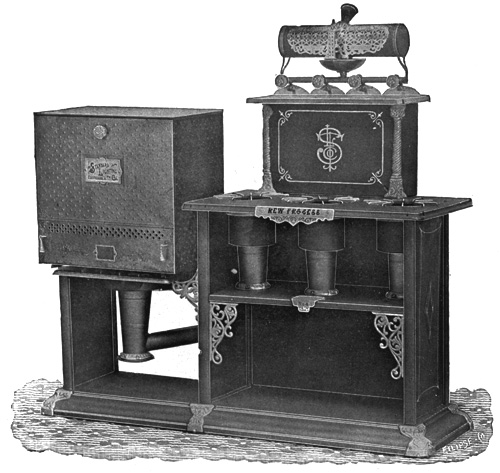
No. 4. “New Process” Semi-Cabinet. Price $26.00. Code Word “Bear.”
TOP HEIGHT STEP LENGTH OVEN SHIPPING WEIGHT WITH OVEN
33″ × 21″ 28½″ 18″ × 14½″ 52″ 19½″ × 13¼″ × 12″ 170 lbs.
Cut shows oven in position for baking. Oven is of Russia iron, New Process style. The flues are arranged to distribute the heat evenly, and the oven is a perfect baker and roaster. Is shipped knocked down in very compact form. Can be put together in two minutes. Stove is mounted on casters. On account of its simplicity, safety and economy, we recommend the “New Process” as the most desirable gasoline stove.
6
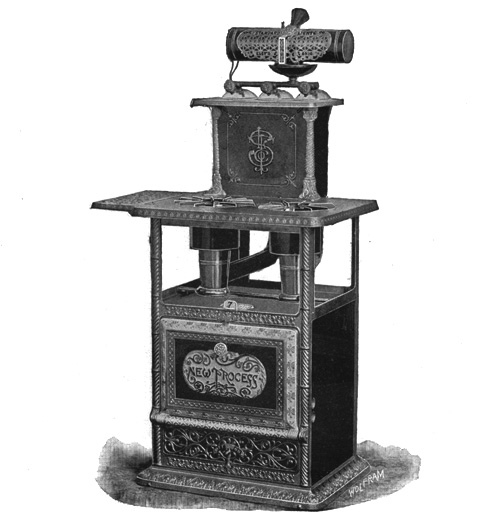
No. 7. “New Process” Cabinet Range. Price $25.00. Code Word “Tiger.”
TOP HEIGHT BASE LENGTH OVEN SHIPPING WEIGHT
25½″ × 21¾″ 35¼″ 25″ × 20″ 25½″ 18″ × 14½″ × 12¼″ 175 lbs.
Same as the No. 8, without the step. Has new improved oven. Is mounted on casters. Oven door is hinged at bottom and counter-balanced by a powerful coiled spring. A very desirable stove for a small family.
7
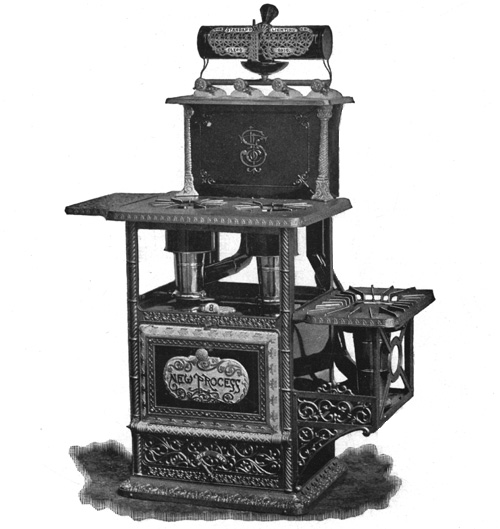
No. 8. “New Process” Cabinet Range. Price $29.00. Code Word “Hyena.”
TOP HEIGHT BASE STEP LENGTH OVEN SHIPPING WEIGHT
25½″ × 21¾″ 35¼″ 25″ × 20″ 19½″ × 11¼″ 36¾″ 18″ × 14½″ × 12¼″ 200 lbs.
This range is very compact, occupying but small floor space. Is mounted on casters. Has three burners besides the one under oven. Step burner can be used to heat a wash boiler or for canning, preserving, broiling, or other purposes. Oven door is hinged at the bottom and counter-balanced by a powerful coiled spring. Has a new improved oven and is a very successful baker.
8
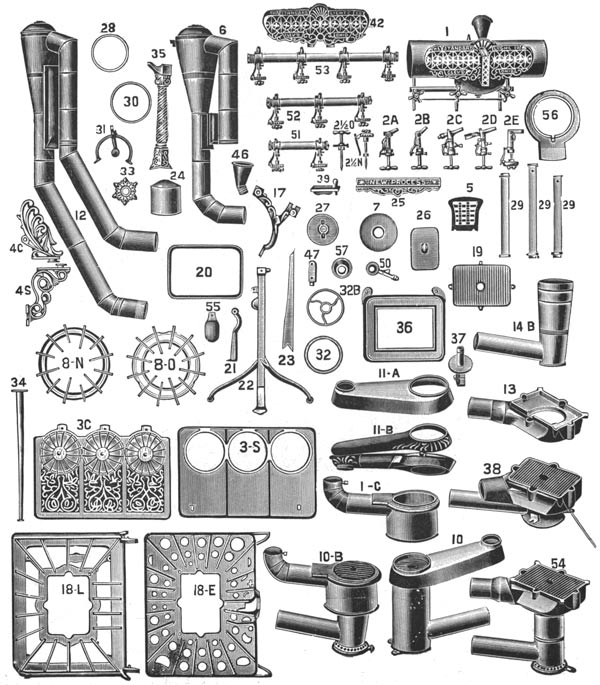
Repairs for “New Process” Vapor Stoves.
See Price List on Pages 9 and 10. When in doubt as to the year in which stove was made refer to page 11.
9
Repair Price List for “New Process” Vapor Stoves.
Orders for repairs must be accompanied with remittance to cover cost of repairs and postage. All repairs sold F. O. B. Cleveland. Terms cash. In ordering always give number and date or serial letter of stove. (See page 11 for date of stove.)
Postage
{ Tank for No. 1 Stove, complete $3 00
{ Tank for No. 2 Stove, complete 3 25
{ Tank for No. 3 Stove, complete 3 25
No. 1 { Tank for No. 4 Stove, complete 3 50
{ Tank for No. 7 Stove, complete 3 25
{ Tank for No. 8 Stove, complete 3 50
In ordering Tanks always give No. of stove and latest date of patent. The Tank made in 1896 same as shown in cut on preceding page, as No. 1 can be used on all stoves made earlier than that year and should be ordered for such stoves. Tanks for 1897 stoves and later are all the same as we are now using.
No. 2 A Valve, complete, with Needle for tank ’90 pattern 60 6c
No. 2 B Valve, complete, with Needle for tank 1891-’92 pattern 60 6c
The center Valves for ’91 and ’92 pattern are the same. The 1892 end Valves have vent holes in top, the ’91 have not.
In ordering Nos. 2 A and 2 B say whether right, left or center.
No. 2 C Valve, complete, with needle and union nut for tank 1893 pattern 60 6c
No. 2 D Valve, complete, with needle for tank 1894-’95-’96 60 6c
No. 2 E Valve, complete, with needle for tank 1897-’98-’99-1900 and 1901 60 5c
In ordering Valves say whether they are soldered to supply pipe, fastened to it with a union nut, or screw into a solid nipple.
No. 2½ O Needle only for Valve. Will fit all valves previous to 1897. 25 3c
No. 2½ N Needle only for Valve for 1897-’98-’99 and 1900 stoves 25 3c
When a Valve Needle is found to be a trifle short and will not close the valve orifice tightly, turn the check nut on the needle back about a quarter or half turn, which will allow the needle to go further into the valve and close it.
{ Top Nickel Shelf for No. 1 Stove 75
No. 3 { Top Nickel Shelf for No. 2 Stove 90
No. 3 C { Top Nickel Shelf for No. 3 Stove 90
No. 3 S { Top Nickel Shelf for No. 4 Stove 1 00
{ Top Nickel Shelf for No. 7 Stove 90
{ Top Nickel Shelf for No. 8 Stove 1 00
No. 3 Shelf (not shown) for all stoves previous to ’94. No. 3 C is for ’94 stove. No. 3 S is for all stoves after ’94. In ordering Shelf always give number of stove and latest date of patent.
No. 4 C Nickel Shelf Brackets (right or left) each. 25 12c
No. 4 S. Always give number or size of stove and latest date of patent 25 12c
No. 5 Small Nickel Shelves (between tubes) 20 5c
No. 6 Drip and Hot Air Tubes with Evaporator for top burners, complete. Say whether for top or oven burners. 1 50
Give number and date of stove.
No. 7 Sawed Cap for Top Burners 25 10c
Number and date of stove must be given.
No. 8 O { Grate for Top Burners 30
No. 8 N { Always say for “New Process” Stoves.
No. 9 Drop End Shelf (Japanned, not shown in cut). 75
No. 10 Burner Drum made of Japanned Iron or Steel, including short pipe, cap and sheet metal heat collector for top burners, complete. 1 50
For all stoves previous to 1893. The Drum made for the 1892 Stoves should be ordered and used. This is true of the top burners only, the oven burners being different for the different years. All top burner Drums are interchangeable, for right, left or center burners. Our regular brass burner drums cannot be used on stoves made previous to 1893.
No. 10 B Burner Drum made of brass, including short pipe, cap and heat collector for top burners, complete. 2 25
Brass Burner Drums are made for the 1893 stoves and later. They are interchangeable for right, left or center burners. The 1893 and 1894 Drums are practically the same and have no sub-burners. The 1895 and 1896 are alike and have a sub-flame.
The 1897-’98-’99 are all alike and interchangeable, and have the same arrangement of caps, center tubes and sub-burners. The 1900 and 1901 Burner Drums are alike and interchangeable, except the sub-burners. In ordering it is necessary to give date of stove and say whether for the top or oven burner.
No. 11 A Heat Collector only for ’90, ’91 and ’92 35
Lower part of Heat Collector 15
Top part of Heat Collector 30
These Heat Collectors are alike and interchangeable for the top burners.
No. 11 B Heat Collector only for ’93, ’94, ’95 and ’96 stoves 50
Lower part of Heat Collector 15
Top part of Heat Collector 40
No. 11 C Heat Collector only for ’97, ’98 and ’99 stoves. 60
This part is given on preceding page as cut No. 1 C.
No. 11 D (not shown in cuts of repairs) Heat Collector only for 1900 and 1901 stoves. 60
No. 12 Oven Drip and Hot Air Tube with Evaporator, complete 1 60
Give No. of stove and latest date of patent.
No. 13 Oven Burner Casting (only) to which sawed cap is bolted 50
Give No. of stove and latest date of patent.
No. 14 Oven Burner Drum (only) made of terne plate (not shown in cut) 75
No. 14 B Oven Burner Drum (only) made of brass. 1 75
In ordering 14 or 14 B repairs, always give No. of stove and date of patent. It is well also to describe the part wanted, as many changes have been made in the oven burners.
Note—If the burner drum only, less the heat collector, cap and center tube, for top burner is wanted, use the repair number 14, for iron drum and No. 14 B for brass drum say for top burner and be sure to give date of stove.
No. 16 Front Brace for step (not shown in cut) 25 10c
No. 17 Back Brace for step (see cut) 25 12c
No. 18 E Oven Grate for ’93 and ’94 stove 85
No. 18 L for all later 85
No. 19 Oven Burner Cap (sawed) 35 25c
Be sure to give date of stove as the caps are not interchangeable on stoves made in different years.
10Note—The least irregular opening at the top of a “New Process” burner will cause the flame to pop out. When this occurs with the oven burner, look carefully first for crack in sawed burner cap as the least break will cause trouble. See if the cap is warped up leaving an opening above center tube. See that the center tube is in the proper place. If the asbestos packing under the lower edge of the sawed cap is imperfect or out of place the same trouble will be experienced. A new burner cap and packing is the remedy.
No. 20 Oven Burner Ring for ’93 and ’94 stoves 15 11c
No. 21 Weight Arm for Oven Burner Ring (right or left) for ’93 or ’94 stoves 15 3c
No. 22 Oven Rest or Track for ’93 or ’94 stoves 50
No. 23 Oven Rest or Track, made of steel. For ’95, ’96, ’97, ’98, ’99, 1900 or 1901 stoves; each 20 5c
No. 24 Brass Evaporators 40 4c
No. 25 Name Plate 20 10c
No. 26 Oven Flame Reducer Caps 15 6c
No. 27 Top Flame Reducer Caps 15 6c
No. 28 Glass Domes for Evaporating Tubes 1893 or 1894, 5-1⁄16 inch diameter 15 12c
Always give date of patent on stove and diameter of dome.
No. 28 Glass Domes for Evaporating Tubes ’95, ’96, ’97, ’98 and ’99, 4⅞ in. diameter. (This with cast ring will fit any stove). 15 9c
Give latest date of patent on stove and diameter of dome.
No. 29 Center Tubes for Burner Drums. Give length of tube and say for which burner, top or step 20 6c
Describe fully and give date of stove. In giving length of center tube it is best to give measurement of old tube as sometimes the sawed cap becomes warped up so that the exact length of center tube cannot be secured from the burner. This is especially true of the oven burner.
No. 30 Protector Ring for Top of Burner (’93 or ’94 stoves) 10 5c
Sheets of Asbestos for oven bottom. 20 5c
No. 31 Evaporator Horse Shoe. Many changes have been made in this repair. Describe fully and give latest date on stove. 15 7c
No. 32 Cone Seat Ring. (Say if for top or step burner) 15 4c
No. 32 B Cone Seat Ring for ’93 and later stoves. 15 4c
No. 33 Dome Nut. 10 2c
No. 34 Leg for ’92 Flue Extension 20 16c
No. 35 Columns for Top Shelf (Nickel). See number on castings and give date of stove. 35 17c
Shelf columns of different styles have been made for 1896 and later stoves. In ordering it is necessary to give the repair number and also the date of stove or serial letter which is found on the number plate.
No. 36 Cast Flue Extension for 1892 stove 30
No. 37 Sub-Burner and Center Tube for No. 8 cabinet oven burner 25 10c
No. 38 Cabinet Range Oven Burner, complete 2 75
No. 39 Oven Door Hinge, 1893 (right or left) 15 2c
No. 40 Oven Racks (sheet steel or wire not shown) 30
No. 41 Patent Plate (not shown) 15 6c
No. 42 Tank Plate 35
No. 43 Tank Plate Handle (not shown) 20 6c
No. 44 Cast Flue (1892 stove not shown). 50
No. 45 Tin Elbows (not shown). 25 5c
No. 46 N. P. Tank Funnel 20 3c
No. 47 End Shelf Hook 10 2c
No. 48 Sub-Burner, complete (not shown) 35 7c
This number is given for the sub-burner used on the 1895 and 1896 stoves. On the later stoves the sub-burner casting is attached to the center tube and top sawed cap, all of which go together.
No. 49 Sub-Burner Cap (not shown separately) 15 2c
No. 50 Sub-Burner Flip 20 3c
The cut No. 50 shows the flip for the 1895 and 1896 sub-burner. The flip for later stoves may be ordered by using the repair No. 50 and giving the date of stove.
Oven Top 1 00
Oven Back 1 25
Oven End, each 1 00
Oven Door 1 00
Oven Door Front and Bottom 1 25
No. 51 Valves and Pipe for No. 1 Tank ’97, ’98, ’99, 1900 and 1901 1 50
No. 52 Valves and Pipe for No. 2 and 3 Tank ’97, ’98, ’99, 1900 and 1901 2 00
No. 53 Valves and Pipe for No. 4 and 8 Tank ’97, ’98, ’99, 1900 and 1901 2 75
The sets of valves, complete, given as Nos. 51, 52 and 53 are easily put on to the tank and can be ordered for tanks made in the years mentioned. For tanks made previously it is better to order valves separately rather than complete with supply pipe.
No. 54 Step Burner, complete. Always give date of patent on stove. 2 50
No. 55 Weight for Oven Ring, ’93 and ’94 15
No. 56 Top Casting of Heat Collector ’97, ’98 and ’99. 20 13c
No. 57 Sub-Burner for ’96 stove only 20 6c
No. 58 Corner Foot with caster for “New Process” frame 35 16c
This part is not shown in cut but is used on the ’99, 1900 and 1901 stoves. In ordering state for which corner it is wanted.
No. 59 Center Foot with caster for “New Process” frame 25 10c
No. 60 Middle Bracket Brace, nickel plated, for “New Process” box frame (not shown in cut). Say whether for right or left side. 25 10c
11
“NEW PROCESS” VAPOR STOVES.
In Ordering Repairs, Always Refer to Cuts Below for Date of Stove.
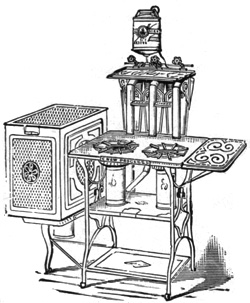
This cut represents our 1891 “NEW PROCESS” Step Stove. (Cut of 1890 Stove not shown.)
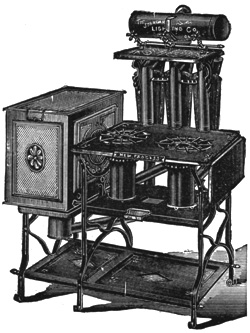
This cut represents our 1892 “NEW PROCESS” Step Stove.
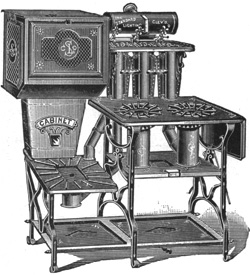
This cut represents our 1892 “NEW PROCESS” Range Cabinet.
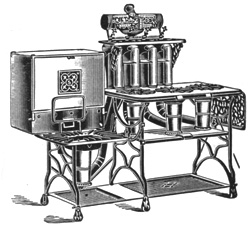
This cut represents our 1893 “NEW PROCESS” Step Stove.
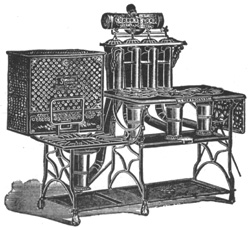
This cut represents our 1894 “NEW PROCESS” Step Stove.
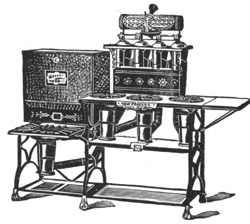
This cut represents our 1895 “NEW PROCESS” Step Stove.
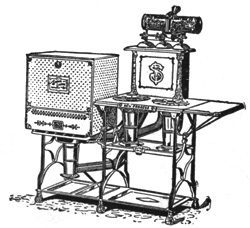
This cut represents our 1896 “NEW PROCESS” Step Stove.
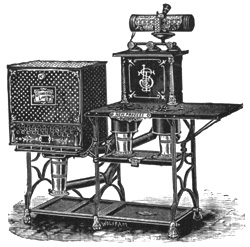
This cut represents our 1897-1898 “NEW PROCESS” Step Stove.
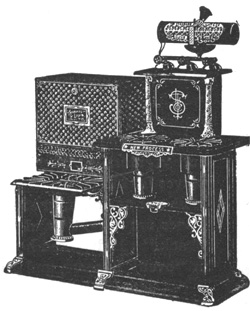
This cut represents our 1899 “NEW PROCESS” Step Stove.
12
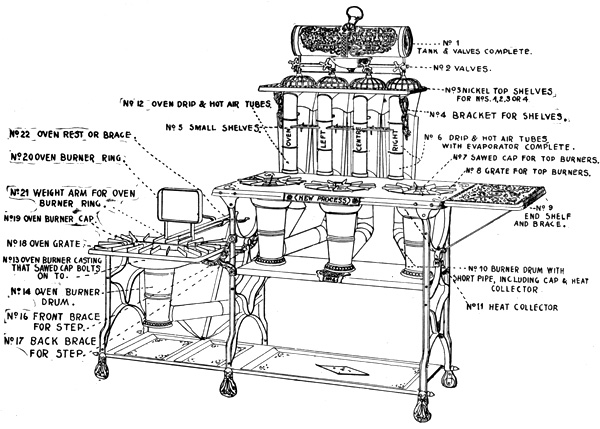
READ CAREFULLY.
As our patterns are changed from year to year, it is absolutely necessary that we know the year the stove was made for which you want repairs, and whether it is a No. 1, 2, 3, 4, 5, 6, 7 or 8. The stoves are constructed of parts made detachable and interchangeable, and in ordering repairs be particular to specify, by number only, just which parts are required. It will not be necessary to order a drum (10) and heat collector (11) where only the former is needed. See cut above.
As you face the stove, the parts are “right” and “left.” Valves are “right,” “left” and “center.” As valves have been changed from year to year, be particular in ordering valves for old tanks, to specify whether valves are soldered on feed pipe or fastened with a loose nut or union, or screwed into a solid nipple. Top brackets for 1893, 1894 and 1895 stoves are “right” and “left,” also the arms for weights. Step braces are “front” and “back.” If drip and hot air tubes are wanted, say whether for “right,” “left,” “center” or “oven” burners, and give the number of stove.
The 1893, 1894, 1895, 1896, 1897, 1898, 1899 and 1900 ovens are made of sections. New parts can be furnished, which anyone can put in place in a few minutes.
13
