VII. THE FJELD AND REINDEER.
Reading edition
OPENING DAY FOR REINDEER—AALESUND—AURORA BOREALIS—INQUIRING FRIENDS—BERRY VARIETIES—TO THE FJELD—NECESSARIES—REINDEER-FLOWERS—TO THE TENTS—THE DOGGIES—DANJEL AND OLE—MØLMEN—THE ARRIVAL—OUR CONCERT—PTARMIGAN—REINDEER SPÖR—TROUT-FISHING IN THE VAND—GOOD SPORT—THE TENTMASTER’S STORY—PASSOP AND THE STOR BUCK—SNOW-WORK—SÆTER LIFE—MARITZ’S LONELY STATE—HER KINDLINESS—THE SWIZZLE-STICK—THE OLD BOAT—THE EAGLE AND NEST—REINDEER AND RED DEER HEADS—THE DIFFICULTY OF GETTING THEM—INDFJORD—OLE ERIKSON BOE—HALVER JACOBSEN—INGEBORG AND THE STEEN-SKREED—INGRANA’S ACCOUNT—INGEBORG’S FUNERAL—RUNIC STONE—GRAVE-BOARDS—ISTERDAL—THE MEAL-MILL—OLD KYLE—A SIMPLE-MINDED COW—OLE FIVA—AIGUILLES—VALDAL—THE SOURCE OF THE ISTER—EXPEDITION TO A FROZEN LAKE.
VER and anon we arrive at some landmark in life which stands out prominently for the rest of our terrestrial journey. Perchance it is one that, surrounded with pleasant associations, invites us back to chew the cud of past happiness, and rises before us as an angel of comfort from time to time, when shadows, storms, or squalls of trouble cross our path, or the hurry-skurry of advanced civilisation has ruffled our calmer nature, and we have become irritable and overstrained, liable to spontaneous combustion of temper, and less kindly than usual. Such a happy landmark is “after reindeer” in Norwegian travel. Let us, then, look back to it, and enjoy it over and over again; and may others derive equal pleasure from similar outings!
The 1st of August is the opening day for reindeer-shooting. About the end of July the enthusiasm gradually increases, everything is supposed to be ready, lists are gone over, fine weather hoped for, and the 1st of August eagerly anticipated. On our way to Gudbransdalen we stopped at Aalesund for the night; and what a night! We had hardly settled down to our aftenmad, or supper, before a servant came in to tell us of a grand sunset, which she thought the English gentlemen would like to see. We all rushed up-stairs, clambered through attics, and finally came out on a kind of platform; and what a sight met us here! The whole heavens were bathed in the most astounding crimson; at our feet lay the harbour of Aalesund, and on the horizon, out in the Atlantic, long ultramarine-purple islands. It was sundown in its most intense arctic grandeur, with a few golden scraps of cirri in the upper heavens. So impressed were we that we mused in silence; adjectives had no power of expression; and we tacitly admired with awe and reverence.
On our return to the table some Cantabs had just arrived, and finding we were compatriots, the all-prevailing subject of the latter days of July rose to the surface. “Were we going after reindeer?” was followed by a sort of mitrailleuse volley of cognate inquiries. They had heard of three Englishmen—did we know them? as they were anxious to meet them before starting. At last the suggestion was thrown out, “Had we not better go another time?” We thought not. Then they divulged the name of him they sought, and the Patriarch revealed himself, quoting the Duke’s Motto, “I am here.” General rejoicing, fraternity, and a skaal for good sport succeeded, and the next morning we all started off together by steamer for our happy hunting-grounds.
On July 31st we made our head habitable quarters on the high plateau of the Lesje Vand, and had time to enjoy the detailed study of the upper flora and berry varieties, which are numerous in this country. Thus:—
Tyttebær Red, juicy berry.
Blaabær Blueberries.
Multebær Juicy, hard berry of raspberry form.
Kirsebær Cherry.
Bringebær Raspberry.
Björnebær Bearberry.
Winborr, Ripsbær Currants.
Stikkelbær Gooseberry.
Silbær Black currant.
Jordbær Strawberry.
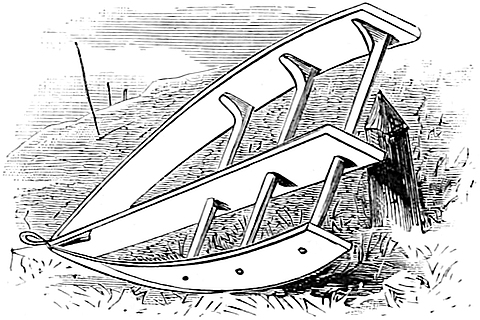
Snow Plough.
The ponies were packed with their curious birch-twig saddles, waterproof sheets for cork bed, deer-skins and air cushions, provisions, a small spade to trench round the tents, cooking canteen—a great work most cunningly carried out by the Tentmaster—lint, chlorodyne, &c.; steel nails to screw into boots for ice-work, vanters, or mufflers, long flannel night-shirts for cold, blue spectacles for snow, a little glycerine, telescope, compass, &c. Our beds were made with Iceland moss, waterproof sheet, cork mattress, and skins, and we slept in thick socks, gloves, and long flannel night-shirts with hood to keep off the flies. Hans Luther was with us, and Trophas the faithful, the doggie with sharp nose and curled tail. The tents had been sent up to the fjeld before us, and, after about six hours’ walk, we spied the white dot—the tent. In making the ascent to the upper plateau the gradual decrease of vegetation was very noticeable, culminating in the reindeer flower, or Ranunculus glacialis, which is much liked by the reindeer. Happy and buoyant with hope the hunter who finds the flowers nibbled off! Their peculiarity is to grow most freely where the snow has melted back. At the tents we found Ole of Lesje, whose first news was that he had seen a herd of about fifty reindeer, after which an important subject was mooted: a glutton had been seen the night before near the tent. Danjel Kulingen had been thirteen years after reindeer, and had never seen one. On the other hand, Hans Luther had shot one, and there was a skin at the station at Mølmen, which reminded us that at fishing inns on the banks of the Thames larger fish are seen stuffed and glazed than the itinerant angler generally hooks and lands.
All at once the dogs, three in number—Trophas, Barefoed, and Storm—opened a barking chorus; but we did not seize our rifles, as the telescopes revealed our Paymaster-general, who was returning from his chasse de bagage, which he had happily recovered. The aneroids registered 5,000 feet, and all was full of promise, save the one fact that the rifle of our friend was below in the valley. The despair and ferocity engendered by this unhappy discovery were soon dispelled by good food, and plenty of it, a word of comfort and sympathy, and last, not least, a little whiskey, after which he took a siesta in his tent, on which we wrote “Requiescat in pace,” and left our cards as a welcome. Being Sunday, we made it quite a day of rest, and revelled in the flora, mosses, and lichens of our new ground, always, however, with an eye to the glutton, which evidently had a day of rest also, as he never appeared. In the evening, at 6.30, we had a hunters’ chorus, for the Norwegian Sunday terminates at six o’clock.
NORGES HERLIGHED.
Words by I. N. Brun..
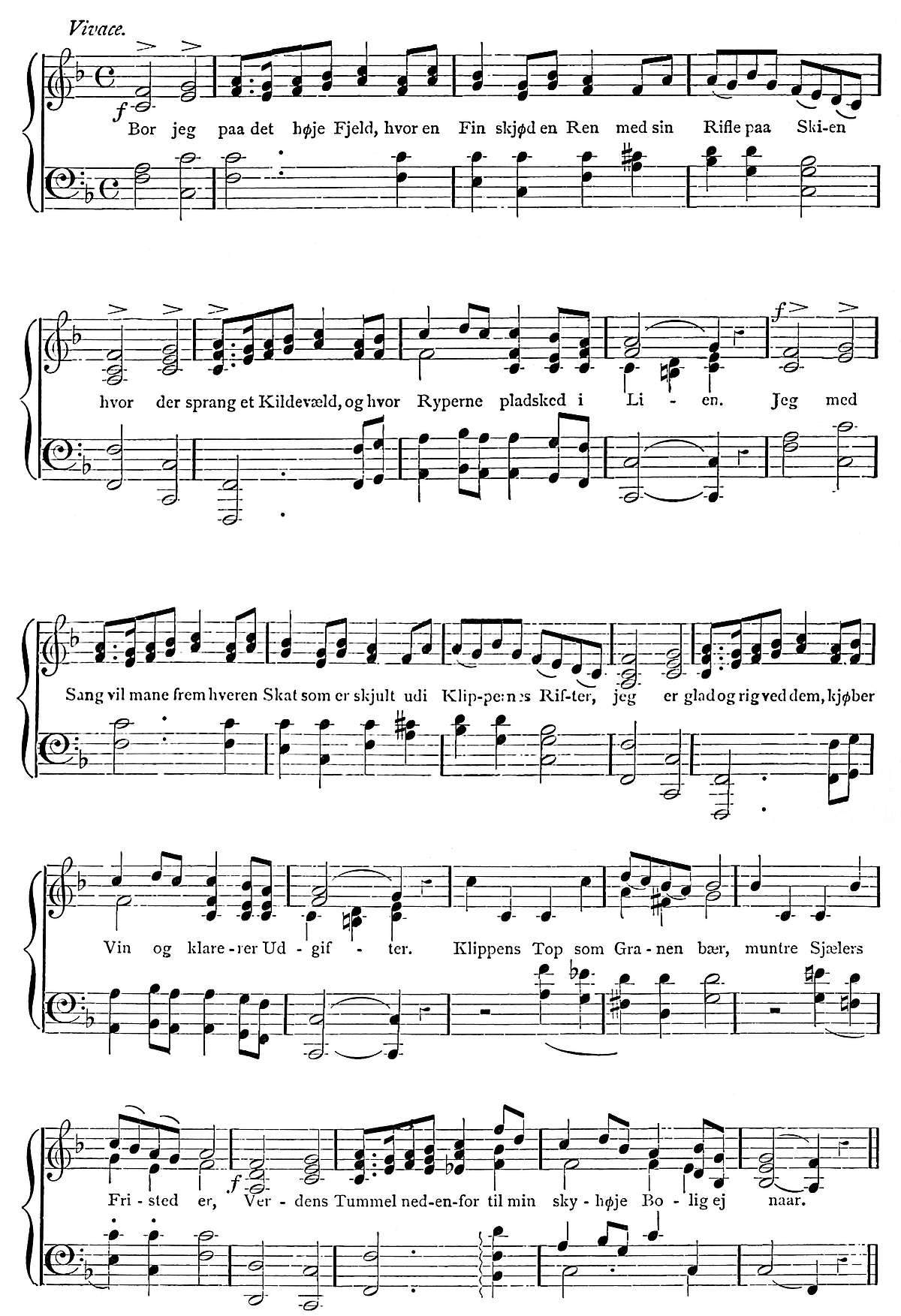
Bor jeg paa det høje Fjeld, hvor en Fin skjød en Ren med sin Rifle paa Ski-en hvor der sprang et Kildevæld, og hvor Ryperne pladsked i Li-en. Jeg med Sang vil mane frem hveren Skat som er skjult udi Klip-pernes Rif-ter, jeg er gladog rig ved dem, kjøber Vin og klare-rer Ud-gif-ter. Klippens Top som Gra-nen bær, muntre Sjælers Fri-sted er, Ver-dens Tummel ned-en-for til min sky-høje Bo-lig ej naar.
[Listen]
Ole sang “Saga’s Hall.” Luther, with his sweet high tenor, was very good, and eventually a bouquet was thrown to him. The delicate attention seemed to be appreciated, although it was composed of straw and red labels from the tin cans of our preserved meats, &c. Then we had a bar or two of “God save the Queen,” and so into our tents. The next day we made a long journey, with much snow and heavy winds. In the afternoon we had to swim the ponies through a river—a very pretty sight indeed—the only drawback being clouds of mosquitoes. They were perfectly awful, and no avoiding them. We were even thankful to think we should not have them at home for a continuance, for the remark that we should soon get used to them afforded no comfort.
At this altitude we found the ptarmigan sitting about. The shooting of these birds does not commence until August 15th, and they seemed to know that we, as Englishmen, would not shoot before that day. So we actually threw stones at them, and one old bird, when knocked off the top of a large stone, positively came back to see what it was all about. Soon after this we discovered freske spör (new deer slots). The dogs livened up for a time. All soon settled, however, into steady travel again. Danjel was telescoping continually, but frequently a supposed reindeer turned out to be only a stone in the snow, till at last the Patriarch ventured to remark that there were “mange stor steen in Gamle Norge, og maget god telescope jagt,” which Danjel understood to suggest real deer instead of stones, and we should all have preferred, as it was one of the objects of our expedition, shooting reindeer to telescoping them. They are very wild, and quite justify the old saying, “Mange dyr, mange øine” (many deer, many eyes). Our course now lay from Buvalden due north, and we started in good time from Thorbvu for the snow ranges, leaving the horses and baggage below, we going as light as possible, with our own food for the day, and plenty of goat cheese. At lunch Danjel explained to the Patriarch that he should eat much goat cheese, for if he eat sufficient he should partake of the nature of that saltatory animal, and in time jump cleverly and boldly from rock to rock—an accomplishment in much requisition during our wanderings.
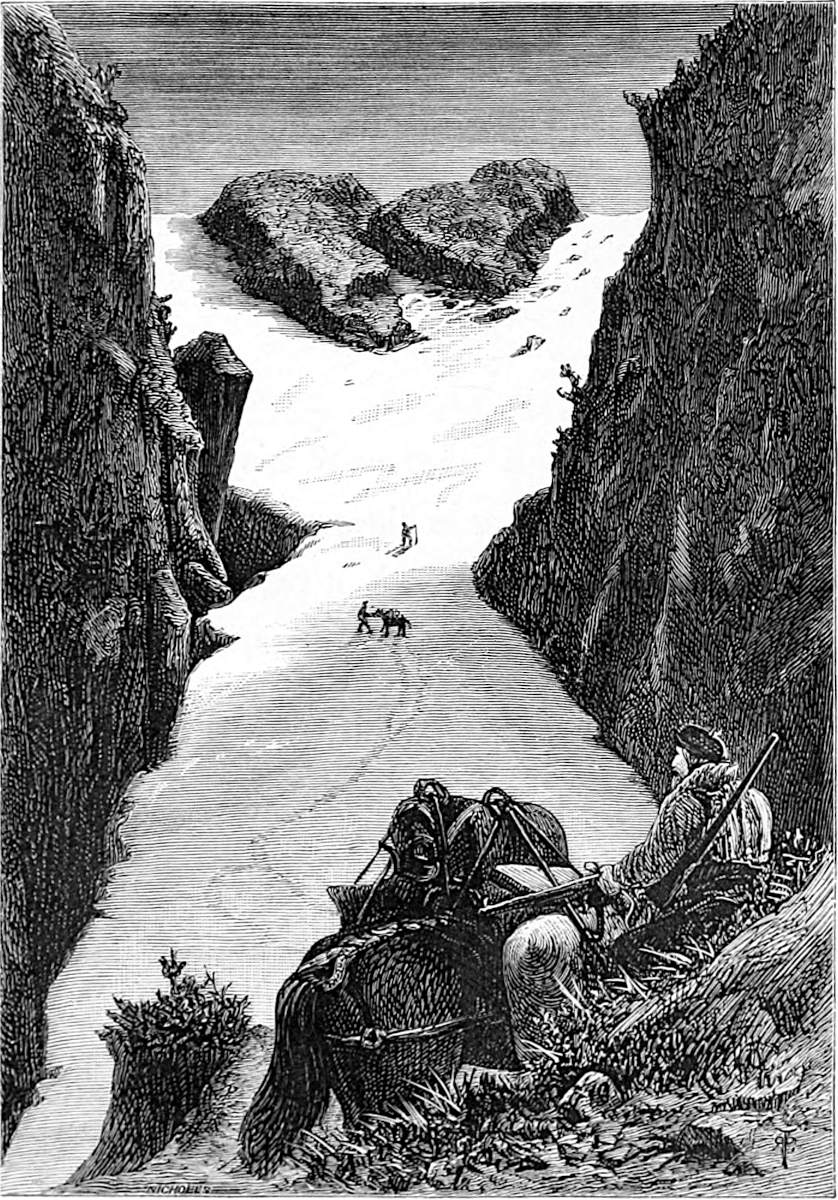
Snow Pass: Thorbvu.
An incident of piscatorial interest occurred here. We sent a hunter, who had never had a rod in his hand before, down to a lake, or vand, to try for some trout. In an hour he came back with about twenty, averaging nearly one pound each. Of course he was not casting, or “flick” would have been the fate of the fly; he only trailed. Still his success was perfect, and he was delighted with his new sport.
The male reindeer are called bucks, the female ko and semle ko, and the young kalve. In the daytime they roll in the snow, and if they sleep at all, it is certainly with one eye open. Having seen and telescoped many large stones, and taken them for deer, there was a strong inclination to inquire more closely as to the probability of sport, and a suppressed anxiety to hear a definite opinion as to our chance of a shot, if nothing more. The hunter must be patient, persevering, careful not to appear even as a moving speck on the interminable expanse of virgin snow, and take his sport quietly, for better or worse. Our Tentmaster had made many expeditions, had seen many deer, and even when his chance came an impetuous—shall we say friend?—rushed out in front of him, fired, and missed. So tradition said. We are glad to state that this did not occur during our present trip. His successes arrived, however, after a time, and never will he forget the day when he killed his first reindeer. Long may he live to kill more!
Let us here give his first experience; so pray silence for the Tentmaster.
The Tentmaster’s First Trip, and How He Tried to Get a Reindeer.
“In the year 1863 I ascended the glorious Norwegian fjelds for the first time to hunt reindeer. What a charm is conveyed in these words, ‘first time!’ The first salmon or trout caught; the first grouse or partridge shot; the first meet at cover and burst with the hounds; the first climb up the snow peaks of Switzerland; the young beauty’s first London season, or first night at the opera or ball; and last, not least, first love, all have a peculiar zest never afterwards equalled.”
(N.B.—The Tentmaster is rather sentimental.)
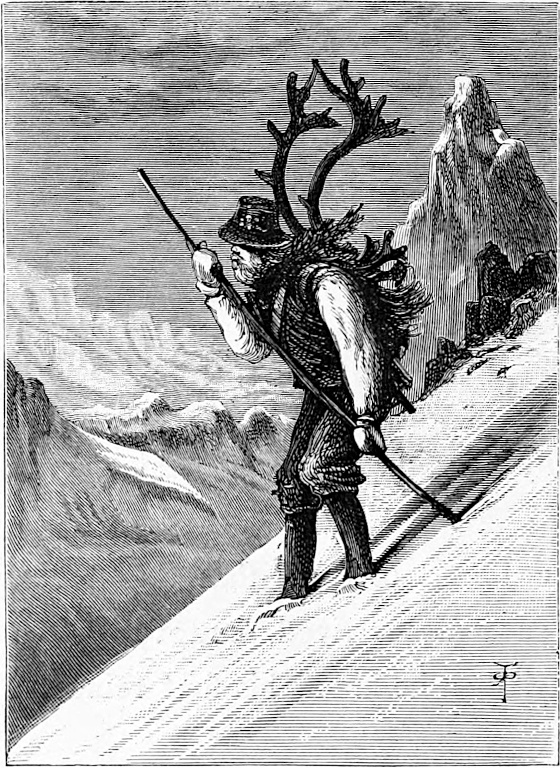
After Sport.
“I experienced this feeling in August, 1863, when, journeying up the magnificent Romsdal valley, on arriving at a station I noticed a splendid head of reindeer horns lying outside the station-house. On inquiry I found that a Norwegian hunter had brought them down from the fjelds. I lost no time in searching him out, and soon arranged for an expedition together. I had no provisions, tents, spare clothing, or other appliances which my subsequent experience has shown to be requisite, but began the ascent with the meagre store of some raw coffee berries, flatbrod, cheese, and biscuits. The hunter (Dan I call him) could not speak English, nor I Norske; but we got on pretty well by pantomime. After a pleasant but toilsome three hours’ walk through the grand scenery peculiar to the Norwegian fjelds, Dan’s hound Passop (the reindeer hounds are held in a leash two or three yards long) suddenly squatted down in great excitement, with his nose steadily pointed to a huge rock about three hundred yards distant, and gave a peculiar low whine. Dan was down immediately, and signalled me to do the same. He was certain that reindeer were close at hand, but a full half-hour’s telescoping failed to disclose their whereabouts. Nothing could induce Passop to move; his sniffing nose kept steadily in the direction of the rock; while he occasionally gave us a most intelligent, imploring look, as much as to say, ‘Do something.’ Unable to see any trace of deer, we dare not move. Dan thought that wherever they were, there they would remain some time; so, with faithful Passop on the watch, we determined to have lunch. Not a bite, however, would Passop touch—not even flatbrod thick with butter. There he squatted, with his nose still to the rock, the model of a watchful sentinel. Lunch finished, Dan began telescoping, and soon discovered the cause of Passop’s agitation. The tips of antlers were visible above the rock, and in distinct relief against the sky. They were perfectly motionless; but we were quite sure, after many exciting inspections with the telescope, that a large buck was resting behind the rock. As the wind was not very favourable Dan said we must be quite still, and remain till we saw a movement. In my innocence I wished to smoke a pipe, but Dan forbade it. The excitement was increased by Dan saying it was a large buck, probably an outlying sentinel, and that a herd of deer was not far off, which proved correct. Our patience being exhausted, Dan, much to the delight of Passop, ordered a forward crawling movement; and, with time and patience, we got within eighty yards of the rock, where we determined to halt and wait. The tops of the antlers were still motionless. Poor Passop was trembling with excitement, and his companions much the same. In this position another half-hour passed, when suddenly Dan exclaimed, ‘Look!’ Passop became very uneasy, when we had the pleasure of seeing a splendid stor buck rise up and stand before us broadside, with his head turned to where we were crouching. Passop behaved splendidly, remaining perfectly still, while I shall never forget the expression of his eyes, and his occasional side glance at us, as much as to say, ‘Now then.’ Resting my rifle on a convenient rock, I took aim steadily behind the shoulder, pulled the trigger, and, to my horror, it missed fire. The buck heard the snap, and started off at a rattling pace; Passop struggled wildly to get out of the leash; and Dan exclaimed, ‘Gud bevar mig! Give me my riffel.’ I handed it to him, he recapped it, and fired at about two hundred yards’ distance without effect. Passop collapsed, and the translation of his thoughts into English was indicated by the expression of his face, ‘I have done my best!’ No doubt he had a clear conscience; and work being finished, he commenced eating flatbrod and butter with great zest. The inevitable pipes were now brought out for consolation. Wonderful weed—exquisite after a success, soothing after a defeat!
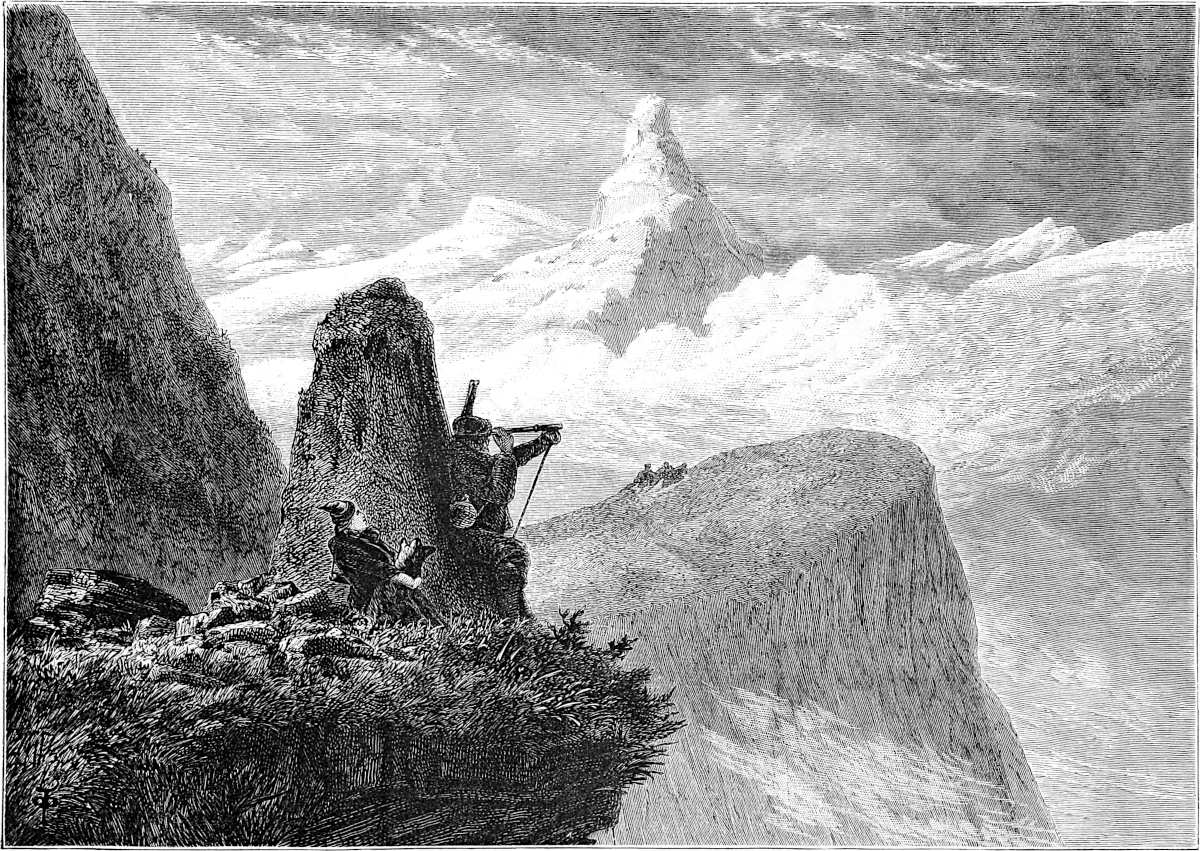
Near Ovendal: after Reindeer.
[See larger version]
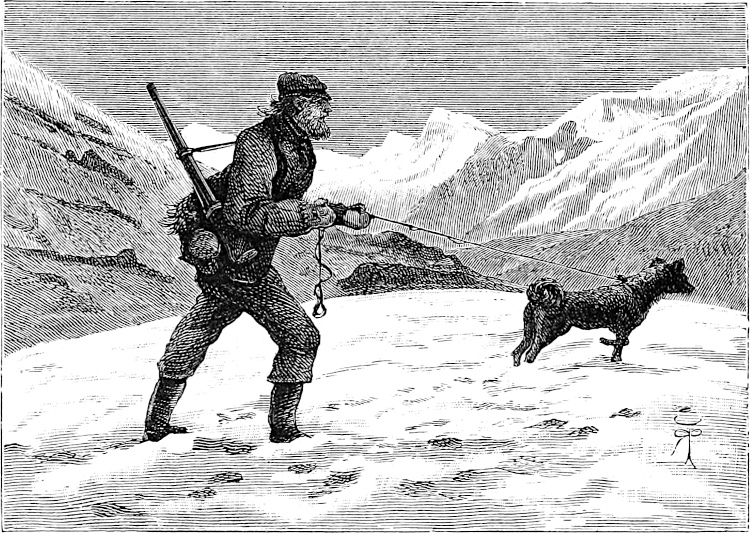
An Anxious Moment.
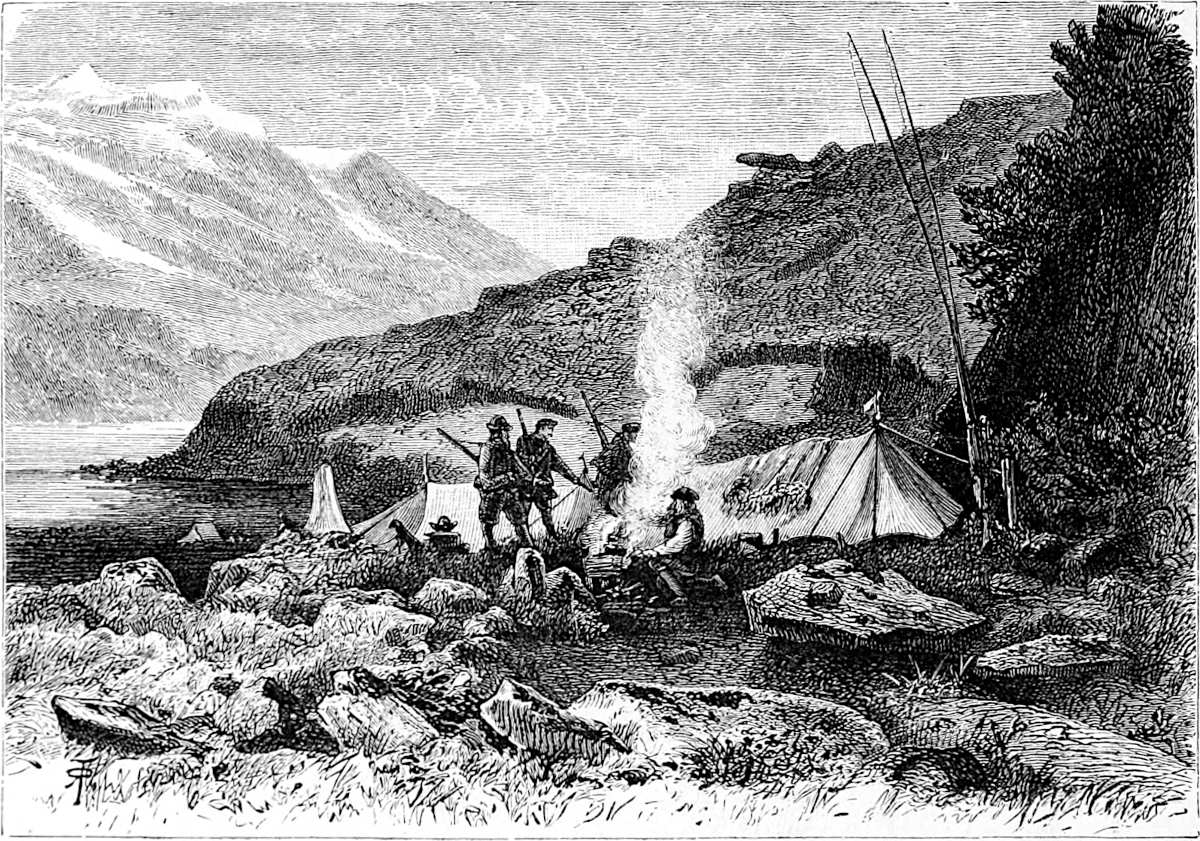
Thorbvu: Encamping.
“We now made our way to a stone cave to pass the night, where we had coffee and flatbrod. The cave was just large enough for me to creep in, and I passed the night on dried moss, sleeping soundly till daybreak. The night being very fine, Dan took up his quarters outside the cave, had coffee, and slept soundly on dried moss too. After breakfast we started, Dan being sure we should find the herd. At one o’clock we discerned them, fourteen in number, taking their noonday siesta on the snow; but in vain we tried to get within shot. Next day we saw herds of deer, but without being able to get within range on account of the quantity of snow. On the third day I returned to the station, much delighted with my first reindeer-hunting experiences. Often as I have been on the fjelds since, the three days of 1863 have not been surpassed, although
NO DEER WAS KILLED.”
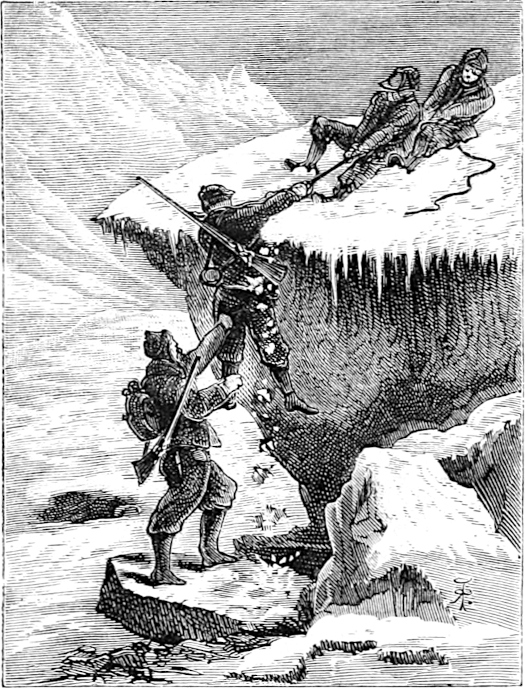
Easing down the Patriarch.
•••••
It would be well here to say a few words respecting the tents and their arrangement.
A regular tente abri carries two very well. Of course there are more room and comfort for a single inhabitant; still, for general travelling, in which luggage may only too truly be described as impedimenta, the tent referred to may be used. Every morning, if the weather permits, the waterproof sheet and cork bed should be laid out to dry, and the skins also. The trench round the tent must be well looked to, the lines tightened, and the ponies tethered, as it is rather disagreeable to be awakened about two a.m. by a storm of rain and wind, and to discover your pony, with his linked fore-legs well tangled in tent lines, doing his best to pull down the whole concern on the heads of the occupants. Far more delightful is it to be aroused on a bright, crisp, and fresh summer morning, when, if near a sæter, the cause of it may be the jodelling of a pige in charge of the cows—Swiss as to character of song, exceedingly Norske as she calls to them to follow. In the country districts animals follow more frequently than they are driven. Kindliness is the rural, coercion the town influence.
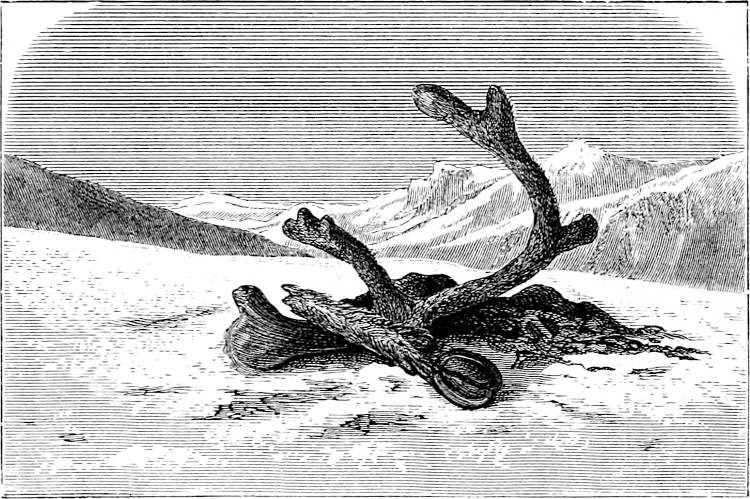
The Grallock.
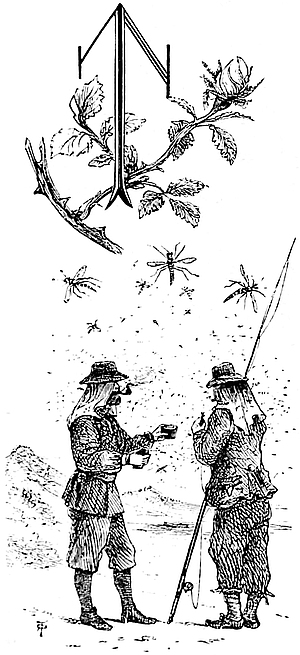
Many of our readers will notice that under the initial letter at the commencement of this chapter, the powder-flask and general arrangement are very much like the old bandoleers still hanging in the guard-chamber of Hampton Court Palace and others at Portsmouth. They were most general in Charles I.’s time, and are beautifully shown in De Gheyn’s costumes of Culverin-men and Harquebusiers. In this case the bandoleer was made of steel, and it is faithfully rendered, with the cord by which the whole arrangement was hung over the shoulder of the hunter.
By this time we deserve sport. We have travelled far and worked hard for it. Let us see the result. We had arrived at a great height, at the snow-fields called Sneebreden, like the Folgefond in the Hardanger, We had slid, crawled, and struggled, sometimes moving one behind the other at an angle to reduce our surface, creeping on the crisp, dry, hard snow, wading rivers of snow-water (very cold tubbing indeed), sloshing at the edge of the snow, where the reindeer-flowers bloom, and going through various other incidents of snow travelling, till at last we arrived at a smart drop, previous to another fond. Here the Patriarch had to be eased down, and his pendent position is only suggested in the cut (p. 147). Soon Trophas began to draw upon some slots in the snow, and it was the unanimous opinion that they were “fresh.” Trophas pulled hard, held back by Ole, who eventually began to half trot. To the unsentimental mind the action was that of a blind man’s dog eyeing coppers in the distance; but Trophas was in earnest, and at last the top of a horn burst upon us, and in a second our fate was disclosed to us. There was nothing but the gralloch of a reindeer kalve shot yesterday—one horn, one hoof, &c.—as shown in the sketch (p. 148). How could it be accounted for? Many suggestions were thrown out, many improbabilities considered feasible, and at last a matter-of-fact mind launched the frightful proposition that the glutton seen by Ole near our tents the night before our arrival was nothing but a native hunter, who had been stalking us, and had killed the kalve of which the remains were now at our feet. Nothing daunted, we flattered ourselves that at all events we had now commenced in earnest, and remembered the saw that the worst beginning has the best ending.
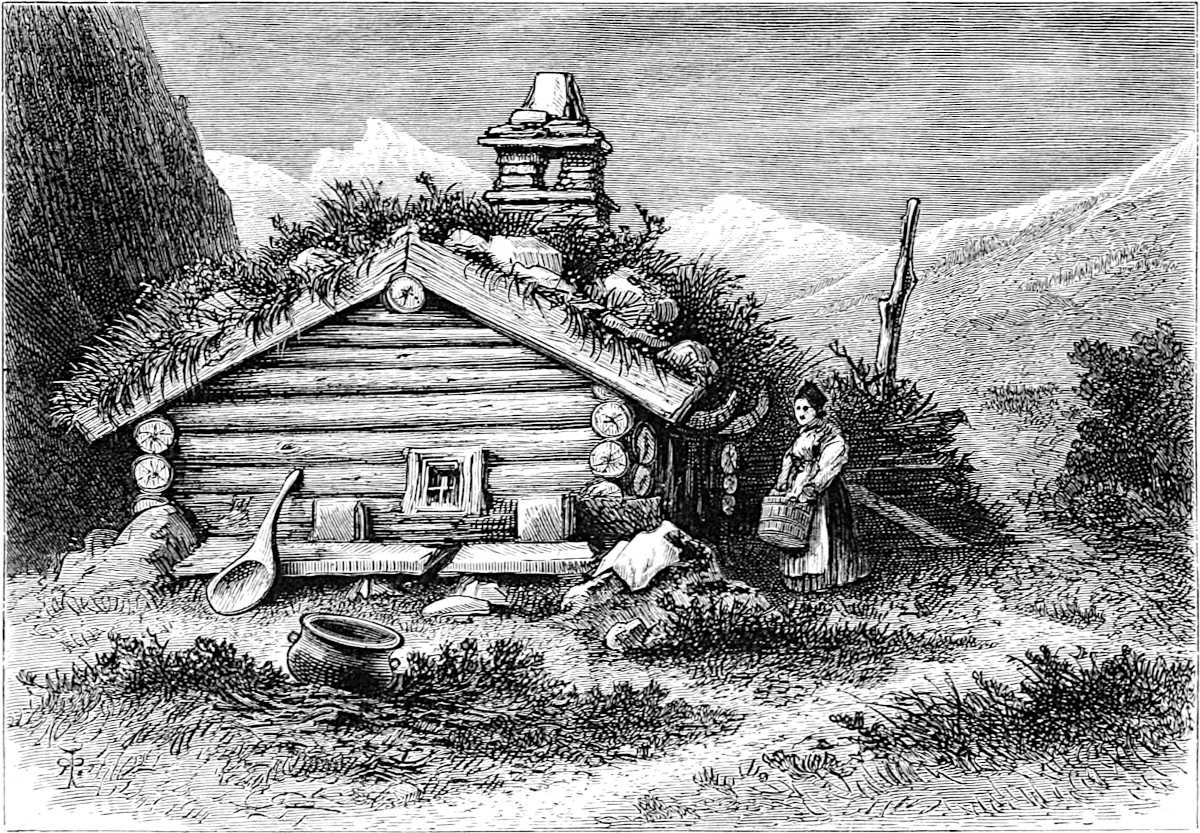
Maritz Sæter.
•••••
RAVELLERS in Norway are surprised, as they pass through the valleys, to see so few cows. This is easily explained. They visit this interesting country when these animals are away, like themselves, for a holiday; and as every dog has his day, so every Norwegian cow has her outing, and goes to the grass pastures in the upper plateau to enjoy life until the white mantle of snow is ready to garb the upper ranges and drive the cows and piger down to their homesteads and winter quarters. As already described, these sæters, or châlets, are high up, and frequently afford the energetic nature-loving traveller and genuine hunter cover and shelter, we may almost say comfort—cum very much grano, though. In snow-work it becomes almost luxury to have one of these to fly to in very bad weather. Tent life is the most truly enjoyable thing—though there are times when a tent may be blown down and soaked through—to say nothing of the milk supply at hand, which is meat and drink at all times, although very filling at the Norwegian price. This will account for our associating a sæter so prominently with our snow-work. The one given in our woodcut (p. 149) was inhabited by Maritz, who was there by herself from July to the beginning of September or end of August, according to the early or late fall of the snow. The 20th of August generally brings the first fall of snow in this latitude (63°). During our stay we always slept in our tents, as we all feared the parasitical ticklings the sæter would inevitably have afforded us had we given it the chance. All the summer through the old snow lay round the antiquated wooden building, and seldom indeed was it that Maritz had any one to speak to, as there was no road or path of any kind. Still she was all kindness. Did she not send a pair of cuffs to the Patriarch’s wife, and iron them, so to speak, after her manner, with the back of a wooden spoon, as she hummed a plaintive ditty in the minor key? Perhaps she thought the lady would hardly like to wear them, or else that they might find their way to some great people. Maritz, too, held to the superstitions of her ancestors. Thus her porridge swizzle-stick—which is like the West Indian swizzles, but larger—made from the five-shoot top of a young fir, was always prepared with a cross cut at the end or swizzling part of it, to keep the Evil One from turning the milk sour. This, too, she sent with the cuffs.
A little outdoor shed, or laave, was our general cooking-place, into which four of us sometimes squeezed, and, as the dogs filled up the interstices, we were as closely packed as sardines, the whole being seasoned with the oil of good fellowship. It is wonderful how invigorating this life is. What a system for a sanatorium! How well balanced should one become with such fresh air, simple food, and exercise, and with all the energy and toughness requisite for this work! It is inconceivable how kindly, obliging, and tender towards others a life like this makes us. Such was the influence of our head-quarters. Prosiness must be avoided, however; so another day on the snow with the hopes of sport, and no buck fever if we get a chance. Bad landmark that, if perchance it befall us. We hope it will not: if it do we will forget it.
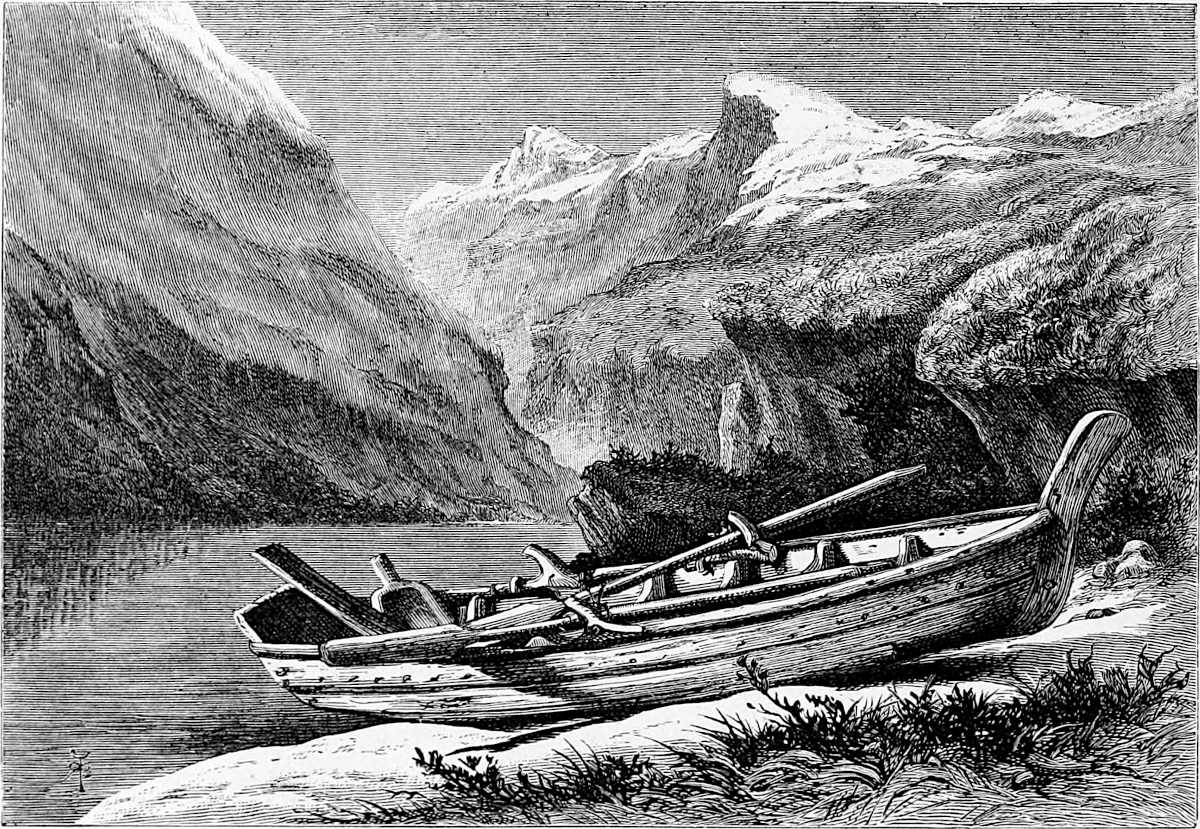
For our line the shortest way would be across the vand where the trout were caught, and Danjel reported the discovery of an old boat of that class which has no iron nails about it, but all wooden pegs, and yet not particularly inviting as to safety, as the baling-ladle of birch wood gave the idea that whoever last used it thought it would be wanted by the next comer. However, as the hunters were agreeable and we could all swim, we determined to try it. So off we started, with ominous gurglings and washings to and fro in the bottom of the boat, fast, frequent, and furious. The ladle was heartily plied, first by one strong arm, then by another; but still the water came. This brought to our remembrance the Scottish Highland custom of baling the boat with a good large shoe, and that if you only take a pair the power becomes doubled.
A Friend in Need.
Happily we arrived safely, and soon started for a long day’s work over unknown ground. The weather had cleared, and everything seemed to combine in our favour. There was a hearty good spirit among our hunters and ourselves, each fellow wishing the other good sport, and the dogs were keen to a degree. They longed for a revenge after the affair of the old gralloch, and flattered themselves that, if we were not unlucky, they would get fresh blood before nightfall. We were soon beginning to ascend steadily, and about an hour after starting, the Patriarch, working his way under some overhanging rocks, met with a surprise. An eagle, a large specimen, swept over his head and shadowed him. With his rifle in its case and across his back, the noble bird was safe, and the Patriarch delighted. Must there not be a nest? Yes, there was. Rough sticks and the lightest of down feathers were all that it was made of—rude, simple, and, one would think, uncomfortable for so grand a bird. Some of the down feathers were taken as a souvenir, and now and then brought out and floated, so light are they, in recollection of our having found one of the noblest of birds at home.
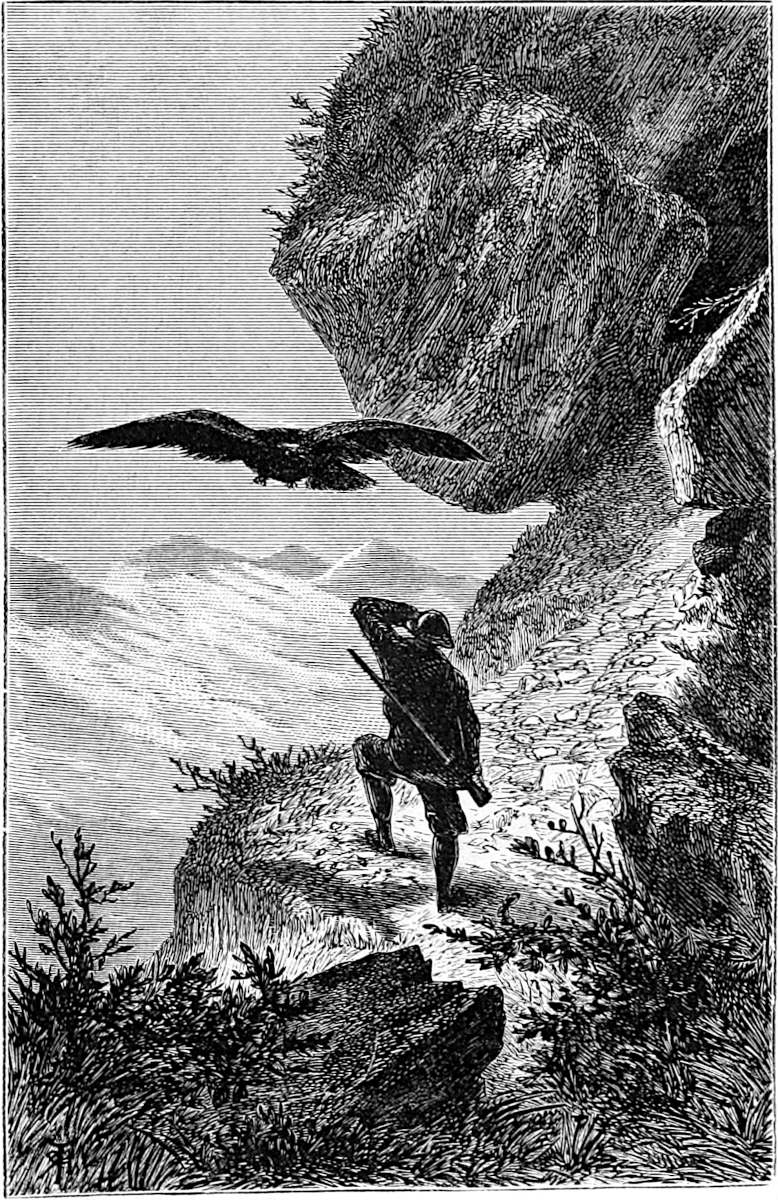
The Eagle’s Nest.
By mid-day we were out on the open snow, with hardly any rock shelter for stalking, should fortune favour us. The reindeer, however, were not “at home;” so we stopped at a suitable rock for lunch. How we enjoyed it! Old Trophas wagged his tail with a conviction that “no sport, no food,” would never be his fate as long as there was something left in our wallets. So we all rejoiced together, winding up with a little whiskey and hearty wishes for good sport.
Soon after lunch the tips of some horns were just visible on the snow-line. A large expanse of snow lay before us, with some small rocks half-way. Could we reach them? No; so we waited for the chance of the deer working up our way. Unfortunately they moved in the opposite direction, and our chance was gone. Still we had seen some, and that inspired fresh hope. Later in the afternoon we again saw a herd, and telescoped them for a length of time. Soon after this a second herd became visible, and it was most interesting to watch their manœuvres, which we did until they joined and moved off—of course in the opposite direction. An immense expanse of snow was now before us, and once we saw four herds of reindeer, and could count about one hundred and forty. For a long time we had hope, and agreed that if we could only get one we should be satisfied; but even that was denied, for the four herds gradually blended and went straight off, leaving us in the most perfect solitude, reindeerless.
Reindeer Head.[5]
By this time we had a long distance to travel to get back to our tents. Fortunately the light fades so little that it hardly signifies; still great care is required to judge of the best footing after leaving the snow, as the hunter leads, and can go any way, even to rolling down places like a hedgehog, and sometimes sitting down for a slide. Indeed, going home becomes a kind of steeple-chase over unknown ground. In such cases woe and grief must be the fate of the novice. At the highest elevation we passed an immense boulder, very much like the Logan Stone, and of similar dimensions, though perhaps larger. On the top of this was a much smaller one, but of different geological formation. This gave rise to considerable discussion about the glacial theory, as there was a non-believer present. What could have produced this remarkable combination but the action of glaciers passing over the surface, bearing huge masses of rock from distant parts, and, as the ice melted away, depositing them? These boulders were found at an elevation of 5,000 feet or more. We also met with a most interesting instance of pink snow, very marked indeed in colour. All these varied phases of nature did much to repay us for our disappointment respecting the deer. This the difficulties of the descent also made us for the time forget, as Danjel Kulingen was tearing away as hard as he could possibly go, sometimes letting himself down, then hanging on to the undergrowth of heather, sliding, rolling, or jumping. We often solaced ourselves with the idea that if we could only get him on the flat for ten miles for a finish, we could give him a spin and run him in at high speed.
Red Deer Head.
Whilst we had been telescoping the deer our Aalesund friend was having sport. On our return we found that he had been over to our tent to see us, and had left word of “Sport, sport,” and a message to try for a meet. This, unfortunately, could not be arranged, or we should have seen joy depicted on his face when he described to us where and how he killed his first reindeer.
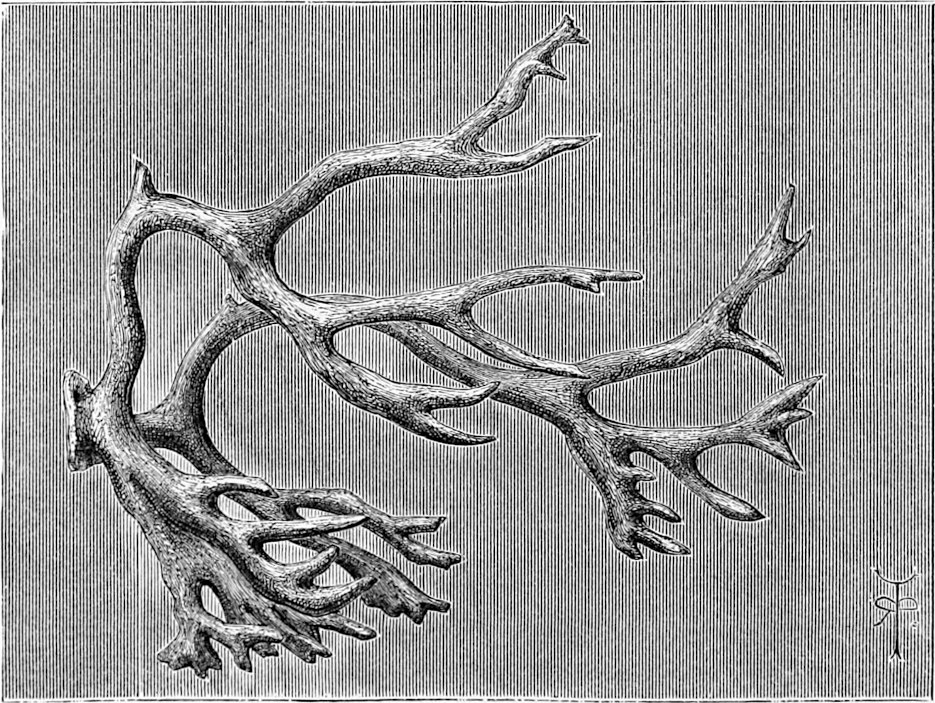
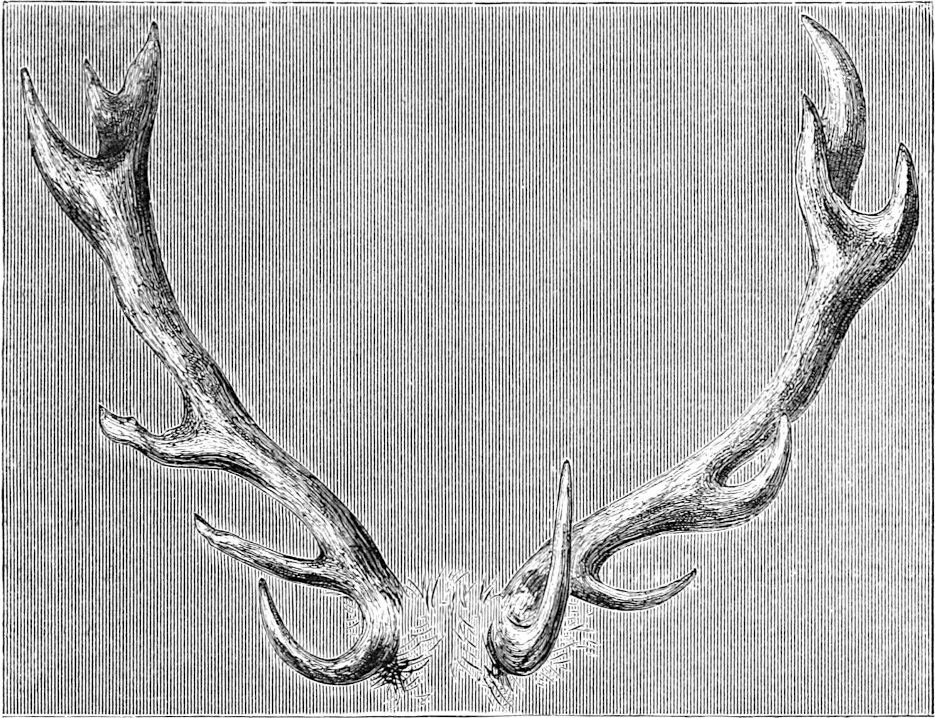
The Norwegians believe that the horns of the reindeer, boiled down, are good for consumptive people. There is no doubt that the reindeer themselves eat, or rather gnaw them when they are shed, which occurs in November. The males shed their horns first, the females retaining them longer. We found several horns partially gnawed through, and, when we consider the number of deer, there must be some reason why the shed horns are not more frequently picked up. The same idea of horn soup for consumptive cases occurs in Scotland, where the horns of red deer are also found gnawed. One would imagine that the best time for this potage would be when the horn was first formed, and the “velvet” is on, or when the horn is being renewed; and during this period it is very warm indeed, as large arteries run inside the velvet, or horn skin, and are engaged in depositing bone on the old stems, until the horns are complete and the velvet fretted off in September.
The reindeer, like ptarmigan, become white during the winter, and in their wild state present a great contrast to the sheeplike tameness of those possessed by Laplanders. The Laps have a regular call for their tame deer, which generally come at once; but if not, the proprietor has generally his lasso with him, which is thrown over the animal’s loins, and he is at once a prisoner. The good travelling pace of reindeer is well known, being about ten miles an hour, with two hundred pounds weight at their back. In their wild state their pace was beyond computation when we were behind them. We could well say that we had been “after reindeer,” and that is all. The only way to have sport in such a country as Norway is patiently to settle down to it, without fixing a time for returning. A river is not always right, nor the water in condition. So is it with the reindeer hunter: a thousand things may occur to mar his success. The very wind is sometimes wrong, and may chop round at the moment when he hopes it will hold on steadily for an hour or two; while, on the other hand, it may change at some fortunate moment exactly in his favour. No; there is no royal road to such sports as these. The charm of uncertainty must at all times attach to real sport. It must be worked for, and directly the uncertainty is removed its real charm is gone, and the relish for it dissipated. The mere act of shooting and killing lasts but a second of time; it is the surroundings which afford the real pleasure—the fresh air, the change of scene, the care required in every detail, the sportsman never knowing but that the very next moment some interesting incident may transpire which would make the day, hour, and spot a landmark; the necessity for watching every breath of air, the most delicate zephyr being registered and measured by the painstaking hunter, as he brings out tenderly some carefully preserved pieces of the finest floss silk, or, better far, some of the eagle’s down feathers already alluded to. Again, the dogs require constant attention; and, to be quite complete, a coronet of eagles’ eyes—optical all-rounders—would be an assistance.
•••••
ISHING for salmon, and the love which Englishmen have for that grandest of all sports, have led to the opening up of Norway to the general traveller. Our first pioneers, finding how importunate were the inquiries of the new-comers respecting the best spots and methods for sport, and that the inclination of some led them to try and bid above others for the waters they had really well earned by their own energy and perception—all this, we say, tended to make men on board the good ship Tasso rather taciturn. (Excuse the approach to an unintentional pun.) This, however, is not surprising, for men are compelled to be reticent when they know the inevitable consequences of giving details of their sport. Nothing will secure success but earnest work, patience, and biding your time for the happy combination which the best rivers can only afford now and then. Why, as we have just observed, the whole charm of sport would be dispelled if it became a dead certainty, and a man knew he would kill so many pounds of fish one day, and none the next. No; like the glorious uncertainty of cricket and hunting, the uncertainty of fishing is one of its charms; the average of good and bad is equalised, and the old French proverb comes in, that “Patience et longueur de temps font plus que la rage.” The noble salmon has become liable to increased and more subtle dangers within the last few years, besides his old natural enemies. The peasants have new means of torture. His natural foes are the bull-trout and sea-trout, which are the vermin of every river, destroying the spawn wholesale, and even lying in wait for the moment when the female deposits her milt, an instance of which came under our observation. The nets at the mouth of the river are an old institution, but they should be well constructed and supervised; also the tine, or stage, described in a former chapter, where the bonde is anything but the “sweet little cherub that sits up aloft;” still it is an old custom, and we like old customs. So also is the “worm box” which hangs from the peasant’s belt as he goes for some trout, or anything else that may be tempted. The worm box is a very primitive construction, its simplicity being well carried out in the birch twig by which it is suspended, and the two pieces of leather through which the lid slides. It is a picturesque relic of old days.
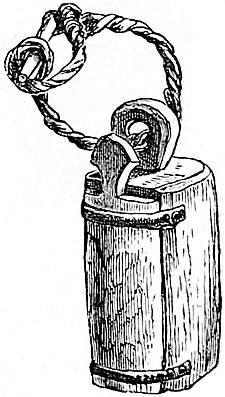
Worm Box.
We now approach the recent diabolical invention of the “otter,” which, sad to relate, must have been introduced thoughtlessly by some one who little knew what damage he was doing when, for his own selfish gratification, he fell back upon so unlawful and unsportsmanlike an expedient. Even to obtain food such poaching is unjustifiable. Certainly enough could have been taken for that purpose by fair means. It is of no use, however, dilating upon this; the deed is done, and otters cannot be withdrawn now. If the arm of the law were stretched forth, “les pommes volées” would become more than ever “les plus douces.” Then, again, the kindly feeling engendered by good sport and a certain sense of gratitude frequently leads, at the end of a visit, to a gift of flies, perhaps even of a rod. In illustration of this let us repeat the case of the proprietor of a river who gave to Nils, his elve-wakker, a salmon rod and flies. Early in the season Nils began to avail himself of the new fishing-gear, and soon wrote home to his benefactor to say that the salmon were coming up the river, but that he had broken both tops of the rod, and lost most of the flies; would the gentleman kindly send out some more flies and tops to get the river ready for him? We do not think this was done; it could hardly be expected that any man would like all the salmon he killed to be landed with more than one fly, perhaps one in his mouth, one in each fin, and finally one in his tail. What an awful apparition for even the merest tyro! Such liberality is simply mistaken kindness. This brings to mind other stories concerning salmon-fishing.
It is often remarked that “truth is stranger than fiction.” When an M.P. fishing in Scotland played and held his fish all night, and on the following morning lost him, and a friend of his afterwards killed a salmon with one of the M.P.’s favourite flies in his tail, that was certainly an event, but hardly to be compared with what we are about to relate. In the large rivers of Norway a fishing may extend four miles, and the fishing next to that only three, so that different waters are let to different persons. In the present instance our foreign Izaak Walton was fishing the very top water, and, as good luck would have it, hooked a stor lax, perchance a forty-pounder. He played him firmly and steadily, but the fish after a time got the gentleman at the reel end of the rod through the next water and the next. Hours rolled on, yet still down they went, and by the next morning arrived at a shallow part of the river. A Norwegian peasant came up, and, despite the national dislike to going into the water, plunged into the river, and walked out with the stor lax in his arms—dead, and reported that he must have been dead for the last five hours. Nevertheless he got him, and a fine fish he was, with one fly in the right place.
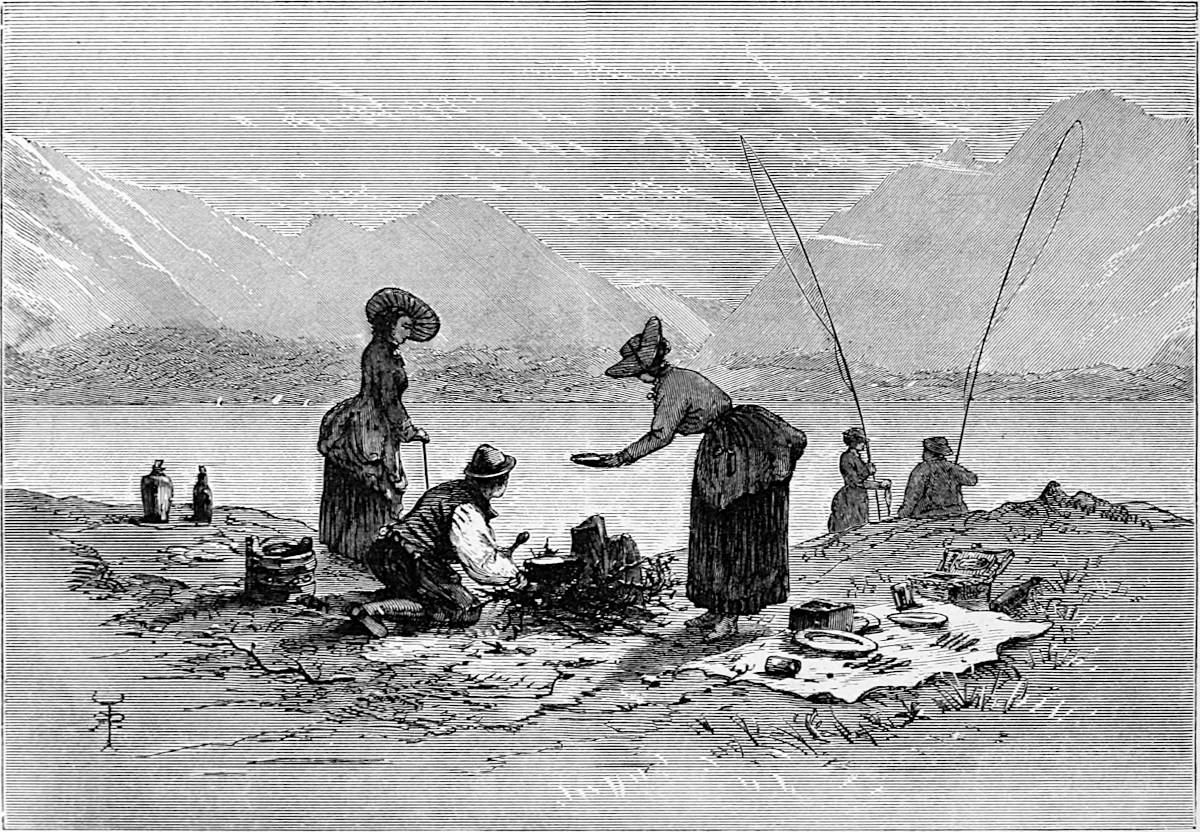
Fresh Fish al Fresco.
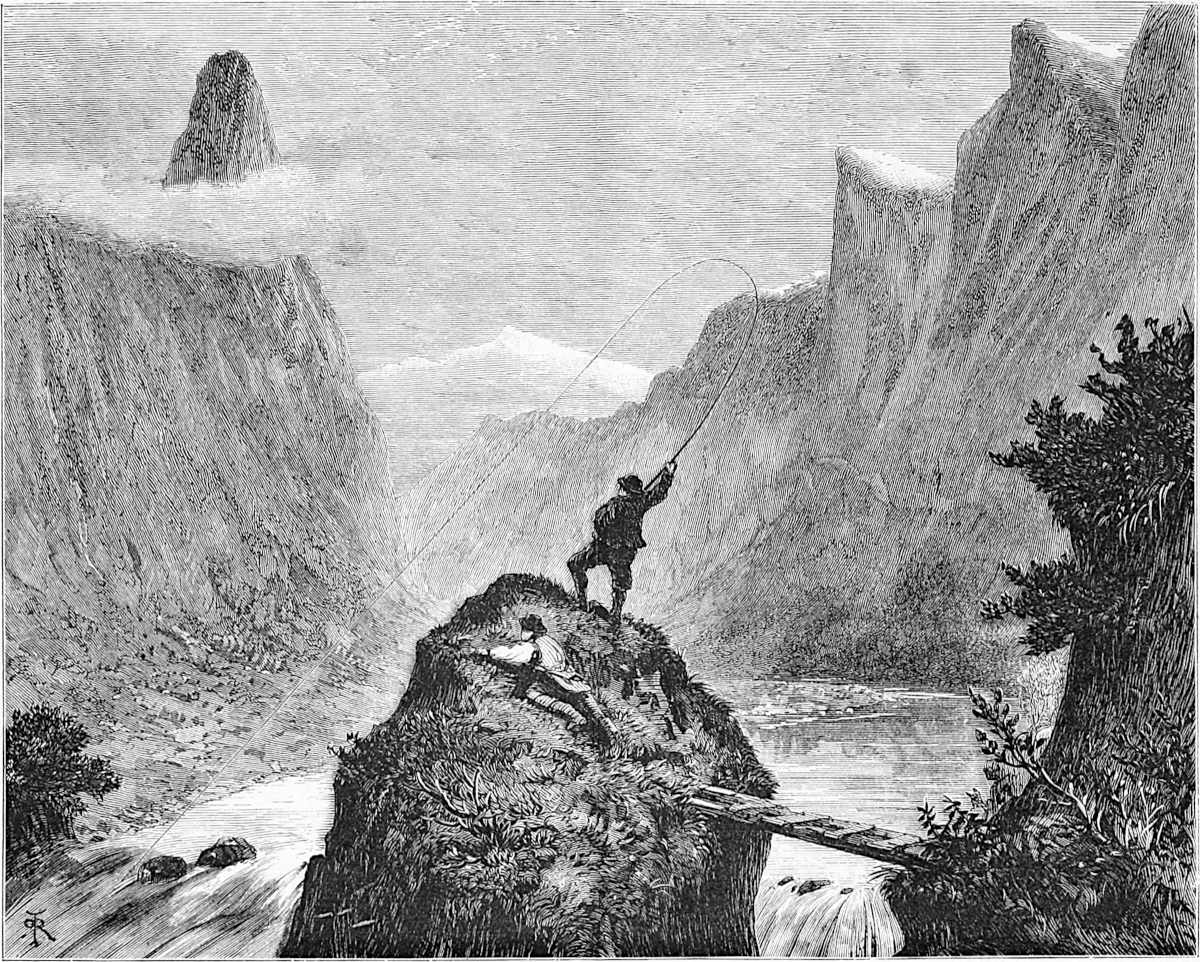
The Stige-steen, or Ladder Rock.
[See larger version]
The Norwegians have a great admiration and respect for a good fisherman. One morning, speaking of the average sport of the river, and referring to that of last year, we inquired if —— were a good fisherman. Knut answered emphatically, “No; he is a poor man, a very poor man.” We naturally replied, “But in England he is a very rich man.” “Ah!” said Knut with strong emphasis, “when he was here he was no richer than we, but the flies bite him much more.” What contentment! no envying, although a latent satisfaction creeps out, which decidedly evinces an undercurrent of thought.
Trout-fishing has the great charm of taking Piscator into the most lovely and retired spots. The salmon, as a larger fish, takes us to a grander scale of nature. The water of the cheerful little trout stream is changed for the rushing river, and the comparatively low bank sometimes gives place to a position like that in the annexed illustration, which was taken from above a grand pool, the Stige-steen, or Ladder Rock, connecting it with the side of the river.
Having said somewhat of fishing, let us now turn to the “aldermanic view” of the salmon, and hark back to a happy day when a lady had killed a nice fish, about fourteen pounds and a half, which was to be cooked on the spot: it is well to observe the process and make a note thereof. Cut the salmon in slices, and boil them for ten minutes; then let the water in which they were cooked boil on, with the head added; put in a little fresh butter, pepper, and salt, and serve as gravy or sauce. With a Norwegian appetite it is perfect, and very simple. N.B.—Fish killed at noon, served at two p.m. This is fresh fish, and contrasts most favourably with the frozen salmon which travels ice-bound to the metropolis of Great Britain.
Evening is the best time for fishing, and the long twilight, which helps the enthusiast for trout and salmon fishing at eleven or twelve, can only be realised by those who know the glories of the North. It seems a curious thing to take, when travelling, a green blind in order to exclude the light when wishing to go to sleep; still it is necessary at first, although Nature is so elastic that she readily adapts herself to circumstances, when the green blind can be given to some new-comer, or lent as a passing boon.
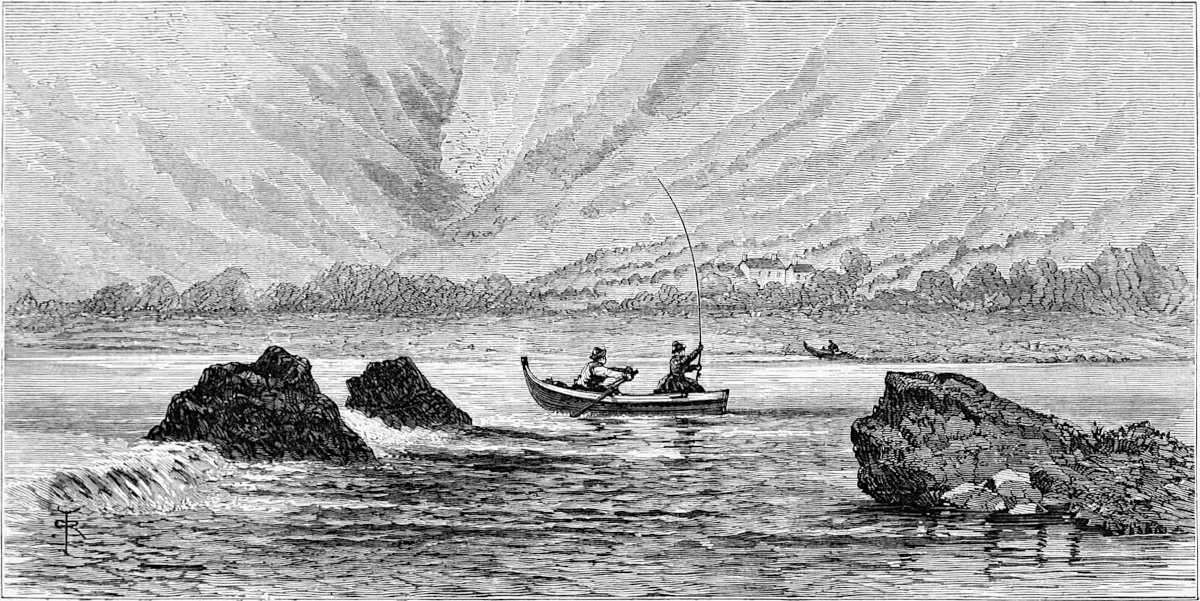
Casting.
One word in reference to the illustration, “A Good Beginning.” It was our last morning: wind, rain, mist low down—in fact, blowing hard. No. 3 was up at five a.m., and found the Tentmaster-general had passed a restless night, every coverlet and blanket being knotted, twisted, and twined into the most perfect disorder. This was attributed to the fact that it was his last night that season in Norway, and his usually placid sleep had been disturbed with Norske nightmare. He must have been dreaming of trolds and nökken, and fancied that he was gaffing ogres or bjergtrolds instead of fine clean fish. The weather was the last straw which broke the camel’s back—he would not go. “You go,” was his rejoinder. So the Patriarch went; and this was the result to greet his companions when they came down to breakfast.
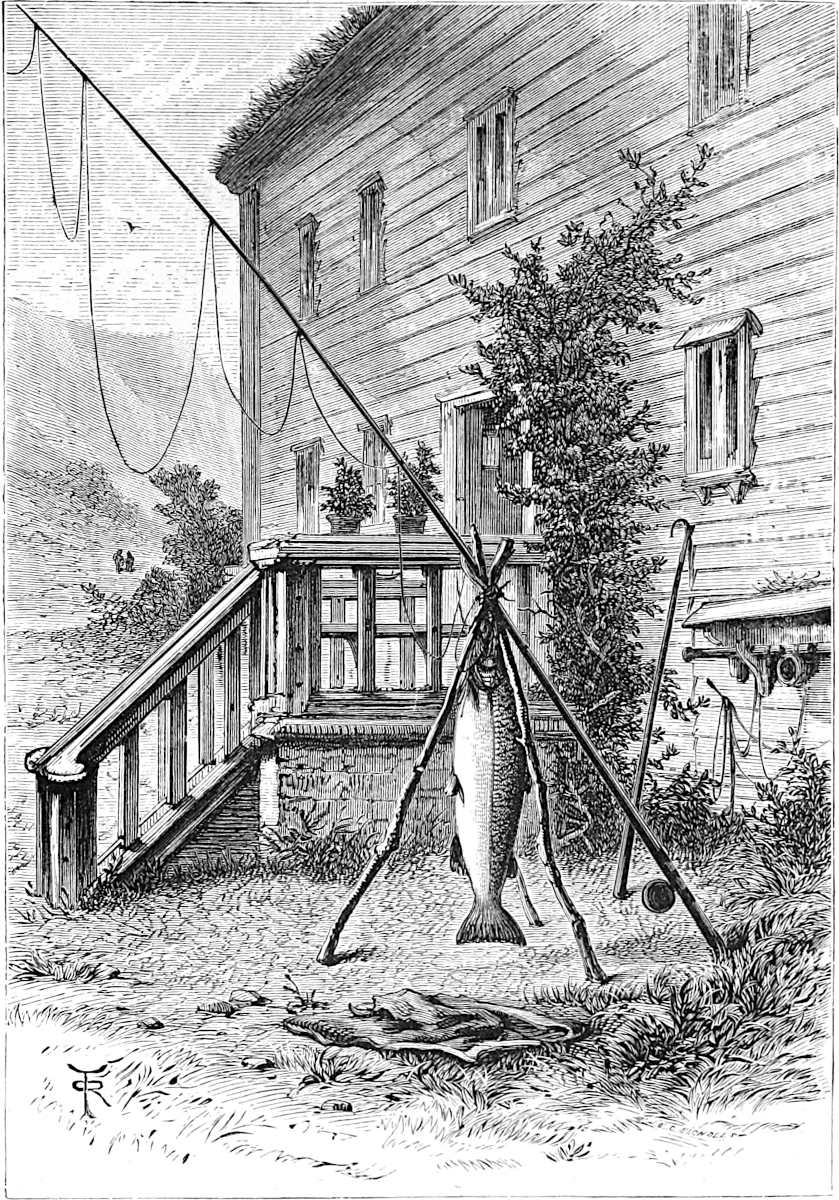
A Good Beginning.
•••••
HERE is a great charm about the freedom of driving one’s own pony and carriole, or stolkjær, for a long run, or even for a short excursion; it conduces to the peaceful rest we are all longing for, and saves one from reminders that at the next station the horses will be charged for if we do not hurry on. This is rather tantalising when one is drinking in nature, and realising the fact that each moment is revealing fresh beauties and developing lifelong impressions—the very time when one wants to be left to nature and himself. In the excursion now before us we had our own ponies part of the way, and pedestrianism for cross country. Our route was from Romsdal, the weird valley where, on the previous evening, the trolds had been playing pranks in the following manner:—About 8.30 a tremendously heavy roll as of thunder, lasting forty seconds, brought us suddenly to the window. The mist was hanging round the peaks, with cirri-strati across them; down came the steen-skreed, or slip, with a mighty rush; and the cloud was driven out by the shower of rocks and stone as they came madly down. It was unusually grand. The sheep boy with his horn ran in, Anna rushed to the door to see it, and as she came the dust rose up in a cloud as incense after Nature’s work. Ole remarked that it was a fine shower, and very impressive it certainly was; still Anna said she did not like it. In some cases in the winter-time the peasants go on to the ice to avoid the possibility of these erratic masses reaching them.
We were soon off to Gudbransdalen, calling as usual at Fladmark—that lovely spot, beautiful to a degree if you have provisions. Should such be the case, you certainly must have brought them, for the station is not one of refreshment, as Mrs. Brassey testified by her anxiety to regain her yacht, the Sunbeam, which is truly a sunbeam to her friends. Long may it be so to her and her husband and son!
We must leave the hurly-burly of rocks through which the Rauma dashes in this part. Rocks the size of detached villas seem to have been “chucked” about, for this is the only term we can bestow upon such higgledy-piggledy positions. One can only realise the idea by imagining one’s self a minute insect in a basin of lump sugar, with a great rushing river beneath.
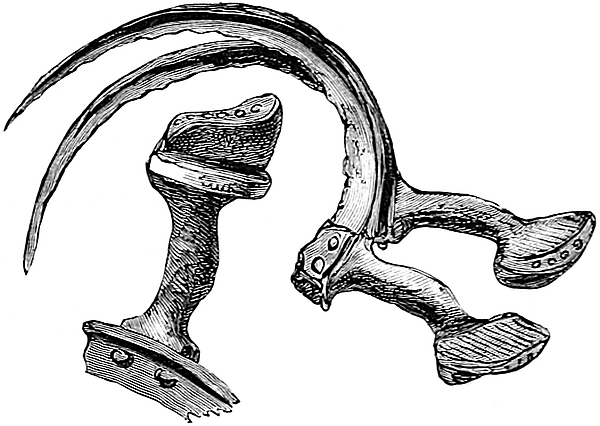
Arriving at Mølmen, we found it a most healthy spot, and worth staying at for a time, as the people are so kind, and the whole surroundings inviting. Being on a high plateau, the air is perfect, and the place seems to be more than usually fortunate in its weather. The following morning, there being no service at kirk, we availed ourselves of the perfect weather for enjoyment on the hillside. Striking off from the houses, we sauntered up through the stunted birch and the heather till the grey rocks became more prominent, the vegetation sparse, the plants closer to the ground, and then we lay down on the fjeld side. What a view there was beneath us! The whole scene was a rare combination of all the prismatic colours so characteristic of Scotland in October. At our feet was the long Lesje Vand, beyond that the Dovre fjeld, and we fancied we could see Sneehatten; then, away to the right, were snow ranges to Storhættan, which is ascended from Ormem. How we basked in the sunlight and longed for more life on the fjeld! “Why should we not go to Eikesdal?” said Ole all at once. “That would be fine: why not?” The idea was caught at. “How long would it take to walk, Ole?” “Well, eighteen hours if there is no mist.” “Very well, then; no mist, if you please, and we will do it.” This was a new joy: eighteen hours’ walk without a house to call at, carrying one’s own nosebag, and great doubts as to a bed on arriving—more delightful still! This is enjoyment indeed, though not to every one, perhaps. We therefore decided to start the next morning at three a.m., provided there was neither mist on the mountains nor the chance of it. How we revelled on the journey in anticipation, enhanced as our happiness was by the beauty of the scene and the grandeur of the surroundings! All the way down we conversed on our coming walk, interrupted only by a visit to a farm, where we heard some of the good folk singing. It was hay-time; the weather fine, with a refreshing breeze that gently waved the new-cut grass as it hung from the frames, like huge towel-horses, which are used for drying it. We were invited to enter the farmhouse, where we found the room tidied up for Sunday, and the family singing a hymn in their customary devotional manner. There was the usual three-cornered cupboard; an old gun which had laid low many a good buck, the powder-flask, primer, and ball-bag were ready for August; the ivy was carefully trained up the windows inside; and the ale-bowls and tankards were about the room. It was quite a Norwegian homestead. One thing was unusual—a musical instrument called a psalmodicum, which is a board painted green with red flowers, about an inch thick and thirty inches long, with three strings raised on a bridge like a violin. These strings are played with a bow, also of the violin class, but different in character. We regretted very much that we could not persuade any one to perform upon it.
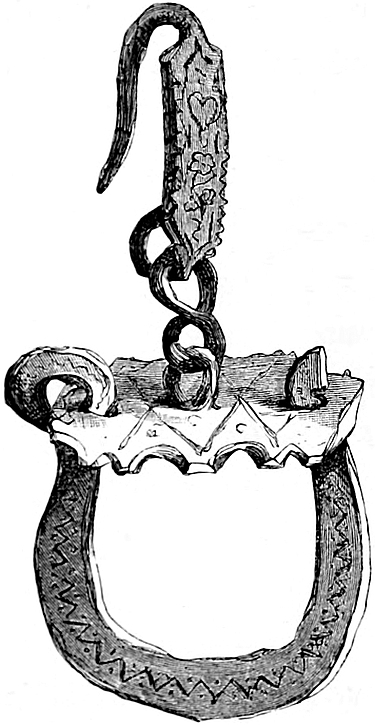
Wool Holder.
On our return we found the proposed trip emanated from the fact that a house-painter was going over to Eikesdal, and had been waiting for clear weather to carry out his object. By the next morning a farmer from Eikesdal proposed joining us: he knew the way. This completed our party, and at four o’clock we started, with every assurance of fine weather. Working up through the stunted birch-trees, we soon looked over the heights of the Vermer Fos to Storhættan. The Svart-hø rose behind us, and approaching the snow-line, we came upon the reindeer-flower (Ranunculus glacialis), with its sharp-pointed leaves and beautiful white blossom. Then the dreary Gravendal opened to us, wild, bleak, weird, and barren to a degree, with Amra Jura on our right, directly over Eikesdal, far, far away. About this time there was a grand solar rainbow. We now got very rough rock-tramping—regular couloir climbing—and there was no vegetation, the moss being of the “crottle” tribe, a perfectly black lichen. As we ascended the peaks were grander. Many reindeer spör were seen, but no reindeer. At the highest part we found the snow discoloured by a very fine dark gritty dust; and it is a remarkable fact that this discoloration was the result of volcanic eruption in Iceland. After the eruption a gale set in from the W.S.W., which on Easter Monday, 1875, positively carried the clouds of scoriæ right across Norway. The line was followed even to Sweden, and corroborated by some peasants who were out when it fell.
A volcanic eruption in Iceland is a serious matter. One of the worst occurred in 1783. On that occasion 14,000 persons were killed. In the eruption of 1875, the vegetation, which provided for 40,000 sheep, 2,000 cattle, and 3,000 horses, was all destroyed. The hay harvest, the only one in Iceland, was also entirely destroyed. Scoriæ, varying from fine pumice to pieces the size of two fists, covered its surface from an inch and a half to eight inches deep. The eruption began about nine a.m., and when the scoriæ fell there was total darkness. The air was so highly charged with electricity that staff-spikes held up in the hand seemed to be in a blaze.
We soon began to descend a little to a vast plateau. Our provisions had been fallen back upon every few hours, and were now much reduced. The farmer looked forward to the plateau as being likely to afford some multebær, a kind of raspberry with a hard skin, but juicy. A good and most useful man was the farmer. Favoured by the weather, he steered well, and we soon came to an incline on the snow, where we could make a long and safe glissade. It was certainly a novelty to see us all flying down. The farmer was the best man, and happily we reached the bottom in safety. Another hour and we lay down to rest and enjoy our multebær. They were deliciously refreshing. The house-painter, or maler, suggested that there was a sæter somewhere at the head of Eikesdal which we might try for. “That is just what we are making for,” said our cheery chief, the farmer; “in about an hour we shall be there.” On we went, our fatigue being forgotten in the grandeur of the scenery and the difficulty of picking one’s way, for hopping from stone to stone absorbs the attention considerably. The time soon passed, and after we had completed our twelve hours’ walk we had arrived at some weather-worn, storm-riven, dwarfed, gnarled, and twisted birches, beyond which, in a botten, lay our sæter. What an invasion! The two girls were astonished, but when they heard the voice of the farmer all was well. Ole immediately ordered a bunker, as it is called in Romsdal; in Gudbransdalen it is termed rummer coller. How we enjoyed our rest after this simple food! A bunker, however, should be described: it is a flat wooden tub of curds and whey, and is handed to two people. Each person is armed with a spoon, with which it is etiquette to draw a line across the centre for your vis-à-vis to eat up to, not beyond; but few Englishmen ever reach the line unless they are very old hands.
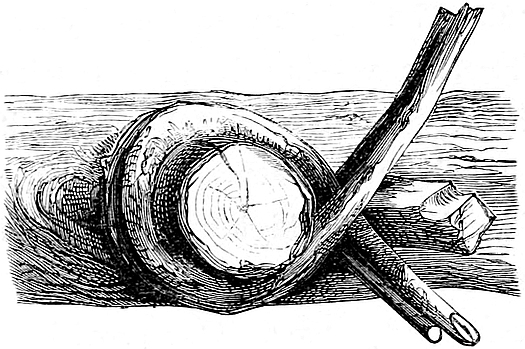
Reeb Holder.
We were now at the head of the Eikesdal gorge, or valley; a roaring torrent rushed down the centre to Utigaard; on the left were steep precipices with a large fall; while the opposite side was perpendicular, and threatened showers of troll stones. As we descended we saw many huge masses of rocks which had ploughed their way down, carrying all before them. To see one of these lapsus naturæ is a very impressive sight, and makes one hold his breath and think. Passing through the valley, we noticed some very curious snow shoes, in form like the square frames on which sea-lines are wound, but with broader cross-pieces. Birch twigs on each side and over the foot fix them. On we trudged, having bidden farewell to the farmer, thanked him for his good services, and had a skaal for Gamle Norge. Finally, we left the house-painter at his destination, where the old lady told us all about the dust coming down upon her; and then Ole and myself were alone to finish the day. We had started at four a.m., and it was now ten p.m. We at length saw the spire of a church—the kirk at Utigaard—and we began to inquire for Torstin Utigaard of Utigaard, the hunter. At last we found his house, but he was on the fjeld. Could we get a bed anywhere? No, nothing. Ole persevered, and we presently found comfort. Torstin was expected down from the fjeld that night with an English gentleman, whose servant most kindly gave me his bed. After awhile down they came. Enter Torstin, a grand-looking fellow, drenched. They had killed a semle ku, and had left two men behind to bring it down next day. In the morning they arrived with it, forming the wildest reunion of hunters. The Finmark dog, quite black, looked a beauty as he lay by the dead reindeer. “Blenk”—for such was his name—was a good and trusty servant: neither biped nor quadruped would venture to interfere with him when he was on duty. It was a splendid group, worthy of the pencil of a Landseer.
After the pouring rain of the previous evening, which had continued through the night, we all had hopes of fine weather for our trip, and still more did we desire to see, before leaving, Utigaard in the beauty of sunshine. But no; on arising at about five, we found dirtier weather than ever; the mist low down; Blenk still keeping watch by the reindeer which had been brought down; every kind of waterproof oilskin being looked out; and a great demand for sou’-westers. At last the stolkjær was packed, and everything ready to go down to the boats. The baggage on the stolkjær was surmounted by a reindeer head, Blenk ever in attendance, and Torstin Utigaard of Utigaard leading the pony as our chief. Then we were off, looking something between fishermen and smugglers.
It was with much regret we took our last look at Utigaard as we settled down in the boats en route for Syltebø. The valley was grand in the extreme, the mist sometimes breaking up over the sky-line with a sudden rush, as if thankful to get loose and range over the fjeld with freedom. Hardly were we under way, and the crew settled down to the steady-going pace which Norwegians can keep up for any length of time, when Utigaard burst out wondering who could have been the figures he telescoped on the snow on the previous day—the fellows who had nearly spoilt their sport and frightened their deer at the very moment when they thought they had the “rein” well in hand. What could people be doing up there? why should they go? who had ever seen any one in that part of the fjeld? At last the thought flashed across his mind that it might have been us. Was it? Yes, most undoubtedly it was, but happily we had unintentionally turned the deer; it was, however, the right way, so no harm had been done. The deer had been bagged, and we now all rejoiced together.
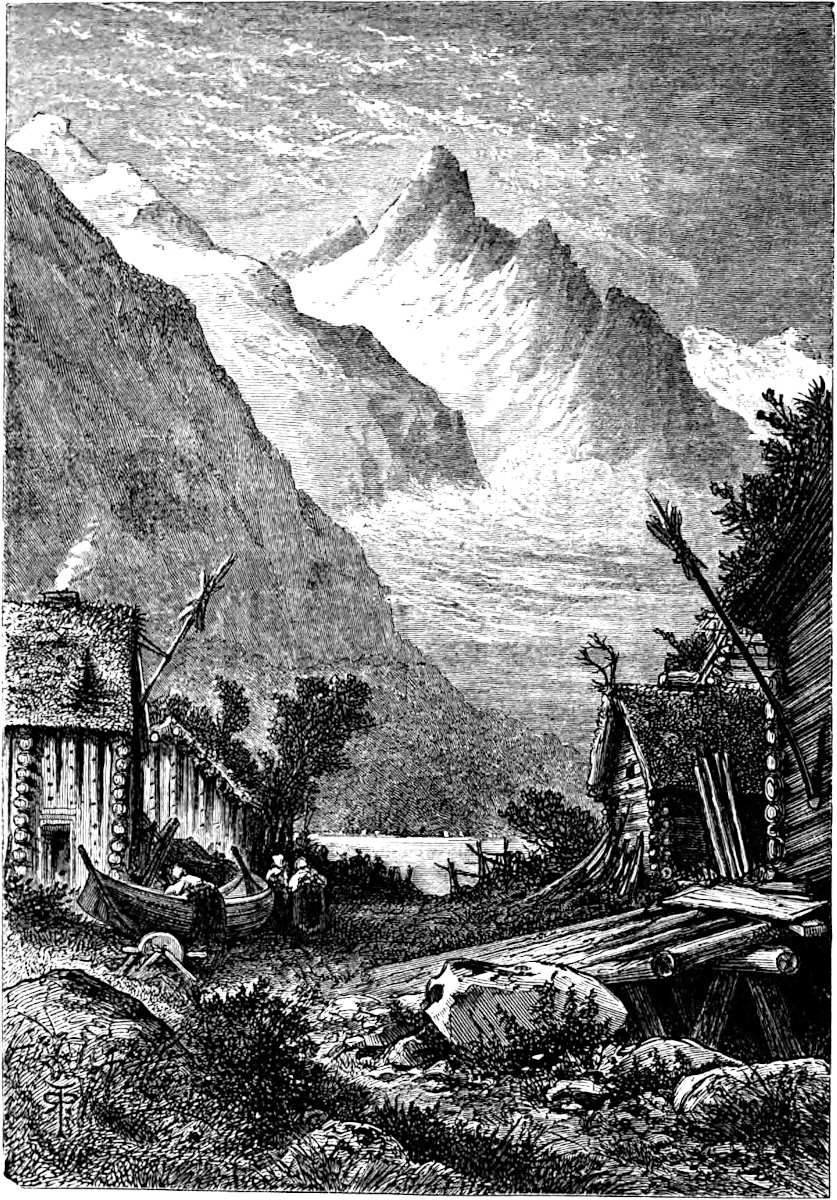
Eikesdal.
As the three boats rowed steadily in solemn procession down the vand we approached the Vika Pass on the starboard side. At this point the lake is most imposing, its grandeur much enhanced by the mist, which is ever changing, ever beautiful in form and intensity. Soon some of the favourite old Norwegian songs were started, the chorus being echoed by the other boats. On the opposite side of the Vika Pass there had been a great steen-skreed; and so immense are the surroundings that it was impossible to realise the extent of the devastation until we approached the base of it, as it had dashed and lumbered into the lake; then the huge masses revealed themselves in their unmistakable proportions, dwarfing our boats to mere insignificant specks by their side.
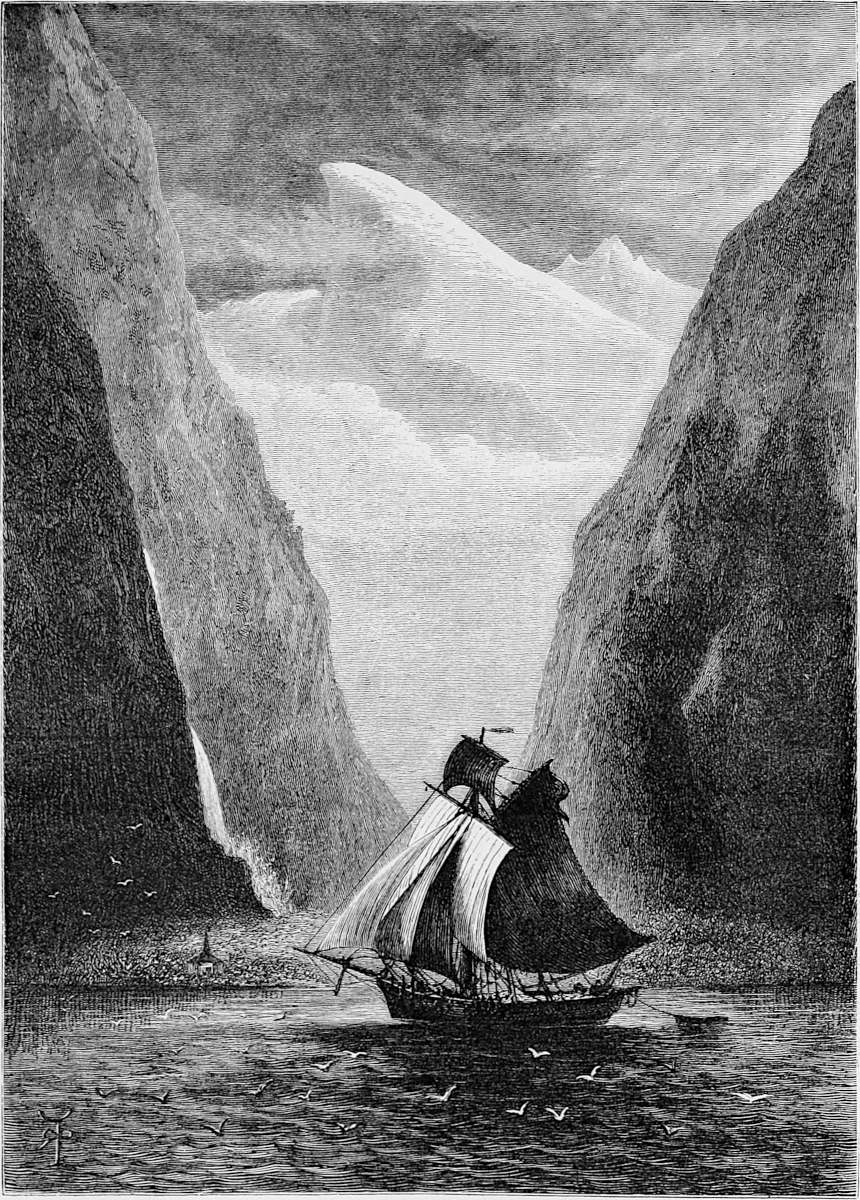
Volda.
[See larger version]
Near this spot bears have been seen, and one was tracked only lately. This led to the subject of bear-traps and “self-shooters,” when the Tentmaster-general enlarged on the modus operandi adopted by the postmaster at Sundal. He knew there were bears, and having fully studied the spot, determined to lay a “self-shooter,” if possible, or at all events a trap; and this he very ingeniously so arranged that when the trap caught Master Bruin a red flag should go up: this he could see with a telescope from the post-office as he sat sorting the letters. Some people had noticed that the latter operation took much longer than usual about this time; still no one attributed the delay to the postmaster’s love of bear-hunting, and they little thought that he sorted with one eye and watched for Bruin with the other. At last one day the postmaster saw the red flag. This was too much; the letter eye immediately joined the fun. He was off at once to the bear, shot him, and brought him home; and during the year he managed to get four.
Hard as it rained, we were very sorry when our boat trip drew to a close, and we felt that we should soon have to bid farewell to Torstin and Eikesdal Lake, with its many joys, rough life, and hearty welcomes. We had a glorious walk from the lake to Syltebø, and were glad when we saw in the distance the white house which was to be our haven of rest, and to welcome us as friends. Soon after our arrival our host came in from the river with a good fish; and many a one has been taken from that stream, in spite of the change which has come over Norwegian rivers within the last few years. When English sportsmen began fishing in Norway the bönder attached no value to salmon. They were surprised to see them caught with such slight rods and tackle; but, as soon as it dawned upon them that salmon were worth so much per pound, they began to help themselves by netting them at the mouth of the river, before they could ascend the stream which the enthusiastic Piscator had paid a good sum to rent. The natural consequence is that Norwegian rivers do not afford the sport they once did.
Whilst shooting at Syltebø, one of my friends found a beautiful specimen of amethystic crystal of considerable size. From here a steamer runs to Molde, one of the northern sea-coast centres, and true to its time the little screw came off the landing-place with hardly any one on board, for the season was far advanced: most tourists and sportsmen had returned, and we enjoyed it all the more, as it afforded us a better opportunity of seeing the people themselves.
The variety in Norwegian travel adds greatly to one’s enjoyment. In the present trip we started from a rich expansive valley; thence we ascended through woods of birch and alder by a torrent’s side, vegetation became stunted and sparse, mosses gradually disappeared, and lichens preponderated; then came barren boulders, and, above all, the everlasting snow. Having attained this, our journey was varied by a descent to the wild gorge of Utigaard; the Lake of Eikesdal, a vast body of water, with its grand fall; then again, after the boating procession, through the valley of Syltebø, by the side of its salmon river, to the sea; and finally we were on the deck of the bustling little screw steamer. On stopping at the first place we were surprised to see a large boat coming off, mushroomed with huge umbrellas, whence issued the music of Norwegian voices, and evidently those of ladies; but as they neared the steamer the soft strains ceased, and they came alongside in silence. Our array of oilskins, waterproofs, and sou’-westers announced that foreigners were on board. We, however, considered that this treasure trove should not be a dead letter on a rainy day, and the Patriarch broached the subject of Norwegian music, which happily led to an encore of all the boat songs and many others, reinforced with much gusto by the chorus of oilskins, waterproofs, and sou’-westers. They were a happy band—all ladies and no gentlemen—going to a party at the præstegaard, some few miles down the fjord. They assured us the priest would be very pleased to see us, and give us a hearty welcome. It was with much regret we were compelled to decline the invitation, especially as it would have afforded a pleasing episode in our trip, and given us an opportunity of seeing the vie intime of a Norwegian minister’s home en fête. As their boat left the steamer, they sang one of our favourite songs, and our modest chorus followed it at a gradually increasing distance until both faded away. After this cheerful but soaking morning we comforted ourselves with stories of the fjeld, salmon, and Norwegian life. Happily the Tentmaster-general was in great force, and, when called upon for a yarn, responded with “muckle hilarity,” giving us one of his reindeer experiences. Can we do better than repeat it here?
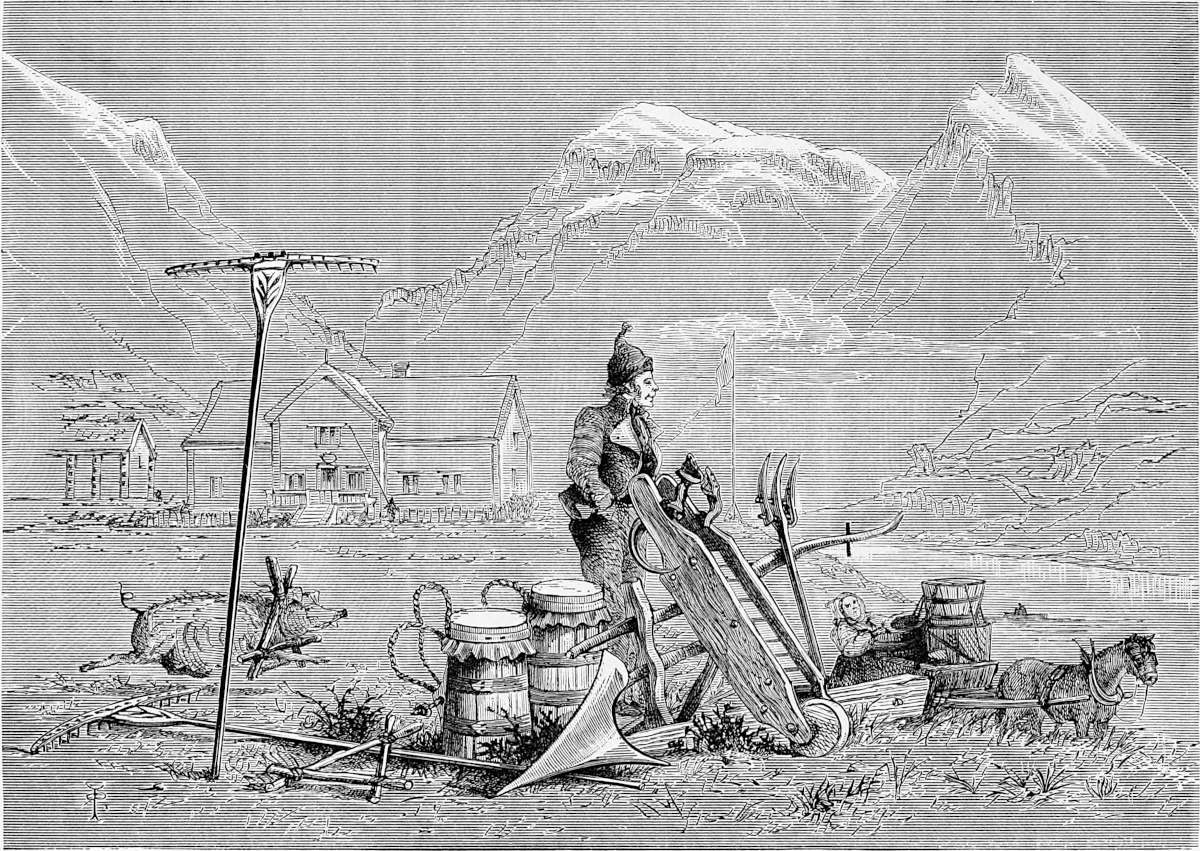
Syltebø: with Farm Implements.
[See larger version]
First scene, tente abri on the fjeld. Snow close above; in fact, too much snow for sport. The Tentmaster-general telescoping alone in the camp, if one may so call two tents. Having had a very hard and weary stalk on the previous day, he was resting whilst the Major and Dan went up after deer. Soon after they had settled down to work, the Finmark dog “Passop” became very uneasy, and so fretted the string by which he was led that Dan thought he might break away, which would be sudden destruction to everything; he therefore carried the dog in his arms. Shortly afterwards, Dan, doubtlessly becoming slightly tired of carrying the dog, relaxed his hold a little. At that moment Passop caught sight of a buck, sprang from Dan’s arms, and bolted after the deer. Dan threw up his arms in despair, and gave vent to several Norwegian hunting quotations unfavourable to Passop’s future happiness. One thing was certain—the dog would go till he died from sheer exhaustion, and Dan would never recover his favourite Finmarker. Dan soliloquised, and watched long with his telescope, and finally gave way to grief. The next few hours were very blank and sad—deer and Passop both gone. In the afternoon, with melancholy thoughts and sluggish conversation, they began retracing their steps to the camp, which was about six miles distant. As soon as they were in sight of their fjeld home the Tentmaster-general came cheerfully to meet them, for he had seen seven deer steadily going down to a lake, and had anxiously awaited the return of Passop. No time, however, was to be lost. Off he went in pursuit alone, with the Major’s rifle. Hardly had he got away from the camp when he caught a glimpse of more deer—two this time, both going to the edge. He lay down to watch them, for patience as well as judgment is required in reindeer work. After some time a strange sound, like the bark of a dog, came down; but who ever heard the bark of a dog in the wilds of the fjeld and on the snow? Listening again, in a few minutes, from behind a huge boulder, came a stor buck straight on, with a dog close behind. What a chance! Happily the Tentmaster was equal to the occasion. In the twinkling of an eye the shot was fired, the buck was hit, but carried his bullet with him, and made for the water. The dog gaining on him a little, he dashed into the water to swim for it; but Passop dashed in too, for by this time our hunter had recovered from his astonishment at the strange dog, and recognised it as Passop. The ice-water of these lakes is, of course, intensely, cold, and the dog was obliged to come back: he, however, did not do so until he had had a good tug at the deer, which by this time had turned on his side and was dead. A second time Passop tried to reach him, and was obliged to return; but the third time he got on his back, and sitting there, held the horns in his teeth. As the dog could not bring him ashore, what was to be done? By this time the Major had come up, and determined to swim for him, and tow him on shore. The ice-water was too cold for him also, and he was obliged to turn back. The deer was too far out to lasso, even could they lead the line up from the camp. But nil desperandum. Hardly had their wondering got full swing when a tremendous squall swept down the hillside, caught the deer and Passop, and they drifted in. The Major made another attempt, and the deer was landed. They were soon off to the camp, where Dan, with a very sad heart, was preparing speise. When the latter looked up and saw them coming, accompanied by his beloved dog, his expression soon changed, and Passop was caught up into his arms as quickly as he had sprung from them in the morning, while Dan, with a radiant face and his head a little on one side, turning round to the Tentmaster-general, said, “Good man, Maget good man.” Passop was made much of, Dan’s happiness restored, and the one bottle of champagne was iced in the snow, to drink to “Rensdyr jagt paa hoie fjeld.” It was a great day happily terminated, and long to be remembered.
•••••
OR some days we had been on the tramp, and arrived at Indfjord. Thursday, August 20th, 1875, was a sad day there. Returned from a long tour through very wild, rough districts, where neither food nor lodgings were to be had, we were settling down for a good night’s rest, certainly under difficulties, at the house of a good farmer named Ole Erikson Boe, when the gruesome news came of a disaster in the mountains above. A tremendous rock crash, or steen-skreed, had taken place at a spot called Sylbotten, some three thousand feet above, where there were two sæters occupied by two piger, who had charge of the cows belonging to the good people down the valley. We started off at once. In a more than quiet spot like this, with what a crash does such news burst upon every one! What sympathy it brings out; what interest in the details of the occurrence! What sadness marks each face, and how quiet and subdued all are, though all are talking!
We pass on, with a little provision in our wallets, and soon come to some reapers in the valley, working in the fields, with leather aprons for their protection. We started with Halve Jacobsen, the owner of the sæter, who went up, taking a pony and foal, in case the mare’s services were required: the foal always runs by the mother. On our sad mission we could not be otherwise than struck with the joyfulness of this young animal, its abounding spirits, caprioles, and quirks and capers. Before arriving at the steep part of the ascent we stopped at a small outbuilding close to the farm, the front of the house looking over the Indfjord, with a grand expanse before one, the morning light shimmering down to the edge of the water far, far below, and all seeming peace and gladness. At the back of the house, between that and the laave, we found a vastly different scene—pain, grief, and heavy hearts. What a contrast to the brightness on the fjord side—the sunny side that was! The anxious group was in shadow, comparatively speaking, the centre attraction being a roughly made stretcher, on which was lying, hardly conscious, pale, agonized, and bone-broken, Ingeborg, Erichsdatter, Griseth. Poor girl! she had been brought down some three thousand feet by a very steep sæter path—for there was hardly any road—jogged and shaken, with one leg broken, ribs crushed, and her face much cut and bruised by the cracking up of the sæter before the overwhelming force which carried it away. Around her were the bönder folk, and one poor old woman whose grief seemed beyond consolation. The autumn was advanced, and the winter coming quickly on, for the first snow days had begun. She had only one cow to support her: that was at Sjolbotten, and was killed, so her only hope of livelihood was for the moment swept from her, as no cow could be got under £5, and “no siller had she.” What a chance for some rich Samaritan to heal a broken heart for the small sum of £5! But as “many a mickle makes a muckle,” so, doubtless, would a new cow be bought by the kindly spirits of the good Indfjord folk. Their love for each other is a lesson to even the most civilised among us. Indeed, it is very noticeable that small communities care for everybody, while large masses notice no individual—only charitable institutions.
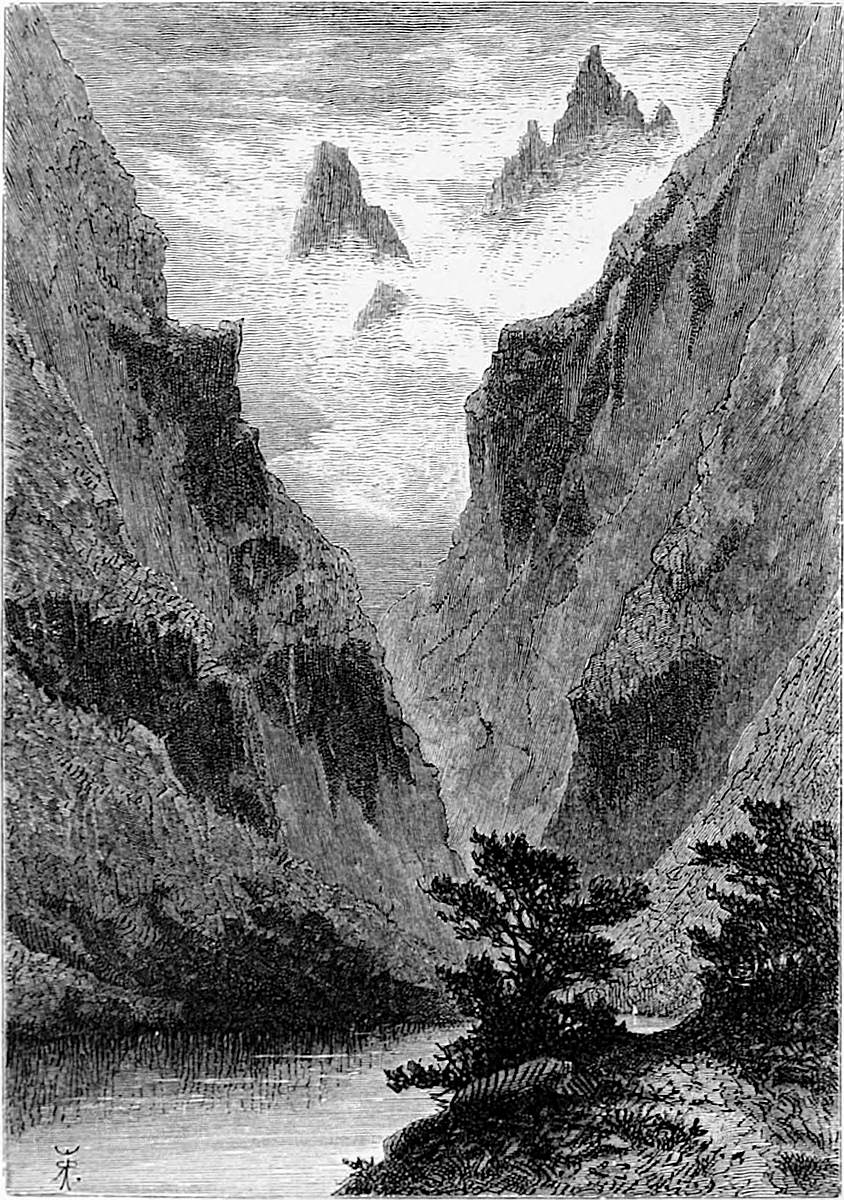
Looking across Indfjord.
But we have not yet commenced the ascent. The mare leads through the brushwood, the cheerful foal diverging now and then in the self-conceit of all young things, fancying they know better than their mothers. It was a steep climb. The mare slipped; but Halve said it was all right, she knew the way. The morning was warm, and, as soon as we arrived at a kind of ledge looking over the valley and fjord, we halted. What a lovely, or rather, what a grand scene it was! Still there was no forgetting our mission—no shaking off its sadness. Our present object, after Ingeborg’s arrival, was to go up and see after her companion, Ingrana. Our halt was not for long. We had already taken off our coats, and hung them on a pine-stump. To our surprise, Halve left his there until our return, and said, when we did not, “You can leave anything as you like in Gamle Norge.”
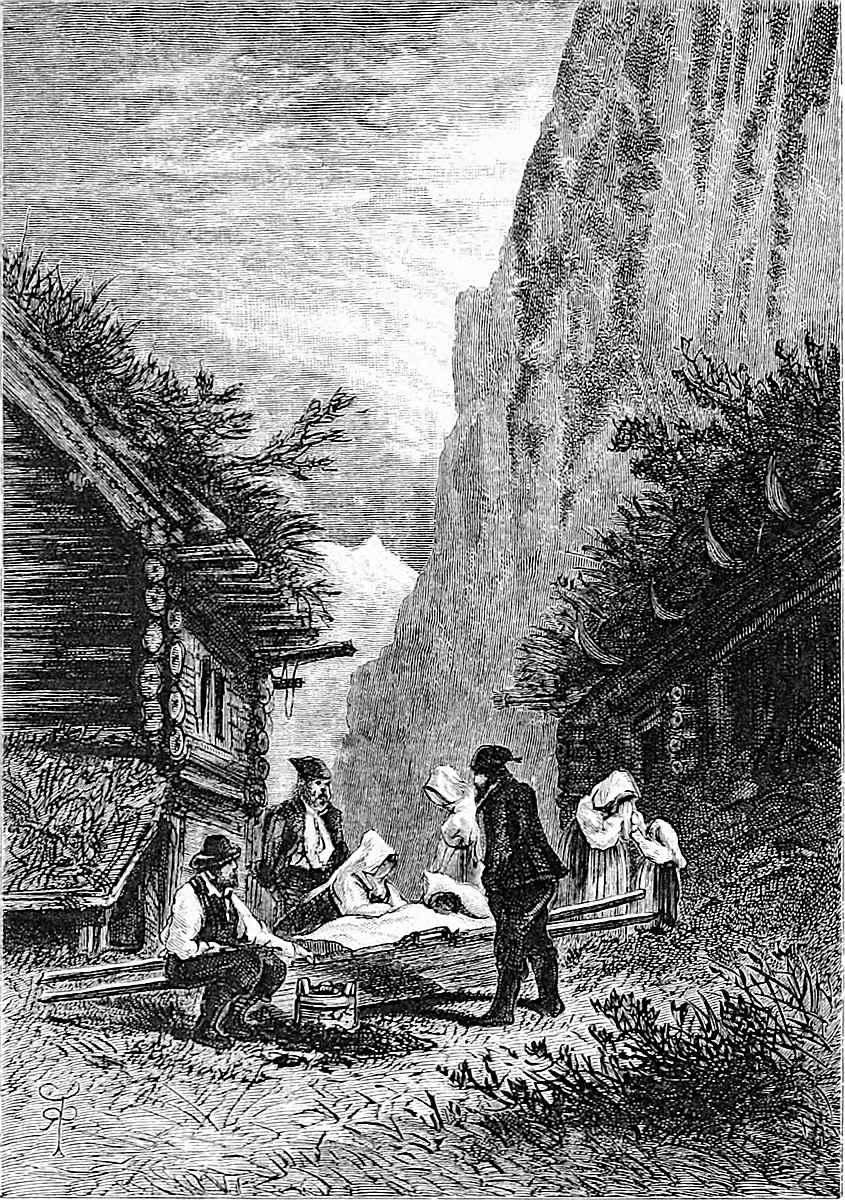
The Halt at Griseth.
En route, in three hours we had left our last brier and alder behind, and were on the plateau of the High Fjeld, and found much smörgrass, so good for cows. As smör is the Norse for butter, it will explain the name. For a long time we tramped over the botten, carpeted with rich flora; but at the end we saw the steen-skreed, or landslip. Some four or five bönder were already there, and seemed very surprised to see a foreigner coming up with Halve. A few words of explanation, and all was understood: one common object in view, that of helping each other, soon bound us together. Ingrana naturally had not been to sleep since the disaster. It is difficult to imagine any Norske pige nervous, but poor Ingrana had been shaken and frightened out of her wits. Her description, after a little entreaty and patience on the part of the persuader, ran thus:—Early in the morning Ingrana was awakened by a heavy rolling sound of thunder, followed directly by a crash. She rushed from her sæter, and, coming out of her door, saw Ingeborg’s sæter carried away and buried. It is difficult to realise the feelings of this simple-minded girl, living so solitary a life for three months. In a moment—a second of time—one was taken and the other left. Ten cows also were buried; and, no help being at hand, Ingrana had to go down this lonely mountain with the sad news, leaving her companion fixed, pinned, and crushed until she could return with assistance.
We arrived after three and a half hours’ hard ascent, when some sour milk that had been left was given us. The Englishman elicited a smile from Ingrana when, taking the bowl from his lips, his moustache was white with cream. This was hopeful and a good sign.
The slip was accelerated by a very large waterspout striking the face of the mountain, as amongst the rocks which were brought down was a quantity of sand, and the presence and action of water were palpable, deep pools being left in many places. The scene was appalling—a wreck in the wildest sense of the word. Some three-quarters of a mile of mountain side had come down, carrying all before it—rammeding, as the Norse word is. Huge rocks, a few stunted trees, hardly any kind of herbage—what a hurly-burly of desolation! Looking across and over it, we saw the distant placid fjord and open sea. What a contrast, the peace of one and the turbulence of the other! Still the damage was a known quantity, every year something of the kind happening, sometimes with loss of life, sometimes without. The accompanying sketch was taken from the lower portion, looking upwards.
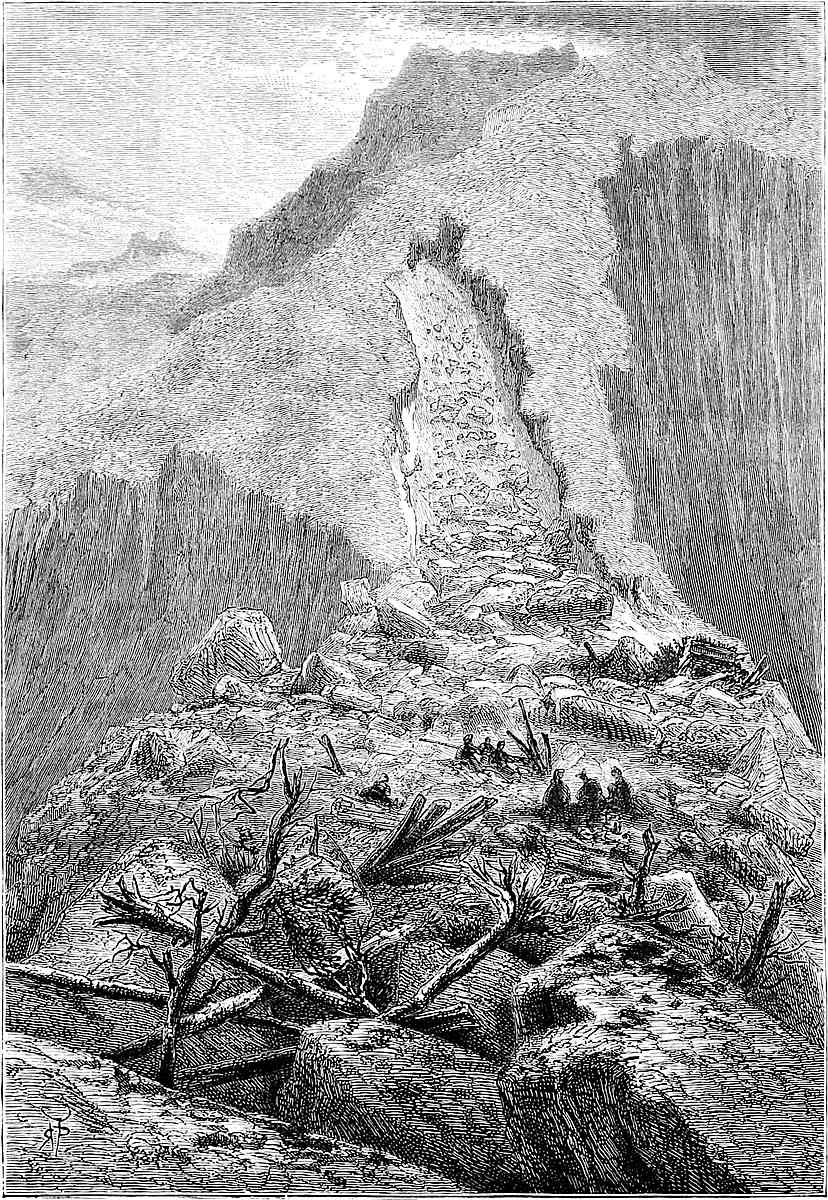
Landslip at Sylbotten; Indfjord.
[See larger version]
After going over the greater part of this chaos we went back to the preserved sæter, where we were most kindly received, our sympathy being accepted in the same spirit in which it was offered. Then we returned. We found Halve’s coat quite safe and undisturbed, and after the usual time arrived at Ole Erikson Boe’s farm, where we had a simple repast of good fladbrod and bunker, there being no meat here. We rested, and early in the morning started for Fiva. During the evening Boe showed me an old Danske Bible, folio size, a.d. 1590, with large brass clasps. The good folk wanted me to bring my wife to the funeral, in case the poor girl should not survive. In the morning we went down to the shore, as we heard the steamer for Molde was coming in to take Ingeborg thither, should she be still alive. Life was all but extinct when she was got on board. Ole Fiva and myself started in a boat for Veblungsnæs, having thanked the good people of Indfjord for their kind welcome, and they expressing their gratitude for our interest and sympathy, and reiterating their desire to welcome my wife at Indfjord.
The morning was lovely for boat travel; such peace that convulsions like those we had witnessed seemed incredible. But it was no dream: the inhabitants of Indfjord, the family of Ingeborg, Ingrana, and the poor woman without her solitary cow, all were stern realities.
Soon after our return to Fiva we heard that Ingeborg was dead, had been taken back from Molde, and was to be buried in the gravested at Indfjord on September 2nd, 1875. Accordingly, early that morning we started in carrioles from Fiva to Veblungsnæs, where myself, wife, daughter, and Ole Fiva took a boat with six oars for Indfjord. A lovely, peaceful morning it was as we left the landing-place at Veblungsnæs. Soon the six oars began their sturdy dip as we came under the shadow of the mountains: the dip was strong, as Norwegians only can row for a long travelling sweep and perfect time. After settling down with our tine of provisions—for we were travelling Norskily, and no Norske is complete without a well-filled tine—a sad tone seemed pervading the boat: our mission was one of sympathy for the bereavement of others, with an after-thought of thankfulness that we had been spared in health, and were sound in body and bone. But the melancholy of every one was broken by a remark from Ole that we should soon see the Runic steen, which is about half a Norske mile from Veblungsnæs. A lieutenant of engineers, who was superintending a new bridge, had described this stone to us, and we were eager to see it. At last we came upon it. The boatman ran alongside, and threw water over it to develop it. In nine hundred years pluvial attrition alone is sure to make its mark, to say nothing of our energetic friend Neptune’s constant stormdrift and tempest. (The writer would apologize for the term “pluvial attrition,” but there are so many long words about just now, what with street advertisements and urban authors.) A general view of the Runic stone is given in the opposite engraving, while the initial ornament on page 175 was drawn from a plant plucked on the spot. The letters are thirteen in number, and their length about eighteen inches. Twelve feet from the sea-level, under low-water mark, and projecting some few feet, runs a ledge of rocks, beneath which is supposed to be secreted untold wealth.
The translation of these Runic hieroglyphics is, “The Court of Justice,” and this inscription was evidently placed in a conspicuous position to guide any who came to the court in old pagan days; for Romsdal was one of the last of the pagan strongholds. Above, high up, close to Sylbotten, was a pagan temple; but the Court of Justice was held at Devold, Romsdal.
There was now a regular good settle down for a long pull. Up to this time we have been in shadow, but now we round a point, and taking what a landsman would call the “first on the left,” we go due south down to Indfjord. The sea-water is beautifully clear, reflecting the quartz rocks. à merveille, like the good old chandeliers of our grandfathers after a spring cleaning; the rich sunlit yellow seaweed is grander far than ormolu; and here are three herons in repose, water-ousels with their snow-white breasts, and now and then sparkles by an old cormorant or diver. As we go down the fjord the snow range at the end of it blocks in everything, the morning mist waiting in the valley for exit, if possible.
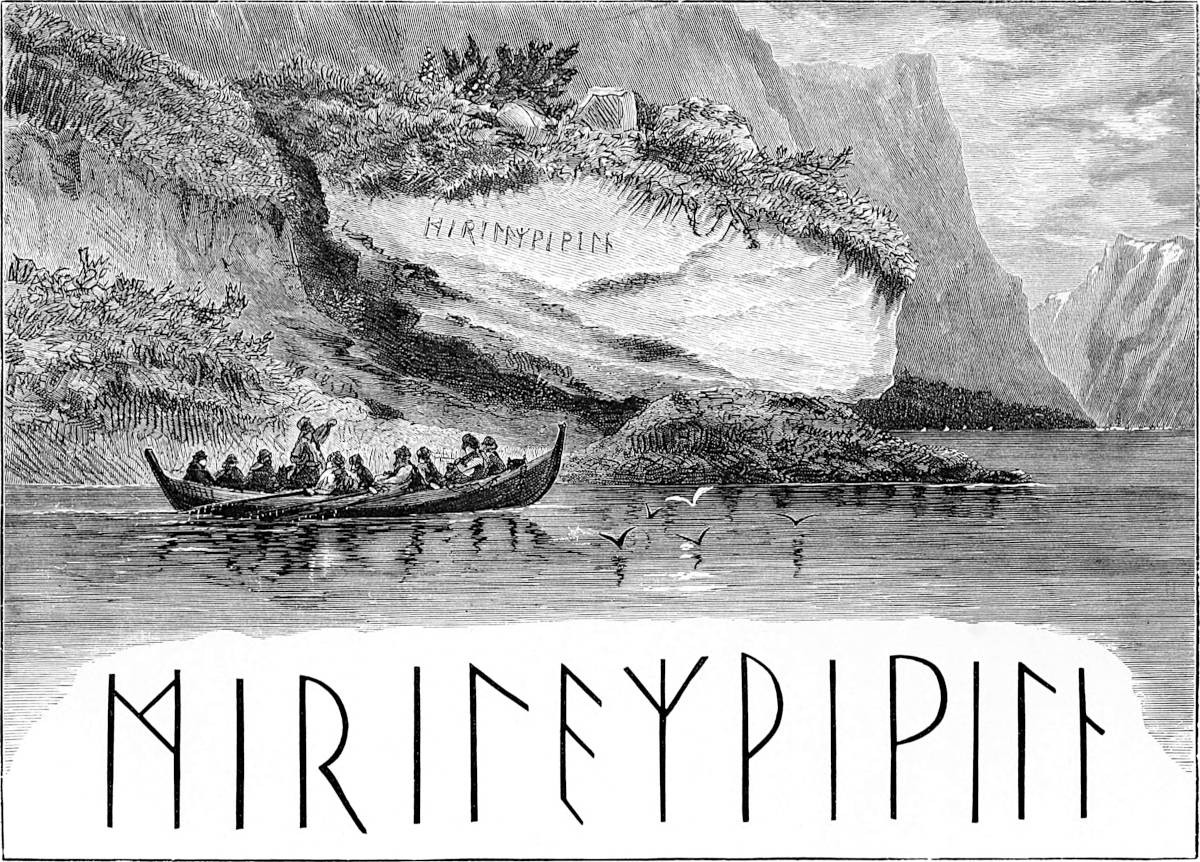
Runic Stone, with Inscription, near Indfjord.
[See larger version]
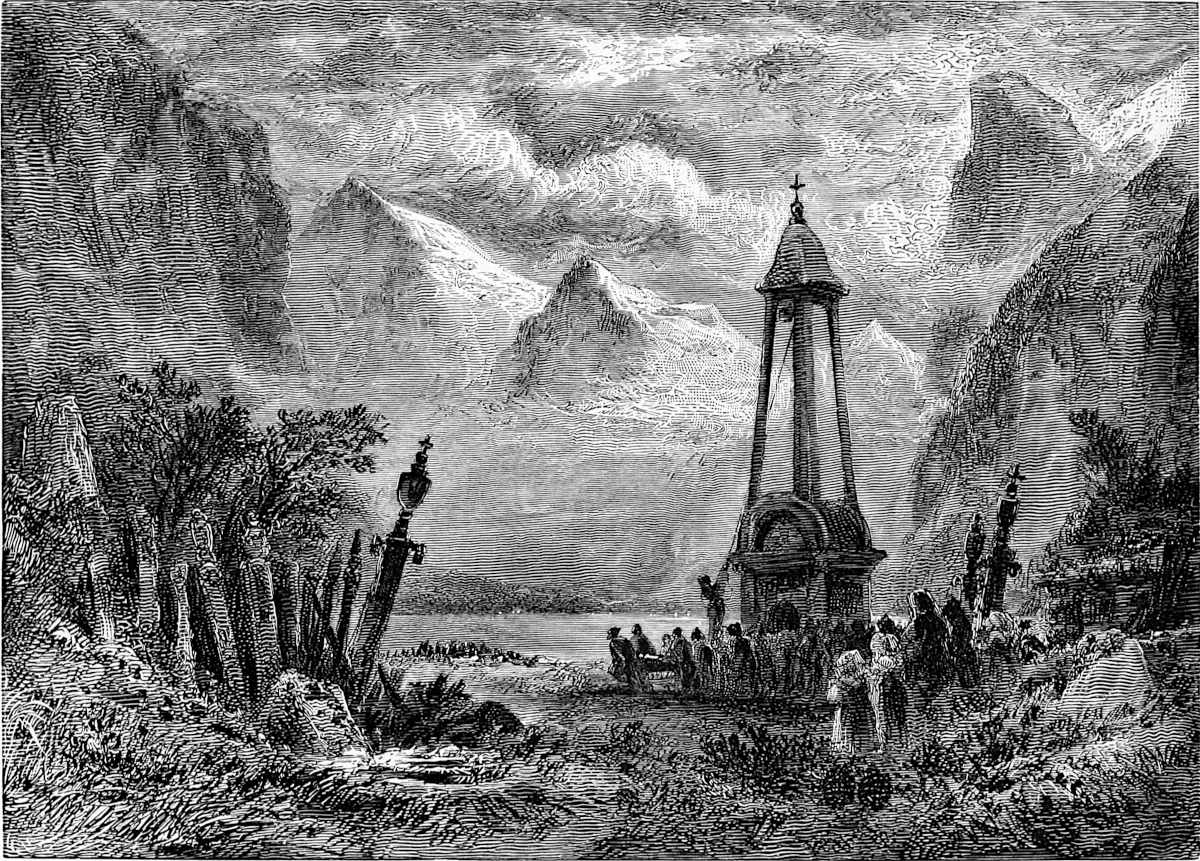
The Gravested: Ingeborg’s Funeral, Indfjord.
[See larger version]
By this time we near the hamlet, and high above us on the left, on a kind of plateau, we see many figures congregated. They were in front of Erich’s house, Griseth being the name of the farm. We soon steered in, and then between two boathouses, at a rude pile-driven landing-place, the well-known scrape of keel on shore was heard, and we had safely arrived at Indfjord. Griseth had sent down to meet us and invite us up to the house, but we return the message that we would rather not disturb the family, but await their arrival at the gravested; so, with our tine, we picked out a spot for lunch, and enjoyed some cold reindeer meat, biscuit, cheese, &c. During lunch we could see the bönder folk collecting high up at Griseth, overlooking the fjord, and at two o’clock we saw them by the telescope start down the narrow mountain path, the coffin being lashed on to the little cart to prevent it slipping. Soon they were lost in a dip of the wood, from which they emerged nearer to us. As we stood at the gravested, or graveplace—like our word homestead, home-place—a man came up and shook hands with us, and then standing on the wall, commenced tolling the bell; for there is no church, but only a bell-tower.
Soon the procession drew near. First came the coffin, black, lashed on to the hay-cart, and drawn by a beautiful young blakken, or Norske pony, whose collar was of old carved wood painted, the bonde driver walking behind the coffin, which bore three wreaths of wild flowers. At a distance behind the coffin followed the men, and after an interval the sorrowing women, who were succeeded by men of the family, many sad hearts, and Ingrana. It was a modest but impressive scene. When the pony arrived at the gravested, hearing the tolling bell, he shied and jibbed, as if regretting what he had done. The coffin was therefore carried in at once. There being no clergyman, a friend sang a hymn. The coffin was lowered into the grave; the wreaths removed; the ropes withdrawn. Some one said to Ingrana, “You were lucky to escape.” “I could not have been ready,” she said; “God wanted me not, and left me a little longer. She was ready,” meaning Ingeborg, whom they were burying. They then sang the second hymn, “Hjemme, Hjemme,” as the friends shovelled the earth in, and the heavy thud of the large spadeful boomed like parts of Handel’s “Dead March” in Saul. After filling in the grave the wreaths were placed on the newly raised mound, and the ceremony closed with “Hjemme.” The weird sea birds screamed, and all went away together. Many will recount the story of Ingeborg, Erichsdatter, Griseth.
Before leaving the gravested the grave-boards must be noted, they being so remarkable in form, so quaint, and also so Bosphoric. Sometimes a white butterfly is introduced, as typical of the soul. How different from the present association with the allegory of their transient nothingness! After the funeral we had to pay two or three visits. All the farmers wanted us to visit them—some to tell of sport, others to offer us aqua vitæ and stamped cakes like the Dutch waffles; and when we returned to Ole Erikson Boe’s he gave me an old Norske belt as a memento of our visit, which we need hardly say is most carefully treasured.
So passed away Ingeborg, Erichsdatter of Griseth, while Ingrana remained waiting her bidding.
•••••
STERDAL is full of interest and character, with a wild river, precipitous mountains on either side, snow on the high peaks above, a rushing of waters below, hardly any track, and shut in by a façade of rock at the end of the valley; and yet it is the way from Romsdal to Valdal. Let us, therefore, explore it, and do so in two fyttes—a short carriole ride to the sæter with the ladies, and beyond, high, high up, for real research without the ladies.
Place aux dames. We tried the short journey with two carrioles, and for an English mile or two we did pretty well, as they will go anywhere and over anything; but as we got into the scrubwood and underwood the road grew worse, the wheels going sometimes over a boulder one or two feet in height, the axle assuming an alarming angle, and the skyd-gut hanging on the high side to keep the vehicle from turning over—first one side and then the other—till the fair occupants of the machine were shaken to a jelly, and would fain try to walk. Still we all persevere, and soon arrive at the meal-mill, given in the accompanying page illustration. What a retired spot for business! Who would ever think of it as a centre to draw customers and found a business—as a likely spot for a man beginning with the conventional half-crown becoming the architect of his own fortune?
The water seen here is the Ister—ever thick and muddy, and always in violent motion. What a contrast to the calm dignity of the adjacent mountains in all their graduated phases! A little above this is a shoot which brings down water to turn the mill. On our arrival the miller comes out with a quiet kind of welcome, and very kindly shows us the stones doing their share of work to bring about fladbrod for the people of the valley during their summer visit: it is for the sæter people they work principally.
Leaving the mill, we pass on to the denser scrub and brushwood. We had with us an old Skye terrier, full of noble traits of character—courage and endurance—but being as blind as Belisarius, and running against some of the rocks in the track, he was not only thrown on his haunches, but his nerve was shaken—that Highland nerve which is of such rare stuff. Let us immortalise our blind Norwegian canine traveller by a description. If lost, an advertisement should run thus:—“Lost, a brindled Skye terrier, answering to the name of ‘Kyle.’ Rough broken hair, broad chest, short-legged, bow-legged, middle-aged and strong, and carries his tail high. True to the core, with a head as large as a deerhound’s. Teeth to match.” The Norwegians at first thought it would be well to shoot him, but when they came to know him better he soon enlisted them all among his many ardent admirers.
Perhaps the idea may flit across the mind of some, Why bring a blind Scotch terrier into a work on Norway? This is why: old Kyle was taken that day for a young bear by a simple-minded Norwegian cow. Never were fear and fright more vividly portrayed than by the action of that animal, and of her tail especially, on the first glimpse of the brown brindled terrier. Hearing his name mentioned, he has just wagged his tail, which is quite flat, like an otter’s, and when very pleased he wags it with the flat side on to the floor to produce more sound.
By this time we are at the sæter, where the piger have come to look after the cows until September. Having driven on to the only flat piece of grass, we unpack for lunch, when the produce of the aforesaid cows comes to our comfort in an unadulterated form, and thoroughly is the simple fare enjoyed. After lunch we visit the interior of the sæter, and find spinning going on steadily, a little national tune being hummed to the whirring wheel accompaniment. The weaving is done during the winter months. In the summer a little spinning is done, but only by the most industrious.
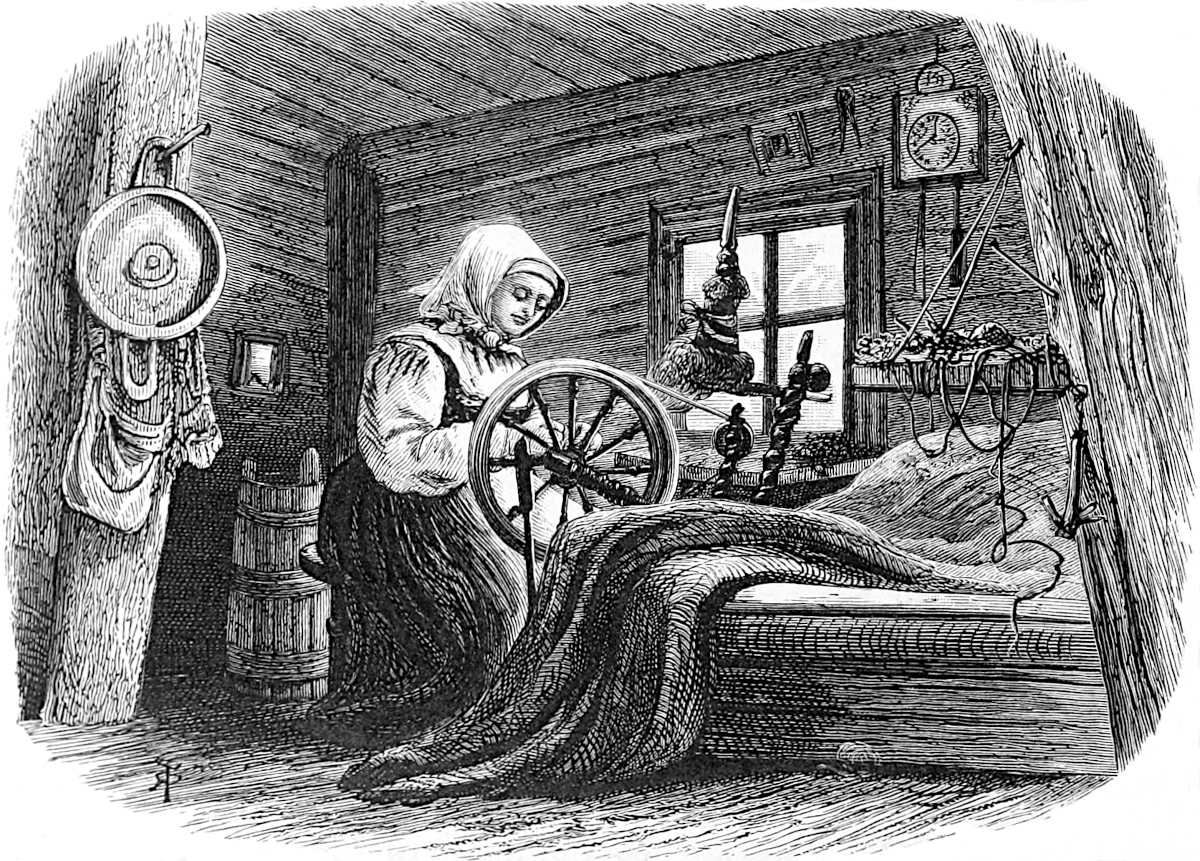
Spinning in the Sæter: Isterdal.
To see Isterdal the only way is to walk. Let us, therefore, continue on from the sæter in the direction of the Valdal. This was done with Ole Fiva. Soon we began to ascend, for the end of the valley is precipitous, with a fine fall, the top of which must be reached before arriving at the plateau, botten, or balloch. On commencing the ascent Ole pointed out in the river below a spot where a bear had been killed; and higher up again where a bear lived, for he had seen it there. Some idea of the situation is given by the opposite woodcut, with the aiguilles on the right. This is looking down Isterdal. The path was effaced the day before we passed by the descent of a quantity of rough stuff, more than sufficient to have carried us with it into the valley beneath. The aiguilles are of a similar formation to the Troltinderne in Romsdal, and seem to be a nursery of trolds for future ages.
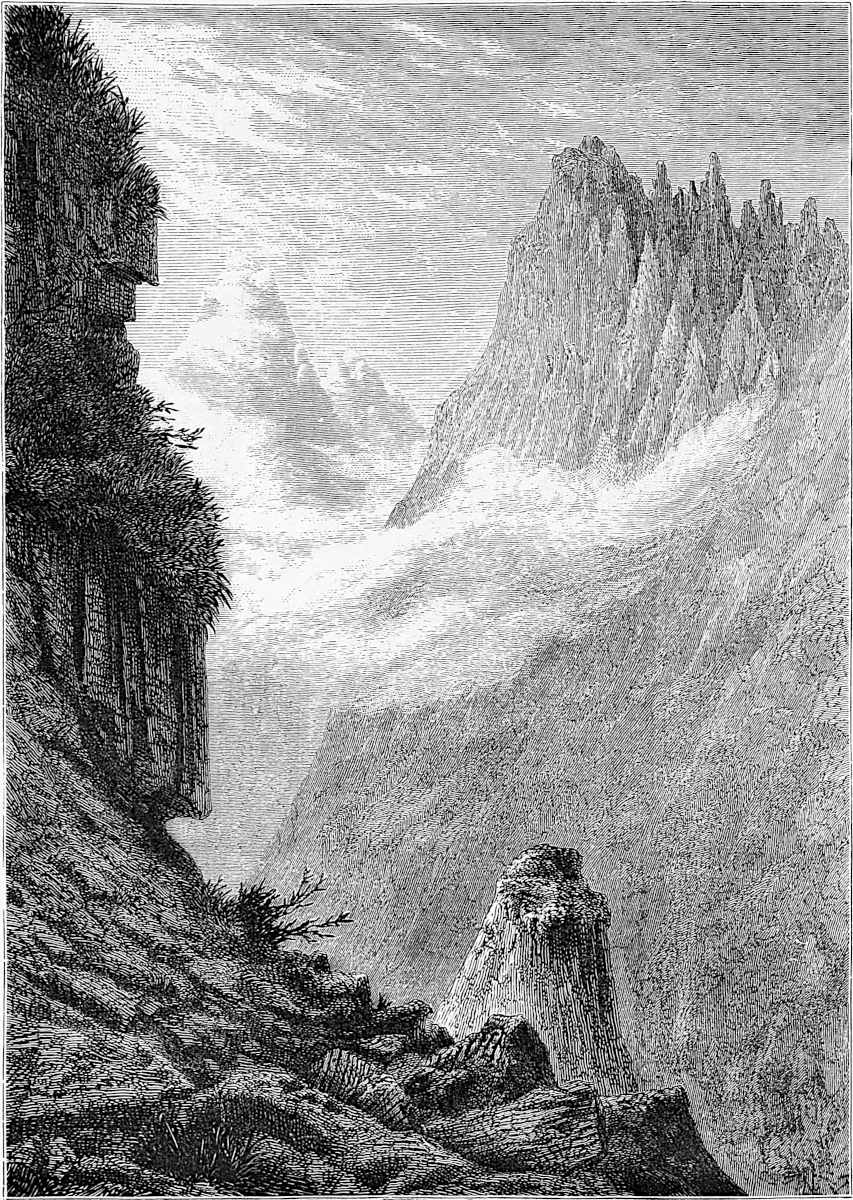
The Head of the Valley: Isterdal.
[See larger version]
The evening glows on these pinnacles are marvellously and beautifully grand, and the transitions of hue from one to the other beyond imagination and conception. Still we work up. Ole, ignoring the slightly defined regular track, goes up really awful places, hauling himself up, and astonishing his follower and companion by displaying the most unnecessary and enviable agility. All honour to such strength and energy! By this time we had reached the plateau from which the murky Ister takes a header into the valley which lay at our feet. Once on the plateau, we could get along better over the stunted flora and bare rocks, with snow here and there, especially on the south-west side. The track is indicated by a few pieces of rock, put here and there in a pile, which being of the same formation as the rock we are walking on, the similarity of colour makes them very indistinct at times: the best way is to look out for one on the sky-line, if possible. After a long tramp we crossed the Ister again, and found it still more turbid, which was puzzling, as it seemed to come from a glacier above; but of this more anon. We worked on until we could look down Valdal, and having drunk in nature in that direction, took a little food from our wallets, and lay down for an al fresco siesta on a handsome natural carpet of fjelde reis and other vegetation.
After that, Ole began telling of expeditions, traditions, and excursions to the Jager’s Steen, and formally wound up with the report of a frozen lake which a hunter had seen, but which had not been visited since. Could we find it? Was the Herr inclined to go? “Most certainly.” So we started.
There is a wonderful sense of freedom, and yet of a closer commune with one’s Creator, in wandering over almost untrodden ground to admire some portion of his works that have been rarely visited by man. It is suggestive of drawing aside the veil of the tabernacle of nature; and happy is the man who derives comfort and soul strength in so doing! Ole led straight up over rocks bare and betumbled; not a symptom of vegetation; above us a glacier coming to the edge of a precipice, and the melting ice forming a fringed fall. We lay down, looking over the side on a bed of scarlet and crimson fjelde reis, a kind of cotoneaster. Beyond this ledge we saw the glacier imperceptibly coming on, backed in the long perspective of glacial blocks by a huge bare mass of rock, the Biskop, and the Drönningen. This was the source of the Ister. The water, some distance from the foot of the fall, passed over a soft deposit, which sullied its pristine purity right down to the sea, the “murky Ister,” thus acquiring near its origin its characteristic turbidity.
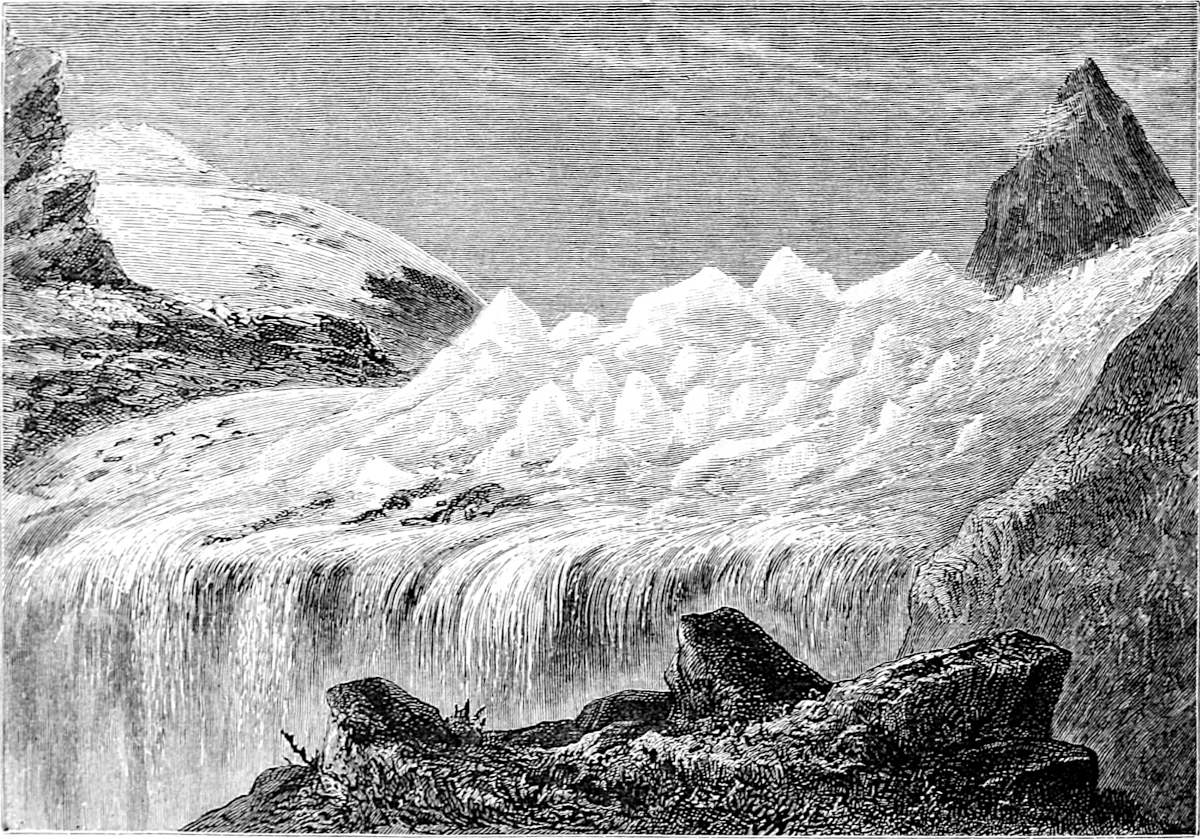
Melting Glacier over Valdal.
Now for a try for the unknown lake. Ole keeps on, thinking he has his bearings all right. At last, having climbed up by the side of a fall dashing down through bare rocks, came the summit, and creeping round a boulder, before us lies a lake intensely deep in colour, and full of icebergs and floes of old ice. Where we stood there was snow, with tracks of reindeer; but in places the former had melted, the lemmings had been there, and the reindeer-flowers were coming up. These we eat with fladbrod og smör after a time, for we could not at once settle down to a snack without paying a tribute of respect to the majesty of nature before us. Beginning our meal in earnest, in the midst of it we heard a noise like a roll of thunder, the direction of which we soon discovered. On the left side of the lake the vast expanse of snow was riven by a gigantic avalanche, which ploughed its way down, and, coming to the edge of the rocks, plunged headlong into the lake, agitating all the ice, and causing the icebergs to jostle each other; but both water and ice soon regained their equilibrium, and nature lay before us in solemn silence and undisturbed majesty. It can well be imagined that having once attained such a spot—some 5,000 feet above the sea—there was a desire to linger, though the day was fading, and we had five and a half hours’ walk home. However, “En route!” was the word. Straight down from bare rock to rock simply ends in no knees after a time, and one’s legs become something between strips of asparagus and sea-kale. There was, however, one thing in store: once on a fair road, we could make some running. It was a lovely evening: we were late, it was true, but, as horses go freely with their noses towards home, we both took to the road very kindly, and went along with a will. Ole did not talk much. It is the pace that kills, and after sixteen hours’ trudge with our provisions, he no doubt felt that he had done enough. With health and strength, such a day amidst grand scenery is a joy for ever.
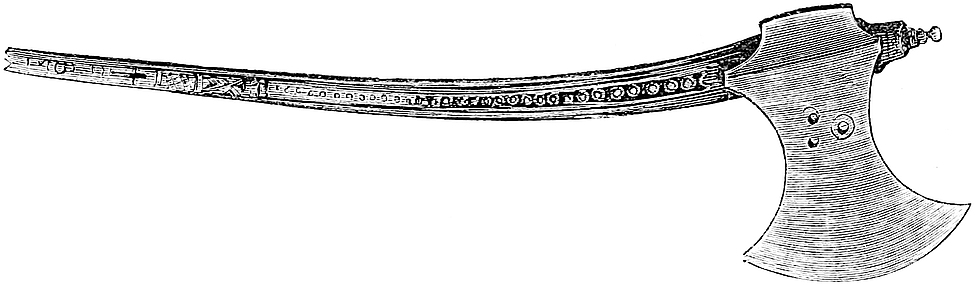
Church Axe.