XII. CERTAIN GAMES OF VERY LITTLE GIRLS.
Reading edition
Dans mon c$oelig;ur il n'y a pas d'amour, Mais il y en aura quelque jour.
French Round.
No. 118. Sail the Ship.
Two little girls, clinching fingers, and bracing their feet against each other, whirl rapidly round, a movement which they call "Sailing the ship."
No. 119. Three Around.
Three little girls join hands and swing about, being the simplest form of motion without song, to which they give the name of "Three Around."
No. 120. Iron Gates.
Two little girls clasp hands tightly, singing,
Iron gates, Never break,
While a third throws herself against them, and endeavors to break through.
No. 121. Charley Over the Water.
Children sing, as they dance with clasped hands about one who stands in the centre of the ring:
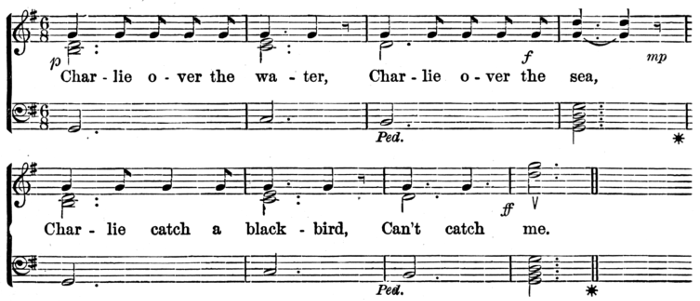
Charley over the water, Charley over the sea, Charley catch a black-bird, Can't catch me!
At the last word all stoop, and if the child in the centre can catch any other before assuming that position, the latter must replace him.
Almost any summer evening, in certain streets of New York, children may be seen playing this round, which they sing on one note, with a shriek to conclude.
No. 122. Frog in the Sea.
Frog in the sea, Can't catch me?
Played like the preceding.
Philadelphia.
No. 123. Defiance.
A mother and children:
"Mother, can I pick a rose?" "Yes, my dearest daughter, if you don't tear your clothes, But remember, to-morrow is your sister's wedding-day."
The children now retire to a safe distance, and sing:
"I picked a rose. I tore my clothes!" "Come home!" "I don't hear you." "I'll send your father after you." "I don't hear you." "I'll send your brother after you." "I don't hear you." "I'll send the dog after you." "I don't hear you." "I'll send myself after you." "Sen' 'em along!"
A chase follows, and the child caught must replace the mother.
The dialogue (which belongs to Georgia) is also extended by the mother's threatening to send the cow, or the trees, after the children.
This game is differently played by little girls in Philadelphia, thus:
"Oh, mother, mother, may I go out to play?" "No, no, no, it's a very cold day." "Yes, yes, yes, it's a very warm day, So take three steps, and away, away, away." "Where's your manners?" "I haven't any."
The indignant mother now pursues the disobedient children.
No. 124. My Lady's Wardrobe.
The children sit in a ring, and are named according to the articles of a lady's wardrobe. The child in the centre of the circle of players names some article, as, "My lady wants her brush, brush, brush." She who has received that name must answer before the third utterance or pay forfeit. The speaker naturally pronounces the word as fast as possible.
No. 125. Housekeeping.
(A ROUND.)
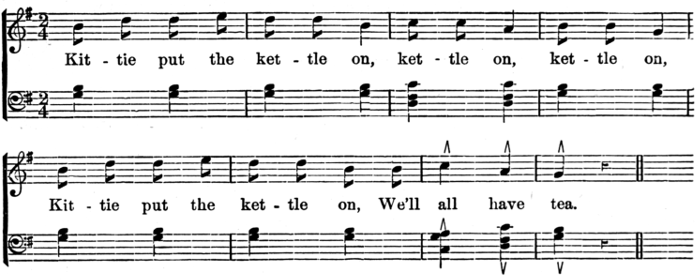
Kittie put the kettle on, Kettle on, kettle on, Kittie put the kettle on, We'll all have tea.
To this familiar little round, girls five or six years of age, in New York, sometimes prefix a fragment of some ballad—
Here stands a red rose in the ring— Promised to marry a long time ago.
No. 126. A March.
March, march, two by two, Dressed in yellow, pink, and blue.
Philadelphia.
No. 127. Rhymes for Tickling.
1. Tickle'e, tickle'e on the knee; if you laugh, you don't love me.
Philadelphia.
2. If you're a little lady, as I take you for to be, You will neither laugh nor smile when I tickle your knee.
Georgia.
3. Old maid, old maid, you'll surely be, If you laugh or you smile while I tickle your knee.
Massachusetts.