THE VILLAGE KEHILLAH.
Reading edition
Nordheim.
Many persons, perhaps the majority of the readers of a certain kind of Jewish literature at present in vogue, led astray by the revival and improper application of the term Ghetto, have an idea that the great mass of the Jewish people on the continent of Europe have their habitations in filthy, noisome slums of the great cities, and that it is only in such secluded reservations, away from the contact or observation of the Gentile, that Judaism in its ancient, traditional form and pristine vigor, is or can be, maintained. In the imagination of such persons, deceived by prejudiced or sensation-seeking writers, Judaism is a feeble, pale, cellar plant which leads its anæmic existence in darkness and slime, but which withers and fades when exposed to the fresh, strong breeze and the bright, warm sun of heaven. These notions, 2however well they may suit the requirements of ambitious story-tellers, are incorrect both as regards the alleged facts and the inferences drawn therefrom. In the greatest part of the civilized world the Jews are not confined, whether by compulsion or choice, to particular sections of the cities, but dwell freely among their Gentile fellow-citizens everywhere; nor is the law of Moses forced to flee for refuge to darksome purlieus, where the humblest and lowliest of Judah’s strain drag out a wretched existence as unwilling neighbors of the vicious and the criminal, but finds multitudes of sincere upholders and adherents in the high places of the lands among the happy possessors of what mankind esteems highest, culture and wealth. In fact, it is not to the great cities at all that we should look for the best examples of a living, earnest Judaism. Scattered broadcast through the Old World, particularly through the lands of central and southeastern Europe, may be found to this day thousands of Jewish communities in villages and rural towns which are in very truth “wells of purest Judaism undefiled,” and living refutations of all the pet theories of the modern Jewish (?) novelist. Our brethren in those little rural communities breathe the purest, health-giving air that nature gives forth over mountain, 3field, and forest, and have never found in the keen ozone any faith-destroying, heretical qualities. They dwell side by side with the Gentile and meet him continually in all the commercial and social relations of life, but they have never found in the free intercourse any dread influence subversive of Judaic beliefs and practices. Indeed, few of them are aware, except in a hazy and indirect manner, that Judaism is in danger in this modern age of ours. They live as their ancestors did before them, honest, simple, earnest, sincere Jewish lives; happy in their state of moderate wealth or endurable, light-pressing poverty; keeping their Sabbaths and their holidays, fasting and feasting in the prescribed seasons, laying Tephillin on week-days and eating only permitted food at all times, giving freely of their means to assist the poor and afflicted, and accepting misfortune with resignation as the will of God, and not doubting but that this Judaism will continue to exist for all time to come.
Of such a little Kehillah in a German village, Nordheim, in the Rhön Mountains of Bavaria, and of some of the quaint and interesting persons that composed it, my tale shall be.
When, as a child, I made my first studies of the world around me, one of the objects which 4chiefly attracted my childish gaze was a picture which hung on the wall of the parlor of my home. It was a crude and inartistic picture, awkward in delineation and barbarous in color; but it was full of interest to me, for it spoke to me of a place far across the sea, a place which oft-told but never wearisome tales had surrounded with a bright halo of romance, and which my eager imagination had glorified into a veritable fairyland; it was a picture of a village in that Germany which seemed so far away and so unreal, my mother’s native place, Nordheim vor der Rhön. These sentiments were not entirely, nor even mainly, due to the picture itself, but to the descriptions with which mother ע״ה used to accompany it; for mother dear, God rest her soul, among her other good qualities, had a most vivid and emphatic way of impressing her ideas upon her auditors. She was not only in loving tenderness and devotion the ideal of a Jewish parent, but a most charming and entertaining raconteuse, full to the brim of reminiscences of her youth, an animated chronicle of persons and events, and capable of describing both the humorous and the pathetic in an inimitably touching and taking manner. In addition to all this she was a living refutation of the favorite anti-Semitic calumny, that Jews have 5no sentiment of patriotism. She cherished in her heart the warmest and most unquenchable love for her native land, while her attachment to the memory of her birthplace, its ties and its traditions, approached the dignity and sincerity of a religion. No wonder that from such a stirring and enthusiastic source I imbibed the liveliest interest in all that concerned Nordheim before the Rhön, its inhabitants and its welfare. I would stand for hours at a time before that crude little picture on our parlor wall, gazing at the array of houses with startlingly red roofs and dazzlingly white walls, at the fields of brilliant green and the trees with trunks as straight as ramrods and mathematically elliptical foliage, and at the tin-soldier-like gendarme whom the rustic artist, who must have inclined either to realism or militarism (I could never determine which) had depicted marching, with martial air and projecting bayonet, along the country highway.
But I saw none of these things. My imagination gazed beyond these externals and saw the quaint and touching figures of those who had their abode in this secluded retreat, and I found myself wondering whether it would ever be my privilege to see the spot where mother’s cradle had stood, and to sojourn there where life 6flowed on in such pure and peaceful and virtuous channels, far away from the crush and the turmoil, the evil and the anguish of the great world, where the peasants were simple, honest folk and the Jews all faithful to their ancestral religion, where old age was venerated and childhood obedient and respectful, where such things as violating the Sabbath and eating Trefoth were unknown.
My opportunity came in my twenty-first year. Circumstances, the nature of which need not be dilated upon here, made it my privilege to spend several years in Europe in study. But while I awaited, in joyous anticipation, the day when I should enter upon my course at the North German University and Seminary, at which I was to prepare for my life’s vocation, it was with an absorbing interest, I might almost say with a passionate longing, that I looked forward to actually seeing Nordheim, and actually knowing the persons and conditions of which I had heard and dreamt so much. Never shall I forget the day when, having crossed the stormy Atlantic and travelled by train a day and a night southward from Hamburg, I alighted at Mellrichstadt, the railroad station nearest to Nordheim—four English miles—and saw upon the platform, waiting for me, a pleasant-faced, dark-complexioned 7youth, whom I had never seen before, and yet whom I at once recognized, for his features appeared in more than one counterfeit presentment in a well-worn family album, over which I had often pored more than three thousand miles away. It was Cousin Solomon, and he had come to the station, having been notified by letter of my prospective arrival, to meet his American relative, and to conduct him to Nordheim and the bosom of his family. Then and there I recognized the reality and the value of sentiment. Here were two persons, born in different and widely separated lands, speaking different mother tongues and citizens of different nations, who had never seen each other before; and yet so powerful were the ties of kinship and the remembrance of common blood and a common origin, that they sufficed to bridge over all that yawning gap of separation and to bring heart to heart and lip to lip in a union of truest love and affection. Our recognition was mutual and instantaneous. We pronounced each other’s names, fell upon each other’s necks, and a moment later were chatting as intimately as though we had met daily during all our previous lives. Three years long I spent my summer vacations at Nordheim, and I came to know and to love it and the surrounding region 8so well that when the hour of final parting came, it cost my heart more than one pang and drew more tears from my eyes than I should like to confess. What a charming ideal life of sentiment and pleasure we led there, Cousin Solomon and I. We seemed to be hovering in a dream world, far too sweet and beautiful to be real. We were at once students on a holiday, friends of nature, children without a shade of care or anxiety, and sincere, devout worshippers at the shrine of Israel’s God. We climbed together the steep and lofty mountains which abound in that region, and when we had reached the summit we gazed with delight at the dazzling panorama spread out before us and inhaled deep draughts of the pure, cool, health-giving air. We wandered for hours through the dense pine forests or undertook long trips on foot to distant villages or spots that were interesting for some historical or other reason. Once we made a long trip, in company with Aunt Caroline, to the village of Burghauen, on the other side of the Rhön Mountains, to visit some relatives there. We travelled in a carriage belonging to the Duke of Weimar. We had hired it from the duke’s manager, who was not above turning an honest penny with his master’s property when occasion offered. The carriage bore the 9ducal escutcheon, and our coachman and footman wore the duke’s livery; and as we rolled through the various villages in grand style, the peasants and their wives and children all came out and made deep and reverent obeisance. I was quite astounded, but Aunt Caroline and Cousin Solomon were so amused that they could hardly keep straight faces. Both they and I bowed to the right and to the left and answered the salutations right royally, at which the people seemed highly gratified.
“What is the reason of all this,” said I (to whom this unexpected enthusiasm was extremely puzzling) to Solomon. “Do they make so much fuss about everybody?” “Why, no!” said Solomon, laughing heartily. “They recognize the carriage and the lackeys, and they take us for members of the ducal family. They think mamma is the duchess, and you and me they take for the young dukes.”
But, altogether, everybody was extremely friendly in Nordheim and vicinity, Jew or Gentile, peasant, merchant or teacher, acquaintance or stranger, without exception. It was “gruesse Gott,” and “guten Morgen,” and “guten Tag,” and “lebe wohl,” and “auf Wiedersehen,” and “schlafe wohl,” and “angenehme Ruhe,” and any number of other kindly and sympathetic 10phrases, and all said with such evident sincerity and good intentions as went quite through one and left one feeling warm and charitable and kindly disposed toward humanity in general. And then the eating, so abundant in quantity, so excellent, and more than satisfying in quality. At first Aunt Caroline wanted to feed me all the time. Six or seven times a day she would spread the table and invite me to partake until I protested, and by dint of hard pleading induced her to reduce the number of meals to four, with an occasional extra bite in between. It makes my mouth water yet to think of the “gefüllte Flanken,” and the “gruenkern Suppe,” and the “eingelegte Gänsebrüst,” and the “Zwiebeltätcher,” and the “gesetzte Bohnen,” and the “Shabboskugel,” and the thousand and one other delicacies with which dear Aunt Caroline used to regale us, and to which healthy appetites and youth gave a zest compared with which ambrosia must have been poor. And, oh, the beer! Such magnificent stuff! So different from the wretched pretence which we call by that name in America. I quite lost all my temperance principles in Nordheim and have never recovered them since.
But along with this joyous physical life there went a spiritual life no less joyous and satisfying. 11We were Jews there in Nordheim. The Sabbath was a guest whose arrival was looked forward to with the most eager anticipation, and which seemed to cast a magic, sacred glamour over all the Jewish houses in the village, transforming the prosaic, work-a-day appearance of persons and things into an aspect of dignity and holiness. All day long on Fridays until about an hour before nightfall, a tremendous bustle of preparation was going on. Such cleaning and scrubbing and polishing, such baking and boiling and brewing! It seemed as though every house was being turned topsy-turvy. On that day, too, the men folks came home several hours sooner than usual, and then there was added the turmoil of the taking of baths and the polishing of shoes, and the taking out of clean shirts and Sabbath suits, and dressing and getting ready. But about an hour before nightfall all the noise and clamor and turmoil ceased and Sabbath stillness began to settle over the village. The quaint old seven-cornered Sabbath lamps were taken out and the Jewish housewives lit them, pronouncing at the same time the prescribed benediction. How charming and yet impressive Aunt Caroline looked as she stood with uplifted hands and reverential mien before the sacred lamp, the Sabbath 12cap of dainty lace and ribbons surmounting her refined and regular features of purest Hebrew type, while from her lips issued in the holy tongue the words of the benediction, “Blessed art Thou, O Lord, our God, King of the universe, who hast sanctified us with Thy commandments and bidden us light the Sabbath lamp.”
A half-hour later all were assembled in the little synagogue, which was filled to the very last seat, for the Nordheim synagogue was not built on the American plan. In our progressive country we build great and imposing synagogues and temples for the benefit, not of the people who regularly attend—for them a very small edifice would suffice—but of those who pay the Almighty the honor of a visit only once or twice a year. But the Nordheim synagogue had accommodations only for its regular members and attendants, and these were expected to be in their places on every occasion of public services. Sometimes somebody would be missing at service, and then it used to amuse me to notice with what anxious solicitude inquiry would be made of his family as to the cause of his absence. It appeared to be taken for granted that only illness or some other equally grave reason could induce any one to be 13absent from synagogue at time of worship. I could not refrain from smiling when I thought how pointless such solicitude would be in America, where, on the contrary, the question addressed to any average Jew, should he present himself in the synagogue on any but two or three days of the year, would be, “What brings you to Shool to-day?”
The services in the synagogue at Nordheim were intensely interesting to me, not, indeed, because of the artistic rendition of the ritual or the technical excellence of the singing, but because of the spirit of devotion and earnestness by which they were pervaded. I have listened to numbers of cantors who certainly rank higher in their profession than the humble individual who acted in the capacity of village teacher, Chazan, and Shochet in Nordheim, and the musical performances of trained and paid choirs are undeniably superior to the untutored though vociferous efforts of a rustic congregation. But all these have something perfunctory and mechanical about their efforts which deprive them of real charm and of power to touch and move the spirit. One remains coldly critical in listening to them, and judges them solely from the standpoint of professional ability and artistic merit. Not so in Nordheim. There was an all-pervading 14sense of earnestness and reality in the worship which made one forget the how of the prayers and hymns and think only of the what. Faith, deep and firm as the rocks, ingrained into the very tissue and life of the spirit, looked forth from those simple, earnest faces, shone forth from those sincere and expressive eyes. This spirit gave the familiar ritual an entirely new vividness and impressiveness. The worshippers seemed to be speaking directly to their heavenly Father, and when, at the close of the Lecho Dodi, the hymn of welcome to the Sabbath, all rose and faced the entrance, I half expected to see Queen Sabbath herself, clad in bridal robes of celestial purity, enter through the portals of that humble house of God.
The prayers concluded, the worshippers greeted each other with hearty “Good Shabbos” salutation and wended their homeward way. The scenes in the homes were in some respects even more impressive than in the synagogue. Uncle Koppel’s house particularly was resplendent with a blaze of glory. The dining-room, which also served as parlor and best room, was brilliantly lighted, and in the midst of the effulgence shone, with especial radiance, the Sabbath lamp. The table was covered with a linen cloth of snowy whiteness and laden with 15the finest porcelain, glass, and silver that the household could boast, while at the head of the table, opposite the seat sacred to the master of the house, stood the two Sabbath loaves covered with a beautifully embroidered satin cover; and at their side the silver Kiddush-beaker and the decanter, from which the wine of blessing was to be drawn. Before Kiddush Uncle Koppel “marched” with the youngest of the children, and presented a picturesque sight indeed as he paraded up and down the room, carrying the infant of the family upon his right arm and leading the next youngest by his left hand, chanting meanwhile the hymn of welcome to the Sabbath angels. Then came the solemn benediction when the children all presented themselves with bowed heads before their parents, and were blessed by them in the words pronounced by Aaron of old over the tribes of Israel, with an added invocation in the case of sons that the Lord might make them like Ephraim and Manasseh, and of daughters that they might become like Sarah, Rebecca, Rachel, and Leah. Then came Kiddush, and the formal washing of hands and breaking of bread, and then the Sabbath meal.
Oh, the pleasure of that Sabbath meal! Everybody had a magnificent appetite on Friday 16evening; which was really no wonder, seeing that every one had worked and hurried all day in preparation for the holy evening; and that, in accordance with the religious precept, no one had eaten any substantial meal all day in order that he should be able to do justice to the first meal of the Sabbath. The dishes were various and all excellent, for they were seasoned with that finest of spices—the Sabbath—which gave them a flavor all their own, and which the most famous chefs of European or American hotels would strive in vain to rival; but the pièce de resistance was undoubtedly the fish. Trout of the finest quality, speckled beauties, which had only been drawn a few hours before from the icy waters of some one of the mountain streams of the Rhön gebirge, they made their appearance at the table cold, from a sojourn of several hours in the rock-hewn cellar, which served the purpose of our modern refrigerators, and with a sweet-and-sour sauce of the consistency of jelly. They were consumed with an avidity which boded ill for their speckled confrères of the mountain streams and shady pools. After the meal and the formal pronouncing of grace, in which all joined with a volume of sound which attracted the attention of the village boys in the street outside, each one followed 17his or her own sweet will. Some conversed, some read devotional books, some dozed until the flickering of the lights betokened their approaching extinction and warned all that the hour of retiring had arrived. Then with pleasant “good-night” wishes, each sought the shelter of his or her couch.
On the morrow the observance of the Sabbath was continued in a manner worthy of its inauguration. The morning service, which began at eight and was over at half-past ten, was followed by Kiddush and the second of the three prescribed Sabbath meals. Here the chief feature was the “gesetztes Essen,” or dishes which had been cooked on Friday and kept warm in a special kind of oven known as “Setzöfen,” in which they were surrounded by a gentle heat which neither burned nor dried them, until they were served at the Sabbath meal. Some persons assert that food cooked a day previous to being consumed is injurious to the health, but to judge by the favor in which it was held in Nordheim, such can hardly be the case. Of course not all food is capable of being treated in this manner; but that which is, acquires a special taste and a mellowness which makes it peculiarly palatable.
On our Sabbath menu we had “gesetze Bohnen,” 18the dish of whose glories Heine has sung, and “Shabbos-Kugel,” to whose merits even a poet could hardly do justice. After dinner visits were in order. The younger members of the Mishpochoh went to pay their respects to their seniors, and the children of the community called at the various houses without distinction of relationship and were treated to fruits and sweetmeats. What impressed me on the part of the children was their extremely respectful and bashful behavior, amounting almost to timidity. They would knock timidly at the outside door; and on being bidden to enter would step in on their tip-toes, timidly utter the Sabbath greeting, and then stand in a row without opening their mouths until they were told to be seated. They would not touch anything or do anything without permission, and when given fruit or sweetmeats would modestly utter words of thanks and eat them in silence. Their actions were typical of the German-Jewish standard of child behavior. The children who were old enough to receive tuition were also examined on the Sabbath in the subjects in which they had been instructed during the week. Great was the joy of parents whose son translated with fluency the Sedrah of the week, and the capable lad always received his reward in 19the shape of an extra portion of fruit or sweetmeats.
After the visits and the examinations came the Sabbath nap. The Sabbath nap! Let no one speak of it in tones of levity or disrespect, for it stood in high esteem indeed in Nordheim and other communities of the same type. Every one deemed it an absolutely indispensable feature of correct Sabbath observance; and though few of the people were learned in Hebrew lore, yet nearly all were able to quote in defence of their practice the cabalistic interpretation that the letters of the word שבת (Sabbath) are equivalent in meaning to the sentence שנה בשבת ת, which may be parodied as “Sleep on SaBBath, the heart delighteTH.”
Between the hours of 1 and 4 P.M., the Nordheim Kehillah, to use a heathenish illustration, lay locked in the arms of Morpheus. On sofas and beds or in arm-chairs, within the house or before the doors, the worthy Baale Batim, their spouses and children slumbered, dozed, and reposed. The cat slept under the stove, the dog dozed peacefully before the door, the very horses and cattle stood motionless as statues within their stalls and seemed to slumber. It was a most peaceful, somnolent, soporific scene. Not a sound disturbed the quiet of the village streets, 20for the Gentile peasants were all abroad in the fields. The very spirit of Sabbath pervaded the noiseless air, and everywhere were rest, repose, and tranquillity universal. I, too, who had never been accustomed to sleep by day, could not resist the drowsy influence of the general example, and after the first week or two took my Sabbath nap as regularly as any, and found it most agreeable. At four all were awake again and then the third Sabbath meal, which was usually light, and consisted only of coffee, cake, and fruit, was partaken of. The congregation then gathered in the synagogue for afternoon service, at the conclusion of which the Chazan “learned Shiur”—that is to say, read to the assembled auditors extracts from a Hebrew devotional work, in German translation, accompanying them with a running commentary of his own. His diction was poor, his expressions the reverse of elegant, and his train of thought in absolute disagreement with most of the pet theories of the age; but I doubt whether the most eloquent and scientifically trained of modern preachers ever had as attentive and sympathetic a congregation as he. Now came the charmed time known as “between Minchah and Maariv,” the period most attractive and pleasing to the Jewish heart of all the Sabbath day. As the light of the sun is most beautiful and glorious just before it sets, so the Sabbath seems sweetest and most delightful when it is about to depart. The afternoon prayers and the Shiur were both concluded; the day was beginning to grow dark, but almost an hour must still elapse before the Sabbath would be over and the evening prayer of the first day might be recited. Some of the people went for a brief stroll in the fields; others went into the inn where they were furnished with beer and other light refreshments without payment; for the Gentile innkeeper knew well that the observant Jew bore no money on his person on the Sabbath day, but most remained in the synagogue or gathered in the court-yard before the sacred edifice and passed the time in pleasant conversation or the relation of anecdotes. There they sat and stood, in various attitudes, while the deepening shadows made their figures ever vaguer and more indistinct, and enjoyed the freest opportunity for unrestricted conversation and interchange of thoughts that all the week afforded.
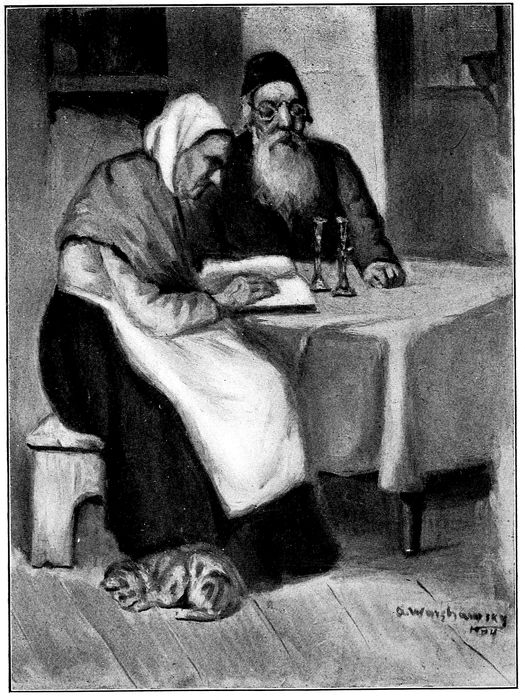
THE VERY SPIRIT OF SABBATH PERVADED THE NOISELESS AIR Page 20
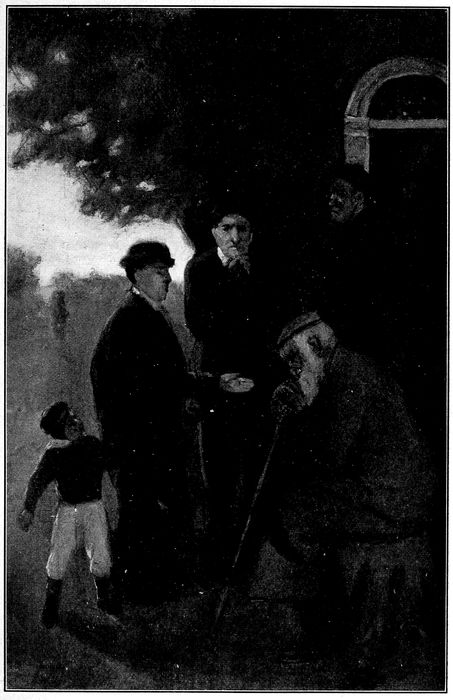
THERE THEY SAT AND STOOD, IN VARIOUS ATTITUDES, WHILE THE DEEPENING SHADOWS MADE THEIR FIGURES EVER VAGUER AND MORE INDISTINCT Page 21
21All possible subjects came up for discussion “between Minchah and Maariv.” The politician of the Kehillah discoursed learnedly on the European situation and the various problems of statecraft involved in the relations of 22the great Powers to each other, the philosopher shed the light of his wisdom on the great scientific movements of the day and the wondrous inventions which are revolutionizing civilization, while the Talmudist elucidated knotty and interesting questions of rabbinical law or lamented the downfall of religious sentiment in these evil days and contrasted these with the unyielding fidelity and loyalty of yore. They all found attentive and eager listeners, to whom their words were as the very revelation of the Urim and Tummim; but they did not arouse the same degree of enthusiasm as the story-teller. This accomplished narrator of witty tales and humorous anecdotes held the hearts of his auditors in his hands; and when his turn came and he began to draw upon his apparently inexhaustible stock of Mesholim, an immense enthusiasm took possession of the entire audience, and there was no limit to their enjoyment of the numberless good points he made. They were indeed amusing, those tales of impecunious rabbis, and still more impecunious Bachurim, of awkward bridegrooms and homely brides, of witty Poles and scheming Schnorrers. But they were more. They were instructive, for they reflected the inner life of the Jewish people, and showed, even if from a humorous 23point of view, the many trials and difficulties by which they were encompassed.
But now the shadows had deepened into night, and the Shammas, who had the privilege of reading the service before the rest of the congregation in order that he might be permitted to perform the work-a-day task of lighting the lights, interrupted the pleasant tales of the story-teller by a brief notification that the time for prayer had arrived. The evening service was brief, lasting in all hardly more than a quarter of an hour. Its chief feature was the Havdoloh, in which the Chazan pronounced a number of benedictions over wine, spices, and a peculiar braided wax candle, and thanked the Lord that He makes a distinction between light and darkness, between Sabbath and week-day, and between Israel and the nations. The service concluded, the worshippers greeted each other with hearty “Gut Woch” and repaired to their homes, but not yet to resume work-a-day tasks.
It was an unwritten law in Nordheim that the Saturday night was not to be given over to labor or business, except in cases of emergency. The women were particularly zealous in following this rule. Instead sociability reigned supreme. The men indulged in friendly card-play, the married women sat together in groups and gossiped, 24the youths and maidens played musical instruments, sang, and danced. These pleasant occupations were continued several hours, so that on Saturday nights the worthy Jewish burghers retired much later than usual.
The sincerity and thoroughgoing consistency which marked the observance of the Sabbath were characteristic of the religious life of the Nordheim community throughout the year. It would be inconsistent with the scope of this sketch to go into all the details of religious life and practice; but suffice it to say that Jewish piety, as illustrated in Nordheim, was eminently earnest, emphatic, and genuine. The very children possessed the spirit of martyrs. They would have endured tortures rather than eat forbidden food or violate the Sabbath or any other of the holy days. Some of the manifestations of this piety were quaintly humorous or pathetic, according to the viewpoint from which they are regarded. The children of Nordheim, like children the world over, were very fond of fruit and berries. Had they been permitted to go into the orchards and gardens and gather their sweet products unrestrained, there can be no doubt that as much would have disappeared down their throats as they brought home. But the Nordheim mothers struck upon a shrewd 25scheme for circumventing the appetites of their sweet-toothed offspring, which did equal credit to their ingenuity and their psychological knowledge. They would send the children to gather fruits or pick berries upon a fast day. The plan was as effective as it was beautifully simple. The children brought home all that they gathered, for no Jewish child in Nordheim would have even thought of committing such a heinous sin as tasting food on a Taanis. Think of applying such a rule to American children! It would be about as effective as trying to restrain a bull with a piece of cotton thread.
It is recorded of a worthy Nordheim Baal Habbayis that he once saw some flies rise from his boots and settle upon some hay, which was later on eaten by his cows. Now that in itself is a trifling and insignificant incident; but it so happened that the boots, in accordance with German village custom, had been smeared with tallow, which, from the viewpoint of the Jewish religious law is Trefah—that is, ritually unclean, and forbidden to be eaten. Our worthy Nordheimer at once felt himself burdened in his conscience and despatched a special messenger post-haste to the rabbi at Gersfeld with an inquiry as to whether the milk of those cows might lawfully be drunk. This pious scrupulosity 26did not, however, as might be thought, involve any gloomy or dreary harshness of sentiment. What we are accustomed to call the Puritanical frame of mind was utterly unknown in Nordheim. On the contrary, a cheerful and pleasant disposition, which made the tone of social intercourse extremely agreeable, was the all prevalent mood. In individual instances this mental tendency was emphasized into pronounced joviality, and the happy possessors thereof became the “Spass macher,” the jesters and fun-makers of the community. Woe betide the unfortunate individual who acquired a reputation for sourness and unsociability. He was considered a legitimate victim for the gibes and jests of the official jokers, and small indeed was the meed of sympathy which he received.
Another instance of the prevailing jocoseness was the custom of attaching nicknames to persons, which were then used instead of their proper appellations. It was rarely that any one was referred to in Nordheim by his given name, the nickname being so universally used as almost to displace the real and legal cognomen. These nicknames were derived from some personal characteristic or some peculiarity arising from vocation or experience in life, which had struck the village wags as humorous. It was “the 27black Elias,” or “the long Moses,” or “the bold Isaac,” or “the gentle Sarah,” the last two appellations being, of course, mildly ironical. One individual, who had an undue amount of audacity in his psychological make-up, was known as “der Baishan,” that is, “the bashful or timid one,” while another who had failed in nearly everything he had undertaken was universally dubbed “der Mazzeldige Shmuel,” that is, “lucky Sam.” A family, some remote ancestor of which had once been imprisoned in a tower and escaped therefrom by leaping from the window of his cell, was generally known as “die Thurm hüpfer,” “the tower-hoppers,” while six brothers, all of whom were over six feet tall and stout in proportion, bore the strikingly apposite designation of “die Kinderlich,” that is, “the babies.” The swineherd, who called his charges together by means of a long tin trumpet, from which he emitted shrill and piercing, though hardly melodious notes, was styled by the Jews “der Baal Tokea,” that is, the blower of the Shofar or ram’s horn trumpet used in the services of the New Year; while the village constable, who was an extremely pious Catholic and always walked around through the village streets on Sundays with a prayer book in his hand, from which he read with strait-laced mien and 28ostentatious devotion, was dubbed “der Baal Tephillah,” that is, the cantor or reader of the synagogue services.
Schnorrers.
The two banes of village life and at the same time the most diverting figures therein were the Schnorrers and the gendarmes or rural policemen. The first-named gentry, wandering Jewish mendicants, who believed in the socialistic doctrine that the world, or at least that part of it which professed Judaism, owed them a living, were a most interesting set and worthy of a special study in themselves. They honored the community frequently with their visits. Some were usually visible in the streets at all seasons of the year, and the services in the synagogue were generally graced by the presence of two or three. In most instances they professed intense piety and then their Tephillin were larger, their Talethim longer, and their prayers louder and more ecstatic than those of the rest of the congregation. They came from anywhere and everywhere. Most of them were of Russian or Polish origin, but there was a goodly sprinkling of individuals of German birth and occasionally a Sephardi from Jerusalem or some other Eastern region, clad in Oriental robes and with a majestic turban upon his head, relieved the monotony of Schnorrerdom and added interest and diversity thereto by his strikingly alien and picturesque appearance. They came in the most diverse guises. Some appeared in the rôle of venerable rabbis with flowing beards, and anxious to display their learning in the law to whomsoever they could induce to listen; others professed to be merchants who had lost their all in ill-starred commercial ventures; while others were wandering apprentices—Handwerksburschen—temporarily out of work. Sometimes they were accompanied by their wives, who were always more voluble and eloquent than their husbands. Sometimes an entire family, grandparents, married sons and daughters and children of all ages, including infants in arms, made their appearance and then the resources of Nordheim charity were severely strained adequately to provide for them.
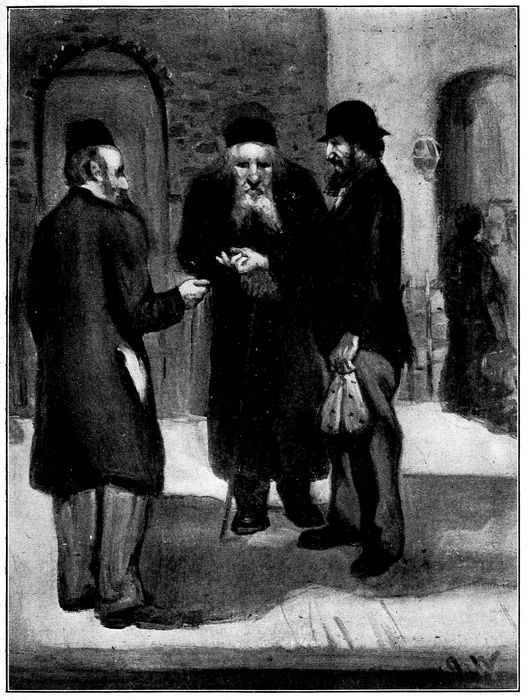
THEY HONORED THE COMMUNITY FREQUENTLY WITH THEIR VISITS Page 28
29These Schnorrers were not beggars in the ordinary sense. They certainly had no humble or suppliant air. They came into the house with the air of calling upon old personal friends, and seemed to think it an entirely self-understood and axiomatic matter that their co-religionists should take upon themselves the duty of caring for their needs. 30Among them many, no doubt, were genuinely unfortunate and deserving individuals, but there was more than a suspicion that a large proportion had taken up the pursuit of Schnorring as a peculiarly pleasant and profitable vocation. Their reliance upon the charitable disposition of their brethren in faith was well grounded. The Nordheim Jews were guided by the eminently humane and noble principle that it is better that ninety-nine undeserving persons should be aided than that one deserving person should be refused the assistance he required; and, consequently, every applicant for charity, unless it was positively known that he was unworthy, received the help he craved. This help usually took the form of food, lodging, and some money or clothing. A sort of system prevailed. The Schnorrer would first call upon the Parnass, or president of the congregation, who would then give him a ticket, called Plett, a corruption of Billet, upon some member of the congregation, entitling the stranger to food and lodging. These tickets were issued in rotation, and were usually cheerfully honored. Some of the members even had a predilection for entertaining these destitute brethren, and would rival each other in the numbers they accommodate. It was amusing to hear one boast that he had 31harbored, let us say twenty-seven, Schnorrers during the year, only to be told by another, with triumphant mien, that the number of his non-paying guests had been thirty-five. The most celebrated hostess of this kind was a widow named Hannah. This warm-hearted daughter of Israel strove to fulfil literally the precept of the sages, “Let the poor be the children of thy house.” The days were few when her house did not contain some “guest”; and she would give him of her best, and wait upon him as though his presence was the most distinguished honor. When asked once how it was that she, although not a woman of means, was always ready to receive needy strangers, far more so, indeed, than persons of far greater wealth, Hannah answered: “Why, that is a very simple matter. All that one needs is a Lef and a Loeffel.”
Altogether, the mental attitude of the Nordheim Jews toward their needy and mendicant co-religionists was very different from that which prevails to-day; at any rate, in America. At present the unfortunates who depend upon the aid of their supposedly sympathetic brethren are considered a nuisance; an unsightly excrescence upon the body social to be abolished by all means, if possible. The 32wretched applicant for relief is rigidly scrutinized and interrogated by lynx-eyed committees until he is made to feel as though he were a criminal on trial for his life. A domiciliary visit is paid to his home by some surly “investigator,” whose efficiency is measured by the number of unfavorable reports he makes. And woe betide the miserable one whose habitation shows some traces of neatness and gentility, and where some humble ornaments, relics, perhaps, of happier days, have been suffered to remain, and have not found their way into the pawnshop. Such a one is at once declared an “undeserving case”; for does not his dwelling show that he is still possessed of means, and his application is at once summarily and without mercy rejected. But Nordheim knew nothing of such uncharitable charity, such inhuman humanity. The disposition there was truly charitable in the kindlier, and hence nobler, sense of the word. Poverty was looked upon as a necessary and inevitable feature of human existence, as, indeed, a part of the Divine order of the world; for had not He said in His law, “The poor shall not cease from the midst of the land”?
The unfortunates who had been selected by some mysterious dispensation of Providence to bear the hard burden of poverty were the objects 33of real and genuine commiseration, and every effort was made to alleviate their sad condition. And if some of them did occasionally resort to deception or petty misrepresentation in order to secure a larger benefaction than would otherwise have fallen to his share, there was no horror-stricken outcry, no show of virtuous indignation, such as our high-salaried or amateur charity experts would indulge in; but people merely shook their heads, rather pityingly than otherwise, and would say: “Poor fellow! he has little enough in this world, God knows. No wonder that he tried to get a little more.” Indeed, if the Schnorrer was really a shrewd fellow and his trick a well-devised one, he was far more apt to arouse amusement than resentment, and would actually profit by his nimble wit. This I saw well illustrated shortly after my arrival in Nordheim. One day a Schnorrer presented himself with an expression of utter woe upon his countenance before Uncle Koppel, and in heart-breaking accents informed him that he had just received news that he had become an Ovel. “Alas, woe is me,” he wailed. “My poor, dear wife in Poland is dead! What shall I do without her? Who will care for my poor, unfortunate orphans? How shall I keep the Shivah for her, as is due to her memory, I 34who have no home and no means?” It need hardly be stated that the sad case of the stricken widower aroused the most profound sympathy among the Jews of Nordheim. Uncle Koppel at once placed his house at the disposal of the unfortunate man in order that he might properly observe the seven days of mourning, and most of the members of the congregation offered to attend the mourning services morning and evening. Aunt Caroline looked well after his comfort, provided him with four or five square meals daily and a good bed at night. At the conclusion of the seven days a substantial purse was made up for his benefit and he departed, showering blessings upon the heads of all the Nordheim Kehillah, and vowing that he would never forget their kindness and their true spirit of brotherliness.
A few weeks later Uncle Koppel had occasion to make a trip on business to Römhild, a somewhat distant town in the grand duchy of Meiningen. As he never ate dinner when away on these trips, it was customary to keep his dinner for him, and all the household would remain up until his return. It was rather late before he returned, after nine in the evening. As soon as he had strode through the door we all noticed that something unusual had befallen 35him during the day, and that that something had been of an amusing nature. His face was wreathed in smiles and he was silently chuckling to himself. We all became, of course, curious to know the cause of his amusement, but none, except Aunt Caroline, ventured to ask. “For goodness’ sake, husband,” said she, “what is the matter? Let us know.” “Give me my meal first, wife,” said Uncle Koppel. “I need strength before I can tell you.” All during the meal Uncle Koppel sat with sides shaking with ill-suppressed laughter, while curiosity and impatience consumed us all. At last, his meal concluded and grace recited, Uncle Koppel began his story. “I heard something in Römhild to-day of our Schnorrer,” said he; “the one who kept Shivah in our house.” “Indeed,” we all vociferated, “what was it?” “I called first on Moses Rosenbaum,” he resumed, “in reference to some cattle that I wished to buy of him; and after we had finished our business, he said to me: ‘By the way, Koppel, there is a very sad case in town at present, and it would be a real Mitzvah for you to help us a little in relieving it.’ ‘What is it,’ said I. ‘A poor man,’ said he, ‘has suddenly received news that his wife died, and he is so destitute that he cannot support his orphans without help, 36or even keep Shivah. We have helped him some and he has been keeping Shivah in my house during the week.’ ‘Aha,’ said I, beginning to smell a rat, ‘this is strange. We had just such a case in Nordheim a few weeks ago. I think I shall go over and see your man.’ We went over to Rosenbaum’s house, and, sure enough, it was the same fellow. The Shivah-keeping business in Nordheim had suited him so well that he was trying it again in another place. When I saw him I said: ‘My friend, I believe I have met you before.’ He looked at me, not in the least abashed, and said: ‘Oh, yes, in Nordheim, a few weeks ago.’ ‘What do you mean by this brazen-faced fraud,’ I asked, ‘pretending to have lost your wife and swindling people into charitable gifts by pretending to keep Shivah?’ ‘Oh, my good sir,’ said he, with great pretence of earnestness, ‘it is no deceit at all. The first time it was a false report. My wife had not died. But this time she is really dead, really indeed; and if you don’t believe me you can go yourself to Pitchichow in Poland, my native town, and convince yourself. You can, indeed.’ We all laughed heartily at the fellow’s impudence, and warning him to be sure that his wife was dead before he sat Shivah for her next time, we bade him begone. 37He went off with great alacrity, evidently glad that he had fared no worse.”
Gendarmes.
The gendarmes or rural policemen were the second bane of village life; but while the Schnorrer was looked on with charitable eye, for these latter gentry no one had a good word. They were detested, thoroughly and intensely. As a rule they well deserved the detestation in which they were held, for they were pompous, insufferable individuals, egregiously proud and conceited because of the little authority they possessed, and over-eager to display their power; in a word, petty tyrants of the worst kind. They were equally hated by Jew and Gentile, and were not popular even with the judges and magistrates, who were often liberal-minded gentlemen, and who knew well the tyrannical disposition of their rustic retainers. The multiplicity of laws and regulations in the German statute book, particularly those referring to trade and commerce, gave the gendarmes the much-desired opportunity for the display of their power; and as the Jews were the chief element engaged in commercial pursuits, they were also the chief victims of these rustic arbiters of weal and woe. To defeat or discomfit a gendarme 38was a highly meritorious deed, and all the community rejoiced in concert when one of these potentates had been made the victim of some particularly ingenious trick.
An incident which had happened some time previous to my arrival in Nordheim, and which all the community were highly enjoying at the time of my arrival, will illustrate this disposition. There lived in Nordheim a poor, half-witted Jew named Meyer, an unfortunate fellow without relatives or home or means of subsistence, who depended for his support on the charitable gifts of the kind-hearted villagers. Despite his mental infirmity, Meyer possessed, as is not seldom the case with the weak-minded, quite a stock of humor; and as he was always cheerful and pleasant, and was continually doing odd and amusing things, “Shoteh Meyerle,” or “Little Meyer the fool,” as he was called, enjoyed considerable popularity. Everybody, rich and poor, high and low, Jew and Gentile, knew him well. Everybody had a friendly greeting for him when met on the road; nobody, not even the most unruly boys, would harm him in any way or permit him to be harmed by others. He had free access to every house, and enjoyed altogether liberties and privileges not possessed by any other member of the community. One day 39it chanced that Shoteh Meyerle determined, in accordance with his wont, to visit the adjoining village of Willmars to obtain some gifts. The day was hot, the road was long and dusty, and Meyer soon felt that rest and recuperation would be agreeable. These could not be had on the dusty road, and he, therefore, stepped aside into a field where there was a fine tree, in whose cool shade he sat him down and reposed. This act, it is true, was illegal, for the agrarian regulations of the Bavarian state strictly prohibit the stepping upon cultivated fields on the part of others than the proprietors, or those to whom they give permission. But what recked Meyer for that; he was, in a measure, above the law. He could violate the solemn enactments of the code with impunity, for the light in which he was viewed by the community enabled him to say, like a celebrated American politician of later date, “What’s the Constitution between friends?” Meyer, therefore, sat him down on the cultivated field of Farmer Dietrich without having obtained his formal permission, but without the least fear of consequences. This time, however, he was in error. A new gendarme had recently come to Nordheim, a stranger from a different region, unacquainted with the people and their ways, but with a soul longing 40to acquire distinction by making some brilliant arrests. His reputation as a surly and churlish fellow had preceded him, and every one had scrupulously avoided him and taken particular care not to come into conflict with any of the numerous statutes and police regulations; so that hitherto no one had fallen into his clutches, and his ambition for distinction had as yet had no opportunity to be gratified. This particular morning he was walking along the road, meditating upon his ill luck (as he considered it), and cursing the people of Nordheim and vicinity for an absurdly law-abiding crowd. What especially grieved him was that no Jew had yet fallen into his hands, for he was a true anti-Semite; and to haul up one of the accursed Semites on some good and heavy charge was incense to his soul. While thus marching along the highway and meditating, he beheld a man sitting upon a stone in a field, whose appearance clearly indicated that he was not a peasant nor a field laborer, and who, therefore, had probably no right to be there. It was, of course, our friend Meyer; but our doughty gendarme knew him not, and was not aware of the peculiar status of immunity which he possessed. “Aha!” thought the gendarme, his soul filled with joy at the idea of at last making an arrest. “A 41law-breaker! Probably a wandering apprentice (Wandersbursch) or itinerant merchant (Handelsman) who does not know that I, the zealous and faithful watchman of the law, am in the neighborhood, and who has therefore dared to invade the sacred precincts of the fields! I must approach cautiously lest he see me while still afar, and escape.” Thus thinking, he began cautiously to draw near to the neighborhood of the suspected violator of the law, slinking behind bushes and walls so as not to reveal his presence until he should be in the immediate vicinity of his intended victim, when he would pounce upon him as the tiger springs upon his prey.
But, cunning as the gendarme was, Shoteh Meyerle was still more cunning. He had seen the bright uniform and shining musket of the pompous champion of the law when they first appeared at the distant turning of the Ostheim chaussée. He at once understood his intention when he saw him first pause and afterward slowly advance, seeking cover behind bushes and walls and, with the instinctive cunning of the half-witted, he at once resolved to baffle his elaborate plan and to have some sport with his would-be captor. He remained quietly sitting upon his stone, apparently in 42entire ignorance of the gendarme’s approach until just before the latter came into too uncomfortable proximity, when he arose and began to move leisurely across the fields in the direction of the Sommerberg, a forest-crowned hill situated somewhat to the northeast of the village. At this the gendarme was compelled to show himself. He burst forth from his covering of bushes, leaped upon the field and called upon the intruder, as he considered him to be, to stand and submit to arrest. Instead of doing so, Meyer continued to move on at a somewhat more rapid pace. To realize the meaning of this action, one must remember that in Germany a person when called upon by the police is expected at once to stand and give an account of himself, and invariably does so. Only one who has the gravest of reasons for not desiring police attention would dare to attempt to evade them when their attention had once been called to him.
Our worthy gendarme was now convinced that he had a dangerous criminal to deal with, and his soul thrilled with the hope of making a brilliant arrest; one that would secure him favorable notice from above, rapid promotion, and perhaps immortality in the annals of criminalistic achievement. He shouted to Meyer at 43the top of his voice to halt, breaking at the same time into a run and dashing toward him. But Meyer did not halt. On the contrary, he too began to run, and was soon speeding over hill and dale, hotly pursued by the now thoroughly enraged officer.
Who can fitly describe the terrors and the glories of that extraordinary race? Meyer was thin and light and active, possessed of splendid wind and as fleet as a deer. He led the gendarme a merry chase, indeed, over hills and down into valleys, through forests and over brooks, through corn-fields, meadows, and gardens. But the gendarme was a strong man and game, though rather heavy from overmuch eating and beer-drinking; weighed down with his heavy musket, and sadly out of condition through lack of exercise. Filled with rage and determined to make a prisoner of this extraordinary criminal, he panted and toiled on in pursuit, despite weariness and perspiration. Meyer could easily have distanced him, but had no intention of doing so; and therefore so controlled his pace as to remain always in sight of his pursuer, and not permit the latter to lose hope and give up.
Thus the chase continued until hunter and hunted, having covered more than four miles of country, found themselves at the gates of Mellrichstadt, 44the chief town of the district and the seat of the district court, which at that time, as Meyer well knew, was in session. Here, Meyer pretending to have grown weary, gradually slackened his pace and permitted himself to be seized by his panting and perspiration-bathed pursuer. “Aha, accursed Jew! Aha, thou rascal!” hoarsely exclaimed the latter, as he seized Meyer roughly by the collar, “at last I have thee! Now thou shalt pay bitterly for thy villainy and thy audacity. I shall drag thee straight to court, and the honorable judges will know well how to deal with an audacious wretch, such as thou art, and who undoubtedly must have committed some great crime or else he would not have thus fled from me.” Meyer vouchsafed no answer and offered no resistance, but meekly followed the gendarme to the courthouse, which was but a short distance away; although the triumphant officer in his wrath at the unprecedented chase he had been forced to make, literally dragged him thither in most ungentle manner.
The district judge, clad in his silken robes of office, and with his velvet cap upon his head, was seated at his elevated desk at the upper end of the court-room, at either side an assessor, when this remarkable pair, the 45stout, hot, perspiring gendarme, with face red as fire, and the comical, well-known figure of the half-witted Jewish beggar entered the room, the former holding the latter with an iron grasp and with an expression of intense excitement upon his countenance; while the latter was perfectly cool and self-possessed, and was smiling all over with an expression of perfect content, as though a run of four miles and apprehension by the constabulary were every-day and quite pleasant experiences in his life. An interesting case was going on at the time, and the court-room was crowded with a mixed multitude of peasants, working-men, Jewish merchants, and landed proprietors, among whom the arrival of this singular pair created a lively sensation, especially as the mischievous propensities of Shoteh Meyerle were well known and curiosity was rife as to what he was up to now.
When the gendarme entered the court-room, he at first hesitated for a moment, being undecided as to whether he had the right to appear at once before the judges or not; but the supreme judge, who knew Shoteh Meyer perfectly well (as did also the assessors), and was himself consumed by curiosity concerning the meaning of this extraordinary arrest, at once signalled him to advance, which he immediately did. No 46sooner had the gendarme brought his prisoner before the bar than the latter made a deep bow to the court; and, smiling affably at the judges, said in a voice audible all over the room: “Good morning, Herr Gerichtshof! Good morning, my Herren Assessoren! How are you all feeling to-day? I trust you all slept well last night!” This, in a court-room, extremely unusual salutation was accompanied by an extraordinary smirk and a comical flourish of the arms, and was greeted by an outburst of hearty laughter on the part of the audience; in which the judges joined, a proceeding extremely disconcerting to the gendarme, who detected in it a note of friendliness to the prisoner, which he could not understand, but which boded ill for the success of his charge.
The gendarme was then ordered to tell his story, and gave the facts with which we are already familiar, laying particular stress on his suspicion that the prisoner was guilty of other grave crimes, based on the desperate manner in which he had endeavored to avoid arrest. This story was listened to with evident amusement, which added greatly to the embarrassment of the valiant captor, who began to feel very cheap, though he knew not why.
Meyer was then called upon for his side of the 47case. “Why, most honored judge and assessors,” said Meyer, with a most engaging smile and ingenuous air, “I do not know why I have been arrested, or why the Herr Gendarme is so angry with me. I am only a poor, humble man, and I have never done any one any harm in all my life. I was resting a little in Farmer Dietrich’s field this morning, and afterward I took a little lively run to Mellrichstadt and I saw the Herr Gendarme a few times on the way. Hardly had I reached Mellrichstadt when he fell roughly upon me and dragged me here, and that is all I know.”
“But why were you in Farmer Dietrich’s field?” asked the supreme judge, trying to assume a severe air. “Do you not know that is against the law, and that you make yourself thereby liable to severe punishment?” “That may be, your honor,” answered Meyer; “but I did not think I was doing any wrong. All the people hereabouts are very kind to me, and willingly permit me in their fields; and I thought it would be the same this time as always.”
“But why did you run all the long way from Nordheim to Mellrichstadt, and in this hot weather, too?” asked the judge, suppressing by a great effort his amusement.
48“The reason I did that,” said Meyer, with a most innocent expression of face, “was for the benefit of my health. I have been suffering a great deal lately from constipation, and the doctor recommended me exercise in the open air.” This answer was greeted with a shout of laughter from all sides.
“But,” continued the judge, still endeavoring to conduct the inquiry in a judicial manner, “when you saw the gendarme running after you, you should not have kept on without noticing him. You should have stopped to see what he wanted of you. Why did you not do so?” “I should gladly have done so, your honor,” said Meyer in a tone of perfect frankness, “but I did not have the least idea that he wanted anything of me. I thought that he, too, was probably suffering from constipation, and that the doctor had also recommended him exercise for his health.” This answer literally “brought down the house.” Amidst a storm of merriment, which utterly defied the usual restraints of court discipline, the case was dismissed and the crestfallen gendarme was overwhelmed with a flood of ironical compliments on his zeal as an official and his ability as a runner. Shoteh Meyerle was more popular than ever after this incident, but it was many a day before the gendarme could muster up courage to look any one in the face.
Page 49
49
Reb Shemayah and Other Nordheim Worthies.
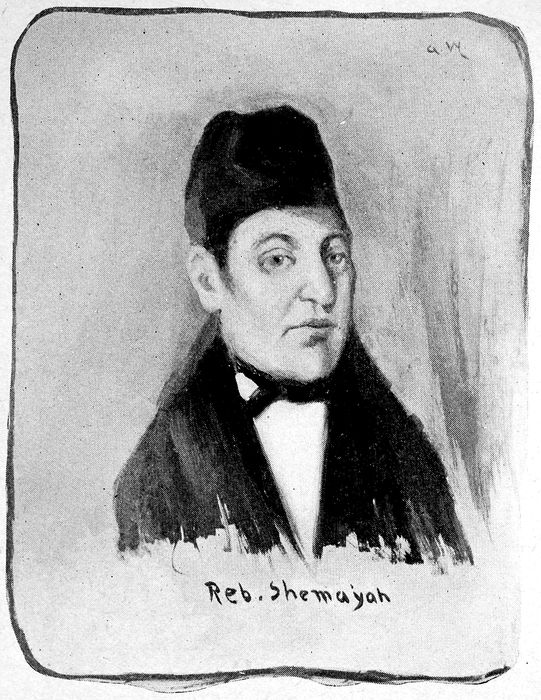
O sweet Nordheim! Though thy inhabitants, particularly those who professed the ancient faith of Israel, were but few, how numerous, comparatively, were those whose characters for one reason or other were interesting and noteworthy. Let me pass a few of these in review before the eye of the reader before I close this insufficient though veracious chronicle. Without a doubt the most important and significant of these persons was Reb Shemayah. He was my grandfather, although it was not my privilege to behold him in the flesh, for he had passed to the better world some years before my visit to the village. He was a perfect type of the old-time, sincere, loyal, and devout German Jew. He was the son of an old family of high repute and standing, which had been settled in Nordheim for several centuries; and one of his ancestors, whose picture appears in an old village chronicle, had enjoyed the unique distinction of being the only inhabitant who owned a saddle horse. Like all the sons of the better 50class of Jewish families in former generations he received a thorough training in Hebrew and Talmudic studies. At the Yeshibah in Fulda, to which he had been sent to study rabbinic lore, he attained such distinction by the keenness of his intellect and the rapidity of his progress that the venerable rabbi became warmly attached to him, and declared that he alone should be his successor and his son-in-law, the husband of his youngest daughter.
Just as Reb Shemayah was about to attain the loftiest pinnacle of Jewish ambition in those days, to become a rabbi and to take as his wife the beautiful, dark-eyed daughter of the Fulda Rav, an event occurred which destroyed his hopes in both these regards, but gave occasion for the display of his noble idealism. The Bavarian Government issued a rescript to the effect that in order to wean Jews from the petty forms of trading to which they had hitherto been addicted, and to induce them to take up agriculture, the law prohibiting Jews from owning land, which had been in force for centuries, was repealed, and it would henceforth be permitted them to own and cultivate land, the same as all other citizens.
The beneficent intentions of the new law were evident, but the Jews hesitated to take advantage 51of it; indeed, they were loath to do so. The centuries of unfamiliarity with agriculture were partly to blame for this reluctance; but then, again, there was also a strong prejudice against the farmer’s vocation, which was considered low and rude and far inferior in social value to that of the merchant or scholar. Reb Shemayah did not share these views. His soul was all aflame with enthusiasm when he heard of the new law which, in his opinion, first put the stamp of real citizenship upon the Jew. Not only did he consider agriculture intrinsically ennobling and the only vocation in consonance with true Jewish, Biblical precepts, but he also held that the landed class are the real foundation of the state, while all others are but floating parasites. When he saw that his brethren were hesitating, and that none appeared willing to purchase land, he determined to give them a good example and himself became a tiller of the soil. He invested his whole fortune in the purchase of a farm near Nordheim, which he himself began actively to cultivate. Thus did Reb Shemayah renounce the rabbinical vocation and become a peasant. It was a tremendous sacrifice to make; but what was worse was that he had to renounce his sweet bride too, for the old Fulda rabbi was obstinate 52and had no liking for these new things. “A peasant shall not have my daughter,” he said; and though Reb Shemayah loved sweet Miriam well, he loved Israel better, and for the sake of his ideal he sacrificed a piece of his own heart. Encouraged by Reb Shemayah’s example, many other Jews invested in land and endeavored to learn the art of agriculture; and at present Jewish tillers of the soil are no longer rarities.
In the Nordheim community and the entire surrounding country Reb Shemayah enjoyed the highest possible reputation. He was universally loved, respected, revered. And right well did he deserve his high repute, for a character of such singular purity, sweetness, and nobility belongs to the rare things of earth. He was profoundly and exceptionally devout, even for those days when piety and religious strictness were usual and ordinary in Israel. The Torah, the divine law, he considered God’s most precious gift to mankind, and Israel’s mission he held to be to practice this law and to show its excellence to the world; and by lives of utmost virtue and beneficence to be mekaddesh Ha-Shem, i.e., to sanctify the name, and to bring honor and glory to Him whose servants were thus righteous and good. He lived up to 53his ideal, and his life thus became one long record of kindly words and noble deeds. Jews and Gentiles alike had in him a sincere friend and a trustworthy counsellor, and were equally glad to seek his wise counsel and ready assistance in their hour of need or distress. The Schnorrers had in him a particularly warm sympathizer, so that, after his death, they lamented that Nordheim, although charitable beyond the average, had lost its halo of glory in their eyes. He always believed any tale of woe told him by a suppliant stranger and never wearied of assisting, for the thought of deceit or fraud never entered his guileless mind. The learned wanderer had his especial sympathy, and he would always welcome such a one right royally to his home and listen with kindliest interest to his erudite comments on Biblical or Talmudic passages or new solutions of old difficulties; and after entertaining him with unstinted generosity, would dismiss him laden with blessings in substantial form.
It was not because Reb Shemayah was wealthy that he was able to do all these things, by merely sparing a little from his abundance. On the contrary, he gave thus liberally as a matter of principle, of religious duty, and his charitable gifts often involved great sacrifices 54on his part. During the greater part of his life he lived in rather straitened circumstances, and rigid economy was necessarily the strict rule of his household. His entire fortune had gone to the purchase of his Bauerngut; and as he was neither a trained agriculturist nor a keen business man, his finances might have fallen into great disorder but for the iron rule he had set up for himself, and from which he never deviated, never to contract debts which he could not see his way clear to pay. In addition to his ordinary difficulties he met with several misfortunes, which would have sufficed to break down the courage of an ordinary man; but his sublime faith enabled him to bear all these trials cheerfully and resignedly, and, like Rabbi Nahum of old, he would repeat whenever any tribulation came upon him: “This also is for good.”
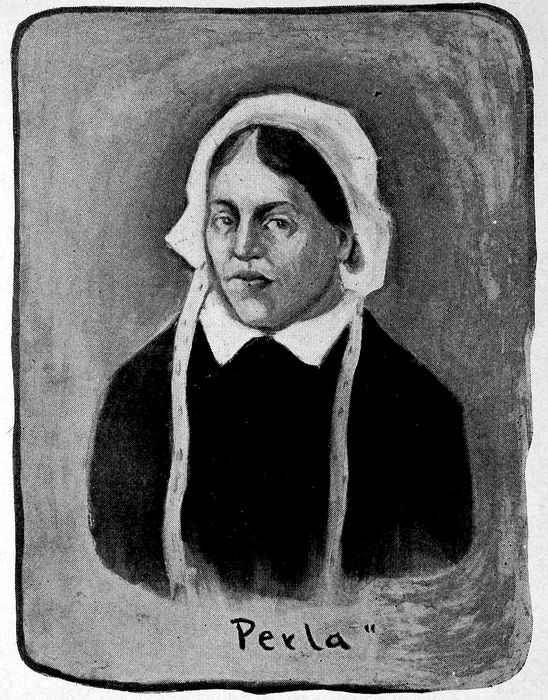
A striking illustration of this trait was given after he had been for quite some years actively engaged in his chosen vocation, had found his chosen life partner, and had already a family of several daughters. In the middle of a bitter winter night a fire suddenly broke out in Reb Shemayah’s dwelling; and, quickly assuming dimensions which rendered it impossible to check it, the family were driven forth half-clad into the 55icy night. The house was burned to the ground and hardly anything of its contents was saved, but the barn had escaped, and there Reb Shemayah and his nearly frozen wife and family found refuge. There, too, his wife, Perla by name, who had for some time been expecting the advent of a little stranger, gave birth to a beautiful black-eyed boy, the first male child. It was a heartrending conjuncture. His home a mass of smoking ruins in the intense cold of a Bavarian mountain winter, nothing saved but a few quilts and articles of clothing, his family huddled together for refuge in a barn, through the chinks of whose wooden walls the chill blasts blew keenly; and most heartrending of all—to see his dear wife forced to undergo, under such circumstances, the pains and dangers of childbirth. It was a situation which would have broken the courage or destroyed the faith of another man. But Reb Shemayah lifted his eyes to heaven, and in all sincerity and truth uttered the words: “I thank Thee, O Master of the universe, for Thou art good. With one hand Thou smitest, but with the other Thou healest. Thou hast destroyed my habitation, but Thou hast also fulfilled the prayer of my heart and given me a son.” And, indeed, the terror and the suffering were soon over. Kind 56Jewish neighbors hastened to open their homes to the afflicted family. Neither mother nor child was any the worse for the harsh exposure, and the black-eyed boy became subsequently the Uncle Koppel, whose hospitality I enjoyed. If anything in the whole incident distressed Reb Shemayah keenly, it was the necessity of accepting, if even temporarily, the assistance of others. Himself ever ready to assist the needy, he entertained an intense aversion to receiving himself such assistance.
Though Reb Shemayah was, as we have seen, an ethically noble and exalted character, he was by no means gloomy or austere. On the contrary, he was natural and unaffected in his ways, accessible to every one, dearly fond of a joke, and a capital story-teller. Despite his readiness to accept as true tales of distress, he was, nevertheless, an excellent psychologist, and had no difficulty in thoroughly reading the characters and motives of those with whom he was thrown into contact. This ability once enabled him to baffle an attempt which was made to victimize and blackmail him, and to turn it into a humorous triumph for him.
Nordheim, as regards the majority of its inhabitants, was an intensely Catholic village. The feasts and fasts of the church were celebrated 57there with great pomp and unction, and the numerous religious processions were particularly solemn and, according to rural standards, magnificent. In these the Jewish inhabitants, of course, took no part, and, indeed, usually remained secluded in their houses during their continuance. For this there were several reasons. The Jews being, from the Catholic standpoint, heretics and unbelievers, were eo ipso excluded from participation in these Christian solemnities; and their presence in the streets on such occasions was apt, even in these more tolerant times, to rouse the slumbering embers of religious animosity and bigotry. Besides, the Jews themselves, warm adherents of their own monotheistic creed, would rather have suffered martyrdom than to have participated in practices which they looked upon as closely akin to idolatrous.
Shortly after Reb Shemayah had become a Nordheim peasant and citizen, the village priest who happened at the time to be presiding over the spiritual affairs of the community conceived what appeared to him a most brilliant idea, by means of which he believed he could press a substantial contribution out of the learned and pious new Jewish householder. A great holiday of the church was approaching—the indulgent 58reader will kindly excuse the author for his ignorance of Catholic theology, which prevents him from specifically stating which one it was—of the celebration of which a particularly great and splendid procession was the leading feature. In this procession substantially all the Gentile villagers took part, and at its head a splendid effigy of the crucified one was borne. The office of carrying the image was performed by a citizen especially selected by the priest and burgomaster conjointly with the council; and to be chosen for this duty was deemed a high honor, and was eagerly coveted by the good Christian burghers of Nordheim. Our priest’s idea was as follows: The honor of carrying the image should be bestowed, with flattering words and honeyed compliments, upon Reb Shemayah as a prominent and universally respected citizen of the village. Of course the cunning ecclesiastic did not seriously mean that Reb Shemayah should actually perform the office, for it was entirely out of the question that any Jew, however worthy, should actually take a leading part in the solemn ceremonies of the church; but our worthy theologian knew well that the aversion of the Jews to participating in such observances was even greater than the disinclination of the Christians to permit them so to do, and 59he had no fear that Reb Shemayah would, under any circumstances, consent. What he imagined would happen was that Reb Shemayah, on being informed of his selection for the honorable task of image-bearer, would decline the honor on the ground that his religion did not permit him to participate in such functions; and when he would be further informed that it was not possible for a citizen to refuse an honor to which he had been duly appointed by the constituted authorities, would beg and implore to be let off, and would finally offer a good round sum to be released. This sum, after various difficulties and objections, would be graciously accepted as a mark of special favor, and thus the little comedy would find a pleasant and profitable end. Filled with this splendid idea for “spoiling the Egyptians” this time in the form of a Hebrew, the priest hastened to the burgomaster and confided his plan to him. That worthy, also, not at all averse to having a little innocent sport and gaining some filthy lucre from the unbelieving Jew, at once gave the plan his most hearty approval, and it was resolved to put it forthwith into execution. Accordingly Reb Shemayah was astounded that evening, when sitting in his room resting after the labors of the day, to hear first a resounding 60knock with the old-fashioned knocker on his front door and afterward from the lips of his Perla, who had gone to answer the summons, and who returned with an expression of amazement not unmingled with anxiety upon her face, the words, “The priest and the burgomaster are here and desire to see you.”
Reb Shemayah at once felt that this visit betokened something unusual. He had often met and conversed with the priest and the burgomaster, singly and together; the one and the other had also been casually within his four walls, but neither had ever visited him formally, and this special visit by the two leading men of the village together he knew must have some particular and unusual reason. He at once determined to reflect ripely on whatever proposition they should make him, and to act upon it in accordance with his best judgment and wisdom. He rose and received them with great politeness; and after they had seated themselves, in accordance with his request, he inquired to what he owed the distinguished honor of their visit. The priest, in view of the deference due to his holy calling, acted as spokesman and explained the mission which had brought them thither.
“We have come, dear Reb Shemayah,” he said, “as a deputation from the church and secular 61community of Nordheim, to show you how free from prejudice or bigotry our village is, and in particular how greatly we love and honor you. You know, of course, that it is a fixed rule with us never to confer any of the honors connected with the rites and ceremonies of our holy church upon any one but a true believer, in full communion with and good standing in the church; but so greatly do we love and esteem you that we have resolved for your sake to depart from this time-honored and otherwise invariable rule, and to honor you as greatly as we would the best of our true Christian burghers. We have therefore come as a delegation to inform you that you have been selected for the high and solemn office of bearing the Holy Image at the great procession of ——mas next, and at the same time to congratulate you upon this rare honor, which has never yet been attained by any Jew.” Reb Shemayah listened to this smooth speech with external calmness, but with the most violent internal agitation. The priest had understood well his true feelings. His very blood ran cold at the thought of the proffered honor(?). What! he, the scion of a long line of martyrs who had died at the stake rather than prove recreant to the command thundered forth amid Sinai’s flames, “Thou shalt not 62make unto thyself any graven image, or any likeness of anything which is in the heaven above, or in the earth beneath, or in the waters beneath the earth; thou shalt not bow down to them nor worship them”; from whose dying lips had issued the cry, “Hear, O Israel, the Lord our God, the Lord is One”—he should march in the procession of an alien cult and himself bear an image for the idolatrous adoration of the multitude! He felt his very soul sicken at the thought. But his keen mind and his shrewd, intuitive perception of the fitness of things helped him out of his difficulty. He missed the note of sincerity in the priest’s smooth words; he noticed that neither his demeanor nor that of his companion, the burgomaster, was exactly such as is characteristic of persons desiring to confer honor upon another; besides, he knew full well how utterly contrary to all Catholic rule and precedent it was to permit heretics to participate in church ceremonials, and he could not conceive that an exception should be made for him, and in a flash the whole devious machinations were revealed to him, and he realized that it was only a cunningly thought-out plot to extort money from him as the price of exemption. He resolved to baffle the ingenious scheme with equal ingenuity, and to give the 63plotters no opportunity to narrate later on, with vociferous hilarity, how shrewdly they had victimized and blackmailed the Jew. His first step was to express his sense of unworthiness of the proffered honor. “I feel greatly honored, indeed,” he said, “by this proof of the esteem in which my fellow-burghers hold me; but how can I accept such a distinction? I am only a young citizen. There are others, older and better known than I; besides I am not even of your faith. I am a Jew whom you deem an unbeliever; and how, then, can I aspire to an honor which should be conferred only upon a true and undoubted co-religionist of your own?”
“We have considered these things well, Reb Shemayah,” said the priest; “and you need not hesitate to accept the honor on account of them. If we esteem you so much that we are willing to overlook them, surely you need not be troubled on that score at all.”
“But surely you know,” said Reb Shemayah, “that my religion also forbids me to take part in such ceremonies. Judaism teaches me that the fundamental ideas which you solemnly proclaim by your processions and other such observances are not true; and I may not lend my countenance to them by participating personally in services held in recognition and 64affirmation of them. It is not lawful for me, as a Jew, to adore an image, or to assist in its adoration by others. I am sorry; but, while appreciating, indeed, the high honor you would bestow upon me, I feel that I must decline it as not suitable to one of my faith.”
“My dear Reb Shemayah,” said the priest in a somewhat harsher manner, while the burgomaster sustained him with a threatening shake of the head, “I am sorry to hear you speak thus. Permit me to say that your words are displeasing, not to say offensive. To decline on such grounds the distinguished honor offered you is to scoff at our holy faith; is, indeed, to insult our entire Christian community here in Nordheim. Furthermore, let me remind you that it is a matter of civic obligation, and that it is not feasible for a citizen to decline the honors or refuse the functions which the community may see fit to confer upon him. If such were permitted, our civic honors might go begging and all authority would fall into contempt. You have been selected, as an honored citizen, to take a leading part in a great public ceremony, and it is expected that as a loyal burgher you will overlook your religious scruples and perform your public duty. Both as a Jew, who needs to live in peace with the inhabitants of 65other faiths, and as a true citizen of this community, we expect, nay we insist, that you will at once declare your willingness to perform the duty assigned to you by the constituted authorities of the community.”
These words made a deep and evident impression upon Reb Shemayah. He was visibly agitated. The choice the priest had given him was a hard one. Either recreancy to his so ardently loved faith, or the disfavor of his fellow-townsmen, and perhaps punishment as a scoffer at the established religion, or a contumacious rejector of civic honors.
The priest and burgomaster gazed at him with triumphant eyes, thinking in their hearts that now they had the Jew on his knees, and that presently he would be begging and pleading for mercy, and offering to do anything or give any amount if only they would release him from the dreaded and abhorred “honor.” The priest was already considering the amount he should ask as the condition of release; and the burgomaster, foreseeing that the unselfish (?) disciple of other-worldliness would want the lion’s share, was resolving in his mind that he would insist on a fair and equitable division of the spoils, share and share alike. But Reb Shemayah had prepared a little surprise for them.
66“Your reverence,” he said when the priest had concluded his remarks, “I beg your pardon for my hasty words, uttered without a true comprehension of the importance of the privilege bestowed upon me. Your lucid explanation has fully convinced me that I was in the wrong. I see now that it is my duty as a good citizen to accept with gratitude any duty which the community may assign to me, even if it does not agree with my religion. I accept, therefore, the honor you have conferred upon me, and I desire you to express my thanks to the worthy councilmen for the high privilege which I have received at their hands.”
It was the turn now of the priest and the burgomaster to be agitated. They could hardly believe their ears. Reb Shemayah, the Jew, the heretic, to be the leading figure in the great——mas procession! The thought was horrifying. They realized that their brilliant plan had failed, that the Jew had triumphed, that they had gotten themselves into a pretty pickle out of which they would have vast trouble to extricate themselves; for, of course, Reb Shemayah had not been really invited by the councilmen, and the matter had never been even broached to them by the cunning schemers. They were beaten, disconcerted, crushed. 67Worst of all, they had to dissemble, to pretend that they were delighted.
“Do I understand you, then, Reb Shemayah,” said the priest, suppressing by a great effort his discomfiture, and forcing his countenance to assume a pleased expression, “you are willing to accept the honor and will bear the image at the procession?” “Yes, your reverence,” answered Reb Shemayah. “Your eloquence has convinced me and induced me to do so.”
“Such being the case,” answered the priest, “we may consider the matter settled and will now bid you good-by.” The priest and burgomaster thereupon took their departure. When they were gone, the members of Reb Shemayah’s household, who had heard with amazement, not unmixed with horror, his declaration of willingness to bear the image, besieged him with questions as to how it was possible for him to think of such a thing. But Reb Shemayah only smiled and answered not a word. In the meanwhile the priest and the burgomaster had a heated and angry discussion. Each blamed the other for the extremely embarrassing position in which they were placed; but the priest smarted most under the reproaches of his colleague in iniquity, for the fact was indisputable that the plot had originated with him, and it was particularly 68mortifying to him, as a man of presumably superior wisdom, to have committed such an egregious blunder, and to be in danger of ignominious exposure. The upshot of their debate was that Reb Shemayah must be induced to change his mind and withdraw his acceptance of the impossible honor which they had tendered him, and that knowledge of their scheme, and the manner in which it had been frustrated, must be kept from the councilmen and the people in general.
But who should undertake the difficult and unpleasant task of undeceiving Reb Shemayah, a task which, they clearly foresaw, would involve confession of their guilty purpose and practically throwing themselves on the mercy of the Jew, whom they had deliberately plotted to torture and plunder, and who had so cleverly turned the tables upon them? Each desired the other to undertake the disagreeable mission; but finally the burgomaster yielded to the urgent pleadings of the humiliated cleric and consented to visit Reb Shemayah and endeavor to alter his unexpected resolution. Accordingly at a very early hour the following morning—the burgomaster called intentionally so early in order to forestall any attempt of Reb Shemayah to disseminate the news of the distinction he had received—the burgomaster appeared again in Reb Shemayah’s 69dwelling. Our friend was not in the least surprised to see the burgomaster; in fact, he had expected that either he or the priest would appear, but expressed, as in duty bound, great astonishment at his early visit.
“To what do I owe the honor of this very early call, good friend burgomaster?” he said, with voice and countenance expressive of surprise. “Is there any other service, perhaps, which the community requires of me?”
“No, good friend Shemayah,” said the burgomaster, with halting voice and embarrassed manner; for, in good truth, he felt very cheap indeed. “In fact, I have come to tell you that his reverence, the priest, and I discussed the matter of your acting as image-bearer on our way back from your house last evening, and we came to the conclusion that we had not given enough consideration to your Jewish prejudices; and that we really ought not to insist on your performing an act which is against your conscience. I have, therefore, come to tell you that you are released from the function for which we had selected you, and that you need not act as image-bearer.”
“Aha,” thought Reb Shemayah, “so this is the direction from which the wind blows! Well, you shall not get off so easy. You and your 70reverend companion must first be taught a little lesson of consideration for the feelings of others, and be discouraged from similar financial ventures in the future.” Then he spoke aloud and in a tone of the utmost courtesy and deference to the burgomaster. “I thank you, most worthy burgomaster, for the delicacy and consideration for my conscientious scruples which your words display, and which are no doubt felt also by his reverence, the priest. But I have also reflected well on the matter, and I shall ask no special privilege as a Jew. As his reverence so well explained last night, it is a matter of civic obligation; and I do not wish, as a Jew, to shirk any civic duty, or to have it said that my co-religionists are unwilling to perform any task which the state imposes upon them. I do not ask, therefore, for any exemption, but shall cheerfully perform the task assigned me, and appreciate greatly the honor which I have received in being selected for such a function.”
The face of our worthy burgomaster was a sight to behold during the delivery of these words, and his feelings would beggar description. He was a picture of limp despair, of utter dismay and dejection. He saw clearly that there was no other escape from the predicament than to make a clean breast of it, which he accordingly 71resolved to do. It is unnecessary to enter here into all the details of conversation, to repeat the faltering words of the confused and embarrassed burgomaster, and the indignant outbursts of virtuous wrath on the part of Reb Shemayah. Suffice it to say, that the burgomaster made an abject confession of the whole despicable plot, and begged Reb Shemayah to have consideration with him and his companion in guilt and not bring disgrace on them both; which Reb Shemayah, after his first outburst of wrath had subsided, consented to do, but only on condition that the priest, as the instigator of the plot, should visit him and personally ask his pardon.
Both conspirators were glad enough to settle the affair in this way. The priest appeared before Reb Shemayah the following evening with an humble apology, which the latter accepted, but not until he had read the abashed cleric a good lesson on the moral aspects of the priestly vocation, and on the duty of respecting the feelings and scruples of those who do not think as we do. Nothing ever became officially known of the episode, but the facts leaked out somehow, as facts of this kind have a way of doing, and became the common talk of the village for a considerable time. The incident caused Reb Shemayah to be looked upon in a somewhat 72different light than hitherto. He had previously enjoyed the reputation of rectitude and piety; after this he acquired a name for shrewdness and wit, so that the phrases, “shrewd as Reb Shemayah,” “sharp as Reb Shemayah” vied in popularity in Nordheimer speech with the other phrases, “good as Reb Shemayah” and “pious as Reb Shemayah.”
And thus this good and noble man lived his allotted tale of years in his rustic home, respected and loved; yes, revered by all. As the French king said, “L’Etat, c’est moi,” so Reb Shemayah could have said had he been egotistical enough to have thought of such a thing, “The Nordheim Kehillah; I am it.” He was the one dominant, overshadowing figure in the whole Nordheim community; so that Nordheim became known as the place where Reb Shemayah lived. And Nordheim people, when away from home and stating whence they came, would often hear in comment the words, “Oh, that is where Reb Shemayah lives.” Some of the less appreciative members of the congregation resented slightly this preëminence, which was shared by no one except Reb Shemayah’s excellent wife, Perla. Indeed, the story-teller of the congregation, who was also the communal wag and humorist, suggested that as Reb Shemayah 73was equivalent to the whole Kehillah, the text of the Yekum Purkan prayer, in which the blessings of heaven are implored on Sabbath mornings for the congregation, should be altered so as to restrict the benediction to Reb Shemayah and his worthy spouse. He actually proposed a new wording with that purpose in view, which, as it is not devoid of a certain wit and may be interesting to those acquainted with the synagogue ritual, I shall not refrain from giving in this place.
Yekum purkan min Shemaya
Für die Perla und Reb Shemayah
In Nordheim vor der Rhön,
Ve-Nomar Omain.
Translated, this composition, a mixtum compositum of Chaldaic and Jewish-German, runs thus:
My salvation arise from heaven,
For Perla and Reb Shemayah,
In Nordheim before the Rhön,
And let us say, Amen.
But these rebellious murmurings did not dim even in the slightest degree the brilliant radiance of Reb Shemayah’s reputation for learning, piety, and benevolence. Ably seconded by his beloved Perla, who was on her part also a model of olden Jewish wifely virtues, God-fearing, 74modest, hard working, and tenderhearted, and who suffered from lack of recognition solely through being eclipsed by the incomparable and exceptional merit of her husband, he maintained an ideal home in which the traditional principles of patriarchal authority and filial devotion, of strictness tempered by gentleness and love, and of constant inculcation of lofty ethical precepts were undeviatingly maintained. And when this gentle and truly pious pair were laid away to rest—as they were within a few brief days of each other—in the little Eternal House in Willmars on the other side of the hill, tears flowed from the eyes of the many hundreds who had followed them to their last resting-place; and all felt that the words of the rabbis in the Talmud were but too true: “When the truly righteous are departed from a place, gone is its glory, gone its radiance, gone its splendor.”
Yes, Reb Shemayah was the crowning glory of Nordheim’s history, his life-time the golden age in the pages of its annals. And therefore we shall glance but briefly at some of the other whimsical or touching figures that lived and moved and had their being within its ancient walls. There was old Eliezer, who was always praying, because he thought it a sinful misuse 75of human speech to apply it to any other use than to the worship of the Maker. He always restricted his worldly remarks to the briefest possible compass, and was never known to grow angry at any one except on one occasion. Then it was the writer’s sainted mother, at the time a little girl of a lively and humorous disposition, who had the misfortune to arouse his ire, and even to receive a slap from his holy hand. That happened in this wise. Eliezer had no sons, but two daughters who bore the appellations respectively of Simchah and Glueck, the signification whereof in the English idiom is “joy” and “good fortune.” These two daughters, contrary to the usual lot of the Jewish maidens of Nordheim, remained unmarried for a long time, so that at last they entered into that state most hateful even to-day in our age of “bachelor girls,” but doubly hateful then, old maidenhood. Finally Simchah succeeded in becoming betrothed to a very worthy man. Eliezer was overjoyed; but Glueck, although outwardly joyous, was, naturally enough, more than a little jealous and displeased. At this juncture mother, peace to her soul, chanced to meet old Eliezer when returning from the synagogue, where the happy event had been announced and the young couple duly blessed and, 76yielding to a momentary mischievous impulse, accosted him thus: “Mazzol tov, Eliezer! I suppose your Glueck must have a great Simchah that your Simchah has such a Glueck.” The joke was good; but Eliezer did not appreciate humor, and a slap was the reward of this humorous effort. Eliezer not only spoke little at any time, but on Sabbath he eschewed the vulgar vernacular altogether and would only speak Hebrew, which language he alone considered suitable, as the holy tongue for the holy day. But as he was anything but a Hebrew scholar, the results of his efforts at restoring to colloquial use the idiom of ancient Canaan I will leave to the imagination of the reader.