"From Powder Monkey to Admiral" (continued 6)
Reading edition
Rayner thanked her very warmly, and accepted her offer.
“I daresay Captain Saltwell will come and see us as soon as he has time. I was delighted to hear that he had obtained his promotion, and I hope, Mr Rayner, that you will soon get yours. You have surely served long enough to pass for a mate, and I would advise you to apply at once, that you may be ready for your lieutenancy.”
“I am afraid that I should have but little chance of passing, but I’ll try,” said Rayner. “I am told the examinations are very stiff. If a midshipman doesn’t answer every question put to him, he is turned back immediately.”
“At all events, go in and try, and take a testimonial from Captain Saltwell,” said Mrs Crofton, who had heard something of the way examinations were conducted in those days.
Rayner found, on inquiry, that, fortunately, a board was to sit the very next day, and, meeting Captain Saltwell, he mentioned his intention.
“The very thing I was going to advise,” was the answer. “I’ll write a letter to Captain Cranston, and you can take it with you.”
Next morning Rayner presented himself on board the flagship, where he found several other midshipmen ready to go up. First one, and then another, was sent for, and came back with smiling faces. At last one, who certainly did not look as if he would set the Thames on fire, went in. In a short time he reappeared, grumbling and complaining that it was very hard a fellow who had been at sea six years should be turned back.
Rayner’s turn came next. Comparatively but a few questions were asked in navigation. He had no difficulty in answering those put to him in seamanship. At last, Captain Cranston, knitting his brow, and looking very serious, said—
“Now, Mr Rayner, supposing the ship you are in charge of is caught on a lee shore with a hurricane blowing, and you find yourself embayed; what would you do?”
“If there was holding ground, I should let go the best bower, and make all snug aloft.”
“But suppose the best bower is carried away?”
“I should let go the second bower, sir.”
“But suppose you lose that?” asked the captain, looking still more serious.
“I should cut away the masts and bring up with my sheet anchor.”
“But in the event of losing that, Mr Rayner, how would you next proceed?”
“I should have done all that a man can do, and should look out for the most suitable place for running the ship ashore.”
“But, suppose you could find no suitable place, Mr Rayner?”
“Then, sir, I should let her find one for herself, and make the best preparations time would allow for saving the lives of her people, when she struck.”
“I have the pleasure to inform you, Mr Rayner, that you have passed your examination very creditably,” said Captain Cranston, handing him his papers.
Rayner, thanking the captain, and bowing, made his exit. On afterwards comparing notes with the midshipman who had been turned back, he mentioned the question which had been put to him.
“Why, that’s the very one he asked me,” said his companion. “I told him I would club-haul the ship, and try all sorts of manoeuvres to beat out of the bay, and would not on any account let her go ashore.”
“I’m not surprised that you were turned back, old fellow,” observed Rayner, with a laugh.
On returning on shore he met Commander Saltwell. “I congratulate you, Rayner,” he said. “I have just received orders to commission the Lily sloop-of-war, and I will apply to have you with me. By-the-bye, where are you going to put up?”
“Mrs Crofton has asked me to go to her house, and as I thought that you would have no objection, I accepted her offer, sir,” answered Rayner.
“I am glad to hear it; the very best thing you could do,” said Commander Saltwell. “Though many would prefer the freedom of an inn, I admire your good taste in taking advantage of the opportunity offered you to pass your time in the society of refined, right-minded persons like Mrs Crofton and her daughter.”
Our hero spent a few happy days with the kind widow and Mary, who both evidently took a warm interest in his welfare. It was the first time he had been living on shore, except during his sojourn in France, since he first went to sea. He was introduced to some of the few friends they possessed, and he made several pleasant excursions with them to visit some of the beautiful scenery in the neighbourhood of Plymouth. His observation, unknown to himself, enabled him rapidly to adapt himself to the manners of people of education, and no one would have recognised in the gentlemanly young midshipman the powder monkey of a short time back. It was with more regret than he supposed he could possibly have felt that he received a summons to join the Lily, now fitting out with all despatch for the West Indies. Though he no longer belonged to the Thisbe, it was with much sorrow that he heard she was pronounced unfit for sea, and that her crew had been dispersed. He made inquiries for Jack and Tom. The former, he discovered, had gone to pay his mother a visit; but, though he searched for Tom, he could nowhere hear of him.
The day after he had joined the Lily, he was well pleased to see Jack come on board.
“I found out, sir, that you belonged to the corvette, as I thought you would when I heard that Mr Saltwell was appointed to command her,” said Jack; “so, sir, I made up my mind to volunteer for her, if I could escape being pressed before I got back to Plymouth.”
“I am glad to see you, Peek,” said our hero. “Have you heard anything of Tom Fletcher?”
“Well, sir, I’m sorry to say I have,” answered Jack. “He has been knocking about Plymouth, hiding away from the press-gangs in all sorts of places, instead of going home to his father, as he said he would. I only found him last night, and tried to persuade him to join the Lily with me, but he’d still a shiner or two in his locker, and he couldn’t make up his mind to come till the last had gone. I know where to find him, and I’ll try again after I have entered on board the Lily.”
“Do so,” said Rayner. “He may be better off with a friend like you to look after him than left to himself.”
Rayner had the satisfaction of seeing Jack rated as an A.B. Several of the Thisbe’s crew had joined the Lily, and besides them Ben Twinch, who, owing to Captain Martin’s recommendation, had been raised to the rank of warrant officer, was appointed to her as boatswain.
“Very glad to be with you again, Mr Rayner,” said honest Ben; “and I hope before the ship is paid off to see you one of her lieutenants. We are likely to have a good ship’s company; and I am glad to say my brother warrant officers, Mr Coles the gunner, and Mr Jenks the carpenter, are men who can be trusted.”
Rayner’s own messmates were all strangers. The first lieutenant, Mr Horrocks, a red-faced man, with curly whiskers, and as stiff as a poker, had not much the cut of a naval officer; while the second lieutenant, Mr Lascelles, who was delicate, refined, young, and good-looking, offered a great contrast to him.
They were both not only civil but kind to Rayner, of whom Commander Saltwell had spoken highly to them.
Jack had been twice on shore to look out for Tom, and had returned saying that he could not persuade him to come on board.
At last, when the ship was almost ready for sea, being still some hands short of her complement, Rayner obtained leave for Jack, with two other men who could be trusted to try and bring him off, and any others they could pick up.
Late in the evening a shore boat came off with several men in her, and Jack made his appearance on deck, where Rayner was doing duty as mate of the watch.
“I have brought him, sir, though he does not exactly know where he is coming to,” said Jack.
“I found him with his pockets emptied and the landlady of the house where he was lodging about to turn him out of doors. We managed to bring him along, sir, however, and to-morrow morning, when he comes to his senses, I have no doubt he’ll be thankful to enter.”
“I’m glad to hear you’ve got him safe at last, and I know you’ll look after him,” said Rayner.
Next morning Tom, not knowing that Rayner was on board, or how he himself came there, entered as an ordinary seaman, which placed him in an inferior position to Jack Peek, who might soon, from his activity and good conduct, be raised to the rank of a petty officer.
Our hero paid a last visit to Mrs Crofton and Mary, promising, as they asked him to do, to write whenever he could obtain an opportunity.
At length the Lily, a fine corvette, carrying twenty guns on a flush deck and a complement of one hundred and twenty men, was ready for sea.
On going down the Sound she found the Latona, which ship she was to assist in convoying a fleet of merchantmen brought up in Cawsand Bay.
As the men-of-war approached, the merchant vessels, to the number of nearly fifty, got under way and stood down Channel. It was pretty hard work to keep them together, and the corvette was employed in continually firing signals to urge on the laggers, or to prevent the faster craft from running out of sight. What with shortening and making sail and signalling, together with getting a newly commissioned ship into trim, the time of all on board was pretty well occupied, and Rayner had no opportunity of learning anything about Tom Fletcher. A bright look-out was kept on every side, for an enemy might at any moment appear, especially at night, when it was possible some daring privateer might pounce down and attempt to carry off one of the merchantmen, just as a hawk picks off a hapless chicken from a brood watched over so carefully by the hen.
The wind was fair, the sea calm, and the traders bound for Jamaica safely reached Port Royal harbour, the remainder being convoyed to the other islands by the Latona and Lily, which were afterwards to be sent to cruise in search of the enemy’s privateers. Our hero had not forgotten Tom Fletcher, but watched in the hopes of doing him a service Jack’s report of him had not been favourable. He had talked of going home to his father, and had plenty of money in his pocket to do so, but instead of that he had gone to dancing-houses and similar places resorted to by seamen, where his money rapidly disappeared. He might have fallen into the docks, or died in the streets, had not Jack found him and brought him on board the Lily. For some neglect of duty his leave had been stopped, and, fortunately for himself, he was not allowed to go on shore at Port Royal when the ship put in there. Tom, however, still avoided Rayner, who had no opportunity, unless he expressly sent to speak to him, to give him a word of advice or encouragement.
Jack, who was really the best friend he had in the ship, did his utmost to keep him out of mischief.
“It’s all very fine for you to talk that way,” answered Tom, when one day Jack had been giving him a lecture. “You got rated as an able seaman, and now have been made captain of the mizen-top, too, and will, I suppose, before long, get another step; and here am I sticking where I was. It’s no fault of mine, that I can see. I’ll cut and run if I have the chance, for I cannot bear to see others placed over my head, as you and Bill Rayner have been, and to see him walking the quarter-deck in a brand new uniform, and talking to the officers as friendly and easy as if he had been born among them, while I, a gentleman’s son, remain a foremast man, with every chance of being one to the end of my days.”
“There’s no use grumbling, Tom; all you have to think about is to do your duty with smartness, keep sober, and to avoid doing anything wrong, and with your education, which I wish I had, you are sure to get on.”
There is an old saying that it is useless to try and make a silk purse out of a sow’s ear. It is to be seen whether Tom Fletcher was like the sow’s ear.
Soon after the Lily left Jamaica she fell in with the Ariel. As a calm came on while they were in company, the officers of the two ships paid visits to each other. Rayner, recollecting that Mary Crofton’s brother Oliver was serving in her, got leave to go on board, for the purpose of making his acquaintance. He was much disappointed, on inquiring for him, to learn that he had been sent away a few days before, in charge of a prize, a brig called the Clerie, with orders to take her to Jamaica.
“She ought to have arrived before you left there,” observed the midshipman who told him this.
“How provoking that I should have missed him, though I do not think any such vessel came in while we were there,” answered Rayner. “His mother and sister are great friends of mine.”
“They must be nice people if they are like him, for Oliver Crofton is a capital fellow. He is as kind-hearted and even-tempered as he is brave and good-looking, and he is a favourite with all on board.”
“I am glad to hear that, though it makes me the more sorry that we should have missed each other, but I hope before long to fall in with him,” observed Rayner.
A breeze springing up, the officers retired to their respective vessels, and the Lily and Ariel parted company, the former rejoining the frigate. While off Antigua, the wind being from the eastward, the frigate made the signal of three strange sail to the south-west, and directly afterwards to give chase.
All the canvas they could carry was set. In a short time one of the strangers was seen to haul up to the northward, and the Lily was ordered to go in pursuit of her. She was apparently the smallest of the three, but was still likely to prove no mean antagonist. As the Lily appeared to be gaining on her, the commander gave the order to prepare for action. The frigate meantime was standing after the other two vessels. Before long her topsails, and finally her royals, disappeared beneath the horizon.
“We shall have her all to ourselves, and we’ll see how soon we can take her,” observed Mr Horrocks to the second lieutenant. “It is some time since you smelt powder, Lascelles.”
“Last time I smelt a good deal of it, when we were beating off a ship twice our size, and should have taken her, too, had she not gone down in the night,” answered the second lieutenant, in his usual quiet tone. “I got my promotion in consequence.”
“And wrote an ode to victory, eh?” said Mr Horrocks, who was fond of bantering his brother lieutenant on his fondness for poetry.
“And it was considered good,” responded the young officer.
“You will have an opportunity of exercising your poetical talents before long on the same subject, I hope,” observed the first lieutenant. “We are gaining fast on the chase.”
Just then the look-out from the mast-head shouted, “Sail on the starboard bow!”
“Go and see what she is like,” said the commander to Rayner.
Our hero hurried aloft, his telescope hanging by a strap at his back. He was quickly joined by the second lieutenant. They were of opinion that she was a large craft, and that the object of the chase was to draw the Lily away from the frigate, so that the corvette might have two opponents to contend with.
“We must manage to take her before she reaches the other, then we shall have time to prepare for a second action,” observed Mr Lascelles.
“Can she be the Ariel?” asked Rayner. “She’s very likely to be cruising hereabouts.”
Mr Lascelles took another look at her through his glass.
“I think not,” he answered. “The chase must have seen her, and must know her to be a friend, or she would not keep on as she is at present standing.”
The two officers descended to make their report.
The Lily was a fast craft, and now rapidly gained on the chase, which, as she drew within range, fired a couple of shot.
Captain Saltwell ordered the two foremost guns to be fired in return. The second lieutenant took charge of one and Rayner of the other. Both, looking along the sights, gave them the proper elevation, and fired at the same moment. The effect of the shot was beyond all expectation. Down came the foreyard, shot away in the slings, causing, it was very evident, considerable confusion on board.
“Bravo, Rayner! you did it!” cried Mr Lascelles. “My shot went through the mainsail.”
The enemy now opened fire from a broadside of ten guns, but not a shot damaged the Lily, which, ranging up on the weather side of her opponent, began blazing away as fast as the crews could run in and load their guns.
The stranger was a large flush-decked vessel, crowded with men, many of whom, stripped to the waist, were working away desperately at their guns, while others opened a heavy fire of musketry.
As Rayner, who had charge of the foremost guns, was watching her, he caught sight of a young man in the uniform of a midshipman, who sprang suddenly up through the companion-hatch, and, making his way aft, seemed to be addressing the captain with energetic action. Rayner got but a glimpse of him, for the next moment there came a fearful roaring sound. The deck of the enemy’s ship rose in the air, rent into a thousand fragments. Her masts and yards and sails shot upwards, and her dark hull seemed suddenly to melt away.
The Lily reeled with the shock, and the crew, astounded by the awful catastrophe, for a moment forgot their discipline. Several of the men were knocked down; indeed, it seemed surprising that any should have escaped. Rayner remained at his station, and although several pieces of burning plank fell close to him, he was uninjured.
The voice of the commander was soon heard recalling the men to their duty, and ordering them to fill the buckets with water, to prevent the blazing fragments which strewed the deck from setting the ship on fire.
Chapter Twenty Eight.
A rescue.
While some of the crew were engaged on deck, others, led by the second lieutenant, the boatswain, and Rayner, ascended the rigging with buckets of water to heave over the sails, which in several places had caught fire.
It was a work of extreme peril, but it was quickly accomplished, before much damage had been done. The ship all the time was standing on, her starboard tacks aboard.
Nearly a quarter of an hour had elapsed before any one could look in the direction where their late antagonist had floated.
A few dark fragments of wreck could alone be seen in the far distance, but no one supposed that any human beings could have escaped from the fearful catastrophe. The Lily was quickly put to rights and stood on in chase of the stranger, which was now seen, under a press of sail, standing away to the north-west.
Evening was approaching, and it was feared that if she wished to avoid the risk of an engagement, she might manage to escape in the night.
During the first part of it the atmosphere was tolerably clear, and the chase could dimly be seen in the distance. She was carrying all sail, evidently doing her best to escape. The Lily had all her canvas set, but as at night a squall cannot be seen, as in the daytime, coming across the ocean, all hands were kept on deck, ready to take it in at a moment’s notice.
“Are we gaining on the chase?” asked the commander, when the second lieutenant, who had just before gone forward, returned.
“I think so, sir; but unless the breeze freshens, it will be a long time before we can get her within range of our guns.”
Everything that could be thought of was done to make the corvette move through the water. The sails were wetted, the hammocks were piped down, and the watch were ordered to turn in, with a couple of round shot with each, under the idea that as the hammocks swung forward with the surge of the ship, her speed would be increased.
The privateers were at that time committing so much havoc among the English merchantmen, that it was of the greatest importance to stop their career.
As the night drew on, the crescent moon, which had before been affording some light, sank beneath the horizon, and the darkness increased, a mist gradually filling the atmosphere, and obscuring all objects around. The chase was thus shut out from view. Still the Lily continued standing in the direction she had last been seen.
Rayner was on the forecastle near Ben Twinch, both endeavouring to pierce the veil which surrounded the supposed privateer.
“We may at any moment run through this mist, and we shall then, I hope, see the chase again,” observed Ben. “It won’t do for a moment to shut our eyes, for maybe we shall find her much closer than before.”
“I fancy that I can even now see her, but my imagination may deceive me,” said Rayner. “Can that be her out there?”
“I can’t see anything,” said the boatswain, putting his hands on either side of his eyes.
“What is that on the lee bow?” suddenly exclaimed Rayner.
Before the boatswain could turn his eyes in the direction the midshipman was pointing, the latter added, “I must have been mistaken. It has disappeared, for I can see nothing. Still I must go aft and report to the commander what I saw, or fancied I saw.”
“It could only have been fancy,” remarked Captain Saltwell. “The imagination is easily deceived in an atmosphere like this. We’ll keep on as we were standing.”
Rayner accordingly went forward. He was not sorry at length to be relieved, as he was growing weary from having had so long to keep a strain on his eyes.
At last, awakened by the gruff voice of the boatswain turning up the hands, he went on deck, and found that it was already daylight; but not a sail was in sight, and it was pretty evident that the chase had altered her course.
The commander, thinking it likely that she had kept to the westward, steered in that direction.
The day wore on, but still no sail appeared, nor did it seem at all likely that the chase would again be sighted. The ship was therefore put about to rejoin the Ione.
Soon after noon the wind fell, and the Lily lay motionless on the glassy ocean; the sun shining forth with intense heat, making the pitch in the seams of the deck bubble up, and every piece of metal feel as if it had just come out of a furnace. The seamen sought every spot of shade which the sails afforded, and made frequent visits to the water-cask to quench their thirst.
A few hours thus passed by, when, away to the south-east, a few clouds could be seen floating across the sky.
“The calm can only be partial, for there’s wind out there,” observed the commander, pointing the clouds out to the first lieutenant. “I hope we shall soon get it.”
In this he was disappointed. The day went by; the ship still lay motionless on the waste of waters. Another night came on. It was not until the sun again rose that the sails were heard to give several loud flaps against the masts; a few cat’s-paws were seen playing over the surface of the water, and at length the canvas swelled out to an easterly breeze. The tacks were hauled aboard, and the Lily stood in the direction it was supposed the Ione would be found, over the course she had just come.
The wind was light, and she made but little progress. It freshened, however, in the evening, and during the night the log showed that she was going at a fair rate.
Rayner was in the morning watch, and was forward when the look-out from the mast-head shouted, “A piece of wreck away on the starboard bow.” As the ship would pass close by it, she was kept on her course. Rayner was examining the piece of wreck through his glass, when he saw what he supposed was a person moving on it.
He went aft, and reported this to the first lieutenant, who was on deck, and the ship was headed up towards it. “I can see four or five men!” exclaimed Rayner, “some are lying down. One man is kneeling up and waving.”
By this time the commander had come on deck, and as the ship drew near, he ordered a boat to be got ready.
Two of the men were seen to rise on their knees, and wave.
“They must have belonged to the crew of the ship which blew up the other day, though how they escaped seems a miracle,” observed the commander. “Poor fellows, they must have suffered fearfully! Put a beaker of water and some food in the boat. They’ll want nourishment as soon as possible.”
The corvette was hove-to. Rayner took charge of the boat, the crew pulling eagerly away to the rescue of the hapless men on the raft.
As they drew near, Rayner observed, to his surprise, as he stood up steering, that one of the persons kneeling on the raft was dressed in the uniform of an English midshipman.
“Give way, lads—give way!” he shouted.
The boat was quickly up to the raft, which was a portion apparently of the poop deck. Besides the young Englishman, there were five persons dressed as ordinary seamen, dark, swarthy fellows, their countenances haggard, and their whole appearance wretched in the extreme.
“Water, water! in mercy give us water!” cried the young Englishman; while the other men, who were scarcely able to move, pointed to their mouths. One lay stretched on the raft, apparently lifeless, and another seemed almost too far gone to recover.
Two of the Lily’s crew leapt on the raft, and, lifting up the English midshipman, carried him to the stern-sheets, where Rayner stood with a cup of water ready to give him.
He grasped it with both his hands, and eagerly drank the contents. A second mug had in the meantime been filled. One of the Frenchmen, in his eagerness to reach it, stretched out his arms, and fell flat on his face. The English seamen lifted him up, and gently poured the water down his throat. He and two more were lifted on board. They then took a cup to the rest, who were too weak to make the slightest exertion. They poured some water down the throat of one; he gave one gasp, and then sank back, apparently lifeless. A sixth person was already beyond human help. On raising his arm, it fell again at his side.
“Are we to take these two bodies with us?” asked one of the men. “They don’t seem to have any life in them.”
“Yes, by all means,” answered Rayner; “we must let the doctor judge about them—perhaps he may bring them round.”
The two bodies were placed in the bows, and the crew giving way, Rayner steered for the ship. As he looked at the countenance of the English midshipman, he thought he had seen him before. He did not trouble him with questions, however; indeed, although the latter had asked for water, it was very evident that he was unable to answer them.
The boat was soon alongside. The young midshipman was the first lifted on board.
“Why, who can this be?” exclaimed the commander. “How came he among the crew of the privateer?”
Rayner explained that he had seen him spring on deck the instant before the ship blew up, but more about him he could not say, as he had not spoken a word since he was taken on board the boat.
“Carry him at once into my cabin,” said the commander. “You’ll do all you can for him I know, doctor,” he added, addressing the surgeon, who, with the aid of the master and another officer, had already lifted up the young stranger.
“He wants nourishment more than doctoring,” answered the surgeon.
While the midshipman was being carried into the cabin, the assistant-surgeon was examining the other men. He ordered some broth to be given to the three who had first been taken into the boat, observing that it was the only thing they required; and he then at once turned his attention to a fourth man, whose pulse he felt with a serious countenance.
“There’s life in him still,” he observed; and ordering his head to be slightly raised, he hurried down to his dispensary, and quickly returned with a stimulant, which he poured down his throat. The effect was wonderful, for scarcely had it been swallowed than the patient gave signs of returning animation. The last poor fellow, after a careful examination, he pronounced beyond human aid.
“Had we arrived half an hour sooner, his life might have been saved,” he observed, “for even now he is scarcely cold.”
The surgeon soon came up.
“We’ll try what can be done,” he said, “for I never despair in a case of this sort.”
All his efforts, however, proved vain; and he at last had to acknowledge to the assistant-surgeon that the unfortunate man was beyond recovery. The yards had in the meantime been braced round, and the ship had been standing on her course.
Rayner was now sent for into the cabin, where he found the midshipman he had saved placed in the commander’s cot.
“Do you see a likeness to any one you know?” asked Commander Saltwell.
“Yes,” answered Rayner, looking at the countenance of the young stranger, who was sleeping calmly; “I thought so from the first; he reminds me of Mrs Crofton, or, rather, of her daughter.”
“So he does me. I have little doubt that he is Oliver Crofton, and I can fully account for his being on board the privateer,” said the commander. “She must have captured the prize of which he was in charge. I fear that the rest of the men who were prisoners on board have perished.”
“I am thankful that he has been saved,” said Rayner. “It would well-nigh have broken Mrs Crofton’s and her daughter’s hearts if they had heard that he had died in so dreadful a manner, though to be sure no one would have known of it unless we had fallen in with the raft.”
The doctor would not allow any questions to be asked his patient until he had several times taken a small quantity of nourishment, and had passed the intermediate time in sleep; and the commander also kindly directed that he should be allowed to remain in his cot, while he had a hammock slung in his cabin for himself.
The surgeon or assistant-surgeon was in constant attendance on him during the night.
Their unremitting care was rewarded, for soon after the hammocks were piped up the young stranger opened his eyes, and exclaimed in a faint voice, with a tone of astonishment, “Where am I? What has happened?”
“You are all right, and safe among friends,” said the commander, who had just turned out of his hammock, coming to his side. “You shall have some breakfast, and then I must get you to tell me all about yourself. Unless I am mistaken, we have met before. Are you not Oliver Crofton?”
“Yes, sir,” answered the midshipman. “How did you know that, sir?”
“I made a shrewd guess at it,” answered the commander, smiling, “and truly glad I am to have you on board my ship. However, do not exert yourself just now, but go to sleep again if you can till the steward brings you your breakfast, and you shall then, if the doctor thinks you are strong enough, tell me all that has happened.”
The commander, coming on deck, told Rayner that he was right in his conjectures, and invited him to breakfast with him.
The surgeon, however, would not allow Oliver to get up, but said that he might give an account of his adventures, provided he did not spin too long a yarn.
“Thank you, sir,” said Oliver. “I’ll try to collect my thoughts; for, to say the truth, I find them somewhat scattered at present.
“It must have been nearly ten days ago when the Ariel, to which I belonged, captured a French brig. Captain Matson sent me on board to take her to Port Royal. We were just in sight of the eastern end of Jamaica, when a large privateer bore down on us. We did our best to escape, but as she sailed two feet to our one, and carried twenty-two guns, we were compelled to yield, and I and my men were taken on board, while our prize was sent away to one of the French islands.
“The privateer continued her cruise in search of our merchantmen, or any prizes our ships might have taken. A more ruffianly set of fellows I never set eyes on. My poor men were robbed of everything they had about them, and I should have had my jacket taken off my back but for the interference of the officers, who allowed me to mess with them, and to go on deck whenever I wished. Considering the style of their conversation at table, however, I should have thankfully preferred living by myself.
“When they discovered that you were English, the officers took a fearful oath that nothing should compel them to yield. They, however, did their best to escape; but when they found that you had the heels of them, they made up their minds to fight, fully expecting, I believe, to take you. Nothing could exceed the savageness of the crew as, stripped to the waist, they went to their guns. Several of them, as they cast their eyes on me, vowed that they would shoot me through the head should the day go against them. Having no fancy to be so treated, I thought it prudent to go below, knowing very well that, in spite of their boasting, they would soon get the worst of it, and that you, at all events, would fight on until you had compelled them to strike their flag or sent them to the bottom. I felt the awful position in which I was placed. I might be killed by one of your shot, even should I escape the knives and bullets of my captors.
“I considered how I could best preserve my life, as I thought it very possible that you would send the privateer to the bottom should she not yield or try to escape. I determined, should I find her sinking, to leap out through one of the stern windows of the captain’s cabin. I accordingly made my way there, and was looking out for some instrument with which to force open the window when I saw smoke curling up through an opening in the deck below me. I at once knew that it must arise from a spot at no great distance from the magazine. In the hopes of inducing the commander to send some men down to try and extinguish the fire before it was too late, I sprang on deck. Scarcely had I reached it, and was telling the captain of our danger, when I felt a fearful concussion, and found myself lifted into the air, the next instant to be plunged overboard amidst the mangled crew, some few around me shrieking vainly for help, though the greater number had been killed by the explosion and sank immediately. Being a strong swimmer, I struck out, narrowly avoiding several who clutched at my legs, and swam towards a large piece of wreck which had been blown to some distance from where the ship went down. I scrambled upon it, and was soon joined by three other men, who had, they told me, been forward, and found themselves uninjured in the water.
“I saw soon afterwards two others floating at some distance from the raft. One of them shouted for help saying that he was exhausted, and could no longer support himself. The other, notwithstanding left him to his fate and swam towards us. I could not bear to see the poor fellow perish in our sight with the possibility of saving him, and as there was no time to be lost, I plunged in and made for him, picking up in my way a piece of plank. I placed it under his arms, and telling him to hold on to it, shoved it before me in the direction of the raft. The other fellow had in the meantime got hold of a piece of timber, on which he was resting, but was apparently almost exhausted. As I passed, I told him that if I could I would come to his help, and I at length managed to get back to the raft, on to which the three other men had hauled up their other shipmate.
“I was pretty well tired by this time, and had to rest two or three minutes before I could again venture into the water. While I was trying to recover my strength, the man clinging to the log, fancying that no one was coming, again shrieked out for help. Once more slipping into the water, at last by shoving the piece of plank before me, I contrived to reach him; then getting him to take hold of it, I made my way back to the raft, when we were both dragged nearly exhausted out of the water.
“At first I had hopes that you would discover us and put back to take us off; but when I perceived that you were on fire, I began to fear that we should not be observed, though I did not say so to my companions in misfortune, but endeavoured to keep up their spirits. I told them that if the ship with which they had been engaged should come back, my countrymen would not look upon them as enemies, but would treat them kindly, as people who had suffered a great misfortune. When, however, they saw you standing away, they began to abuse the English, declaring that we were a perfidious nation, never to be trusted; and I had some suspicion that they would wreak their ill-temper on my head.
“My position would have been very dreadful even had I been with well-disposed companions. The sun beat down upon our heads with terrific force; we had not a particle of food, nor a drop of water to quench our thirst. I was thankful when, the sun at length having set, the men, accustomed only to think of the present, and not suffering much as yet from the want of food or water, stretched themselves on the raft to sleep.
“I sat up, hoping against hope that you might come back to ascertain if any people had escaped, or that some other vessel might pass within hail. We had no means of making a signal, not even a spar on which to hoist our handkerchiefs or shirts. The only article which had by some means or other been thrown on the raft was a blanket. How it had fallen there I cannot tell. I secured it, and doubling it up, it served as a rest to my head. I constantly, however, got up to look about, but no vessel could I see, and at length, overpowered by weariness, I lay down and fell asleep.
“At daylight I awoke. The sea was calm. I gazed anxiously around. Not a speck was visible in the horizon. The sun rose, and its rays beat down upon us with even greater fury than on the previous day, or, at all events, I suffered more, as did my companions. They now cried out for water and food, and I saw them eye me with savage looks. I pretended not to observe this, and said that I hoped and thought that we might catch some fish or birds.
“‘It will be better for some of us if we do,’ muttered one of the men.
“Although I saw several coveys of flying-fish leaping out of the water in the distance, none came near us. Once I caught sight of the black fin of a shark gliding by; presently the creature turned, and as it passed it eyed us, I thought, with an evil look; but while the water was calm, there was no risk of its getting at us. Had the brute been smaller, we might have tried to catch it. I remembered having heard of several people who saved their lives, when nearly starved, by getting hold of a shark. One of the men stuck out his leg, and when the creature tried to grab it, a running bowline was slipped round its head, and it was hauled up. My companions, however, had not the spirits to make the attempt—indeed, we could not find rope sufficient for the purpose on our raft.
“The day wore on, and scarcely any of my companions spoke, but lay stretched at full length on the raft. Others sat with their arms round their knees, and their heads bent down, groaning and complaining, one or two swearing fearfully at the terrible fate which had overtaken them, regardless of that of their late shipmates, hurried into eternity. In vain I tried to arouse them. Now and then one would look at me with an ominous glance, and I confess I began to fear, as night drew on, that I should not be allowed to see another day dawn. I stood up, though it was with difficulty that I could steady myself, for my strength was already failing. Anxiously I looked round the horizon. The sky had hitherto been clear; but, as I cast my eye to the eastward, I observed a cloud rising rapidly. Another and another followed. They came on directly towards us, discharging heavy drops of rain. My fear was that they would empty themselves before they reached us. The looks of my companions brightened.
“‘Now, my friends,’ I said, ‘we must try and catch some of that rain. Here, spread out this blanket, for if a shower falls but for ten minutes we shall have water enough to quench our thirst.’
“We got the blanket ready. The first cloud passed by, nearly saturating the blanket. The men wrung it out into one of their hats, two or three sucking at the corners. They seemed inclined to fight for the small quantity they had obtained, but did not even offer to give me any. I got no water, though the blanket was somewhat cleansed, not that I felt inclined to be particular. In a few minutes another shower fell. Each of us got an ample supply of water. My spirits rose in a way I could not have expected. For some time I did not suffer from the pangs of hunger; but they presently returned with greater force than before, and I guessed how my companions were feeling. I encouraged them as well as I was able. ‘God, in His mercy, has sent us water, and He may, I trust, supply us with food.’
“Some of them stared at my remark, but others replied—
“‘Yes, yes, perhaps to-morrow we shall have an ample breakfast.’
“Still I did not trust them completely, and endeavoured to keep awake until they had all dropped off to sleep.
“Another heavy shower fell during the night, and I roused them up to obtain a further supply of water. We filled all our hats, for we had nothing else to put it in. The next day was but a repetition of the former. The water we had obtained during the night was quickly exhausted. My hopes of catching some fish appeared likely to be disappointed. Twice a shark came near us, but the brute was too large to give us a chance of catching it. It was far more likely to have caught us had we made the attempt. We shouted to drive it off. At last, smaller fish of some sort approached—albicores or bonitas. It was extraordinary with what eager looks we eyed the creatures.
“While we were watching the fish, trying to devise some means of snatching them, one of the men, who lay stretched on the raft apparently asleep or in a state of stupor, suddenly sat up, uttering an exclamation of delight. We turned our heads, and saw him eagerly gnawing at a flying-fish; but he snarled and growled, eating eagerly all the time, just as a dog does when a person attempts to take a bone from him. He had managed to gulp down the larger portion before the others could snatch the prize from him. The next moment he sank back, and never spoke again. I saw no violence used, except the force they exerted to take the fragments of the fish from his hands. It appeared to me as if one of them had stabbed him, so suddenly did he fall.
“The others gave me none of the fish: indeed, my portion would have been so small that I did not miss it, though for the moment I would have been thankful for the merest scrap of food.
“I still endeavoured to keep up my spirits, and prayed for strength from above. I am sure it was given me, or I should have sunk. I did not like even to think of the pain I suffered. The Frenchmen, too, were growing ravenous, and I heard them talking together, and looking at me as if meditating mischief.
“I thought over the means by which I could best preserve my life. I knew that it would not do to show the slightest fear, so arousing myself, I said, ‘My friends, you are hungry, so am I, but we can endure another day without eating. Now I want you to understand that we are more likely to be saved by an English vessel than by one of any other nation, as there are three times as many English cruisers in these seas as there are French, and ten times as many merchantmen. If we are picked up by an English vessel, you are sure to be well treated for my sake, but if any accident were to happen to me—if I were to fall overboard, for instance—there would be no one to say a word in your favour. Remember that I was the means of saving the lives of two of you, although, when I plunged into the water and swam to you at the risk of being caught by a shark, or sinking myself from fatigue, I did not expect any return. I suppose that you do not wish to be ungrateful.’
“This address seemed to have some effect on the men I had saved. Each of them uttered an exclamation of approval, while the two others, who still retained some little strength, turned aside their heads, not daring to look at me. I did not move until night came on, when I crawled from the place I had occupied, and lay down between the two men who seemed most disposed to befriend me. In the middle of the night I awoke, and finding that there was a light breeze. I endeavoured to kneel up and ascertain if providentially any vessel were approaching.
“I was raising myself on my elbow when I saw one of the men who had threatened me by their words creeping towards me. I instantly awoke my two friends, for so I will call them, by exclaiming, ‘There is a breeze. Perhaps a vessel is approaching us. We should not be sleeping;’ while the man whom I suspected of a design against my life drew back and lay perfectly still. I determined not again to fall asleep, if I could avoid it, until daylight. I believe, however, that I frequently dropped off, but I was preserved. When morning dawned, I discovered that the man who had, as I believed, intended to kill me was utterly unable to move. The other fellow, however, seemed to be the strongest of the party. He got up, and stretching out his arms, exclaimed, addressing his countrymen—
“‘Food we must have this day at every coast, or we shall perish.’
“I also rose, and found, to my surprise, that I could stand on my feet.
“‘I pray God that we may have food, and that some friendly vessel may bring it,’ I exclaimed.
“As I spoke I looked round the horizon, when I need not tell you how grateful I felt to Heaven at seeing a sail standing, as I judged, directly towards us. I pointed her out to my companions; but as they were sitting down, they could not for some time make her out. I, too, could no longer support myself, and once more sank on the raft. In a short time, however, we could all distinguish her. The Frenchmen began to weep. Now they expressed their fears that she would pass us; now they tried to shout for joy at the thoughts of being saved. I at times also dreaded lest we should not be observed, but all my doubts vanished when I made you out to be an English sloop-of-war, and saw you haul up towards us.”
Chapter Twenty Nine.
A shipwreck.
The Lily had been continuing her cruise in the Caribbean Sea for some days without falling in with the Ariel, or any other English ship-of-war, nor had she taken a prize. Oliver Crofton had completely recovered. As one of the midshipmen was ill, he took his duty. Our hero and Oliver soon became fast friends, and they were well able to appreciate each other’s good qualities.
Commander Saltwell, not looking upon the Frenchmen he had picked up in the light of prisoners, wished to put them on shore as soon as possible. He resolved, therefore, to stand in towards the coast of San Domingo, the western portion of which island belonged to France, and to land them at some settlement where they could obtain assistance.
The Lily was still off the east end of the island, belonging to Spain, when a schooner was sighted running along the shore, apparently endeavouring to escape observation. The wind, however, headed her, and she was compelled to tack off the land.
“She’s French, to a certainty, or she would have run in and brought up somewhere,” observed Mr Horrocks.
The commander agreed with him. The ship was steered so as to cut her off. On seeing this, the schooner wore, and, setting a large square sail, ran off before the wind to the westward. Though the stranger evidently possessed a fast pair of heels, the Lily, making all sail, soon got near enough to send a shot skipping over the water close under her counter. The schooner, notwithstanding, still held on, when another shot almost grazed her side. Her object was probably to run on until she could steer for some port where she could obtain shelter and protection.
“If she doesn’t shorten sail presently, send another shot through her canvas, Mr Coles,” said the commander.
The Lily carried a long gun which could be run out at either of her bow ports. It was the gunner’s favourite. He declared that he could shoot as true with it, and ten times as far, as he could with a tower musket. The gun was loaded and pointed through the larboard bow port.
Still the chase held on. It was time to bring her to, for the wind gave signs of dropping.
“Are you ready there, forward, with the gun?” asked the commander.
“Ay, ay, sir!” was the answer.
“Port the helm! Fire!” he shouted directly afterwards.
The gun was well aimed, for the shot went through the schooner’s large squaresail. The ship was again kept on her course, when the gun was hauled in and reloaded.
“Stand by to fire again, and this time pitch it into her. All ready there, forward?”
“Ay, ay, sir!”
Again the helm was ported, but before the commander had time to shout “Fire!” the schooner was seen to haul down her flag, at the same time to take in her squaresail and clew up her foretopsail.
The corvette was soon up, when she was found to be a fine little schooner, such as was employed in the carrying trade between the islands, or in bringing the produce of the plantations to some central depôt.
“Heave to!” cried the commander; “and if you attempt to escape I’ll sink you, remember that! Tell them in French what I mean,” he added, turning to Rayner.
“Oui, oui; je comprende,” answered one of the few white men on board—probably the master—and, the schooner’s helm being put down, she came up head to wind, with her foretopsail to the mast.
The corvette, which had by this time shot a little way ahead, also hove-to, and the commander directed Rayner, with a boat’s crew, to go on board the prize and take possession.
The master stood, hat in hand, at the gangway, ready to receive him.
He was bound, he said, for Martinique, in ballast, to obtain a cargo and other stores for Leogane, the principal settlement of the French in the island. The crew consisted of a Creole mate, two mulattos, and four blacks, one of the former calling himself the boatswain.
“Then you’ll do me the favour of accompanying the master and mate on board the ship,” said Rayner pointing to the boat.
The master seemed very unwilling to obey, but the crew soon tumbled him, with the mate and boatswain, into the boat, which returned to the corvette, while Rayner remained with two hands on board.
He now ordered the crew to haul round the fore yard, and, keeping the helm up, soon ran within speaking distance of the Lily.
“I intend to send you in to land the people picked up on the raft, with a flag of truce, and as soon as you put them on shore, come back and join me,” said the commander.
“Ay, ay, sir,” answered Rayner, very well pleased to have a separate command, although it might only last a few hours. He was still more pleased, however, when the boat came back, bringing Oliver Crofton, the four Frenchmen, and Jack and Tom, to form part of his crew. The blacks and the mulatto were kept on board to assist in working the schooner. The mulatto said he was the steward, and one of the blacks, with a low bow, introduced himself as the cook.
“Me talkee English, massa, well as French, and me cookee anyting dat buckra officer like to order,” he said, with a grimace which made the midshipman laugh.
“By-the-bye, before we part company with the corvette, we may as well ascertain what Sambo here has got to cook,” said Oliver.
It was fortunate that he had this forethought, for, except a supply of salt-fish, some yams and bananas, and a small cask of flour, with a half-empty case of claret, no other provisions were discovered for officers or men. Oliver accordingly returned, and obtained some beef and biscuit, and a few articles from the mess.
“And just bring five or six dollars with you, in case we want to purchase any fish or vegetables,” said Rayner, as he was shoving off.
No time was lost in procuring what was necessary, when Oliver returned to the Mouche, for such was the name of the prize. The corvette making sail, she and the schooner ran on in company until they came off the French part of the coast. The commander then ordered Rayner to stand in, directing him, should any people be seen on shore, to hoist a white flag, and land the four Frenchmen.
Scarcely, however, had they parted company for a couple of hours, when a dead calm came on, and Rayner and Oliver believed that there was no chance of being able to land the Frenchmen that night.
“I am very sorry for it,” remarked Oliver; “for from the experience I have had of them, I think it more than possible, if they can get the assistance of the black crew, they will try and play us some scurvy trick. I have not hitherto pointed out the fellow who tried to take my life, and who was so nearly dying himself; but I suspect his disposition has not altered for the better. You’ll fancy me somewhat suspicious, but I cannot help thinking that should he win over the blacks, they will try and take the schooner from us.”
“They’ll find that rather a tough job with you and me and our four men to oppose them,” answered Rayner. “However, after your warning, I’ll keep an eye on the gentlemen, and I’ll tell Jack Peek to let me know if he sees anything suspicious in their behaviour. He understands French almost as well as I do, and he’ll soon find out what they are about.”
“I do not like to think ill of other people, even though they are foreigners; but I cannot forget what a villain one of those men is,” remarked Oliver.
“Forewarned, forearmed,” said Rayner. “We need not, after all, be anxious about the matter; but it will be wise to keep our pistols in our belts and our swords by our sides, and not to let the Frenchmen and the black crew mix together more than is necessary.” The steward now came aft, hat in hand, and speaking in a jargon of French and Spanish, interlarded with a few words of English, of which he was evidently proud, requested to know what the officers would like for supper.
“We shall not find fault, provided that the cook supplies us with the best he can,” answered Rayner. “One of our men there,”—pointing to Jack Peek—“will give him the materials, unless he happens to have some ducks or fowls, or a fine fish, for which we will pay him.”
The steward shrugged his shoulders, regretting that the only fish he had on board were salted; but, notwithstanding, the cook would exercise his skill upon them, and would produce a dish which even an epicure would not disdain.
While waiting for the evening meal, the young officers walked the deck, whistling for a breeze, but there seemed no chance of its coming. The land lay blue, but still indistinct, away to the northward, its outline varied by hills of picturesque form, which rose here and there along the coast.
Rayner called up Jack Peek, and told him to keep a watch not only on the black crew, but on the Frenchmen. “Notwithstanding the kind way they have been treated, they may think it a fine opportunity for obtaining a vessel in which they can carry on their former calling,” he observed.
“They’ll be audaciously ungrateful wretches if they do, sir,” answered Jack. “To my mind they’ll deserve to be hove overboard to feed one of those sharks out there;” and he pointed to a black fin which was gliding just above the surface.
“I hope that they will not prove treacherous, and it is our business to take care that they have no opportunity of being so,” said Rayner. “Do you and Tom keep an eye upon them, that’s all.”
“Ay, ay, sir,” answered Jack.
The English seamen kept together. Though there were but four of them, they were sturdy fellows, well armed, and it was not likely that either the blacks or Frenchmen would venture to attack them.
At length the mulatto steward announced supper ready, and Rayner and Oliver descended to partake of it, leaving Tom in charge of the deck.
“Call me if you see the slightest sign of a breeze,” said the former, as he went below.
The cabin was not very large nor yet very clean; indeed, cockroaches and centipedes were crawling about in all directions, and every now and then dropped down on the white cloth from the beams above. The table, however, was covered with several dishes, which, from the fragrant odour ascending from them, promised to satisfy the hunger of a couple of midshipmen. It was difficult to make out the materials of which the dishes were composed, but on examination it was found that they consisted chiefly of salt beef and fish dressed in a variety of fashions, fricasséed, stewed, and grilled, and mixed with an abundance of vegetables, with some delicious fruit, such as the West Indies can alone produce.
“Me tinkee better keep on de cobers, massa,” observed the steward, “or de cockroaches fall in an’ drown demselves.”
“By all means,” said Rayner, laughing. Indeed, he and Oliver had to examine each mouthful before they raised it to their lips, lest they should find one of the nauseous creatures between their teeth.
As soon as the midshipmen had finished supper, they returned on deck.
The sun had sunk beneath the ocean in a refulgence of glory, its parting rays throwing a ruddy glow over the surface, unbroken by a single ripple.
“We must make up our minds to spend the night where we are,” observed Rayner. “It will be as well for you and me to take watch and watch, and not to trust to any of the men, for although I have every confidence in Peek, I cannot say the same for the rest.”
Oliver, of course, agreed to this, and took the first watch. At midnight he aroused Rayner, who had stretched himself on one of the lockers, not feeling inclined to turn into either of the doubtful-looking bunks at the side of the vessel.
“I suspect that we are going to have a change of weather,” said Oliver, as he came on deck. “The air feels unusually oppressive for this time of night. There is a mist rising to the southward, though the stars overhead shine as bright as usual.”
“I don’t know what to think of it, having had but little experience in these seas,” answered Rayner; “I must ask the oldest of the Frenchmen, but I don’t see any of them on deck.”
“No, they and the blacks have all turned in,” said Oliver. “They did not ask my leave, but I thought it useless to rouse them up again, as there seemed no chance of their being wanted.”
“Well, go and lie down and take a caulk, if the centipedes and cockroaches will let you,” laughed Rayner. “They have been crawling all over me during the time I have been below, but I knew there was no use attempting to keep them off, so I let them crawl, without interfering with their pleasure. If I see any further change in the appearance of the sky, I will rouse you up, and we’ll make the black fellows turn out to be ready to shorten sail.”
Rayner for some time walked the deck of the little vessel alone. Jack was at the helm, and one of the men forward. The watch was very nearly out, and he determined not to call up Oliver until daylight. On looking to the southward he saw that the mist which had before remained only a few feet above the horizon was rapidly covering the sky, while beneath it he distinguished a long line of white foam.
“Turn out, Oliver!” he shouted through the cabin skylight; “I’ll take the helm. Peek, run forward and rouse up the blacks and Frenchmen to shorten sail. Not a moment to be lost!”
Jack as he went forward shouted down the main hatchway, where Tom and the other men were sleeping, and then in a stentorian voice called, in French, to shorten sail.
The Englishmen were on deck in a moment, but the blacks came up stretching their arms and yawning.
“Lower away with the throat and peak halyards!” shouted Rayner.
Oliver and the two English sailors hastened to obey the order.
“Brail up the foresail. Be smart, lads! Aloft with you and furl the foretopsail, or it will be blown out of the bolt-ropes!”
The mainsail was quickly got down. The black crew were pulling and hauling at the brails of the headsails, when a fierce blast struck the vessel. She heeled over to it.
Rayner immediately put up the helm; but before the vessel had answered to it, she heeled over till the water rushed over the deck. Then there came a clap like thunder, and the main-topsail, split across, was blown out of the bolt-ropes.
“Square away the foreyard!” shouted Rayner.
The vessel, righting, flew off before the fierce gale, the water rushing and foaming round her sides. Astern, the whole ocean seemed a mass of tumultuous foam-covered waves.
The sky was as black as ink. To bring the vessel to the wind was impossible. All that could be done was to run directly before the gale, and even then it seemed that at any moment the fast rising seas might break over her stern and sweep her decks.
The schooner, however, by continuing her course, was running on destruction, unless some port could be found under her lee to afford her shelter; but even then there was a great risk of being captured by the enemy, who would not pay much attention to a flag of truce, or believe that she came for the object of landing the Frenchmen. Besides which, as the vessel was a prize, it would be thought perfectly right to detain her.
Dawn broke; for an instant a fiery-red line appeared in the eastern horizon, but was quickly obscured. The increasing light, however, enabled the crew to carry on work which could not otherwise have been performed.
Rayner and Oliver resolved that they must, at all risks, try to heave the schooner to while there was yet sea-room; and, should the weather moderate, beat off shore until the gale was over and a boat could land the people with safety on the beach. The first thing to be done was to strike the maintopmast. Peek took the helm, while the rest went aloft.
It was no easy matter to get out the fid—the pin which secured the heel of the topmast in the cross-trees—but after considerable exertions, with a fearful risk of being jerked overboard, they succeeded in lowering down the mast.
They had next to get fore and main-trysails ready to set, should it be found possible to beat to windward, though at present it was evident that the schooner could not bear even that amount of canvas.
The foretopsail had stood, being a new stout sail, and it being closely reefed, Rayner hoped that the little vessel would lay to under it. It was a dangerous experiment he was about to try, but he had to choose between two evils—that of being driven on shore, or the risk of having the decks swept by the tremendous seas rolling up from the southward before the schooner could be hove-to. She had already run a considerable distance nearer the land.
Stationing the men in readiness to brace round the yard, he looked out for a favourable opportunity to put down the helm and bring the vessel up to the wind.
That favourable opportunity, however, did not come; every sea that rolled up astern threatened to overwhelm her should he make the attempt.
The land appeared closer and closer. If the vessel was to be hove-to it must be done at once, in spite of all risks.
“Hold on, lads, for your lives!” cried Rayner, in English and French, setting the example by clinging to the larboard main rigging. “Now starboard the helm. Haul away on the larboard headbrace. Ease off the starboard.”
Oliver and Jack, who were at the helm, as they put it down prepared to lash it to starboard; but as the vessel came up to the wind, a fearful sea struck her, sweeping over her deck, carrying away the caboose and the whole of the bulwarks forward; at the same moment the foretopsail split as the other had done, and the canvas, after fluttering wildly in the blast, was whisked round and round the yard.
“Up with the helm!” cried Rayner.
Oliver and Jack, knowing what was necessary, were already putting it up. Before another sea struck the vessel she was again before the gale. Her only resource was now to anchor, should no port be discovered into which they could run.
The cable was accordingly ranged ready to let go at a moment’s notice; but Rayner and Oliver well knew that there was little hope of the anchor holding, or if it did, of the vessel living through the seas which would break over her as soon as her course was stopped. Still, desperate as was the chance, it must be tried. There might be time to set the foresail yet, and she might lay to under it.
The order was given to get the sail ready for setting as soon as she could be brought up to the wind. Again the helm was put down.
“Hoist away!” shouted Rayner.
But scarcely had the sail felt the wind than it was blown away to leeward, and another sea, even heavier than the first, struck the vessel, sweeping fore and aft over her deck.
Rayner, who was clinging on to the rigging, thought that she would never rise again. A fearful shriek reached his ear, and looking to leeward, he saw two of his people in the embraces of the relentless sea.
In vain the poor fellows attempted to regain the schooner, farther and farther they were borne away, until, throwing up their arms, they disappeared beneath the foaming waters.
At first he thought they were his own men, but on looking round he saw Oliver and Jack clinging to the companion-hatch, and the rest holding on to the main rigging. One of the Frenchmen had been lost, and the coloured steward.
Ere long the rest on board might have to share the same fate. Still Rayner resolved to struggle to the last.
Another attempt was made. The main-trysail was shifted to the foremast; if that would stand, the vessel might possibly be kept off shore; but scarcely had it been set, than the hurricane came down on the hapless vessel with redoubled fury. The weather rigging gave way, and down came the mast itself, killing one of the blacks, and fearfully crushing another; and, to Rayner’s dismay striking down Jack Peek. He sprang forward to drag Jack out from beneath the tangled rigging and spars, calling Tom Fletcher to assist him. They ran a fearful risk of being washed away, but he could not leave Jack to perish.
“Are you much hurt?” he shouted, as he saw Jack struggling to free himself.
“Can’t say, sir; but my shoulder and leg don’t feel of much use,” answered Jack.
Tom, with evident reluctance, had to let go his hold, but could not refuse to run the same risk as his officer.
By lifting the spars they got Jack out, and dragged him to the after-part of the vessel, where, as he did not seem able to help himself, Rayner secured him by a lashing to a stanchion.
“I’ll stand by you, Peek, and, if it becomes necessary, I’ll cast you off, so that you may have a chance of saving yourself,” he said.
As it was now evidently hopeless to attempt heaving the vessel to, she was once more kept before the wind, while Rayner and his men, armed with two axes, which they found hanging up in the companion-hatch, and their knives cut away the rigging, and allowed the foremast, which hung over the side, to float clear of the vessel.
“We must now cut away the mainmast. We shall have to bring up presently, and it will enable her to ride more easily,” cried Rayner. The standing rigging was first cut through, then that on the other side, when a few strokes sent the mast overboard. Still the schooner ran on before the wind. Had she been laden, she must have foundered. The hatches had been got on and battened down. They now, as far as practicable, secured the companion-hatch, for they all well knew that the moment they should bring up, the seas would come rolling on board, and sweep the decks fore and aft. By Rayner’s advice, each man got lashings ready to secure himself to the stanchions or stumps of the masts. Nearer and nearer the vessel drew to the shore. Looking ahead, the line of breakers were seen dashing wildly on a reef parallel with the shore, beyond which there appeared to be a narrow lagoon.
Rayner, observing that the surf did not roll up the beach to any considerable height, looked out for a passage through which the vessel might be steered. The continuous line of breakers ran as far as the eye could reach along the shore. There was only one spot where they seemed to break with less fury. Towards it Rayner determined to steer the schooner. He and Oliver soon came to the conclusion that it would be useless to attempt anchoring. The water, probably, was far too deep outside the reef for their range of cable, and even if it were not, the anchor was not likely to hold.
They accordingly steered for the spot they had discovered, the only one which afforded them the slightest hope of escaping instant destruction.
On rushed the vessel, now rising on the top of a sea, now plunging into a deep hollow. Rayner and Oliver held their breaths.
“I say, what’s going to happen?” asked Tom of one of the other men. “Shall we get safe on shore? I shouldn’t mind if we could, although the Frenchmen made us prisoners.”
“As to that, it seems to me doubtful,” was the answer. “Maybe, in a few minutes we shall be floating about among those breakers there, with no more life in us than those poor fellows who were washed away just now; or it may be that this little craft will be carried clear over the reef into smooth water.”
“Oh dear, oh dear!” exclaimed Tom, “I have often wished that I had stayed at home; I wish it more than ever now.”
“No use wishing. It won’t undo what has been done. But, see, we are getting very close. We shall know all about it presently.”
The schooner was farther off than Rayner had at first supposed; and as they got nearer he saw, to his relief, that the spot for which he was steering was wider than he had fancied.
There seemed just a chance that the vessel might be thrown through without striking; at the same time, tossed about as she was, it was impossible to steer her as might be wished. He commended himself and his followers, as every wise men would do, to the care of the Almighty, and nerved himself up for whatever might happen.
The roar of the breakers sounded louder and louder. On the vessel drove, until there was a crash. She had struck, but, contrary to all expectation, another sea lifted her and flung her completely through the breakers, when, swinging round, she grounded on a sandbank just within them, heeling over with her head to the eastward, and her deck towards the shore.
Though the sea, which washed over the reef, still beat against her, she might possibly hold together for some time.
Chapter Thirty.
Rayner proves that he is a true hero.
The sea dashing over the reef, though spent of its fury, still broke with great force against the hull of the schooner. Her timbers shook and quivered as wave after wave, striking them, rolled on towards the beach, and then came hissing back, covering the surface of the lagoon with a mass of creaming foam. The coast, as far as could be seen through the masses of spray, looked barren and uninviting.
The Frenchmen and blacks, recovering from the alarm which had well-nigh paralysed them, rushed to the boat stowed amidships, and began casting adrift the lashings, and preparing to launch her.
“Keep all fast there!” cried Rayner, as he saw what they were about. “It will be best to wait till the sea goes down, when we shall be able to get the boat into the water with less risk of her being swamped than at present.”
They, however, paid no attention to his orders, and continued their preparations for launching the boat.
When he found that they persisted in their attempts, he urged them to wait till they had collected a supply of provisions, and obtained some fresh water, as it was probable that they might find neither the one nor the other on shore. Calling Fletcher aft to attend to Peek, he and Oliver went into the cabin to collect all the eatables they could find, as also their carpet bags and such other articles as might be useful.
“We must get up some water before the boat shoves off,” said Rayner. “I’ll send one of the men to help you, while I go into the hold to search for casks.”
The boat was still on the deck, and there seemed no probability that the Frenchmen and blacks would succeed in launching her.
He was some time below, hunting about for the casks of water.
He had just found a couple, and was about to return on deck to obtain some slings for hoisting them up, when he heard Jack Peek shout out, “Quick, Mr Rayner—quick! the fellows are shoving off in the boat.”
Springing on deck, what was his surprise and indignation to see the boat in the water, and all the men in her, including Tom Fletcher!
“What treachery is this?” he exclaimed. “If go you must, wait until we can get our injured shipmate into the boat, and Mr Crofton will be on deck in a moment.”
While he was speaking, the man named Brown, who had gone with him below, rushing on deck, leapt into the boat, intending to prevent them from shoving off. Rayner, for the same object, followed him, with a rope in his hand, which he was in the act of making fast, when one of the Frenchmen cut it through, and the boat rapidly drifted away from the side of the vessel.
In vain Rayner urged the people to pull back, and take off Oliver and Jack; but, regardless of his entreaties, one of them, seizing the helm, turned the boat’s head towards the beach. They pulled rapidly away, endeavouring to keep her from being swamped by the heavy seas which rolled up astern. Now she rose, now she sank, as she neared the shore.
“Oliver will fancy that I have deserted him; but Jack Peek knows me too well to suppose that I could have acted so basely,” thought Rayner. “If, however, the boat is knocked to pieces, it will be a hard matter to get back to the wreck. All I can do is to pray to Heaven that the schooner may hold together till I can manage to return on board.”
These thoughts passed through his mind as the boat approached the beach. He saw that it would be utterly useless to try and induce the men to return. Indeed, the attempt at present would be dangerous. He again urged the crew to be careful how they beached the boat.
“The moment she touches jump out and try to run her up, for should another sea follow quickly on the first, she will be driven broadside on the beach, and before you can get free of her, you may be carried away by the reflux.”
The Frenchmen and blacks, eager to save themselves, paid no attention to what he said. On flew the boat on the summit of a sea, and carried forward, the next instant her keel struck the sand. Regardless of his advice, they all at the same moment sprang forward, each man trying to be the first to get out of the boat. He and Tom Fletcher held on to the thwarts.
On came the sea. Before the men had got out of its influence, two of them were carried off their legs, and swept back by the boiling surf, while the boat, broaching to, was hove high up on the beach, on which she fell with a loud crash, her side stove in. Rayner, fearing that she might be carried off, leaped out on the beach, Tom scrambling after him. His first thought was to try and rescue the two men who had been carried off by the receding wave. Looking round to see who was missing, he discovered that one of them was a British seaman, the other a Frenchman. He sprang back to the boat to secure a coil of rope which had been thrown into her, and calling on his companions to hold on to one end, he fastened the other round his waist, intending to plunge in, and hoping to seize hold of the poor fellows, who could be seen struggling frantically in the hissing foam. The Frenchmen and blacks, however, terror-stricken, and thinking only of their own safety, rushed up the beach, as if fancying that the sea might still overtake them. Tom and his messmate alone remained, and held on to the rope. Rayner swam off towards the Frenchman, who was nearest to the shore. Grasping him by the shirt, he ordered Tom and Brown to haul him in, and in a few seconds they succeeded in getting the Frenchman on shore.
Ward, the other seaman, could still be seen floating, apparently lifeless, in the surf—now driven nearer the beach, now carried off again, far beyond the reach of the rope. The moment the Frenchman had been deposited on the sands, Rayner sprang back again, telling Tom and Brown to advance as far as possible into the water.
Rayner, however, did not feel very confident that they would obey his orders, but trusted to his powers as a swimmer to make his way back to the beach. A sea rolled in. He swam on bravely, surmounting its foaming crest. He had got to the end of the rope, and Ward was still beyond his reach. Still he struggled. Perhaps another sea might bring the man to him. He was not disappointed, and grasping the collar of Ward’s jacket, he shouted to Brown and Tom to haul away; but the sea which had brought Ward in rolled on, and Tom, fancying that he should be lifted off his legs, let go the rope and sprang back. Happily, Brown held on, but his strength was not sufficient to drag in the rope. In vain he called on Tom to come back to his assistance. While tugging manfully away, he kept his feet on the ground, although the water rose above his waist. The next instant the sea bore Rayner and his now lifeless burden close up to where he stood. Rayner himself was almost exhausted, but with the help of Brown, and such aid as Tom was at length, from very shame, induced to give, they got beyond the influence of the angry seas Rayner lost no time in trying to restore the seaman, but with sorrow he found that it was a corpse alone he had brought on shore.
The Frenchman, Jacques Le Duc, having been less time in the water, quickly recovered, and expressed his gratitude to Rayner for having saved him.
“Mais, ma foi! those poltroons who ran off, afraid that the sea would swallow them up, should be ashamed of themselves,” he exclaimed. “You had best show your gratitude, my friend, by getting them to assist us in bringing off my brother officer and the seaman from the wreck,” answered Rayner. “I fear that she will not hold together many hours, and unless they are soon rescued they may lose their lives.”
“I will try and persuade them to act like men,” answered Jacques. “You have twice saved my life, and I feel bound to help you.”
Saying this, Jacques, who had been assisted on his legs by Tom and Brown, staggered after his companions, shouting to them to stop.
On seeing him, they only ran the faster.
“Do you take me for a ghost?” he cried out, “Come back, come back, you cowards, and help the brave Englishman!”
At last they stopped, and Jacques was seen talking to them. In a short time he came back, saying that they declared nothing would induce them to return to the wreck; that the boat, they knew, could no longer float, and that there was no other means of getting off; that if they remained on the shore they should be starved, and that they must hurry away in search of food and shelter before night, which was fast approaching.
“Then we must see what we can do by ourselves,” said Rayner. “We cannot allow Mr Crofton and Peek to perish while we have any means of going to their assistance. I must first see if we can patch up the boat so as to enable her to keep afloat.”
On examining her, however, it was discovered that several of the planks on one side were stove in, and that they could not repair her sufficiently to keep out the water. At first Rayner thought of making a raft out of the materials of the boat; but he soon came to the conclusion that he should never be able to paddle it against the seas which came rolling in.
“It must be done,” he said to himself. “I have swum as far in smooth water, with no object in view; but strength will be given me. I trust, when I am making an effort to save my fellow-creatures. Crofton might perhaps swim to the shore, but nothing would induce him to leave a shipmate alone to perish.”
All this time Oliver and Jack could be seen seated on the deck, holding on to the stanchions to save themselves from being washed away by the seas which, occasionally breaking over her side, poured down upon them.
It of course occurred to Rayner that if Oliver could manage to float a cask, or even a piece of plank secured to the end of a rope, a communication might be established between the wreck and the shore; but as far as he could see, the running rigging and all the ropes had gone overboard with the masts, and the only coil saved was that which had been brought in the boat.
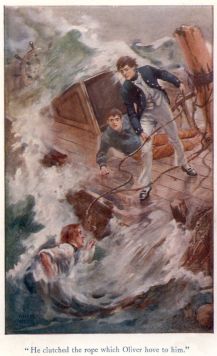
“Go off again I must,” he said; “and I want you, my lads, to promise me, should I perish, that you will use every exertion to save the people on the wreck. Fletcher, you know our object in coming on the coast. You must go to the authorities and explain that we had no hostile intentions—that our wish was to land the Frenchmen whose lives we had saved; and if you explain this, I hope that you will all be well treated.”
Even Tom was struck by his officer’s courage and thoughtfulness; and he and his messmate promised to obey his orders.
Rayner, having now committed himself to the care of Heaven, prepared to swim off to the wreck. He knew that Oliver would see him coming, and would be ready to help him get on board. Waiting until a sea had broken on the beach, he followed it out, and darting through the next which rolled forward, he was soon a long way from the shore. He found he could swim much better than before, now that he had no rope to carry. Boldly he struck forward. Happily he did not recollect that those seas swarmed with sharks. On and on he went. Now and again, as a sea rushed over the reef, he was thrown back, but exerting all his strength, he struggled forward. He was nearing the wreck, and could see that Oliver, who was eagerly watching him, had got hold of a short length of rope, with which he stood ready to heave when he should be near enough. But he felt his own strength failing. It seemed almost beyond his power to reach the wreck. Still, it was not in his nature to give in, and making a desperate effort, striking out through the surging waters, he clutched the rope which Oliver hove-to him, and the next instant was clambering on board. Throwing himself down on the deck, he endeavoured to regain his strength, Oliver grasping him tightly with one hand, while he held to the stanchion with the other.
“I knew you would not desert us, Rayner,” he said. “But now you have come, how are we to get this poor fellow to the shore? I could not leave him, or I would not have allowed you to risk your life by returning on board. We must try and knock a raft together sufficient to carry Peek, and you and I will swim alongside it, if we cannot make it large enough to hold us all three. There’s no time to be lost, though.”
Providentially the wind had by this time decreased, and the tide having fallen, the seas struck with less fury against the wreck, and enabled the two midshipmen to work far more effectually than they could otherwise have done.
Jack begged that he might try and help them, but they insisted on his remaining where he was, lest a sea should carry him off, and he might not have the strength to regain the wreck.
Fortunately the two axes had been preserved, and going below, they found several lengths of rope, though not of sufficient strength to form a safe communication with the shore. They would serve, however, for lashing the raft together.
They quickly cutaway some of the bulkheads. They also discovered below several spars and a grating. By lashing these together they in a short time formed a raft of sufficient size to carry all three. They next made a couple of paddles with which to guide the raft. They were very rough, but they would serve their purpose. It was almost dark by the time the raft was finished.
“I say, I feel desperately hungry, and I daresay so do you, Rayner, after all you have gone through,” said Oliver. “I propose that we should have some of the contents of the basket we packed. I left it in the steward’s pantry on the weather side.”
“A very good idea,” answered Rayner. “Pray get it up. Some food will do Peek good, and enable us all to exert ourselves. I’ll finish this lashing in the meantime.”
They were not long in discussing some of the sausages and bread which Oliver produced.
“I feel much more hearty, sir,” said Jack, when he had swallowed the food. “I don’t fancy there’s so much the matter with me after all, only my leg and back do feel somewhat curious.”
“Come,” said Rayner, “we must make the attempt, for we cannot tell what sort of weather we shall have during the night.”
With forethought, they had fixed some lashings to the raft with which to secure both Jack and themselves. It floated with sufficient quietness to enable them to place Jack upon it.
“We must not forget the food, though,” said Oliver.
“Do you, Peek, hold the basket, and do not let it go if you can help it.”
They took their seats, and lashing themselves to the raft, cast off the rope which held it to the wreck, and began paddling away with might and main. The seas rolled in with much less force than before, though there was still considerable risk of the raft capsizing.
While under the lee of the wreck they proceeded smoothly enough, but the seas which passed her ahead and astern meeting, several times washed over them. As they approached the shores they could see through the gloom three figures standing ready to receive them.
“I am glad those fellows have not deserted us, for after the way they before behaved I did not feel quite sure about the matter,” said Rayner.
While he was speaking, a sea higher than the rest came rolling along in, and lifting the raft on its summit, went hissing and roaring forward.
“Be ready to cast off the lashings, and to spring clear of the raft, or it may be thrown over upon us,” cried Rayner. He gave the warning not a moment too soon, for the sea, carrying on the raft, almost immediately dashed it on the beach. Springing up and seizing Jack Peek by the arm, he leapt clear of it. They would both have fallen, however, had not Tom and Brown dashed into the water and assisted them, while Le Duc rendered the same assistance on the other side to Oliver.
Before the raft could be secured the reflux carried it away, together with the basket of provisions, and it soon disappeared in the darkness. “What shall we do next?” asked Oliver. “We cannot stop on the beach all night.”
Wet to the skin as they were, although the wind was not cold, it blew through their thin clothing, and made them feel very chilly.
“We must look out for food and shelter,” observed Rayner. “Perhaps we shall fall in with some of the huts of the black people where we can obtain both, though the country did not look very inviting when there was light enough to see it. I, however, don’t like to leave the body of that poor fellow on the beach.”
“Fletcher and I will try and bury him, sir,” said Jack.
“I don’t see much use in doing that,” growled Tom. “He can’t feel the cold. It will keep us here all the night, seeing we have no spades, nor anything else to dig a grave.”
“We might do it if we could find some boards,” said Jack. “How would you like to be left on shore just like a dead dog?”
His good intentions, however, were frustrated, as no pieces of board could be found, and they were compelled at length to be satisfied with placing the body on a dry bank out of the reach of the water. This done, they commenced their march in search of some human habitations, Tom and Brown supporting poor Jack, who was unable to walk without help, between them.