Chapter X · SUPERNORMAL APPEARANCES (continued 2)
Daniel B. Vermilye translation
I ought to state at the outset that, as far as Hélène’s mediumistic phenomena are concerned, their careful analysis has not revealed to me in them any evident vestige of the other world, not even of traces of a telepathic transmission on the part of the living. I have only succeeded in perceiving in them very beautiful and instructive examples of the well-known tendency of the subliminal imagination to reconstruct the deceased and to feign their presence, especially when the favorable suggestions of the surrounding environment incites them to do so. Not being infallible, and bearing in mind Hamlet’s principle, I will guard myself well from affirming that these subliminal imitations and simulacra are absolutely free from any spirit collaboration; I content myself with repeating that I have not discovered any, and that it seems to me in the highest degree improbable, and with leaving it to others to demonstrate its reality, if they think they are able to do so. Some examples taken from the principal incarnations of Mlle. Smith will enable me to show after a more concrete fashion my manner of regarding them.
1. Case of Mlle. Vignier.—This case has no evidential value whatever, since (as has been seen, p. 411), there were formerly relations between the Vignier family and Mme. Smith which suffice to explain the veridical knowledge manifested by Hélène in this incarnation.
I give an abridged recital of it, nevertheless, for the sake of certain points of psychological interest. None of the spectators had any suspicion of these relations at the time of this scene, which was absolutely enigmatical to all of them.
In a seance at my house (on March 3, 1895, after a Hindoo vision, described p. 280), Mlle. Smith saw an unknown lady appear, of whom she gave the following description: “A nose bent and hooked like the beak of an eagle; small gray eyes, very close together; a mouth with three teeth only; a wicked smile, mocking expression; simple dress; a collar not of the fashion of to-day; she draws near to this portrait,[30] and gazes at it not ill-naturedly.”
The name of this person is asked, and the table (Leopold) commences to spell: “Mademoiselle”—but refuses to go further, while Hélène sees the apparition laughing, “with a sly air”; as the name is insisted on, the table dictates: “That does not concern you,” then she begins to jump and skip as though glad of an opportunity to mock us.
Presently Hélène falls asleep and enters into somnambulism; she leaves the table and moves towards the portrait in question, before which she remains fixed, completely incarnating the unknown lady of her vision. I take down the portrait and place it in its frame upon an easy-chair; immediately she kneels before it and contemplates it with affection; then, taking the frame in her right hand, while the left, very much agitated, plays with the cord, she ends, after many vain attempts, by saying with a great stammering, “J—j—je l’aimais b—b—beaucoup: je n’aime pas l’autre—j—j—je ne l’ai jamais aimée l’autre—j’amais bien mon neveu—adieu!—je le vois.” “I liked it very much: I do not like the other one: I never liked the other one. I was very fond of my nephew. Adieu! I see him.”
It was impossible to obtain any explanation of this incomprehensible scene, until, having slipped a pencil and a writing-tablet into Hélène’s hand, she scribbled feverishly, in a hand not her own, these two words “Mademoiselle Vignier”; then she fell into a cataleptic phase, from which she awakened without memory at the end of half an hour.
This name of Vignier evoked in me far-off memories and vaguely recalled to my mind the fact that Professor Dandiran (who had married, as we have seen, my mother’s sister) had an ancestress of that name; was it she who returned to express to me by means of Mlle. Smith her affection for my mother, whose portrait she had so attentively regarded, and her regrets, perhaps, that her nephew had not been preferred to my aunt?
On the other hand, M. Cuendet recollected a Mlle. Vignier who had been a friend of his family, but who did not correspond at all with the description of Hélène’s visions; he promised to obtain information, and, in fact, wrote me on the following day: “Dear Sir,—Here is some information on the subject of our seance of yesterday. This morning I asked my mother: ‘Did you ever know another Mlle. Vignier than the one who was your friend?’ After an instant of reflection: ‘Yes,’ replied she; ‘I did know another. She was M. Dandiran’s aunt, of Lausanne, his mother’s sister. She stammered, and was not always very good-natured; she had three large teeth which projected, and a hooked nose.’ It is useless to state to you that this was the first time I had heard her spoken of.”
This information, coinciding with my remembrances and Hélène’s vision, was later confirmed by M. Dandiran, who gave me the following information: “Your aunt, Mlle. Vignier, who died about thirty-five or forty years ago, loved her nephew very much; but she was made very angry by his marriage, and the sentence uttered before my mother’s portrait could not have referred to a difference of sentiment in regard to the two sisters, for whom she always had an equal affection. This sentence, on the contrary, is wonderfully well explained by the following facts: My mother and her sister having become betrothed at the same time, oil-paintings of both, of natural size, were made by the same painter. These portraits were not of equal merit, and Mlle. Vignier, who was herself something of an artist, always considered that of my mother excellent, while the other, that of my aunt, she did not like at all. Mlle. Vignier was very lively, and M. Dandiran finds that the epithet ‘sly’ and the table dictating ‘That does not concern you,’ very well express her character; she was, however, not at all malicious or mocking at heart, but it is true that persons who knew her slightly could easily have gained that impression of her. She had three or four prominent teeth and stammered badly. In her photograph she wears a white collar, has a nose long and arched, but the eyes are rather large and wide apart. She always wore gold eye-glasses, of which the medium did not speak.”
If the reader has had patience to read these details, he will have remarked that the distinctive traits of Mlle. Vignier in the vision and her incarnation by Hélène (the stammering, the teeth, the shape of the nose, the ill-natured air) coincide with those spontaneously indicated by M. Cuendet, who had known her slightly; and that while M. Dandiran, better posted as to his aunt’s character, finds the note of maliciousness or want of good-nature false, he acknowledges that people outside of her family could have been deceived concerning it. That is to say, has not the imagination of Mlle. Smith produced the exterior memory, the description according to public notoriety, as it were, which Mlle. Vignier left behind her? And if it be recalled that at the period at which the two fiancées were painted, Mme. Smith was in communication with my maternal grandparents through the only sister of Mlle. Vignier, there would be a probability amounting almost to a certainty that these are contemporary remembrances, narrated some time or other to Hélène by her mother, and which furnished the material for this somnambulic personification.
In this example, to which I might add several analogous ones, the apparent spirit control is reduced to latent memories of recitals formerly heard by Hélène.
In other cases, in which, for lack of information, it has hitherto been impossible to discover this wholly natural filiation of facts, simple analysis of the circumstances and of the content of the communications indicates that, in all probability, they proceed from reminiscences and impressions appertaining to living individuals much rather than from disincarnates. In other words, these messages and personifications too evidently reflect the point of view of the medium or other living persons for it to be permissible to regard them as due to the intervention of deceased persons, whose attitude towards them would, in all probability, be wholly different.
2. Case of Jean the Quarryman.—We have here to deal with a very curious spirit message concerning Mme. Mirbel, in which I cannot fail to see actual memories of the latter—transmitted I know not how (but not necessarily in a supernormal manner) to Mlle. Smith—rather than an authentic communication from a pretended disincarnate.
In a seance at which Mme. Mirbel was not present, Hélène had the hallucination of a very strong odor of sulphur; then the vision of a quarryman from the foot of Salève, in which she perceived and described in detail an unknown man, who, by the dictations of the table, was declared to be Jean the Quarryman, and charged the sitters with an affectionate message for Mme. Mirbel. The latter, interrogated on the following day, recognized in the very circumstantial description of this man, and under all the features of Hélène’s vision, perfectly correct facts connected with her childhood, and which had passed away from the habitual circle of her ideas for more than twenty years. It concerned a workman employed in her father’s quarries, and who, when she was a little girl, had always evinced a special affection for her.
Let us suppose—in the absence of all proof that Mlle. Smith had ever heard these remembrances of Mme. Mirbel’s childhood mentioned—that recourse must be had to the supernormal in order to explain the case. It still would not amount to an intervention of the deceased quarryman; and M. Lemaître was perfectly right, in my opinion, in clinging to telepathy and in hazarding the idea of an etheric influence, to which Hélène was subjected by Mme. Mirbel, who at the hour of this seance happened to be half a kilometre distant from the place of the seance. Without going out of the domain of telepathy, I still would prefer the hypothesis of a previous transmission in the course of one of the seances at which Mme. Mirbel was present to that of telepathy at a great distance at the time of the seance. It is, in fact, not contrary to that which is believed to be known of mental suggestion, to admit that Hélène’s subliminal, in the state of Esenale, for example, could in some way draw from Mme. Mirbel’s subliminal the latent memories which there lay buried for some time before being ready to reappear at a seance at which she had some reason to think Mme. Mirbel would again be present.
Whatever the mode of its transmission may have been, the content of this vision seems to me to indicate clearly that it has its origin in the personal memories of Mme. Mirbel rather than in the posthumous memory of Jean the Quarryman. All the presumptions in this case are, to my mind, in favor of a memory of Mme. Mirbel, and not of a veritable communication from the other world. The personal aspect of the messages supposed to be dictated by the quarryman do not constitute an obstacle to my interpretation or a guarantee of spiritistic authenticity, this aspect being the form that the automatisms habitually assume among mediums.
3. Case of the Syndic Chaumontet and of the Curé Burnier.—The following case is the last. It is a very recent one, in which the spiritistic and the cryptomnesiac hypotheses exist face to face, apropos of signatures written by Mlle. Smith in somnambulism which do not lack similarity to the authentic signatures of the deceased persons to whom they are supposed to belong.
In a seance at my house (February 12, 1899), Mlle. Smith has a vision of a village on a height covered with vines; by a rocky road, she sees descending from it a little old man, who has the air of a quasi gentleman; he wears shoes with buckles, a large felt hat, the collar of his shirt is unstarched, and has points reaching up to his cheeks, etc. A peasant in a blouse, whom he meets, makes reverences to him, as to an important personage; they speak a patois which Hélène does not understand She has the impression of being familiar with the village, but vainly searches her memory to discover where she has seen it. Presently the landscape fades away, and the little old man, now clothed in white and in a luminous space (i. e., in his actual reality of a disincarnate), appears to draw near to her. At this moment, as she leans her right arm upon the table, Leopold dictates by the index-finger: “Kiss her arm.” I execute the order; Hélène’s arm at first resists strenuously, then yields suddenly. She seizes a pencil, and in the midst of the customary struggle relative to the manner of holding it (see p. 100), “You are holding my hand too tightly,” says she to the imaginary little old man, who, according to Leopold, wishes to make use of it in order to write. “You hurt me very badly; do not hold it so firmly.... What difference does it make whether it is a pencil or a pen?” At these words she throws away the pencil and takes up a pen, and, holding it between the thumb and index-finger, slowly traces in an unknown hand: “Chaumontet, syndic” (see Fig. 44).
Then the vision of the village returns; at our desire to know the name of it she ultimately perceives a sign-post on which she spells “Chessenaz,” a name which is unknown to us. Then, having by my advice asked the little old man, whom she still sees, at what period he was syndic, she hears him answer, “1839.”
It is impossible to learn more; the vision vanishes and gives way to a total incarnation of Leopold, who, in his deep Italian voice, speaks to us at length of various matters. I take advantage of it in order to question him upon the incident of the unknown village and syndic; his replies, interrupted by long digressions, may be summed up about as follows: “I am searching.... I traverse in thought the ascent of this great mountain pierced through at its foot by something, the name of which I do not know; I see the name of Chessenaz, a village on a height, and a road which ascends to it. Search in this village; you will certainly find the name (Chaumontet); seek to examine his signature; this proof you will find there; you will find that the handwriting was that of this man.”
To my question whether he sees this in Hélène’s memories and whether she has ever been at Chessenaz, he replies in the negative as to the first point and evasively as to the second: “Ask her; she has a good memory for everything. I have not followed her in all her wanderings.”
Awakened, Hélène could not furnish us any information. But the following day I found on the map a little village called Chessenaz, in the Department of Haute-Savoie, twenty-six kilometres, in a straight line, from Geneva, and not far from the Crédo. As the Chaumontets are not rare in Savoy, there was nothing unlikely in the fact of a person of that name having been syndic there in 1839.
Two weeks later I made a visit to Mme. and Mlle. Smith—there was no seance held—when Hélène suddenly assumed the voice and accent of Leopold, without being aware of the change, and believing me to be joking when I sought to cause her to notice it. Presently the hemisomnambulism becomes accentuated; Hélène sees the vision of the other day, the village and then the little old man (the syndic) reappear, but the latter is accompanied this time by a curé with whom he seemed on good terms and whom he called (which she repeats to me all the while with Leopold’s Italian accent), “My dear friend Burnier” As I ask whether this curé could not write his name with Hélène’s hand, Leopold promised me by a digital dictation that I should have that satisfaction at the next seance; then he begins to talk to me of something else by Hélène’s mouth, she being now entirely entranced.
At the following seance at my house (the 19th of March), I remind Leopold of his promise. He answers at first by the finger: “Do you very much desire that signature?” and it is only upon my insisting that he consents. Hélène then is not long in again seeing the village and the curé, who after divers incidents takes hold of her hand as the syndic had done, and traces very slowly with the pen these words, “Burnier greets you” (Fig. 44); then she passes into other somnambulisms. The moment had arrived to clear up the matter. I wrote at hazard to the mayor’s office at Chessenaz. The mayor, M. Saussier, had the kindness to answer without delay: “During the years 1838-39,” stated he to me, “the syndic of Chessenaz was a Chaumontet, Jean, whose signature I find attached to divers documents of that period. We also had as curé M. Burnier, André, from November, 1824, up to February, 1841; during this period all the certificates of births, marriages, and deaths bear his signature.... But I have discovered in our archives a document bearing both signatures, that of the syndic Chaumontet and that of the curé Burnier. It is an order for the payment of money. I take pleasure in transmitting it to you.” I have caused to be reproduced in the middle of Fig. 44 the fragment of this original document (dated July 29, 1838), bearing the names of these two personages; the reader can thus judge for himself in regard to the quite remarkable similarity which there exists between these authentic signatures and those automatically traced by the hand of Mlle. Smith.
My first idea was, as may be supposed, that Mlle. Smith must some time or other have seen some certificates or documents signed by the syndic or by the curé of Chessenaz, and that it was these forgotten visual flashes, reappearing in somnambulism, which had served her as inner models when her entranced hand retraced these signatures. One may likewise imagine how angry such a supposition would make Hélène, who has no recollection whatever of having ever heard the name of Chessenaz nor of any of its inhabitants, past or present. I only half regret my imprudent supposition, since it has availed to furnish us a new and more explicit manifestation of the curé, who, again taking hold of Mlle. Smith’s arm at a later seance (May 21st, at M. Lemaître’s) comes to certify to us as to his identity by the attestation, in due and proper form, of Fig. 43. As is there seen, he makes it twice; being deceived as to the signature, he incontinently, with disgust, crosses out that which he had so carefully written, and recommences on another sheet; this second draft, in which he has omitted the word “soussigné” (“undersigned”) of the first, took him seven minutes to trace, but leaves nothing to be desired as to precision and legibility. This painstaking calligraphy is very like that of a country curé of sixty years ago, and in default of another specimen for comparison, it presents an undeniable analogy of hand with the authentic receipt of the order for payment of money of Fig. 44.
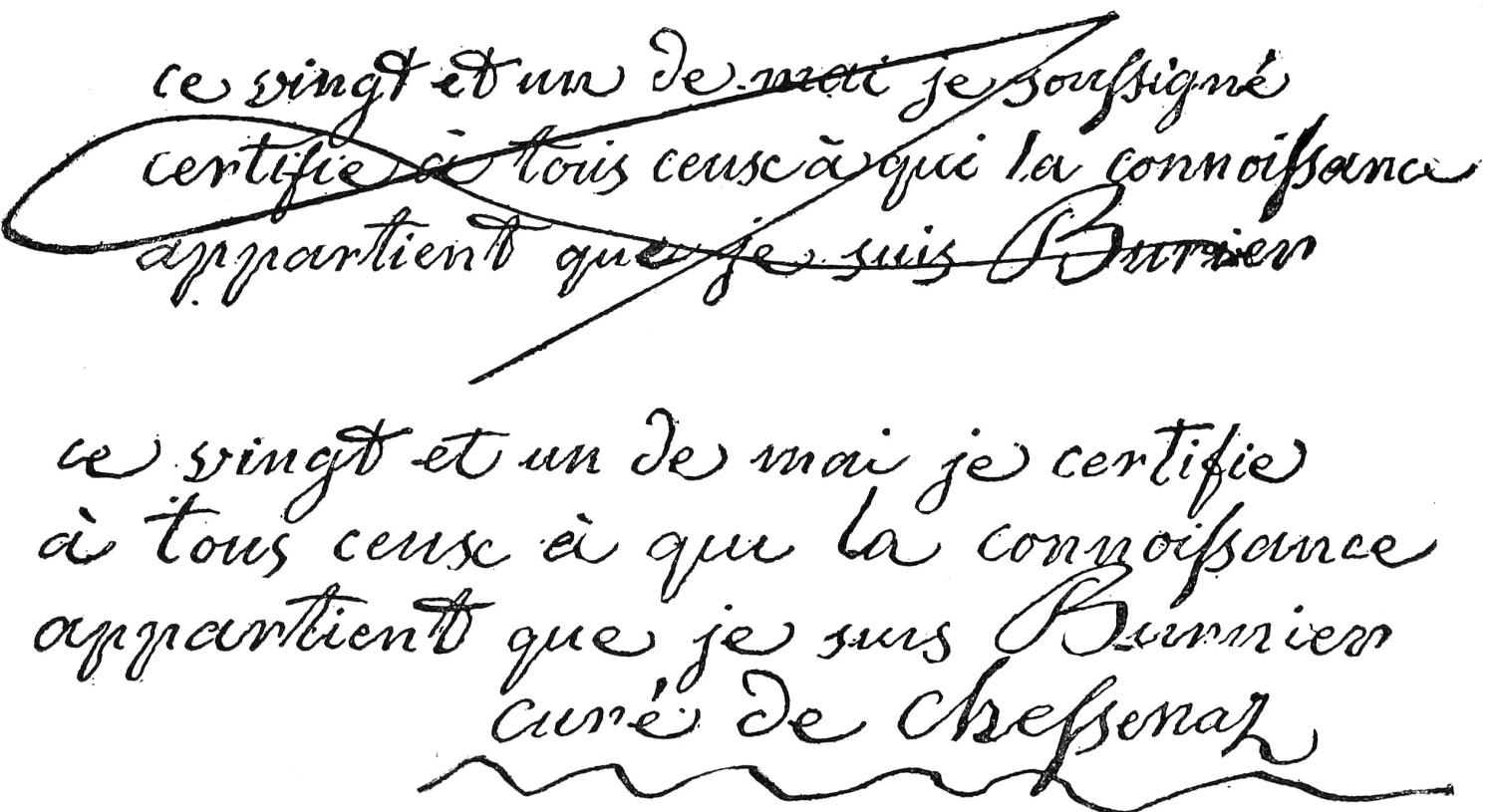
Fig. 43. Certificates written (May 21, 1899) by Mlle. Smith while in a trance. The one above was feverishly crossed out in finishing the faulty signature. The one below was afterwards written in seven minutes. Natural size. [From the collection of M. Lemaître.]
Neither Mlle. Smith nor her mother had the least notion in regard to the curé or the syndic of Chessenaz. They nevertheless informed me that their family formerly had some relatives and connections in that part of Savoy, and that they are still in communication with a cousin who lives at Frangy, an important town nearest the little village of Chessenaz. Hélène herself made only a short excursion in that region, some dozen years ago; and if, in following the road from Seyssel to Frangy, she traversed some parts of the country corresponding well to certain details of her vision of the 12th of February (which she had the feeling of recognizing, as we have seen, p. 432), she has not, on the other hand, any idea of having been at Chessenaz itself, nor of having heard it mentioned. “Moreover,” says she, “for those who can suppose that I could have been at Chessenaz without remembering it, I would affirm that even had I gone there I would not have been apt to consult the archives in order to learn that a syndic Chaumontet and a curé Burnier had existed there at a period more or less remote. I have a good memory, and I positively affirm that no one of the persons around me during those few days while I was away from my family ever showed me any certificate, paper—anything, in a word—which could have stored away in my brain any such memory. My mother, at the age of fourteen or fifteen, made a trip into Savoy, but nothing in her remembrances recalls her ever having heard these two names uttered.”
The facts are now presented, and I leave to the reader the privilege of drawing such conclusion from them as shall please him.
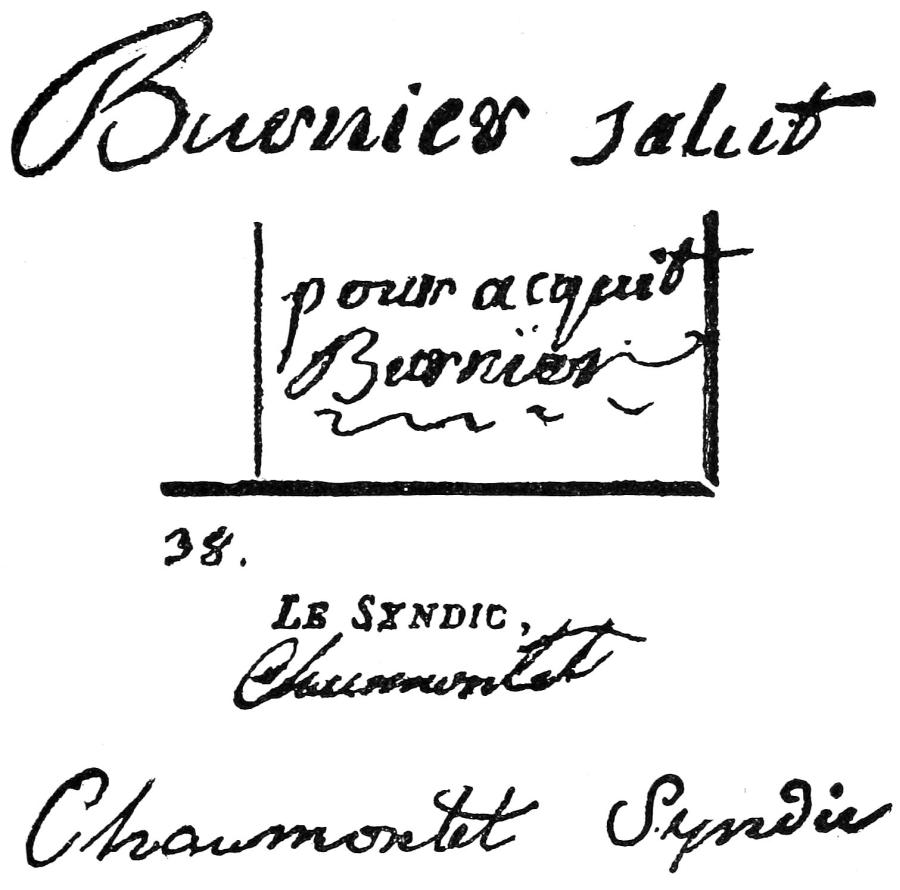
Fig. 44. Comparison of the signatures of the syndic Chaumontet and of the curate Burnier, with their pretended signatures as disincarnates given by Mlle. Smith in somnambulism. In the middle of the figure, reproduction of a fragment of an order for payment of money of 1838. Above and below, the signatures furnished by the hand of Hélène. Natural size.
This case seemed to me worthy to crown my rapid examination of the supernormal appearances which embellish the mediumship of Mlle. Smith, because it sums up and puts excellently in relief the irreconcilable and hostile respective positions of the spiritistic circles and mediums on the one side, perfectly sincere but too easily satisfied—and investigators somewhat psychological on the other, always pursued by the sacrosanct terror of taking dross for gold. To the first class, the least curious phenomenon—an unexpected vision of the past, some dictation of the table or the finger, an access of somnambulism, a resemblance of handwriting—suffices to give the sensation of contact with the unknown and to prove the actual presence of the disincarnate world. They never ask themselves what proportion there could well be between these premises, however striking they may be, and that formidable conclusion. Why and how, for example, should the dead, returning at the end of a half-century to sign by the hand of another person in flesh and blood, have the same handwriting as when alive?
The same people who find this altogether natural, although they have never seen any absolutely certain cases of it, fall from the clouds when the possibility of latent memories is invoked before them, of which the present life furnishes them, moreover, daily examples—which they have not, it is true, ever taken the trouble to observe.
The psychologists, on the contrary, have the evil one in them in going to look behind the scenes of the memory and the imagination, and when the obscurity prevents them from seeing anything, they have the folly to imagine that they will end by finding that which they are seeking—if only a light could be had.
Between these two classes of temperaments so unlike, it will, I fear, be very difficult ever to arrive at any satisfactory and lasting understanding.