Front matter (continued 2)
Reading edition
"Righto, bloke," he said. "Freeze on to Douglas there and cut us some firewood."
I cut him a good pile, and the decent pot not only gave me a good square feed, but enough to carry along for another as well. Armed with this I marched along to the Barron River, where I found the river was up owing to recent rain, and I nearly got drowned crossing the atrocious ford of slippery stones which the "powers that be" consider safe, wading waist deep in the rushing stream.
I finally reached the barn at 7 p.m., where I found Len and Terry just finishing tea. Their welcome made the welkin ring. I don't quite know what the welkin is, but anyhow it rang. And wasn't I just glad to get back to where I was known and there were friendly faces to greet me! We talked sixteen to the dozen, and at ten o'clock, with hearty good-nights, we turned in, and again I slept the heavy sleep of the tired under the hospitable roof of Braun's old barn.
CHAPTER XII.
Scrub Life.
Next day I was up with the sun to see what my burn was like, Terry O'Gorman having let my place go when he burnt a fortnight before. I was assured that I had a good burn, but when I saw the black waste, gridironed with logs and strewn with big stumps, I was a bit dismayed. What on earth could I do with it to make a living? It looked pretty hopeless.
I tried to get a fire going round some of the big stumps, but, of course, they wouldn't burn, being too green. When I looked at the place, and thought how many years it would be before it was clear of refuse, it made me feel despairing. Of course, I know now that I had a really good burn, and was lucky, and that in five years I would be able to plough patches, with no other effort than dropping a match here and there, when the logs had rotted a bit; but experience has to be learned. I tried digging a patch, but that was hopeless, the ground being a network of roots, almost impossible to dig among; so I gave that up too. I could have planted corn easy enough; but then, even if the roads had been decent, the price of haulage to the station would have been more than the crop would fetch; so there was nothing to do but sow grass in the clearing. Plenty of rain lately had brought Braun's paddock into seed, and I set to work to reap it. A week's work gave me more than enough to sow my burn.
Of course, I made a botch of the sowing at first, putting on about five times as much as was necessary, but soon got the hang of it, and a week's work finished it, a faint green sheen down on the creek showing that the seed was good and fertile. Then I got to work on a creek flat where the silt was piled high over the maddening roots, and got a number of vegetable seeds put in. All sorts of garden truck here grow prolifically, almost without cultivation. Terry and Len finished sowing the former's place same time as I did, and next day proposed a trip out to the Range by way of a holiday. As I hadn't been there I was eager to go.
The track lay through dense scrub all the way, being an old road well made forty years ago, and disused for a decade. It was used hauling cedar out to the Range, with a view to shooting it down the mountain side to the Mulgrave River, down which it would be rafted to the sea. As they salved only about one log in twenty the scheme didn't pay, so was abandoned, and the road, with its bridges and box-cuttings, went to ruin. We tramped along and, in an hour or so, saw, as through an open door at the end of the avenue of scrub, the sunlit grass of the open forest at the range head, and a glimpse of a gum tree or two. Presently we were waist deep in the lush grass, clambering over the mouldering cedar logs lying there by the score, with the scent of the gums strong in our nostrils, and the shrilling of the cicadas nearly deafening us. A few minutes more and we were standing among gigantic granite boulders, looking down at such a glorious view as I had never seen before.
The Trade wind was snoring strong on this exposed position, and there was a champagne-like exhilaration about the slightly rarified, gum-scented air which set us laughing and romping like school-kids. The Range went almost sheer down 2000 feet or more to the Mulgrave Valley at our feet. On the other side, facing us, stretched a heavily timbered range of mountains. At each end to right and left was a glimpse of blue sea, and in the background to the extreme right the blue mass of Bartle Frere, Queensland's highest mountain. Winding along the valley floor ran the narrow violet ribbon of river, flecked with white here and there, where were rapids. I found it hard to realise that those low bushes were really tall trees, and that that narrow blue streak of water was half a mile wide in places. I think one could notice a man moving on the white sandbanks, the atmosphere is so clear. Away to the left, where the valley opened out, could be seen the chess-board of cultivated canefields, with Gordon Vale and its mill embosomed among them. Further still, a bit of Cairns, the Inlet and the blue sea, with a tiny speck or two on it, which close investigation showed to be steamers entering or leaving the port.
The Range, steep as it is, is clothed from foot to summit with grass and timber. The ground is gravelly; the formation free granitic. There is plenty of water there, as elsewhere on the tableland. We shot a couple of scrub turkeys (megapodii) on our way home. Good enough eating but gamey, and one soon tires of them. They are about as big as a good-sized rooster. I'd never go after them with a shot-gun unless I was really hungry. When started off the ground the poor wretches just make for the handiest branch, and squat there. A shot-gun is plain murder, while a pea rifle will give them a sporting chance, for if you miss they are off a hundred yards or so to another branch, and one must want a change of diet pretty badly before one will force a way through prickly lawyer-vines after him.
Just before we turned into Braun's a huge cassowary, with three chicks, stalked on to the track ahead. We stopped dead, and the beautiful bird then hesitatingly came towards us with her slow, dainty step, and we had a real good "dekko," as she turned her handsome blue and red head this way and that, eyeing us with eager curiosity. Terry then said "Boo!" and she was off like a shot. Not being "sports," not one of us had even dreamed of raising the gun at her.
Christmas Day was at hand—beautifully fine. Last one I had spent making up for Valparaiso before a howling Southerly; a tremendous sea was on, and it was freezing cold.
Len took me in to his parents' place to spend the day, and I was introduced to Dad, Mum, and a host of strapping brothers and sisters. Dad was a fine-looking, middle-aged man, tall and spare, with short, square-cut, sandy beard, thoughtful grey eyes, good-humoured smile, and spoke concisely and deliberately, laying emphasis on every other word, thus:—"Well, Mr. Senex, I am delighted to make your acquaintance." He was a more or less self-educated, well read man, a most interesting companion and a keen debater, though rather prone to excitement in argument. Lastly, he was the most confirmed optimist I have ever met. Mum was a handsome Junoesque blonde, sharp of eye and tongue, distinctly the boss, and inclined to make the most of it. Rather cold and hard perhaps, but kind-hearted enough. They were very good to me in my early struggling days, and I was glad to accept their ungrudging hospitality.
Christmas Day passed with the usual accompaniment of pudding and other fairly solid comestibles, and I stopped there overnight, as a picnic had been arranged for next day to go and see the famous Lake Barrine. The day was bright and clear, and about twenty of us set out through the dense scrub along a fairly good road. After an hour or two's march we turned into a narrow pad, and presently saw a blue gleam through the trees. It was a steep descent, and the first effect of the sight of the lake was, queerly enough, that of looking right up at it. However, we were soon at the water's edge, and I got my first view of the deep cobalt blue mere, lying calm and peaceful, embosomed in the dense scrub.
It is about a square mile in extent, very pretty, dangerous to bathe in if one is a poor swimmer, as the banks are steep and very deep (the water being six feet deep only eight feet from the bank). It is locally considered unfathomable, which probably means that a forty-fathom line would bottom it. Still one could get comfortably drowned there. I have heard enthusiasts compare these little lakes, Eacham, Barrine and Euramoo, to the Irish Killarney, which is a wild absurdity, though the lakes are pretty enough to be worth going to see. The three of them, about three miles apart, are perched on the very lip of the Range, 2500 feet above sea-level, and are the craters of extinct volcanoes. Barrine is blue, cheerful and bright; Eacham is green, cold and depressing, and one has a feeling as of some dreadful Thing just below the surface, waiting for one's foot to slip. Euramoo I haven't seen, though only a mile or two away, since the scrub is impenetrable. The blacks think these lakes "debil-debil," and won't go near them after sundown.
Our party boiled the billy, explored round a bit, played the usual picnic games, and had a dip in the enticingly cool water. I, who can't swim, in spite of my thirteen years at sea, cautiously kept within reach of the overhanging shrubs growing close to the water. Then, as the cows must be milked though the heavens fall, and those who had some to put through were beginning to get restive, we packed up and wended our way home again, I going straight out to the barn to be in trim for work next day.
The next three weeks I worked at clearing a site for a house, planting panicum grass on the creek banks, and attending to the vegetables, which, with a few good rainy days, were looking well. The rainy season burst on us early in January, and for nearly a fortnight it poured in a steady, ceaseless torrent, drumming on the iron roof of the barn until one had almost to shout to be heard. By mid-January my grass was a foot high, pumpkins running all over the place, and I had about three thousand cabbages coming on well, which I thought to make money out of by and bye.
Terry and Len were timber-cutting on the former's place, in spite of the wet. When it got really too bad, we stayed in the barn, played crib, mended clothes, got axes and brush-hooks to a razor-like sharpness, and so on. One thing about the wet weather was that it was warm, and it didn't matter how soaked you got, so long as you wore the universal short-sleeved grey flannel, and changed at once on coming home. You could work then in the wet all day without ill-effect.
CHAPTER XIII.
The Cyclone.
The cyclone was heralded by a week of stifling hot weather. As a general rule it isn't hot up here, the thermometer rarely climbing to 90 deg., and then only on an odd day in November; but that week was awful. From being unable to work, it got to be an effort to move. The nights too were hot, a most unusual circumstance. Every day the sky would bank up with heavy, hard-edged clouds, leaving just an inverted saucer of smoky blue at the zenith, through which the sun appeared at noon, strong enough to throw a shadow, but not bright enough to make your eyes water looking at him. The birds, after their morning carol, were silent, and by noon each day the stillness was weird. Nature seemed to be waiting for something; there was not even a breath of wind to stir the lifeless trees. We got to have a feeling that we ought to talk in whispers, a creepy sensation—almost of fear. Occasionally there was a faint far-off air-tremor, rather than sound, of thunder. On the fifth day Len, Terry and I were lying about the barn, too languid to move, when, about noon, there was a sudden change. It got quickly cold and the sky to the South-East banked up, tier upon tier, with blue-black clouds. The zenith was covered, and the clouds commenced rushing across it, rapidly whirling and dissolving as they went, in rather an awe-inspiring fashion.
"It's coming, blokes, whatever it is," said Terry quietly.
On the word, like a bucket suddenly tipped over us, a deafening roar of rain on the roof, ceasing in two minutes as suddenly as it came, and dying hissingly away up the paddock. Silence again. Then, in the distance, a sound like a slowly-expelled breath, only continuous, and rapidly getting louder as it drew nearer. A few minutes later, and with a rush and a roar, wind and rain were on us. There was not much force in the wind—just about half a gale—but it was its sudden shock that was rather startling. Wind about S.E., and a good deal of thunder and lightning, which gave us the idea at first that it was only a heavy thunderstorm. It kept the same force pretty well until 5 p.m., when it shifted to South, and commenced to show us what it really could do. Crash after crash from the scrub near-by showed how the wind was testing the trees.
Just at this time two swaggies, who had come up the Range, banged at the door. We let them in, soaked and shivering, nearly in a state of collapse with long exposure to the driving rain. We gave them hot tea and dry togs, and while they were getting warm again we, nearly naked (so as not to wet any clothes!), went outside and gathered a big pile of firewood, to keep a roaring blaze going all night.
By half-past six it was blowing a heavy gale, and the old barn was creaking and straining like a ship at sea. We put a big back log on the fire, piled her up to keep going all night, and were just going to turn in, when there was a hammering on the door, which we had well secured against its being blown in. We fell over each other scrambling to see who the devil it was, and discovered two neighbouring bachelor selectors, who had been camped in a tent pitched inside a rough shed half a mile away. A dead tree had come down fair across their camp with the two of them in it—a miracle of an escape. They just pulled themselves out of the wreckage, and, with their lives in their hands, crossed through the scrub in the dark to Braun's. They didn't seem to think anything of it—sort of "all in the day's work" idea. It was nine o'clock by the time they had finished tea, and the hurricane was going full bore.
The hoarse roar of the wind drowned every other sound. A huge dead elm came down just astern of the barn, missing the end by about four feet, and we never heard it; indeed, we never knew anything about it till morning. The rain was driving in fine spray, wetting everything, so we rigged the swaggies' "fly," and the seven of us crowded under it like sardines in a tin, managing to keep just about damp.
None of us slept though, being too much concerned about the possibility of the barn coming about our ears. However, it weathered the gale triumphantly. At midnight, in a furious squall, the wind veered to S.W., and the door got the full force of it. It gave, the top hinge went, and inside she came on top of us. Away went the tent, split in half, and in about two ups we and everything we possessed were soaked through. It took the lot of us about ten minutes to re-secure the door, and we spent the rest of the night huddled round the fire, the furious back draught blowing smoke and flame in all directions.
About 3.30 a.m. the wind shifted again to about W.N.W. and blew harder than ever. The barn swayed perceptibly, but the corner posts were three feet in the ground, and went solid up to the roof, and that saved us.
It was daylight now, and we could see the clearing. What a difference! It looked as if a titanic steam-roller had been all over it: weeds, dead trees, bushes, all levelled flat. We, who a few hours ago had to part the bushes to get in the door almost, now had a clear view of the whole clearing. It would have cost Braun pretty well £50 to do the work the wind did gratis for him that night in his clearing.
At about 7 a.m. there was a lull, and shortly after it became clear that the storm's back was broken, the unbroken grey pall of sky commencing to break up into clouds and scud. The wind slowly veered to N.N.W., lessening in force all the time, but kept at hard gale till after midnight, when it died down rapidly, and by 3 a.m. it was calm, sky clear, and stars shining brightly.
While the gale was on I slipped down to see the creek, and found the little brawling stream transformed into a raging torrent twenty feet deep. Even while I looked, the bank higher up gave way, and for a hundred feet or so slid roaring into the current.
After the weather cleared up I went across to my own clearing, to find numberless little water-courses all over the place, and the grass! well—you could fairly hear it growing. In a week (say, five weeks after sowing), it was good enough to have turned stock on to, had I possessed any.
I went in towards the line, thinking to get a job clearing wreckage somewhere, but there were too many willing volunteers already at it. Most of the roads were blocked by falling timber, and everybody had suffered more or less, either by loss of stock, or through having their buildings unroofed.
I took the opportunity, while in town, to interview the local storekeeper with a view to credit, which he willingly granted on explaining my position. The country storekeeper! Go where you will, one of the principal topics of conversation is sure to be the iniquities of the local storekeeper. But we couldn't do without him. By extending a liberal credit he enables one to stay on the farm until one's footing is secure, and if his prices are a bit stiff, it ought to be remembered how many bad debts he contracts, and what a risky thing it is to give credit to a comparatively unknown man. If it be true that the farmer is the country's backbone, it is equally true that the storekeeper is the one who stiffens that backbone till it can stay erect of itself, and often prevents it from breaking. I know. I'm one of the vertebræ, and I'd often have been dislocated but for old "Stores."
CHAPTER XIV.
Effecting Improvements.
After the satisfactory interview with the storekeeper I tramped out home with a light heart. I wouldn't starve for a month or two, anyhow, and now the first thing to be done was to erect a house. I had fourteen ten-foot sheets of iron, and though some of them were a bit battered owing to an irresponsible bloke thrashing out seed on them while I was away, still they were good enough for an eighteen-by-twelve humpy. The building was to be of rough-split bush timber. I chose red oak for the purpose, mainly because I didn't know of any of the other good splitters, like silky oak, young maple, or ash. With a crosscut I cut the tree up into three-foot lengths; then, with a maul, wedges and axe, split these up into a species of short weatherboards.
My two mates being now away on holiday, there was nobody to show me how to start right, so of course I met endless difficulties, which made the work back-breaking. An experienced "bushey" would have had all the required timber split in about four days. It took me exactly three weeks.
Then came the erection. Four corner posts, which I would have three feet in the ground, and going right up to the roof, for stability in case of cyclones, of the hardest timber I could find, which was also the heaviest, as I thought it would be the most likely to last in the ground. As a matter of fact, these rot quickest. The four posts weighed about five hundredweight each, and I had to "fleet jig" them with block and tackle over the log-strewn paddock up to the site, and then erect a derrick to get them into their places. It was interesting enough, but Lord! how slow.
Then wall plates and ground plates—the former one end at a time with the tackle; then lash that end while I tackled the other end up and nailed it. "Dinkum yakker" all right, and about three-parts of it not necessary, if I'd only known. I think "Senex's house" was the topic of amused conversation all over the district for months after.
The studs were saplings on which I left the bark, thus making a fine harbourage for all sorts of biting, stinging and stinking vermin. On to these went the slabs, weatherboard fashion. Then the roof, with a nail in every corrugation, in the concaves instead of the convexes, and the mansion wanted but a floor. I got a bloke to buy me some second-class boards from a mill on the line, and bring them out to me. The cartage came to ten shillings more than the price of the timber, but, as he had to wait nine months for me to pay him, he deserved it.
Next, I put in a fireplace with the roof of it at the wrong angle, so that the smoke came pouring into the main room all the time the fire was going. Finally, I set the guinea stamp of aristocracy on the mansion by inserting a cracked glass window. It was raining nearly all the time I was building. I had spilt a gallon billy of boiling water over my feet through the handle coming adrift, and, to add to the difficulties, I had to hump the floor boards about a mile through the mud, fallen timber preventing the cart getting right out. Anyhow, it was finished at last.
I felt so proud the first night I camped in it that I couldn't sleep, and got up several times to walk round and admire the shanty in the moonlight. On one of these peregrinations (I clad in an airy costume of a single shirt), I suddenly felt something cold and wriggley under my foot. I must have jumped about fifteen feet. Turning round, I saw a black snake squirming about. I must have stepped on his neck. Otherwise, I don't know how I escaped a bite. I got a stick and finished the little devil. Nobody seems to pay much attention to black snakes up here. They always whip out of the way, and don't attack unless actually interfered with, and they're easily killed with a light stick.
About this time I got a small brushing job from a mean person who gave me ten shillings an acre to cut four acres thickly grown with the accursed stinging tree. I found afterwards that thirty shillings an acre is little enough for tackling this dreadful stuff. However, I got it done, and was laid up for a week in consequence. No sleep through the pain, and blood coming from nose and ears while working in it. There must be a frightfully deadly poison in the plant. The bare inhalation of the smell of the fresh-cut stalks makes you vomit, and brings blood from the nose in a few minutes, while the least touch on any part by the bush causes agonising pain, which lasts for weeks sometimes. There is no palliative.
I then got a job from a neighbouring selector to brush twenty acres, so I shouldered "Matilda" and went to camp with him. It's the devil's own job "Matilda-ing" in the Rainy Season. The tracks are knee deep in mud, and the paddocks, what with logs and interlaced seed stems on the grass, are nearly impassable. I don't know of anything so tiring as trying to wade through a paspalum paddock in seed. I anticipated being a month or so with this chap, Barker. He was a bachelor, young, fair-haired, rather shifty blue-grey eyes, a quick and uncertain temper, and as sarcastic as the devil. Although twenty-four, he was practically illiterate, owing to having had to milk cows from about six years of age, there being therefore no time for schooling. As is always the case, this misfortune had bred in him a suspicion of anyone educated, and a disposition to try and take him down a peg, to show that he was as smart as the other, in spite of lack of education. This sort of thing is inevitable.
I must give him his due though—he had "made good." He cleared out from the cow-slavery when he was fifteen years old and started for himself; told a fib about his age, got a selection, and felled most of the scrub himself. When twenty-one he sold out for £800, and took a partly improved place further out, going in for fattening "beefers." A dry spell nearly ruined the game youngster, so, sickening of the South, he sold out, came up with a wad, got a block here, and started in to fall all the scrub as before. He had about a fifteen-acre paddock with a house on it when I made his acquaintance. His place is worth £1000 easily now.
His mate was an Irish-Tasmanian named Paddy (of course); middle-aged, tall, lank and dark, with a long melancholy face like a cow, and very weather-beaten. Quite uneducated, but an absolute glutton for work, and with a very decided weakness for beer—lots of it for choice. He was an artist with the axe, putting a scarf in a tree as neat as a saw cut. Good-tempered, he had a quiet humour that floored Snappy Barker every time, as thus:—
Barker: "Hey, Paddy! I was down at Blogg's yes'day, and they was runnin' yer down summat crool."
Paddy: "Was they? Well, why dinyer stop 'em? Yer could, easy."
Barker: "'Ow could I?"
Paddy: "Oh! Don't you start runnin' me down to 'em. Then they won't git startit."
The three of us were to tucker together, and as they had ordered a big stock, which had been left at a house three miles off, the first job we did was to hump the stuff out. It was raining hard—as it did almost every day of the six weeks I was with them. We had an old pack-horse. My road was bad enough, Lord knows; but Barker's was literally waist deep in mud in places, covered with a repulsive green slime and bubbling with foul-smelling gas when disturbed. There was a whole cask of salt beef among other things, and this was the first thing we tackled. We emptied the meat into corn sacks, and loaded the old horse and Paddy with that, while Barker and I slung the cask, with about five gallons of salt pickle in it, on a pole between us, and started out home. We struggled up the first slippery hill.
"Blow this," said Barker. "We'll lighten up."
We emptied out part of the pickle, and proceeded. After we had ploughed along a mile or so, I said "Blast the stuff!" so we emptied out some more. A little further, and we mutually damned it, and jettisoned the whole cargo, finding even the empty cask all too heavy on that dreadful road. It took us the next two days to get the balance of the stuff out. We got sick of unloading the old nag, hauling him out of the bog, and loading him up again.
It would have been an enlightening sight for the city "go-on-the-land- young-man" person to have seen us slowly crawling along between the gloomy walls of scrub, squash! squelch! splash! covered with mud and sweating with the heat, Paddy ahead with two bags of tinned stuff, Barker next with two fifties of flour slung by straps over his shoulders, I last with two dozen of jam in my shirt, and a seventy of sugar across my neck, with sacking round it to keep it a bit dry. By cripes! It made us appreciate Barker's dry snug little crib, really beautifully built of split-out stuff, roof and all. It was quite waterproof.
I would have quite enjoyed living there, if only it hadn't been for Barker's infernal tongue. He soon found I didn't take very much rousing up, so of course it was a great joke to "gittim wild." With this end in view, he assumed a particularly galling habit of patronisingly referring to me as "Me good mahn," or more often "Me good little mahn." I think he must have spent his hours devising ridiculous names, and springing them on us at night. Paddy suffered in silence under "Me little gohanna;" his dog, with a sort of Zulu touch, was dubbed "Little-snake-with-the-teeth-so-sharp-and-big;" while I was driven to a state bordering on homicidal mania by a week of "Me little axe-handle breaker," because I fractured the handle of the doddery firewood axe—already badly sprung and wobbling—which he had sworn should last the year out.
The more we expostulated, the worse he got. He had a pair of cats ("Curse-guts" and "Stinker"), of whom he was so fond that he took them to bed with him at night, and then blamed me for bringing fleas to the camp, after a night spent in scratching himself. With as much sense of music as a cow, he used to drone out all day the one song he knew in a dismal monotone. It was a doleful ditty; something about "Why did they sell Killarney?"
He was very superstitious, and I'm ashamed to say that I once or twice got my own back on him through this weakness—but only when very wild.
I made him lose a night's sleep once through suddenly jumping out of bunk, opening the door, slamming it to again, and then turning wild-eyed to Barker, whispering: "It's there again, Jack!" He was keen on his garden, and he and Paddy had about a dozen different kinds of vegetables growing, with bananas and pineapples to beat the band. When the latter were ripening we had to light big fires to keep the flying foxes off, and it gave one a creepy feeling to lie round one of the fires before turning in, swapping yarns, and watching the countless myriads of bat things stream steadily across the sky in an unbroken cloud by the hour together. (Note for orchardists: These pests don't alight anywhere near a decent blaze.)
I finished my contract with Barker by the end of May, and got enough out of it to renew my credit with the storekeeper, and pay the £3 inspection fee for survey of improvements, prior to borrowing from the Agricultural Bank, so that I could go on falling on my own place. I applied for £120, to fall sixty acres; the loan was granted. Payment by instalments as work proceeded, and terms twenty-one years at five per cent. interest. Getting my old friend Len Vincent to help me, I re-started on my own place early in June.
CHAPTER XV.
More Improvements—Bullockys.
The weather had fined up and remained so for months. Beautiful warm sun, tempered by the cool breeze by day, and cold, sometimes frosty, nights. It was ideal weather for work; and Len and I worked well, ate well, slept well, and for the first time I started to throw off the effects of all that worry and nerve-strain I had undergone at sea.
Those glorious days! We would be off just after daybreak, red-nosed and shivering, clad in thick garments and heavy coats, with perhaps a frost on the grass. Ten minutes with the axe and off came the coat. Another ten, and the extra pair of pants followed suit, and by half-past eight the benignant sunshine reduced one to pants and shirt. How you could work! and when lunch-time came, eat!! It was good to be alive, life was rosy, and every lungful of the glorious crisp bush-scented air put fresh manhood into us.
Then the still more enchanting moonlit nights. Small print could be read with ease by the moonlight, and with the air so still the howl of a lonely dog three miles off came clear and distinct. From the hut we could see mile on mile of rolling scrub, sombre and still, and in the distance a long line of scrub-clad hills, clear cut against the star-strewn, ink-blue sky. The spirit of the romance of pioneering took possession of us. We were the only inhabitants of a new-found beautiful world; we were shipwrecked on an unspoiled pre-Adamite island; we were, well—just a couple of enthusiastic bush-lovers, with some ability to appreciate the beauty of old mother Nature.
Len was a good mate, and time passed on winged feet. On Sundays we tramped in for tucker and spent best part of the day at the open house his hospitable parents kept. We had whips of vegetables from my garden, until Braun in an unlucky hour gave Ellison permission to turn a few cows into his paddock. Now my cabbage garden was down on the creek at a place where several big trees had come down, the spaces between being filled up with smaller timber. This formed a barrier that I thought no mortal cow could ever get over. I didn't know cows.
At 8 p.m. one night three thousand beautiful cabbages and about a quarter of an acre of other green stuff formed a patch of cultivation to gladden the eye. At 7 a.m. next day I, newly-arisen, came to the door of the hut just in time to see the last of a line of ten dropsical, bloated cows see-saw over the impregnable logs out of a trampled muddy waste that had been a garden. I rushed down. Too late by hours. Absolutely nothing remained, save a few mangled stalks. Oh! my cabbages! that were to have paid the storekeeper's bill, rent, rates, and left a few pounds in hand. Gone! all gone! With murder in my heart and profanity on my lips, I chased the horrible wretches, who, grunting with distension and, I fondly hope, suffering pangs of indigestion, could hardly get up a slow trot. The tangled grass tripped me up, and I could only stand swearing impotently, and throw a few futile sticks at the brutes waddling heavily across the creek, where they lined up on the opposite bank, turned round and grinned—grinned at me. Ever see a cow grin? Wait till they manage to crawl into your cultivation patch, or land a hefty kick home when you're putting the leg-rope on, and then you'll find out. I know now why the conventional devil has horns and hoofs. The monks of old who first pictured him kept cows. That's why.
I swore at them until my breath failed, while the light breeze gently waved the frosted grass against my bare legs and turned my nose blue, then scurried back to the house. Len laughed unfeelingly, told me to put a secure fence up, and grow some more. He gave me a hand with the fence on Sunday. We always put off play-time jobs like that till Sunday.
Terry O'Gorman had come back to his place by this time, doing a bit more falling, and it was quite like old times again, for, of course, the three of us camped together. Terry was great on springboard work. A springboard is a six-inch by one-inch board four feet long, with a horse-shoe bolted on one end point up. You cut a notch two inches deep in a tree, insert the board, and stand on it to chop, the point of the shoe being driven by your weight into the upper edge of the notch and holding firm. Terry would go up three "lifts" (twelve to fifteen feet) without nervousness. The advantage is that the higher you go the easier it is to chop, the grain of the wood being straighter. When the tree goes, you scuttle away as best you can. I have heard it described as chopping with one foot in the grave and other on a bit of orange peel; but it's not quite that bad.
About a month after we commenced falling I actually got a "divvy" out of my place. A local bullocky had an order for "some small Kauri pine," and some on my block were the handiest, so I got £5 for about 12,000 super feet (worth over £200 in Sydney, I suppose), and I thought myself lucky to get that.
Pardy, the bullocky, was a big, rough, dark-complexioned bloke, with a shambling walk, a rough tongue and a heavy hand. He absolutely didn't care a damn for anybody or anything. The only way we could get the timber out was across a steep gully with a little muddy ditch at the bottom. It was hard work for the bullocks to come up dragging the empty jinker, but going down! Pardy would snig his log to the brow, then—whish! The whip sent skin and hair flying, and the poor brutes took the descent at a canter, the log behind skidding from side to side, while Pardy would stand on the brink cracking that awful whip, yelling, "Go it! you —— sons of ——! Head over turkey; I thot she wud," as they brought up all standing in the little creek, bullocks in an untidy mob, log broadside on, and the polers down. How on earth he didn't kill half his team every time, I don't know. The place is known as "Pardy's jump-up" to this day.
All sorts and conditions of bullockys! There was Pardy, sweating and swearing, and knocking his cattle to pieces, without enough breath left at night to cool his tea with, and yet not doing nearly as much as his rival Robin Hood, who, with a team of young steers and cunning old "stags" only, would haul a 20 per cent. bigger load to the railway an hour quicker than Pardy; never raising his voice; just talking quietly to his beasts, and never more than flicking the whip at them. He had their confidence! A striking example of what kindness and patience will do.
Jack Bayton was another one. He had a team of magnificent animals that could pull the guts out of any other on the road. He could haul some astonishing loads, but used to let the brutes just dodge along, while he admonished them with loving profanity. "Baldy! Baldy!! You ——! I'll teach y' ter go pokin' inter the scrub!" (Baldy was after shade and a spell.) Flick! would come the whip without force enough to kill a fly, and Baldy lazily resumed the track. Or perhaps Spot would stop and reach for a bunch of Commonwealth weed. "Ha! you Spot! —— you, ye blanky ol' ——! I'll —— well teach yer about wastin' time eatin' weeds." Spot looks back with a sleepy eye, shoves out, gets his weed, and walks on calmly chewing. A fat lot he cares about Jack, who affectionately apostrophises him. "Luk a' that now! Jevver see sich an ol' ——! Cunnin' as a —— —— rat, so he is." Jack thought the world of his team, and cripes! they could pull when they let themselves out. It was a treat to see his plodding team swaying up a long hill, without a pause, with 2500 of bulloak, perhaps, aboard. Very few would do it.
Tom Faringdon was another type again. Big, black, hairy as Esau, a bloodshot eye, bristly beard and a frightful temper. Doesn't take long for that sort of man to upset a team. Let his waggon get stuck, and then watch the circus. What ho! A frightful stream of language. Still stuck. Then the whip, till the fall was sticky with blood; then frantic rushes fore and aft alongside the team, digging into their ribs with the butt of the whip. His voice would be nearly gone by this time, and, with his Mephistophelian face and glaring eyes, he looked a perfect fiend. Next he uses the whip handle—smash! smash! smash! along the unfortunate shivering line, who, lowing with fright, don't know what to do. The handle breaks across a bullock's back. A frantic howl; down goes his hat, and he dances it madly into the mud, while his hands (like old "Dad Rudd's" when the horses went down the well) are raised, but not in prayer, to Heaven. Then, extremes meeting, he gets so mad that he becomes calm, and so finally gets the team clear—to repeat the whole process another half-dozen times before he reaches the station yard.
Well, good or bad, your slow, plodding bullocky is the true pioneer. Always first in the field, following the fresh cut tracks after timber in country that perhaps years after will be thrown open for selection—and his old tracks made the future main roads of the district. He has a rough, lonely life. Works hard, lives hard, ay! and sometimes has to die hard too. Collectively, a brave, hardy and useful member of the mighty Brotherhood of Labour.
Len and I went on chopping, the days passing pleasantly, the work interesting. Occasionally we attended a dance at the school house on Saturday nights (of which more hereafter), which was the only break. We had about thirty-five acres down, and then came——
CHAPTER XVI.
An Accident.
The August day was bright and fine, but very gusty.
"Don't like the looks of it at all," said Len, after breakfast. "Too windy to be safe."
"Think we'd better stop home?" I hazarded.
"M—m! Can't spare the time," he demurred. "Got our work cut out to finish in good time for the burn, you know, so guess we'll chance it."
"Righto!" I answered. So 7.30 a.m. saw us at it as usual. I was on a "mad" patch—trees leaning every way—on the side of a hill. I had sent several drives up; then had to go among the fallen stuff to send the last four trees of that patch down hill. The last one of these four was a long willowy crowfoot elm, and as he had a bit of a lean uphill I "nicked" him well, to make sure he'd go; scarfed the others, and then started on the driving tree. It was blowing fresh and I was a bit nervous. I hurriedly got the belly cut in, and had the back in near enough to make him start talking (i.e., cracking a bit), when a strong gust came along, making the trees sway dangerously. I stood a second or two undecided whether to go or stay, and "he who hesitates is lost." A sharp crack! and the long crowfoot broke back over the scarf, automatically becoming the driver, and sending the whole lot down on top of me. "Oh, Christ!" I panted, and made a jump for safety. A stumble, a slip, and I was down. Up again, and, with the whistling rush of the falling trees loud in my ears, I turned to face and, if possible, dodge them, as the fallen stuff round prevented my jumping aside. The first trunk missed, but tore the shirt off my arm as it swept to earth, throwing me off my balance; then a whirling stick split my head open, sent me down on my face, and next second I was buried in falling limbs. Whack! whack! whack!
I suppose the whole business was only a matter of seconds, but to me it seemed like an eternity. Half-stunned with fright and the bursting crash of breaking branches, with the breath beaten out of my body, I thought at each fresh thump: "This has done it! N-no, not quite yet." Then a sudden silence and a slowly dawning realisation. "Why! I'm not dead!"
I lay a second or two gathering my scattered wits; then slowly raised my head, which sang like a kettle. I was in a sort of rustic grotto of green stuff piled six feet over me. Lord knows how I escaped being killed. Then I set to work to overhaul myself. Didn't feel the least pain. Good! But hallo! What's the matter with my left arm? There should be no joints between elbow and wrist, and here's at least two. I felt an insane desire to laugh as I waggled the injured member about, with the blood running down my face from my cut head. Both bones were broken twice, and the wrist as well, but that seemed to be all; so, under the circumstances, I had got off fairly easy. I crawled out with some difficulty, lay down, and coo-eed for Len.
There's something about the call of a hurt man that can't be mistaken, and Len dropped his axe and raced for me at the first sound of my voice. Again I felt the hysterical desire to laugh at the sight of him tumbling, scrambling, tripping over the jumble of fallen stuff in his eagerness to get to me. He rushed up. I must have looked rather startling—pale and blood-stained, and the shirt half-torn off me.
"My God! Charlie! What's happened?"
"All right, Len," I answered. "Ain't going to snuff it yet; but my arm's broke, and I feel awful sick."
"Well, tell us what to do, ol' chap," he said, fluttering round like a distressed hen. "I feel as useless as the fifth wheel of a coach; but tell us what to do, and I'll do it."
He got a bit of a stick, and we bound the arm to it with the remnants of my shirt. Then, with his assistance, I crawled painfully over the fallen stuff, down and up the steep banks of a creek, and so to the hut. Didn't feel any pain, only a dreadful sick, vomity sensation. I lay down a bit while Len brewed a strong mug of tea; swallowed that; felt a heap better; dragged on my Sunday-go-to-meetings, and prepared for the tramp into hospital. My back was bruised to a jelly nearly, but I didn't feel it. A real injury seems to be its own anaesthetic somehow. We left the humpy about ten o'clock on the ten-mile journey to the station, I cheerfully ruminating en route on this being the end of everything. I wonder how many times since then I've had the same thought: "Oh, Lord! this set-back really is the end." Oh, well! It's all in the day's work.
We tramped in. Nobody had a buckboard in those days, and I couldn't ride a horse. We got to the station about half-past three, and had to wait for the lengthsmen to finish a job they were at before taking me in on the pump-car, meanwhile telephoning for the ambulance to meet me at the next station. I sat down, and, for the first and only time in my life, fainted.
Finally I got into Atherton Hospital, sick and shaky, about 6 p.m., and didn't I suffer that night! My arm ached, my head ached, the left shoulder was hurt somehow and also ached, and my back was one huge ache.
I got over it all right, though my arm was very weak for two years after. What with one thing and another I was in hospital six weeks, and if it hadn't been for worrying over the selection would rather have enjoyed the holiday. The cheerful nurses called me "Skipper" (every patient had a nickname), and were rather inclined to "pet" me. Take it all round, I had rather a fine time.
I needn't have worried either, for several of the blokes out there left their own pressing work and bogged into my scrub, doing it under regulation price, so that I wouldn't have to find any cash over what the bank had advanced. I don't know about the towns, but in the Bush you'll always find them willing to help a lame dog over a stile like that. You've only got to be sick to find out how some, perhaps intolerably bad tempered, hitherto unfriendly neighbour will turn-to and do his bit for you with a will. You don't find that sort of spirit much at 'Ome in the Old Dart.
CHAPTER XVII.
Social Amenities.
Atherton Hospital was a very good country hospital in those days. Now, what with added buildings, increased staff, X-ray plant, and so forth, it can hold its head up with a metropolitan institution. It wants to be good, too, in a rising place like the Tableland, where there are so many accidents in the bush. I was glad of the change, but my heart being in the scrub, I welcomed the day when the doctor said I could go back. I was just in time to see the last trees of my falling go down. The bank paid me, I settled all outstanding accounts, including storekeeper's bill for seven months, and had about £5 left. Couldn't do any heavy work, but got the promise of a wardsman's job at the hospital for the following January, which, being fairly light toil, I thought I could tackle.
Meanwhile I put in the time reaping seed in O'Gorman's, to sow my falling when it was burnt. Len's twenty-first birthday happened, and his hospitable parents gave a big party to celebrate it. Everybody was invited, and came as soon as possible after evening milking, and what with dancing, singing and a splendid supper the evening was a great success. I made the first speech of my life on this occasion, congratulating Len, and presented an admirable picture of stuttering nervousness. "Steele Rudd's" selection stories are somewhat apt to give the impression that bush folk mostly attend such "do's" in rough boots and patched clothes. Practically all the settlers here started like myself, with nothing to speak of, and all were still in the struggling stage; but there wasn't a bloke among them who didn't have a good suit carefully packed away for such occasions, no matter how badly off he was. Same with the girls. All had tasteful frocks, neat blouses and good shoes; and the bright eyes, rosy cheeks and superabundant energy, which is imparted by this glorious climate (in which, according to certain interested persons, the white man can't live), with the laughter and chatter of happy young people, make a cheerful scene, good to look at.
On such occasions, usually held at the school-house, Mrs. Bloggs and Mrs. Jimson, who haven't been playing speaks on account of "things I 'eard you'd bin sayin' about me," bury the hatchet, and unite in condemning the tale-bearing party. Roberts forgets that Robinson's bull broke the fence, got into his cultivation, and that he had to repair the fence himself. All is peace and friendly feeling. Everyone is bent on casting care to the winds and enjoying himself or herself—for that one evening, anyway.
Music, more or less sweet, is discoursed by an accordion. The M.C., who usually takes his duties very seriously, bellows his orders at intervals. Perhaps it is "S'lect y'r pa-ardners f'r a walce." Then is Bill seen slouching shamefacedly up to Ethel or Maude, "'Ow erbout gittin' up with us f'r this one?" Maude giggles, squirms, and finally says, "Oh, all right." They go through the dance amid a fire of such witticisms as, "'Ello, Bill, when's it comin' orf?" or, "Nar then, Mord, I'll tell y'r mar!" Bill, not a very brilliant controversialist, contents himself with, "Ah! garn!" while Maude, with high disdain, answers, "D'y' think I'd 'ave him? Pooh!" So poor Bill feels sat on.
Now and then you see big men like Pardy bending nearly double, painfully "treading the mazy" with bits of kids of twelve or thereabout, as there are often not ladies enough to go round. Now and again the chatter of voices is stilled and we hear, "Mr. Ransome will oblige the comp'ny with a song." Mr. Ransome forthwith proceeds to oblige, in a voice hoarse from long and fervent swearing at refractory bullocks, and is inclined to crack on the high notes. He gives us "Eileen Alannah." Later on, Mr. Furney also obliges. He is short and spare, and, to the great astonishment of his audience, renders "Let me like a soldier fall," in a roaring basso that makes the roof rattle.
As eleven o'clock strikes certain of us slide off, collect sticks, build a fire, and suspend a kerosene tin of water over the blaze. When that is boiled there is a general yell of "Supper," and hampers, which the ladies have generously provided, are opened, and their hidden wealth of sandwiches and cake revealed. The community have by general levy long ago accumulated a large stock of crockery, specially for such ceremonies at the present. The catering is all arranged beforehand. Mrs. A. brings tea, sugar and milk. Mrs. B. some sandwiches, and so on. There is always more than the company can assimilate, and this surplus it is the custom to divide among any far-out bachelors who may be present—a gift most acceptable, as I know from experience.
One notices that the gentlemen, no matter how rough in their work-a-day world, are naturally chivalrous, and take care to see every lady provided for before commencing to imbibe tea themselves.
It is midnight now, and those who have plenty of cows, and little assistance, slide off home. The others resume dancing with more vigour than ever. Mr. Daney obliges with several songs. He is a bit of a dandy, got up to kill in a chocolate-coloured suit, dark blue waistcoat and cerise tie. He has rather a pimply face, a perpetual grin and damp-looking, wispy, straw-coloured hair. He is nervous and continuously wipes his hands on a handkerchief held for the purpose. He is a fair tenor, much inclined to tremolo. His first number, "To a manshun in the cit-e-e-e," etc., is received with much applause, which moves him to a second effort, "Please, Mr. Conductor, don-putmeyoff the ter-rain," which is also taken kindly. Rubbing his hands harder than ever, he comes up to us, a broad smile on his rather weak face, "Ah! I'm makin' myself popular, ain't I?" Poor "Algy's" songs always run to sugary sentiment, so of course, "Don't go down in the mine, daddy," is his closing piece. Give him his due though, he could work; but, being easily bamboozled, it was usually for someone else, with little profit to himself. He was also an excellent hand among the cows.
About 3 a.m. the party breaks up, and you see the hurricane lamps, like dancing fireflies, disappearing in the scrub, many of the people to go right on milking as soon as their glad rags are off, and get a few hours' sleep after breakfast.
Another time, perhaps at the annual break-up of the school just before Christmas, all hands assemble at the school-house for a picnic. The school reserve is like a miniature saddling paddock at race time. The ladies are all there, clad in their best; scores of happy, laughing kiddies romping round, also togged up, and the men folk in soberer hues, but all in their best. All forget their worries and try to pretend they are children again; and the onlooker smiles at the sight of bearded men and stout ladies playing "Jolly Miller," "Puss-in-the-corner," and so on, until he finds the infectious spirit of the day seize him, and he too joins in.
The schoolmaster presently puts the children through their paces under the parents' eagle eyes, and prizes are distributed—not without some murmurs and vague insinuations of favouritism from the mothers of the unsuccessful. Plenty of cash having been collected by weeks of busy canvassing, the winners obtain substantial rewards at running, jumping, climbing, etc. The ladies, as usual, provide the more solid portion of the bountiful spread, but there are always plenty of lollies, fruit and aerated waters besides.
Usually a bloke with a camera happens along some time in the afternoon, and then for a few minutes everyone loses his or her individuality, and combines in one hideous smirk with the conventional idea of looking pleasant. The long warm day draws to a close, and the kids, tired out, start off home, some to early bed, others to change hurriedly into muddy duds and milk cows. The milking is rushed through this evening, and the elders re-congregate at the school for a dance, which lasts until the "wee sma' hours ayont the twal!"
It all sounds simple enough in the telling, but go and live in the Bush a short time, and then see how you will enjoy these unceremonious little reunions; and contrast that feeling with the blasé indifference with which, when living in town, you attended a theatre or some other entertainment. Towns? Not on your life! Give me the great, quiet, hospitable Bush. The life is more natural, less strained—more human.
CHAPTER XVIII.
Burning Off.
It was time to burn-off. Since Braun's paddock would inevitably go when I fired, Braun himself, with philosophic acceptance of the fact, had dismantled the old barn and told me to go ahead. However, he had rented his paddock to old Pardy for a few months, and that nuisance had his bullocks there.
Like a damned ass, I went to give him notice that I intended to burn. Cripes! Wasn't there a storm! "—— —— it!! You burn, and see what I'll do. Only bit of (sanguinary) grass I can get in the (luridly fiery improper) district, and now —— ——!!!"
I reminded him of the possibility that rain might come any day, and the Rainy Season was due to burst on us in a fortnight. No use. The old cow wouldn't hear of any compromise. If I burnt he'd blanky well burn me. "Selfish old rotter!" I muttered, and retired in dudgeon. I, of course, wasn't selfish. I went to see old Paddy, and took him and Barker into my confidence.
"Yer a fool," said Paddy. "If yer don't fire now, yer'll lose yer charnst, and then yer'll be ——'d (ruined). Fat lot Pardy'll care ef y'are! 'E's only got a few bullocks, and they won't starve. Whips o' grass on th' road, and ef y' don't git y'r burn, y'll be like Barney's bull. Don't say nothin'. Just burn." Sensible advice.
Then Barker: "Well, me little frogs whisker" (I winced), "if I was you, I'd burn, and if thar-role snake's ears" (I writhed) "ses owt, just scruff 'im." Not so good, this, I thought, seeing that Pardy weighed fifteen stone, and I nine and a half.
However, in spite of their opinion, I pusillanimously decided to hold off for a fortnight, and then fire without notice. They agreed to come and help me, but opined they wouldn't be wanted, as it would be raining before then. A week went by with only a light thunderstorm; then the sky commenced banking up every night, to the southward. On the tenth day the bank came up to the zenith, with mutterings of thunder in the distance. Off I went to Barker's camp, and got there sweating.
"Come on, blokes; I'm burnin' to-morrow. Blast Pardy. We'll burn the grass round the hut to-night."
"Too late, I'm feared," said Paddy, looking at the sky. "But we'll come, anyhow. Got 'ny tucker?"
"Whips," I answered; "just fetch your blankets."
We went back on the run, reaching my place at dusk, and, arming ourselves with green bushes, fired the grass round the humpy. The sun being off it, it went slowly, and was easily kept within bounds. In an hour we had the hut standing safely in a burnt patch of about a couple of acres. Then tea and bunk. But there was no sleep for me. The sky remained overcast, and the wind cold. I was in and out like a jack-in-the-box all night. About 2 a.m. there was a few minutes' slight drizzle, and my heart sank. At first streak of dawn ("sparrow-crack," in the vernacular) we were out, choked down some breakfast, then crossed into Braun's and drove Pardy's bullocks into a timber track in the scrub, cooping them up safely with a few bits of barb wire across the entrance. The morning was misty.
"Um!" said old Paddy. "Might be fine after all. That mizzle las' night won' 'urt. Wasn' 'nough ter but damp the top stuff; 'n if the sun comes out bright and 'ot bye and bye, it'll make the bark split on the big logs, 'n yer'll git all the better burn f'r it."
How anxiously I waited! At eight o'clock out sprang the sun in full strength. Nine—ten—then eleven o'clock came, and the day was one of the hottest I have ever felt up here. Half-past eleven!
"Now, me little frogs' ears," said Barker. "A few buckets of water ready at the hut; then away she goes a million!"
We got the water, then went up to the scrub, running along the edge of the falling and lighting up all round as we went, as quick as possible. Then back to the hut, fired all the grass round the burnt patch, and stopped there to watch the building. Before long we wished we hadn't stopped, but by that time we daren't try to cross the burning grass, roaring away in the daytime. It wasn't too bad the first half-hour. There was just the thin blue reek from the crackling grass, and in the background the thicker smoke, rapidly increasing, from the scrub. Every now and again a darting tongue of dark crimson flame, with a fresh volume of oily black smoke, told that the line of fire was quickly joining up round the clearing. A little while longer, then, as the air inside the sixty-acre patch got heated and rarified, a strong breeze rose, setting into the fire from all sides, and going upward in the heated area, as through a funnel. At once a steady muffled roar was audible, and some trees left standing in the falling had quite big branches torn off and whirled aloft.
The falling was now fired all over by flying sparks, and the fire speedily assumed the appearance of a huge waterspout of thick oily black smoke sky-high, shot with innumerable flickering tongues of crimson flame. It roared like a titanic engine under tremendous steam pressure. As the smoke bellied out overhead and slowly overspread the sky, the sunlight faded, and gave place to a dim yellow twilight, which had an inexpressibly depressing effect on the spirits—a sort of "something going to happen" feeling. The strong draught whirled and eddied the smoke clouds round, nearly suffocating us in the hut, but, with streaming eyes and mouths covered by cloths, we kept a sharp look-out, extinguishing any sparks that alighted on or near the house. At one time it struck awe to our hearts to see a billowing cloud of flame, like a crimson cloth being shaken out, some sixty feet right overhead.
In the midst of it all there came a wild yell from Braun's, "Hay! Hay!! Hay!!! You in that 'ut there. I see yer. Wer's me bullicks?" and there was Pardy dancing excitedly about on the creek bank. "Oh, lemme get atchyer. You wait, you Senex, yer —— cow. I'll burst yer fer firin'!"
"Yer bullocks" (cough, cough) "are all right. They're" (cough) "penned up in Ellison's" (cough) "track. Can't get out," I wheezed, eyes, nose and lungs full of smoke. "Fire caught by acci" (cough) "dent."
"Accident!! Acci-oh, Gord! If I cud —— Blanky good job fer you me bullicks is safe, but t'wont keep me 'ands off o' yer fer burnin' me grass. Accident!!! Yer COW! I'll —— you ——," and just here the grass suddenly caught at his feet and went roaring past him. He took to his heels up the paddock, and we saw him no more. A minute or two later and the fire leaped on to the old barn, and the poor old place, my first home in the bush, disappeared in a whirling gust of flame.
About 4 p.m. we managed to dodge away, our heads feeling like pumpkins, the worst of the fire being over, and by six o'clock it had died down, leaving a charred black waste, with innumerable twinkling lights all over it, which, in the gathering dusk, gave the impression of a city seen in the distance by night. For weeks after our eyes were blurred, and match or lamp flame was surrounded by a broad blue halo. Barker's eyes, always weak, were bleeding profusely long before we left the hut. The sole remains of Braun's old barn were one charred post and a few little heaps of nails, and his paddock was as clean and bare as a billiard table. A week later, covered with the new green shoot, it looked lovely, and has never had a weed in it since.
I kept carefully out of Pardy's way for a week or so, but he soon cooled down, for on the evening of the day after I fired the rain came suddenly, like a tank emptied on the roof, as it does in the tropics, and kept up continuously for thirty-six hours. In a week there was "feed for dogs" all over the district, but it was a near go for my burn. I set to work sowing my paddock carefully and well, finished the job by mid-January, and by the end of the month the grass was shooting well, giving every promise of the last being every bit as good a paddock as my first burn. My luck was "in" then.
CHAPTER XIX.
Wardsman and Deckhand.
At the beginning of February I took up my duties as wardsman at the hospital. The young lady, who had been patiently waiting some ten years or so for me in Melbourne, had written to say that she thought we would be better struggling along together, and she was willing to rough it with me, even if she had to live in a tent. So I told her to have all ready for New Year, 1915, and in the meantime I would devote the whole of 1914 to making a cheque.
With this end in view I would do the light graft at the hospital until the end of May, then, conquering the feeling of dislike, go down to the Richmond again, and try for a job as deckhand aboard one of the tugboats hauling punts of cane up and down the river—technical work, not too hard and well paid. So I communicated with the manager at the mill, explaining that I was a fully qualified sailorman, and received a reply that if I would guarantee to stop the full season he would guarantee me a berth. So that was all right.
I soon fell in with the hospital routine, though continued close companionship with sickness, and sometimes death, had a depressing effect on my sensitive, rather highly-strung nerves.
We always had a Chinaman or two, and it made my gorge rise to see the pretty white nurses attending to some of the specimens, though the washing of 'em fell to me (ugh!). I remember one dreadful old morphia fiend, about seventy, who was brought in dying, and who passed out next day. I was detailed to watch him die, and perform the necessary offices immediately after death, but being called away for a few minutes, I missed his actual passing. When I returned he was lying there, his glassy eyes, shrivelled monkey face and dropped jaws, exposing the long yellow decayed fangs, making a perfectly dreadful sight; and even in that minute or two the horrible flies——. God! the mere sound of a blowfly has made me feel sick ever since then.
There was another old fellow named Ah Chi who also passed out, and in connection with whose death the matron made a peculiar "mistake in identity." His son had told her to ring up No. 16 when old Ah Chi passed in his checks. She rang up No. 60—a business house presided over by a gentleman named Archibald Davidson. I imagine his surprise, and presumably pleasure, on hearing through the telephone a sweet feminine voice, "Is that Archie?" One could imagine the said Archie tumbling over himself to do the polite, and wondering if he should address the fair unknown as "Yes, pet; you're the one."
The sweet voice continues: "Hospital. Matron speaking. Look here, Archie; your father died last night, and as the weather's so hot you'd better make arrangements for the funeral at once."
Quoth Archie: "What the devil are you talking about, madame?"
"W-why, isn't that Ah Chi, Chinatown?"
"Good Lord, no! This is Davidson, Messrs. Blank and Co." Collapse of matron.
I had to sit by the bedside of more than one alien watching them die; mostly at night, for the reason that, if they possibly can, they will get up and try to crawl away somewhere just before their passing. An unpleasant job, sitting waiting, like a ghoul or a vulture, and trying not to seem impatient.
None of us objected to attending the little Japs, though. They were always scrupulously clean, and, though nobody save a fool wants to see many of them knocking round here, yet they are real men one can respect, aye! and like—in their own country.
Every week saw fresh scrub-falling accident cases brought in. One in particular ought to be recorded, as showing that peace hath her heroes as well as war. An old chap, aged about sixty, scrub-falling by himself, had a tree jump back at him, jambing his foot and grinding it to pulp. He tied a bit of string round below the shin, cut off the bits of foot still dangling, and then crawled two miles through the scrub to a road. The cream cart passed shortly, outward bound.
"What's up, Bill?"
"Oh, had a bit of an accident" (he had his coat over the leg). "Pick me up when you come back. Y'll only be about twenty minutes or so, eh? Oh, well, I can last double that," and he lit his pipe.
Old Buckboard whipped his nags to a canter, and got back in less than the quarter-hour. Then he saw the injury.
"Christ!" he said; "if I'd seen that, their bloomin' cream cud a' gone t'ell."
"Yes, I know," said old Bill. "That's why I didn't show it yer."
After it was fixed up at the hospital, the doctor was sympathising with him.
"'S all right, Doc," he broke in; "I'll be savin' footgear now."
The weeks passed on, and I, being personally associated with the rest of the staff, saw things that the casual patient never heeds. For instance, the gentle, patient nurses, never out of temper, always calm, cool and prompt. No complaints, despite the comparatively meagre pay and long hours; the querulous complaints of sick men, made irritable by long hours of pain, passing over them like water off a duck's back, or to be met with a cheerful smile, and a "Well, now, cheer up; it's not that bad, I'm sure." Only when off duty and "done up" does the mask drop a little. And mighty little real gratitude they get from the average patient, or thanks either, beyond a few conventional phrases.
Just before I left the hospital there came tragedy to my selection. Old Paddy and a mate were falling my road, the council having decided to fall all roads adjacent to cleared selections, and the son of a neighbouring selector, a lad some twelve years old, used to bring their tucker out to them. On this occasion the lad had stopped to watch them let a big drive go, although they had told him to trot along. Paddy's mate was at work on the driver, while he himself was brushing round their next drive.
A call: "Look out, Paddy; she's crackin'."
Paddy trotted along to the boy, who was astride a slow old mare that wouldn't get a move on. "Come on, kid. Git a bit further off. Told yer t' git outer this before."
A wild yell: "She's comin' back! Run, man, run!! Oh, Gord! the boy!"
The lad dug his heels into the mare's ribs, but she only shook her head, and started a slow walk. Paddy made a jump for him, caught him round the waist, and tried to drag him out of the saddle. Too late. Next second the tree caught the boy across the shoulders, drove him into the horse, and both into the earth, Paddy being thrown to one side with but a few bruises and scratches. Imagine the feelings of the poor mother! Outwardly though she took it like a Spartan; but it was no surprise that when her baby was born, five months later, she went West without an effort to hold on to life, heart-broken. May her soul find rest! Make no mistake; the slain trees can, and do, often get their revenge.
I left the hospital towards the end of May, all square, and with enough over to get to the Richmond, where I had to show up by 25th June. I saw the Lands Commissioner to obtain permission to leave my selection for a short while.
"That's all right," he said. "So long as it's bona fide wage-earning, and we know where you are, we don't penalise a selector with a good record. Drop me a post card once a month, and you can stop away till the end of the year." I thanked him and promised.
Next day I was on the "briny" en route for Brisbane; had rather a stormy passage down. I paid a duty call to the Lands Office, and informed them I was highly satisfied, and into the willing ears of several reporters poured a glowing account of the district, which duly appeared in next day's papers.
I went by train to Lismore, and on to Broadwater by boat, and I enjoyed the interesting boat trips up the Tweed and down the Richmond. I got to Broadwater about 6 p.m. on a dismal day pouring with rain, to find a strike on and the mill hung up. I won't say anything about the strike, but, well—a pound a week and tucker isn't much, now is it? I had cut things rather fine—in fact I had only about five shillings left; so I interviewed the manager, who gave me permission to camp in the barracks along with a couple of decent blokes who came regularly from Sydney each year, and who, being like myself under an award, didn't join the strike camp.
They remembered me. "Hello, Senex, you here again?"
"Yes; and damn near broke, too."
"Cripes! You're not the only pebble on the beach. We are, too."
"Well, what are you going to do about tucker?" said I.
"Reckon the best thing we can do is to have what you sailor blokes call a tarpaulin muster," said Jim. "What you got, Bill?"
Bill turned out his pockets. "Oh! seven and a sprat."
Jim had eight bob, and I five and six. By combining our resources and buying cheap stuff "in bulk" we lived eight days on that lot, till the strike finished and work started. Jim had built a fish trap, which was mainly responsible for our success, the river teeming with fish of all sorts. I was duly appointed deckhand on one of the tugs, powerfully engined but slightly ancient. The bloke in charge was rather a martyr to liver complaint, but he was ordinarily so decent that one could easily be tactful, and pass over the livery bouts. The engineer was German, but when the war started he became "Hanoverian"—as indeed I believe he was, only he didn't say so before. Not at all a bad sort, but apt to lose his head when things went wrong.
We'd be toddling along with a string of empty punts astern, when the regulation "doodlum-clink" would suddenly change to a series of terrific bangs. A wail of despair from below. "It's der whackum (vacuum) agin!" Then would we tie up to the handiest wharf and effect repairs, with much banging of hammers and clashing of tools thrown angrily about. Next day, perhaps, we would haul a punt off a shallow place, stirring up much mud. A few minutes later a powerful smell of burning rubber, and loud oaths in a strong German accent, would apprise us of another disaster. Up would come the "sheaf," tearing his hair and dancing on his cap. "What's wrong, Franz?" says our skipper, with that quietly sarcastic attitude which is more maddening than a blow.
"Blitzen und picklehaubes! Der Cotdom gon-denzer iss choged vit zand!!"
"Well, clear the damn thing then. What'r'ye makin' such a fuss for?"
"But der rupper backing iss burnt!" with much gesticulation.
"Well," says the skipper, with a disgusted look. "Want me to give you one o' m' boots to mend it with? Put a new bit of rubber in!"
Franz, not apparently having thought of it before, dives below again, and we wait until the orgy of oaths, bangs, thumps and thumb-smashings has ceased, and he comes up again, wiping his brow, to inform us that "she's all right now till someting eless goes."
But it was always the "whackum," and it "went" pretty often, in fact nearly every day for a month, and Franz talked wildly of "shucking his yob." This statement roused old Tom (the skipper) to ribald contumely. "What! You 'shuck' your 'yob.' Why! a bloomin' charge of dynamite wouldn't shift you, and you know it, and" (with bitter emphasis) "you can't stuff me with that, old 'shap.'"
At last one day Franz's bête noir broke so badly that we were left alongside a downstream wharf for ten hours while he took the whole caboodle up to the mill in a launch, to be properly seen to. After that it went all right. Time passed quickly, the work was interesting, even the deckhand's job calling for the exercise of some brains and common-sense, and I averaged about £12 a month right through.
It was a bitter satire on deep sea life. When I was mate of an 8000-ton steamer I got £10 and find my own uniform, instruments, etc., and had a position to live up to. Here, deckhand on a little tub we could have carried on our poop, I was actually banking more than my pay as mate, no position to keep up, and, having no responsibility, sleeping well at night!
We sometimes came up late, and the river on a fine night is really beautiful. We brought up the last load of the season on 22nd January, 1915, and the same night I took passage in the "Brundah" for Sydney, with about £60 in my pocket. She was due at Broadwater at 10 p.m., and I went up to old Tom's place to bid him good-bye.
At nine o'clock we heard a siren. "Hello, she's before her time. Hurry up, Charlie." She had just cast off when I reached the wharf, so I chartered a trap and drove hell for leather through a pelting rain storm to Wardell. I tumbled into the ferry skiff, tipped the boatman to put me alongside the "Brundah," scrambled frantically aboard, to find—she was going to tie-up till daylight. In due course we left the river, arrived in Sydney after a rather stormy passage, and thus ended the second stage of my journey.
CHAPTER XX.
Married.
I got the wedding ring in Sydney. I was always rather a bashful person, and I went from shop to shop without entering, because there were girls behind the counter. At last I came to one. Ah! a man here. This'll do me. And in I dived.
"Yes, sir; and what can I get for you?"
"Er—er—I want some wedding rings, please" (as if I were a Mormon).
"Certainly. Miss Blithers, attend to this gentleman, please."
Forward stepped a perky miss from the back of the store. It was early in the morning, and I was the only customer. Whether purposely or not I don't know, but she took me to the end counter, where a couple more girls were lying in wait for me, put down about a dozen trays of rings in front of me, and smiled. I blushingly pulled out my marked size-card, and they smiled some more. Finally I chose one and a keeper; then—
"May I congratulate you?" smilingly.
"Oh, er—yes—er—thank you."
"Sydney?"
"Er—no; Melbourne."
"Indeed." Then very archly: "Now I'm sure she's dark." (I am gingery myself.)
Before I knew where I was I had hauled out her picture from my breast pocket and handed it over.
Instantly: "M-m-m-m! Cream Sicilian.... M-m! Jap. silk.... M-m! Ducky shoes ... love of a hat ...," and so forth. Finally the photograph was handed back.
"Yes; she does look a real good sort. We hope you'll be very happy."
My opinion of them at once rose ten beans. I bade them good-bye and left the shop, followed by their cheerful grins.
That night I boarded the boat for Melbourne, speculating most of the passage as to whether She would be down to meet me, how She would look, and so on. It was nearly five years since we had bade good-bye to each other—for a few months! The familiar landmarks slipped by—Montague Island, Cook's Pigeon House, Mt. Imlay, Queenscliff, then Melbourne wharf at 11 p.m.
And She was there to meet me all right—with a chaperone (I suppose that's the correct term. Anyway, it was her aunt), who discreetly turned her back to our meeting, and, giddy old thing, ogled a big policeman, who was looking at us with a kind of amused tolerance as of one who had been all through that kind of thing long ago and got past it. We chartered a cab, and got the last train home by a hair's breadth.
The day was fixed for a fortnight ahead, and the time passed in a whirlwind of visits and introductions to about half the population of that Melbourne suburb, I should think. Then there was the preliminary visit to the reverend gentleman who was to "pass the reef point."
I'll never forget that day. We had missed the train, and had to walk, say, three miles over some flat open country. I've been in Calcutta in the height of the South-West monsoon; in a place called Infernillo (anglicé "little Hell"), a dreadful desert spot up the Gulf of California; in Santiago-da-Cuba in July—but never in my life have I felt such an unbearable scorching heat as on that awful walk in the hot North wind in Melbourne. The kindly old clergyman showed us his thermometer—109 degrees in a stone-walled room and the blinds drawn. And they call it a hell of a day up here in North Queensland when the mercury touches 85 degrees! Give a dog a bad name——
The momentous day came round in due course. The augury was excellent. A brilliant sun, cool breeze, and, as I stepped on to the verandah in the early morning, a flight of white seagulls wheeling round overhead. What better omen could the most superstitious desire?
The ceremony was quickly over. I am burdened with four Christian names, and when the parson came to "I, Charles William Reginald," etc., he transposed the names, and there was a dreadful moment, while I hesitated, wondering whether I would be properly married if I alluded to myself as "William Charles." However, I courageously said I was Charles, the minister smiled, and we were soon spliced hard and fast. My best man had the ring ready at the right moment, and of course the blessed thing wouldn't go on, and I had to use brute force to get it on to its proper finger. Then the wedding breakfast, where doubtless, under the combined influence of love, lemonade and excitement, I made numerous speeches, and soared to heights of windy verbosity seldom heard outside Parliament House. Following that the usual photographer arranged us on the lawn and snapped us in the usual fashion; then, ho! for the station and Australian wharf, where lay the good ship "Canberra," which was to have the signal honour of bearing us North.
CHAPTER XXI.
Starting Housekeeping.
Rapidly the splendid "Canberra" ploughed her way North. Fine weather attended us, making our trip a perfect honeymoon. The wretched confetti having completely given us away, the ship's personnel seemed to regard us with a sort of proprietary air of paternal amusement. In due course we reached Mackay, where there was a lop of a sea alongside, sufficient to keep the tenders rolling and bumping, and prevented the side ladder from being lowered. The passengers desirous of going ashore had therefore to be gathered into the embrace of a cargo net six at a time and slung overboard on to the tender's deck per derrick, like so many bags of spuds. It was the funniest spectacle imaginable (to the onlooker) to see the sling load go down by the run on to the tender's deck, the contents to go sprawling like a spilt handful of peas. Of course it can't be helped, with the tender rising and falling four or five feet in the seaway.
In Townsville we had rather a nasty experience. Went for a motor boat picnic with a large party across the bay. Coming back late at night—dark, rainy and blowing fresh, with high following sea—one of the party went overboard. It was some time before he was missed, then we 'bout ship and headed into it, continuing until we had "all hands and the cook" bailing. Another illustration of the needle and haystack business, so we gave up, and finally got inside the Breakwater about 2 a.m. About half-way to the town wharf the engine gave a protesting cough, slowed and stopped. No petrol left aboard. So it was a fairly "close go."
We transhipped at Townsville into a dirty old tub belonging to another company and left about noon for Cairns. That night we slipped forrard on to the focsle head, and stood leaning on the stem head, watching her sharp cutwater shearing along and admiring the play of phosphorescence in the backwash. A perfect night. The dim coast slipping past, the dull beat of the engines, the plunging hiss of the stem ploughing the watery furrow, and that strange tropical smell, coming on the faint land breeze, gave an air of romance to this part of our trip, and we were loath to go below and lose any of it.
We were roused out in the morning in time to see the twinkling lights of Cairns just paling to the first faint streaks of dawn. Then the landing, a hurried rush to the station, and by the time we had settled down we were half-way to the Range. The weather was beautifully fine, and the country round Atherton looked its best, giving a splendid first impression to a "newey." There happened to be a buckboard waiting at our station, which took us right out to Ellison's place, where Mrs. Ellison, who had been expecting us, gave us a hospitable welcome.
I found many changes round the place. A road, sixty feet wide, had been cut through the scrub right out to my selection, though a lot of side-cutting and bridge construction would still be necessary to make it navigable for a buckboard. Len, Terry, old Paddy and some others had enlisted for the war, and I frankly admit I felt a bit ashamed and sort of lonely when I heard of it. The wife and I had waited nearly twelve years for our taste of happiness, and if the authorities wanted me they knew where I was. Poor old Paddy had celebrated his departure by a glorious burst, and his final farewell to the crowd on the station was, "'Sall ri-ight, you shaps, b-but (hic!) y'all have er go whe-nen subscrichun (hic!) gess goin-nin."
There was a young fellow who had gone named Jimmy McKay. He had the place adjoining mine opposite end to Terry O'Gorman, and we decided to camp at his little iron shack till I got a bit better place erected on my own farm. So, a day or two after arrival, the wife and I carried our belongings over to Jim's little shack, along the muddy scrub tracks. It was the wife's first introduction to scrub life. Every few yards we had to stop while she picked the blood-thirsty little scrub leeches off herself, and she spent that night crying quietly, scratching scrub-itch and leech bites, and nursing the place on her arm where the cursed stinging tree had got her through the coat sleeve. Poor girl! She was dreadfully homesick, and the open fire and camp oven cookery had lowered her spirits some more. She stuck to it like a Briton though, and never said anything. Jim's humpy was a very depressing place, too, situate at the bottom of a hollow in the scrub. Only ten acres of a clearing, and the dense wall of standing timber glooming down on the house in a pessimistic fashion.
She soon shook down to it, however, and in a few days I started with a mate named Jack Redburn, who kindly volunteered to give me a hand, splitting out the stuff for a new house. Thus we started housekeeping together. Quite penniless, no income assured, and the future extremely uncertain. Rather funny to look back on, but grim enough at the time.
CHAPTER XXII.
Struggling Along.
I used to set out at six every morning to go over to my place, where my mate, Jack Redburn, would be awaiting me, and we worked until dark putting up the house. He was a good bushman, and in ten days or so we had a really decent comfortable little house up. Eighteen by twelve it was, with a ten-by-ten kitchen attached, all rough lined and ceiled. It was a lonely time for the wife, and I often felt my way home in the dark to find her crouched alongside the smoky fire, starting at every sound from the scrub.
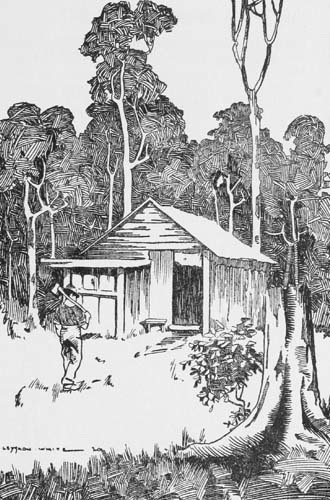
We had a really decent comfortable little house.
She and I carried our stuff over to the new place, having to make a long detour through the scrub to avoid scrambling about in Jimmy's overgrown loggy clearing, but the end of March saw us comfortably installed. Mrs. Ellison made us a present of a wee dolly stove she had used at first, so there were no more scorched aprons and smarting eyes for the wife, and the only fly in the ointment was how to make a bob or two. Though so early in the year, people were anticipating a dry spell, as the Rainy Season had not, so far, been up to much, as the grass wasn't as plentiful as it should have been. On that account there wasn't much doing. My first move, after talking things over with older settlers, was to get some cows.
Two "purple patches" of advice:—
Dad Vincent: "Lord love yer, man! Of course you've done the right thing! Look at me. Came up here with no experience, a wife and thirteen kids. I've been submerged half a dozen times, and look at me now. Get some cows and good luck to you."
Old Pardy: "So yeh've got married? Well, a man's a blanky lizard ef 'e can't knock out a blanky livin' in the bush. Git some blanky cows; and dairy!"
So I put the fear of a drought away from me. Such a thing had never happened before in the thirty years' history of the Tableland. Cows were fairly cheap. Therefore—borrow some more cash from the Agricultural Bank and buy cows. Good. I applied for £200 and got it without any trouble.
Then Bayton the bullocky offered to take some pine off my place at sixpence a hundred (two pounds odd in Sydney!) and give me the cutting. I jumped at it, and he took about twelve thousand feet. This gave me enough money to get six coils of barb wire (it hadn't risen much up to then), and about £3 over to renew my credit with the storekeeper. That was the last money he got for twelve months; yet he never worried me. I was only one of scores on his books that year, but he always got more kicks that thanks, and of course was a profiteer.
I used the wire to fence my road line; then made a deal for sixteen cows, a bull and seven twelve-month heifers for my £200, and thought I was all sagalio. Four cows were milking, and the others were supposed to be in calf, but weren't. We made a bit of butter and sold it to some bachelor neighbours for about two months, and that paid the rent. Then the green grass disappeared, the cows went dry, and the two calves that had come with them died.
I assisted the maintenance man putting up a bridge near my place, and that paid for rates. A week or two cutting timber nearby for Hood and Bayton, and the half-yearly interest bill worried us no more; then their bullocks got too weak to work, so that source of income stopped too. And "Old Store's" account rendered kept on mounting up, although we lived on rice and beef-shins, made a seventy-pound bag of sugar last six months, and a fifty-pound bag of flour eight weeks. A nightmare of a time!
So July came along, with some hard frosts. Now frost up here is invariably followed by rain within two days in a normal year, which causes the grass to get a spring on at once, as the days are always warm and bright. But in this infernal year there was no rain, so the grass got completely settled—above ground, that is. It sprang again in a night once the rain came at the end of the year. My cows were wandering out through Braun's paddock all over the country searching for a bit of green stuff, and I nearly tramped my legs off looking for them to keep them dipped and clear of ticks. Half the time I couldn't find them, so that with ticks and starvation the herd got down to ten.