Chapter VII
Reading edition
Saturday's Letters
(1) Sir,—H. Immemor's suggestion clears the air, and should persuade Mr. Dexter and his reactionary friends to think twice before again inaugurating a crusade which can only recoil upon their own heads. I enclose 5 shillings, if only as a protest against this un-English 'hitting below the belt,' and am:
Yours, etc.,
"PRACTICAL."
(2) Sir,—It is only occasionally that I get a glimpse of your invaluable paper, and (perhaps, fortunately) missed the issues containing Mr. Dexter's diatribes anent woman. But what astounds me is their cynical audacity. Your correspondents, though not in accord as to the name of the victim (can it be more than one?) agree that, after encouraging her to unbridled license, Mr. Dexter turned round and attacked her with a poker— whether above or below the belt is surely immaterial. 'Tis true, 'tis pity, and pity 'tis 'tis true; but not once or twice, I fear me, in 'our fair island-story' has a similar thing occurred. The unique (I hope) feature in this case is the man Dexter's open boast that the incident is closed, and it is now 'too late in the day' to reopen it. 'Too late,' indeed! There is an American poem describing how a young woman was raking hay, and an elderly judge came by, and wasn't in a position to marry her, though he wanted to; and the whole winds up by saying that 'too late' are the saddest words in the language—especially, I would add, in this connection. But, alas! that men's memories should be so short! Is the reflection of:
"A MOTHER OF SEVEN."
[This correspondence is now closed, unless Mr. Dexter should wish to reply to his numerous critics. We do not propose to open a subscription list, at any rate for the present.—Ed. Daily Post.]
FEBRUARY.
"O That I were lying under the olives!"—if I may echo the burthen of a beautiful little poem by Mrs. Margaret L. Woods. I have not yet consulted Zadkiel: but if I may argue from past experience of February—'fill-dyke'—in a week or so my window here will be alternately crusted with Channel spray and washed clean by lashing south-westerly showers; and a wave will arch itself over my garden wall and spoil a promising bed of violets; and I shall grow weary of oilskins, and weary of hauling the long-line with icily-cold hands and finding no fish. February—Pisces? The fish, before February comes, have left the coast for the warmer deeps, and the zodiac is all wrong. Down here in the Duchy many believe in Mr. Zadkiel and Old Moore. I suppose the dreamy Celt pays a natural homage to a fellow-mortal who knows how to make up his mind for twelve months ahead. All the woman in his nature surrenders to this businesslike decisiveness. "O man!"—the exhortation is Mr. George Meredith's, or would be if I could remember it precisely—"O man, amorously inclining, before all things be positive!" I have sometimes, while turning the pages of Mrs. Beeton's admirable cookery book, caught myself envying Mr. Beeton. I wonder if her sisters envy Mrs. Zadkiel. She, dear lady, no doubt feels that, if it be not in mortals to command the weather her husband prophesies for August, yet he does better—he deserves it. And, after all, a prophecy in some measure depends for its success on the mind which receives it. Back in the forties—I quote from a small privately-printed volume by Sir Richard Tangye—when the potato blight first appeared in England, an old farmer in the Duchy found this warning in his favourite almanack, at the head of the page for August:—
"And potentates shall tremble and quail."
Now, 'to quail' in Cornwall still carries its old meaning, 'to shrink,' 'to wither.' The farmer dug his potatoes with all speed, and next year the almanack was richer by a score of subscribers.
Zadkiel or no Zadkiel, I will suspire, and risk it, "O that I were lying under the olives!" "O to be out of England now that February's here!"—for indeed this is the time to take the South express and be quit of fogs, and loaf and invite your soul upon the Mediterranean shore before the carnivals and regattas sweep it like a mistral. Nor need you be an invalid to taste those joys on which Stevenson dilates in that famous little essay in "Virginibus Puerisque" (or, as the young American lady preferred to call it, "Virginis Pueribusque."):—
"Or perhaps he may see a group of washer-women relieved, on a spit of shingle, against the blue sea, or a meeting of flower-gatherers in the tempered daylight of an olive-garden; and something significant or monumental in the grouping, something in the harmony of faint colour that is always characteristic of the dress of these Southern women, will come home to him unexpectedly, and awake in him that satisfaction with which we tell ourselves that we are richer by one more beautiful experience.… And then, there is no end to the infinite variety of the olive-yards themselves. Even the colour is indeterminate, and continually shifting: now you would say it was green, now grey, now blue; now tree stands above tree, like 'cloud on cloud,' massed in filmy indistinctness; and now, at the wind's will, the whole sea of foliage is shaken and broken up with little momentary silverings and shadows."
English poets, too, have been at their best on the Riviera: from Cette, where Matthew Arnold painted one of the most brilliant little landscapes in our literature, along to Genoa, where Tennyson visited and:
"Loved that hall, tho' white and cold, Those nichèd shapes of noble mould, A princely people's awful princes, The grave, severe Genovese of old."
[I suppose, by the way, that every one who has taken the trouble to compare the stanza of 'The Daisy' with that of the invitation 'To the Rev. F. D. Maurice,' which immediately follows, will have noted the pretty rhythmical difference made by the introduction of the double dactyl in the closing line of the latter; the difference between:
"Of ólive, áloe, and maíze, and víne,"
And:
"Máking the líttle one leáp for jóy."]
But let Mrs. Woods resume the strain:—
"O that I were listening under the olives! So should I hear behind in the woodland The peasants talking. Either a woman, A wrinkled granddame, stands in the sunshine, Stirs the brown soil in an acre of violets— Large odorous violets—and answers slowly A child's swift babble; or else at noon The labourers come. They rest in the shadow, Eating their dinner of herbs, and are merry. Soft speech Provençal under the olives! Like a queen's raiment from days long perished, Breathing aromas of old unremembered Perfumes, and shining in dust-covered palaces With sudden hints of forgotten splendour— So on the lips of the peasant his language, His only now, the tongue of the peasant."
Say what you will, there is a dignity about these Latin races, even in their trivial everyday movements. They suggest to me, as those lines of Homer suggested to Mr. Pater's Marius, thoughts which almost seem to be memories of a time when all the world was poetic:—

"And how poetic," says Pater, "the simple incident seemed, told just thus! Homer was always telling things after this manner. And one might think there had been no effort in it: that here was but the almost mechanical transcript of a time naturally, intrinsically poetic, a time in which one could hardly have spoken at all without ideal effect, or the sailors pulled down their boat without making a picture in 'the great style' against a sky charged with marvels."
One evening in last February a company of Provençal singers, pipers, and tambour players came to an hotel in Cannes, and entertained us. They were followed next evening by a troupe of German-Swiss jödelers; and oh, the difference to me—and, for that matter, to all of us! It was just the difference between passion and silly sentiment—silly and rather vulgar sentiment. The merry Swiss boys whooped, and smacked their legs, and twirled their merry Swiss girls about, until vengeance overtook them—a vengeance so complete, so surprising, that I can hardly now believe what my own eyes saw and my own ears heard. One of the merry Swiss girls sang a love-ditty with a jödeling refrain, which was supposed to be echoed back by her lover afar in the mountains. To produce this pleasing illusion, one of the merry Swiss boys ascended the staircase, and hid himself deep in the corridors of the hotel. All went well up to the last verse. Promptly and truly the swain echoed his sweetheart's call; softly it floated down to us—down from the imaginary pasture and across the imaginary valley. But as the maiden challenged for the last time, as her voice lingered on the last note of the last verse… There hung a Swiss cuckoo-clock in the porter's office, and at that very instant the mechanical bird lifted its voice, and nine times answered 'Cuckoo' on the exact note! "Cuckoo, Cuckoo, O word of fear!" I have known coincidences, but never one so triumphantly complete. The jaw of the Swiss maiden dropped an inch; and, as well as I remember, silence held the company for five seconds before we recovered ourselves and burst into inextinguishable laughter.
The one complaint I have to make of the Mediterranean is that it does not in the least resemble a real sea; and I daresay that nobody who has lived by a real sea will ever be thoroughly content with it. Beautiful—oh, beautiful, of course, whether one looks across from Costebelle to the lighthouse on Porquerolles and the warships in Hyères Bay; or climbs by the Calvary to the lighthouse of la Garoupe, and sees on the one side Antibes, on the other the Isles de Lérins; or scans the entrance of Toulon Harbour; or counts the tiers of shipping alongside the quays at Genoa! But somehow the Mediterranean has neither flavour nor sparkle, nor even any proper smell. The sea by Biarritz is champagne to it. But hear how Hugo draws the contrast in time of storm:—
"Ce n'étaient pas les larges lames de l'Océan qui vont devant elles et qui se deroulent royalement dans l'immensité; c'étaient des houles courtes, brusques, furieuses. L'Océan est à son aise, il tourne autour du monde; la Mediterranée est dans un vase et le vent la secoue, c'est ce qui lui donne cette vague haletante, brève et trapue. Le flot se ramasse et lutte. Il a autant de colère que la flot de l'Océan et moins d'espace."
Also, barring the sardine and anchovy, I must confess that the fish of the Mediterranean are what, in the Duchy, we should call 'poor trade.' I don't wish to disparage the Bouillabaisse, which is a dish for heroes, and deserves all the heroic praises sung of it:—
"This Bouillabaisse a noble dish is— A sort of soup, or broth, or brew, Or hotchpotch of all sorts of fishes, That Greenwich never could outdo; Green herbs, red peppers, mussels, saffron, Soles, onions, garlic, roach and dace: All these you eat at Terré's tavern, In that one dish of Bouillabaisse."
To be precise, you take a langouste, three rascas (an edible but second-rate fish), a slice of conger, a fine 'chapon,' or red rascas, and one or two 'poissons blancs' (our grey mullet, I take it, would be an equivalent). You take a cooking-pot and put your langouste in it, together with four spoonfuls of olive-oil, an onion and a couple of tomatoes, and boil away until he turns red. You then take off the pot and add your fish, green herbs, four cloves of garlic, and a pinch of saffron, with salt and red pepper. Pour in water to cover the surface of the fish, and cook for twenty minutes over a fast fire. Then take a soup-plate, lay some slices of bread in it, and pour the bouillon over the bread. Serve the fish separately. Possibly you incline to add, in the immortal words of the late Mr. Lear, "Serve up in a clean dish, and throw the whole out of window as fast as possible." You would make a great mistake. The marvel to me is that no missionary has acclimatised this wonderful dish upon our coasts, where we have far better fish for compounding it—red mullet, for instance, in place of the rascas; and whiting, or even pollack or grey mullet, in place of the 'poissons blancs.' For the langouste, a baby lobster might serve; and the saffron flavour would be no severe trial to us in the Duchy, who are brought up (so to say) upon saffron cake. As for Thackeray's 'dace,' I disbelieve in it. No one would add a dace (which for table purposes has been likened to an old stocking full of mud and pins: or was that a tench?) except to make a rhyme. Even Walton, who gives instructions for cooking a chavender or chub, is discreetly silent on the cooking of a dace, though he tells us how to catch him. "Serve up in a clean dish," he might have added, "and throw him out of window as fast as possible."
"O that I were lying under the olives!" And O that to olive orchards (not contiguous) I could convey the newspaper men who are almost invariably responsible when a shadow of distrust or suspicion falls between us Englishmen and the race which owns and tills these orchards. "The printing-press," says Mr. Barrie, "is either the greatest blessing or the greatest curse of modern times, one sometimes forgets which." I verily believe that if English newspaper editors would nobly resolve to hold their peace on French politics, say for two years, France and England would 'make friends' as easily as Frenchmen and Englishmen 'make friends' to-day.[1] One hears talk of the behaviour of the English abroad. But I am convinced that at least one-half of their bad manners may be referred to their education upon this newspaper nonsense, or to the certainty that no complaint they may make upon foreign shortcomings is too silly or too ill-bred to be printed in an English newspaper. Here is an example. I suppress the name of the writer—a lady—in the devout hope that she has repented before this. The letter is headed—
"THE AMENITIES OF RAILWAY TRAVELLING IN FRANCE.
"Sir,—As your newspaper is read in France, may I in your columns call attention to what I witnessed yesterday? I left Dinard by the 3.33 p.m. train en route for Guingamp, having to change carriages at Lamballe. An instant before the train moved off from the station, a dying man belonging to the poorest class was thrust into our second class carriage and the door slammed to. The poor creature, apparently dying of some wasting disease, was absolutely on the point of death, and his ghastly appearance naturally alarmed a little girl in the carriage. At the next station I got down with my companion and changed into a first-class compartment, paying the difference. On remonstrating with the guard (sic), he admitted that a railway carriage ought not to be turned into an hospital, but added, 'We have no rules to prevent it.' "I ask, sir, is it decent or human, especially at such a time, to thrust dying persons in the last stage of poverty into a second-class carriage full of ladies and children?"
There's a pretty charity for you! 'A dying man belonging to the poorest class.'—'Our second-class carriage'—here's richness! as Mr. Squeers observed. Here's sweetness and light! But England has no monopoly of such manners. There was a poor little Cingalese girl in the train by which I travelled homeward last February from Genoa and through the Mont Cenis. And there were also three Englishmen and a Frenchman—the last apparently (as Browning put it) a person of importance in his day, for he had a bit of red ribbon in his buttonhole and a valet at his heels. At one of the small stations near the tunnel our train halted for several minutes; and while the little Cingalese leaned out and gazed at the unfamiliar snows—a pathetic figure, if ever there was one—the three Englishmen and the Frenchman gathered under the carriage door and stared up at her just as if she were a show. There was no nonsense about the performance—no false delicacy: it was good, steady, eye-to-eye staring. After three minutes of it, the Frenchman asked deliberately, "Where do you come from?" in a careless, level tone, which did not even convey that he was interested in knowing. And because the child didn't understand, the three Englishmen laughed. Altogether it was an unpleasing but instructive little episode.
No: nastiness has no particular nationality: and you will find a great deal of it, of all nationalities, on the frontier between France and Italy. I do not see that Monte Carlo provides much cause for indignation, beyond the tir aux pigeons, which is quite abominable. I have timed it for twenty-five minutes, and it averaged two birds a minute—fifty birds. Of these one escaped, one fluttered on to the roof of the railway station and died there slowly, under my eyes. The rest were killed within the enclosure, some by the first barrel, some by the second, or if they still lingered, were retrieved and mouthed by a well-trained butcher dog, of no recognisable breed. Sometimes, after receiving its wound, a bird would walk about for a second or two, apparently unhurt; then suddenly stagger and topple over. Sometimes, as the trap opened, a bird would stand dazed. Then a ball was trundled at it to compel it to rise. Grey breast feathers strewed the whole inclosure, in places quite thickly, like a carpet. As for the crowd at the tables inside the Casino, it was largely Semitic. On the road between Monte Carlo and Monaco, as Browning says—
"It was noses, noses all the way."
Also it smelt distressingly: but that perhaps was its misfortune rather than its fault. It did not seem very happy; nor was it composed of people who looked as if they might have attained to distinction, or even to ordinary usefulness, by following any other pursuit. On the whole, one felt that it might as well be gathered here as anywhere else.
"O that I were lying under the olives!" But since my own garden must content me this year, let me conclude with a decent letter of thanks to the friend who sent me, from Devonshire, a box of violet roots that await the spring in a corner which even the waves of the equinox cannot reach:—
TO A FRIEND WHO SENT ME A BOX OF VIOLETS.
Nay, more than violets These thoughts of thine, friend! Rather thy reedy brook —Taw's tributary— At midnight murmuring, Descried them, the delicate, The dark-eyed goddesses. There by his cressy beds Dissolved and dreaming Dreams that distilled in a dewdrop All the purple of night, All the shine of a planet. Whereat he whispered; And they arising —Of day's forget-me-nots The duskier sisters— Descended, relinquished The orchard, the trout-pool, The Druid circles, Sheepfolds of Dartmoor, Granite and sandstone, Torridge and Tamar; By Roughtor, by Dozmare, Down the vale of the Fowey Moving in silence. Brushing the nightshade By bridges Cyclopean, By Glynn, Lanhydrock, Restormel, Lostwithiel, Dark woodland, dim water, dreaming town— Down the vale of the Fowey, Each in her exile Musing the message— Message illumined by love As a starlit sorrow— Passed, as the shadow of Ruth From the land of the Moabite. So they came— Valley-born, valley-nurtured— Came to the tideway, The jetties, the anchorage, The salt wind piping, Snoring in equinox, By ships at anchor, By quays tormented, Storm-bitten streets; Came to the Haven Crying, "Ah, shelter us, The strayed ambassadors! Lost legation of love On a comfortless coast!" Nay, but a little sleep, A little folding Of petals to the lull Of quiet rainfalls,— Here in my garden, In angle sheltered From north and east wind— Softly shall recreate The courage of charity, Henceforth not to me only Breathing the message. Clean-breath'd Sirens! Henceforth the mariner, Here on the tideway Dragging, foul of keel, Long-strayed but fortunate, Out of the fogs, the vast Atlantic solitudes, Shall, by the hawser-pin Waiting the signal— "Leave-go-anchor!" Scent the familiar Fragrance of home; So in a long breath Bless us unknowingly: Bless them, the violets, Bless me, the gardener, Bless thee, the giver.
My business (I remind myself) behind the window is not to scribble verses: my business, or a part of it, is to criticise poetry, which involves reading poetry. But why should anyone read poetry in these days?
Well, one answer is that nobody does.
I look around my shelves and, brushing this answer aside as flippant, change the form of my question. Why do we read poetry? What do we find that it does for us? We take to it (I presume) some natural need, and it answers that need. But what is the need? And how does poetry answer it?
Clearly it is not a need of knowledge, or of what we usually understand by knowledge. We do not go to a poem as we go to a work on Chemistry or Physics, to add to our knowledge of the world about us. For example, Keats' glorious lines to the Nightingale—
"Thou wast not born for death, immortal bird…"
Are unchallengeable poetry; but they add nothing to our stock of information. Indeed, as Mr. Bridges pointed out the other day, the information they contain is mostly inaccurate or fanciful. Man is, as a matter of fact, quite as immortal as a nightingale in every sense but that of sameness. And as for:
"Magic casements opening on the foam Of perilous seas, in faëry lands forlorn,"
Science tells us that no such things exist in this or any other ascertained world. So, when Tennyson tells us that birds in the high Hall garden were crying, "Maud, Maud, Maud," or that:
"There has fallen a splendid tear From the passion-flower at the gate: She is coming, my dove, my dear; She is coming, my life, my fate; The red rose cries, 'She is near, she is near'; And the white rose weeps, 'She is late'…"
The poetry is unchallengeable, but the information by scientific standards of truth is demonstrably false, and even absurd. On the other hand (see Coleridge's Biographia Literaria, c. xiv.), the famous lines—
"Thirty days hath September, April, June, and November,…"
Though packed with trustworthy information, are quite as demonstrably unpoetical. The famous senior wrangler who returned a borrowed volume of Paradise Lost with the remark that he did not see what it proved, was right—so far as he went. And conversely (as he would have said) no sensible man would think to improve Newton's Principia and Darwin's Origin of Species by casting them into blank verse; or Euclid's Elements by writing them out in ballad metre—
The king sits in Dunfermline town, Drinking the blude-red wine; 'O wha will rear me an equilateral triangle Upon a given straight line?'
We may be sure that Poetry does not aim to do what Science, with other methods, can do much better. What craving, then, does it answer? And if the craving be for knowledge of a kind, then of what kind?
The question is serious. We agree—at least I assume this—that men have souls as well as intellects; that above and beyond the life we know and can describe and reduce to laws and formulas there exists a spiritual life of which our intellect is unable to render account. We have (it is believed) affinity with this spiritual world, and we hold it by virtue of something spiritual within us, which we call the soul. You may disbelieve in this spiritual region and remain, I dare say, an estimable citizen; but I cannot see what business you have with Poetry, or what satisfaction you draw from it. Nay, Poetry demands that you believe something further; which is, that in this spiritual region resides and is laid up that eternal scheme of things, that universal order, of which the phenomena of this world are but fragments, if indeed they are not mere shadows.
A hard matter to believe, no doubt! We see this world so clearly; the spiritual world so dimly, so rarely, if at all! We may fortify ourselves with the reminder (to be found in Blanco White's famous sonnet) that the first man who lived on earth had to wait for the darkness before he saw the stars and guessed that the Universe extended beyond this earth—
"Who could have thought such darkness lay conceal'd Within thy beams, O Sun! or who could find, Whilst fly and leaf and insect stood reveal'd, That to such countless orbs thou mad'st us blind?"
He may, or may not, believe that the same duty governs his infinitesimal activity and the motions of the heavenly bodies—
"Awake, my soul, and with the sun Thy daily stage of duty run…"
—That his duty is one with that of which Wordsworth sang—
"Thou dost preserve the stars from wrong; And the most ancient heavens, through thee, are fresh and strong."
But in a higher order of some sort, and his duty of conforming with it, he does not seem able to avoid believing.
This, then, is the need which Poetry answers. It offers to bring men knowledge of this universal order, and to help them in rectifying and adjusting their lives to it. It is for gleams of this spiritual country that the poets watch—
"The gleam, The light that never was on sea or land.…"
"I am Merlin," sang Tennyson, its life-long watcher, in his old age—
"I am Merlin, And I am dying; I am Merlin, Who follow the gleam."
They do not claim to see it always. It appears to them at rare and happy intervals, as the Vision of the Grail to the Knights of the Round Table. "Poetry," said Shelley, "is the record of the best and happiest moments of the happiest and best minds."
If this be the need, how have our poets been answering it of late years? How, for instance, did they answer it during the South African War, when (according to our newspapers) there was plenty of patriotic emotion available to inspire the great organ of national song? Well, let us kick up what dust we will over 'Imperial ideals,' we must admit, at least, that these ideals are not yet 'accepted of song': they have not inspired poetry in any way adequate to the nobility claimed for them. Mr. Swinburne and Mr. Henley saluted the Boer War in verse of much truculence, but no quality; and when Mr. Swinburne and Mr. Henley lacked quality one began to inquire into causes. Mr. Kipling's Absent-minded Beggars, Muddied Oafs, Goths and Huns, invited one to consider why he should so often be first-rate when neglecting or giving the lie to his pet political doctrines, and invariably below form when enforcing them. For the rest, the Warden of Glenalmond bubbled and squeaked, and Mr. Alfred Austin, like the man at the piano, kept on doing his best. It all came to nothing: as poetry it never began to be more than null. Mr. Hardy wrote a few mournfully memorable lines on the seamy side of war. Mr. Owen Seaman (who may pass for our contemporary Aristophanes) was smart and witty at the expense of those whose philosophy goes a little deeper than surface-polish. One man alone—Mr. Henry Newbolt—struck a note which even his opponents had to respect. The rest exhibited plenty of the turbulence of passion, but none of the gravity of thoughtful emotion. I don't doubt they were, one and all, honest in their way. But as poetry their utterances were negligible. As writers of real poetry the Anti-Jingoes, and especially the Celts, held and still hold the field.
I will not adduce poets of admitted eminence—Mr. Watson, for instance, or Mr. Yeats—to prove my case. I am content to go to a young poet who has his spurs to win, and will ask you to consider this little poem, and especially its final stanza. He calls it—
A CHARGE
If thou hast squander'd years to grave a gem Commissioned by thy absent Lord, and while 'Tis incomplete, Others would bribe thy needy skill to them— Dismiss them to the street! Should'st thou at last discover Beauty's grove, At last be panting on the fragrant verge, But in the track, Drunk with divine possession, thou meet Love— Turn, at her bidding, back. When round thy ship in tempest Hell appears, And every spectre mutters up more dire To snatch control And loose to madness thy deep-kennell'd Fears,— Then to the helm, O Soul! Last, if upon the cold, green-mantling sea Thou cling, alone with Truth, to the last spar, Both castaway, And one must perish—let it not be he Whom thou art sworn to obey.
The author of these lines is a Mr. Herbert Trench, who (as I say) has his spurs to win. Yet I defy you to read them without recognising a note of high seriousness which is common to our great poets and utterly foreign to our modern bards of empire. The man, you will perceive, dares to talk quite boldly about the human soul. Now you will search long in our Jingo bards for any recognition of the human soul: the very word is unpopular. And as men of eminence write, so lesser wits imitate. A while ago I picked up a popular magazine, and happened on these verses—fluently written and, beyond a doubt, honestly meant. They are in praise of King Henry VIII.:—
King Harry played at tennis, and he threw the dice a-main, And did all things that seemed to him for his own and England's gain; He would not be talked to lightly, he would not be checked or chid; And he got what things he dreamed to get, and did— what things he did. When Harry played at tennis it was well for this our Isle— He cocked his nose at Interdicts; he 'stablished us the while— He was lustful; he was vengeful; he was hot and hard and proud; But he set his England fairly in the sight of all the crowd. So Harry played at tennis, and we perfected the game Which astonished swaggering Spaniards when the fat Armada came. And possession did he give us of our souls in sturdiness; And he gave us peace from priesthood: and he gave us English Bess! When Harry played at tennis we began to know this thing— That a mighty people prospers in a mighty-minded king. We boasted not our righteousness—we took on us our sin, For Bluff Hal was just an Englishman who played the game to win.
You will perceive that in the third stanza the word 'soul' occurs: and I invite you to compare this author's idea of a soul with Mr. Trench's. This author will have nothing to do with the old advice about doing justice, loving mercy, and walking humbly before God. The old notion that to conquer self is a higher feat than to take a city he dismisses out of hand. "Be lustful be vengeful," says he, "but play the game to win, and you have my applause. Get what you want, set England fairly in sight of the crowd, and you are a mighty-minded man." Now the first and last comment upon such a doctrine must be that, if a God exist, it is false. It sets up a part to override the whole: it flaunts a local success against the austere majesty of Divine law. In brief, it foolishly derides the universal, saying that it chooses to consider the particular as more important. But it is not. Poetry's concern is with the universal: and what makes the Celts (however much you may dislike them) the most considerable force in English poetry at this moment is that they occupy themselves with that universal truth, which, before any technical accomplishment, is the guarantee of good poetry.
Now, when you tell yourself that the days of 'English Bess' were jolly fine empire-making days, and produced great poets (Shakespeare, for example) worthy of them; and when you go on to reflect that these also are jolly fine empire-making days, but that somehow Mr. Austin is your laureate, and that the only poetry which counts is being written by men out of harmony with your present empire-making mood, the easiest plan (if you happen to think the difference worth considering) will be to call the Muse a traitress, and declare that every poem better than Mr. Austin's is a vote given to—whatever nation your Yellow Press happens to be insulting at this moment. But, if you care to look a little deeper, you may find that some difference in your methods of empire-making is partly accountable for the change. A true poet must cling to universal truth; and by insulting it (as, for example, by importing into present-day politics the spirit which would excuse the iniquities of Henry VIII. on the ground that 'he gave us English Bess'!) you are driving the true poet out of your midst. Read over the verses above quoted, and then repeat to yourself, slowly, these lines:—
"Last, if upon the cold, green-mantling sea Thou cling, alone with Truth, to the last spar, Both castaway, And one must perish—let it not be he Whom thou art sworn to obey."
I ask no more. If a man cannot see the difference at once, I almost despair of making him perceive why poetry refuses just now even more obstinately than trade (if that be possible) to 'follow the flag.' It will not follow, because you are waving the flag over self-deception. You may be as blithe as Plato in casting out the poets from your commonwealth—though for other reasons than his. You may be as blithe as Dogberry in determining, of reading and writing, that they may appear when there is no need of such vanity. But you are certainly driving them forth to say, in place of "O beloved city of Cecrops!" "O beloved city of God!" There was a time, not many years ago, when an honest poet could have used both cries together and deemed that he meant the same thing by the two. But the two cries to-day have an utterly different meaning—and by your compulsion or by the compulsion of such politics as you have come to tolerate.
And therefore the young poet whom I have quoted has joined the band of those poets whom we are forcing out of the city, to leave our ideals to the fate which, since the world began, has overtaken all ideals which could not get themselves 'accepted by song.' Even as we drum these poets out we know that they are the only ones worth reckoning with, and that man cannot support himself upon assurances that he is the strongest fellow in the world, and the richest, and owns the biggest house, and pays the biggest rates, and wins whatever game he plays at, and stands so high in his clothes that while the Southern Cross rises over his hat-brim it is already broad day on the seat of his breeches. For that is what it all comes to: and the sentence upon the man who neglects the warning of these poets, while he heaps up great possessions, is still, "Thou fool, this night thy soul shall be required of thee." And where is the national soul you would choose, at that hasty summons, to present for inspection, having to stand your trial upon it? Try Park Lane, or run and knock up the Laureate, and then come and report your success!
Weeks ago I was greatly reproached by a correspondent for misusing the word 'Celtic,' and informed that to call Mr. Yeats or Mr. Trench a Celt is a grave abuse of ethnical terms; that a notable percentage of the names connected with the 'Celtic Revival'—Hyde, Sigerson, Atkinson, Stokes—are not Celtic at all but Teutonic; that, in short, I have been following the multitude to speak loosely. Well, I confess it, and I will confess further that the lax use of the word 'Celt' ill beseems one who has been irritated often enough by the attempts of well-meaning but muddle-headed people who get hold of this or that poet and straightly assign this or that quality of his verse to a certain set of corpuscles in his mixed blood. Although I believe that my correspondent is too hasty in labelling men's descent from their names—for the mother has usually some share in producing a child; although I believe that Mr. Yeats, for instance, inherits Cornish blood on one side, even if Irish be denied him on the other; yet the rebuke contains some justice.
Still, I must maintain that these well-meaning theorists err only in applying a broad distinction with overmuch nicety. There is, after all, a certain quality in a poem of Blake's, or a prose passage of Charlotte Brontë's, which a critic is not only unable to ignore, but which—if he has any 'comparative' sense—he finds himself accounting for by saying, "This man, or this woman, must be a Celt or have some admixture of Celtic blood." I say quite confidently that quality cannot be ignored. You open (let us say) a volume of Blake, and your eye falls on these two lines—
"When the stars threw down their spears And watered heaven with their tears,"
And at once you are aware of an imagination different in kind from the imagination you would recognise as English. Let us, if you please, rule out all debate of superiority; let us take Shakespeare for comparison, and Shakespeare at his best:—
"These our actors, As I foretold you, were all spirits, and Are melted into air, into thin air; And, like the baseless fabric of this vision, The cloud-capp'd towers, the gorgeous palaces, The solemn temples, the great globe itself, Yea, all which it inherit, shall dissolve And, like this insubstantial pageant faded, Leave not a rack behind. We are such stuff As dreams are made of, and our little life Is rounded with a sleep."
Finer poetry than this I can hardly find in English to quote for you. But fine as it is, will you not observe the matter-of-factness (call it healthy, if you will, and I shall not gainsay you) beneath Shakespeare's noble language? It says divinely what it has to say; and what it has to say is full of solemn thought. But, for better or worse (or, rather, without question of better or worse), Blake's imagination is moving on a different plane. We may think it an uncomfortably superhuman plane; but let us note the difference, and note further that this plane was habitual with Blake. Now because of his immense powers we are accustomed to think of Shakespeare as almost superhuman: we pay that tribute to his genius, his strength, and the enormous impression they produce on us. But a single couplet of Blake's will carry more of this uncanny superhuman imagination than the whole five acts of Hamlet. So great is Shakespeare, that he tempts us to think him capable of any flight of wing; but set down a line or two of Blake's—
"A robin redbreast in a cage Puts all heaven in a rage… A skylark wounded on the wing Doth make a cherub cease to sing."
—And, simple as the thought is, at once you feel it to lie outside the range of Shakespeare's philosophy. Shakespeare's men are fine, brave, companionable fellows, full of passionate love, jealousy, ambition; of humour, gravity, strength of mind; of laughter and rage, of the joy and stress of living. But self-sacrifice scarcely enters into their notion of the scheme of things, and they are by no means men to go to death for an idea. We remember what figure Shakespeare made of Sir John Oldcastle, and I wish we could forget what figure he made of Joan of Arc. Within the bounds of his philosophy—the philosophy, gloriously stated, of ordinary brave, full-blooded men— he is a great encourager of virtue; and so such lines as—
"The expense of spirit in a waste of shame Is lust in action…"
Are thoroughly Shakespearean, while such lines as—
"A robin redbreast in a cage Puts all heaven in a rage…"
Are as little Shakespearean in thought as in phrasing. He can tell us that:
"We are such stuff As dreams are made of, and our little life Is rounded with a sleep."
He can muse on that sleep to come:—
"To die, to sleep; To sleep; perchance to dream; aye, there's the rub; For in that sleep of death what dreams may come When we have shuffled off this mortal coil, Must give us pause."
But that even in this life we may be more truly ourselves when dreaming than when waking—that what we dream may perchance turn out to be more real and more important than what we do—such a thought overpasses his imaginative range; or, since to dogmatise on his imaginative range is highly dangerous, let us be content with saying that it lies outside his temperament, and that he would have hit on such a thought only to dismiss it with contempt. So when we open a book of poems and come upon a monarch crying out that:
"A wild and foolish labourer is a king, To do and do and do and never dream,"
We know that we are hearkening to a note which is not Shakespearean at all, not practical, not English. And we want a name for that note.
I have followed the multitude to call it Celtic because in practice when we come upon this note we are pretty safe to discover that the poet who utters it has Celtic blood in him (Blake's poetry, for instance, told me that he must be an Irishman before ever I reflected that his name was Irish, or thought of looking up his descent). Since, however the blood of most men in these islands is by this time mixed with many strains: since also, though the note be not native with him, nothing forbids even a pure-blooded Anglo-Saxon from learning it and assimilating it: lastly, since there is obvious inconvenience in using the same word for an ethnical delimitation and a psychological, when their boundaries do not exactly correspond—and if some Anglo-Saxons have the 'Celtic' note it is certain that many thousands of Celts have not; why then I shall be glad enough to use a better and a handier and a more exact, if only some clever person will provide it.
Meanwhile, let it be understood that in speaking of a 'Celtic' note I accuse no fellow-creature of being an Irishman, Scotsman, Welshman, Manxman, Cornishman, or Breton. The poet will as a rule turn out to be one or other of these, or at least to have a traceable strain of Celtic blood in him. But to the note only is the term applied, Now this note may be recognised by many tokens; but the first and chiefest is its insistence upon man's brotherhood with bird and beast, star and flower, everything, in short, which we loosely call 'nature,' his brotherhood even with spirits and angels, as one of an infinite number of microcosms reflecting a common image of God. And poetry which holds by this creed will hardly be subservient to societies and governments and legalised doctrines and conventions; it will hold to them by a long and loose chain, if at all. It flies high enough, at any rate, to take a bird's-eye view of all manner of things which in the temple, the palace, or the market-place, have come to be taken as axiomatic. It eyes them with an extraordinary 'dissoluteness'—if you will give that word its literal meaning. It sees that some accepted virtues carry no reflection of heaven; it sees that heaven, on the other hand—so infinite is its care—may shake with anger from bound to bound at the sight of a caged bird. It sees that the souls of living things, even of the least conspicuous, reach up by chains and are anchored in heaven, while 'great' events slide by on the surface of this skimming planet with empires and their ordinances.
"And so the Emperor went in the procession under the splendid canopy. And all the people in the streets and at the windows said, 'Bless us! what matchless new clothes our Emperor has!' But he hasn't anything on!' cried a little child. 'Dear me, just listen to what the little innocent says,' observed his father, and the people whispered to each other what the child had said. 'He hasn't anything on!' they began to shout at last. This made the Emperor's flesh creep, because he thought that they were right; but he said to himself, 'I must keep it up through the procession, anyhow.' And he walked on still more majestically, and the Chamberlains walked behind and carried the train, though there was none to carry."
This parable of the Emperor without clothes can be matched, for simplicity and searching directness, against any parable outside of the Gospels, and it agrees with the Divine parables in exalting the wisdom of a child. I will not dare to discuss that wisdom here. I observe that when the poets preach it we tender them our applause. We applaud Vaughan's lines:—
"Happy those early days, when I Shin'd in my angel-infancy… When yet I had not walk'd above A mile or two from my first love, And looking back—at that short space— Could see a glimpse of His bright face; When on some gilded cloud or flow'r My gazing soul would dwell an hour, And in those weaker glories spy Some shadows of eternity.…"
We applaud Wordsworth's glorious ode—
"Our birth is but a sleep and a forgetting: The Soul that rises with us, our life's Star, Hath had elsewhere its setting, And cometh from afar: Not in entire forgetfulness, And not in utter nakedness, But trailing clouds of glory do we come From God, who is our home: Heaven lies about us in our infancy!…"
We applaud even old John Earle's prose when he tells us of a Child that—
"The elder he grows, he is a stair lower from God; and, like his first father, much worse in his breeches. He is the Christian's example, and the old man's relapse; the one imitates his pureness, the other falls into his simplicity.… His father hath writ him as his own little story, wherein he reads those days of his life that he cannot remember, and sighs to see what innocence he hath outlived.… Could he put off his body with his little coat, he had got eternity without a burden, and exchanged but one heaven for another."
But while we applaud this pretty confident attribution of divine wisdom to children, we are much too cautious to translate it into practice. "It is far too shadowy a notion," says Wordsworth prudently, "to be recommended to faith as more than an element in our instincts of immortality;" and he might have added that, while the Child may be Father of the Man, the Man reserves the privilege of spanking. Even so I observe that, while able to agree cordially with Christ on the necessity of becoming as little children as a condition of entering the Kingdom of Heaven, we are not so injudicious as to act upon any such belief; nay, we find ourselves obliged to revise and re-interpret the wisdom of the Gospels when we find it too impracticably childish. When Christ, for instance, forbids oaths of all kinds, we feel sure He cannot be serious, or we should have to upset a settled practice of the courts. And as for resisting no evil and forgiving our enemies, why, good Heavens! what would become of our splendid armaments! The suggestion, put so down rightly, is quite too wild. In short, as a distinguished Bishop put it, society could not exist for forty-eight hours on the lines laid down in the Sermon on the Mount. (I forget the Bishop's exact words, but they amounted to a complete and thoroughly common-sense repudiation of Gospel Christianity.)
No; it is obvious that, in so far as the Divine teaching touches on conduct, we must as practical men correct it, and with a special look-out for its indulgent misunderstanding of children. Children, as a matter of experience, have no sense of the rights of property. They steal apples.
And yet—there must be something in this downright wisdom of childishness since Christ went (as we must believe) out of His way to lay such stress on it; and since our own hearts respond so readily when Vaughan or Wordsworth claim divinity for it. We cannot of course go the length of believing that the great, wise, and eminent men of our day are engaged one and all in the pursuit of shadows. 'Shadows we are and shadows we pursue' sounded an exquisitely solemn note in an election speech; but after all, we must take the world as we find it, and the world as we find it has its own recognised rewards. No success attended the poet who wrote that—
"Those little new-invented things— Cups, saddles, crowns, are childish joys, So ribbands are and rings, Which all our happiness destroys. Nor God In His abode, Nor saints, nor little boys, Nor Angels made them; only foolish men, Grown mad with custom, on those toys Which more increase their wants to date.…"
He found no publisher, and they have been rescued by accident after two hundred years of oblivion. (It appears, nevertheless, that he was a happy man.)
And yet—I repeat—since we respond to it so readily, whether in welcome or in irritation, there must be something in this claim set up for childish simplicity; and I cannot help thinking it fortunate and salutary for us that the Celtic poets have taken to sounding its note so boldly. Whatever else they do, on the conventional ideals of this generation they speak out with an uncompromising and highly disconcerting directness. As I said just now, they are held, if at all, by a long and loose chain to the graven images to which we stand bound arm-to-arm and foot-to-foot. They fly far enough aloof to take a bird's-eye view. What they see they declare with a boldness which is the more impressive for being unconscious. And they declare that they see us tied to stupid material gods, and wholly blind to ideas.
P.S.—I made bold enough to say in the course of these remarks that Euclid's Elements could hardly be improved by writing them out in ballad metre. A friend, to whom I happened to repeat this assertion, cast doubt on it and challenged me to prove it. I do so with pleasure in the following—
NEW BALLAD OF SIR PATRICK SPENS.
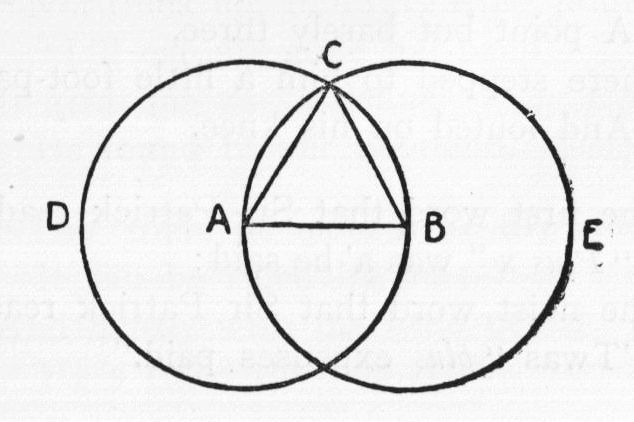
The King sits in Dunfermline toun Drinking the blude-red wine: "O wha will rear me an equilateral triangle Upon a given straight line?" O up and spake an eldern knight, Sat at the King's right knee— "Of a' the clerks by Granta side Sir Patrick bears the gree. "'Tis he was taught by the Tod-huntére Tho' not at the tod-hunting; Yet gif that he be given a line, He'll do as brave a thing." Our King has written a braid letter To Cambrigge or thereby, And there it found Sir Patrick Spens Evaluating Π. He hadna warked his quotient A point but barely three, There stepped to him a little foot-page And louted on his knee. The first word that Sir Patrick read, "Plus x," was a' he said: The neist word that Sir Patrick read, 'Twas "plus expenses paid." The last word that Sir Patrick read, The tear blinded his e'e: "The pound I most admire is not In Scottish currencie." Stately stepped he east the wa', And stately stepped he north: He fetched a compass frae his ha' And stood beside the Forth, Then gurly grew the waves o' Forth, And gurlier by-and-by— "O never yet was sic a storm, Yet it isna sic as I!" Syne he has crost the Firth o' Forth Until Dunfermline toun; And tho' he came with a kittle wame Fu' low he louted doun. "A line, a line, a gude straight line, O King, purvey me quick! And see it be of thilka kind That's neither braid nor thick." "Nor thick nor braid?" King Jamie said, "I'll eat my gude hat-band If arra line as ye define Be found in our Scotland." "Tho' there be nane in a' thy rule, It sail be ruled by me;" And lichtly with his little pencil He's ruled the line A B. Stately stepped he east the wa', And stately stepped he west; "Ye touch the button," Sir Patrick said, "And I sall do the rest." And he has set his compass foot Untill the centre A, From A to B he's stretched it oot— "Ye Scottish carles, give way!" Syne he has moved his compass foot Untill the centre B, From B to A he's stretched it oot, And drawn it viz-a-vee. The tane circle was BCD, And A C E the tither: "I rede ye well," Sir Patrick said, "They interseck ilk ither. "See here, and where they interseck— To wit with yon point C— Ye'll just obsairve that I conneck The twa points A and B. "And there ye have a little triangle As bonny as e'er was seen; The whilk is not isosceles, Nor yet it is scalene." "The proof! the proof!" King Jamie cried: "The how and eke the why!" Sir Patrick laughed within his beard— "'Tis ex hypothesi— "When I ligg'd in my mither's wame, I learn'd it frae my mither, That things was equal to the same, Was equal ane to t'ither. "Sith in the circle first I drew The lines B A, B C, Be radii true, I wit to you The baith maun equal be. "Likewise and in the second circle, Whilk I drew widdershins, It is nae skaith the radii baith, A B, AC, be twins. "And sith of three a pair agree That ilk suld equal ane, By certes they maun equal be Ilk unto ilk by-lane." "Now by my faith!" King Jamie saith, "What plane geometrie! If only Potts had written in Scots, How loocid Potts wad be!" "Now wow's my life!" said Jamie the King, And the Scots lords said the same, For but it was that envious knicht, Sir Hughie o' the Graeme. "Flim-flam, flim-flam!" and "Ho indeed?" Quod Hughie o' the Graeme; "'Tis I could better upon my heid This prabblin prablem-game." Sir Patrick Spens Was nothing laith When as he heard "flim-flam," But syne he's ta'en a silken claith And wiped his diagram. "Gif my small feat may better'd be, Sir Hew, by thy big head, What I hae done with an A B C Do thou with X Y Z." Then sairly sairly swore Sir Hew, And loudly laucht the King; But Sir Patrick tuk the pipes and blew, And played that eldritch thing! He's play'd it reel, he's play'd it jig, And the baith alternative; And he's danced Sir Hew to the Asses' Brigg, That's Proposetion Five. And there they've met, and there they've fet, Forenenst the Asses' Brigg, And waefu', waefu' was the fate That gar'd them there to ligg. For there Sir Patrick's slain Sir Hew, And Sir Hew Sir Patrick Spens— Now was not that a fine to-do For Euclid's Elemen's? But let us sing Long live the King! And his foes the Deil attend 'em: For he has gotten his little triangle, Quod erat faciendum!
[1] This was written some time before the entente cordiale.
MARCH.
How quietly its best things steal upon the world! And in a world where a single line of Sappho's survives as a something more important than the entire political history of Lesbos, how little will the daily newspaper help us to take long views!
Whether England could better afford to lose Shakespeare or her Indian Empire is no fair question to put to an Englishman. But every Englishman knows in his heart which of these two glories of his birth and state will survive the other, and by which of them his country will earn in the end the greater honour. Though in our daily life we—perhaps wisely—make a practice of forgetting it, our literature is going to be our most perdurable claim on man's remembrance, for it is occupied with ideas which outlast all phenomena.
The other day Mr. Bertram Dobell, the famous bookseller of Charing Cross Road, rediscovered (we might almost say that he discovered) a poet. Mr. Dobell has in the course of his life laid the Republic of Letters under many obligations. To begin with, he loves his trade and honours the wares in which he deals, and so continues the good tradition that should knit writers, printers, vendors and purchasers of books together as partakers of an excellent mystery. He studies—and on occasion will fight for—the whims as well as the convenience of his customers. It was he who took arms against the Westminster City Council in defence of the out-of-door-stall, the 'classic sixpenny box,' and at least brought off a drawn battle. He is at pains to make his secondhand catalogues better reading than half the new books printed, and they cost us nothing. He has done, also, his pious share of service to good literature. He has edited James Thomson, him of The City of Dreadful Night. He has helped us to learn more than we knew of Charles Lamb. He has even written poems of his own and printed them under the title of Rosemary and Pansies, in a volume marked 'Not for sale'—a warning which I, as one of the fortunate endowed, intend strictly to observe. On top of this he has discovered, or rediscovered, Thomas Traherne.
Now before we contemplate the magnitude of the discovery let us rehearse the few facts known of the inconspicuous life of Thomas Traherne. He was born about the year 1636, the son of a Hereford shoemaker, and came in all probability (like Herbert and Vaughan) of Welsh stock. In 1652 he entered Brasenose College, Oxford, as a commoner. On leaving the University he took orders; was admitted Rector of Credenhill, in Herefordshire, in 1657; took the degree of Bachelor of Divinity in 1669; became the private chaplain of Sir Orlando Bridgman, at Teddington; and died there a few months after his patron, in 1674, aged but thirty-eight. He wrote a polemical tract on Roman Forgeries, which had some success; a treatise on Christian Ethicks, which, being full of gentle wisdom, was utterly neglected; an exquisite work, Centuries of Meditations, never published; and certain poems, which also he left in manuscript. And there the record ends.
Next let us tell by how strange a chance this forgotten author came to his own. In 1896 or 1897 Mr. William T. Brooke picked up two volumes of MS. on a street bookstall, and bought them for a few pence. Mr. Brooke happened to be a man learned in sacred poetry and hymnology, and he no sooner began to examine his purchase than he knew that he had happened on a treasure. At the same time he could hardly believe that writings so admirable were the work of an unknown author. In choice of subject, in sentiment, in style, they bore a strong likeness to the poems of Henry Vaughan the Silurist, and he concluded that they must be assigned to Vaughan. He communicated his discovery to the late Dr. Grosart, who became so deeply interested in it that he purchased the manuscripts and set about preparing an edition of Vaughan, in which the newly-found treasures were to be included. Dr. Grosart, one may say in passing, was by no means a safe judge of characteristics in poetry. With all his learning and enthusiasm you could not trust him, having read a poem with which he was unacquainted or which perchance he had forgotten, to assign it to its true or even its probable author. But when you hear that so learned a man as Dr. Grosart considered these writings worthy of Vaughan, you may be the less apt to think me extravagant in holding that man to have been Vaughan's peer who wrote the following lines:—
"How like an Angel came I down! How bright are all things here! When first among His works I did appear how their Glory me did crown! The world resembled His Eternity, In which my soul did walk; And everything that I did see Did with me talk. "The streets were paved with golden stones, The boys and girls were mine, O how did all their lovely faces shine! The sons of men were holy ones; In joy and beauty they appeared to me: And everything which here I found, While like an angel I did see, Adorned the ground." 'Proprieties.'—
That is to say, 'properties,' 'estates.'—
"Proprieties themselves were mine, And hedges ornaments, Walls, boxes, coffers, and their rich contents Did not divide my joys, but all combine. Clothes, ribbons, jewels, laces, I esteemed My joys by others worn; For me they all to wear them seemed When I was born."
Dr. Grosart then set about preparing a new and elaborate edition of Vaughan, which, only just before his death, he was endeavouring to find means to publish. After his death the two manuscripts passed by purchase to Mr. Charles Higham, the well-known bookseller of Farringdon Street, who in turn sold them to Mr. Dobell. Later, when a part of Dr. Grosart's library was sold at Sotheby's, Mr. Dobell bought—and this is perhaps the strangest part of the story—a third manuscript volume, which Dr. Grosart had possessed all the time without an inkling that it bore upon Mr. Brooke's discovery, "though nothing is needed but to compare it with the other volumes in order to see that all these are in the same handwriting."
Mr. Dobell examined the writings, compared them with Vaughan's, and began to have his doubts. Soon he felt convinced that Vaughan was not their author. Yet, if not Vaughan, who could the author be?
Again Mr. Brooke proved helpful. To a volume of Giles Fletcher's, Christ's Victory and Triumph, which he had edited, Mr. Brooke had appended a number of seventeenth-century poems not previously collected; and to one of these, entitled 'The Ways of Wisdom,' he drew Mr. Dobell's attention as he had previously drawn Mr. Grosart's. To Mr. Dobell the resemblance between it and the manuscript poems was at once evident. Mr. Brooke had found the poem in a little book in the British Museum entitled, A Serious and Patheticall Contemplation of the Mercies of God, in several most Devout and Sublime Thanksgivings for the same (a publisher's title it is likely): and this book contained other pieces in verse. These having been copied out by Mr. Dobell's request, he examined them and felt no doubt at all that the author of the manuscript poem and of the Devout and Sublime Thanksgivings must be one and the same person. But, again, who could he be?
A sentence in an address 'To the Reader' prefixed to the Devout and Sublime Thanksgivings provided the clue. The editor of this work (a posthumous publication), after eulogising the unnamed author's many virtues wound up with a casual clue to his identity:—
"But being removed out of the Country to the service of the late Lord Keeper Bridgman as his Chaplain, he died young and got early to those blissful mansions to which he at all times aspir'd."
But for this sentence, dropped at haphazard, the secret might never have been resolved. As it was, the clue—that the author of Devout and Sublime Thanksgivings was private chaplain to Sir Orlando Bridgman—had only to be followed up; and it led to the name of Thomas Traherne. This information was obtained from Wood's Athenae Oxonienses, which mentioned Traherne as the author of two books, Roman Forgeries and Christian Ethicks.
The next step was to get hold of these two works and examine them, if perchance some evidence might be found that Traherne was also the author of the manuscripts, which as yet remained a guess, standing on Mr. Dobell's conviction that the verses in the manuscripts and those in Devout and Sublime Thanksgivings must be by the same hand.
By great good fortune that evidence was found in Christian Ethicks, in a poem which, with some variations, occurred too in the manuscript Centuries of Meditations. Here then at last was proof positive, or as positive as needs be.
The most of us writers hope and stake for a diuturnity of fame; and some of us get it. Sed ubi sunt vestimenta eorum qui post vota nuncupata perierunt? "That bay leaves were found green in the tomb of St. Humbert after a hundred and fifty years was looked upon as miraculous," writes Sir Thomas Browne. But Traherne's laurel has lain green in the dust for close on two hundred and thirty years, and his fame so cunningly buried that only by half a dozen accidents leading up to a chance sentence in a dark preface to a forgotten book has it come to light.
I wonder if his gentle shade takes any satisfaction in the discovery? His was by choice a vita fallens. Early in life he made, as we learn from a passage in Centuries of Meditations, his election between worldly prosperity and the life of the Spirit, between the chase of fleeting phenomena and rest upon the soul's centre:—
"When I came into the country and, being seated among silent trees and woods and hills, had all my time in my own hands, I resolved to spend it all, whatever it cost me, in the search of Happiness, and to satiate the burning thirst which Nature had enkindled in me from my youth; in which I was so resolute that I chose rather to live upon ten pounds a year, and to go in leather clothes, and to feed upon bread and water, so that I might have all my time clearly to myself, than to keep many thousands per annum in an estate of life where my time would be devoured in care and labour. And God was so pleased to accept of that desire that from that time to this I have had all things plentifully provided for me without any care at all, my very study of Felicity making me more to prosper than all the care in the whole world. So that through His blessing I live a free and kingly life, as if the world were turned again into Eden, or, much more, as it is at this day."
Yet Traherne is no quietist: a fervent, passionate lover, rather, of simple and holy things. He sees with the eyes of a child: the whole world shines for him 'apparell'd in celestial light,' and that light, he is well aware, shines out on it, through the eyes which observe it, from the divine soul of man. The verses which I quoted above strike a note to which he recurs again and again. Listen to the exquisite prose in which he recounts the 'pure and virgin apprehension' of his childhood:—
"The corn was orient and immortal wheat which never should be reaped nor was ever sown. I thought it had stood from everlasting to everlasting. The dust and stones of the street were as precious as gold; the gates were at first the end of the world. The green trees when I saw them first through one of the gates transported and ravished me; their sweetness and unusual beauty made my heart to leap and almost mad with ecstasy, they were such strange and wonderful things. The Men! O what venerable and reverend creatures did the aged seem! Immortal Cherubim! And young men glittering and sparkling angels, and maids strange seraphic pieces of life and beauty! Boys and girls tumbling in the street were moving jewels; I knew not that they were born, or should die.… The streets were mine, the temple was mine, the people were mine, their clothes and gold and silver were mine, as much as their sparkling eyes, fair skins, and ruddy faces. The skies were mine, and so were the sun and moon and stars, and all the world was mine; and I the only spectator and enjoyer of it.…"
All these things he enjoyed, his life through, uncursed by the itch for 'proprietorship': he was like the Magnanimous Man in his own Christian Ethicks—'one that scorns the smutty way of enjoying things like a slave, because he delights in the celestial way and the Image of God.' In this creed of his all things are made for man, if only man will inherit them wisely: even God, in conferring benefits on man, is moved and rewarded by the felicity of witnessing man's grateful delight in them:—
"For God enjoyed is all His end, Himself He then doth comprehend When He is blessed, magnified, Extoll'd, exalted, prais'd, and glorified."
Yes, and 'undeified almost, if once denied.' A startling creed, this; but what a bold and great-hearted one! To Traherne the Soul is a sea which not only receives the rivers of God's bliss but 'all it doth receive returns again.' It is the Beloved of the old song, 'Quia Amore Langueo;' whom God pursues, as a lover. It is the crown of all things. So in one of his loveliest poems he shows it standing on the threshold to hear news of a great guest, never dreaming that itself is that great guest all the while—
ON NEWS I. News from a foreign country came, As if my treasure and my wealth lay there: So much it did my heart enflame, 'Twas wont to call my soul into mine ear, Which thither went to meet The approaching sweet, And on the threshold stood To entertain the unknown Good. It hover'd there As if 'twould leave mine ear, And was so eager to embrace The joyful tidings as they came, 'Twould almost leave its dwelling-place To entertain that same. II. As if the tidings were the things, My very joys themselves, my foreign treasure, Or else did bear them on their wings— With so much joy they came, with so much pleasure— My Soul stood at that gate To recreate Itself with bliss, and to Be pleased with speed. A fuller view It fain would take, Yet journeys back again would make Unto my heart: as if 'twould fain Go out to meet, yet stay within To fit a place to entertain And bring the tidings in. III. What sacred instinct did inspire My Soul in childhood with a hope so strong? What secret force moved my desire To expect my joy, beyond the seas, so young? Felicity I knew Was out of view; And being here alone, I saw that happiness was gone From me! For this I thirsted absent bliss, And thought that sure beyond the seas, Or else in something near at hand I knew not yet (since nought did please I knew), my bliss did stand, IV. But little did the infant dream That all the treasures of the world were by: And that himself was so the cream And crown of all which round about did lie. Yet thus it was: The Gem, The Diadem, The Ring enclosing all That stood upon this earthly ball; The Heavenly Eye, Much wider than the sky, Wherein they all included were, The glorious Soul that was the King Made to possess them, did appear A small and little thing.
I must quote from another poem, if only for the pleasure of writing down the lines:—
THE SALUTATION. These little limbs, These eyes and hands which here I find, These rosy cheeks wherewith my life begins— Where have ye been? Behind What curtain were ye from me hid so long? Where was, in what abyss, my speaking tongue? When silent I So many thousand, thousand years Beneath the dust did in a chaos lie, How could I smiles or tears Or lips or hands or eyes or ears perceive? Welcome ye treasures which I now receive!
These poems waited for two hundred and thirty years to be discovered on a street bookstall! There are lines in them and whole passages in the unpublished Centuries of Meditations which almost set one wondering with Sir Thomas Browne "whether the best of men be known, or whether there be not more remarkable persons forgot than any that stand remembered in the known account of Time?"
I am tempted, but will not be drawn to discuss how Traherne stands related to Vaughan on the one hand and Cowley on the other. I note the discovery here, and content myself with wondering if the reader share any of my pleasure in it and enjoyment of the process which brought it to pass. For me, I was born and bred a bookman. In my father's house the talk might run on divinity, politics, the theatre; but literature was the great thing. Other callings might do well enough, but writers were a class apart, and to be a great writer was the choicest of ambitions. I grew up in this habit of mind, and have not entirely outgrown it yet; have not so far outgrown it but that literary discussions, problems, discoveries engage me though they lie remote from literature's service to man (who has but a short while to live, and labour and vanity if he outlast it). I could join in a hunt after Bunyan's grandmothers, and have actually spent working days in trying to discover the historical facts of which Robinson Crusoe may be an allegory. One half of my quarrel with those who try to prove that Bacon wrote Shakespeare rests on resentment of the time they force me to waste; and a new searcher for the secret of the Sonnets has only to whistle and I come to him—though, to be sure, that gentleman almost cured me who identified the Dark Lady with Ann Hathaway, resting his case upon—
SONNET CCXVIII. Whoever hath my wit, thou hast thy Will: And where is Will alive but hath a way? So in device thy wit is starvèd still And as devised by Will. That is to say, My second-best best bed, yea, and the gear withal Thou hast; but all that capital messuage Known as New Place goes to Susanna Hall. Haply the disproportion may engage The harmless ail-too-wise which otherwise Might knot themselves disknitting of a clue That Bacon wrote me. Lastly, I devise My wit, to whom? To wit, to-whit, to-whoo! And here revoke all previous testaments: Witness, J. Shaw and Robert Whattcoat, Gents.
After this confession you will pardon any small complacency that may happen to betray itself in the ensuing narrative.
Mr. Dobell followed up his discovery of Traherne by announcing another trouvaille, and one which excited me not a little:—
"Looking recently over a parcel of pamphlets which I had purchased, I came upon some loose leaves which were headed A Prospect of Society. The title struck me as familiar, and I had only to read a few lines to recognise them as belonging to [Goldsmith's] The Traveller. But the opening lines of my fragment are not the opening lines of the poem as it was published; in fact, the first two lines of A Prospect of Society are lines 353-4 in the first edition of The Traveller.… A further examination of the fragment which I had discovered showed that it is not what is usually understood as a 'proof' of The Traveller, but rather the material, as yet formless and unarranged, out of which it was to be finally evolved."
Now—line for corresponding line—the text discovered by Mr. Dobell often differs, and sometimes considerably, from that of the first edition of The Traveller, and these variations are highly interesting, and make Mr. Dobell's 'find' a valuable one. But on studying the newly discovered version I very soon found myself differing from Mr. Dobell's opinion that we had here the formless, unarranged material out of which Goldsmith built an exquisitely articulated poem.[1] And, doubting this, I had to doubt what Mr. Dobell deduced from it—that "it was in the manner in which a poem, remarkable for excellence of form and unity of design, was created out of a number of verses which were at first crudely conceived and loosely connected that Goldsmith's genius was most triumphantly displayed." For scarcely had I lit a pipe and fallen to work on A Prospect of Society before it became evident to me (1) that the lines were not "unarranged," but disarranged; and (2) that whatever the reason of this disarray, Goldsmith's brain was not responsible; that the disorder was too insane to be accepted either as an order in which he could have written the poem, or as one in which he could have wittingly allowed it to circulate among his friends, unless he desired them to believe him mad. Take, for instance, this collocation:—
"Heavens! how unlike their Belgic sires of old! Rough, poor, content, ungovernably bold; Where shading elms beside the margin grew, And freshen'd from the waves the zephyr blew."
Or this:—
"To kinder skies, where gentler manners reign, We turn, where France displays her bright domain. Thou sprightly land of mirth and social ease, Pleas'd with thyself, whom all the world can please, How often have I led thy sportive choir With tuneless pipe, along the sliding Loire? No vernal bloom their torpid rocks display, But Winter lingering chills the lap of May; No zephyr fondly sooths the mountain's breast, But meteors glare and frowning storms invest."
Short of lunacy, no intellectual process would account for that sort of thing, whereas a poem more pellucidly logical than The Traveller does not exist in English. So, having lit another pipe, I took a pencil and began some simple counting, with this result:—
The first 42 lines of The Prospect correspond with lines 353-400 of The Traveller. The next 42 with lines 311-352. The next 34 with lines 277-310. The next 36 with lines 241-276. The next 36 with lines 205-240. The next 36 with lines 169-204. The next 38 with lines 131-168. The next 28 with lines 103-130. And the remaining fragment of 18 lines with lines 73-92.
In other words, The Prospect is merely an early draft of The Traveller printed backwards in fairly regular sections.
But how can this have happened? The explanation is at once simple and ridiculous. As Goldsmith finished writing out each page of his poem for press, he laid it aside on top of the pages preceding; and, when all was done, he forgot to sort back his pages in reverse order. That is all. Given a good stolid compositor with no thought beyond doing his duty with the manuscript as it reached him, you have what Mr. Dobell has recovered— an immortal poem printed wrong-end-foremost page by page. I call the result delightful, and (when you come to think of it) the blunder just so natural to Goldsmith as to be almost postulable.
Upon this simple explanation we have to abandon the hypothesis that Goldsmith patiently built a fine poem out of a congeries of fine passages pitchforked together at haphazard—a splendid rubbish heap; and Mr. Dobell's find is seen to be an imperfect set of duplicate proofs—fellow, no doubt, to that set which Goldsmith, mildly objurgating his own or the printer's carelessness, sliced up with the scissors and rearranged before submitting it to Johnson's friendly revision.
The pleasantest part of the story (for me) has yet to come. We all know how easy it is to turn obstinate and defend a pet theory with acrimony. Mr. Dobell did nothing of the sort. Although his enthusiasm had committed him to no little expense in publishing The Prospect, with a preface elaborating his theory, he did a thing which was worth a hundred discoveries. He sat down, convinced himself that my explanation was the right one, and promptly committed himself to further expense in bringing out a new edition with the friendliest acknowledgment. So do men behave who are at once generous of temper and anxious for the truth.
He himself had been close upon the explanation. In his preface he had actually guessed that the "author's manuscript, written on loose leaves, had fallen into confusion and was then printed without any attempt at rearrangement." In fact, he had hit upon the right solution, and only failed to follow up the clue.
His find, too, remains a valuable one; for so far as it goes we can collate it with the first edition of The Traveller, and exactly discover the emendations made by Johnson, or by Goldsmith after discussion with Johnson. Boswell tells us that the Doctor "in the year 1783, at my request, marked with a pencil the lines which he had furnished, which are only line 420, 'To stop too faithful, and too faint to go,' and the concluding ten lines, except the last couplet but one.… He added, 'These are all of which I can be sure.'" We cannot test his claim to the concluding lines, for the correspondent passage is missing from Mr. Dobell's fragment; but Johnson's word would be good enough without the internal evidence of the verses to back it. "To stop too faithful, and too faint to go," is his improvement, and an undeniable one, upon Goldsmith's "And faintly fainter, fainter seems to go." I have not been at pains to examine all the revised lines, but they are numerous, and generally (to my thinking) betray Johnson's hand. Also they are almost consistently improvements. There is one alteration, however,— unmistakably due to Johnson,—which some of us will join with Mr. Dobell in regretting. Johnson, as a fine, full-blooded Jingo, naturally showed some restiveness at the lines—
"Yes, my lov'd brother, cursed be that hour When first ambition toil'd for foreign power,"
And induced Goldsmith to substitute—
"Yes, brother, curse with me that baleful hour When first ambition struck at regal power,"
Which may or may not be more creditable in sentiment, but is certainly quite irrelevant in its context, which happens to be a denunciation of the greed for gold and foreign conquest. It is, in that context, all but meaningless, and must have irritated and puzzled many readers of a poem otherwise clearly and continuously argued. In future editions of The Traveller, Goldsmith's original couplet should be restored; and I urge this (let the Tory reader be assured) not from any ill-will towards our old friend the Divine Right of Kings, but solely in the sacred name of Logic.
Such be the bookman's trivial adventures and discoveries. They would be worse than trivial indeed if they led him to forget or ignore that by which Goldsmith earned his immortality, or to regard Traherne merely as a freak in the history of literary reputations, and not primarily as the writer of such words as these—
"A little touch of something like pride is seated in the true sense of a man's own greatness, without which his humility and modesty would be contemptible virtues." "It is a vain and insipid thing to suffer without loving God or man. Love is a transcendent excellence in every duty, and must of necessity enter into the nature of every grace and virtue. That which maketh the solid benefit of patience unknown, its taste so bitter and comfortless to men, is its death in the separation and absence of its soul. We suffer but love not." "All things do first receive that give: Only 'tis God above That from and in Himself doth live; Whose all-sufficient love Without original can flow, And all the joys and glories show Which mortal man can take delight to know. He is the primitive, eternal Spring, The endless Ocean of each glorious thing. The soul a vessel is, A spacious bosom, to contain All the fair treasures of His bliss, Which run like rivers from, into, the main, And all it doth receive, return again." "You never enjoy the world aright till the sea itself floweth in your veins, till you are clothed with the heavens and crowned with the stars."
[1] Early editions of Goldsmith's poem bore the title, The Traveller; or, A Prospect of Society. Later editions dropped the sub-title.
APRIL.
"Thus, then, live I Till 'mid all the gloom By Heaven! the bold sun Is with me in the room Shining, shining! "Then the clouds part, Swallows soaring between; The spring is alive And the meadows are green! "I jump up like mad, Break the old pipe in twain, And away to the meadows, The meadows again!"
The poem of FitzGerald's from which these verses come was known, I believe, to very few until Mr. E. V. Lucas exhumed it from Half-hours with the Worst Authors, and reprinted it in that delightful little book The Open Road. I have a notion that even FitzGerald's most learned executor was but dimly aware of its existence. For my part, at this time of the day, I prefer it to his Omar Khayyàm—perversely, no doubt. In the year 1885 or thereabouts Omar, known only to a few, was a wonder and a treasure to last one's lifetime; but I confess that since a club took him up and feasted his memory with field-marshals and other irrelevant persons in the chair, and since his fame has become vulgarised not only in Thames-side hotels, but over the length and breadth of the North American continent, one at least of his admirers has suffered a not unnatural revulsion, until now he can scarcely endure to read the immortal quatrains. Immortal they are, no doubt, and deserve to be by reason of their style—"fame's great antiseptic." But their philosophy is thin after all, and will not bear discussion. As exercise for a grown man's thought, I will back a lyric of Blake's or Wordsworth's, or a page of Ibsen's Peer Gynt against the whole of it, any day.
This, however, is parenthetical. I caught hold of FitzGerald's verses to express that jollity which should be every man's who looks up from much reading or writing and knows that Spring has come.
"Solvitur acris hiems grata vice veris et favoni Trahuntque siccas machinæ carinas…"
In other words, I look out of the window and decide that the day has arrived for launching the boat—
"This is that happy morn, That day, long wishèd day!"
And, to my mind, the birthday of the year. Potentates and capitalists who send down orders to Cowes or Southampton that their yachts are to be put in commission, and anon arrive to find everything ready (if they care to examine), from the steam capstan to the cook's apron, have little notion of the amusement to be found in fitting out a small boat, say of five or six tons. I sometimes doubt if it be not the very flower, or at least the bloom, of the whole pastime. The serious face with which we set about it; the solemn procession up the river to the creek where she rests, the high tide all but lifting her; the silence in which we loose the moorings and haul off; the first thrill of buoyant water underfoot; the business of stepping the mast; quiet days of sitting or pottering about on deck in the sunny harbour; vessels passing up and down, their crews eyeing us critically as the rigging grows and the odds and ends—block, tackle and purchase—fall into their ordered places; and through it all the expectation running of the summer to come, and 'blue days at sea' and unfamiliar anchorages—unfamiliar, but where the boat is, home will be—
"Such bliss Beggars enjoy, when princes oft do miss."
Homer, who knew what amused men, constantly lays stress on this business of fitting out:—
"Then at length she (Athene) let drag the swift ship to the sea, and stored within it all such tackling as decked ships carry. And she moored it at the far end of the harbour.… So they raised the mast of pine tree, and set it in the hole of the cross plank, and made it fast with forestays, and hauled up the white sails with twisted ropes of oxhide."
And again:
"First of all they drew the ship down to the deep water, and fixed the oars in leathern loops all orderly, and spread forth the white sails. And squires, haughty of heart, bare for them their arms,"—but you'll observe that it was the masters who did the launching, etc., like wise men who knew exactly wherein the fun of the business consisted. "And they moored her high out in the shore water, and themselves disembarked. There they supped and waited for evening to come on."
You suggest, perhaps, that our seafaring is but play: and you are right. But in our play we catch a cupful of the romance of the real thing. Also we have the real thing at our doors to keep us humble. Day by day beneath this window the statelier shipping goes by; and our twopenny adventurings and discoveries do truly (I believe) keep the greater wonder and interest awake in us from day to day—the wonder and interest so memorably expressed in Mr. Bridges's poem, A Passer By:—
"Whither, O splendid ship, thy white sails crowding, Leaning across the bosom of the urgent West, That fearest nor sea rising, nor sky clouding, Whither away, fair rover, and what thy quest? Ah! soon when Winter has all our vales opprest, When skies are cold and misty, and hail is hurling, Wilt thou glide on the blue Pacific, or rest In a summer haven asleep, thy white sails furling? "I there before thee, in the country so well thou knowest, Already arrived am inhaling the odorous air: I watch thee enter unerringly where thou goest, And anchor queen of the strange shipping there, Thy sails for awnings spread, thy masts bare.".… "And yet, O splendid ship, unhailed and nameless, I know not if, aiming a fancy, I rightly divine That thou hast a purpose joyful, a courage blameless, Thy port assured in a happier land than mine. But for all I have given thee, beauty enough is thine. As thou, aslant with trim tackle and shrouding, From the proud nostril curve of a prow's line In the offing scatterest foam, thy white sails crowding."
Though in all human probability I shall never be the first to burst into a silent sea, I can declare quite seriously that I never steer into an unfamiliar creek or haven but, as its recesses open, I can understand something of the awe of the boat's crew in Andrew Marvell's "Bermudas;" yes, and something of the exultation of the great Columbus himself!
In a later paper I may have to tell of these voyages and traffickings. For the while I leave the reader to guess how and in what corner of the coast I happened on the following pendant to Mr. Dobell's trouvaille.
It may not challenge comparison with Mr. Flinders Petrie's work in Egypt or with Mr. Hogarth's Cretan explorations; but I say confidently that, since Mr. Pickwick unearthed the famous inscribed stone, no more fortunate or astonishing discovery has rewarded literary research upon our English soil than the two letters which with no small pride I give to the world this month.
Curiously enough, they concern Mr. Pickwick.
But, perhaps, by way of preface I shall remind the reader that the final number of Pickwick was issued in November, 1837. The first French version—which Mr. Percy Fitzgerald justly calls 'a rude adaptation rather than a translation'—appeared in 1838, and was entitled Le Club de Pickwickistes, Roman Comique, traduit librement de l'Anglais par Mdme. Eugenie Giboyet. With equal justice Mr. Fitzgerald complains (The History of Pickwick, p. 276) that "the most fantastic tricks are played with the text, most of the dialogue being left out and the whole compressed into two small volumes." Yet, in fact, Mme. Giboyet (as will appear) was more sinned against than sinning. Clearly she undertook to translate the immortal novel in collaboration with a M. Alexandre D—', and was driven by the author's disapproval to suppress M. D—'s share of the work. The dates are sufficient evidence that this was done (as it no doubt had to be done) in haste. I regret that my researches have yielded no further information respecting this M. Alexandre D—'. The threat in the second letter may or may not have been carried out. I am inclined to hope that it was, feeling sure that the result, if ever discovered, will prove in the highest degree entertaining. With this I may leave the letters to speak for themselves.
(1)
"45 Doughty Street," "September 25th, 1837." "MY DEAR MADAM,—It is true that when granting the required permission to translate Pickwick into French, I allowed also the license you claimed for yourself and your collaborateur—of adapting rather than translating, and of presenting my hero under such small disguise as might commend him better to a Gallic audience. But I am bound to say that—to judge only from the first half of your version, which is all that has reached me—you have construed this permission more freely than I desired. In fact, the parent can hardly recognise his own child. "Against your share in the work, Madame, I have little to urge, though the damages you represent Mrs. Bardell as claiming—300,000 francs, or £12,000 of our money—strikes me as excessive. It is rather (I take as my guide the difference in the handwriting) to your collaborateur that I address, through you, my remonstrances. "I have no radical objection to his making Messrs. Snodgrass, Winkle, and Tupman members of His Majesty King Louis XIII.'s corps of Musketeers, if he is sincerely of opinion that French taste will applaud the departure. I even commend his slight idealisation of Snodgrass (which, by the way, is not the name of an English mountain), and the amorousness of Tupman (Aramis) gains—I candidly admit—from the touch of religiosity which he gives to the character; though I do not, as he surmises, in the course of my story, promote Tupman to a bishopric. The development—preferable as on some points the episcopal garb may be considered to the green velvet jacket with a two-inch tail worn by him at Madame Chasselion's fête champetre— would jar upon our Anglican prejudices. As for Winkle (Porthos), the translation nicely hits off his love of manly exercises, while resting his pretensions on a more solid basis of fact than appears in the original. In the incident of the baldric, however, the imposture underlying Mr. W.'s green shooting-coat is conveyed with sufficient neatness. "M. D—' has been well advised again in breaking up the character of Sam Weller and making him, like Cerberus, three gentlemen at once. Buckingham (Jingle) and Fenton (a capital rendering of the Fat Boy) both please me; and in expanding the episode of the sausage and the trouser-buttons M. D—' has shown delicacy and judgment by altering the latter into diamond studs. "Alas! madam, I wish the same could be said for his treatment of my female puppets, which not only shocks but bewilders me. In her earlier appearances Mrs. Bardell (Milady) is a fairly consistent character; and why M. D—' should hazard that consistency by identifying her with the middle-aged lady at the great White Horse, Ipswich, passes my comprehension. I say, madam, that it bewilders me; but for M. D—'s subsequent development of the occurrences at that hostelry I entertain feelings of which mere astonishment is, perhaps, the mildest. I can hardly bring myself to discuss this with a lady; but you will allow me to protest in the very strongest terms that Mr. Pickwick made that unfortunate mistake about the sleeping apartment in the completest innocence, that in ejaculating 'ha-hum' he merely uttered a note of warning, and that 'ha-hum' is not (as M. D—' suspects) an English word from which certain syllables have been discreetly removed; that in thrusting his head through the bed-curtains he was, as I am careful to say, 'not actuated by any definite object'; and that, as a gentleman should, he withdrew at the earliest possible moment. His intercepted duel with Mr. Peter Magnus (De Wardes) rests, as I fondly imagined I had made clear, upon a complete misunderstanding. The whole business of the fleur-de-lys on Mrs. Bardell's shoulder is a sheer interpolation and should be expunged, not only on grounds of morality, but because when you reach the actual trial, 'Bardell v. Pickwick,' you will find this discovery of the defendant's impossible either to ignore or to reconcile with the jury's verdict. Against the intervention of Richelieu (Mr. Nupkins) I have nothing to urge. M. D—' opines that I shall in the end deal out poetical justice to Mrs. Bardell as Milady. He is right. I have, indeed, gone so far as to imprison her; but I own that her execution (as suggested by him) at the hands of the Queer Client, with Pickwick and his friends (or, alternatively, Mrs. Cluppins, Mr. Perker, and Bob Sawyer) as silent spectators, seems to me almost as inconsistent with the spirit of the tale as his other proposal to kidnap Mr. Justice Stareleigh in the boot of Mr. Weller's coach, and substitute for his lordship the Chancery prisoner in an iron mask. I trust, madam, that these few suggestions will, without setting any appreciable constraint on your fancy, enable you to catch something more of the spirit of my poor narrative than I have been able to detect in some of the chapters submitted; and I am, with every assurance of esteem, Your obliged servant, Boz." "P.S.—The difference between Anjou wine and the milk punch about which you inquire does not seem to me to necessitate any serious alteration of the chapter in question. M. D—'s expressed intention of making Master Bardell in later life the executioner of King Charles I. of England must stand over for some future occasion. The present work will hardly yield him the required opportunity for dragging in King Charles' head."