XII (continued 2)
Reading edition
I must tell you that we have received a citation, and Colonel Hill's brother the Croix de Guerre for the work we did during the attack of October 15 to 19. Two more citations and we receive, each one, the Croix de Guerre.
L. C. D.
Poignant Impressions
I had a wild ride last night in the rain. A German shell landed in a town only two kilometres from the front and killed four civilians and wounded one woman. I had to go and get her. For two kilometres the road runs over a slight rise in the plain, in full view of the Germans. It is all screened off with brush cut and stuck up along the side toward the lines, but here and there the brush was blown down by the terrific wind which came with the storm. We could not use lights, but we did not need them, for, though it was raining like fury, the Germans were sending up illuminating bombs which lighted up the country for miles around. They are the most fascinating yet weird things you have ever witnessed. This ball of fire rises from the trenches to a height of one hundred feet, and then floats along slowly through the air for a quarter of a mile, illuminating everything around. At one time one came directly for us, and we stopped the car and watched it. At the roadside stood a huge crucifix, and, as this ball of fire approached, it silhouetted the cross, and all we could see was the beautiful shadow of the figure on the cross rising from the earth against the weird glow of white fire. It seemed like the sacrifice of Calvary and the promise of success for poor France.
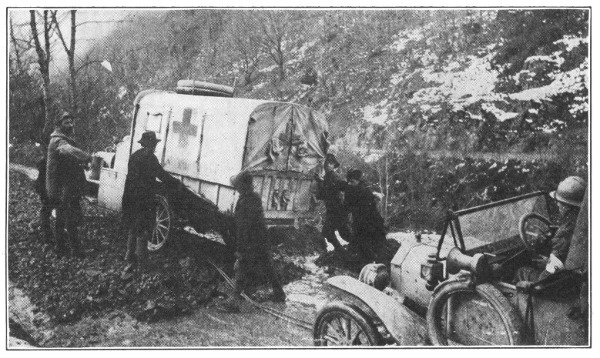
ONE OF OUR CARS IN TROUBLE
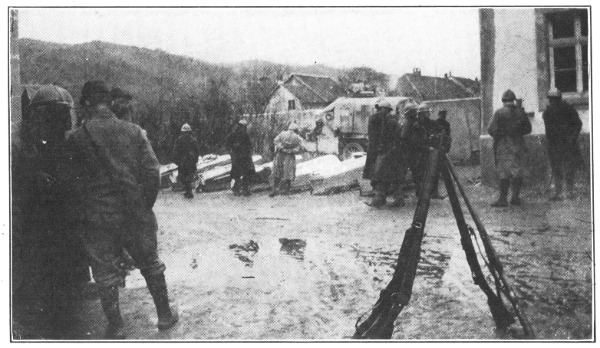
COFFINS IN COURTYARD OF BASE HOSPITAL IN ALSACE—AMONG THEM RICHARD HALL'S
We did not dare to use our low speed for fear the Boches would hear us, so we tore over this road on high, rushing past the bare spots, afraid of being seen. The illuminating bombs are used for this purpose only; the one which came toward us went out before it reached us, for which we were grateful. We got the woman. She had to have her arm amputated.
December 27
We have had very strenuous times, as a big attack has just taken place and the wounded have come in so fast and so badly cut up they could not give them the care they would like to, as everything is so crowded. The Germans lost a lot of trenches, and almost two thousand of them were taken prisoners. They have been shelling the French lines and towns constantly; since the 22d, our cars have been more or less under fire. We moved our quarters about six kilometres nearer the line and bring the wounded in to the hospital three times a day. The Germans shelled this place,—why we do not know, for there is nothing military here but the hospital, and why should people of any intelligence and feeling wish to shell a hospital?
One of our men was killed on Christmas Day and we are terribly broken up over it. He was going from this hospital to the poste we go to daily over a road up the mountain. At four o'clock Christmas morning one of our boys started up this road, which goes up and up with no level place on it. He passed the middle of the journey when he thought he noticed a wagon turned over about forty feet down in the ravine. He went to a point where he could stop his car, took his lantern, and walked back. He found one of our Fords so demolished it could not be distinguished. The top of the car was up in a tree and so were the extra tires; there was nothing on the ground but a chassis. He saw no one around, but on going down a little farther, he saw a bundle of blankets which we always carry for the wounded, and, on walking up to it, he found one of our fellows, Dick Hall. He was lying on his side with his arms fixed as if driving and in a sitting position, cold and rigid. He had been dead a couple of hours. Walter, who found him, went back up the road for assistance, and, while there, Hall's brother came along in his car and asked what the matter was and offered his assistance. Walter told him his brakes were not working and he was fixing them, so Hall, knowing nothing of his brother, passed on up the mountain, got his load of wounded, and took them to the hospital.
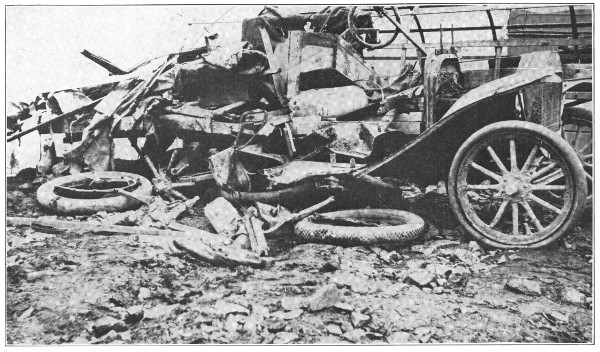
RICHARD HALL'S CAR AFTER SHELL LANDED UNDER IT
In the Hospital
January 1, 1916
This brings the war home to us! This and the suffering and torments of the wounded make me sick at heart. I have seen them suffer particularly since this last attack, as I am a blessé myself—and am in a French hospital. It is only a slight arm wound; the bone is cracked a little, but not broken. I am here to have the piece of shell drawn out and am assisting these poor wounded all I can. I was sent to the poste we have nearest the lines, on the other side of the mountain and hidden in the woods. The trenches begin at this poste. The poste itself is an abri, a bomb-proof dug-out in the ground. The roof and supports are made of timbers a foot or more thick, over these are placed two feet of heavy rock and again two feet of earth. When I got there the Germans began bombarding, and fired shells into these woods and into this poste for almost five hours. I never want to see another such bombardment; it was frightful. I saw shells land among horses, smash big trees in half within ten and twenty yards. I saw three men hit; one had his face shot away. The poste became so full of wounded we had to stand near the doorway, which is partly protected by a bomb-proof door. It was not exactly safe inside, for the shells, if big enough, when they hit such an abri often loosen the supports, and the roof, weighing tons, falls in and buries people alive. A man in the same room with me in the hospital here was in an abri not far from where we were when it was struck; the roof fell and killed three men who were with him and he was buried for an hour. A shell struck a tree not eight feet off from where we were standing and smashed it in half; it fell and almost killed one of two brancardiers (stretcher-bearers) who were carrying a dead man past the door. A piece of the éclat hit the other brancardier in the head and killed him. The man standing beside me had his hand shot off, and I got hit in the elbow. Three pieces went through my coat, but only one went into the arm. If I had not been standing against the door I might have fared worse. I was carried with two other wounded by one of our fellows up the steep mountain road to our second poste. They were bombarding that road as well as the poste. We could see the sky redden from the flash of the guns below and we could hear the shells shriek as they came toward us, and the éclat not too far away. Twice we started the Ford on the way up; it stalled and took five precious minutes to get it going again. The force of one explosion knocked the fellow with me over when he walked ahead to try and make out the road. We stuck in the road twice, not daring to pass a wagon conveying munitions. We could not make the hill, it was so steep, and we had to seek men to push us. It was pitch-black and we could not use our lights. This with two gravely wounded men on our hands rather took the nerve out of us. We finally got back to headquarters and found them bombarding there, one shell having struck not far from the hospital.
January 20
I am still in the hospital, but am glad to say my arm is almost quite well again. It does take time. The bombardment by the Germans of all our former postes has become pretty nerve-racking. The house we took for the attack has been hit twice. We had moved out only the day before. They struck a schoolhouse close by and killed a nun and wounded three harmless children. Our cars have been hit by scraps of shell, but fortunately when none of the men were in them.
The suffering of the men in this hospital and the cries in the night make it an inferno. Though I am glad I can help a little, I must say it is on my nerves.
In this hospital—which is one of the best—they need very badly beds for men who have had their vertebræ broken. These men live from two to six months in a frame on their backs all the time. This is the way they spend the last months of their lives. We have three men in this condition now, and each time they are moved it takes at least four men to change them and they suffer terribly. The special beds I speak of are made on pulleys with bottom and sides which can be opened for washing and service purposes. They cost forty dollars and France cannot afford to buy them, as she has so many needs. If you could raise some money for this purpose, you would be doing these poor fellows the last favors they will have on this earth and help them in their suffering.
L. C. D.
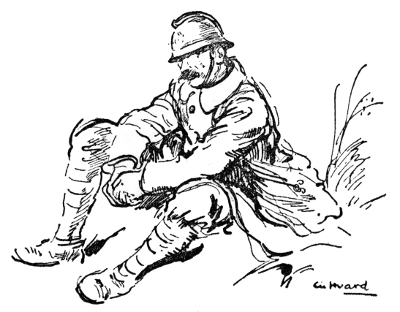
New Quarters
August 6, 1915
I was delighted to see "Doc" to-day. He arrived yesterday evening from Paris, but I was on M—— duty, so we did not meet until this morning. We had a long talk and I told him the story of the fatal 22d; the recital of it only seems to have reimpressed me with the horror of that night.
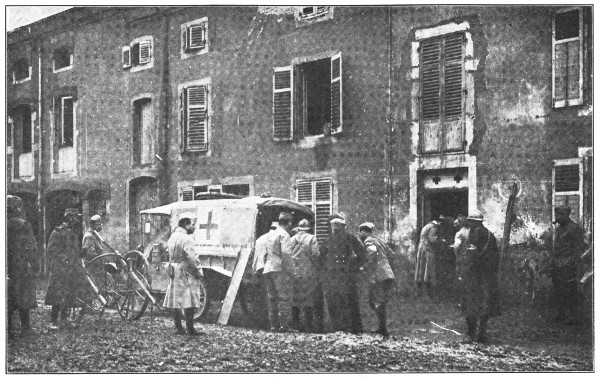
A "POSTE DE SECOURS" AT MONTAUVILLE
We are now quite comfortably settled in our new quarters, a house never shelled until just after our occupation of it, when we received a 77 a few feet from our windows. I do not know why it has been spared unless the Boches were anxious not to destroy a creation so obviously their own. Architecturally it is incredible—a veritable pastry cook's chef d'œuvre. Some of the colors within are so vivid that hours of darkness cannot drive them out of vision. There is no piano, but musical surprises abound. Everything you touch or move promptly plays a tune, even a stein plays "Deutschland über alles"—or something. Still the garden full of fruit and vegetables will make up for the rest. Over the brook which runs through it is a little rustic bridge—all imitation wood made of cast iron! Just beneath the latter I was electrified to discover a very open-mouthed and particularly yellow crockery frog quite eighteen inches long! A stone statue of a dancing boy in front of the house was too much for us all. We ransacked the attic and found some articles of clothing belonging to our absent hostess, and have so dressed it that, with a tin can in its hand, it now looks like an inadequately clad lady speeding to her bath-house with a pail of fresh water.
Last night "Mac" and I were on night duty at M——, and when we arrived at the telephone bureau—where we lie on stretchers fully dressed in our blankets waiting for a call (the rats would keep you awake if there were no work to do)—we were told that they expected a bad bombardment of the village. "Mac" and I tossed up for the first call, and I lost. "Auberge Saint-Pierre, I bet," laughed "Mac." That is our worst trip—but it was to be something even more unpleasant than usual. About eleven o'clock the Boches started shelling the little one-street village with 105 shrapnel. In the midst of it a brancardier came running in to ask for an ambulance—three couchés, "très pressé." Of course, I had to grin and bear it, but it is a horrid feeling to have to go out into a little street where shells are falling regularly—start your motor—turn—back—and run a few yards down the street to a poste de secours where a shell has just landed and another is due any moment.
"Are your wounded ready?" I asked, as calmly as I could. "Oui, monsieur." So out I went—and was welcomed by two shells—one on my right and the other just down the street. I cranked up No 10, the brancardier jumped up by my side, and we drove to our destination. I decided to leave the ambulance on the left side of the road (the side nearer the trenches and therefore more protected by houses from shell-fire), as I thought it safer on learning that it would be fifteen minutes before the wounded were ready; and luckily for me, for a shell soon landed on the other side of the road where I usually leave the ambulance. My wounded men were now ready; it appeared that one of the shrapnel shells had entered a window and exploded inside a room where seven soldiers, resting after a hard day's work in the trenches, were sleeping—with the appalling result of four dead and three terribly wounded. As I felt my way to the hospital along that pitch-black road, I could not help wondering why those poor fellows were chosen for the sacrifice instead of us others in the telephone bureau—sixty yards down the street.
However, here I am writing to you, safe and sound, on the little table by my bedside, with a half-burnt candle stuck in a Muratti cigarette box. Outside the night is silent—my window is open and in the draught the wax has trickled down on to the box and then to the table—unheeded—for my thoughts have sped far. To Gloucester days, and winter evenings spent in the old brown-panelled, raftered room, with its pewter lustrous in the candlelight; and the big, cheerful fire that played with our shadows on the wall, while we talked or read—and were content. Well—that peace has gone for a while, but these days will likewise pass, and we are young. It has been good to be here in the presence of high courage and to have learned a little in our youth of the values of life and death.
Leslie Buswell
The Poetry of War
We have had much talk to-night about the probable effect of the war upon art and literature in different countries, and gradually the discussion shifted from prophecy to history and from the abstract to the concrete, and narrowed down to the question as to the best poem the war has already produced. In France enough verse has been inspired by the war to fill a "five-foot shelf" of India-paper editions, but we all had finally to admit that none of us was in a position to choose the winner in such a vast arena. Among the short poems in English, some voted for Rupert Brooke's sonnet which begins:—
"If I should die, think only this of me: That there's some corner of a foreign field That is forever England."
But nothing that any of us has seen is more inspired than the verses which poured from the heart and mind of a young American in the Foreign Legion here in France. His name is Alan Seeger, and the poem was written in, and named from, the region in which his regiment was stationed. It is called "Champagne, 1914-15," and was printed in the North American Review for October, 1915.
CHAMPAGNE, 1914-15
In the glad revels, in the happy fêtes, When cheeks are flushed, and glasses gilt and pearled With the sweet wine of France that concentrates The sunshine and the beauty of the world, Drink, sometimes, you whose footsteps yet may tread The undisturbed, delightful paths of Earth, To those whose blood, in pious duty shed, Hallows the soil where that same wine had birth. Here, by devoted comrades laid away, Along our lines they slumber where they fell, Beside the crater at the Ferme d'Alger And up the bloody slopes of La Pompelle, And round the city whose cathedral towers The enemies of Beauty dared profane, And in the mat of multicolored flowers That clothe the sunny chalk-fields of Champagne. Under the little crosses where they rise The soldier rests. Now round him undismayed The cannon thunders, and at night he lies At peace beneath the eternal fusillade.... That other generations might possess— From shame and menace free in years to come— A richer heritage of happiness, He marched to that heroic martyrdom. Esteeming less the forfeit that he paid Than undishonored that his flag might float Over the towers of liberty, he made His breast the bulwark and his blood the moat. Obscurely sacrificed, his nameless tomb Bare of the sculptor's art, the poet's lines, Summer shall flush with poppy-fields in bloom, And Autumn yellow with maturing vines. There the grape-pickers at their harvesting Shall lightly tread and load their wicker trays, Blessing his memory as they toil and sing In the slant sunshine of October days. I love to think that if my blood should be So privileged to sink where his has sunk, I shall not pass from Earth entirely, But when the banquet rings, when healths are drunk, And faces, that the joys of living fill, Glow radiant with laughter and good cheer, In beaming cups some spark of me shall still Brim toward the lips that once I held so dear. So shall one, coveting no higher plane Than Nature clothes in color and flesh and tone, Even from the grave put upward to attain The dreams youth cherished and missed and might have known. And that strong need that strove unsatisfied Toward earthly beauty in all forms it wore, Not death itself shall utterly divide From the beloved shapes it thirsted for. Alas, how many an adept, for whose arms Life held delicious offerings, perished here— How many in the prime of all that charms, Crowned with all gifts that conquer and endear! Honor them not so much with tears and flowers, But you with whom the sweet fulfilment lies, Where in the anguish of atrocious hours Turned their last thoughts and closed their dying eyes, Rather, when music on bright gatherings lays Its tender spell, and joy is uppermost, Be mindful of the men they were, and raise Your glasses to them in one silent toast. Drink to them—amorous of dear Earth as well, They asked no tribute lovelier than this— And in the wine that ripened where they fell, Oh, frame your lips as though it were a kiss.
Alan Seeger
ALAN SEEGER SOLDIER OF THE FOREIGN LEGION KILLED IN ACTION JULY 4, 1916
Yet, sought they neither recompense nor praise, Nor to be mentioned in another breath Than their blue-coated comrades whose great days It was their pride to share, ay! share even to death. Nay, rather, France, to you they rendered thanks (Seeing they came for honor, not for gain), Who, opening to them your glorious ranks, Gave them that grand occasion to excel, That chance to live the life most free from stain And that rare privilege of dying well.
From a poem written by him in memory of American Volunteers fallen for France, upon the occasion of a memorial service held before the Lafayette-Washington statue on the Place des États-Unis in Paris, May 30, 1916.