Volume 1 / Part 2 — I
Reading edition
THE INSURANCE CONTROVERSY
In the July, 1904, number of Everybody's Magazine I announced that I proposed to give to the world a story concerned with events which had taken place in real life—a true story.
I outlined it, giving the names of the persons and events it would deal with.
These things happened:
The edition of the magazine was sold out in three days; my chapter was printed in part or in full in nearly all the papers and periodicals of the United States and Canada; many of the representative journals, even in England, published long editorials on the subject, and with but few exceptions, editorials and news comments were favorable.
I was urged to continue. My second chapter appeared.
The magazine, with an additional 100,000 copies, was sold out in two days. The press took hold of the matter with even greater interest than it had accorded my first chapter.
The third chapter met with a still more cordial reception. The edition of the magazine, although increased another 100,000, sold out as before, and my mail expanded to a degree that surprised me. In addition to thousands of press notices and criticisms, I received ever so many letters from all classes of Americans and Canadians—teachers of the Word of God, and members of the flocks who are taught, earnest statesmen and insincere politicians, millionnaires and paupers, anarchists, socialists, municipal-ownershipists, and the hundred and one travelers on the beaten highways and lowways of life, who, spurred by ambition or unrest, pantingly seek a chance to blaze a way for the trudging millions of the future to that goal of all ambitious and restless dreamers—a people's Utopia. Nearly all appealed to me to give them the word as to the ultimate intention of "Frenzied Finance"—"Is it only to point to the sores, or will it prick them with its long sharp point and will its double edge cut the flesh in which they are rooted?" Others required further information or explanation about the subjects I had treated; another section questioned my statements and found fault with my disclosures. The volume of these communications and criticisms finally became so large and they were so urgent in tone that I made up my mind it was necessary to devise some fair and intelligent way to remove the writers' difficulties and resolve their doubts. The modern surgeon finds the preparation of a patient who is to go under the knife as important as the operation itself. My readers, unacquainted with the intricate details of finance and confused by the angry outcries and denials of those I had attacked, required education en route to be able to absorb and digest the hard facts and strong statements I was dealing out to them in monthly instalments. My publishers agreed with me as to the necessity of dealing in some radical way with the emergency, and devoted to my service additional pages in the back of Everybody's Magazine. Here I decided to begin a department to be called "Lawson and His Critics" in which I would solve the knotty problems my correspondents presented to me, set right their misunderstandings, and reply fully to those critics who had aspersed my motives or were attempting to discredit my message.
I began the department in October, 1904, and though I have been most seriously pressed for time, and in many instances have dealt imperfectly with the problems treated, I must say that the task I set myself has proved interesting and agreeable, and the letters the department evoked have been a tremendous source of inspiration and encouragement to me along the hail-stony road I had set myself to travel.
The bulk of the department during the months of 1904 was devoted to the subject of insurance. In an early chapter of my story I said that the three great insurance corporations, the New York Life, the Equitable, and the Mutual Life of New York, were an integral part of the "System," and especially instanced the New York Life as one of the most pliable tools of the "Made Dollar" makers. This statement, so mild and so vague in view of subsequent developments, was the first move in the historic controversy that has resulted in the extraordinary exposures that are being made as this book goes to press. When that first pebble was thrown, the surface of the insurance pond was as placid as a mountain lake, unruffled by a ripple, and in it were reflected the benignant faces of the noble philanthropists who consented to spend their days conserving the interests of the widows and the orphans of America. The people had grown so accustomed to regarding the McCalls, the Perkinses, the Hydes, the McCurdys, and the Alexanders, whose eminent physiognomies looked out at them from their insurance policies, as lofty and generous souls far removed from thoughts of pelf or self-aggrandizement, that my assertion caused consternation such as would occur in a Chinese temple if some rough intruder struck the idol, before whom a congregation was worshipping, with a stone. At once an avalanche of letters—protests, demands for further facts, anxious appeals from policy-holders—poured in upon me, and frankly I took up the subject, giving my readers exactly what they desired.
NEW HAMPSHIRE TRACTION
In order that the controversy may be unfolded in the manner in which it was first given to the public, I give here the first letter of the series, and then follow directly along with those passages from succeeding numbers that are devoted to the subject:
Buffalo, N. Y., August 25, 1904.
Mr. Thomas W. Lawson, Boston, Mass.
Dear Sir: I have been astounded beyond measure at the revelations you make in your second article regarding the New York Life Insurance Company, because I have two policies in that concern which I am keeping up for the protection of my family. My confidence in the company has been shaken by your revelations, and I wonder if much more can be said. Perhaps it is best for clean life insurance to tell all now—the rest will be the better for it. Do you really believe the officers of the company personally profited from using the "cash on hand" of the company? Go on in your exposure; you are doing a meritorious work, and we poor devils, plodders, will never cease to thank you for your work. Should like to have you intimate if anything more about New York Life is coming.
Yours truly,
—— ——
To this I replied: I desire to emphasize that the New York Life Insurance Company, which I cited, is no different from the Equitable and the Mutual Life, or many of the other large companies. They are links in the chain of the "System"—necessary links in the device by which dollars are "made," by which the savings of the people are sucked from the people to the "System," the "Private Things."
I will, later in my story, dwell upon this tremendous phase of this stupendous question, and will only say at the present time, as an answer to such questions as "Buffalo's": The insurance companies use the billions the people have placed with them to buy or create banks and trust companies, the stocks of which are a large part of their assets. They then use these banks and trust companies, which exist because of the people's savings, in stock gambling enterprises, speculations as unsafe and as frenzied as those of the wildest plunger of Wall Street. I will give one illustration:
The New York Life Insurance Company's directors and managers created the New York Security and Trust Company. $1,000,000 capital; $500,000 surplus—in all, $1,500,000. $150 per share, of which the insurance company held about two-thirds. The Trust Company soon secured deposits to the extent of about $50,000,000, and these it loaned out by "financing" new and old enterprises. Among them was the New Hampshire Traction. The Trust Company flourished. Its stock advanced in price to over $1,300 per share, or over $13,000,000, and its different speculative ventures prospered exceedingly. New Hampshire Traction kept pace with the rest and simultaneously with them bounded upward in value until the amount of this stock owned by the Trust Company represented a value of between $5,000,000 and $6,000,000. There came a time when the directors of the New York Life Insurance Company decided to dispose of their stock in the Trust Company, and did so to a syndicate composed of their own members, headed by John D. Rockefeller, at $800 per share. Afterward the stock disposed of at $800 per share advanced to over $1,300, or, with the third which had not been owned by the insurance company but by the "insiders" and their friends, to a total of over $13,000,000. Then came the slump, and the price of the New Hampshire Traction fell to twenty-five cents on the dollar, and the Trust Company's stock to less than $600.
If in all the histories of the wildcats of the wild catteries of Wall Street a wilder case of "frenzied finance" can be discovered, I don't know it, and yet this is only one of many I could quote, selected at random. Boiled down, it means that what was bought at $150 went to $1,400 and back to $590, and that it changed hands at $800 before it got to $1,400, and that the plunger in this transaction, which made this plunging possible, was one of the most conservative life insurance companies in America.
I will answer "Buffalo's" question by asking another:
Suppose all the insurance companies have been doing business on the same scale, and have tied up billions of the people's money in such schemes as New Hampshire Traction, and the people, learning these facts, should demand their savings to the extent of the $9,000,000,000 which they have deposited in banks and trust companies, what would happen? What would happen to the undigested securities, the insurance companies, the people's savings, and the policies such as "Buffalo" says he has purchased for the benefit of his family?
This statement precipitated a perfect flood of letters and queries, growing more urgent as the month wore on. It was impossible to answer all of them. I contented myself with replying to the letter of a prominent Philadelphia church-man, a policy-holder in the New York Life, who wrote as follows:
Philadelphia, September 23, 1904.
Mr. Thomas W. Lawson, Boston, Mass.
My Dear Sir: I have just finished reading the current article on "Frenzied Finance," and like "Buffalo" I am astounded at your statements regarding the "New York Life." I, too, have a policy in that company and have been led to believe that I was not only insured in the best and most conservative company, but that I had a first-class and perfectly safe investment as well. This particular company claims that not a dollar of its assets is invested in stocks of any kind, and yet, to quote from your article:
"The insurance companies use the billions the people have placed with them to buy or create banks and trust companies, the stocks of which are a large part of their assets."
Either you are manifestly unfair or else the company is guilty of deliberate falsehood for the purpose of deceiving the public.
As a policy-holder and prospective sharer in the surplus of the "New York Life," I am much interested in knowing whether its statements in regard to its investments are to be relied upon.
Will you take just a moment to answer the following question? Is the "New York Life" telling a falsehood when it states that not a dollar of its assets is invested in stocks of any kind?
Very respectfully yours,
—— ——
I replied: The transaction in regard to the New York Security Company and the New Hampshire Traction stocks was exactly as I set it forth. I can imagine no one but an absolute idiot who would dare to set it forth unless he knew he was dealing with facts.
Your high position in the church should, in my opinion, peculiarly fit you to answer fairly your question, "Is the New York Life telling a falsehood when it states that not a dollar of its assets is in stocks of any kind?" when I unqualifiedly state the fact that the New York Life owned the millions of the New York Security Company's stock; that it paid $150 a share for them and sold them to a syndicate of its own directors at $800 per share, and that the stock afterward sold at over $1,300 per share, and still afterward dropped to less than $600 per share. I did not wish to be unfair to the New York Life, or I should have stated, what I shall endeavor to show before my story is ended, that at the time the New York Life parted with these shares to their own directors at $800 per share they were actually worth and could have been sold for hundreds of dollars per share more.
THE HONESTY OF THE ONE MAN
At this the big insurance companies uncovered their guns, and soon the air, the newspapers, and my mail were full of underwriting explosions. It was necessary then to line up my forces and to go at the attack seriously. So, having carefully thought out a campaign which my knowledge of the men whom I was antagonizing taught me would bring results, I began, in December, as follows:
When I began to write "Frenzied Finance" I specifically stated that I should not concern myself with men, but with principles. I held that to put an end to the plundering of the people required more than the denunciation of individual criminals; that the real peril lay in the financial device through which the plundering was done and the "machine" developed for their operation. The "machine" is the tremendous correlation of financial institutions and forces that I call the "System," and the most potent factor in the "System" is the life insurance combine—the three great insurance companies, the New York Life, Mutual Life, and Equitable, with their billion of assets and the brimming stream of gold flowing daily into their coffers. That I should have to discuss the relation between the "System" and these great institutions was inevitable; but, knowing how vitally interested the public is in the preservation of the gigantic structures its savings have erected, I had thought to treat this phase of my subject later on, when my readers should be absolutely convinced by what had preceded it of the honesty and fairness of my purpose. Moreover, it did not seem possible to touch on life insurance conditions without involving the men who direct the three great companies, and whom policy-holders and the people at large have been taught to regard as men of wellnigh miraculous sagacity, integrity, and beneficence. With these men I have had none but the pleasantest relations, and determined as I am on the performance of my task, I go about it with the reluctance a surgeon feels when, in order to save a friend's life, he must amputate his limb.
A contingency has now arisen which compels me to depart from my rule and to discuss much more frankly than I had purposed at this juncture, the New York Life Insurance Company, the system which controls it, and its president, John A. McCall, the "System's" representative.
In reply to the inquiries of an anxious policy-holder, who had taken alarm at my statement that the funds of these great corporations were under the control of the "System," I stated in the October issue of Everybody's Magazine that the New York Life was, as well as its so-called competitors, the Equitable and the Mutual, as much a participant in the frenzied speculation of the period as were the plunging Wall Street stock gamblers; but in giving an illustration of its methods (the New York Security and Trust Company and the New Hampshire Traction Company) I selected a case which would not unnecessarily alarm nervous people, for the transaction showed an enormous profit as the result of a wild stock plunge, instead of an enormous loss—some of the New York Life's other deals were much less fortunate. When I stated that the New York Life disposed of its interest in the Security Trust Company to its directors for four millions of dollars, which represented a gain of over $3,000,000 on its original investment, I was careful not to state that the shares for which they paid $800 each were worth at the time $1,300 each, or $7,000,000 for what was sold for $4,000,000—particularly careful to state that they were afterward worth this additional amount.
Policy-holders in the three great life-insurance companies may argue: "The man who is known to us policy-holders as the real head of the New York Life is John A. McCall, its president. All that you may say about the 'System's' votaries being in control may be so, but we depend on the integrity and the character of this one man to protect our interests. He is our representative, not the 'System's,' and our savings are surely safe in his strong hands."
There is the point. In the great insurance corporations that are "one-man run," the hundreds of thousands of policy-holders have but one protection. This, notwithstanding the protection of the State laws, the guardianship of the Insurance Department of the various States, and the provisions of the company's charter and by-laws.
However impregnable may seem the safeguards which the law has built round the administration of our great insurance companies, the fact absolutely is that the honesty of "the one man" is the one potent protection policy-holders may depend on. The others may be juggled with as are the rules of the Stock Exchange, which say in thunder tones, "All within our sacred walls is honest and honorable," when in reality if the microbes of dishonor and dishonesty generated within Stock-Exchange walls each busy week of every year should be collected and disseminated throughout the land, they would give typhoid of the soul to our eighty millions of Americans. So it becomes the duty of every policy-holder to find out by such tests as he can apply, "Is 'the one man' who runs our company an honest man or is he a dishonest man?" If "the one man" stands their tests, if he emerges from their ordeal clean, strong, honest, as they believed, then they may rest awhile in patience. But if he is revealed as dishonest, then it behooves the policy-holders of that company to take measures for the protection of their interests. The welfare and happiness, perhaps the very lives of their mothers, their wives, and their children depend on their action.
I was recently waited upon by an important man.
"Lawson, what are you doing in life insurance?" he asked.
"Giving facts about the life-insurance branch of a 'System' which is foully plundering the people," I answered.
"What are you trying to do?"
"Educate the millions of life-insurance policy-holders to their present peril; after they are educated, arouse them to quick, radical action."
"What are you going to do?" he asked.
"I am going to cause a life-insurance blaze that will make the life-insurance policy-holders' world so light that every scoundrel with a mask, dark-lantern, and suspicious-looking bag will stand out so clearly that he cannot escape the consequences of his past deeds, nor commit new ones."
"Have you figured the consequences to yourself?"
"Having no interest in what the consequences may be to myself in performing what I have decided is a sacred duty, I have not."
"Let me show them to you. First let me ask, do you intend to confine your criticisms to the New York Life Insurance Company?"
"I intend to bring out the facts, particularly as to the New York Life, the Mutual Life, and the Equitable Life; and, so far as in my power lies, as to every other life-insurance company in America that is connected with the 'System.'"
"Are you actuated by any selfish motives—gain, revenge, or friendly interest in certain life-insurance companies or banks or trust companies?"
"My only interest is to perform a duty in righting a startling wrong, and I would not undertake the terrible task if I could possibly avoid it."
"I am sent to ask you these questions, to find out whether, if you are only seeking to serve the policy-holders, and the insurance companies can absolutely prove to you that your making public your facts will cause terrible destruction to policy-holders' interests, you will consent to forego the life-insurance branch of your story?"
"I know the facts. I have calmly, and I believe intelligently, reviewed the effects of their being given to the world, and have concluded that the damage to policy-holders and the people would, in any circumstances or conditions, be greater because of my not doing what I have decided to do than by my doing it. Therefore I will not in any circumstances consent to stop until I have laid before the world those things I consider it should know."
"Well and good. Let me show you what you are up against. The Equitable, the New York Life, and Mutual Life Insurance Companies, and their affiliated institutions and individuals, are to-day by all odds the greatest power in the world, greater by all odds than any power that can possibly be gathered together from those outside themselves, a power so great that the effort of no man nor party of men outside themselves can possibly prevail against their wishes."
"Stop where you are for a minute," I answered, "and let me run over to you what I know I am up against, and then you can judge whether I appreciate the difficulties of my task:
"First, the three companies I have named have absolute possession of property and money in the form of assets of over $1,000,000,000—more than half the combined assets of all the insurance companies of America—and indirectly, through their affiliated institutions, of an additional sum, the aggregate of which is much greater than the assets of all the national banks of America and the great financial institutions of Europe, such as the Banks of England, France, and Germany. The three have a ready cash surplus of almost $200,000,000, which is greater than the combined capital of the four greatest institutions of Europe—the Banks of England, Russia, France, and Germany. The income of these three companies is, each year, $100,000,000 greater than the combined capitals of the Banks of England, Russia, France, and Germany—or about $250,000,000, $200,000,000 of which is taken each year from their policy-holders in the form of premiums. Yet from out of this income there is returned to their policy-holders each year in dividends less than $15,000,000, and in total payments of all kinds not over $100,000,000. And yet these three companies pay out each year in what they call expenses to keep the concerns running $50,000,000, paying to the officers of the companies $3,000,000 in salaries, almost $1,000,000 to their lawyers, and a number of millions in various forms of advertising.
"Second, the three companies are absolutely steered and controlled from a common centre, and the men who do the steering and controlling are the 'System's' foremost votaries, Henry H. Rogers, William Rockefeller, James Stillman, and J. Pierpont Morgan through George W. Perkins, a partner in J. Pierpont Morgan & Co. Mr. Rogers, vice-president of the Standard Oil Company, is a trustee of the Mutual Life and a director in one of the largest trust companies owned by the three great insurance companies, the Guaranty Trust Company of New York. William Rockefeller, vice-president of the Standard Oil Company, is a trustee of the Mutual Life and director in the National City—the 'Standard Oil'—Bank. James Stillman is a trustee of the New York Life, and president of the National City—the 'Standard Oil'—Bank of New York. George W. Perkins, partner of J. Pierpont Morgan & Co., is vice-president and trustee of the New York Life and a director in the National City—the 'Standard Oil'—Bank; while John A. McCall, the president of the New York Life, is a director in the National City—the 'Standard Oil'—Bank.
"These great institutions own a majority of the capital stock or have absolute control of a number of the leading banks and trust companies of New York and elsewhere; and such ownership shows conclusively the linking together of the three great insurance companies. For instance, the Equitable owns more than a majority of the stock of the Mercantile Trust Company of New York, of a book value of about $4,500,000 and a market value of almost $13,000,000; and of the Equitable Trust of New York, of a book value of $5,500,000 and a market value of $9,000,000; and of the Bank of Commerce of New York, of a book value of about $8,000,000 and a market value of over $9,000,000; and in the directory of the Mercantile Trust of New York and Equitable Trust is E. H. Harriman, one of the leading 'Standard Oil' men and one of the active votaries of the 'System,' while in the directory of the Bank of Commerce are the president of the Mutual Life and seven other trustees of the Mutual Life and three of the trustees of the New York Life.
"The Mutual Life owns stock of the Bank of Commerce, of a book value of $4,500,000 and a market value of $7,500,000; of the United States Mortgage & Trust Company, of a book value of $2,000,000 and a market value of $4,500,000; and of the Guaranty Trust Company of New York, of a book value of $1,250,000 and a market value of $5,500,000. The directors of the United States Mortgage & Trust Company consist of eight trustees of the Mutual Life, including its president, and two trustees of the Equitable Life, while in the Guaranty Trust directory is the president of the Mutual Life, Henry H. Rogers, and E. H. Harriman, 'Standard Oil' votary and director in the Equitable.
"In addition to these financial institutions, the Mutual Life has about $20,000,000 of its funds invested in the stock of twenty-five other trust companies and national banks, while the Equitable has about $10,000,000 invested in some fifteen other trust and banking institutions.
"Third, the absolute control of the three great companies, and through them of their subsidiary financial institutions, while supposed to be in the hands of the policy-holders, is entirely beyond their regulation, as all policy-holders of the three companies give over complete control of their companies to the 'System' through the following machinery: The control of the New York Life rests absolutely in President McCall, that of the Mutual Life with President McCurdy. Originally these men were elected to office by policy-holders' proxies, voted by the great general agents; but so immeasurable has been the growth of these corporations that only rebellion among policy-holders on an international scale could oust from power the McCalls and the McCurdys. The control of the Equitable Life rests in the $100,000 of capital stock which is almost entirely owned by the men who elect themselves to manage the company.
"Therefore you will see that I fully comprehend that this power, which you claim to be, and which undoubtedly is, the greatest on earth, is absolutely, for all practical purposes, in the hands of three men, and that any one who attempts to do anything contrary to what this power allows will find himself opposed by practically unlimited money, which can be used first to corrupt all sources of help, including State insurance-law enforcers, and then to keep such corruptions from the policy-holders by subsidizing the press. In other words, you see that I fully comprehend that I, or any man or any body of men, would be absolutely helpless in an attempt to correct present evils unless we could do two things: First, show to the policy-holders of the great insurance companies that they are absolutely in the hands and at the mercy of 'one man,' and next, that this 'one man' is unscrupulous."
In other and different ways I had it forcibly impressed upon me that I must go no further in connecting the life-insurance companies with "frenzied financiering"; that while the "Standard Oil"-Amalgamated-City Bank crowd might bide their time for reprisal and vengeance, the great insurance companies must at any cost instantly squelch those rash souls who dared to cross their paths. To all such warnings I replied that a life-insurance company, especially great institutions with hundreds of thousands of policy-holders, must be as far above suspicion as Cæsar's wife; that the security of the immense funds in their possession must be as unassailable as the United States Constitution; but that immunity from criticism could be secured only by honesty of purpose, honesty of method, and honesty of results; and that I would follow "frenzied finance" wherever it might lead, even if the exposure brought every life-insurance concern in the country down to the ring-bolt of making public confession of complicity. But with all my knowledge of the "System's" weakness, I never dreamed of the condition of fatuity into which the past few years of unbridled "frenzied finance" have plunged its votaries. If the correspondence that follows here correctly represents the purposes and the methods of great American life-insurance companies, I ask my readers what quick, sharp, effective means should be taken to call a halt and rescue the billions of the people's savings before it is too late. And I ask all policy-holders in the great insurance companies to weigh carefully what follows, that from it they may decide the question.
As soon as it became fixed in the minds of the different interested parties who had communicated with me that my purpose was unalterable, queer things happened:
First, there appeared in the press of the country, under large, black headlines, the startling confession of the editor of a New York financial paper, who, conscience-stricken, admitted that he had been engaged in the systematic blackmail of insurance companies and officials and Wall Street institutions such as banks and trust companies. It was a curious document, and even the casual reader must have wondered at the mysterious lack of detail. The paper, I found out later, was one of the innumerable swarm of journalistic insects generated, like mosquitoes, in the financial swamps of Wall Street, destined to live a day and die as they deliver their sting, and the attention given it was curiously out of proportion to its importance. Among other queer things, the editor announced that after printing his confession he would disappear; no names were mentioned nor a fact printed which identified any one or anything. All this could not happen without a motive, and I said to myself, "The 'System' is planting a mine for some one." Not another word appeared. I awaited developments. On October 8th I received the following letters, which tell their own story:
Fremont, Ohio, October 6, 1904.
Mr. Thomas W. Lawson, Boston, Mass.
My Dear Sir: I have followed with intensest interest your discussion of "Frenzied Finance." The exposé of the "System," and its Machiavellian performances, was highly interesting to me. I was associated with Attorney-General Monnett in his effort to get testimony and the inside facts concerning the trust and its operations in his prosecution against that corporation for violating the Ohio anti-trust law. At that time the books of the company were burned in Cleveland, and, as stated in your article, the company now relies upon the superior memory of Standard Oil.
I was well aware of the connection of certain life-insurance companies with Morgan and the Rockefellers, but until your public charge, was not familiar with the details. As I had considerable money invested myself in New York Life Insurance I wrote John A. McCall a bitter letter. In this age of commercialism sentimental benevolence gets little place. The common sentiments of humanity and appreciation of responsibility admonish one in moderate circumstances or even in affluence to invite the co-operation of others in providing for those dependent upon the individual hazard of life and fortune. Life insurance has come to be a sacred thing. It is the substantial token and expression of responsibility which a reasonable man dying leaves to those dependent upon him. I so wrote Mr. McCall, and told him that if the head of a great institution like the New York Life Insurance Company would be guilty of such perfidy as charged by you, the organization which would retain him in a position of responsibility was undeserving of confidence or patronage.
photograph of john a. mccall's reply to h. c. deran, the policyholder who had asked for a denial of mr. lawson's charges.
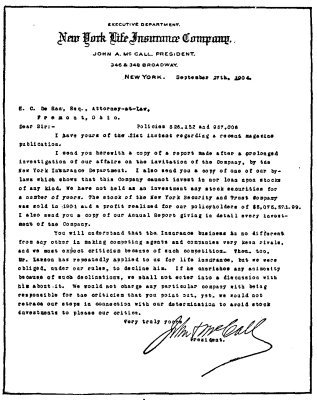
I enclose for your inspection Mr. McCall's reply. This is doubtless a sample of the sort of campaign waged throughout the country by the "System."
I enclose stamped envelope for the return of the McCall letter, as I purpose continuing the correspondence until I force him to an issue.
You will observe the very palpable evasion of the issue. I asked him if the details of the transaction described in Everybody's, in which the New York Life Insurance figured conspicuously, were true. He answered by saying that he made money out of the trust company venture and retired. The fact that New York Life money is so deposited as to suit the convenience of the "System" in its heads—I win, tails—you lose, operation, is a matter which has escaped the attention of the astute financier. I have written him further, calling his attention to the fact that his letter conveys no information not heretofore made public in circular but that my inquiry was directed to the particular transaction alluded to in Everybody's, and requesting a flat affirmation or denial.
Trusting that these facts may be of assistance to you, I am,
Yours very truly,
(Signed) H. C. DeRan.
I shall spare my readers the enclosures. They were newspaper slips, printed on fairly thick paper, reproduced from unknown publications, and obviously put forth to discredit me by implication. One, headed "A Frenzied Financial Blackmailer," from the Vigilant, New York City, September 30, 1904, presented the confession, previously referred to, made by the editor of the United States Investors' Guardian, and an editorial denouncing the blackmail of financial corporations. Another slip was "Stamp out the Fake Financial Newspaper Publisher" from the Fourth Estate, New York City, October 1, 1904, in which the wickedness of the aforesaid editor came in for further moral castigation.
At once, as I read these letters and ran over the printed slips pinned to Mr. McCall's, I realized the purpose of the blackmail editor's confession and just how so much space came to be given it in the daily papers. Insurance corporations are large advertisers[20] and enjoy great popularity in the business offices of great newspapers. It is not said in these clippings that either Mr. Lawson or Everybody's Magazine belongs to that lowest order of criminal, the self-confessed black-mailer, but the suggestion is obvious. Every policy-holder throughout the world who received these enclosures attached to letters from the greatest insurance president in America would instantly supply the connection—"'Frenzied finance black-mailer'—that's intended for Lawson, surely; 'Frenzied financial journal'—Everybody's Magazine, beyond question."
Will my readers weigh carefully this awful charge:
"Thomas W. Lawson, in addition to being a frenzied financial black-mailer, is attacking the New York Life Insurance Company because he tried to secure insurance from that company, and that company would not give it to him. His attack is made in the interest of some competing company."
Again, I ask that it be kept in mind that all this is not said by an insignificant and irresponsible trickster, but is deliberately put forth by the greatest insurance president in America, over his signature, to his policy-holder No. 826,152 and 957,006.
Soon afterward, in its issue of October 20th, a well-known organ of the insurance companies, The Spectator, published in New York, had a long article dealing with malicious attacks on our great insurance corporations, specifically mentioning my accusation against the New York Life. "Mr. Lawson was actuated by the meanest motives," says The Spectator.
Extract from The Spectator, October 20, 1904:
Mr. Lawson, in the hypocritical rôle of a would-be-reformed-speculator, is a figure calculated to stir the risibilities of all who have watched his antics and read his articles, especially when each one of the companies he mentions has repeatedly rejected him for insurance.
Letters to policy-holders from the New York Life Insurance officers poured in on me from different parts of the country, all containing the same defence and the same accusations as the one above, and signed by vice-presidents of the company as well as President McCall, showing conclusively that this great corporation as a corporation had deliberately adopted this method of meeting my serious yet conservatively put business accusations.
President McCall's defence of the New York Life Insurance Company and his reply to my accusations are now completely before my readers. Let us see if there is not a chance here to determine the grave question, "Is 'the one man' who runs each of our great insurance companies honest?"
The facts are: During the past twenty years I have been importuned, begged, and hounded by the several great insurance companies of the United States to take out policies with them almost upon any terms I might name. Of this statement I could present more photographic proof than would fit in any one issue of this magazine, but most of it would have no bearing on the point at issue.
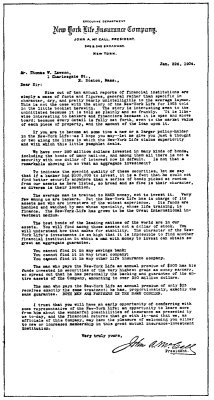
In the present year (1904)—to go no further back—John A. McCall has repeatedly urged me to come into the New York Life Insurance Company. Absolute evidence of the truth of this assertion is presented below. Mr. McCall's letter reproduced here would be accepted as complete proof in any court of justice. In the correspondence that follows this first letter it will be seen that Mr. McCall left no stone unturned in his effort to get me into the New York Life Insurance Company. A duplicate of the communication sent to my residence went on the same date to my office. To quote his own words, "I hope you may" and "I may have the pleasure of welcoming you either to new or increased membership in this great mutual insurance investment." Then, his anxiety being so great, after waiting four days for a reply he sent his special agent to argue with me, and, on the following day, his Boston manager to urge me further.
photograph of letter from john a. mccall soliciting insurance, sent to mr. lawson's house.
photograph of heading and signature of john a. mccall's letter of january 22d, sent in duplicate to mr. lawson's office; of special agent gillespie's letter of january 27th; of manager hayes's letter of january 28th. these three letters soliciting insurance, followed each other within a period of six days.
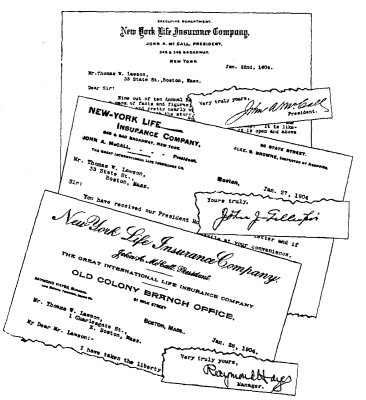
Is it any wonder that I called the history I am writing "Frenzied Finance"? The man who wrote the letter practically saying that I was a black-mailer and that my reason for attacking the New York Life was my anger because he would not take me into his company, and the man who wrote the ones begging me to come in, are one and the same; and he absolutely controls directly $400,000,000 of the people's savings in the New York Life, and indirectly unnumbered millions in affiliated institutions!
I think the case is complete. The policy-holders of the New York Life have an opportunity to decide whether the "one man" who runs the great institution in which their savings are invested is honest. In making up their minds, I implore them not at the present time, or at least until the question has been more fully ventilated, to allow their policies to lapse. Under any and all circumstances they should keep up the payment of their premiums, for the one thing especially desired and schemed for by some of the "frenzied finance" insurance companies is a wholesale lapse of policies.
Some few years ago the financial world learned with great interest of a new and very useful invention in finance. A group of individuals who had been buying large quantities of a certain stock at a low price, found they could not, on account of the fact of its overcapitalization having become known to the public, resell it; and they were, to use the stock-gambling term, "hung up" with it because it was too water-logged to float. It became necessary to disguise its identity. Here's how they did it: They formed a "syndicate," to which they "turned over" their stock at a good profit; the "syndicate" in its turn put it "in trust" by simply depositing the stock certificate with a trust company, which in its turn issued against the stocks thus held a new security, which it called a "bond." For these a ready market was found, for the word "bond" is still a term to conjure with in the world of finance.
This seemed such a serviceable arrangement that the originators soon had many imitators. Many "syndicates" were formed, and many so-called "bonds" were put on the market. In most cases the stocks were purchased at a low price, turned into "trusts" at double their cost, and then paid for by means of these certificates, dubbed "bonds." As one stock after another was converted into syndicate certificates—"bonds"—the familiarity of the procedure robbed it of its novelty and these "bonds" were quoted and dealt in much as other and more tangible securities bearing the same name. Perhaps this is why the startling announcement of the New York Life Insurance Company made about this time, that it proposed to sell all its stocks and thereafter hold nothing but bonds, created so much less of a sensation than was anticipated. The term "bond" had become vulgarized.
This excellent example would undoubtedly have had many followers but for the humor of the Tobacco Trust. This robust institution, with an immense amount of watered stock, audaciously poured it all but a small amount into bonds, $157,000,000 of them, and with a fine trumpet-blast proclaimed these "bonds" safe investments for widows, orphans, and insurance companies. Even Wall Street, with its frenzied votaries and its frenzied environment, was staggered. The culmination of these conversion performances was the brilliant plan evolved by George W. Perkins, the junior partner in the firm of J. Pierpont Morgan & Co., vice-president of the New York Life Insurance Company and expert investor of its vast surplus, to have the United States Steel Trust purchase some $200,000,000 worth of its own water-logged stock and convert the same into more "absolutely safe bonds"; for its most valuable services in the turning-over process the Morgan firm was to have a commission of some forty millions of dollars. At this juncture "frenzied finance" became gagged with its own froth, and I have not space here to go further into the subject.
The New York Life Insurance Company declares to its agents, policy-holders, and prospective policy-holders that it no longer holds stock securities. In its last report to the Insurance Commissioners there are set forth stock securities of the kind I have described above, to the amount of fifty millions of dollars. I will give one illustration:
"Northern Pacific—Great Northern—C., B. & Q. collateral 4s, book value—$12,057,132.59, market value—$11,375,000."—(From the official report to Insurance Commissioners.)
Now, these bonds are nothing more nor less than Chicago, Burlington and Quincy stock of a par value of $100 per share, which shares were purchased by individuals, and had "bonds" issued against them at $200 per share. (Northern Pacific and Great Northern stock in about the same proportion.) In the sense in which the public look upon the old bonds of railroads this "bond" is no more a bond than it is a Government bond. It is nothing more nor less than a stock security, and yet President McCall says in his letter printed above and sent by him to policy-holder DeRan that the New York Life does not and cannot invest its surplus in stock securities.
THE TRUE STORY OF HOW I WAS "BLACK-LISTED"
The publication of President McCall's letter and the charges which accompanied it attracted so much attention that the "Big Three" were flooded with letters from policy-holders demanding information. In the January, 1904, issue of Everybody's Magazine, I continued the controversy. After reviewing the conditions of the previous month's argument, I went on:
In entering upon the exposure of the most powerful body of men in the world, I knew quite well what I was "up against," and deliberately decided that in the conduct of my fight I would use such strategy as I believed proper to outwit so strong and so unscrupulous an adversary. One can hang a dog as well with a cord as with a hawser, and in proving my assertions I am quite willing that the insurance companies should believe each play is my best card. I decline, however, to show my hand.
In reply to the charge that I was attacking the New York Life because I had been refused insurance by that company, as positively stated in Mr. McCall's letter, I reproduced a letter written and signed by President John A. McCall, dated 1904, soliciting me to take out insurance in his company. I printed parts of three other letters, one directed to my office, also signed by Mr. McCall, another from the special agent, and a third from the Boston agent of the New York Life, supplementing Mr. McCall's letter and requesting the privilege of an interview.
This correspondence was put forth with a thorough understanding of its nature. The publishers of Everybody's Magazine and my own lawyers, to whom I submitted it, both pointed out that the insurance companies would undoubtedly take the ground that the McCall letter was no more than a circular that had been sent out to a number of capitalists and had gone to me by mistake. I replied that such a rejoinder would practically amount to an admission that the statement and signature of the highest officials of the New York Life were valueless and without significance, which would place President McCall in an untenable position. If his signature were valueless and without significance when appended to a letter addressed to me, why not in other instances if the interests of his corporation seemed to require such a disclaimer? Considering my argument, would not such a confession have a pregnant bearing on the proposition—is the "one man" honest, especially as I was equipped with additional documents to offset further attempts on the part of the insurance companies to show me up as a disappointed seeker after their policies?
Here, specifically, are the details of my encounter with the life-insurance institutions, and I pledge my word to my readers that they constitute all the facts in this connection. They are well known to the prominent men associated with the great companies whose duty it is to keep track of just such transactions. Whoever knows by experience of the incessant pursuit of business by the important insurance corporations need not be told that a man in my position has had his share of importuning by agents great and small. I have never sought life insurance, for it has not appealed to me as an investment, but on three separate occasions I have yielded to the persuasions of a friend connected with one of the big institutions and have considered the subject. The first time was in 1887, following a breakdown from overwork. This illness my friend used as an argument to induce me to take out insurance, and I went so far as to agree to submit to a private medical examination by the leading physicians of his company for the purpose of ascertaining if my breakdown, which for a brief time had left a trace of paralysis in my left side, would bar me. This examination was at my own expense, and it was expressly understood that, being private, it should not constitute a record. The physician pronounced me a perfect risk, but advised against going further inasmuch as a rigid rule of the company precluded them from granting insurance to any one who had suffered from this form of illness until seven years after the attack. I was not disappointed except on account of my friend.
Five years later his solicitation was renewed and I was assured that the officials of his company were so eager to have me that they would waive the seven-year rule, which still had two years to run. This time I went up before another medical examiner, and after the usual tests, was asked the stereotyped question if I had ever previously been rejected for life insurance. My friend replied for me—no. I, however, in spite of his protests stated fully the conditions of my previous examination, which the doctor assured me did not constitute an official rejection, and the application was filled out. In the conversation that ensued, the doctor said that it was safer to await the expiration of the seven years, and I being still indifferent, except to my friend's interest, accepted the apologies of the several people concerned for the trouble I had taken and let it go at that.
Four years later, in 1896, after the attack of appendicitis which I described in the December, 1904, instalment of "Frenzied Finance," again my good friend the agent came to me and used the incident of my narrow escape from death to impress upon me once more the desirability of having a large policy of life insurance. Those who have read the "System's" disclaimer, will remember that I had been blacklisted since 1892. There were the usual consultations with high officials of the corporation, and when all preliminary bargains had been arranged, I underwent a thorough examination in New York. This time, the seven-year term having expired, I was pronounced a perfect risk. But my latest illness had brought me up against another waiting rule, and once more the subject was abandoned after the usual expressions of regret and good-will. Since 1896 my connection with life-insurance companies has been about the same as that of a molasses barrel with the industrious flies in summer.
The interviews of 1892 and 1896 are both matters of record. My position in each instance was well understood, and several insurance officials who know the facts as well as I do have, since the publication of the company's statement, come to me and offered to back up my assertions with their own. American manhood is certainly not extinct when men are willing to sacrifice their careers to set a wrong right.
The manner in which the great companies have met my rejoinder to President McCall will afford my readers an excellent illustration of how the "System" goes after a man who has excited its antagonism.
A few days after the publication of the December issue of Everybody's Magazine, containing my fac-simile of President McCall's letter to policy-holder DeRan and his two letters to me, the Life Insurance Underwriters met and "resoluted" that I had applied for insurance in the New York Life Insurance Company in 1892, and being asked if I had ever been refused insurance, had replied in the negative. Investigation showed that I had been refused four years before by two other companies, whereupon my application was rejected and I was practically black-listed, and so could not secure life insurance in any American company. By way of corroborating this plausible story two letters, purporting to have been written by agents of the two companies to their head officers without my knowledge, were incorporated in the resolution. The letters stated that the writers could secure me for a large amount of insurance if the companies would accept the risk. The virtuous corporations were alleged to have replied that Mr. Lawson had been refused life insurance before, and for good reasons was not desired as a risk. This resolution was then published throughout the press of America in the news columns, and to all but those initiated in the desperate practices of the "System" and its votaries, it was conclusive evidence that an unprincipled man had been convicted, red-handed, of fraud.
You who read this statement of mine doubtless found the resolutions in your own paper, and thought it ordinary news-matter printed because of its public interest. This notice was an advertisement disguised as news, and inserted through the "System's" professional character assassinator, whose head-quarters are in Boston, a person who will occupy a prominent part in the chapters of my story wherein I treat of the crimes of Amalgamated. The publication cost the insurance companies $2.50 per line of the policy-holders' money, while advertisements that I insert in the course of my private business cost me but 75 cents per line.
HOW THE "SYSTEM" MAKES ITS PROFITS
It appeared that I had sinned still further, for had I not questioned the virtue and integrity of the New York Life's securities? To policy-holder DeRan, Mr. McCall had stated, over his own signature, that the New York Life did not and could not own stock securities. (See the DeRan letter on page 428.) I proved from the regular insurance reports that millions of the New York Life's bonds were no more than disguised stock securities, created by the new device of depositing stocks with a trust company at an inflated price and issuing against them a receipt which is arbitrarily called a "bond." I mentioned, as an illustration, the Northern Pacific-Great Northern-C., B. & Q. Collateral 4s, created out of the stock of the Chicago, Burlington & Quincy and other railroads. I could have selected a much worse type of security, just as, instead of the typewritten letter of Mr. McCall, I might have published others of a more personal nature.
Against me out sallied 2d Vice-President Perkins, brother of George W. Perkins, 1st Vice-President of the New York Life (J. Pierpont Morgan's partner), and at a banquet in Philadelphia boldly answered my aspersions by declaring that the bonds I named "are printed in the list of holdings which the company publishes in detail, and has published for the last five years, in order that its policy-holders may be informed of its affairs in the minutest detail." The convincing logic of this rejoinder the dullest will appreciate, but for a moment I must stop to remind Mr. Perkins that the publicity on which he plumes himself is really not an expression of the New York Life's individual frankness, but merely an observance compelled by the law.
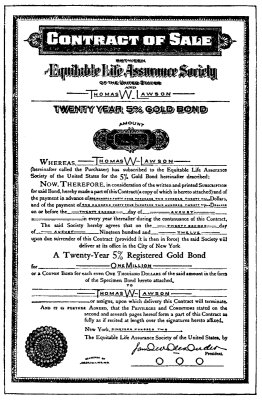
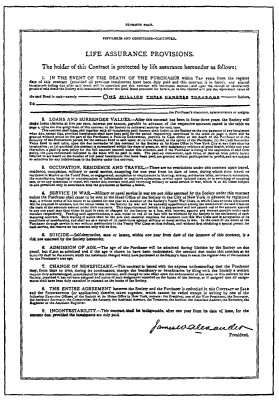
All this recapitulation has been for a purpose. My readers will bear in mind before taking hold of my next exhibit that the great insurance companies have published me as a falsifier, who since 1892 has been refused insurance and black-listed for good reasons, and have claimed that Mr. McCall's letters were circulars sent me by mistake. We are still considering the problem—are the men who run our great insurance companies honest? Well, look at the reproduction on page 442 of a document that is now in my possession and has always been since the date when it was delivered to me by one of the three great representatives of the "System," the Equitable Life Insurance Company.
This document speaks for itself. My readers are aware of the negotiations and investigations which precede the making of an insurance contract. To them and to the "System's" votaries I recommend the exhibit and the underwriters' resolutions as a simple lesson in frenzied finance.
My charge that the directors of the great life-insurance corporations of America use the funds of the companies they control in stock speculation for their personal benefit is but one contention in my argument against the character of their management. Here I formally add another charge: It is that in the placing of loans, in the purchase of properties and securities, and in the underwriting of enterprises, there are enormous profits made, directly and indirectly, which are pocketed by individuals and are never shown on the books of the corporation.
The basis of life insurance is security. A policy-holder pays his premium to enable the corporation accepting it to make good its contract with him when death or time matures it. The vast sums in the possession of the three great companies are accumulated to safeguard their policy-holders, and should be invested only in securities of tried and solid worth, which will bring in no more nor less than the going rate of interest. There must be no experiments and, above all, no speculation. But what do we find? The positions of managers and manipulators of these huge hoards of the people's money have become the greatest financial prizes of the day. New and ingenious methods of graft have been devised in connection with them. The vast revenues of the insurance companies have become the "System's" most potent instrument in working its will in the stock world.
Their investments, largely in the securities of properties or corporations in which the "System's" votaries have large interests, are fertile sources of profit to the "insiders." The groups of banks and trust companies affiliated with them are the medium through which access to the coveted insurance funds is obtained, for these institutions are allowed by law to use money for speculative purposes, which the insurance concerns are prohibited from doing.
The immense opportunities for profit afforded by the control of these great money hoards are taken advantage of in various ways. Let me illustrate one or two of them. Rogers, Rockefeller, Stillman, and Morgan buy the capital stock of three railways at a fair valuation, say, $20,000,000 apiece, $60,000,000 for the three. Owning all, or nearly all, the stock, they can put its price on the stock-exchanges to any figure they desire, say, $60,000,000 for each railway, or $180,000,000 in all. They proceed to deposit the stocks of the three roads in a trust company, issuing against them $180,000,000 of what they call "bonds." An "underwriting" syndicate is then organized. This is composed of certain individuals and corporations who agree that when these bonds are offered to the public at $180,000,000, the portion the public does not buy, they (the "underwriters") will purchase on the basis of $120,000,000; in other words, they guarantee the sale of the bonds at $180,000,000. In return they "make" on all the bonds sold the difference between the price to them, $120,000,000, and the price the public pays, $180,000,000. Let us assume that the public takes up the issue greedily and the full price, $180,000,000, has been secured. The original owners, Rogers, Rockefeller, etc., have made $60,000,000, the difference between the first cost and $120,000,000, the cost to the "underwriters," while the "underwriters" have made $60,000,000, the difference between $120,000,000 and the $180,000,000, the cost to the people. In looking over the list of subscribers to these bonds, you will note that the largest purchases have been made for the great insurance corporations and the banks and trust companies owned or controlled by them and "The System." If, in the instance I am using for illustration, a president or vice-president of one of the great insurance companies is known to be willing to subscribe for, say, $10,000,000 for his insurance company; $5,000,000 for his principal trust company, which is owned by the insurance company; $1,000,000 apiece for five other banks and trust companies, also owned or controlled by the insurance company; and can influence five other affiliated institutions to subscribe for $1,000,000 apiece, he controls, as will readily be seen, a purchasing power of $25,000,000, and is sought for as an underwriter, if he is not already an owner. For this $25,000,000 which his institutions buy he "draws down," as his personal profit, 33-1/3 per cent. "underwriters'" commission, or over eight millions of dollars.
In taking this amount, he is not robbing his insurance company, in the common acceptance of the term in this era of "frenzied finance," though he has absolutely appropriated to himself a profit which belongs to it and not to him.
It must not be supposed that such transactions as this I have outlined are conducted in the simple ABC fashion I have set down here for purpose of illustration. No "one man" appears through any deal. The purchases and sales are usually made through dummies, and the final recipient of the "made millions" carefully conceals all the phases of his participation.
Let us take another type of transaction. An insurance company owns two adjoining pieces of unimproved city real estate, for which it paid $250,000 apiece, but which are now worth $500,000 each. The directors of the corporation formally decide to dispose of these holdings, and sell the first piece to a trust company, which is owned or controlled by the insurance company. One of the "System's" dummies or an officer or director of the corporation agrees to take the other at the same price. This is a perfectly legitimate transaction, and the insurance company shows a half-million profit on its investment. The next step is this. On its piece the trust company erects a two-million-dollar building, procuring the money from the insurance company at a low rate of interest. Thereupon the value of the adjoining piece bought by the "System's" votary jumps fifty per cent., so he has made $250,000 without risking a dollar. At the same time there have been several other profitable transactions between institutions and individuals. The agent who disposed of the two pieces of real estate and who is "in" the transaction receives a generous commission for making the sales; the trust company's representative has his own "draw-down," and there are further commissions to the agents who borrow and loan the money and control the erection of the building.
My readers may well ask, Are these merely illustrations, or do such things really take place? I unqualifiedly reply that deals similar to these have occurred repeatedly and that the principle and procedure set forth are the rule and not exceptional. Here is a minor episode of which I have personal knowledge. A well-known man made direct application to the Mutual Life Insurance Company for a loan of $400,000 on a valuable city business block which he owned. He was told that the corporation had no funds available for that purpose. The refusal was authoritative and definite. A few days later a lawyer and real-estate agent came to his office and said to him: "I'm informed that you want $400,000 on your property. I can let you have it, or $500,000 if you need that much."
"Good," said the would-be borrower, "I will take it. Whose money is it?"
"The Mutual's."
"My dear fellow," said the would-be borrower, "how can that be? I was there at the office a few days ago and was assured I could not have the money."
"That's all right," was the answer. "Of course you could not get the money. The right party did not see the right party. D'ye understand?"
He understood.
A recent issue of the Insurance Register, of Philadelphia, in criticizing my comments on President McCall and life insurance, makes the following significant admissions in regard to the conduct of these great corporations:
While riding on the train on my way to my office this morning a lawyer told me the following story: A client of his, a real-estate agent, represented a corporation owning and wishing to sell a valuable Chestnut Street property. The price asked was $750,000. A representative of a New York corporation called upon him and agreed to take the property, but stipulated that the price named in the deed and receipted for should be $850,000, the difference covering his commission of $100,000. The Philadelphian, finding it impossible to induce his clients to make this concession, and the New York agent insisting upon it as indispensable to the purchase, made a trip to New York to see the principal, acquaint it with the facts, and find out whether or not some arrangement could be made by which the buyer could take care of its agent's commission. He was received by the manager of the New York corporation, but when he stated that he represented the owner of the Philadelphia property he was instantly bowed out of the office, with the assurance: "We never interfere with business in the hands of our agent." The outcome was that the sale was not consummated, because the officers of the Philadelphia corporation would not receipt for $850,000 when they were to receive only $750,000, for the reason that they could not square the transaction with their stockholders, and the buyer's agent would not consummate the deal without such a receipt, because he could not square with his client and its stockholders the payment of $850,000 with the consideration of $750,000 mentioned in the deed. This story was told to illustrate the proposition that every action has its prompting motive, and my fellow-passenger imparted to me his conclusion that the motive of the manager of the New York corporation for refusing to listen to his client was that "the scoundrel was in cohoots with the agents to share in the commission and cheat his own company." The public will in time come to look for motives, and we, fellow-editors, and the managers of mutual life-insurance companies, will be judged by what seems the most apparent motive for our actions....
Any alliance between life insurance and this modern speculative frenzy cannot be too deeply deprecated, nor too strongly reprobated. Every true friend of honest life insurance among insurance journals will demand that this great business, of all businesses, must be kept free from the contagion of corruption that has shamed finance, is covering commerce with a blighting mildew, and threatens our whole land with disaster as well as dishonor.
All this is preliminary to treating the case of the Prudential Insurance Company. I want to say here that I do not know the corporation, any of its officers, nor any one interested in the control or management of it, and personally have never had the slightest connection with its officers. I desire to prove through an outsider, some one of unquestioned authority, that the great insurance companies are part of the "System" and are engaged in manipulating the stock-market with the funds their policy-holders put in their hands as a sacred trust. In so far as the Prudential is concerned, rank and unsound as are the transactions I am about to speak of, my investigations have proved to me that this insurance corporation is only as a baby-carriage to a runaway automobile compared with the three great representatives of the "System," the New York Life, the Mutual, and the Equitable. Certain critics have accused me of being unduly emphatic in my strictures on the doings of the corporations of which I am treating. I will confess to a secret amusement at being able, in this instance, to quote the language of one of the most conservative insurance officials in America, Frederick L. Cutting, for many years Insurance Commissioner for the State of Massachusetts.
The Prudential Life Insurance Company has $2,000,000 capital stock. The stock is owned and the company absolutely controlled by a few men. This capital of $2,000,000 represents only $91,000 paid in in cash; the balance has been derived from stock dividends; that is, profits that have been made out of policy-holders. In addition to this enormous amount, there has been paid ten per cent. in cash dividends annually, so that for every thousand dollars paid in the stockholders hold $22,000 of stock, upon which they receive annually $2,200, or, as Commissioner Cutting puts it, "each year for ten years the stockholders have received in cash dividends more than twice the original investment." I commend to the policy-holders of the Prudential and other insurance corporations, and to other honest men, these tremendous figures: every $1,000 invested turned into $22,000, not in a gold or diamond mine, but in a life-insurance company where every dollar comes from the policy-holder who is supposed to pay in only enough to insure a promised payment plus provision for honest expense.
The Prudential Company owned the stock of the Fidelity Trust Company, the capital of which was $1,500,000, and the directors came before Commissioner Cutting and informed him that they proposed to double up the stock of the Fidelity Trust Company to $3,000,000; that the new $1,500,000 at a par value of $100 was to be sold for $750 per share; that the new stock was to be bought by the Prudential Company and the Equitable Company; and that with the proceeds of the sale, the Trust Company was to buy a control of the Prudential Company from its directors. The motive of this transaction was as follows: The set of men who absolutely controlled the Prudential, with its sixty millions of assets belonging to its policy-holders, proposed to control it for all time, but without tying up $7,000,000 of their own money in the business. In other words, they desired to eat their pudding and yet have it for continuous re-eating, and had found a way to accomplish this heretofore impossible feat.
By this plan the men who controlled the Prudential Company, and thereby the Trust Company, at the time the plan went into force, would forever continue to manage and control both institutions, although not one of them held a policy or any investment in the insurance company beyond the one share of stock required by law to qualify as director.
If this scheme had been consummated it would have borne to "frenzied finance" the same relationship that perpetual motion does to mechanics. By it a few men could gamble forever with the entire assets of the policy-holders of this corporation for their own personal benefit. If my readers will imagine the same scheme applied to several other great insurance companies and the men controlling them, the "System's" votaries, they will recognize the "System's" ideal world, with all the people in a condition of ideal servitude. However, this ingenious plan was forestalled because there happened to be in control of the life-insurance affairs of Massachusetts one of those old-fashioned relics of American honesty—a man who thought more of the interests of the people intrusted to his care than of the prospect of innumerable "made dollars" which might have been his had he proved more amenable. It is regrettable that he was not able to deprive the conspirators of their power to juggle with the property of the corporation, for only two weeks later they developed and executed an alternative device which practically accomplished the result which the Massachusetts authorities had declared illegal and the courts of New Jersey had enjoined.
There is food for thought here for the policy-holders of American insurance corporations who have intrusted to the "System" and its upholders the billions of their savings, to which they are adding every year hundreds of millions. To them I recommend a reading of the Forty-eighth Annual Report of the Massachusetts Insurance Commissioner, dated January 1, 1903, and the decision of the New Jersey judge who passed on the case. These men are surely not to be accused of exploiting my story. Under the head of "Control of Life Insurance Companies" in the Massachusetts Report will be found the following:
The Insurance Commissioner had the honor of addressing the insurance committee of the General Court relative to the control of life-insurance companies by other corporations or by syndicates. For some years it has seemed to impartial observers who are conversant with life-insurance matters, and have also seen the eager quest by promoters for funds to finance all kinds of enterprises, and the determined struggle to grasp every opportunity for speculation, that there would be no cause for wonder if covetous glances should be turned toward the massive accumulations of life-insurance companies. It is well, therefore, to pause and ask what would be the chances for obtaining control of them, and what might be the result of such control, and in general whether the funds of such companies are imperilled by modern methods.
Insurance corporations on a capital stock basis, on the other hand, give their policy-holders no voice in their management. To obtain control of such a company it is necessary only to control by purchase or otherwise a majority of its capital stock. If a "king of finance" should start out with the determination to secure a majority of the stock of such corporations, the chances are that in some cases at least he would be successful. He might, it is true, be obliged to pay more than the "book value" of the shares; but perhaps control of a company's assets would well be worth twice or thrice or even more than what could be figured out as the value of the stock on the books of the company. On no other theory can the figure offered for life-insurance company stock in some cases be accounted for, since these offers are not warranted by the surplus nor by the dividends paid, nor by both combined.
Is there aught to prevent a bold manipulator from entering this inviting field and purchasing a controlling interest in the stock of enough such life-insurance companies to make their combined assets aggregate one hundred million dollars of the more than six hundred millions of assets of stock life-insurance companies doing business in Massachusetts? This accomplished, he transfers his rights to a "trust," or an association, or trust company, which is not only a bank of deposit, but is also engaged in brokerage schemes, in financing large enterprises and promoting all kinds of corporate consolidations, and underwriting their stock for a consideration. The central controlling trust company, or whatever it may be, becomes a medium through which the investments of the controlled insurance companies are made; all sales of their securities pay tribute to its treasury; all funds awaiting investment are deposited in its keeping; the most valuable of their securities are turned into cash, and then used by the controlling power for such purpose as it sees fit. All these things are conceivable, and their accomplishment would be a no greater task, seemingly, than some of the gigantic "operations in finance" of the last few years.
Judged by what has happened in other fields, this trust would not only control these vast assets, if the plan should be executed, but would control them without individual liability on the part of its managers.
The Prudential Merger Case
Is there really any danger, it may be asked, that any trust or syndicate will attempt to control the stock and assets of life insurance in this way, or is this simply the presentation of possibilities? As an answer to that question here follows a plain, unvarnished story of what has been attempted and what has taken place within the past year between one of the life-insurance companies doing business in Massachusetts and a trust company with which it has close relations.
In October, 1902, the Insurance Commissioner received from the president of the Prudential Insurance Company of America a letter, transmitting a copy of a circular letter addressed "To the field and home office staff" of the company. That circular letter disclosed a plan of mutual control between the insurance company and the Fidelity Trust Company, a corporation organized under the laws of New Jersey. It stated that:
"The capital of the Fidelity Trust Company is about to be increased from $1,500,000 to $3,000,000, the new stock being sold at $750 per share. This will result in giving the Fidelity Trust Company a capital of $3,000,000, a surplus of $13,000,000, and a considerable amount of undivided profits, making this company, from the standpoint of capital and surplus, as large if not larger than any similar institution in the country. Sufficient of this stock will be taken by the Prudential Insurance Company to give it, together with its present very large holdings of Fidelity stock, absolute control of that company. A very large portion of the balance of said stock is to be taken by the Equitable Life Assurance Society of New York, which will give to that company a very substantial interest in the Fidelity Company, and therefore justify it in materially increasing its business with the Fidelity. The bulk of the new money thus to be received by the Fidelity Trust Company is to be used by it in the acquisition of a controlling interest in the entire capital stock of the Prudential Insurance Company.... A contract has been entered into between the Fidelity Trust Company and a large majority of stockholders in interest of the Prudential, in which the latter have contracted to sell their holdings of Prudential stock, or as much as may be necessary, to the Fidelity Trust Company on or before May 1st next, at $600 for every $100 of par value.... While by this arrangement the Prudential Company will control the Fidelity, and, on the other hand, the Fidelity will own a majority of the capital stock of the Prudential, the annual meetings of the two companies will be so arranged and other arrangements be so made that the Prudential will forever be the dominant factor, as of course it should be. The officers of the Prudential are united in their belief that this move is of the greatest possible interest to its stockholders, as well as to all of its policy-holders and its great army of employees. The consummation of this arrangement insures the continuance of the present management of the Prudential, both in its home office and in the field. The advantages of the plans of the trust company are too obvious to need comment. It is expected to consummate this entire transaction between the two companies on or about February 1, 1903."
The Insurance Commissioner of Massachusetts, on receipt of this circular, wrote United States Senator John H. Dryden, president of the Prudential Insurance Company of America, declining to approve of the proposed exchange of stock on the ground that the merger was antagonistic to the interests of policy-holders, inasmuch as it forever deprived them of the power to dislodge the management from the control of the institution. The minority stockholders petitioned the New Jersey courts for an injunction to restrain the Prudential and the Trust Company's directors from carrying out the proceeding for mutual control, and Vice-Chancellor Stevenson enjoined the corporation from executing its project. However, the reciprocal control was effected by the sale of enough Prudential stock to the Fidelity, whose capital was increased for the purpose of purchasing it, so that the Fidelity lacks but eight shares to control absolutely the Prudential. As the situation stands now, the Prudential directors control the Fidelity, and the Fidelity holdings, with eight shares more, control the Prudential. Practically the ring is about as hard to break into as the plan enjoined. Those who control the Fidelity can always "dominate" the insurance company. Minority stockholders and policy-holders alike are practically in the hands of the trust company for all time, and the insurance company's assets can be managed as the majority of the trust company's directors dictate.
The director goes on to explain the relations between a life-insurance company and a trust company, which, in the light of recent exposures, seems prophetic.
"The money value of intimate relations between a majority of the directors of a life-insurance company and a trust company may be easily comprehended. These relations are at the beginning based on the needs of the insurance company, which needs it is hard to define and limit, and accordingly hard to say just where the provision for them becomes more of an advantage to the trust company than to the insurance company. Standards will differ, and change, too. But here, let us say, is a great insurance company with over $50,000,000 of assets which it has collected from its policy-holders, and which are needed for carrying out their contracts, and which safety requires shall be held in sound investments. Such an insurance company has to have a large and active bank account. It must deposit checks and all forms of paper promises or orders for collection, and for the payment of expenses and claims must have a large sum of ready money. This is the absolute need; but the directors are not bound by any legal requirements to limit their deposits to just what will reasonably suffice as a margin to pay current claims and expenses, nor are they required to patronize any particular banks. They conclude, let us say, that 'it will be safer' to take some banking institution for such depository which they 'know about,' and of which, perchance, some of them are directors, or in which, at all events, they are stockholders. If no such trust company is at hand, it is very easy to start one, and easy for the directors of the insurance company to be in 'on the ground floor.' The insurance company then begins to bestow its patronage. The trust company, which is thus supplied with funds, begins to feel the effects of this attention; by the use of its big deposits large dividends are earned. A 'boom' begins, and the director who 'had the sagacity' to invest in the stock of the trust company when it was around about par, sees his holdings advance by rapid strides until he is offered perhaps ten times as much for his stock as its par value. He has seen this stock advance in value in proportion to the amount of funds of the insurance company which the trust company had at its command. It has been worth much to him 'to be on the inside,' and will be worth much in the future for him to be on the inside if any new trust company is to be a depository; the bigger the deposit, the more it will be worth to him."
All thinking people, after reading these extracts from Insurance Commissioner Cutting's report, will ask: "Why have we never heard of this before?" I can only answer that he found it impossible to get any part of the warning contained in it before the people. It should be remembered that the insurance companies annually spend millions of dollars with the daily, weekly, and monthly press—and it is unnecessary for me to say more. My own advertisement calling attention to the life-insurance chapters in the last issue of Everybody's Magazine was refused by some of the leading dailies of New York, Boston, Cleveland, and Pittsburg. When I called on the managing editor of one of Pittsburg's leading dailies for an explanation of the publication's declination, he said: "Don't mention me or you'll get me into trouble. Our copy for the advertisement was a day late and the insurance combine had time to get in its work. The local managers sent a representative to all the papers warning them not to run your stuff, under penalty of losing the big full-page annual from each of the three big companies, as well as the numerous fliers through the year." One hears of the sagacious ostrich which, when pursued by an enemy, hides its head in the sand. The ostrich is wise in comparison with the "System's" votaries in the year 1904.
THE VULTURES FEEDING
Owing to the claims of other subjects on my space, I left the subject of life insurance for a few months. In the meantime President Alexander began his grapple with President Jimmy Hyde for the control of the millions of the Equitable Life—the historic entanglement which has had such dire consequences for all concerned. In the April, 1905, issue of The Critics I wrote as follows:
When first I touched on the subject of life insurance and called attention to the manner in which the three great companies were juggling with the immense funds entrusted to them by their policy-holders, the "System" raised a great outcry, declaring that I was unsettling the confidence of the people in a sacred institution. At this moment we have the chief officials of one of these huge organizations engaged in a desperate and disgraceful struggle among themselves for its control. All thought of the widow and the orphan, against whom they declared my hand had been raised, has been forgotten in the mad fight for supremacy over the accumulated millions in stocks, bonds, and in trust companies, from the secret manipulation of which the great private fortunes of successful underwriters are derived.
Before definitely grappling with the evils of the insurance trust, I hesitated a long time. I realized my words would cause terror or distrust among policy-holders and perhaps induce some misguided ones to abandon their insurance. After long consideration, however, I became convinced that what I had to say would in the long run benefit all policy-holders, insure the greater safety of their funds, reduce their annual premium-payments, and perhaps bring about the restitution of the vast amounts which in the past had been diverted from them to private individuals. The response to my criticism was a flood of abuse. Instead of meeting my charges, the big companies denounced me for a liar and a misrepresenter, and the insurance journals and subsidized press declared that the things I had charged were impossible. Now, the president of the Equitable Life Insurance Company is openly accusing a leading member of his board of trustees, who is one of the foremost votaries of the "System," of loading the company with twenty-two millions of securities, which, as a member of the finance committee of the corporation, he had purchased for himself in his capacity as head of a great banking-house. On the other hand, the president and his associates, who have hitherto swayed the destinies of the institution, are accused by the other party of conspiring to mutualize the institution, not for the benefit of the policy-holders, but to conceal the traces of past misdeeds. Before this chapter is in the hands of my readers the officers and directors of this great insurance company may be before the courts and a condition of affairs spread out for the public's gaze such as will make my charges seem, in comparison with the actual truth, as chestnut-burrs to porcupines' quills.
One result achieved so far is an awakening of the people's attention to the evils of present conditions; but let them beware of the remedies suggested. The "System" is quick to adjust itself to storms it cannot control, and there are many signs abroad that it is trimming its sails to fly before the present blow, ready when it shall abate to switch back to its old course, and, under fresh canvas, make up for lost time. Already we have Senator Dryden, representing New Jersey and the Prudential Life Insurance Company in the United States Senate, introducing a bill for Federal supervision of life insurance, and the "System's" hirelings throughout the land are clamorously agitating the passage of some such measure. It behooves the public to scrutinize carefully the form of reform which these patriots approve. It may be taken for granted that they will initiate nothing that will interfere with their grip on the millions of the policy-holders or will divert fat pickings and commissions from their own pockets. Once I asked a leading votary of the "System":
"What would you do if by any chance the Government decided to get into the railway business, and took a railway or so to see how government control would work?"
"Oh," was the reply, "we'd manage that all right! As soon as we saw it coming, the stocks and bonds of the roads wanted would go up, so that by the time Uncle Sam got ready to buy, it would be the fattest sale we could possibly make. After that it would not be difficult to disgust the Government with its bargain, and before long the people would be glad to sell the property back to us, and we'd find a way to get it at slaughter prices."
The reformation of the big insurance companies is sadly needed, but reformation of a more drastic kind than they'll be willing to administer to themselves. To begin with, there should be a relentless probing of their stock transactions of the last fifteen years, followed by the passage of some simple laws regulating their investments. The relationship between these institutions and the "System" would then at once of necessity terminate, and we could say good-by to the régime under which the expenses of the Big Three have enormously increased and their dividends to policy-holders have steadily declined while during the same period the private fortunes of their officers and controllers have flourished amazingly.
I have been repeatedly asked to define the conditions that make it possible for these immense private fortunes to be gathered, within the law. An examination of the figures that follow will reveal the far-reaching possibilities that reside in the direction of the billion of assets of the great insurance companies.
The last issued New York report (1903) shows that the three leading companies had in uninvested funds, all told, $70,212,453. Of this sum total there was "deposited in trust companies and banks drawing interest"—at the close of the year:
Equitable$25,617,668
Mutual22,439,396
New York17,731,710
$65,788,774
the balance, $4,423,679, being on deposit without interest.
The above aggregate represents 71.7 per cent. of the uninvested interest-bearing funds of twenty-eight companies—leaving but 28.3 per cent. for the remaining twenty-five (in which, by the way, is included $6,801,789 of the Prudential, as large in proportion as the funds of the Big Three, with which it is associated).
This sum, at the two-per-cent. interest allowed by the trust companies, returned to the insurance companies $1,315,775, while it earned for the trust companies in the different speculations in which they were engaged, from five to twenty per cent., or an annual profit of $1,973,663 to $11,184,079, over and above the interest paid the insurance companies for its use.
But who owns the trust companies? you ask. Some are owned jointly by the three great insurance corporations and their directors, others by the directors alone. The men who control the Big Three organize these flexible depositary institutions, allotting half or more of their stocks to themselves, the balance to the insurance companies, or keeping all the stock themselves, for the purpose of manipulating the stupendous sums in the treasuries of the insurance companies. The trust company is the irrigating canal of Wall Street, the insurance company the reservoir. For the development of the various schemes of consolidation, trustification, and amalgamation in which Wall Street profits are made, money is required in large quantities. When the soil is ready for the seed, when negotiations have been sufficiently matured, the trust company's sluice is tapped and the gold flows out. And gold which makes a $225 crop sprout, where previously only a $100 crop grew, is a valuable commodity, for the use of which large compensation is given the engineers. Thus the men who hold the treasury-keys of the Big Three, and who decide how the accumulated premiums of the policy-holders shall be used and where deposited, are actually the owners of these trust companies and of other corporations and trusts which borrow the money the trust companies have on deposit from the insurance companies.
The hackneyed defence of the insurance companies to this accusation is that great corporations, such as they are, must keep on hand, ready for emergencies, enormous amounts of cash. This is a futile argument, for in the nature of things the daily receipts of each of the Big Three are larger than the expenditures. We are also told "We keep large amounts, ready to take advantage of a sudden smash in the market." This sounds well, but cloaks one of the most vicious practices of these great institutions, and another of the insider's opportunities for private graft. It means that the officers of the great insurance corporations are ever ready for a stock gamble with the sacred funds of their policy-holders; that is, they admit their willingness to use the people's savings to make sure-thing gambling-profits from those unfortunates who must throw over their stocks and bonds because of the "System's" manipulations.
Imagine, my honest, old-fashioned reader, the millions of insurance funds used in this way! Let me give you a picture of how it is done. I have seen it worked a score of times. The stock-market is crashing, dropping tens of millions a minute, and business men are saying: "Oh, if we only had cash to buy, but we can not get it! The banks will not loan at any price. Rates have gone up to 100 to 150 per cent. and no cash is in sight." No one has money but the big insurance companies and the "System's" votaries.
Suddenly mysterious buying appears—hundreds of thousands of shares of stock, and bonds in million blocks. The crash has been stayed; the panic is over; stocks are bounding upward again; millions are being made by the mysterious buyers with each tick of the clock, and presently it is common knowledge that all the insurance insiders have cleaned up millions, and—of course, the company has made something, but the biggest profits have been won by the men who, having previously personally loaded up, were able to throw the unlimited buying power of the policy-holders' millions into the gap. Talk of loaded dice, or any of the sure-thing gambling devices! They are lily-white business schemes compared with this method of plundering the people.
Again we are authoritatively informed that the great companies have so much cash on hand that it is impossible to find investments for it save at a low rate of interest. The fallacy here is obvious. If these institutions have grown so unwieldy that they cannot conduct their business as ably as the smaller companies, the latter are the ones to insure with, because, right along, they are deriving larger returns from their invested funds than the big companies. There are scores of ways, however, by which the sixty-five millions could be made to earn even larger dividends than do the funds in stocks and bonds. Let the Big Three offer the use of their big cash balances by public competition—under the most conservative conditions that can be prescribed. Instantly the net returns will double.
All insurance policy-holders are familiar with the specious circulars and letters presenting statements of business done and investments made, which are sent out from the head offices of the great companies at odd intervals on the plea: "We want our policy-holders to know everything we are doing at all times." The public is assured at other intervals that there can be no secret or inside deals in the affairs of insurance companies because of the close examinations they are subjected to by the Insurance Departments of the various States. The insurance officials say: "All our facts and figures are vouched for by so many different sets of auditors and State Departments that they must be exact truths." To what extent is the public actually safeguarded by these investigations?
Some months ago I called attention to the fact that the directors of the New York Life Insurance Company had sold to themselves the stock of the New York Security & Trust Company at from three to four millions less than the property would have commanded from outsiders. Here is another transaction which requires explanation: