Chapter XIV
Reading edition
LA SALLE AND THE FOUNDING OF LOUISIANA
La Salle leads an Expedition to seize the Mouth of the Mississippi.—A Series of Mishaps.—Landing at Matagorda Bay.—Fort St. Louis of Texas.—Seeking the Mississippi, La Salle explores the Interior of Texas.—Mounted Comanches.—La Salle starts out to go to Canada for Relief.—Interesting Experiences.—La Salle assassinated.—Tonty's Heroic Efforts to rescue him and his Party.—Supplement: The Founding of New Orleans.
On a day in February, 1685, a party landed from one of three vessels lying off the entrance of Matagorda Bay, on the coast of Texas. They were under the command of La Salle. What was this extraordinary man doing there? In accordance with the plan which had long filled his mind, of planting French forts and colonies in the valley of the Great River and giving its trade an outlet into the Gulf of Mexico, he had come to establish a fort on the Mississippi. This, the first part of his plan, was very rational, if only he had the vast resources needed for such an undertaking.
But the second part was so crazy that we must suppose that his mind was beginning to give way. With a handful of Frenchmen and an army of fifteen thousand savages, which he professed to be able to muster and to march down the Mississippi, he had promised the King of France that he would conquer the northern province of Mexico, called New Biscay, and get possession of its valuable silver mines.
Louis had cheerfully accepted this insane proposition—insane, if we consider the pitiful equipment that La Salle said would suffice, namely, two ships and two hundred men. Louis was indeed furiously jealous of the Spanish King's success in the New World and irritated by his arrogant treatment of the Gulf of Mexico as private property of Spain,—as completely a "closed sea" as if it had been a duck-pond in his palace yard. Moreover, there was war now between the two countries, and he would gladly seize an opportunity of striking his rival a blow in what seemed an exposed part. Besides, the risk would be small. If La Salle failed, the loss would be chiefly his; if he succeeded, a province of Mexico would be a shining jewel in the French crown.
So here was La Salle, with an outfit corresponding with his mad scheme—but three ships, only one a man-of-war, the "Joly," one a little frigate, the "Belle," and one a transport, the "Aimable"; for soldiers, the destined army of invasion, a parcel of rapscallions raked up from the docks and the prisons; for colonists some mechanics and laborers, priests and volunteers, with the usual proportion of "broken gentlemen," some peasant families looking for homes in the New World, and even some wretched girls who expected to find husbands in the land of promise. This ill-assorted little mob to seize and colonize the mouth of the Mississippi and to wrest a province from Spain!
From the first everything had gone wrong. La Salle and the ship-captains, who could not endure his haughty manners, quarreled incessantly. A Spanish cruiser captured his fourth vessel, laden with indispensable supplies for the colony. Then he was seized with a dangerous fever; and while the vessels waited at San Domingo for him to be well enough to resume the voyage, his villains roamed the island and rioted in debauchery.
Its destination being the mouth of the Mississippi, what was the expedition doing at Matagorda Bay, in Texas? This was the result of another folly. Not a soul on board knew the navigation of the Gulf, so carefully had Spain guarded her secret. The pilots had heard much of the currents in those waters, and they made so excessive allowance for them that when land was sighted, instead of being, as they supposed, about Appalachee Bay, they were on the coast of Texas, probably about Galveston Bay. In the end it proved to be a fatal mistake, wrecking the enterprise.
On New Year's day La Salle landed and found only a vast marshy plain. Clearly, this was not the mouth of the Great River. He returned on board, and the vessel stood westward along the coast, every eye on board strained to catch some indication of what they sought, whereas they were all the time sailing further from it. At one point where they stopped, some Indians, who doubtless were familiar with the sight of white men, swam out through the surf and came on board without any sign of fear. But, nobody knowing their language, nothing could be learned from them.
After hovering for three weeks in sight of land, La Salle, perplexed beyond measure, but forced to decide because the captain of the man-of-war was impatient to land the men and to sail for France, announced that they were at one of the mouths of the Mississippi and ordered the people and stores put ashore.
Scarcely were they landed, when a band of Indians set upon some men at work and carried off some of them. La Salle immediately seized his arms, called to some of his followers, and started off in pursuit. Just as he was entering the Indian village, the report of a cannon came from the bay. It frightened the savages so that they fell flat on the ground and gave up their prisoners without difficulty. But a chill foreboding seized La Salle. He knew that the gun was a signal of disaster, and, looking back, he saw the "Aimable" furling her sails. Her captain, in violation of orders, and disregarding buoys which La Salle had put down, had undertaken to come in under sail and had ended by wrecking her. Soon she began to break up, and night fell upon the wretched colonists bivouacking on the shore, strewn with boxes and barrels saved from the wreck, while Indians swarmed on the beach, greedy for plunder, and needed to be kept off by a guard.
What a situation, ludicrous, had it not been tragic! Instead of holding the key of the Mississippi Valley, the expeditionists did not even know where they were. Instead of the fifteen thousand warriors who were expected to march with them to the conquest of New Biscay, the squalid savages in their neighborhood annoyed them in every possible way, set fire to the prairie when the wind blew toward them, stole their goods, ambushed a party that came in quest of the missing articles, and killed two of them.
Next came sickness, due to using brackish water, carrying off five or six a day. When the captain of the little "Belle," the last remaining vessel—for the man-of-war had sailed for France—got drunk and wrecked her on a sand-bar, the situation was truly desperate. Nobody knew where they were, and the last means of getting away by water had perished.
In the meantime La Salle had chosen a place for a temporary fort, on a river which the French called La Vache (Cow River), on account of the buffaloes in its vicinity, and which retains the name, in the Spanish form, Lavaca.
La Salle returned from an exploration unsuccessful. He had found nothing, learned nothing; only, he knew now that he was not near the Mississippi. The summer had worn away, steadily filling the graveyard, and, with the coming of the autumn, he prepared for a more extensive exploration. On the last day of October he started out with fifty men on his grand journey of exploration, leaving Joutel, his faithful lieutenant, in command of the fort, which contained thirty-four persons, including three Recollet friars and a number of women and girls.
The winter passed not uncomfortably for the party in the fort. The surrounding prairie swarmed with game, buffaloes, deer, turkeys, ducks, geese, and plover. The river furnished an abundance of turtles, and the bay of oysters. Joutel gives a very entertaining account of his killing rattlesnakes, which his dog was wont to find, and of shooting alligators. The first time that he went buffalo-hunting, the animals were very numerous, but he did not seem to kill any. Every one that he fired at lumbered away, as if it were unhurt. After some time he found one dead, then others, and he learned that he had killed several. After their wont they had kept their feet while life lasted. Even the friars took a hand in buffalo-hunting.
La Salle and his party, meanwhile, were roaming wearily from tribe to tribe, usually fighting their way, always seeking the Mississippi. At last they came to a large river which at first they mistook for it. Here La Salle built a stockade and left some of his men, of whose fate nothing was afterward heard. Then he set out to return to Fort St. Louis, as he called his little fort on Lavaca. One day in March he reappeared with his tattered and footsore followers, some of them carrying loads of buffalo-meat.
Surely the condition of affairs was dismal in the extreme. More than a year gone, and as yet the Frenchmen did not even know where they were. The fierce heat of another summer was near. Still La Salle, with his matchless courage, so soon as he recovered from a fit of illness, formed a desperate resolve. He would start out again, find the Mississippi, ascend that river and the Illinois to Canada, and bring relief to the fort. This time the party was composed of twenty men, some of them clad in deerskin, others in the garments of those who had died. On April 11 they started out.
Months went by. Then, to the surprise of those in the fort, one evening La Salle reappeared, followed by eight men of the twenty who had gone out with him. One had been lost, two had deserted, one had been seized by an alligator, and six had given out on the march and probably perished. The survivors had encountered interesting experiences. They had crossed the Colorado on a raft. Nika, La Salle's favorite Shawanoe hunter, who had followed him to France and thence to Texas, had been bitten by a rattlesnake, but had recovered. Among the Cenis Indians, a branch of the Caddo family, which includes the famed Pawnees, they met with the friendliest welcome and saw plenty of horses, silver lamps, swords, muskets, money, and other articles, all Spanish, which these people had obtained from the fierce Comanches, who had taken them in raids on the Mexican border. They also met some of the Comanches themselves and were invited to join them in a foray into New Mexico. But La Salle had, necessarily, long since given up his mad scheme of conquest and was thinking only of extricating himself from his pitiable dilemma.
This seems to have been the first meeting of Frenchmen with mounted Indians of the plains. The possession of horses, which had strayed or been stolen from Spanish settlements, had transformed these wild rovers from foot-travelers, such as Cabeza de Vaca and Coronado found them, having no other domestic animals than dogs, into matchless horsemen and the most dangerous brigands on the continent, capable of covering hundreds of miles in an incredibly short space of time. Splendid specimens of savage manhood, presenting the best type of the Shoshonee stock, they amply avenged the terror which the sight of mounted Spaniards at first struck into the hearts of the aborigines, by harrying the colonists and laying the border in blood and ashes, as they sometimes do to this day.[1]
From the Cenis villages, where they bought five horses, the Frenchmen went as far, perhaps, as the Sabine River, encamped there for two months, detained by La Salle's illness with fever, and then, on account of their weakened condition, returned to Fort St. Louis.
A deeper pall of gloom settled upon the little band of exiles. They had now been two years on that forlorn spot, and still they had not even found their way out. From one hundred and eighty their number had dwindled to forty-five. Clearly, there was but one thing to be done. If anybody was to remain alive, the journey to Canada must be accomplished, at all costs. This time La Salle determined to take Joutel with him, leaving Barbier in command of the little party in the fort.
The New Year, 1687, came, and a few days later, with sighs and tears, the parting took place which many felt was for all time, and the travelers went away in mournful silence, with their meagre outfit packed on the horses, leaving Barbier to hold the fort with his little band of twenty persons, including all the women and children and a few disabled men.
We shall not attempt to trace closely the movements of the travelers. For more than two months they journeyed in a northeasterly direction. At the best, they were in wretched plight, with nothing for shoes but raw buffalo-hide, which hardened about the foot and held it in the grip of a vise. After a while they bought dressed deerskin from the Indians and made themselves moccasins. Rivers and streams they crossed, two or three at a time, in a boat made of buffalo-hide, while the horses swam after them. They met Indians almost daily and held friendly intercourse with them.[2]
Once they saw a band of a hundred and fifty warriors attacking a herd of buffalo with lances, and a stirring sight it was. These warriors entertained the Europeans most handsomely. Says La Salle's brother, the priest Cavelier, "They took us straight to the cabin of their great chief or captain, where they first washed our hands, our heads, and our feet with warm water; after which they presented us boiled and roast meat to eat, and an unknown fish, cooked whole, that was six feet long, laid in a dish of its length. It was of a wonderful taste, and we preferred it to meat." Here the way-worn travelers were glad to buy thirty horses—enough to give every one of them a mount, and to carry their baggage besides—all for thirty knives, ten hatchets, and six dozen needles!
In one of the villages they witnessed the catching of an alligator twelve feet long on a large hook made of bone and baited with meat. The Indians amused themselves an entire day with torturing it. They would have been keenly disappointed, had they known how little this animal, so low in the scale of life as to be almost insensible to pain, suffered from their ingenious cruelty.
The Colorado and the Trinity were reached. A deluge of rain kept them weather-bound for four or five days. It was a gloomy time. What added fuel to the flame was that La Salle had with him a young nephew, named Moranget, who presumed on his relation to the leader and behaved most overbearingly to the men.
One day it chanced that some of the men were separated from the main body when Nika killed two buffaloes. They sent word to La Salle, in order that he might have the meat brought in on the horses. Accordingly, he dispatched his nephew, Moranget, with two other men, for that purpose. This was just the opportunity the malcontents desired. Besides, Moranget incensed them by flying into a passion because they had reserved certain portions of the meat for themselves, and by seizing the whole of it. They laid their plans and, in the dead of the night, murdered him, La Salle's servant Saget, and his faithful Indian, Nika.
Now they had to choose between killing La Salle and being killed by him, as soon as he should learn the facts. They laid an ambush for him, and when he came in the morning to look after the missing men, they shot him dead. Then the murderers stripped his body, dragged it into the bushes, and left it to be torn by buzzards.
Thus died, in the prime of his manhood, one who had done more than any other toward the opening of our continent. He had traversed regions where white men were almost unheard of. He had launched the first vessel that ever floated on the vast inland seas above Niagara Falls. He had established the French in the Illinois region, opening the way for the possession of the Mississippi Valley. He had drawn hostile Indian tribes together into a league strong enough to resist the Long House. He had traveled thousands and thousands of miles on foot and by canoe. He had led the first party of white men from the Lakes to the Gulf of Mexico. His foresight had grasped the commercial value of the Mississippi Valley, and, triumphing over enormous difficulties, he had opened the Great West to our race. And now all his greatness was come to this, to die in the wilderness by an assassin's hand!
After the death of the leader, a little party, among whom were Joutel and La Salle's brother, the friar Cavelier, after many strange experiences, finally made their way down the Arkansas River to the Mississippi. There, to their inexpressible joy, they found two of their countrymen who had been left there by Tonty. That brave man and loyal friend, when he received the news, by the way of France, of his former leader's disastrous landing, had at once, at his own expense, fitted out an expedition and led it down the Illinois to the mouth of the Mississippi. Of course, he did not find La Salle or any trace of him there. He had then returned to his post, leaving some of his men at the mouth of the Arkansas. These escorted the survivors of La Salle's party to Canada, whence they sailed to France, having made one of the most remarkable journeys on record. They arrived in Europe, the sole known survivors of the expedition that had left France three years before.
Louis the Great, when he heard the news of the failure of the enterprise, took no steps to relieve the forlorn little band of exiles on the coast of Texas. Not so Tonty. That brave soul determined to rescue them, if possible. For the third time he voyaged down the Mississippi, turned up the Red River, and penetrated as far as the country of the Caddoes.[3] There he lost the most of his ammunition in crossing a river, his men mutinied and refused to go further, and he was compelled to turn back. On his way down the Red River he encountered a flood and traveled more than a hundred miles through country covered with water. The party slept on logs laid side by side and were reduced to eating their dogs. Few men who figure in our country's early story are more deserving of honorable remembrance than this man with one hand and with the heart of a lion.
The French King neglected the exiles in Texas, but the Spanish King did not. He ordered a force sent from Mexico, to destroy the nest of invaders. When the Spanish soldiers arrived on the spot, not a human being was to be seen. The poor little fort was a ruin, and a few skeletons were all that remained of its former inmates. The Indians in the neighborhood told a story of a band of warriors who had entrapped the garrison into opening the gates, on the plea of trading, and then had rushed in and massacred them.
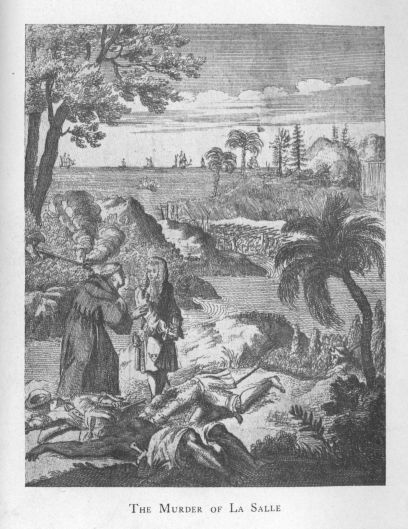
The Murder of La Salle
Thus ended, for the time, La Salle's brilliant scheme of colonizing Louisiana.