EPILOGUE
N. D'Anvers translation
I have now narrated all our adventures, and I leave my readers to judge of our work. I think it necessary still just to jot down here the practical conclusions I came to, which may be of use later in French colonial policy.
To begin with, let us consider how to turn the Niger to account as a highway for reaching the heart of the Western Sudan.
The French Journal Officiel of Western Africa has published a report written by Baudry on the possible importations and exportations, to which I have nothing to add. To every unprejudiced mind he has clearly proved that there is great wealth of natural produce to be found in these districts, such as india-rubber, gutta-percha, skins, wool, wax, karité, cotton, etc., which can easily be bought, and are, in fact, simply waiting to be developed.
Now which would be the best route to take these products to France? This is the point we have to elucidate to begin with.
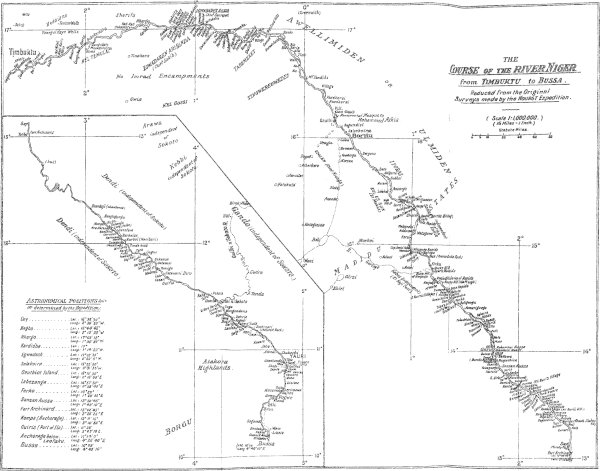
We brought home our hydrographical map of the Niger, from Timbuktu to Bussa, on a scale of 16 miles to the inch, in fifty sheets. One glance at it will suffice to show that the river is not really practically navigable further than Ansongo: that is to say, 435 miles below the last French port in the Sudan.
Further down than Ansongo the river is simply one hopeless labyrinth of rocks, islands, reefs, and rapids; and although at the time of our transit there seemed to be fewer obstacles between Say and Tchakatchi than elsewhere, it must be remembered that we passed when the water was at its maximum height. As for the Bussa rapids, they are simply impassable for laden boats.
“You passed all right, though!” some one said to me; and so we did, but I think the tour de force by which, thanks to our lucky star, we achieved our passage under the greatest difficulties, would not be successful once in three times. We might, however, go down again once more, but to go up would be quite a different matter.
None but little boats, very lightly laden, or without any cargo, such as the canoes of the natives, can venture without foolhardiness into such passes as we came through.
This is certainly not the way in which a river can be remuneratively navigated. Even if an attempt were made to employ the primitive means alone likely to succeed, beasts of burden, such as camels, could compete on disastrous terms with the waterway.
To attempt therefore to turn the river to account in supplying the central districts with merchandise, or to bring down their products to the coast, would simply result in failure. To take merchandise up to Say by means of the lower branches of the river, is but a utopian dream, which would but result in disaster to those traders involved in the speculation.
Nature has, in fact, laid her interdict on the navigation of a great part of the course of the Niger; but at least the 435 navigable miles above Ansongo, and between it and Timbuktu, added to the 622 between the latter town and Kolikoro, form what may be characterized as a safe mill-stream, well within the French districts. We have not as yet nearly realized all the resources of those districts.
How then shall we get to this mill-stream of ours, or, as we may perhaps call it, this inland trading lake? A unique solution to the problem presents itself: we must finish the line of railway uniting Kayes to Kolikoro.
The first workers at the task of penetrating into Africa were right. The project of Mungo Park, and Faidherbe, taken up and continued by the Desbordes, the Gallieni, the Archinards, etc., should be continued, pushed on and completed without delay.
All has already been explored. We are no longer discussing a castle in the air, with no firm foundations. We know what that railway will cost, its whole course has been decided on and surveyed; only one thing is still needed, and that is money. It is for the French Government to ask for it, and for the French Parliament to grant it. Certain there be who deliberately oppose French colonial expansion; with them discussion is impossible. I do not try to convince them, for they are already proved to be in the wrong.
There are, however, others, noble and loyal Frenchmen, who stigmatize as sterile all the efforts we make beyond seas to add to the possessions of our native country. “What,” they urge, “you talk of wholesale emigration, when the population of France is by no means increasing!”
This is, after all, only a specious argument. Who speaks of advising expatriation en masse to Frenchmen for the sake of peopling distant countries? All the colonies suitable for peopling have already been appropriated by our English rivals. Australia was the last of them.
With regard, however, to colonies for exploration, it is quite a different matter. And with the fullest conviction of my soul, I say France ought to acquire such colonies. Through them alone will she recover her commercial ascendency, which has been so seriously jeopardized; through them alone will her social position become assured.
Take, for instance, some child, the son of a workman or farmer: he goes to the school of his quarter or village. Intelligent and hardworking, he soon wins the affection of his teacher. “Work,” says that teacher; “to every one the reward is sure, according to his merits. Think of Pasteur, the son of a workman, to whom all Europe renders homage.”
Believing what he is told, the child works on. At first the State fulfils the promises made through the lips of the master. The teacher has spoken to the inspector of his protégé, the rector bestirs himself in the matter, the minister even intervenes, encouragement and money aid alike are lavished upon the young fellow. His zeal increases, he redoubles his application, he passes all the examinations and gets all the honours possible, till the University has no more to teach. Teacher, rector, minister, all justly pride themselves in having done their duty by him.
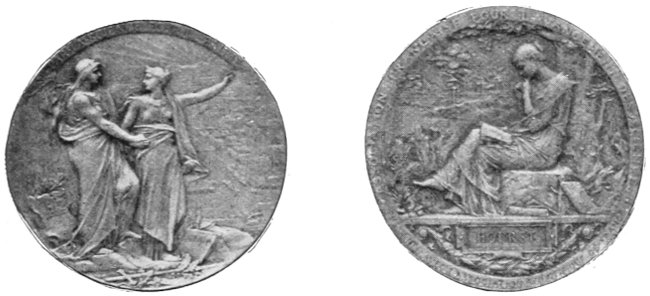
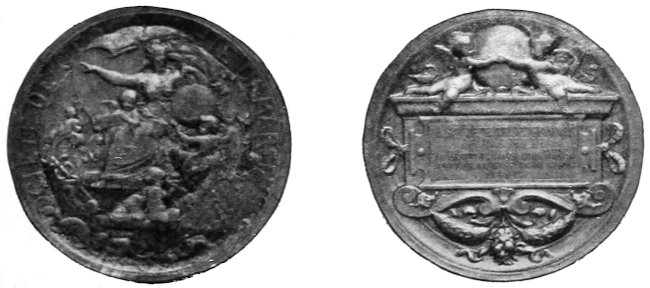
MEDAL OF THE FRENCH SOCIETY FOR THE ADVANCEMENT OF SCIENCE.
Then the son of the workman begins his life in the world.
Oh, how changed is everything to him now! Knowledge and industry are much, it is true, but there are still two applicants for every post, for every social function, and it is always the weaker, the less skilful, or rather perhaps the less fortunate, who goes to the wall.
The State has no other situation to offer him, and there is a regular glut of brain-workers already in commerce and in manufacture. Still it is necessary to eat to live.
It is easy to say “go back to the workshop or the plough,” but it is against human nature to do so; the cultivated brain, the matured intelligence, need the intellectual food to which they have become accustomed. The hands are too soft and delicate now for manual labour, nor are the muscles strong enough for it.
One more embittered, discontented, unfortunate man has been produced, that is all, and who knows but that to-morrow he may astonish the world by some attempted crime or act of folly, the result of his despair, perhaps even of actual hunger?
Am I making excuses for an anarchist? By no means. I have but proved the necessity of French colonial expansion in colonies of exploration.
If we wish to turn our distant possessions to account, the criminal of yesterday, the dangerous member of society, might go there, and in directing industrial or commercial enterprises find legitimate employment and a fair return for all his intelligent efforts and for the work and study of his youth.
There is plenty of labour to be obtained out there, for it is only the natives, of whatever tribe or colour, whose temperament is hostile to manual work.
More than that, these very natives who are now in a degraded state of barbarism, if taught by intelligent Europeans, would soon rise above their present condition to more of an equality with their instructors. Not only would the young man of whom I have been speaking live a happy life; not only would he win riches for himself and add to the wealth of his native country, but he would also aid in bringing about what, in my opinion, is the noblest of all possible ambitions, the amelioration of the lot of his fellow-creatures, for to make them better and happier is to share in the work of God Himself.
So logical is this reasoning, that my only wonder is why those who have the good of humanity at heart have not thought of it before myself.
Is not our French Sudan just such a fertile colony as is well suited for playing a part in what I may call the future social policy of France? I can answer that question in a very few words.
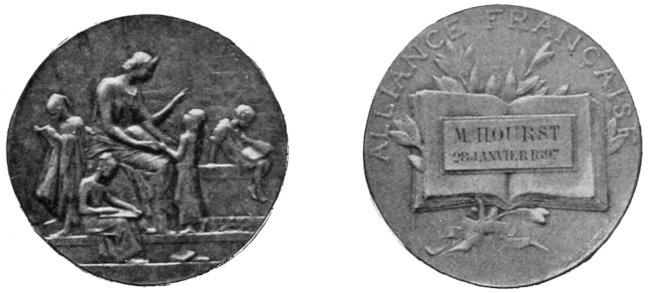
MEDAL OF THE ‘SOCIETÉ D’ALLIANCE FRANÇAISE.’
I have visited the lower course of the river, with the districts under the control of the Royal Niger Company, and I can confidently assert that except for palm-oil, which is only to be obtained on the seaboard, none of the exports, gum, india-rubber, ivory, and above all, karité, are wanting in the French Sudan. In fact, we have all these things in greater quantities than the English, without counting the products peculiar to our districts, but unknown at the mouth of the river.
Let us then make that railway, and make it quickly. Do not let us waste any more time talking about it; do not let us turn aside for any other projects, and when some 373 miles of iron road unite some 622 miles of the navigable Senegal, with no less than 1056 miles of the Niger, all alike fit to be navigated by our boats, we shall have a second Algeria, larger and richer than the first. The mind can scarcely grasp the idea of the new source of fortune to be opened to France by a thing so simple as this, a thing in which the Belgians have been beforehand with us—the construction of a railway. Stanley was right when he said Africa would belong to the first who should lay down a line of railway through it.[12]
This will bring us to Ansongo. Are we to let it be the limit of our zone of trading operations? No, certainly not; and this brings me to a second result won by our expedition: the opening of relations with the Awellimiden.
I have constituted myself the defender of the Tuaregs. I have shown them to be less cruel, less traitorous, less hostile to progress than they are generally said to be. It is for the reader to judge whether the adventures I have related do or do not prove my impressions to have been correct.
One thing, however, I must stipulate, and that is: if we let months or years slip by without improving the relations opened with the Tuaregs of the Niger by further contact with them, we shall find them more difficult to deal with, more suspicious, altogether less accessible than we did during our stay in their country.
As I have already said, the Azgueurs were in our hands after the journey of Duveyrier. Ikhenukhen, their great chief, who was honoured and obeyed by them, was our friend. When the treaty of Rhâdames was made, we said to them, “We want to go to the Sudan by way of Aïr: you will guide us, you will protect our traders, you will hire your camels to us, and you will find it to your profit to do so.”
A Tuareg proverb says, “You should never promise more than half what you mean to perform.”
The Azgueurs of course expected our caravans to arrive, and they are still expecting them. Gradually, however, they are beginning to doubt us. “What,” they are saying, “did those Frenchmen, who seemed so anxious to trade in our country, come to do here?” When this question is put to a Tuareg, he will answer immediately, “They came to spy; they were the spies of a great army, which will come to take away our liberty and our independence.”
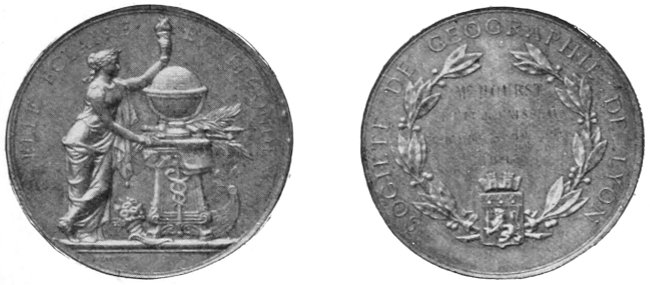
MEDAL OF THE LYONS GEOGRAPHICAL SOCIETY.
In the English of Tripoli and their agent, the Kaimakhan of Rhâdames, they would have advisers, who would increase their suspicions of us. Little by little the sympathy the Tuaregs had felt for us would give way to dread of us. Ikhenukhen is dead now, the Sahara is closed to us, more completely closed than when Duveyrier visited it, or when Barth and Richardson crossed it.
If we are equally negligent with the Awellimiden, we shall obtain equally melancholy results.
If only an opposite policy could be pursued, how different everything would be!
Whilst waiting for that iron road, and alas! its completion is very far off! the only means of transit—bearing in mind the impossibility of navigating the second section of the river—is to employ the comparatively cheap and easily obtained ships of the desert, the ugly but useful camels.
Now the camels all belong to the Tuaregs, generally to their Imrad tribes.
Let us imagine that the railway is completed, that boats brought up in sections to Kolikoro have been put together there, and are going down the river as far as Gao, boats sufficiently well armed to make the French respected, and of sufficient tonnage to carry merchandise; we should at once have either at Gao or somewhere else in its neighbourhood, a centre, so to speak, of transit, to which the Tuaregs could bring their animals to be laden, and acting as convoys to our caravans, would be most useful auxiliaries to the French traders.
Do not let any one urge against this the pillaging instincts of the Tuaregs. To begin with, it is in our power, if necessary, to destroy, or at least to insist, upon the removal elsewhere, of the riveraine negro villages, an excellent way of keeping the natives in awe, for we should then have it in our power to avenge ourselves efficaciously on them in case of their hostility, for it is from these riveraine districts that they obtain the grain which is their only food.
I assert, however, that it would never be necessary to proceed to such extremities as that.
The Tuaregs are alike too intelligent and avaricious of gain to risk raids, the result of which would be uncertain, when merely letting out their camels on hire would bring them in alike a greater and a surer profit.
By doing as I suggest, the old route from Gao to Lake Tchad, one of the most ancient in Northern Africa, could be reopened. This route, bearing as it does in the direction of Gober and Aïr, and skirting the Sahara, as it were in the rear, might in the end be made to connect the French Sudan with Algeria and Tunis.
To achieve this I repeat we must not give the marabouts, who are badly disposed towards the French, time to destroy our work before it is fairly begun; we must not by too long a delay, awake once more the suspicions of the Awellimiden, which are always easily aroused.
I do not pretend to say that any immediate profits would result from the course I advocate. Skins, wool, and gum are all too heavy to make it worth while to export them by difficult and costly modes of transport from Timbuktu to Kolikoro, and from Kolikoro to Diubeba, where ends at the present moment the railway from the Senegal to the Niger.
MEDAL OF THE MARSEILLES GEOGRAPHICAL SOCIETY.
It is, however, absolutely necessary to pave the way for traffic even at the cost of a temporary loss, so that it may be in full swing from the very day of the completion of the railway, when steamers will begin to ply on the navigable portion of the Niger.
On that day our hydrographical map, which is so far the chief result of our expedition, will find its use!
Was our stay at Say a profitable one? The future alone can decide.
I do think, however, that at least our gentle and benevolent behaviour to the peaceable natives, to the tillers of the soil, the Koyraberos, must, however obtuse their intelligence, have proved to them that these French infidels, these Kaffirs, as they called us, were not really exactly what their marabouts told them we were: ferocious beasts.
Moreover, our establishing ourselves in our island, and our stay at Fort Archinard, in spite of the prohibition of our enemy, Amadu Cheiku, under his very eyes, as it were, and in spite of all his satellites could do, all his vain intrigues against us, must surely have weakened his influence and his prestige.
We could not possibly have done more than we did with the very small force at our command, and in view of the instructions we had received to maintain the pacific character of our expedition, instructions, alas! which to the end remained incomplete, and were very different from what I had hoped they would be.
With regard to the Lower Niger it is best to be silent. There is far too much competition there with other European nations, and it would only lessen the effect of the results we had been able to obtain, whether those results were great or small, to publish what they were. It is for diplomacy to deal with them, bearing in mind that our rivals know on occasion how to act with what I may call quite a special bad geographical faith, which is not, however, any longer effective, since we have now reconnoitred and examined the districts in dispute.
I may add that we also brought back with us a few collections, and what was, as it appears to me, a most important point, the results of as careful a study as possible of the different dialects spoken in the river districts.
There is nothing which gains the confidence of the natives more than to be able to speak, or even to jabber, their language. The effect on the Tuaregs especially is immense when they find that a European can say a few phrases in Tamschenk, and a very great stride has been made towards a good understanding when those sentences have been pronounced.
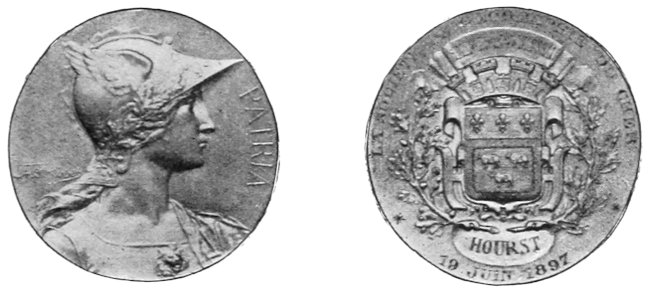
MEDAL OF THE CHER GEOGRAPHICAL SOCIETY.
Whatever may be the results of our journey, I should be guilty of the grossest ingratitude if I concluded my account of our adventures in any other way than by thanking all the devoted companions who helped me to bring it to a successful conclusion.
Our negroes, those brave Senagalese, whom we have watched at their work so long, who were so devoted, so French, who so blindly followed the chief whose service they had entered, had held their own lives cheap, and now shared with us the proud sense of duty accomplished.
Then above all, our thanks are due to my friends Baudry, Bluzet, Taburet, and Father Hacquart. We were going back now to civilized life, perhaps to disperse to the four corners of the earth, but a bond had been formed between us which nothing will ever break. As for me, that bond was made up chiefly of loving gratitude, for to them is due the fact that I was able to keep my oath made when Davoust died, to serve my country and to increase the extent of the future possessions of France.
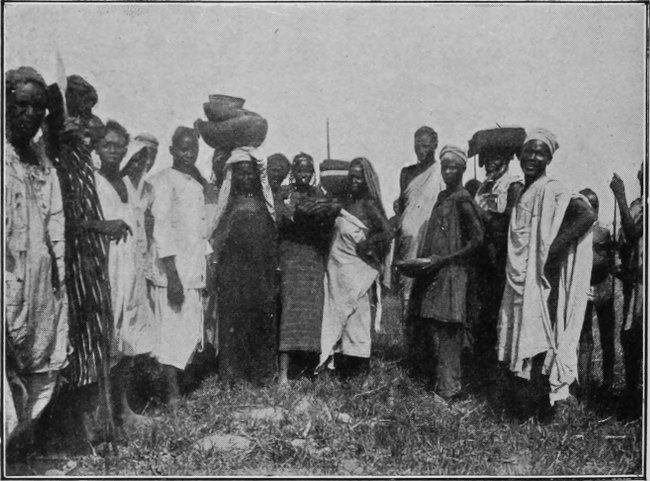
NATIVES OF SANSAN HAUSSA.
Thanks too must be given to those who aided me by their influence, their encouragement, and their contributions, no matter how small. As my readers have seen, the beginning of the hydrographical expedition I commanded was set about with many difficulties, and I can honestly assert that I suffered far more personally just because of my zeal for the task I had undertaken; a task which when completed would extend the area of our colonial possessions and make them better known, which would add to the wealth and the power of my native country. Yes, I suffered more than if I had been a bad officer, caring little about his duty.
I wish I could say that at least all was changed on my return, but truth compels me to add that there were certain notable exceptions to the general sympathy with me, and the general kindness of the reception given to me.
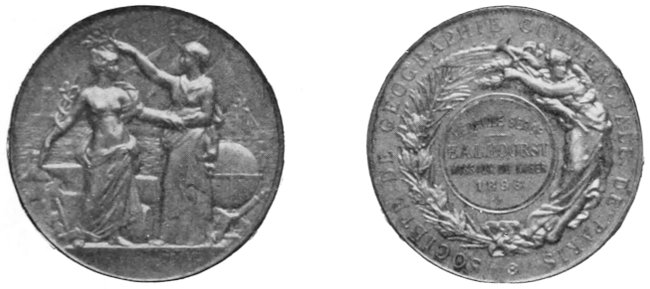
GRAND MEDAL OF THE PARIS SOCIETY OF COMMERCIAL GEOGRAPHY.
But never mind, the sense of having done one’s duty is worth more than anything else.
It is to you, dear friends, dear companions on the Niger, that I add—“Let people say what they will; a hundred years hence many things and many men will be forgotten, but for all that, it will be as true then as it is now, that our hydrographical expedition was the first to descend the Niger, the first to explore its course from Kolikoro to the sea.”
A French sailor, Francis Garnier by name, on his way to Tonquin, which he had to aid in conquering, and where he was to end his days, wrote to his mother describing all the difficulties he would have to contend with, adding, “But I do not mind, mother dear. Forward, for the sake of old France!”
For ourselves, and for those who are to come after us in Africa or elsewhere, I too close my narrative with the same words. “Forward, for the sake of old France!”
THE Course of the river Niger from Timbuktu to Bussa. Reduced from the Original Surveys made by the Hourst Expedition. (Large-size)