PART II. (continued 2)
Reading edition
These bear stories may be taken as facts, and as substantial proofs that, although we luckily did not encounter any bears, there are plenty of them up in the hills just above us.
160
LETTER No. XIV.
Saying "Goodbye"—Departure in a heavy snowstorm—Gallatin Valley—Helena—Garrison—Butte City—Salt Lake City—Polygamy—Articles of faith—Trial of a murderer—Trial of polygamists.
Cheyenne, Wyoming, Oct., 1885.

On Saturday morning we found the ground covered with snow, and it was bitterly cold. It seemed as if this sudden change had come upon us opportunely to prevent our carrying away a too favourable impression of the climate. Truly, the day was a rough one, and we had to drive twelve miles across the prairie to Bozeman in a blinding storm of snow and sleet, and over a road smooth and level a week ago, but now full of holes and 161deep ruts up to the axles. Our progress through the sludgy snow was very slow.
I had hoped to make some calls in Bozeman, but the weather prevented my doing so.
We reached the station only just in time to catch the train for Helena, and we were not sorry to get under cover from the pitiless storm.
Now the time had arrived for saying goodbye to the boy I had gone so far to see, a great lump came into my throat as I thought of the years that may pass before we meet again; of his rough journey back, and of the poor little leaky shanty he had to winter in, and to which he had voluntarily exiled himself.
But for this taste of wintry weather, I should have left Frank's ranche with a more cheerful heart, yet with a false impression of the country and climate.
Unquestionably the life on a ranche such as Frank's is a rough and hard one, and I should be sorry if I have said anything throughout this narrative that might induce any aspiring youth to adopt a similar mode of life under a contrary impression. But for 162a young fellow who is willing to banish himself from all society and to work as Frank has done, I can certainly commend this country.
We left Bozeman in the afternoon for Helena and Garrison, the junction where we turn to the south on the Branch Line of the Union Pacific.
As I felt a special and peculiar interest in the beautiful Gallatin Valley, it was some disappointment to me that my latest view of it was in the midst of a heavy snowstorm. Our railroad route ran for thirty miles through this valley, and had the afternoon been clear, we might have caught a last glimpse of the little log cabin ten miles away up yonder, at the foot of the Eastern Hills.
At the head of the valley we came to "Gallatin City." Here "The Gallatin," "The Madison," and "Jefferson" rivers are lost in the great Missouri. After crossing the Missouri, the road passes down the Missouri Valley to Helena. No sooner had we got out of the valley than the storm cleared off, the evening sun shone out brightly, and by the time we arrived at Helena, just 100 miles 163from Bozeman, we found ourselves again in the same mild, genial atmosphere we had experienced previous to the storm. No snow had fallen at Helena.
Helena, the capital of Montana, has a population of 8,000, is situated at the eastern foot of the main chain of the Rockies, and close to the famous "Last Chance" gold mines, out of which $10,000,000 worth of gold has been taken, and which still yields a considerable amount annually. This circumstance, and the fact that it is the nearest point in the mining region to the head of navigation on the Missouri river at Fort Benton, gave Helena a great start in earlier days, and it is certainly likely to maintain its position as the chief commercial town of Montana territory. It is surrounded by mountains, rising one above the other, till the more distant are lost in the clouds, forming a view of striking beauty and grandeur.
The town itself, so far as we had time to observe, is not well built; the streets are narrow, crooked, and steep; but it has all the appearance of wealth and prosperity. It has four 164national banks, a fine opera house, seating 1,200, and two daily papers. The shops are large, and full of attractive-looking "stock." The city is lighted by the Brush electric light system.
The hotel we stopped at is very large and very comfortable, but they won't black one's boots. If you wish to indulge in this luxury you must descend to the boot-black's quarters, and mount on his stool. He will polish you off in five minutes, and scorns anything less than a shilling for doing it. Why should he take less when he finds full employment all the day long at this rate of pay? I reckoned that fellow was making thirty shillings a day by his blacking.
Next morning we started for Garrison. The route from Helena to "The Mullan Pass" is most picturesque, taking us through the charming valley of "Prickly Pear," and past great masses of craggy rocks and boulders. "The Mullan Pass" takes us over, or rather through the main range of the Rocky Mountains by a tunnel 3,850 feet in length, and at an elevation above sea-level of 5,547 feet.
Now we are at Garrison, where we leave 165the Great Northern Pacific Railway, on which we have travelled so pleasantly over 1,200 miles of country, through scenes as tame and scenes as wildly picturesque as are probably to be found in any other part of this great country.
Our route now lies due south for a distance of nearly 500 miles to Ogden and Salt Lake City.
The cars being narrow gauge, we did not find them so pleasant as those we had just left; but as we secured sleeping compartments, and the passengers for part of the way were few, we had nothing to complain of. On this line there are no dining-cars, so we had to descend at various stations for scrambling meals, at not by any means nice hotels.
At a distance of about thirty miles from Garrison, we passed the great mining city of Butte, on the west side of the main dividing range of the Rocky Mountains; for an hour or two our car was crowded with holiday people from that wealthy city, decked out very gorgeously, and proud of their display of jewellery. Butte is a city of 18,000 inhabitants, and is called "a mining camp." 166It is the county seat of Silver Bow county. There are over 1,300 patented mines in this district, five smelters, and nine quartz mills. The mines produce silver, copper, and gold, the shipments of which amount to $6,000,000 annually. The adjoining city of Anaconda, which two years ago consisted of two tents, has now 3,000 inhabitants, and boasts of having the largest smelter in the world. It cost a million dollars, and the two owners are said to be worth forty million dollars each—they own two mines. This smelter pays the Union Pacific a hundred thousand dollars a month for carrying ore over a little branch line of nine miles in length.
The train passes through the Cache Valley, which is fifty miles long and ten miles broad; it is wholly occupied by Mormons. On the south-east side of the valley is the city of Logan, where a fine temple overlooking the whole of the valley has been built. There are seventeen separate settlements in this most fertile valley, and these, seen from the railway, look like green patches of verdure dotted over the great brown prairie, each settlement being hidden in groves of green trees.
167We reached Ogden at 5.30 p.m., and took train the same evening for Salt Lake City, where we arrived at the Walker House Hotel at eight.
Salt Lake City.
A residence of one day and two nights in Salt Lake City does not constitute me an authority or entitle me to put forth any opinions on the vexed question of Mormonism, but as I chanced to reach the city in stirring times, I venture to give two or three quotations from the current literature, which exhibit the question in its two aspects. The first is an extract from a very well-written pamphlet by Mrs. H. M. Whitney in favour of Polygamy. She says:—
"I have been a spectator and a participator in this order of matrimony for over thirty years, and, being a first wife, I have had every opportunity for judging in regard to its merits. The Scriptures declare, "By their fruits ye shall know them;" so I know that this system tends to promote and preserve social purity, and that this alone can remedy the great social evils of the present day. When lived up to as the Lord designed it should be, it will exalt the human family; and those who have entered into it with pure motives, 168and continue to practise it in righteousness, can testify to the truth of these statements. There are real and tangible blessings enjoyed under this system which cannot be obtained in any other way. Not only can the cares and burdens be equally distributed among the members of the family, but they can assist one another in many ways, and if blessed with congenial natures and filled with the love of God, their souls will be expanded, and in the place of selfishness, patience and charity will find place in their hearts, driving therefrom all feelings of strife and discord."
The little if in the last sentence seems to beg the whole question, and reminds one of Cowper's epigram:—
"If John marries Mary, and Mary alone,
'Tis a very good match between Mary and John;
Should John wed a score, O, the claws and the scratches!
It can't be a match—it's a bundle of matches!"
Another enthusiastic lady says:—
"Shall we, the wives and daughters of the best men on earth, submit to the dictation of unholy, licentious, and wicked men? No, never! I feel that it is high time for the women of Utah to stand up and defend this Heaven-revealed principle. I am a polygamous wife, and am proud to say it. I regard those women who are my husband's wives to be so as 169much as I am. Our husbands are virtuous and noble men, and are the friends of all mankind."
The following is taken from the biennial message of W. M. Budd, Governor of Idaho, and, I fancy, fairly represents the general feeling of the United States Government on this very important question at this time:—
"Polygamous and Treasonous Mormonism.
"While the constitution of our nation guarantees to every person of whatever birth, rank, or condition, past or present, a generous freedom in his own thoughts and religious convictions, not only the common law pronounces against adultery, bigamy, and polygamy, but every consideration of safety urges against permitting a self-proclaimed enemy to harbour within our fold while he gathers strength to strike at our life with the venom he already possesses. It becomes you to approach the discussion of this malignant mischief, that has retarded the Territory in the past and threatens such disaster for the future, with brave and grave deliberation. If you decide after careful investigation, as I have decided, that there can be no harmony between virtue and such monstrous vice; that either—and that at no distant day—pure, moral Christianity, that is such from fear of God, love of Christ and hope of heaven, or this leprous legacy of barbarity and sensual riot must possess the land to the exclusion of the other, then I say, it is not merciful to temporize with the blow that must be 170struck to free this Territory of this social plague and political curse. Polygamous and treasonous Mormonism stalks wantonly, insolently, and blatantly through this Territory, to the shame and degradation of every Christian woman and every man with a love for law and a regard for decency. Crime under the guise of religion is a hundred fold worse than under the banner of Satan. The leaders, owners, and bidder of this unholy, licentious, and treasonable institution are saints to glut their own vile and selfish purposes. Selfishness, which sees in the world only a mirror just large enough to reflect itself, writes in their case, as it always has written, a story of cant, hypocrisy, falsehood, deceit, fraud, and violence; and the inevitable logic of events, which is stronger than all the sins that infamy, greed, and selfishness are heir to, will write the invariable sequel: detection, retribution, expiation, and the felon's cell. These law-breakers mock and scoff the power of this great government, abuse our free institutions, and bedraggle our flag in the muck and mire of their offences. The guilty may be brought to bay and to justice even at the time when they imagine themselves most strongly entrenched. The Mormon leaders were never more defiant than at this peculiar and particular time. I conjure you to do your utmost toward destroying the polluting practices of this seditious organization. Suppress these licentious saints with their plural marriages, and so wipe away the fetid blotch upon this Territory, that is a stench in the nostrils of all the honest humanity within our borders. I advise 171the enactment of such laws and amendments as shall make effective the laws of God and man regarding adultery, bigamy, and polygamy, and compel loyalty to the nation and respect for the flag."
"Articles of Faith of the Church of Jesus Christ of Latter-Day Saints.
"1. We believe in God the Eternal Father, and in His Son Jesus Christ, and in the Holy Ghost.
"2. We believe that men will be punished for their own sins, and not for Adam's transgression.
"3. We believe that through the atonement of Christ all mankind may be saved, by obedience to the laws and ordinances of the Gospel.
"4. We believe that these ordinances are: first, Faith in the Lord Jesus Christ; second, Repentance; third, Baptism by immersion for the remission of sins; fourth, Laying on of hands for the gift of the Holy Ghost.
"5. We believe that a man must be called of God by 'prophecy and by the laying on of hands,' by those who are in authority, to preach the Gospel and administer in the ordinances thereof.
"6. We believe in the same organization that existed in the primitive church, viz., apostles, prophets, pastors, teachers, evangelists, &c.
"7. We believe in the gift of tongues, prophecy, revelation, visions, healing, interpretation of tongues, &c.
"8. We believe the Bible to be the word of God, 172as far as it is translated correctly; we also believe the Book of Mormon to be the Word of God.
"9. We believe all that God has revealed, all that He does now reveal, and we believe that He will yet reveal many great and important things pertaining to the Kingdom of God.
"10. We believe in the literal gathering of Israel, and in the restoration of the Ten Tribes. That Zion will be built upon this continent. That Christ will reign personally upon the earth, and that the earth will be renewed and receive its paradisiacal glory.
"11. We claim the privilege of worshipping Almighty God according to the dictates of our conscience, and allow all men the same privilege, let them worship how, where, or what they may.
"12. We believe in being subject to kings, presidents, rulers, and magistrates, in obeying, honouring, and sustaining the law.
"13. We believe in being honest, true, chaste, benevolent, virtuous, and in doing good to all men: indeed, we may say that we follow the admonition of Paul, 'We believe all things, we hope all things,' we have endured many things, and hope to be able to endure all things. If there is anything virtuous, lovely, or of good report or praiseworthy, we seek after these things.—Joseph Smith."
This is all very well as far as it goes, but I find nothing about polygamy here, and I learn elsewhere that—
173"According to Mormon theology, God the Father, the Supreme Jehovah, became man in the form of Adam, and thus became the father of the human race. He is thus represented as a being of parts such as we are. And all true and faithful Mormons who live up to their privileges, who take many wives, and who beget many children, will in the process of time become gods to all those who spring from them. Brigham Young was regarded as God by some of his followers even before his death."
In walking down Main Street I came to a great crowd opposite the court-house. I was curious to know what was going on, and to see the interior of a law court in a Mormon city, but the staircase was so completely blocked that I could not get in. On inquiry I learned that a murderer named Hopt was receiving his sentence, and that three Mormons were being tried for polygamy.
The court, in passing sentence on Hopt, said "The penalty of the crime for which you have been convicted is death, and must be inflicted by hanging you by the neck, or by shooting you, at your discretion. Which mode of death do you elect shall be inflicted upon you?"
174Hopt—"I choose to be shot."
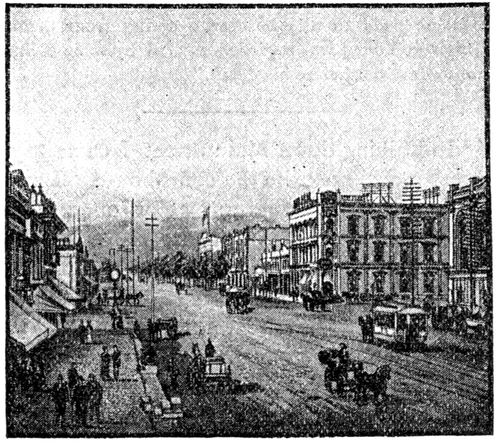
MAIN STREET.
Shortly afterwards, going down the same street, I came upon another great crowd round a photographer's, and I was told that immediately after Hopt had received his sentence he had been conveyed here to have his portrait taken. Whether this was at his "own 175discretion," or by order of the authorities, I could not ascertain.
Salt Lake City has a population of 30,000 inhabitants, of whom 25,000 are "Latter-day Saints," and 5,000 Gentiles, and just now the Gentiles seem to be making the city too hot for the saints. I was told that several of the leading men, including President Taylor, were wanted by the city marshals on the score of polygamy, but could not be found; and that one hundred polygamists are now in "The Pen," undergoing six months' imprisonment (and a fine of 300 dollars and costs) for refusing to part with their surplus wives.
Of the three men sentenced this day, the first was a policeman named Smith, who stood to his colours, as will be seen.
"The Court—Your name is Andrew Smith, I believe.
"Mr. Smith—Yes, sir.
"The Court—You have been found guilty of the crime of unlawful cohabitation, and this morning was fixed upon for your sentence. Have you anything to say why this sentence of the law should not be pronounced in accordance with the verdict—have you anything further to say?
176"Mr. Smith then said, in a firm, clear voice—If your honour please: I have been placed on trial here for living in the practice of my religion, which I do not intend to relinquish, under any circumstances whatever, and I have no promises to make. Therefore, I am prepared to receive the judgment of the court. I cannot under any circumstances give up any principle of my religion. My religion is worth everything to me, or it is worth nothing, and I am prepared to receive any judgment you may see fit to pronounce. That is about all, I believe.
"The Court—I understand you to state by inference that you understand your religion authorizes you and makes it your duty to practice polygamy and unlawful cohabitation?
"Mr. Smith—That is a part and portion of my religion.
"The Court—Yes, and I suppose from what you state also that it makes it your duty to advise others, so far as you give any advice at all, to practise that?
"Mr. Smith—I have not been an adviser, sir, but that is my feeling. I am not much of a preacher; but my religion is worth everything to me. As I said before, I could not sacrifice that under any consideration whatever.
"The Court—Well, I have so often stated here from this bench that polygamy and unlawful cohabitation are crimes under the laws of the United States that it is hardly worth while to state it again. I presume you understand that they are both defined as crimes, and you must realize that you are not to 177determine what the laws of the United States are for yourself, contrary to the tribunals selected to interpret and construe the laws and to enforce them. In view of your statements the law makes it my duty to impose upon you such a penalty as may possibly reform you and may tend to deter others from like crimes against society. The object of this law is to protect society, and it is my duty to enforce that law so far as the law gives me my discretion, and use the discretion which I possess so as to accomplish the purpose and to reach the end intended by the law. You are sentenced in the penalty of a term of six months, and to pay a fine of 300 dollars and costs. You will also stand committed until the fine and costs are paid."
The next defendant was evidently a gentleman of considerable standing in the city.
"As the name of John Nicholson was called, there was a buzz of interest which subsided into a breathless silence as that gentleman stood up under the judge's gaze.
"The Court—Mr. Nicholson, I suppose it is hardly necessary for me to state to you—you are already advised that the jury found you guilty of the crime of unlawful cohabitation. Have you anything further to say why sentence of the law should not be pronounced against you?
"Mr. Nicholson—If your honour please: I will take advantage of the privilege that the court affords 178me of stating my position before the court from my own standpoint. I have been connected with the Church of Jesus Christ of Latter-day Saints for about a quarter of a century. I accepted its doctrines, including the law that is called in the church 'celestial marriage,' which includes plurality of wives. At the time that I entered upon that relationship I had not the slightest idea that I was infringing upon or acting in contravention to any law made in pursuance of the constitution of the country, the supreme law of the land. I entered into that relation in 1871, and, to give the court an idea of my position in reference to the law, I will illustrate it by stating that when the Reynolds case was offered in order to test the constitutionality of the statute of 1862, enacted against polygamy, at the request of the defendant in that suit I went upon the stand and testified for the prosecution that a conviction might be obtained. There is no need for me to state to your honour that the essence of a crime is the intent to commit it. There could be no intention on my part to commit a crime in entering into the relationship which I have mentioned.
"Years afterwards the Edmunds' law was enacted, which made my status criminal—that is to say, from my standpoint—my conduct was made by it malum prohibitum, because in my opinion it cannot be made malum in se. That law requires that I should give up a vital principle of my religion, and discard at least a portion of my family, and consequently disrupt my family organization.
"This places me, as your honour will perceive, in a 179very painful position: because I have a large family, and the ties which bind them to myself are sacred, and the affection which I entertain for them is deep, and I do not think that these ties can possibly be severed by any law of whatever character it may be, or from whatever source it may spring; because there are sentiments and feelings that are engendered in the human heart that the law cannot touch. I will say here, also, that the lady who would have been the principal witness in this case, had I not testified against myself, stated to me that she would decline to testify against me, or do anything that would have the effect of sending me to prison. And now, after such an exhibition of devotion to me on her part, the bare contemplation of cutting her adrift is revolting to my soul, and I could not do it.
"People's ideas differ in regard to what constitutes religion. Some hold that it is merely sentiment and faith, and does not necessarily embody action. I differ from this view; and I have always been bold to express my opinions on every subject without fear, favour, or hope of reward. I am of the opinion expressed by the Apostle James, who stated that faith without works is dead. The religion that I believe in is a religion that finds expression in action.
"I am aware of the attitude of the court, and I presume of the country, towards the peculiar institution of religion in the Church with which I am identified, and which I have honestly accepted and have honestly practised. It is held that this conjugal relationship threatens the existence of monogamous marriage. 180must say that, judging from the attitude of this court, which represents, I presume, the attitude of the nation, and in view of the assaults that are made on plural marriage, it appears to me that there is not very much ground for apprehension of danger in that respect.
"It is also true that some people hold that my relations in a family capacity are adulterous. From my point of view, however, I have the consoling reflection that I am in excellent company, including Moses, the enunciator, under God, of the principles which constitute the foundation of modern jurisprudence.
"Not to weary the court, I will simply say that my purpose is fixed, and I hope unalterable. It is, that I shall stand by my allegiance to God, fidelity to my family, and what I conceive to be my duty to the constitution of the country, which guarantees the fullest religious liberty to the citizen.
"I thank your honour for bearing with me, and will now simply conclude by stating that I am prepared to receive the pleasure of the court.
"Mr. Nicholson spoke in a low, but clear and deliberate tone, which was maintained without variation to the close. The manner, as much as the matter of his speech, clearly prepossessed all hearers in his favour, and even the judge was impressed by it."
It will be seen from these examples that there is a strong determination on the part of the United States' government to root out polygamy, and there also seems to be an 181equally firm determination of the Mormons to stand by this, which they regard as an essential article of faith.
After a long address from the judge, Mr. Nicholson and the other polygamists received the same sentence as Smith, and were all driven off to the Penitentiary.
It may be added that a Bill now before Congress is of a still more stringent character. I quote the following from a recent evening paper:—
"The Bill provides that all marriages in the Territories shall be certified in writing by the minister and contracting parties, compels the testimony of the husband or wife of the accused in prosecutions for polygamy, prescribes punishment for adultery in Utah, and abolishes the present limitation of prosecutions for adultery to the complaint of husband or wife. It also abolishes female suffrage, takes away the general jurisdiction of the Utah probate courts, and annuls the territorial law about the capacity of illegitimate children to inherit property. The Bill further attacks the Mormon Church by giving the President of the United States authority to appoint trustees to take charge of its temporal affairs, and annuls the Mormon emigration fund, prohibiting the re-establishment of any such corporation for importing Mormons, all funds being forfeited for the benefit of a school fund in Utah."
182We paid a visit to the Tabernacle, the Temple, and Assembly Hall. We were politely received by the superintendent, who showed us round in the usual way. The wonderful acoustic properties of the Tabernacle, by which a pin dropped at one end of the great building can be distinctly heard at the other, were pointed out. I quote the following brief statistics about these buildings, only remarking that, judged by present appearances, the Temple is not likely to be completed for many years:—
Tabernacle: This building is 233 feet long, 133 feet wide, and 70 feet high. It has 20 doors of 9 feet wide. In case of an accident an audience of 10,000 people can be cleared out in a few minutes. Seating capacity, 12,000.
Temple: The corner-stone was laid April 12th, 1853, and amount expended in construction to March 12th, 1884, $2,500,000. It is 200 by 800 feet. Height of walls, 100 feet. Middle tower on either end will be 200 feet high.
Assembly Hall: Dimensions of building, 120 by 68 feet. Seating capacity, 2,500. Cost, $150,000. Services every Sunday at 2 p.m. The ceiling is divided off into sixteen panels of different shape and design, each panel having some fresco painting; one of them is a rather gaudy-looking historical painting 183of "The angel Moroni showing the prophet Joseph where the plates were hid in the hill Cumorah."
Bee-Hive, Lion, and Gardo Houses: One block east of the Temple, the latter block now occupied by President John Taylor.
Streets: There are nearly 100 miles of streets in Salt Lake City. They run with the four points of the compass. Each street is 132 feet wide, including the side-walks, and nearly all are bordered with shade trees. A small stream of water also flows down each side of many streets.
Total population of Utah in 1880, 143,965. Population of Salt Lake City is about 30,000.
Value of Utah's mineral production in 1884 is estimated at $9,301,508.
Great Salt Lake is nearly 100 miles long by 60 miles wide, with average depth of 40 feet.
In the afternoon we drove round the city and suburbs, and up to Fort Douglas, a well-built full-regiment post, situated on a plateau three miles east of the city. It is well laid out, and the officers' quarters, in charming little villas embowered in creepers and green foliage, are exceedingly pleasant to look at.
Our driver was an Englishman, a thirty-years' resident, who had married a Mormon wife (now dead), but he was careful to tell us that he was and always had been a Gentile, 184though for the sake of peace and quietness, and, in the early days, personal safety, he had duly paid his "tithing." He prided himself in having driven Hepworth Dixon during his stay here, and in having "introduced" Lord Carrington to President Taylor! The stories he volunteered to tell us were perhaps more facetious than veracious.
I will only add that the city in its outward appearance has left a most favourable impression on me—it is pleasantly situated at the foot of the Wasatch Mountains, which rise on the east to a height of from 10,000 to 12,000 feet, and are covered with snow nearly all the year. The city occupies a series of terraces, and, with its houses half hidden in shade and fruit-trees, it presents the appearance of a beautiful green oasis in the midst of a desert.
185
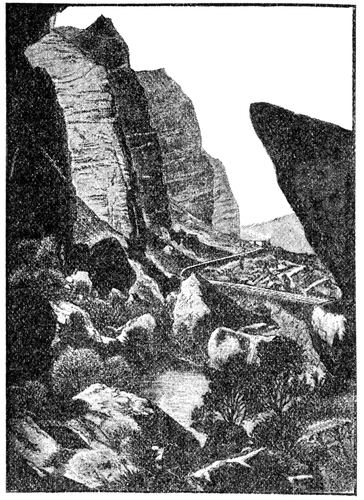
CLIFFS OF ECHO CAÑON.
186

LETTER No. XV.
Leave for Cheyenne—"Rock Springs"—Murder of Chinese—Mr. Black's "Green Pastures" and bottle of champagne—"Hell upon Wheels"—Big Horn Cowboy and Milord.
Cheyenne, Oct., 1885.

We left Salt Lake City by the Union Pacific Railway on Wednesday at 7.50 a.m., and we reached Cheyenne at 10.30 a.m. on Thursday. It is impossible for me to describe or even to mention the many objects of interest and points of beautiful scenery through which this line passes. How can one describe in a few hurried words such scenes as those to be found in "The Echo Cañon," "The Devil's Gate," "The Devil's 187Gate Mountain," and "The Devil's Slide"?[6] The makers of this road, or the early pioneers, seem to have had a great liking for his black majesty, or they would not have given his name to such splendid scenery.
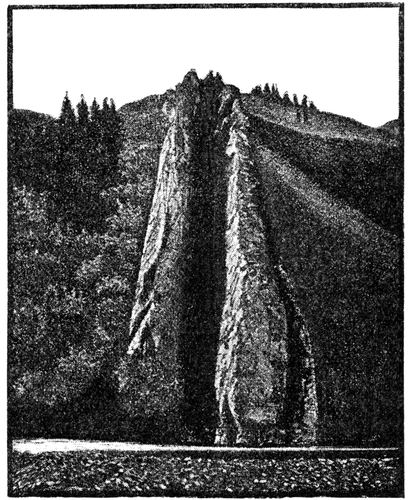
"THE DEVIL'S SLIDE," WEBER CAÑON.
188About two hundred miles east of Ogden we passed a place called "Rock Springs," where a number of Chinamen had been brutally massacred by white miners a week or two before.
Two Chinamen had taken up a white man's "chamber," and when ordered out the Chinamen went at them with their picks. A general battle ensued, in which two men were shot. At night their village was set fire to, and it was said that several Chinamen in trying to escape from the fire were shot down by the miners, and about fifteen others perished in the flames.
Soldiers from the nearest fort were sent for, and several miners were arrested, but it was found impossible to get sufficient evidence to convict them. The Chinese Consul from Washington had just been there investigating the brutal affair, and was returning in the same train with us.
In Mr. William Black's "Green Pastures and Piccadilly" there is an interesting description 189of Cheyenne as it was some twelve years ago. There was a time, not long previous to Mr. Black's visit, when this now thriving little city had earned for itself the name of "Hell upon Wheels," and I was told by an inhabitant who lived there then, when the Union Pacific Railway was being made, and the city comprised a long row of saloon tents, that bowie knives and six-shooters were freely used in the settlement of disputes, and that three or four murders a week were the average, to say nothing of fights with Sioux Indians.
Cheyenne had settled down from these exciting times when Mr. Black arrived there, and he found "nothing about its outward appearance to entitle anyone to call it 'Hell on Wheels.'"
"Certainly," he says, "the Cheyenne we saw was far from being an exciting place; there was not a single corpse lying at any of the saloon doors, nor any duel being fought in the street."
Of the outskirts of Cheyenne, he says:—
"The odd fashion in which shanties and sheds—with some private houses here and there—are dotted 190down anyhow on the plain; their temporary look; the big advertisements; the desolate and homeless appearance of the whole place, all serve to recall the dismal scene that is spread around the Grand Stand on Epsom Downs on the morning after Derby Day, when the revellers have all returned to town.... We drove out to a lake which will no doubt form an ornamental feature in a big park, when the Black Hill miners, gorged with wealth, come back to make Cheyenne a great city."
Mr. Black will be pleased to know that his prophecy has been, to some extent, fulfilled.
Cheyenne is now a most pleasant city. The big park has been formed; the streets are broad, and lined with trees; the houses are well-built; there are stores there which would almost rival Whiteley's or Shoolbred's in the magnitude and variety of their contents, and perhaps surpass them in their outward appearance. The outskirts are now dotted, I might rather say crowded, with very charming "Queen Anne" villas, surrounded by well-laid-out lawns, flower-beds, and creeping foliage, reminding one not so much of Epsom Downs, as of that æsthetic suburb of London known as Bedford Park, 191only that the houses are larger and better built, and in their furniture display an exuberance of wealth and good taste. There are two fine hotels, several churches and chapels, and a delightful little club-house, where we were most hospitably entertained.
I may add that the place has none of the appearance of vulgar show which "Black Hill miners, gorged with wealth," might be supposed to have given to it; on the contrary, it has an air of quiet respectability not to be seen in many other western cities. The inhabitants are well-educated people, musical and social, and amongst them is a large community of well-bred English people.
As I have a personal interest in the matter, I will venture to give another extract from "Green Pastures and Piccadilly."
Mr. Black says that—
"As he was unanimously requested by his party to pay a tribute of gratitude to the clean and comfortable inn at the station, he must now do so; only he must also confess that he was bribed, for the good-natured landlord was pleased, as we sat at supper, to send in to us, with his compliments, a bottle of real French champagne. Good actions should never go unrewarded; so the gentle reader is most earnestly entreated, 192the first time he goes to Cheyenne, to stay at this inn and give large orders. Moreover, the present writer not wishing to have his conduct in this particular regarded as being too mercenary, would wish to explain that the bottle of champagne in question was, as was subsequently discovered, charged for in the bill and honestly paid for too; but he cannot allow the landlord to be deprived of all credit for his hospitable intentions merely on account of an error on the part of the clerk."
Just before I left England, and knowing that I contemplated a visit to the Rockies, Mr. Black was good enough to request me to look into his book and to see, from the circumstances, as quoted above, whether I was not fairly entitled to have that bottle of champagne produced: he also desired me to present his compliments to a "very pretty Scotch lassie" at the hotel.
Of course I pursued the inquiry; I had by chance stayed at this very hotel, but I ascertained, alas! that poor old Jones, the good-natured landlord, had long since made his pile in the good old times when he could charge crowds of passengers a dollar and a half for their meals instead of (as now) seventy-five cents only: had retired to a 193farm somewhere in Idaho; had died, and left an enormous fortune to his widow. I may also inform Mr. Black that "the pretty Scotch lassie" is now the mother of a large family somewhere up in the mountains.
The inn has become the property of the Union Pacific, and is, in fact, one of the dining stations of that enterprising company. I regret to say that the intelligent and civil manager, though perfectly acquainted with the circumstances (through having read "Green Pastures" in a ten cent edition), did not feel it to be a part of his duty to his employers to hand over to me the bottle of champagne, notwithstanding the credentials I presented. He did not, however, raise the slightest objection when I invited him to join me and my friend M. in drinking to the health of the writer of "Green Pastures," to the wealthy widow of the departed Jones, and to "the pretty Scotch lassie," wherever she may be.
A local newspaper thus, somewhat erroneously, recorded our visit to this city:—
"A. B. and C. D., two Englishmen who have been travelling around the world, stopped off yesterday 194morning, and are guests at The Pacific. They had letters of introduction to Jones(!), the former landlord of the hotel, and had been told that Cheyenne was 'Hell on Wheels.' They are disappointed."
In these western parts it is a dangerous thing sometimes to refuse a "drink," and to offer to pay for it is a mortal offence. I was told that in Cheyenne even the cowboys, with their big whips, broad-brimmed felt hats, and hip-joint boots, were a superior, well-educated class, who had a large reading-room, crowded of an evening with men who could hold their own on any subject, political, social, or literary; and that there were among them good mathematicians, and even classical scholars.
The following cutting from "The Cheyenne Democrat" exhibits the cowboy in another light:—
"He Drank.
"MILORD HAS AN ADVENTURE WITH A BIG HORN COWBOY AND A BIG HORN.
"Editor Becker, of the Big Horn 'Sentinel,' tells a good story of a nobby and snobby milord, of British extraction, who travelled from Big Horn with him and Abe Idelman on the stage-coach early this week. 195Milord was excessively exclusive. He wouldn't be social, and spoke to no one except the two 'John Henry' servants he had with him, and was altogether as unpleasant as his snobbishness could make him. At a dinner station there were a lot of jolly cowboys on a lark, and one of them 'treating' everybody asked the Englishman to drink. Of course, milord haughtily refused. The cowboy displayed a dangerous-looking six-shooter, and very impressively insisted on his drinking.
"'But I cawn't, you know. I don't drink, you know,' was milord's reply.
"Mr. Cowboy brought the muzzle in dangerous proximity to the knot in which milord's brains were supposed to lie hidden somewhere, and then he said he'd drink—he'd take soda water, you know.
"'Soda water nuthin,' said Mr. Cowboy. 'You'll take straight whiskey.'
"'But, aw, this American whiskey, I cawn't swallow it, you know.'
"'Well,' said the cowboy, 'I'll make a hole in the side of your head so that we can pour it in,' and he began to draw down on milord, and milord said—
"'Aw, that'll do; I'll drink it.'
"Then the cowboy invited milord's servants to drink, which horrified him.
"'They don't drink, you know,' he said.
"'Well, we'll see whether they do or not,' said Mr. Cowboy. 'The chances are you don't give 'em a "hopportunity." Come up here, you fellows, and guzzle some,' and the two 'John Henrys,' with a 196little show of reluctance, but really glad to get a drink, came up, and the cowboy passed a tumbler full of torchlight procession whiskey for milord, and the servants poured for themselves. Then the cowboy made the 'John Henrys' clink glasses with milord, and all drank, and there was great fun. Milord tried after that to be very jolly, and the stimulant assisted him decidedly. But in the coach he fell back into his exclusiveness and retained it throughout, and has probably got it yet.
"Now the fact is that, abstractly, the cowboy was wrong in forcing a man to drink who had no desire to do so. But, on the other hand, snobbishness is not the proper thing in this country, and sensible men generally try, while in Rome, to do as Rome does. At any rate, they don't make themselves offensive to the country in which they are travelling."

197

LETTER No. XVI.
We leave Cheyenne—Arrival at Omaha—The barber's shop—Narrow escape from having my head shaved—Arrival at Chicago—Niagara Falls.
New York, Nov., 1885.

I have already told you that I am not writing a book of travels, but merely recording my impressions by the way; these have already occupied far more space than I had ever contemplated, and as we are now approaching the more beaten tracks of civilization, I will hasten on to a conclusion.
We left Cheyenne on Friday morning at 10.30, and after a continuous run of 516 miles, we "stopped off" at Omaha for a few hours at 10.30 on Saturday morning. Omaha is a great rambling city of 60,000 inhabitants 198on the western bank of the Missouri. Council Bluffs is an equally flourishing city on the eastern bank.
My chief recollection of Omaha is the barber's shop whither I went to get shaved. I had tried to shave myself in the train, but had contrived instead to gash my cheek sufficiently to cause much bloodshed. When the barber had finished shaving me, I asked him just to trim my hair the least bit in the world. He was an hour and a quarter over the job, and as I had been travelling continuously for twenty-four hours with little or no sleep, I fell asleep under his hands. Luckily, I was woke up by an unusual tickling at the back of my head; he was lathering me there, and I am quite sure he meant to shave the whole of my head.
"Confound it," I shouted; "what are you doing?"
"I was only going to shave the back of your head," he said.
I found to my horror that my whiskers had entirely disappeared, and he had not only cut my hair as closely as it could be cut with a pair of scissors, but he had run it over with a 199sort of small horse-clipper. I caught him in time to stop the further operation of shaving. Judging by the many naked polls I afterwards saw in the hotel, I concluded that it is the fashion in Omaha to go about with your head shaved. It is a compliment, I suppose, which those who have hair pay to the bald-headed ones.
The Omaha barber has quite destroyed the youthful appearance which I flattered myself I had acquired since I have been travelling on this Continent.
My friend M., when I came out of that terrible barber's hands, passed me by without knowing me; and when at last he began to have a suspicion that the bald individual before him was I, he exclaimed, "What on earth have you been doing? An hour and a quarter of our precious time have you wasted in that barber's shop, and you come out like a bald-headed boiled lobster. Our friends in Chicago, Boston, and New York certainly won't know you."
Time the destroyer is also a happy restorer, and now while I am writing, a fortnight after the event, my whiskers have already given indication 200of a returning crop, and my hair has grown long enough to enable me to identify myself. I trust that after the sea voyage, and when I get home, my wife will also be able to identify me. The rascal charged me seventy-five cents (three shillings) for this personal disfigurement.
I was very glad to get away from Omaha the same day at 5.30 p.m. We travelled by the Chicago and Rock Island line, and we reached Chicago, a distance of 500 miles, the next afternoon at three o'clock.
On Monday it rained in torrents all day, and Tuesday was not much better. On Tuesday night at 8.40 I started for Boston, leaving my friend M. behind for two or three days. This was the first time we had separated since we started together from Euston on our outward journey.
The line I now travelled on was "The Michigan Central." About seven o'clock next morning we reached Niagara, where the train stopped a few minutes to give us a look at "The Falls."
As I have no more superlative adjectives left in my vocabulary, I will tell you what 201the "Michigan Central" has to say about Niagara. It far surpasses my most sublime efforts.
"The Niagara Falls Route.
"'So long as the waters of that mighty river thunder down to the awful depths below, so long as the rush and roar, the surge and foam, and prismatic spray of nature's cataphractic masterpiece remain to delight and awe the human soul, thousands and tens of thousands of beauty-lovers and grandeur-worshippers will journey over the only railroad from which it can be seen. There is but one Niagara Falls on earth, and but one direct great railway to it.'
"Trains stop at Falls View, near the brink of the Horseshoe Fall, where the finest view is obtainable without leaving the cars, cross the gorge of Niagara river on the great steel, double-track Cantilever Bridge, the greatest triumph of modern engineering, and connect in Union Depots, at Niagara Falls and Buffalo with the New York Central and Hudson River, the only four-track railroad in the world."

202