Chapter XI
Reading edition
THE NATIONAL DEFENCES
About the year 1909 the administration of the French navy had fallen into a scandalous state of chaos. Battleships were so long in building that the type was beginning to be superseded before the vessels were commissioned. There was a story circulated not long ago to the effect that some one who enquired of the widow of a workman at Cherbourg what her son was going to do for a livelihood received the reply that he would work on the Henri IV. as his father had done. The story may not be quite true, but it indicates what people were thinking at the time. British ships are not infrequently completed within a year of their launch, but the Dupetit Thouars which took the water in 1901 was only completed in 1905.
It was during the period of office of M. Pelletan that the various departments of the navy lost cohesion and their productive capacity was greatly diminished. This minister was responsible for a species of socialistic propaganda which brought about the most deplorable results in so far as the efficiency of the navy was concerned. Le Journal, in its summary of the conclusions of the commission of enquiry into the state of naval administration, admitted that money had been wasted in petty errors and foolish blunders, in orders and counter-orders, on untried guns, on worthless boilers, on white powder which turned green, on shells which destroyed the gunners, on 16-centimetre turrets in which 19-centimetre guns had been placed. "The money," said this newspaper, "has passed through ignorant hands, and slipped through fools' fingers."
Drastic changes were necessary to stop the alarming deterioration that was taking place, for the nation had not, for fully ten years, been getting anything near the full measure of sea-power to which it was entitled by the annual sums voted. Between 1900 and 1909 France expended 129 millions sterling on her navy, and in the same period Germany devoted 121 millions to that branch of national defence, and at the end of the decade it was found that the country spending the larger sum had dropped down to a fifth place in the scale of world sea-power, while with her smaller outlay Germany had risen to the second place. In other words, the French had paid for the second place and only realised the fifth!
In this crisis Admiral Boué de Lapeyrère was appointed Minister of Marine, and was provided with a civilian Under-Secretary of State to act as assistant and be responsible with him for civil administration. Since this appointment much leeway has been made up, although the nation has had to mourn the loss of the Liberté, which blew up in the crowded naval harbour of Toulon, and has been alarmed more than once on account of the unstable quality of the powder with which the ships have been supplied. At last this danger appears to have been rectified.
The French naval officer receives his training at the naval schools at Brest and Toulon and is generally very keen and capable. He does not enjoy hard conditions from the sporting instinct after the fashion so usual in the British navy, but his devotion to his work produces very efficient gunnery and admirable handling of submarine craft. For the lower deck the supply of the suitable class of bluejacket might be sadly deficient were it not for the seafaring populations of Brittany and Normandy. At Bologne there was living recently a wrinkled old grandmother who had forty grandchildren, of whom all the males were sailors or fishermen, while several of the girls had become fishwives or had married fishermen or sailors. France owes much to her little weather-beaten grandmothers of this type.
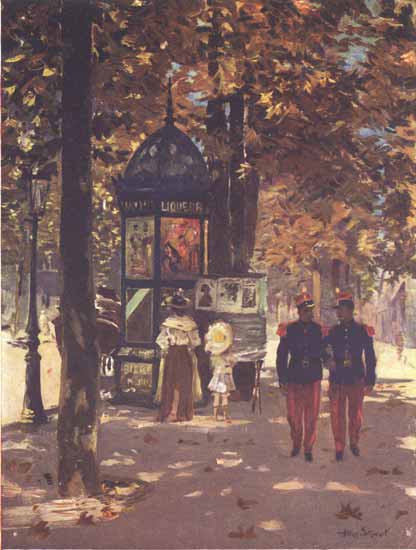
SOLDIERS OF FRANCE IN PARIS.
The manning of the fleet is partially carried out by voluntary enlistment, but the main supply is gained by means of the inscription maritime, a system established in the latter part of the seventeenth century by Colbert. This method requires all sailors between eighteen and fifty to be enrolled in "the Army of the Sea." They begin their term of seven years of obligatory service at about twenty, two years of the period being furlough. Any man earning his livelihood on inland waters, provided they are tidal or capable of carrying sea-going vessels, is included in the term "sailor." A further supply of men is obtained by transferring a certain number of the year's army recruits to the sea service.
Cherbourg, Brest, and Toulon are the chief naval ports, Lorient and Rochefort being of lesser importance. Shipbuilding, however, takes place at each of the five.
The frequent changes make it impossible to discuss the strength of the fleets in the Mediterranean and the Atlantic, or those stationed in colonial waters, but collectively the fighting force of the navy has for the last few years numbered roughly 25 battleships, 15 large armoured cruisers, 16 protected cruisers, 80 or 90 destroyers, 180 torpedo-boats, and about 90 submarines and submersibles. Under the new administration larger ships are being built, and the destroyer is taking the place of the torpedo-boat.
On account of its superiority as a fighting machine the army of France ranks above the navy, and it should have been placed before the navy in the short notes which constitute this chapter. The author has felt, however, that the subject is too complex to deal with in such a book as this. He confesses to blank ignorance as to the efficiency of the French artillery material, although from English sources he gathers that it is superior to that possessed by almost any other nation. It would be extremely interesting if one could state how far the army is prepared for "the real thing," how much it has learned in recent years, to what extent its very efficient army of the air is a source of strength, and whether the rifle at present in use is as perfect a weapon as those of other countries. These are subjects much discussed by the inexpert, and the author does not feel competent to deal with them.
In the present year (1913) the period of service for the conscripts who form the army was raised from two to three years, and by this means the numbers of the peace strength were enormously increased from the former establishment of a little over half a million men. The new law did not add, as might perhaps be imagined, another quarter of a million to the total. France has not a sufficiently large population to provide such a number of men of the required age and physical fitness. The numbers are, however, considered sufficient to meet the imaginary dangers which threaten her national existence, and the country has now to divert much of its energy to meeting the cost of this regrettable lengthening and thickening of her big stick. Incidentally the world's prosperity must suffer, and social reforms generations overdue must be postponed! With Ebenezer Elliott one asks again:
When wilt Thou save the people? O God of mercy, when?
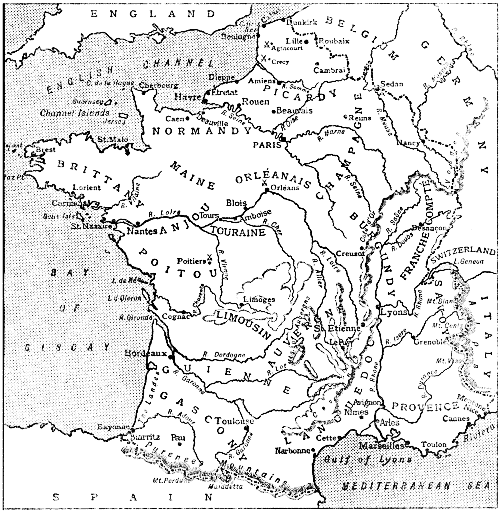
SKETCH MAP OF FRANCE.