Front matter (continued 3)
Reading edition
"Mira V., hombre! Two nights ago, when my feet are worn away with more than ten leguas of walking on the railroad, I come to Baeza. It is dark, and I wander along the track to find a soft bank to sleep. On the short railroad that is at each station there is waiting a train of merchandise. Suddenly a great idea comes to me. 'Sh! Jesús,' I whisper, 'what if you should hide yourself away somewhere on this train of merchandise? It would perhaps bring you to the next station.'
"With great quiet I climb a wagon and hide myself between bales of cork. Screech! Brrr! Rboom! The train is off, and all night I am riding--without a ticket. But at Vilches the man that goes with the train with a lantern comes by and it is my curse to be making some noise, moving to roll a cigarette. 'Ya te 'pia!' (I spy you!) he cries. Vaca que soy! So of course I must get down. But mira, hombre! There I have traveled more than twelve miles without paying a perrito!"
I had not the heart to disillusion him with a yarn or two from the land of the "hobo."
In the telling we had come within sight of Valdepeñas. It was a "valley of rocks" indeed, though a city of good size and considerable evidence of industry, abounding with great bodegas, or wine warehouses. As we trudged through the long straight street that had swallowed up the highway, we passed the taller of a marble-cutter.
"It is in a place like this that Gásparo works," sighed Jesús, wandering languidly in at the open door. I was strolling slowly on when a whoop as of a man suddenly beset by a band of savages brought me running back into the establishment. Jesús was shaking wildly by both hands a stockily-built young fellow in shirt sleeves and white canvas apron, who was rivaling him in volubility of greeting. Gásparo was found.
Still shouting incoherently, the two left the shop and squatted in the shade along the outside wall.
"Hombre!" panted Jesús, when his excitement had somewhat died down. "I have told myself that by to-morrow we should be tramping the carretera together."
But Gásparo shook his head, sadly yet decisively.
"No, amigo. Jamás! Nunca! Never do I take to the road again. I have here a good job, the finest of patrons. No. I shall stay, and send for the amiga--or find another here."
With the dignity of a caballero, Jesús accepted the decree without protest, and wished his erstwhile comrade luck and prosperity. Then that they might part in full knowledge, he launched forth in the story of his journey from Seville. Gásparo listened absently, shaking his head sadly from time to time. When the episode of the amateur hoboing began, he sat up with renewed interest; before it was ended he was staring at the speaker with clenched fists, his eyes bulging, the cigarette between his lips stone-dead. From that great epic Jesús jumped without intermission to a hasty survey of the anticipated joys that lay between him and Madrid. Suddenly Gásparo sprang into the air with an explosive howl, landing on his feet.
"By the blood of your namesake!" he shouted. "How can a man stay always in one place? This daily drudgery will kill me! I will throw the job in the patron's face, and get my wages this very minute, amaguito, and we will go to Madrid together. Jesús Maria! Who knows but we can hide ourselves on another freight train!"--and crying over his shoulder some rendezvous, he disappeared within the establishment.
We sauntered on to the central plaza. It was utterly treeless and paved with cobble-stones; nor could we find a patch of grass or a shaded bench in all the neighborhood.
"Look here, señor!" cried Jesús, suddenly rushing toward a policeman who was loitering in the shade of a bodega. "Don't you have any parks or Alamedas in this val de penas of yours? You call this a city!"
"Señor," replied the officer in the most apologetic of voices, "we are not a rich city, and the rain so seldom falls in La Mancha. I am very sorry," and touching a finger respectfully to his cap, he strolled slowly on.
Though the sun was low it was still wiltingly hot in the stony streets. Jesús, as I knew, was penniless. I suggested therefore that I would willingly pay the score of two for the privilege of retreating to the coolness of a wineshop.
"Bueno!" cried the Sevillian. "The wine of Valdepeñas is without equal, and of the cheapest--if you know where to buy. Vámonos, hombre!"
He led the way down the street and by some Castilian instinct into a tiny underground shop that was ostensibly given over to the sale of charcoal. The smudged old keeper motioned us to the short rickety bench on which he had been dreaming away the afternoon and, descending still lower by a dark hole in the floor, soon set before us a brown glazed pitcher holding a quarto--about a quart--of wine, for which I paid him approximately three and a half cents.
In all western Europe I have drunk the common table wine in whatever quantity it has pleased me, and suffered from it always the same effect as from so much clear water. It may be that the long tramp under a scorching sun and the distance from my last meal-place altered conditions. Certainly there was no need of the seller's assurance that this was genuine "valdepeñas" and that what had been sold us elsewhere as such was atrociously adulterated. Before the pitcher was half empty, I noted with wonder that I was taking an extraordinary interest in the old man's phillipic against the government and its exorbitant tax on wine. Jesús, too, grew in animation, and when the subterranean Demosthenes ended with a thundering, "Sí, señores! If it wasn't for the cursed government you and I could drink just such wine as this pure valdepenas anywhere as if it was water!" I was startled to hear us both applaud loud and long. A scant four-cents' worth had seemed so parsimonious a treat for two full-thirsted men that I had intended to order in due time a second pitcherful. But this strange mirth seemed worthy of investigation. I sipped the last of my portion and made no movement to suggest a replenishing. A few minutes later the old man had bade us go with the Almighty, and we were strolling away arm in arm.
The sun was setting when we reached the plaza. We sat down on the cathedral steps. The Sevillian had suddenly an unaccountable desire to sing. He struck up one of the Moorish-descended ballads of his native city. To my increasing astonishment I found myself joining in. Not only that, but for the first and last time of my existence I caught the real Andalusian rhythm. An appreciative audience of urchins gathered. Then the sacristan stepped out and politely invited us to choose some other stage.
Across the square was a casa de comidas. We entered and ordered dinner. The señora served us about one-third of what the bill-of-fare promised, and demanded full price--something that had never before happened in all my Spanish experience. I protested vociferously--another wholly unprecedented proceeding. The policeman who had apologized for the absence of parks sauntered in, and I laid the case before him. The señora restated it still more noisily. I declared I would not pay more than one peseta. The lady took oath that I would pay two. The policeman requested me to comply with her demand. I refused to the extent of commanding him to take his hand off the hilt of his sword. He apologized and suggested that we split the difference. This seemed reasonable. I paid it, and we left. Dark night had settled down. We marched aimlessly away into it. Somewhere Gásparo fell in with us. Somewhere else, on the edge of the city, we came upon a heap of bright clean straw on a threshing floor, and fell asleep.
CHAPTER VIII
ON THE ROAD IN LA MANCHA
It was Sunday morning, the market day of Valdepeñas, when I returned alone to stock my knapsack. The plaza that had been so deserted and peaceful the evening before was packed from casa de comidas to cathedral steps with canvas booths in which the peasants of the encircling country were selling all the products of La Mancha, and among which circulated all the housewives of Valdepeñas, basket on arm. The women of the smaller cities of Spain cling stoutly to their local costumes, aping not in the least the world of fashion. These of Valdepeñas were strikingly different from the Andalusians, considering how slight the distance that separates them from that province. They were almost German in their slowness, with hardly a suggestion of "sal"; a solemn, bronze-tanned multitude who, parting their hair in the middle and combing it tight and smooth, much resembled Indian squaws.
From the northern edge of the city the highway ran straight as the flight of a crow to where it was lost in a flat, colorless horizon. The land was artificially irrigated. The first place I stopped for water was a field in which an old man was driving round and round a blind-folded burro hitched to a noria, a water-wheel that was an exact replica of the Egyptian sakka, even to its squawk, jars of Andújar being tied to the endless chain with leather thongs. The man, too, had that dreamy, listless air of the Egyptian fellah; had I had a kodak to turn upon him I should have expected him to run after me crying for "backsheesh."
Ahead stretched long vistas of low vineyards. The only buildings along the way were an occasional bare uniform stone dwelling of a peon caminero, or government road-tender. At one of these I halted to quench my thirst, and the occupant, smoking in Sabbath ease before it, instantly pronounced me a "norte americano." I showed my astonishment, for hardly once before in the peninsula had I been taken for other than a Frenchman, or a Spaniard from some distant province.
The peon's unusual perspicacity was soon explained; he had been a soldier in Cuba during the Spanish-American War. I readily led him into reminiscences. Throughout the war, he stated, he had fought like a hero, not because he was of that rare breed but because every member of the troop had been filled with the belief that once captured by "los yanquis" he would be hanged on the spot.
"And are you still of the opinion?" I asked.
"Qué barbaridad!" he laughed. "I was taken at Santiago and carried a prisoner to your country. What a people! A whole meal at breakfast! We lived as never before, or since.
"You were quite right, vosotros, to take the island. I do not blame you. It was competición, just competition, like two shop-keepers in the city. I am glad the miserable government lost their Cuba."
So often did I hear exactly this view from Spaniards of the laboring class that it may be considered typical of their attitude toward the late disagreement. The strange question has often been asked whether it is safe so soon after the war for a North American to travel alone in the interior of Spain. For answer we have only to ask ourselves whether a Spaniard traveling alone in the interior of the United States would be in any imminent danger of having his throat cut--even had we been defeated. In Spain there is vastly less, for not only is the Spaniard quicker to forgive and far less belligerent than he is commonly fancied, but there exists in the peninsula not one-tenth the rowdyism and hoodlum "patriotism" of our own country.
I stayed long and left with difficulty. Gregarious is man, and on Sunday, when all the world about him is at rest, even the pedestrian finds it hard to exert himself. A league beyond I came upon the Sevillians lolling in the shadow of another isolated peon dwelling in what seemed once to have been a village.
Jesús in his eleven-day beard hailed me from afar; moreover, the Sunday languor was still upon me. I stretched out with them in the shade of the building, but the flies prevented us from sleeping. We crawled into a peasant's cart under the shed--but the flies quickly found us out. We crossed the road to the ruin of a church, split almost exactly through the middle of tower and all, and one side fallen. Within it was a grassy corner where the sun never fell, and even a bit of breeze fanned us. But the flies had made this their Spanish headquarters. We decided to go on.
In that only were we unanimous, for the Sevillians wished to follow the railroad, a furlong away, and I the carretera. I had all but won them over when a freight train labored by.
"Ay! Ay! Los toros!" shouted the two in chorus.
"Where?" I asked, seeing no such animals in sight.
"En las jaulas, hombre! In the cages!" cried Jesús, pointing to a flat-car on which, set close together, were six tightly-closed boxes each just large enough to hold a bull.
"We go by the railroad!" shouted Gásparo, decisively. "Alma de Dios! Who knows but we may be able to hide ourselves on a train that is carrying toros to the córrida!"
We separated, therefore, and struck northward, though we marched side by side within hailing distance until we were all three swallowed up in the city of Manzanares.
The bare-faced, truly Manchegan town was half-deserted, though the reason therefor was not hard to guess, for the bullring in the outskirts was howling as I passed. For all its size the place did not seem to boast an eating-house of any description. At last I halted before an old man seated in a shaded corner of the plaza, to inquire:
"Señor, what does a stranger in your town do when he would eat?"
"Vaya, señor!" he replied, with the placid deliberation of age, and pointing with his cane to the shops that bordered the square. "He buys a perrito of bread in the bakery there, dos perros of ham in the butchery beyond, fruit of the market-woman--"
"And eats it where?" I interrupted.
"Hi jo de mi alma!" responded the patriarch with extreme slowness and almost a touch of sarcasm in his voice. "Here is the broad plaza, all but empty. In all that is there not room to sit down and eat?"
I continued my quest and entered two posadas. But for the only time during the summer the proprietors demanded my cédula personal. I explained that Americans are not supplied with these government licenses to live, and showed instead my passport. Both landlords protested that it was not in Spanish and refused to admit me. One might have fancied one's self in Germany. It was some time after dark that I was directed to a private boarding-house that almost rewarded my long search. For the supper set before me was equal to a five-course repast in the Casa Robledo of Granada, and for the first time since leaving Seville I slept in a bed, and not in my clothes.
In the morning an absolutely straight road lay before me across a land treeless but for a few stunted shrubs, a face of desolation and aridity and solitude as of Asia Minor. From the eastward swept a hot, dry wind across the baked plains of La Mancha that recalled all too forcibly the derivation of its name from the Arabic manxa--a moistureless land.
At fifteen kilometers the highway swerved slightly and lost from view for the first time the immense cathedral of Manzanares behind. On either hand, miles visible in every direction, huddled stone towns on bare hillsides and in rocky vales, each inconspicuous but for its vast overtowering church. "Si la demeure des hommes est pauvre, celle de Dieu est riche," charges colorful Gautier; which, if the church of Spain is truly the "demeure de Dieu," is sternly true. City, town, village, hamlet, a church always bulks vast above it like a hen among her chicks--rather like some violent overpowering tyrant with a club. To the right of the turn one might, but for a slight rise of ground, have espied a bare twelve kilometers away immortal Argamasilla itself.
During the day there developed a hole in my shoe, through a sole of those very "custom-made" oxfords warranted by all the eloquent Broadway salesman held sacred--whatever that may have been--to endure at least six months of the hardest possible wear. Sand and pebbles drifted in, as sand and pebbles will the world over under such circumstances, and for some days to come walking was not of the smoothest.
Almost exactly at noonday I caught sight of the first windmills of La Mancha, three of them slowly toiling together on a curving hillside, too distinctly visible at this hour to be mistaken by the most romance-mad for giants. The few peasants I fell in with now and then were a more placid, somber people than the Andaluz and, as is commonly the case in villages reached by no railway, more courteous to the roadster than their fellows more directly in touch with the wide world.
It was that hour when the sun halts lingering above the edge of the earth, as if loath to leave it, that I entered the noiseless little hamlet of Puerto Lápiche. It contained no public hostelry, but the woman who kept its single shop cooked me a supper, chiefly of fried eggs, which I ate sitting on a stool before the building. The fried eggs of Spain! Wherein their preparation differs from that in other lands I know not, but he who has never eaten them after a long day's tramp cannot guess to what Epicurean heights fried eggs may rise. How, knowing of them, could Sancho have named cow-heel for his choice?
The evening was of that soft and gentle texture that invites openly to a night out-of-doors. On the edge of the open country beyond, too, was a threshing-floor heaped with new straw that would certainly have been my choice, had not the village guardia been watching my every movement from across the way. When I had returned the porcelain frying-pan to its owner, I strolled boldly across to the officer and inquired for a lodging.
"With regret, señor," he replied, raising his hat and offering me the stool on which he had been seated, "I am forced to say that we are a small village so rarely honored by the presence of travelers that we have no public house. But--" he hesitated a moment, then went on "--the weather is fine, señor; the night is warm, the pure air hurts no one; why do you not make your bed on the soft, clean straw of the threshing-floor yonder?"
"Caballero," I responded, with my most Spanish salute, "a thousand thanks--and may your grace remain with God."
For the first time during my journey the heat was tempered next morning, though by no means routed, by a slightly overcast sky. The wind continued. The highway led on through a seared brown country, for the most part a silent, smokeless, unpeopled land. The windmills of La Mancha were numerous now on either hand as the road sank slowly down to a gap in the low, gaunt mountains of Ciudad Real. At last it reached them and, picking its way through the narrow pass of Lápiche, strode off again across a still hotter, drier region, unmitigated even by the wind, which had stopped short at the mountain barrier--a land flowing not even with ditch-water. I halted but briefly at the large village of Madridejos, peopled by a slow, dreamy-eyed, yet toil-calloused peasantry, as if their world of fancy and the hard stony life of reality never quite joined hands.
Hot, thirsty and hungry, I came in mid-afternoon to an isolated ramshackle venta in a rocky wilderness. An enormous shaggy man of a zoölogical cast of countenance, and a male-limbed girl were harnessing mules in the yard. No other living thing showed itself. I offered a peseta for food. The man glared at me for a time in silence, then growled that he sold nothing, but that I should find a posada not far beyond. He was evidently the champion prevaricator of that region, for not the suggestion of a hovel appeared during the rest of the afternoon. But he would be a fellow with Sancho indeed, who could not overrule a few hour's appetite in thinking of higher things, and no fit traveler in this hard, toilsome land where overeating is not numbered among the vices.
The setting of the sun was perhaps an hour off when the highway, swinging a bit to the left and surmounting a barren, rocky ridge, laid suddenly before me an enthralling prospect. Below, far down on a distinctly lower level, a flat, ruffled country still misty with rising waves of heat, stretched away to the uttermost endless distance. The whole, glinting in the oblique rays of the setting sun, was scored in every direction with dull rock villages huddled compactly together, while on every hand, like signal fires on a western prairie, rose from a hundred threshing-floors columns of chaff straight and slender into the motionless air to an incredible height before breaking up. The road descended with decision, yet in no unseemly haste and, marching for an hour across a country traveled only by an occasional donkey loaded with chopped straw, led me at nightfall into the scene of Sancho's labors in the wheat-piles--the village of Tembleque.
In its immense fonda, but for the underground stables one single, vast, cobble-paved room, a vacant-eyed old man, a girl, and a leviathan of a woman sat among the carts, wine-casks, and heaps of harnesses, the latter knitting. In strictest Castilian the establishment was no fonda, but a parador, from parar, to stop; and certainly it could not with honesty have laid claim to any more inviting name, for assuredly no man in his senses would have dreamed of choosing it as a staying-place. When I asked if lodging was to be had, the woman replied with a caustic sneer that she had always been able thus far to accommodate any who were able and willing to pay.
"And can one also get supper?" I inquired timorously.
"How on earth do I know?" snapped the woman.
I stared with a puzzled air at the old man and he in like manner at the knitter, who turned out to be his wife, espoused in budding maidenhood when his march in life had well begun.
"How can I cook him supper if he has none with him?" snarled the no longer maidenly.
"Er--what have you brought to eat?" asked the preadamite in a quavering voice.
"Nothing to be sure. What is a fonda for?"
"Ah, then how can la señora mía get you supper? Over the way is the butcher, beyond, the green-grocer, further still the panadero--"
I returned some time later with meat, bread, potatoes, garbanzos, and a variety of vegetables, supplied with which the señora duly prepared me a supper--by sitting tight in her chair and issuing a volley of commands to the girl and the old man. For this service she demanded two "fat dogs," and collected at the same time an equal amount for my lodging.
When I had eaten, the mistress of the house mumbled a word to the dotard. He lighted with trembling hand a sort of miner's lamp and led the way downward into the subterranean stable and for what seemed little short of a half-mile through great stone vaults musty with time, close by the cruppers of an army of mules and burros. Opening at last a door some three feet square and as many above the floor, he motioned to me to climb through it into a bin filled with chaff. This was to all appearances clean, yet I hesitated. For in these endless vaults, to which the outer air seemed not to have penetrated for a century, it was cold as a November evening. I glanced at the old man in protest. He blinked back at me, shook his ever-quaking head a bit more forcibly, and turning, shuffled away through the resounding cavern, the torch casting at first weird, dancing shadows behind his wavering legs, then gradually dying out entirely. I stood in blackest darkness, undecided. Before, however, the last faint sound of his going had wholly passed away, the scrape of the veteran's faltering feet grew louder again and in another moment he reappeared, clutching under one thin arm a heavy blanket. When I had taken it, he put a finger to his lips, cast his sunken eyes about him, whispered "sh!" with a labored wink, and tottered once more away. I climbed into the bin and slept soundly until the cursing of arrieros harnessing their mules aroused me shortly before dawn.
CHAPTER IX
THE TRAIL OF THE PRIEST
The people of Tembleque had been just certain enough that none but an arriero could follow the intricate route thither, and that no man could cover the distance on foot in one day, to cause me to awaken determined to leave the Madrid highway and strike cross-country to Toledo. The first stage of the journey was the road to the village of Mora, which I was long in finding because at its entrance to--which chanced also to be its exit from--Tembleque it split up like an unraveled shoe-string. I got beyond the loose ends at last, however, and set a sharp pace--even though the hole in my shoe had enlarged to the size of a peseta--across a scarred and weather-beaten landscape that seemed constantly reminding how aged is the world.
Twenty-four kilometers brought me to Mora, a sturdy town of countrymen, in time for an early and stinted dinner and inquiries which led me off in a new direction up a steadily mounting region to Mascargne. There, at a still different point of the compass, a ruined castle on a hilltop ten kilometers away was pointed out to me as the landmark of El Monacail; to which village a rugged and sterile road clambered over a country hunch-backed with hills. It was siesta-time when I arrived, the sun scorching hot, a burning wind sweeping among the patched and misshapen hovels that made up the place. There were no inhabitants abroad, which argued their good sense; but in the shadow of the only public building a trio of soldiers were playing at cards. They leered at me for some time when I made inquiry, then burst out in derisive laughter.
"Claro, hombre!" answered one of them sarcastically. "You can walk to Toledo la Santa if you know enough to follow a cow-path."
I stumbled into it just beyond, a cow-path indeed, though too little used to be clearly marked, and meandering in and out with it for twenty kilometers through rocky barrancas and across sandy patches, gained as the day was nearing its close the wind-bitten village of Nambroca. A few miles more through a still greater chaos of rocks and I came out unexpectedly on the crest of a jagged promontory that brought me to a sudden halt before one of the most fascinating panoramas in all Spain.
A still higher rise cutting off the foreground, there began a few miles beyond, the vast, wrinkled, verdureless plateau of Castile, rolling away and upward like an enormous tilted profile-map of the world, sea-blue with distance and heat rays, all details blended together into an indistinctness that left only an undivided impression like a Whistlerian painting. I pushed forward and at the top of the next ridge gasped aloud with new wonder. From this summit the world fell pell-mell away at my feet into a bottomless gorge; and beyond, two or three miles away, the culminating point in a tumultuous landscape of ravines, gulleys and precipitous chasms, sat an Oriental city, close-packed and isolated in its rocky solitude, the sun's last rays casting over its domes and minaret-like spires a flood of color that seemed suddenly and bodily to transport the beholder into the very heart of Asia. My goal was won; before me lay the ancient capital of the Goths, history-rich Toledo.
I sat down on the crest of the precipice overhanging the Tajo, almost beneath the enormous iron cross set in a rock to mark Toledo as the religious center of Spain, and remained watching the city across the gulf, full certain that whatever offered within its walls could in no degree equal the view from this facing hilltop. Richly indeed did this one sight of her reward the long day's tramp across the choking hills, even had there not been a pleasure in the walk itself; and upon me fell a great pity for those that come to her by railroad in the glare of day and the swelter of humanity.
As I sat, and the scene was melting away into the descending night, a voice sounded behind me and a ragged, slouching son of fortune proffered the accustomed greeting and, rolling a cigarette, sat down at my side. He was a "child of Toledo," and of his native city we fell to talking. At length he raised his flabby fist and, shaking it at the twinkling lights across the Tajo, cried out:
"O Toledo, my city! Gaunt, sunken-bellied Toledo, bound to your rock and devoured by the vulture horde of bloated churchmen while your children are starving!
"Señor," he continued, suddenly returning to a conversational tone, "let me show you but one of a thousand iniquities of these frailuchos."
He rose and led the way a little further along the path I had been following, halting at the edge of a yawning hole in the rocks, like a bottomless well, the existence of which I was thankful to have learned before I continued my way.
"Señor," he said, "no man can tell how many have died here, for it lies, as you see, in the very center of the trail over these hills. For a hundred years, as my grandfather has known, it has stood so. But do you think yon cursed priests would spend a perrito of their blood-sweated booty to cover it?"
It was black night when I picked my way down into the valley of the Tajo and, crossing the Alkántara bridge, climbed painfully upstairs into Toledo. Even within, the Oriental impression was not lost, though the Castilian tongue sounded on every side. With each step forward came some new sign to recall that for half the past eight hundred years Toledo was an Arab-ruled and Arabic-speaking city. Thus it is still her Eastern fashion to conceal her wealth by building her houses inwardly, leaving for public thoroughfare the narrow, haphazard passageways between them, and giving to the arriving stranger the sensation of wandering through a haughty crowd of which each coldly turns his back.
Her medley of streets was such as one might find in removing the top of an ant-hill, an ant-hill in which modern improvements have made little progress; her pavements of round, century-polished cobble-stones, glinting in the weak light of an occasional street-lamp, were painful indeed to blistered feet. Ugly and barn-like outwardly, like the Alhambra, hen houses frequently resemble that ancient palace, too, in that they are rich with decoration and comfort within. It was an hour or more before I was directed to a casa de huéspedes in the calle de la Lechuga, or Lettuce street, a gloomy crack between two rows of buildings. The house itself was such as only a man of courage would have entered by night in any other city. I ventured in, however, and found the family out-of-doors--lolling in the flower and palm-grown patio beneath the star-riddled sky, the canvas that formed the roof by day being drawn back. Even the well was in the patio, on which opened, like the others, the room to which I was assigned, presenting toward the street a blank, windowless wall.
It was late the next forenoon before I had slept the forty hot and rocky miles out of my legs and sallied forth to visit a shoemaker. As he lived only two streets away, it was my good fortune to find him in less than an hour, and as Toledo is the last city in the world in which a man would care to run about in his socks, I sat on a stool beside his workbench for something over three hours. His home and shop consisted of one cavernous room; his family, of a wife who sewed so incessantly that one might easily have fancied her run by machinery, and of a daughter of six who devised more amusement with a few scraps of leather than many another might with all the toys of Nürnberg. The shoemaker was of that old-fashioned tribe of careful workmen, taking pride in their labor, whom it is always a joy to meet--though not always to sit waiting for. He, too, hinted at the misery of life in Toledo, but unlike the specter of the night before, did not lay the blame for the sunken condition of his city on the "frailuchos," charging it rather to the well-known perverseness of fate, either because he was of an orthodox turn of mind or because his wife sat close at hand. When he had finished, having sewed soles and nailed heels on my shoes that were to endure until Spain was left behind, he collected a sum barely equal to forty cents.
In striking contrast to him--indeed, the two well illustrated the two types of workmen the world harbors--was the barber who performed the next service. He was a mountain of sloth who rose with almost a growl at being disturbed and, his mind elsewhere, listlessly proceeded to the task before him. Though he was over forty and knew no other trade, he had not learned even this one, but haggled and clawed as that breed of man will who drifts through life without training himself to do anything. The reflective wanderer comes more and more to respect only the man, be he merely a street-sweeper, who does his life's work honestly; the "four-flusher" is ever a source of nausea and a lowerer of the tone of life, be he the president of a nation.
While I suffered, a priest dropped in to have his tonsure renovated and gloriously outdid in the scrofulousness of his anecdotes not only this clumsy wielder of the helmet of Mambrino, but exposed poor timorous Boccaccio for a prude and a Quaker.
Packed away down in a hollow of the congested city is that famous cathedral surnamed "la Rica." "The Rich"--it would be nearer justice to dub her the Midian, the Ostentatious, for she is so overburdened and top-heavy with wealth that one experiences at sight of her a feeling almost of disgust, as for a woman garish with jewelry. We of the United States must see, to conceive what shiploads of riches are heaped up within the churches of Spain by the superstitions of her people and the rapacity of her priests, who, discovering the impossibility of laying up their booty hereafter, agree with many groans to stack it here.
"The Spanish church," observes Gautier, "is scarcely any longer frequented except by tourists, mendicants, and horrible old women." If one choose the right hour of the afternoon even these vexations are chiefly absent, entirely, perhaps, but for a poor old crone or two kneeling before some mammoth doll tricked out to represent the Virgin and bowing down now and then in true Mohammedan fashion to kiss the stone flagging. The Iberian traveler must visit the cathedrals of the peninsula, not merely because they offer the only cool retreat on a summer day, but because they are the museums of Spain's art and history. But even the splendor of the setting sun through her marvelous stained-glass windows cannot overcome the oppressiveness of "la Rica."
As he stands before the wondrous paintings that enrich the great religious edifices of Spain, the matter-of-fact American of to-day is not unlikely to be assailed by other thoughts than the pure esthetic. There comes, perhaps, the reflection of how false is that oft-repeated assertion that the world's truly great artists exercised their genius solely for pure art's sake. Would they then have prostituted their years on earth to tickling the vanity of their patrons, in depicting the wife of some rich candle-maker walking arm in arm with the Nazarene on the Mount of Olives, or the absurdity of picturing Saint Fulano, who was fed to Roman lions in A.D. 300, strolling through a Sevillian garden with the infant Jesus in his arms and a heavenly smirk on his countenance? How much greater treasures might we have to-day had they thrown off the double yoke of contemporaneous superstitions and servility to wealth and painted, for example, the real Mary as in their creative souls they saw her, the simple Jewish housewife amid her plain Syrian surroundings. Instead of which they have set on canvas and ask us to accept as their real conception voluptuous-faced "Virgins" who were certainly painted from models of a very different type, and into whose likeness in spite of the painter's skill has crept a hint that the poser's thoughts during the sitting were much less on her assumed motherhood of a deity than on the coming evening's amours.
Horror, too, stands boldly forth in Spanish painting. The Spaniard is, incongruously enough, as realist of the first water. He will see things materially, graphically; the bullfight is his great delight, not the pretended reality of the theater. Centuries of fighting the infidel, centuries of courting self-sacrifice in slaying heretics, the reaction against the sensuous gentleness of the Moor, have all combined to make his Christianity fervid, savage, sanguinary. Yielding to which characteristic of his fellow-countrymen, or tainted with it himself, many a Spanish artist seems to have gloried in depicting in all gruesome detail martyrs undergoing torture, limbs and breasts lopped off and lying bleeding close at hand, unshaven torturers wielding their dripping knives with fiendish merriment. These horrors, too, are set up in public places of worship, where little children come daily, and even men on occasion. It is strange, indeed, if childhood's proneness to imitation does not make the playground frequently the scene of similar martyrdoms. How much better to treat the tots to a daily visit to the morgue, where what they see would at least be true to nature--and far less repulsive.
There are other "sights" in Toledo than the cathedral for him who is successful in running them down in her jungle of streets. Each such chase is certain sooner or later to bring him out into the Zocodover, that disheveled central plaza in which the sunbeams fall like a shower of arrows. The inferno into which he seems plunged unwarned chokes at once the rambler's grumble at the intricacies of the city and brings him instead to mumble praises of the Arabs, who had the good sense so to build that the sun with his best endeavors rarely gets a peep into the depth of the pavement; and the time is short indeed before he dives back into the relief of one of the radiating calles.
As often as I crossed the "Zoco" my eyes were drawn to a ragged fellow of my own age, with a six-inch stump for one leg, lolling prone on the dirt-carpeted earth in a corner of the square, mumbling from time to time over his cigarette:
"Una limosnita, señores; qué Dios se lo pagará."
There was in his face evidence that he had been born with fully average gifts, perhaps special talents; and a sensation of sadness mingled with anger came upon me with the reflection that through all the years I had been living and learning and journeying to and fro upon the earth, this hapless fellow-mortal had been squatting in the dust of Toledo's Zocodover, droning the national lamentation:
"A little alms, señores, and may God repay you."
Just another was he of her thousands of sons that Spain has wantonly let go to waste, until even at this early age he had sunk to a lump of living human carrion that all the powers of earth or from Elsewhere could not remake into the semblance of a man.
Try though one may, one cannot escape the conviction that the fat of Toledo goes to the priesthood, both physically and figuratively. High or low, the churchmen that overrun the place have all a sleek, contented air and on their cynical, sordid faces an all too plain proof of addiction to the flesh pots; while the layman has always a hungry look, not quite always of animal hunger for food, but at least for those things that stand next above. Nowhere can one escape the cloth. Every half-hour one is sure to run across at least a bishop tottering under a fortune's-worth of robes and attended by a bodyguard of acolytes, pausing now and again to shed his putative blessing on some devout passer-by. Of lesser dignitaries, of cowled monks and religious mendicants there is no lack, while with the common or garden variety of priest, a cigarette hanging from a corner of his mouth, his shovel hat set at a rakish angle, his black gown swinging with the jauntiness of a stage Mephistopheles, ogling the girls in street or promenade, the city swarms. Distressingly close is the resemblance of these latter to those creatures one may find loitering about the stage-door toward the termination of a musical comedy.
I sat one afternoon on a bench of that broken promenade that partly surrounds Toledo high above the Tajo, watching the sun set across the western vega, when my thoughts were suddenly snatched back through fully a thousand years of time by the six-o'clock whistle of the Fabrica de Armas below. When my astonishment had died away, there came over me the recollection that not once before in all Spain had I heard that sound, a factory whistle. Agreeable as that absence of sibilant discord is to the wanderer's soul, I could not but wonder whether just there is not the outward mark of one of the chief reasons why the Spain of to-day straggles where she does in the procession of nations.
I descended one afternoon from Lettuce street to the sand-clouded station on the plain and spent the ensuing night in Aranjuez, a modern checker-board city planted with exotic elms and royal palaces. It was again afternoon before I turned out into the broad highway that, crossing the Tajo, struck off with business-like directness across a vega fertile with wheat. Before long it swung sharply to the right and, laboring up the scarified face of a cliff, gained the great central tableland of Castilla Nueva, then stalked away across a weird and solemn landscape as drear and desolate as the hills of Judea.
The crabbed village that I fell upon at dusk furnished me bread and wine, but no lodging. I plodded on, trusting soon to find a more hospitable hamlet. But the desolation increased with the night; neither man nor habitation appeared. Toward eleven I gave up the search and, stepping off the edge of the highway, found a bit of space unencumbered with rocks and lay down until the dawn.
The sun rose murky. In twenty kilometers the deserted carretera passed only two squalid wineshops. Then rounding in mid-morning a slight eminence, it presented suddenly to my eyes a smoky, indistinct, yet vast city stretching on a higher plane half across the desolate horizon. It was Madrid. I tramped hours longer, so uncertainly did the highway wander to and fro seeking an entrance, but came at last into a miserable outskirt village and tossed away the stick that had borne my knapsack since the day I had fashioned that convenience in the southern foothills of Andalusia. Two besmirched street Arabs, pouncing upon it almost as it fell--so extraordinary a curiosity was it in this unwooded region--waged pitched battle until each carried away a half triumphant. I pushed on across the massive Puente de Toledo high above the trickle of water that goes by the name of the river Manzanares and, mounting through a city as different from Toledo as Cairo from Damascus, halted at last in the mildly animated Puerta del Sol, the center of Spain and, to the Spaniard, of the universe.
CHAPTER X
SHADOWS OF THE PHILIPS
A day or two later I was installed for a fortnight in a casa de huéspedes in the calle San Bernardo. In such places as one plans to remain for any length of time there are few cheaper arrangements for ample fare in all Europe than these Spanish "houses of guests." My room, which was temporarily on the second-floor front, but solemnly pledged to be soon changed to the third-floor back, was all that an unpampered wanderer could have required. Breakfast was light; a cup of chocolate and a roll--no self-respecting traveler ventures to sample Spanish coffee more than once. But one soon grows accustomed and indeed to prefer the European abstemiousness at the first meal. In compensation the almuerzo and comida, at twelve and seven, were more than abundant. A thick soup, not unseldom redolent of garlic, was followed by a salad, and that by a puchero, which is to say an entire meal on one platter,--in the center a square of boiled beef flanked like St. Peter's amid the hills of Rome by seven varieties of vegetables, the garbanzos--bright yellow chickpeas of the size of marbles--with the usual disproportion granted that robust comestible in Spain, overtowering not only every other eminence but carpeting the intervening valleys. That despatched, or seriously disfigured, there came a second offering from the animal world,--a cocido or an olla podrida, after which the repast descended gradually by fruit, cheese, and cigarettes to its termination. Through it all a common wine flowed generously.
Even on Friday this sturdy good cheer knew no abatement. Centuries ago, in the raging days of the Moor, the faithful of Spain were granted for their Catholic zeal and bodily behoof this dispensation, that they might nourish their lean frames on whatever it should please Santiago, their patron, to bring within bowshot of their home-made crosspieces. The Moor has long since removed his dusky shadow from the land, but the dispensation remains. Indeed, there is left scarcely a custom the inobservance of which betrays the non-Catholic; or if one there be at all general it is this: when he yawns--which he is not unwont to do even at table--the devout Spaniard makes over his mouth the sign of the cross, to keep the devil from gaining a foothold therein--an exorcism that is not always successful.
There is yet another custom, quite the opposite of religious in result at least, which the guest at a casa de huéspedes must school himself to endure. It grows out of the Spaniard's infernal politeness. Figure to yourself that you have just returned from a morning of tramping through sweltering Madrid on the ephemeral breakfast already noted, and sit down at table just as a steaming puchero is served. With a melodious and self-sacrificing "Serve yourself, señor," the addle-pated Spaniard across the way pushes the dish to his neighbor; to which the neighbor responds by pushing it back again with a "No! Serve yourself, señor," followed in quick succession by "No! No! Serve yourself, señor;" "No! No! No! señor! Serve yourself!" "No! No! No! No! serve--" and so on to the end of time, or until a wrathy Anglo-Saxon, rising in his place, picks up the source of dispute and establishes order.
Our household in the calle San Bernardo consisted of a lawyer, a "man of affairs"--using the latter word in its widest signification--of two young Germans, "Don Hermann" and "Don Ricardo," for some time employed in the city, and of the family itself. Of this the husband, a slouching, toothless fellow of fifty, and the grandmother were mere supernumeraries. The speaking parts were taken by the wife and daughter, the former an enormous, unpolished woman with a well-developed mustache and the over-developed voice of a stevedore. Indeed, a stentorian, grating voice and a habit of speaking always at the tiptop of it is one of the chief afflictions of the Spanish women of the masses--and of their hearers. Is it by chance due to the custom of studying and reciting always aloud and in chorus during their few years of schooling? Quién sabe? There was presented during my stay in Madrid the play, or more properly playlet--zarzuela--"Levantar Mueros--Raising the Dead"; but I dared not go lest it turn out to be a dramatized sewing circle.
But it remains to introduce the star member of the cast, the center of that San Bernardo universe around which revolved mother, supernumeraries, and guests like planets in their orbits--the daughter. I fully expect to wander many a weary mile before I again behold so beautiful a maid--or one that I should take more pleasure in being a long way distant from. She was sixteen--which in Spain is past childhood--a glorious, faultless blonde in a land where blondes are at high premium, her lips forming what the Spaniard calls a "nido de besos"--a nest of osculatory delights--and-- But why drive the impossible task further? Such radiant perfections in human form must be seen at least to be appreciated. It is sufficient, perhaps, to mention that her likeness was on sale in every novelty shop in Madrid and found more purchasers than that of Machaquito, King of the Toreros. In short, a supreme beauty--had she been captured early and suitably polished instead of remaining at home with mother until she had acquired mother's voice, and mother's roughshod manners, and a slothful habit of life that was destined, alas, in all probability to end by reproducing her mother's bulk and mustache.
There are two things worth seeing in howling, meeowling, brawling, blistering Madrid--her outdoor life and the Prado museum. It was the latter that I viewed by day, for when relentless August has settled down the capital is not merely hot, it is plutonic, cowering under a dead, sultry heat without the relief of a breath of air, a heat that weighs down like a leaden blanket and makes Seville seem by comparison a northern seaport. A saying as old as its foolish founder's grave credits the city with three month's invierno and nine months' infierno, a characterization that loses much in symmetry, though gaining, perhaps, in force by translation. It was my fortune to have happened into the place when the lowest circle of the latter region was having its inning.
Wherefore I went often to the Prado; and came as often away more physically fatigued than after a four-hour watch in a stokehole, and with my head in a bewildered whirl that even a long stroll in the Buen Retiro only partly reduced. It is like the irrationality of man to bring together these thousands of masterpieces, so close together that not one of them can produce a tenth of its proper effect. Of the pictures in the Prado the seeing alone would require two years of continuous work, the attempt to describe, a lifetime; pictures running through all the gamut of art from the fading of the pre-Raphaelites down to Goya, that plain-spoken Goya who seems to have stood afar off and thrown paint by the bucketful at his canvas--with marvelous results. A pandemonium of paintings, not one of which but off by itself would bring daily inspiration to all beholders. It is the tendency of all things to crowd together--wealth, art, learning, work, leisure, poverty; man's duty to combat this tendency by working for a sane and equitable distribution. The Prado collection would be a treasure, indeed, had those who exerted themselves to bring these paintings together given half that exertion to spreading them out. Then it might be that in a land as rich with art as Spain one would not find daubs and beer-calendars hung in the place of honor in the homes and fondas of "the masses." When the good day comes that the accumulation of the Prado is dispersed I shall bespeak as my share the "Borrachos" or "Vulcan's Forge" of sturdy Velazquez.
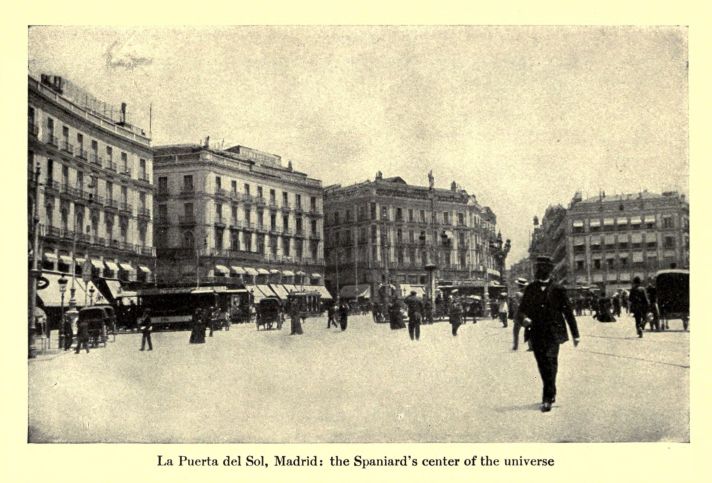
La Puerta del Sol, Madrid: the Spaniard'
center of the universe]
Those who are curious may also visit, at seasons and with permissions, the unpleasing royal palace, about the outer walls of which sleep scores of fly-proof vagrants in the shade of half leafless trees, and sundry other government buildings, all of which--except the vagrants--are duly and fully described in the guide-books. There is, too, the daily juego de Pelota, imported from the Basque provinces, a sort of enlarged handball played in a slate-walled chamber in which the screaming of gamblers for bids and their insults to the players know no cessation. Wandering aimlessly through her streets, as the sojourner in Madrid must who cannot daily sleep the day through, I found myself often pausing to admire the splendid displays in the windows of her tailors. Spain has no wool schedule, and as I gazed a deep regret came over me that I could not always be a dweller in Madrid when my garb grows threadbare or a tailor bill falls due. But there was sure remedy for such melancholy. When it grew acute I had but to turn and note the fitting of these splendid fabrics on the passer-by, and the sadness changed to a wonder that the madrileño tailor has the audacity to charge at all for his services.
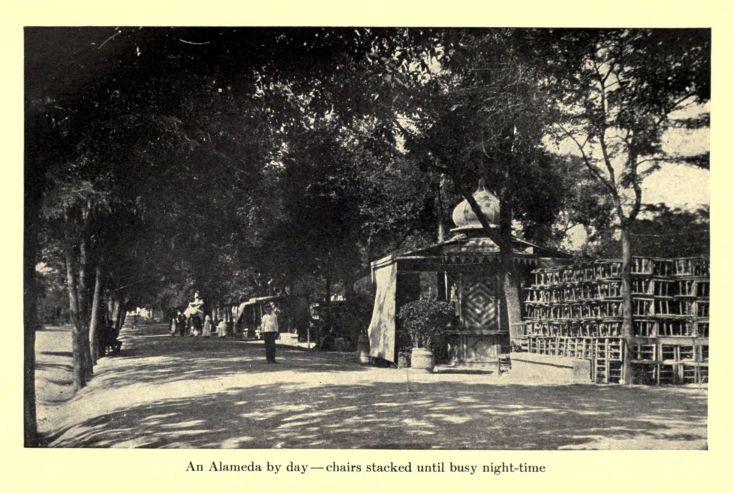
An Alameda by day--chairs stacked until busy night-time
So bare and uninviting are her environs--and she has no suburbs--that Madrid never retires outwardly as other cities for her picnics and holidays, but crowds more closely together in the Buen Retiro. The congestion is greatest about the Estanque Grande. The largest body of water the normal madrileño ever sees is this artificial pond of about the area--though not the depth--of a college swimming-pool. On it are marooned a few venerable rowboats, for a ride in which most of the residents of Madrid have been politely quarreling every fair day since they reached a quarrelsome age. Small wonder dwellers in the capital cry out in horror at the idea of drinking water. One might as sanely talk of burning wood for fuel.
Obviously no untraveled native of "las Cortes" has more than a vague conception of the sea. Indeed, the ignorance on this point is nothing short of pathetic, if one may judge from the popular sea novel that fell into my hands during my stay. The writer evidently dwelt in the usual hotbox that constitutes a Madrid lodging and had not the remotest, wildest notion what thing a sea may be, nor the ability to tell a mainsail from a missionary's mule. But he was a clever man--to have concocted such a yarn and escaped persecution.
Madrid, however, like all urban Spain, comes thoroughly to life only with the fall of night. Occasionally a special celebration carries her populace to some strange corner of the city, but the fixed rendezvous is the Paseo de Recoletos, a broader Alameda where reigns by day an un-Spanish opulence of shade enjoyed only by the chairs stacked house-high beneath the trees. There is nothing hurried about the congregating. Dinner leisurely finished, the madrileño of high or low degree begins to drift slowly thither. By nine the public benches are taken; by ten one can and must move only with the throng at the accepted pace, or pay a copper to sit in haughty state in one of the now unstacked chairs. Toward ten-thirty a military band straggles in from the four points of the compass, finishes its cigarette, languidly unlimbers its instruments, and near eleven falls to work--or play. About the same time there come wandering through the trees, as if drawn here by merest chance, five threadbare blind men, each with a battered violin or horn tucked tenderly under one arm. During the opening number they listen attentively, in silence, after the manner of musicians. Then as the official players pause to roll new cigarettes the sightless ragamuffins take their stand near at hand and strike up a music that more than one city of the western world could do worse than subsidize. Thereafter melody is incessant; and with it the murmur of countless voices, the scrape of leisurely feet on the gravel, the cries of the hawkers of all that may by any chance be sought, and louder and more insistent than all else the baying of newsboys--aged forty to sixty and of both sexes--"El País!" "El Heraldo!" "La Cor-r-respondencia-a-a-a!"
Midnight! Why, midnight is only late in the afternoon in Madrid. The concert does not end until three and half the babies of the city are playing in the sand along the Paseo de Recoletos when the musicians leave. Besides, what else is to be done? Even did one feel the slightest desire to turn in there is not the remotest possibility of finding one's room less than a sweatbox. The populace shows little inclination to disperse, and though many saunter unwillingly homeward for form's sake, it is not to sleep, for one may still hear chatting and the muffled twang of guitars behind the blinds of the open windows. As for myself, I drifted commonly after the concert into the "Circo Americano" or a zarzuela, though such entertainments demonstrated nothing except how easily the madrileño is amused. Yet even these close early--for Madrid; and rambling gradually into my adopted section, it was usually my fortune to run across a "friend of the house"--of whom more anon--to retire with him to the nearest Juego de Billar, or billiard-hall, there to play the night gray-headed.
The doors of Madrid close at midnight, and neither the madrileño nor his guests have yet reached that stage of civilization where they can be entrusted with their own latch-key. But it is easy for all that to gain admittance. One has only to halt before one's door, clap one's hands soundly three or six or nine or fifteen times, bawl in one's most musical and top-most voice, "Ser-r-r-r-reno!" not forgetting to roll the r like the whir of a broken emery-wheel, and then sit calmly down on the curb and wait. Within a half-hour, or an hour at most, the watchman is almost sure to appear, rattling with gigantic keys, carrying staff and lantern, and greeting the exile with all the compliments of the Spanish season, unlocks, furnishes him a lighted wax taper, wishes him a "good night" and a long day's sleep, and gracefully pockets his two-cent fee.
Theoretically the sereno is supposed to keep order--or at least orderly. But nothing is more noted for its absence in Madrid by night than order. The sereno of the calle San Bernardo showed great liking for the immediate neighborhood of our casa de huéspedes--after I had been admitted. Rare the night--that is, morning--that he did not sit down beneath my window--for my promotion to the third-floor back was postponed until I left the city--with a pair of hackmen or day-hawks and fall to rehearsing in a foghorn-voice the story of his noble past. Twice or thrice I let drop a hint in the form of what water was in my pitcher. But the serenos of Madrid are imperturbable, and water is precious. On each such occasion the romancer moved over some two feet and serenely continued his tale until the rising sun sent him strolling homeward.
"Don Ricardo," of our German boarders, aspired to change from his stool in a banking-house to the bullring. He had taken a course in Madrid's Escuela Taurina and was already testing his prowess each Sunday as a banderillero in the little plaza of Tetuan, a few miles outside the city. In consequence--for "Ricardo" was a companionable youth for all his ragged Spanish--our casa de huéspedes became a rendezvous of lesser lights in the taurine world. Two or three toreros were sure to drop in each evening before we had sipped the last of our wine, to spend an hour or two in informal tertulia. I had not been a week in the city before I numbered among my acquaintances Curdito, Capita de Carmona, Pepete, and Moreno de Alcala, all men whose names have decorated many a ringside poster.
There appeared one evening among the "friends of the house" a young man of twenty, of singularly attractive appearance and personality. Clear-eyed, of lithe yet muscular frame, and a spring-like quickness in every movement, he was noticeable above all for his modest deportment, having barely a touch of that arrogant self-esteem that is so frequently the dominating characteristic of the Spaniard. His speech was the soft, musical Andalusian; his conversation quickly demonstrated him a man of a high rate of intelligence.
Such was Faustino Posadas, bullfighter, already a favorite among the aficionados of Spain, though it is by no means often that a youth of twenty finds himself vested with the red muleta. Son of the spare-limbed old herder who has been keeper for many years of the Tabladas, or bull pastures, of Seville, he had been familiar with the animals and their ways from early childhood. At sixteen he was already a banderillero. A famous espada carried him in his caudrilla to Peru and an accident to a fellow torero gave him the opportunity to despatch his first two bulls in the plaza of Lima. He returned to Spain a full-fledged "novillero" and was rapidly advancing to the rank of graduate espada, with the right to appear before bulls of any age.
Once introduced, Posadas appeared often in the calle San Bernardo; much too often in fact to leave any suspicion that either his friendship for "Don Ricardo" or the charms of our conversation was the chief cause of his coming. A very few days passed before it had become a fixed and accepted custom for him to set out toward nine for the Paseo with the radiant daughter of the house--though mother waddled between, of course, after the dictates of Spanish etiquette. Within a week he was received by the family on the footing of a declared suitor; and of his favor with the señorita there was no room for doubt.
There was always a long hour between the termination of supper and the time when Madrid began its nightly promenade, during which it was natural that our conversation should touch chiefly upon affairs of the ring.
"Don Henrico," asked Capita one evening--for I was known to the company as "Henrico Franco"--"is it true that there are no bullfights in your country?"
"Vaya que gente!" burst out Moreno, when I had at length succeeded in making clear to them our national objections to the sport. "What rubbish! What does it matter if a few old hacks that would soon fall dead of themselves are killed to make sport for the aficionados? As for the bull-- Carajo, hombre! You yourself, if you were in such a rage as the toro, would no more feel the thrust of a sword than the pricking of a gadfly."
Posadas, on the other hand, readily grasped the American point of view. He even admitted that he found the goring of the horses unpleasant and that he would gladly see that feature of the córrida eliminated if there were any other way of tiring the bull before the last act. But for the bull himself he professed no sympathy whatever.
"What would you have us do?" he cried in conclusion. "Spain offers nothing else for a son of the people without political pull than to become torero. Without that we must work as peasants on black bread and a peseta a day."
"As in any other trade," I inquired, "I suppose you enter the ring without any thought of danger, any feeling of fear?"
"No, I don't remember ever being afraid," laughed the Sevillian, "though when Miúra furnishes the stock I like to hear mass before the córrida."
"What are the secrets of success?"
"I know only one," answered Posadas, "and that is no secret. Every move the bull makes shows first in the whites of his eyes. Never for an instant do I take my eyes off his. So it has been my luck not to be once wounded," he concluded, making the sign of the cross.
"Cogidas!" cried Capita, passing a hand over a dull brown welt on his neck. "Caramba! I have five of them, and every one by a cursed miúra. No, I never felt pain, only a cold chill that runs down to your very toes. But afterward--in the hospital! Carajo!"
One would suppose that men engaged in so perilous a calling would take extreme bodily care of themselves. Not a torero among them, however, knew the meaning of "training" as the word is used by our athletes. They drank, smoked--even during the córrida--ate what and when they pleased, and more commonly spent the night strolling in the Paseo with an "amiga" or carousing in a wineshop than sleeping. Whether it is a leaving of the Moor or native to this blear, rocky land, there is much of the fatalist in the Spaniard, especially the Andalusian. He is by nature a gambler; be he torero, beggar, or senator, he is always ready and willing to "take a chance."
"If a man is marked to be killed in the ring he will be killed there," asserted Pepete. "He cannot change his fate by robbing himself of the pleasures of life."
Posadas was engaged to appear in the plaza of Madrid on the first Sunday of our acquaintance. When I descended to the street at three the city was already drifting ringward, a picador in full trim now and then cantering by on his Rozinante--a sight fully as exciting to the populace as the circus parade of our own land. I had reached the edge of the Puerta del Sol when I heard a "Hola, amigo!" behind me and turning, beheld none other than Jesús the Sevillian bearing down upon me with outstretched hand. He had found work at his trade in the city--though not yet a barber apparently.
"And Gásparo?" I asked.
"Perdido, señor! Lost again!" he sighed. "Perhaps he has found a new amiga. But I much more fear he has fallen into the fingers of the police. Mira V., señor. In all the journey we have not been able once to hide ourselves on a freight train. At last, señor, in Castillejo, Gásparo goes mad and swears he will ride once for nothing. With twenty people looking on he climbs a wagon. A man shouts 'thief!' and around the station comes running a guardia civil. I have not been able to find Gásparo since. Señor, I have come to think it is not right to ride on the railroad without a ticket. Gásparo, perhaps, is in prison. But we will meet again when he comes out," he concluded cheerfully, as I turned away.
At the plaza fully twelve thousand were gathered. The córrida was distinguished particularly for its clumsiness, though the fighters, while young, were not without reputation. Falls and bruises were innumerable and the entire performance a chapter of accidents that kept the aficionados in an uproar and gave no small amount of work to the attendant surgeons. Of the three matadores, Serenito, a hulking fellow whose place seemed last of all in the bullring, was gored across the loins by his first bull and forced to abandon his task and fee to the sobresaliente. Then Platerito--"Silver-plated"--a mere whisp of a man, having dedicated to the populace as is the custom in Madrid the death of the fifth bull, gasconaded up to the animal, fell immediately foul of a horn, whirled about like a rag caught on a fly-wheel, and landed on his shoulders fully sixty feet away. To the astonishment even of the aficionados he sprang to his feet as jaunty as ever and duly despatched the animal, though not over handily.
The misfortunes of his fellows served to bring out by contrast the skill of Posadas. Not only did he pass the day unscathed, but killed both his bulls at the first thrust so instantly that the thud of their fall might be heard outside the plaza, how rare a feat only he knows who has watched the hacking and butchering of many a "novillero." Indeed, so pleasing was his work that he was at once engaged, contrary to all precedent, to appear again on the ensuing Sunday.
By that time I had learned enough of the "fine points of the game" to recognize that the Sevillian was approaching already true matador "form," and as I took leave of him next day it was with the conviction that success in his chosen career was as sure as the certainty of soon winning his most cherished reward.
"Vaya, Don Henrico," he laughed as we shook hands. "We shall see each other again. Some day when I go to Mexico or the Americas of the south I shall come by New York and you shall show me all you have told us of."
There are few countries in which it is more difficult to lay out an itinerary that will take in the principal points of interest without often doubling on one's track than Spain. By dint of long calculation and nice adjustment of details I sketched a labyrinthian route that my kilometer-book, together with what walking I should have time for, would cover. As for my check-book there was left exactly three pesetas a day for the remainder of my time in the peninsula.
So one cloudy morning in early August I took train at the Estación del Norte and wound away upward through the gorges of the Guardarrama to Segovia. Only there did I realize that the rumble of Madrid had been absolutely incessant in my ears; the stillness of the ancient city was almost oppressive, even more than in Toledo one felt peculiarly out of the world and a sensation that he must not remain too long lest he be wholly forgotten and lose his place in life's procession.
In the morning I set off by the highway that follows for some miles the great unmortared aqueduct, that chief feature of Segovia, a thing indeed far greater than the town, as if a man's gullet, or his thirst should be larger than himself, so difficult is it for a city to obtain water in this thirsty land. Where the road abandoned the monument it continued across a country brown and sear, with almost the aspect of an American meadow in autumn, steadily rising all but imperceptibly. Well on in the morning I entered a forest, at a side road of which I was joined by two guardias civiles, who marched for an hour with me exchanging information and marveling that I had wandered so far afield. It has been my lot to become well, nay, intimately acquainted with the police of many lands, and I know of none that, as a body, are more nearly what police should be than these civil guards of Spain, to whom is due the suppression of all the old picturesque insecurities of the road. They have neither the bully-ism of our own club-wielders nor the childishness of Asiatic officers. Except in blistering Bailen the bearing of every pair I met--they never travel singly--was such as to win at once the confidence of the stranger and to draw out of him such facts as it is their duty to learn so naturally that it seemed but a mutual exchange of politenesses. There are, no doubt, petty corruptions in so large a body, but in the presence of almost any of them one has a conviction that their first thought is their duty.
The highway ended its climb at noon in La Granja--The Grange--residence of the king in spring and autumn, a town little Spanish in aspect seated in a carefully cropped forest at the base of a thickly wooded mountain. I roamed unchallenged for half the afternoon through the royal park, replete with fountains compared with which those of Versailles are mere water-squirts; playthings that Philip the half-mad accused of costing three million and amusing him three minutes. I was more fortunate, for they cost me nothing and amused me fully half an hour.
After which I picked up the highway again and, winding around the regal village, struck upward into the mountains of Guardarrama. At the hamlet of Valsain I had just paused at the public spring when the third or fourth tramp I had seen on the road in all Spain swung around a bend ahead, marching doggedly northward. As I stooped to drink, a moan and a thud sounded behind me. I turned quickly around to behold the roadster writhing in the middle of the highway, the gravel of which had cut and gashed one side of his face. The simple villagers, swarming wide-eyed out of their houses, would have it at first that he was my companion and I to blame for his mishap. He bore patent signs of months on the road, being burned a tawny brown in garb and face by the sun that was evidently the author of his misfortune. For a time the village stood open-mouthed about him, the brawny housewives now and then giving vent to their sympathy and helpless perplexity by a long-drawn "ay de mi!" I suggested water, and a dozen women, dashing away with the agility of middle-aged cows, brought it in such abundance that the victim was all but drenched to the skin before I could drive them off. He revived a bit and while a woman clumsily washed the blood and gravel from his face, I addressed him in all the languages I could muster, for he was evidently no Spaniard. The only response was a few inarticulate groans, and when he had been carried to a grassy slope in the shade, I went on, knowing him in kind if awkward hands.
A half-perpendicular hour passed by, and I seemed to have left Spain behind. The road was toiling sharply upward through deep forests of evergreen, cool as an Alpine valley, opening now and then to offer a vista of thick treetops and a glimpse of red-tiled villages; a scene as different from sterile, colorless, sunken-cheeked Castille as could well be imagined. Nor did the dusk descend so swiftly in these upper heights. The sun had set when I reached the summit at six thousand feet and, passing through the Puerto de Navacerrada, started swiftly downward in the thickening gloom; but it was some time before the night had settled down in earnest.
I had marched well into it when I was suddenly startled by a sound of muffled voices out of the darkness ahead. I moved forward noiselessly, for this lonely pass has many a story to tell. A dim light shone through what appeared to be a window. I shouted for admittance and a moment later found myself in the hovel of a peon caminero.
Within, besides the family, were two educated Spaniards, one indeed who had been a secretary in the American Legation up to the outbreak of the recent war. When he had been apprised of my mode of travel and my goal, he stared wonderingly at me for a moment and then stepped out with me into the night. Marching a few paces down the highway until we had rounded some obstruction, he pointed away into the void.
"Do you see those lights?" he asked.
Far away and to the right, so far and so high in the heavens that they seemed constellations, twinkled three clusters of lights, almost in a row but far separated one from another.
"The third and farthest," said my companion, "is El Escorial; and your time is well-chosen, for to-morrow is the day of Saint Lawrence, her patron saint."
We returned to the hut, where the wife of the peon was moved to cook me a bowl of garbanzos and spread me a blanket on the stone floor. In the morning the sharply descending highway carried me quickly down the mountain, and by sunrise I was back once more in the familiar Castille. It was verging on noon when, surmounting a sterile rise, I caught sight of the dome and towers of the Escorial. A roadside stream, of which the water was lukewarm, removed the grime of travel, and I climbed sweltering into the village of Escorial de Arriba, pitched on a jagged shoulder of the calcined mountain high above the monastery.
Spain is wont to show her originality and indifference to the convenience of travelers, and on this, the anniversary of the grilling of him in whose honor it was built, the great monastery was closed for the only time during the year. I experienced no regret, however, for the vast gloomy structure against its background of barren, rocky hills had far too much the aspect of some dank prison to awaken any desire to enter. Least impressive of famous buildings, the Escorial is certainly the most oppressive. There is poetry, inspiration in many a building, in the Taj Mahal, the Cathedral of Cologne; but not in the Escorial. It suggests some frowning, bulky bourgeois of forty whose mother thinks him and who would fain believe himself one of the most poetic and spiritual of men.
I wandered away the day in the town, drifting in the afternoon down into the village "de Abajo." There, in the multitude about the stone-pile of a bullring, I ran across Curdito in festive garb. He was scheduled to kill all three bulls of the day's córrida, but in spite of his urgent invitation I felt in no mood to sit out the blistering afternoon on a bare stone slab of this rough-and-tumble plaza.
El Escorial was so overrun with visitors to her annual celebration that not a lodging of any sort was to be had in either the upper or the lower village. The discovery brought me no shock, for a night out of doors I neither dreaded nor regretted. But as I sauntered at dusk down past the great building into the flanking "woods of Herrera," I could not but wonder how those travelers who bewail the accommodations of the "only possible hotel" would have met the situation.
Behind the monastery extends a broad, silent forest, not over thick, and beneath the trees squat bushes and brown heather. I spread the day's copy of the Heraldo between two shrubs and, stretching out at my ease, fell to munching the lunch I had bought in the village market. Let the circumstances be right and I know few more genuine joys than to sleep the night out of doors. Lie down in the open while a bit of daylight still lingers, or awaken there when the dawn has come, and there is a feeling of sordidness, mixed with the ludicrous, a sense of being an outcast prone on the common earth. But while the night, obscuring all details, hangs its canopy over the world there are few situations more pleasing.
When I had listened a while to the panting of the August night I fell asleep. For weeks past I had been viewing too many famous spots, perhaps, had been delving too constantly into the story of Spain, My constant use of Castilian, too, had borne fruit; English words no longer intruded even on my inner meditations. Was it possible also that the market lunch had been too heavy, or the nearness of the gloomy monastery too oppressive? At any rate I fell to dreaming.
At first there passed a procession of all Spain,--arrieros, peasants, Andalusian maidens, toreros, priests, Jesús the tramp, a chanting water-seller, merchants and beggars; close followed by two guardias civiles who looked at me intently as they passed. Then suddenly in their place Moors of every garb and size were dancing about me. They seemed to be celebrating a victory and to be preparing for some Mohammedan sacrifice. A mullah advanced upon me, clutching a knife. I started to my feet, a distant bell boomed heavily, and the throng vanished like a puff of smoke.
Away off above, in a hollow in the gaunt mountain, I made out gradually the form of a man sitting pensive, elbows on knees, gazing dark-browed down upon me. He was in royal robes, and all at once he seemed to start, to grow in size, and a line across his breast expanded to the letters "Felipe II." Larger and larger he grew until he overtowered the mountain itself; then slowly, scowlingly he rose and strode down upon me. A women joined him, a scrawny woman who laid a hand inertly in his, and I recognized Bloody Mary, who seemed thus in an instant to have leaped over the seas from her island kingdom to join her gloomy husband.
In rapid succession new figures appeared,--Herrera first, a torpid, lugubrious man strangely like the building he has left behind; then quickly a multitude, through which strolled a man whose crown bore the name "Pedro," running his sword with a chuckle of devilish laughter through any that came within easy reach, young or old, asleep or awake. Of a sudden there stalked forth from nowhere a lean, deep-eyed man of fifty, a huge parchment volume under one arm, an almost cynical, yet indulgent smile on his countenance; and as if to prove who he was there raced down over the mountain a man not unlike him in appearance, astride a caricature of a horse, and behind him a dumpy, wondering peasant ambling on an ass. The cavalier sprang suddenly from his hack and fell affectionately on the shoulder of the parchment-bearer, then bounding back into the saddle he charged straight for Felipe, who, stepping to one side, flung, backhanded, Mary his wife far out of sight over the mountain.
A sound drew my attention to another side. Across the plain was marching with stately tread a long file of Moors, each carrying in one hand his head, by the hair.
"Los Abencerrajes!" I seemed to shout; and almost before it was uttered there remained only Felipe and behind him a score of indistinct forms. He waved a hand toward me and turned his back, and the company moved down upon me unlimbering a hundred instruments of torture. Distant bells were tolling mournfully. A priest advanced holding aloft a crucifix and chanting in sepulchral voice:
"The hour of heretics sounds."
Louder and funereally rang the dismal bells; the torturers drew near; I struggled to rise to my feet--and awoke.
The bells of the monastery were booming out over the night.
CHAPTER XI
CRUMBLING CITIES
It was well along in the next afternoon that I descended at the station of Avila and climbed a long dusty mile into the city. A scent of the dim, half-forgotten past hovered over the close-walled, peculiarly garbed place. When I had made a circuit of her ancient wall, through which her no less time-worn cathedral thrusts its hips, I drifted down into the dusty vega below, where in the church of Santo Tomás sleeps the dead hope of "los reyes católicos." If the sculptor be trustworthy the prince would have been an intelligent, kindly lad, even though his martial valor might never have rivaled that of his stout-hearted mother. Returned to the city, I strolled for an hour along the lofty Paséo del Rastro, watching the sun sink red behind the serrated jumble of mountains on the far western horizon, beyond which lay my next stopping-place; and so to bed in the Posada de la Estrella amid the munching asses and snoring arrieros.
Avila is connected with Salamanca by rail, but the route forms a sharp angle with its apex many miles to the north. I had decided, therefore, to walk. Swinging down through the western city gate and across the babbling Adaja by the aged stone bridge, I clambered again upward to where a huge stone cross invites to a rest in its shade and a final retrospect of crumbling Avila and her many-turreted, constraining wall. An easy two-days' walk lay before me. For had not Heir Baedeker, so seldom in error as to plain facts, announced the distance as thirty-five miles?
As I wended on up the hillside, however, I was suddenly stricken profane by a stone sign-post rising before me with the dismal greeting:
"Salamanca 99 kilómetres."
Herr Baedeker was wrong by a little matter of thirty miles.
But I had set the time of my entrance into Salamanca; delay would bring havoc to my delicately adjusted itinerary. I doubled my pace.
The way led through a country as savage of aspect as any in Spain, waterless, dusty, glaring, overspread with huge rocks tumbled pell-mell as if the Mason of the universe had thrown here the materials left over from His building. By afternoon a few lean farms began to crowd their way in between the rocks, now and then a sturdy, thick-set tree found place, and over all nature hovered great clouds of locusts whose refrain reminded how euphonious is the Spaniard's name for what we dub "dog days,"--"canta la chicharra--the locust sings." The inhabitants of the region seemed somewhat more in fortune's favor than the rest of the peninsula. Passing peasants, though rare, had none a hungry look; their carts were fancifully carved and painted both on body and wheels, while the trappings of their cattle were decorative in the extreme.
All a summer day I tramped forward over hill and hollow toward the great jagged range, the hardy trees dying out, the fields growing in size and number, but the sierra seeming to hold ever as far aloof. Beyond a small withered forest in which were roaming flocks of brown goats, I climbed a steady five miles to a summit village exhibiting every outward sign of poverty and most fittingly named "Salvadios--God save us." The keeper of its one quasi-public house deigned after long argument to set before me a lame excuse for supper, but loudly declined to furnish lodging. I withdrew, therefore, to a threshing-floor across the way, heaped high with still unbroken bundles of wheat, and put in a shiveringly cold night--so great is the contrast between the seething plains by day and this hilltop bitten by every wind--not once falling into a sound sleep for the gaunt, savage curs that prowled about me.
At dawn I was already afoot and three hours later entered the city of Penaranda, in the outskirts of which a fine plaza de toros was building, but within all the confines of which was no evidence of school, library, nor indeed of restaurant. I contented myself with a bit of fruit and trudged on. This may not, perhaps, have been the hottest day of all that Spanish summer, but it bore certainly all the earmarks thereof. The earth lay cracked and blistered about me, the trees writhing with the heat, the rays rising from the rocky soil like a dense stage-curtain of steam. In a shriveled and parched pueblo of mud huts, exactly resembling the villages of Palestine, I routed out a kindly old woman for a foreshortened lunch; and then on again in the inferno, choking fields of grain and vineyards soon becoming numerous on either hand. The wise husbandmen, however, had sought refuge, and in all the grilling landscape was not a human being to be seen, save and except a sweat-dripping pedestrian from foreign parts straining along the scorching highway.
This swung at length to the right, swooped down through a river that had not a drop of water, and staggering to the top of an abrupt knoll, showed me far off, yet in all distinctness, a rich reddish-brown city gathered together on a low hilltop and terminating in glinting spires. It was Salamanca; and of all the cities I have come thus upon unheralded and from the unpeopled highway none can rival her in richness of color, like ripe old wine, a city that has grown old gracefully and with increasing beauty. So fascinating the sight that I sat down beneath the solitary tree by the way to gaze upon it--and to swing half round the circuit of the shrub as the sun drove the scanty shadow before it.
But I was still far off the golden-brown city and, setting slowly onward in the descending evening, I all but encircled the place before the carretera, coming upon the ancient puente romano, clambered upward into its unrivaled Blaza Mayor.
Just back of this, four stories above the Plaza de la Verduga, or Place of the Green Stuff, lives a widow whose little spare chamber is let in the winter season to some unpretentious student of the now unpretentious university. I engaged this, together with what of physical nourishment should be reasonable, at three pesetas a day. As I took possession, the daughter of the hostess, a muchacha of eight, peered in upon me hugging a doll under one arm.
"Qué muñeca más bonita!" I hazarded, which turned out to be unwise, for the homage so overcame her diffidence that she came in not only to offer the information that my complexion strangely resembled that of a lobster in the salmantino museum, but such a fund of further information that it was long before I had inveigled her outside the door and, throwing myself on the bed, slept the clock round.
As in many another city it had been my fortune to reach Salamanca on the eve of one of her great festivals. Indeed, that must be a foresighted traveler who can journey through Spain without being frequently caught up in the whirlpool of some local fiesta. The excuse this time was Assumption Day. The festivities within the city walls offered nothing of extraordinary, being chiefly confined to a band concert in the central plaza. Richer by far would be the richest city of the earth could she purchase and transplant into her own midst the Plaza Mayor of Salamanca, with its small forest of palms, the rich brown medallioned façades and surrounding colonnades beneath which the salmantino is wont to stroll, la salmantina on his arm, while the band plays in the flower-shrouded stand in its center. Salamanca might sell, too, in spite of her boast that it is the finest in Spain, being poorer than the proverbial church mouse, were she not also Spanish and prouder than she is poor.
The real fiesta, however, took the form of a bullfight that had a character all its own. Salamanca, as I have hinted, is no longer a city of wealth. Indeed, those occasions are rare in these modern days when she can indulge in a round of the national sport, even though she possesses one of the largest bullrings in Spain. On this great holiday, however, the city fathers had decided that nothing within the bounds of reason was too good for the recreating of Salamanca's long unfeasted children. A full-sized bullfight would, to be sure, have far overstepped the bounds above mentioned. But after long debate and deep investigation it had been concluded that a córrida with four bulls, no horses, one real matador, and seats of all shades and distinctions at one peseta each might be conceded.
With this unlimited choice of vantage-points at my own price I went out early to the plaza and picked my place in the sombra in what was evidently a section reserved for the guardia civil; for before long the guards, in full uniform and their three-cornered hats, began to gather about me, first in pairs, then in groups, then in swarms, until I was wholly, shut in and surrounded by guardias civiles like a dandelion in the center of a bed of tulips. Far from resenting my intrusion, however, if such it was, they initiated me into their order with botas and cigarettes and included me in their conversation and merriment during the rest of the day.
The entertainment began at four. With that exception, however, it had few points of similarity with the regulation córrida. The procession entered, fully six men in torero garb--though that of two or three of them fitted like amateur theatrical costumes--followed by two horsemen, two, in their shirt-sleeves, as was also señor el alcalde in his box. The key thrown, the fight began; with the elimination of the one unquestionably unpleasant feature,--the killing of horses. Even aged hacks cost money and, as I have already more than once suggested, money is a rare commodity in Salamanca. When the bull had been worried a bit with the cloaks, the banderilleros proceeded at once to plant their darts. The professional matador, a young man rejoicing in the name of Trueno--"Thunder"--had, therefore, a far more difficult task than usual, for more than anything else it is the venting of his rage and strength on the blindfolded steeds that tires the bull, and on this occasion it was a still wild and comparatively fresh animal which the diestro was called upon to face. He despatched his three allotted bulls, however, without accident and to the vociferous satisfaction of the audience, which filled even at the low price only a bit more than the shaded section. It was not, as the guardia beside me was at some pains to explain, that there were not salmantinos quite sufficient to pack the plaza to overflowing, but that there were not pesetas enough in town to go round. In the throng, too, were no small number of peasants from all the widely surrounding country, some in the old dress with knee breeches.
But to touch upon the unusual features of the córrida. As a part of the worrying of the second bull a chulo placed a chair in the ring and, standing upon it with neither weapon nor cloak, awaited the charge. When the bull had all but reached him he sprang suddenly into the air, the animal dashed under him and, falling upon the unoffending article of furniture, dissolved it thoroughly into its component parts and scattered them broadcast about the arena.
The most nerve-thrilling performance, however, that it was my privilege to see in all the devil-may-care land of Spain was the feat that followed immediately on the death of the chair-wrecker. It was the "star attraction" of the day and was announced on the posters in all the Spaniard's richness of superlatives--and he is a born and instinctive writer of "ads." Clinging as closely as possible to the eloquent phraseology of the original the announcement may be set forth in near-English as follows:
"Various are the chances (tricks) which are executed in the different plazas of Spain inside the taurine art, but none that has more called attention than that which is practised by JOSÉ VILLAR son of the memorable matador (killer, murderer) of bulls Villarillo who"--not father Illo, who has left off all earthly sport, but son José--"locating himself in the center of the arena and placed with the head towards below and the feet by above imploring the public to maintain the most impressive silence during the risk (fate) consummates the trick (chance) of Tancredo; very well, this Management not reflecting on (sparing) either expense or sacrifice has contracted with him in order that he shall fulfill (lift, pull off; sic.) this trick (risk) on the third bull to the end that the salmantinos shall know it, with which program this Management believes to have filled to the full the desires of the aficionados (rooters, fans, amateurs)."