THE AGE OF REPTILES
Reading edition
The Mesozoic, or era of middle life, was a long stretch of time during which there was marvelous development among the reptiles. Many strange types were produced and most of them became extinct before the end of the era. The reptilian stock branched out in many directions. Types emerged which differed from one another so widely that their mutual relationships have become obscure. Hideous and fantastic creatures suggesting sea serpents and dragons were worldwide in distribution. Reptiles of the air and seas acquired large size and weird forms, but greater advances were made upon land.
The flying reptiles or pterosaurs flourished in Jurassic times with some of the larger varieties surviving until near the close of the Cretaceous. Although these winged lizards were the first of the vertebrates to fly they are not to be confused with birds. They were without feathers, and the earlier forms were provided with long tails bearing a flattened rudder-like tip. One of the best known of this type had a length of about eighteen inches. Its jaws were long and provided with sharp teeth. The wings were membranes attached to body and legs, stretched and manipulated by means of greatly elongated fingers. In later types there was a reduction in tooth equipment and length of tail. Pteranodon, found in Kansas, had a wing spread of twenty-five feet, a large toothless beak, a short body, and a mere stub of a tail. It was one of the last of these winged monsters.
Several types of marine reptiles appeared during this era, among them the plesiosaurs which first appeared in Triassic seas. These peculiar animals were serpent-like with regard to the character of head, neck, and tail, but in other respects were quite different, the short barrel-shaped body being provided with four large paddles corresponding to the usual limbs of quadrupeds. Fossil remains of these animals are common in many Jurassic and Cretaceous deposits, some of the largest exceeding forty feet in length. Mosasaurs, also marine carnivores, inhabited shallow Cretaceous seas throughout the world and are especially abundant as fossils in the Kansas chalk beds. These were elongated forms with a resemblance to salamanders in some respects but provided with long pointed jaws and sharp teeth. Swimming was accomplished largely by the tail though probably aided to some extent by four webbed paddles or flippers. The ichthyosaurs were more fish-like in construction, as the name implies. The limbs were short and broad, and there was usually present a well-developed tail-fin as well as a large fin on the back. They were especially abundant in Jurassic time. Fossils are fairly common in marine deposits 48 of western North America. Mosasaurs and ichthyosaurs were about half as long as the plesiosaurs.
DINOSAURS
Most spectacular of the prehistoric reptiles were the dinosaurs, a large group of animals varying greatly as to size, form, and habits. They were adapted for a life on land though many of them probably spent much of their time partly submerged in the waters of lakes and streams. There is little that can be said of the group as a whole other than that all of them were reptiles. Further than that it is necessary to regard them as belonging to several different subdivisions of the Reptilia. Classification has been difficult and the names used for the various subdivisions are often misleading to the layman who tries to understand the terminology.
Ancestral reptiles were five-toed and five-fingered but among the dinosaurs there were many departures from the standard formula. Three or four of the digits were commonly well developed, the others when present being shortened or reduced to mere rudiments. Early in the history of dinosaurs there was a division of the stock into two main branches, each of which includes a variety of types and sizes, and is again subdivided. The two main groups are best recognized by the construction of the bony framework which comprises the pelvic girdle or hip region of the skeleton. In order to avoid technical difficulties, however, the remaining discussion of these interesting reptiles will be confined to a few names and descriptions which serve to illustrate roughly the great amount of variation that developed from the comparatively simple ancestral pattern. The plan according to which the dinosaurs are usually classified is barely suggested by the types described.
The meat-eaters were active creatures provided with powerful jaws and teeth. They were unarmored, moved about on their hind feet, and during their time were the most highly advanced of all animals. Tyrannosaurus with a length of forty-five feet or more, and Deinodon, nearly as large, were among the greatest of these. Both lived in the Cretaceous period. Their teeth were simple but strong, knife-like, curved, and finely serrated. Skulls were large and the forelimbs were reduced almost to a state of uselessness. Large carnivores lived also during Jurassic time and even as far back as late Triassic. Early Triassic forms were of smaller size.
More primitive flesh-eating dinosaurs of the Triassic and Jurassic periods were delicately proportioned and lightly built bipeds bearing some resemblance to birds. Struthiomimus, which means ostrich-resembling, was about the size of the bird which provides the name. It was slender in the limbs, three-toed, long necked, long tailed. The skull was small, forelegs long for a biped. Unlike most dinosaurs it was toothless. All these bird-like carnivores were small as compared with other contemporary forms. Compsognathus, of Germany, and one of the smallest of all dinosaurs, had a length of less than three feet, including the long tail.
49
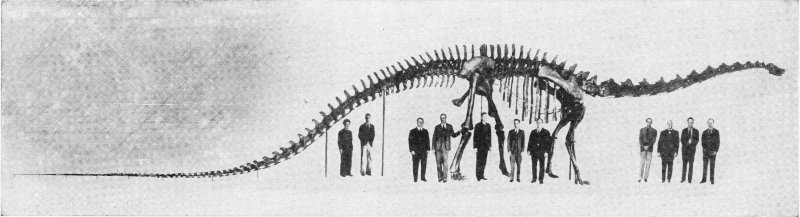
One of the Large Jurassic Dinosaurs (Diplodocus longus)
This magnificent specimen, exhibited by the Denver Museum of Natural History, has a length of seventy-five feet six inches. Two years were required to complete the task of removing the bones from the matrix rock and preparing them for mounting. Diplodocus was one of many large reptiles which inhabited western North America a hundred and fifty million years ago. The skeleton was obtained from the Morrison beds of eastern Utah. The same formation is exposed in many Colorado localities, including the foothills west of Denver, where it acquired its name from the town of Morrison.
50
In Jurassic time there became prominent a group of large dinosaurs which were more equally developed as to fore and hind limbs. They were sluggish creatures, quadrupedal in their manner of locomotion, vegetarians in regard to their diet. Some of them reached enormous proportions and it is believed that they resorted to life in the water in order to get part of the weight off their feet. Diplodocus and Brontosaurus are the names of well-known giants in this group. They had long necks and tails, very small skulls, were the largest of all land animals and are known to have reached a length of eighty feet or more. Some estimates, based on measurements of incomplete skeletons, have exceeded one hundred feet, but these extremes are somewhat questionable. Diplodocus was the more elongated of the two, with much of its length in the whip-like tail. Our mounted skeleton has a length of seventy-five feet six inches, measured along the vertebrae. Its height at the pelvis is twelve feet six inches.
The teeth of these large quadrupeds are of a slightly broadened and blunted form which has caused some speculation as to their possible use. It has even been suggested that the animals were fish-eaters but this seems impossible in view of the great size and general characteristics of the group. Although they differ extremely in some respects, they are regarded as being more closely related to the carnivores than to the herbivores of the second great branch of the tribe.
The unquestioned herbivores, constituting this second branch of the dinosaurian race, also include both bipeds and quadrupeds. The better known plant-eaters were large animals but not such monsters as Tyrannosaurus or Brontosaurus. Of the bipeds, Trachodon is perhaps best known. It is one of the duck-billed dinosaurs which had an average length of about thirty feet. The duckbills were unarmored, active animals, good swimmers as well as runners. They were prominent and widely distributed during late Cretaceous time. Many skeletons have been found in western North America. Natural casts and impressions of mummified remains indicate that the hides were scaly and the feet provided with webs between the toes. The bill was broad, flat, and toothless, but the sides of the mouth were provided with a large number of simple teeth closely arranged in parallel rows. The fine skeleton exhibited in our hall is thirty feet six inches in length. Near relatives of Trachodon, such as Corythosaurus had hollow, bony crests, combs, or tubular structures on top of the head. These may have been of some service in connection with breathing while feeding under water.
51
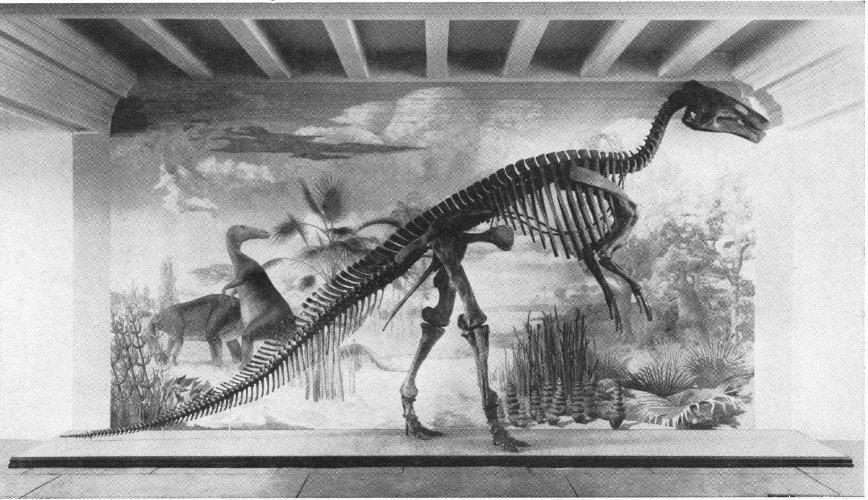
A Duck-billed Dinosaur of the Cretaceous Period (Trachodon mirabilis)
52
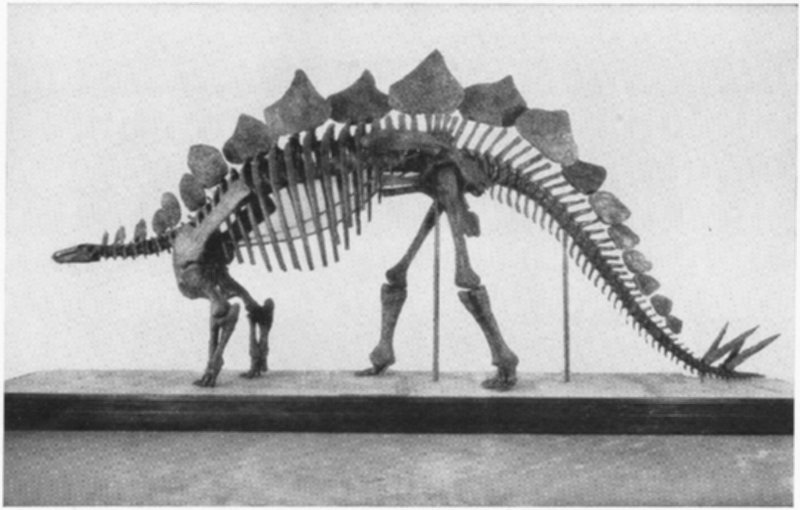
Stegosaur (Stegosaurus stenops)
53
Among the quadrupedal vegetarians an interesting family is represented by Stegosaurus, a late Jurassic dinosaur having a length of about twenty feet. These creatures had heavy limbs, all used in walking, an arched back, and almost no brain at all. A double row of large flattened plates standing upright and extending from the rear of the skull nearly to the tip of the tail provided some protection for the back of the animal, but otherwise there was no defensive armor. Several long spikes at the end of the tail probably served as weapons. The mounted skeleton in our collection was obtained from Garden Park, near Canon City, Colorado, a district which has long been famous for dinosaur remains.
The ankylosaurs were more completely armored with closely set bony plates fitting neatly over the body. They were of about the same size as the stegosaurs but the body was broad and somewhat flattened. These armored quadrupeds apparently lived only during the Cretaceous period, after the disappearance of the stegosaurs. Their tooth equipment was very poor and in a few cases entirely lacking. Ankylosaurus and Nodosaurus are good examples of the type. They have been described as animated tanks and are sometimes referred to as having the appearance of enormous horned toads.
Among the last of the dinosaurs to come and go were the horned quadrupeds known as the Ceratopsia. Their entire history appears to have been confined to the Upper Cretaceous and the closing stages of the reptilian era in America. Triceratops and Monoclonius are well-known representatives of the group. Besides the horns, which appeared above the eyes or near the center of the nose, there was a broad, flattened, backward extension of some of the skull bones which produced a great frill or collar reaching over the neck as far back as the shoulders. This frill, combined with the large skull, gave the animal the appearance of being nearly one-third head. Triceratops had three horns, Monoclonius only one. The average length of the animals was slightly under twenty feet.
Although very little is known about the ancestry of the horned dinosaurs a valuable discovery in Mongolia may throw some light on the subject. A small dinosaur with a well-developed frill, but no horns, once inhabited the region of the present Gobi desert, and in recognition of the apparent relationship it has been named Protoceratops. In addition to numerous skeletons, several nests of eggs were found in association with the bones. Until this discovery was made, dinosaur eggs had been practically unknown. A reproduction of one of these nests is among our exhibits.
54
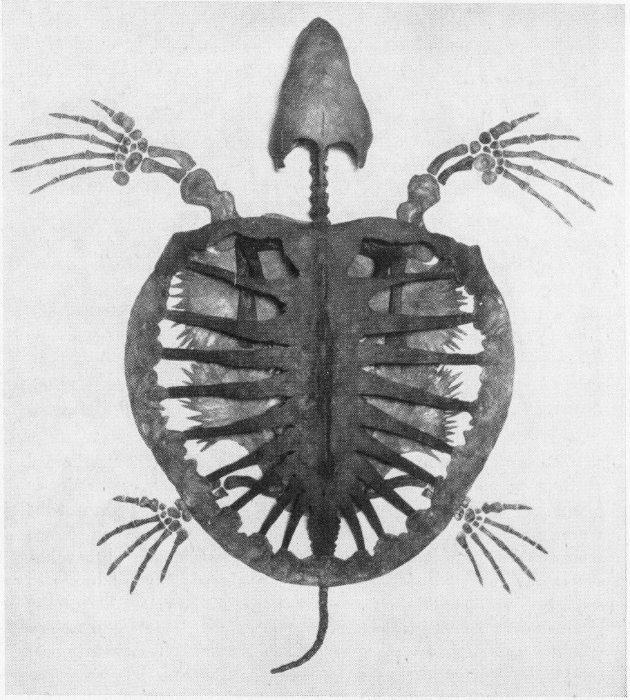
A Sea Turtle of Cretaceous Time (Protostega gigas)
This marine animal belongs to a group which became extinct near the close of the great reptilian era, but a few related forms still survive. Their weight is greatly reduced by the peculiar construction of the shell, and the front feet are enlarged for use as oars, an excellent illustration of the manner in which a land type can become adapted to life in the sea.
55
With the possible exception of a very few short-lived survivals dinosaurs were extinct before the opening of the Age of Mammals, many of them for millions of years. Along with them went other types of ancient reptiles, and the cause of their extinction is a problem which may never be solved. Conditions remained favorable for the turtles, which made their first appearance during Triassic time, and for the crocodiles, which date back to the Jurassic period. Snakes were only at the beginning of their history as the era closed. The survival of these modern forms suggests that they were favored to a greater extent than the dinosaurs during a prolonged period of changing conditions the full details of which are unknown to us.
In general it is to be expected that disaster would first overcome the highly specialized creatures, such as the dinosaurs, which had become more delicately adjusted to the particular environments in which they lived. It appears that some of them had been too progressive up to a certain point, but not sufficiently adaptable to get beyond that stage, or fortunate enough to make their advances in directions that could be followed, through fluctuations in the matter of food supply, predatory enemies, climate, and other factors which bear upon success and failure.
The reptilian era closed with exceptional volcanic activities in many parts of the world, but these cannot account for the disappearance of the highly diversified and abundant reptilian life. The eruptions were merely incidental to movements and readjustments in large masses of rock comprising the earth’s crust or surface. Such crustal folding and elevations always have been of serious consequences to both plants and animals because of their effect upon drainage and climate. There were disturbances of this kind in western North America in late Jurassic time, with folding and uplift in the region of the Sierras and probably extending from Mexico to southern Alaska. A great trough to the east of this elevated district was produced in the course of these movements and provided access to the sea from south to north. During the Cretaceous period there were repeated invasions and retreats of the sea by way of this great depression, consequent upon slight changes in the elevation of the floor. Hence there are numerous marine formations in Colorado and adjoining states, some of them rich in fossils.
Before the close of the Cretaceous period the sea had made its final departure from this region, and the Mesozoic era was terminated by revolutionary disturbances which brought about the uplifting of a new mountain system. The Rocky Mountains may be regarded as part of this system and to have had their birth at this time. The Rockies, however, show unmistakable signs of repeated elevation, with intervals of erosion 56 during which there was great reduction of their total height. What we see of them today is the result of more than fifty million years of continuous geological activity.
PLANT LIFE AND CLIMATE
Some idea of the Mesozoic climate is obtained from the character and distribution of the plant life. Triassic floras are not large and there is very little fossil evidence for the earlier half of the period. It is quite possible that arid or desert conditions prevailed for a time in much of North America, as at the close of the Paleozoic era. Plant life was at first not abundant, and conditions were unfavorable for the production of fossils. In Upper Triassic rocks of Virginia, however, there are signs of swampy conditions, with rushes and ferns predominating. Adjoining forest areas were well timbered with large coniferous evergreens which show no annual growth rings, as similar trees do in regions where cold winters alternate with warm summers. This suggests, for that time and place at least, a uniformly warm climate, lacking seasonal variations. Warm temperature or subtropical climates are indicated again by some of the Jurassic and Cretaceous plants, but intervals of lower temperatures and variable climates are also apparent. Palms, figs, and other trees, very similar to modern types now living only in warmer regions, were widely distributed in late Cretaceous time, and their range was extended into regions which have since become too cold to support such growths.
The trend toward modern forms in the plant world was gradual, but throughout the era there were occasional novelties that attract the attention of botanists. Ferns and horsetail rushes, reminiscent of the Paleozoic forests, soon began to lose their prominence as the seed-bearing trees gained the ascendency. Mesozoic time could well be called the age of cycads, because of the striking performance of this plant group. Different varieties flourished in the three periods, with the Jurassic standing out as the time of greatest abundance.
To the uninitiated, the usual cycad fossils resemble “petrified pineapples,” but these are merely the scarred stems or trunks of small to medium-sized trees with a tufted arrangement of leaves at the top, and usually without branches. Foliage and habit of growth suggest something more like large ferns or low-growing palms, with short, thick trunks seldom more than fifteen feet tall and many of them under three feet. The leaves are rarely found entire or attached to the trunks, but occasional discoveries indicate a leaf-length of about ten feet. Although they are classed among the first and lowest of seed-bearing plants, and 57 in this respect are related to the conifers, their appearance was quite unlike that of the modern cone-bearing evergreens.
More nearly resembling the common conifers of today were the sequoias, of early Mesozoic origin and far more abundant during Cretaceous time than they are at present. The maidenhair trees, now represented by a single species of Ginkgo which is cultivated principally in China and Japan, were never very prominent but are of interest as an ancient family that persisted throughout the Mesozoic and down to our own time. Before the close of the Cretaceous period the flowering plants had greatly outnumbered the spore-bearing groups, such as the ferns and horsetails which were formerly so abundant. We know little of early flowers, however, except in connection with trees, the large gayly colored blossoms of the type now conspicuous in woodlands, meadows, and gardens being later arrivals and poor subjects for preservation as fossils.
Cretaceous floras were surprisingly modern in character, far in advance of the animal life. Poplars, plane trees, magnolias, palms, figs, oaks, and buckthorns were abundant at the close of the Cretaceous, as indicated by fossils of the Laramie formation, which is the surface rock in many localities near Denver. Also abundant in various places at this time were walnut, hazelnut, laurel, tulip, maple, beech, birch, breadfruit, ivy, holly, and many other well-known trees and shrubs. Sedges and grasses, which became so important to the herbivorous mammals of the next era, made their first appearance in Cretaceous time but were then inconspicuous.
COAL AND FOSSIL FOOTPRINTS
The abundance of plant life in the Colorado area during the Cretaceous period is indicated by the extent of coal deposits of this age. About one-fourth the area of the state is underlain by coal seams varying in thickness from a few inches to fifty feet or more, most of it being Cretaceous. In the northern Colorado district the coal-bearing formation is the Laramie. Near Denver there is some coal in the Arapahoe formation which overlies the Laramie and is of later age.
Coal mines often produce excellent plant fossils, and occasionally other evidence of prehistoric life. In a mine near Canon City, Colorado, a series of natural casts of dinosaur feet was taken from the overlying rock after the coal had been removed. One of these, in the Denver Museum of Natural History, is seen to consist of sandstone inside a very thin layer of dark clay. Flattened against the lower surface is the carbonized stem of a Cretaceous plant which grew in the swamp where the coal deposit was formed.
Since the shape of dinosaur feet is unmistakable we can only assume 58 that a large reptile of this type walked over the surface of swampy ground in which a great thickness of decaying vegetation had accumulated. A layer of mud settled over the top and became sufficiently firm to retain the mold of the feet as the animal moved along. Any plant material either on the mud or included in it was pushed to the bottom of the impressions and flattened out by the weight of the huge creature. Then sand was washed into the footprints from some nearby source during a heavy rainstorm.
Following these events there was probably a subsidence of the area, and a great thickness of rock-making sediments was built over the ancient swamp. The buried vegetation gradually became converted into coal, the sand consolidated into a firm sandstone, and the mud produced the shales forming the roof of the present mine, which is now at an elevation of a mile above sea level as a consequence of the general uplifting of the Rocky Mountain region during late Cretaceous and subsequent time.
When the coal was removed, the hard sandstone casts separated readily from the softer shales surrounding them. A small amount of the shale adheres to the sandstone, and some of the flattened vegetation, now in the condition of coal, still remains attached.
MESOZOIC INVERTEBRATES
As in other eras, the invertebrates fluctuate with the periods. Characteristic forms appear, become more or less prominent, then in many cases decline or disappear. Variations among the mollusks are particularly helpful in the identification of rocks which originated in the Cretaceous seas. Clam-like bivalves of the genus Inoceramus, the straight-shelled ammonids known as Baculites, and oysters, are locally common in some of the formations exposed a few miles west of Denver.
The ammonids, or “ammonites,” were extremely abundant throughout the world during Mesozoic time. Their shells were chambered like those of the pearly nautilus, a related cephalopod mollusk inhabiting tropical seas at the present time. While only four species of the Nautilus tribe are living today, thousands of species of ammonids swarmed the prehistoric seas. Many new forms came into existence in Triassic time but few survived the period. A pronounced revival occurred in the Jurassic, only to be followed by a decline and eventual extinction at the close of the Cretaceous. Ammonites measuring three or four inches across the diameter of the coiled shell were about average size, but diameters up to three or four feet were not uncommon. Externally the shells were ornamented with ribs, knobs, and spines; inside was a pearly 59 lining. The partitions were thin and composed of the same pearl-like substance as the lining. Each partition becomes wavy as it approaches the shell, and the line of union has a distinct pattern which is seen in specimens which have lost the outer shell layer. This wavy suture line becomes more complicated in the later members of the race, and the peculiar markings developed by the repeated partitions provide a convenient method of identification.
The belemnites or ink-fishes, regarded as ancestors of the cuttlefishes now living, comprise another group of carnivorous mollusks. These, however, had lost the external shell, and the usual fossil is part of an internal shell or “skeleton,” known as the guard. This limy structure has the form of a pointed cigar, and is seldom over a foot long although the total body-length of the larger animals was commonly about six to eight feet. Several hundred species have been described, the majority being of Jurassic age. They declined rapidly toward the close of the era.
The invertebrate life of the Mesozoic was strongly dominated by mollusks, with cephalopods in first place, the bivalve pelecypods and the single-valve gastropods or snail-like forms sharing subordinate positions. The dominating trilobites, sea-scorpions, and tetracorals of the Paleozoic had disappeared, while the brachiopods and crinoids were greatly modified and more like the forms which live today.
Crinoids became moderately abundant at various times, but in many ways different from their relatives of the preceding era. Some of the largest known species, with stems estimated as fifty feet long, have been found in lower Jurassic rocks. A great abundance of microscopic life is indicated by the frequent occurrence of chalk in the Cretaceous formations. Corals of the modern reef-building type (hexacorals) were common in the warm seas of a large part of the world.
The insects of the early Mesozoic are represented by few fossils although it is evident some new forms were becoming established. The warm climates prevailing throughout much of the world appear to have been a favorable factor in the progress of insect life. In addition to the older cockroach and dragon-fly types may be mentioned the arrival of grasshoppers, cicadas, caddis-flies, beetles, and ants.
Several hundred species are found in Jurassic rocks, and by the end of the Cretaceous period most of the insect families now known to us were probably in existence. The record is seriously obscured by the erosion of rocks which so frequently marks the end of a period, also by the small size of the subjects, and by the exceptional conditions required for the production of such delicate fossils. Among the last of the familiar insects to appear were the bees and butterflies. These evidently 60 came in with the more advanced types of flowering plants that produce the nectar on which many insects feed. It is probable, too, that without the arrival of these insects and their service in the pollination of flowers, the floras of today would be rather different from what they are.
EXTINCT BIRDS
It is not surprising to find that birds made their first appearance in the Mesozoic era, for of all animals they are most like the reptiles as a class. Feathers are about the only dependable characteristic of the entire group, nearly every other feature being matched by some reptilian creature of great antiquity. The nesting habit, which includes care of the young as well as the eggs, is a matter of progress which relates to flight and to warmer body temperature. It appears to have been developed by forest-dwelling types living among trees and nesting there in comparative safety from enemies prowling on the ground.
The oldest known prehistoric birds were found in lithographic stone of Upper Jurassic age. Archaeopterix was discovered in 1861 at Solenhofen, Germany. Sixteen years later a similar bird in a better state of preservation was found in Bavaria. The latter was named Archaeornis. These Jurassic fossils are regarded as true birds by some authorities, while others believe them to be more nearly related to the reptiles, the opinions being based on careful studies of the skulls and other skeletal features. Both birds had teeth of reptilian character, and it is evident that there was no beak, for the jaws were covered with scaly skin. The bony construction of the long tail would suggest lizards rather than birds, were it not for the presence of feathers which were attached at each side. Head, neck, and parts of the body were covered with scales. Wings were well provided with stout feathers but the skeletal framework indicates that the birds were gliders rather than true flyers. Claws on the wings served like fingers to aid in climbing among the branches of trees, a practice which is occasionally noted among the young of living birds. In adult birds of today, however, the claw-like appendages of the fore limbs are greatly reduced and of little service.
The next fossil birds of importance have been found in Cretaceous rocks of Kansas, both of them fishers of the seas instead of forest inhabitants. Ichthyornis was a small bird, standing about eight inches in height, a powerful flyer with reptilian jaws and teeth. Hesperornis was built for diving and swimming, like the loon, but was somewhat larger and provided with teeth. Its wings were too poorly developed to be of use in flying.
Toothed birds became extinct with the close of Cretaceous time, 61 and the ancestors of modern types were in existence before the Age of Mammals, but fossil remains are few and poorly preserved. Large ostrich-like birds, however, are known to have lived in North America during the Eocene period. One of these, named Diatryma, stands nearly seven feet tall in the reconstructed skeleton. Its legs are heavy, wings greatly reduced, beak massive. In its relation to modern birds it is possibly nearer to the cranes than the ostriches.
Flightless birds of large size are known from many parts of the world and seem to have been prominent throughout the Cenozoic era, as they are today in the southern hemisphere. Aepyornis lived in Madagascar during the Pleistocene period and may have become extinct quite recently. Its eggs are the largest known among fossils, several times the size of an ostrich egg. Also in this period the moas were living in New Zealand where their remains are still abundant. One of the largest, known as Dinornis, had about the same form as Diatryma but the neck was longer, head and beak smaller, legs better fitted for running, height about eleven feet.
A much smaller flightless bird, the dodo, became extinct in modern time. This former inhabitant of Mauritius and other islands of the Indian Ocean was related to the doves and pigeons, and had lost its power of flight through disuse of the wings. It was a clumsy, defenseless bird weighing possibly as much as fifty pounds. Actual remains are few and incomplete, and descriptions published by the explorers who knew the bird two centuries ago are not entirely trustworthy. In the Pleistocene Rancho la Brea beds of California the largest of all prehistoric flying birds has been found, a vulture bearing the name of Teratornis. Re-assembled skeletons show them to be slightly bigger than existing condors.
ANCESTORS OF THE MAMMALS
The monotremes or egg-laying types of mammals such as the duck-bill and spiny anteaters which now inhabit Australia are almost unknown as fossils. Marsupials, the next higher living group, which includes the opossum and kangaroo, appeared at the end of Cretaceous time along with the placentals or higher mammals which dominate the history of the Cenozoic era. Nevertheless, there are a few teeth and jaws from rocks of Triassic and Jurassic age to indicate that small mammals, from the size of mice to slightly larger than rats, existed throughout most of the Age of Reptiles. There is no complete skeleton of any of the earlier forms, and little is known of their relationships either with living orders of mammals or with probable ancestors among 62 the reptiles. The record becomes somewhat clearer toward the end of the era but it is obscured again by the great disturbances which followed.
Looking back among earlier land animals for the origin of the first mammalian stock it is necessary to go as far as Permian or even Carboniferous time. Reptiles then living had many structural features in common with mammals, and mammal-like forms continued to flourish until late in the Triassic. An interesting group of such animals, named therapsids, was one of the earliest reptilian stocks to appear, and is well known from fossils found in the Red Beds of Texas and New Mexico, in Europe, South Africa, and Asia. Quite a variety of types is included in this group, with many advances in dentition, and modifications of the skull, limbs and pelvic construction which strongly suggests a relationship to the mammals.
63
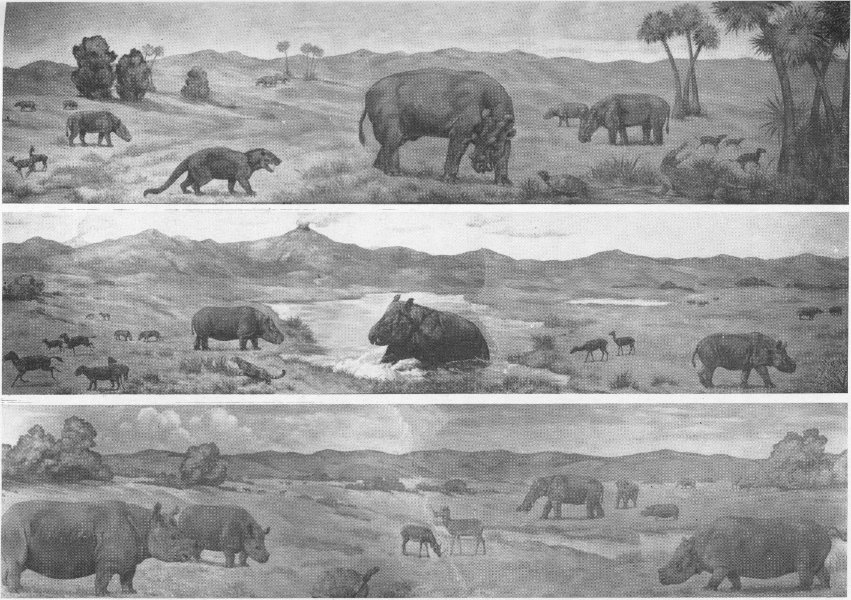
Murals Over Fossil Exhibits, Hall of Mammals Top: Eocene; Protylopus, Tanyorhinus, Patriofelis, Uintatherium, Turtle, Crocodile, Eohippus. Middle: Upper Oligocene; Mesohippus, Merycoidodon, Hoplophoneus, Metamynodon, Poebrotherium, Trigonias. Bottom: Pliocene; Teleoceras, Turtle, Synthetoceras, Amebelodon, Teleoceras.
64