LETTER IX.
Reading edition
Denmark Hill, 1st September, 1871.
My Friends,
As the design which I had in view when I began these letters (and many a year before, in the germ and first outlines of it) is now fairly afoot, and in slow, but determined, beginning of realization, I will endeavour in this and the next following letter to set its main features completely before you; though, remember, the design would certainly be a shallow and vain one, if its bearings could be either shortly explained, or quickly understood. I have much in my own hope, which I know you are as yet incapable of hoping, but which your enemies are dexterous in discouraging, and eager to discourage. Have you noticed how curiously and earnestly the greater number of public journals that have yet quoted these papers, allege, for their part, nothing but the difficulties in our way; and that with as much contempt as they can venture to express? No editor could say to your face that the endeavour to give you fresh air, wholesome employment, and high education, was reprehensible or dangerous. The worst he can venture to say is, that it is ridiculous,—which you observe is, by most, declared as wittily as they may.
“True justice!” I might more shortly have written “justice,” only you are all now so much in the way of asking for what you think “rights,” which, if you could get them, would turn out to be the deadliest wrongs;—and you suffer so much from an external mechanism of justice, which for centuries back has abetted, or, at best, resulted in, every conceivable manner of injustice—that I am compelled to say “True justice,” to distinguish it from that which is commonly imagined by the populace, or attainable under the existing laws, of civilized nations.
This true justice—(not to spend time, which I am apt to be too fond of doing, in verbal definition), consists mainly in the granting to every human being due aid in the development of such faculties as it possesses for action and enjoyment; primarily, for useful action, because all enjoyment worth having (nay, all enjoyment not harmful) must in some way arise out of that, either in happy energy, or rightly complacent and exulting rest.
“The best shapes there is room for,” since, according to the conditions around them, men’s natures must expand or remain contracted; and, yet more distinctly, let me say, “the best shapes that there is substance for,” seeing that we must accept contentedly infinite difference in the original nature and capacity, even at their purest; which it is the first condition of right education to make manifest to all persons—most of all to the persons chiefly concerned. That other men should know their measure, is, indeed, desirable; but that they should know it themselves, is wholly necessary.
“By competitive examination of course?” Sternly, no! but under absolute prohibition of all violent and strained effort—most of all envious or anxious effort—in every exercise of body and mind; and by enforcing on every scholar’s heart, from the first to the last stage of his instruction, the irrevocable ordinance of the third Fors Clavigera, that his mental rank among men is fixed from the hour he was born,—that by no temporary or violent effort can he train, though he may seriously injure the faculties he has; that by no manner of effort can he increase them; and that his best happiness is to consist in the admiration of powers by him for ever unattainable, and of arts, and deeds, by him ever inimitable.
Some ten or twelve years ago, when I was first actively engaged in Art teaching, a young Scottish student came up to London to put himself under me, having taken many prizes (justly, with respect to the qualities looked for by the judges) in various schools of Art. He worked under me very earnestly and patiently for some time; and I was able to praise his doings in what I thought very high terms: nevertheless, there remained always a look of mortification on his face, after he had been praised, however unqualifiedly. At last, he could hold no longer, but one day, when I had been more than usually complimentary, turned to me with an anxious, yet not unconfident expression, and asked: “Do you think, sir, that I shall ever draw as well as Turner?”
This, then, shall be the first condition of what education it may become possible for us to give, that the strength of the youths shall never be strained; and that their best powers shall be developed in each, without competition, though they shall have to pass crucial, but not severe, examinations, attesting clearly to themselves and to other people, not the utmost they can do, but that at least they can do some things accurately and well: their own certainty of this being accompanied with the quite as clear and much happier certainty, that there are many other things which they will never be able to do at all.
“The happier certainty?” Yes. A man’s happiness consists infinitely more in admiration of the faculties of others than in confidence in his own. That reverent admiration is the perfect human gift in him; all lower animals are happy and noble in the degree they can share it. A dog reverences you, a fly does not; the capacity of partly understanding a creature above him, is the dog’s nobility. Increase such reverence in human beings, and you increase daily their happiness, peace, and dignity; take it away, and you make them wretched as well as vile. But for fifty years back modern education has devoted itself simply to the teaching of impudence; and then we complain that we can no more manage our mobs! “Look at Mr. Robert Stephenson,” (we tell a boy,) “and at Mr. James Watt, and Mr. William Shakspeare! You know you are every bit as good as they; you have only to work in the same way, and you will infallibly arrive at the same eminence.” Most boys believe the “you are every bit as good as they,” without any painful experiment: but the better-minded ones really take the advised measures; and as, at the end of all things, there can be but one Mr. James Watt or Mr. William Shakspeare, the rest of the candidates for distinction, finding themselves, after all their work, still indistinct, think it must be the fault of the police, and are riotous accordingly.
To some extent it is the fault of the police, truly enough, considering as the police of Europe, or teachers of politeness and civic manners, its higher classes,—higher either by race or faculty. Police they are, or else are nothing: bound to keep order, both by clear teaching of the duty and delight of Respect, and, much more, by being themselves—Respectable; whether as priests, or kings, or lords, or generals, or admirals;—if they will only take care to be verily that, the Respect will be forthcoming, with little pains: nay, even Obedience, inconceivable to modern free souls as it may be, we shall get again, as soon as there is anybody worth obeying, and who can keep us out of shoal water.
Meantime, at distance from the scene of blood,
The pensive steeds of great Achilles stood;
Their godlike master slain before their eyes
They wept, and shared in human miseries.
In vain Automedon now shakes the rein,
Now plies the lash, and soothes and threats in vain;
Nor to the fight nor Hellespont they go,
Restive they stood, and obstinate in woe;
Still as a tombstone, never to be moved,
On some good man or woman unreproved
Lays its eternal weight; or fix’d as stands
A marble courser by the sculptor’s hands,
Placed on the hero’s grave. Along their face,
The big round drops coursed down with silent pace,
Conglobing on the dust. Their manes, that late
Circled their arched necks, and waved in state,
Trail’d on the dust, beneath the yoke were spread,
And prone to earth was hung their languid head:
Nor Jove disdain’d to cast a pitying look,
While thus relenting to the steeds he spoke:
“Unhappy coursers of immortal strain!
Exempt from age, and deathless now in vain!
Did we your race on mortal man bestow,
Only, alas! to share in mortal woe?
For ah! what is there, of inferior birth,
That breathes or creeps upon the dust of earth;
What wretched creature of what wretched kind,
Than man more weak, calamitous and blind?
A miserable race! But cease to mourn!
For not by you shall Priam’s son be borne
High on the splendid car; one glorious prize
He rashly boasts; the rest our will denies.
Ourself will swiftness to your nerves impart,
Ourself with rising spirits swell your heart.
Automedon your rapid flight shall bear
Safe to the navy through the storm of war.…”
He said; and, breathing in th’ immortal horse
Excessive spirit, urged them to the course;
From their high manes they shake the dust, and bear
The kindling chariot through the parted war.
It exists yet, and out of La Mancha, too (or none of us could exist), whatever you may think in these days of ungentleness and Dishonour. It exists secretly, to the full, among you yourselves, and the recovery of it again would be to you as the opening of a well in the desert. You remember what I told you were the three spiritual treasures of your life—Admiration, Hope, and Love. Admiration is the Faculty of giving Honour. It is the best word we have for the various feelings of wonder, reverence, awe, and humility, which are needful for all lovely work, and which constitute the habitual temper of all noble and clear-sighted persons, as opposed to the “impudence” of base and blind ones. The Latins called this great virtue “pudor,” of which our “impudence” is the negative; the Greeks had a better word, “αἰδώς;” too wide in the bearings of it for me to explain to you to-day, even if it could be explained before you recovered the feeling;—which, after being taught for fifty years that impudence is the chief duty of man, and that living in coal-holes and ash-heaps is his proudest existence, and that the methods of generation of vermin are his loftiest subject of science,—it will not be easy for you to do; but your children may, and you will see that it is good for them. In the history of the five cities I named, they shall learn, so far as they can understand, what has been beautifully and bravely done; and they shall know the lives of the heroes and heroines in truth and naturalness; and shall be taught to remember the greatest of them on the days of their birth and death; so that the year shall have its full calendar of reverent Memory. And on every day, part of their morning service shall be a song in honour of the hero whose birthday it is: and part of their evening service, a song of triumph for the fair death of one whose death-day it is: and in their first learning of notes they shall be taught the great purpose of music, which is to say a thing that you mean deeply, in the strongest and clearest possible way; and they shall never be taught to sing what they don’t mean. They shall be able to sing merrily when they are happy, and earnestly when they are sad; but they shall find no mirth in mockery, nor in obscenity; neither shall they waste and profane their hearts with artificial and lascivious sorrow.
Regulations which will bring about some curious changes in piano-playing, and several other things.
“Which will bring.” They are bold words, considering how many schemes have failed disastrously, (as your able editors gladly point out,) which seemed much more plausible than this. But, as far as I know history, good designs have not failed except when they were too narrow in their final aim, and too obstinately and eagerly pushed in the beginning of them. Prosperous Fortune only grants an almost invisible slowness of success, and demands invincible patience in pursuing it. Many good men have failed in haste; more in egotism, and desire to keep everything in their own hands; and some by mistaking the signs of their times; but others, and those generally the boldest in imagination, have not failed; and their successors, true knights or monks, have bettered the fate and raised the thoughts of men for centuries; nay, for decades of centuries. And there is assuredly nothing in this purpose I lay before you, so far as it reaches hitherto, which will require either knightly courage or monkish enthusiasm to carry out. To divert a little of the large current of English charity and justice from watching disease to guarding health, and from the punishment of crime to the reward of virtue; to establish, here and there, exercise grounds instead of hospitals, and training schools instead of penitentiaries, is not, if you will slowly take it to heart, a frantic imagination. What farther hope I have of getting some honest men to serve, each in his safe and useful trade, faithfully, as a good soldier serves in his dangerous, and too often very wide of useful one, may seem, for the moment, vain enough; for indeed, in the last sermon I heard out of an English pulpit, the clergyman said it was now acknowledged to be impossible for any honest man to live by trade in England. From which the conclusion he drew was, not that the manner of trade in England should be amended, but that his hearers should be thankful they were going to heaven. It never seemed to occur to him that perhaps it might be only through amendment of their ways in trade that some of them could ever get there.
Such madness, therefore, as may be implied in this ultimate hope of seeing some honest work and traffic done in faithful fellowship, I confess to you: but what, for my own part, I am about to endeavour, is certainly within my power, if my life and health last a few years more, and the compass of it is soon definable. First,—as I told you at the beginning of these Letters,—I must do my own proper work as well as I can—nothing else must come in the way of that; and for some time to come, it will be heavy, because, after carefully considering the operation of the Kensington system of Art-teaching throughout the country, and watching for two years its effect on various classes of students at Oxford, I became finally convinced that it fell short of its objects in more than one vital particular: and I have, therefore, obtained permission to found a separate Mastership of Drawing in connection with the Art Professorship at Oxford; and elementary schools will be opened in the University galleries, next October, in which the methods of teaching will be calculated to meet requirements which have not been contemplated in the Kensington system. But how far what these, not new, but very ancient, disciplines teach, may be by modern students, either required or endured, remains to be seen. The organization of the system of teaching, and preparation of examples, in this school, is, however, at present my chief work,—no light one,—and everything else must be subordinate to it.
But in my first series of lectures at Oxford, I stated (and cannot too often or too firmly state) that no great arts were practicable by any people, unless they were living contented lives, in pure air, out of the way of unsightly objects, and emancipated from unnecessary mechanical occupation. It is simply one part of the practical work I have to do in Art-teaching, to bring, somewhere, such conditions into existence, and to show the working of them. I know also assuredly that the conditions necessary for the Arts of men, are the best for their souls and bodies; and knowing this, I do not doubt but that it may be with due pains, to some material extent, convincingly shown; and I am now ready to receive help, little or much, from any one who cares to forward the showing of it.
Sir Thomas Dyke Acland, and the Right Hon. William Cowper-Temple, have consented to be the Trustees of the fund; it being distinctly understood that in that office they accept no responsibility for the conduct of the scheme, and refrain from expressing any opinion of its principles. They simply undertake the charge of the money and land given to the St. George’s fund; certify to the public that it is spent, or treated, for the purposes of that fund, in the manner stated in my accounts of it; and, in the event of my death, hold it for such fulfilment of its purposes as they may then find possible.
It is time, too, I think. Did you notice the lovely instances of chivalry, modesty, and musical taste recorded in those letters in the ‘Times,’ giving description of the “civilizing” influence of our progressive age on the rural district of Margate?
They are of some documentary value, and worth preserving, for several reasons. Here they are:—
I.—A TRIP TO MARGATE.
To the Editor of the Times.
Sir,—On Monday last I had the misfortune of taking a trip per steamer to Margate. The sea was rough, the ship crowded, and therefore most of the Cockney excursionists prostrate with sea-sickness. On landing on Margate pier I must confess I thought that, instead of landing in an English seaport, I had been transported by magic to a land inhabited by savages and lunatics. The scene that ensued when the unhappy passengers had to pass between the double line of a Margate mob on the pier must be seen to be believed possible in a civilized country. Shouts, yells, howls of delight greeted every pale-looking passenger, as he or she got on the pier, accompanied by a running comment of the lowest, foulest language imaginable. But the most insulted victims were a young lady, who having had a fit of hysterics on board, had to be assisted up the steps, and a venerable-looking old gentleman with a long grey beard, who, by-the-by, was not sick at all, but being crippled and very old, feebly tottered up the slippery steps leaning on two sticks. “Here’s a guy!” “Hallo! you old thief, you won’t get drowned, because you know that you are to be hung,” etc., and worse than that, were the greetings of that poor old man. All this while a very much silver-bestriped policeman stood calmly by, without interfering by word or deed; and myself, having several ladies to take care of, could do nothing except telling the ruffianly mob some hard words, with, of course, no other effect than to draw all the abuse on myself. This is not an exceptional exhibition of Margate ruffianism, but, as I have been told, is of daily occurrence, only varying in intensity with the roughness of the sea.
Public exposure is the only likely thing to put a stop to such ruffianism; and now it is no longer a wonder to me why so many people are ashamed of confessing that they have been to Margate.
I remain, Sir, yours obediently,
C. L. S.
London, August 16.
II.—MARGATE.
To the Editor of the Times.
Sir,—From personal experience obtained from an enforced residence at Margate, I can confirm all that your correspondent “C. L. S.” states of the behaviour of the mob on the jetty; and in addition I will venture to say that in no town in England, or, so far as my experience goes, on the Continent, can such utterly indecent exhibitions be daily witnessed as at Margate during bathing hours. Nothing can be more revolting to persons having the least feelings of modesty than the promiscuous mixing of the bathers; nude men dancing, swimming, or floating with women not quite nude, certainly, but with scant clothing. The machines for males and females are not kept apart, and the latter do not apparently care to keep within the awnings. The authorities post notices as to “indecent bathing,” but that appears to be all they think they ought to do.
I am, Sir, yours obediently,
B.
To the Editor of the Times.
Sir,—The account of the scenes which occur at the landing of passengers at the Margate jetty, given by your correspondent to-day, is by no means overcharged. But that is nothing. The rulers of the place seem bent on doing their utmost to keep respectable people away, or, doubtless, long before this the class of visitors would have greatly improved. The sea-fronts of the town, which in the summer would be otherwise enjoyable, are abandoned to the noisy rule of the lowest kinds of itinerant mountebanks, organ-grinders, and niggers; and from early morn till long after nightfall the place is one hopeless, hideous din. There is yet another grievance. The whole of the drainage is discharged upon the rocks to the east of the harbour, considerably above low-water mark; and to the west, where much building is contemplated, drains have already been laid into the sea, and, when these new houses are built and inhabited, bathing at Margate, now its greatest attraction, must cease for ever.
Yours obediently,
Pharos.
Margate, August 18.
I have printed these letters for several reasons. In the first place, read after them this account of the town of Margate, given in the ‘Encyclopædia Britannica,’ in 1797: “Margate, a seaport town of Kent, on the north side of the Isle of Thanet, near the North Foreland. It is noted for shipping vast quantities of corn (most, if not all, the product of that island) for London, and has a salt-water bath at the Post-house, which has performed great cures in nervous and paralytic cases.”
Now this Isle of Thanet, please to observe, which is an elevated (200 to 400 feet) mass of chalk, separated from the rest of Kent by little rivers and marshy lands, ought to be respected by you (as Englishmen), because it was the first bit of ground ever possessed in this greater island by your Saxon ancestors, when they came over, some six or seven hundred of them only, in three ships, and contented themselves for a while with no more territory than that white island. Also, the North Foreland, you ought, I think, to know, is taken for the terminal point of the two sides of Britain, east and south, in the first geographical account of our dwelling-place, definitely given by a learned person. But you ought, beyond all question, to know, that the cures of the nervous and paralytic cases, attributed seventy years ago to the “salt-water bath at the Post-house,” were much more probably to be laid to account of the freshest and changefullest sea-air to be breathed in England, bending the rich corn over that white dry ground, and giving to sight, above the northern and eastern sweep of sea, the loveliest skies that can be seen, not in England only, but perhaps in all the world; able, at least, to challenge the fairest in Europe, to the far south of Italy.
So it was said, I doubt not rightly, by the man who of all others knew best; the once in five hundred years given painter, whose chief work, as separate from others, was the painting of skies. He knew the colours of the clouds over the sea, from the Bay of Naples to the Hebrides; and being once asked where, in Europe, were to be seen the loveliest skies, answered instantly, “In the Isle of Thanet.” Where, therefore, and in this very town of Margate, he lived, when he chose to be quit of London, and yet not to travel.
And I can myself give this much confirmatory evidence of his saying;—that though I never stay in Thanet, the two loveliest skies I have myself ever seen (and next to Turner, I suppose few men of fifty have kept record of so many), were, one at Boulogne, and the other at Abbeville; that is to say, in precisely the correspondent French districts of corn-bearing chalk, on the other side of the Channel.
“And what are pretty skies to us?” perhaps you will ask me: “or what have they to do with the behaviour of that crowd on Margate Pier?”
Well, my friends, the final result of the education I want you to give your children will be, in a few words, this. They will know what it is to see the sky. They will know what it is to breathe it. And they will know, best of all, what it is to behave under it, as in the presence of a Father who is in heaven.
Faithfully yours,
J. RUSKIN.
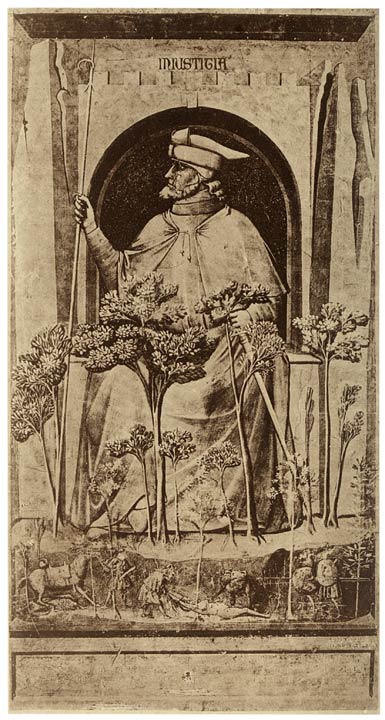
INJUSTICE.
Drawn thus by Giotto in the chapel of the Arena at Padua.