HOW TO KNOW THEM (continued 2)
Reading edition
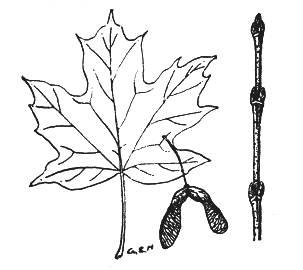
SUGAR MAPLE Leaf, one-third natural size. Twig, one-half natural size.
The leaves are 3 to 5 inches across, simple, opposite, with 3 to 5 pointed and sparsely-toothed lobes, the divisions between the lobes being rounded. The leaves are dark green on the upper surface, lighter green beneath, turning in autumn to brilliant shades of dark red, scarlet, orange and clear yellow.
The flowers are yellowish-green, on long threadlike stalks, appearing with the leaves, the two kinds in separate clusters. The fruit, which ripens in the fall, consists of a two-winged “samara”, or “key”, the two wings nearly parallel, each about 1 inch in length and containing a seed. It is easily carried by the wind.
The wood is hard, heavy, strong, close-grained and light brown in color. It is known, commercially as hard maple, and is used in the manufacture of flooring, furniture, shoe-lasts and a great variety of novelties.
The black maple, Acer nigrum Michx., occurs with the sugar maple with darker bark. The leaves are usually wider than long, yellow-green and downy beneath, and the base of the petioles enlarged. The two lower lobes are very small; the lobes are undulate or entire.

SILVER MAPLE Acer saccharinum L.
THE silver or river maple, also called the soft maple, occurs on moist land and along streams. It attains heights of 100 feet or more and diameters of 3 feet or over. It usually has a short trunk which divides into a number of large ascending limbs. These again subdivide, and the branches droop but turn upward at the tips. The bark on the old stems is dark gray and broken into long flakes or scales; on the young shoots it is smooth and varies in color from reddish to a yellowish-gray. The silver maple grows rapidly and has been much planted as a shade tree. Because of the brittleness of its wood, it is often damaged by summer storms and winter sleet.
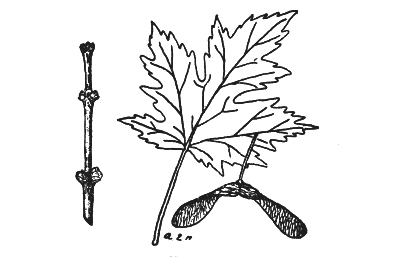
SILVER MAPLE Twig, one-half natural size. Leaf, one-third natural size.
The leaves are opposite on the stem, have from 3 to 5 lobes ending in long points with toothed edges and are separated by deep angular sinuses or openings; they are pale green on the upper surface and silvery-white underneath. The buds are rounded, red or reddish-brown, blunt-pointed; generally like those of red maple.
The flowers appear in the spring before the leaves, in dense clusters, and are of a greenish-yellow color. The fruit ripens in late spring. It consists of a pair of winged seeds or “keys” with wings 1 to 2 inches long on slender, flexible, threadlike stems about an inch long.
The wood is soft, weak, even-textured, rather brittle, easily worked, and decays readily when exposed. It is considerably used for boxboards, furniture, veneers and fuel.
The red maple, or swamp maple, Acer rubrum L., has leaves deeply lobed with the lobes sharply toothed. The autumn color is deep red. The flowers also are red and the fruit is small reddish, maturing late in spring.
BOX ELDER Acer negundo L.
THE box elder is a fairly rapidly growing tree, found commonly along streams rather generally over the State. It is a tree of medium size, rarely reaching over 24 inches in diameter and 60 to 70 feet in height. It has been considerably planted for shade because in good soil its growth is rapid. Its limbs and branches, however, are fragile, and the tree as a whole is rather subject to disease. It is not long-lived or generally satisfactory for any purpose. It is prolific in reproduction but is largely destroyed by grazing and cultivation.
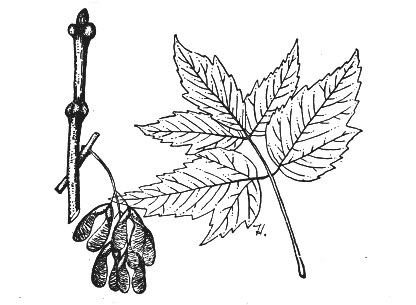
BOX ELDER Twig, two-thirds natural size. Leaf, one-third natural size.
The bark on young branches is smooth and green to purple in color; on old trees it is thin, grayish to light brown and deeply divided.
The leaves are compound, with usually 3 leaflets (rarely 5 or 7), opposite, smooth and lustrous, green, and borne on a leaf stem or petiole 2 to 3 inches long. The leaflets are 2 to 4 inches long by 1 to 2 inches wide, making the whole leaf 5 to 8 inches in length.
The fruit is a samara, or key, winged similarly to that of a sugar maple, but smaller. It ripens in late summer or early fall, and so is like its close relative, the sugar maple, but unlike its close relatives, the red maple and silver maple.
The wood is soft, light, weak, close-grained and decays readily in contact with heat and moisture. It is used occasionally for fuel.
The Norway maple, Acer platanoides L., is a European species which has been extensively planted. It forms a round, spreading crown of stout branches with coarse twigs. The leaves resemble those of the sugar maple but somewhat broader and the petioles exude a milky juice when cut. The flowers are larger than those of our native maples and fruit is large with diverging wings. It holds its leaves longer in the fall and the autumn coloring is pale yellow. It succeeds well as a city shade tree.
OHIO BUCKEYE Aesculus glabra Willd.
THE buckeye is rare in the northern fourth of Illinois, but is known in the rest of the State, forming no considerable part of the forest stand. It reaches a height of 60 to 70 feet and a diameter of 18 to 24 inches. The trunk is usually short, limby, and knotty. The crown or head, is generally open and made up of small spreading branches and twigs orange-brown to reddish-brown in color. The bark is light gray and, on old trees, divided or broken into flat scales, which make the stem of the tree rough; the bark is ill-smelling when bruised.
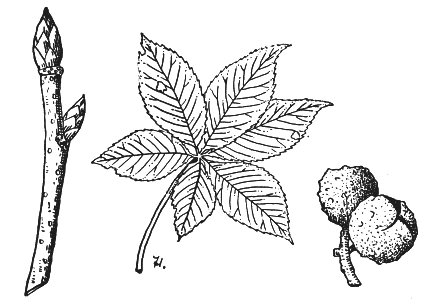
OHIO BUCKEYE Twig, two-thirds natural size. Nut, one-third natural size. Leaf, one-quarter natural size.
The leaves are opposite on the twigs, compound and consisting of 5 long-oval, rarely 7, pointed, toothed, yellow-green leaflets, set like the fingers of a hand at the top of slender petioles 4 to 6 inches long. They usually turn yellow and then fall early in the autumn.
The flowers appear after the leaves unfold; are cream-colored; in terminal panicles 5 to 7 inches long and 2 to 3 inches broad, quite downy.
The fruit is a thick, leathery, prickly capsule about an inch in diameter, and, breaking into 2 or 3 valves, discloses the bright, shiny, mahogany colored seeds, or nuts.
The wood is light, soft and weak, and decays rapidly when exposed. It is used for woodenware, artificial limbs, paper pulp, and for lumber and fuel.
The horse-chestnut, Aesculus hippocastanum L., is a handsome European tree with a very symmetrical crown. The flowers are larger than those of our native species and add beauty to the foliage. It forms a desirable shade tree.
BASSWOOD Tilia americana L.
THE basswood, or American linden, is a rather tall tree with a broad, round-topped crown. It ranges throughout Illinois and may be found wherever rich, wooded slopes, moist stream banks and cool ravines occur. It grows best in river bottoms, where it is common and forms a valuable timber tree, attaining a height of 80 feet and a diameter of 4 feet. The bark is light brown, deeply furrowed and the inner bark furnishes bast for making mats.
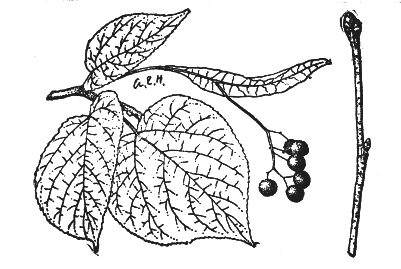
BASSWOOD Leaf, one-third natural size. Twig, one-half natural size.
The leaves are broadly heart-shaped, 3 to 6 inches long, coarsely saw-toothed, smooth on both sides, except for some hairs on the axils of the veins. They are dark above but light green beneath.
The flowers are yellowish-white, in drooping clusters opening in early summer, and flower stem is united to the middle of a long narrow leaf-like bract. They are very fragrant and from them the bees make a large amount of choice grade honey.
The fruit is a berry-like, dry, 1 or 2 seeded, rounded nutlet ¼ to ½ an inch in diameter, covered with short, thick and brownish wool. It remains attached in clusters to the leafy bract, which later acts as a wing to bear it away on the wind.
The wood is light, soft, tough, not durable, light brown in color. It is used in the manufacture of pulp, woodenware, furniture, trunks, excelsior and many other articles.
It makes a fine shade tree, grows rapidly and is easily transplanted.
The white basswood, Tilia heterophylla Vent., is similar to the preceding species, but with somewhat lighter bark. The leaves are larger, dark yellow-green above, the under surface being generally densely covered with short, silvery or gray hairs with tufts of brown hairs in the axils of the veins. It is more plentiful in the southern part of the State.
FLOWERING DOGWOOD Cornus florida L.
THE flowering dogwood is rare in the northern third of the State. It is a small tree, growing under the larger forest trees, usually 15 to 30 feet in height and 6 to 12 inches in diameter, with a rather flat and spreading crown and short, often crooked trunk. The bark is reddish-brown to black and broken up into small 4-sided scaly blocks.
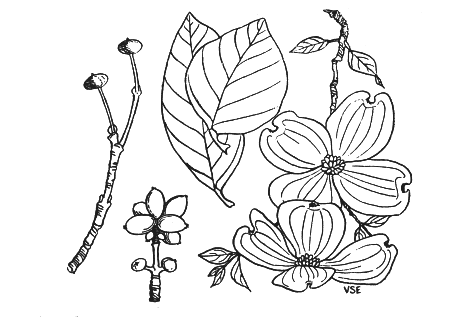
FLOWERING DOGWOOD Leaf and flowers, one-half natural size. Twig, two-thirds natural size.
The leaves are opposite, ovate, 3 to 5 inches long, 2 to 3 inches wide, pointed, entire or wavy on the margin, bright green above, pale green or grayish beneath.
The flowers, which unfold from the conspicuous round, grayish, winter flower buds before the leaves come out, are small greenish-yellow, arranged in dense heads surrounded by large white or rarely pinkish petal-like bracts, which give the appearance of large spreading flowers 2 to 4 inches across.
The fruit is a bright scarlet “berry”, ½ inch long and containing a hard nutlet in which are 1 or 2 seeds. Usually several fruits, or “berries”, are contained in one head. They are relished by birds, squirrels and other animals.
The wood is hard, heavy, strong, very close-grained, brown to red in color. It is in great demand for cotton-mill machinery, turnery handles and forms. One other tree has quite similar wood—the persimmon.
The dogwood, with its masses of early spring flowers, its dark red autumn foliage and its bright red berries, is probably our most ornamental native tree. It should be used much more extensively in roadside and ornamental planting.
The alternate-leaved dogwood, Cornus alternifolia L., occasionally reaches tree size with long slender branches arranged in irregular whorls giving the tree a storied effect. The flowers are small, followed by blue-black fruit borne in loose red-stemmed clusters.
SOUR GUM Nyssa sylvatica Marsh.
THE sour gum, often called black gum, is found in many types of soil and in most conditions of soil moisture in southern Illinois, but it becomes rare in the northern half of the State. In lowlands, it is occasionally found in year-round swamps with cypress, and in the hills on dry slopes with oaks and hickories.
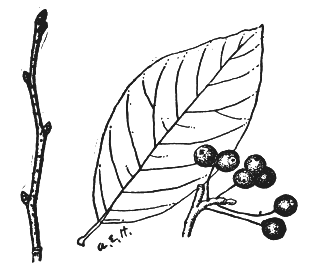
SOUR GUM One-half natural size.
The leaves are simple, 2 to 3 inches long, entire, often broader near the apex, shiny, dark green in color. In the fall the leaves turn a most brilliant red.
The bark on younger trees is furrowed between flat ridges, and gradually develops into quadrangular blocks that are dense, hard and nearly black. Most of the branches are nearly horizontal.
The greenish flowers on long slender stems appear in early spring when the leaves are about one-third grown. They are usually of two kinds, the male in many-flowered heads and the female in two to several-flowered clusters on different trees. The fruit is a dark blue, fleshy berry, ⅔ of an inch long, containing a single hard-shelled seed, and is borne on long stems, 2 to 3 in a cluster.
The wood is very tough, cross-grained, not durable in contact with the soil, hard to work, and warps easily. It is used for crate and basket veneers, box shooks, rollers, mallets, rough floors, mine trams, pulpwood and fuel.
The tupelo gum, or cotton gum, Nyssa aquatica L., is found in deep river swamps which are flooded during a part of the year. It occurs in 4 or 5 of the southern counties of Illinois in cypress swamps. The enlarged base and the larger fruit serve to distinguish it from the sour gum. This fruit or “plum” is about an inch long, dark purple and has a tough skin enclosing a flattened stone. The wood is light, soft, and not strong and is used for woodenware, handles, fruit and vegetable packages.
PERSIMMON Diospyros virginiana L.
THE persimmon, often called “simmon”, is well known throughout its range. It is a small tree, rarely exceeding 50 feet in height and 1 inch in diameter, occurring throughout the State from the southern part north to Peoria County. It seems to prefer dry, open situations, and is most abundant in the old fields, though it also occurs on rich bottom lands. The bark of old trees is almost black and separated into thick nearly square blocks, much like the black gum.
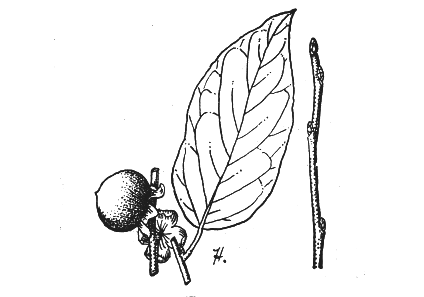
PERSIMMON Leaf, one-half natural size. Twig, three-quarters natural size.
The leaves are alternate, oval, entire, 4 to 6 inches long, dark green and shining above, paler beneath.
The small flowers, which appear in May, are yellowish or creamy white, somewhat bell-shaped, the two kinds occurring on separate trees; the male in clusters of 2 or 3, the female solitary. They are visited by many insects.
The fruit is a pulpy, round, orange-colored or brown berry, an inch or more in diameter and containing several flattened, hard, smooth seeds. It is strongly astringent while green, but quite sweet and delicious when thoroughly ripe.
The wood is hard, dense, heavy, strong, the heartwood brown or black, the wide sapwood white or yellowish. It is particularly valued for shuttles, golf-stick heads, and similar special uses, but is not of sufficient commercial use to warrant its general encouragement as a timber tree.
The Hercules’ club, Aralia spinosa L., grows to tree size in southern Illinois, with a spiny stem 25 to 30 feet tall and a flat-topped head. The doubly compound leaves are often more than 3 feet long. Its small greenish-white flowers are followed by large clusters of purple juicy berries. It is desirable for ornamental planting.
WHITE ASH Fraxinus americana L.
THE white ash is found throughout the State, but grows to best advantage in the rich moist soils of bottom lands. It reaches an average height of 50 to 80 feet and a diameter of 2 to 3 feet, though much larger trees are found in virgin forests. The bark varies in color from a light gray to a gray-brown. The rather narrow ridges are separated with marked regularity by deep, diamond-shaped fissures.
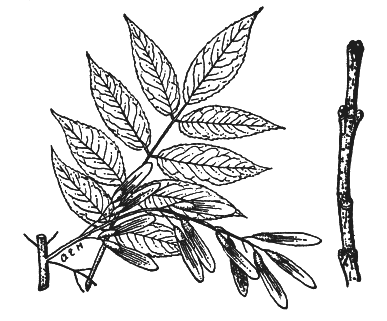
WHITE ASH Twig, one-half natural size. Leaf, one-third natural size.
The opposite leaves of the white ash are from 8 to 12 inches long and have from 5 to 9 plainly stalked, sharp-pointed leaflets, dark green and smooth above, pale green beneath.
The flowers are of two kinds on different trees, the staminate in dense reddish-purple clusters and the pistillate in more open bunches. The fruit of the ash is winged, 1 to 1½ inches long, resembling the blade of a canoe paddle in outline, with the seed at the handle end. The fruits mature in late summer and are distributed effectively by the winds.
The wood of the white ash is extremely valuable on account of its toughness and elasticity. It is preferred to all other native woods for small tool handles, such athletic implements as rackets, bats, and oars, and agricultural implements. It is also used extensively for furniture and interior finish.
The green ash, Fraxinus pennsylvanica lanceolata Sarg., is common in stream valleys throughout the State. The hairy form of this tree is known as the red ash. This species differs from the white ash in having the leaves bright green or yellow-green on both sides. The fruit has the wing portion extending well down past the middle of the seed-bearing part, and with the wing sometimes square or slightly notched at the outer end. The wood is similar to that of the white ash, but is not quite so tough.
BLUE ASH Fraxinus quadrangulata Michx.
THE blue ash is not very common but widely distributed in the upland portions of the State, where it is limited to limestone bluffs, occasionally descending to the adjacent bottom lands. It becomes a large tree 60 feet or more in height with a trunk 2 feet in diameter. The young twigs are usually square, sometimes winged or 4-ridged between the leaf bases.
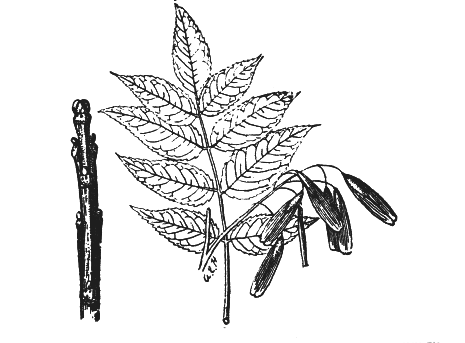
BLUE ASH Leaf, one-third natural size. Fruit and twig, two-thirds natural size.
The bark is light gray tinged with red, ½ to ⅔ inch thick, irregularly divided into large plate-like scales. Macerating the inner bark in water yields a blue dye.
The leaves are 8 to 12 inches long, having 7 to 11 stalked leaflets, long pointed and coarsely toothed, thick and firm, smooth and yellowish-green above, paler beneath.
The flowers are without petals and appear in clusters when the buds begin to expand.
The fruit is flattened and oblong, 1 to 2 inches long and less than ½ inch wide and usually notched at the outer end. The wing is about twice the length of the seed-bearing portion and extends down the sides past the middle.
The wood is heavy, hard, and close-grained, light yellow, streaked with brown, with a very broad zone of lighter sapwood. It is not usually distinguished commercially from the wood of other ashes.
The pumpkin ash, Fraxinus tomentosa Michx., grows in deep river swamps in southern Illinois. It is a tall slender tree, usually with a much enlarged base. The twigs are light gray. The leaves, with 7 to 9 leaflets, smooth above and soft downy below, are from 10 to 18 inches long.
The black ash, Fraxinus nigra Marsh., appears occasionally on the flood plains in the northern part of the State. It may be known by its ashy light gray bark, its very thick twigs and sessile, long-pointed sharply serrate leaflets.
CATALPA Catalpa speciosa Warder
THIS is a native to the Wabash Valley of Illinois, but has been widely planted and has spread somewhat farther as a result of cultivation. It is a medium sized tree with a short trunk and broad head with spreading branches. Because of its attractive flowers and conspicuous heart-shaped leaves, it is considerably used for shade and ornament. The bark varies from dark gray to brown, slightly rough, being divided in narrow shallow strips or flakes. The leaves are simple, opposite, oval, long-pointed, 6 to 10 inches long, and heart-shaped at the base.
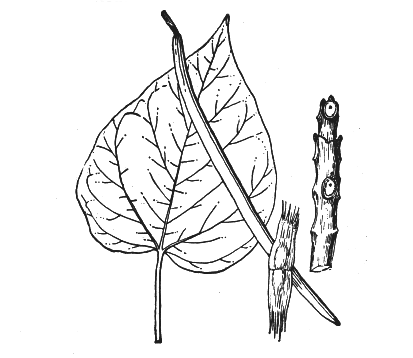
CATALPA Leaf, one-third natural size. Twig, two-thirds natural size.
The flowers appear in clusters or panicles in May or June. They are white with purple and yellow markings, and this makes them decidedly showy and attractive. The fruit consists of a bean-like pod, 8 to 16 inches long. It hangs on the tree over winter and gradually splits into 2 parts, or valves. The seeds are about 1 inch long and terminate in wings that are rounded and short-fringed at the ends. They are freely carried by the wind.
The wood is rather soft, light, coarse-grained and durable in contact with the soil. It is used for fence posts, poles and fuel, and occasionally for railroad ties.
The paulownia, Paulownia tomentosa (Thumb). Steud., is a large tree native of China with the aspect of the catalpa with broad opposite leaves. Its upright pyramidal clusters of pale violet flowers which appear with the unfolding of the leaves are strikingly handsome. The individual flowers are bell-shaped, two inches long and spotted with darker purple.
DEPARTMENT OF CONSERVATION Division of Forestry
The State Division of Forestry was organized in 1926 as a division of the Department of Conservation. It was organized at that time as a result of an increased need for proper forestry practices within the State on the part of the owners of timber land and potential timber lands.
The objectives of the Division are as follows:
1. To promote and assist in the reforestation of idle lands unfit for agriculture.
2. To prevent and control woods fires.
3. To control erosion by the planting of trees.
4. To establish State forests to act as demonstration areas in timber land management.
5. To assist Illinois farmers, landowners, and corporations in woodland management practices.
6. To assist in the establishment of county and community forests.
7. To disseminate forestry knowledge through the publication of forestry literature.
Reforestation
Illinois has within its total land area of approximately 35,800,000 acres, 2,500,000 acres of land that should be reforested. These lands are lying idle at present due to the fact that they are too poor for agricultural purposes. As such they provide an economic burden to their owners and to the State because they are unproductive. These same lands will grow trees profitably, therefore, it is necessary that they be planted to trees for a future timber crop which ultimately will bring a revenue to the landowners and community.
To meet this situation, the Department of Conservation, Division of Forestry has developed two large forest tree nurseries capable of producing 15,000,000 trees annually for reforestation and erosion control purposes. These trees are available to farmers and landowners at prices varying from $5.00 to $15.00 per thousand, dependent upon the species of trees desired. Trees secured from the State must be used only for reforestation and erosion control and cannot be used for landscape or ornamental plantings.
Definite progress has been made in the State reforestation program of idle lands. The first major distribution of trees took place in 1936 at which time 300,000 trees were planted in the State. Since 1936 the State’s reforestation program has steadily been enlarged to the extent that in 1940, 6,250,000 trees were distributed from State nurseries and in 1954, 9,996,000 trees left the Division’s nurseries to be planted by farmers and public agencies in the State.
Considerable progress has been made, however, it is hoped that the reforestation program in Illinois will continue to expand until all idle lands in Illinois are growing a useful timber crop.
Forest Fire Protection
Woodland fires in Illinois always present a serious problem to the future growth and quality of our forests. Thousands of dollars worth of damage is done annually to our existing woodlands by fires which not only destroy our merchantable timber but also cause severe mortality to young forest seedlings. Fires seriously affect the soil, destroy wildlife and disrupt the entire biological balance of the forest. Every effort should be made, therefore, to prevent woods fires.
In 1938 the State Division of Forestry inaugurated a program in forest fire protection. Since that time ten fire protection districts and a forest fire protection headquarters have been established in southern Illinois. Fire fighting personnel has been hired, radio communication established, and ten State forest fire towers have been erected. Fire protection has been established on all State forests. Necessary tools and equipment for use by both forestry personnel and volunteer groups have been purchased. As a result, 3,674,000 acres of State and private land are now receiving fire protection. This program will be enlarged as funds permit until all woodland acreage in need of protection will receive necessary fire protection.
Our forest resources are a valuable asset to Illinois and one of the most valuable renewable resources that we have. They can only be so, however, if adequate forest fire protection is afforded them.
Woodland Management
Illinois’ total forest acreage, when our first settlers came to the State, included 15,273,000 acres of the finest timber to be found in the Middle West. This represented 42 per cent of the total acreage. Although Illinois today is considered strictly an agricultural State, at one time we were rich in forest resources and they were the State’s most valuable asset. Today Illinois has but 3,996,000 acres of woodlands of which 92% is in private ownership. The trained foresters of the Division of Forestry are making every effort to assist farmers and landowners in their woodland management problems. It is vitally necessary that proper forestry practices be conducted on our woodlands today in order that the landowners realize an income from their forest lands and thereby make them an asset rather than a liability. Advice on woodland management is available free of charge from the Division.
The marketing and proper utilization of our existing forest resources is the concern of the Division of Forestry. Approximately 1,000 small sawmills are operating in the State and, of course, much timber is needed annually to keep such mills in operation. Every effort is being made to advise timber landowners as to proper cutting practices and disposal of merchantable timber.
State Forests
The State at present has 10,110 acres in State forests. It is hoped that this acreage can be enlarged in future years as State appropriations permit. The above acreage includes three State forests located in Union, Mason and Henderson counties. Illinois State forests will always be smaller than those of other states because of the unavailability of low valued land. The Division’s proposed State forest plan provides for a large number of small State forests throughout the State which would serve as ideal examples of proper woodland management and reforestation practices. As funds permit these will be acquired in the future.
Our State forests provide ideal recreational areas at present and thousands of visitors use them annually. In addition, as the timber matures on them, they will provide a revenue from timber sales and become self-sustaining.
Community Forests
Community forests are the oldest type of forest lands in public ownership. Some have been in existence for 200 years in the eastern states and records of older community forests have been found in some of the European countries. The Division of Forestry is cooperating with counties and communities in an effort to get a large scale community forest program in Illinois. To date there are 58 community forests having a total acreage of 52,296 acres. Up to the present time 700,000 trees have been planted on these areas in cooperation with the Division of Forestry.
Nine counties in the State have County Forest Preserve Districts at present. The ratio of ten acres for each 1,000 population within the county appears to be a fair goal for county forest preserve systems in accordance with the Illinois State Planning Commission. On this basis 19 counties in Illinois should have forest preserves.
Summary
As a result of increased appropriations for forestry in recent years a definite well-planned forestry program is in effect in Illinois. For additional information on the Division’s activities, write the State Forester, Springfield.
INDEX OF SCIENTIFIC NAMES
Page
Acer
negundo,58
nigrum,56
platanoides,58
rubrum,57
saccharum,56
saccharinum,57
Aesculus
hippocastanum,59
glabra,59
Ailanthus
altissima,54
Alnus
glutinosa,19
incana,19
Amelanchier
canadensis,46
laevis,46
Aralia
spinosa,63
Asimina
tribola,41
Betula
lutea,21
nigra,21
papyrifera,20
Carpinus
caroliniana,19
Carya
aquatica,13, 15
buckleyi,13, 18
cordiformis,13, 14
glabra,13, 18
illinoensis,13, 15
laciniosa,13, 16
ovalis,13, 17
ovata,13, 16
pecan,15
tomentosa,13, 17
Castanea
dentata,22
Catalpa
speciosa,66
Celtis
leavigata,36
occidentalis,36
Cercis
canadensis,52
Cornus
alternifolia,61
florida,61
Crataegus
calpodendron,47
crus-galli,47
mollis,48
phoenopyrum,48
punctata,47
viridis,48
Diospyros
virginiana,63
Fagus
grandifolia,22
Fraxinus
americana,64
nigra,65
pennsylvanica,64
quadrangulata,65
tomentosa,65
Gleditsia
aquatica,51
triacanthos,51
Gymnocladus
dioicus,52
Juglans
cinerea,12
nigra,11
Juniperus
virginiana,7
Larix
decidua,6
laricina,6
Liquidambar
styraciflua,43
Liriodendron
tulipifera,40
Maclura
pomifera,37
Magnolia
acuminata,39
Malus
coronaria,45
iensis,45
Morus
alba,38
rubra,38
Nyssa
aquatica,62
sylvatica,62
Ostrya
virginiana,20
Paulownia
tomentosa,66
Picea
abies,5
Pinus
banksiana,5
echinata,5
nigra,4
strobus,4
sylvestris,5
Planera
aquatica,35
Platanus
acerifolia,44
occidentalis,44
Populus
alba,9
deltoides,9
grandidenta,8
nigra,9
heterophylla,9
tacamahaca,9
tremuloides,8
Prunus
americana,49
hortulana,49
nigra,49
pennsylvanica,50
serotina,50
virginiana,50
Quercus
alba,23, 24
borealis,28
bicolor,23, 25
coccinea,23, 30
digitata,31
ellipsoidalis,23, 29
falcata,23, 31
imbricaria,23, 33
lyrata,23, 24
macrocarpa,23, 25
marilandica,23, 32
montana,26
muhlenbergii,23, 26
pagodaefolia,31
palustris,23, 30
phellos,23, 33
prinus,23, 26
rubra,28, 31
shumardii,23, 28
stellata,23, 27
velutina,23, 29
Rhus
copallina,55
glabra,55
typhina,55
Robinia
pseudoacacia,53
Sassafras
albidum,42
Salix
alba,10
amygdaloides,10
babylonica,10
nigra,10
fragilis,10
Taxodium
distichum,6
Thuja
occidentalis,7
Tilia
americana,60
heterophylla,60
Ulmus
americana,34
fulva,35
rubra,35
thomasi,34