INTRODUCTION. (continued 2)
Reading edition
“One kit of boiled eggs; a second full of butter; a third full of cream; an entire cheese made of goat’s milk; a large earthen pot full of honey; the best part of a ham; a cold venison pasty; a bushel of oatmeal made in thin cakes and bannocks, with a small wheaten loaf in the middle for the strangers; a large stone bottle full of whisky, another of brandy, and a kilderkin of ale. There was a ladle chained to the cream kit, with curious wooden bickers to be filled from this reservoir. The spirits were drunk out of a silver quaff, and the ale out of horns. Finally a large roll of tobacco was presented by way of desert, and every individual took a comfortable quid, to prevent the bad effects of the morning air.”[247]
Knox, in his Tour through the Highlands,[248] gives a still vaster bill of fare. The houses of the country gentlemen were for the most part small. “It was only on festivals or upon ceremonious occasions, that the dining-room was used. People lived mostly in the family bed-chamber, where friends and neighbours were received without scruple. Many an easy, comfortable meal,” writes Ramsay, of Ochtertyre, “had I made in that way.”[249] It was to this custom that the Scotch had of turning a bed-room into an eating-room that an English traveller refers, when he says that the Edinburgh taverns are the worst in the world, for “you sup underground in a bed-chamber.”[250] Even at the modern houses there was generally a total absence of an accommodation such as would not at the present day be tolerated in a labourer’s cottage by a sanitary inspector in any district in England.[251]
The state of the capital was far worse even than the state of the country. It was one of the last places in the world on which would have been bestowed that favourite and almost exalted epithet of praise—neat.[252] The houses, indeed, were solidly built, and the rooms of the well-to-do people were comfortable and clean, and often spacious. “Nothing could form a stronger contrast than the difference between the outside and the inside of the door.” Within all was decency and propriety, without was a filthy staircase leading down into a filthy street. Every story was a complete house, occupied by a separate family. The steep and dark staircase was common to all, and was kept clean by none. It was put to the basest uses.[253] The gentry did not commonly occupy the lowest stories or the highest. The following is the list of the inhabitants of a good house in the High Street:—
“First door upstairs, Mr. Stirling, fishmonger.
Second door, Mrs. Urquhart, who kept a lodging-house of good repute.
Third flat, the Dowager Countess of Balcarras.
Fourth flat, Mrs. Buchan, of Kelly.
Fifth flat, the Misses Elliots, milliners.
Garrets, a great variety of tailors and other tradesmen.”[254]
THE SCAVENGING OF EDINBURGH.
There were no water pipes, there were no drain pipes, there were no cess-pools, and there were no covered sewers in the streets. At a fixed hour of the night all the impurities were carried down the common staircase in tubs, and emptied into the street as into a common sewer, or else, in defiance of the law, cast out of the window. “Throwing over the window” was the delicate phrase in which this vile practice was veiled. It was “an obstinate disease which had withstood all the labour of the Magistrates, Acts of Council, Dean of Guild Courts for stencheling,[255] tirlesing,[256] and locking up windows, fines, imprisonments, and banishing the city.”[257] The servants were willing to serve for lower wages in houses where this practice was winked at. It gave rise to numerous quarrels which caused constables more trouble than any other part of their duty.[258] According to the account given by the English maid in Humphry Clinker, when “the throwing over” began, “they called gardy loo to the passengers, which signifies Lord have mercy upon you.”[259] A young English traveller, who, the first night of his arrival in Edinburgh, was enjoying his supper, as he tells us, and good bottle of claret with a merry company in a tavern, heard, as the clock was striking ten, the beat of the city drum, the signal for the scavenging to begin. The company at once began to fumigate the room by lighting pieces of paper and throwing them on the table. Tobacco smoking, it is clear, could not have been in fashion. As his way to his lodgings lay through one of the wynds he was provided “with a guide who went before him, crying out all the way, Hud your Haunde.”[260] The city scavengers cleansed the streets as fast as they could, and by opening reservoirs which were placed at intervals washed the pavement clean.[261]
To this intolerable nuisance the inhabitants generally seemed insensible, and were too apt to imagine the disgust of strangers as little better than affectation.[262] Yet it was not affectation which led John Wesley, in May, 1761, to make the following entry in his Journal:—
“The situation of the city on a hill shelving down on both sides, as well as to the east, with the stately castle upon a craggy rock on the west, is inexpressibly fine. And the main street so broad and finely paved, with the lofty houses on either hand (many of them seven or eight stories high) is far beyond any in Great Britain. But how can it be suffered that all manner of filth should still be thrown, even into this street, continually? Where are the Magistracy, the Gentry, the Nobility of the Land? Have they no concern for the honour of their nation? How long shall the capital city of Scotland, yea and the chief street of it, stink worse than a common sewer?”[263]
Ten years earlier he had described the town as dirtier even than Cologne. According to Wolfe, it was not till after Christmas, when the company had come into it from the country, that it was “in all its perfection of dirt and gaiety.”[264] Gray called it “that most picturesque (at a distance) and nastiest (when near) of all capital cities.”[265] “Pray for me till I see you,” he added, “for I dread Edinburgh and the —.”[266] To add to the insalubrity, the windows would not readily open. In Scotland they neither opened wide on hinges, nor were drawn up and down by weights and pulleys. For the most part the lower sash only could be raised; and when lifted, it was propped open by a stick or by a pin thrust into a hole.[267] “What cannot be done without some uncommon trouble or particular expedient will not often be done at all. The incommodiousness of the Scotch windows keeps them very closely shut.”[268] From this closeness Johnson suffered not a little, for he loved fresh air, “and on the coldest day or night would set open a window and stand before it,” as Boswell knew to his cost.[269] Topham, who sided with his Scotch friends against Johnson, scoffed at these observations on window-frames and pulleys. “Men of the world,” he wrote, “would not have descended to such remarks. A petty and frivolous detail of trifling circumstances are [sic] the certain signs of ignorance or inexperience.”[270] Johnson, in introducing the subject, had guarded himself against such reflections. “These diminutive observations,” he said, “seem to take away something from the dignity of writing. But it must be remembered that the true state of every nation is the state of common life.”[271] This indifference to pure air no doubt spread death far and wide. In Sir Walter Scott’s family we see an instance of the unwholesomeness of the Old Town. His six elder brothers and sisters, who were all born in the College Wynd, died young. It was only by sending him to breathe country air that he was reared. His father’s younger children were born in one of the new squares, and they for the most part were healthy.[272]
ABOLITION OF VAILS.
From one burthen that weighed heavily in England the guests in most houses in Scotland were free. It was the Scotch, who, as Boswell boasted, “had the honour of being the first to abolish the unhospitable, troublesome, and ungracious custom of giving vails to servants. ‘Sir,’ said Johnson, ‘you abolished vails, because you were too poor to be able to give them.’”[273] How heavily they weighed on all but the rich is shown by an anecdote that I have read somewhere of a poor gentleman, who refused to dine with his kinsman, a nobleman of high rank, unless with the invitation a guinea were sent him to distribute among the expectant servants, who, with outstretched hands, always thronged the hall and blocked up the doorway as he left. “I paid ten shillings to my host’s servants for my dinner and retired,” is the record of a man who had received the honour of an invitation to the house of an English nobleman of high rank.[274] Even Queen Caroline had complained of “the pretty large expense” to which she had been put in the summer of 1735 in visiting her friends, not at their country houses, but in town. “That is your own fault (said the King), for my father, when he went to people’s houses in town, never was fool enough to be giving away his money.”[275] It was to the gentlemen of the county of Aberdeen that was due the merit of beginning this great reformation. About the year 1759 they resolved at a public meeting that vails should be abolished and wages increased.[276] Early in February, 1760, the Select Society of Edinburgh, following their lead, passed a resolution to which their President, the historian Robertson, seems to have lent the graces of his style. They declared that “this custom, being unknown to other nations and a reproach upon the manners and police of this country, has a manifest tendency to corrupt the hospitality and to destroy all intercourse between families. They resolved that from and after the term of Whitsuntide next every member of the Society would absolutely prohibit his own servants to take vails or drink-money, and that he would not offer it to the servants of any person who had agreed to this resolution.”[277] Like resolutions followed from the Faculty of Advocates, the Society of Clerks to His Majesty’s Signet, the Heritors of Mid-Lothian headed by the Earl of Lauderdale, the Grand Lodge of Freemasons, headed by the Earl of Leven, and the Honourable Company of Scots Hunters headed by the President, the Earl of Errol.[278] The same good change was attempted a few years later in England, but apparently without success. The footmen, night after night, raised a riot at Ranelagh Gardens, and mobbed and ill-treated some gentlemen who had been active in the attempt. “There was fighting with drawn swords for some hours; they broke one chariot all to pieces. The ladies go into fits, scream, run into the gardens, and do everything that is ridiculous.”[279]
That “felicity” which England had in its taverns and inns was not equally enjoyed in Scotland. Certainly it was not in Edinburgh that was to be found “that throne of human felicity a tavern chair.”[280] Yet in the Lowlands generally the fare in the inns was good and the accommodation clean. Along both the eastern and the western roads John Wesley was well pleased with the entertainment with which he met. “We had all things good, cheap, in great abundance, and remarkably well dressed.”[281] In the Gentleman’s Magazine for December, 1771, a curious list is given of the inns and innkeepers in Scotland. According to this account the fare generally was good, while everywhere was found “excellent clean linen both for bed and board.” The traveller did well, however, who had his sheets toasted and his bed warmed, for the natives, used as they were to sleeping in their wet plaids, were careless about a damp bed. Goldsmith, on the other hand, spoke as ill of the Scotch inns as he did of the Scotch landscape. In them, he says, “vile entertainment is served up, complained of, and sent down; up comes worse, and that also is changed, and every change makes our wretched cheer more unsavoury.”[282] The scantiness of his purse, however, would have made him resort to the humblest houses, and probably his experience did not extend much outside of Edinburgh. Of the inns of that city, no one, whether native or stranger, had a good word to say. The accommodation that was provided, writes the historian of Edinburgh, “was little better than that of a waggoner or a carrier.”[283] “The inns are mean buildings,” he continues, “their apartments dirty and dismal; and if the waiters happen to be out of the way, a stranger will perhaps be shocked with the novelty of being shown into a room by a dirty sun-burnt wench without shoes or stockings. If he should desire furnished lodgings, he is probably conducted to the third or fourth floor, up dark and dirty stairs, and there shown into apartments meanly fitted up. The taverns in general are dirty and dismal as the inns; an idle profusion of victuals, collected without taste, and dressed without skill or cleanliness, is commonly served up. There are, however, exceptions, and a Scots tavern, if a good one, is the best of all taverns.”[284] Smollett, willing as he was to see the good side of everything in Scotland, yet represents the inn in Edinburgh at which Matthew Bramble alighted as being “so filthy and so disagreeable in every respect, that the old man began to fret.”[285] Perhaps it was the same house which is described by Topham in the following lively passage in his Letters:[286]
“Nov. 15, 1774. There is no inn that is better than an alehouse, nor any accommodation that is decent or cleanly. On my first arrival my companion and myself, after the fatigue of a long day’s journey, were landed at one of these stable-keepers (for they have modesty enough to give themselves no higher denomination) in a part of the town called the Pleasance.[287] We were conducted by a poor devil of a girl, without shoes or stockings, and only a single linsey-wolsey petticoat, which just reached half-way to her ankles, into a room where about twenty Scotch drovers had been regaling themselves with whiskey and potatoes. You may guess our amazement when we were informed that this was the best inn in the metropolis, that we could have no beds, unless we had an inclination to sleep together, and in the same room with the company which a stage-coach had that moment discharged.”
EDINBURGH STABLERS.
In the Edinburgh Directory for 1773-4, among the different trades, there is no entry under the heading of inn-keepers. There are vintners, who, I suppose, were also tavern-keepers, and stablers, who kept the inns. It was to this curious appellation that Topham referred when he said that the inn-keepers had the modesty to call themselves stable-keepers.
A few years after Johnson’s visit a good hotel was at last opened in the New Town. The accommodation was elegant, but the charges extravagant.[288] The French traveller, Saint Fond, who stayed in it about the year 1780, said that the house was magnificent and adorned with columns, as his bill was with flourishes and vignettes. Half a sheet of note-paper was charged threepence, with sixpence added for the trouble of fetching it. He paid twice as much for everything as in the best inn on the road from London. In all his journeyings through England and Scotland he was only twice charged exorbitantly—at Dunn’s Hotel in Edinburgh, and at the Bull’s Head in Manchester.[289]
THE HIGH STREET OF EDINBURGH.
Johnson, coming from Berwick by the coast-road, entered Edinburgh by the Canongate. It was on a dusky night in August that, arm in arm with Boswell, he walked up the High Street. “Its breadth and the loftiness of the buildings on each side made,” he acknowledged, “a noble appearance.”[290] In the light of the day he does not seem to have been equally impressed. “Most of the buildings are very mean,” he wrote to Mrs. Thrale; “and the whole town bears some resemblance to the old part of Birmingham.”[291] In his Letters he does not touch on that appearance so unusual to Englishmen which, as we learn from his narrative, generally struck him in the ancient towns of Scotland.[292] Wesley’s attention was caught by this same “peculiar oddness” and “air of antiquity.” They were like no places that he had ever seen in England, Wales, or Ireland.[293] It was not, however, to Birmingham that that great traveller likened the famous High Street. There was nothing, he said, that could compare with it in Great Britain. Defoe’s admiration had risen still higher. In his eyes it ranked as almost the largest, longest, and finest street in the world. Its solidity of stone he contrasted with the slightness of the houses in the South. Lofty though the buildings were, placed, too, on “the narrow ridge of a long ascending mountain,” with storms often raging round them, “there was no blowing of tiles about the streets to knock people on the heads as they passed; no stacks of chimneys and gable-ends of houses falling in to bury the inhabitants in their ruins, as was often found in London and other of our paper-built cities in England.”[294] “The High Street is the stateliest street in the world,” said another writer; “being broad enough for five coaches to drive up a-breast, while the houses are proportionately high.”[295] According to Topham it surpassed “the famous street in Lisle, La Rue Royale.”[296] “It would be undoubtedly one of the noblest streets in Europe,” wrote Smollett, “if an ugly mass of mean buildings, called the Luckenbooths, had not thrust itself into the middle of the way.”[297] Pennant had the same tale to tell. “As fine a street as most in Europe, was spoilt by the Luckenbooth Row and the Guard House.”[298] Carlyle, when he came to Edinburgh as a boy-student, in the year 1809, had seen “the Luckenbooths, with their strange little ins and outs, and eager old women in miniature shops of combs, shoe-laces, and trifles.”[299] One venerable monument had been wantonly removed, while so much that was mean and ugly was left to encumber the street. In 1756 those “dull destroyers,” the magistrates, had pulled down “Dun-Edin’s Cross.”[300] From the bottom of the hill “by the very Palace door,” up to the gates of the Castle the High Street, even so late as Johnson’s time, was the home of men of rank, of wealth, and of learning. It did not bear that look of sullen neglect which chills the stranger who recalls its past glories. The craftsmen and the nobles, the poor clerks and the wealthy merchants, judges, shopkeepers, labourers, authors, physicians, and lawyers, lived all side by side, so that “the tide of existence” which swept up and down was as varied as it was full. The coldness of the grey stone of the tall houses was relieved by the fantastic devices in red or yellow or blue on a ground of black, by which each trader signified the commodities in which he dealt. As each story was a separate abode, there were often seen painted on the front of one tall house half-a-dozen different signs. Here was a quartern loaf over a full-trimmed periwig, and there a Cheshire cheese or a rich firkin of butter over stays and petticoats.[301] To the north, scarcely broken as yet by the scattered buildings of the infant New Town, the outlook commanded that “incomparable prospect” which delighted Colonel Mannering, as he gazed from the window of Counsellor Pleydell’s library on “the Frith of Forth with its islands; the embayment which is terminated by the Law of North Berwick, and the varied shores of Fife, indenting with a hilly outline the clear blue horizon.”[302]
Every Sunday during the hours of service the streets were silent and solitary, as if a plague had laid waste the city. But in a moment the scene was changed. The multitude that poured forth from each church swept everything before it. The stranger who attempted to face it was driven from side to side by the advancing flood. The faithful were so intently meditating on the good things which they had just heard that they had no time to look before them. With their large prayer-books under their arms, their eyes fixed steadily on the ground, and wrapped up in their plaid cloaks, they went on regardless of everything that passed.[303]
Less than thirty years before Johnson, on that August night, “went up streets,”[304] the young Pretender, surrounded by his Highlanders, and preceded by his heralds and trumpeters, had marched from the Palace of his ancestors to the ancient Market Cross, and there had had his father proclaimed King by the title of James the Seventh of Scotland and Third of England. Down the same street in the following Spring his own standard, with its proud motto of Tandem Triumphans, and the banners of thirteen of his chief captains, in like manner preceded by heralds and trumpeters, had been borne on the shoulders of the common hangman and thirteen chimney-sweepers, to the same Cross, and there publicly burnt.[305] Here, too, was seen from time to time the sad and terrible procession, when, from the Tolbooth, some unhappy wretch was led forth to die in the Grass Market. As the clock struck the hour after noon, the City Guard knocked at the prison door. The convict at once came out, dressed in a waistcoat and breeches of white, bound with black ribands, and wearing a night-cap, also bound with black. His hands were tied behind him, and a rope was round his neck. On each side of him walked a clergyman, the hangman followed bemuffled in a great coat, while all around, with their arms ready, marched the Town Guard. Every window in every floor of every house was crowded with spectators.[306] Happily the criminal law of Scotland was far less bloody than that which at this time disgraced England, and executions, except for murder, were rare.[307] There was also much less crime. While the streets and neighbourhood of London were beset by footpads and highwaymen, in Edinburgh a man might go about with the same security at midnight as at noonday. Street robberies were very rare, and a street murder was, it is said, a thing unknown. This general safety was due partly to the Town Guard,[308] partly also to the Society of Cadies, or Cawdies, a fraternity of errand-runners. Each member had to find surety for good behaviour, and the whole body was answerable for the dishonesty of each. Their chief place of stand was at the top of the High Street, where some of them were found all the day and most of the night. They were said to be acquainted with every person and every place in Edinburgh. No stranger arrived but they knew of it at once. They acted as a kind of police, and were as useful as Sir John Fielding’s thief-takers in London.[309] In spite of these safeguards, in the autumn before Johnson’s visit there was an outbreak of crime. A reward of one guinea each was offered for the arrest of forty persons who had been banished the city, and who were suspected of having returned.[310] The worthy Magistrates, it should seem, were like Dogberry, and did not trouble themselves about a thief so long as he stole out of their company.
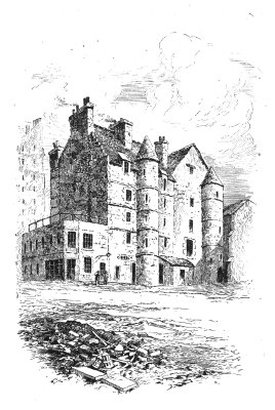
THE TOLBOOTH.
THE EDINBURGH TOLBOOTH.
The Edinburgh Tolbooth and the other Scotch gaols were worse even than those cruel dens in which the miserable prisoners were confined in England. They had no court-yard where the fresh air of heaven might be breathed for some hours at least of every weary day. Not even to the unhappy debtor was any indulgence shown. That air was denied to him which was common to all. Even under a guard, said an expounder of the law, he had no right to the benefit of free air; “for every creditor has an interest that his debtor be kept under close confinement, that by his squalor carceris he may be brought to the payment of his just debt.”[311] He was to learn the fulness of the meaning of “the curse of a severe creditor who pronounces his debtor’s doom, To Rot in Gaol.”[312] At the present time even in Siberia there cannot, I believe, be found so cruel a den as that old Edinburgh Tolbooth, by whose gloomy walls Johnson passed on his way to Boswell’s comfortable home close by, where Mrs. Boswell and tea were awaiting him. In one room were found by a writer who visited the prison three lads confined among “the refuse of a long succession of criminals.” The straw which was their bed had been worn into bits two inches long. In a room on the floor above were two miserable boys not twelve years old. But the stench that assailed him as the door was opened so overpowered him that he fled. The accumulation of dirt which he saw in the rooms and on the staircases was so great, that it set him speculating in vain on the length of time which must have been required to make it. The supply of the food and drink was the jailer’s monopoly; whenever the poor wretches received a little money from friends outside, or from charity, they were not allowed the benefit of the market price. The choice of the debtor’s prison was left to the caprice of his creditor, and that which was known to be the most loathsome was often selected.[313] The summer after Johnson’s visit to Edinburgh John Wesley, in one of the streets of that town, was suddenly arrested by a sheriff’s officer on a warrant to commit him to the Tolbooth. Happily he was first taken to an adjoining building—some kind of spunging-house, it is probable—whence he sent word to his friends, and obtained bail. The charge brought against him was ridiculous, and in the end the prosecutor had heavy damages to pay.[314] Nevertheless, monstrous though the accusation was, had Wesley been not only a stranger and poor, but also friendless, it was in that miserable den that he would have been lodged. His deliverance might have been by gaol-fever.
THE DOUGLAS CAUSE RIOT.
Boswell himself, if we may trust the tradition, little more than four years before he welcomed Johnson, had run a risk of becoming acquainted with the inside of that prison. Scotland was all ablaze with the great Douglas cause. The succession to the large estates of the last Duke of Douglas was in dispute; so eagerly did men share in the shifting course of the long lawsuit, that it was scarcely safe to open the lips about it in mixed company. Boswell, with all the warmth of his eager nature, took the part of the heir whose legitimacy was disallowed by the casting vote of the President in the Court of Session. The case was carried on appeal to the House of Lords, and on Monday, February 27, 1769, the Scotch decision was reversed. A little before eight o’clock on Thursday evening the news reached Edinburgh by express. The city was at once illuminated, and the windows of the hostile judges were broken. Boswell, it is said, headed the mob. That his own father’s house was among those which he and his followers attacked, as Sir Walter Scott had heard,[315] is very unlikely: Lord Auchinleck had voted in the minority, and so would have been in high favour with the rioters. A party of foot soldiers was marched into the city, a reward of fifty pounds was offered for the discovery of the offenders, and for some nights the streets were patrolled by two troops of dragoons.[316] “Boswell’s good father,” writes Ramsay of Ochtertyre, “entreated the President with tears in his eyes to put his son in the Tolbooth. Being brought before Sheriff Cockburn for examination, he was desired to tell all that happened that night in his own way. ‘After,’ said he, ‘I had communicated the glorious news to my father, who received it very coolly, I went to the Cross to see what was going on. There I overheard a group of fellows forming their plan of operations. One of them asked what sort of a man the sheriff was, and whether he was not to be dreaded. ‘No, no,’ answered another; ‘he is a puppy of the President’s making.’ On hearing this exordium Mr. Cockburn went off, leaving the culprit to himself.”[317]
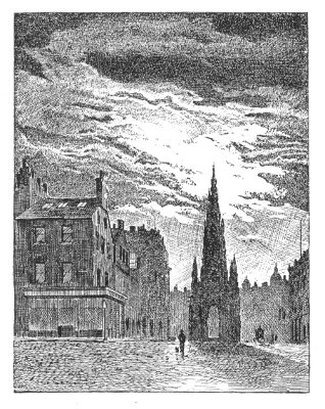
HUME’S HOUSE.
Among the sights which Johnson was shown at Edinburgh, the New Town was not included. Yet some progress had been made in laying out those streets, “which in simplicity and manliness of style and general breadth and brightness of effect” were destined to surpass anything that has been attempted in modern street architecture.[318] From Boswell’s windows, over the tops of the stately elm-trees which at that time ran in front of James’s Court and across a deep and marshy hollow, the rising houses could be easily seen. Full in view among the rest was the new home Hume had lately built for himself at the top of a street which was as yet unnamed, but was soon, as St. David’s, to commemorate in a jest the great philosopher who was its first inhabitant. Had the change which was so rapidly coming over Auld Reekie been understood in its full extent, surely Johnson’s attention would have been drawn to it. Boswell only mentions the New Town to introduce the name of “the ingenious architect” who planned it, Craig, the nephew of the poet Thomson.[319] His mind, perhaps, was so set on escaping from “the too narrow sphere of Scotland,” and on removing to London, that of Edinburgh and its fortunes he was careless. Yet, shrewd observer as he was of men and manners, he must have noticed how the tide of fashion had already begun to set from the Old Town, and was threatening to leave the ancient homes of the noble and the wealthy like so many wrecks behind. In many people there was a great reluctance to make a move. To some the old familiar life in a flat was dear, and the New Town was built after the English fashion, in what was known as “houses to themselves.” “One old lady fancied she should be lost if she were to get into such an habitation; another feared being blown away in going over the New Bridge; while a third thought that these new fashions could come to nae gude.”[320] Nevertheless, in spite of all these terrors, the change came very swiftly. So early as 1783, “a rouping-wife, or saleswoman of old furniture,” occupied the house which not many years before had been Lord President Craigie’s, while a chairman who had taken Lord Drummore’s house had “lately left it for want of accommodation.”[321] There were men of position, however, who, fashion or no fashion, clung to their old homes for many years later. Queensberry House, nearly at the foot of the Canongate, which in later years was turned into a Refuge for the Destitute, so late as 1803 was inhabited by the Lord Chief Baron Montgomery. Lord Cockburn remembered well the old judge’s tall, well-dressed figure in the old style, and the brilliant company which gathered round him in that ancient but decayed quarter.[322]
THE NEW TOWN OF EDINBURGH.
It was full five years before Johnson’s arrival that Dr. Robertson, pleading the cause of his poverty-stricken University, pointed out how the large buildings that were rising suddenly on all sides, the magnificent bridge that had been begun, and the new streets and squares all bore the marks of a country growing in arts and in industry.[323] It was in 1765 that the foundations were laid of the bridge which was to cross the valley that separates the Old and New Town. It was not till 1772 that “it was made passable.”[324] In 1783 the huge mound was begun which now so conveniently joins the two hills. The earth of which it is formed was dug out in making the foundations of the new houses. Fifteen hundred cartloads on an average were thrown in daily for the space of three years.[325] The valley, which with its lawns, its slopes, its trim walls, its beds of flowers, and its trees, adds so much to the pleasantness and beauty of Edinburgh, was when Johnson looked down into it “a deep morass, one of the dirtiest puddles upon earth.”[326] It was in its black mud that Hume one day stuck when he had slipped off the stepping-stones on the way to his new house. A fishwife, who was following after him, recognizing “the Deist,” refused to help him unless he should recite first the Lord’s Prayer and the Belief.[327] This he at once did to her great wonder. His admiration for the New Town was unbounded. If the High Street was finer than anything of its kind in Europe the New Town, he maintained, exceeded anything in any part of the world.[328] “You would not wonder that I have abjured London for ever,” he wrote to his friend, Strahan, in the year 1772, “if you saw my new house and situation in St. Andrew’s Square.”[329] Adam Smith told Rogers the poet, who visited Edinburgh in 1789, that the Old Town had given Scotland a bad name, and that he was anxious to move with the rest.[330]
THE “EDINBURGH FLY”.
The age which I am attempting to describe was looked upon by Lord Cockburn as “the last purely Scotch age that Scotland was destined to see. The whole country had not begun to be absorbed in the ocean of London.”[331] The distance between the two capitals as measured by time, fatigue, and money was little less than the distance in the present day between Liverpool and New York. Johnson, who travelled in post-chaises, and therefore in great comfort, was nine days on the road. “He purposed,” he wrote, “not to loiter much by the way;”[332] but he did not journey by night, and he indulged in two days’ rest at Newcastle. Hume, three years later, travelling by easy stages on account of his failing health, took two days longer.[333] Had Johnson gone by the public conveyance, the “Newcastle Fly” would have brought him in three days as far as that town at a charge of £3 6s. On the panels of the “Fly” was painted the motto, Sat cito si sat bene. Thence he would have continued his journey by the “Edinburgh Fly,” which traversed the whole remaining distance in a single day in summer, and in a day and a half in winter. The charge for this was £1 11s. 6d. In these sums were not included the payments to the drivers and guards. The “Newcastle Fly” ran six times a week, starting from London an hour after midnight. The “Edinburgh Fly” ran only on Tuesdays, Thursdays, and Saturdays. A traveller then who lost no time on the road, leaving London at one o’clock on Sunday night, would in the summer-time reach Edinburgh by Thursday evening, and in the winter after mid-day on Friday.[334] Even the mail which was carried on horse-back, and went five times a week, took in good weather about 82 hours.[335] The news of the battle of Culloden, though it was forwarded by an express, was seven days all but two or three hours in reaching London.[336] There were men living in 1824 who recollected when the mail came down with only one single letter for Edinburgh.[337] By 1793 a great acceleration had been effected in the coach-service. It was possible, so the proud boast ran, to leave Edinburgh after morning service on Sunday, spend a whole day in London, and be back again by six o’clock on Saturday morning.[338] The weary traveller would have had to pass every night in the coach. By the year 1800 the journey was done from London to Edinburgh in fifty-eight hours, and from Edinburgh to London in sixty and a half.[339] But such annihilation of time and space, as no doubt this rapid rate of travelling was then called, was not dreamed of in Johnson’s day. The capitals of England and Scotland still stood widely apart. It was wholly “a Scotch scene” which the English traveller saw, and “independent tastes and ideas and pursuits” caught his attention.[340] Nevertheless in one respect Edinburgh, as I have already said, felt strongly the influence of England. In its literature and its language it was laboriously forming itself on the English model. There had been a long period during which neither learning nor literature had shone in Scotland with any brightness of light. Since the days of the great classical scholars not a single famous author had been seen. There had been “farthing candles” from time to time, but no “northern lights.”[341] The two countries were under the same sovereign, but there was no Age of Queen Anne north of the Tweed. There was indeed that general diffusion of learning which was conspicuously wanting in England. An English traveller noticed with surprise how rare it was to find “a man of any rank but the lowest who had not some tincture of learning. It was the pride and delight of every father to give his son a liberal education.”[342] Nevertheless it had been “with their learning as with provisions in a besieged town, every man had a mouthful and no one a bellyful.”[343] That there was a foundation for Johnson’s pointed saying was many years later candidly admitted by Sir Walter Scott.[344] So great had been the dearth of literature that the printer’s art had fallen into decay. About the year 1740 there were but four printing-houses in Edinburgh, which found scanty employment in producing school-books, law-papers, newspapers, sermons, and Bibles. By 1779 the number had risen from four to seven and twenty.[345] This rapid growth was by no means wholly due to an increase in Scotch authors. Edinburgh might have become “a hot-bed of genius,” but such productiveness even in a hot-bed would have been unparalleled. The booksellers in late years, in defiance of the supposed law of copyright, had begun to reprint the works of standard English writers, and after a long litigation had been confirmed in what they were doing by a decision given in the House of Lords.[346]
ENGLISH STUDIED BY THE SCOTCH.
The growth of literature in Scotland had taken a turn which was not unnatural. In the troubles of the seventeenth century the nation, while yet it was in its power, had neglected to refine its language. No great masters of style had risen. There had been no Sir William Temple “to give cadence to its prose.”[347] The settled government and the freedom from tyranny which the country enjoyed on the fall of the Stuarts, the growth of material wealth which followed on the Union, the gradual diminution of bigotry and the scattering of darkness which was part of the general enlightenment of Europe had given birth to a love of modern literature. The old classical learning no longer sufficed. Having no literature of their own which satisfied their aspirations, the younger generation of men was forced to acquire the language of their ancient rivals, brought as it had been by a long succession of illustrious authors to a high degree of perfection.[348] It was to the volumes of Addison that the Scotch student was henceforth to give his days and nights. To read English was an art soon acquired, but to write it, and still more to speak it correctly, demanded a long and laborious study. Very few, with all their perseverance, succeeded like Mallet in “clearing their tongues from their native pronunciation.”[349] Even to understand the language when spoken was only got by practice. A young lady from the country, who was reproached with having seen on the Edinburgh stage some loose play, artlessly replied:—“Indeed they did nothing wrong that I saw; and as for what they said, it was high English, and I did not understand it.”[350] Dr. Beattie studied English from books like a dead language. To write it correctly cost him years of labour.[351] “The conversation of the Edinburgh authors,” said Topham, “showed that they wrote English as a foreign tongue,” for their spoken language was so unlike their written.[352] Some men were as careless of their accent as they were careful of their words. Hume’s tone was always broad Scotch, but Scotch words he carefully avoided.[353] Others indulged in two styles and two accents, one for familiar life, the other for the pulpit, the court of Session, or the professor’s chair. In all this there was a great and a strange variety. Lord Kames, for instance, in his social hour spoke pure Scotch, though “with a tone not displeasing from its vulgarity;” on the Bench his language approached to English.[354] His brother judge, Lord Auchinleck, on the other hand, clung to his mother tongue. He would not smooth or round his periods, or give up his broad Scotch, however vulgar it was accounted. The sturdy old fellow felt, no doubt, a contempt for that “compound of affectation and pomposity” which some of his countrymen spoke—a language which “no Englishman could understand.”[355] In their attempt to get rid of their accent they too often arrived at the young lady’s High English, a mode of speaking far enough removed no doubt from the Scotch, but such as “made ‘the fools who used it’ truly ridiculous.”[356] There were others who were far more successful. “The conversation of the Scots,” wrote Johnson, “grows every day less unpleasing to the English; their peculiarities wear fast away; their dialect is likely to become in half a century provincial and rustic, even to themselves. The great, the learned, the ambitious, and the vain, all cultivate the English phrase, and the English pronunciation; and in splendid companies Scotch is not much heard, except now and then from an old lady.”[357] The old lady whom he chiefly had in his memory when he wrote this was probably the Duchess of Douglas. He had met her at Boswell’s table. “She talks broad Scotch with a paralytick voice,” he wrote to Mrs. Thrale, “and is scarce understood by her own countrymen.”[358] Boswell himself, by the instruction of a player from Drury Lane, who had brought a company to Edinburgh, succeeded so well in clearing his tongue of his Scotch that Johnson complimented him by saying: “Sir, your pronunciation is not offensive.”[359]
In their pursuit of English literature the Scotch proved as successful as in everything else which they took in hand. Whatever ill-will may have existed between the two nations, there was no grudging admiration shown in England for their authors. In popularity few writers of their time surpassed Thomson, Smollett, Hume, Robertson, John Home, Macpherson, Hugh Blair, Beattie, and Boswell; neither had Robert Blair, Mallet, Kames, John Dalrymple, Henry Mackenzie, Monboddo, Adam Ferguson, and Watson, any reason to complain of neglect. If Adam Smith and Reid were not so popular as some of their contemporaries it was because they had written for the small class of thinkers; though the Wealth of Nations, which was published little more than two years after Johnson’s visit, was by the end of the century to reach its ninth edition. “This, I believe, is the historical age, and this the historical nation,” Hume wrote proudly from Edinburgh.[360] He boasted that “the copy-money” given him for his History “much exceeded anything formerly known in England.” It made him “not only independent but opulent.” Robertson for his Charles V. received £3,400, and £400 was to be added on the publication of the second edition.[361] Blair for a single volume of his Sermons was paid £600.[362]
Whatever ardour Scotchmen showed for English literature as men of letters, yet they never for one moment forgot their pride in their own country. In a famous club they had banded themselves together for the sake of doing away with a reproach which had been cast upon their nation. Just as down to the present time no Parliament has ventured to trust Ireland with a single regiment of volunteers, so Scotland one hundred years ago was not trusted with a militia. In the words of Burns,
“Her lost militia fired her bluid.”[363]
THE POKER CLUB.
In 1759 a Bill for establishing this force had been brought into Parliament, and though Pitt acquiesced in the measure, it was thrown out by “the young Whigs.” Most Englishmen probably felt with Horace Walpole, when he rejoiced that “the disaffected in Scotland could not obtain this mode of having their arms restored.”[364] Two or three years later the literary men in Edinburgh, affronted by this refusal, formed themselves into a league of patriots. The name of The Militia Club, which they had at first thought of adopting, was rejected as too directly offensive. With a happy allusion to the part which they were to play in stirring up the fire and spirit of the country, they decided on calling themselves “The Poker.” Andrew Crosbie, the original of Mr. Counsellor Pleydell, was humorously elected Assassin, and David Hume was added as his Assessor, “without whose assent nothing should be done.”[365] It was urged with great force that Scotland was as much exposed as England to plunder and invasion. Why, it was asked, was she refused a militia when one had been granted to Cumberland and Westmoreland, and Lancashire? Had not those countries contributed more adventurers to the forces of the Young Pretender than all the Lowlands? “Why put a sword in the hands of foreigners for wounding the Scottish nation and name? A name admired at home for fidelity, regaled [sic] in every clime for strictness of discipline, and dreaded for intrepidity.”[366] In 1776 the Bill was a second time brought in, but was a second time rejected. “I am glad,” said Johnson, “that the Parliament has had the spirit to throw it out.”[367] By this time it was not timidity only which caused the rejection. The English were touched in their pockets. It was maintained that as Scotland contributed so little to the land-tax, so if she needed a militia she ought to bear the whole expense herself. “What enemy,” asked Johnson scornfully, “would invade Scotland where there is nothing to be got?”[368] It was not till the year 1793, in the midst of the alarms of a war with France, that the force was at last established, and Scotland in one more respect placed on an equality with England.
In Edinburgh such a club as this, formed of all the eager active spirits in the place, could act with the greater vigour from the ease with which the members could meet. In whatever quarter of the town men lived, even if they had moved to the squares which had lately been built to the north and south, they were not much more widely separated than the residents in the Colleges of Oxford. The narrowness of the limits in which they were confined is shown by the small number of hackney-coaches which served their wants. In London, in 1761, there were eight hundred; by 1784 they had risen to a thousand.[369] In Edinburgh there were but nine; and even these, it was complained, were rarely to be seen on the stand after three o’clock in the afternoon. It was in sedan chairs that visits of ceremony were paid; the bearers were Highlanders, as in London they were generally Irishmen.[370] The dinner-hour was still so early that the meal of careless and cheerful hospitality was the supper. In 1763 fashionable people dined at two; twenty years later at four or even at five.[371] At the time of Johnson’s visit three was probably the common hour. Dr. Carlyle describes the ease with which in his younger days a pleasant supper party was gathered together. “We dined where we best could, and by cadies[372] we assembled our friends to meet us in a tavern by nine o’clock; and a fine time it was when we could collect David Hume, Adam Smith, Adam Ferguson, Lord Elibank, and Drs. Blair and Jardine on an hour’s warning.”[373] Though the Scotch were “religious observers of hospitality,”[374] yet a stranger did not readily get invited to their favourite meal. “To be admitted to their suppers is a mark of their friendship. At them the restraints of ceremony are banished, and you see people really as they are.” The Scotch ladies, it was noticed, at these cheerful but prolonged repasts drank more wine than an English woman could well bear, “but the climate required it.”[375] The “patriotic Knox” describes the inhabitants of Edinburgh as being “not only courteous, obliging, open, and hospitable, but well-inclined to the bottle.” It was not to the climate that he attributed this joyous devotion, but “to their social dispositions and the excellence of their wines.”[376] Boswell has left us a description of a supper which he enjoyed at Hume’s new house in St. Andrew’s Square. He had Dr. Robertson and Lord Kames for his fellow-guests, and three sorts of ice-creams among the dishes. “What think you of the northern Epicurus style?” he asked. He complained, however, that he could recollect no conversation. “Our writers here are really not prompt on all occasions as those of London.”[377] He had been spoilt by the talk in the taverns of Fleet Street and the Turk’s Head Club, and was discontented because he did not find in St. Andrew’s Square a Johnson, a Burke, a Wilkes, and a Beauclerk.
JOHNSON AND DAVID HUME.
Into Hume’s pleasant house Johnson unhappily never entered.[378] He even thought that his friend Dr. Adams, the Master of Pembroke College, had done wrong when he had met by invitation “that infidel writer” at dinner, and “had treated him with smooth civility.”[379] Yet a man who could yield to the temptation of the talk of Jack Wilkes had no right to stand aloof from David Hume. We should like to know what he would have thought of that philosopher’s soupe à la reine made from a receipt which he had copied in his own neat hand, or of his “beef and cabbage (a charming dish) and old mutton and old claret, in which,” he boasted, “no man excelled him.” Perhaps, however, if Johnson could have been persuaded to taste the claret, old as it was, he would have shaken his head over it and called it “poor stuff.”[380] The sheep-head broth he would certainly have refused, though one Mr. Keith did speak of it for eight days after,[381] and the Duke de Nivernois would have bound himself apprentice to Hume’s lass to learn it.[382] “The stye of that fattest of Epicurus’s hogs” he failed to visit. “You tell me,” wrote the great Gibbon to a friend who was at Edinburgh just at the time of Johnson’s arrival, “you tell me of a long list of Dukes, Lords, and Chieftains of renown to whom you are introduced; were I with you I should prefer one David to them all.”[383] Boswell could easily have brought the two men together, intimate as he was with both. Early in his life he was able to boast that one of them had visited him in the forenoon and the other in the afternoon of the same day.[384] Hume’s conversation perhaps was not after the fashion which Johnson liked. It certainly would not have come recommended to him by his broad Scotch accent. Nevertheless there was that about it which endeared it to his friends. For innocent mirth and agreeable raillery he was thought to be unmatched.[385] Adam Smith has celebrated his constant pleasantry. In his wit there was not the slightest tincture of malignity.[386] But Johnson would have nothing to do with him.[387] In Boswell’s house in James’s Court, that Sunday he spent there in Dr. Robertson’s company, he said “something much too rough both as to Mr. Hume’s head and heart,” which Boswell thought well to suppress. In the quiet stillness of that summer sabbath day in Edinburgh, the strong loud voice might almost have been carried across the narrow valley to St. Andrew’s Square, and startled the philosopher in his retirement.
Neither did Johnson see Adam Smith, who in Hume’s house had his room whenever he chose to occupy it. To meet a famous stranger he would, we may well believe, have willingly crossed the Firth from his house in Kirkaldy. But the two men had once met in London, and “we did not take to each other,” said Johnson. Had he been more tolerant, and sought the society of these two great Scotchmen, he would have seen in Scotland the best which Scotland had to show. Even as it was, in his visit to the capital and the seats of the other universities, in his tour through Lowlands, Highlands and Isles, he saw perhaps as great a variety of men and manners as had been seen in that country by any Englishman up to his time.