XI GASTRONOMIC AMERICA (continued 2)
Reading edition
Some of Mr. Burbank's prunes excel the best of the French; and his plumcot is another of the entirely new fruits he has given the world. In creating this, he bred together a wild American plum, a Japanese plum, and an apricot, making a fruit which differs in flavor, color and texture from any other kind. There are already several varieties of it.
Of his successful experiments in "educating" nuts three may be mentioned. He has made chestnut trees bear at the unheard-of early age of a year and a half; he has created a "paper shell" walnut; and, what is more remarkable still, he has removed from the walnut the disagreeably bitter inside skin which makes it indigestible because of the tannin in it.
Grapes have not been neglected. In the summer of 1911 I asked him if he would not undertake to educate some other grapes grown in California to the level of the Muscatels and at the same time give the Muscatel a thicker skin to make it better able to stand transportation to the East. He answered in a letter dated July 25, that he was "at work on several of the California grapes to give them better flavors, thicker skins, and better keeping qualities; and," he added, "I assure you that I am having good success. They are not yet ready to send out."
The Newtown Pippin is one of the finest apples, but he has a descendant of it which is a far better bearer and has "an added aromatic fragrance." There are improved peaches, too; also, many beautiful flowers new to the world; but of flowers this is not the place to write.
Is it not strange that this unselfish wonder-worker, whose object is not to make money (except for the purpose of enabling him to go on with his experiments), should have met with so much hostility? Yet he declares that the greatest inconvenience or injustice he has met is not misunderstanding, prejudice, envy, jealousy, or ingratitude, but the fact that purchasers are so often deceived by unscrupulous dealers who, misusing his name, foist upon the public hardy bananas, blue roses, seedless watermelons, and a thousand other things, including United States Government thorny cactus for the Burbank Thornless.
On this point Mr. Burbank has reason to write with a feeling of mingled pride and resentment. In 1896 the first scientific experiments for the improvement of cactus as food for man and beast were made on his farms. Eight years later, when these costly experiments were crowned with success, the Department of Agriculture spent $10,000 in searching for a thornless cactus like those already produced by Mr. Burbank. The result was a failure; the "spineless" cactus sent out were not spineless, not safe to handle or feed to stock, while the fruit was "seedy and poor."
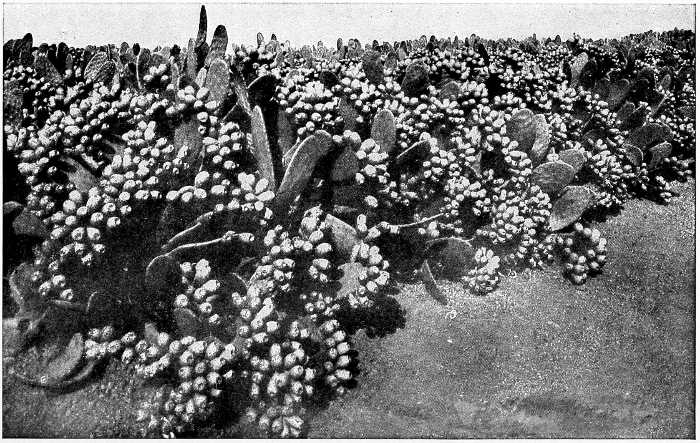
Burbank's Spineless Cactus
The Burbank improved cactus, on the other hand, is free not only from the long spines but from the even more harmful microscopic spicules. It is therefore "as safe to handle and as safe to feed as beets, potatoes, carrots or pumpkins." The new thornless varieties will produce a hundred tons of good feed where the average wild ones will yield only ten tons of inferior fodder. It can be grown on millions of acres of deserts where no other edible vegetation can be raised, and as it is possible to produce a thousand tons of feed on a single acre, the imagination conjures up the time when beef will once more be as abundant, as good, and as cheap as it was in the days of unlimited pasturage.
The leaves or slabs are valuable as food for other farm animals, including poultry.
The fruit, also, is produced in enormous quantity and is likely to become as important in our markets as bananas and oranges. The cactus bearing the best fruit is not yet quite spineless, but the fine bristles on the fruits are easily removed with a small whiskbroom before picking. Burbank's 1912 Spineless Cactus bulletin lists more than a dozen varieties cultivated for the fruit, and fifteen varieties raised for forage.
The cactus fruit "can be produced at less than one-tenth the expense of producing apples, oranges, apricots, grapes, plums, or peaches." There is never a failure in the crop, and the fruit can be stored like apples. It will oust the injurious "fillers" and adulterants now used by manufacturers. Excellent jams, jellies, syrups, marmalades and preserves can be made of cactus fruit at a minimum cost. For candies and for pickling, also, it can be used to advantage, and "the juice from the fruits of the crimson varieties is used for coloring ices, jelly and confectionery. No more beautiful colors can be imagined."
Mr. Burbank takes a keen delight in his new plants, and like other artists, he likes to know that you really see and feel what he has done. When we visited him in the summer of 1909, in company with John Burroughs and the California poet, Charles Keeler, nothing seemed to please him more than the proof we gave that we were actually familiar with his creations, by our comments on the improvements he had made in his crimson and crimson-and-gold California poppies and the wonderful Shirleys since we last raised them, the previous summer, in our Maine grounds. I felt like Parsifal in the enchanted garden. We had a chance to stroke the spineless blackberry and cactus, and to taste various kinds of berries and fruits more luscious than any that mortals have eaten since the Garden of Eden was destroyed.