LETS GO A-FISHING
Reading edition
"No man is in perfect condition to enjoy scenery unless he has a fly-rod in his hand and a fly-hook in his pocket."
Wm. C. Prime
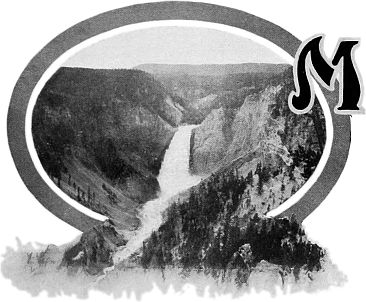
Lower Falls of the Yellowstone
ANY who know these mountains and valleys best have gained their knowledge with a rod in hand, and you will hear these individuals often express surprise that a greater number of tourists do not avail themselves of the splendid opportunities offered for fishing. In no other way can so much pleasure be found on the trip, and by no other means can you put yourself so immediately and completely in sympathy with the spirit of the wilderness. Besides, it is this doing something more than being a mere passenger that gives the real interest and zest to existence and that yields the best returns in the memories of delightful days. The ladies may be taken along without the least inconvenience and to the greater enjoyment of the outing. What if the good dame has never seen an artificial fly! Take her anyway, if she will go, and we will make her acquainted with streams where she shall have moderate success if she but stand in the shadow of the willows and tickle the surface of the pool with a single fly. You will feel mutually grateful, each for the presence of the other; and, depend upon it, it will make the recollection doubly enjoyable.
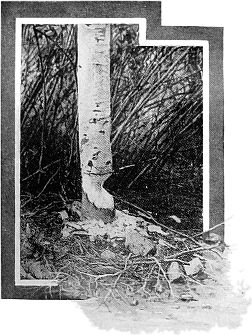
We shall never know and name all the hot springs and geysers of this wonderland, but we may become acquainted with the voice of a stream and know it as the speech of a friend. We may establish fairly intimate relations with the creatures of the wood and be admitted to some sort of brotherhood with them if we conduct ourselves becomingly. The timid grouse will acknowledge the caress of our bamboo with an arching of the neck, and the beaver will bring for our inspection his freight of willow or alder, and will at times swim confidently between our legs when we are wading in deep water.
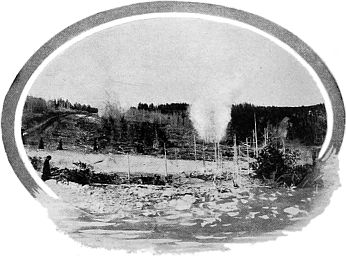
The Black Giant Geyser
The author of "Little Rivers" draws this pleasing picture of the delights of fishing: "You never get so close to the birds as when you are wading quietly down a little river, casting your fly deftly under the branches for the wary trout, but ever on the lookout for all the pleasant things that nature has to bestow upon you. Here you shall come upon the catbird at her morning bath, and hear her sing, in a clump of pussy-willows, that low, tender, confidential song which she keeps for the hours of domestic intimacy. The spotted sand-piper will run along the stones before you, crying, 'wet-feet, wet-feet!' and bowing and teetering in the friendliest manner, as if to show you the best pools." Surely, if this invitation move you not, no voice of mine will serve to stir your laggard legs.
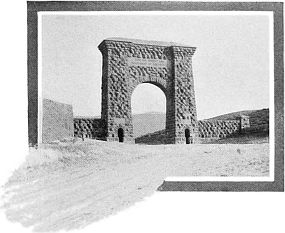
One should not, however, go to the wilderness and expect it to receive him at once with open arms. It was there before him and will remain long after he is forgotten. But approach it humbly and its asperities will soften and in time become akin to affection. As one looks for the first time through the black, basaltic archway at the entrance to the Park, the nearby mountains have an air of distance and unfriendliness, nor do they speedily assume a more sympathetic relation toward the visitor. A region in which the world's formative forces linger ten thousand years after they have disappeared elsewhere will make no hasty alliance with strangers. The heavy foot of time treads so slowly here that one must come often and with observant eye to note the advance from season to season and to feel that he has any part or interest in it.
Park Gateway
When we can judge correctly from the height of the up-springing vegetation whether the forest fire that blackened this hillside raged one year ago or ten; when we have noted that the bowl of this terrace, increasing in height by the insensible deposit of carbonate of lime from the overflowing waters, appears to outstrip from year to year the growth of the neighboring cedars; when these and a multitude of kindred phenomena are comprehended, how interested we become!
Nothing said here is intended to encourage undue familiarity with the wild game. "Shinny on your own side," is a good motto with any game, and more than one can testify of sudden and unexpected trouble brought on themselves by meddlesomeness. In following an elk trail through the woods one afternoon, I found a pine tree had fallen across the path making a barrier about hip-high. While looking about to see whether any elk had gone over the trail since the tree fell, and, if so, whether they had leaped the barrier or had passed around it by way of the root or top, a squirrel with a pine cone in his teeth, sprang on the butt of the tree and came jauntily along the log. Some twenty feet away he spied me, and suddenly his whole manner and bearing changed. He dropped the cone and came on with a bow-legged, swaggering air, the very embodiment of insolent proprietorship. The top of my rod extended over the log, and as he came under it I gave him a smart switch across the back. Now, there had been nothing in my previous acquaintance with squirrels to lead me to think them other than most timid animals. But the slight blow of the rod-tip transformed this one into a Fury. With a peculiar half-bark, half-scream, he leaped at my face and slashed at my neck and ears with his powerful jaws. So strong was he that I could not drag him loose when his teeth were buried in my coat collar. I finally choked him till he loosened his hold and flung him ten feet away. Back he came to the attack with the speed of a wild cat. It was either retreat for me or death to the squirrel, and I retreated. Never before had I witnessed such an exhibition of diabolical malevolence, and, though I have laughed over it since, I was too much upset for an hour afterward to see the funny side of the encounter.
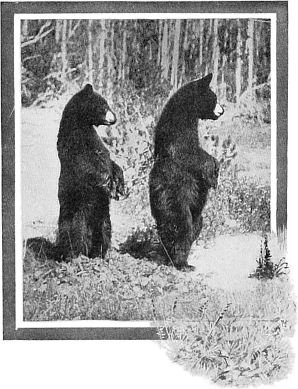
Bear Cubs Photo by F. J. Haynes
The ways of the wilderness have ever been pleasant to my feet, and whether it was taking the ouananiche in Canada or the Beardslee trout in the shadow of the Olympics, it has all been good. Without detracting from the sport afforded by any other locality, I honestly believe that, taking into consideration climate, comfort, scenery, environment, and the opportunities for observing wild life, this region has no equal for trout fishing under the sun. I am aware that he who praises the fishing on any stream will ever have two classes of critics—the unthinking and the unsuccessful. To these I would say, "Whether your success shall be greater or less than mine will depend upon the conditions of weather and stream and on your own skill, and none of these do I control." In that splendid book, "Fly-Rods and Fly-Tackle," Mr. Henry P. Wells relates an instance in which he and his guide took an angler to a distant lake with the certain promise and expectation of fine fishing. After recording the keen disappointment he felt that not a single trout would show itself, he says, "Then I vowed a vow, which I commend to the careful consideration of all anglers, old and new alike—never again, under any circumstances, will I recommend any fishing locality in terms substantially stronger than these 'At that place I have done so and so; under like conditions it is believed that you can repeat it.' We are apt to speak of a place and the sport it affords as we found it, whereas reflection and experience should teach us that it is seldom exactly the same, even for two successive days."
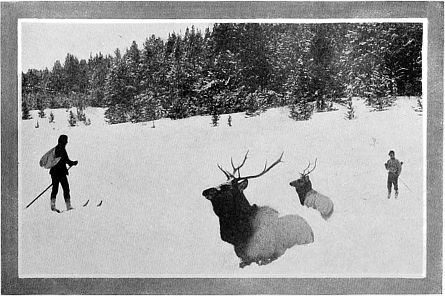
Elk In Winter Photo by F. J. Haynes
There is a large number of fly-fishermen in the east who sincerely believe that the best sport cannot be had in the streams of the Rocky Mountains, and this belief has a grain of truth when the fishing is confined solely to native trout and to streams of indifferent interest. But when the waters flow through such picturesque surroundings as are found in the Yellowstone National Park, when from among these waters one may select the stream that shall furnish the trout he loves most to take, the objection is most fully answered. The writer can attest how difficult it was to outgrow the conviction that a certain brook of the Alleghanies had no equal, but he now gladly concedes that there are streams in the west just as prolific of fish and as pleasant to look upon as the one he followed in boyhood. It is proper enough to maintain that: "The fields are greenest where our childish feet have strayed," but when we permit a mere sentiment to prevent the fullest enjoyment of the later opportunities of life, your beautiful sentiment becomes a harmful prejudice.
Having Eaten and Drunk
When the prophet required Naaman to go down and bathe in the river Jordan, Naaman was exceeding wroth, and exclaimed, "Are not Abana and Pharpar, rivers of Damascus, better than any in Israel?" The record hath it that Naaman went and bathed in the Jordan, and that his body was healed of its leprosy and his mind of its conceit. So, when my angling friend from New Brunswick inquires whether I have fished the Waskahegan or have tried the lower pools of the Assametaquaghan for salmon, I am compelled to answer no. But there comes a longing to give him a day's outing on Hell-Roaring Creek or to see him a-foul of a five-pound von Behr trout amid the steam of the Riverside Geyser. The streams of Maine and Canada are delightful and possess a charm that lingers in the mind like the minor chords of almost forgotten music, but they cannot be compared with the full-throated torrents of the Absarokas. As well liken a fugue with flute and cymbals to an oratorio with bombardon and sky-rockets!
Who hath seen the beaver busied? Who hath watched the black-tail mating? Who hath lain alone to hear the wild-goose cry? Who hath worked the chosen water where the ouananiche is waiting, Or the sea-trout's jumping-crazy for the fly? He must go—go—go—away from here! On the other side the world he's overdue. 'Send your road is clear before you when the old Spring-fret comes o'er you And the Red Gods call for you! Do you know the blackened timber—do you know that racing stream With the raw right-angled log-jam at the end: And the bar of sun-warmed shingle where a man may bask and dream To the click of shod canoe poles round the bend? It is there that we are going with our rods and reels and traces, To a silent smoky Indian that we know— To a couch of new-pulled hemlock with the starlight on our faces, For the Red Gods call us out and we must go! The Feet of the Young Men—Kipling.
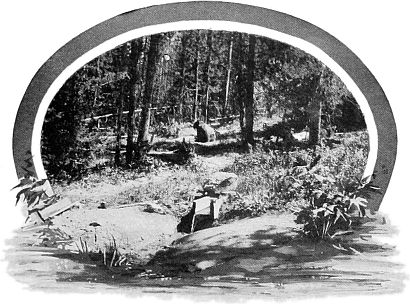
Who Hath Seen the Beaver Busied? Photo by Biological Survey