LIST OF FLOWERS (continued 2)
Reading edition
If you gather a Daisy, and then gently pick it to pieces, you find that it is made up of a great many tiny little flowers crowded together on a pear-shaped centre. These tiny flowers are of two kinds; those in the centre are yellow and are shaped like little tubes, each of which is edged with five points. But in the outer row of flowers, one of the five points has grown into a long white strap, which is tinged with pink and red at the tip.
These pretty white straps are arranged in a double frill round the yellow centre.
At the end of the flower-stalk there is a thick ring of small green pointed leaves, and these, as well as the stalks, are slightly hairy.
The Daisy leaves grow in a rosette close to the ground. They are oval, and each leaf has hairs all over it and round the edges.
3. SCENTLESS MAYWEED
This daisy plant is very common too. It grows all over Britain, and is in flower from June till October.
It is not such a stiff, handsome plant as the Ox-eye Daisy, but much more branched and bushy, and it often grows close to the ground. The stalks are tougher, and they are quite smooth, with fine ridges running up them.
The flower-heads are made up in the same way as those of the other daisy plants. You find a mass of tiny yellow tubes in the centre, and forming a border round this yellow centre is an outer ring of flowers, each with one large white strap.
When the Mayweed begins to wither, these white straps droop towards the stalk, and the yellow centre, instead of remaining nearly flat, becomes the shape of a thimble. You will find many of these yellow thimbles on the plant, after all the white straps are gone.
The tips of the green leaves, which grow in a double ring behind the flowers, are often tinged with pink.
The leaves of the Scentless Mayweed are like many leaves that grow in running water. They are divided into a tangle of fine hair-like points, which spring directly from the main stem without any stalk.
Plate XXIII
1. SNOWDROP 2. COMMON STAR OF BETHLEHEM 3. RANSOMS
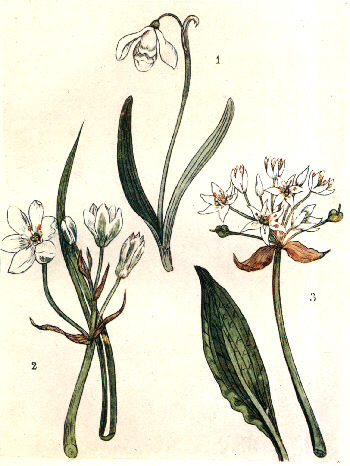
1. SNOWDROP
The modest Snowdrop, with its graceful, drooping head, grows abundantly all spring in meadows and pastures and orchards in England and Scotland. It is not so common in Ireland.
The flower is enclosed in a grey sheath, edged with bright green lines. After the flower bursts out of the sheath, it droops from the end of a slender flower-stalk. Each flower has six white petals; the three outer petals are boat-shaped towards the tips, and there are three shorter petals which are not curved. These straight petals have a notch cut in the upper edge, and there is a bright green wavy stain just below this notch.
Inside these dainty white petals are six yellow-headed stamens with scarcely any stalks. These stamens stand on the flat round top of the seed-vessel, and in the centre rises its short, pointed pillar.
Notice that the oval green seed-vessel is outside the circle of white petals, at the top of the slender flower-stalk.
A single pair of leaves rise from the Snowdrop root, with the flower-stalk between them. These leaves look like short straps with blunt points. They are bluey green in colour, and have deep grooves running from base to tip.
2. COMMON STAR OF BETHLEHEM
This beautiful starry plant is found in many places in England and in a few in Scotland, but not in Ireland. It grows in meadows and pastures and orchards in early summer.
The flowers grow singly on long stalks which branch near the top of the main stem. There is always a withered-looking brown leaf at the base of each flower-stalk.
The flowers have six large white petals, which are pointed at the tips. The back of each petal is stained with bright green, except round the edge, where it remains white.
There are six yellow-headed stamens clinging to the base of the white petals. These stamens stand up in a circle round a fat green seed-vessel which sits in the centre of the white petals. This seed-vessel has a tiny pointed column in the middle.
The leaves of the Star of Bethlehem are very narrow. From the middle each leaf tapers to a long point. These leaves are deeply channelled, and they have a broad white stripe running down the centre.
3. RANSOMS
This unpleasant-smelling plant is common all over the country, except in the North of Scotland. It grows in woods and copses and on hedge-banks, and it blooms in early summer.
Each flower grows on a short stalk, in a loose cluster at the end of a stout juicy stem. When in bud these flowers are all enclosed in a brown sheath, which bursts open in two pieces as soon as the flowers are ready to expand.
Each flower has six narrow white pointed petals, opening flat out like a star. There is a short yellow-headed stamen clinging to each of these white petals. In the centre of the flower, among the white petals, is a green seed-vessel, which is divided into three small oval balls. A slender pillar rises from amongst these small seed-balls.
There are no sepals in this flower.
The leaves of the starry-white Ransoms are not unlike those of the Lily of the Valley. They have long lines running from base to tip, and are a delicate pale-green in colour.
Plate XXIV
1. MOSSY SAXIFRAGE. 2. MARSH PENNYWORT. 3. INTERMEDIATE WINTERGREEN.
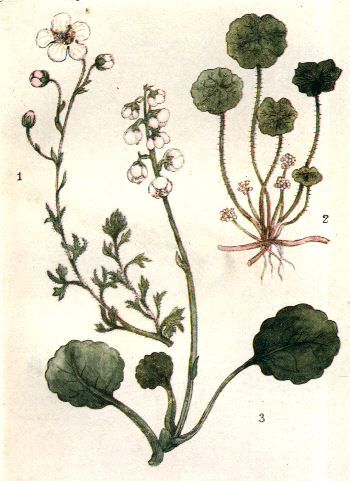
1. MOSSY SAXIFRAGE
In all parts of the country this slender, graceful plant is abundant. You will find it growing on damp banks and on the mountain side, and it blooms throughout the summer.
The flowers are cup-shaped, and they grow singly on short stalks which branch from the main stem near the top. Each flower has five white petals streaked with fine veins.
Within the petal-cup there is a ring of ten stamens with yellow heads, and in the centre of the flower you can see a green seed-vessel like a small pear, with two wavy points coming out of the top.
Behind the white petals you find a tiny green calyx-cup, made up of five little sepals. These sepals are joined together at the bottom, but round the mouth of the cup the five points stand up separately.
The reddish-green stems are slender and wiry. They have single, little leaves growing up them, with a short space in between each leaf.
Only some of these stems have flowers at the top. Others end in a tuft of leaves, and never bear any flowers. These leafy stems are clothed with leaves all the way to the tip, and each leaf is very small and narrow. At the end the leaf is divided into three small fingers, and these fingers, as well as the stem, are covered with dark hairs.
2. MARSH PENNYWORT
This water-loving plant is very common all over the country in marshes and bogs and by the sides of ditches. It blooms in summer.
The plant is easily recognised by its round leaves. These have wavy edges, and fine green veins running from the centre of the leaf to the edge.
The stalk is fastened exactly underneath the centre of the leaf, and it is soft and juicy and covered with fine hairs.
The flowers of the Pennywort are greenish-white, tinged with red. These flowers grow in little clusters of three or four together at the end of short stalks which spring from the root, close beside the leaf-stalk. But these flower-stalks are so short, and the flowers are so small, you recognise the round leaves long before you discover that there are any flowers.
The Pennywort is one of those plants with a creeping stem, which lies along the surface of the ground. The stem is a delicate, pale pink, and wherever a bunch of flowers and leaves rises, you find a tuft of white, hair-like roots growing down into the mud.
3. INTERMEDIATE WINTERGREEN
It is a great delight to discover this dainty plant. It is not very common, but in summer and autumn you find it blooming on heaths in many parts of the country.
The Wintergreen flowers are not unlike Lily-of-the-Valley. They are delicate, creamy white bells, which hang from short drooping stalks near the top of a slender stem.
These bells have five ivory petals slightly tinged with pink, which form a dainty fairy cup.
Within the cup there is a ring of ten stamens with heavy yellow-heads, clustered round the tip of the green seed-vessel. This green tip rises in the centre, like a slender pillar, a good way above the stamens.
Behind the ivory cup is a green star, with five points. These points are the sepals. Notice that wherever a flower-stalk joins the main stem a tiny pointed green leaf appears.
The soft juicy stem is twisted near the top and is four-sided. It grows straight from the root.
The dark glossy leaves of the Wintergreen are spoon-shaped, with wavy edges. They spring from the ground with very short stalks, and they remain on the plant all winter.
Plate XXV
1. GRASS OF PARNASSUS. 2. COMMON BLADDER CAMPION. 3. SEA CAMPION.
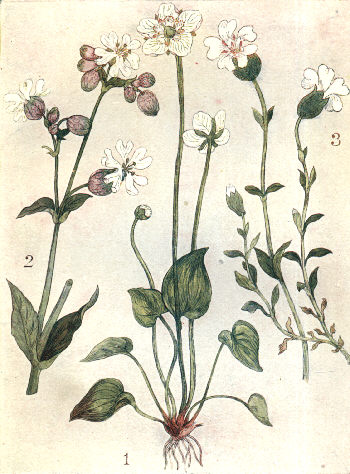
1. GRASS OF PARNASSUS
This slender plant grows in bogs and damp places all over Britain and blooms in autumn.
It has large white flowers, which grow singly at the end of tall green stalks. These stalks are square and slightly twisted.
Each flower has five creamy-white petals, covered with delicate veins. Inside this ring of petals, lying at the bottom, are five curious scales, like tiny hands. The hands have each ten fingers, tipped with yellow dots, so you may count fifty dots altogether. On the scales are glands which hold honey. This, you may be sure, the bees very soon find out.
In the centre of the flower is a round pale green seed-vessel, and in between the scales with the tiny yellow dots lie five fat stamens with heavy yellow-heads.
The Grass of Parnassus has also five green sepals, whose tips you can see appearing in between each of the five white petals, as you look down into the flower.
Most of the green leaves of this plant grow from the root. They are oval, with smooth edges, and each leaf has a stalk of its own.
But often you will find a single leaf clasping the flower-stalk half way up its stem, and this leaf has no stalk of its own.
2. COMMON BLADDER CAMPION
The Common Bladder Campion is to be found all summer by the edge of fields and pastures.
It is a tall, slender plant, with white flowers which grow each on a thin short stalk, two or three close together at the end of a smooth stem.
The flowers have five petals, and each petal has V-shaped notches cut in the outer edge. The lower part of the petals is hidden from sight in the calyx-cup.
The five sepals which form this calyx-cup are joined together, and they are swollen like a bladder. This bladder is covered with a fine network of reddish veins, and has five teeth round its mouth.
You will easily recognise the Common Bladder Campion by this curious calyx.
In this white Bladder Campion the stamens and the seed-vessel are found in the same flower, and you can always see the forked tip of the seed-vessel, rising among the dark green heads of the stamens.
The leaves of the Common Bladder Campion are smooth and shiny. They grow opposite each other in pairs, and wherever a pair joins the main stem, the stem is swollen like the joint of a finger.
3. SEA CAMPION
The Sea Campion grows by the seashore, by the side of mountain streams, or on wet rocks among the hills.
It blooms all summer, and although it is really a smaller plant than the Common White Campion, the flowers are larger.
These flowers have five white petals, each with a V-shaped notch in the outer edge. Half way down these petals there is a white-fringed scale. These scales stand up like a crown round the inside of the flower.
The calyx is swollen like a bladder, and is covered with fine veins, the same as in the Common Campion. Round the mouth it has five sharp teeth.
In this plant the flowers do not grow in groups of two or three. Each flower appears singly at the end of a slender stalk, and there are several pairs of small leaves a good way below the flower.
These leaves are slightly thick and juicy. They grow so close together on the ground that it looks as if it were covered with a green mat.
Plate XXVI
1. COMMON EYEBRIGHT. 2. WHITE DEAD NETTLE. 3. SPOTTED ORCHIS.
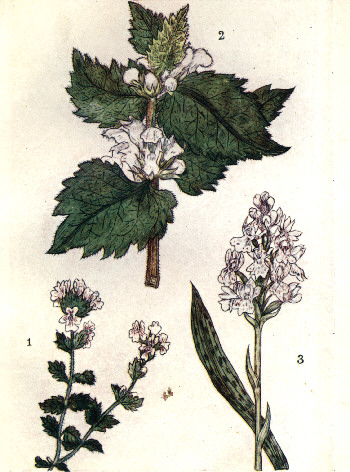
1. COMMON EYEBRIGHT
This humble little plant is to be found everywhere on heaths and meadows and pastures. It blooms plentifully in summer and autumn. The flowers of the Eyebright grow in clusters of four to six at the end of the main stem. They are white, or pale lilac streaked with pink, and they are small and unattractive. The petals are joined together into a tube, with two lips at the mouth. The upper lip has two divisions, and the lower lip is cut up into three. They appear to be five unequal petals standing round the mouth of the tube.
Inside the tube are four purple-headed stamens, two long and two short. You can see them appearing at the mouth of the tube, also the slender white point which rises from the seed-vessel.
The calyx is a green cup with four deeply pointed teeth at the mouth. The tube of the flower goes down into the cup, and the five unequal petals stand round its mouth.
The Eyebright stem varies much in height. Sometimes you find it only about two inches from the ground, and in other places it has straggled eighteen inches high. These stems are very hairy.
The leaves grow opposite each other in pairs up the stem. They have no stalks, and the edges are cut all round into blunt teeth. They are rather hairy leaves, and are dark green and crinkled. In shape they are oval with a blunt point at the end.
2. WHITE DEAD NETTLE
The White Dead Nettle is fairly common everywhere except in the North of Scotland. You find it in waste places, by the roadside, and on ditch banks, and it blooms from spring to autumn.
This is a much more attractive plant than the Stinging Nettle we have all learned to avoid.
The flowers grow in beautiful whorls or circles round the stem. In this plant the flowers are snowy white, tinged with green, but in other Dead Nettles you find them rose pink or deep purple.
There are often as many as eighteen flowers on one whorl. The flower petals are joined together into a tube which stands in a shallow calyx-cup, edged with five very long, sharp teeth. The mouth of the white flower-tube is cut very irregularly. The upper part bends over like a hood, and underneath this hood are hidden the four long stamens. The lower part of the flower-tube hangs down like a tongue, and it is fringed and rounded at the end. Amongst the stamens you see the slender forked point which rises from the seed-vessel.
The leaves of the White Dead Nettle are very similar in shape to those of the Stinging Nettle; but they are a paler shade of green. They grow in pairs close to the stem, with a good space in between each pair, and the ring of stalkless flowers clusters round the stem beside them.
3. SPOTTED ORCHIS
This Orchis is common all over the country, where it grows in damp woods, on chalky banks, and in meadows and pastures.
You find it in summer.
The leaves are stained with purplish-black blotches as in the early Purple Orchis, but they are narrower and taper more to a point. Notice the small leaves which cling at intervals to the flower-stalk all the way up.
The flowers grow in a dense cone-shaped head at the top of the flower-stalk. The petals are pale lilac or nearly white, and are spotted or streaked with purple. They are curiously shaped. The broad petal, which folds back like a hanging lip, is deeply waved round the edge, and behind it there is a long lilac spur.
Two petals stand erect, and form a hood which covers the stamens and the slender column of the seed-vessel.
There are also three small lilac or white sepals which you will scarcely be able to distinguish from the petals.
The flower sits at the top of what looks like a swollen stalk, but is really the seed-vessel.
Where this stalk-like seed-vessel joins the main stem there is always a tiny purple or green leaflet.
Plate XXVII
1. RED BERRIED BRYONY 2. CHICKWEED WINTERGREEN 3. CUCKOOPINT OR WAKE ROBIN
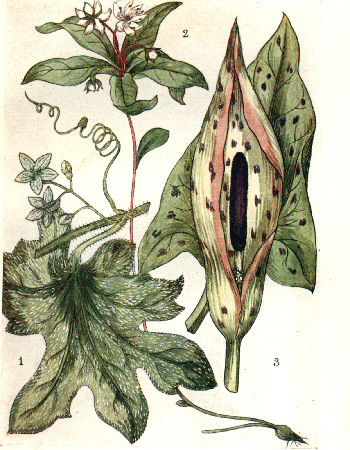
1. RED-BERRIED BRYONY
The Red-Berried Bryony is very common in the South of England, where it climbs over the hedges and grows among the thickets. But it does not grow wild in the North. It is in flower all summer and autumn.
The stems of this plant are soft and easily broken, and they have not enough strength to keep the leaves and flowers upright. But at the bottom of each leaf-stalk, there are long curly green tendrils, and with these the Bryony catches hold of some stronger plant, which helps to support it.
The flowers are greenish-white in colour, and they grow in loose heads which spring from between the leaf-stalk and the stem.
These flowers have five separate greenish-white petals covered with a fine network of veins and with many transparent hairs.
At the back of the petals sits a green calyx-cup edged with five pointed teeth.
When the flowers are withered they are followed by groups of beautiful dark red berries.
The Red Bryony leaves are very large, and are shaped like a hand with five blunt fingers. The green colour is pale and bright, and each leaf is covered with short white hairs.
2. CHICKWEED WINTERGREEN
It is delightful to find the Chickweed Wintergreen as it is rather a rare plant. It grows in fir woods and on heaths in hilly districts, and it blooms all summer. There is no other plant at all like this Wintergreen, so you will have no difficulty in recognising it.
The stem is very delicate and wiry, and at the end it bears a spreading rosette of six long pointed leaves. These leaves are smooth and shiny: in autumn they are often tinged with purple.
You may find one or two solitary leaves lower down on the stem; if so, these leaves are quite small, and they are rounded at the ends.
The flowers look like white stars. They have five or seven long narrow petals with pointed tips. These petals lie open in a circle, and you can see five or seven thread-like stamens with tiny pink heads rising in the centre, round a small green seed-vessel.
The flower-stalks grow from the centre of the green leaf rosette. Each flower has a delicate pink stalk of its own, and you may find three or four stalks springing from the same place. But more often the flower is solitary.
3. CUCKOOPINT OR WAKE ROBIN
This is one of our most curious wild plants. It is common in England and Ireland, but rare in Scotland. It grows on hedge banks and in open woods, and blooms in late spring and early summer.
The large glossy leaves are arrow-shaped, and they are covered all over with dark purple blotches.
From amongst them rises a pale green twisted sheath, which is completely closed when in bud. Like the leaves, it is spotted all over with purple blotches, and the edges are stained a pale yellow-brown.
Inside this sheath rises a tall narrow purple cone, on a stout green stalk. Fastened round this green stalk are three curious collars.
First comes a collar of tiny green pear-shaped glands, of which nobody knows the use. Then comes a purple collar made up of stamen heads without any stalks.
And a little way below these there is a deep band of round green seed-vessels like small beads. These are hidden in the lower part of the green sheath; but in autumn they grow much larger, and soon burst open the covering sheath. Then they turn into beautiful scarlet berries. These berries are very poisonous.
The root of the Cuckoopint is a rough brown knob with many white rootlets hanging from it.
Plate XXVIII
1. COMMON MARE'S TAIL 2. COMMON BUTTERBUR 3. GREATER BURDOCK
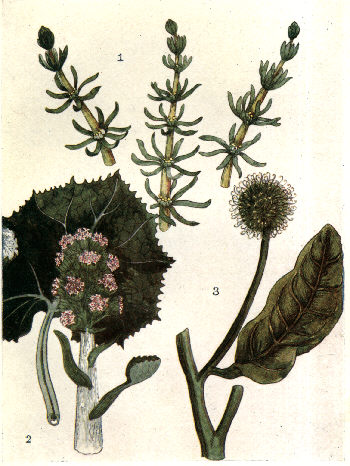
1. COMMON MARE'S TAIL
This strange-looking plant grows in many parts of the country, and its spikes are found during summer in ponds and ditches. The flowers are so tiny that you may scarcely notice them. They grow in a circle close round the main stem where the leaves join it, and they are greenish in colour. These flowers have no petals, and all you can see is a small green ball with a yellow dot on the top of it.
The leaves of the Common Mare's Tail grow in circles up the stem at short distances apart. They are very narrow and pointed, exactly like short green straps, and you find from six to twelve of these strap-leaves in the same circle.
2. COMMON BUTTERBUR
The Common Butterbur grows in wet places, especially beside streams. It is not found in the North of Scotland, but is common in the South country. The flowers appear very early in spring, before the leaves, and they are nearly withered by the time the leaves are at their best.
The flowers grow closely crowded together in cone-shaped heads, near the top of a thick fleshy stalk. These flowers are made up of tiny pink tubes with toothed edges, and there is a row of long-headed pink stamens clinging to the inside of each tiny tube. Outside the head of flowers there is a thick bundle of narrow green pointed leaves, and each little bundle of green leaves and pink tubes has a short stalk of its own.
You will notice the narrow green leaves which grow singly up this main stem. Sometimes these leaves become much broader at the tips, and when this is the case these leaf-tips are dark green and have toothed edges.
The root leaves of the Butterbur are very large. They are roughly heart-shaped with sharply cut teeth round the edge. Each leaf is dark green and smooth above, but underneath it is woolly, and the short stalk on which it grows is hollow.
3. GREATER BURDOCK
The Greater Burdock grows in waste places by the roadside and on the borders of fields. It is fairly common all over Britain and flowers in autumn.
The Burdock is a low-growing bushy plant with strong stems. Growing close to the ground it has large coarse leaves not unlike rhubarb leaves. They are dark green, very wrinkled, and with slightly waved edges.
The leaves which grow on the flower-stems are much smaller, and are long and rather narrow.
The flowers are scarcely seen. They are made up of small rose-coloured and purple tubes, which are crowded close together at the end of stout round stalks. But these small flowers are completely surrounded by a ball of green bristles, so that you require to pull the bristles apart and look into the top of the green ball if you wish to find the flowers.
Each of the bristles on this green ball ends in a tiny hook, and with these hooks they cling to whatever they touch. You often see these prickly balls sticking to the wool on a sheep's back. If you throw one at a companion it will hang to his clothes by its sharp little hooks.
Plate XXIX
1. MOUSE TAIL. 2. RIBWORT PLANTAIN. 3. KNOTTY FIGWORT.
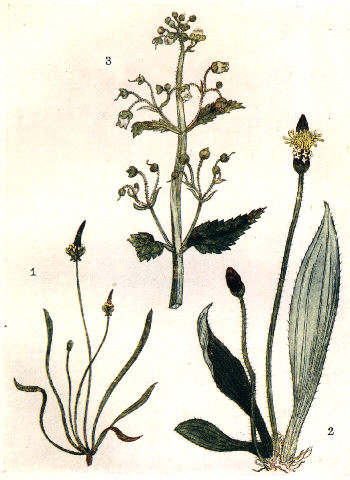
1. MOUSE-TAIL
This little plant grows plentifully in the East of England, but it is not found all over Britain. It flowers in summer.
You will easily recognise it by the curious way the seed-vessels grow. You remember in the Buttercup (Plate I.) there was a little hard knot of seed-vessels like a green raspberry in the centre of the ring of stamens?
The Mouse-Tail is a cousin of the Buttercup, but the seed-vessels grow on a long pointed spike which shoots up in the middle of the flower, and is just like a mouse's tail.
Each flower has five yellowish-green petals, shaped like pale yellow tubes, with a lip at the top. There are five long, narrow, yellow-green sepals, with little spurs at the bottom. And there is also a ring of stamens with yellow heads which stand straight up round the foot of the Mouse's Tail.
The leaves are long and narrow, with a line down the centre. They are rather thick leaves, and they all grow in a tuft from the root.
2. RIBWORT PLANTAIN
Is there any child that has not played at 'Soldiers' or at 'Lords and Ladies,' with the flower-heads of the Ribwort Plantain? It is common everywhere, and flowers from spring to autumn.
The narrow pointed leaves grow in a circle straight from the root. They are dark green on one side, and silvery green on the other, and have long 'ribs' running from the bottom to the top. From these 'ribs' the plant gets its name of 'Ribwort.'
The flowers are closely crowded together in brown, cone-shaped heads. Each flower consists of a narrow white tube, with four graceful yellow points folded back at the mouth.
The large yellow heads of the stamens stand up beyond the mouth of this tube, but you can scarcely see the tip of the seed-vessel which is hidden inside.
When the flowers are fully out, you do not notice the white tubes; all you see is a big cluster of fuzzy yellow-headed stamens.
There are four small green sepals at the bottom of the flower-tube, and these sepals are often stained with brown blotches.
The stems are ribbed all the way up and are covered with short hairs. They are juicy and very easily broken.
3. KNOTTY FIGWORT
This uninteresting plant is abundant everywhere. It is found in damp, shady places by the side of ditches, and it is at its best in summer and autumn.
At first you scarcely notice the flowers. They are small, dull green bells stained with brown, and are not at all attractive. But when you examine them, you find that the mouth of each bell is prettily waved all round the edge, and inside there are two long stamens and two short ones, as well as a fat green seed-vessel, with a curly point standing up in the middle.
There is a green calyx-cup with five teeth at the mouth, and as the small green bell soon withers and falls off, you oftenest notice this calyx-cup with a green seed-vessel sitting in the centre.
The tiny flower-bells grow in loose clusters, which spring from between the leaf and the main stem.
The Knotty Figwort is a tall and stout plant, with a four-sided stem which is curiously twisted.
Be sure to pull up the root, and you will find it covered with small bulbs or knots. From these knots the plant gets its name.
The leaves near the foot of the Knotty Figwort stem are large and broadly oval, with short stalks. But those that grow further up the stem are narrower and more pointed, and they all have the edges cut like the teeth of a saw.
Plate XXX
1. LADY'S MANTLE 2. DOG'S MERCURY. 3. COMMON NETTLE.
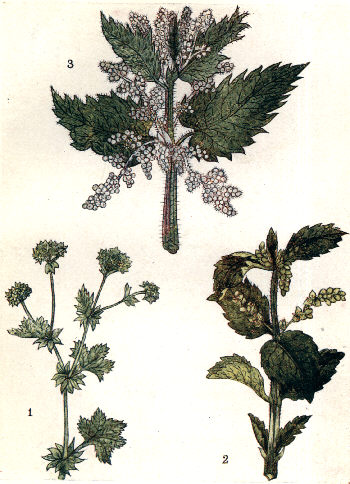
1. LADY'S MANTLE
The Lady's Mantle is a curious little plant and is common everywhere in summer. The beautifully shaped green leaves at once attract you, but the flowers are so small that you scarcely notice them. They are crowded into clusters at the end of short stalks, which branch many times from the main stem. These flowers have no petals. If you look at them very closely, you find that they have eight green sepals, which lie flat open when the flower is in bloom. These sepals are all pointed, and vary in size. The four which are utmost are smaller than the sepals which form the inner circle.
In the middle of these green sepals there is a yellow ring, and in the centre of this ring sits the tiny seed-vessel, sunk almost out of sight. There are four stamens, each of which stands out separately from this yellow ring.
The root-leaves of the Lady's Mantle are rounded, and they are covered with a fine network of veins. Each leaf looks as if it had been folded into five or seven folds, and each fold is divided round the edge into scollops. The edge of these scollops is cut into sharp teeth. Sometimes you find a big diamond dew-drop lying in the folds of the Lady's Mantle leaf.
You will also notice a frill of tiny pointed green leaves clasping the main stem wherever it forks.
2. DOG'S MERCURY
The Dog's Mercury grows abundantly in England and Scotland but is rare in Ireland. You find it during early spring in woods and shady places and thickets.
This is one of our green flowers. It has no beautiful coloured petals to attract the bees or insects.
The Dog's Mercury is a bushy, upright plant, with a stout, four-sided green stem, closely covered with pretty leaves.
These leaves grow in pairs, on alternate sides of the stem: they are oval, and slightly hairy, and the edges are cut all round into sharp teeth.
Where each leaf joins the stem a flower-stalk rises, and in the Dog's Mercury there are two kinds of flowers. On one stalk you find groups of small flowers clustered at close intervals round the stalk. Each of these flowers has three broadly pointed green sepals, which curl slightly at the tips. In the centre of these sepals rises a large bunch of eight to sixteen yellow-headed stamens. In these flowers there are no petals, and no seed-vessel.
But you will find different flowers on another plant. These flowers have also three green sepals, and are without petals. But in the centre lie two hairy green seed-vessels, like small peas joined together, and on the top of these seed-vessels are two tiny green horns.
3. COMMON NETTLE
What child does not know the Common Stinging Nettle? We have all learned to avoid it after having felt its sting.
You find this Nettle everywhere in late summer and autumn.
It has a four-sided stem, which is rough with bristly hairs. The leaves grow opposite each other in pairs with a good space between each pair. They are dark green and rather coarse, and are covered with a network of veins and with many stinging hairs.
Close to the stalk the leaves are heart-shaped, but the tips are sharply pointed and the edges are deeply toothed all round.
The flowers of the Common Nettle grow on slender stalks which rise between the leaf and the main stem. These flowers are green, and they are very small and unattractive.
On one flower you find four green sepals and four yellow-headed stamens, but there are no petals and no seed-vessel.
In another flower there is a fat green seed-vessel, with four sepals round it.
Plate XXXI
1. PURPLE SEA ROCKET 2. CUCKOO FLOWER OR LADY'S SMOCK 3. MARSH CINQUEFOIL 4. WATER AVENS
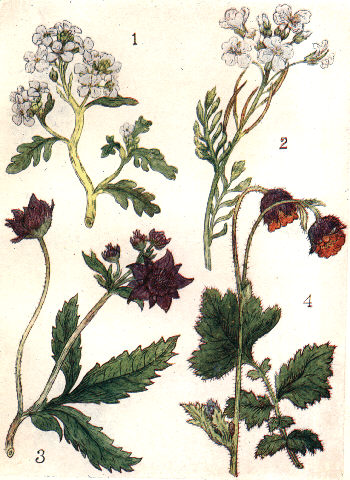
1. PURPLE SEA-ROCKET
The Purple Sea-Rocket grows abundantly all summer on most of our seashores. It is a bushy plant with many branches, and you will recognise it by its thick and fleshy green leaves. The flowers are a pale lilac colour, like those of the Cuckoo Flower. Some of them grow on heads at the end of the main stem, and others have short stalks which branch from each side of this stem.
In this plant there are always buds in a cluster at the end of the stem, and those flowers that come out first grow further down the stem.
Behind the lilac flowers there are four small brownish-green sepals. When these fall off, after the flower is withered, the seed-vessel which lies inside grows into a small green pod. The pod is in two pieces and looks as if it were joined in the middle. You will see a great many of these tiny pods growing on each side of the main stalk where there have been flowers.
The stem of the Sea-Rocket is very smooth and juicy. The leaves are long and feather-shaped, and they are cut very irregularly into fingers all the way round.
2. CUCKOO FLOWER OR LADY'S SMOCK
The Cuckoo Flower is very common and grows all springtime in every meadow.
The flowers are a pale purple or lilac. Sometimes you find them almost white. They have four petals, each of which has a slight nick in the outer edge. There are six stamens with yellow heads, which you can just see in the centre of the flower where the petals meet; and you will notice that two of these stamens are much shorter than the others.
The flowers grow in a cluster near the end of a stout stalk. After the petals and the small green sepals fall off, the seed-vessel, which is in the middle of the stamens, shoots up into a long thin pod. This pod is slightly curved, and is pale brown.
The leaves of the Cuckoo Flower are of two kinds. Those that spring from the root, close to the ground, grow opposite each other in pairs of leaflets, on a stalk which has an odd leaflet at the end.
But the leaves which appear further up the main stem are quite different They, too, grow in opposite pairs, but they are long and narrow like pointed straps, and are not nearly so pretty as those which are closer to the ground.
3. MARSH CINQUEFOIL
The Marsh Cinquefoil is not so common as many plants. It likes best to grow where there are high hills, and you find it all summer in wet ground among the peat-bogs.
It has black roots, which creep a long distance among the mud, and from these roots grow beautifully shaped green leaves, and rather strange-looking flowers.
These flowers have five small petals, which are a deep purple colour. So are the stamens, so are the seed-vessels. Even the sepals, which are bigger and longer than the petals, are a rich, dark purple, except at the foot where they join the stalk, and there they are greenish.
The Marsh Cinquefoil has two rings of sepals. Those in the outermost circle are shaped like a narrow tongue. The inner sepals are much broader, and they end in sharp points.
The flowers have each a stalk which branches from the main stem. Sometimes two flower-stalks will spring from the same part of the stem, and in that case there will be a large green leaf clasping the stem where they rise.
These leaves are usually divided into three fingers, each of which is long and rather narrow, with sharp teeth all round. There are a few hairs on the upper side of the leaf, but underneath it is quite smooth.
4. WATER AVENS
The Water Avens loves moist places, and in summer you find it abundantly by the sides of ditches and streams.
It is a delightful plant to discover, as both the leaves and the flowers are beautiful.
The flowers grow singly at the end of slender stalks which branch from the main stem near the top. They are cup-shaped, with heads that are always drooping.
The petals are bright orange-brown, tinged with purple, and outside these brilliant petals there is a calyx of deep purple sepals. These sepals are lined with bright green and have pointed tips, and there are many hairs all over them.
In the centre of the flower are bright yellow-headed stamens, and when the flower is withered, and the seeds begin to ripen, a short green stalk rises in the middle, and on this there appears what looks like a small green strawberry. From every seed on the strawberry there grows a long spike with a curl in the middle. This spiky seed-vessel is very curious.
The leaves of the Water Avens are deep green, and sometimes they have red streaks round the edges as well as on the back. They grow in pairs on the leaf-stalk, a large pair and a small pair alternately, and they are slightly hairy, with edges which are nicked all round. Where the leaves join the main stem there is often a tiny scale.
Plate XXXII
1. DOG VIOLET. 2. HEARTSEASE. 3. COMMON MALLOW.
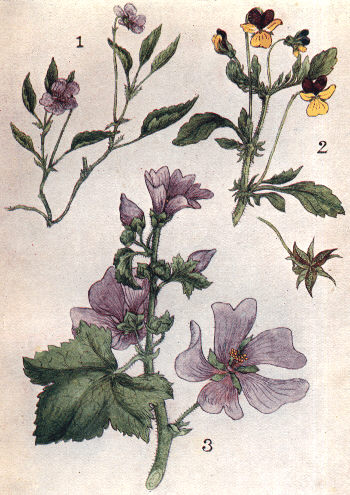
1. DOG VIOLET
The Dog Violet begins to flower early in summer. You find it growing on banks under the hedges, a tiny plant with flowers so small and stalks so short that the flowers are of no use after you pluck them.
Every child knows what a violet is like, but you should pick one of the flowers to pieces and see how curiously each petal is shaped. There are five petals, and these petals are pale purple at the broad part, but at the narrow end they are almost pure white, and this narrow end is hidden among the green sepals. Four of these petals are nearly the same size, and on two of them there are patches of hair near the foot.
The fifth petal is much larger, and the narrow end of this broad petal is shaped like a round tube. This tube, instead of being hidden among the sepals, stands out beyond them like a spur. Inside the tube are the stamens, and all the yellow heads of the stamens are joined edge to edge in a ring round the seed-vessel.
The Dog Violet has five green sepals with very sharp points, and the lower part of each sepal is slightly swollen. The leaves are heart-shaped, with toothed edges, and they grow very close to the ground and have scarcely any stalks. This Violet has no scent.
2. HEARTSEASE
The Heartsease is not quite so common as the Dog Violet, though in some parts of Britain it grows abundantly. It is in flower all summer.
The flowers have five petals, but these are not all the same colour. There are two deep purple petals and three which are bright orange-yellow. In the Heartsease the broadest petal has a very small tube at the narrow end, the same as in the Dog Violet. There are five pointed green sepals, which do not fall off after the flower is withered. You will often see the seed-vessel sitting among these sepals, and when this seed-vessel is ripe it splits open into three small boat-shaped cases, each with a row of seeds inside.
The stem of the Heartsease is round, with distinct lines running up the sides.
The leaves are oval, on short stalks, and they have wavy edges. Where they and the flower-stalk join the main stem you find a fringe of other green leaves, quite differently shaped. These leaves have a long name which you will learn later, but meantime you should notice how they are cut up into little green straps which stand out all round the stem.
3. COMMON MALLOW
The Common Mallow is a handsome flower which grows by roadsides and in waste places. It is plentiful all summer and autumn. The five petals are a beautiful pale mauve streaked with purple. They are long and rather narrow, and each petal has a deep notch in the outer edge. These petals do not meet close together at the bottom; you can see part of the green calyx appearing between each petal.
In the middle of the flower stands a small purple pillar. In this pillar all the slender stems of the stamens are joined together, and their heads cluster near the top like tiny beads, with the wavy points of the seed-vessel rising among them.
This Mallow has two kinds of green sepals. Five of these are broad, with sharply-pointed tips and hairy edges. And besides these there are three long narrow sepals.
The green leaves of the Mallow are very pretty. They are shaped like a hand with five blunt points, and the edges all round are cut into delicate teeth.
Those leaves which grow close to the root have often a deep purple blotch near the centre.
Plate XXXIII
1. SCOTCH THISTLE 2. MARSH PLUME THISTLE 3. FIELD SCABIOUS
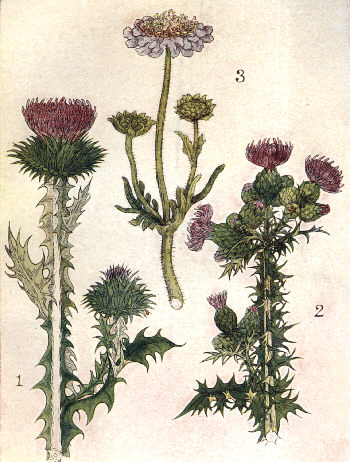
1. SCOTCH THISTLE
This Thistle is very well known, particularly in Scotland, where it is the national flower. It blooms in late summer and autumn.
The stem of the Scotch Thistle is very stiff and straight, with 'wings' at each side. These wings are pale green flaps edged with very sharp points, and they run from top to bottom of the stem. The stem itself is white and woolly.
The Thistle flowers are a dull purple colour, and grow in a dense head, forty or fifty of them closely packed together. If you pick to pieces one of these heads, you will find that it is made up of many purple tubes which are edged with five purple teeth. The foot of each tube is enclosed in a covering of dingy yellow down.
When you have a great many of these flowers growing close together in a head, the under part looks like a bundle of woolly down.
Below this down bundle you find a prickly green covering, in which there are dozens of narrow green leaves. Each leaf ends in a sharp point, and it is this prickly green covering which makes the Thistle such a difficult flower to gather.
The leaves have very sharp points at the edges. They are dark green, and are thinly covered with beautiful grey down. The young leaves are entirely white and woolly until they open.
2. MARSH PLUME THISTLE
The Plume Thistle is very common all over Britain. It grows during summer in bogs and in wet places by the roadside.
This tall, thin plant is not nearly so attractive as the Scotch Thistle.
The flowers grow in heads which contain a great many dull purple flowers crowded together in one bundle. These heads do not grow singly as in the Scotch Thistle. You will find three or four close together at the end of the main stem, and there is usually one head of flowers much further out than the others.
The green covering which protects the lower part of the flowers and binds them together is not hard and prickly as in the Scotch Thistle. When you pick this covering to pieces you find that it is filled with woolly down.
The stem of the Marsh Plume Thistle is stiff and straight, and it has green wings with very sharp prickles up each side.
The leaves are long and narrow, and they are edged with sharp points. Each leaf is dark green above, but underneath it is covered with white down.
3. FIELD SCABIOUS
This pretty plant is common over most of Britain. You find it on dry banks and by the edge of fields, and it blooms all summer and autumn.
The flowers are very interesting. They grow in a bouquet which contains many flowers crowded together at the end of a stout stalk.
The centre flowers are a reddish pink colour, and have many tall yellow-headed stamens standing up beyond them. The petals of these flowers are joined together into a tube which is unevenly divided round the mouth. If you open the tube gently, you will find that the stamens are clinging to the inside.
Outside these pinky flowers there is a border of purply-blue tube-flowers, and these are much larger than the group in the centre. At the mouth of each tube there is a purple strap, and these straps stand out like a frill round the bouquet.
Behind these flowers there is a double row of small pointed green leaves.
The stem leaves are shaped like a feather, and they have long narrow fingers growing up each side of a centre stalk. There is always a solitary finger at the end of the stalk, and each finger is covered with soft hairs.
Plate XXXIV
1. COMMON LING OR HEATHER. 2. BLACK KNAPWEED. 3. WILD THYME.
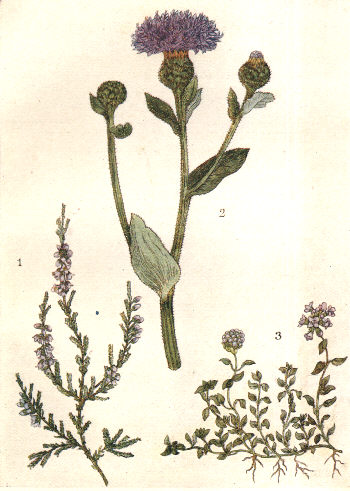
1. COMMON LING OR HEATHER
The Heather is so well known that it scarcely requires any description. It grows on moors and commons and mountain-sides in England, Scotland and Ireland, and in autumn you will find it covering the ground like a carpet, sometimes growing in bushes as high as your knee.
The flowers of the Heather are very tiny, and they vary in colour from a pale pink to a deep purple. These flowers grow in spikes near the end of thin woody stems, and each flower has a very short stalk which droops slightly. The small flowers are bell-shaped, with the mouth of the bell deeply divided into four parts. Outside this purple bell there is a calyx made up of four purple pink sepals. These sepals are much longer than the petals, and they are very crisp and dry, like tissue paper. There is a double row of tiny green pointed leaves, clasping the bottom of the purple flowers. At first you might mistake these for sepals, but they have a different name, which you will learn some day.
The Heather leaves are very tiny. They have no stalks, and they grow tightly pressed against the tough woody stems. When you look at them closely you see that the edges are rolled back so as almost to touch each other behind. When these leaves are withering they are often a beautiful brown-red colour.
2. BLACK KNAPWEED
This hard-headed plant is common everywhere, in pastures and fields and by the roadside, and it blooms in autumn.
The Black Knapweed is a stiff, soldierly plant, not unlike a small Thistle without prickles.
The flowers grow in thickly crowded heads each at the end of a stout stem. These heads are made up of dozens of tiny purple tubes with the mouth cut into five straps round the edge. You can see the forked end of the seed-vessel coming out of the centre of each tube. The stamens cling to the sides of the purple tubes, hidden from sight inside. This cluster of purple tubes grows on the top of a hard green ball which has a circle of light brown strap-shaped leaves round the top.
This hard ball is covered with row upon row of green leaves pressed tightly one above the other, like the scales of a fir cone.
When the flowers are in bud they are completely hidden inside this hard green ball, and after the flowers are withered you see these balls, which have become dark brown, still clinging to the ends of the stalks.
The Knapweed leaves vary much in shape. Some are narrow and long, with edges that are finely toothed. Some are deeply cut up at the sides. Those that grow clasping the stem are broad, and they are smooth all round the edge.
3. WILD THYME
This sweet-scented little evergreen grows abundantly on all sandy and chalky pastures, and is specially common in mountainous districts. It flowers in summer and early autumn.
The Wild Thyme trails along the ground in a thick tangle of wiry stems and tiny glossy leaves. From this tangled mat some of the stems stand upright, and these bear masses of small purple flowers at the top. Other stems end in a tuft of tiny leaves.
The flowers of the Wild Thyme consist of a narrow purple tube which stands in a deep green funnel-shaped calyx. The mouth of the flower-tube is cut in two, and the upper half has a small notch in the centre. The lower half is divided into three blunt points.
Inside the tube, clinging to its sides, are four stamens. After the flowers are withered you can see the tip of the seed-vessel coming out of the mouth of the calyx.
The calyx is funnel-shaped and has many sharp teeth found its mouth, and there is a fringe of white hairs just inside.
The leaves of the Wild Thyme are very small. Sometimes the edges are rolled back till they almost meet behind. They are dark green and glossy, with smooth edges, on which you can see a line of fine hairs.
Plate XXXV
1. EARLY PURPLE ORCHIS. 2. PURPLE LOOSE-STRIFE. 3. COMMON BUTTERWORT.
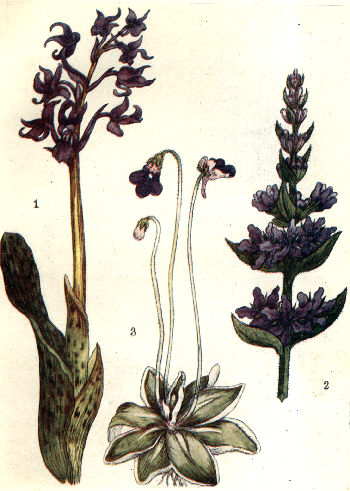
1. EARLY PURPLE ORCHIS
At the same time of year, and in the same places as you find the Blue Hyacinth, you will discover the Early Purple Orchis.
It is a curious plant, and belongs to a family whose flowers are always strangely shaped.
The flowers grow in a cone-shaped head at the upper end of a stout, juicy stalk. Each flower consists of three purple petals and three purple sepals, and you will not be able to distinguish which are which. These petals or sepals are very irregular in shape. One is broad, and hangs open like a lip. This one has a long purple spur behind. Two smaller petals rise straight up above this lip and form a hood. And the others are shaped in varying ways.
Inside the broad lip with its hood you see a slender column, in which the one stamen as well as the point of the seed-vessel are combined.
The flower is placed at the end of what looks like a twisted purple stalk. This is really the seed-vessel, and where it joins the flower-stem there is always a narrow strip of purple leaf.
The leaves have no stalks. They are broadly strap-shaped with blunt ends, and they have long narrow lines running from base to tip. Each leaf is stained all over with purple spots.
The root of the Early Purple Orchis consists of two egg-shaped knobs, and above these knobs grow many white, worm-like rootlets.
2. PURPLE LOOSE-STRIFE
The Purple Loose-strife is common in all parts of England, but you do not find it so abundantly in Scotland. It is a tall, spiky plant, which likes to grow in wet places, and it blooms in late summer and autumn.
The flowers are a rich purple colour which is sometimes almost pink. They grow in circles close round the main stem, and there is always a pair of broad pointed green leaves separating each circle from the one above.
The flowers have six separate petals, which are long and narrow and rather crumpled looking. These petals are placed at the mouth of a green calyx, which is shaped like a thick tube. This tube is ribbed all over, and has six large green teeth and six smaller green teeth round its mouth. If you gently split open this green tube you find two rows of stamens clinging to its sides. These stamens have purply-pink heads, and there are six long ones which stand up in the centre of the flowers, and six which are shorter and hidden out of sight.
The leaves of the Purple Loose-strife are dark green. Usually they are covered with fine hairs, but sometimes you find leaves which are quite smooth. It is easy to recognise this plant by the rings of flowers growing close round the main stem.
3. COMMON BUTTERWORT
It is always a delight to find the dainty Butterwort. It grows in heaths and bogs and marshes almost everywhere, but is most abundant in the North. The delicate flowers bloom in summer.
You will easily recognise this beautiful highland plant by the leaves. They are thick and juicy, and grow close to the ground in a pale green star-pointed rosette. Each leaf is stalkless and as smooth as satin. On the upper side these leaves are pale yellow-green, but sometimes the edges curl upwards, and then you see that the leaf underneath is so pale that it is almost white.
From the centre of the rosette rise tall, slender stalks with drooping flower-heads. These flowers are dark bluey-purple, and their petals are joined into a short tube which stands in a shallow, toothed calyx-cup.
The mouth of the tube folds back in two parts. The upper half is short, with a deep notch in the middle. The lower half is much longer, and is divided into three deep scollops.
You will find a pink horn-like spur standing up near the base of the short tube, and you can see that the back of the flower is a delicate rose pink colour. Inside the blue tube there are two stamens and a curiously shaped seed-vessel hidden from sight.
Plate XXXVI
1. COMMON BUGLE. 2. GROUND IVY. 3. HAIRY WATER MINT.
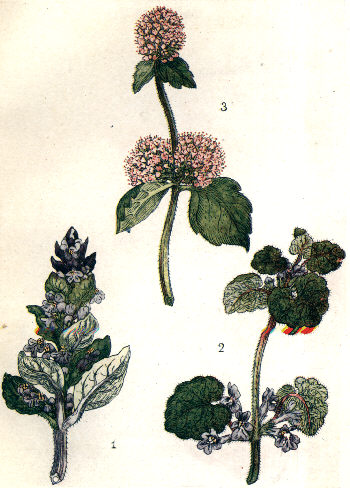
1. COMMON BUGLE
The Common Bugle is a low-growing plant, very frequently found in open woods, banks, and pastures. It blooms in spring and early summer.
You will not think this a very attractive plant. The leaves and flowers are crowded together from top to bottom of the main stem. The stem is pale purple, and has four sides. It is hollow in the centre, and breaks off easily because it is soft and juicy.
The flowers grow without stalks in circles close to the stem wherever the leaves join it, and each circle is close to the one above it.
In every flower there is a slender tube, and one half of this tube folds over at the mouth into three lips, the centre lip having a notch in the middle. The other half of the tube stands erect.
These flowers are usually deep blue, but you may find them purple, or rose colour, or even white. They are never yellow.
Four golden-headed stamens stand up a good way beyond the mouth of the flower; two of these are short and two are much longer. The forked tip of the seed-vessel can be seen among these stamens.
The end of each tube stands in a small green calyx-cup edged with pointed teeth.
The leaves of the Common Bugle are dark green, and each pair clasps the stem closely at the bottom.
2. GROUND IVY
The Ground Ivy bears little resemblance to the ivy we all know so well. It is common everywhere, and blooms in spring and early summer.
The flowers grow without stalks in whorls or circles close to the stem where the leaves spring from it. These flowers are dark purply-blue tubes, prettily divided at the mouth into rounded lips. The lower lips are marked with white and dark purple blotches. Inside the tubes are four small stamens with yellow heads; you can just see them at its mouth, with the forked tip of the seed-vessel among them.
There are usually six or more flowers in a whorl, and each flower has a green calyx-cup which is very hairy and is edged with five long sharp teeth.
From each side of the stem, close among the flowers, grow two leaves on pink stalks. These leaves are round and are beautifully scolloped at the edge. Each leaf is covered with a network of veins and is hairy all over, both above and below, as well as round the scollops.
These circles of leaves and flowers grow at intervals all the way up the stem, with a good distance between each circle, and the flowers in the lowest circles always come out first.
The stem of the Ground Ivy is four-sided. It is tinged with pink and is very hairy.
3. HAIRY WATER MINT
This strong-smelling plant is common everywhere. It likes to grow in wet places, and it is in flower towards the end of summer and in autumn.
The Water Mint is not an attractive plant. It has four-sided juicy green stems stained with purple. These stems do not grow straight.
The flowers grow in pink clover-shaped heads, either at the end of the main stem or sometimes on very short stalks which spring from between the stem and the leaf.
Each pink head is made up of many tiny tubes. These tubes are prettily cut round the mouth, and you can see four stamens, with deep crimson heads, coming out of the mouth of each tube. The forked tip of the seed-vessel is so tiny you scarcely notice it.
Below the flower there is a deep funnel-shaped calyx in which each pink tube stands, and both it and the flowers are covered with fine soft hairs. There is often a pair of small oval green leaves just beneath the head of flowers.
The leaves of the Hairy Water Mint are broadly oval with widely separated teeth round the edge. They grow in pairs on short stalks on each side of the main stem, and they are hairy all over.
Plate XXXVII
1. COMMON FUMITORY 2. RAGGED ROBIN 3. RED CAMPION
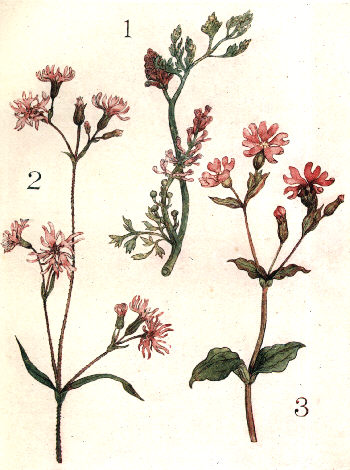
1. COMMON FUMITORY
The Common Fumitory is abundant in all parts of Britain, and it blooms in summer. The flowers grow in loose clusters. Those that are lowest down the stem come out first, and the buds are always at the top of the stem.
The flowers are a pretty rose pink colour, but the tips are often purple, especially before the flower is fully out. The petals are curiously shaped. They are joined together into a tube which is curved at the end, and inside this tube the stamens and the seed-vessel are hidden. You will notice that there is a tiny piece of one petal which is not joined to the others. It stands out by itself and looks like a small pink tongue, which broadens at the end. You can always recognise the Fumitory by this pink tongue.
There are two tiny green sepals with edges cut like the teeth of a saw, and the pink tube lies in between these sepals. After the pink tube falls off, the seed-vessel, which is inside, grows into a little green knot. You can see many of these little green knots on the lower part of the stem where there have once been flowers.
The green leaves of the Fumitory are very delicate and pretty. They are finely cut up into many little divisions, and each division is a beautiful shade of grey-green.
2. RAGGED ROBIN
This untidy plant likes to grow in damp places; it is very common in meadows and in marshes, and it blooms all summer.
The flowers grow in twos and threes, on short stalks which branch opposite each other near the end of a long slender stem.
The petals are a delicate pale pink, and they are very much cut up into narrow ragged pieces. You will easily know the Ragged Robin by these pink petals.
The sepals are joined together into a cup which is cut into teeth all round the mouth. They are dark green tinged with red, and have many purple veins running from top to bottom.
The leaves of the Ragged Robin are shaped like a lance. They are long and narrow with smooth edges, and they grow opposite each other in pairs, closely clasping the stem. Those leaves that grow close to the ground have sometimes short stalks.
The upper part of the sticky stem is dark red in colour, and it is usually rough.
3. RED CAMPION
This pretty summer plant is fond of damp places like its cousin the Ragged Robin.
It has pink flowers, which usually grow in pairs at the end of slender stalks branching from the main stem. Sometimes you may find a single flower growing on a small stalk in between two pairs on much larger stalks.
There are five petals, each with a deep nick in the centre, as if a three-cornered piece had been cut out. These petals lie flat open round the rim of the reddish-green cup formed by the sepals; and if you pull the sepals apart, you find that the petals have long strap-shaped ends which go right down into the cup.
There is a curious thing about this plant. You find one pink flower with a bunch of stamens inside the cup. You can see their tips peeping out where the pink petals all meet together. There is no seed-vessel in the middle. And in another plant, that looks just the same till you examine it, you find no stamens, but instead there is a green seed-vessel in the centre of the cup, with fine, wavy green threads at the top which stand out where the petals join.
The stem of the Red Campion is red and sticky, and the leaves grow opposite each other in pairs which clasp the stem.
If you crush the leaves and stalks they give out a strong scent which is not pleasant.
Plate XXXVIII
1. DOVE'S-FOOT CRANE'S-BILL 2. HERB-ROBERT 3. STORK'S BILL
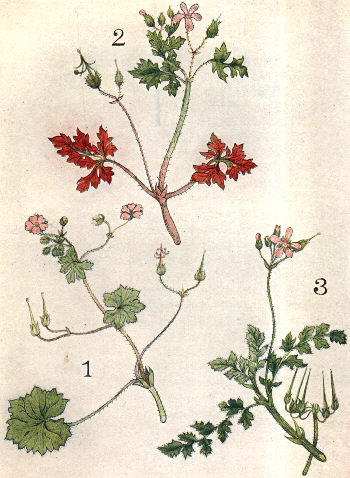
1. DOVE'S-FOOT CRANE'S-BILL
The Dove's-foot Crane's-bill is known to us all. You will find it flowering by the roadside from May to September.
The flowers are small and pink, sometimes almost purple. They have five petals, each with a notch in the broad end and with many fine hairs near the narrow end.
The flowers open flat, like a wheel, and you can see the green tips of the sepals appearing between each of the pink petals, as you look down into the flower.
After all the pink petals have fallen off, a thin green spike shoots up in the middle of the sepals. These sepals no longer lie flat open, but half closed, they form a green cup. The spike holds the seeds, and when it is time for them to be scattered over the ground, five green threads loosen themselves from the bottom of the spike and curl up nearly to the top. At the end of each of these green threads there is a seed, and very soon the green threads crack and the seeds fall to the ground.
The leaves of the Dove's-foot Crane's-bill are very soft and downy. They are round in shape and are covered with fine hairs. Each leaf is divided into seven parts, which are toothed round the edges.
This plant has a weak stem, which lies near the ground. It is tinged with pink, and is very hairy.
2. HERB-ROBERT
The Herb-Robert is common everywhere in early summer. It is a cousin of the Dove's-foot Crane's-bill, but differs from it in some points which you must notice. The stems are much stronger and can stand upright.
The flowers are longer than those of the Dove's-foot Crane's-bill, and the five petals have no notch in the broad end, and no hairs at the narrow end. These petals are pale pink, streaked with white or purple, and they grow in pairs at the end of short stalks which branch near each other from the main stem.
The sepals are of two kinds. You have three outer sepals which are green and hairy, and inside these there are two others which are very thin and almost colourless.
The seeds of the Herb-Robert are scattered in the same way as those of the Dove's-foot Crane's-bill.
You will always know this plant by its beautiful red leaves. They are shaped like a hand, and are cut up into many tiny fingers. At first they are green, but very soon they become a beautiful red colour. So do the stalks.
The whole plant has a strong and rather unpleasant odour.
3. STORK'S BILL
The Stork's Bill is very well known. In summer it grows plentifully on dry ground, especially near the sea coast.
The flowers grow on short stalks. You will find a bunch of five flower-stalks rising together at the end of the main stem. Each flower has five pretty pink petals with smooth edges. These pink petals soon fall off, and you then notice a long green spike coming out of the green cup formed by the sepals. Each green spike is supposed to resemble a stork's bill, and from this resemblance the flower gets its name.
When the plant is ready to scatter its seeds, many fine green threads loosen themselves from the spike, and curl round and round like a corkscrew. At the end of each green thread there is a seed. When the seed is ripe, both the seed and the corkscrew-thread separate from the spike and fall to the ground.
The green leaves of the Stork's Bill are cut up into leaflets which are arranged on each side of a centre stalk, but not always exactly opposite each other. There is always a single leaflet at the end of this centre stalk.
PLATE XXXIX
1. REST HARROW. 2. SAINTFOIN. 3. RED CLOVER.
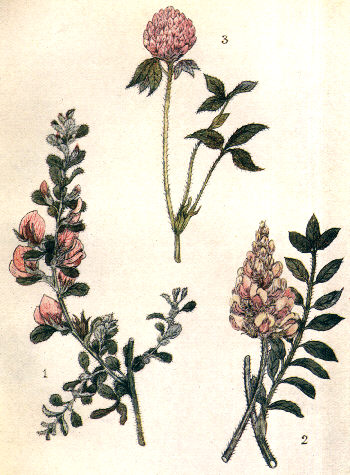
1. REST HARROW
The Rest Harrow is to be found in sandy places near the sea, and blooms all summer.
It belongs to the Pea family, along with the Broom and the Whin. But in this plant the flower-petals are a beautiful rose-pink colour.
The largest petal, which is called the standard, is streaked with veins of deep red. The two side petals, or 'wings,' are pale pink, and the tip of the two 'keel' petals, which are joined together into a little boat and hide the stamens, is also a deep rose-red.
The flowers have scarcely any stalks. They grow close to the main stem, in a green calyx-cup edged with five sharp teeth, and there are small green leaves beside each flower.
These leaves are dark green in front but are much paler behind, and they have tiny teeth all round the edges.
Sometimes, close to the root, you find leaves which grow in threes, but oftenest the plant has single oval leaves, and these are always covered with fine hairs.
The Rest Harrow usually lies close to the ground, but you may find it growing upright like a small bush.
It has long, tough roots, which creep through the soil, and these are said to be so strong they will turn aside the harrow when it is drawn over the field.
2. SAINTFOIN
Some people tell us that this is not a British wildflower, but one which was brought from some other country to grow in our gardens. They say that the wind and the birds carried away the seeds, and the plant learned to grow among our other wildflowers. In any case, you find its handsome flowers adorning chalky banks and cliffs all summer and autumn.
Like the Rest Harrow it is a relation of the Pea family, but its flowers grow quite differently.
In colour they are not such a clear pink. The two petals which hide the stamens are almost purple, and the side wings are so tiny, at first you scarcely notice them.
The flowers grow close together in the shape of a cone; you find twelve or more open flowers with no leaves among them, crowded together near the upper end of a long flower-stalk, and at the top of this flower-stalk there is always a bunch of buds.
The calyx is a green cup with five sharp teeth round the mouth, and it is covered with woolly hairs.
The leaves of the Saintfoin are long and narrow, and the edges are quite smooth. Each leaf is made up of from eight to twelve pairs of leaflets growing opposite each other on a leaf-stalk, and there is always a solitary leaflet growing at the end of the stalk.
3. RED CLOVER
The Red Clover is as well known as the Buttercup. It grows all summer in every hayfield. Sometimes the flowers are large and showy, and sometimes they are quite small.
The Red Clover is a member of the Pea family, though at first you may not think that the flowers are at all like those of the Broom or the Rest Harrow. These flowers grow in a round head, thirty or forty of them close together at the end of the flower-stalk.
If you pull a single flower apart from the others and separate the petals, you will see that they are shaped in the same way as those of the other Pea plants.
You find one large standard petal which stands erect, rather a long, narrow petal in this plant. Then there are two side petals for the 'wings,' and two front petals joined together so as to form a tiny boat, and in this boat the stamens and seed-vessel are hidden.
These petals are a pale pinky-red, and each flower is set in a green calyx-cup edged with five long teeth.
The leaves of the Red Clover are 'Trefoils'; that means that they grow in groups of three. Each group has a short stalk, and there are curious yellow markings in the centre of each oval leaf. The edges are smooth, and the leaves are covered with fine downy hairs.
Plate XL
1. DOG ROSE 2. BURNET ROSE 3. LOUSEWORT OR RED RATTLE
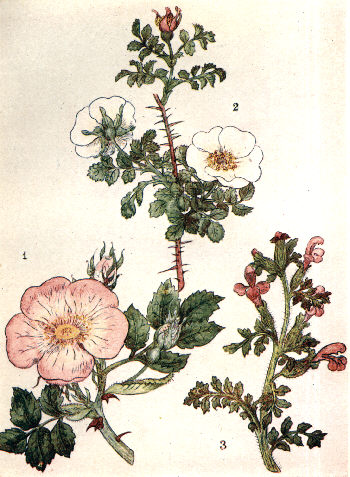
1. DOG ROSE
There are a great many wild roses, pink, white, and crimson, but the pink Dog Rose is the commonest. Every one has gathered it in the sunny June days.
You must notice a curious thing about the seed-vessel of this plant. Only the top of it rises in the middle of the stamens. But if you look at the back of the flower, you see a small green swelling at the end of the stalk, and the sepals and petals and the stamens stand in a ring round the top of this swelling. This is the seed-vessel, and in autumn, after the flower is withered, it will grow into a round red berry, which is called a hip.
The sepals of the rose are very pretty. They are cut up into many points like small leaves, and after the flower is withered these points fold right back and cover the green berry. Later on they dry up and fall off, leaving the berry bare.
The rose leaves are too well known to need any description. Notice the two narrow green leaves, like wings, which grow at the foot of the leaf-stalk, clasping the main stem.
The Dog Rose is very thorny. There are large hooks all over the main stem, as well as close to the flower, and these hooks are often coloured a bright crimson.
2. BURNET ROSE
The Burnet Rose is different in several ways from the Dog Rose. It grows in early summer on sandy sea shores and on heaths, but not in the hedges, and the flowers are usually white.
It is a much smaller plant than the Dog Rose. Its leaves grow closely crowded together in a small, low bush, and there are no long shoots running out from the plant.
The main stem of the Burnet Rose is a bright pink colour, and instead of having big hooks here and there it is covered from top to bottom with fine sharp prickles of all sizes.
The green sepals are pointed, but they are not cut up into leafy tips as in the Dog Rose. Neither do they fold back over the seed-vessel after the flower is withered, but remain standing straight up at the top of the berry.
The seed-vessel of this rose is rounder than the hip of the Dog Rose. When ripe it is a dark purple colour which is almost black.
The leaves are made up of leaflets which grow in pairs opposite each other on a leaf stalk, and there is always an odd leaflet at the end of the stalk. They are small, nearly oval, and the edges are cut all round into fine teeth.
3. LOUSEWORT, OR RED RATTLE
This bright plant is common all over the country. It grows in wet places, such as bogs and damp fields, and it is in flower from spring to autumn.
The Lousewort is a small plant and does not rise very far above the ground. The flowers are bright pink, and they grow singly at intervals up the main stem. The flowers are curiously shaped. The lower part is round, like a narrow pink tube, but at the mouth this pink tube becomes much wider and is divided in two. One half rises straight up and then bends over at the top like a hood.
Inside the pink hood are hidden the yellow heads of the stamens. The other half of the flower is divided at the edge into three pink scollops, which fold back so that you can look inside the tube of the flower. After the pink flowers are withered the calyx-cup swells into a small bladder, and on windy days you can hear the seeds rattling inside this bladder.
The stem of the Lousewort is hairy, and the leaves grow very close to it. These leaves are made up of small fingers with deeply toothed edges, which grow in pairs on each side of the centre leaf-stalk. There are frequently six pairs of these fingers on one stalk, and there is always a single finger at the end of the stalk.
Plate XLI
1. GREAT WILD VALERIAN 2. SMALL BINDWEED 3. FOXGLOVE
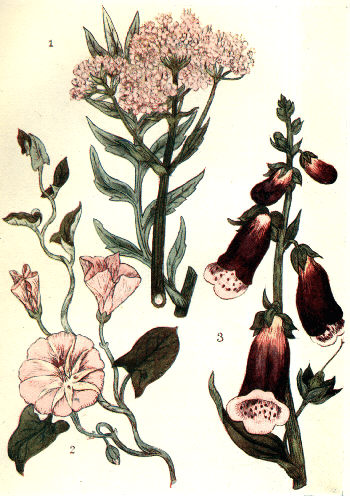
1. GREAT WILD VALERIAN
You find the Great Wild Valerian in most parts of Britain. It grows in marshy meadows and in damp woods, and is in flower all summer.
The Wild Valerian is a tall, handsome plant. It has small pale pink flowers, which grow in thick clusters on long, stiff green stalks rising from the main stem.
If you pull off a single flower you find that its five pink petals are joined together at the bottom into a tube. This tube folds back at its mouth into five pink scallops, and you can see three yellow-headed stamens coming out of the mouth of the pink tube. If you gently split the tube open you will discover that these stamens are clinging to its sides.
The green sepals of the Wild Valerian are also joined into a tube which has five teeth at the top, and after the pink petals are withered, this green tube sends up a tuft of beautiful feathery down.
The stem is dark and glossy. It is ribbed all over and is hollow inside.
In the Wild Valerian each leaf is divided into fingers, which grow in pairs on each side of a slender stalk. Sometimes there will be ten pairs of these little fingers, and you will notice that each finger is not placed exactly opposite its neighbour, but that they grow alternately.
2. SMALL BINDWEED
The Small Bindweed or Convolvulus is common everywhere. You find it in the hedge-banks, on waste places and in fields, and it blooms all summer.
This pretty plant is very well known by its pale pink or pure white flowers. These flowers have a narrow tube which fits into the small green sepal-cup. But round the mouth this tube widens out into a beautiful bell, and the edges of the bell are gracefully waved all round. Inside the flower there are curious markings like large cream-coloured rays, and you must notice how wonderfully the flower of the Bindweed is folded when it is in bud.
The stem of the Bindweed is very curious. It is twisted like a piece of rope. This stem clings to any stronger plant within reach, and it will twist itself round and round that plant till it nearly chokes it.
The leaves are dark and shiny with smooth edges, and they are shaped like the head of an arrow. Each leaf has a short stalk of its own.
3. FOXGLOVE
This is one of the handsomest of our wildflowers. It grows abundantly in woods, on banks and in fields, and it flowers all summer and autumn.
The Foxglove is a tall plant with a very stiff stem, from one side of which hang beautiful rose-pink and purple bells.
These fairy bells are daintily scolloped round the mouth, and the pale pink lining inside is dotted all over with purple spots. When you look down the mouth of a Foxglove bell you see that two long and two short stamens with large yellow-heads are clinging to its side, and rising from the centre of the bell there is a fat green seed-vessel which sends up a slender yellow thread.
Those bells which are nearest the bottom of the stem come out first, and the buds are always found at the top. Behind each bell there are five green sepals with sharp points, and wherever the flower-stalk joins the main stem there is always a small green leaf.
The Foxglove leaves are broad and long, and they are pointed at the end. Each leaf is covered with a network of fine veins. These leaves are grey-green in colour, and the underside is hoary with soft, white woolly down.
Plate XLII
1. BROAD-LEAVED WILLOW HERB 2. CORN COCKLE 3. CROSS-LEAVED PINK HEATH
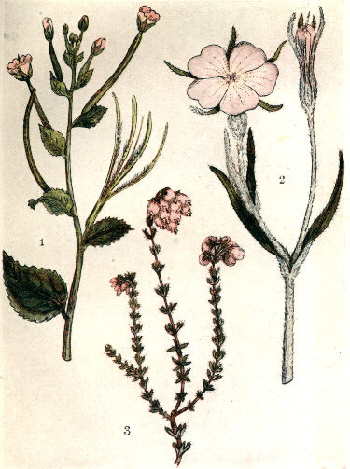
1. BROAD-LEAVED WILLOW HERB
The Broad-leaved Willow Herb is common in most parts of Britain. You find it growing on old walls, in woods and under hedges, and it blooms all summer and autumn.
It is a tall, thin plant, and has small pink flowers with four petals, each of which has a V-shaped notch cut in the outer edge. Behind these pink petals there are four narrow pointed green sepals, and within the flower grow eight stamens with tiny yellow heads. Amongst these stamens you can see the slender pillar which rises from the seed-vessel; it is divided at the top into four yellow rays.
The flowers grow singly, each at the end of a long thin pod which is slightly red in colour. When the petals and the green calyx fall off, this pod grows larger, and as soon as the seeds inside are ripe, it splits open into four strips, and each strip is lined with a row of small brown hairy seeds.
The leaves of this Willow Herb are oval, with pointed tips, and they are cut into sharp teeth all round the edge. These leaves are dark green, and usually they are smooth all over, but you sometimes find leaves which have hairs along the veins.
The stem is quite smooth, and it is red on the side which gets most sunshine.
2. CORN COCKLE
The Corn Cockle is common everywhere. It grows in the cornfields, and you find its pink flowers all summer.
The flowers are large and handsome. In shape they are like a Primrose, but the petals are pale pink and each has a tiny notch in the outer edge. On these petals there are tiny lines of dark purple dots, like rays, which run from the centre of the flower almost to the edge of the petal. The heads of the stamens can only just be seen in the centre of the flower where the five petals meet.
Behind the pink flower there is a green calyx-cup marked with ten ridges, and at the mouth of this cup there are five narrow green teeth, which are so long they look like pointed leaves. These sepals are dark green inside, but the outside is pale green and woolly. You can see their sharp points standing out beyond each of the petals of the flower.
The stem of the Corn Cockle is stiff, and it grows very straight. Like the calyx-cup, it is covered with soft white wool.
The leaves grow in pairs on each side of the stem. These leaves are long and narrow, with pointed ends. Each leaf is dark green above, but the back is always pale grey-green and woolly.
3. CROSS-LEAVED PINK HEATH
This waxen Pink Heath is to be found all over the country. It grows best in damp places, and is in flower in late summer and autumn before the purple heather is fully out.
The flowers grow in clusters of from five to twelve at the top of the woody stem. Each cluster is made up of pale pink waxy bells, and the mouth of each small bell is edged with four pointed teeth. If you split open one of these pink bells, you will find inside a round green seed-vessel like a tiny pea.
There is a long green spike growing from the top of this seed-vessel, and you can see its point coming out of the mouth of the pink bell. There is also a ring of yellow stamens hidden inside the bell, and these grow close round the green seed-vessel.
The leaves of this Pink Heath are very small and pointed, and they have hairs along the edge. They grow in fours, and are placed crossways at short distances up the main stem. The edges are usually rolled back on to the woolly underside of the leaf.
The stem of the Cross-leaved Pink Heath is slender and wiry, and this pretty plant is never found growing in large bushes like the common heather. Sometimes the flowers are pure white.
Plate XLIII
1. BLUE MEADOW CRANE'S-BILL 2. MILKWORT 3. CORN FLOWER OR BLUE BOTTLE 4. TUFTED VETCH
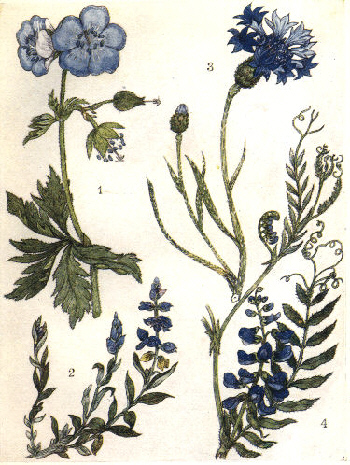
1. BLUE MEADOW CRANE'S-BILL
The Blue Meadow Crane's-bill is one of our handsomest wildflowers. It is to be found by the edge of the fields and in the meadows all over Britain in summer and autumn.
This plant is related to the beautiful geranium which grows in our gardens. The flowers have five large petals. In front these petals are bright blue and are painted with tiny pink streaks. Behind, they are a delicate pale pink.
In the centre of the flower there is a ring of stamens, and within this ring is the seed-vessel.
There is a circle of green sepals behind the pinky-blue petals.
After the blue petals are withered you can see a long spike with a small star at the end coming out from among the sepals.
This spike has five seeds clustered round the bottom, and whenever these seeds are ripe, the spike splits into five fine hairs. Each of these hairs curls up to the top, carrying a seed with it. Then the five seeds are blown by the wind away from the slender hairs.
The leaves of the Blue Meadow Crane's-bill are beautifully shaped. They are like a hand with five thin fingers, and each of these fingers is deeply cut up all round the edges.
The stem of the plant is covered with rough, hairy bristles.
2. MILKWORT
The Milkwort has flowers which are not always the same colour. You may find them either pink, or blue, or white, but I think the blue Milkwort is the commonest. It blooms all summer.
The flowers grow on spikes in which the buds are always at the top, and further down the same spike there are leaves. Each flower has five sepals. Three are only small green strips, but inside these three there are two which are large and broad, and beautifully coloured. These look like petals.
When the flower is withered these two sepals change colour and become green.
The real petals are paler in colour than the sepals. The lowest one is cut up at the end into little strips like a blue fringe, and there are two small side petals as well as two upper ones, which are so tiny that they are merely scales.
The leaves resemble narrow straps. They grow alternately on the stem, and they are dark green above and pale green below.
The Milkwort lies close to the ground among the grass. You would never notice it, were it not for its beautiful spikes of blue, pink-white flowers.
3. CORN FLOWER
The Corn Flower or Blue Bottle is common all over Britain; you find it in the cornfields and by the roadside, and it flowers all summer and autumn.
This pretty plant belongs to the same family as the Thistles. The flower-heads are made up of a great many flowers grouped together. In the outer row you find a circle of beautiful bright blue flowers, each of which consists of a blue tube which widens out at the mouth like a trumpet, and is edged with seven sharp points.
Inside this outer circle there is a mass of darker blue flowers, slightly tinged with rose-colour. These flowers are very much smaller, and their pinky tubes are very tiny. So are the strap-shaped teeth at the mouth of the tube. Coming out of the mouth of each tube is the dark purple tip of the seed-vessel.
Underneath this bunch of flowers there is a double ring of green scales with fringed edges. These scales are tightly pressed together in the shape of a cup, but they are not prickly as in some of the Thistles.
The stems of the Corn Flower are very tough. The plant is tall and straggling, and it has narrow strap-shaped leaves with smooth edges. These leaves, as well as the stems, are often covered with white woolly down.
4. TUFTED VETCH
The Tufted Vetch is a very common plant, and all summer-time you find its masses of bright blue or purple flowers growing up the hedges. It belongs to the large family of Pea-plants, along with the Broom and the Trefoils, and you will find that its bright bluish-purple petals are shaped as curiously as those of the other Pea-plants.
Do not forget to look at the stamens. You will see that there is one stamen whose slender stem is not joined with the others, but has a separate stalk of its own.
The flowers grow in clusters on a stiff stalk; the buds are at the end of the stalk, and the flowers that grow lowest on the stalk always open first. When the flower is withered, the seed-vessel grows into a small green pea-pod which has a curly tail at the end, and when the seeds are ripe, this pod turns brown.
The leaves are made up of short pointed straps, set opposite each other in pairs on each side of a thin stalk. You will often find ten pairs of little straps, and at the end of the stalk there grow curly green threads called tendrils. This Tufted Vetch is one of these climbing plants which are not strong enough to stand alone; so these tendrils curl themselves round the twigs of the hedges, and this helps the plant to rise high above the ground.
Plate XLIV
1. WILD SUCCORY. 2. BLUEBELL OR HAREBELL. 3. SEA HOLLY.
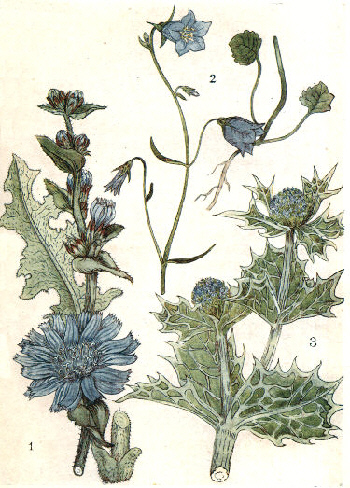
1. WILD SUCCORY
The Wild Succory is abundant all over England, but is not so plentiful in Scotland. It grows by the borders of fields, in waste places or by the roadside, and it blooms in late summer and autumn.
The flowers are like large blue dandelions. They have no stalks, but grow from top to bottom of the main stem.
The flowers at the bottom of the stem come out first and the buds are always at the top. Each of these large blue dandelions is made up of a great many tiny tubes grouped together.
In the inner circle there are a great many blue tubes which have no strap, but in the outer circle the flowers have a broad blue strap at one side, and the end of this strap is cut into fine teeth. In the centre of each tube you see the tip of the seed-vessel standing up. It looks like a white thread with two curly points at the end.
The heads of the stamens are placed edge to edge and form a collar close round this white thread.
Behind the blue flowers there is a green calyx-cup of narrow strap-shaped leaves, with reddish-brown tips. There is always a large pointed green leaf where the flower-bud joins the main stem.
The leaves of the Wild Succory are rough and hairy all over, and are a grey-green colour.
2. BLUEBELL OR HAREBELL
The Bluebell or Harebell is one of our prettiest wildflowers. It is common all over the country on heaths and on pastures, and it blooms in late summer and autumn.
The five petals of the flower are joined together into a beautiful bell. This bell is divided round the mouth into five pointed scollops, and when you look into the mouth of the bell you can see the yellow heads of the five stamens and the three-cornered top of the seed-vessel.
The flowers grow singly, on many very slender stalks which branch from the main stem.
The green calyx-cup behind the Bluebell is curiously marked with raised lines. It is deeply divided into five sharp green points, which stand out like the rays of a star at the back of the Bluebell.
The leaves of the Harebell are of two kinds. Those that grow on the main stem, where the flower-stalks branch from it, are narrow and pointed. But the leaves that spring from the root are quite different.
They are nearly round, with edges which are cut into large teeth, and each leaf has a stalk.
3. SEA HOLLY
This curious plant grows on sandy seashores in England, but it is not common in Scotland, and it will not grow far North.
The flowers grow in clover-shaped heads at the ends of very stiff stems. These flowers are very small, of a whitish-blue colour, and they are not at all attractive. If you examine one closely you find that the petals stand straight up, and each petal has a pointed beak which bends forward towards the centre of the flower. The stamens also curve inwards.
Outside this cluster of flowers there is a crowded mass of small green leaves, and each leaf ends in three short points. These leaves are a yellow-green colour, but all the rest of the flower is a beautiful grey-blue.
The stems of the Sea Holly are stiff, with ridges running up them, and the leaves have no stalks of their own, but grow in a circle of three or five, tightly clasping the main stem. These leaves are very smooth and thick. They are grey-blue in colour, with yellow-green patches between the veins, and they have very hard edges which are waved all round. Each of these waves ends in a sharp point.
The Sea Holly is quite as prickly as the Christmas Holly, and as it grows low down among the sands, bare-footed children must be careful not to stand on it.
Plate XLV
1. GERMANDER SPEEDWELL. 2. BROOKLIME SPEEDWELL. 3. GREAT WATER FORGET-ME-NOT.
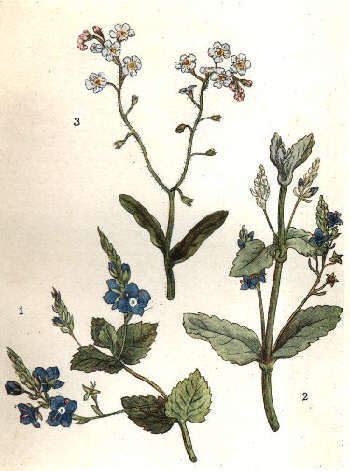
1. GERMANDER SPEEDWELL
This bright blue flower is to be found on banks, and in woods and pastures all over the country. It blooms in spring and early summer. Many people call this the Forget-me-not, but that is not correct, and you should notice carefully the difference between the two plants. They are not really alike.
The Germander Speedwell is a slender, wiry plant, whose stem sometimes creeps along the surface of the ground before it grows upward.
The flowers have four small petals of the brightest blue, and within the flower at the foot of the petals is a small white circle, like a little white eye looking up.
Two stamens with crimson heads rise from this white circle, and in the very centre of the flower there is a tiny green seed-vessel, with a spike coming out of the top.
The four sepals are very narrow green straps with sharp points.
The dark green hairy leaves are oval, with the edges cut all round like the teeth of a saw. They have no stalks, and they grow in pairs opposite each other. The slender stems, which bear the flowers in loose heads near the top, spring from between the leaf and the main stem.
2. BROOKLIME SPEEDWELL
The Brooklime Speedwell is quite as common as its cousin the blue Germander Speedwell, but it grows in damp places. You find it in ditches and beside slow-running streams, and the flowers are in bloom from spring to autumn.
The plant has a round juicy stem, which is hollow in the middle. It rises straight up from its muddy bed.
The flowers have four small petals which are a dull blue in colour, and are not very attractive.
In the centre of the flower there is a tiny blue ring, and to this ring are fastened the two red-headed stamens.
The seed-vessel is a small green dot with a spike at the top. It is so tiny that you can scarcely see it until the blue petals have fallen off.
Behind the flower there are four small green sepals.
The leaves of the Brooklime Speedwell are smooth and glossy. They are oval with blunt points, and the edges are waved. These leaves grow in pairs opposite each other, and have very short stalks which widen out at the foot so as to clasp the stem.
The flowers grow in loose heads on a long thin stalk, which springs from between the leaf and the stem.
3. GREAT WATER FORGET-ME-NOT
Every child knows the pale blue Forget-me-not with its dainty flowers. It has many varieties which are found all over the country, but the Water Forget-me-not is one of the loveliest, and grows abundantly in ditches and marshes from spring to autumn.
It is a tall straggling plant, with long flower-stalks which grow singly on alternate sides of the stem. Those flowers nearest the bottom of the stalk come out first, and they soon fall off. The pink buds are always at the very top of the stem, and the full-open flowers are close below them.
Each flower has five small round blue petals which lie open like a wheel, and in the centre of the flower there is a bright yellow eye.
The stamens are hidden from sight in the small blue tube below the petals. So is the seed-vessel. There is a green calyx-cup which is hairy all over, and round the mouth it is edged with sharply pointed teeth.
The leaves of the Forget-me-not are long and narrow, with blunt points and smooth edges. They are as glossy as if they were wet, and they clasp the stem.
The lowest part of the stem is four-sided and hairy, and it creeps along the mud before it rises up to bear the leaves and flowers.
Plate XLVI
1. COMMON BORAGE. 2. EVERGREEN ALKANET. 3. WOOD HYACINTH.
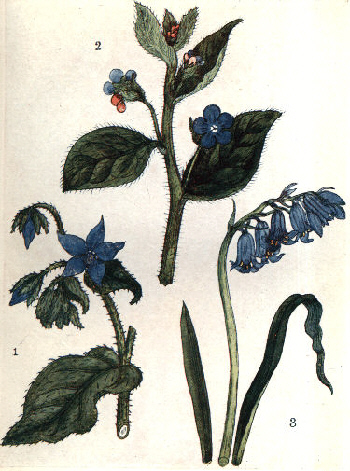
1. COMMON BORAGE
The Borage is not a very common plant, though it is widely distributed throughout the country. You find it on hedge-banks and in waste places, and it blooms in summer and autumn.
It has beautiful bright blue flowers, with five petals which are gracefully pointed at the tips. These flowers droop either singly or in clusters at the end of stout, hairy stalks.
The stamens of the Common Borage have no thread-like stalks; their purple heads are placed close together in a circle round the slender white pillar of the seed-vessel. Notice the curious purple horns that rise from the back of each stamen. There is a ring of dark purple scales with white blotches on them at the base of the petals. The calyx has five long narrow pointed sepals. These are covered with bristly hairs, and so are the leaves, stalks, and stem.
The leaves of the Borage are a dusty grey-green colour. Wherever the stem forks, you find a large stalkless leaf clasping it. These leaves are usually oval, but they are very varied in shape, and those leaves that rise from the root are frequently quite different.
The stem is light green and is round, with a hollow in the centre.