ACKNOWLEDGMENTS (continued 2)
Reading edition
GREEN
104
Simmondsia chinensis
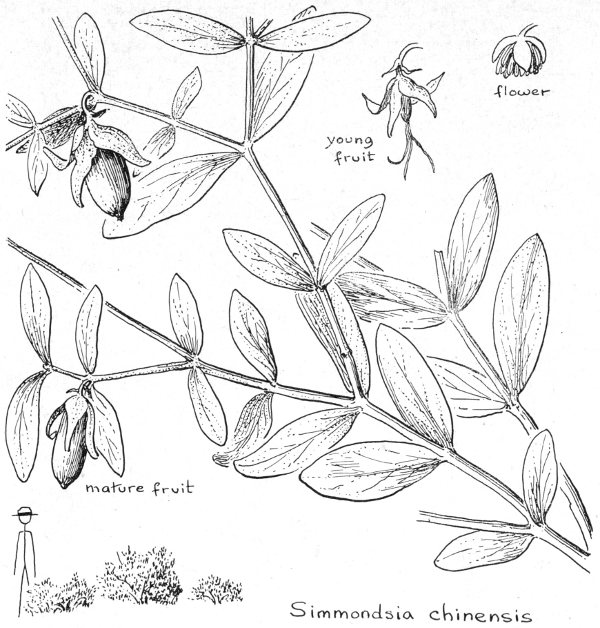
Common names: GOATNUT, DEERNUT, (JOJOBA), WILD-HAZEL, COFFEEBERRY
Arizona and California deserts: (Simmondsia chinensis). Green-yellow. December-July.
Box family. Size: Shrub, 2 to 5 feet high.
Jojoba (hoh-HOH-bah) is another of the desert plants which is noticeable, not because of its flowers, but due to its leathery, gray-green foliage which persists throughout the year. These shrubs are numerous at elevations between 1,000 and 4,300 feet in the lower levels of desert mountain ranges, particularly on the alluvial fans at the mouths of canyons.
The acorn-like nuts, which taste something like filberts, but are bitter because of their tannin content, were long an important item of food among the Indians and the early settlers. The thickly set, evergreen leaves are browsed by Deer and other animals, and the nuts are gathered by Ground Squirrels.
The nuts contain an edible oil (actually a liquid wax) which has some medicinal value and is used in small quantities in the manufacture of hair oil. Attempts to raise the nut in commercial quantities have not proved successful. On occasions the nuts have been roasted and used as a substitute for coffee.
GREEN
105
Asclepias subulata Asclepias erosa
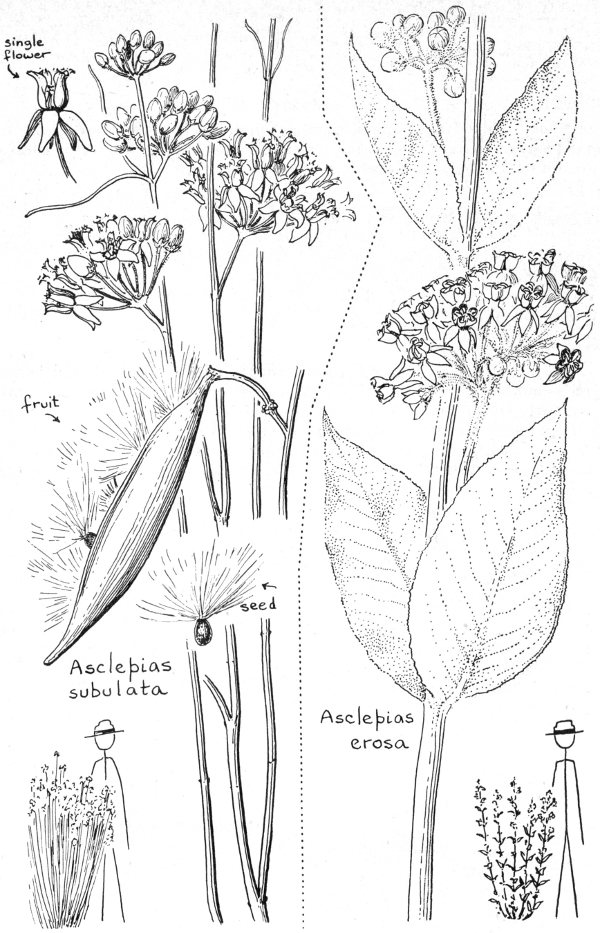
Common names: DESERT MILKWEED, BEDSTRAW MILKWEED, (AJAMENTE)
Arizona desert: (Asclepias subulata). Green-yellow. April-October.
California desert: (Asclepias erosa). Green-white. September-October.
Texas desert: (Asclepias texana). Green-white. Autumn.
Milkweed family. Size: Perennials, up to 5 feet.
Readily recognizable because of their milky sap and the pods filled 106 with silky-winged seeds, the Milkweeds are generally considered as poisonous to livestock, although rarely eaten. Appreciable quantities of rubber are found in the sap of some species.
GREEN
Koeberlinia spinosa Holacantha emoryi
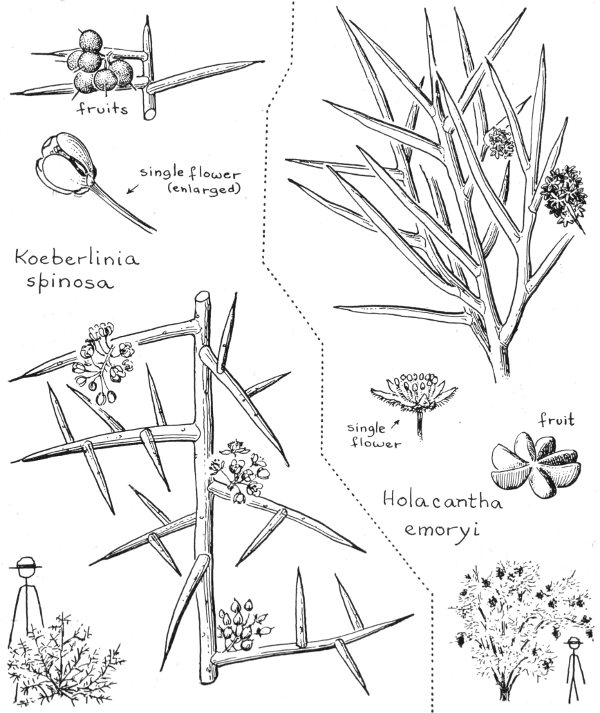
Common names: ALLTHORN, CROWN-OF-THORNS, CRUCIFIXION-THORN, (CORONA-DE-CRISTO)
Arizona desert: (Koeberlinia spinosa). Greenish. May-June.
California desert: (Holacantha emoryi). Yellow-green. June-July.
Texas desert: (Koeberlinia spinosa). Greenish. May-June.
Koeberlinia is Junco family.
Holacantha is Simaruba family. Size: From 2 to 10 feet high.
Two intricately branched, thorny shrubs with green bark and leaves reduced to small scales and otherwise resembling each other are both popularly known by the names of Crown-of-thorns and Crucifixion-thorn, although they are not closely related botanically.
Flowers of both are small and inconspicuous, although when the bushes are in full bloom, they are quite noticeable. Even so, it is the unusual and eye-arresting appearance of these shrubs which appear as leafless masses of robust thorns, making them a conspicuous feature of the desert and arousing the interest and curiosity of observers.
107
In some locations these shrubs are sufficiently abundant to form thickets which repel livestock. Fruits of H. emoryi remain on the plant for years, and it is usually possible to identify each season’s fruit clusters by the degree of weathering. These masses of brown to black fruits are very noticeable and are often mistaken for parasitic growths or the results of a disease. A somewhat similar shrub, sometimes attaining tree size and superficially resembling the Paloverde (see p. 36), is the Mohave-thorn (Canotia holocantha). It is found at elevations between 2,500 and 4,500 feet, over much of southern and western Arizona and northern Sonora, and blossoms from May to August.
Franseria dumosa
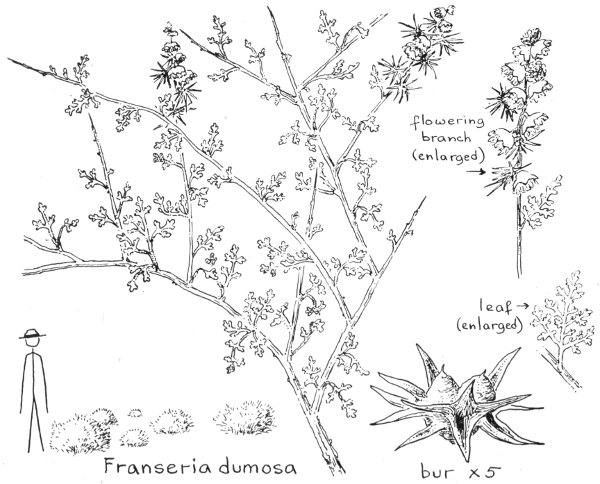
Common names: BUR-SAGE, BURROWEED, BURROBUSH
Arizona desert: (Franseria deltoidea). Greenish. December-April.
California desert: (Franseria dumosa). Greenish. April-November.
Sunflower family. Size: Up to 3 feet high.
Noticeable because of its ashy foliage, Bur-sage is a low, rounded, white-barked shrub, the several species of which are very common on the dry plains and mesas up to 3,000 feet. The flowers are small, without petals, and colorless inasmuch as they are wind-pollenated and do not need to attract insects.
It is classed by A. A. Nichol as one of the major plants of the Paloverde-Bur-sage-Cacti plant association, one of the three plant communities of the Sonoran Desert.
Bur-sage is one of the favorite foods of burros and sheep, and is said to be preferred also by horses.
GREEN
108
Suaeda torreyana
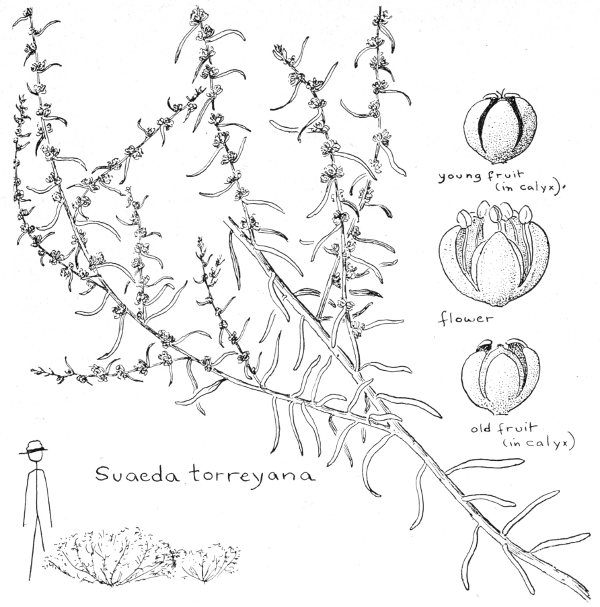
Common names: INKWEED, SEEPWEED, IODINEBUSH, (QUELITE-SALADO)
Arizona and Texas deserts: (Suaeda suffrutescens). Greenish. March-July.
California desert: (Suaeda torreyana). Greenish. July-September.
Goosefoot family. Size: Up to 6 feet tall, and branching.
Seepweed, which is usually an indicator of alkaline soil, is browsed to some extent by cattle when other feed is scarce. The young plants are used for greens by the Pimas and other desert Indians, sometimes eaten with cactus fruits. Pinole was made by roasting the seeds. Coahuila Indians extracted from the plants a black dye which they used in art work.
Flowers of the Seepweed are small, greenish, and without petals. Since the pollen is carried by the wind, color to attract insects to the flowers is not necessary. Because of its tolerance for somewhat salty or alkaline soils, Seepweed thrives along the margins of dry lakes and on salt flats where moisture is near the surface. On the desert of southern California it is often associated with Mesquite and Quailbrush, the sooty-green to brown plants standing out in sharp contrast.
Because it is so common in moist locations throughout the Southwest, and sufficiently unusual in appearance to arouse curiosity as to its identity, Seepweed is included in this publication regardless of the fact that its flowers are small and inconspicuous.
GREEN
109