The Little Old Abbé of Saint Denis and the Imagiers
Reading edition

Early in the twelfth century, within the hospitable walls of the old Abbey of Saint Denis, a prince and a charity child grew up together; there a love, almost romantic, developed between them. When the prince became king and embarked upon a crusade he left the reins of government in the hands of his old comrade, who in the meantime had become the Abbé of Saint Denis and was, incidentally, one of the cleverest of politicians. Suger paid the royal debts (democratic good pay seems to have been an ideal with him), and called the realm to order so successfully that statesmen came from afar to study his very novel methods, for the crusades had set the people traveling. On his return the king graciously greeted his regent as “father of his country.” Suger, not to be outdone, instituted a somewhat legendary liturgy to be celebrated annually at Saint Denis commemorating the merits of Louis the Lusty (or Louis the Fat, as we call him).
Was this liturgy so different from the campaign songs we sing now? It was really more called for, since enthusiasm over the royal person is one of the legitimate tools of monarchy, and Louis VI is an early monarch who deserves credit for abetting the gradual advance of France from a feudality to a veritable kingdom.
Suger, individually, did not stand too greatly in awe of royalty, for he peremptorily ordered Louis VII to come back from the “Holy Wars” to attend to his mundane duties, and be it credited to that monarch that he graciously obeyed the old friend of his father.
Suger is the most interesting personality that comes down to us from France of the twelfth century. Though a few characteristic anecdotes are told of him, we know him most intimately as the builder of Saint Denis and the far-seeing friend of the arts and crafts. It was said that he was a good goldsmith, and his sympathy with skilled labor lends color to the statement; but however hazy our other impressions of Suger may be, we know how he loved the old Abbey of Saint Denis—“sa mère et sa nourrice.” As a churchman he loved the blessed spot to which the angels had escorted brave old Saint Denis, when, after his martyrdom, he picked up his head and walked along with them unto the place “where he now resteth by his election and the puveance of God. And there was heard so grete and swete a melody of angels that many that heard it byleuyd in oure lorde.” He loved the old building that Dagobert, the Robin Hood of French monarchs, had built so royally, almost five hundred years before his day, for the poor and lowly, and for which the pleasant Saint Eloi, patron of goldsmiths, singing as he worked, had made the wondrously beautiful old reliquary; and as a man of literary feeling, he loved the old Abbey as his Alma Mater. But the diocese had grown, and on festal days so pressing were the crowds who would touch the holy relics of Saint Denis that good people were continually being trodden underfoot by eager and other worldly worshipers. So Suger decided to enlarge the church. He did not touch the dear old choir of Saint Denis: that was consecrated to God and, too, it was tenderly hallowed to man by many human associations; but he decided to add to it a great nave.
Of course at first the crowds vigorously abetted him, humbly harnessing themselves together like beasts of burden to draw the stone from the quarry. The trumpet sounded; banners were unfurled, and the procession marched; except for the murmur of those who confessed their sins to God, silence reigned. When the concourse arrived at the holy site, the multitude burst forth into a song of praise. Their sins once disposed of, the ardor of the multitude may have flagged, for we read of the busy little Abbé leaving the cares of state to go himself to the forests in search of the big timber others had not the enthusiasm to find.
That the very earth might pay its tribute to the blessed martyr, Suger studded the new golden screen in front of the tomb of Saint Denis with gems from “every land of the world,” and then the little old Abbé conceived of a still higher tribute: he gathered skill from “every country in the world” (his world was small, it is true); he gave to these skilled craftsmen the honor of working on “the Church, his Mother”; besides, they taught in the layman’s school of architecture, which he established in the yard of the old abbey.
To the amazement of the world, in that day of serfdom, Suger voluntarily paid his workmen and paid them by the week; and with the force and intensity that was in him, he advanced architecture as much in the ten years he was rebuilding Saint Denis as others had done in a hundred. The influence of his school of architecture still lives. It was one of our earliest instances of systematic training for the laity, and those who would trace the Italian Renaissance to French and classic sources, attach especial importance to the imagiers of Saint Denis.
An immense number of statues, varying greatly in excellence, were made during the Middle Ages to decorate the churches. In our meagre records of the period, we even come across instances of peasants traveling far and spending their all to secure an especially beautiful Madonna, and we are assured of miraculous rewards, spiritual and temporal, coming to them from it. Actually, through the enthusiasm and liberality of these rude people, miracles of art have wrought their magical effect upon the imagination of generations and generations of men. These imagiers became so numerous that they formed a powerful guild in which a race of sculptors was born and bred. While Sculpture was merely the hand-maiden and scribe of Architecture, her craftsmen were called imagiers. But the imagiers became so expert that in the seventeenth century the French Academy changed the name of their order to the “Sculptor’s Guild.”
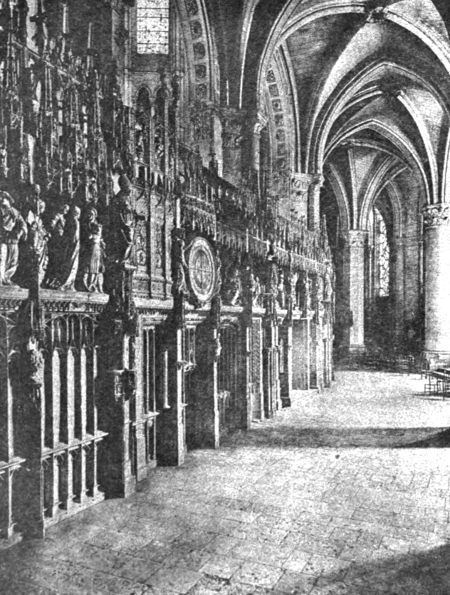
In the Sixteenth Century the French Academy Changed the Name of the Imagiers’ Guild to the Sculptors’.
That the imagier loved the cathedral which he was dowering with what talent he possessed is most likely; for, added to the simple conscientiousness, alike in all ages, of the worker who loves his craft and respects himself, was the intensity of the Age of Faith.
Gothic art may have been lived more generally even than Grecian, for it was the only intellectual outlet of its age. Much of its symbolism is now a dead language. We guess at the meaning of the gargoyles and grotesques, and draw liberal interpretations from the lips of the smiling angels who spoke more familiarly to a childish people; but when we count the decorative kings and bishops ranged in rows upon the grand façades, their supremacy over the souls, bodies and estates of men, of which we know so well, seems the myth of myths. However, we can read some of the old carvings, which had nothing in particular to say at the time they were made, like a book. Hybrid designs on pillars, capitals and cornices speak of the chivalrous meeting of the east and the west on the broad field of art. They bring up pictures of the rude crusaders overpowered by their first view of oriental elaboration, and we smile to see how it set them imitating, or, better still, adapting, and how the arts of war may bring about the arts of peace; for, in the fulness of time, those who strive, achieve, if not for themselves and their cause, for others and perhaps for a better cause.
Another art made great strides during the rebuilding of Saint Denis,—the glass-maker’s. We read about Vitrearii as far back as Charlemagne’s time. The windows they made were glass mosaics, held together with lead instead of stucco, forming little gem-like pictures above the holy altars, which told sacred stories beautifully, for in this way many scenes could be connected on one window; besides, color, like music, takes the emotions captive. One must examine a statue to realize it, but, in the phrase of the studio, color “sings.” A childish old chronicler relates that the retainers of Godfrey of Bouillon were obliged almost to tear him away from the churches, so absorbed was he in gazing on the windows. Was it through beautiful windows that the mystic aspiration of the mute minor poets of the cloister was finally reflected upon the man of action who took the first step, all unconsciously, toward the deliverance of his age from its dark, narrow bondage?
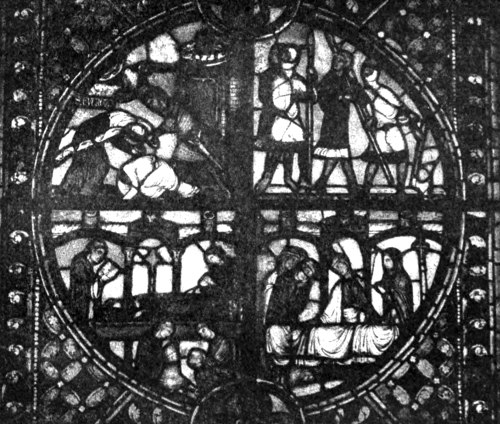
A Continuous Story, Related on a Thirteenth Century Window.
As a soldier, Godfrey de Bouillon had answered the call of the pilgrims who demanded protection; as a soldier, he had kept the peace (when there was any to keep). He was the one early crusader of whom we have record, who seems to have had the slightest idea of the fitness of things; indeed, in feeling, he was as truly a poet as a soldier. “So, day after day, in silence and in peace, with equal measure and just sale, did the Duke and the people pass through the realms of Hungary,” writes an astonished old chronicler, for Godfrey de Bouillon had paid the way of his army to the Holy City—an unheard of idea in warfare! How quixotic he must have seemed!
Language has changed since those windows spoke to Godfrey of Bouillon. But when a general stops on his line of march for higher council and then steers so true through the darkest day toward a faint, far-distant light, must he not have seen through the glass darkly?
It was but a few years after this “parfit gentil” knight passed away before he was as dear a hero of romance as King Arthur had become after many centuries, so little was there in his life for men to forget, so much that was sweet to dream upon. I suppose his story must have been related many times in beautiful glass, though as the panes grew larger and finer they told their stories less personally; but gallant knights on windows far and near are still reflecting an ideal that came to the First Baron of Jerusalem through the old church’s windows. Might it not be said of these old church builders, who builds from the heart feeds three: himself, his hungry neighbor, and Me?
To make windows like those of Saint Denis, an orderly, organized factory was necessary, and organization was the crying need of that age. Another astonished old chronicler repeats, that in those days of serfdom Suger paid his glass-workers. But the men learned their rights more readily than the chroniclers. Thereafter we constantly run upon the records of powerful workmen’s unions or guilds. In fact, we read of them later on the glass itself. These splendid church windows were, of course, very costly, and then, as now, they were usually presented to the churches. We find the guilds are the proud donors of many of them; two fine old church windows come down to us proudly representing some imagiers and glass-makers at their work, those guilds having thus elected to “with the angels stand.”
Complaints of the luxury of the church also come down. Saint Bernard declares “their stones were gilded with the money of the needy and wretched to charm the eyes of the rich” (but had the poor no eyes?). Being against the government by temperament, Saint Bernard especially abominated the royal Abbey of Saint Denis. He complained of the “unclean apes and befowled tigers” upon which Suger’s imagiers developed their skill, and it is written (how the writer arrived at the scene he does not explain) that as Suger’s confessor, Bernard commanded him to divest his mind of mundane cares and to dream only of the heavenly Jerusalem.
But the world weighed on Suger as long as he remained in it: his dream was of two splendid powers, England and France, separated, but living in peace! Suger was not in favor of crusades. He was the one ecclesiastic who would subject the clergy as well as the laity to royal authority, rendering unto Cæsar that which was Cæsar’s. Though a priest, in his political methods Suger was a broad, true and practical patriot, and if, unlike Saint Bernard, he was not adapted for canonization, he was a hero to his private secretary and to his king; and he still is a hero to the modern student of architecture, or of economics.
Into the very walls of his big and simple old church the “little old Abbé” built his big and simple sermon. It read: “Let us have good, honest, beautiful work, doing honor alike to God and man. Let us train our craftsmen, pay them and respect them.”
Though Saint Denis may lack the mystical beauty of the best Gothic, so noble and satisfactory is its design that the nineteenth century could do no better than to restore it.
Though Suger’s economics were very simple, the twentieth century has found no better platform: “Pay your workmen voluntarily, and summon all, from the king down, into their respective fields of labor; only when they all respond, we shall have a lovelier church than the old Abbey of Saint Denis.”