Front matter (continued 2)
Reading edition
CHAPTER VIII.
PLEASURES AND PAINS.
A few days after the conversation recorded in our last chapter took place, Flora, full of youthful hope and joy, sprang into the carriage which was to convey her to the station, and waved again and again a fond farewell to the beloved parent who watched her departure from the gate.
It was with mixed emotions that the gentle widow beheld disappearing down the winding lane the carriage which held her dearest earthly treasure, separated from her for the first time. Mrs. Vernon took pleasure in her daughter's pleasure, and had, perhaps, secret pride in the thought that her beauty, talents, and virtues, would now be more widely known and appreciated. But there was pain also in parting; pain with which the meek parent reproached herself--that Flora could be so happy in parting! There was a secret fear, which Mrs. Vernon thought want of faith, lest the different scenes into which she was entering should, were it even in the slightest degree, change one who, in her partial love, she thought could scarcely change for the better. Mrs. Vernon also suffered from the cares and anxieties of life, which she now must bear alone; for she was not one to complain, even to her most intimate friends, of the secret trials of her home. The peevishness, the selfishness, the heartlessness of Emma, the wayward passions of her ill-taught children, the loss of the quiet repose of a well-ordered dwelling, were a cross to Mrs. Vernon as well as to her daughter; if to the latter it formed the most painful burden, it was because she murmured, struggled, and chafed under its weight, while the widow bent meekly under it, remembering the divine hand that had laid it upon her.
So, quietly and unostentatiously, never dreaming either of merit or reward, the widow went through her round of daily duties, ordering her household, teaching the children, caring for her guest, nursing the infant, and never forgetting the poor. Emma's total indifference on the subject of religion often grieved Mrs. Vernon; but trusting in God, and not in herself, the simple Christian would not despair even of a heart which seemed like the beaten highway, on which the good seed fell only at once to be carried away. There was no use in lending religious works to Emma; the volumes lay unopened beside her. She never considered herself equal to the fatigue of attending service in the house of God. Mr. Ward and his wife paid her more than one visit. The good man spoke, as was his wont, out of the abundance of his heart; while Mrs. Vernon listened meekly with her clasped hands resting on her knee. But even he was chilled by the affected nod and meaningless smile with which the daughter-in-law received his words of holy consolation; while his wife felt uncomfortable under the dark eye which seemed scrutinizing every article of her simple apparel.
Not every one bore as patiently as Mrs. Ward this scrutinizing survey of dress from the fashionable and extravagantly-attired young widow. Miss Butterfield, who had a character and a temper of her own, was irritated by the close attention paid to her large poke-bonnet and rusty shawl. She made some observations, more true than polite, about heads like band-boxes in a milliner's shop, intended to hold nothing more weighty than quilings and puffings; which brought an angry tinge to Emma's sallow cheek, and made her bitterly comment, when the guest had departed, upon the insufferable vulgarity of Mrs. Vernon's country acquaintance.
"How can I win Emma's attention to anything serious?" such was Mrs. Vernon's frequent thought, till one day the happy idea struck her mind of reading to her Flora's manuscript hymns. "If any human writings can interest her, these will," thought the simple-hearted mother. "She will listen to them first for the sake of the authoress, and then their own beauty must touch her heart;--I am sure that it always does mine!"
Emma could not, of course, refuse her assent to the proposal to read aloud the verses of her sister. She declared that she would be charmed to hear them, secretly hoping that the infliction might not be long, and that her mother-in-law would not think it necessary to go through the volume from beginning to end. Mrs. Vernon read with great impressiveness and feeling; every touching sentiment, every graceful idea, gained added beauty from her earnest expression. She was pleased and gratified by the profound silence of her listener, and read on, and on, warming with her subject, till in one favourite hymn, which described the blessedness of living for eternity, her eyes filled, and her heart overflowed, and she turned, as she wiped away a thankful tear, to see if Emma shared her emotions. The widow lay fast asleep on the sofa!
The only things to which Emma listened with real interest were portions of Flora's letters from London. These, written to amuse her mother in her seclusion, and full of lively descriptions given with freshness and vigour by one to whom everything which she beheld was new, were, even to a stranger, extremely entertaining. By Mrs. Vernon the arrival of the post was looked forward to as bringing the one great treat of the day, and never once was she disappointed of it. She feasted on the letters of her daughter with unmingled delight; for she saw in them proofs of the conscientious regard which Flora paid to her wishes, and of the tender affection with which, in the midst of her amusements, her heart clung to the parent whom she had left.
All the little circle of friends in the quiet village of Wingsdale shared in Mrs. Vernon's enjoyment. They listened to accounts of the first wondrous Crystal Palace, glittering like some fairy structure on the trodden sward of Hyde Park; the "sermons in stones" preached from the spoils of old Nineveh; descriptions of the treasures of art, all the things beautiful, curious, and rare, upon which the eye of Flora had rested delighted. They heard also personal descriptions of men with whose names they were already familiar--how Shaftesbury had spoken, and Guthrie had preached; whilst not least interesting to the hearts of her rural subjects was a graphic account of our gracious Queen from the enthusiastic pen of Flora.
But never had the young correspondent expressed herself in such glowing terms of admiration and pleasure as in her description of Sir Amery Legrange, whom she spoke of as one of the leading writers of the day. She had been actually introduced to "the lion," had listened to the wondrous flow of eloquence which made his conversation an intellectual treat beyond any which she had ever known before. With his expansive brow, eagle eye, most poetical cast of countenance, his were exactly the face and form which a painter would wish to immortalize on canvas, as representing the beau ideal of a genius; and Flora could not but imagine that Sir Amery must have drawn himself in the hero of his famous chef-d'oeuvre, "The Master-Mind."
"'The Master-Mind!'" lisped Emma from the sofa; "Oh! I have read that--all the world has read it--it is a most charming work! I have it somewhere in my boxes, I think."
Mrs. Vernon was content to be classed with those not of the world, for she had never read, nor even heard of the book. She was pleased, however, that her child should have met one of the literary celebrities of London, and had thus added another to the pleasant recollections which she would carry with her from the metropolis.
The next morning's post brought a description of a fête at the Botanical Gardens; and this sentence occurred in Flora's letter: "We met our brilliant author just as we were entering the gardens, and he remained the whole time with our party. He has certainly wonderful powers of conversation; just such as might be expected from a writer whose pen seems dipped in the colours of the rainbow, and brightens whatever it touches. When he speaks, we can do nothing but listen."
"I think, Emma," said Mrs. Vernon, "that you mentioned that you had a copy of 'The Master-Mind' beside you. I should be obliged, if you would allow me to read it."
"Oh, certainly, when I can lay hands upon it; but all my luggage is still one mass of confusion, and whatever I want is certain to be at the very bottom of the very last box into which I should think of looking for it. But you really wish to see 'The Master-Mind?' Well," added the lady, with an affected laugh, "I should as soon have dreamed of Mr. Ward's dancing a polka, as of your sitting quietly down to a novel!"
Emma's promise to look for the work was speedily forgotten by herself, nor did more than one reminder induce her to take this slight trouble for one to whom she owed the comfort of a home.
Flora's subsequent letters contained scarcely any mention of Sir Amery. She occasionally quoted his opinion, or mentioned a brilliant remark made by him on some subject of general interest; but it was merely from such passing allusions that her mother gathered that Flora was not unfrequently in the society of the literary "lion."
Mrs. Vernon had much to occupy her thoughts--much to engage her anxious attention. She was now patiently listening to the frivolous complaints of the hypochondriac widow; then quitting her to stand by the death-bed of a young school-girl--hear her last faint breathings of devotion--receive her last message of affection to Flora. The next hour would find Mrs. Vernon seated amongst the children, enduring their rough play and noisy glee, and ministering to their amusement as patiently as she had done to the wants of the suffering and the dying. But the wear upon her spirits and the strain upon her energies were too much for the strength of Mrs. Vernon. There was no one to watch her faded cheek, her weary step, her languid eye; no one, at least in her own home, to think for her, care for her--attend to the comforts of one who ever attended to the comforts of others. She might have been ill, she might have been dying, and Emma, absorbed in her own selfish cares, would never have observed that anything ailed her. Mrs. Vernon missed Flora each day more and more--longed more and more to hear her light step on the stair, her sweet song from the garden--to look again into those soft and loving eyes which were wont to rest on her so tenderly, so fondly. But Mrs. Vernon would not abridge a visit which afforded so much enjoyment to her daughter; she would not, even by the slightest allusion to her own failing health and spirits, throw a shadow over that enjoyment. She was content if Flora was happy; and if she herself needed comfort and strength, was not the source of all comfort and strength ever open to the Christian!
CHAPTER IX.
THE NOVEL.
One afternoon, Mrs. Vernon returned exceedingly wearied from a visit to a sick woman who resided at some distance. The walk was too long for her, and had her daughter been at home, she would not have been suffered to take it; for Flora, in the vigour of her youthful strength, appropriated to herself all the more distant visits. Certainly a feeling of regret crossed the mind of Mrs. Vernon, as she wearily ascended her own stair, and heard loud, angry sounds from above, that peace and seclusion were now hers no longer--that she could not have rest when she was tired, nor solitude when she was sad. But she struggled against the feeling as against a sin.
As Mrs. Vernon approached the door of Emma's sleeping apartment, it was evident that the sound came from thence, and that the angry voice was the widow's.
"Tiresome monkey! you have destroyed it entirely! my beautiful India muslin! Was ever mother tormented as I am? Ah, is that you?" continued Emma, as Mrs. Vernon crossed the entrance to her room. "Just come in here, do, and see what this insufferable child has been doing!"
Mrs. Vernon entered, and beheld Lyddie, the little culprit, in the centre of the apartment, fancifully arrayed in all the finery which she had pillaged from a large trunk of her mother's. A yellow satin dress, with the body turned in, was fastened by a red scarf round the waist of the child; and being, of course, much too long, swept the floor on every side with its gaudy folds. Long feathers, scarlet and white, were stuck in the girl's lank dark hair; while an India muslin shawl, which had been twisted into the form of a turban, appeared, with a grievous rent in the middle, in the hands of the irritated parent.
"Did you ever see anything like it? The vanity, the folly, the absurdity of the child! Here I find her parading before the glass, dressed up like a May-queen, and in all the best clothes which I used to wear in my happier days! Take them off!" she cried in a shriller tone to the child, who stood biting the ends of her fingers, in mingled sulkiness and fear. "Take them off, I say! and if ever you touch them again, you shall have a whipping--such a whipping as you will remember to the last day of your life! I am sure that no one," she continued, turning towards Mrs. Vernon, who was silently disrobing the culprit--"no one but a parent can tell the incessant anxiety, plague, and worry, caused by children! It is enough to drive us out of our senses!"
Mrs. Vernon saw in the expression of the countenances of both mother and child something far more saddening to her gentle spirit than the destruction of anything that gold could replace;--anger in the one, sullen defiance in the other; not maternal solicitude grieving over the folly of a daughter, but selfish vanity irritated at the loss of a bauble; not filial love distressed at the displeasure of a parent, but pride rising against the threat of punishment. Emma would permit the gravest faults of her children to pass unnoticed, until their consequences affected her own comfort, and then the most trivial excited in her anger as unreasonable as her former indifference had been culpable.
"I do not see that your English nurse manages the children any better than old Chloe. I always said, and I always will say, that it was a great pity to make any change," cried Emma fretfully, willing as usual to blame anybody and anything but herself.
"We can scarcely expect wonders to be worked in three days," replied Mrs. Vernon, as Lyddie, released from her cumbrous finery, made a hasty exit from the room, glad to escape from the presence of her mother. "To change old ways, and to introduce habits of order and obedience, must ever be a work of patience and time. And does it not appear to you, Emma," continued Mrs. Vernon, cautiously approaching dangerous ground, "that children insensibly imbibe more from watching the example of those who are with them, than from any direct instruction?"
"I do not comprehend what that has to do with the question," said Emma, stooping over the trunk to replace its contents.
"If our dear children see by our conduct how little we care for the petty vanities of this life, if they see that our minds are fixed upon nobler objects than the adorning of our poor perishing forms, they will learn to estimate at their true value such trifles as these"--Mrs. Vernon was handing the feathers to her daughter in-law--"and are not likely to fall into the childish folly into which our poor Lyddie has to-day been betrayed."
"Ah! here is 'The Master-Mind'" cried Emma, suddenly, diving into the lowest recess of her trunk, and bringing from thence two old soiled volumes. It is not impossible that a desire to change the subject of conversation had quickened her perceptions, and led her to make the discovery which turned it into a more agreeable channel. "This is the novel which you are so impatient to read. Here are the first and third volumes; I think that the second must be lost; but doubtless it is all the same to you, you could never spare enough of your valuable time for the perusal of more than two."
Mrs. Vernon took the work, and laid it aside; she had not at that hour leisure for reading. But when the children had gone to rest, and their mother retired to her own room, when the day's duties had all been fulfilled, and the still summer night had closed in, Mrs. Vernon, in her own quiet apartment, opened the first volume of the work of Sir Amery.
She soon became strongly interested both in the characters and the plot. "The Master-Mind" had been written by a master's hand; the author's powers had not been over-rated. Sir Amery described his hero as one distinguished by birth, but yet more by exalted talents. He was generous, humane, chivalrous and constant, possessing every virtue but piety, every grace but the grace of God, every gift but "the one thing needful." Not that he was represented as one destitute of every sentiment of religion. He was made to revere with lofty devotion an almighty Creator, but not a righteous Judge; one so merciful that he could not punish, so lenient that he would not destroy. The hero was not a believer in revelation--his lofty mind could not bow to the mysterious truths which his reason could not grasp; but his scepticism was represented as candour, his pride as greatness of soul--he was placed in bright contrast to hard, narrow-minded bigots, who denounce sin because God hath condemned it, and fear hell because divine truth hath declared that its terrors await the impenitent.
Mrs. Vernon read on and on, and wondered as she read. She had seen very few novels in her life, and all appeared to her strange and new. Sometimes she was filled with admiration by a generous sentiment or a noble deed; then she was startled by some idea, veiled in sublime language and beautiful imagery, but which, as it appeared to her, was contrary to the simple truth of the Scriptures.
The close of the first volume left the hero deeply, passionately loving a fair and highly-principled girl, the daughter of parents who, under the garb of great sanctity, were drawn as worldly, heartless and unforgiving. He was resolved to win her under circumstances of difficulty which, to love less ardent and a spirit less firm, must have presented obstacles insuperable. Mrs. Vernon closed the book and glanced at her candle. It had burnt quite down to the socket. She rose and lighted another. Was it a strange fascination that made her sit down again, with her pale cheek and her heavy aching eyes, to resume her unwonted occupation? Was the interest of a mere novel so strong that it could render her careless of needful rest? It was that in the hero Mrs. Vernon was reading the character of the author--that she, almost unconsciously, connected the gentle heroine with her own fondly-loved child.
"I see the moral of the tale," said the widow to herself: "Virgilius, ennobled by his affection for a worthy object, enlightened by experience, and improved by trials, will find out the errors into which his fine mind has been led; he will become religious as well as moral, and all will end happily at last."
All did end happily in the novel, but not in the way which Mrs. Vernon expected. Hypocrisy was unmasked, bigotry disgraced, but infidelity triumphed in success! The brilliant winding-up of the work was almost a paraphrase of the celebrated line,
"He can't be wrong whose life is in the right;"--
as if any life could be right in which the chief end of our existence, the glory of God, is disregarded! It is as though we should speak of the perfection of the ocean without water, or of the universe without the sun!
The dim light of morning was purpling the sky before the widow had finished the book. She sat for some moments with her brow resting upon her hand, and the open volume on her knee.
"Perhaps I have read until my mind is too much wearied to form a correct judgment," she murmured to herself. "Perhaps I have mistaken the meaning of the author, and have done him injustice. I am a weak, ignorant woman, not capable of appreciating all the beauties of this work; I will lean on a stronger mind than my own, ask the aid of a better judgment. I will take the books to Mr. Ward to-morrow, and see if he views the work in the same light as I do. And now I must go to my rest; I have done wrong to waste so many hours over a novel!"
But even in sleep the mind of the mother pursued the same theme; the scenes of the novel were repeated in her dreams, only the actors were Sir Amery and Flora. Mrs. Vernon arose unrefreshed and uneasy, and before many hours were over, she was on her way to the little vicarage, bearing with her "The Master-Mind."
"How foolish I am to take these anxious thoughts!"--such were the lady's reflections as she wearily toiled up the lane, which had never seemed so long before. "I have no reason to fear that Sir Amery is anything more to my child than an admired author, an agreeable acquaintance. He is above her in birth and position; flattered as he is by the world, why should I fancy that my simple moss-rose should attract the regard of one who is the idol of all the circles of fashion! It is a mother's weakness, a mother's vanity, which make me believe that all who see her must view her with eyes like my own! But oh! is she not my earthly all, and can it be wondered at that my heart should tremble at the most distant prospect of danger to one so beloved!"
CHAPTER X.
RECALL.
"Well, my dear Mrs. Vernon, this is a singular request, and one which I never anticipated from you," said the aged clergyman, with a smile, as, fixing his spectacles on his nose, he glanced at the title-page of the work which Mrs. Vernon had placed in his hand. When he raised his eyes, however, to the countenance of his friend, he was struck by its worn look and anxious expression--he felt that no light curiosity had led the widow lady to desire his opinion of a novel, and gravely and kindly he promised to give his attention to her request.
"To-day is Saturday, and I have much upon my hands," said the minister, whose desk was heaped with papers; "I shall not be able to look at the volumes at once, but my first leisure hours shall be given to their perusal, and you shall have my candid opinion upon their contents."
Often, very often, did the thoughts of Mrs. Vernon recur to "The Master-Mind" during that and the following day. She was distressed to find that even in the house of prayer she was haunted by the remembrance of the novel. On the Sabbath afternoon she was so unwell as to be confined to her room; not to remain there, however, in undisturbed peace, for again and again the door was burst open by Johnny, who clambered upon her bed to give her news of the chicken that had been nearly drowned, or to repeat to her a beautiful new verse which he had learned "just to please grandmamma." Mrs. Vernon's head throbbed so violently that she could scarcely raise it from the pillow to give the child a kind smile and a kind kiss. Once her eyes closed for a few minutes in sleep; when she opened them, Lyddie was standing beside her, looking on her with a strange, earnest gaze. The girl had brought a tangled bunch of wild-flowers, which she laid silently beside the suffering lady, and left the room with her orphan heart warmed by the sweet words of thanks with which her ill-timed little offering had been received.
Monday, as usual, brought no post; but on Tuesday came the envelope directed in Flora's well-known hand, which it was Johnny's delight to carry at full speed to his grandmother, demanding the postage of a kiss. Mrs. Vernon eagerly broke the seal, but the enclosure, for once, disappointed her; there were merely a few hurried lines, containing little more than an excuse for their own brevity. Flora, however, mentioned that she was to pass the Tuesday at Richmond; that she expected the excursion to be a delightful one; and that she trusted that the weather would be fine, as Sir Amery had ordered his boat.
Mrs. Vernon silently replaced the note in its cover, and after going through the usual routine of her household duties with a preoccupied mind, again sought the quiet dwelling of the vicar.
All there looked peaceful and cheerful--the thick shrubbery, the neat flower-beds with their border of box, the closely-mown lawn spreading its carpet of velvet beneath the shadow of sycamore trees. Mrs. Vernon passed on without noticing aught. The vicar's wife, she found, was making her round in the village, but the vicar himself was in his study. She entered it unannounced save by her gentle tap at the door, and was kindly welcomed by her friend.
"Mrs. Vernon, my dear lady, this is a warm morning for a walk, but glorious weather for the crops. Pray take a seat," he wheeled round for her his own arm-chair; "and let me release you from your bonnet and shawl. We shall detain you here a prisoner till the cool of the evening, and talk over your novel together," he added, with a smile, glancing at the book which lay open on the table.
"What do you think of it?" said Mrs. Vernon.
"I confess that I think very ill of it," replied the old clergyman, seating himself beside her. "It is well written, very cleverly written; but so much the worse for the reader. It is ill to plant flowers by the edge of the pitfall."
"And yet there are such beautiful passages, such noble sentiments--some parts seem calculated to do so much good--"
"My dear madam," said Mr. Ward earnestly, laying his hand on the volume, "there is no good here that will weigh against one tithe of the evil which such a work is calculated to produce in young and enthusiastic minds. It appears written to show that there are some men of natures so noble and hearts so pure, that they require no Saviour, no sacrifice for sin; men of intellect so large and exalted, that Revelation is by them unneeded, they can walk securely in the light of their own reason, and pity poor, weak, bigoted fools, who seek a guide in the Scriptures. If the Almighty had blessed me with children, most anxiously should I have endeavoured to guard them against the art which invests with strong interest such characters as that of the hero of this tale, that makes human pride appear at the root of all virtue, instead of being, as it is, at the root of all sin. My dear friend, believe me, this is a dangerous book, and its author is a dangerous man."
Mrs. Vernon made no reply, but drawing out Flora's last note, gave it in silence to the clergyman. He read it twice before he made any observation, his brow slightly contracting as he read; then returning it to Mrs. Vernon, he said, "I think that Flora has been long enough absent."
"It seems an age since she left me," said the mother, her eyes filling with tears. "I miss her more than I can express. But then she is so happy in London, and in a house full as ours is at present I cannot prevent little trials--"
"Believe me, dear lady, these trials are no evil; they are the gentle discipline by which our heavenly Father trains the hearts of such of His children as are spared the more terrible furnace of affliction. Send for your Flora home. Home is the sphere of her duties; it should also be that of her pleasures. She is too young to mingle unharmed in the society of such as Sir Amery Legrange."
Mrs. Vernon left the house of her friend; he could neither persuade her to wait till the heat of the day was abated, nor to partake of the simple refreshment which the vicarage could afford. The fierce rays of the noontide sun poured down upon her head, the road was dry and dusty, the birds had stilled their songs, all was silent save the drowsy hum of some summer insects, nature lay panting and breathless in the glaring heat. Mrs. Vernon was almost exhausted ere she reached her dwelling. The cottagers whom she had met on her way shook their heads when she had passed, and declared that the good lady had never looked like herself since dear Miss Flora went away!
Mrs. Vernon opened her desk and wrote to her daughter. The letter was a short one, but full of tenderness, rather hinting at than openly telling of the feeble state of her own health, and her longing desire to have her child beside her again.
Flora received that note the next morning; in the evening, just as the first tremulous star appeared in the darkening sky, Flora's step was on the threshold of her home.
CHAPTER XI.
DOUBTS.
"Sweeter, lovelier, dearer than ever!" thought Mrs. Vernon, as she pressed her daughter closer and closer in her fond embrace. When the flush of excitement at the first meeting had passed away, the eye of affection observed that Flora had become paler and thinner, that there was a thoughtful, preoccupied expression on her gentle brow, as though her mind were wandering far away; but there was deeper feeling in those soft blue eyes, more beaming sweetness in that smile, than even her mother had ever seen before.
Flora retired early to her room, pleading the fatigue of her journey. She had scarcely been able to give even the semblance of attention to the multifarious questions of Emma on the amusements and fashions of London, and had answered them almost at random; but when she found herself in her own apartment, the door closed, and only Mrs. Vernon beside her, she threw herself again on her mother's bosom, buried her glowing face on her parent's neck, and, trembling with joyful emotion, uttered, in scarcely articulate accents, "Mother, dear mother, he has spoken!"
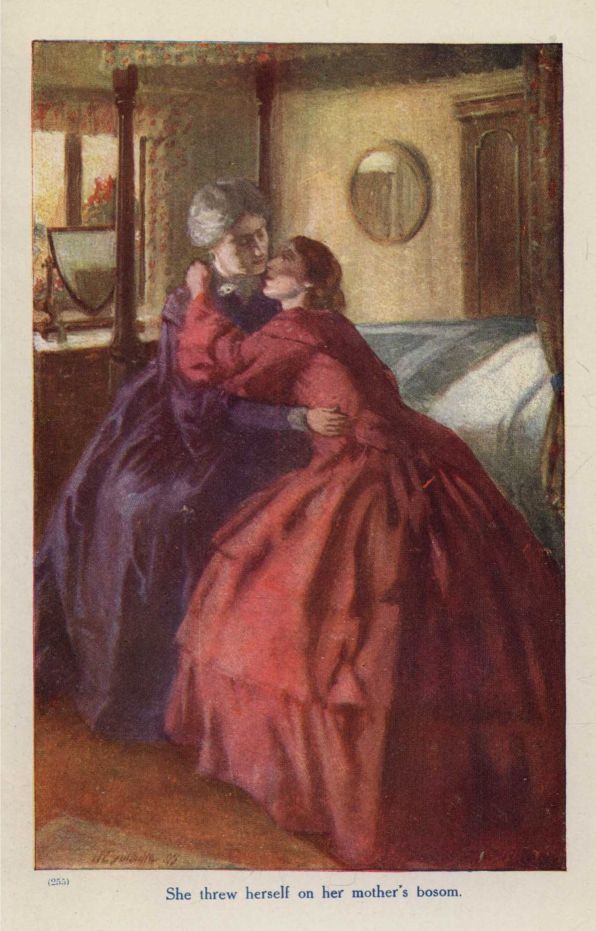
She threw herself on her mother's bosom.
"Sir Amery Legrange!" faltered Mrs. Vernon.
"I must tell you all," continued Flora, without raising her head. "It was yesterday--only yesterday--at Richmond. I did not know--I had scarcely dreamed--oh, mother!" she exclaimed suddenly, bursting into tears of delight, "I never never believed it possible to be so--" the bright, sparkling drops told the rest.
Mrs. Vernon grew very cold. There was a sinking at her heart and a rising in her throat, which made her for the moment unable to speak.
"And he will be a son to you, mother, the most tender and dutiful of sons! He will never separate us--he is so generous--so good!"
"And is he"--said Mrs. Vernon, speaking slowly, as if fearful to break by one word the spell of happiness thrown around her daughter--"is he one who holds the same blessed faith in which your dear father lived and died?"
Flora was silent for a short space. "He does act, I believe--indeed, I know--he does not in all things hold the same opinions as those which I have been taught; he is too candid, too honourable to make false professions; he--he does not view everything in the same light which you do; but his character, his life are beyond reproach; his actions prove that his creed cannot be far wrong! It is from you, mother, that I have learned to value deeds far more than words. Was it not our Saviour himself who said, 'By their fruits ye shall know them?'"
"He did so, my child; and where the fruits of the Spirit are found, there we may be sure that a blessing abides. But the first fruit is love, supreme love towards God, the love of the redeemed for their Redeemer, of pardoned sinners for their Saviour: where this is wanting, what cause have we to hope that the soul has been 'born again' unto God?"
Flora raised her head: her cheek was painfully flushed, and the tears of joy which had glistened on her lashes were followed by bitter drops, as she exclaimed, "Some one has been prejudicing you against him; some one has been maligning him, mother!"
"It is himself, then," replied Mrs. Vernon, calmly; "I have been reading 'The Master-Mind.'"
"And do you not think it beautiful--sublime--the transcript of a noble heart, an exalted mind?"
"Not the heart of one converted--not the mind of a Christian!"
There was a long and most painful silence. Flora was wounded to the quick, and that by a hand that she loved. Blinded by her affection, she regarded Sir Amery with an enthusiastic admiration which could see no fault, a tender devotion which would have regarded the sacrifice of life itself but a small one for his sake. Every fibre of her loving heart seemed to have twined itself round its new idol, and to breathe even a slighting word of him was to wrench and lacerate those tender heart-strings. She again buried her face, but this time it was not on the bosom of her mother.
"Mamma, you know not how wretched you make me with your doubts!"
"My child--my own child--I would give my life's blood to render you happy!" Mrs. Vernon took the cold hand of Flora, and pressed it convulsively to her heart. "But I cannot--I dare not--trust you to one who is not treading the same path towards heaven: I cannot--dare not--let you break the command which bids our unions be 'only in the Lord.'"
"You will refuse your consent?" exclaimed Flora, starting to her feet, and gazing on her mother with a look of wild dismay.
"Oh, God help me!--God guide me!" murmured the unhappy parent, pressing her hand tightly over her brow.
"You will refuse your consent?" repeated Flora, more wildly and passionately than before. "Mother, mother! you know not what you are doing!--you may break my heart, you may lay me in my grave; but"--her manner suddenly changed to one of clinging, confiding affection, as she sank at the feet of her mother, and looked imploringly up into her face--"but you will not, dear mother, you will not; you will let us be happy together. When you see him--when you know him--all these terrible doubts will pass quite away; you will look on him as I look--you will love him: only wait till he comes--till to-morrow."
"To-morrow! is he coming?" gasped the lady.
"Mother, dearest mother, you are trembling!"
"Oh, this is a very, very bitter cup! God give me strength to drink it," exclaimed the widow.
"He will bring sunshine with him; he will plead his own cause--"
"Thankful, most deeply, profoundly thankful will I be, Flora, if he can indeed satisfy my mind that he is a faithful servant of our divine Master! I can pass over minor differences--the outer garb of religion--the forms which man hath appointed--we may hold various opinions here, and yet be one in the Lord. But if I find that my fears are but too true--that Sir Amery, gifted and noble as he is, has chosen a path of his own, which is not the narrow one which leadeth alone unto life; that he rests upon a hope of his own, which is not trust in the merits of his Saviour; that he has formed a standard of his own, which is not the standard of the Word of Truth; whatever grief, whatever anguish it may cost me, my duty is plain before me--I must not resign the treasure committed by God to my charge to the keeping of one who is not His disciple."
And so they parted, the mother and the daughter, and many and bitter were the tears which wet their pillows that night. Mrs. Vernon sought and found relief in prayer--Flora, in thoughts of him whose idolized image stood between her and the light of Heaven.
CHAPTER XII.
DECISION.
Before sunset on the following day, while yet the bright orb darted his beams, like glittering lances, through openings in the foliage, and the jasmine blossoms trembled in the breeze and scattered their silver stars on the ground, an elastic step trod the path which led to the door of Laurel Bank--a tall graceful form ascended the steps; and the children in the garden wonderingly gazed from a distance on the lordly stranger who came, an unwonted visitor, to their home.
How fast throbbed one trembling heart at the sight of that form, the sound of that footstep! Flora had spent an exciting and agitating day. She had been for hours alone with her mother, those fatal volumes before them which they had perused with such different feelings. Flora had listened, argued, and wept, her judgment half convinced, but her heart altogether unpersuaded. Sir Amery was still the hero of her fancy, the idol of her affection. His very imperfections, like broken rocks in wild scenery, were to her invested with a charm which made the virtues of others appear tame. If he had errors, she thought, they were the errors of a noble mind, the wanderings of a glorious river, pursuing its bright course at its own free pleasure, not confined to one long, dull, straight line, like a canal made by measure and rule.
"And oh, my mother!" she exclaimed, clasping her hands, "think of the privilege, the blessing, of helping to draw such a noble spirit nearer to religion and to God!--of winning him to love what I love--to serve whom I serve! How can I, weak and helpless as I am, so benefit my fellow-creatures as by employing such influence as Providence has given me over the heart of one of the most gifted of men, to lead him to devote his high powers to the cause of piety and virtue? Does not this appear to be the special work which God has appointed me to do? is it not for this that I have been given favour in the eyes of one so far above me in all things? I have heard Mr. Ward preach upon providential calls, doors of usefulness opened to God's servants, opportunities offered which it is sin to neglect: is not a door now opened to me, an opportunity granted of serving the Lord in a wider sphere than I could ever hope to occupy here?"
"My child, your feelings and not your judgment now speak. A plain commandment of the Almighty is before you--'Be not unequally yoked with unbelievers.' Do you believe that in breaking the law of your God you can expect his blessing, that blessing without which it were as impossible for one being to change the heart of another, as it would be to bring waters from the stony rock or call up fire from the ocean?"
"But," pleaded Flora through her tears, "did not the apostle write that 'the unbelieving husband is sanctified by the wife; for what knowest thou, O wife! whether thou shalt save thy husband?' is not such a blessed hope as this held out to encourage feeble women like me?"
"It was held out to such as were themselves converted after marriage, to such as had already formed the tie which bound them to unbelievers, before the grace of God was shed abroad in their own hearts. Can you mention a single verse in the Bible that encourages us to do evil that good may come, to break God's law that we may aid others to keep it?"
Flora looked down and sighed heavily.
"Oh, my daughter! while you hopefully regard the effect which your influence may have upon the man whom you love, you forget the influence which he will assuredly exercise over yourself. You trust that you will be the means of drawing him nearer to the Lord--you overlook the danger that he will draw your own heart away. When we wilfully throw ourselves into temptation, what assurance can we have that the Almighty will preserve us from its effects? Who dare say, 'I will stand fast in the Lord,' when, through our tenderest affections, our closest ties, the danger presses on our souls?"
Little did Sir Amery dream of the cloud that was rising to darken the sky which was so bright before him! Little did he dream of the conflict which awaited him, as with an exulting heart he approached the home of his beloved! He knew that her heart was his own; and from her family, judging by his knowledge of the world, he deemed that he could have nothing to fear. He was conscious of high talent, and of that strange, undefined power over the feelings and passions of others which is exercised but by few, and which makes its possessor take a lofty position in society even when not, as was the case with himself, entitled to such by birth. Sir Amery knew that he might contract a brilliant alliance--that, in the object of his choice, rank, wealth, and beauty, might unite, and that the proudest families in the land would deem connection with him an honour. He knew all this; and when he who had been the observed of all observers--admired, envied, courted--he whose fame had spread into distant lands, whose works were quoted in foreign tongues--when he turned from the glittering circles of fashion to choose for his bride a simple maiden, who possessed neither rank nor riches, he felt that the world might regard his disinterested attachment as romantic folly. But for the world's opinions on the subject he cared little; he was almost satiated with its applause, and he was content, and more than content, to stoop from his pinnacle of fame, to rest on one gentle, loving heart, that he could make entirely his own, and mould according to his will.
Had the idea been suggested to Sir Amery that his suit for the hand of Flora would meet with opposition in her home, he would have smiled at it as something more improbable than the wildest flights of his fancy; but the thought that such opposition might be dangerous, nay, successful--that his hopes might be blighted, his happiness marred, and that by an instrument so feeble as the conscientious scruples of a merchant's widow--such thought would have been at once dismissed from his mind as beyond the bounds of possibility. When, therefore, the anxious, trembling mother, received him with an emotion of which he at first misinterpreted the cause--when, by an effort which sent back the blood to her heart, she told him of her doubts, of her fears, shrinking from meeting the bright eye which rested so keenly upon her--the first sentiment awakened in his breast was one of surprise, succeeded by something akin to indignation. Was he to be called upon to explain his views, to give an account of his opinions! Were the depths of his mind to be sounded by the feeble thread of a woman's judgment! What was it to her what he thought or believed--it was not to be expected that she should understand him! Why was theology dragged in at all, where the question was between heart and heart! "Such matters might suit," as he observed, with a sarcastic smile, "the discussion of grave doctors at convocation, but could scarcely occupy now the attention of him whose mind was absorbed by but one object--the deep, passionate love which he bore towards her in whom all his hopes of happiness centred!"
Sir Amery had at first suspected Mrs. Vernon of throwing frivolous difficulties in the way, in order to enhance the value of the prize which he sought, and to prevent the baronet from feeling that the merchant's daughter was too easily won. Flora's silent anguish, however, and her mother's quiet decision, soon undeceived him on this point. He saw that the danger was real, the opposition which he encountered, sincere. He then changed his position altogether; and dropping the calm, almost sarcastic manner in which he had at first replied to Mrs. Vernon, he burst into a strain of fervid, glowing eloquence, pouring forth those impassioned words which excite the feelings and confound the judgment. He pleaded his own cause as those only can plead whose more than life is at stake.
To Flora, such words were irresistible. If doubts or scruples had been raised in her mind, they were swept in a moment away, as the rushing cataract, dashing from a height, whirls along the autumn leaves that have dropped on its surface! But as easily could that roaring cataract break the arch of the rainbow that glistens at its foot, as the torrent of eloquence to which she listened warp the settled judgment of the parent. She needed not to be persuaded that Sir Amery loved--she believed Flora to be worthy of the warmest affection which ever glowed in the heart of man; but no sentence which he uttered altered her conviction that he was one who, however gifted with earthly wisdom, was yet a stranger to the knowledge which alone can make man wise unto salvation.
Sir Amery read in the expression of her sad eye that, as far as regarded Mrs. Vernon, all that he had spoken had been uttered in vain. Repressing the fierce resentment which swelled in his breast, he addressed himself more exclusively to Flora, whose tears were her only reply. Mrs. Vernon saw that the love of her only child for one whom, some few weeks before, she had met as a stranger, was overcoming even that affection which had grown with her growth and strengthened with her strength; she felt herself the only barrier between her daughter and a danger to which Flora was blind, and she dreaded lest that barrier might be passed. Her nerves overstrained, her feelings wounded, her fears for the moment overmastering her faith, Mrs. Vernon sank back on her chair, the paleness of death overspread her face, a feint sigh burst from her whitening lips!
The sight of her mother in this state roused all that deep affection which Flora had ever borne towards her parent. In a moment she was at her side, supporting her drooping head, covering the pallid brow with her tears.
"Oh, mother, mother!" she sobbed forth, "look not thus. I will do anything--everything that you will! Leave me, leave me, Sir Amery!" she continued, in tones of passionate grief; "I never can--I never will--marry without the consent of my mother!"
"You do not bid me despair?" exclaimed Sir Amery, grasping the unresisting hand which trembled in his. "Flora, you do not bid me despair?"
"Go--go. Perhaps a time may come--perhaps--only leave me--for pity's sake, leave me!"
"You shall be obeyed," replied Sir Amery, pressing her hand fervently to his lips; "Flora, my heart's life, you shall be obeyed. But notwithstanding all the obstacles which narrow-minded bigotry would raise up between us, did all the powers of earth combine to separate those whose hearts are united, love like mine should trample down those obstacles, and, in defiance of the opposition of the world, you should be mine: yes, Flora, idol of my soul! you shall be mine!"
He was gone!--gone with burning words on his lips, passionate, indignant emotions in his heart: he was gone, and left desolation behind him!
CHAPTER XIII.
THE MOTHER'S TRIAL.
"Sweet are the uses of adversity," writes the great poet of Nature. Experience confirms the blessed truth proclaimed by Revelation, that "they who sow in tears shall reap in joy." The lips that meekly kiss the rod find that, like Aaron's, it will blossom, and bear the fruits of peace, and even joy. Sorrow has so often been the step to sanctification, that we can scarcely wonder that the means have sometimes been mistaken for the end--that it has been thought that grief has in itself some purifying power, until much suffering on earth is almost regarded as a passport to heaven!
And yet how mistaken is this view!--how contrary to the warning in the Scriptures, that there is a sorrow of the world that worketh death? If some tears are like the dew that descends on the earth, shedding fertility and beauty on all sides, others are like the waters of the Dead Sea, bitter and unblessed: buried joys lie beneath, and a desert spreads around!
Such were the tears of Flora, on this blighting of her fondest hopes--this separation from him whom she regarded as the lode-star of her existence. Earth to her held nothing more to live for. All was a weary blank like that before the darkened eyes of the blind. She no longer found pleasure in aught that had pleased her before: her flowers drooped neglected, her instrument was dumb, her books were unopened, her pencil untouched. And as with her pleasures, so with her duties--all were alike disregarded. The poor listened in vain for her well-known step; her pupils wondered at her absence from the school; Emma openly complained of unkindness and neglect; while her children were shunned by Flora, or their presence endured with scarce concealed dislike and irritation. She noticed not, cared not, for the improvement wrought in them by Mrs. Vernon's patient care; she only felt that their noisy merriment jarred on her wounded spirit; she was almost angry to think that they were happy! Flora was a changed being--changed even to her mother. The parent's fond glance never met an answering smile; her tender words received short, sullen answers. Flora saved no pang to the gentle breast which maternal love gave her such power to wound. Not that she uttered a murmur--pride would not have suffered that; but there was reproach in the downcast, tearful eye--reproach in the tone of the mournful voice, in the languid step, the drooping form. By neglect of her own health, by sullen yielding to despair, Flora was revenging herself upon her mother.
And what was the state of her heart towards her heavenly Father? Alas! could the thoughts and feelings of the unhappy Flora have been written down, she would have started and trembled to see how near the breathings of a repining, gloomy spirit approached to blasphemy! She deemed herself hardly, unmercifully dealt with. She marvelled why she had been raised for a moment to the very pinnacle of human felicity, to be dashed down into the deep gulf of despair! Was the Almighty indeed a pitying Father? Had He led her into the paths of peace? Had He not rather filled her cup with bitterness, and withered her soul with disappointment? Nay, was it not religion that lay at the root of all her misery? Were not the conscientious misgivings of her mother as the worm that had destroyed the gourd that she delighted in? Had Mrs. Vernon's views been less strict and puritanical--less bigoted, as Flora called them, in the anguish of her soul--would not her daughter have been the happiest of women?--would not she herself have been the proudest of mothers?
Such thoughts were sinful, marked with the deepest stain of ingratitude; yet Flora indulged in them freely. She almost accused Providence in secret of having exposed her to trials beyond what she could bear; unmindful of the fact that she had herself, in impatience of petty annoyances, chosen the path which, however flowery at first, she had found to be strewn with sharp thorns. If she was conscious that her faith was growing weak, and her love towards God becoming cold, she laid the blame upon the cruel circumstances of the position in which the Almighty had placed her. She had loved and served the Lord--at least so she deemed--when she was happy; but when His hand lay so heavy upon her, she was ready to forget all past mercies, all present blessings, all bright hopes of a blissful future. With Jonah her spirit exclaimed, "I do well to be angry:" with Elijah, "It is enough; take away my life!" Impatient to throw down the burden which her unchastened will refused to sustain, she longed, almost prayed, for death--little deeming in her present state how unfit she was to die. The sun of trial was now indeed glowing with intense and burning heat on the seed which had been sown in rocky ground; the plant which had shown in the world's eye so fair, unwatered by grace, having no root in itself, in the time of temptation withered away.
Deep was the affliction of Mrs. Vernon; darker and darker grew the path before her. She had stood firm against the sophistry of human wisdom, the power of human eloquence; she had resisted even Flora's pleading tears: but to see, week after week, and month after month, her child wasting to a shadow before her, was a lengthened torture to her loving heart which wore away the very thread of her life. In vain medical advice was sought for Flora. There was no physician to "minister to a mind diseased;" all the skill of man was unavailing where the patient chose death rather than life. There was an awful possibility before Mrs. Vernon, too terrible to contemplate, but which recurred to her mind again and again, as she gazed on the fading form of her child. There was nothing which appeared to rouse Flora, or to excite in her a moment's interest, except the letters which she received from Ada, and which were perused only by herself. Mrs. Vernon never sought to know their contents; she felt that her daughter's confidence and affection were now given to another, and that she herself stood in the position of a tyrant towards one who was far dearer to her than life!
"Have I indeed done what was right? or have I mistaken my duty--sacrificed to blind prejudice the happiness of my child--destroyed her health, her peace--ruined her hopes, in my ignorant, misguided zeal?" Such were the bitter reflections which recurred again and again, and ever with increasing bitterness, to the mind of the unhappy mother. In vain her pastor endeavoured to support her with the consolations of religion--to assure her that she had not only acted faithfully, but wisely: she could not endure to see the consequences of her own decision, still less to contemplate what might possibly be its final result.
Autumn rain was fast descending, streaming from the heavy black clouds, while ever and anon a wild gust of wind stripped the boughs of their faded leaves, and scattered them far and wide. Emma tried to beguile the weary time with a novel, but looked up from it every five minutes with a languid sigh, to complain of "the horrid weather," and contrast the English climate with that of her native island. The children were restless and noisy, impatient of the confinement of the house, till Mrs. Vernon found employment for them all in looking over the curiosities of an old cabinet.
Where was Flora? Her mother sought her in the small sitting-room in which her daughter usually pursued her occupations. Her books, her piano, her desk, were there. The room was not, however, now occupied; Flora was in her own apartment. Mrs. Vernon noticed that an album was laid on the desk, in which Flora usually wrote her poetical effusions; and the sight of it made the mother hope that at least one favourite occupation had not been relinquished by her daughter. Often had Mrs. Vernon copied out verses from that album, and shed tears of pleasure over them. She opened the book to see if Flora had recently added to their number. Between the last written pages there were compressed flowers, their beauty faded, their life gone; yet precious, perhaps, as relics of the hours when they had bloomed as freshly as the hopes which, like them, had withered. The last verses in the volume were new to Mrs. Vernon; they bore the date but of yesterday; and she with anguish perused them as the transcript of the feelings of a young being whose life had not yet numbered twenty years.
LINES.
Is it sinful to gaze on the morning sun,
And wish that the gates of the west he had won--
That life's day were over, its labours done?
Is it sinful to mark the first silver hair
'Mid dark tresses touched by the hand of care,
And wish time had shed all his winter there?
Is it sinful in life no joy to take,--
To feel like a captive bound to the stake
By a chain that galls us, and will not break?
Some fear to die: 'tis not so with me;
Rather, O Death, I pine for thee!
I long in the quiet grave to be!
"Oh! this is too much--too much!" exclaimed Mrs. Vernon, wringing her hands. "I can endure anything myself, but I cannot--oh, I cannot break the heart of my child!"
She hastened to Flora's apartment with a quick and agitated step. She unclosed the door--she saw Flora on her knees, her hair dishevelled, her bosom heaving with sobs, as she pressed again and again convulsively to her lips a little diamond locket which she held in her hand.
Flora started to her feet at the sound of her mother's entrance: as she did so a letter fell to the ground. Mrs. Vernon's eye rested upon it for a moment: the handwriting was not that of Ada.
"Oh! mother--mother--forgive me; it was--from him!"
"He loves you still?"
"More than ever!" exclaimed Flora, bursting into a fresh flood of tears.
"Then let him be happy with you!" cried the mother, folding her child in her arms, and kissing away her tears, while her own flowed freely and fast. "I can resist no longer. Oh, God forgive me if I do wrong! Flora, my own beloved! be united to the husband of your choice; you have your mother's consent and her blessing!"
On the scenes that followed I will not dwell, but leave them to the imagination of the reader. On the day when the first snow fell, Flora was the bride of Sir Amery.
CHAPTER XIV.
THE VISIT.
More than two years had now elapsed since the day when, in the little church of Wingsdale, Flora had plighted her troth to him whom she so deeply loved, while many a fervent prayer arose for her happiness from the poor whom she had tended, the young whom she had taught. The interval between her engagement and her marriage had been one of brightness to Flora. A mountain's weight seemed to have been removed from her spirits, and with the elasticity which youth and hope give, they had more than rebounded to their former elevation. Again she had smiles and kind words for all, and she appeared resolved by her winning sweetness of manner to deepen the regrets of the village at losing its "sunshine." Mrs. Vernon had stifled her own misgivings, that she might cast no shadow on the bliss of the young bride; and no one could have told from her outward manner how heavy lay the heart within. Even Emma had shaken off a little of her languor, roused to something like interest by the excitement of a wedding. Her children had brought their little offerings, prepared in mysterious secrecy with the assistance of their grandmother, who was to them teacher, companion, and confidant; and Flora's surprise and thanks on receiving their presents almost realized their juvenile expectations.
More than two years had rolled their course since that exciting, joyous day, when a cab drove up to the door of a large house in Cavendish Square, and a lady stepped out and rang the bell. She was attired in habiliments which once had been handsome, but which had decidedly seen their best days; the rich silk dress had been dyed, the shawl was faded, the sable boa showed tokens of age, and neat fingers had repaired the Lisle lace veil which gave grace to the bonnet of straw. In the staid manner and somewhat care-worn face, where certain lines were traced across the brow which was smooth some two years ago, we mark a change beyond that which time would have made in our old acquaintance Ada.
"Ada! oh, how delighted I am to see you! What an age it is since we met!" cried Flora, as the visitor was ushered into the elegant apartment of Lady Legrange, and the cousins exchanged an affectionate embrace.
Has Flora also been altered by the plain gold ring, which often works wonders as strange as those wrought by an enchanter?
Flora is lovely as ever, her beauty enhanced by a womanly dignity which beseems the baronet's wife. But she too has lost the joyous brightness which rested on her gentle countenance when Ada first visited Wingsdale. An expression of thought, almost of melancholy, is there; and she certainly looked far happier in her gipsy bonnet, seated on the gnarled roots of the old oak, than she does now in her spacious mansion, robed in velvet and surrounded by luxury.
"I could not resist the temptation of coming to see you!" cried Ada, sitting with Flora's hand clasped in her own, and surveying her with a look of affectionate interest.
"I hope that you have brought your twins to London with you?" said Flora.
"Oh, the little cherubs! how I should delight to show them to you! But we left them in Wiltshire; it is a serious matter to travel with two infants not a year old."
"Then I am afraid that your stay in London will be but short," observed Lady Legrange, "with two such powerful magnets drawing you away."
"Only two!" laughed Ada; "you forget my husband's children,--a whole scale of magnets, from five feet five to three feet nothing! I thought that I should never have managed to get away at all! But the Major was obliged to come to town to fit out his middy, and I took such a longing to revisit my old haunts, look at old faces, hear the sounds of carriage wheels, and knocks at the door, and street cries, and hurdy-gurdies again, that, like a dutiful mamma, I must see Jack off myself, and pay a flying visit to dear smoky London."
"I can scarcely fancy you the staid, sober mother of such a large family!" exclaimed Flora.
"Very odd--isn't it? reversing the order of nature; instead of the quiet spinning caterpillar turning into the gay butterfly, the butterfly doffing its silken wings and beginning to crawl through the routine of daily duties, a prisoner to its cabbage-leaf. Only imagine me, Flora, mending stockings, shaping out pinafores, bandaging cut fingers and broken heads, scolding tradespeople, keeping servants in order, paying bills, and dancing babies till my arms ache!"
"I should think the last a very delightful occupation," said Flora, suppressing a sigh.
"None but a mother can tell how delightful," replied Ada; "but I do not take so kindly to all my domestic employments. I never yet took pleasure in solving the problem how far a shilling would go, nor finding out how it is that boys are always wanting new shoes, and how elbows and knees are perpetually running a race as to which should first run through the clothes. I believe that children have found out the secret of perpetual motion, to the great discomfort of those who have to look after little rogues!"
"But children make a house so cheerful," said Flora, abstractedly.
"And now, my dear child--ah! you see that I can't get over my old way of talking to you yet--do give me your last news from Wingsdale. You know that I'm such a shocking correspondent that I know as little of what passes in the world beyond Salisbury Plain as if I were a denizen of the moon."
"Poor old Mrs. Ward, my mother tells me, is now a confirmed invalid, and unable to leave her bed."
"And your sweet mother herself?"
"She never mentions her own health; her letters are full of the children."
"Ah! the whity-brown legion of little horrors, who like a swarm of hornets literally drove you out of Laurel Bank, and compelled you to take refuge in Grosvenor Square! I suppose that they have been undergoing the process of taming, at which my aunt is so famous, and that Johnny now does not scratch out any one's eyes, and that Lyddie may be trusted in a store-room full of treacle and sugar. I should think your mother a first-rate hand at bringing up children, judging from the charming specimen before me!"
Flora neither smiled nor blushed at the flattery now.
"But tell me how they all appeared when you were last at Laurel Bank."
Then, indeed, the colour rose to Flora's pale cheek, and it was with an appearance of some embarrassment that she replied, "I have not been there since you were there, on the day of my marriage."
Ada suppressed the exclamation of astonishment that was upon her tongue, for she saw that its utterance would give pain.
"My dear husband has been so much engaged--of course I could not leave him--it is so difficult sometimes to make arrangements--but I hope soon--" Flora stopped short, for her lips were not accustomed to utter an absolute untruth.
"How your mother must be longing to see you! I should not have thought that she could have lived so long without you!"
"Words cannot express how I long to see her!" exclaimed Flora, with tears in her eyes.
"I think that it might be managed in some way. If you could not visit Wingsdale, she might come to London--"
Flora looked so uneasy at the proposition that Ada changed the conversation in pure good nature, wondering much in her mind what could have occurred to separate a parent so much beloved from so dutiful a daughter.
"I hope that you have not given up your pen, Flora; that you don't think that your talented husband the author does enough in that line for you both?"
"Oh, I write a little sometimes," said Flora, in a tone of indifference.
"I never read anything so pretty as your hymns. Do you know, Flora," Ada added more gravely, "that I have often thought over the verses which you wrote during my first visit to Wingsdale, after we heard that solemn sermon from Mr. Ward on the subject of the sower and his seed!"
"I had almost forgotten them," said Flora.
"And the sermon too?"
"Well--I have heard so many since."
"Ah! that is the thing, you have lived in such an atmosphere of piety."
"Oh, don't speak so!" cried Flora hurriedly.
"It does seem to me," observed Ada, folding her hands, "that it is a great deal more difficult for some people than for others to lead a religious life. Look how differently you were brought up from what I was; is there any wonder that we are so different now? I had been taught to think of nothing but gaiety, and shining in the world, and making a sensation, and all that sort of thing; I lived in a perpetual round of amusements: so pleasure was my danger then, and I fancied that when the time for pleasure was past, my difficulties would vanish, and that I should grow serious as I grew old. Well, I follow your example, and marry, and am taken completely from the world; but I am plunged into a little bustling world of my own, and I have so much to think of, so much to do, that I have really no time for religion. Instead of the pleasures, come the cares of this life."
"Cast your cares upon Him, for He careth for you," faintly murmured Lady Legrange.
"Ah, Flora, you were never like any one else; I always feel better when I am near you." Flora's brow contracted a little, as if she were in pain, and she turned her head away from the speaker.
"I wish that I could always have you beside me," continued Ada; "it would be such a comfort to have your wise, calm advice!"
"It is so much easier to give advice than to take it home to ourselves," said Flora, with something like a sigh.
The ladies then conversed for some time together on topics of general interest. Flora really enjoyed seeing her old companion, and would gladly have invited both Ada and her husband to her house, to remain there during their stay in London; but she did not venture even to ask them to dinner. Sir Amery, she knew, would have had no objection to the society of the lively Ada; but the Major, a simple, blunt man, with more kindness in his heart than polish in his manners, did not suit the refined taste of the baronet, and must "be kept at a proper distance." All that Flora could do was by the cordiality of her own manner to endeavour to smooth away from the mind of her cousin any sense of unkindness, or even of ingratitude, which might arise from no invitation being given; and Ada left the house satisfied that Flora was not changed, though with a rising doubt as to whether she were happy.
CHAPTER XV.
THE WIFE.
And was Flora happy in her new life? She had much to render her so, according to the opinion of the world. She had made what would be called a brilliant marriage; she was united to one who loved her, and whom she passionately loved; she was surrounded by all that could please the eye or charm the taste; she had leisure for every graceful occupation; she was not weighed down by a multiplicity of home-cares; she had a life of ease, it might be deemed of enjoyment: and yet, with all this, Flora was not happy. The sunshine of her existence seemed to have passed away.
Let us examine more closely into the causes of the melancholy which often rested like a cloud on her soul.
In the first place, Flora was childless; and this, to a loving spirit like hers, was no light trial. She would have given all the grandeur of her home, all the jewels which glittered in her hair, all the beautiful things which met her eye wherever she turned it, to feel little arms clasping her neck, to hear infant lips lisp the sweet name of mother! Flora had never yet, amidst all the outward forms of religion, acquired that which is the very essence of it, submission to the will of the Almighty. Her own will had never been brought into the quiet subjection which is the result of confidence in God's wisdom and love, and which is the source of true peace and joy. Like the Israelites in the wilderness, she "murmured," not with her lips, but in the depths of her heart.
And Flora pined for her mother; she longed again to rest her weary head on a parent's bosom, and to be blessed with a parent's counsels. She could not conceal from herself that her marriage had separated her from the home of her childhood. It was not so much, perhaps, that Sir Amery could never quite forgive Mrs. Vernon's opposition to his marriage, as that he feared her influence over his wife. Flora had, he thought, too many narrow prejudices, acquired in her puritanical home: he had no wish to see them strengthened. He had no wish to have a praying, sermonizing wife who would see sin in what he thought harmless, and who would always be attempting to convert him to her own peculiar views of religion. He had put down, sometimes with a jest, sometimes even with a frown, the few feeble attempts made by Flora soon after their marriage to win him to pay more attention to the outward observances of religion. The Lord did not bless these attempts--they resulted in failure and disappointment; and Flora bitterly recalled her mother's words, that it is as impossible for one human being to change the heart of another, as it would be to bring water from the stony rock, or to call up fire from the ocean.
Flora's deep love for her husband, even though returned, was no source of unmingled happiness. She could not rest in calm confidence upon the hope that all was well with him whom she deemed the most gifted and the most attractive of men. Blinded as she was by her admiring affection, Flora had yet many a secret misgiving and pang, when she heard words pass the lips of her husband which confirmed the opinion of her mother. She was ever struggling to persuade herself that the path which he pursued could not be far wrong; that it was her education which had narrowed her own mind; that he whose intellect soared to such a height must see more clearly and widely than others. But it is difficult to overthrow at once the fabric of opinion which has gradually been forming from infancy; most difficult when that fabric is founded on truth, and has the strong though secret support of conscience!
And there was one source of pain which Flora never owned to others, never even acknowledged to her own heart. She prized the affection of her husband beyond all earthly--alas! above all heavenly things; it was her pride, her delight, her treasure: but how could she trust to links which God had not rivetted? was not her treasure one which might take wings to itself and flee away? Who could insure that the love which beauty had awakened would not be perishable as that beauty? It had not that firmness which arises from steady principle, that element of immortality which religion alone can give. Flora was painfully aware that many, and amongst them members of Sir Amery's own family, had deemed his marriage far below the expectations which such a man might have formed. Was it quite impossible that the same thought might sometimes cross the mind of her husband! There was no sweet babe, no dear pledge of mutual affection, to bind the baronet's heart to the mother of his child.
Flora's strength was not sufficient to enable her to share all the amusements of her husband, nor had she enough of mental vigour to enter into all his pursuits. He shone as a star in many places where his gentle wife was never seen. Many a lonely evening she passed, while at some festive board a brilliant circle was listening delighted to his ever-flowing fountain of wit. Might Sir Amery not sometimes find her society dull, her conversation insipid, after that to which he had been accustomed? would her love suffice to make him happy? could he be contented alone with her? Flora knew that the baronet had not married her "in the Lord," that his affection for her was not from the Lord; her whole felicity rested upon an earthly support--it might be shaken--it might bend--it might give way!
Even when accompanying her husband to scenes of festivity, neither his loved presence nor the pleasures around her always chased from the mind of Lady Legrange this phantom of undefined fear. But that which above all things oppressed the young wife with a sorrow for which the world has no remedy, was her consciousness of alienation from her God. What matter how fair be the surrounding landscape, if the heaven above be of dull leaden hue, if the sun be blotted from the sky? As regarded the most important of all subjects, the heart of Flora was cold and hard; and she knew it. No one can for long worship an earthly idol without feeling the withering effect. Sir Amery stood between his wife and her God. Flora was careful as ever to observe the forms of religion, when she could do so without displeasing her husband; her seat was not vacant in the pew, nor her name absent from the charity list: but her piety was like a petrified leaf--it could deceive even her own heart no longer. All that remained of her religion seemed a vague sense of fear, the fear of a slave for an offended master, who has the power, perhaps the will, to chastise. Sometimes Flora doubted whether she had ever been a Christian at all--whether from childhood she had not played a hypocrite's part, and whether she were not playing it still. She no longer thought of heaven as a blissful home, and even when bitterness of soul made her weary of life, she felt a shrinking from the thought of death.
And can we wonder that Flora was not happy--that pleasures failed to amuse her, even conjugal affection to bless? Had she rested with cheerful content, in that state of coldness, alienation, and wandering from God, it had been a sign, indeed, that religion had utterly perished in her soul--that her mother's prayers, and teaching, and example, had all been in vain.
CHAPTER XVI.
RISING CLOUDS.
"Flora, my love, has anything occurred to distress you?" said the baronet, as he entered the breakfast room one morning in his embroidered dressing-gown and slippers, with the newspaper in his hand.
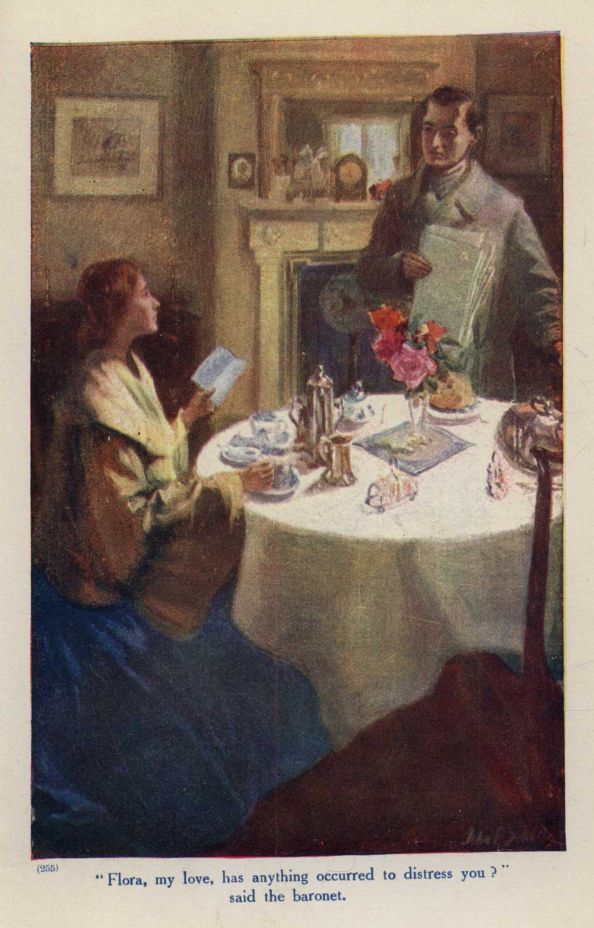
"Flora, my love, has anything occurred to distress you?" said the baronet.
Flora looked anxious and unhappy, her eye rested upon an open letter which she had received by the early post.
"I have heard from Mr. Ward, dearest," she replied; "he gives me tidings which have made me very uneasy. Scarlet fever, of a malignant kind, has been raging lately in Wingsdale, and I grieve to say that two of my brother's children are ill with it now, and it is feared that the baby is sickening."
The baronet coughed slightly, stirred the fire, and sat down to sip his chocolate.
"My poor mother!" faltered Flora; "Mr. Ward writes that she is far from strong; the nursing will be so heavy upon her."
"Have not the children a mother?" said Sir Amery, abruptly.
"Emma has taken such alarm at the idea of infection, that she has actually hurried away, and engaged a room at a hotel in a town about ten miles distant from Wingsdale!"
The baronet elevated his handsome brows with an expression of contempt.
"I fear," continued Flora, with emotion, "that the anxiety and fatigue will quite break down the health of my mother. She will watch the children day and night, as she watched me in my fever." The voice of the daughter trembled as she added, "Oh, Amery! she needs me to help her; dearest, will you not spare me to her now?
"You!" exclaimed her husband in a loud tone of surprise, pushing back his chair from the table; "what could have put such an insane thought into your mind? Do you think that I would suffer you to go into the midst of infection--to take the place of an unfeeling woman--to act as nurse to a set of mulattoes--to risk your precious life for those whom their own mother has deserted?"
"My mother will never desert them," said Flora; "it is to assist her--"
"We will send a nurse down from London to assist her; let that set your mind at rest," replied Sir Amery. Then he added, as his stern features relaxed into a smile, "It is easier to find an efficient substitute for you, Flora, in the sick-room at Laurel Bank, than at Lady Montague's soirée to-night."
"The ball!--oh!" exclaimed Flora, leaning back on her chair, "I have not the heart to go to it!"
"No heart is required," said the baronet, laughing; "we do not look for such commodities at balls."
Flora was ever submissive and obedient to her husband. She saw that it was his will that she should accompany him to the party, and she went, though with a joyless spirit. Decked out in jewels and costly array, and leaning on the arm of him who attracted every eye, the fair young wife might have appeared an object of envy to the proudest dame in the glittering throng. But there was a fount of sadness in her bosom, which mingled with and imbittered every pleasure. The music had to her a mournful tone; the gay dancers flitted before her like images in a dream; she felt it hard to wear a smile on the lips when the heart was depressed with care. Flora was glad to choose a quiet corner for herself, where it would be unnecessary to enter into conversation, where she might remain unnoticed and unknown.
She was seated beside some ladies who were strangers to her, and Sir Amery conversing with friends of his own in another apartment, Flora felt herself alone in a crowd, solitary in the midst of society. Her thoughts wandered back to her mother's home--she was treading, in fancy, well-known paths, seeing long absent faces, listening to the sound of the church bells which had once made sweet music to her ear; and, absorbed in her own recollections, had been at first inattentive to the conversation of the ladies beside her, till her ear was caught by the sound of the name which was to her dear beyond all others.
"And that is Sir Amery!" exclaimed one, leaning forward to catch a glimpse of him through the open folding-doors; "what a princely form! what a noble countenance! He looks like the statue of an old Greek demigod warmed into life!"
The wife felt a glow of pleasure at the words, and turned with interest towards the speaker.
"Did you not say that he was married?" said the companion of the lady who had spoken.
"Oh, yes; he married some time ago; made quite a mistake, if report be true--the usual fate of geniuses; he threw himself away on some insipid little rustic, who had nothing but a pretty face to recommend her!"
Flora had heard enough; she rose and left her seat, and made her way with difficulty through the crowd to another part of the ball-room.
But even here she was destined again to find her gifted husband the topic of conversation. An elderly gentleman was talking with a young man, who appeared to be eagerly arguing some point with him.
"But you must allow that he has very great power--"
"Just as I allow that the boa-constrictor has very great power," replied the senior, laughing. "This man envelops truth in the mighty folds of his genius, and squeezes the very life and shape out of it. I believe that writers like Sir Amery do a world of mischief, especially amongst young men. I, for one, will not join this worship of an author whose great merit seems to be, that he can mix up poison so skilfully that the victims take it for a wholesome medicine."
Flora, trembling, made her way into the adjoining room, and again was at the side of her husband, bearing in her bosom a sting which lay and rankled there for many a day.
The next morning brought another letter from Mr. Ward--Mrs. Vernon not writing herself, lest her epistles should convey contagion. Flora learned that the youngest child had taken the fever, and that Johnny was not expected to live. Mrs. Vernon had sat up with him the whole of the preceding night, and had never quitted the sick-room. Flora's only comfort was in the thought that the experienced nurse, whom without delay she had procured from an hospital, would relieve her mother to a certain degree; and she wrote a long tender letter to Mrs. Vernon, secretly wishing that she herself could take the place of her epistle.
Then followed two days of silence, weary, anxious days to Flora, whose absence of mind and restless longing for news called forth an impatient remark from Sir Amery. Submissive and fearful of displeasing, Flora sat quietly listening to his comments on a new work, even when she at last heard the double rap at the door; and she held the unopened letter in her hand, though it bore the postmark of Wingsdale, till her husband had concluded the brilliant review, of which his auditor had not comprehended one sentence.
"Thank Heaven!" exclaimed Flora, as she glanced at the first lines, "all the children are likely to recover!"
"Did you feel any apprehensions on their account?" said the baronet drily; "empty casks always float, the full ones are those that are in danger of sinking."
"But, oh! how shocking!" exclaimed Flora as she read on further: "'Your sister-in-law had scarcely reached the place of her retreat when she was seized with the terrible malady, all alone as she was, without a friend near her. Your dear mother could not quit the sick children; but she sent the London nurse on to Manton directly. From her account of the state in which she found her patient, serious apprehensions are entertained for the poor lady's life.'"
"Oh, she'll recover too," said the baronet philosophically.
But the unhappy Emma did not recover. She had had her last warning--had thrown away her last opportunity of returning to that God whom she from childhood had neglected and forgotten. Her harvest was over, her summer was ended, and she was not saved. She was not one who could be charged with any gross violation of the commandments of the Lord; but they had never had a place in her heart. The seed of the Word had not perished on the cold ice of unbelief, or the burning lava of passion, but on the track beaten and trodden down by selfishness--the highway of folly, on which the soft breath of counsel, or the keen blast of trial, had stirred nothing but the light dust of vanity.
CHAPTER XVII.
DARKENING CLOUDS.
It was not to be expected that Flora, though shocked by the sudden event, should deeply lament the death of her sister-in-law. As Sir Amery observed, Emma had passed the life of a zoophyte, with this difference, that the ocean anemone clings to something beyond self, be it only a rock or a seaweed. Lady Legrange wore black velvet instead of violet, clasped a bracelet of jet round her wrist, and, except for these reminders, might almost have forgotten that such a being as Emma Vernon had ever existed.
It was about a month after the death of her sister-in-law, on a dull morning in the beginning of March, that Flora sat alone in her boudoir, arranging some early primroses and violets. Sir Amery had been absent for two or three days on a visit to a nobleman in the country, but was expected home in the evening. As it was the birth-day of his wife, Flora felt sure that he would not fail to return.
"None of these are worth preserving," she said to herself as she put aside the fading flowers; "how soon they have lost their fragrance, and all their beauty is gone! Poor flowers--this heated room, the smoky atmosphere of London, has made them quickly wither; they would have bloomed longer on their own green bank!" Flora sighed as her mind pursued the train of association called up. "How I once delighted at this season to find the first violets in the copse, and carry them home to my mother! How bright and cheerful all things looked to me then; there was a freshness of enjoyment which, I suppose, only belongs to youth--yet I am but twenty-two years old to-day! There are no garlands now hanging on my myrtle; I wonder if the plant is living still! My mother will not forget the anniversary; she will have thought of her Flora in her prayers! I made so sure of a letter to-day;" and Flora stood pensively looking at the fading blossoms, when the door unclosed, and a servant entering, announced a well-known name.
"Mr. Ward--can it be! Oh, how good in you," commenced Flora, hastening with unaffected delight to greet her old friend; but the aspect of the venerable clergyman, as he kindly but gravely returned her greeting, awoke a feeling of alarm in the bosom of Lady Legrange.
"You bring bad tidings--my mother!" she exclaimed, still grasping the hand of the old man, and looking up anxiously into his face.
"Mrs. Vernon is not so well as we all wish her to be," replied Mr. Ward, quietly but sadly meeting the daughter's earnest gaze.
"She wished you to come to me--?"
"She does not know of my coming, but I thought it best to let you hear all, and an interview is so much more satisfactory than a letter--"
"Oh, tell me all!" cried Flora in agony. "My mother--is she very--is she dangerously ill?"
Mr. Ward broke to the daughter, as gently as he could, that, in the preceding night, Mrs. Vernon had been suddenly and alarmingly attacked by a malady which threatened her life. He did not say--it was unnecessary that he should say what Flora too surely divined--that the overtaxed powers of her mother's frame were at length giving way; that her exertions during the illness of the children had, it was feared, irreparably injured herself; and that it was very doubtful whether, on his return to Wingsdale, he would find the sufferer yet alive.
Flora could not hesitate now; even the fear of displeasing her husband was swallowed up in a more terrible fear. She wrote a few hurried lines for Sir Amery to receive on his arrival, hastily made her slight preparations for the journey, and under the escort of her kind old friend, and accompanied by her maid, with a very heavy heart she set out for the home of her much-loved parent.
The journey by railroad occupied about three hours; long, painful hours were they to Flora. She could not but contrast this return to Laurel Bank with her last. Then, indeed, she had not been without anxiety, and even a shadow of self-reproach, but the prevailing feeling of her heart had been all-absorbing happiness. She loved and was beloved again, and might have expressed herself in the language of the great poet--
"Come what sorrow may,
It cannot countervail the exchange of joy
Which one short moment gives me in his sight."
But her fair bud of hope had not blossomed into happiness. God had given her her heart's desire, but withal sent leanness into her soul. Flora had learned by experience the hollowness of mere human felicity. "He builds too low who builds beneath the skies." And the change in the appearance of nature harmonized with the alteration in Flora's feelings. On that last journey to Laurel Bank she had beheld earth laughing in the sunlight, and decked in all the beauty of summer. The breeze had waved the broad fields of golden corn, and rustled in the luxuriant foliage of the groves; the gardens had been gay with a thousand flowers, and the wild rose had bloomed in the green hedge. Now, the trees reared their bare dark branches aloft, for the season was a late one; and Winter, driven from his throne for a few sunshiny days, was returning with increasing force to chase back the approaching Spring. From the gray lowering sky above the snow-flakes were beginning to fall, and, before Flora reached the place of her destination, a brooding storm was wrapping the world in premature night.
The snow was driving fast into her face, as Flora hurried up the gravel walk which her footsteps had trodden so often. She opened the door without ringing, for in that quiet retreat bolts and bars were deemed unnecessary. The entrance to the dining-room was open; she heard voices within, and paused an instant to glean from their tone the information which she longed but dreaded to receive.
"No, Emmie, you must not make a noise,"--it was the voice of Johnny that spoke; "don't you know dear grandmamma is ill? Come, sit here quietly, and I'll tell you a little story."
"Then she lives--thank God!" exclaimed Flora to herself, hastening with noiseless footstep up the stairs. In that house she required no guide.
She proceeded straight towards the chamber of her mother, her heart palpitating fast. As she reached it the door unclosed softly, very softly, and Mrs. Vernon's maid appeared with the doctor.
"Miss Flora!" exclaimed the old servant in a subdued tone of surprise.
The doctor glanced sternly at her, and raised his finger, then advanced silently to Lady Legrange.
"Is she--is she--?" Flora could not finish the sentence.
"My dear lady, she is in God's hands; He may raise her yet. Everything that can be done shall be done; but I cannot conceal from you that I entertain serious apprehensions." He spoke in tones too low to be heard in the chamber of the invalid.
"But I may go to her--nurse her--"
"Pardon me," replied the medical man, courteously but firmly interposing, "our patient is in a very critical state; the pleasure of seeing you after so long an absence would cause a degree of excitement which might be attended with fatal consequences."
Flora said nothing, but pressed her hand against her heart; she felt as though it would break.
"Ann is most watchful and attentive," pursued the doctor, feeling for Flora's evident distress, "and Miss Lyddie will not quit the room for a moment."
"Lyddie!" thought the miserable daughter, with a sharper pang of envy than her gentle bosom had ever before known; "and she may sit and watch where I dare not enter; she may look on that loved face which I have come so far to see; she is the comfort, and I--and I--!" Flora leaned down her head upon her clasped hands and tried to stifle her sobs.
A miserable night was that for Lady Legrange--the most miserable which she had ever known. The cold became more and more piercing, yet no entreaties could induce her either to go to rest or to seek the comfort of a fire in one of the rooms below. She had a chair brought for her to the door of her mother's room, and there she sat, trembling and shivering, counting every stroke of the clock which at intervals--oh! how long and weary--told the lapse of time. She heard the wind shaking the casements, as though fiercely demanding entrance, and shrieking aloft in the chimneys with a wild and wailing noise; and sometimes her painfully strained ear could catch sounds from the sick-room--a light step, a soft rustle, a low voice, or, terrible to hear, the faint moans which told of irrepressible suffering. Flora also, as morning drew nigh, heard words, words from the lips of her parent, words which reason guided no longer--but not one word which it could have pained piety to hear. The unconscious sufferer uttered prayers for mercy, for pardon--prayers for those who were dear to her heart. Flora wept as she heard her own name repeated again and again in unconscious supplications. It seemed as though that which had been the habit of a life remained now as an instinct; the mind might be darkened, reason might have fled, but love and piety lingered yet in their accustomed home, the last to leave the sanctuary which had enshrined them so long. To apply to a nobler subject the beautiful simile of Moore--