"Fix Bay'nets" (continued 7)
Reading edition
“It is your duty to go.”
“But you don’t know how bad you are, sir,” pleaded the lad, with the great sobs struggling to escape from his breast. “You don’t know, sir; but I do, sir. You’d be frozen stiff before it was light again.”
“Perhaps; but I should die knowing that an effort was being made to save those we have left behind.”
“You’ve done all you can do, sir,” pleaded Gedge passionately. “We can’t do no more.”
“I can’t, but you can. I call upon you once more to go and do this thing. If you have any manhood in you, go.”
“I can’t, sir,” groaned Gedge.
“You coward!—it’s your duty to go.”
“It ain’t, sir; it can’t be, to leave my orficer to die like this. I know it can’t. Why, if I did, and got the help, and took the men back, and the Colonel got to know how, he’d think it warn’t worth getting it at such a price. He’d call me a cowardly dog and a hound, and the lads would groan and spit at me. Why, they’d cob me when they got me alone, and I couldn’t say a word, because I should feel, as I always should to the last day I lived, that I’d been a miserable sneak.”
“I tell you it is your duty, my man,” cried Bracy again.
“Don’t send me, sir! I ain’t afraid,” pleaded Gedge once more. “It’s leaving you to die in the cold and dark. I can’t go!—I can’t go!”
Bracy struggled up at this, supporting himself with his left hand, moved now as he was by his companion’s devotion; but he choked down all he longed to say in the one supreme effort he was making to fulfil the mission he had failed in by another hand.
“I am your officer, sir. You are a soldier, sworn to serve your country and your Queen.”
Gedge looked down at the speaker through the gloom, and saw him fumbling beneath his sheepskin coat with his right hand. The next minute he had drawn his revolver, and Gedge heard it click.
“You hear me, sir?” cried Bracy sternly.
“Yes, sir, I hear.”
“Then obey your officer’s orders.”
“You ain’t an officer now, sir; you’re a patient waiting to be carried to the rear, after going down in front.”
“How dare you!” cried Bracy fiercely. “Obey my orders.”
“They ain’t your orders, and it ain’t my dooty to obey a poor fellow as has gone stick stark raving mad.”
“Obey my orders, dog, or—”
“I won’t!” cried Gedge passionately. “I’ll be drummed out if I do.”
“You dog!” roared Bracy, and the pistol clicked.
“Shoot me, then, for a dog,” cried Gedge passionately, “and if I can I’ll try to lick yer hand, but I won’t leave you now.”
The pistol fell with a dull sound as Bracy sank back, and in that terrible darkness and silence, amid the icy snow, a hoarse groan seemed to tear its way from the young officer’s breast.
Chapter Thirty Four.
A Wild Idea.
How long that silence lasted neither could have afterwards said, but after a time Bracy felt a couple of hands busy drawing the spare poshtin more about him. Then a face was placed close to his, and a hand touched his forehead softly. “I’m not asleep, Gedge,” he said. “Ha!” sighed the lad, with a long drawn breath: “getting afraid, sir; you lay so still.”
“It’s all over, my man,” said Bracy wearily.
“No, no; don’t say that, sir,” cried Gedge. “I was obliged to—”
“Hush! I don’t mean that. I only feel now that I can sleep.”
“Yes, sir; do, sir. Have a good try.”
“I cannot while I know that I have your coat.”
“Oh, I don’t mind, sir; and I’ve got to be sentry.”
“We want no sentry here, my lad. Take the coat from under me.”
“But—”
“Come, obey me now,” said Bracy quietly. “Get close to me, then, and cover it over us both.”
“You mean that, sir?”
“Yes.—There, my lad, all men are equal at a time like this. I have striven to the last, but Fate has been against me from the first. I give up now.”
“I didn’t want to run against you, sir; but I was obliged.”
“Yes, I suppose so.”
“You wouldn’t have gone and left me, sir?”
“I don’t know,” said Bracy slowly.
“I do, sir; I know you wouldn’t.”
“Let it rest, my lad, and we’ll wait for day. God help the poor creatures at the fort, and God help us too!”
“Amen!” said Gedge to himself; and as the warmth began to steal through his half-frozen limbs he lay gazing at the distant glow of the enemy’s fire far away below, till it grew more and more faint, and then seemed to die right out—seemed, for it was well replenished again and again through the night, and sent up flames and sparks as if to give a signal far away, for the supply of fir-branches was abundant, and the fire rose in spirals up into the frosty sky.
Bracy too lay watching the distant blaze till it grew dim to his half-closed eyes. A calmer feeling of despair had come over him, and the feeling that he had done all that man could do softened the mental agony from which he had suffered. This was to be the end, he felt; and, if ever their remains were found, those who knew them would deal gently with their memory. For the inevitable future stared him blankly in the face. Gedge would strive his utmost to obtain help, but he felt that the poor fellow’s efforts would be in vain, and that, if they lived through the night, many hours would not elapse before they perished from hunger and the cold.
The feeling of weary mental confusion that stole over him then was welcome; and, weak from the agony he had suffered, he made an effort to rouse himself from the torpor that, Nature-sent, was lulling the pangs in his injured limb, but let his eyelids droop lower and lower till the distant light was shut out, and then cold, misery, and despair passed away, for all was blank.
The specks of golden light were beginning to show on the high peaks, and gradually grew brighter till it was sunny morning far up on the icy eminences, chilly dawn where the two sheepskin-covered figures lay prone, and night still where the fire was blazing by the pine-forest, and the great body of the enemy had bivouacked.
The two motionless figures were covered by a thick rime frost, which looked grey in the dim light, not a crystal as yet sending off a scintillation; and tiny spicules of ice had matted the moustache and beard of Bracy where his breath had condensed during the night, sealing them to the woolly coverlet he had drawn up close; while a strange tingling sensation attacked his eyes as he opened them suddenly, waking from a morning dream of defending the fort and giving orders to his men, who fired volley after volley, which, dream-like, sounded far away.
He was still half-asleep, but involuntarily he raised a warm hand to apply to his eyes. In a very few minutes they were clear, and he began breaking and picking off bit by bit the little icicles from his moustache.
It was strange how it mingled still with his dreams—that firing of volleys; and the half-drowsy thoughts turned to wonder that there should be firing, for he must be awake. Directly after he knew he was, for there was a sharp rattle in the distance, which came rolling and echoing from the face of the great cliff across the gulf, and Gedge jerked himself and said sleepily:
“That’s right, boys; let ’em have it.”
“Gedge!” cried Bracy hoarsely.
“Right, sir; I’m here,” was the answer; and the young soldier rolled over from beneath the poshtin, rose to his feet, staggered, and sat down again.
“Oh, murder!” he cried. “My poor feet ain’t froze hard, are they?”
“I pray not,” said Bracy excitedly.
“’Cause I can’t stand. But, hallo! sir; what game’s this? They’re a-firing at us, and coming up over the snow.”
“No, no, it can’t be!” cried Bracy wildly. “No tribes-men could fire volleys like that.”
“Course not, sir. Hoorray! then the Colonel’s sent a couple o’ comp’nies to help us.”
“Impossible!” cried Bracy. “Hark! there is the reply to the firing. Yes; and another volley. I almost thought I could see a flash.”
“Did yer, sir? Oh, don’t talk; do listen, sir. There they go. There must be a big fight going on down there.”
“Then friends have attacked the enemy in camp—advanced upon them so as to catch them before daylight.”
“Oh! they might ha’ waited till it was light enough for us to see, sir. Mr Bracy, sir, don’t, pray don’t say it’s reg’lars, because if it ain’t I couldn’t stand it now. I should go down and blubber like a great gal.”
“It is a force of regulars, my lad,” cried Bracy, whose voice sounded as if he were choking. “Friends are there below in the valley. I know: the Colonel must have been badly beaten at the fort.”
“Oh, don’t say that, sir.”
“It must be. They have been too much for him, and he is retreating with our lads trying to make for the Ghil Pass. That is the meaning of the gathering last night to bar their way.”
“Oh Lor’! oh Lor’! and us not able to fire a shot to help ’em. Be any use to begin, sir, like for signals to show we’re here?”
“No,” said Bracy sadly; “our single shots could not be heard.”
“Not if we fired both together, sir?” cried Gedge wildly. “I’ll load for you.”
“How could they distinguish between our shots and those of the enemy you can hear crackling?”
“Course not, sir. I’m a poor idjit sometimes. But oh! why does it keep dark down there so long when it’s getting quite light up here? We can’t see what’s going on a bit.”
“No; but my ears tell me pretty plainly,” said Bracy excitedly.
“Mr Bracy, sir.”
“Yes?”
“We aren’t worse, are we, and all this a sort o’ nightmare before we loses ourselves altogether?”
“No, man, no. Listen. They must be getting the worst of it.”
“Our lads, sir? Oh, don’t say that! There must be a lot of them, by the volley-firing. Don’t say they’re being cut up.”
“The enemy, man. Can’t you hear how steady the firing is?—Splendid. I can almost see them. The enemy must be retiring stubbornly, and they’re following them up.”
“Yes, sir; that’s it,” cried Gedge wildly. “Go on, sir; go on.”
“Their officers are holding the men well in hand, so as not to come to a charge in that broken country, and withering the crowd with their fire to make them scatter.”
“Right, sir, right. That’s it. Oh, if we was only there!”
There was a pause—the two men listening.
“The enemy’s firing sounds more broken up, and is getting feebler.”
“Yes, sir; I can make out that,” panted Gedge. “Oh! I say, don’t let the lads get out of hand and follow the beggars where they can get hold of the bay’nets and use their long knives.”
For another half-hour the pair lay listening to the engagement going on, till it seemed as if the daylight below would never come. Then the darkness gave way, to display far below a cold grey mist, through which clouds of smoke were softly rising; and Bracy brought his glass to bear upon the fight still raging furiously, and looked in silence till Gedge turned to him:
“Oh, do say something, sir! Our lads—they ain’t being cut up, sir, are they?”
“No, no, I think not, my lad; but I can hardly make out what is going on at present. Ha! it’s gradually growing lighter there. The enemy are not where they were last night, and the troops are there.”
“Then they’ve took the beggars’ camp, sir?”
“That does not follow,” said Bracy, whose eyes were glued to his glass.—“I can make out the white-coats now. They have divided, and are upon the rising ground all round. Our poor fellows must have fallen into a trap.”
“No, sir; no, sir, they couldn’t, sir,” cried Gedge; “they’d have seen that fire and known there was an enemy.”
“Yes, I forgot the fire,” said Bracy. “Oh, if the sun would only shine down upon them now!”
“But he won’t, sir; he never will when he’s wanted to. He won’t shine there for an hour yet.”
“Yes—no—yes—no,” panted Bracy at slow intervals; and Gedge wrung his hands, like a woman in trouble, whimpering out:
“Oh! who’s to know what that means, with his ‘Yes—no—yes—no’? Mr Bracy, sir, do—do say that our lads are whipping the beggars back.”
“Yes,” cried Bracy excitedly; “I can see now; the hill-men are scattered and running towards the mountains.”
“Hoorray!” yelled Gedge. “Hoorray! Hoorray! Hark at the steady volleys still, sir! Hoorray! Who wouldn’t be a soldier of the Queen?”
“Ha! Who indeed?” sighed Bracy.
“And it don’t matter, sir, now?” said Gedge.
“No; not so much, my lad; but they’ll be harassed like this all the way to the Ghil Pass.”
“And drive the beggars back, sir. But don’t you think we ought to make one try to get down to them, sir? Same as I said last night?”
Bracy was silent as he kept on using his glass, with the valley below growing clearer—so light now that, the young soldier could begin to see something of the fight with the naked eye, and he joined in the eager watch downward for a time before repeating his question.
“I fear not, my lad,” said Bracy, with a sigh. “The enemy are cut in two; one body is retreating down the valley in the direction of the fort; the other, widely scattered, is making for the snow-slope.”
“Not coming this way, sir?” cried Gedge.
“Yes, as far as I can see; and our men are steadily in pursuit, firing wherever a crowd collects.”
“That’s the way to do it, sir; but that’s cutting off our retreat.”
“Yes.”
“Well, then, sir, we must lie low till the enemy is cleared off. They won’t come up here.”
“No; they must be making for the track we crossed—the one below there, where we saw the men going towards the valley-bend.”
“That’s it, sir, and they’ve got their work cut out; but our lads won’t follow ’em right up there.”
“No; they will only follow till they have scattered them as far as possible.”
“And then go back, sir, and leave us where we are.”
“Yes,” said Bracy sadly.
Gedge was silent for a few minutes, during which they still watched the scene below. Then he broke out with:
“It’s all downhill, sir.”
“Yes, Gedge,” said Bracy drearily; “it is all downhill now to the end.”
“You ain’t listening to me, sir,” cried the lad. “Do put that glass away, sir, and we’ll have a try.”
“A try? What! to get down below? You try, my lad; but there is the terrible risk of being cut to pieces by the enemy if they see you.”
“Don’t begin that again, sir, please. You know I won’t leave you, but let’s have a try.”
“I am helpless, my lad—as helpless as a figure half of lead.”
“But I ain’t, sir,” cried Gedge. “The sight of our lads below there seems to ha’ woke me up. I’m ready to die game; but I want to make one spurt for life first.”
“Why, Gedge,” cried Bracy excitedly as he lowered the glass from his eyes, “they’re not our fellows after all.”
“What, sir!”
“No; and there’s a detachment down yonder coming from the east. I can almost see that they’re doubling to get up in time.”
“From the east, sir? Then the Colonel ain’t retreating?”
“No.—Hurrah!”
“Hoorray!” roared Gedge, joining in.
“They’re the Ghoorkhas, Gedge. They must be a thousand strong.”
“Then one o’ the messengers must ha’ got to them after all.”
“Yes; that must be it, Gedge; and they surprised the enemy’s camp at dawn.”
“That’s it, sir!” yelled Gedge. “Hoorray! hoorray again! Then there is life in a mussel after all.”
“They’ve scattered this force, Gedge, and the fort will be relieved, for the bravo little fellows will cut their way through all.”
“Yes, sir. Now then, sir, you needn’t hardly move. There’s a bit o’ slaty stone yonder as’ll do, and all I want of you, sir, is for yer to sit still upon it, and nuss the rifles while I steer you down to the truck.”
“Right in among the enemy, my lad?”
“Right through ’em, sir. They’re on the run, and won’t dare to stop to go at us. I never heard of a nigger as’d stand a moment when a Ghoorkha was coming after him with his crooked knife.”
“Let’s try,” said Bracy, setting his teeth. “Life is sweet, my lad.”
“Even without sugar, sir. Why, bless your ’eart! there’s a lot of it in us both yet, sir. This here’s nothing to what we’ve been and done.”
Wild with excitement now, Gedge fetched the heavy slab of stone, almost as much as he could lift, drew it close up behind Bracy, and placed his arms under the young officer’s shoulders.
“Now, sir,” he said, “you set your teeth just as if the doctor was going to use his knife.”
“What are you going to do?”
“Draw you right back on to this stone, sir. I must hurt you a bit, but I can’t help that.”
“Go on,” said Bracy; and the next moment he was drawn back upon the stone, with no worse suffering than a fit of faintness, for his leg was numb with the cold.
“Right, sir. Now your rifle and mine across your legs. Stop; my poshtin first. May want it again. Got the cartridges handy?”
“Yes.”
“Then I sits here between your legs, sir. Just room, and I can steer and put on the break with my heels. Ready, sir?”
“Yes.”
“Then off.”
The surface of the snow was like glass with the night’s frost, and the stone began to glide at once, just as the first gleams of the rising sun lit up the spot where such terrible hours had been spent; and the next minute, with a strange, metallic, hissing sound, the pair were gliding down the slope at a steady rate, which Gedge felt it in his power to increase to a wild rush by raising his heels from the surface upon which they ran.
“All right, sir?”
“Yes, all right. Go on.”
“Ain’t it wonderful, sir? Why, we can get down to the track long before any of them can get up to it.”
“Stop, then, to let them reach it and retreat.”
“If you order me to, sir, I will; but they’ll never try to stop us; they’ll scatter to see us coming down like this. Why, in less than an hour, sir, we shall be all among the Ghoorkha lads, and then hoorray for the fort!”
“Go on, then. I trust to you.”
“Right, sir,” cried Gedge excitedly; and in spite of several risks of overturning, he steered the novel toboggan sledge down the gigantic slide, with the wild, metallic, hissing sound rising and falling on the keen wind that fanned their cheeks, and a glistening prismatic, icy dust rising behind them like a snaky cloud.
Chapter Thirty Five.
The Idea Tamed.
Onward, swifter or slower, they moved as the undulations of the mighty snow-slope ruled with the rough track crossing at right-angles far below and gradually growing plainer, the white-coats of the fleeing enemy, the kharkee jackets of the advancing line of Ghoorkhas, and the pulls of smoke from each discharge coming nearer as if in a dream. The excitement of the wild rush seemed to madden Gedge, who, as he found out that he could easily control his rough chariot of stone, let it glide faster and faster, his eyes sparkling, and the various phases of the fight below sending a wild longing to be amongst it thrilling through his nerves.
“Oh,” he shouted, “if there was only a hundred of us coming down like this to take the enemy front and rear! Are you all right, sir?”
“Yes, yes; but beware of the rocks down below there by the track.”
“Right, sir. Wish they weren’t there, though, and we could go right on; charge through ’em in no time.”
He had to speak without turning his head, and Bracy did not catch half his words. But it was no time for speaking; and, forgetting for the time being his injuries and partial helplessness, Bracy began to share in his driver’s excitement, and watched the movements going on below.
The height to which they had climbed had been great, and some memory of the labour they had gone through in the ascent came back as they swept rapidly down, till in an incredibly short space of time they neared the rocky track, with its rugged pinnacles and masses standing right up out of the snow.
Gedge saw that the enemy was still far below the track; and as he checked the way on the stone by gradually driving in his well-nailed boot heels, he looked to right or left for a spot where there would be a clear crossing of the track, free from projecting rocks, so that a stoppage would not be necessary. There it was, lying well to the right, narrow but perfectly practicable. For, plainly enough, he could see that there had been a snow-slide burying a portion of the track, and if he could steer between a couple of rocks, not ten yards apart, the glide down could be continued without a pause.
“It’s all right, sir,” he cried. “Signals is clear, and we don’t stop at that station. Hoorray! Her Majesty’s mails. Fast express.”
It was on Bracy’s lips to cry, “Take care,” but he nipped them together and sat fast, feeling their pace slacken as if, to carry out Gedge’s simile, they were easing down to run through a station.
Nearer, nearer, with rough crags half-buried in the snow on both sides and seeming to close in upon them as they glided down, with the narrow pass between the two rocks unaccountably growing for the moment closer together. But directly after, by clever steering, Gedge made a curve in their descent, brought the stone opposite the opening, and then let it go.
Their way rose a little as they approached the track where it was buried in the snow, but directly after the descent was steeper; and as soon as Gedge felt sure of his course they dashed through the opening at a greatly increased speed. Then he shouted in his wild excitement as they tore down towards the enemy, who were toiling upward, slipping, and even crawling on all-fours in places, while their active little pursuers were striving their best to overtake them, but pausing at times to fire.
Pursued and pursuers were still far below, but Bracy saw that it was only a matter of a short time before they would be amongst them; and now, for the first time, it was evident that their descent had caught the attention of the hill-men striving to reach the track, some of whom stopped short to stare, while a party of about twenty immediately bore off to their left as if meaning to intercept them.
“What’s it to be, sir!” panted Gedge. “Charge through ’em, or stop and let ’em have it? They’ll be ‘twix’ two fives.”
“Stop!” shouted Bracy. “They’ll try to check us, and slash as we come; and if we strike against even one we shall be upset.”
“That’s right, sir. Be ready with the rifles. Mine’s charged, I think. ’Nother five hundred yards right for that lot o’ twenty, and then slide off and open fire—eh?”
“You don’t want your orders, Gedge,” said Bracy dryly. “Quite right.”
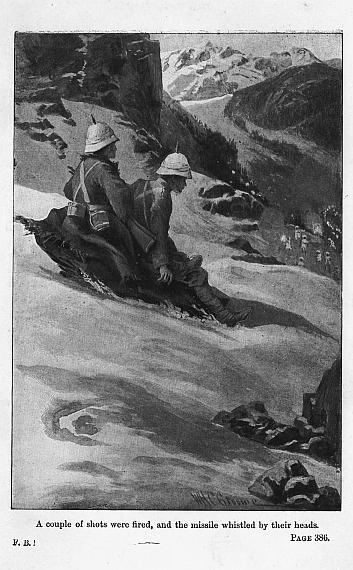
Gedge did not hear him, for, as they rushed down over the icy snow, he had his work cut out to check his awkward car, as it nearly mastered him, his heels gliding over the smooth surface and refusing to cut in. Forcing them down, though, the speed began to slacken, till they neared the ascending group of savage faces of those who had borne off to intercept them; and as the car was brought to a stand a couple of shots were fired, and the missiles sent whistled by their heads.
“Can yer roll off, sir, and lie on yer face?” cried Gedge as he snatched his rifle, threw himself down behind the stone, and opened his cartridge-pouch.
“Yes. Look to yourself. Fire sharply, or they’ll be upon us.”
“Or our bay’nets,” said Gedge through his teeth.
The next moment he fired as he rested upon his elbows, and a shot from Bracy rang out, with the result that two of the group below them dropped, and a yell came from the remainder as they made a rush to reach them. But their running powers were exhausted, and at the end of twenty yards they resumed their heavy climb, with their feet breaking through the crust of frozen snow.
Crack, crack! from the English rifles, and one more dropped in his track, while another sprang wildly in advance for a few yards, before pitching forward upon his face and lying still.
“Fire steadily,” said Bracy hoarsely, “and we may cheek them.”
“Right, sir. Quick, too, for the beggars on the left are closing in to help.”
A couple more shots were fired, and another man went down, and then there was a yell of rage and an order from one of the party, with the result that all dropped upon their faces, checked, and began to fire at the pair crouching behind the stone, made to look bigger by Gedge’s poshtin lying in a little heap on the top.
“It’s all right, sir; they couldn’t hit a haystack. Their hands are all of a tremble with climbing. We’re right enough. I hit that chap.”
Proof was given, for one of the enemy started up, dropped his long jezail, and fell backwards.
“Keep on firing steadily, Gedge,” said Bracy huskily. “I must open upon that group on our flank. They’re coming on.”
“Then we’re done, for, sir,” said the young soldier. “But mind this, sir; I die game, though you did call me a coward last night.”
“I did, Gedge, and it was a cruel lie, my lad. Fire away. I wish I had your pluck. Look here.”
“Yes, sir.—One for you,” growled Gedge as he fired again.—“I’m listening, but I can’t look. Hit him, sir?”
“Yes,” said Bracy. “Look here.”
“Can’t, sir.”
“Then listen. When it comes to the worst—one grip of the hand, my lad, before we go.”
Crack—crack!
Two more shots in answer to the scattered fire of the enemy, whose bullets whistled over their heads, seeking billets in the snow around.
“Won’t be long, sir, I’m afraid,” said Gedge. “No, I ain’t afraid—not a bit. But those chaps are coming on faster. ’Tain’t climbing, sir, now.”
“No; they’ll be upon us before five minutes have passed. Turn your rifle upon them, my lad, for two or three shots, and we may check them too.”
Before Gedge could change his position a scattered volley from below somewhere rattled out, and the flanking-party coming on needed no checking, some of them falling dying or wounded, while the remainder threw themselves down and began firing, some at their pursuers below, the rest at Bracy and Gedge.
“Hoorray, sir! Didn’t I say there was life in a mussel? The Ghoorkhas are at ’em. Look, sir, there’s about a dozen of ’em lying down to cover the advance, and another dozen coming on with their knives. Let’s show ’em how to shoot, sir. It ’ll help the little chaps, too, when they charge.”
It was as Gedge said; and as shot after shot was sent with good aim, the party of tribes-men in front was lessened by half-a-dozen before the little Ghoorkha party came up within charging distance and made their rush.
“Fix bayonets!” cried Bracy. “The enemy may come at us;” and the little, dagger-like weapons clicked and clicked as they flashed in the sunshine.
But Bracy and Gedge got in a couple more shots before their foes sprang up to charge them. Then a couple more dropped as they came on, while a volley from below rattled out and made their attack feeble and aimless, though they reached their goal, one to make a slash at Gedge as he was pinned by the lad’s bayonet, while two more struck at Bracy. Then the Ghoorkhas were upon them, racing over the snow, their crooked knives flashing, and the remaining enemy were fleeing for their lives, scattering far and wide, with their pursuers overtaking man after man, whose white-coats made blots on the glistening snow, and many a terrible stain. Then a whistle rang out as an officer came up to the stone at the double, sword in hand.
“Hullo, here!” he cried; “who, in the name of wonder, are you? I couldn’t get up in time. My boys didn’t do that?”
Bracy’s lips parted, but no sound came.
“No, sir,” panted Gedge; “it was the straight knives did it, not them pretty little blades.”
“I’m glad of that. I was afraid my boys had made a mistake. But who are you?”
“Private Willyum Gedge, in the 404th Fusiliers; and here’s my lieutenant, Mr Bracy, sir. We was coming from the fort to fetch you.”
“Ah!” cried the officer. “How is it with them there?”
“All right, sir; but hard pushed when we come away. Ain’t got such a thing as a doctor about yer, have you?”
“Yes, yes. My boys shall carry you down. All right,” he cried as a bugle rang out from below with the recall; and by that time the little group were surrounded by some twenty of the active Ghoorkhas, for the most part with a begonia-leaved kukri in hand, laughing, chattering, and ready to dance with delight around the two British soldiers they had saved.
Meanwhile their officer was down on one knee rendering first aid to the wounded, the knife of one of the enemy having slashed Bracy’s thigh, which was bleeding profusely; and a havildar of the Ghoorkhas was cleverly bandaging Gedge’s left arm, chattering to him merrily in broken English the while.
“Try and swallow a drop more,” said the officer to Bracy, who was reviving a little, and smiled his thanks, his eyes wandering round directly after in search of something, till a movement on the part of their rescuers enabled him to see Gedge, to whom he feebly held out his hand.
“Much hurt?” he said faintly.
“Tidy, sir. Smarts a lot; but I don’t mind, sir. Say you’ve not got it bad.”
“Bad enough, my lad; but we’ve won.”
Gedge turned to the officer with a wild, questioning look in his eyes, for Bracy sank back, half-fainting.
“A bad, clean cut; that’s all,” said the officer, smiling encouragement.
“But it ain’t all, sir,” cried Gedge passionately. “He’s badly hurt besides. Crippled in the leg.”
“Ah! and you fought like that! Well, we must get him down to the doctor; he is not far below. Ambulance party here.”
“Beg pardon, sir; why not lay him on the stone again, and let him slide down easy? I can ride, too, and steer.”
“I don’t understand you, my lad,” said the officer, looking at Gedge as if he thought him wandering.
He soon did comprehend, though; and the little Ghoorkhas cheered with delight as, with Bracy lying upon the sheepskin-coats, the stony sledge went gliding slowly down the slope, half-a-dozen of the little fellows forming its escort, and ready to check it from breaking away, till the end of the snowfield was reached, and the two sufferers were soon after being well tended by the doctor in the temporary camp.
This was near the fir-wood hold by the enemy the night before—the enemy, after heavy loss, having been scattered far and wide.
Chapter Thirty Six.
How the Fort was saved.
It was on the third morning after Bracy and Gedge had been with the Ghoorkhas, who were in camp in a natural stronghold of the upper valley, resting before making their final advance to the fort. Gedge, with his arm in a sling, and a frost-bitten foot, which made him limp about the little tent they shared by the doctor’s orders, was looking anxiously down at his officer, who lay perfectly helpless, appearing terribly thin and worn, but with a bright look in his eyes, which augured well for his recovery.
“Yes, sir; you look a deal better,” said Gedge in answer to a question: “and, of course, the doctor ought to know; but I don’t think you ought to be so weak.”
“Wasn’t it enough to make me weak, my lad?” said Bracy in a faint voice. “Why, I have hardly a drop of blood left in my body.”
“Course not, sir; and you do eat and sleep well.”
“Yes, my lad; and if we can only cut our way through these swarming wretches, and relieve the fort before it is too late, I shall soon begin to mend. It is horrible, this delay, and no news.”
“No news, sir?” said Gedge, staring. “Didn’t the doctor tell you?”
“The doctor? I have not seen him this morning.”
“But he’s been here, sir. He said you were in such a beautiful sleep that you warn’t to be woke up, for it was doing you no end of good.”
“But he said something?” said Bracy anxiously. “Have we had news?”
“Tip-top, sir. One of the little Ghoorkha chaps got back soon after daylight—one of the three that was sent different ways.”
“But the news?”
“He got into the fort, sir, and brought a despatch from the Colonel.”
“Yes, yes,” said Bracy breathlessly.
“They was all well, but hard up for everything, ’speshly ammynition; but they could hold out for three days; and as soon as we come up he’s going to make a sally and attack the Dwats in the rear.—Oh, sir, it is hard, and no mistake!”
“Thank Heaven!” cried Bracy softly. “There, my lad, I can lie and rest now.”
“Yes, sir, that’s the worst of it.”
“It is hard—the worst of it?” said Bracy wonderingly. “What do you mean?”
“You and me, sir, having to lie up and be out of all the fun.”
“Oh, I see,” said Bracy, smiling, and with the careworn look seeming to die out of his thin face. “Well, I think we have done our share.”
“Did you hear the firing last night?”
“I? No. Was there an attack?”
“A big un, sir; but the enemy was driven back everywhere, and left a lot of dead behind. I never see such fellows as these little Ghoorkha chaps is to fight.”
“If they can only cut their way through to the fort, Gedge, there will be nothing then to fear, for Colonel Graves will hold the place, against any number that can be brought against it.”
“And they will, sir,” cried Gedge proudly; “nothing can stop ’em. They’ve got so much dash and go in ’em. There’s going to be a big fight to-day, for the hills seem dotted with white-coats as far as you can see; and in an hour’s time I hear we’re to advance, so as to get the job done before it’s dark.”
Gedge’s news was correct: and in an hour the column was in motion, the order coming to advance in skirmishing order, with ample supports, and no following up of the enemy was to be attempted, the sole object, being to reach the fort before night, and trust to the future for giving adequate punishment for all that had been done.
The orders of the officers were splendidly carried out, and the gallant regiment advanced along the right bank of the river as fast as the front was cleared, but at a severe cost, for the hills and patches of forest and rock swarmed with the enemy, and but for the abundance of cover the attempt must have failed. But by a series of rushes and their deadly fire the brave little fellows won their way on till well into the afternoon, when farther progress seemed impossible, the enemy’s leader holding a patch of cedar forest most determinedly with a dense body of men. All this Bracy knew, for Gedge, in spite of his wound, was active enough, and kept his officer well furnished with accounts of their progress; but his face looked grave as, in obedience to Bracy’s question, he told him all.
“Yes, sir,” he said, “we’re in a very tight place; and the Colonel here is looking a bit down in the mouth. The little chaps are raging about being kept back, and if he’d let ’em go they’d kill till they couldn’t lift those head-choppers of theirs; but as soon as one’s shot or cut down a dozen seems to spring up, and the place swarms with white-gownds, as if they’d quite made up their minds to kill us to a man before we can get to the fort. There, sir—hear that?”
“Yes, I hear,” said Bracy, breathing hard. “It means an attack on the rear.”
“That’s it, sir. We’re surrounded; and if it weren’t for that rushing river being so full they’d come swarming over, and we should be done.”
Further conversation was put an end to by the order to advance, after a brief halt to rest and refresh the men, the Ghoorkha Colonel seeing that the enemy must be dislodged from the forest in front at any cost. It was a desperate business, and could only be achieved at a terrible loss, for the river and precipitous rocks on either side put a stop to all idea of turning the enemy’s flank. A bold dash was the only chance, and this was about to be attempted, while the rear of the regiment was being terribly harassed by the enemy closing in.
The last arrangements had been made, and the swarthy little fellows, so long held in by the tight rein, were trembling with excitement as they stood together in shelter, with fixed bayonets and kukris, waiting to make the rush. The bugle was being raised to the holder’s lips to sound the advance, when a thrill of joy surged through the British leaders’ breasts, for the help they needed came in the nick of time.
A sharp volley was fired from behind the dense patch the enemy was holding, and the Ghoorkhas cheered wildly as the bugle rang out; and then as volley after volley followed from beyond the trees they literally flew over the broken ground, not a man stopping to fire, but raced into the wood, hewing with their terrible knives, and driving the enemy out like a flock of sheep right on to the fire, and soon after upon the bayonets of Colonel Graves’s men. It was only a matter of ten minutes, and then, fleeing to right and left, the enemy was springing up among the rocks or plunging into the river to escape the tierce little regiment they had sought to destroy.
Ill news flies swiftly, and the sight of their fellows streaming scattered up among the hills disheartened those who were making a savage attack upon the rear. A couple of volleys from the two companies who formed the rear-guard turned their hesitation into flight, and amidst tremendous cheering the advance was continued, with Colonel Graves’s men clearing the way; and, merely harassed by a few distant shots, the column readied the fort whose walls were lined by non-combatants, women, and the weak garrison left behind. The men marched in cheering and counter-cheering, intoxicated as they were with success, while even the wounded carried on litters and mules, and the brave fellows who persisted in tramping on in spite of injuries terrible to bear, added their feeble cries to swell the jubilation of the scene.
But the wildest, most exciting moments were when, in the bright evening glow, the rear-guard of the little Ghoorkhas marched in, proud of two burdens they carried shoulder-high in litters, singing and cheering and waving their caps, as if they bore the greatest triumph of the relief.
One of those they carried lay prone and helpless, his sallow face quivering slightly from time to time with the emotion which attacked him as he was borne into the court—most painfully perhaps when his face was recognised by those at the windows of the buildings and on the walls. It was then that his name was shouted, first by shrill women’s voices, and then thundered out and half-drowned by the cheers.
The other burden carried by the brave little Ghoorkhas would not lie, but insisted upon sitting; and somehow, in the midst of the wild excitement of their reception as the heroes who had brought back the help, Gedge seemed to go quite mad with boy-like joy. For as soon as he appeared, bandaged and damaged as he was, Mrs Gee called out his name. A burst of fresh cheering arose then from the men of his company who were near, and as their shouts arose and were echoed by those around, “Bill Gedge! Bill Gedge!” the poor fellow sat up as high as he could upon the little Ghoorkas’ shoulders, threw himself into one of his favourite nigger minstrel attitudes, with left arm outstretched and right hand seeming to thump with all his poor strength upon the imaginary banjo held against his breast.
“Welcome, welcome back!” cried Colonel Graves a few minutes later, as he forced himself through the crowd to where Doctor Morton was excitedly superintending the carrying in of his two old patients to the officers’ ward.
“Thanks, thanks, Colonel,” said Bracy in a feeble voice. “I did my best, sir, but I only failed.”
“Failed!” cried the Colonel proudly. “Why, the fort is saved.”
Chapter Thirty Seven.
“For Valour.”
There is little more to tell, for, after this last repulse and the strengthening of the but by doubling its garrison, the enemy’s ranks melted away once more, the white-coats, terribly lessened, vanishing like snow from the hills.
Two days later long processions of unarmed villagers were bringing in stores for sale; and before twenty-four more hours had elapsed a deputation of chiefs from different tribes were suing for peace, the Empress Queen’s authority being acknowledged, and the fort and its approaches became safe, so that it seemed hard to realise the truth of the great change. But change there was, the various hill-tribes round apparently accepting the position of being under the stronger power, and devoting themselves to the arts of peace.
It was while getting slowly over his injuries that Bracy’s quarters became the favourite resort of many of the officers, even Colonel Wrayford, once more himself, often coming in company with Major Graham and the Doctor. But the chief visitors were Roberts and Drummond, the three young officers exchanging notes as to what had taken place during their separation.
“I never knew such a lucky chap as you are, Bracy,” said Drummond on one occasion. “You seem to get most of the titbits and all the fat.”
Bracy’s face assumed such a peculiar aspect of perplexed wonder as he carefully shifted his injured leg so as not to jar his wound while moving, and he directed such a questioning look at Roberts that the latter burst into a roar of laughter.
“What is it?” said Drummond. “Have I said something stupid—a bull?”
“More like the bleat of an innocent calf,” said Roberts—“eh, Bracy?”
“Oh, all right; chaff away, old chaps. But, I say, I hear that there are a lot of supplies coming up the pass—mule-loads and loads. There’s sure to be a bullock-trunk for me, and I shall be able to get out of you fellows’ debt.”
“Our debt?” said Bracy. “You don’t owe me anything.”
“Oh, don’t I? What about those boots?”
One morning, when Bracy was getting on towards convalescence, Gedge, who was acting as invalid servant, entered the homely room holding out one arm.
“Why, Gedge!” cried Bracy; “the sergeant’s chevrons?”
“That’s right, sir,” cried their owner proudly. “Youngest sergeant in the ridgement, Colonel says, and that he was proud to give me my promotion.”
The young soldier held out his arm, upon which the regimental tailor had sewn a patch of very shabby cloth, bearing the three stripes of the sergeant’s rank, the thing itself being a weather-stained rag.
“I congratulate you, my lad, with all my heart.”
“I knew you would, sir. Ain’t much to look at, sir, to some people. We shall get fresh togs served out some day; but I don’t believe the noo stripes ’ll shine out half so bright as these here do, sir, to me.”
Bracy sighed.
“Can’t help feeling as proud as a dog with two tails—ought to say three, sir, because that’s the number of the stripes. But somehow I don’t feel as I thought I should.”
“I suppose not,” said Bracy sadly. “I feel the same, Gedge. We did not fetch the Ghoorkhas.”
“No, sir,” said Gedge, grinning; “but we brought ’em back, and I don’t see how any two could ha’ done more than we did. But I didn’t mean that, sir. I meant about Sergeant Gee. I thought it would make him as waxy as could be; but as soon as parade was over, and the boys had done cheering me for my promotion, I got showing off, for old Gee was coming up to me, and I was getting ready to give him back as good as he give me. But what d’yer think, sir?”
“I don’t know, Gedge,” said Bracy, smiling.
“Knocks the wind outer me at once.”
“What do you mean?”
“Comes up to me and offers me one hand, and claps t’other on my shoulder. ‘Glad to welcome so brave a brother,’ he says, ‘to the sergeants’ mess.’ My! I was took aback, sir, and couldn’t say a word; and if next minute his missus wasn’t shaking hands too with the tears in her eyes, sir—real uns, for I counted four as tumbled out and fell spat on the front of her dress. ‘Willyum Gedge,’ she says, and then she stops short with her lower lip dithering, and she couldn’t say another word, only stood shaking her head, while the boys cheered again. Think Sergeant Gee meant it, sir, or was it only showing off?”
“He meant it, my lad. Gee has a great deal of harsh tyranny in his ways of dealing with those under him; but a braver and more honest man never joined the regiment.”
“I’m glad o’ that, sir,” said Gedge. “Then, as he did mean it, why, of course we’re going to be friends.”
“Ah, Sergeant, you here?” said Colonel Graves, entering Bracy’s quarters. “One moment before you go. I have mentioned you in my despatch for displaying signal bravery in protecting your officer upon two occasions.”
“Me, sir? Oh, thanky, sir, but I—”
“Silence!—Bracy, my dear boy, I came to tell you that I have spoken so of you that if they do not give you the Victoria Cross I shall say there is something wrong.”
“For me, sir?” cried Bracy, with his pale, thin face flushing faintly. “Impossible, sir. Oh, I have not deserved all this!”
The Colonel’s eyes did not look quite so bright as usual as he warmly shook his young officer’s hand.
“Let me be the best judge of that,” he said. “You have always been one of my smartest officers, and in this last dangerous expedition you showed the will and did your utmost. It was fate that helped you in the last extremity to perfect the deed.”
The day came when the simple little much-prized decoration was pinned on Captain Bracy’s breast, and the motto never shone upon a truer heart.
“For Valour,” he said softly as he looked down upon his breast. “Was it really well deserved?”
| Chapter 1 | | Chapter 2 | | Chapter 3 | | Chapter 4 | | Chapter 5 | | Chapter 6 | | Chapter 7 | | Chapter 8 | | Chapter 9 | | Chapter 10 | | Chapter 11 | | Chapter 12 | | Chapter 13 | | Chapter 14 | | Chapter 15 | | Chapter 16 | | Chapter 17 | | Chapter 18 | | Chapter 19 | | Chapter 20 | | Chapter 21 | | Chapter 22 | | Chapter 23 | | Chapter 24 | | Chapter 25 | | Chapter 26 | | Chapter 27 | | Chapter 28 | | Chapter 29 | | Chapter 30 | | Chapter 31 | | Chapter 32 | | Chapter 33 | | Chapter 34 | | Chapter 35 | | Chapter 36 | | Chapter 37 |