FIVE & TEN
Reading edition
In the long reaches of what had become chronic insomnia John G. Rarick found himself mentally mouthing to himself phrases such as this: I am a rich man. I am a very rich man. Me, John G., rich!
It was his way of striving to grind into his overtaxed realizations the fact that, as he lay there, wheels of industry, turning by now of their own momentum, were pouring more and more gold into Rarick coffers.
Even in a land where such annals of achievement as textbooks and success magazines were crowded with the names of those who had vaulted from petty beginnings into high places, there was something about the rapid phantasmagoria from obscurity to rapid success that never failed to tax Rarick’s credulities.
Now, Jenny Rarick, lying there beside him in the elaborate marquetry bed, the first piece of signed furniture, by the way, which they had acquired, had less imagination to startle with the fecundity of events. She had a capacity to take for granted many of the phenomena of the world in which she lived.
A sunset was something to admire, but not to wonder about.
She had once remarked to a poet of no small repute, that she regretted she had never found time to become a writer.
Yet it was obviously a nervous woman lying there asleep beside Rarick. The face, always too angular for beauty, was constantly ridden across with expressions, as if, while the body slept, the mind kept open shop.
Above the fine coverlet, her shoulders, narrow white ones, with firm breasts that had not sagged from child-bearing, rose and fell to irregular breathing. Here was someone asleep with much on her mind.
With Rarick, the difference lay in his not being able to sleep at all. As a boy, back on his stepaunt’s farm, twenty miles out of Keokuk, he had known the torments of insomnia, coming in, time after time, from a long back-splitting day in the fields, to lie sleepless for hours after he had sought his bed.
His room then had been an unfurnished attic with a window set into a slanting roof. Stars had gleamed into his insomnia through that window.
Stars gleamed into his insomnia now. They were gilt, hand-wrought ones, against a ceiling of billow, cherub, and streamer, done after the manner of Tiepolo’s Labia Palace painting of “Antony and Cleopatra.”
Whimsically Rarick lay on the marquetry bed, ruminating on the divergence of causes that had contributed to the years of his insomnia. Everything, from a sick calf; the haunting lilt of “The Ancient Mariner”; a harsh word from his stepaunt’s farmer husband; fear of losing his clerkship in a hardware store, to one million dishpans; Avery’s croup; a seven-hundred-and-fifty-thousand-dollar bank-loan; a rare and exclusive obsidian mirror with native textile string which he coveted for his Aztec collection, was fodder to his sleeplessness.
No subject was too casual to tempt his insomnia. He built empires and warehouses by night. He dreamed into flooding darkness of achieving his nine-hundred-and-sixty-first store, of possessing the Gutenberg Bible, of tin tacks, of beholding with his own eyes, in his own conservatories, the opening of a passion-flower. Into that darkness he designed window displays, calculated floor space, inaugurated Eskimo pie for his soda-fountains, and coveted a tode-stone ring from Clusium, the ancient capital of the Etruscans.
Across his relentless insomnia there stalked contemplations of new sites for new Five and Tens. Insolent sites within shadow of Hellenic marble libraries and along boulevarded frontage; more and more Rarick temples to tin tacks, paper napkins, hooks and eyes, sink-swabbers, and paste jewelry mounted on pasteboard and sold in bins.
His way of sleeping over a matter was to lie sleepless over it. A chain of six hundred and forty-two stores might virtually be said to have crocheted itself out of these hours of enforced contemplations. Problems of population of a given town, types and habits of the people, study of main industries, bank deposits and clearings, number of different industries, proportion of workers to clerks, of women employees to men, prevailing local rental conditions, had been pondered to their minutiæ from the flat of his back.
The problems of Jenny, now, or of his small son Avery, or his daughter Jennifer, were another matter. They made him restless and unable to concentrate. The fact that approximately eight per cent of all candy sales in America are made to men was a reasonable hypothesis on which to work out a system of extensive candy departments in those stores which drew their business from the wholesale districts.
The fact, however, that Jenny’s nervous dissatisfactions with the gratifications of today, in order that she might yearn for those of tomorrow, seemed to increase in just such proportion as her creature-cares decreased, was an unreasonable hypothesis upon which to base nothing.
How dissatisfiedly she slept, two perpendicular lines flashing in and out between her eyes. Her strong hooked nose flashed slightly, too, at the nostrils, and in the pale light from a transom, the triangular planes of her cheeks, far too thin, rippled now and then. There was something of a frail, pale Dante about the sleeping face of Jenny. A face that walked in a hell.
Prop himself on an elbow, and gaze as he would across the mound of delicate coverings between them, the pale splotch of the face of Jenny had a habit of seeming to recede through the darkness.
What was it she wanted? Strange angular woman whom he called wife, lying there sharing his bed, what is there that will ease your hunger, slake your thirst, gratify your indomitable appetites. Appetites for what? God knows! Love? Bah! she was as empty as a meal-sack of it for him, yet she was not the woman to seek it elsewhere. Up to now, hers had been the easy morality of the frigid.
Lying there beside him, in a house that already contained a sister portrait to an “El Greco” that hung in the Prado; a pear-shaped pearl said to have been given by Jérôme Bonaparte to Queen Hortense; and the largest private collection of Stücks in the world, what was the secret of the anguish that rippled beneath her cheeks?
Rarick owned, in his already considerable collection of precious stones of religious uses, a small steatite cup said to have been found in a Japanese grave of the Iron Age. There was a pinhead hole through the bottom of the precious thing. It seemed to Rarick that Jenny’s cup of happiness must be something like that. The contents ran out of the wrong end when she tilted it to her thirsty lips.
And what thirsty lips! She was thirsty now in her sleep. And, as always, that sense of her desire for what lay just beyond her present transmitted itself to him.
What did she want? She had her children, as much as one seemed to have one’s children nowadays.
What did she want? She had the security that goes with a fifteen-year-old marriage that has borne the fruit of offspring and material success. Indeed, a material success that taxed the credulities. As to the underlying gratifications of the passions, romance, oneness of purpose, sympathy, companionship, love—well, well, what proportion of human beings can hope to sustain those?
Rarick had once hoped. But the young clerk who had come to St. Louis from Keokuk and had married, rather considerably above his station, a Miss Jenny Avery, had cast off many a dead skin since then. It seemed to him terribly certain that Jenny had. Where was that somewhat caustic, but intellectual-faced girl of those eager, wooing days, who had sat opposite him in a canoe that cut through the Meramac River with the same lean swiftness of their dreams? Where was that girl, a high-school graduate, from whom he could learn; who had talked to him of life in terms of the grave, simple, beautiful things that had somehow started so consistently to elude them, once they seemed to be in a position to make some of those early yearnings come true?
Where was that eager, narrow, intelligent-faced Jenny? Why, he had almost lost sight of her the first year of their marriage, when there had been so little time for the old talks of those days when the mind of each to the other had seemed an oyster-shell crammed with pearls!
Their marriage had routinized so quickly. Perhaps because of the circumstance that it had been Jenny’s total capital of twenty-five hundred dollars which had embarked him on the enterprise of the Nick Nack Store on Olive Street.
After that, her face had immediately taken on some of the pinch and strain from which it was never to recover. Jenny’s money had started him. Had that had something to do with the immediate reversal of what had been their pre-nuptial relationship of idealization of life and love? Undoubtedly. Jenny had begun to fear terribly for her investment. Naturally. The money represented the careful total of the tiny estate that had been held in trust for her in the five years between the death of her parents and her coming of age. And the first few years after, the investment had been unbelievably precarious. Rarick never held it against her judgment that she had resisted, with all her vehemence, his determination to try and reëstablish the almost defunct business which her money had launched, on the new basis of the five-and-ten-cent Nick Nack Store.
As a matter of fact, it had been a maneuver of desperation rather than of logic. No more than Jenny had he even remotely anticipated the enormity of that move....
And now ... perhaps he had been the one to change. The desire for passionate love with the Jenny Avery who had dreamed with him of walking-trips through the Pyrenees, was by now nothing more than a sense of frustration lying back in the dim reaches of his mind.
That walking-trip through the Pyrenees! She had been so bright! A high-school girl, educated by rote, rather than by the desultory reading of such books as his older sister Hildegarde in Keokuk had sometimes sent him by mail. Jenny, at his very first mention, had known at once of the Pyrenees, and their highest peak, the Maladetta. She had leaned so sympathetically into the yearnings of his untutored mind and spirit ... and now.... Something of that same frustration, mutual to them both, must be what kept her face flickering so in her sleep.
Well? Then what? How many times, leaning on his elbow, gazing at her through the pale darkness, had that question of his dropped down into the cistern of a silence from which there was no answer.
Presently the gilt stars, among the foliated stars, the festoons, and the adumbrated cherubs on the ceiling, would begin to fade; and dawn, a pale horse, would ride through the Corinthian archway that inclosed the exclusive residential Westmoreland Place where the Raricks occupied the most pretentious house of all the pretentious row.
It was about this time that John Rarick was due to drop off into brief but resuscitative sleep.
It was about this same time that Jenny, an early waker against her will, was due to open her eyes almost with a click, as it were, and start to a sitting posture at once, as if she had been called. Called she had been, by the pressure of the procession of her thoughts, which were marching so closely beneath the surface of her sleep.
Ficke house! Cretonne covers for the sedan. Box for the San Carlo Opera. Mermord and Jaccard’s about the twenty-ninth pearl for Jennifer’s necklace. Wednesday Club. Wire Long Island Kennels to ship Russian wolfhound to pose in the portrait Shandig was doing. Pour tea at St. Louis Water-Colorists Exhibit. Toy electric motor-boat for Avery. Meeting advisory board Garrison Avenue Home for Wayward Girls. Bridge-tea St. Louis Club. Garden Swing. Sit for Shandig. Oh yes! Mermord and Jaccard’s, too, about the gold bouillon-spoons. They could also be used for grapefruit. Avery must be forced, if necessary, to attend dancing-school. Avery’s riding-lesson. Rarick must telegraph bid on the Ficke house.
All this on the instant of awakening. Jenny’s mind might have been a memorandum-book, the leaves turning.
... Oh yes, and remind Rarick to indicate which plants in the conservatory were to be sent to the Chrysanthemum Show, and then, the Ficke house. Ficke House.
How he slept! Across the mound of the sheets that sprayed lace and sometimes made him flick as if at a fly, she too had to raise herself on an elbow, in order to find his face, which slept in the position of staring upright through closed eyes.
A little man. In the beginning, his shortness of stature had been merely something to regret and then adjust oneself to, with the immemorial processes of a woman compromising between the Lothario of her dreams and the stocky reality of her husband.
Subsequently, she had come almost to hate him for that shortness. A stunted man. Curious, that to her he had always given the effect of a hunchback. Not so much because his head, on a short neck, was so deeply set into the valley of high shoulders, but because, even in the days when he had wooed and fascinated her, the little hardware clerk from Keokuk, who had first been brought to see Jenny by a poor relation who boarded in the same house with him, had somehow had the face of a hunchback. A bony, up-thrust, hurt face. Short sinews of rear neck, rather than the slightest indication of an actual hunch, kept it thrust upward. Rarick’s face was always cocked to a world slightly taller than he. It was already upturned to his fourteen-year-old daughter Jennifer. Fervently Jenny found herself hoping, as her son’s slight frame and threat of short stature began to prove worrisome, that some day it would be necessary for Rarick to look up to his son.
All this talk that men of brief stature had ruled the world—poppycock! What about Alexander the Great, Charlemagne, Bismarck, Lincoln? Jenny was not sure about the heroic proportions of most of them. Lincoln, of course, and Alexander, the vast-minded Macedonian, and Charlemagne, must surely have matched up to the heroic proportions of their names. On the other hand, Rarick, Jenny felt certain, had steeped himself in the sugared legend of the magnificence of the small.
His collection of Napoleonana already included a desk from Versailles, an inkstand flanked by onyx horses, and an enameled snuff-box worn down by the Corsican’s own thumb. The entire north end of his library, fourteen shelves of it behind copper grating, either pertained or appertained to the small Emperor.
How much of his success, Jenny asked herself, leaning on her elbow and gazing at him who slept there with his hunchback’s face washed in dawn, was due to luck or power? Without the incalculable boon of her patrimony of twenty-five hundred dollars which had first set him up in the Nick Nack Store, might he not still be clerking in the Schwebbe hardware establishment from which he had taken a day off for his marriage to her?
How much of this man’s success was due to an initial stroke of luck, her patrimony, and her distaste for his petty rôle of selling wire nails over Schwebbe’s hardware counter? Little as it seemed to matter, this speculation was one of tireless interest to Jenny.
How much foresight had Rarick ever manifested in his business moves? Precious little. Credited already in the industrial world with vision, acumen, and imagination, was it not rather that every move he had made had been a lucky gesture in the dark? The result of an imminent need to jump this way or that; and Rarick had happened to jump right. How well she could recall the move that had precipitated the change in the policy of the Nick Nack Store to the five-and-ten-cent idea. It had been nothing more or less than a clutch at a straw to avoid going under. Mingling even with her sense of pride, as she had sat beside him one day at a Chamber of Commerce luncheon and heard him referred to by a speaker as “that far-sighted industrial peer right in our very own midst—John Rarick (applause),” had been her merciless appraisal of him. Without the incalculable boon of her patrimony ... where would he be?
The chain-store idea, originating long before his time, had never really entered Rarick’s head as a scheme of scope, insistent as his biographers were to credit him with a canny and pioneer eye that had anticipated the dawn of mass-production and quantity-buying.
It had all just happened. Of this much she felt powerfully certain. Rarick had not foreseen his magnificent business maneuvers. They were born out of circumstance and stress. She did not want the world to know what she knew, but she wanted Rarick to know that she knew!
Without the initial patrimony that had been scrimped for her by deceased parents, where would Rarick be now? She was so fairly sure that she knew. Clerking at Schwebbe’s or possibly following up an old dream of his to acquire a Missouri farm and a sufficient formal education to divide his time between working it and teaching in some rural school.
It had taken courage to hand over that sum to a young clerk with such lofty ideals as this and who was constantly chafing under penny-wise business methods of the old German firm that employed him. And moreover, in the very first year of their marriage, when she was already carrying Jennifer and the fear of childbirth was upon her! He had rowed her on the Meramac those days, on Sundays and holidays, or taken her across the river to Cahokia to see the Indian mounds; and they had talked, not of big business, but of a dream which was to be only deferred by this rather unanticipated coming of the child—that walking-trip through the Pyrenees. The trip through the Pyrenees had come true, twice over, in fact, in a Hispano-Suiza car; and some of the most important of the excavations at Cahokia had subsequently been made at Rarick’s expense. But what was the use pretending? A wife, peering into the sleeping face of her husband as he lay beside her, need play no rôle before her own soul....
In Jenny’s mind, Rarick had not even succeeded in being educated to greatness. He was like a man who, at fifty, still spends most of his time reliving his college days. He had not gone on in spirit. The handsome house that contained him inclosed him as loosely as a gigantic pod holds an ordinary-sized pea. He rattled about inside his setting. And talk about penny-wise! He was still dreaming dreams the stature of that walking-trip through the Pyrenees and the farm that was to be worked as a sideline to teaching the young that Hannibal crossed the Alps.
The pea had not grown with its pod. Jenny had, mark you that! Breeding will tell. Her maternal forebears had been Piexottos who had settled in St. Louis as early as Pierre Laclede. You could not come of that kind of colonizing stock and not know how to meet success with the same kind of indomitability with which they had met adversity. Jenny spoke frequently of her colonizing ancestors. One grew to the demands of circumstance. In other words, Jenny Avery was being educated to greatness. After all, not even the Corsican upon whom Rarick doted, had remained the Corsican.
What was it that this man, her husband, lay there wanting, even in his sleep? What were the citadels behind those closed lids of his, upon which shone some secret inner sun of his private own? Was he inscrutable or just inadequate? The smallish young man who had fascinated her, way back there, with his inchoate desires that had never entered the heads of the sons of the St. Louis business men who had milled about the wealthy-in-her-own-name Miss Avery, had remained a sophomore on the campus of that youth.
One outgrew being a sophomore about life. One ceased desiring what one had achieved ten times over. In many ways, Rarick was like a man whose garages are filled with high-power motor-cars, but who, by the force of fondness for old dreams, continues to tour on his velocipede. The comparison was Jenny’s.
He had what he wanted ten times, forty times, over, but in the forty times, had missed the once.
But was it desire behind those closed lids, or just a gnawing frustration? As a matter of fact, their marriage had borne the fruits of love, four times over. Two children between Jennifer and Avery had died in infancy. She had submitted to Rarick’s bed with the same unequivocal acceptance of marriage that she expected and received from him.
She had seen the glance of this allegedly great little man, her husband, follow many a time the living, flowing line of a beautiful woman’s body, but with much the appraisement with which he was fond of observing, in its glass case, a fine example of a wooden statuette of the Virgin of San Domingo in his North American collection, one of whose breasts was studded with a turquoise-incrusted marine clam-shell.
There was no telling....
Little man, you, I think I hate you. He must telegraph bid on the Ficke house. He must! He must! He must! Cretonne covers for sedan. Box for the San Carlo Opera. Mermord and Jaccard’s about the twenty-ninth pearl for Jennifer’s necklace. Wednesday Club. Sealed bid on the Ficke house....
If anyone had told Rarick on the morning of the day he wired the sealed bid on the Ficke house that before his sun set on another afternoon he would be owner of two million five hundred thousand dollars’ worth of mortar-stone lace and Italian Renaissance façade, flanked by two famous Grecian urns which guarded a pair of doors, superb copies of the Campanile doors in Florence, he would have listened to it with that polite third ear of his which enabled him to appear attentive to the discourse of another while thinking of something entirely removed. A quality, by the way, which was to win and sustain him the reputation of being a canny and silent listener.
A maid entered on the seven-thirty chime of a hall clock, drew back curtains and lowered spacious windows that looked out upon the elaborately boulevarded, landscaped, and very private precincts of Westmoreland Place, before he lifted back his eyelids from the deep kind of sleep that invariably capped his insomnia.
From the depths of her pillow, where for an hour her open eyes had lain upturned to the gilt stars, it was as if Jenny had heard the flicker of his lids.
It was characteristic of her that she should resume conversation, upon his awaking, at precisely the point where they had left off the night before.
“Sooner or later, Rarick, the move is inevitable! Wire your bid today!” The phrase beat against his brain as if it had been there all night, and yet with his conscious mind he had forgotten it. That room in which he slept was always beating with repetitious little phrases that were Jenny’s. Do this. Do that.
Wire what bid? Of course, that had been her last phrase before dropping off to sleep. Ding. Dong. Here it was again. “Sooner or later the move is inevitable. It is Providence that the Ficke house should be on the market just at this time.”
“Not necessarily inevitable, Jenny. The roots of our lives are down here.”
“Nonsense! The roots of life are where one chooses they should be. You wouldn’t have a Guatemala orchid in your conservatory if that were not partially true.”
“Well, then, I choose that our roots should be here.”
“You choose. You choose. You choose. As usual, that closes the controversy?”
His eyes, as he lifted them into quizzical peaks, made him look Asiatic in a way she detested. Oh yes, that closes the controversy, he was saying to himself. Oh yes. Oh yes. Rather, it kept it running in great sluices of talk through all-too-brief silences which he craved.
“No, Jenny, but it is scarcely necessary to argue that my greatest interests are here.”
“At the moment, yes. But your main office is practically now in the East. You are on trains half your time.”
That was true. But the prospect of reiterating, as if it had never been said before, this two-year-old argument between them, made him long to close his eyes and sink back, at least on to the rim of the slumber which had visited him so reluctantly.
“We have outgrown St. Louis, Rarick. Anyone can remain a big frog in a small pond.”
“My home is here.”
“You have the opportunity to live in one of the most beautiful homes in America. Do you realize that you are rich enough to buy the home of the man who endowed the Metropolitan Gallery with the Ficke Collection? I have been prophesying for the six months, ever since the death of Emanie Ficke, that the house would come on the market. Don’t be all kinds of a fool, Rarick. Wire your bid.”
“And what then?”
And what then? She sat up in bed at that, her nightgown, plain but impeccably sheer, falling down off one shoulder, her brick-colored, eccentric hair, which she wore brushed up perpendicularly off her ears as if to accentuate the narrowness of her face, falling in thin spray along her shoulders. A sort of tremor, faint as a blue flame, seemed to burn along the pale wick of her lips, making them flicker.
And then what! The most beautiful house in the world, Rarick, built out of damned little ugly things.
Things. Things. Things and things. It was as if, so that he put his hands over his eyes to squeeze back their pressure, there came marching out of his insomnia the nightly procession of the million dishpans, bins of hair-pins, carloads of coin-purses, glass beads, curtain rods, rubber gloves, cotton stockings, eye-shades, flower-seed, pink soaps, tooth-brushes, darning-cottons, water-tumblers, salted peanuts, baby-dolls, lead-pencils, paper flowers, gimcrack vases, and chewing-gums.
“Things.”
“Exactly, Rarick. Titians out of stewpans. Conservatories out of cotton stockings. Pipe-organs out of gas tubing. Libraries out of tooth-paste. Polo ponies out of Eskimo pies. Rarick, where is your imagination!”
She was not the one to cajole with any grace. Her thin face, in a way that was no longer lovely to him, propped on its elbow, was all covered over with an expression that, starting with her lips, had burst like paper into flame. She desired with an intensity that was embarrassing. It grated Rarick horribly to see her wanting anything. It stretched her face so, drawing the tight skin back further still from the bony outline, nakedly, like a person biting down pain.
Wherever his imagination was, it left him lying there with his tired hand pressed against his eyes, and his lips lifted back slightly from his teeth, as her voice grated:
“Do you realize that you’re a richer man than Cyrus Breckenridge, Rarick?”
Trust Jenny to have heard, almost before the proposition had been put into writing, this newest offer of the Breckenridge group of Southwestern stores to buy in the Rarick chain. His reply to it had been to add six new links to his own. Youngstown, Altoona, Akron, Fall River, Lowell, and New Bedford. Her entire being was like a hateful little antenna. Sensing. He wanted her not to be hateful to him, and the knowledge that she was, kept him in a state of constant mental retribution toward her. Through the lattice of his fingers he regarded her, his lids half down to blur the eager, tight-skinned thrust of her face.
“I suppose I am a richer man than Breckenridge.”
“Hellman figures you out about the thirteenth richest man in the world, Rarick. Know that?”
As a matter of fact, he did. His confidential secretary, Harry Hellman, an exceedingly stout young Jew, with excellent qualifications for his position, had called his attention to that new fact only that week. He had thought about it subsequently and with the sustained sort of incredulity that had caused him to clutch toward reality by repeating to himself such phrases as: I am a rich man. I am a very rich man. Me, John Rarick, born Fancy Prairie, Iowa, October 7th, 1870, son of Anna Masey Rarick and John Geoffrey Rarick. m. Jenny Avery, St. Louis, 1898. President Rarick Chain, Inc. Vice-president Dime Savings Bank. Vice-president Ajoy Soap Company. Board directors Dime Savings Bank. Board directors Corn Belt Traction Company. Vice-president Empire State Trust Company. Vice-president Croton Mills. Trustee Guaranty Trust Association. Director St. Louis Art Center; Municipal Opera Company; Americana Association; Lapidarian Club Society; Hispano Association; Society for Preservation of Indian Culture; Missouri Historical Association; Member of.... Me, John G. ... all those ... me, John!
It was like Jenny to take this dazzling fact, rather indiscreetly handed her by Hellman, for granted, and without wasting either analysis or wonderment upon it, begin to cut her cloth accordingly. One became the thirteenth richest man in the world and then set immediately about adjusting one’s life to the requirements of being the thirteenth richest man in the land. Hers not to reason why.
He was being constantly ashamed of the way she could grate on him. Coming from Jenny, the selfsame statement that had caused him a rise of goose-flesh when Hellman had called his attention to this new notch on his hickory stick, filled him with a dull resentment.
What new desires and cravings and ambitions for herself, and, worst of all, crazy plots for her children, were there left to set in motion?
What was it that being the wife of the thirteenth richest man in the world could give her that she had not enjoyed as the wife of the thirteenth hundredth richest man in the world?
It did not seem so long ago to Rarick when their first car, a Buick sedan, had stood new and shiny one Sunday morning at the curbstone of their seven-room house on Kensington Avenue, and Jenny, with his overcoat thrown on over her kimono, had rushed out to try its upholstery. There had been a small tag on the steering-wheel:
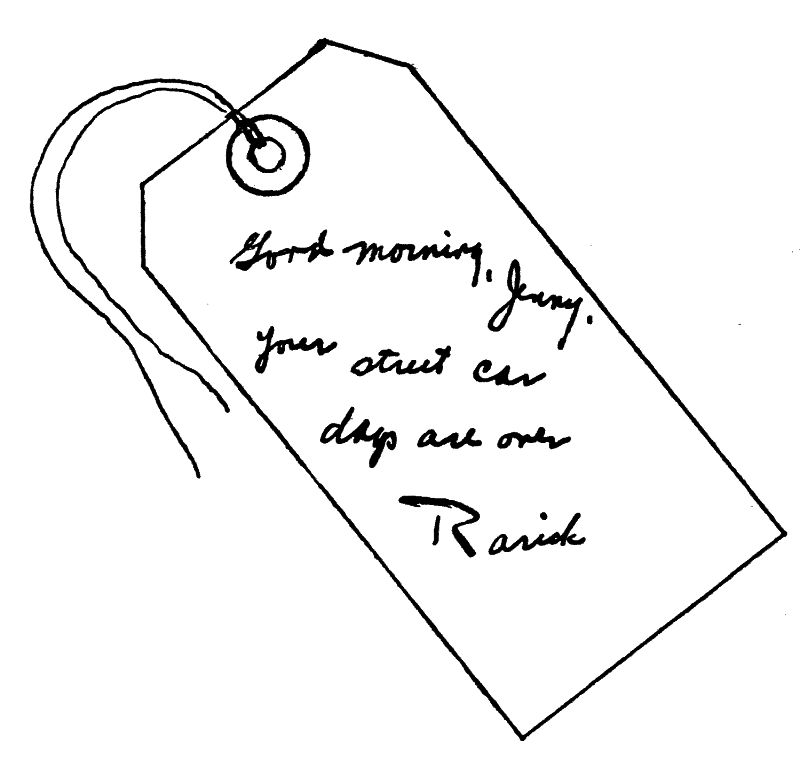
Good morning, Jenny. Your street car days are over
Rarick
That was about as demonstrative as Rarick could bring himself to be, even back in the days before their fairy tale had begun to happen.
“Good morning, Jenny. Your street car days are over,” he had written during the fifth year of their marriage. During the first year he had sent her a modest little traveling-case for a birthday present, but the card had read: “Pack my love and some of our dear dreams in this, for our walking-trip through the Pyrenees.”
That had been before the acquisitive, tight-skinned look had spread itself over the face of Jenny: before the fox had leaned out of the nervous and intelligently homely face of the girl he had been proud of himself for choosing from a world that seemed to him populated with girls with no faces at all, only a vacuous geometry of pleasantly related features.
No one but God and Rarick knew that the dowry that went with Jenny had played no part in his choice. Sometimes, as the something flowed out of their relationship that had been precious to him, it seemed there must be some way to tear open the secret chambers of his heart and reveal this truth to Jenny, on to whose lips, not so many years after marriage, had crept occasional innuendo.
What she did not or would not remember was that it actually was well after their engagement that Rarick, a young man from the outside of her circle, had come to know about the twenty-five hundred dollars.
What she did and would remember, as if her mind were a magnifying-glass under which a small mental image could become Gargantuan, was the hot August day when they had taken the street car together for the Union Trust Company, and withdrawn from her safety-deposit box there, the twenty-five hundred dollars’ worth of government bonds which were to be converted into capital investment in the Nick Nack Store.
That fact, in these years when Jenny was already buying an eighty-five-hundred-dollar bauble far more casually than she had once bought an eighty-dollar one, never lost its luminosity in the dark places of her mind. It was a piece of phosphorescent memory. A cold, flameless light that tinged every aisle of her mind where he was concerned, and which she kept dancing before the eyes of her husband like a signalman on a bridge at night swinging his lantern.
Behind her reminder to him that he was the thirteenth richest man in the world there trailed the unspoken tagline, “thanks to the start I gave you by intrusting you with my inheritance,” a string of words which, spoken or unspoken, traveled through him in a groove that innuendo had worn down, his live nerves the trolley of transmission. Rebuttal would have meant the fatal act of admission to her implied word. Rarick had learned various kinds of silences.
“I haven’t minded the years of your stubborn refusal to pretty nearly everything I’ve asked for myself, Rarick. It is Jennifer now. I want the child to see the light of her fifteenth birthday in the Ficke house. That’s not asking much of a man many times a millionaire. The pity is that it has to be coaxed out of you.”
“The pity of it” clung in a burr-like phrase to his brain.
The pity of it. The pity somehow of everything, including this flavorless beginning of another day. Pretty Jennifer, who had everything, and now, at barely fifteen, was so cruelly fretted, aided and abetted by a doting mother, with wanting more than everything. After all, if you had two motor-cars, there was only left for you to want three, if the goal of your acquisitiveness was things. And things. And things. It was an entirely different kind of wanting from the desire to own a Buick sedan when you owned no car at all. The difference between desiring a Buick sedan when you owned no car, or desiring a third car when you already owned two, was all the difference in the world. The pity of it. Jennifer at fifteen, who had a good mind, was a good pupil, and was a phantom of delight to her father, already too busy wanting more than everything.
That kind of thinking made him heavy and pedantic and old-as-the-hills, as a father.
The little girl who wanted more than everything.
Damn her mother.
The phrase shot through his mind like a burst of flame, startling him horribly.
Under cover of Jenny’s steady runnel of accusative and importuning talk, he began to reason with himself, to calm himself, to rid his mind of the taste of the phrase that had shot through his mind in sacrilege to this woman who shared his bed.
As mothers went, Jenny would have stood impeccable before any jury. She wanted passionately for her young. She was forever baring herself to his scorn by asking in their name. She was a doting, gloating mother, fierce for her offspring, yet, withal, sweet with them and to them. Many a night through she had sat unnecessarily, but tirelessly, beside the bed of Avery, whose first years had been precarious ones. The death of two infants had gone hard with her. Jennifer was her doting, her waking, and her sleeping thought.
Rarick, whose manner was not fortunate with his children because he was seldom at ease with them, could not have formulated into words, except in vague fashion to the effect that she spoiled them, the stubborn wall of opposition which he erected between himself and Jenny’s plans and dreams for her children.
“It is as if you were jealous of them,” she had barked at him once, hysterically, when he was opposing an indoor roller-skating rink across the top of the house.
No. No. No.
Without his knowing how to reach out a hand to stay them, except in vague fumings and consistent conservatisms, the entire kingdom of his household was drifting like a bit of land disassociating itself from the mainland to become island, out into some high tide beyond his reach. Jenny and Jennifer and his boy Avery were on that island. He was back helplessly on the mainland; and Jenny, mark you, mind you, no otherwise to it, was to blame! The bitterness of that tore at him constantly, like a flame pulling itself off the candle.
Jennifer, for a time, while she had been a little pupil at Mary Institute, had been something of an eager student, with a hint of her mother’s old air of desire to know, about her. Rarick had said little, but her school reports had been a source of deep private pleasure to him; and once he had carried about in his pocket an essay of hers, written on ruled paper, called “WHY WE LOVE RUSKIN.” He had filched it off her desk and returned it there a few evenings later when he observed the child scrambling among her possessions for what might have been the essay.
Rarick had not, up to that time, known who Ruskin was, and it elated him no little that the enlightenment should have come by way of his daughter. “In mastery of prose language he has never been surpassed,” the thirteen-year-old daughter of Rarick, undismayed by discursive eagerness and floriated mannerism, had written in her roundly vertical chirography. It was this phrase out of the mouth of his babe that must have lain engraved upon Rarick’s memory when, years later, he acquired, at what was said to be an astonishingly high price, a page of the original manuscript of Ruskin’s Præterita.
Suddenly that brownish, rather studious Jennifer of those days back in the solid square house on MacPherson Avenue had slipped from her little-girlhood into a high-strung, mature-faced disciple of her mother’s ambitions for her. The home in Westmoreland Place. Finishing school in Tarrytown.
Now here was family history repeating itself. It had been the same way when Jenny began to “feel her oats,” as Rarick was in the habit of putting it, in the MacPherson Avenue house, and was casting an eye toward Westmoreland Place. Jennifer’s graduation reception must be held in the new home, and not in the twelve-room yellow-brick one on MacPherson. The neighborhood was running down so. Stores. Flats. Even the G. H. Francises were talking of selling.
The little brown jug of a Jennifer of the MacPherson Avenue house was now the slip of a young miss, straight as a paper-cutter, with the sophisticated eyes that for the life of him her father could never catch and hold in a glance.
And now that brown child back there, whitened because her freckles seemed to have come off, this Jennifer whom he was casting about, in his futile way, to save, what was left of her, for himself, must have her fifteenth birthday in a house on Fifth Avenue that almost faced the Metropolitan Museum.
To think that he, John Rarick, who had once dreamed dreams no bigger than that walking-trip through the Pyrenees, should be in a position to give her such a house. Was Jenny, after all, the natural and doting parent, and was he to Jennifer the grudging, silent father? Was he too finished with youth to know his own children?
Could his dreams for Avery, the boy, slip between his fingers, too, as this mother of his began to demand his rights for him? Would Avery grow up alien to a father who seemed to have no shred of youth left that would enable him the better to understand the youth in his children?
From what was it he was struggling to save them? His own innate sense of rightness could be no deeper than his wisdom, and who was he to be cocksure of his wisdom? After all, what was the meaning of this success, which sometimes threatened to seem chimeric to him, if it was not to enable him to do just such things as give Jennifer her fifteenth birthday in one of the most beautiful and expensive houses in the world?
Success had done its share to teach Rarick himself new and complex appetites. He was a philatelist of elaborate and expensive tastes. There was in one of the pockets of his waistcoat, which was hanging over the foot of the bed, a famous Gnostic gem, heliotrope, engraved with the sacred name “Abrasax.” A museum in Boston had been bidder against him for that gem. There were in that same pocket, result of those same tastes acquired through his growing wealth, an ominous and luminous opal, a tiny agate ring with a runic inscription of the late-Saxon period, and a transparent aquamarine cut en cabochon with the figure of a hump-bull. In his library, at this period, were celebrated “firsts” upon the shelves; a Tintoretto, a Greuze, and a triptych of the Cimabue period upon his walls.
What Jenny was demanding for herself and her children were the equivalents of the runic gems, the celebrated firsts, and the misty Greuzes.
No wonder, as she lay there beside him, silent for the moment, the lines about her thin lips were tight with the distaste of their state of constant asking, and the stretched look across her face was the look that had been written there by the constant and almost automatic opposition he had been erecting for years against the nature of her desires for herself and her children.
His children, even the small boy Avery, approached him only through the mother. The mother herself approached him as a diplomat goes to the conference table, her points carefully tabulated in the portfolio of her mind.
A man, if he loved them, could hold out only so long against his children....
He swung himself to a sitting posture on the side of the bed, and reached for a robe to slip on over his nightshirt. He was short, somber, gnome-like, and a little ridiculous in his nightshirt; and he never forgot it.
“I’ll buy you the Ficke house, Jenny.”
During the last six months of the six years the Raricks had occupied the Ficke mansion, a man by the name of Dr. Felix Gerkes had lived on the top floor of the house. He occupied two rooms and a green bathroom with a frieze of mermaids over the tub. His meals for the most part were brought to him and served on a card table beside a window that overlooked Central Park, which separated him in a diagonal from the Museum, where he had spent twenty-one years in the archæological department. He was also an Indianologist of first-rank repute, a man who had been frequently endowed with honorary degrees in the realms of scholarship and science.
He was the author of numerous brochures and pamphlets, a text-book on geology that was in general use throughout American colleges, had written three books on amulets, precious stones, and meteorites, and was regarded as a foremost living authority on religious uses of stones among primitive peoples.
He was a lean, shabby fellow, with a walrus-like mustache and a conspicuously prominent forehead with thin stringlets of hair brushed sidewise across what threatened to become a bald horseshoe. His clothing, so loosely it hung, seemed to have no points of contact with his body.
The women of the household, even though weeks might pass without their so much as encountering him, and then only in a hallway or on the rare occasions when he dined with the family, thought him repulsive, and considered it disgusting of Rarick to insist upon having him there.
A curious bond existed between these two men. They had first met when Rarick had been directed to him for advice concerning a contemplated purchase, for his collection, of a necklace of banded and variegated agates, onyx, carnelians, and sards, attributed to the first century, A.D.
In the course of a long and enlightening conversation with this wise, strange man, who wore a hexagon-shaped Chinese skull-cap with a crystal button on its peak, Gerkes had quoted from the Pantagruel of Rabelais, reciting almost word for word that part of the book which describes the oracle of the Dive Bouteilly and its seven columns of sapphire, jacinth, diamond, ruby, emerald, “more brilliant and glistening than those which were set in place of eyes in the marble lion stretched before the tomb of King Hermias. The sixth column of agate, the seventh of transparent syenite with a splendor like that of Hymettian honey, and within appeared the moon in form and motion such as she is in the heavens, full and new, waxing and waning.” In the further course of that casual hour’s conversation, Gerkes had discoursed upon the seven heavens of the Mohammedans, white lapis-lazuli, the sack of Constantinople by the Sassanian Persian king, Khusrau II, Navajo silversmiths, Figdor collection in Vienna, use of black and white enamel on bezel, cramp-rings, Edward the Confessor, native Indian mountaineers of California, Liberian silver, Catherine von Bora and her marriage to Martin Luther, Cleveland Museum of Art, Antiochus IV, aluminum kitchenware, alleged curative effects of violet-blue, John Ruskin on crystals, balas-rubies, Flinders Petrie, Field Museum of Natural History, and the snake story in Gesta Romanorum.
Rarick, who had just returned from Atlanta, where he had contracted for the annual run-of-the-mill output of two million cotton handkerchiefs of the largest three concerns in the South, sat in the musty little office of Gerkes, which was laid out at the moment with stone arrow-heads of a Navajo collection, and let the wisdom of this slow man flow against ear-drums that were still throbbing with the barter for the delivery of the two million cotton squares that were to be sold in eleven hundred and eight stores at five cents apiece.
There were lying undercurrent in Rarick’s mind at the time of this talk, an impending conference of the Mountain region and Eastern store-managers, with an eye to further standardization of window display; a contemplated monopoly of the output of a paper-napkin factory near Brattleboro, Vermont, and a trip to Springfield, with one of his buyers, a German, for the purpose of demonstrating to an American toy-manufacturer how to produce a celluloid doll, the equivalent of the German product, which could retail for ten cents. There was further at work under the surface of Rarick’s consciousness, a major plan for the formation of a policy, not yet revealed to his company, for the establishment of a Rarick store in every city of seven thousand or over, in the entire country.
Years of nights of lying awake over that immense project were about to fructify into action.
The thirteenth richest man in the world sat in that musty pocket of an office with Gerkes until museum attendants began to turn off the lights and rattle keys. Then Gerkes, who loved talk, and who, deep in the midst of a discourse on amber deposits in the Stone Age, had found a listener, clapped on his shapeless hat and walked home with Rarick across the twilit park, depositing him at his door, without so much as a glance up at the pale splendor of the façade of the Ficke house, which John Rarick had purchased by sealed bid at sensational auction seven years before. That meeting was the beginning of an impeccable friendship between these two.
A week later, Rarick invited Gerkes to lunch at a downtown business men’s club. Gerkes did not belong to the world of men to whom lunch is a social or business ritual. He either took his off a lunch-stand in the vicinity of the Museum or cut slivers with a pocket knife off the small loaf of American cheese he kept in a desk drawer along with a box of Swedish biscuit.
His imperviousness to surroundings was colossal. He had once lunched with the King of England over a matter pertaining to the Jubilee jewels, and was unable later to describe the occasion in anything except the contents of the discussion.
He ate sparingly of Rarick’s carefully ordered luncheon, giving little if any heed to it, and once more, apropos of the first-century string of agates and sards, let his discourse flow from the crammed stock-room of his mind.
Here was a man who, in casual discussion of a mediæval and practically obsolete gem, could quote from the Divina Commedia the lines in which Dante uses these stones as a symbol of joy divine:
“L’altra letizia, che m’era gia nota Preclara cosa, me si fece in vista Qual fin balascio in che lo sol percota,”
and then, with a mental handspring and a Rabelaisian twist of the old rascal in him, which was absurdly out of keeping with his odor of chalk dust and blackboard, would lean his walrus mustache into Rarick’s ear with a foul bit of anecdote about a youth with a ruby studded into his flesh, who fancied the chryselephantine statue of Athena by Phidias.
After the boiling turmoil of a morning that held a conference on the feasibility of installing soda-water fountains in the west of the Mississippi areas, a complicated discussion with three architects on the standard fronts of Rarick stores, a long-distance-telephone conversation with the Chattanooga real-estate office on a ninety-nine-year lease for a second store, and the consummation of an order for one hundred thousand bathing-hats, to walk with Gerkes through the sarcophagus of his mind was like emerging from noisy sunlight into the green twilight of the Italian cypresses Rarick was fond of transplanting, in long aisles, from Sicilian hillsides to his own.
Here was a man who had a decayed-looking green circle on the front of his neck, from a brass collar-button, which he was never to discard, even after Rarick had sent him precious ones, but to whom, on the other hand, a blemish on the crystal flesh of an art-object was something to cause his own flesh to crawl upward.
Some five years after these meetings between the two, Gerkes fell ill of a flaying neuritis, and, tracing him to the lair of his dwelling, Rarick found him in a small room in the high-up rear of a Twenty-third Street rooming-house, books stacked from floor to ceiling, and exactly three personal objects in evidence. A wooden-backed hair-brush, a pocket comb, and a tooth-brush, sharing the dresser-top with an assortment of Aztec arrow-heads, proof-sheets of an article on scarabs for the Encyclopedia Britannica, a copy of Plato’s Phædon, William Langland’s Piers Plowman, and a World Almanac.
If Rarick had expected protest when he suggested the move from these quarters to the suite at the top of his home, nothing of the sort happened. With his imperviousness to environment or even to the sense of personal obligation, Gerkes took up residence under his friend’s roof. One had to live somewhere. Money was something you shared if you had it, or you accepted if you had not. Within a week the walls which Jenny had recently had done in yellow brocatelle, were plastered with maps, and the furniture itself littered, as the lodging-house room had been, with the story of the dawn of the human race as told by flint-head, ax, and spear, littering up the decorator’s idea of a perfect example of a suite done in the manner of the Second Empire.
Jenny’s kind of opposition to the invasion of Gerkes had been tinctured with the wisdom of a certain restraint. Here was one of the times it was not good to oppose Rarick. When his head seemed to jam down tightly between his shoulders, and his lower lip shot out, and his eyes, which so seldom met hers any more, slid up under their lids, leaving a horrid effect of just white ball, Jenny had the intuition to know that here was not the time to put up active opposition.
She had missed this scent a few times, once in particular over an apparently trivial matter that had to do with Avery and a week-end stag party of eleven school companions which she planned for him on board a motor-yacht which she was maneuvering for his father to give him on his fifteenth birthday.
The idea of Avery on his own private yacht, lording it as host over eleven youngsters to whom a yacht was that day’s toy, was roiling to Rarick. There had been a similar scene, not two months before, over a cigar-shaped roadster for Avery; but then there had been high, bitter, even more terrible words and Rarick’s foot had come down with an emphasis that Jenny somehow knew better than to further oppose, and Avery had not even been allowed to come home from school at Newberry over the occasion of his birthday.
There had been a matter that had to do with Jennifer, who had played high stakes beside her mother at the baccarat tables of Nice and won sums large enough for the papers to carry the story in headlines that had been the occasion of peremptory cablegrams for their return to America and had virtually shut off subsequent trips abroad.
There had been the affair, too, of the young Argentinian, son of a castor-bean magnate, driving his Hispano-Suiza into the swimming-pool at the Roslyn, Long Island, estate. Jenny had been as outraged as Rarick, except that he went to the extreme of keeping the house closed for two subsequent seasons.
There were certain well-defined limits to opposing Rarick, which were none the less tricky limits, because there seemed to be no way, except the intuitive one, to anticipate them. He would give in on many a grand issue, such, for instance, as the Ficke house, Jennifer’s fabulous string of matched pearls, or Jenny’s whim for five thousand acres of French-Canadian tract north of Quebec, upon which they had built an artificial lake, a forty-room chalet, “The Cataract,” and which had been opened exactly twenty days in five years. On the other hand, a trifle like Avery’s roadster, or this matter of Dr. Gerkes, would set his head rigidly into the valley of his shoulders and square him for fight.
The coming of Dr. Gerkes was one of those occasions. This time Jenny knew it even before she raised the first faint dust of issue; but she could not forego that first faint dust. The coming of Gerkes angered her. It went against the grain. Not that, offhand, it would seem to cause much of a ripple in a household where thirty-one servants reported to the housekeeper every morning; but it did matter more than was discernible at the first glance.
From the first, Jenny had found the Ficke house deceptive. A Gothic library, two stories high, which ran across the entire Fifth Avenue frontage, a drawing-room of enormous proportions, a Roman dining-room into which you ascended by Pompeian-marble steps, and a glassed-in conservatory for which a breakfast-room had been sacrificed as Rarick’s passion for difficult and exotic transplantation began to grow, left embarrassingly few bedroom suites.
An additional story would have marred the Hellenic grace of the building, and the owner of the adjoining pile of magnificence felt affronted, rather than tempted, by the Rarick offer to buy.
The yellow suite assigned to Dr. Gerkes subtracted one from the five small suites of guest-chambers that Jenny had so elaborately planned and redone. It is true that the comings and goings of Gerkes, who preferred to use what was known as the service-entrance and the small rear staircase that led quite privately up to his rooms, made practically no dent in that household. He dined in his rooms, except on those rare occasions when the family was home alone and Rarick wanted him at table. He was seldom, if ever, seen in the wide, beautifully vaulted corridors of the house; and yet to Jenny there was something repulsive about his being there at all. The shabby black figure somehow recalled the musty memory and figure of an old music-teacher back in her St. Louis girlhood, whose face, close beside hers at the piano, and his audible breathing had been repellent to her. A lady’s-maid had gossiped to Jennifer, who gossiped to Jenny, that he used only three towels a week, and no bed-linen, because he slept on the floor, wrapped in one of the beautiful canary-yellow camel’s-hair blankets. A secret survey of his rooms, one day during his absence, revealed to Jenny’s horrified eyes the yellow-brocade hangings and bed-coverings removed and crammed into a corner, the tops of her lovely curving period-furniture covered with a layout of lean-looking hair-brush, a whisk broom, and primitive stone implements, her paneled yellow walls hung with pin-studded maps, and, on the mantelpiece, beside the meticulously right ormolu clock, a box of Swedish biscuit, a cube of American cheese, and a huge pocket knife, open.
That evening, before they went down to dinner, Jenny’s anger overflowed her discretion.
“There’s a time and a place for everything, Rarick,” she said to him, as he stood tugging at his collar in the enormous mirrored bathroom which gave off their bedroom. “That man is no more comfortable here than we are in having him.”
Standing in a foundation slip of coral-colored silk, over which she was presently to slip a coral-colored evening dress of all front and no back, her carrot-colored hair caught upward in the tight perpendicular line which accentuated the narrowness of her head, she could see Rarick’s neck, through the wall of mirror, drop into the slit of his shoulders, and that peculiar look of the hunchback which she dreaded, and of which she was wary, come cunningly into his face.
“What man?”
“Gerson, or whatever it was you said his name is.”
He turned, in his black trousers, stiff white shirt, black suspenders, still tinkering with his tie, so that, as he faced her, she could see his eyes ride up under his lids.
“I said his name is Felix Gerkes,” he pronounced, slowly and meticulously, as you might mouth a lesson to a child. “Dr. Felix Gerkes has condescended to come and make his home here.”
“Isn’t it usual, Rarick,” she said, her rising anger crowding closer on her discretion, “for even so great a patron saint of indigent college professors as yourself to consult the members of his family before introducing a worthy outsider into the household?”
“There are few demands I make here. This is one of them.”
“You have a young-lady daughter to consider.”
“That is precisely what I did, when I introduced into this madhouse a human being out of the world of ideas.”
“I see. You feel that Jennifer’s scientific education has been neglected and that no young woman is equipped for life without a Ph.D. knowledge of the glacial age,” she said, and glittered as she stood there with her bronze-colored eyes and the points of light off the tapping toe of her slipper. She could have plunged her long jeweled fingers into the valleys of his shoulders and shaken him, as a smothering sense of futility began to crowd her in.
“Not at all, Jenny. Our daughter’s education is all one could ask. She knows a Hispano-Suiza from a Rolls-Royce. She knows a Cartier setting, Theodore at the Ritz, her finishing-school ‘R’s,’ and how to stack her artichoke leaves. I notice our son, too, already has quite a way with his artichokes.”
The speech was not like him, but rather in mimicry of what she might have said under similar circumstances.
“What a devil you are, Rarick!”
“A poor devil, Jenny,” he said, his face as pulled-looking as tarpaulin.
“You are a poor father.” She was going to add, “and a poor husband,” but she let the words lodge in her eyes.
“I am that,” he said, replying to the spoken and unspoken indictment.
“What is it you want of us?” she cried. “Must you oppose your children on every occasion, just as you have always opposed me? Is merely the fact that we want something, sufficient itself to dispose you against it? Why must you always be the stern parent to them, with me the buffer between? What do you want?”
She did not know it, but she was voicing the cry within his heart.
What did he want? He wanted some of the intimacy from that boy of his that was Jenny’s. He wanted some of that intimacy from Jennifer. He wanted.... What did he want?...
“Do you want your children to skip their youth, so that they may follow in the footsteps of some doddering college professor who spends his life fiddling among arrow-heads?”
“I want Felix Gerkes in my house,” he said, climbing back from what was sure to be a discussion of defeat by reason of what he considered her colossal lack of logic, “because he knows things that we don’t know. That we cannot buy for them. He has not mere learning. He has wisdom.”
“I see. Why Eskimo Indians like blubber.”
There was absolutely no way to capture a focal point of discussion when you found yourself in argument with such a woman. She invariably answered you in terms of something irrelevant, making you wild with futility. Damn her! Damn her! In the years since that thought first lightened into his brain, it had flashed there with recurring frequency.
“Yes, Jenny,” he said again, driven to the extremity of employing her same skidding method, “and why your son, a second-year boy at Newberry, maintains two roadsters, a motor-boat, a trotting horse, and fails in his mid-year examinations.”
“No man ever understood a high-strung boy less than you understand yours!”
The dart struck sure, and sent his head retreating down into his shoulders. True. True. Too, too true.
“Nor a gay and beautiful daughter, one with brains, let me tell you that, although you prefer to treat her as if she were a moron. She’s a match for your professors. Jennifer’s got brains!”
“Exactly, damn it all! And for what? Waste. Waste.”
In a world of superficial interests, filled with the need to be clever and sophisticated, you could be clever with the sharp edge of your brain, if you had one, and sophisticated on a shoestring of intelligence and no heart.
“Your merely clever person is only a first-rate second rather.”
“Try being one.”
“I can’t; it’s not in me.”
“Lots of things are not in you, Rarick. The ability to meet your world is not in you.”
“I wish to God it were not so deeply in you.”
“Gerkes’s world, I suppose....”
“I don’t know his world. He knows the secret of things and of not being smothered by them. Like you. Like me. Like your children.”
“Obviously, from the look of his hair-brush.”
You couldn’t argue with a woman like that. You couldn’t. You couldn’t. The crazing sense of futility....
She was in her gown by now, a sort of henna-colored affair, as if the threads had been picked from her hair—a gown that wrapped her eccentrically thin body on a diagonal, rushing to a high ruff about her neck in front, cut daringly, almost to her waist line, behind. Between the bang of her hair and a stiff, enormously brilliant dog-collar of diamonds, her eyes were red and level and full of the impudence of her remark.
“Doctor Gerkes remains, Jenny.”
She shrugged her shoulders and walked out.
Damn her! Damn her! Damn her!
A story about Jennifer Rarick went the rounds that winter, creating hilarity at many a cocktail and dinner party.
It seemed that the Rarick house, shiningly conditioned, was now being shouted out by sight-seeing-omnibus megaphones as the billion-dollar Ficke-Rarick mansion purchased with Rarick dimes.
One morning, just as Jennifer, in riding-habit, was emerging from the house to enter a large fawn-colored roadster which she was accustomed to drive herself across the Park to the academy where she kept her mounts, one of these omnibuses slowed while the megaphone roared of Rarick dimes and billion-dollar mansions.
Throughout this canned oration, the daughter of John Rarick, one hand against her slim hip, the other thumbing her nose at the omnibus, held posture, precipitating the picture by a dash into her roadster at its conclusion, and leaving a gasping and bucolic sight-seeing omnibus load not quite sure that it had happened.
Whether it did happen or not, the gesture might be said to be somewhat typical of Jennifer. I am. You are. Take me. Leave me.
Usually you took her. Even at her worst, when she was cocksure and tiresomely sophisticated and pseudo and pretentious, there was about her a hearty self-loathing, concerning which she was robustly frank.
“I despise myself,” she was constantly saying to people on club verandas and in grand stands at polo matches, where patter predominated. “I am a swine. I’m N. G. I’m stealing a ride through life. I’m a panhandler.”
After a fashion she meant it. After the fashion of one who attempts to appease a dissatisfaction by throwing to it slops of words.
People were always saying of her, “She has brains,” in the key of saying, “Too bad, the girl has brains.”
“So’s my old man,” was Jennifer’s usual retort, in the slang with which she hung her speech. She meant this. She admired her father from the distance that lay between them. She wanted his respect and, strangely enough, gave him precious little of hers.
The evening following his scene with Jenny regarding the coming of Gerkes, Rarick sent for his daughter.
In a house filled with the confusions, the comings, the goings, the ringing of telephones, and the hurrying of servants, that the two women, mother and daughter, managed to create about themselves, the occasions of family conference were seldom enough.
When the summons came for Jennifer to go to her father, in the library, she was in the act of slapping about her rooms, with her own confused English maid and her mother’s Breton maid hurrying at her heels, in the effort to help her toward a dinner engagement for which she was already thirty minutes late.
The fact of the matter was, she had remained shockingly overtime at a bridge game at the Mayfair, vainly trying to retrieve a several-hundred-dollar loss.
Jennifer was of that species of tormentor who, abusive of her servants, was none the less beloved by them, because, quickly contrite, she wooed them back by anointing their wounds with tips and gifts.
It was her maid Mariana’s boast that these tantrums kept her supplied with furs, French gowns, and even jewels.
The last time Jennifer had been summoned in this fashion by her father was about two years before. She had bought on a dare, at the auction of a famous Long Island estate, a cigar-shaped roadster with an Italian engine of very special make, for eleven thousand dollars. The estate was being sold because the owner had been killed in this very car. Jennifer had stood on a table in the garage and led the spirited bidding.
Rarick, after a high and ugly scene with her in the library, had paid the eleven thousand dollars, and the day following, in her enraged and humiliated presence, had sold it to a dealer for twenty-five hundred.
“The meanest man in the world,” Jennifer had ground through clenched teeth into her mirror after the episode, the tears of her humiliation splashing down a face which, although molded after her father’s, had a lightning beauty that darted into it and played around her eyes and her lips. A straight brown slab of a girl, with a brilliant sort of Jeanne d’Arc directness to her eyes, which were surrounded by a mediæval-looking curtain of straight brown bob.
There had been, too, the highly unpleasant occasion when, like a small girl, Jennifer at twenty had been obliged to endure the unendurable indignity of standing beside her much younger brother for a dressing-down from Rarick that had to do with Avery’s presence—to say nothing of her own—at a swimming-pool party at Greenwich that had found its way into insinuating print.
As a matter of fact, both Jennifer’s and Avery’s presence had been the result of a flat tire in front of the estate of the friends who had detained them. But somehow, facing her father, as she stood beside her slim brother, there on the mysterious beauty of a sixteenth-century Kuba hunting-rug, the truth of the story seemed too flimsy to bear the telling, or something grim and hating in these children kept them silent. Rarick was always to believe, not from what they said, but from what they did not say, that their presence on this notorious occasion had been deliberate.
In any event, a summons to her father in the library was grimly associated with the scratching memory of scenes like those.
Then there had been the excruciating occasion when Jennifer and her mother, returning from a season at Deauville and Le Touquet, had successfully passed customs officials without declaring three important and perfectly matched pearls, which they had sewn on to a beaded gown. There had been an outrageous scene in the library when these facts became known to Rarick; in fact, rage and terror had caused Jenny to swoon—cutting her forehead as she went down—at her husband’s reiterated threats to reveal the whole untidy business.
There was rankling, in some terror at the moment, in Jennifer’s mind, a dread that an extremely private dramatic evening, entitled “Casanova, Be Careful,” which had been staged with great lavishness in the garden-amphitheater of a Connecticut estate, was through some mysterious leak about to find its way into notorious publicity.
Hang it all! she had been lured into the thing chiefly because it had given her an opportunity to try her hand at what she secretly suspected in herself to be a talent for lyrical writing.
Hang it all! the way to avoid such jams as this was to ditch the home condition. Marry forty-million-dollar Charley Kempner and spawn him square-faced little Kempner heirs with Kempner casts in their Kempner eyes. Or not marry Lew Bissinger and live in embroidered sin with an already married man. Or pursue Berry Rhodes, who was simply unassailable with social position, and who fascinated her. Or just ditch it. Open a tea-room. Write a scandalous book. Hang it all! No parent can hope to get away with moyenâge, maiden-in-a-tower stuff. Yes, she had written the “Casanova, Be Careful” lyrics and danced in the last of seven veils. Damned talented job, if she did say it. “Well, Father,” she improvised to her mirror, “it’s come to this between you and me; has been coming to this between you and me since you popped me into a world I didn’t ask to be popped into. I’m no nincompoop. You’d see to it that a daughter of yours wasn’t. But I’m tired being treated like one. I’m finished. If you want to throw me a million or two to save me from being somebody’s expensive hussy, I’m not too proud to accept it. If you don’t, and since I’m not made of the stuff you seem to think your daughter should be made of, I’m through, anyway. I’ll go off and write a dirty play and show up the whole wretched business of life as it is lived behind the tessellated walls of the million-dollar Rarick mansion that is built out of dimes. If the walls aren’t tessellated, they ought to be. I’ll give them a megaphonefull that they’ll remember. I’ll tell the story of how somebody took a couple of hair-pins and bent them into a couple of frowns and stuck them into sour dough and made a little man who lived in tall marble halls that kept him looking like a dwarf, and who would have thought he was Napoleon, if he had quite had the nerve, but who only got as far as owning everything in the world he could lay his hands on that had belonged to Napoleon or was about Napoleon. I’ll tell the world about this little man who got so rich on needles and pins that he hated himself—and his family. I’ll tell the world, damn it! I’ll tell....” cried Jennifer to herself, as she ran down the hall toward the library; but not without pausing to snatch up a spangled scarf to throw across the back of her dinner gown, which was cut to one inch above the waist line, where a topaz buckle bit softly into the flesh.
What Rarick wanted with his daughter was to have her meet Gerkes.
He was standing waiting for her, on the hearthstone of a vaulted fireplace that had been lifted out of the palace of a Milanese Sforza, a small man who was forever to be dwarfed by the Gothic grandeur through which he moved, and yet to whom the Druid twilight of such splendor was to become a fetish.
Three enormous chandeliers, designed after the crowns of Merovingian kings, poured cunningly diffused pools of light on to this scene of mediæval resurrection. The very modern young Jennifer, who wore her docked head like Jeanne d’Arc, and whose metallic frock clicked, slouched in on slim, inelegant legs.
Her smartness, even back in the St. Louis days when she had first begun to drift from him, had always been a source of her father’s deep admiration. Not her indubitable smartness in the worldly sense, but the brand of it that was indicated in the intelligent bright dark eyes, set into a head that stood so erect and right between its slim shoulders. She could have been anything, Jennifer could have been, except the thing she was. And the thing she was, without his being able to define the exact why, was anathema to her father.
It was not that she carried her cocktails vulgarly, or said gross things with what passed for the new frankness. She was no more and no less than any girl of her upbringing. Or her mother’s upbringing. If anything, a little more. She drank rather less, smoked not at all, and, in her own phraseology, had remained a virgin chiefly because she had never let her curiosity get the better of her.
When she said a thing like that, Rarick ground his fingers into his palms to keep from boxing the ears of the consciously modern young Jennifer. She was so cocksure of what a sophisticated, unillusioned, amusing thing it was to be Jennifer. She was tiresome and a swine, yes, she was willing to admit, but only in the sense that her rattling-good brain was going to waste in cocksure and debonair fashion. You couldn’t live in her swinish set and take the world seriously enough to concentrate. Hang it all! why try to write plays, even if you felt a talent for it, when, to be true to the life she knew, they would have to be dirty plays? Or why do charity or social work, when the world hadn’t time for the dirty-nosed little darlings even after you’d gone to all the trouble to save them for it. Part of the amusing thing it was to be Jennifer was to be brutal and frank and unsentimental and greedy and a little foul-mouthed.
To Rarick, this young woman of his flesh, his board, his keep, who stood there on the hearth-rug before him, glittering in her gown of fake armor, was as strange as if she had just stepped full grown from the life-size silver-and-chalcedony Zeus that stood on a credenza against the wall. Everything he felt about this illuminated edition of himself was imbedded in disapproval. Had been, since the Mary Institute days back in St. Louis, when she had stopped bounding the state of Missouri for him in an unaffected little voice that was appealing, and had first started going to football games in the white-kid gloves her mother provided for her, with boys in their first long trousers, who came calling for her in their family automobiles. He despised what she had become, chiefly in terms of what she might have been.
“You sent for me, Father?” she said, the glance she guarded from ever meeting his sliding to the spot where his graying hair hung in the Napoleonic forelock down his brow, and simulating unconcern by feeling very concernedly along the rear edges of her shining curtain of coiffure.
“Dr. Felix Gerkes, of the National Museum and a scholar of considerable consequence, is going to make his home with us. I suppose you know that, Jennifer?”
Jennifer did. In fact, she was the one who had passed along to her mother the first information concerning the thin-bristled hair-brush and the square of American cheese, as they had sat, in pajamas, in Jennifer’s bedroom over coffee one morning. Pretty snide, to stick a fossil in the yellow suite, with the blessed old Gothic mausoleum as cramped as a Harlem flat, when it came down to actual living-quarters.
But nevertheless a sense of relief ran through Jennifer. Thank Heaven, he had not got wind of the whole silly business of “Casanova, Be Careful.” They were damned clever lyrics, if she did say so, but fat chance to get anything but a dressing-down for them from her father.
“I’m like the fellow, Father, when it comes to science, who kept ‘Stones of Venice’ on the geology shelf of his library.”
“Dr. Gerkes’s scientific achievement is by no means all there is to him, Jennifer. I want you to cultivate him.”
His ability to antagonize his children was infallible.
She drew back from his command, with the kind of rearing of the neck that he had beheld countless times in his boy Avery. A dull sense of his impotence, where these youngsters were concerned, was a chronic rage within him.
“I want you to have dinner with Dr. Gerkes and me tonight.”
“That’s impossible. I’m late as it is for early dinner with the Delaney Stuarts. Shibby sails tomorrow.”
The name “Shibby Stuart” was no more anathema to him than a dozen others which were constantly on the lips of his wife and daughter. In fact, there were important reasons of diplomacy why there should be an entente cordiale with Delaney Stuart, president of an Eastern Federal Reserve Bank with which the Rarick Chain, Inc., had enormous transactions. But the picture of Shibby Stuart as he had once seen her lying sick-drunk on a couch in his house, during one of Jennifer’s dinner dances, rose crazily before him.
“You will remain at home for dinner tonight. It may help you to remember you have a home.”
“Don’t be absurd, Father,” said Jennifer, and began pulling at the net edge of her handkerchief. Her rage, which she felt hitting in hot points against her eyeballs, was out of all proportion to the dilemma of being obliged to cancel her dinner with Shibby Stuart. As a matter of fact, even as she had been sliding into the armor gown that clicked, the thought of evasion had flashed through her brain. What with her back stiff and sore from riding a new mount that afternoon, and a more recent invitation to go off to a speak-easy for dinner and dancing with Berry Rhodes, here was an opportunity to pass up the Stuart farewell dinner and incidentally repay Shibby for a last-minute non-appearance of hers that she had recently staged at one of Jennifer’s bridge luncheons.
“It isn’t often I make demands, Jennifer. I let weeks go by without so much as seeing you at the dinner table. This is one of the times I want you here.”
It seemed to her at the moment that nothing mattered quite so much as dinner at the Stuarts’.
“You should have given me warning.”
“You should have had sufficient judgment to know there comes a time when a halt must be called, if you won’t call it yourself. You haven’t sat down to dinner in this house for three weeks or more.”
“Why should I? Everything I do gets on your nerves. If I’m so much as called to the telephone, you humiliate me before a butler by refusing to let me answer it.”
“I have known you to spend twenty minutes of a dinner hour at the telephone.”
“If I say the moon is made of green cheese, then I’ve said something off-color. Hell! why should I want to stay at home, Father?”
He reached out and hit a gong with a baton of lapis-lazuli, padded in velvet.
“Miss Jennifer will join us at dinner,” he said to an immediate butler.
She waited until the door had closed again, and then, with her face clenched and her hands clenched and her gown making jangling little sounds as the quivers of her wrath shot through her, she lowered her face until it almost touched her father’s.
“I just hate you sometimes,” she said, and began to cry the invariable tears of anger and humiliation to which these scenes could reduce her. “I wish I had the guts to go out and scrub floors for a prostitute, rather than put up with being treated like one here.”
A fit of trembling that went through him like a tree-shake caught him at the words which came off her lips, which were so close to his face that it was as if he could feel their shape.
“You will have dinner at home tonight, Jennifer, even if your temper does turn you into a barmaid.”
“It must be a splendid feeling to have to force the members of your family to your side.”
“It is, Jennifer,” he said, and looked at her with what, for a moment, threatening to disarm her, seemed like a film across his eyes. She sat down, still pulling at the net edge of her handkerchief and every so often scraping it angrily along her wet cheeks.
“Well, now you’ve got me, what is it you want with me? I suppose it isn’t asking too much to be allowed leave-of-absence to get a message off to the Stuarts. God knows what I am to say.”
He beat the gong again. “Telephone Mrs. Delaney Stuart that, owing to an unavoidable change in her plans, Miss Jennifer will be unable to come to dinner tonight.”
She held her face, during this, averted from the butler’s view of it, a little squeal of rage rising to her throat.
“Now what? I suppose I am to spend a jolly evening at home talking isinglass, or blue grottos, or dinosaurs’ eggs, or whatever it is one talks to fossil-finders.” Her rage ended on a spurt of laughter and for the life of him, he could not see her face break into amusement, her eyes crinkling, and keep his own face straight.
“I want you to meet a great and simple person, Jennifer. A man who has not grown simply great in his work, but great simply.”
“He sounds as if he ought to be done in stained glass.”
“He is witty enough to think that poor wit.”
“Thank you, Father. Any more lilies today?”
“Cultivate Dr. Gerkes, Jennifer. Cultivate Gerkes. You want to learn.”
He knew he was being roiling and didactic and tiresome again but to his surprise, she flashed a tear-stained face at him that was lit with a sudden sweetness, a clear-eyed curiosity to it that was reminiscent of the small brown jug of a girl who had bounded Missouri.
“I do, Father! I know I’m all of a total loss. I’m on to myself, don’t you forget it. I want to sit at the feet of somebody and learn. God knows I don’t know anybody with a pair of feet like that. Trot out this wise guy, Father. I’ll chuck everything and stay home at the indoor sport of improving my so-called mind. Do you think he’d like to collaborate with me on a book I’ve long had in mind, called ‘Sex O’Clock’? Really, Father, I am in favor of more and better brains.”
Jenny came in then, wearing a yellow satin gown that had been dry-cleaned to the color of an old tooth, and so shrunken that it spanned. She had long since discarded it from her more formal wardrobe, but, with a survival of an old instinct for economy, went through the mean and futile performance of reserving it for just such occasions as this, when they dined alone and en famille.
“You look like the devil, darling,” said Jennifer, and kissed her.
“I feel like him and his bride,” said Jenny, stooping to draw at a thread that was raveling at her hem. “I thought you were having dinner at Shibby’s.”
“I’m dining at home with the Department of Arts and Sciences,” said Jennifer, and dropped a large slow wink to her mother.
Across the island of the hunting-rug, Jenny regarded her husband with eyes that had no gleam.
“I didn’t mind canceling the Dentons at the last moment and leaving a vacancy in her opera box, but I don’t relish the idea of also being on Shibby Stuart’s black list, any more than you should, Rarick, considering your banking connections with them.”
“You leave my banking connections to me.”
“Gladly.”
“Never mind, Mother. Father and I have evolved a new philosophy of life. Less philosophy and more life.”
“The philosophy, I suppose, that the rich are all mean and frivolous and vicious, and the poor holy and righteous.”
He regarded her with the masked look to his face that could cause her to say over and over to herself: “Little man. Little man, you. Little fake Napoleon, you.”
“Holy righteousness, my dear Jenny, cannot reside exclusively among the poor while you are you.”
“Attaboy, Father!” said Jennifer, and jammed a pillow into the cave between the small of her back and the couch. “I can forgive a dirty dig if it’s well dug. Can’t you, Mother?”
Her mother glanced at her wrist watch, a singular and precious one, set into the plane surface of a square diamond.
“It’s a wise house guest who is on time for his meals.”
“At that rate, Jenny, our average run of them must be morons.”
“Life among the Raricks,” sang out Jennifer and hurling out the pillow, jumped to her feet and to some inner syncopated rhythm, began teetering on her slim toes down the great length of room that led to an organ at its far end.
Carved down the pipes of the towering instrument was the legend of the St. Gregorian Mass, the meeting of Abraham and Melchisedec, and the Last Supper. A chime, somewhere in the complicated heart of the organ, which was rigged with all sorts of mechanical attachments, gave out the half-hours. To Jennifer’s hilarity, it played the grand operas, stained-window versions of the action springing into light above the keyboards. “Father’s folly,” she called it.
“Jennifer, if you turn that on, I’ll scream!”
“Keep your well-known equilibrium, Jenny. I just wanted to see the fat Brünnehilde, in purple cheeks and corsets, heave in stained glass.”
How small they made him, these women of his. That organ, built in at tremendous expense and effort by tearing out one entire end of the house, was as dear as someone beloved could have been. The storied operas, stalking in stained glass to the pressure of a button, peopled his solitude, plunged, in the glory of melody, through his evenings, saturating his thirsting spirit. Chromoesque tinned music, perhaps, but full of solaces....
“Jennifer!”
“I’m not! I’m not turning it on. Surely, if Father can stand his ‘Faust’ served up to him like Campbell’s soup, you should be able to endure a magenta and majestic trickle of ‘Tannhäuser.’”
“Do you think Gerkes understood the dinner-hour, Rarick?”
“Why, Jenny, what is the matter? The man is not even due for five minutes. I’ve known you to hold dinner three-quarters of an hour without a whimper when the guests happen to be yours, as they almost invariably are.”
“She’s a cave-in from dieting, Father.”
That was doubtless true. It offended him to the point of disgust to see this angular woman responding to a herd instinct that apparently deprived her of logic, trying to reduce herself still closer to her skeleton by nibbling at meal-time on a special faddistic diet of chop and pine-apple slices.
“I’m a cave-in, all right,” said Jenny, and stretched her thin body outright on a divan and pressed her fingers into her eyes and bared her teeth in an on-edge fashion.
“Nerves. Underfed,” said Rarick, eyeing her from the opposite side of the hearth.
“Nerves, all right. Reason, all wrong.”
There descended a silence characteristic of their times together. Taking up an object here and there, as she wandered aimlessly about the museum-like room, Jennifer began to whistle in short, breathy snatches.
“For Heaven’s sake, Jennifer, stop it!”
“Sorry, Mother.”
Silence.
“Say, Dad, what do you call this?”
“That’s a Tau-crossed pastoral staff. French, about the eleventh century....”
“No, I mean the gold panel above it!”
“Oh, that’s a reredos of St. Peregrine. It’s part of an old altar-table. I bought it at the Donetti auction at the same time I got the ivory panel of the Virgin Mary with the pearl crown there, over the doorway.”
“I think it’s a waste of those lovely seed pearls, Rarick. You might have them done into something wearable for Jennifer or me.”
He did not answer.
“I was going to say, Father, I saw what might be a sister panel to that reredos today, at Duveen’s. I was there with Mary Dakin. She got caught in a tumbling market and was trying to unload two Romneys that came with her share of her grandmother’s estate. By the way, wouldn’t be interested, would you, Father, in buying a pair of Romneys? Mangy-looking, but frightfully bona-fide. Girl with a lamb. And Boy with a Goat. Or maybe his was a lamb, too. Well, anyway, Mary’s asking fifteen thousand for the pair, and Duveen’s sent a man to appraise.”
“Not interested.”
“What did they stick you for the pearl-incrusted reredos, Dad?”
“Hellman bid for me ... something like twenty-five thousand, if I remember....”
“Good God!” said Jenny from her reclining position, blowing smoke and holding her cigarette at bare arm’s length upward from her.
“Good God, what?” barked Rarick, ready to be on edge.
“Good God, she’s hungry!” said Jennifer, and resumed her aimless tour.
Silence.
“A Baby Gar speed-boat for your son would have cost half that much. Why is it so much easier to understand your own desire to own a sixteen-thousand-dollar piece of ivory slab than it is for you to understand a boy’s desire for the things that mean youth and sport to him?”
“Because it is not his desire. I am convinced that all these notions to add more and more dangerous and expensive toys to the jumble of things with which you are cluttering his school life and educating both your children to demand, come from you.”
“In which Jennifer is drawn dirtily into the picture.”
“Keep quiet, Jennifer.”
“Sorry, Mother.”
“Your boy demands precious little.”
“I realize that, Jenny. In fact, it is just my point.”
“Fortunately, Rarick, I am of sufficiently tough fiber to nag in his behalf for some of the things he is too sensitive to nag for himself.”
“What are some of those things, Jenny?”
“The things to which, as a rich man’s son, he is entitled.”
“Meaning....”
“O Lord! Rarick, I haven’t it left in me to go over it all again.”
“I’ll go over it for you. Meaning things. Things to keep him moving instead of thinking. Devices for speed. For motion. Things to distract him from books, things to distract him from thinking.”
“Good Lord, Dad, where do you get off? Things? You’ve spent half your life shoveling snide things into the shopping-bags of snide people who need snide things like safety-pins and stewpans. You’ve glorified the American dime by making it stand for things. You’re the Thing King!”
How astute she was! Clever, slim Jennifer, with her sophisticated Egyptian-looking eyes, merciless in her ability to lay him open to himself.
“A major reason why I want to spare my own from the tyranny of things,” he yapped back at them, trying to express, with the chronic sense of futility, some of the malaria of his spirit which managed to keep his family at this kind of antagonized arm’s length.
“You don’t seem particularly inclined to spare yourself the tyranny of those fifteenth-century tapestries or that enameled Pietà up there that cost a king’s ransom, or unpronounceable and unwearable gems with which your pockets are crammed.”
“There is at least something of the story of mankind to be found in historical objects.”
“There’s beauty in that motor-boat Avery isn’t going to get,” sang Jennifer, cupping the tall heel of her slipper in her hand and teetering. “Slim, speedy beauty, let me tell you that. And as for that story-of-mankind stuff, if you ask me, it is pretty much the low-down same, whether you read it off the hieroglyphics of an amulet from Hindustan or study our gigolo civilization through a magnifying-glass shaped like a monocle. And, Father, speaking of gigolos, I’m in love! He’s a window-dresser for a haberdasher by day, and dances at Florentine’s by night. Abbey Chadwick engaged him for her dinner dance, and I’m going to have him for mine next week. He tangos like a patent-leather-haired god, and his name is Nemo.”
“Darling, that’s the name of a rubber corset or a comic strip or something.”
“No, Mother. He wears one and is the other; but, oh, my beating heart!”
“Bicarbonate of soda, darling!”
Why must he stand there with disgust printed on to his features, instead of meeting her vulgarity as Jenny did, by snapping her fingers. Was Jenny, after all, clever and even subtle with her children, giving them their heads, to prevent them from running away? Her children adored her. They were easy and indolent and insolent in her presence. Sometimes he even felt himself hankering for some of that insolence. Avery had once said to his mother in Rarick’s presence, “Shut up, old darling,” and he had rebuked him for it. At that there had flashed between Avery and his mother a look of amused understanding at his lack of understanding. Letters from Avery to his mother were constantly lying about the gold-stoppered bottles and knickknacks of her dressing-tables. He never read them, even surreptitiously, but he knew they were chatty letters that preyed upon the easy indulgences of his mother; and, meticulous as he was not to read, constantly his glance was being snagged by such salutatory exuberance as “Dearest Brick of a Mother” or “Dearest Mother-on-the-Spot.”
That was precisely what Jennifer was saying to her now. “Mother-on-the-Spot, you’re beautiful, but dumb.”
Dr. Gerkes entered then, after the inconsequential manner he had of appearing on a scene without the slightest preamble. His dinner clothes, which he called his “overalls,” because he wore them when he lectured, hung from the rounded part of his back like a suit that had been suspended from a nail. His shuffling footsteps skidded the small rugs from under them like so much silent gravel.
There was a graciousness to Gerkes. A man of almost unlimited intellectual contacts, he could be loquacious enough on subjects where he felt informed, and an indulgent listener to those who, in his opinion, wanted to talk more than he. Stupidity he regarded as a cardinal vice. It made him snappy. His principal income was derived from lecturing, but he could be thoroughly rude to the interrogators who crowded and chirped around him at women’s clubs; and even at the meetings of such learned organizations as scientific and historical societies he was capable of rebuking a colleague for the inattention to his lecture that his question had implied.