THE SALMON AND TROUT OF ALASKA.
Reading edition
By L. A. Beardslee, Captain D. S. Navy.
From the great salmon of the Yukon, to the tiny fingerlings, which in innumerable quantities throng in the various creeks of Alaska, and are as ambitious to seize a single salmon egg as are their larger brethren to appropriate great masses of the same, however illy the bait may cover and disguise the hook which impales it, there is not, I am convinced, an Alaskan fish, which through any merit of its own, is entitled to an introduction to the angling fraternity through the medium of this volume, and to the companionship of the beautiful fac-similes of the flies, which in life they scorned.
From personal observation and collected information, I am prepared to accuse all of the salmon family which are found in Alaska, of the grave offence of utterly ignoring the fly, either as food or plaything, and of depending upon more gross and substantial resources.
They are odd fish, and require peculiar treatment both in catching and discussing. And it is to this cause alone that they are indebted for the honor of being made honorary members of the gallant band of game-fishes of which this volume treats.
I have selected them as the subject of my contribution, because a single glance at the array of well-known names of those who are to be my co-contributors, convinced me that if I wished to present any new, interesting, or valuable facts upon any icthyological subjects within my range, I would have to travel well out of the ordinary tracks, and go prospecting in some “far countree.”
This I have done, and I feel confident that I alone of the contributors have been forced by circumstances over which I had no control, into a situation where the obtaining of my notes became pleasure instead of toil.
The notes which will be woven into this paper are not all of them entirely new. Some have entered into a series of letters, which over the signature “Piseco” have appeared in the columns of the Forest and Stream, during 1879-80-81. Through the courtesy of the editor of that journal, I am permitted to again make use of them.
I have preferred a grave charge against the salmon and trout of Alaska; it is but just that I should explain the basis upon which it is founded, and endeavor to establish my claim to be somewhat of an authority on the subject.
From the middle of June, 1879, to the latter part of September, 1880, I, as the commander of the U. S. ship of war Jamestown, was stationed in the Territory of Alaska, with general instructions to restore and preserve order among the incongruous collections of Whites, Creoles, and Indians of which the inhabitants of that forsaken country was composed.
My command was moored in Sitka Harbor, but during the two summers and autumns of my sojourn, my duties called upon me to make frequent trips of from ten to two hundred miles, to various portions of the Territory.
These trips were made in small steamers which I hired, steam launches and boats of the ship, and Indian canoes, and in them I explored many of the straits and sounds which separate the islands of the Alexander Archipelago.
Naturally fond of fishing and gunning, my Orvis rods, with full assortment of flies, all gear necessary for salt-water fishing, and my rifle and shot-gun, were my inseparable companions; and after days spent in explorations, sometimes of bays and sounds never before entered by white men, and in one case of a large bay forty miles deep by fifteen broad, existing where the latest charts showed solid land only, my evenings were spent poring over works on natural history, icthyology, and ornithology, and jotting down in my note-book descriptions of my finds. Such jolly times! One day a mineral lode, another great flocks of ptarmigan, another a bear, a mountain sheep, or some new fish—gave me something to dream of.
The Alexander Archipelago, of which Baranoff, Kruzoff, and Tchitagofi Islands are the principal, is separated from the coast by Chatham Strait, which, beginning at the southward as a continuation of Puget Sound reaches to above 60° north at Chilkhat; it is from three to ten miles wide, deep and steep, too, throughout, bordered on the coast side by high, heavily timbered, snow-clad mountains, and on the other by high wooded islands. On both sides, many of the ravines are occupied by immense glaciers, from which flow icy streams, the birthplace of salmon.
Running nearly east and west there are several straits and sounds connecting Chatham Strait with the Pacific Ocean, of which Peril Strait, Icy Strait, and Cross Sound, are the principal. These, too, are bordered, as is Chatham Straits, and are the homes of glaciers and glacial streams.
Many of these streams I have personally fished, and among those under my command were several with kindred tastes, and I became possessed of the results of their experience.
I have read all that I could find of works on Alaska, and since my return have naturally conversed much with every one whom I have met who had also an Alaskan episode in his life, and have collected testimony on the point at issue. One and all affirm that my experience has been theirs, and the most strenuous efforts with well selected flies have failed to record a single capture of trout or salmon. The first bit of evidence I collected is worth recording. When the news that the Yankees had purchased Alaska, and thus become owners of the land north as well as south of British Columbia, was communicated to the Scotch Admiral of the English squadron at Victoria, Vancouver’s Island, he ejaculated, “Dom the country! let ’em have it; the blausted saumon won’t rise to a floi.” Such was our united experience and verdict.
Of course, as we caught no end of them (trout and salmon) there were baits which would seduce them, and these were, for the trout, salmon roe, and for the salmon, live herrings.
There was no poetry in our trout fishing, for compared with salmon roe in slippery, sticky, slimy chunks, fish worms are aesthetically dainty.
There are several little lakes and more streams in the vicinity of Sitka; some within reach for a day’s fishing, and some within an hour’s. The principal of these are Piseco Lake and stream, back of and running through the town; Indian River and pond, Saw-Mill creek and lakes, from one to five miles to the eastward; the Redoubt river, lake, and fall, seven miles to the southward; and a nameless lake and outlet on Kruzoff Island, the lake embedded in a deep valley, one side of which is formed by the foot-hills of Mount Edgecomb, a noble, eternally snow-clad extinct volcano. In all of these trout or salmon are abundant in the season; in some both, and in some are found species which do not exist in others.
At the “Redoubt” I believe that all varieties and species are found. The place is named from a huge dam winch the Russians built across the mouth of a deep and wide ravine, thus forming a large lake of the river which here empties into the sea. The dam is provided with a number of salmon gates and traps. From the first run to the last, every passing school leaves here its tribute, seduced by the proximity of the beautiful lake; which tribute, duly smoked or salted, is barrelled for the San Francisco market by a very “lone fisherman,” a Russian who for many years, without other companionship than his klootchman (Indian wife) and dogs, has devoted his life to the business.
If in this paper I make an occasional blunder, by transposition, or misapplication of the terms “specie” and “variety,” or fail on a scientific nomenclature, I beg that it will be remembered that my claim is not to be an authority on icthyology, when such names are necessary, but on Alaska fish, which get along very well with their English, Indian, or Russian names.
I find in my note-book memoranda of the capture of bathymaster-signatus, chirus deccagramus, and even a cotlus-polycicantliocejrfialous, but had not Professor Bean instructed me, I should have continued (and I believe I did) to call the first two after the fish they most resembled, viz., rock cod and sea bass; and of the last named I have lost and forgotten the description. But we can spare him; the salmon and trout will, I feel sure, furnish all the material needed, and I will confine myself to them.
THE SALMON.
Five species of salmon have been identified as found in Alaska; these are:
The Oncorhynchus Chouicha,
The Oncorhynchus Keta,
The Oncorhynchus Nerka,
The Oncorhynchus Kisutch,
The Oncorhynchus Garbosha.
I am indebted to Professor Bean for the above list. In it I recognize some familiar Russian names, and I will supplement the nomenclature. The “Keta” is the big hump-backed salmon of the Yukon, sometimes attaining a weight of sixty pounds; the Nerha is also called by the Russians Crassnarebia, or red-fleshed; and the distinction is well made, for compared with it, the flesh of the other species seems to fade into pink; the “Kisutch” or “black throat” is so called on account of the intense blackness of the roof of the mouth and throat; the flesh is lighter red than the Nerkas, but more so than any other species, and as a table fish it excels all others, bringing twice the price at retail; the Garbosha is the small hump-back, and strikingly resembles the “red fish” of Idaho. This is the only salmon that I am sure ascends any of the streams near Sitka, except at the Redoubt, where the Kisutch and Crassna-rebia are taken in late August and early September. The common name for the garbosha is the “dog salmon,” and a more hideous object than one of them as found swimming listlessly or dying in one of the pools, it is hard to conceive of. I find this note of description: “Aug. 26th.—In a shallow pool I saw a fish some two feet long, feebly struggling as though he were trying to push himself ashore. I picked him up and laid him on the grass. A sicker fish never continued to wag his tail; his skin was yellow, picked out with green and blue spots, from an inch to three in diameter; and one on his side was about an inch wide and six inches long, bleeding and raw as though gnawed by mice. One eye was gone, one gill cover eaten through, and every fin and the tail were but ragged bristles, all web between the rays having disappeared.”
The first run of the salmon is well worth description. About the middle of May, varying from year to year by a few days only, the inhabitants of dull, sleepy old Sitka experience a sensation, and are aroused from the lethargy in which they have existed through the long winter. The word spreads like wildfire, the salmon are coming! Everybody rushes to the heights which furnish prospect, and strain their eyes for confirmation.
One of our sailors, musically inclined, paraphrased very neatly the old song, “The Campbells are Coming! huzza! huzza!” and achieved fame by portraying the emotions nightly under the lee of the forecastle.
So good an outlook has been kept by the keen-eyed Indians, and the Creole boy in the belfry of the Greek church, that when first the glad tidings are announced, the fish are many miles away, and no signs of their advent visible to the unpracticed eye. Ear away to the southward, there hangs all winter a dense black bank, the accumulation of the constant uprising of vapor from the warm surface of the Kuro-siwo, or Japanese Gulf Stream, which washes the shores of this archipelago; condensed by the cold winds sweeping over the snow-clad mountains to the northward, it is swept by them, and piled up as far as the eye can reach, covering and hiding the southern horizon as with a pall.
Presently our glasses reveal bright flashes upon the face of this curtain; and soon, to the naked eye, it appears as though the whole horizon had been encircled with a coral reef, against which the dashing waves were being shattered into foamy breakers. The breakers advance, and soon among them we discern black, rapidly-moving forms, and here our previous nautical experience comes into play, and, “Holymither, d’ye mind the say pigs!” as shouted by Paddy Sullivan, the captain of the afterguard, explains most graphically the phenomenon.
The salmon are coming, and with them, among, and after them, a host of porpoises; an army so great, that an attempt to estimate in numbers would be futile.
The Bay and Sound of Sitka are dotted with many beautiful, well-wooded islands; between them, the channels are deep and blue, and these are soon thronged by the fleeing salmon and their pursuers; the harbor is soon reached; but it does not prove one of safety, for although there are immense flats covered only at half to whole tide, where the salmon could, and the porpoises could not go, the former avoid them, and, clinging to the deep water, seek vainly the protection of our ship and boats, which do not deter the porpoises in the slightest degree. For two or three days, our eyes, and at night, our ears, tell us that the warfare, or rather massacre, is unceasing; then there comes an interval of several days, during which there are no salmon nor porpoises.
I had formed an idea, a wrong one, that the presence of salmon would be made manifest by the leaping of the fish; on the contrary, were we to judge by this sign alone, but very few had visited us.
The first school had hardly gotten fairly into the harbor, before I, with others, was in pursuit.
The cannery boats, and Indians, with their seines, and I with a trolling line and fly-rod.
A single fish apparently, was at intervals of perhaps a minute, leaping near a point. Indian Dick, one of my staff, excitedly pointed that way, and urged me to go. “There! there! sawmo sugataheen” (plenty). I was inclined to look elsewhere, or wait for a larger school; but Dick remonstrated, “Man see one fish jump, sir, may be got thousand don’t jump, be under.” And Dick was right; but a very small percentage leap from the water, of which I became more fully convinced when I went with Tom McCauley, head fisherman of the cannery, on seining trips, or rather on a seining trip, for the affair disgusted me; and, as with my experience of Spanish bull-fighting, one trial was enough. Imagine so many fish that tons were the units used in estimating, penned up by the walls of the seines, into an enclosure, massed so solidly that five Indians, striking rapidly at random into the mass, with short-handled gaff hooks, at such rate that, upon one day’s fishing, this boat, manned by eight Indians and one white man, secured thirteen tons of marketable fish. It was bloody, nasty butchery, and sickened me. Not a fish attempted to leap out of the net.
McCauley supplied me with some data, from his point of view.
“About the middle of June, the fish are plentiful enough to start the cannery, and the season lasts from ten to twelve weeks” He has observed “Seven different kinds of salmon, all of which are good for canning and for the table; but two species which come latest are the most valuable, the flesh being very red and rich with oil” (Kisutch and Crassna Rebia); that “all of the salmon ‘dog’ more or less, and that the dogging begins immediately after they have attempted to enter the streams, not before August; that after this process has begun (and he discovered it in fish which, to my unexperienced eyes showed no signs of it) the value for canning was depreciated,” and all such he rejected, and gave to the flock of poor Indians, who, in their canoes, followed us to secure them. If McCauley’s ideas are correct, the Alaska salmon caught in salt water, should be superior to those of the Columbia River and elsewhere, caught in brackish water. During the season of 1879 there was packed at this cannery, 144,000 lbs. of fish; the largest catch of any one day was 30,000 lbs. (over 16 tons); the greatest quantity canned, 9,000 lbs.; the largest fish obtained, 51 lbs.; and the average weight 12 lbs. The cost of the fish can be estimated at less than one cent per pound. Just what “dogging” is, I don’t know. McCauley’s opinion, which was shared by many others familiar with the fishing, is that it is a sickness indicated by a change of form and color, produced by contact with fresh water, and that the most hideously hump-backed, hook-jawed, red and purple garbosha, was once a straight-backed, comely fish; which, if true, upsets some theories. All I know about it is, that previous to the advent of the garboshas, in August, no change of form and color is observable in any of the fish, none of which enter the streams. During August, at the same time and place in the creeks, there can be seen garbosha salmon in all stages of the transformation, and the change in form and color is coincident. Some are silvery and nearly straight; others tarnished, and with slight elevation of back; others red, with greater protuberance; and finally, some purple-red, with fully developed humps, which more than double their height above the median line; and these monsters the Indians like best, and say that they are better for smoking than any other.
Another idea which I had imbibed in regard to salmon, became greatly modified by my experience. I thought, and I believe many do, that the instinct which prompts the salmon to run in from the sea, is to reach, by the shortest route, the place of birth; and that they make a straight wake from the ocean to the mouth of their native creeks; and that while impelled by this instinct, they refrain altogether from food. In all of this, I think that I was mistaken; and that the fish which begin to swarm in Sitka Harbor in May, and continue coming and going for nearly three months before any enter the stream, are simply visitors, which, on their way north, are driven in to seek shelter from the porpoises and other enemies.
That they feed at this time, I have plenty of evidence. We caught small ones, on hand-lines baited with venison. Numbers were taken trolling, using any ordinary spoon. I had with me pickerel, bass, and lake trout spoons, of brass and silvery surface. All were successful, the silvery ones the most so.
And I had many good strikes upon spectabilis or salmon trout, of six to eight inches, spun on a gang and trolled. The Indians in Chatham Strait catch a great many upon hooks baited with live herring; these are attached to short lines, which are fastened to duckshaped wooden buoys, and allowed to float away from the canoe. I have myself been present at the capture of a number in this manner.
The Greek Priest, and companies of the least poor of the Creoles, own seine boats, which go out daily; and after every fair clay’s seining the sandy beach in front of Russian town presents a picturesque appearance, dotted as it is with heaps of from one to three tons of salmon, whose silvery sheen reflects the light of the bonfires, around which, knives in hand, squat all the old squaws and children, cleaning on shares. Nearly all of the fish taken by them are smoked for winter’s use.
Every glacial stream in Alaska is, in its season, full of salmon, alive and dead. One, which for want of a better, was given my name, and appears on the charts as Beardslee River, I will describe; for in it I saw, for the first time, that which had been described to me, but which I had doubted; a stream so crowded with fish that one could hardly wade it and not step on them; this and other as interesting sights fell to me that pleasant August day.
As we, in our little steamer, neared William Henry Bay, situated on the west side of Chatham Strait, and an indentation of Baranoff Island, we found ourselves in a pea-green sea, dotted here and there with the backs of garbosha salmon; the fish, which were of the few that had survived the crisis of reproduction, having drifted out of the hay, and with their huge humps projecting, were swimming aimlessly, and apparently blindly (for after anchoring, they would run against our boats, and directly into hands held out to catch them), in the brackish surface water; made so and given its peculiar color by the water of Beardslee River, which arising at the foot of a glacier, had been fed by rivulets from others on its course to the sea, and through its lower specific gravity, rested upon the salt water. These sick salmon were so plentiful that I thought that a large percentage had lived and escaped the danger, but upon landing at the mouth of the river, saw that I was mistaken. For several miles the river meanders through an alluvial flat, the moraine of receded glaciers. The moraine was covered with a thick growth of timothy and wild barley, some standing six feet in height; much more pressed flat by layers, three and four deep, of dead salmon, which had been left by the waters falling. Thousands of gulls and fish crows were feeding upon the eyes and entrails of these fish, and in the soft mud innumerable tracks of bears and other animals were interspersed with bodiless heads of salmon, showing that they, too, had attended the feast. I waded the river for over two miles, and the scene was always the same. That wade was one to be remembered. In advance of me generally, but checked at times by shoal water, there rushed a struggling and splashing mass of salmon, and when through the shoaling, or by turning a short corner, I got among them, progress was almost impossible; they were around me, under me, and once when, through stepping on one I fell, I fancy over me. All were headed up stream, and I presumed, ascending, until, while resting on a dry rock, I noticed that many, although headed up, were actually slowly drifting down stream.
In many pools that I passed, the gravel bottom was hollowed out into great wallows, from which, as I approached, crowds of salmon would dart; and I could see that the bottom was thickly covered with eggs, and feasting on them were numbers of immense salmon trout.
I saw frequently the act of spawning; and I saw once, a greedy trout rush at a female salmon, seize the exuding ova, and tear it away, and I thought that perhaps in some such rushes, lay the explanation of the wounds which so frequently are found on the female salmon’s belly after spawning.
At first, I thought there were two species of salmon in the creek; one unmistakably the hideous garboslia, the other a dark straight-backed fish; but upon examining quite a number of each variety which I had picked up, I found that all the hump-backed fish were males, and the others all females; that is, all that I examined; but as they were all spent fish, I could not be sure. I therefore shot quite a number of livelier ones, and found confirmation.
I saw one female that was just finishing spawning. She lay quiet, as though faint, for a couple of minutes, then began to topple slowly over on to her side, recovered herself, and then, as though suddenly startled from a deep sleep, darted forward, and thrust herself half of her length out of the water, upon a gravel bar, and continued to work her way until she was completely out of water, and there I left her to die.
A very large proportion of the fish were more or less bruised and discolored; and upon nearly all there extended over the belly a fungoid growth resembling rough yellow blotting paper.
The size of the fish was quite uniform, ranging from two feet to thirty inches.
But that I had seen the living spent fish in the bay, I could have readily believed the truth of the impression of many, that the act of spawning terminates the life of the salmon of the Pacific coast.
One more point on the salmon, and I will leave them.
Upon our first arrival, we all indulged very heartily upon them, and in two or three days, a new disease made its appearance among us. A number of us were seized with very severe gripes and cramps, and these lasted, in all cases, for several days, and in some for a much longer period, two of the men becoming so reduced that it was necessary to send them to hospital. The direct cause, our doctor ascertained, was the diet of salmon to which we had taken; and by regulating and reducing the consumption, the difficulties were checked.
In conclusion, I would say that I have made every effort that would naturally occur to a fisherman to take Alaska salmon with flies, of which I had good assortment, and never got a rise.
ALASKA TROUT.
I am indebted to Professor Tarleton II. Bean for a classification of the various trout, of which specimens had been duly bottled and labelled, during our stay in Alaska. I had fancied, from differences in the markings, that I had five species at the least, but Bean ruthlessly cut the number down to three, viz.:
Salvelina Malma, or Spectabilis, or Bairdil
Salmo Gardneri, and
Salmo Purpuratus, or Clark’s trout.
The first named, called commonly by us the salmon trout, was abundant in all of the streams, from about middle of June until middle of September, evidently timing their arrival and departure by the movements of the salmon, upon whose eggs they live. I have noted, on June 1st, “No salmon trout yet in any of the streams. Several fine, large ones captured by the Indians in nets set in sea.” Ten days after, the streams were full of them, and in the earlier part of the interim many would run into the pools of the lower parts with the flooding tide, and out again on the ebb.
When they left us in September, it is probable that they migrated south, for in a letter to Forest and Stream, dated Portland, Oregon, September 28, a correspondent states that, in that month, “there begins to appear in the streams near the Columbia river, a trout,” whose description tallies exactly with that of the spec-tabilis, except that the correspondent speaks of their affording fine sport with the fly; this the trout while in Alaska fails to do. At first, the spectabilis affect the rapids, but after a few days seek the deep pools, where they gather in great numbers, and bite ravenously on hooks covered with spawn and sunk to the bottom. Occasionally, when spawn was out, we used a bit of fresh venison; but at the best they cared little for it, and when the blood became soaked out, the bait was useless. Although fairly gamey when hooked, fishing for these trout was but a poor substitute, for one who had felt and remembered the thrills caused by sudden strikes of our Adirondack fish. I have often when pool-fishing, seen them leisurely approach the bait, and nibble at it as a dainty, full-fed kitten will at a bit of meat, and when one did get the hook, we found it out only by a slight resistance to the series of light twitches which it was necessary to give it. They have evidently been taught by experience that salmon roe is not apt to attempt escape. The usual size of the fish ranged from six to twelve inches—now and then one larger. The largest taken by any of us, near Sitka, fell victim to my “salmon spawn fly,” and gave my little Orvis rod half an hour’s good work. It measured twenty-one inches, but was very light for the length, weighing but two and three-quarter pounds. At the Redoubt river, much larger ones were taken; and two which I shot in Beardslee river were over two feet in length; how much they weighed I never found out, for their surroundings of sick and dying salmon, upon whose eggs they were feeding, prejudiced me against them and I left them.
In shape and color the spectabilis vary greatly, both factors depending upon the length of time they have been in fresh water. When fresh run, they are long and lean, shaped somewhat like the lake trout of Adirondack lakes. The colors are dark lustrous olive-green back, growing lighter as the median line is approached, and blending into a silvery gray tint, which pales to a pure white on the belly; the green portion is sprinkled with golden specks; the flesh is hard, and very good for the table. After a very short sojourn in the creek, bright crimson specks appear among the golden, which, however, fade to a pale yellow; the lustre of the green disappears, they become heavier, but the flesh becomes soft and uneatable, and the skin is covered with slime. Salmon trout taken late in August and early in September, were full of ripe ova.
Professor Bean placed some fish, that had been taken in salt water, into a bucket of fresh, and the crimson spots made their appearance in less than a day.
When fully decked with these, and fattened, they resembled our fontanalis greatly—the head, however, being somewhat larger, and the tail less square.
Salmo Gardneri. My acquaintance with this species is very limited. The first one that I saw I took in Sawmill Creek, well up to the head, in September, 1879. Seeing that it differed greatly from the spectabilis, I preserved it in alcohol, and it was subsequently identified by Professor Bean. It measured a trifle over ten inches, and was very plump, weighing seven and a quarter ounces. In my notes, I describe it thus: “Body, dark green on back, but in general colors very much like a steel head or quinnat salmon; covered with round, black spots, from one-sixteenth to one-eighth inch in diameter; these extend considerably below the median line, and the tail and dorsal fins are covered with them; the second dorsal adipose, but less so than that of the fontanalis, having a slight show of membrane, on which there are four spots; ventral and anal fins, yellowish in centre, bordered with red; belly, dull white; tail, nearly square; scales, quite large, about the size of those of a fingerling chub; flesh, firm; and skin, not slimy. No signs of ova or milt.”
On the 28th of April, 1880, I made note: “The first salmon of the season made their début to-day—that is, if they are salmon, which I doubt.
“Five beauties, from thirty to forty inches long, were brought alongside, in a canoe paddled by a wild-looking and awe-struck Siwash, who, with his crouching Klootchman and papoose, gazed upon our ship, guns, and us with an expression that showed them to be unfamiliar sights. He was evidently a stranger, and was taken in, for he took willingly two bits (25 cents) each for the fish, and no Sitka Siwasli but would have charged treble the price. Through an interpreter, I learned that he had spent the last seven months in a shanty on the western side of Kruzoff Island, and that well up, among the foot-hills of Mount Edgecomb, there was a little lake, from which there flowed a small stream into the Pacific, and that in the headwaters of this stream he had speared these fish, which run up the stream in the fall, remain all winter in the lake, and in early spring spawn in the head of the outlet.”
All of this militated strongly against the theory that they were salmon, and when, on being dressed, the females were found to be full of ripe ova, said theory was upset completely. My ten-inch specimen of last September supplied us with a clue, and it was soon decided that these magnificent fish were indeed trout; for in every respect except size, and size of spots, some of which were a quarter of an inch in diameter, the fish were identical. Whitford, the oldest inhabitant, confirmed the Indian’s story, and gave me in addition the Indian name for the fish—Quot and that of the Russians, which I forget, but it meant “Mountain Trout,” and said that they are found only in the lakes, high up in the mountains, and that in winter the Indians spear and catch them through holes in the ice.
We found the flesh to be very delicious—far more so than the best of the salmon. The processes of cooking, both by broiling and boiling, had a curious effect, for the flesh, which, when uncooked, was of a very bright red, blanched to pure white.
The trip to Mount Edgecomb, in the early spring, involved hardship and danger; and although several of us resolved that we would undertake it, for the sake of such fish, somehow we never did, and I have thus described all of the gardneri that I ever saw.
Salmo purpuratus (Clarkii). The most beautiful of the trout family, although in no way equal to our Eastern trout in any other respect.
The purpuratus is a lake trout, and found only in low-lying lakes. Just back of Sitka, at the foot of the mountains, and elevated perhaps twenty feet above the sea, is a little lake dubbed by me “Piseco”.
Handy to get at, and its outlet running through the centre of the town, it became, in early spring, our first resort for fishing. Arriving in June, 1879, many of us had, through days of fruitless endeavor, during the summer and autumn, grown to disbelieve the tales of the inhabitants, that this lake abounded in trout; but on the 20th of May, 1880, from somewhere, there thronged the shallow edges, among the lily pads, great schools of these trout, and for about two weeks there was no limit to the number one could take of them. Salmon spawn was the best bait, but a bit of venison would answer. A fly they would not rise to. In size, they ranged from six to twelve inches—the latter size being, however, very exceptional; their average was about eight inches. The description in my notes is: “Specimen, May 27th. Length, nine and one-half inches; depth, two and three-eighth inches; weight, five ounces; colors—back, rich, dark brown, growing lighter toward medial line; at which, covering it for a space of half an inch, there is a longitudinal stripe of rich purple, extending from opercle nearly to tail; below the median line, bright olive-green, lightening to silvery white on belly. All of the tinted portion is profusely sprinkled with oval black spots, which mark also the dorsal, caudal, and adipose fins; the ventral and anal fins are yellowish bordered with crimson; tail, nearly square.
“The entire tinted portion has a beautiful golden iridescence, so that when held in the sunlight, and looked at from the rear, it seems to be gilded.” It may be noticed that, with the exception of the purple stripe and the golden iridescence, the description of this fish is almost identical with that of the gardneri. I think it quite possible that they are the same at different ages, and that later in life these Clarkii may become ambitious and seek more lofty lakes. None that were taken contained ova.
Where they came from, unless they run up the inlet at night, no one found out, for although closely watched in the daytime, none were ever seen in it.
After about two weeks the greater portion disappeared, and although sought in the deep waters of the lake, could not be found. Major William Governeur Morris, the Collector of Customs of Alaska, assures me, however, that during the summer of 1882, he found certain places in the lake where he caught them until August. On July 4th he with a friend catching four hundred and three in three hours, baiting with a single salmon egg.
I am not sure that we could not have again found them, but the fishing having grown slack in the lake, and growing daily better in the creeks, we spent most of our time on the latter.
COMPARISON OF ALASKA WITH EASTERN TROUT.
The principal differences between the Alaska and Eastern trout are, first, all Alaskans have hyoid teeth, the eastern trout have not.
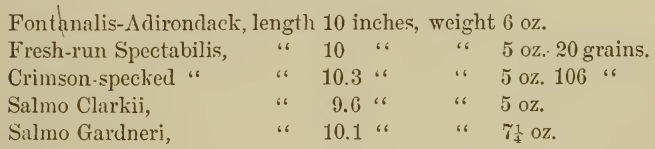
No Alaskan trout will take a fly. All Alaskan trout, I think, spend a portion of their lives in salt water. Length being equal, the Alaska trout, with the exception of the Gardneri, or mountain trout, are lighter than those of our eastern streams.
Using as a standard the average weight of a number of ten-inch Adirondack trout, the following table will show this:
Original
In conclusion, I must again request that this contribution shall not be considered and judged as an attempt to scientifically describe the fish treated upon, but rather as what it really is, a condensation of the field-notes of an amateur angler.
I have, in giving the sizes, weights, and other data in regard to the Alaska salmon and trout, depended almost entirely upon my personal knowledge and experience; it may not be out of place to add to them some data gathered from reliable authorities.
In his report on the resources of Alaska, Major Mm. Governeur Morris writes: “Sixty thousand Indians and several thousand Aleuts and Esquimaux depend for the most part upon dried salmon for their winter sustenance.”
The Hon. Wm. S. Hodge, formerly Mayor of Sitka, states in an official report: “And additional testimony comes to us from numerous persons, that at Cook’s Inlet the salmon average in weight sixty pounds, and some of them reach a weight of one hundred and twenty pounds, and Mr. T. G. Murphy only last week brought down from there on the Newbern a barrel full, containing only four fish.” Surgeon Thomas T. Minor, who some years ago visited Cook’s Inlet, in connection with business of the Smithsonian Institution, makes statements which confirm the foregoing.
In the vicinity of Klawaek a cannery is established. A catch of seven thousand fish at one haul of the seines is not unusual, many weighing over forty pounds.
Mr. Frederick Whymper, artist to the Russian Overland Telegraph Expedition, says in his well-written and interesting account of his adventures: “The Yukon salmon is by no means to be despised. One large variety is so rich that there is no necessity when frying it to put fat in the pan. The fish sometimes measure five feet in length, and I have seen boats whose sides were made of the tough skin.”
And a writer who, if disposed to strain the truth would not do so to say anything in favor of Alaska, says in an article in Harper’s Magazine, Vol. LV. page 815: “The number of spawning fish that ascend the Yukon every June or July is something fabulous.... It would appear reasonable to anticipate, therefore, the adoption by our fishermen of some machinery by which they can visit the Yukon when the salmon begin to run, and while they ascend the river catch a million pounds a day, for the raw material is there, of the largest size, the finest flavor, and the greatest number known to any stream in the world.’”
My general views about Alaska differ widely from those of the writer, but on the salmon question, I indorse all I have quoted, excepting only the word flavor.
I do not think the Alaska salmon equal in this respect to those of the Atlantic coast, and far behind those of the Rhine; they are, however, superior to those of the Columbia River.
In speaking of the salmon, I find I have omitted to mention that in early spring, before the arrival of the salmon trout, and after their departure in fall, great quantities of fingerling salmon pervaded the streams, and bit eagerly at any kind of meat bait.
While the spectabilis were present, these little fellows kept out of sight and notice.
Since the body of this paper was written there has been on exhibition by Mr. Blackford, of Fulton Market, Yew York, a number of trout, pronounced to be the salmo irideus, one of which, weighing fifteen pounds, was sent to the Smithsonian Institution, and there identified by Professor Bean as being “Salmo gardneri, the great trout of Edgecomb Lake.”
I, studying these fish in their glass tank, did not form this opinion, for Blackford’s trout had a broad red band extending from just back of the eye to the tail, covering the opercule, a marking not existing on any of the Edgecomb trout I have seen. But the Professor assures me that “color on the lateral line is not a specific character.” On comparing my notes of description of these fish, I find that in all other respects they did appear identical, hence that the conclusion arrived at by Prof. Bean, that “the gardneri and the irideus (or rainbow trout of McCloud River), are identical seems well founded. If so, and my crude supposition that the Clarkii, obtained in Piseco Lake near Sitka are also identical with the gardneri turns out to be correct, there can be a condensation of nomenclature, which will lead to at least one valuable result from this paper.
“No sooner had the barbed hook fastened in its insidious hold, and the impaled monarch learned that he was captive, than every effort of his lithe and agile frame was brought into play to recover freedom. In every struggle, in every effort to burst thee bonds that made him captive, there was an utter recklesness of consequences, a disregard for life that was previously unknown, as from side to side of the pool he rushed, or headlong stemmed the sweeping current. Nor did the hero confine himself to His own element; again and again he burst from its surface to fall back fatigued, but not conquered. The battle was a severe one, a struggle to the death; and when the landing net placed the victim at my feet, I felt that he had died the death of a hero. Such was my first sea-trout, no gamer, truly, than hundreds I have captured since; but what can be expected of a race of which every member is a hero?”—Parker Gilmore.
“If, indeed, you be an angler, join us and welcome, for then it is known to you that no man is in perfect condition to enjoy scenery unless he have a fly-rod in his hand and a fly-book in his pocket.”—Wm. G. Prime.
“It was something more than a splendid trout that he brought to our view as we met him at the landing. The young heart in the old body—the genuine enthusiasm of the veteran angler—the glorification of the gentle art which has soothed and comforted many an aged philosopher—all this he revealed to us, and we wanted to lift the grand old man to our shoulders and bear him in reverent triumph up the ascent.”—A. Judd Northrop.
“From the fisherman’s point of view, the sea trout is equal to the finest grilse that ever ascended Tay or Tweed, exceeding, as he does, for gameness and pertinacity every other British fish.”—David Foster.
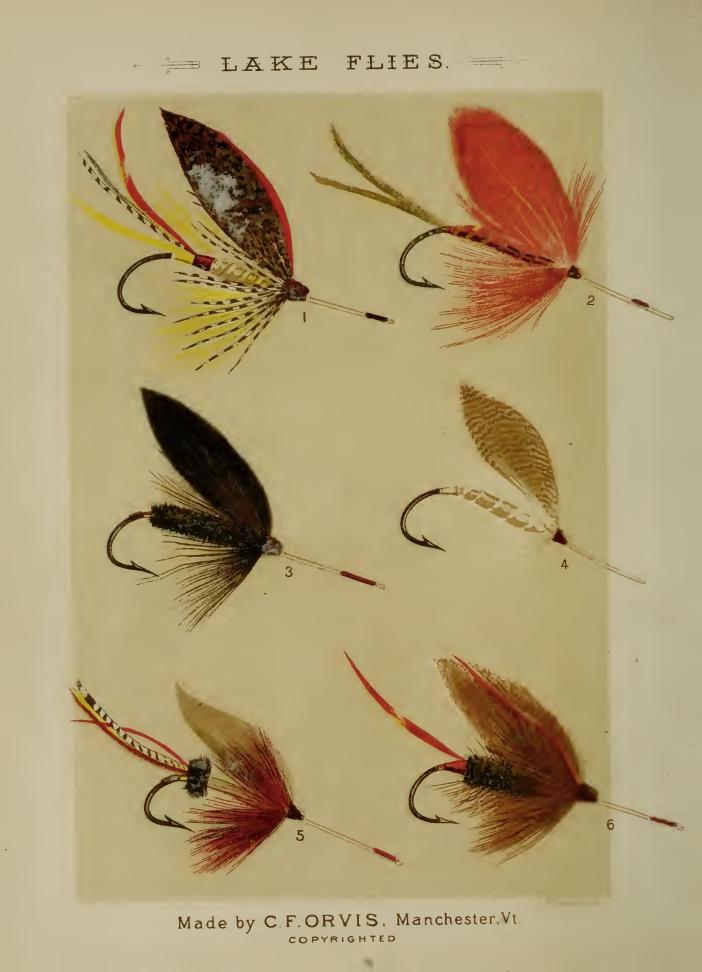
Original
1. Silver Doctor.
2. Scarlet Ibis.
3. Black June.
4. Gray Drake.
5. Captain.
6.’Academy.
“As to flies, the indifference of sea-trout about kind, when they are in the humor to take any, almost warrants the belief of some anglers that they leap in mere sport at whatever chances to be floating. It is true they will take incredible combinations, as if color-blind and blind to form. But experiments on their caprice are not safe. If their desire is to be tempted, that may most surely be done with three insects, adapted to proper places and seasons. One need not go beyond the range of a red-bodied fly with blue tip and wood-duck wings for ordinary use, a small all gray fly for low water in bright light, and a yellowish fly, green striped and winged with curlew feathers, for a fine cast under the alders for the patriarchs.”—A. R. Macdonough.
“His tackle, for brieht airless days, is o’ gossamere; and at a wee distance aff, you think he’s fishin’ without ony line ava, till whirr gangs the pirn, and up springs the sea-trout, silver-brieht, twa yards out o’ the water, by a delicate jerk o’ the wrist, hyucked inextricably by the tongue clean ower the barb o’ the kirby-bend. Midge-flees!”—The Ettrick Shepherd.
“O, sir, doubt not but that Angling is an art; is it not an art to deceive a trout with an artificial fly?”—Izaak-Walton.
“Sea-trout show themselves wherever salmon are found, but not always simultaneously with them. In rivers where the salmon run begins in May or early June, you need not look for sea-trout in any considerable numbers before well on into July. Intermediately they are found in tide-water at the mouths of the salmon rivers, and often in such numbers and of such weight as give the angler superb sport.”—George Dawson.