General Vandegrift and His 1st Marine Division Staff
Reading edition
Whenever a work about the Guadalcanal operation is published, one of the pictures always included is that of Major General Alexander A. Vandegrift, 1st Marine Division commanding general, and his staff officers and commanders, who posed for the photograph on 11 August 1942, just four days after the assault landings on the island. Besides General Vandegrift, there are 40 Marines and one naval officer in this picture, and each one deserves a page of his own in Marine Corps history.
Among the Marines, 23 were promoted to general officer rank and three became Commandants of the Marine Corps: General Vandegrift and Colonels Cates and Pate. The naval officer, division surgeon Commander Warwick T. Brown, MC, USN, also made flag officer rank while on active duty and was promoted to vice admiral upon retirement.
Four of the officers in the picture served in three wars. Lieutenant Colonels Gerald C. Thomas, division operations officer, and Randolph McC. Pate, division logistics officer, served in both World Wars I and II, and each commanded the 1st Marine Division in Korea. Colonel William J. Whaling similarly served in World Wars I and II, and was General Thomas’ assistant division commander in Korea. Major Henry W. Buse, Jr., assistant operations officer, served in World War II, Korea, and the Vietnam War. Others served in two wars—World Wars I and II, or World War II and Korea. Represented in the photograph is a total of nearly 700 years of cumulative experience on active Marine Corps service.
Three key members of the division—the Assistant Division Commander, Brigadier General William H. Rupertus; the Assistant Chief of Staff, G-1, Colonel Robert C. Kilmartin, Jr.; and the commanding officer of the 1st Raider Battalion, Lieutenant Colonel Merritt A. Edson—were not in this picture for a good reason. They were on Tulagi, where Rupertus headed the Tulagi Command Group with Kilmartin as his chief of staff, and Edson commanded the combat troops. Also notably absent from this photograph was the commander of the 7th Marines, Colonel James C. Webb, who had not joined the division from Samoa, where the regiment had been sent before the division deployed overseas.
In his memoir, Once a Marine, General Vandegrift explained why this photograph was taken. The division’s morale was affected by the fact that Vice Admiral Frank Jack Fletcher was forced to withdraw his fleet from the area—with many of his ships not yet fully unloaded and holding more than half of the division’s supplies still needed ashore. Adding to the Marines’ uneasiness at seeing their naval support disappear below the horizon, was the fact that they had been under almost constant enemy air attacks beginning shortly after their landing on Guadalcanal. In an effort to counter the adverse influence on morale of the day and night air attacks, Vandegrift began making tours of the division perimeter every morning to talk to as many of his Marines as possible, and to keep a personal eye on the command. As he noted:
By August 11, the full impact of the vanished transports was permeating the command, so again I called a conference of my staff and command officers.... I ended the conference by posing with this fine group of officers, a morale device that worked because they thought if I went to the trouble of having the picture taken then I obviously planned to enjoy it in future years.
Recently, General Merrill B. “Bill” Twining, on Guadalcanal a lieutenant colonel and assistant D-3, recalled the circumstances of the photograph and philosophized about the men who appeared in it:
The group is lined up on the slope of the coral ridge which provided a degree of protection from naval gunfire coming from the north and was therefore selected as division CP....
There was no vital reason for the conclave. I think V[andegrift] just wanted to see who was in his outfit. Do you realize these people had never been together before? Some came from as far away as Iceland....
V[andegrift] mainly introduced himself, gave a brief pep talk.... I have often been asked how we could afford to congregate all this talent in the face of the enemy. We didn’t believe we (at the moment) faced any threat from the Japanese. The defense area was small and every responsible commander could reach his CP in 5 minutes and after all there were a lot of good people along those lines. Most of the fresh-caught second lieutenants were battalion commanders two years later. We believed in each other and trusted.
—Benis M. Frank
The General and His Officers on Guadalcanal, According to the Chart
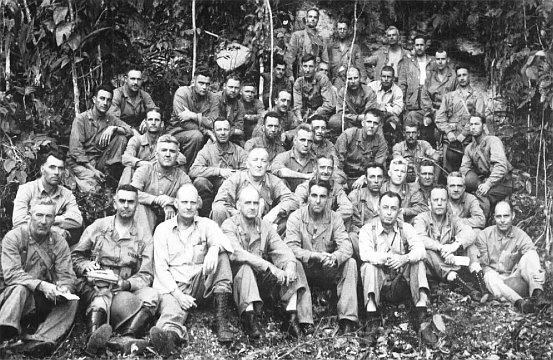

1. Col George R. Rowan
2. Col Pedro A. del Valle
3. Col William C. James
4. MajGen Alexander A. Vandegrift
5. LtCol Gerald C. Thomas
6. Col Clifton B. Cates
7. Col Randolph McC. Pate
8. Cdr Warwick T. Brown, USN
9. Col William J. Whaling
10. Col Frank B. Goettge
11. Col LeRoy P. Hunt, Jr.
12. LtCol Frederick C. Biebush
13. LtCol Edwin A. Pollock
14. LtCol Edmund J. Buckley
15. LtCol Walter W. Barr
16. LtCol Raymond P. Coffman
17. LtCol Francis R. Geraci
18. LtCol William E. Maxwell
19. LtCol Edward G. Hagen
20. LtCol William N. McKelvy, Jr.
21. LtCol Julian N. Frisbie
22. Maj Milton V. O’Connell
23. Maj William Chalfant III
24. Maj Horace W. Fuller
25. Maj Forest C. Thompson
26. Maj Robert G. Ballance
27. Maj Henry C. Buse, Jr.
28. Maj James W. Frazer
29. Maj Henry H. Crockett
30. LtCol Lenard B. Cresswell
31. Maj Robert O. Brown
32. LtCol John A. Bemis
33. Col Kenneth W. Benner
34. Maj Robert B. Luckey
35. LtCol Samuel B. Taxis
36. LtCol Eugene H. Price
37. LtCol Merrill B. Twining
38. LtCol Walker A. Reaves
39. LtCol John D. Macklin
40. LtCol Hawley C. Waterman
41. Maj James C. Murray, Jr.
[Sidebar (page 17):]
The Coastwatchers
A group of fewer than 1,500 native Coastwatchers served as the eyes and ears of Allied forces in reporting movements of Japanese units on the ground, in the air, and at sea.
Often performing their jobs in remote jungle outposts, the Coastwatchers were possessed of both mental and physical courage. Their knowledge of the geography and peoples of the Pacific made them invaluable additions to the Allied war effort.
The concept for this service originated in 1919 in a proposal by the Royal Australian Navy to form a civilian coastwatching organization to provide early warning in the event of an invasion. By the outbreak of war in September 1939, approximately 800 persons were serving as coastwatchers, operating observation posts mainly on the Australian coast. They were, at the outset, government officials aided by missionaries and planters who, as war with Japan neared, were placed under the control of the intelligence section of the Australian Navy.
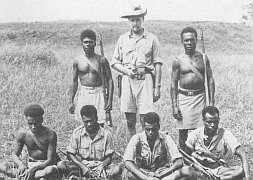
Coastwatcher Capt W. F. Martin Clemens, British Solomon Islands Defence Force, poses with some of his constabulary.
National Archives Photo 80-G-17080 courtesy of Richard Frank
By 1942, the system of coastwatchers and the accompanying intelligence network covered an area of 500,000 square miles, and was placed under the control of the Allied Intelligence Bureau (AIB). The AIB coordinated Allied intelligence activities in the southwest Pacific, and had as its initial principal mission the collection of all possible information about the enemy in the vicinity of Guadalcanal.
Coastwatchers proved extremely useful to U.S. Marine forces in providing reports on the number and movement of Japanese troops. Officers from the 1st Marine Division obtained accurate information on the location of enemy forces in their objective areas, and were provided vital reports on approaching Japanese bombing raids. On 8 August 1942, Coastwatcher Jack Reed on Bougainville alerted American forces to an upcoming raid by 40 Japanese bombers, which resulted in 36 of the enemy planes being destroyed. The “early warning system” provided by the Coastwatchers helped Marine forces on Guadalcanal to hold onto the Henderson Field airstrip.
The Coastwatchers also rescued and sheltered 118 Allied pilots, including Marines, during the Solomons Campaign, often at the immediate risk of their own lives. Pipe-smoking Coastwatcher Reed also was responsible for coordinating the evacuation on Bougainville of four nuns and 25 civilians by the U.S. submarine Nautilus.
It is unknown exactly how many Coastwatchers paid the ultimate sacrifice in the performance of their duties. Many died in anonymity, without knowledge of the contribution their services had made to final victory. Perhaps they would be gratified to know that no less an authority than Admiral William F. Halsey recorded that the Coastwatchers saved Guadalcanal, and Guadalcanal saved the Pacific.—Robert V. Aquilina
[Sidebar (page 19):]
The 1st Marine Division Patch
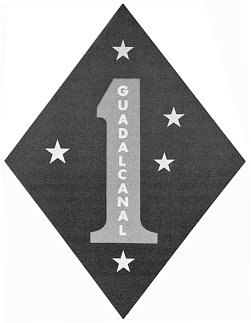
The 1st Division shoulder patch originally was authorized for wear by members of units who were organic or attached to the division in its four landings in the Pacific War. It was the first unit patch to be authorized for wear in World War II and specifically commemorated the division’s sacrifices and victory in the battle for Guadalcanal.
As recalled by General Merrill B. Twining, a lieutenant colonel and the division’s operations officer on Guadalcanal, for a short time before the 1st left Guadalcanal for Australia, there had been some discussion by the senior staff about uniforming the troops. It appeared that the Marines might have to wear Army uniforms, which meant that they would lose their identity and Twining came up with the idea for a division patch. A number of different designs were devised by both Lieutenant Colonel Twining and Captain Donald L. Dickson, adjutant of the 5th Marines, who had been an artist in civilian life. The one which Twining prepared on the flight out of Guadalcanal was approved by Major General Alexander A. Vandegrift, the division commander.
General Twining further recalled that he drew a diamond in his notebook and “in the middle of the diamond I doodled a numeral one ... [and] I sketched in the word ‘Guadalcanal’ down its length.... I got to thinking that the whole operation had been under the Southern Cross, so I drew that in, too.... About an hour later I took the drawing up to the front of the aircraft to General Vandegrift. He said, ‘Yes, that’s it!’ and wrote his initials, A.A.V., on the bottom of the notebook page.”
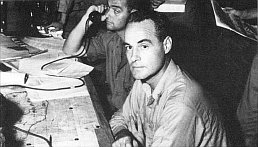
Designer of the patch, LtCol Merrill B. Twining (later Gen) sits in the 1st Marine Division operations bunker. Behind him is his assistant D-3, a very tired Maj Henry IV. Buse, Jr.
After he arrived in Brisbane, Australia, Colonel Twining bought a child’s watercolor set and, while confined to his hotel room by a bout of malaria, drew a bunch of diamonds on a big sheet, coloring each one differently. He then took samples to General Vandegrift, who chose one which was colored a shade of blue that he liked. Then Twining took the sketch to the Australian Knitting Mills to have it reproduced, pledging the credit of the post exchange funds to pay for the patches’ manufacture. Within a week or two the patches began to roll off the knitting machines, and Colonel Twining was there to approve them. General Twining further recalled: “After they came off the machine, I picked up a sheet of them. They looked very good, and when they were cut, I picked up one of the patches. It was one of the first off the machine.”
The division’s post exchanges began selling the patches almost immediately and they proved to be popular, with Marines buying extras to give away as souvenirs to Australian friends or to send home to families. Before long, newly established Marine divisions, as well as the raider and parachute units, and as the aircraft wings, sea-going Marines, Fleet Marine Force Pacific units, and others, were authorized to have their own distinctive patch, a total of 33, following the lead of the 1st Marine Division. Marines returning to the United States for duty or on leave from a unit having a distinctive shoulder insignia were authorized to wear that insignia until they were assigned to another unit having a shoulder patch of its own. For many 1st Marine Division men joining another unit and having to relinquish the wearing of the 1st Division patch, this rankled.
Shortly after the end of the war, Colonel Twining went to now-Marine Commandant General Vandegrift saying that he “no longer thought Marines should wear anything on their uniforms to distinguish them from other Marines. He agreed and the patches came off for good.”—Benis M. Frank