FIRST IMPRESSIONS. (continued 4)
Reading edition
The tone of general conversation here was easy, animated, lively, and full of benevolently polite attention to the feelings of each other. In short, it was conversation; of which we do not always understand the right meaning, or enter into the true spirit, in the circles of England, whatever is the reason. We had a discussion upon the drama, and the present state of the Italian opera, both with us and upon the continent. Those who had been in England praised Miss O'Neill very rapturously, but Kean did not appear to have struck them so forcibly as I thought his merits deserved. I was asked (as the conversation turned upon the marked taste for classical and studied tragic acting upon the French stage), whether I thought Miss O'Neill or Mrs. Siddons (in her day) would have been most applauded and understood by a Parisian audience? I had no hesitation in replying that I thought the latter would have been more to their taste, as her style was rather the perfection of art than the wild and spontaneous effect of nature. They all agreed in this opinion, and seemed to prefer Miss O'Neill to her dignified and splendid rival: those who consider acting as a science, however, will not coincide with them.
At about eight o'clock we adjourned to another apartment, where tea was served: the table was very long, and covered with a cloth, round which the company seated themselves as if at dinner. The lady of the house made tea herself, and the servants waited behind her chair, to hand it about; her situation was no sinecure: There was a profusion of cakes, brioches, and fine fruit. This is always the custom at Geneva, where, as people dine at three o'clock, they of course are ready to make a sort of supper at tea-time. I never beheld any thing so resplendently beautiful as the moon during my drive home: I saw it rise like a globe of fire from behind the mountains, and throw a long track of glittering brightness upon the calm bosom of the lake. The effect was lovely, and the sky appeared to me to be of a far deeper and more decided blue colour than with us. I ought not to omit the mention of a very singular and striking phenomenon (if I may so call it), which I had likewise this day witnessed at Sir F.'s: I mean the influence of the setting sun upon the glaciers. They first, as the orb declined, assumed a yellow tint, then gradually warmed into pink, and kindled at length into a glow of rich crimson, of indescribable beauty. Mont Blanc's three fantastic peaks received it last of all, and immediately afterwards the whole snowy chain of mountains rapidly faded into their original hue of spotless (or, as my friend Mr. T. fancifully calls it, ghostly) white. Upon my return to the hotel, I had the unexpected pleasure of finding Mr. Baillie and Mr. W. safely arrived from their expedition to Chamouni. The following is the former's account to me of the incidents of their journey.
"As we could only allow ourselves two entire days in which to perform our journey to Chamouni, it was quite necessary that we should make the most of our time; the distance (if I recollect right) being from fifteen to eighteen leagues from Geneva. We started from thence at about five o'clock in the afternoon, on the 13th of September, and slept that night at Bonneville, a small town about fifteen miles on our route. There was nothing particularly worthy of remark thus far, except the magnificently beautiful tints of the setting sun upon the Mole and adjacent mountains, which we enjoyed in great perfection. The next morning we proceeded through the small town of Kluse to St. Martin, where we breakfasted, and hired mules for the remainder of our journey, the road being impassable for any carriages except those of the country, called char-a-bancs, which are the most uncomfortable conveyances that can be imagined, being built without springs.
"We passed this day two very beautiful waterfalls; but as you have already seen the P. V. (which is superior to both), I need not trouble you with an account of them. The aubergiste at St. Martin was philosopher enough to have a cabinet of the natural curiosities of the country, upon which he set no small value; his prices for the minerals, &c. being absurdly high. The prospect became far more interesting as we advanced towards the base of that hoary mountain, whose summit we had distinctly seen at a hundred and fifty miles distance, some few weeks since. We observed and admired a singular piece of water, in whose transparent bosom Mont Blanc was clearly reflected. This was the Lac de Chede, and though very small, is interesting, from its retired and solitary situation. It is infested by serpents, but I could not learn that they were venomous.
"The valley of Servoz, into which we afterwards entered, and which joins the vale of Chamouni, is romantic beyond any thing I have ever beheld. The road (cut out of the mountain's side) is in many places rough, and somewhat dangerous, a very abrupt precipice being on one hand, and the river Arve rolling below, whose waters are of great depth. I confess that I was a little disappointed with the first view of these glaciers (Note H.), perhaps, as the imagination has no bounds, from having previously formed too magnificent an idea of them. They are situated in the valley, at the foot of the mountain, and are formed by the frozen snow, or rather snow-water. Their shape is irregularly pyramidical, and their colour a very light blue.
"The Mer de Glace, which is the object most worthy of notice in this valley, is a glacier of giant size, the pyramids of ice being in some places of prodigious altitude, and the chasms proportionably deep. From this place the Arve takes its source. It is quite impossible for me to give you an adequate idea of this stupendous sea of ice, so called from its constant, although imperceptible, movement towards the valley, the entrance of which, it is generally expected, it will in time effectually block up. We witnessed one or two avalanches, which our guide told us were inconsiderable; their noise, however, made the valley roar.
"Our trusty mules deserve mention. We really thought we could not too much admire them; although we had been prepared to find them sure-footed and steady, we had no conception that they could possibly have led us with such perfect safety through such rugged and dangerous passes; the more particularly as we had no reason to reckon upon their complaisance, having urged them to a pace to which they were quite unaccustomed, from our desire of visiting the Mer de Glace the first day.
"The inn at Chamouni was clean and comfortable, and upon a far superior scale of accommodation than could have been supposed in so forlorn a situation. The Duke of G. arrived during the evening, and consequently must have travelled through Servoz when it was dark, thereby losing all the beauties of that wonderful scene. We set off the next morning very early, upon our return. It was a severe frost, the ground quite white with the hoary particles, and the weather feeling colder than I ever remember to have experienced, although the season was but little advanced; so much so, that my companion had to walk at a great pace for a considerable distance, to preserve any degree of animal warmth. About the middle of our route we observed a monument, in the shape of a large mile-stone, which had been erected during the consulship of Bonaparte, to the memory of a young German philosopher, who was unfortunately lost, from the ignorance of his guide, while traversing these mountains. He fell into the crevice of a glacier, and was not discovered until some time afterwards, when it appeared his nails were worn off, and his fingers stripped to the bone, in his agonizing and desperate attempts to release himself from his horrible grave. The stone was erected (as it is stated in an inscription) first, as a warning to travellers in their choice of guides; secondly, to commemorate the loss of the unhappy youth; and, thirdly, to inform the world that France encourages science, even in her enemies.
"We found a variety of all the rarest Alpine plants and vegetables in this valley, and were assured that it contained also mines of gold, silver, and lead, (Note I.) which the poverty of the state at present prevents being worked. We met at the little inn two Polish gentlemen, who had been making a pedestrian tour through Switzerland; one of them had a few days before ascended the highest mountain (next to Mont Blanc) in the neighbourhood: he was the friend and companion of an enterprising nobleman of the same nation, who some weeks since had gone up Mont Blanc, by a different route to that pursued by Monsieur de Saussure, who has written voluminously on the subject. The Pole had endured great difficulty and fatigue, and had been three days in completing his journey, having slept two nights upon the mountain: he was attended by about twenty guides, all of whom were tied together, as a precaution against any one of them falling into the chasms which are so frequently met with in the ascent. The summit was found to be considerably changed since it had last been visited. This stupendous mountain is 15000 feet above the level of the sea, and rises about 9000 from the valley of Chamouni. It is hardly necessary to tell you, that its brow is eternally crowned with frozen snow.
"Travellers who are in delicate health, or otherwise not strong, are by no means advised to undertake the journey from St. Martin to Chamouni on mules; especially if they are pressed for time, as that method of conveyance is both fatiguing and dilatory. They will find the guides of the inn particularly intelligent and conversible, possessing a knowledge of the mineral and vegetable kingdoms that is quite extraordinary in men of their situation and rank in life. They are employed during the winter months in chamois hunting, and other dangerous and hardy exercises, and are frequently detained (as they told me themselves) by the snow, for weeks together, in the cheerless shelter of the most wretched chalets."
The next day we devoted to the purchase of some of the curiosities for which this place is celebrated (Note J.), and to taking leave of our friends, who had shewn us so much attention: we also visited the street in which Rousseau was born, and which is called after his name, the Rue de Jean Jacques Rousseau. We took leave of Sir F. and Madame d'I. with a degree of regret that was only softened by the hope of seeing them in England ere many ages should elapse. I believe I have not yet mentioned their children; a fine boy and a very promising little girl, both extremely young, and in whose welfare and happiness the parents seemed to be completely wrapped up. Yet Sir F. did not appear to have spoiled them by injudicious indulgence; on the contrary, he expressed his conviction of the necessity and importance of early moral restraint, and I had one accidental opportunity of witnessing that his practice perfectly harmonized with his theory: this desirable union does not always take place, even among parents who pride themselves upon a superior system of education.
On September 17th, we bade adieu to this delightful neighbourhood, and proceeded upon our route to Lausanne. We continued for a great length of way to wind along the borders of the lake, which sparkled like a diamond in the morning sun, and whose extensive surface was slightly rippled by a fresh and animating breeze from the mountains. With respect to the extraordinary exhilaration of mountain air, which first struck me in crossing Mont Cenis, and has been confirmed by subsequent experience, I had heard and read a thousand times of its effect; but a truth, when personally proved for the first time, always seems like a discovery, rather than a sober confirmation of the words of other people. This pure atmosphere appears to me the finest remedy possible for every sort of nervous indisposition. It would even lighten (I should think) the heavy pressure of real affliction, acting as a perfect cordial to the spirits, as well as a tonic to the body—but Rousseau has expressed this opinion so admirably in the first volume of his Nouvelle Heloise, that while I recal his magical description, any other seems powerless and inadequate. (Note K).
We now passed though the village of Coppet. Necker's house is still shewn here, to which he retired upon being denounced by the French government as an enemy to his country, and where the adversity of this great and amiable character was soothed by the presence of his equally celebrated daughter, Madame de Stael. I feel an involuntary sensation of attendrissement, whenever I think of the singular degree of affection that subsisted between this venerable parent and his daughter, and which breathes so touchingly in every line of her Memoires de la Vie privée de Monsieur Necker, lately published in our own country. An affection so highly wrought, as to bear rather the character of passion, and which has therefore been objected to, by many people, as overstrained and unnatural. But let it be remembered that the great virtues, the attractive gentleness, the grand and expansive mind, and superior talents of Necker, were (in her eyes) unique, and might therefore well have the effect of creating a more than ordinary portion of admiration, respect, and love: nor, in judging of Madame de Stael, should it ever be forgotten, that her extraordinary depth of feeling, and her native enthusiasm of disposition, rendered it impossible for her to experience sensations of any sort, in a mediocre degree, or even in that rationally moderated force, which can alone secure the possession of real happiness. This peculiarity of feeling, which unfortunately induced some errors in her conduct, has been admirably commented upon, by the Edinburgh Review, in its critique upon her works in general. It explains and apologizes, I think, for those wildly warm expressions in which she has indulged, when speaking of Necker's character, and which might perhaps sound strange, if uttered by a less energetic personage, or if applied to those sort of parents who are usually met with in common life. The woman who has been allowed by the general voice of her cotemporary judges to be "the greatest writer of a female, that any age, or any country, has produced;" (nay even by one distinguished genius[8] has been called "the most powerful author, whether man or woman, of her day;") has surely a high claim upon the forbearance of all who have been charmed by her transcendent talents. At the same time, let me not be mistaken, as to my own particular sentiments upon the subject; for I have no hesitation in avowing, that as a general principle, I extremely disapprove of the admission of what is termed passion into the filial affections, and vice versa. I believe it to answer no wise or rational end, but to be, on the contrary, in nine cases out of ten, a fruitful source of disquietude and disappointment.
I fear my earnestness in the cause of a writer whose abilities I so greatly admire, has led me into a dissertation which may prove tedious to some of my readers.—Revenons à nos moutons. The country, the whole of the way to Lausanne, is one continued scene of beauty; and the pastoral air of the verdant meadows, the rich cultivation of the hills (sprinkled with the prettiest little hamlets), the appearance of comfort and neatness in the cottages (each with a garden and orchard), and the grandeur of the lake and mountains beyond, altogether formed a scene of peace, loveliness and delight, that is far more easily imagined than described. Were it possible for me to forget the charms of my dear native land, it is here that I could happily live, and tranquilly die. Not that it possesses the Armida-like fascination of the shores of the Lago Maggiore in Italy, or the high romance of parts of Savoy: the imagination here is less excited, but the heart is more interested. I turned from one to the other, with the kind of sensation which the mind experiences, when comparing a brilliantly beautiful and accomplished, a highly enchanting and charming acquaintance, with a tender, cheerful, and amiable friend.
We stopped to take breakfast at Rolle, a neat little town, where at the humble inn (la Couronne) we hailed with great satisfaction the comforts of cleanliness and domestic order, so totally unknown to the natives of the other countries through which we had passed.
Morges; a remarkably pretty town. In this neighbourhood there were many vineyards, which yielded the fruit of which the wine called vin de cote is made. The lake became much narrower here, and the mountains upon the opposite side seemed to rise abruptly from the water. Their dark purple hue contrasted finely with the light aqua-marine tint of the latter, and the fresh verdure of the banks, where the peasants were mowing their second crop of hay. The beauty of some of the cottages also struck us with admiration, but we observed as yet no particular costume.
We arrived at Lausanne to dinner. The entrance was cheerful and pretty, and the town itself is clean and gay, built upon the side of a very steep hill; the grand street forming as precipitous an ascent as that of Lansdown in Bath. We found all the inns full, therefore took lodgings at a charming house upon a hill overhanging the lake, (the view of the Chateau de Chillon and mountains, in the distance) and to which there was a garden and terrace, ornamented with green-house plants and flowers. We could hardly have desired une plus jolie campagne even for our own permanent residence and property. The restaurateur (who was an appendage to this establishment, and lived in part of the house) was a civil bustling personage, who extremely loved to hear himself talk: he told us that these lodgings ought to stand high in reputation, for they had been occupied successively by les plus grands seigneurs, who had all expressed themselves greatly pleased with their accommodations; a fair hint this, how we were expected to behave. We found, however, upon parting, that the hostess had overcharged us for these wonderful accommodations in a very preposterous manner, and she was so conscious of it, that she consented without much difficulty to take off part of her bill, and to allow us to pay for her apartments in French money, instead of the Swiss, which makes a very material difference. We breakfasted the next morning upon honeycomb from the mountains; I believe I have mentioned this before. It is a very common article for breakfast in Switzerland, and always brings an agreeable association of ideas to my mind. I ought perhaps to have made earlier mention of the great opportunity afforded to the traveller of leisurely surveying and enjoying the beauties of scenery, from the circumstance of his not being able to travel post through Switzerland: the system of voituring is, however, rather tedious, and very expensive.
The environs of Lausanne are almost equally attractive with those of Geneva, but the latter were impressed upon my memory in such bright and bewitching colours, that I could never think any other part of Switzerland quite so delightful.
We quitted Lausanne, Sept. 19, for Berne. Our road still led us through beauties innumerable. On the right was the lake, once more expanded into a breadth like the ocean, bounded, as usual, by mountains. On the left were vineyards, gardens, and hamlets. The grape ripens later here than in France, but is equally luxuriant and delicious in flavour. We frequently passed so near the glowing clusters of this tempting fruit, that we might easily have gathered as many as we chose from the windows of the carriage. There was a wonderfully fine growth of walnut trees also, stretching their long branches for many yards over the water. They are in such quantities that oil is made from the nut, for purposes of the commonest use.
We again saw part of the romantic rocks of Meillerie, so celebrated by Rousseau. We had been reading his Nouvelle Heloise for the last few days (as we were passing through the same scenes which are so beautifully depicted there), and felt as if these rocks were our old acquaintance. I always feel, in reading his works, ready to exclaim,
"I love thee, and hate thee!"
A literary friend (in a long conversation which we had upon the subject of this author) thought better of his Julie (as a single woman) than I did, or ever can; but we perfectly agreed in admiration of her conduct as a wife and mother, mistress of a family, &c. The lessons of morality (which she there exhibits) are beyond every thing beautiful and impressive; but I never can forgive the disingenuousness of her conduct in consenting to marry Monsieur de Wolmar, without having previously told him her past story. All the reasonings, the arguments, the chain of entangling circumstances, which Rousseau has contrived to justify her for not doing so, I think false, perverted, and totally unsatisfactory.
The costume of the peasants in this neighbourhood is not at all remarkable, except for their straw hats, which are universally of the gipsy shape, with a very high crown, ending in a point like a Chinese pagoda, or the top of a parasol. We took a dejeuné at Vevay, and went in a boat upon the lake, to view the Chateau de Chillon somewhat nearer than we had hitherto been able to do. The beauty of Lord Byron's affecting Tale of its Prisoner returned strongly upon my imagination. I certainly prefer his picture of Captivity to that of Sterne in the Sentimental Journey. It appears to me to be equally touching, and far more sublime. One or two of the minor incidents may probably have been founded upon the legends of the Bastile; but Byron's powerful genius stamps every line with the character of originality.
A few miles beyond Vevay the country assumed all the refined and cultivated beauties of an English park. Here (near a miniature lake) softly swelling hills of velvet turf, ornamented with the rich and feathery foliage of the beech, rose gently upon the admiring eye. There vast plantations of aspiring firs expanded their screen of darker green. Close to the road were meadows enamelled with the lilac crocus, and various wild flowers, fringed by hedges, where the white convolvulus and scarlet hawthorn berry mingled gaily with the thick hazel and other native shrubs. A few ledges of rock now and then started from amid these mild beauties, as if to evince that we were still in the vicinity of wilder scenery. This change in the landscape was novel and delightful to us all. We had not seen any thing exactly in its style since leaving England, and I almost felt annoyed when a turning in the road displayed the snowy peaks of the eternal glaciers towering, as usual, in the distance. Forgive this honest confession, ye exclusive lovers of the sublime, and recollect, that the eye as well as the mind becomes fatigued by being kept too long upon the stretch.
Stopping at a little post-house, between Vevay and Moudon, we were surprised to see a large coarse loaf of bread brought out (instead of hay) for the refreshment of the horses. They eat it in slices, and appeared to relish this sophisticated food not a little. One of the animals, however, would not take the crust in his mouth, tossing it away in the most ridiculously disdainful manner, when he had carefully devoured all the crumb, and it was not until he had received two or three good cuffs on the ears from his driver that he condescended to swallow it.
We met several prettyish women in the course of this day's journey; but the style of their beauty did not please us so much as that of France and Italy. It was mild without being soft, and fresh without being brilliant: they were, in short, neither jolie ni belle; neither had they la grace plus belle encore que la beauté; but formed a class apart, which I cannot exactly define, but which certainly I did not like.
Dined and slept at Moudon (inn, au Cerf), where we experienced the comforts of warmth, cleanliness, and good beds; no bad things after a long and cold journey. We were waited upon by a lively natural young creature, of the name of Josephine, who, together with several other girls, was staying at this inn, to learn the French language from the occasional guests. They were all of them German Swiss. We astonished them very much, by exhibiting a couple of musical snuff-boxes, which we had bought when at Geneva. The girls had never seen any thing of the kind, and were never tired of listening to them. We left Moudon the next morning at six o'clock: the country still continued to charm us with a pleasing succession of woods, mossy banks, and rich valleys, watered by little serpentine silver brooks, softly flowing through green meadows. We were still in the Pays du Vaud. Our servant Christian's national enthusiasm burst forth at every step. Our friend, who frequently took a share of his seat behind the carriage, amused us extremely with an account of his transports. "Ah! there are de cows with bells round their necks! How I love those bells! There be de neat cottages, all of wood: dey builds very pretty ones always in my country." At Lausanne (where he had been at school) it was nothing but "shaking hands," and "greetings in the market-place."—"There is a friend of mine! I know dat man! There lives such a one, a very honest person!" In short, the poor fellow was in a state of continual ecstasy, and carried it so far as to think the very stones in the road were more than commonly valuable and beautiful; for, knowing Mr. W. to have made a small collection of spars and fossils, &c. he drew his attention frequently, upon entering Switzerland, to the pebbles by the wayside, calling out every now and then, "There be a pretty stone now, Mr. V.! Very pretty stones all in my country!" A lady at Geneva, in describing the peculiar attachment of the Swiss to their native land, told me that her brother, upon being exiled to England for pecuniary reasons, actually died of the true maladie du pays, pining gradually away in hopeless longings after the dear scenes amid which his youth had been passed. We now entered the grandest and most luxuriant beech woods I ever beheld. I never had seen such magnificent trees, except in some parts of Norbury park, in Surrey; indeed the whole view strongly reminded me of that exquisite spot, and brought a thousand agreeable recollections and associations to my mind. Wherefore is it that the imagination feels a charm and a repose so delightful amid scenes of this nature? My own peculiar feeling is now confirmed by long experience, and I can consequently assert, with renewed confidence, that wood, assisted by a judicious inequality of ground, forms by far the most satisfactory and soothing feature in a landscape. A visit to mountains, glaciers, lakes, waterfalls, and impetuous floods, gives great and animating sensations, but a constant residence among them I should never desire; though I have no doubt but that a Highlander or a Swiss mountaineer would extremely despise me for the homeliness of my taste.
Payerne, a small town. The women here amazed us by their superb chevelures. We saw three in particular, who wore their hair (of a dark yet golden brown colour) twisted round the head, in a large braid, beneath an enormous flat straw hat. If these braids had been dishevelled, I am certain the hair would have swept the ground, and the thickness of its growth was even yet more remarkable than its length. We were afterwards informed of a circumstance which explained this apparent phenomenon, as I shall presently take occasion to mention. There was a large stone fountain here (with a statue of some warrior, armed from head to heel), which appeared to form the only ornament of the place.
At Avenche we observed a very singular costume among the paysannes; in addition to the full shift sleeve and becoming chemisette, confined beneath the bosom by a coloured boddice, they wore a head-dress of black gauze, lace, or thin horse-hair, transparent as a cobweb, stiffened with fine wire, and standing out widely from the temples, in the most extraordinary manner, resembling some representations I have seen of the cobra capella, or hooded serpent, the wings of a Patagonian butterfly, or the sort of bat-winged cap, which Fuseli, in the extravagance of his wild imagination, has given to his pictures of Queen Mab. The coarse, tame, insipid style of feature which accompanied this attire, however, by no means suited its peculiar character. I looked in vain for the pale, delicate, oval visage, small red lip, and large gazelle sort of dark eye, with which it would have harmonized so exquisitely. This is the usual Bernoise costume.
The country here became much more open, and was enlivened by the glittering waters of the lake of Morat (Note L). In almost every house we passed, we remarked great quantities of green tobacco leaves, suspended from the projecting roofs, drying in the sun. On the borders of the lake of Morat was formerly a chapel, filled with the bones of the Bourguinons, who were killed in battle, in the year 1476, when Charles the Bold was defeated. It is now destroyed, but the bones are still left "bleaching in the wind." We got out of the carriage, and discovered among them some very large thigh bones, &c. The size of the warriors to whom they belonged must have been wondrous. A small rise, upon which we stood, was entirely formed of the bodies of the slain. The fragrant wild thyme and nodding hare-bell grew thickly upon the fatal spot; and I observed a tuft of the latter wreathing its azure flowers (as if in mockery) around the fragment of a mouldering skull!
There are several beautiful little maisons de campagne near this place, with their surrounding vineyards, gardens, orchards, and fountains. They were a good deal in the style of what we are used to call cottages ornées, so few of which we had hitherto seen upon the continent, notwithstanding the adoption of a foreign title. There were also many lovely dwellings belonging to the peasantry, built of tan-coloured wood (Note M.), with stairs and galleries on the outside, and neatly thatched or tiled. The frontispiece to this little volume, which has been kindly presented to me by an elegant amateur artist, is a most correct representation of a Swiss cottage.
We were now in the canton of Berne: passing through another wood of beech, scarcely less beautiful than the former, the tremulous light, flitting capriciously across the leaf-strewn paths, and the soft chirping of the birds above our heads, again gave us exquisite pleasure. I say we; for my sensations were fully participated by my companions.
We now crossed the river Sarine, by means of a large wooden bridge, covered overhead like a penthouse, and entered the village of Guminen, sunk between bold and rocky hills, fringed with rich trees and underwood. The females in this part of Switzerland all appeared to possess a qualification which Shakespeare has pronounced (and with truth) to be "a marvellous excellent thing in woman." I allude to the soft musical tone of their voices in speaking: it was really remarkable, and we thought it almost made amends for the want of beauty. We dined at Guminen, in a cleanly little inn (l'Ours), where, on looking out at the window, we were struck by the sight of a Lucerne paysanne in full costume. She wore the usual tresses of braided hair hanging down at length behind, and the black gauze cap; but her boddice was remarkably curious, being of black velvet, richly embossed with lilac and black beads (the latter coming from Venice, and extremely small), in the manner of embroidery; indeed such quantities had been expended, that her bust looked as if in armour. This boddice was likewise ornamented with silver filigree buttons, and long silver chains, ending in large tassels of the same material, gilt. She had also a black velvet collar, studded with Venetian beads and coloured foil, and a worked linen chemisette and full shift sleeves, white as snow. This dress must have been very expensive for a woman in her rank of life; and upon inquiry we found that she was, in fact, the wife of a rich miller. We were not annoyed here, as in Italy and France, by the clamours of beggars; they very rarely made their appearance, and even when they did, were always modest and diffident. It gave us pleasure to pass through so large a tract of country without being able to discover any trace of abject poverty among the peasantry: they all wore an air of ease and content, and we found upon inquiry that they were in general enjoying the most comfortable and independent circumstances.
From a hill near Berne we first caught the distant harmony of a number of mellow-toned bells, which pastoral sounds, our Swiss informed us, were produced by the cattle (round whose necks the bells were suspended), and who were at that moment descending in large herds from the mountains, for the evening milking. At the same time we were struck by a glorious view of the Alps (Note N.), their frozen peaks rosy from the reflection of departing light: one of the highest of them is called, from hence, Monte Rosa. I have never listened to church bells (when their clang has been mellowed by distance) without a feeling of melancholy; but these seemed to breathe of innocent joy, and to tell a tale of peace, happiness, comfort, and domestic delight. This, I know, must have proceeded in both cases from early associations, and in the latter from the influence of ideas connected with poetry. What an ever-springing source of exquisite enjoyment is that divine gift! A susceptibility of its powers is like a sixth sense, for which it becomes all who possess it to be truly grateful to the benevolent Donor.
We now entered Berne. This is a fine large town, with a remarkably handsome entrance. We obtained most excellent rooms, replete with every essential comfort, and furnished with taste, at our inn (au Faucon), which was spacious enough to be taken for some ancient castle, when the feudal lords lodged a hundred or two of retainers, besides guests, beneath their ample roof. It was built in the form of an oblong square, with three galleries, one above another (each of which had interminable passages connected with it, all leading to different suites of apartments), looking down upon an open court or area in the midst. In this court a little army of washerwomen were assembled (belonging, I believe, to the establishment), carrying on the process of purification with great activity (in tubs almost large enough for brewing vats), and with hot water, which is an unusual thing upon the continent. Apropos to cleanliness, we all made the same observation in passing through Switzerland, namely, that the inhabitants (more especially in the protestant cantons) seemed to understand the comfort inseparable from this virtue, and that they certainly practised it in a far higher degree than any people we had seen since leaving England. We have frequently met with better accommodations (because cleanliness has been scrupulously attended to) in the inferior inns of Switzerland than in the most superb hotels of Paris, Turin, Milan, &c. I am sorry to be obliged, however, to except those of Geneva, which are allowed by the inhabitants themselves to be all very dirty.
We walked about Berne the next morning, and gave audience to Christian's venerable father and to his sister, who came over from their farm in the neighbourhood to fetch him to spend a day with them. They had not met for some years; neither father nor daughter spoke a word of any language but German patois; the latter was drest in the complete Bernoise costume, even to the little bouquet of natural flowers in the bosom. I forget what great author it is who says that "a man who has left his native place for years is generally anxious to make some figure in it, upon his return,"—this was truly exemplified in our servant, who, the morning after our arrival, burst upon his town's folk, in all the glory of the most dandy English dress, appearing far more smart than his master, and forming a curious contrast to the rustic figures of his humble yet picturesque-looking relations. We proceeded, after dinner, to view the bears, and stags, which have from time immemorial been kept in the deep fosse, which surrounds the town. There are tall fir-trees planted in this moat, for the bears to climb, and plenty of green cool turf for the refreshment of the stags. The animals are separated from each other, of course. The origin of this custom is singular. In ancient times, a rich seigneur of the country, and his sons, determined to found a town, which should transmit their memories to posterity, and should be called after the name of the first animal that they might happen to kill in a grand hunting-match, which they assembled for the purpose. This animal turned out to be a bear; accordingly the town was called Berne, and the stone image of the creature was erected at the gates—a custom which is continued to the present moment. When the founders died, they left a sum of money to be laid out for the sole benefit of this bear, which in process of time so greatly accumulated, as to form quite a little fortune; so that all the successive bears have been persons of property, and accustomed to the enjoyment of those agrèmens, which an easy income can alone secure. Bonaparte pounced upon the senior bruin (called Monsieur Martin), and carried off both himself and his money to Paris, where he now lives in high reputation, and equal splendor, at the bottom of a deep pit, in le Jardin des Plantes. The people of Berne have since obtained some other bears, which are the same that we now saw, and a proper sum for their support is awarded by the government, which also is increasing by occasional legacies from individuals.
We passed the evening in company with an Englishman (an old friend of my husband's), who had spent many years upon the continent, and who had made it one of his chief objects to visit and inspect the different prisons there. We were glad (as far as nationality was concerned) to hear that those of England are (comparatively speaking) carried on upon a system of benevolence superior to most others. This gentleman told us, that the prisons of Turin at this day, were a disgrace to humanity, being the most horrible dungeons that the imagination can picture. We saw several groups of the convicts at Berne, who wore an iron collar, and were chained by the leg, to a small light cart, which (like beasts of burden) they drew daily round the town, to collect and carry away the dirt of the streets. The prisoners of both sexes are also employed in sweeping the crossways, pavements, &c. and are drest in a peculiar uniform, their labour being proportioned to the degree of their guilt. All the culprits in the country, who are not condemned to death, are sent to Berne, and are employed in these and similar offices.
The cathedral did not appear to us worth visiting; our eyes had been satiated with buildings in this style, and after having seen the glories of the Duomo at Milan, we found all other cathedrals poor and uninteresting. Most of the shops here are built under stone arches, which renders them somewhat gloomy, but adds to their convenience in rainy weather. There are numerous stone fountains in all parts of the town, many of which have a martial figure on the top; we saw one, however, with a statue of Moses upon it, no inappropriate patron, as he could make the solid rock gush out with water. Over one of the principal gateways, we remarked a colossal image of Goliah, grim and gaunt enough to frighten all the naughty boys in the place.
Happening to mention the circumstance of the extraordinary growth of hair, among the women about Payerne, we were informed that it was almost all false. The paysannes have an ancient and invariable custom of mixing great quantities of borrowed tresses with their own, in order to form that singular braid round the head, which had so forcibly attracted our notice. I should imagine the toilette of these rural belles must be an operation of some skill, for the false is so very well mingled with the real hair, that it might defy the sharp eye of the most prying old spinster to detect the method in which it is done.
We saw several girls at Berne working upon cushions (something in the manner of lace-makers), under the piazzas; they were embroidering the collars and stomachers of the Bernoise paysannes, in small Venetian beads (called in England seed beads) of all colours, gold tinsel, foil, &c. upon a ground of black velvet. Their performance was really very neat and tasteful. The prince Leopold of Coburg was here, at the same time with ourselves, looking very melancholy, and almost continually alone: he was on a visit to his sister, the grand duchess Constantine, who resides in the neighbourhood. She is separated from her husband, who is brother to the emperor of Russia. They were married, I believe (in pursuance of one of those horrible schemes of state policy, where every better feeling of the heart is cruelly sacrificed and overborne), at the age of fourteen, and the subsequent catastrophe is not to be wondered at. Of the society at Berne we could not judge, as our stay did not exceed three days and a half, but our English friend (lately mentioned, and who had been a great deal amongst the best families there) mentioned it to be particularly agreeable. During the winter, there are concerts and balls, private parties, and a company of actors. The hospital is a fine establishment, with a garden full of choice flowers and shrubs, green-house plants, and a fountain, being sustained upon the most liberal plan; any poor person, passing through the town, may find food and lodging at the hospital for twenty-four hours, and is sent away at the expiration of that time with a donation of one franc (value, in English money, tenpence). There is also an asylum for foundlings, where the children are maintained till they attain the age of fifteen, and are then put out to service. It being one of the market days, we saw many different costumes (belonging to the various cantons) assembled. That of the women of Guggisberg is frightfully ugly; a napkin is folded flat across the forehead, and tied behind in a slouching manner; the dress is of black cotton, with a very long waist, and the petticoat does not reach to the knee; their legs are terribly thick, but luckily this circumstance is reckoned amongst themselves as a beauty, and to increase it, they wear four or five pair of stockings at a time. Mr. B. observed a Tyrolese peasant, with whose manly beauty and elegant costume he was much struck. I did not see him myself; they are generally fine figures, strong and athletic, yet extremely graceful, the dress being always particularly becoming and highly picturesque.
The women of Lucerne I have already described, in the specimen of the rich miller's wife that we saw at Guminen. Entering the shop of a famous picture-dealer here, he shewed us a collection of portraits, of the most celebrated rural belles of Switzerland, among which was that of the fair bateliere of the lake Brientz. I hoped to have beheld another "Ellen, Lady of the Lake," but was greatly disappointed, not being able to admire the character of her beauty, thinking it far too coarse; but those persons who have really seen her assured us her picture by no means did her justice. We were also shewn a set of coloured prints from the original drawings of a poor wretch of the name of Mind[9]; he died about two years ago, and his works are very much valued in this country, not only for their intrinsic merit, but as being the performance of a cretin, which means an idiot, afflicted with a goître. We were told by the picture-dealer, who had known him well, that this Mind was one of the most deformed and horrible objects of the sort, and was perfectly imbecile and stupid in every thing that did not immediately relate to his art. He had (like some idiots who have fallen under my own personal observation) a prodigiously retentive memory, from the impressions of which he alone was able to draw. If he met any group of men or animals in his daily rambles, he would instantly run home, lock himself up, and produce shortly afterwards the most spirited and accurate drawing of the objects which had thus fired his fancy. The high finish of his colouring, also, was equally remarkable with the boldness of his outline; he more particularly excelled in drawing cats, and had completed a voluminous collection of these animals, in all their stages of existence and habits of life; from which circumstance he has obtained the name of le Raffaelle des Chats. At a first view of his works, we were inclined to doubt the truth of his having been so complete an idiot in all respects which were unconnected with his art; but as vague arguments of conjecture and probability, cannot stand against the positive evidence of attested facts, of course we gave up our objections, and felt that to persevere in them would be obstinacy, rather than penetration. The history of this man would, I think, form an interesting subject of reflection to the philosopher and the physician, and I wish it were generally known and published. This evening we went to see the exhibition of Mr. Kœnig, an excellent landscape painter; it consisted of a set of transparent views (beautiful beyond any thing of the sort that we had ever previously beheld), taken from the most celebrated scenes in Switzerland; among them, we were most pleased with the chapel of William Tell (Note O.) by moonlight, on the lake of Zug, and with a cottage (also by moonlight) on the lakes of Bienne and Thun. The wonderful degree of nature and truth which these paintings displayed, I shall hardly forget; indeed I cannot say too much in praise of them, and would advise every traveller who visits Berne to go and see this enchanting little spectacle: I will venture to say his expectations will be greatly exceeded.
September 24th.—I must in justice recommend all our friends passing this way to take up their quarters au Faucon, as it is a most excellent house, and the mistress a very attentive sensible person.
I ought not to take leave of the place without also mentioning the promenade upon the ramparts, and the glorious view of woods, hamlets, and glaciers to be seen from thence[10]. We were much amused in watching the sports of the youth of the town there, who have a green inclosure, where various games and exercises (resembling the ancient gymnastic) are carried on every evening, at a certain hour; they are admirably well calculated to cherish habits of activity and agility, and to promote both health and strength.
All the public offices here are served by persons who faithfully and zealously fulfil their functions, without emolument of any sort.
Marriages through Switzerland are much encouraged by some of their political institutions; in this canton, for instance, a bachelor cannot arrive at the honourable post of bailiff, or be admitted to the council, or become what they call a seigneur, which is an inferior office in the government; but at the same time so fearful are these governments of any circumstance that might in process of time by the accumulation of fortunes infringe upon their liberties, that marriages between cousins german are forbidden by law.
In the best statistic account of the population of this country taken from the public registers, it is estimated inclusive of the allied provinces at about two millions. The protestant cantons are found to be the most populous, as they are the most active, industrious, and commercial, but they are not always the richest.
The police is regulated with the most exemplary vigilance and good order; the canton is a protestant one.
Upon quitting Berne, we found the country a lovely repetition of rich waving woods (chiefly of beech and pine); the brilliant autumnal tints of the former trees glowing beneath the bright blue of a cheerful morning sky, and the aromatic perfume of the latter, scenting the freshness of the breeze. How weak and inadequate are words to express certain feelings of delight! How easy is it to mention woods and plains, rocks and lakes, and to expatiate upon the charm of each, in appropriate terms; yet how far are we all the time from conveying to the minds of our hearers or readers the sensation of enjoyment which thrilled through our own bosoms while actually beholding the scenes we attempt to describe.
We passed through several villages which appeared to be the favourite haunts of peace, health, and humble happiness. The parsonage-house in one of them was a charming picture of comfort, neatness, and picturesque taste; close to the cheerful little whitewashed church, it reared its grey venerable roof. The walls were covered by the spreading branches of a fruitful pear-tree, and the green latticed windows were shaded by a vine, which wreathed its graceful foliage, and hung in luxuriant clusters, likewise, over a small bower, or recess, adjoining the sitting-room, where I could imagine a simple primitive pastor and his happy family assembled together, enjoying the social evening meal. La Fontaine's lovely descriptions of such scenes and such beings, in his Nouveau Tableau de Famille, rushed upon my recollection, and I almost expected to see his sweet Augusta (in the days of her prime) come forth from the rustic porch, leaning on the arm of her valuable husband, and surrounded by their innocent and blooming race. When this same Augusta becomes a grandmother, I think La Fontaine has painted her too selfishly forgetful of the happiness of her youthful days, and of the feelings natural to girls at that age; it is not in character with the virtue and sentimental graces of her earlier years, and rather conduces to encourage in the bosom of the reader a sensation of indignant disgust at the rigid, frigid, and unamiable propensities sometimes found among the aged. This beautiful and affecting novel is so well known to all persons of good taste and discrimination, that my allusion to it will I hope be at once understood and forgiven. Beyond this neighbourhood, the country opened in the most striking manner, affording a fine and heart-cheering prospect of cultivated plains, fresh pastures, peaceful flocks and herds, walnut groves and thatched cottages; the latter looked at a distance like large beehives, and the inhabitants seemed to evince a similarity to the bees in their habits of brisk and lively industry. I can easily understand the pre-eminent attachment of the Swiss to their native land; they must indeed be senseless were they less alive to the charms of scenes like this.
London, Published by I, Murray, 1819. Hermitage of Ste. Frene.
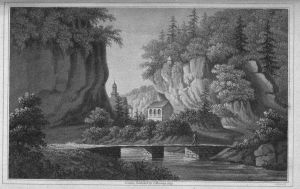
We took an early dinner at Soleure (Note R.), or Solothurne. We were now in a catholic canton, and the difference of our accommodations at the inn (la Couronne) from those we had experienced in the protestant governments was very apparent, for once more dirt, in various shapes, made its unwelcome appearance. The houses were, some of them, painted gaudily on the whitewashed outsides, in the Italian manner, and the cathedral, of Grecian architecture, was full of paltry paintings. The costume of the townspeople was both tasteless and dirty; a white linen cap, with a border of muslin, half a yard in depth, flapping about in the most unbecoming way, increasing the general plainness of the women's features. Their persons, also, were awkward and ill made, particularly about the legs and feet. The place itself was full of bad smells, but situated in a picturesque part of the country. As we proceeded, we found the cottages decrease in beauty; nor did they exhibit the same degree of aisance and comfort as those near Berne. The fields likewise partook of this spirit of decline, appearing less cultivated and productive. We could not help attributing this to the people having their time so perpetually broken in upon by the necessity of going to mass, and by the too frequent recurrence of jours de fêtes.
We passed a fine picturesque old castle upon the left, a few miles beyond Soleure, and arriving at Balstadt (a dirty-looking village), where we slept, found a most uncomfortable, slovenly inn, and bad attendance; and to heighten our miseries, our friend became so much worse, that we were obliged to send for what medical assistance the wretched place afforded. Accordingly there arrived the "village leech," who had much the air of a farrier, or cow-doctor, and who applied various nostrums without success. His unfortunate patient made a vigorous effort to shake him off the next morning, and we went on, hoping to get as far as Basle. We started with two horses and three mules, having to ascend a steep mountain immediately upon quitting Balstadt (or rather Ballstall, in modern orthography). The surrounding scenery was of a very different nature from that of the preceding day: the road (in some places nearly as perpendicular as any in the wild mountains of Savoy) led us through pale grey rocks, scooped occasionally into quarries, and fringed on one side by an infinite variety of young trees of every sort, and on the other by extensive woods of pine, whose shades formed a beautiful contrast to the brighter verdure of the velvet turf, from which they sprung. We observed (as usual) great numbers of wild barberry trees, and juniper bushes, while the purple heath-bell, waving her fairy cups amid the moss and thyme, upon every bank, gave a smiling character to the foreground.
Falkenstein Castle (a fantastic ruin, crowning the summit of a bold jutting mass of rock far above our heads) had a very imposing effect. The battled walls and narrow round towers were so much of the same colour as the mountain from which they rose, as scarcely to be distinguished from it at a distance. It reminded us strongly of some of Mrs. Radcliffe's descriptions, and our fancy easily peopled it with a terrific baron, a fair suffering heroine, a captive lover, and every other requisite et cetera of romance. As we were now in German Switzerland, such visions were not inappropriate, and my readers will pardon them accordingly. We saw another castle, also, further on, situated upon an eminence in the midst of magnificent woods of beech, and looking down upon a pretty hamlet of white cottages, each with its neat little verger and potager, some of them shaded by vines, and almost all furnished with a range of beehives. The inhabitants were gathering the walnuts, apples, and plums, from their loaded trees, as we passed: a clear little wimpling stream ran through the village, and the spire of the church rose among rich tufted foliage in perspective. We began to suspect, from this appearance of comfort and neatness, that we were once more in the neighbourhood of a protestant government, which we found afterwards was really the case. The sweet stream I have just mentioned was so kind as to accompany us for a considerable way, pure, sparkling, and dashing its shallow waters over the yellow pebbles, with a rippling murmur that was delightfully soothing to the ear. The country again resumed the woody, cultivated appearance, which is so pleasing to behold, and gradually expanded into lovely meadows, which the little brook kept forever fresh and verdant.
We stopped at Liestall, where we found a cleaner town, a better inn, and a more prepossessing hostess than at Ballstall. The people manufacture gloves here: they were good, but very dear. It is not to be told how disagreeably the German language grated upon our ears in passing through these cantons; after the mellifluous harmony of the Italian, and even when compared with the French, it was doubly intolerable. Our own is harsh enough, in the opinion of foreigners; yet I can with difficulty imagine any thing so bad as German.
We arrived to dinner at Basle. This is a very large town (under a protestant jurisdiction), clean and gay. Its chief attraction to us was the river Rhine, which rolled its majestic waters beneath the windows of our auberge (les Trois Rois), which was spacious and convenient. We ascended to our apartments by a curious spiral staircase, in an old round tower, that formed part of the building.
The Rhine is a noble river, but inferior in beauty of colour to the Rhone at Geneva. Indeed the latter I cannot at this moment recollect without a feeling of pleasure and admiration impossible to describe.
We left Basle, Sept. 26. The road as far as Bourglibre, and even considerably beyond it, was flat and uninteresting; the cottages rather dirty than otherwise, and extremely ugly; the costume of the peasantry very indistinctly marked, and by no means becoming, being a wretched imitation of the French. All this was accounted for, when we recollected that we had now once more entered the territories of that nation, leaving modern Germany on our right, and turning our backs upon the sweet simplicity and unequalled charms of Switzerland. The postillion also strongly evinced the national character, mounting his horse with a true gasconade flourish, and cracking his whip in the old well-remembered style.
We dined and slept at Colmar. The inn (aux Six Montagnes Noirs) was dirty, and the attendance very mediocre; but the beds were good, and free from vermin. Our host was the most hideous man I ever saw: he was absolutely strangling with fat; his bristly grizzled hair was strained off the forehead, and forced into a long thick queue, with so tight a hand, that the water in consequence was perpetually running from his little red eyes; his voice in speaking was most unpleasantly guttural, and rendered still more disagreeable by the absurd mixture of bad French and German, which he sputtered with great difficulty, in answering our necessary questions. His daughter usually sat in the bar, playing a French love ditty upon an old guitar. Of her I can only say, that she was the "softened image" of her "honoured papa."
The paysannes in the near neighbourhood of Colmar wear a pretty little flat, round-eared cap, at the back of the head, made either of very gay coloured silk, or cotton, and sometimes of gold tissue with crimson spots; their neck handkerchiefs are likewise of the brightest dyes, thrown carelessly over the gown, and the ends confined before, by a girdle. These women, generally speaking, are not at all handsome; the men chiefly wear coats of coarse bright green cloth, without collars, enormously long waisted waistcoats (sometimes red, laced with gold, and large buttons), with cocked hats.
The country upon first leaving Colmar was mountainous, but not very pleasing or interesting, in spite of the inequality of ground, the presence of verdure, the view of distant villages, and a very fine clear sky; all of which are notwithstanding the materials for forming a beautiful landscape. This, to my mind, had an analogy with the persons of some women I had formerly seen; who possessed fine hair and teeth, clear bright eyes, a good complexion, were sufficiently young, and not ill-made; yet with all these requisites to beauty, were plain, awkward, and totally wanting in agreeable effect. A strange caprice of nature, but not less true than strange.
The face of things, however, rather improved, upon approaching Schelestat. The costume of the paysannes brightened into a degree of taste and neatness that we had not seen equalled since leaving St. Denis, near Paris. Some of their caps were wholly of white worked muslin, with a thin clear border, and bound neatly round the head by a light blue or rose-coloured riband: the gowns also sometimes varied, being not unfrequently made of white cotton, with gay crimson sprigs upon them. We continually saw castles and churches upon the surrounding heights, and a great number of vineyards; but the villages and small towns were invariably dirty, and very ugly.
Since we had left Basle, we had been travelling through Alsace (ancient Germany), in the department of the Haut Rhin. A few miles farther, brought us into the vicinity of very fine fresh pasture lands, bordered by willows, and relieved by a magnificently rich back ground of high hills, clothed with young beech-trees, intermingled with oak. Here vast herds of cattle were feeding; close to the road, and forming a sort of border to the meadows, were extensive fields of potatoes, turnips, cabbages, and broccoli, &c. without any guard or inclosure; this (as I formerly mentioned) spoke well for the honesty of the poor people, and at all events proved them to be enjoying a degree of ease and plenty, as far as vegetable riches were concerned. I remarked, in the hedges here, the first honey-suckles I had seen since leaving England. The costume of the young infants in this part of the world is very singular; they all wear little foundling-shaped caps of black velvet, studded with gold spots, or of white, with silver embroidery upon them, which has a very strange effect to an English eye; but among the French people there is such an infinite variety of fanciful attire, that nothing appears extraordinary or out of the common way.
Passing through a small village, we saw several groups of the peasantry, mingled with the Austrian soldiery, all dressed in their gayest costume (it being Sunday evening), and we caught the musical tones of the slow German waltz, to which national melody some of them were dancing. There was not the least appearance of riot or disorder; they were blamelessly rejoicing in the natural gaiety of their hearts, at the close of that day whose forenoon had been spent in the exercise of their religious duties;—that day which is devoted, in some parts of the world, to mere peaceful rest from labour, unattended with any demonstration of hilarity: in others, to a puritanical gloom, and rigid formality; but in this, to cheerful, social intercourse, and the enjoyment of a harmless mode of exercise—I say harmless, because the waltz is not looked upon by the natives here in at all the same light as it sometimes is, in the higher ranks of English society; and it is the only dance with which they are acquainted. How weak and absurd, how really wicked is the intolerance which leads people to condemn or quarrel with their fellow creatures, for the different points of view under which they regard this same day! Although I cannot quote Sterne as a moralist in all cases, I certainly do most sincerely coincide with him in his sentiments relative to religious feeling, as expressed in that chapter of his "Sentimental Journey," called "The Grace." At the same time I am perfectly aware that a similar method of passing the Sunday evening, after the service of the day is fulfilled, would not be advisable (even were it possible to try the experiment), in our own country. It does not agree with the character and habits of the nation; and the lower orders of people, (in the present state of existing circumstances), would assuredly debase it by every species of vice and immorality. They require a strongly marked line to be laid down, as a rule of right, from which all deviation would probably be dangerous. Considering the subject in this light, I should therefore be concerned to behold any great change attempted in the manner of spending the Sunday evening, and would certainly not be the first person to put myself forward in the outward display of different opinions to the generality of individuals in the country, and under the government to which I belong. We all owe an example, which may be salutary to our inferiors and dependents.
At St. Marie aux Mines we were obliged to take five horses to the carriage, as the road beyond that place was very mountainous. We had the mental refreshment of observing numbers of sweetly pretty women here, all dressed with native taste and neatness; the children also were engaging in their appearance, and the men generally good-looking. French is almost universally spoken among them.
Ascending les montagnes de St. Marie aux Mines, the scenery presented a beautiful melange of wood and rock; the road likewise was excellent. We admired the way in which the postillions managed their horses, walking, the whole of the ascent, by their side, but obliging them to maintain an unrelaxing steady pace, and this by words alone: the poor animals were almost as intelligent as their drivers, obeying them with the utmost readiness and alacrity. I must here indulge myself in marvelling at that perversion of every generous and rational feeling, which leads man to torture and abuse these generous, noble creatures. I have before mentioned, that the conduct of the French drivers to their horses is highly praiseworthy. The sleek comely appearance of the post-horses throughout France, as well as the state of their feet, evinces that they are well fed and kindly treated, and during our whole tour, we met with no instance of brutality among the postillions. These roads have been greatly improved by the present king.
We arrived to a late supper at St. Diez, where we slept. We were not disposed to quarrel with la Poste for being a true country inn: the host had not been spoiled by too many English travellers, those Milords Anglais, of whose proverbial riches every aubergiste imagines he has a right to take advantage, and who in consequence render humbler voyageurs of other nations ready to execrate their very names. We were taken for Germans, and found our bills reasonable and moderate in consequence. The maitresse de la maison was a kind-hearted, natural little bourgeoise, and very proud of her only child (a fine infant of nine or ten months), which she brought to shew us, in hopes of its being admired and praised. Mothers, in higher life than this poor woman, are deeply sensible to the charms of this species of flattery; and, even when they know it to be flattery, are hardly ever able to resist feeling pleased and propitiated thereby. For myself, I plead guilty at once. The amount of our charges at St. Diez it may perhaps be as well to mention: for supper (which was a good one), beds, apartments, wine, fruit, lemonade, and breakfast the next morning, we three persons did not pay more than twelve English shillings.
We started from hence at eight o'clock the following day, and found the road for the first stage mountainous and woody. Most of the cottages were ugly (as usual), and the inhabitants appeared dirty and lamentably poor. For the two or three following stages the country grew perceptibly flatter, and more open; the highway began to resume the old French line of undeviating straightness, and avenues of puny seedling trees were planted by its side. Large (or rather vast) tracts of arable land, in all the baldness of a recent harvest, spread their tawny surface around, and the whole presented a picture of monotony that was far from agreeable.
All the people in this part of France seemed attached to the memory of Bonaparte. The postmaster at Menilflin had a conversation with the gentlemen upon the subject. He said that "the nation entertained a good opinion of the private virtues of Louis XVIII., and wished him well; but it was impossible not to remember what vast improvements of various sorts Bonaparte had introduced, what noble works he had achieved, and to what a pitch of military glory he had raised the country." He then asked, with some appearance of reproach, "Why the English kept him so barbarously immured in a dreadful prison?" All attempt to soften this representation of Napoleon's present circumstances seemed of no avail; our host only shook his head, and seemed to entertain a very strong persuasion of the needless cruelty of the British nation.
Beyond Menilflin the scene again changed to a view of pasture lands, with hills and woods in the distance; and upon approaching the latter we found they were chiefly of oak. The potatoe was here generally cultivated, and in great quantities. Formerly the French despised this fine vegetable, but at present they are fully sensible of its importance.
Just beyond the large town of Luneville there were many vineyards, and a profusion of walnut-trees. The vines were planted alternately with the potatoe, in patches, and the contrast of the two different shades of green was singular, and not unpleasing. Beggars at this time began to make their reappearance, clamouring, in the old cant, at the windows of the carriage.
We now passed through a landscape of wonderful richness and verdure, and enjoyed a succession of woods and vineyards for many miles. It was the time of les vendanges. Every waggon we met was loaded with grapes, and every peasant was reeling under the weight of a large wooden bucket (as long as himself) filled with the same luxuriant and picturesque burden. Groups of young children followed, each, like a little Bacchus, holding a ripe cluster in its hand, attended by several women carrying baskets of the fruit, and all of them singing, laughing, and warmly enjoying the cheerful scene.
We reached Nancy to dinner. This is a large, clean, and very handsome town, and the streets are much broader than in most foreign ones. They resounded, as the evening advanced, with joyous songs in chorus, sung (often in parts with considerable accuracy) by the common people, in honour of les vendanges; but their mirth soon became rather too loud for refined ears, as they shouted (men and women together) at the utmost pitch of their voices, a sort of recitative and chorus, dancing at the same time en ronde, and frequently mingling shrill bursts of laughter and shrieks with this wild and extraordinary harmony. Every one of the garçons of our inn ran out in the street to join the peasantry in the maddening dance. Altogether it was a perfect bacchanalian festival, strongly resembling those ancient rites in honour of the rosy god mentioned in the pagan mythology. We went in the evening to the theatre, to see Baptiste (from Paris), who is reckoned one of the best French actors in comedy, and who performed here for one night only. The piece was a little comic pastoral, interspersed with music, but Baptiste's role was far too trifling for us to form any just idea of his talents—but how extraordinary it is that this nation, from time immemorial to the present day, should have been so totally ignorant of the true genius of vocal music. Rousseau's well-known opinion (in his letter from St. Preux to Julie, upon the difference of Italian and French taste in singing) came into my head more than once, and I most sincerely wished that the French would always confine themselves to what they so particularly excel in, the dance: their songs make the same sort of impression upon my mind, when compared with the beautiful productions of the Italian school, that a Savoyard cretin would do, if placed by the side of an Apollo Belvidere.
The theatre at Nancy was large, and the decorations and machinery tolerably good. It was the only one that we had seen illuminated in the boxes as well as upon the stage, a lustre being suspended above the pit, which shed a very pleasant light over all the house.
The next day, Sept. 30, we pursued our route. There is a beautiful Grecian gateway at this end of the town, which is worthy of every traveller's observation.
The road from hence was in a straight line with a tiresome avenue, as usual (Note S.), and led us through a fine wood of beech and other trees (none of them of large growth); but it lost nearly all picturesque effect, from the vicinity of this artificial avenue, and the unbending line of the highway. The country for many miles is very open, bounded by hills, and bearing some resemblance to the county of Wiltshire.
Thoul, a pretty town, stands in the midst of wide plains, a small hill covered with vines sheltering it on one side. It is decorated with long rows of formal stiff poplars, above which tower the spires of its large cathedral. The river Moselle runs near this place, an inconsiderable tame little stream, whose banks can boast no kind of beauty.
The town was adorned by several vineyards and kitchen-gardens, full of well-cultivated vegetables and fruit; but the country beyond it was wide, flat, and insipid, for a considerable distance. At length we had the agreeable variety of entering a remarkably pretty, wild looking wood of young beech-trees, where we observed an ancient, lone, white mansion, greatly fallen to decay, yet evidently inhabited, and surrounded by gardens and walls for fruit, of large size and height: the latter also, as well as the house, much dilapidated. The wood, closing round on all sides, gave it an air of singularity and romance; nor could I restrain my fancy (during a subsequent uninteresting drive) from tracing the plan of a little novel sort of history, relative to the inhabitants of this solitude. How delightfully would the late Charlotte Smith have done the same thing! All her novels (putting on one side her passion for democracy, and her blind prejudices in favour of the Americans) interest my feelings extremely. They have a tone of elegant pathos (far removed from the sickly whine of affected sensibility) peculiar to themselves, and with many palpable faults are altogether bewitching. I am not singular in this taste, having, I believe, the honour of acquiescing in the opinion of some of the best judges.
We were now close upon the borders of Champaigne. Immense woods extended in every direction, yet they were not sufficiently near, to vary the landscape agreeably. As far as the eye could distinctly reach, nothing but vast uninclosed stubble fields appeared in view.
Ligny, a large town (surrounded by vineyards), dull and dead-looking, and unenlivened by any attempt at costume among the inhabitants. There are large manufactories of cotton here.
We dined and slept at Bar le Duc, a cheerful, neat town: inn (au Cigne), where we met with excellent accommodations. At dinner we were attended by a merry active paysanne: she brought us some of the wine to taste, of this year's vintage. It was then in its first state, previous to fermentation, and much resembled sweet cyder fresh from the press. When properly clarified, and ripened by age, it would turn out, we were told, to be a strong bodied red wine. This town, for the last few years, had been successively occupied by soldiers of all nations, French, Prussians, Russians, Austrians, and Cossacks: the girl persisted in calling the latter Turques, and told us that during the time of their séjour here, all the young paysannes of the neighbourhood had been carefully concealed (herself among the number), by their mothers: she said that at that period she had not entered service, but was living at home with maman. We observed maman to be the usual title of all mothers, even in the lowest class of people, and that it was used by the grown up daughters (in speaking of them), contrary to our English custom, where the term is a refinement, and not much adopted, except by the little denisons of the nursery: the unlimited power of mamans of all classes now appears to be very happily moderated and reduced; a great moral improvement which has taken place in France in consequence of the Revolution. The unprincipled system of parents arranging the marriages of the children, independent of their own choice or consent, which existed during the ancien régime, being nearly abolished, and consequent crime and misery connected with it, much diminished. I was happy to learn, from one of the most enlightened and sensible persons at Geneva, that since that awful bouleversement, conjugal attachment and fidelity, together with a taste for domestic pleasures, had rapidly increased, and this even in Paris itself. I was assured that the English (judging of the whole from their experience of a part) have formed an erroneous idea of the general immorality of French families, particularly in fancying that their national and innate love of amusement (springing from climate, constitution, and other causes), interfered improperly with, or was preferred to the duties of husband and parent. This defence of the French nation (prompted by a benevolent love of truth and candour) appeared particularly amiable, coming as it did from persons, whose government, religious opinions, and habits of life, were so very different.
Leaving Bar le Duc, October 1st, we proceeded through several woods, and found the face of the country more varied and agreeable than during the journey of yesterday: there was an appearance of cleanliness and comfort in this town, not often met with in France: the dress of the inhabitants and the neatness of the shops bore a nearer resemblance to an English country town than any we had yet seen. It is situated on the river Ornaine, and is as generally called Bar sur Ornaine as Bar le Duc. Being on the high road to Strasburg, we met with many German travellers, and were ourselves now, as well as formerly, frequently mistaken for natives of that country: the similarity of language, and perhaps of features and complexion, will naturally account for it.
We soon entered Champagne, and continually met bands of joyous peasants gathering the rich produce of the widely extended vineyards. This is the only province throughout France where the grape of which this wine is made will grow, and there must be, I should imagine, some great peculiarity of soil. The vintage, universally, was finer than had been known for years. It is generally remarked, that neither in Paris, nor in any other place upon the continent, is wine to be met with of that very superior quality, which it is usual to find in England; no other nation can afford so high a price.
In the vicinity of Vitri sur Marne, the country can scarcely be said to be the country, if trees, green fields, hills, and dales, give a right to that appellation. Nothing but one vast boundless uninclosed surface of stubble was to be seen. It reminded me (in point of monotonous effect) of the plain in the Palais de la Verité (mentioned by Madame de Genlis), where a fairy condemns the fickle-minded Azelie to remain for years, in order to cure her of a passion for variety. During this wearisome journey, I know not what we should have done without Moliere. Fortunately we had him in the carriage, and I need not say what an enlivening compagnon du voyage he was. Turning our eyes therefore from the "dull realities" of the scene around, we were soon lost in an imaginary world, full of bright creations and amusing conceptions.
We dined and slept at Chalons sur Marne, where we met with tolerable accommodations, but were charged very extravagantly, at la Cloche d'Or. We left it at half past six the next morning, and found the road equally uninteresting: I could hardly have formed an accurate idea of the bald sort of ugliness of a great portion of France, had I not thus witnessed its effect. The usual absence of costume continued, and there was nothing to break the dulness, or to give a ray of animation to the scene.
We now and then passed through villages, built formally in a long street, with the high road running between the houses; dirty, ugly, tasteless, and mean! no gardens, consequently neither fruit nor vegetables to be seen, and as there was no appearance of trees for such an immense number of miles, we were at a loss to conceive how the wretched inhabitants warmed themselves sufficiently, during the winter, except from the heaps of cinder dirt, at some of their doors, which proved that coals were burned there; not a very common circumstance in France. Troops of beggar children now ran after us, bold, audacious, and filthy in the extreme; all our charitable feelings froze in a moment.
The farther we proceeded, the wider seemed to extend the vast and barren desert that surrounded us; never can I forget the disgust and ennui which assailed us in consequence. We tried to awaken our powers of conversation, when wearied by long continued reading, but it was a vain attempt. Imagination seemed extinguished, and our minds experienced a degree of stagnation impossible to describe. After passing through this country, I must be allowed to differ, for the rest of my life, from those theoretical reasoners, who think it is even a point of morality to maintain, that the mental powers are not influenced by local impressions. I am convinced Madame de Genlis took her idea of the redoubted plain in her Palais de la Verité before mentioned, from having travelled through this part of her native country; for surely she would never have discovered its parallel in any other: even in the deserts of Arabia the traveller finds a species of sublimity, and undergoes perils, which at all events prevent his suffering from ennui.
In many of the villages (in all parts of France) we observed the sign of "Saint Nicholas." He is a very popular saint among this nation, and must have been a man of taste, as he stands forth the patron of all the young unmarried damsels, presiding over every nôce, and fête de village. He has chosen a most amusing metier altogether, thereby proceeding upon a far more rational and sensible plan than some of his brethren, many of whom have made it their business to frown upon the enjoyments of mankind, and who pretend that the only way to merit heaven in the next world, is to make a purgatory of this. Fortunately their unhappy followers are but few, (comparatively speaking); for the great body of the people, in all ages, seem to be of Sir Toby Belch's opinion, when Shakespeare makes him indignantly exclaim to his formal censor Malvolio, "what! dost think that because thou art virtuous, there shall be no more cakes and ale?" These Roman catholic puritans, let it be remembered, have the honour of being imitated very closely by many a worthy English heretic.
It was a great relief to us to enter Rheims, where we took a luncheon, and afterwards walked about the town, and saw the grand gothic cathedral. The façade of this building is most superbly beautiful; the fret work, carving, and imagery, are in some respects superior to those of the Duomo at Milan; although the edifice is of a less precious material, much smaller, and in a different taste altogether. The interior is grandly simple, the windows of the most magnificent old stained glass, in patterns of infinite variety, and of the most glowing colours. But the outside of this cathedral is by far more imposing than any other part, and I was rather discomposed upon being obliged to acknowledge that our Westminster Abbey is extremely inferior in every way. Here the ancient monarchs of France used to be crowned (as books of juvenile information have duly informed us), and we could scarcely imagine a finer place for such sort of spectacles. The portal was built in the thirteenth century, and the other parts as far back as about the seventh or eighth.
We did not remark any thing particularly worth notice in the town (which is nevertheless very large), and the only thing which struck us forcibly was the general ugliness of the bourgeoises, and also the paysannes of the environs. The country beyond was exactly in the same wearisome character with what we had already passed, and the road for many miles extremely bad.
Owing to repeated delays about horses, we did not arrive at Laon until nine o'clock in the evening, by which means we lost the view of the two last stages before reaching that place, where the country is said to improve in a very striking manner, swelling occasionally into lofty hills, enriched with wood.
Laon is built upon an abrupt and rocky eminence, shaded by trees, and commanding a very extensive bird's-eye prospect of the surrounding country. There was a high appearance of cultivation and fertility of soil, while the immediate vicinity of vineyards, filled with cheerful groups of people, was very enlivening; but no costume was to be observed except the almost universal cross worn round the necks of the women[11]. Our inn (à la Hure) was extremely well appointed; the host an attentive, civil old man, and we were waited upon with celerity and good humour by two young paysannes, who appeared to think no exertion too much which could contribute in any way to the comfort of the guests. One of them (like most French servants) chatted in a natural intelligent manner, was full of frolic and glee, ready to laugh at every thing, carolling with the gaiety of a lark, in all parts of the house, and seeming with difficulty to restrain herself from dancing at the same time: all this (as I once before mentioned) without the least degree of immodesty. What a wide difference exists between the ideas of a French and English woman in this situation of life, on the score of what is called propriety; a vague term, and changeable as the chamelion in its nature, however some worthy folks may suppose it confined solely to one shape, and one definite meaning. The sense of female honour among the country girls of France, so far from being too lax, or but little regarded, seems, on the contrary, to be particularly correct, and I have taken some pains in my inquiries upon this point. The loss of fair fame is rare, and always accompanied by the utmost disgrace and ignominy; so much so, that one young woman (whose heart was, I am sure, upon her lips) told me, "that if such a circumstance occurred, the unfortunate girl had much better be dead at once; for she never would be looked upon again by her youthful companions." Let it, therefore, be remembered, to the credit of the French, that innocence is perfectly compatible with a lively freedom of manner, and that virtue can be firmly maintained, although unshackled by the restraints of primness and formality. I am now convinced that climate has a great deal more influence upon our feelings and conduct than I was once inclined to think. The chilly fogs and heavy weight of atmosphere in England do certainly affect, in some measure, the mental faculties of her children, rendering their ideas of morality needlessly gloomy and strict. I judge (in part) from my own occasional sensations. I never feel in so cheerful and happy a frame of mind, so willing to be candid, and to look upon persons and things in the most favourable light, as during a fine clear sunshiny day. Au contraire, there have been moments in the cold, humidity, and dark gloom of winter, when I have been shocked and ashamed at perceiving my sentiments involuntarily narrowing into prejudices, and my spirits saddening in proportion. It has required a strong exertion of reason to get the better of such feelings, and even to divest myself of an idea of their being in some degree meritorious.
I now hasten to continue the narrative of our route from Laon to Cambray, which was a day's journey. The road for the first stage presented us with a welcome variety of landscape, hills, dales, copses, shady villages, and fertile fields. Never did we see such a profusion of fine apples as were growing here, on each side of the way. The peasants were gathering them as we passed, and heaps of this rosy, tempting fruit were piled up in hillocks beneath the trees from which they had just been taken. They were even strewed by thousands on the grass around, and were perpetually rolling into the road under the wheels of our carriage. Such a triumph of Pomona it is really difficult to imagine without having seen its animating effect! We stopt to purchase some, and found them truly delicious; spirited, juicy, and possessing all the acid sweetness of champaigne. We remarked the soil in which these trees so peculiarly flourished: it consisted of a loose, light, sandy earth, with a mixture of clay; but in those parts of England where they thrive best, I understand that the soil is of a redder earth, with not nearly so large a proportion of sand. For what are called common fruits and flowers I have ever entertained a preference, and for the latter I have almost a passion. The richest collection of rare exotics do not make the same agreeable and soothing impression upon my imagination as the unpretending garden which my mother formerly cultivated in Surrey, or that of a dear and excellent friend, in which from childhood I have ever delighted, and where the common flowers of each season, fruits, vegetables, herbs, and shrubs, flourish together, in defiance of the more refined arrangements of modern days. I recollect the simple charms of her sitting-room windows (shadowed by the climbing honeysuckle and sweetbriar), and those of my mother's pretty doorway, half lost in a thick bower of clematis, with the liveliest feelings of pleasure, while I have totally forgotten a hundred prouder boudoirs, rich in the odours of tuberose, cape jessamine, night-blowing geraniums, and other splendid extravagancies.
The country for the last stage before we reached St. Quentin (a strong-built large town) was very fast relapsing into the baldness of that which had so lately annoyed us; but the peasantry were generally much better looking, cleaner, and altogether gayer in their appearance. This place is in the direct road from Paris to Brussels. We arrived at Cambray to supper, slept, and breakfasted there the next morning, when we proceeded towards the coast. The inn was not very comfortable, although we had the best apartments in the house. It was a very striking and singular spectacle to behold, as we now did, English sentinels on duty at the drawbridges of this town, and an encampment of the same troops just beneath its walls. How would John Bull have writhed and raged with shame and grief, if the scene had been exhibited vice versa in our own country? Can we then (with any pretence to candour and justice) affect to wonder at the deep-felt disgust and dislike of the French towards us?
We saw the fine regiments of our foot guards, and the 95th, or sharp-shooters, here. All the men looked clean, bright, and cheerful, and most of them were decorated with Waterloo medals. Our hearts sensibly warmed at sight of the well-remembered countenance of our countrymen, and (without any degree of unjust partiality) we could not but be forcibly struck with the superiority of appearance and deportment displayed by our English officers, when we compared them with all the French whom we had had an opportunity of observing. There is, I think (generally speaking), a greater suavity and benevolence in the manners of a Frenchman of birth and education; there is a higher degree of polish in his address; but in point of personal appearance I must decidedly award the preference to our manly, graceful, dignified countrymen. An English gentleman (in the true acceptation of the word) is the flower of the world. I do not mean to discuss at length, the different moral virtues and mental perfections of either nation. I have neither time nor sufficient experience and information for such a task; but of this I am convinced, "that the head and heart of our countrymen (taking their fairest specimens) may sustain a comparison with those of any other race of men upon this habitable globe, and fail not to come forth with honour and credit from the investigation." Of the bourgeoisie of each country I cannot pretend to judge; but with respect to the unsophisticated peasantry, I feel by no means clear that the superiority lies on our side. We were informed that a great many of the English soldiers at Cambray, and elsewhere, had taken wives from among the paysannes, but that the petites bourgeoises did not listen so favourably to their vows. Every where we had the gratification of hearing praises of the orderly, quiet, and moderate behaviour of the British regiments.
The country beyond this town, for a considerable distance, was uninteresting, and the lesser towns and villages were very ugly. What was wanting in trees seemed to be made up in windmills, which spread their long arms abroad in every direction. Had Don Quixote been alive, and travelling this road, he would have found himself in the predicament of poor Arlechino, dans l'embarras des richesses.
We now passed through Douay, a clean, gay-looking, strong-built town. It was more than usually alive, from the circumstance of a fair which was going on in the market-place. Among the different articles exposed for sale, I was struck by the cotton handkerchiefs worn by the paysannes. Their richness and beauty of colour were very remarkable, the dyes being brilliant beyond any that we possess, and the patterns very fanciful and pretty. Here the women adopt the same picturesque double gold drops in the ears, as those of Calais; wearing likewise richly-worked heavy crosses upon the bosom, and long loose cloaks, made of coloured linen or black silk, frilled round, with a very deep hood. Two pretty little girls, from twelve to thirteen years of age, had a highly graceful effect, as they passed through the crowd, in white gauze or muslin veils, extremely transparent, and reaching to the ground, thrown carelessly over their heads. They appeared like young sylphs, flitting in all their purity among the gayer, yet grosser, figures which surrounded them.
We arrived in very good time at Lille (frequently spelt Lisle), and entered through a most beautiful gateway of Tuscan architecture. This town is extensive, well built, lively, and interesting: there are excellent shops, with signs of the most fanciful and ingenious devices, like those of Paris. This place is reckoned impregnable, and the citadel is of wonderful strength, being the masterpiece of Vauban, the celebrated engineer. Our inn (l'hotel de Bourbon) was very comfortable in every respect, except that we were bitten by bugs. They, however, are so common in various parts of the continent that the traveller must make up his mind to bear with them as things of course. We were amused by the humour of a valet de place here, who was also hair-dresser and barber: he was a true disciple of the renowned Vicar of Bray, having squared his politics according to every change in the government, and contrived to thrive equally under all. He assured us (as if he had been enumerating his virtues) that Vive la liberté! vive Napoleon! or vivent les Bourbons! was all the same thing to him; and he had constantly held himself in readiness to call out for each, provided they left heads enough for him to find hair to friz, and beards to mow. His countenance made us laugh the moment he appeared, being the counterpart of Liston's, with that peculiar expression of niaiserie which is so irresistibly ludicrous in him. It was no wonder that we were amazed by the number of windmills in the environs of this town; for we learnt that there were no less than two hundred used in making oil, &c.