Chapter XXVI
Reading edition
ALCOHOL.
1. As we learned in the early part of our study of this subject, alcohol is produced by fermentation. It is afterwards separated from water and other substances by distillation. We will now learn a few more things about alcohol.
2. Alcohol Burns.—If alcohol is placed in a lamp, it will burn much like kerosene oil. Indeed, it does not need a lamp to help it burn as does oil. If a few drops of alcohol are placed upon a plate, it may be lighted with a match, and will burn with a pale blue flame. Thus you see that alcohol is a sort of burning fluid.
3. The vapor of alcohol will burn also, and under some circumstances it will explode. On this account it is better not to try any experiments with it unless some older person is close by to direct you, so that no harm may be done. Alcohol is really a dangerous substance even though we do not take it as a drink.
4. An Interesting Experiment.—We have told you that all fermented drinks contain alcohol. You will remember that wine, beer, ale, and cider are fermented drinks. We know that these drinks contain alcohol because the chemist can separate the alcohol from the water and other substances, and thus learn just how much alcohol each contains.
5. If we should remove all the alcohol from wine, no one would care to drink it. The same is true of beer and cider. It is very easy to remove the alcohol by the simple process of heating. This is the way the chemist separates it. The heat drives the alcohol off with the steam. If the heating is continued long enough, all the alcohol will be driven off. The Chinaman boils his wine before drinking it. Perhaps this is one reason why Chinamen are so seldom found drunken.
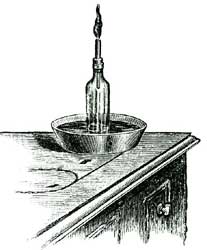
6. By a simple experiment which your parents or your teacher can perform for you, it can be readily proven that different fermented drinks contain alcohol, and also that the alcohol may be driven off by heat. Place a basin half full of water upon the stove where it will soon boil. Put into a glass bottle enough beer or cider so that when the bottle stands up in the basin the liquid in the bottle will be at about the same height as the water in the basin. Now place in the neck of the bottle a closely fitting cork in which there has been inserted a piece of the stem of a clay pipe or a small glass tube. Place the bottle in the basin. Watch carefully until the liquid in the bottle begins to boil. Now apply a lighted match to the end of the pipe-stem or glass tube. Perhaps you will observe nothing at first, but continue placing the match to the pipe-stem, and pretty soon you will notice a little blue flame burning at the end of the stem. It will go out often, but you can light it again. This is proof that alcohol is escaping from the liquid in the bottle. After the liquid has been boiling for some time, the flame goes out, and cannot be re-lighted, because the alcohol has been all driven off.
7. The Alcohol Breath.—You have doubtless heard that a person who is under the influence of liquor may be known by his breath. His breath smells of alcohol. This is because his lungs are trying to remove the alcohol from his blood as fast as possible, so as to prevent injury to the blood corpuscles and the tissues of the body. It is the vapor of alcohol mixed with his breath that causes the odor.
8. You may have heard that sometimes men take such quantities of liquor that the breath becomes strong with the vapor of alcohol and takes fire when a light is brought near the mouth. These stories are probably not true, although it sometimes happens that persons become diseased in such a way that the breath will take fire if it comes in contact with a light. Alcohol may be a cause of this kind of disease.
9. Making Alcohol.—It may be that some of our young readers would like to find out for themselves that alcohol is really made by fermentation. This may be done by an easy experiment. You know that yeast will cause bread to "rise" or ferment. As we have elsewhere learned, a little alcohol is formed in the fermentation of bread, but is driven off by the heat of the oven in baking, so that we do not take any of it into our stomachs when we eat the bread. If we place a little baker's yeast in sweetened water, it will cause it to ferment and produce alcohol. To make alcohol, all we have to do is to place a little yeast and some sweetened water in a bottle and put it away in a warm place for a few hours until it has had time to ferment. You will know when fermentation has taken place by the great number of small bubbles which appear. When the liquid has fermented, you may prove that alcohol is present by means of the same experiment by which you found the alcohol in cider or wine. (See page 160.)
10. Alcohol is made from the sweet juices of fruits by simply allowing them to ferment. Wine, as you know, is fermented grape juice. Cider is fermented apple juice. The strong alcoholic liquor obtained by distilling wine, cider, or any kind of fermented fruit juice, is known as brandy.
11. How Beer is Made.—Beer is made from grain of some sort. The grain is first moistened and kept in a warm place for a few days until it begins to sprout. The young plant needs sugar for its food; and so while the grain is sprouting, the starch in the grain is changed into sugar by a curious kind of digestion. This, as you will remember, is the way in which the saliva acts upon starch. So far no very great harm has been done, only sprouted grain, though very sweet, is not so good to eat as grain which has not sprouted. Nature intends the sugar to be used as food for the little sproutlet; but the brewer wants it for another purpose, and he stops the growth of the plant by drying the grain in a hot room.
12. The next thing the brewer does is to grind the sprouted grain and soak it in water. The water dissolves out the sugar. Next he adds yeast to the sweet liquor and allows it to ferment, thus converting the sugar into alcohol. Potatoes are sometimes treated in a similar way.
13. By distilling beer, a strong liquor known as whiskey is obtained. Sometimes juniper berries are distilled with the beer. The liquor obtained is then called gin. In the West Indies, on the great sugar plantations, large quantities of liquor are made from the skimmings and cleanings of the vessels in which the sweet juice of the sugar-cane is boiled down. These refuse matters are mixed with water and fermented, then distilled. This liquor is called rum.
14. Now you have learned enough about alcohol to know that it is not produced by plants in the same way that food is, but that it is the result of a sort of decay. In making alcohol, good food is destroyed and made into a substance which is not fit for food, and which produces a great amount of sickness and destroys many lives. Do you not think it a pity that such great quantities of good corn and other grains should be wasted in this way when they might be employed for a useful purpose?
15. The Alcohol Family.—Scientists tell us that there are several different kinds of alcohol. Naphtha is a strong-smelling liquid sometimes used by painters to thin their paint and make it dry quickly. It does not have the same odor as alcohol, but it looks and acts very much like it. It will burn as alcohol does. It kills animals and plants. It will make a person drunk if he takes a sufficient quantity of it. Indeed, it is so like alcohol that it really is a kind of alcohol.
16. There are also other kinds of alcohol. Fusel-oil, a deadly poison, is an alcohol. A very small amount of this alcohol will make a person very drunk. Fusel-oil is found in bad whiskey. (All whiskey is bad, but some kinds are worse than others.) This is why such whiskey makes men so furiously drunk. It also causes speedy death in those who use it frequently. There are still other kinds of alcohol, some of which are even worse than fusel-oil. So you see this is a very bad family.
17. Like most other bad families, this alcohol family has many bad relations. You have heard of carbolic acid, a powerful poison. This is one of the relatives of the alcohol family. Creosote is another poisonous substance closely related to alcohol. Ether and chloroform, by which people are made insensible during surgical operations, are also relatives of alcohol. They are, in fact, made from alcohol. These substances, although really useful, are very poisonous and dangerous. Do you not think it will be very wise and prudent for you to have nothing to do with alcohol in any form, even wine, beer, or cider, since it belongs to such a bad family and has so many bad relations?
18. Some persons think that they will suffer no harm if they take only wine or beer, or perhaps hard cider. This is a great mistake. A person may get drunk on any of these drinks if a sufficient amount be taken. Besides, boys who use wine, beer, or cider, rarely fail to become fond of stronger liquors. A great many men who have died drunkards began with cider. Cider begins to ferment within a day or two after it is made, and becomes stronger in alcohol all the time for many months.
19. "Bitters."—There are other liquids not called "drinks" which contain alcohol. "Bitters" usually contain more alcohol than is found in ale or wine, and sometimes more than in the strongest whiskey. "Jamaica ginger" is almost pure alcohol. Hence, it is often as harmful for a person to use these medicines freely as to use alcoholic liquors in any other form.
20. Alcoholic liquors of all kinds are often adulterated. That is, they contain other poisons besides alcohol. In consequence of this, they may become even more harmful than when pure; but this does not make it safe to use even pure liquor. Alcohol is itself more harmful than the other drugs usually added in adulteration. It is important that you should know this, for many people think they will not suffer much harm from the use of alcohol if they are careful to obtain pure liquors.
21. Some Experiments.—How many of you remember what you have learned in previous lessons about the poisonous effects of alcohol? Do people ever die at once from its effects? Only a short time ago a man made a bet that he could take five drinks of whiskey in five seconds. He dropped dead when he had swallowed the fourth glass. No one ever suffered such an effect from taking water or milk or any other good food or drink.
22. A man once made an experiment by mistake. He was carrying some alcohol across a lawn. He accidentally spilled some upon the grass. The next day he found the grass as dead and brown as though it had been scorched by fire.
23. Mr. Darwin, the great naturalist, once made a curious experiment. He took a little plant with three healthy green leaves, and shut it up under a glass jar where there was a tea-spoonful of alcohol. The alcohol was in a dish by itself, so it did not touch the plant; but the vapor of the alcohol mixed with the air in the jar so that the plant had to breathe it. In less than half an hour he took the plant out. Its leaves were faded and somewhat shrivelled. The next morning it appeared to be dead. Do you suppose the odor of milk or meat, or of any good food, would affect a plant like that? Animals shut up with alcohol die in just the same way.
24. A Drunken Plant.—How many of you remember about a curious plant that catches flies? Do you remember its name? What does the Venus's fly-trap do with the flies after it catches them? Do you say that it eats them? Really this is what it does, for it dissolves and absorbs them. In other words, it digests them. This is just what our stomachs do to the food we eat.
25. A few years ago Mr. Darwin thought that he would see what effect alcohol would have upon the digestion of a plant. So he put a fly-catching plant in a jar with some alcohol for just five minutes. The alcohol did not touch the plant, because the jar was only wet with the alcohol on the inside. When he took the plant out, he found that it could not catch flies, and that its digestion was spoiled so that it could not even digest very tender bits of meat which were placed on its leaves. The plant was drunk.
26. Mr. Darwin tried a great many experiments with various poisons, and found that the plants were affected in much the same way by ether and chloroform, and also by nicotine, the poisonous oil of tobacco. Sugar, milk, and other foods had no such effect. This does not look much as though alcohol would help digestion; does it?
27. Effects of Alcohol on Digestion.—Dr. Roberts, a very eminent English scientist, made many experiments, a few years ago, to ascertain positively about the effect of alcohol upon digestion. He concluded that alcohol, even in small doses, delays digestion. This is quite contrary to the belief of very many people, who suppose that wine, cider, or stronger liquors aid digestion. The use of alcohol in the form of beer or other alcoholic drinks is often a cause of serious disease of the stomach and other digestive organs.
28. Effects of Alcohol on Animal Heat.—A large part of the food we eat is used in keeping our bodies warm. Most of the starch, sugar, and fat in our food serves the body as a sort of fuel. It is by this means that the body is kept always at about the same temperature, which is just a little less than one hundred degrees. This is why we need more food in very cold weather than in very warm weather.
29. When a person takes alcohol, it is found that instead of being made warmer by it, he is not so warm as before. He feels warmer, but if his temperature be ascertained by means of a thermometer placed in his mouth, it is found that he is really colder. The more alcohol a person takes the colder he becomes. If alcohol were good food would we expect this to be the case? It is probably true that the alcohol does make a little heat, but at the same time it causes us to lose much more heat than it makes. The outside of the body is not so warm as the inside. This is because the warm blood in the blood-vessels of the skin is cooled more rapidly than the blood in the interior of the body. The effect of alcohol is to cause the blood-vessels of the outside of the body to become much enlarged. This is why the face becomes flushed. A larger amount of warm blood is brought from the inside of the body to the outside, where it is cooled very rapidly; and thus the body loses heat, instead of gaining it, under the influence of alcohol. This is not true of any proper food substance.
30. Alcohol in the Polar Regions.—Experience teaches the same thing as science respecting the effect of alcohol. Captain Ross, Dr. Kane, Captain Parry, Captain Hall, Lieutenant Greely, and many other famous explorers who have spent long months amid the ice and snow and intense cold of the countries near the North Pole, all say that alcohol does not warm a man when he is cold, and does not keep him from getting cold. Indeed, alcohol is considered so dangerous in these cold regions that no Arctic explorer at the present time could be induced to use it. The Hudson Bay Company do not allow the men who work for them to use any kind of alcoholic liquors. Alcohol is a great deceiver, is it not? It makes a man think he is warmer, when he is really colder. Many men are frozen to death while drunk.
31. Alcohol in Hot Regions.—Bruce, Livingstone, and Stanley, and all great African travellers, condemn the use of alcohol in that hot country as well as elsewhere. The Yuma Indians, who live in Arizona and New Mexico, where the weather is sometimes much hotter than we ever know it here, have made a law of their own against the use of liquor. If one of the tribe becomes drunk, he is severely punished. This law they have made because of the evil effects of liquor which they noticed among the members of their tribe who used to become intoxicated. Do you not think that a very wise thing for Indians to do?
32. Sunstroke.—Do you know what sunstroke is? If you do not, your parents or teacher will tell yow that persons exposed to the heat of the sun on a hot summer day are sometimes overcome by it. They become weak, giddy, or insensible, and not infrequently die. Scores of people are sometimes stricken down in a single day in some of our large cities. It may occur to you that if alcohol cools the body, it would be a good thing for a person to take to prevent or relieve an attack of sunstroke. On the contrary, it is found that those who use alcoholic drinks are much more liable to sunstroke than others. This is on account of the poisonous effects of the alcohol upon the nerves. No doctor would think of giving alcohol in any form to a man suffering with sunstroke.
33. Effects of Alcohol upon the Tissues.—Here are two interesting experiments which your teacher or parents can make for you.
Experiment 1. Place a piece of tender beefsteak in a saucer and cover it with alcohol. Put it away over night. In the morning the beefsteak will be found to be shrunken, dried, and almost as tough as a piece of leather. This shows the effect of alcohol upon the tissues, which are essentially like those of lower animals.
Experiment 2. Break an egg into a half glassful of alcohol. Stir the egg and alcohol together for a few minutes. Soon you will see that the egg begins to harden and look just as though it had been boiled.
34. This is the effect of strong alcohol. The alcohol of alcoholic drinks has water and other things mixed with it, so that it does not act so quickly nor so severely as pure alcohol; but the effect is essentially the same in character. It is partly in this way that the brain, nerves, muscles, and other tissues of drinking men and women become diseased.
Eminent physicians tell us that a large share of the unfortunate persons who are shut up in insane asylums are brought there by alcohol. Is it not a dreadful thing that one's mind should be thus ruined by a useless and harmful practice?
SUMMARY.
1. Alcohol is produced by fermentation, and obtained by distillation. It will burn like kerosene oil and other burning fluids.
2. The vapor of alcohol will burn and will sometimes explode.
3. Alcohol may be separated from beer and other fermented liquids by boiling.
4. Brandy is distilled from fermented fruit juice, whiskey and gin from beer or fermented grains, rum from fermented molasses.
5. Alcohol is the result of a sort of decay, and much good food is destroyed in producing it.
6. Besides ordinary alcohol, there are several other kinds. Naphtha and fusel-oil are alcohols.
7. All the members of the alcohol family are poisons; all will burn, and all will intoxicate. The alcohol family have several bad relations, among which are carbolic acid, ether, and chloroform.
8. Cider, beer, and wine are harmful and dangerous as well as strong liquors. "Bitters" often contain as much alcohol as the strongest liquors, and sometimes more.
9. Alcoholic liquors are sometimes adulterated, but they usually contain no poison worse than alcohol. Pure alcohol is scarcely less dangerous than that which is adulterated.
10. Death sometimes occurs almost instantly from taking strong liquors.
11. Alcohol will kill grass and other plants, if poured upon them or about their roots.
12. Mr. Darwin proved that the vapor of alcohol will kill plants; also that plants become intoxicated by breathing the vapor of alcohol.
13. Alcohol, even in small quantities, hinders digestion.
14. Alcohol causes the body to lose heat so rapidly that it becomes cooler instead of warmer.
15. The danger of freezing to death when exposed to extreme cold is greatly increased by taking alcohol.
16. Stanley, and other African explorers, say that it is dangerous to use alcoholic drinks in hot climates.
17. In very hot weather, persons who use alcoholic drinks are more subject to sunstroke than those who do not.
18. Beefsteak soaked in alcohol becomes tough like leather. An egg placed in alcohol is hardened as though it had been boiled.
19. The effect of alcohol upon the brain, nerves, and other tissues of the body is much the same as upon the beefsteak and the egg.
QUESTIONS FOR REVIEW.
CHAPTER I. The House we Live in.—What is the body like? Does the body resemble anything else besides a house? How is it like a machine? Name the different parts of the body. What is anatomy? physiology? hygiene?
CHAPTER II. A General View of the Body.—What are the main parts of the body? Name the different parts of the head; of the trunk; of each arm; of each leg. What covers the body?
CHAPTER III. The Inside of the Body.—What is the name of the framework of the body? What is the skull? How is the back-bone formed? Name the two cavities of the trunk. What does the chest contain? the abdomen?
CHAPTER IV. Our Foods.—Of what are our bodies made? What are foods? Where do we get our foods? Name some animal foods; some vegetable foods. What are poisons?
CHAPTER V. Unhealthful Foods.—Is the flesh of diseased animals good for food? What can you say about unripe, stale, or mouldy foods? What is adulteration of foods? What foods are most likely to be adulterated? Are pepper, mustard, and other condiments proper foods? What about tobacco? What is the effect of tobacco upon boys?
CHAPTER VI. Our Drinks.—What is the only thing that will satisfy thirst? Why do we need water? How does water sometimes become impure? What is the effect of using impure water? What are the properties of good water? Are tea and coffee good drinks? How is alcohol made? Give familiar examples of fermentation. How are pure alcohol and strong liquors made? Is alcohol a food? Why do you think it is a poison? Do you think moderate drinking is healthful?
CHAPTER VII. How we Digest.—What is digestion? What is the digestive tube? Name the different digestive organs. How many sets of teeth has a person in his lifetime? How many teeth in each set? How many pairs of salivary glands? What do they form? What is the gullet? Describe the stomach. What is the gastric juice? How long is the intestinal canal? What fluid is formed in the intestines? Where is the liver found, and how large is it? What does the liver produce? What is the gall-bladder, and what is its use? What does the liver do besides producing bile? What and where is the pancreas? What does the pancreas do? Where is the spleen? How many important organs of digestion are there? How many digestive fluids?
CHAPTER VIII. Digestion of a Mouthful of Bread.—Name the different processes of digestion [mastication, action of saliva, swallowing, action of stomach and gastric juice, action of bile, action of pancreatic juice, action of intestines and intestinal juice, absorption, liver digestion]. Describe the digestion of a mouthful of bread. Where is the food taken after it has been absorbed? What are the lacteals? What is the thoracic duct?
CHAPTER IX. Bad Habits in Eating.—What is indigestion? Mention some of the causes of indigestion. How does eating too fast cause indigestion? Eating too much? too frequently? Irregularly? when tired? How do tea and coffee impair digestion? Why is it harmful to use iced foods and drinks? Why should we not eat pepper and other hot and irritating things? How should the teeth be cared for? How does tobacco-using affect the stomach? What dreadful disease is sometimes caused by tobacco? How does alcohol affect the gastric juice? the stomach? the liver?
CHAPTER X. A Drop of Blood.—What does the blood contain? How many kinds of blood corpuscles are there? What work is done for the body by each kind of corpuscles?
CHAPTER XI. Why the Heart Beats.—Where is the heart? Why does the heart beat? How many chambers has the heart? What are the blood-vessels? How many kinds of blood-vessels are there? Name them. What is the difference between venous blood and arterial blood? What change occurs in the blood in the lungs? What is the pulse? How much work does the heart do every twenty-four hours? What are the lymphatics? What do they contain, and what is their purpose? What are lymphatic glands?
CHAPTER XII. How to Keep the Heart and Blood Healthy.—Name some things likely to injure the heart or the blood. What is the effect of violent exercise? of bad air? of bad food? of loss of sleep? of violent anger? What can you say about clothing? What is the effect of alcohol upon the blood? the heart? the bodily heat? What is the effect of tobacco upon the heart? the pulse? the blood? What is the effect of tea and coffee upon the heart? What is a cold? In a case of bleeding from a wound, how can you tell whether a vein or an artery is cut? How would you stop the bleeding from an artery? from a vein? How would you stop nose-bleed?
CHAPTER XIII. Why and How we Breathe.—What happens to a lighted candle if shut up in a small, close place? to a mouse? Why is air so necessary for a burning candle and for animals? How is the heat of our bodies produced? Name the principal organs of breathing. Describe each. How do we use the lungs in breathing? How much air will a man's lungs hold? How much air do we use with each breath? What poisonous substance does the air which we breathe out contain? Will a candle burn in air which has been breathed? What happens to animals placed in such air? What change takes place in the blood as it passes through the lungs? How do plants purify the air?
CHAPTER XIV. How to Keep the Lungs Healthy.—What is the thing most necessary to preserve life? Name some of the ways in which the blood becomes impure. Why is bad-smelling air dangerous to health? What are germs? Why are some diseases "catching"? Name some such diseases. What should be done with a person who has a "catching" disease? What is the effect of the breath upon the air? How much air is poisoned and made unfit to breathe by each breath? How much air do we spoil every minute? every hour? How much pure air does each person need every minute? every hour? How do we get fresh air into our houses? Why are windows and doors not good means of ventilating in cold weather? How should a room be ventilated? How should we use the lungs in breathing? What about the clothing in reference to the lungs? Why is it injurious to breathe habitually through the mouth? What is the effect of alcohol upon the lungs? What is the effect of tobacco-using upon the throat and nose?
CHAPTER XV. The Skin and What it Does.—How many layers in the skin? What is each called? To what is the color of the skin due? What glands are found in the true skin? What are the nails and what is their purpose? How does the hair grow? Name the different uses of the skin?
CHAPTER XVI. How to Take Care of the Skin.—What happened to the little boy who was covered with gold leaf? Why did he die? What is the effect of neglecting to keep the skin clean? What is the effect of wearing too much clothing and living in rooms which are too warm? How should the hair be cared for? the nails? What is the effect of alcohol, tobacco, and other narcotics upon the skin?
CHAPTER XVII. The Kidneys and their Work.—What is the work of the kidneys? How may we keep these organs healthy? What is the effect of alcohol upon the kidneys?
CHAPTER XVIII. Our Bones and their Uses.—How many bones in the body? What are the bones called when taken all together? Name the principal parts of the skeleton. Name the bones of the trunk, of the arms, of the legs. What are the uses of the bones? What is a joint? What is cartilage? By what are the bones held together? Of what are the bones largely composed?
CHAPTER XIX. How to Keep the Bones Healthy.—What sort of bread is best for the bones? Why? If a child tries to walk too early why are its legs likely to become crooked? What are the effects of sitting or lying in bad positions? Of wearing tight or poorly-fitting clothing? Of tight or high-heeled shoes? What injuries are likely to happen to the bones and joints by accident or rough play?
CHAPTER XX. The Muscles and How we Use Them.—How many muscles in the body? Of what are the muscles composed? How are many of the muscles connected to the bones? To what are all bodily movements due? How do the muscles act? What causes the muscles to act? Do all muscles act only when we will to have them act?
CHAPTER XXI. How to Keep the Muscles Healthy.—What makes the right arm of the blacksmith stronger than the left one? How should exercise be taken? Mention some things in relation to the use of the muscles which we ought not to do, and state the reasons why. What is the effect of alcohol upon the muscles? of tobacco? of tea and coffee?
CHAPTER XXII. How we Feel and Think.—With what part of the body do we think? How many brains does a man have? How is each brain divided? Of what is the brain largely composed? Where do the nerves begin? What is the spinal cord? Why does it cause pain to prick the finger? How many kinds of nerves are there? (Ans. Two; nerves of feeling and nerves of work.) Name some of the different kinds of nerves of feeling? Name some of the different kinds of work controlled by the nerves of work. Of what use to the body are the brain and nerves? How does the brain use the nerves? Of what use is the large brain? What does the little brain do? Of what use is the spinal cord?
CHAPTER XXIII. How to Keep the Brain and Nerves Healthy.—Mention some things which we need to do to keep the brain and nerves healthy. Mention some things which we ought not to do.
CHAPTER XXIV. Bad Effects of Alcohol upon the Brain and Nerves.—What is the effect of alcohol upon the brain and nerves? Does alcohol produce real strength? Does it produce real warmth? Does alcohol make people better or worse? What is the effect of tobacco upon the brain and nerves? Does the use of tobacco lead to other evil habits? What about the effect of opium and other narcotics?
CHAPTER XXV. How we Hear, See, Smell, Taste, and Feel.—How many senses have we? What is the ear? Name the three parts of the ear. How do we hear? How should we treat the ear?
Name the principal parts of the eye? What are found in the eyeball? How is the eyeball moved in the socket? How is the eye moistened? Of what use is the lens of the eye? Of what use is the pupil of the eye? How may we preserve the eyesight?
Where are the nerves of smell located? Of what use is the sense of smell?
Where are the nerves of taste found? How is the sense of taste sometimes injured or lost? What do we detect with the sense of taste? Of what use to us is the sense of taste?
With what sense do we feel objects? In what parts of the body is this sense most delicate? Upon what do all the special senses depend? Does anything that injures the brain and nerves also injure the special senses? What is the effect of alcohol and tobacco upon the sense of sight? How is the hearing affected by tobacco-using? The sense of smell? The sense of taste?
CHAPTER XXVI. Alcohol.—How is alcohol produced? In what respect is alcohol like kerosene oil? Is alcohol a dangerous thing even if we do not drink it? How can you prove that there is alcohol in wine, beer, cider, and other fermented drinks? Can you tell by the odor of his breath when a person has been drinking? Why? Does the breath ever take fire? May alcohol be a cause? From what is brandy made? How are whiskey, gin, and rum made? Is alcohol a result of growth, like fruits and grains, or of decay? Is there more than one kind of alcohol? Mention some of the members of the alcohol family. In what ways are the members of this family alike? Name some of the bad relations. Are cider and beer, as well as whiskey, dangerous? Why? Mention some other things, besides drinks, which contain alcohol. Are alcoholic drinks adulterated? Is pure alcohol safe? Is instant death ever produced by alcohol? Will alcohol kill plants? Describe Mr. Darwin's experiment which proved this. Can plants be made drunk by alcohol? Describe the experiment which proves this. What has Dr. Roberts proven concerning the influence of alcohol upon digestion? How are our bodies kept warm? Explain how alcohol makes the body cooler? Do Arctic explorers use alcohol? Why not? Does the use of alcohol prevent sunstroke? What do Stanley and Livingstone say about the use of alcohol in Africa? What is the effect of using alcohol upon meat and eggs? What is the effect of alcohol upon the brain and other tissues of the body? Does alcohol cause insanity and other diseases of the brain and nerves?
FOOTNOTES:
THE END.
Aids to Field and Laboratory Work in Botany
Apgars' Plant Analysis. By E.A. and A.C. Apgar.
Cloth, small 4to, 124 pages 55 cents
A book of blank schedules, adapted to Gray's Botanies, for pupils' use in writing and preserving brief systematic descriptions of the plants analyzed by them in field or class work. Space is allowed for descriptions of about one hundred and twenty-four plants with an alphabetical index.
An analytical arrangement of botanical terms is provided, in which the words defined are illustrated by small wood cuts, which show at a glance the characteristics named in the definition.
By using the Plant Analysis, pupils will become familiar with the meaning of botanical terms, and will learn how to apply these terms in botanical descriptions.
Apgar's Trees of the Northern United States
Their Study, Description, and Determination. For the use of Schools and Private Students. By Austin C. Apgar.
Cloth, 12mo, 224 pages. Copiously Illustrated $1.00
This work has been prepared as an accessory to the study of Botany, and to assist and encourage teachers in introducing into their classes instruction in Nature Study. The trees of our forests, lawns, yards, orchards, streets, borders and parks afford a most favorable and fruitful field for the purposes of such study. They are real objects of nature, easily accessible, and of such a character as to admit of being studied at all seasons and in all localities. Besides, the subject is one of general and increasing interest, and one that can be taught successfully by those who have had no regular scientific training.
Copies of either of the above books will be sent, prepaid, to any address on receipt of the price by the Publishers: