WATER SUPPLY. (continued 2)
Reading edition
If the ticket be not given in, as before provided, within half an hour after the alarm is given at their engine-house, or at all events, within half an hour after the arrival of the engine at the fire, the defaulter will forfeit the allowance for turning out, and also the first hour's pay.
If not given in within the first hour, he will forfeit all claim to pay.
The superintendent, however, may do away the forfeiture in any of these cases, on cause being shown to his satisfaction.
On quarter-days and days of exercise, every man must be ready equipped at the appointed hour, otherwise he will forfeit that day's pay, or such part of it as the superintendent may determine.
Any man destroying his equipments, or wearing them when off duty, will be punished by fine or dismissal from the service, as the superintendent may determine.
Careless conduct, irregular attendance at exercise, or disobedience of superior officers, to be punished as above-mentioned.
The man who arrives first at the engine-house to which he belongs, properly equipped, will receive three shillings over and above the pay for turning out.
The first of the Nos. 1 and 2 who arrives at the fire, properly equipped, in whatever district it may be, will receive three shillings over and above the pay for turning out.
No pay will be allowed for a false alarm, unless the same is given by a policeman.
As nothing is so hurtful to the efficiency of an establishment for extinguishing fires as unnecessary noise, irregularity, or insubordination, it is enjoined on all to observe quietness and regularity, to execute readily whatever orders they may receive from their officers, and to do nothing without orders.
The first engine and company which arrive at the fire are not to be interfered with, nor their supplies of water diverted from them by those coming afterwards, unless by a distinct order from the superintendent, or, in his absence, from the chief magistrate on the spot. The same rule will apply to each succeeding engine which takes up a station.
The men must be careful not to allow their attention to be distracted from their duty by listening to directions from any persons except their own officers; and they will refer every one who applies to them for aid to the superintendent, or to the chief magistrate present at the time.
All the firemen must be particularly careful to let the policemen on their respective stations know where they live, and take notice when the policeman is changed, that they may give the new one the requisite information.
The men are particularly cautioned not to take spirituous liquors from any individual without the special permission of the captain of their engine, who will see that every proper and necessary refreshment be afforded to them; and as intoxication upon such alarming occasions is not merely disreputable to the corps, but in the highest degree dangerous, by rendering the men unfit for their duty, every appearance of it will be most rigidly marked; and any man who may be discovered in that state shall not only forfeit his whole allowances for the turn-out and duty performed, but will be forthwith dismissed from the corps.
All concerned are strictly enjoined to preserve their presence of mind, not to lose temper, and upon no occasion whatsoever to give offence to the inhabitants by making use of uncivil language or behaving rudely.
*** Every one belonging to the establishment will be furnished with a printed copy of these Regulations, which they are enjoined carefully to preserve and read over at least once every week.
MEANS OF ESCAPE FROM FIRE.
[The following was written in the year 1830, and does not refer to Public Fire-Escapes other than those that can be carried with a Fire-Engine.—Editor.]
When the lower floors of a house are on fire, and the stairs or other ordinary means of retreat destroyed, the simplest and easiest mode of removing the inhabitants from the upper floors, is by a ladder placed against the wall. In order to be able at all times to carry this plan into effect, the person having charge of the engines should (as far as possible) inform himself where long ladders are to be had, and how they can most easily be removed.
But if a ladder of sufficient length is not to be procured, or is at too great a distance to render it safe to wait for it, recourse must immediately be had to other means.
If it happens that the windows above are all inaccessible, on account of the flames bursting through those below, the firemen should immediately get on the roof (by means of the adjoining houses,) and descend by the hatch. The hatch, however, being sometimes directly above the stair, is in that case very soon affected by the fire and smoke. If, on approaching, it is found to be so much so as to render an entrance in that way impracticable, the firemen should instantly break through the roof, and, descending into the upper floors, extricate those within. If it should happen, however, that the persons in danger are not in the upper floor, and cannot reach it in consequence of the stair being on fire, the firemen should continue breaking through floor after floor till they reach them. In so desperate a case as this the shorter process may probably be to break through the party-wall between the house on fire and that adjoining, when there is one; and when there is no house immediately contiguous, through the gable, taking care in either case to break through at the back of a closet, press, chimney, or other recess, where the wall is thinnest. If an opening has been made from the adjoining house, it should immediately (after having served the purpose for which it was made) be built up with brick or stone, to prevent the fire spreading. All these operations should be performed by slaters, masons, or house-carpenters, who, being better acquainted with such work, are likely to execute it in a shorter time than others—time, in such a case, being everything, as a few minutes lost may cost the lives of the whole party. It is not impossible, however, that circumstances may occur to render all or either of these plans impracticable; in that case, one or two of the lower windows must be darkened, and by this means access gained to the upper ones. The plan recommended by the Parisian firemen is, for a man to wrap himself up in a wet blanket, and thus pass swiftly through the flames. But this effort is only to be attempted when the flames from a single door are to be passed; in any other case the stair will most likely be in flames, and impassable.
A simple means of escape from fire is to have an iron ring fastened to the window sill, and inside of the room a cradle, with a coil of rope attached to it. The rope is put through the ring, and the person wishing to escape gets into the cradle, and lowers himself down by passing the rope through his hands. The great objection to this plan, which is certainly very simple, is the difficulty, or rather impossibility, of persuading people to provide themselves with the necessary materials. Many men, too, are incapable of the exertion upon which the whole plan depends; and if men in a state of terror are unfit for such a task, what is to become of women and children?
Any fire-escape, to be generally useful, must, in the first place, be capable of being carried about without encumbering the fire-engine; and, in the next place, must be of instant and simple application. The means which appear to me to possess these qualifications in the highest degree, is a combination of the cradle plan, with Captain Manby's admirable invention for saving shipwrecked seamen.
The apparatus necessary for this fire-escape is a chain-ladder eighty feet long, a single chain or rope of the same length as the ladder, a canvas bag, a strong steel cross-bow, and a fine cord of the very best workmanship and materials, 130 feet long, with a lead bullet of three-ounce weight attached to one end, and carefully wound upon a wooden cone seven inches high and seven inches broad at the base, turned with a spiral groove, to prevent the cord slipping when wound upon it, also a small pulley with a claw attached to it, and a cord reeved through it of sufficient strength to bear the weight of the ladder.
In order to prevent the sides of the ladder from collapsing, the steps are made of copper or iron tube, fastened by a piece of cord passed through the tube and into the links of the chain, till the tube is filled. The steps thus fastened are tied to the chain with copper-wire, so that, in the event of the cord being destroyed, the steps will be retained in their places by the wire. The ladder is provided with two large hooks at one end, for the purpose of fixing it to a roof, window-sill, &c. The bag is of canvas, three feet wide and four feet deep, with cords sewed round the bottom, and meeting at the top, where they are turned over an iron thimble at each side of the mouth of the bag. The steel cross-bow is of the ordinary description, of sufficient strength to throw the lead bullet with the cord attached, 120 feet high.
When the house from which the persons in danger are to be extricated is so situated that the firemen can get to the roof by passing along the tops of the adjoining houses, they will carry up the chain-ladder with them, and drop it over the window where the inmates show themselves, fastening the hooks at the same time securely in the roof. The firemen will descend by the ladder into the window, and putting the persons to be removed into the bag, lower them down into the street by the single chain. If the flames are issuing from the windows below, the bag, when filled, is easily drawn aside into the window of the adjoining house, by means of a guy or guide-rope.
If the house on fire stands by itself, or if access cannot be had to the roof by means of the adjoining houses, the lead bullet, with the cord attached, is thrown over the house by means of the cross-bow; to this cord a stronger one is attached, and drawn over the house by means of the former; a single chain is then attached, and drawn over in like manner; and to this last is attached the chain-ladder, which, on being raised to the roof, the firemen ascend, and proceed as before directed.
If the house be so high that the cord cannot be thrown over far enough to be taken hold of by those on the opposite side, then the persons to be extricated must take hold of the cord, as it hangs past the window at which they may have placed themselves. By means of it they draw up the small pulley, and hook it on the window-sill. The chain-ladder is then made fast to the end of the cord, and drawn up by those below. When the end of the chain-ladder comes in front of the window, the persons inside fasten the hooks of the ladder on its sill, or to the post of a bed, the bars of a grate, or anything likely to afford a sufficient hold. After having ascertained that the ladder is properly fixed, the firemen will ascend and proceed as in the former cases.
I must here remark, that before this plan can be properly put in execution, the firemen must be regularly trained to the exercise. When the firemen here are practised with the fire-escape, the man ascending or descending has a strong belt round his middle, to which another chain is fastened, and held by a man stationed at the window for that purpose; if any accident, therefore, were to occur with the chain-ladder, the man cannot fall to the ground, but would be swung by the chain attached to the belt round his body. The men are also frequently practised in ascending and descending by single chains. The firemen here are very fond of the above exercise; the bagging each other seems to amuse them exceedingly.[I]
The last resort, in desperate cases, is to leap from the window. When this is to be attempted, mattresses, beds, straw, or other soft substances, should be collected under the window; a piece of carpet or other strong cloth should be held up by ten or twelve stout men. The person in the window may then leap, as nearly as possible, into the centre of the cloth, and if he has sufficient resolution to take a fair leap, he may escape with comparatively little injury.[J]
FIRE-ENGINES.
In the application of manual power to the working of fire-engines, the principal object is, to apply the greatest aggregate power to the lightest and smallest machine; that is, suppose two engines of the same size and weight, the one with space for 20 men to work throws 60 gallons per minute; and the other, with space for 30 men, throws 80 gallons in the same time; the latter will be the most useful engine, although each man is not able to do so much work as at the former.
The reciprocating motion is generally preferred to the rotary for fire-engines. Independent of its being the most advantageous movement, a greater number of men can be employed at an engine of the same size and weight; there is less liability to accident with people unacquainted with the work, and such as are quite ignorant of either mode of working, work more freely at the reciprocating than the rotary motion. To these reasons may be added, the greater simplicity of the machinery.
Various sizes of engines, of different degrees of strength and weight, have been tried, and it is found that a fire-engine with two cylinders of 7 inches diameter, and a stroke of 8 inches, can be made sufficiently strong at 17-1/2 cwt. If 4 cwt. be added for the hose and tools, it will be found quite as heavy as two fast horses can manage, for a distance under six miles, with five firemen and a driver.
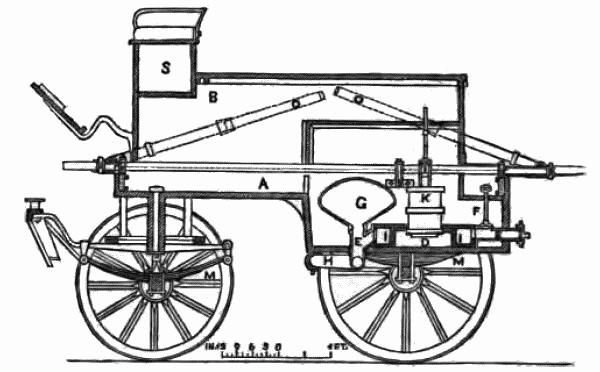
Fig. 1. Fire-Engine used by the London Fire Brigade. Longitudinal section,—with the Levers turned up for travelling.
This size of engine has been adopted by the Board of Admiralty and the Board of Ordnance, and its use is becoming very general.
When engines are made larger, it is seldom that the proper proportions are preserved, and they are generally worked with difficulty, and soon fatigue the men at the levers.
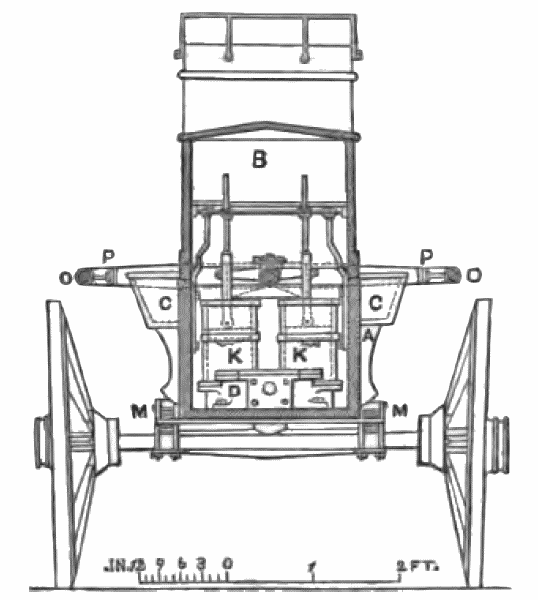
Fig. 2. Transverse section.
When an engine is large, it not only requires a considerable number of men to work it, but it is not easily supplied with water; and, above all, it cannot be moved about with that celerity on which, in a fire-engine establishment, everything depends. When the engine is brought into actual operation, the effect to be produced depends less on the quantity of water thrown than upon its being made actually to strike the burning materials, the force with which it does so, and the steadiness with which the engine is worked. If the water be steadily directed upon the burning materials, the effect even of a small quantity is astonishing.
When a large engine is required in London, two with 7-inches cylinders are worked together by means of a connecting screw, thus making a jet very nearly equal (as 98 to 100) to that of an engine with cylinders 10 inches diameter.
It is also an advantage not unworthy of consideration, that two 7-inch engines may be had nearly for the price of one 10-inch one; so that if one happens to be rendered unserviceable the other may still be available.
The usual rate of working an engine of the size described is 40 strokes of each cylinder per minute; this gives 88 gallons. The number of men required to keep steadily at work for three or four hours is 26; upwards of 30 men are sometimes put on when a great length of hose is necessary. The lever is in the proportion of 4-1/4 to 1. With 40 feet of leather hose and a 7/8 inch jet, the pressure is 30 lb. on the square inch; this gives 10.4 lbs. to each man to move a distance of 226 feet in one minute. The friction increases the labour 2-1/2 per cent. for every additional 40 feet of hose, which shows the necessity of having the engine, and of course the supply of water, as close to the fire as is consistent with the safety of the men at the levers.
In order that the reader may have a distinct idea of such a fire-engine, I shall here endeavour to give a description, chiefly taken from those made by W. J. Tilley,[K] fire-engine maker, London.
The engravings (figs. 1 and 2) represent a fire-engine of 7-inch barrels and 8-inch stroke.[L] The cistern marked A is made of mahogany or oak. The upper work, B, and side-boxes or pockets, C, are of Baltic fir. The sole, D, upon which the barrels stand, and which also contains the valves, is of cast-iron, with covers of the same material, which are screwed down, and the joints made good with leather or india-rubber. The pieces E, at each end of the cast-iron sole D, are of cast brass, and screwed to the cast-iron sole D, with a joint the same as above. In one of these pieces is the screwed suction-cap F, and to the other is attached the air-vessel G, made of sheet-copper, and attached to the piece E by a screw. The exit-pipe H is attached to the under side of the casting E by a swivel. The valves at I are of brass, ground so as to be completely water-tight. The barrels K are of cast brass. The engine is set on four grasshopper springs M. The shafts or handles O, of the levers P, are of lancewood. The box S, under the driving seat, is used for keeping wrenches, cord, &c.; in the fore part of the cistern A, and the box B above the cistern, the hose is kept; the branch and suction-pipes are carried in the side-boxes or pockets C; the rest of the tools and materials are kept along with the above-mentioned articles, in such situations as not to interfere with the working of the engine.
The cistern is made of oak or mahogany, for strength and durability; but, for the sake of lightness, the upper work and side-boxes are made of Baltic fir, strength in them being of less importance.
As the valve cannot be made without a rise for the lid to strike against, there is a small step at each of the valves, and the sole is carried through as high as this step, to admit of the water running off when the engine is done working. If constructed in a different manner, the water will lodge in the bottom, and produce much inconvenience in situations where the engine is exposed to frost.
The valve-covers are of cast-iron, fastened down with copper screws, a piece of leather or india-rubber being placed between them and the upper edges of the sole.
The pieces at each end of the sole are of cast-brass, instead of sheet-copper, with soft-solder joints, which are very apt to give way.
The screwed suction cap with iron handle admits the water in two different directions, according as it is open or closed: the one to supply the engine when water is drawn from the cistern, the other for drawing water through the suction-pipe.
The valves are brass plates, truly ground to fit the circular brass orifice on which they fall. The brass being well ground, no leather is used for the purpose of making them tight. The longer they are used the better they fit, and by having no leather about them they are less liable to the adhesion of small stones or gravel. The whole valve is put together and then keyed into a groove in the sides and bottom of the sole, left for that purpose.
The barrels are of cast-brass, with a piston made of two circular pieces of the same metal, each put into a strong leather cup, and bolted to the other. The bottoms of the cups being together, when the piston becomes loose in the barrels, and there is not sufficient time to replace the cups by new ones, they are easily tightened by putting a layer of hemp round the piston between the leather and the brass. This operation, however, requires to be carefully performed; for if more hemp is put into one part than another it is apt to injure the barrels. The barrels are fixed to the cast-iron sole by copper screws, a little red lead being placed between the bottom flange of the barrel and the sole.
When the engine is likely to be dragged over rough roads or causeways, it is of importance to have it set on springs, to prevent the jolting from affecting the working part of the engine, everything depending on that being right.
The engines used in Paris are mounted on two wheels, the carriage and the engine being separate, the latter being dismounted from the former before it can be used. In Paris, where the engines are managed by a corps of regularly-trained firemen, this may answer well enough; but if hastily or carelessly dismounted by unskilful persons, the engine may be seriously damaged. It is also worthy of remark, that the proper quantity of hose, tools, &c., can be more easily attached to and carried on a four-wheeled engine.
In order that the men may work more easily at the handles, and suffer less fatigue, the engine is not higher than to enable them to have the levers easily under their command. The shafts of the levers are of lancewood, being best calculated to bear the strain to which they are exposed when the engine is at work, and they are made to fold up at each end for convenience in travelling.
The air-vessel should be placed clear of any other part of the engine, excepting only the point where it is attached.
The fore-carriage of the engine is fitted with a pole, and is made to suit the harness of coach-horses, these being, in large towns, more easily procured than other draught cattle; this can be altered, however, to suit such harness as can most readily be obtained. Where horses are seldom used to move the engines, a drag-handle is attached, by which one or two men are able easily to direct the progress of the engine.
Two drag-ropes, each twenty-five feet long, of three-inch rope, with ten loops to each, are attached, one to each end of the splinter-bar, by means of which the engines are dragged; and to prevent the loops collapsing on the hand, they are partly lined with sheet-copper.
The whole of the brass work of an engine should be of the best gun-metal, composed of copper and tin only. Yellow brass should never be used; even at first it is far inferior to gun-metal, and after being used for some time it gets brittle. The whole of the materials used in the construction of a fire-engine should be of the best description.
In London for some years past a hand-pump has been carried with each engine. They have been found of the greatest service in keeping doors, windows, &c., cool. They throw from six to eight gallons per minute, to a height of from thirty to forty feet, and can be used in any position. The idea of the hand-pumps I took from the old-fashioned squirt, or "hand-engine."
When fire-engines are unserviceable it arises more frequently from want of care in keeping in order than from any damage they may have received in actual service or by the wearing out of the materials; so it is quite plain that this important part of the duty has not generally had that degree of attention paid to it which it deserves.
Although an engine were to be absolutely perfect in its construction, if carelessly thrown aside after being brought home from a fire, and allowed to remain in that state till the next occasion, it would be in vain (especially in small towns, where alarms are rare) to expect to find it in a serviceable condition; some of the parts must have grown stiff, and if brought into action in this state something is likely to give way.
When an engine is brought back from a fire, it ought to be immediately washed, the cistern cleaned out, the barrels and journals cleaned and fresh oil put on them, the wheels greased, and every part of the engine carefully cleaned and examined, and if any repairs are needed they should be executed immediately. When all this has been attended to clean hose should be put in, and the engine is again fit for immediate service. Besides this cleaning and examination after use, the engine ought to be examined and the brass part cleaned once a week, and worked with water once a month whether it has been used or not.
In addition to the keeping of the engine always in an effective state, this attention has the advantage of reminding the men of their duty, and making them familiar with every part of the mechanism of the engine; thus teaching them effectually how the engines ought to be protected when at work, by enabling them to discover those parts most liable to be damaged, and to which part damage is the most dangerous. It is more troublesome generally to get the engines well kept when there are no fires, than when there are many. But the only effectual method of inducing the men to keep them in good order, in addition to the moral stimulants of censure and applause, is to fine those who have the charge of them for the slightest neglect.
When the engine has been properly placed, before beginning to work the fore-carriage should be locked. This is done by putting an iron pin through a piece of wood attached to the cistern, into the fore-carriage. This prevents the wheels from turning round, and coming under the shafts, by which the latter might be damaged, and the hands of the men at work injured.
Small stones, gravel, and other obstructions, sometimes find their way into the nozzle of the branch-pipe, from having dropped into the hose before being attached, or having been drawn through the suction-pipe or from the cistern. Whenever the engine is found to work stiffly, it should be stopped and examined, otherwise the pressure may burst the hose, or damage some part of the engine. If anything impedes the action of the valves the pistons must be drawn, and if a person's hand be then introduced they may easily be cleared—constant care and attention to all the minutiæ of the engine and apparatus being absolutely indispensable, if effective service be expected from them.
Considerable attention ought to be paid to the selecting a proper situation for an engine-house. Generally speaking, it ought to be central, and on the highest ground of the district it is meant to protect, and care should be taken to observe when any of the streets leading from it are impassable.
If, in addition to these advantages, the engine-house can be had adjoining to a police watch-house, it may be considered nearly perfect, in so far as regards situation. These advantages being all attained, the engine can be conveyed to any particular spot by a comparatively small number of men, while the vicinity of a police watch-house affords a facility of communicating the alarm of fire to the firemen not to be obtained otherwise. When the engine-house is placed in a low situation the men who first arrive must wait till the others come forward to assist them to drag the engine up the ascent, and many minutes must thus be lost at a time when moments are important.
After choosing a proper situation for the engine-house, the next care should be directed towards having it properly ventilated, as nothing contributes more to the proper keeping of the engines and hose than fresh and dry air. For this purpose a stove should be fitted up, by which the temperature may be kept equal. When engines are exposed to violent alternations of heat and cold, they will be found to operate very considerably on the account for repairs, besides occasioning the danger of the engine being frozen and unserviceable when wanted.
There ought to be at least half a dozen keys for each engine-house, which should be kept by the firemen, watchmen, and those connected with the establishment, that the necessity of breaking open the door may not occur.
DESCRIPTION OF TOOLS WITH WHICH EACH ENGINE IS PROVIDED.
Having considered the sort of fire-engine which is best adapted for general purposes, I shall now notice the different articles which, in London, are always attached to, and accompany, each engine of this kind:—
7 coils of hose, 40 feet each.
4 bundles of sheepskin and lay-cord.
4 lengths of suction-pipe, each between 6 and 7 feet long.
2 branch pipes.
3 jet pipes or nozzles and an elbow for jet.
3 wrenches for coupling-joints.
2 lamps.
2 lengths of scaling ladder.
1 fire-hook.
60 feet of patent line, and 20 feet of trace line.
1 mattock.
1 shovel.
1 hatchet or pole-axe.
1 saw.
1 iron crow-bar.
1 portable cistern.
1 flat suction strainer.
1 standcock, and hook for street plugs.
1 screw wrench.
1 canvas sheet with 10 or 12 rope handles round its edges.
9 canvas buckets.
1 hand-pump with 10 feet of hose and jet pipe.
Of these articles I shall endeavour to give a description as they stand in the above list.
The article of hose being first in order, as well as importance, merits particular attention.
The sort used is leather, made with copper rivets, and is by far the most serviceable and durable hose that I have yet seen.
Manufacturers of this article, however, for a very obvious reason, are not always careful to select that part of the hide which, being firmest, is best adapted for the purpose. Indeed, I have known several instances wherein nearly the whole hide has been cut up and made into hose, without any selection whatever. The effect of this is very prejudicial. The loose parts of the hide soon stretch and weaken, and while, by stretching, the diameter of the pipe is increased, the pressure of the water, in consequence, becomes greater on that than on any other part of the hose, which is thereby rendered more liable to give way at such places.
Hose are frequently made narrow in the middle, and, in order to fit the coupling-joints, wide at the extremities—a practice which lessens their capability of conveying a given quantity of water, in proportion to the difference of the area of the section of the diameters at the extremity and the middle part.
In order to make them fit the coupling-joints, when carelessly widened too much, I have frequently seen them stuffed up with brown paper, and in that case they almost invariably give way, the folds of the paper destroying the hold which the leather would otherwise have of the ridges made on the ends of the coupling-joints.
In order to avoid all these faults and defects, the riveted hose used are made in the following manner:—
The leather is nine and five-eighths inches broad (that being the breadth required for coupling-joints of two and a half inches diameter of clear water-way), and levelled to the proper uniform thickness. The leather used is taken from hides of the very best description, perfectly free from flesh-cuts, warble-holes, or any other blemish, and stuffed as high as possible.[M] Not more than four breadths are taken from each hide, and none of the soft parts about the neck, shoulders, or belly are used. No piece of leather is less than four feet long.
The leather is gauged to the exact breadth, and holes punched in it for the rivets. In the operation of punching, great care must be taken to make the holes on each side of the leather exactly opposite to each other. If this precaution be not attended to, the seam when riveted takes a spiral direction on the hose, which the heads of the rivets are very apt to cut at the folds. Care must also be taken that the leather is equally stretched on both sides, otherwise the number of holes on the opposite sides may be unequal. The ends are then cut at an angle of thirty-seven degrees; if cut at a greater angle, the cross-joint will be too short, and if at a smaller, the leather will be wasted. This must, however, be regulated in some degree by the number of holes in the cross-joint, as the angle must be altered a little if the holes at that part do not fit exactly with the holes along the side.
The different pieces of leather necessary to form one length, or forty feet of hose, are riveted together by the ends.
Straps of leather, three inches broad, are then riveted across the pipe, ten feet apart, to form loops for the purpose of handing or making fast the hose when full of water. The leather is then laid along a bench, and a bar of iron, from eight to ten feet long, three inches broad, and one inch thick, with the corners rounded off, is laid above it. The rivets are next put into the holes on one side of the leather, along the whole length of the iron bar. The holes on the other side are then brought over them, and the washers put on the points of the rivets, and struck down with a hollow punch. The points of the rivets are then riveted down over the washers, and finished with a setting punch. The bar of iron is drawn along, and the same operation repeated till the length of the hose be finished.
The rivets and washers should be made of the best wrought copper, and must be well tinned before being used.
Some objections have been made to riveted hose on account of the alleged difficulty of repairing them; but this is not so serious a matter as may at first view appear. Indeed, they very seldom require any repairs, and when they do, the process is not difficult. If any of the rivets be damaged, as many must be taken out as will make room for the free admission of the hand. A small flat mandrel being introduced into the hose, the new rivets are put into the leather, and riveted up the same as new pipe; the mandrel is then shaken out at the end.
If the leather be damaged, it may be repaired either by cutting out the piece, and making a new joint, or by riveting a piece of leather upon the hole.
The manner of attaching the hose to the coupling-joint is also a matter of very considerable importance. If a joint come off when the engine is in operation, a whole length of hose is rendered useless for the time, and a considerable delay incurred in getting it detached, and another substituted.
To prevent this, the hose ought to fit as tightly as possible to the coupling-joint, without any packing. In riveted hose, a piece of leather, thinned down to the proper size, should be put on to make up the void which the thick edge of the leather next the rivet necessarily leaves; the hose should then be tied to the coupling-joint as firmly as possible with the best annealed copper wire, No. 16 gauge.
When the hose are completely finished in this manner they are proved by a proving-pump, and if they stand a pressure of two hundred feet of water they are considered fit for service. I may also add, that when any piece of hose has been under repair it is proved in the same manner before it is deemed trustworthy.
The proving of the hose is of very considerable importance, and the method of doing so which I have mentioned is greatly superior to the old plan of proving them on an engine or fire-cock. By the latter method, no certain measure can be obtained by which the pressure can be calculated. In the first place it must depend on the relative height of the reservoir from whence the water is obtained and that of the fire-cock where the experiment is made; and as the supply of water drawn from the pipes by the inhabitants may be different on different days of the week and even in different hours of the day, it is quite evident that by this method no certain rule can be formed for the purpose required, the pressure being affected by the quantity of water drawn at the time.
The method of proving by an engine is considerably better than this; but when a proving-pump can be obtained it is infinitely better than either. One disadvantage of an engine is, that it requires a considerable number of men; but even the proof, that of throwing the water to a given height on the gable of a house or other height, is not always a test of the sufficiency of the hose. As the temperature is low or high, the wind fresh or light, the degree of pressure on the hose in throwing the water to the required height will be greater or less. Indeed, in high winds it is a matter of extreme difficulty to throw the water to any considerable height.
With an engine of 7-inch barrels and 7-inch stroke, fitted with eighty feet of 2-3/8-inch hose, I have found from several experiments that when the water is thrown seventy-five feet high, the pressure on the hose is equal to one hundred feet. The same engine, with 160 feet of hose, and the branch-pipe raised fifty feet above the level of the engine, when the water was thrown fifty-six feet from the branch, occasioned a pressure equal to 130 feet on the hose. From these experiments, I am convinced that the pressure will not be equal to 200 feet, except in very extreme cases, or when some obstacle gets into the jet pipe.
I tried the extreme strength of a piece of riveted hose 4 feet long and 2-3/8 inches diameter, and found that it did not burst till the pressure increased to 500 feet; and when it gave way the leather was fairly torn along the rivet-holes.
Every possible care should be taken to keep the hose soft and pliable, and to prevent its being affected by mildew. After being used, in order to dry them equally they should be hung up by the centre, with the two ends hanging down, until half dry. They should then be taken down and rubbed over with a composition of bees'-wax, tallow, and neats-foot oil,[N] and again hung up to allow the grease to sink into the leather. When the hose appear to be dry they should be a second time rubbed with the composition, and then coiled up for use. In order that the hose undergoing the operation of greasing may not be disturbed or used till in a fit state, it is better to have a double set, and in this way, while one set is in grease the other is in the engine ready and fit for service. More time can also be taken for any repairs which may be necessary, and they will in consequence be more carefully done, and at fires where a great length of hose is required the spare set will always be available. When the weather is damp, and the hose cannot be dried so as to be fit for greasing in two or three days, a stove should be put into the room in order to facilitate the process. The greatest care, however, must be taken in the use of artificial heat. The whole apartment should be kept of one equal temperature, which ought never to be higher than is requisite to dry the hose for greasing in about forty hours.
Coupling-joints.[O]—So much of the efficiency and duration of the hose depend on the proper form given to the brass coupling-joints, that I deem it useful to give a detailed description, both of those generally made use of and of those adopted by the Edinburgh fire-establishment, and also to point out their various defects and advantages.
Fig. 3. Old Coupling
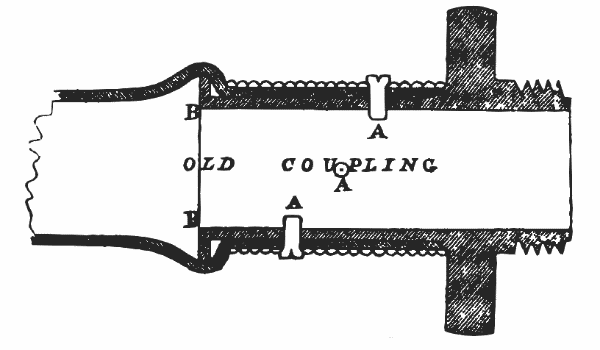
Fig. 3 is the construction commonly made by engine-makers. Its defects are as follows:—From the form of the furrows and ridges where the leather is tied it does not hold on well against a force tending to pull the hose off end-ways; screw-nails are therefore often employed, as at A, to secure the hose on the brass. The points of these nails always protrude more or less into the inside of the joint, and materially impede the current of water. The mouths of the joints are also turned outwards, and form a shoulder, as at B. The intention of this is probably to assist in securing the leather in its place, and to prevent the lapping from slipping. The effects of it are as follows:—First, from the leather being strained over this projection, it becomes liable to be cut by every accidental injury, and very soon cracks and gives way, when a portion must be cut off and a fresh fixing made; second, the leather being stretched over the projection, does not fit the other part of the joint, and must be loose or filled up with pieces of leather, or, as is sometimes done, with brown paper; third, the irregularity of the calibre of the conduit which this shoulder occasions diminishes the performance of the engine.
Fig. 4. New Coupling
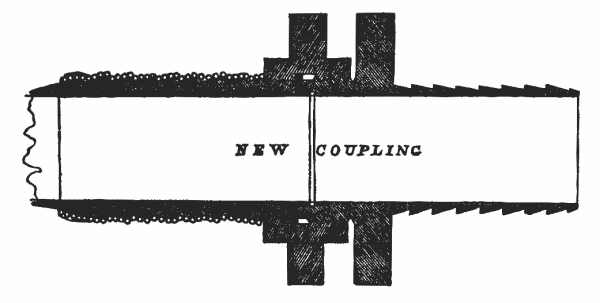
Fig. 4 is the coupling-joint adopted in Edinburgh. The furrows at the tying place are shallow, but their edges present a powerful obstacle to the slipping of the leather. No screw-nails are employed, nor is there any shoulder, as at B; there is therefore no impediment to or variation in the velocity of the current, as the calibres of the coupling joints and of the hose are so nearly uniform. It will be seen also that as the lapping projects above the leather this latter can never be injured by falls or rubbing on the ground.
Another great advantage attending the joints used here is the manner in which their screws are finished. On examining the figure minutely, it will be observed that the male-screw ends in a cylinder of the diameter of the bottom of its thread, consequently of the diameter of the top of the thread of the female-screw. The effect of this is, that, when the screws are brought together, the cylindric portion serves as a guide to the threads, and the most inexperienced person cannot fail to make them catch fair at the first trial. The advantage of this in the circumstances attending fires is obvious.
These joints, although requiring three or four turns to close them up, yet as it is only the ring D which requires to be turned, it can easily be done with the hand alone without the use of wrenches. Although, when the whole length of hose has been jointed, it may be as well to send a man with a pair of wrenches to set the joints firm; this, however, is by no means absolutely necessary; if the joints are kept in proper order a man can secure them sufficiently with the hand.
There is also a facility in taking turns out of the hose, which no other but a swivel joint affords. By slackening a single turn any twist may be taken out, without undoing the joint or stopping the engine, while, from the number of turns required to close the joints, there is no chance of the screw being by any accident undone. In order to prevent the threads from being easily damaged, they should be of a pretty large size, not more than five or six to the inch. For the same reason also the thread should be a little rounded.
As it sometimes happens that the screws are damaged by falling on the street, or by heavy bodies striking them, whenever the hose have been used the joints should be tried by a steel gauge-screw, to be kept for that purpose. This ought to be particularly attended to, as, on arriving at a fire, it is rather an awkward time to discover that a joint has been damaged, while the delay thus occasioned may be attended with very serious consequences.
Four Bundles of Sheepskin and Lay-cord.—These are simply four or five stripes of sheepskin, each about three or four inches broad. When a leak occurs in a length of hose which cannot be easily replaced at the time, one or more pieces of sheepskin are wrapt tightly over the leak and tied firmly with a piece of cord. This is but an indifferent method of mending, but I do not know of any other which can be so readily applied with the same effect. If another length of hose can be substituted for the leaky one it is better to do so; but that is not always at hand, nor does it always happen that time can be spared for the purpose.
Four Lengths of Suction-pipe.—These are generally made of leather, riveted tightly over a spiral worm of hoop-iron, about three-quarters of an inch broad, a piece of tarred canvas being placed between the worm and the leather. They are usually made from six to eight feet long, with a copper strainer screwed on the farther end, to prevent as much as possible any mud or dirt from getting into the engine with the water. It is of advantage to carry four lengths of suction-pipe, as they can be joined to reach the water; if one is damaged the others will still be serviceable.
The suction-pipes are more troublesome to rivet than the common hose, and are done in the following manner:—After the joints are fixed on the spiral worm, and it is covered with the tarred canvas, an iron mandrel longer than the worm is put through it, the edge being rounded to the circle of the inside of the worm. The projecting ends of the mandrel are supported to allow the worm to lie quite clear. One end of the mandrel has a check, that the brass joint may not prevent the worm from lying flat on the mandrel. The leather is then put over the worm, and the rivets being put into one side, a small thin mandrel is laid over the canvas and the rivets struck down upon it. If the small mandrel be not used the heads of the rivets are apt to lie unequally on the worm.
Three Wrenches for Coupling-joints.—These are for tightening the coupling-joints, when that cannot be sufficiently done by hand. When the hose are all put together a man is sent along the whole line with a pair of wrenches to tighten such of the coupling-joints as require it. The wrenches are generally made with a hole to fit the knob on the coupling-joint, and, when used, are placed, one on the nob of the male and another on the nob of the female-screw, so as to pull them in opposite directions.
Two Branch Pipes.—These are taper copper tubes, having a female-screw at one end to fit the coupling-joints of the hose, and a male-screw at the other to receive the jet pipes, one is 4 feet long to use from the outside of a house on fire, the other 12 inches for inside work.
Three Jet-pipes or nozzles of various sizes made to screw on the end of the branch pipe.
A great many different shapes of jet have been tried, and that shown in Fig. 5, I found to answer best when tried with other forms. The old jet was a continuation in a straight line of the taper of the branch, from the size of the hose-screw, to the end of the jet-pipe; this had many inconveniences; the size of the jet could not be increased without making the jet-pipe nearly parallel. As the branches were sometimes 7 feet or 8 feet long, in some instances the orifice at the end of the jet-pipe was larger than that at the end of the branch. The present form of the jet completely obviates this difficulty, as the end of the branch is always 1-1/2 inches diameter.
Fig. 5.
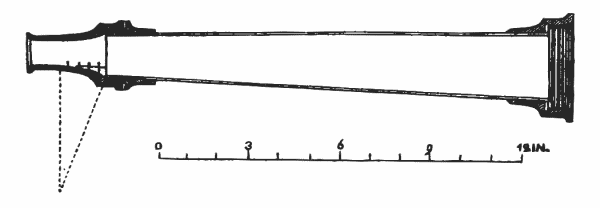
The curve of the nozzle of the present jet is determined by its own size; five times one-half of the difference between the jet to be made and the end of the branch, is set up on each side of the diameter of the upper end of the branch, a straight line is then drawn across, and an arc of a circle described on this line, from the extremity of each end of the diameter of the jet, until it meets the top of the branch; the jet is then continued parallel, the length of its own diameter; the metal is continued one-eighth of an inch above this, to allow of a hollow being turned out to protect the edge: The rule for determining the size of the jet for inside work is, to "make the diameter of the jet one-eighth of an inch for every inch in the diameter of the cylinder, for each 8 inches of stroke." The branch used in this case is the same size as shown in Fig. 5. When it is necessary to throw the water to a greater height, or distance, a jet one-seventh less in area is used, with a branch from 4 feet to 5 feet long.
Two Lengths of Scaling Ladders.—These are 6-1/2 feet long, and are fitted with sockets so that any number up to 7 or 8 may be joined together to form one ladder varying in length according to circumstances from 6-1/2 to upwards of 40 feet.
One Fire-hook.—This is similar to a common boat-hook, of such length as may be most convenient to strap on the handles of the engine. It is used for pulling down ceilings, and taking out deafening-boards when the fire happens to be between the ceiling and the floor above. It is also used when a strong door is to be broken open. It is placed with the point upon the door, one or two men bearing upon it, while another striking the door, the whole force of the blows is made to fall upon the lock or other fastening, which generally yields without much difficulty.
Sixty Feet of Patent Line and Twenty Feet of Trace Line.—These are generally used for hoisting the hose into the windows of the house, in which there is a fire, the stairs being sometimes so crowded with people and furniture, that it is difficult to force a passage, and when the pipe is laid in the stair, it is liable to be damaged by people treading on it.
One Mattock and Shovel.—These are useful in damming any running water or gutter, uncovering drains, &c., from which the engine may be supplied with water. The mattock should be short and strong, and the shovel of the sort called diamond-pointed.
One Hatchet.—The most serviceable hatchet for a fire-engine, is similar to that used as a felling axe by wood-cutters. The back part is made large that it may be conveniently used as a hammer.
One Saw.—This should be a stout cross-cut saw, very widely set. It is useful in cutting off the communication between one house and another, which, when water is scarce, is sometimes necessary.
One Iron Crow-bar.—This should be about two feet long. It is used in opening doors, breaking through walls, &c.
One Portable Cistern.[P]—This is made of canvas on a folding iron frame, and is used in London placed over the street-fire plugs, a hole is left in the bottom through which the water enters and fills the cistern, the escape between the canvas and the plug box being trifling. Two and sometimes three engines are worked by suction-pipe from one plug in this manner. The portable cistern is also used when the engine is supplied by suction, from water conveyed in carts or buckets, and is greatly preferable to any plan of emptying the water directly into the engine. By this latter method there is always a considerable waste of water, arising both from the height of the engine, and the working of the handles; and, in addition to these objections only one person can pour in water at a time. When the water is poured into the engine from carts, it must stop working till the cart is emptied. All these objections, are in a great measure removed by placing the portable cistern clear of the engine; when used in this manner there must of course be no hole in the bottom.
One Flat Suction Strainer, made to screw on to the suction pipe, to prevent anything being drawn in that would not pass through the jet-pipe, and made flat, with no holes in the upper surface, for use in the portable cistern.
One Standcock, with stem to insert direct in the fire-plug, and used principally with hose to throw a jet for cooling ruins.
One Canvas Sheet.—This, when stretched out and held securely by several men, may be jumped into from the window of a house on fire with comparative safety.
One Hand-pump, as described at page 130, and used with the canvas buckets.
FIRE ANNIHILATOR
With regard to the Fire Annihilator, I have seen several experiments with this machine, and heard of more which were not successful; and if an invention fails when experiments are tried, it is open to the impression that it might fail when brought into active operation. There have also been many cases where these machines have met with accidents, one at Drury Lane Theatre amongst the number.
Water, properly applied, will do whatever the Annihilator can accomplish, and also many things which the latter cannot do. As it is, there are some forty or fifty different articles to carry with each fire-engine, and to add to them such unwieldy things as Fire Annihilators, would be to encumber the men more than they are at present, with a very doubtful prospect of advantage.
WATER SUPPLY.
The supply of water is the most vital part of any exertions towards extinguishing fire. Where the pressure is sufficient, and the mains large enough, by far the most efficient and economical mode of using the water is to attach the hose directly to the mains.
In London, however, this can rarely be done, for several reasons. The greatest number of plugs are on the service pipes, that is, the pipes for supplying water for domestic and other purposes, which are only open a short time every day. If the cisterns are nearly empty, the pressure cannot be obtained till they are filled. Then, again, the plugs being some distance apart, it is difficult to obtain a sufficient number of jets. But when the plugs are full open 1-3/4 diameter, a sufficient quantity of water is obtained from each to supply three engines, each of which will give a jet equal to the plug if confined to one jet. The pressure also in the mains in London seldom exceeds 120 feet at the utmost. For these reasons the pressure from the mains is seldom used till the fire is checked, when the ruins are cooled by the "dummies," as the jets from the mains are named by the firemen.
If water can be obtained at an elevation, pipes with plugs or firecocks on them, are preferable to any other mode at present in use for the supply of fire-engines. The size of the pipes will depend on the distance and elevation of the head, and also on the size of the buildings to be protected. It may be assumed as a general rule, that the intensity of a fire depends, in a great measure, on the cubic content of the building; distinction being made as to the nature and contents of such building. If no natural elevation of water can be made available, and the premises are of much value, it may be found advisable to erect elevated tanks; where this is done, the quantity of water to be kept ready, and the rate at which it is delivered, must depend on the means possessed of making use of the water.
The average size of fire-engines may be taken at two cylinders of 7 inches diameter, with a length of stroke of 8 inches, making forty strokes each per minute. This sized engine will throw 141 tons of water in six hours, and allowing one-fourth for waste, 176 tons would be a fair provision in the tanks for six hours' work; this quantity multiplied by the number of engines within reach, will give an idea of what is likely to be required at a large fire. If, however, there are steam-engines to keep up the supply through the mains, the quantity of water kept in readiness may be reduced to two hours' consumption, as it is likely that the steam-engines would be at work before that quantity was exhausted. This is what may be supposed to be required, in cases of serious fires in dockyards, in large stacks of warehouses, or in large manufactories.
Fig 6. Opening for Suction-pipe.
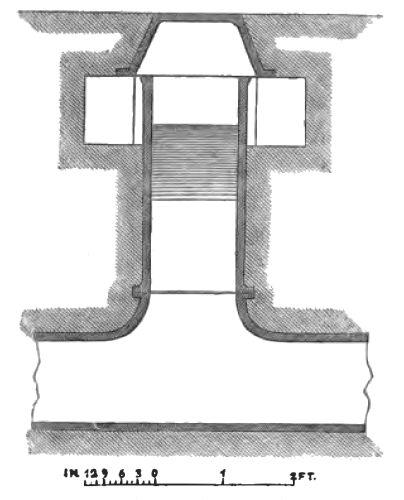
Where water can be had at nearly the level of the premises, such as from rivers, canals, &c., if it is not thought prudent to erect elevated tanks, the water may be conducted under the surface by large cast-iron pipes, with openings at such distances as may seem advisable for introducing the suction-pipes (Fig. 6). This plan should not be adopted where the level of the water is more than 12 feet below the surface of the ground, as although a fire-engine will, if perfectly tight, draw from a much greater depth than 14 feet (2 feet being allowed for the height of the engine), still a very trifling leakage will render it useless for the time, at such a depth.
The worst mode of supplying engines with water is by covered sunk tanks; they are generally too small, and unless very numerous, confine the engines to one or two particular spots, obliging the firemen to increase the length of the hose which materially diminishes the effect of the fire-engine. If the tank is supplied by mains from a reservoir, it would be much better to save the expense of the tank, and to place plugs or firecocks on the water-pipe. Another evil in sunk tanks is, that the firemen can seldom guess what quantity of water they may depend upon, and they may thus be induced to attempt to stop a fire, at a point they would not have thought of if they had known correctly the quantity of water in store.
Where sunk tanks are already constructed, they may be rendered more available by a partial use of the method shown in Fig. 6.
Memoranda of Experiments tried on the mains and service pipes of the Southwark Water Company, between 4 and 9 A.M. of the 31st January, 1844. The wind blowing fresh from N.N.W.
The pressure at the water-works at Battersea was kept at 120 feet during the experiments, and every service pipe or other outlet was kept shut.
1st Experiment.—Six standcocks, with one length of 2-1/2 inches riveted leather hose 40 feet long, and one copper branch 4 feet to 5 feet long, with a jet 7/8 inch in diameter on each, were placed in six plugs on a main 7 inches diameter, in Union-street, between High-Street, Borough, and Gravel-lane, Southwark, at distances of about 120 yards apart. The water was brought from the head at Battersea, by 4250 yards of iron pipes 20 inches diameter, 550 yards of 15 inches diameter, and 500 yards of 9 inches diameter.
1st. One standcock was opened, which gave a jet of 50 feet in height, and delivered 100 gallons per minute.
With four lengths of hose the jet was 40 feet high, and the delivery 92 gallons per minute. When the branch and jet were taken off with one length of hose the delivery was 260 gallons per minute.
2nd. The second standcock was then opened, and the jet from the first was 45 feet high.
3rd. The third standcock was opened, and the jet from the first 40 feet high.
4th. The fourth standcock being opened, the first gave a jet of 35 feet high.
5th. The fifth being opened, the first gave a jet of 30 feet high.
6th. All the six being opened, the first gave a jet of 27 feet in height.
2nd Experiment.—Six standcocks were then put into plugs, on a main 9 inches diameter in Tooley-Street, the extreme distance being 450 yards, with hose and jets as in the first experiment. The water was brought from the head at Battersea by 4250 yards of iron pipes of 20 inches diameter, 1000 yards of 15 inches diameter, 1400 yards of 9 inches diameter. The weather was nearly the same, but the place of experiment was more protected from the wind than in Union-street.
1st. With one standcock open, a jet 60 feet in height was produced, and 107 gallons per minute were delivered.
2nd. The second standcock was then opened, and the difference in the first jet was barely perceptible.
3rd. Other two standcocks being opened, the first jet was reduced to 45 feet in height, and the delivery to 92 gallons per minute.
4th. All the six standcocks being opened, the first jet was further reduced to 40 feet high, and the delivery to 76 gallons per minute.
3rd Experiment.—Two standcocks, with hose, &c., as in the first experiment, were then put into a service-pipe, 4 inches diameter and 200 yards long, in Tooley-street, the service-pipe was connected with 200 yards of main 5 inches diameter, branching from the main of 9 inches diameter. The weather was still the same as at first, but the wind did not appear to affect the jets, owing to the buildings all round being so much higher than the jet.
1st. The standcock nearest the larger main was opened, and a jet of 40 feet high was produced, delivering 82 gallons per minute.
2nd. Both standcocks being opened, the first gave a jet of 31 feet, and delivered 68 gallons per minute.
3rd. The standcock farthest from the large main only being opened, gave a jet of 34 feet, and delivered 74 gallons per minute.
4th. Both standcocks being opened, the farthest one gave a jet of 23 feet, and delivered 58 gallons per minute.
When both these plugs were allowed to flow freely without hose, the water from that nearest the large main, rose about 18 inches, and the farther one about 1 inch above the plug-box.
Fig. 7. Common Fire-plug.
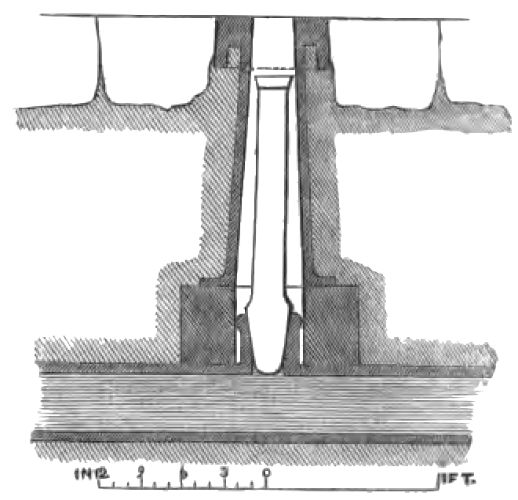
These and other experiments prove the necessity of placing the plugs on the mains, and not on the service pipes, where there are mains in the street.
The different modes of obtaining water from the mains or pipes are shown in the accompanying drawings.
(Fig. 7) is a section of a common plug when not in use.
Fig. 8. Fire-plug with canvas cistern.
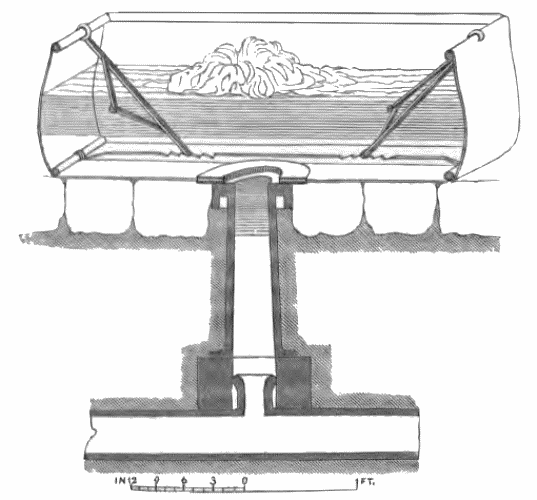
(Fig. 8) is a section of the common plug, with a canvas dam or cistern over it, as used in London. The cistern is made of No. 1 canvas, 15 inches deep, extended at top and bottom by 5/8-inch round iron frames, a double stay is hinged on the top frame at each end. When the cistern is used the top frame is lifted up, and the stays put into the notches, in two pieces of hoop iron, fixed to the bottom frame. There is a circular opening 9 inches diameter in the canvas bottom, two circular rings of wash-leather, about 2 inches broad, are attached to the edges of the opening in the canvas, so as to contract it to 4 inches or 5 inches diameter; the plug being opened, the cistern is placed over it; the wash-leather is pressed down to the surface of the road by the water, and a tolerably water-tight cistern, with about 12 inches or 14 inches of water in it, is immediately obtained.
Fig. 9. Plug, with Standcock.
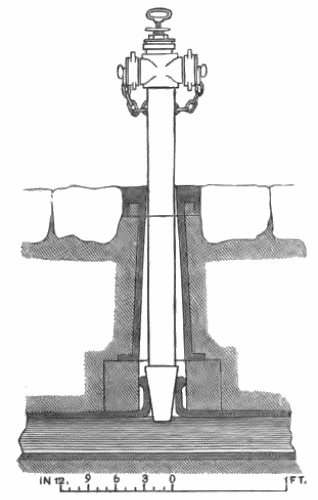
(Fig. 9) is a plug with a standcock in it, to which hose may be attached.
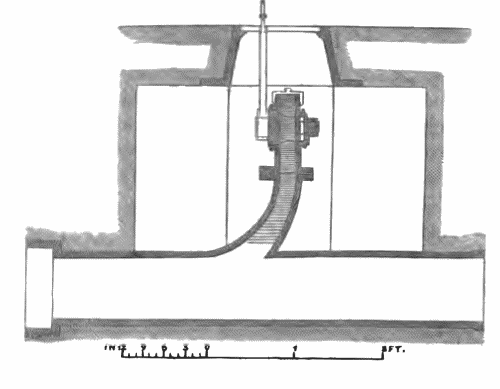
(Fig. 10) is a common single firecock with a round water-way 2-1/2 inches diameter.
Fig. 10. Single Firecock.
(Fig. 11) is a double firecock, as laid down in Her Majesty's Dockyards.
Fig. 11. Double Firecock, used at the Royal Dockyards.
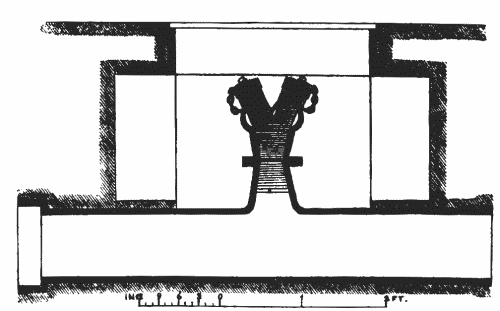
It will be observed, that the short piece of pipe between the main and this firecock is not curved to the current of the water, but merely opened a little; this is done with a view of increasing the supply by steam power, and as the steam engines are, in most cases, situated in a different direction from the tanks or reservoirs, therefore the curve that would have assisted the current in one direction would have retarded it in the other. It has been objected to these firecocks, that the opening does not run through the centre of the key, therefore only one side of the key covers the opening in the barrel, while in the common firecock both sides are covered.
Fig. 12. Double Firecock, used at the British Museum.
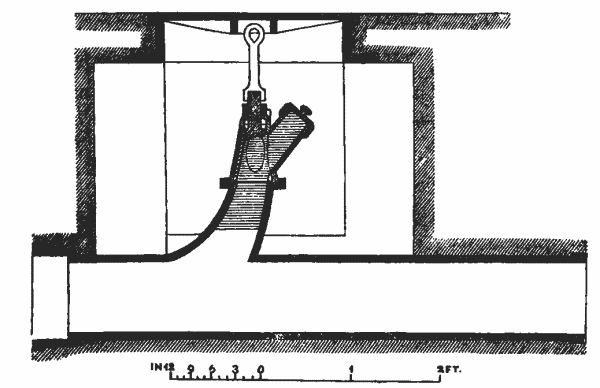
(Fig. 12) is a double firecock, as laid down at the British Museum.
This has a very good delivery, and is certain to be always tight, if well made, as the pressure of the water forces the key into the barrel; this also renders the cock somewhat difficult to be opened and shut, if the pressure be great; but as a lever of any length may be used, and the key, from its perpendicular position, may be loosened by a blow, this objection is in a great measure obviated.
In Figs. 10 and 11 the openings in the street are large enough to admit of the levers for opening the cock to be fixed, that no mistake may occur from the lever being mislaid; but with those at the British Museum, it was not thought necessary to have fixed levers, as a crow-bar, or anything that could be introduced into the eye of the spanner, would open them.
The plug and firecock have both certain advantages and disadvantages, which are now described.
The plug, with a canvas cistern, is the easiest mode of obtaining water; the plug-box being only the size of a paving-stone, is no annoyance in the street, and the water has only one angle to turn before it is delivered.
On the other hand, where the supply of water is limited, the plugs give but little command of it; there is, however, comparatively very small loss at a large fire in London from this cause, as it is very seldom that all the fire-engines can be supplied direct from the plugs, and those that arrive late must pick up the waste water as they best can, by using another description of canvas dam, or opening the street; but in enclosed premises, especially where the water is kept for the purpose of extinguishing fires, firecocks are much to be preferred. It is very difficult to insert the standcock into a plug if there is a considerable force of water, and if the paving has moved, it cannot be done without raising the plug-box; but this is, however, the easiest mode of using firecocks, and where there is a considerable pressure of water, if the watchmen or the police are supplied with a hose-reel and branch-pipe, they can, in enclosed premises, direct a jet on the fire while the engines are being prepared, and if they cannot reach the fire, they will have water ready for the engine when it arrives.
Inclosed premises are particularly mentioned, because the principal duty of the watchmen, in these cases, is to guard against fire, and their other duties being comparatively few, the men are not often changed, and they can be instructed thoroughly in the matter. With the general police of the metropolis it is quite different, their duties are so numerous and varied, that to add that of firemen to them would only be to confuse them.
Firecocks, if kept at 9 inches to 12 inches below the surface, are easily protected from frost, by stuffing the opening with straw.
The advantage which the double firecocks have over the single ones, is merely the increased water-way, as a firecock 3-1/2 inches diameter could not be so easily opened or shut, as two cocks of 2-1/2 inches diameter.
One of the greatest objections to firecocks, is the very large openings required in the streets, the first cost and the repair of which are both considerable, besides their liability to accident. To take them to the footpath, increases the expenses and diminishes the supply of water, as it is generally done with a small pipe, and the number of angles is increased. In some instances, where firecocks have been put down on one side of the street, no less than four right angles have been made in the course of the water; and if the fire happens to be on the opposite side of the street from the firecock, the thoroughfare must be stopped. The expense also is no slight consideration, for if laid along with the water-pipes, each firecock, if properly laid, and the pit built round with cement, will cost eight or ten times as much as a plug.
London is, upon the whole (except in the warehouse districts), fairly supplied with water for the average description of fires, that is, where not more than five or six engines are required. When, however, it is necessary to work ten or twelve engines, there is very often a deficiency. In many of the warehouse districts the supply is very limited indeed, although it is there that the largest fires take place.
The water companies are generally willing to give any quantity of water, but they object to lay down large mains without any prospect of remuneration. The warehouse keepers decline to be at the expense of laying the pipes, and there the matter seems to rest. In most other places of importance, the water is under the management of the civic authorities, and they, of course, endeavour to obtain a good supply of water at fires in warehouse as well as in other districts.
In supplying fire-engines with water from firecocks, one or more lengths of hose are screwed on the firecock; the extreme end being put into the engine, the firecock is then opened and the water rushes in. When the water-pipes are large and the pressure considerable, two or even three engines may be supplied from the same firecock.
If the firecocks are all at too great a distance from the place on fire, to be reached by the supply of hose brought with the engine, the next resource is, to open the nearest firecock above the level of the place where the water is required. By covering the eyes of drains, and stopping up any cross-water channels, the water may in this manner be conveyed along the street, from a very considerable distance. From the nature of the ground it does not always happen that the water will run directly from the nearest firecock, to the spot where it is required; acclivities, buildings, and many other causes, may prevent this; but in some of these cases a few lengths of the hose, attached to the firecock, may convey the water to a channel which will conduct it to the required point. Upon the arrival of the water, it ought to be dammed up, and the engine will lift it by suction out of the pool so formed.
If, however, from the nature of the ground, from the want of hose, or from other causes, it is found impracticable to convey the water by either of the above methods, the next best is, to conduct the water in hose as far as can be accomplished, and carry it the remainder of the distance in carts, buckets, or whatever else may be most convenient.
When carried in buckets it is of advantage to form a line of men from the water to the engine, each man covering five or six feet of ground. The buckets are then handed from one man to another, till they reach the two or three men who are stationed round the suction-tub or fire-engine to receive them. The buckets when emptied are returned by a different line of men (women or boys) stationed in the same manner as the former. If a sufficient number of hands cannot be had to return the buckets in this manner, any convenient number may be employed to carry them to the firecock, that they may be again filled. When a fire occurs where the water-pipes are unprovided with firecocks or plugs, the ground should be immediately opened, and the water-pipe cut. If it be of cast-iron, a large hammer may effect the purpose: on the water-pipe being broken, the suction-pipe of the engine is placed in the opening so made. If the pipe be of lead, the opening in the street should be made of sufficient length to admit of one end of it, when cut, being turned into the engine. If the supply of water by this means be so great as to occasion waste, it may be regulated by the nearest stopcock on the water-pipe, by driving a wooden plug into the end of a cast-iron pipe, or compressing the end of a leaden one.
The next plan I shall notice of supplying fire-engines is from drains, gutters, &c. In particular situations and wet weather considerable supplies of water from these and similar sources may be obtained. In the gutters all that is required is to dam them up; and, if there be no materials at hand for this purpose, the causeway must be dug up, till there is a sufficient depth of water for the suction-pipe of the engine.
When the water is to be drawn from drains or common sewers, great care should be taken not to damage them farther than is absolutely necessary.
If enough of cover be taken off to allow one man to enter easily, it will be quite sufficient for all necessary purposes. When the man inside the drain or common sewer has collected a proper supply of water by damming up the channel, the suction-pipe should be handed down to him, and the engine set to work.
Although it be true that foul water quenches fire, I will here observe, that the water from a common sewer should never be used, except when it is impossible to procure it from a purer source. For the purpose of procuring water to extinguish a fire, I had at one time occasion to open a common sewer, in which, with the usual impurities, the waste from a gas manufactory was intermixed, and the stench in the premises where the fire had been extinguished by this water, was for some time after very disagreeable.
If the water be obtained from a pond or river at a little distance, one engine may be stationed close to it, and that engine made to pump the water into another at work. If the water be conveyed in carts, an engine may be kept at the pond or river for the purpose of filling them. Of course this can only be done where there is a proper supply of engines.
In working from an open water, such as a gutter, drain, river, or pond, it is proper, in order to prevent sand or gravel being drawn into the engine, to sink an iron or wooden bucket, into which the suction-pipe of the engine should be placed. If nothing better can be had, a good wicker basket will be found useful.
It is of great advantage to have a number of carts, with butts upon them full of water, as it ensures a small supply to the engines the moment they arrive at the fire. This plan, however, entails a very considerable expense, as carters must be paid for taking them out on every alarm, besides giving prizes to the owners of the first and second horses, to ensure their coming in time.