Chapter II
F. R. (Francis Reginald) Wingate translation
RESIDENCE IN DARFUR, AND EARLY HISTORY OF THE PROVINCE.
Arrival at Om Shanga—Matrimonial Difficulties—A Sudanese Falstaff—Description of El Fasher—The Furs and the Tago—A Tale of Love and Perfidy—Founding of the Tungur Dynasty—Conquest of Darfur by Zubeir Pasha—The Rizighat Tribe—Quarrel between Zubeir Pasha and the Governor-General—Both recalled to Cairo—Gordon Governor-General of the Sudan—I take up my Duties at Dara—Zogal Bey the Sub-Governor—I undertake a Campaign against Sultan Harun—Niurnia, Harun's Stronghold in Jebel Mara—I defeat the Sultan at Rahad en Nabak—Death of Harun—My Meeting with Dr. Felkin and the Rev. Wilson—My Boy Kapsun—Gordon's Letter from Abyssinia.
I left El Obeid early in July, 1879, in company with Dr. Zurbuchen, the Sanitary Inspector-General, whom I had met in Cairo; our route took us through Foga, the telegraph terminus, and here I found a telegram from Gordon, telling me that he was proceeding on a Mission to King John of Abyssinia.
We reached Om Shanga to find it crowded with Gellabas who had been turned out of the southern districts, and were really in a pitiable condition. Curiously enough, the news had spread far and wide that I was Gordon's nephew (I suppose on account of my blue eyes and shaven chin), and in consequence I was looked upon with some apprehension by these people, who considered him as the cause of all the troubles which they were now justly suffering. I was overwhelmed with petitions for support; but I told them that as Om Shanga was not in my district, I could do nothing for them,—and even if I could have spared them something from my private purse, I had neither the desire nor inclination to do so.
In one case, however, I confess to having broken the rule; but before relating this little episode, I should explain that my action must not be judged from the standpoint of purely Christian morality. In this case I admit to being guilty of even greater moral laxity in regard to the Moslem marriage law, than is enjoined in the Sharia, or religious law; but when my readers have finished the story, I think they will perhaps share the feelings which prompted me to act as I did. Several of the merchants who had travelled from the Nile called upon me and begged me to interest myself in the case of an unfortunate youth, a native of Khartum and only nineteen years of age. They related that before quitting Khartum he had been betrothed to his beautiful but very poor young cousin; the parents had consented to the marriage, but he was to first take a journey and try to make some money. On his arrival at Om Shanga a very rich old woman took a violent fancy to him. Whether the youth had been overcome by her riches, my informants did not say, but the old woman would have her way and had married him; and now, finding himself comparatively wealthy, he had no particular desire to give her up. The sad news had reached Khartum, the poor girl was distracted, and now I was asked to solve the difficulty. What was I to do? I called up the youth, who was unusually good-looking, and, taking him aside, I spoke to him with as serious a countenance as I could preserve; I pointed out how very wrong it was of him, a foreigner, to have married a strange old woman while his poor fiancée was crying her eyes out at home, and that even if his cousin's dowry was small, still, in honour bound, he should keep his promise. He hesitated for a long time, but at length decided to go before the Kadi (judge of the religious law) and get a divorce. I had previously seen the Kadi, and had instructed him that should the youth seek a divorce, it was his duty to break the news as gently as he could to the old wife, as I was most anxious the separation should be carried out with as little commotion as possible; and, taking a guarantee from the young man's relatives that they would be responsible that he should go direct to Khartum, I warned the Government official of Om Shanga that the youth was to be banished at two days' notice! I also told him that he might say what he liked about me to the old woman, and that I was quite ready to bear the blame, provided he could get her to give him some money for the journey. Little did I imagine what a storm I had brought on my devoted head! It was about four o'clock in the afternoon, and I was lying on my angareb (native couch) in the little brick hut, when I heard the voice of an angry woman demanding to see me instantly. I guessed at once who it was, and, bracing my nerves for the fray, told the orderly to let her in. Dr. Zurbuchen, who was in the room with me, and whose knowledge of Arabic was very limited, was most desirous to leave me; but I was by no means anxious to be left alone with an angry woman, and at length persuaded him to stay. No sooner was the divorced wife admitted than she rushed up angrily to Dr. Zurbuchen, whom she mistook for me, and shrieked in a tone of frantic excitement, "I shall never agree to a divorce. He is my husband, and I am his wife; he married me in accordance with the religious law, and I refuse to let him divorce me." Dr. Zurbuchen, thoroughly startled, muttered in broken Arabic that he had nothing to do with the case, and meekly pointed to me as the hard-hearted Governor. I could not help being amused at the extraordinary figure before me. She was a great strong woman, with evidently a will of her own; and so furious was she that she had quite disregarded all the rules which usually apply when Eastern ladies address the opposite sex. Her long white muslin veil had got twisted round and round her dress, exposing her particoloured silk headdress, which had fallen on her shoulders; she had a yellowish complexion, and her face was covered with wrinkles, while her cheeks were marked by the three tribal slits, about half an inch apart; in her nose she wore a piece of red coral, massive gold earrings in her ears, and her greasy hair was twisted into innumerable little ringlets, which were growing gray with advancing age. I thought I had never seen a more appalling looking old creature; but my contemplations were cut short by her screeching voice, which was now directed on me with renewed fury, and I was confronted with the same question she had addressed to the terrified doctor. Giving her time to recover her breath, I replied, "I quite understand what you say, but you must submit to the inevitable: your husband must leave; and as you are a native, I cannot permit you to go with him. You appear undesirous of having a divorce; but you must remember that, in accordance with the Moslem law, it is for the man to give the woman her divorce papers, and not the woman the man."
"Had you not interfered," she shrieked, "he would never have left me. Cursed be the day you came here!"
"I beg of you, do not say that," I answered; "you are a woman of means, and I should not think you would have any difficulty in securing another and perhaps older husband."
"I want no other," she literally screamed.
"Silence!" I said somewhat sharply. "The relatives of your former husband wish him to leave you; they complained that it was only your money which bound him to you; and now, whatever you may say, he is to leave to-morrow. Besides, do you not think it is outrageous that an old woman like you should have married a young lad who might have been your grandson?" These last words drove her into a state of perfect frenzy; and, losing all control over herself, she threw up her hands, tore off her veil, and what else might have happened I know not, but my kavass (orderly), hearing the noise, rushed in and quietly but forcibly removed her from the room, cautioning her that her conduct was disgraceful, and that she had made a laughing-stock of herself. The following day her husband left, and I do not doubt her grief was considerable; but some years later I had the satisfaction of meeting the youth, married to his early fiancée, and already the father of a family; he thanked me profusely for having got him out of the clutches of the old woman and brought him to his present happy state. It is needless to relate that I slept soundly that night, convinced that I had done a good piece of work, and that it had cost me nothing.
Two days later we left Om Shanga, and halted for the night at Jebel el Hella, where we were met by Hassan Bey Om Kadok, the Sheikh of the northern Berti tribes, who had shown great loyalty and had been granted by Gordon the rank of Bey. He was a middle-aged man, very stout, with great broad shoulders and a round, smiling face; he might well have been called the Sudan "Falstaff." Some years later, when the tables were turned, and masters became servants, he and I found ourselves together as orderlies in the Khalifa's body-guard, where his cheerful disposition and genial nature brightened an existence which at times was almost unbearable. His brother Ismail was exactly the opposite,—tall, thin, and serious; and the two brothers never by any chance agreed, except on one point, and that was their inveterate love of marissa (Sudan beer): to have each a large jar (made of pottery, and known in Darfur as the Dulang asslia or Um bilbil) of this marissa, and to vie with one another in emptying it first, was to them the greatest pleasure in life.
They invited us to sup with them, and for our evening meal an entire sheep, baked on charcoal, was served up, besides a quantity of roast fowls and a dish of asida (the latter is somewhat like the Italian polenta, and is eaten with all the courses); there were also several jars of marissa. We thoroughly enjoyed the food, leaving the marissa to our hosts, and substituting for it some of our own red wine. Hassan and Ismail, however, freely regaled themselves with wine as well as marissa; the effect on the former being to make him extremely talkative, while the latter became more and more silent. Hassan related many little incidents about Gordon, for whom he had the greatest admiration and regard. He was much grieved to hear he was going to Abyssinia. "Perhaps," said he, sadly, "he will go back to his own country, and never return to the Sudan again." Curiously enough, he was partially correct. He then left the room and returned almost at once, carrying a magnificent saddle and sword. "Look," said he, "these are the last presents General Gordon gave me when I accompanied him to El Fasher; he was most kind and generous." Then Ismail showed us a rich gold embroidered robe which Gordon had presented to him. "Pride," said Hassan, "was unknown to Gordon. One day, on our way to El Fasher, one of the attendants shot a bustard; and when we halted at noon, the cook at once boiled some water and threw the bird into the pot, so as to take off its feathers. Gordon, seeing this, went and sat himself down by the cook and began helping him to pull out the feathers. I at once rushed up and begged him to allow me to do this for him, but he answered, 'Why should I be ashamed of doing work? I am quite able to wait on myself, and certainly do not require a Bey to do my kitchen work for me.'"
Hassan continued chatting till a late hour. He related his experiences during Zubeir's conquest of Darfur, then of the subsequent revolts and the present situation, frequently reverting to Gordon, whom he held in great honour. "Once, travelling with Gordon," he remarked, "I fell ill, and Gordon came to see me in my tent. In the course of our conversation I told him that I was addicted to alcoholic drinks, and that I put down my present indisposition to being obliged to do without them for the last few days. This was really my indirect way of asking Gordon to give me something; but I was mightily disappointed, and, instead, received a very severe rebuke. 'You a Moslem,' said he, 'and forbidden by your religion to drink wines and spirits! I am indeed surprised. You should give up this habit altogether; every one should follow the precepts of his religion.' I replied, 'Having been accustomed to them all my life, if I now gave them up my health must suffer; but I will try and be more moderate in future.' Gordon seemed satisfied, got up, shook hands with me, and bade me good-bye. The following morning, before leaving, he sent me three bottles of brandy, with injunctions that I should use them in moderation."
Meanwhile Hassan's lanky brother sat in complete silence, leaning on his elbows and solemnly filling up and swallowing glass after glass of marissa, with an almost clockwork regularity. When we had stopped talking, he got up in a very deliberate manner, solemnly wiped his mouth with his hand, and said in a melancholy tone, "Yes, brandy is very good; it is not an alcoholic drink, it is medicine. Gordon is a great and benevolent man; we shall never see him again."
It was very late before our hosts left us, and, having ordered our baggage camels to start before daybreak, we had a few hours' sleep. The next morning at sunrise our riding camels were ready, and Dr. Zurbuchen and I looked about for our hosts to wish them good-bye. At length we saw Ismail hurrying towards us; his head was evidently suffering from the effects of the previous night. "Masters," he shouted, "we have always been told that in your country justice exists; I am sure that there guests never wrong their hosts. Last night, when your baggage camels started, your people carried off my best rug, which I had laid out for you to lie down on yesterday." I made inquiries, and had no doubt that one of my men must have made off with the precious rug; so, ordering one of my kavasses to mount his camel and overtake the caravan, I patiently awaited his return. In due time he came back with the stolen rug, and, tied on behind him, one of my eight Black soldiers who belonged to our escort. On being interrogated, the man said he had taken it by mistake; but as I had no doubt of his guilt I had him flogged and sent back a prisoner to the nearest military post at Om Shanga. I was much upset by the occurrence, for I knew that these people were apt to conclude that as the master is, so is the servant; and had I not acted with severity on this occasion I should probably have had a frequent recurrence of such thefts.
With profuse apologies to our hosts, we set off for El Fasher, and, passing through Brush, Abiat, and Ergud, reached there after five days' march.
For the last century El Fasher had been chosen as the capital of Darfur. It is built on two sandy hills running north and south, and separated by a valley some four hundred yards across, known as the Wadi Tendelti. The fort is situated on the western hill, and consists of a square mud-brick enclosure about three feet thick built on the slope, and surrounded with a ditch fifteen feet deep; at the corners were four small towers, manned with guns which fired from embrasures.
This enclosure embraces the Government buildings, Governor's house, officers' quarters, and men's barracks; but the quarters of the irregular cavalry are outside. The wells are down in the valley, about one hundred and fifty yards distant from the walls of the fort.
At this time Messedaglia Bey, an Italian, was Governor of El Fasher; he gave Dr. Zurbuchen and myself a cordial welcome, and allotted us quarters in the Government buildings. We had both suffered somewhat from fever during our wet march, and therefore decided to rest here for a few days.
Darfur was formerly one of the line of ancient Central African kingdoms, stretching across the continent from west to east. Up to the early part of the seventeenth century the kings of Darfur had dominion over the country as far east as the Atbara; but the warlike Fungs, who at that time were one of the most powerful tribes of the Sudan, gradually drove the Darfurians back, and established their own authority up to the banks of the White Nile. In 1770 they wrested the province of Kordofan from the Darfur kings, but five years later it was retaken by the latter, and remained under their control until conquered in 1822 by Mohammed Bey Dafterdar, the brother-in-law of Ismail Pasha, who, it will be remembered, was burnt alive at Shendi. History has already described the heroic bravery of the Darfur troops led by Musallem, the Viceroy of Kordofan, who, with almost all his men, utterly ignorant of the effect of fire-arms, dashed up to the muzzles of the Turks' guns, and were annihilated almost to a man. Kordofan thus remained under Egyptian rule until, in 1883, it fell under the sway of the Mahdi.
Meanwhile, after the loss of Kordofan the Darfurians retired further to the west, and the kings now governed only a circumscribed area, of which Jebel Marra was the centre. The roads through these almost inaccessible mountains are few and very difficult, and in consequence the place is one of great strength. Many of the peaks are between six and seven thousand feet high, and separated from each other by deep and fertile valleys gradually descending to the plains below. During the rains the rivulets in these valleys become rushing torrents, and, flowing south into the main valleys of Wadi Asum and Wadi Ibra, convert them into two gigantic rivers, the latter emptying into the Bahr el Arab, which eventually joins the Bahr el Ghazal, and forms the main western tributary of the White Nile. The streams flowing north from Jebel Marra have a less rapid descent, and are quickly absorbed in the sandy soil of the desert.
In the valleys of Jebel Marra, barley, Turkish wheat, and dukhn are planted; but in the plains of Darfur only the latter can be grown, and it is therefore the ordinary food of the inhabitants. In the southern district it comes to maturity from ninety to a hundred days after being planted, but in some of the northern districts it ripens even twenty days earlier.
The original tribes of the country were the Furs and the Tago, the latter ruling for centuries over the entire district from their inaccessible strongholds in Jebel Marra. Tradition relates that about the fourteenth century, the Tungur Arabs, emigrating south from Tunis, scattered throughout Bornu and Wadai, and eventually reached Darfur, the first arrivals being two brothers, Ali and Ahmed, who, with their flocks, settled on the western slopes of Jebel Marra. Ali, who was older and better off than his brother, had recently married a beautiful young girl of his own tribe, and she, in turn, being constantly thrown with her brother-in-law, who was celebrated for his bravery, conceived a great fancy for him. One day, when her husband was away, she confessed her feelings to Ahmed, and implored him to help her out of her misery; but Ahmed's sentiments of right and honour in regard to his brother's wife could not be overcome by this appeal, though he promised that her secret should never be divulged. The girl fell ill, and in her jealous love determined that her brother-in-law should never marry another; she therefore called her husband to her side and bade him swear, under a solemn oath, that he would never disclose what she was about to tell him, and then she whispered that his brother never ceased making love to her. Ali, horror-stricken at the thought of the deception of Ahmed, whom he dearly loved, and to whom he confided everything, was beside himself with grief; but he could not bring himself to believe entirely in his brother's perfidy, though the seeds of mistrust were sown. Meanwhile Ahmed, knowing that his sister-in-law's jealousy was aroused, did all he could by kindness and sympathy to pacify her and to treat her as if nothing had happened; the result, of course, being that Ali's suspicion grew into certainty, and he determined on revenge. He could not bear the thought of killing him, but wanted to inflict on him some lasting injury. Two days later, he determined to move camp, and, sending on all his people with their flocks and herds, he remained behind with his brother, and began talking to him about ordinary matters. From this they got into a discussion on arms, and Ali, playfully drawing out his sword, in an unguarded moment struck Ahmed a blow on his right leg, severing the tendon Achilles; and then, making off as quickly as he could, he left his unfortunate brother weltering in his blood, who, too proud to cry out, calmly awaited death. This Ahmed el Makur (signifies one who is wounded, applying more especially to the sort of wound he received) was destined to become the founder of a new dynasty in Darfur, and this is how it came about.
Ali, whose love for his brother was not altogether extinguished, sent two of his slaves, Zayed and Birged (the forefathers of the great Zayedia and Birged tribes), with two camels, two she-camels, and a few necessaries, in search of Ahmed, but at the same time he told them that on no account were they to bring him back. He himself returned to the west, and, as the story goes, separated soon afterwards from his wife, as he could not bear the thought of his brother's supposed perfidy. The slaves, finding Ahmed unconscious from loss of blood, revived him, and at his request brought him to the nearest native settlement, where he was well received, and King Kor (the last of the Tago dynasty) was informed that a foreigner, who had been wounded in the leg by his brother, was in their village. The king ordered Ahmed to be brought before him, in order to hear from his own lips the account of this strange event. Ahmed, however, refused to explain, and the matter remained a mystery; but he was taken care of and permitted to stay in the king's household. King Kor, like all his predecessors, was a heathen; he had become ruler by violence, was utterly ignorant of the outside world, and did not even know of the existence of any country outside his own immediate dominions; beyond making occasional raids from his mountain strongholds on the dwellers in the plains, he seldom left his hills. This savage old king took a fancy to the stranger, made him director of his household, and consulted him on all occasions. Gradually Ahmed rose to power. By judicious management he brought the unruly Tago chiefs into subjection, and portioned out the land amongst the poorer inhabitants, thus putting a stop to the constant internal raiding, and introducing a feeling of security and contentment hitherto quite unknown. Ahmed during his long journey from Tunis had passed through many distant kingdoms, and, being a man of sense, he was able to apply his knowledge in introducing a number of reforms. One of those, still quoted, is the wonderful change he effected in the king's household. It had been the custom for centuries for any retainer to take his food at the time it pleased him, quite regardless of the wants of others. It therefore frequently happened that, "first come, first served," nothing remained for the later arrivals, who, in their anger, would fall on their comrades, and as often as not blood would be shed. Ahmed reformed all this by establishing a fixed hour for meals, at which all must be present, with the happy result that peace and tranquillity prevailed.
In this and a hundred other ways did Ahmed show his capacity, and became much beloved by the king, who, having no successors, gave him his favourite daughter as a wife, and before his death nominated him as his successor to the throne.
Almost all the inhabitants had a great respect for Ahmed, and on Kor's death they made him their king. The news spread far and wide, and on it becoming known to the Tungurs in Bornu and Wadai, they flocked into the country in such numbers as to partially displace the Tago; and now the only small settlements left of the former rulers are near Dara, where there is a Tago Sheikh, and also at Dar Sula, a long way to the west, where there is a semi-independent ruler called "Sultan Abu Risha et Tagawi," who is also known as "El Jamus el asfar," or the yellow buffalo.
Ahmed el Makur ruled happily for a long period, and a regular male succession was established. His great grandson was the celebrated Sultan "Dali," whose mother belonged to the Kera-Fur tribe, and thus consanguinity was established between the Blacks and the Tungur dynasty. Dali was a very enlightened ruler; he travelled a great deal, and collected round him many men who could read and write; he divided the country into provinces and districts, and wrote the celebrated "Kitab-Dali," or penal code. The system of government inaugurated by Dali was carefully followed by his successors, and continued in use up to the middle of the present century. One of the most noted of the Darfur rulers was Suleiman, who, being the son of an Arab mother, and having himself married an Arab woman, took the title of Solong, which is generally applied to those who consider themselves of Arab descent. It was through him that the country was definitely moslemised; and his descendants, up to 1875, proudly boast of their Arab descent, and entirely ignore the Black element, which undoubtedly is there, and which may be said to show itself in the bitter hatred which has always existed between the ruling Darfur family and the nomad Arabs.
In accordance with Dali's code, the descent should devolve on the eldest son; but gradually the custom obtained of selecting one of the sons (provided he was in the direct line) who happened to be the most popular in the estimation of the court dignitaries, and especially in that of the "Abu Sheikh," the name given to the principal eunuch of the royal household. A rigorous exclusion was exercised over all sons who were addicted to alcohol or marissa.
Suleiman was succeeded by his son Musa, and the latter by his son Ahmed Bakr, who did all in his power to introduce foreigners into the country, as he hoped thereby to benefit his people. He was succeeded by his son Mohammed Dura, who is said to have had over a hundred brothers, of whom he caused fifty to be killed on coming to the throne; he is also credited with having killed his eldest son, whom he suspected of having pretensions to make himself king.
On his death his son Omar Leila succeeded, and he also was as unpopular as his father. He took command of the Darfur army which invaded Wadai, and was killed, being succeeded by his uncle, Abu el Kasem, who, with his brothers Mohammed Terab and Abderrahman, was amongst those who had escaped the slaughter when Mohammed Dura came to the throne. Abu el Kasem showed a great inclination to the Blacks, and incurred, in consequence, the hostility of his relations, who urged him to take the field against Wadai, and, having advanced, suddenly deserted him with the army, leaving him the Blacks only. It is said by some that he was at once killed in the battle which ensued, while others state that he remained for some time in Wadai, and then returned to attack his brother, Mohammed Terab, by whom he had been succeeded. The latter proved himself a capable and energetic ruler, but towards the close of his reign he conceived the idea of enlarging his dominions and restoring the country to its early limits, which, it will be remembered, extended as far as the Atbara. He therefore issued a decree declaring war against the Fungs, and advanced with his brother Abderrahman and a mass of warriors, both horsemen and spearmen, in an easterly direction. Eventually they arrived at Omdurman, the present Dervish capital of the Sudan, and, to their surprise, found their further progress stopped by the Nile. The inhabitants had removed all the boats, so the construction of a bridge was attempted; but to cross a rapid river six hundred yards broad, was a task beyond the powers of the Darfur king, who remained stationary for months at Omdurman, vainly making attempt after attempt to overcome this impassable obstacle. At length the chiefs, despairing of success, approached the king, and urged that the army should return to Kordofan and Darfur; but the latter, furious at his failure, threatened any one with death who should show any inclination to retreat. The leaders, however, were not to be baffled; secretly arranging with the king's favourite wife, Khadija, they convinced her that she would be performing a public service by poisoning her husband's food, which she did, nothing loath, and Abderrahman succeeded to the throne.
The stone walls erected by Sultan Mohammed Terab are to be seen to this day at the south end of Omdurman. His body was embalmed, taken to Bara, and conveyed thence to Tura, in Jebel Marra, some thirty-five miles west of El Fasher, the burial-place of the old Darfur sultans.
Abderrahman and the army returned to Darfur to find that Mohammed Terab's son, Ishaak, who had been appointed regent, refused to acknowledge his authority; with the result that a battle took place, in which Ishaak was killed.
Abderrahman's favourite wife was a certain Umbusa, of the Begu tribe. This tribe had emigrated from Bahr el Ghazal many years before, had settled in Darfur, and had been granted lands by the kings, on condition that they should annually supply a beautiful girl for the royal harem. The Begus are a purely African race, descended from the Monolké family, and Umbusa, besides being a great beauty, was endowed with exceptionally high qualities, which induced Abderrahman to raise her to the status of a legal wife; and in his advanced age she bore him a son, who was named Mohammed el Fadl.
It was during Abderrahman's reign that the traveller Browne visited Darfur, and it was this Sultan who in 1799 sent an address of congratulation to Napoleon, then campaigning in Lower Egypt, and received from him in return a present of two thousand Black slaves. During his reign also the nominal capital of Kobbé was abandoned for El Fasher, which henceforth became the royal residence.
Abderrahman, before his death, placed his son in charge of the chief eunuch, Abu Sheikh Kura, who had originally been a slave, but had risen to a high position in the royal household; and at the age of thirteen, the youth succeeded to the throne. It is related that when Abderrahman died, Umbusa's father, Omar, was tending the flocks in Dar Begu, some fifty miles southwest of El Fasher, when suddenly a messenger was seen galloping a horse covered with foam, which fell dead before reaching him: the messenger, rushing forward, cried, "I bring you the glad tidings that the son of your noble daughter Umbusa was made Sultan of Darfur five days ago." Without saying a word, Omar broke with his foot the wall of the dabarek,[1] and caused the water to flow over the sand, and then shouted, "No more shall the flocks of my family water at this well, for the great and merciful God has chosen my grandson to be ruler over Darfur;" and, saying this, he at once distributed his herds amongst those present, and then without delay proceeded to his grandson at El Fasher.
Mohammed el Fadl's first step as Sultan was to declare his mother's tribe as free for ever, the annual tribute of a girl was no longer to be exacted, and buying and selling of Begus was made a crime punishable by death. For some four years the young king, under the guidance of Kura, ruled with energy and justice; but now intrigues crept in: it was whispered by some that Kura aimed at supreme power, while others asserted that the king was doing his utmost to deprive him of his authority; mutual mistrust, resulting in an open quarrel, prevailed, and in a fight which took place on the Rahad River, Kura was defeated, taken prisoner, and instantly executed.
After this, Mohammed el Fadl determined to coerce the proud Arab tribes who hesitated to comply with his orders and who frequently attempted to shake off the Darfurian yoke. His first step was to despatch the official in charge of Dara to the Beni Helba Arabs, who had refused to pay tribute; these were speedily coerced, and almost all their property confiscated; he then turned to the Ereikat tribe,—one of the most powerful in Darfur,—and these also were soon reduced to complete submission; but to subjugate the great Rizighat tribe was a more difficult matter. This was the most warlike and powerful tribe in the country. Several centuries ago an Arab from the far west named Ruzeik and his three sons, Mahmud, Maher, and Nueib, with their families, flocks, and herds, emigrated to the southern districts of Darfur; here in the vast forests they found abundance of food for themselves, and in these dense and pathless regions they were safe from intrusion. As time went on their numbers rapidly increased, and, being joined by numerous smaller tribes, they became a power in the land, and the Sultans of Darfur were unable to gain their entire submission. Moreover, the districts they peopled were infested in winter by the Um Bogone (a kind of insect somewhat resembling the tsetse fly), which killed off the cattle.
Mohammed Fadl now decided that the only way to deal with the Rizighat was to completely surround them; by degrees their forests were encircled by myriads of Darfurians, and gradually the human chain closed in on the luckless tribesmen, who were slaughtered wholesale. At length some captives, being brought before the Sultan, were asked where the main body of the Rizighat was to be found. "Sire," they answered, "we have all been separated and dispersed amongst your own army;" whereupon the Sultan issued orders to his chiefs that all men of over thirty years of age wearing beards were to be slain; and after this order had been carried out, the survivors, who were all young men, and some thousands in number, were brought before him. These he classified according to their original families, and divided them into two sections: the first section were allowed to take back their captured wives and children and a proportion of their cattle, and were permitted to remain in their country; also to each widow whose husband had been killed in battle a milch-cow and an ox were given.
The second division, which was composed principally of the descendants of the families of Mohammed, Maher, and Nueib, were ordered to move into the northern districts of Darfur, and to occupy the lands formerly owned by the now almost exterminated Ereikat tribe. This section eventually developed into the powerful tribes now known as the Mahamid, Maheria, and Nueiba, who are, of course, the blood-relatives of the Rizighat, who are, in their turn, a division of the Baggara, or cattle-owning Arabs of the Western Sudan.
Mohammed el Fadl died early in 1838, and was succeeded by his son, Mohammed Hussein, who did his utmost to recover the popularity which his father had lost; about the year 1856, however, he became blind, and delegated most of his official work to his eldest sister, Iya Basi Zemzem,—it being an ancient Darfur custom that the eldest sister of the reigning Sultan should receive the title of Iya Basi, and exercise a certain political influence. This worthy lady was both extravagant and immoral; the conduct of her court was notorious, and absorbed most of the state revenues. At this period the provinces of Bahr el Ghazal were subject to Darfur, and the Black tribes paid tribute of slaves and ivory to the Sultans. It often happened that the payment of this tribute was delayed, and this at once offered a pretext for a raid, in which the Darfurians invariably obtained large quantities of spoil. The ivory and many of the slaves were sold to the Egyptian merchants who travelled along the Arbaïn road between Assiut and Darfur, and for these, Turkish and European wares were exchanged. This trade was most lucrative on both sides, and gradually quantities of gold-brocaded stuffs, richly caparisoned saddles, silk embroideries, and other articles of luxury found their way into Darfur, besides quantities of jewellery as well as arms and ammunition.
And now we come to the period when the famous Zubeir Pasha enters on the scenes. A member of the Gemiab section of the Jaalin tribe, he quitted Khartum as a young man, and went south in search of a fortune. Already several merchants and slave-traders were established in the White Nile and Bahr el Ghazal districts, and the young Zubeir became the assistant of the well-known Ali Abu Amuri, so often mentioned by Sir Samuel Baker. Affairs prospered with him, and eventually he was able to set up an independent establishment, or zariba, of his own,—his labours lay, so to speak, in virgin soil; with well-armed bands of natives he gradually succeeded in annexing territories and amassing quantities of ivory and slaves, which he exchanged with the Nile merchants for arms and ammunition. I do not think Zubeir Pasha was any worse or any better than the hundreds of other merchants occupied in a traffic which at that time was considered perfectly legitimate; but there is no doubt that he was a man of iron will, and of an energy and intelligence far above the average; and to these qualities may be attributed his ultimate success as an ivory and slave dealer. It is not my intention to describe the various steps by which he became practically ruler of the Bahr el Ghazal; it will be sufficient for my present purpose to say that at the time of which I write he had become one of the most powerful men in the Sudan, and it was not long before the tottering kingdom of Darfur fell bodily into his hands; and this is how it came about.
Zubeir, gradually extending his conquests into the northern districts of Bahr el Ghazal, began to encroach on those regions which were tributary to the Sultan of Darfur, and, anxious to avoid a quarrel, he wrote to Sultan Hussein to the effect that Blacks who had no masters, and were heathens, were, in accordance with the law of the Prophet, the fair spoil of the Moslems; to which Hussein replied that he, too, being a descendant of the ancient line, claimed similar rights to deal with Black slaves and horse-dealers. By this latter epithet he referred to Zubeir, whom he classed amongst the other Jaalin known to the Darfurians as vendors of Dongola horses.
Zubeir, however, was not to be thwarted, and year by year his influence increased, until he had complete possession of all the Bahr el Ghazal districts which had paid tribute to Darfur. The effect of this on the luxury-loving Darfurians was painfully evident. They saw their main source of ivory and slave supplies cut off, and to meet the Government expenditure increased taxation was enforced, which resulted in widespread discontent.
At this time there lived in Sultan Hussein's palace a certain Mohammed Belali of the Belalia tribe, which is settled partly in Wadai and partly in Bornu. This man was a fiki, or religious teacher, and claimed noble descent, thereby ingratiating himself with Hussein, much to the annoyance of Iya Basi and the Vizir Ahmed Shata, who resented his interference, and eventually induced the Sultan to drive him out of the country.
Zubeir Pasha.
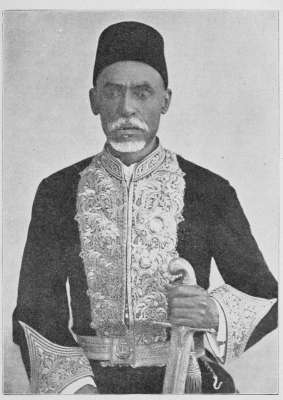
Breathing threats of vengeance, he proceeded to Khartum and informed the Government of the immense riches and fertility of the province of Bahr el Ghazal and the Hofret en Nahas district, which no longer belonged to Darfur, and were now without a ruler. The astute Belali, whose sole object was to injure Sultan Hussein for having driven him out of the country, conceived this plot, which was destined to bring about a war with Darfur. Thoroughly trusted by the ignorant Khartum authorities, he was despatched, in company with Kutshuk Ali, who commanded some bashi-bozuks and two hundred regulars, to take possession of those supposed rulerless regions. As may be imagined, Zubeir looked with no friendly eye on the intrigues of this upstart; but, with his far-seeing astuteness, he watched and waited patiently for the further development of his rival's plans. Meanwhile Kutshuk Ali died suddenly, and was replaced by Haj Ali Abu Nurein; and, at the instigation of the latter, Belali, emboldened by Zubeir's inaction, proceeded to seize some large stores of grain which he had prepared for his Bazingers. Zubeir did not hesitate to seize this chance, and, falling on him suddenly, drove him and his men off with some loss. Belali now collected as many men as he could, and made a determined attack on Zubeir's zariba, but was again repulsed. Severely wounded himself, he fled to Ganda, where he was pursued, captured by Zubeir's men, and taken back to the zariba, where he died.
Zubeir, however, was not slow to perceive that his action in this matter might have serious consequences. He therefore did all in his power to show that Belali was entirely to blame for what had occurred, and, by making valuable presents to Belali's men as well as to those in authority, he succeeded in having the matter reported to Khartum in its most favourable aspect, with the result that he received a full pardon, and was appointed Governor of Bahr el Ghazal.
Soon afterwards he confidentially pointed out to the Governor-General that great discontent prevailed in the neighbouring State of Darfur, and that he had relations with some of the principal dignitaries who would gladly see the country annexed to Egypt; and he also volunteered to carry this out without further assistance from the Government. After much deliberation his proposal was at length agreed to, and early in 1873 he made preparations to seize Shakka.
Let us turn now for a moment to the Rizighat. For years following on the terrible treatment they had received at the hands of the Darfur Sultan, they remained quiet and submissive, but gradually, as the governing power in Darfur grew weak, they recovered in proportion, and again assumed a semi-independent position between Darfur and Bahr el Ghazal. Attempts were made to collect taxes from them, but they almost invariably drove off the tax-gatherers, and in one of these raids the Vizir Adam Tarbush, one of the principal Darfur commanders, lost his life,—curiously enough at the very spot where, some years later, I was destined to suffer a heavy defeat at the hands of the Dervishes.
On another occasion the Rizighat had fallen on a large caravan coming from the Nile and Kordofan to Bahr el Ghazal, with which were a number of Zubeir's relatives, almost all of whom were killed. Zubeir, rightly considering that the Rizighat owed allegiance to the Sultan of Darfur, called on the latter for compensation for the losses he had sustained; but the Sultan either would not or could not give it, and Zubeir now openly gave out that, being unable to obtain satisfaction, he had determined to punish the Rizighat,—being well aware that this must lead to the fulfilment of the project to annex Darfur.
Meanwhile early in 1873 Sultan Hussein had died and had been succeeded by his son, who was nicknamed by the Darfurians Ibrahim Kuiko. I may here mention that some years later, when residing at El Fasher as Governor, I made the acquaintance of the celebrated Fiki Mohammed el Heliki, who, though a Fellata by race, had been born there, and was infinitely the best authority on the former history of Darfur. It greatly interested one to talk to this man, and I made a mass of notes which, with many other interesting records, fell subsequently into the hands of the Mahdists, and were burnt. I well remember Fiki Mohammed one day telling me the following story: "Three years," he began, "before the death of my master, Sultan Hussein,—may God give him peace,—I was talking to him about the present and future of the country. Bowing down his head and supporting it in his hand,—for the poor man had been blind for the last thirteen years,—he said, 'I feel that my country and the throne of my ancestors are about to be overthrown; God grant I may not live to see that day! Already I seem to hear the trumpets of the Turks and the distant sound of the ombeÿa blown by the Bahhara.[2] May God have mercy on my son Ibrahim and on my unfortunate descendants!'" The fiki then went on to tell me that in spite of his old age and blindness, Sultan Hussein well knew the state of corruption of his country, and how impossible it was for him to check it; he realised the growing desire of the Egyptians to increase their conquests, and he instinctively knew that Zubeir and his Bazingers would be their instruments. He was a wise man, he said, and though God had deprived him of sight, He had sharpened his intellect.
Zubeir now lost no time in beginning operations. Quitting his fortified post of Dem Zubeir with a considerable force, he advanced towards Shakka, and on reaching the southern frontiers of Darfur he was joined by some of the principal chiefs of the Rizighat, such as Madibbo, Egeil Wad el Jangawi, and several of their men, who, being well acquainted with the districts, acted as his spies and scouts, and considerably facilitated his advance through their country, which was hostile.
Attacked incessantly by the Arabs, and suffering greatly from sickness and privations, Zubeir's force advanced steadily, and at length reached Abu Sigan, which is the centre of the Shakka district. There he learnt that Sultan Ibrahim had despatched a strong force against him, under his Vizir (and father-in-law, Ahmed Shata, Ibrahim having married his daughter, Um Giddein). The latter, since the accession of his son-in-law, had grown discontented, and showed much reluctance in taking command of the expedition against Zubeir. He had told his friends he did not seek victory, but preferred to die honourably in the field rather than continue to live under the new rule. Zubeir meanwhile strengthened his position at Shakka, and made all preparations for the impending attack. He now received from the Rizighat a truly characteristic Arab message: "The army of the Sultan of Darfur is advancing. You and they are our enemies. When you begin fighting, we shall remain neutral. If you are defeated, we shall harass you on your retreat, and shall kill you all. If you conquer, then shall we mount our swift horses, follow up the Darfurians, and share with you the booty." Zubeir was quite satisfied with this arrangement, and patiently awaited events. In the early dawn his outposts saw in the far distance the great Darfur army advancing, led by the warriors in coats of mail, wearing chain helmets, and mounted on richly caparisoned horses, whose gold and silver trappings glittered in the morning sun. In front of all, advanced the Vizir Ahmed Shata, as if seeking death. Zubeir withdrew all his men within the intrenchments, and when the Darfur host had approached sufficiently near, he opened a deadly fire on them. The Vizir's horse was instantly shot; but, mounting another, he continued to advance until he fell, riddled with bullets; and with him many of his relations and members of his household, including Melek Sad en Nur and Melek en Nahas (the chief of the copper drums), whom the Sultan had placed as his second in command.
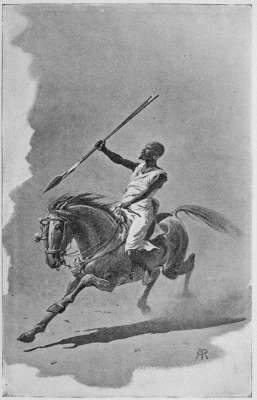
Deprived of their leaders, the troops retired, and Zubeir seized the opportunity to make a counter attack on their flank, which broke up the army, and caused it to disperse in all directions. Instantly, from behind the trees, dashed clouds of Rizighat horsemen, who slaughtered the flying Darfurians, capturing immense quantities of valuable loot, and now they entirely threw in their lot with the conquerors, with the certainty that they would reap considerable benefit.
A Rizighat Warrior.
The few who succeeded in escaping the massacre fled to Dara, while Zubeir sent messages to El Obeid and Khartum, announcing the victory, and asking for the reinforcements of troops and guns which, in the event of his success, the authorities had agreed to place at his disposal. In due time these arrived, and he continued his advance towards Dara, his flank being covered by the advance of the Governor-General from El Obeid to Om Shanga, at the head of three thousand regulars and a number of irregular horsemen.
With the exception of one small skirmish, Zubeir entered Dara unopposed, to find it completely deserted. Erecting a small fort on the sand-hill, he awaited the attack of Sultan Ibrahim's sons; but the latter, at the head of a considerable force, merely reconnoitred the position, and, returning to their father at El Fasher, urged him to lead his troops against Zubeir. Ibrahim now collected every available man; but large as were his hosts, there were few amongst them ready to lay down their lives for their ruler. At the head of his army, the Sultan advanced to some houses which had belonged to the late Vizir, and which were almost within range of the sand-hill, while Zubeir withdrew his troops into Dara, where he had made all preparations for a siege, and had collected a large store of grain.
Wishing to make a close inspection of Zubeir's position, Ibrahim, with a portion of his force, approached the town, and was met by a storm of bullets which killed several of his men, and forced him to retire. The remainder of his force, seeing what appeared to them to have been an attack by the Sultan on Zubeir's position, which had failed, made some mocking remarks within his hearing. Burning with anger, he ordered some of his riflemen to advance and fire on his own troops, who were retiring on the camp, with the result that several were killed and wounded, and the remainder dispersed, while many of those within the camp took advantage of the confusion to desert to their homes.
Thus was Sultan Ibrahim the means of the destruction of his own army. And this incident subsequently lost him his kingdom and his life.
He now ordered what remained of his army to retire to Manawashi, making his chiefs believe that by this movement Zubeir would be drawn out of Dara, and he would be able to attack him in the open; but his men had now lost all confidence in him, and his army was still further reduced by numerous desertions. Zubeir, who had full information from his spies of what was going on in the Sultan's camp, now followed him to Manawashi, and formed up in battle array, awaiting attack. His arrival was the signal for a general scuttle; men, women, and children fled in all directions; and Ibrahim, knowing that all was lost, determined to die an honourable death. Donning his coat of mail and helmet, and accompanied by his sons, the Kadi, and a few servants, all mounted on their magnificently trapped steeds, they sallied forth, and with drawn swords dashed at the enemy. Cutting his way through the first line of Bazingers, Ibrahim shouted, "Fein sidkum ez Zubeir?" (Where is your master, Zubeir?), and then made for the spot where Zubeir, dressed like his own men, was directing a gun against the assailants; but he had only gone forward a few steps when he and his little party fell, riddled with bullets. Thus perished the last of the long line of kings of Darfur, who had ruled this vast country and its millions of inhabitants uninterruptedly for centuries.
Zubeir ordered the dead Sultan to be treated with the greatest respect. The fikis of Manawashi were directed to wash the body in accordance with the religious rites; and, wrapped in a costly shroud, it was buried with all honour in the mosque of the town.
He now lost no time in informing the Governor-General, then at Om Shanga, of the victory; and the latter, anxious that the rich plunder of the province should not fall into Zubeir's hands, hurried forward without delay.
Meanwhile, Zubeir, advancing rapidly, arrived at El Fasher in two days, and took possession of the royal treasures, as well as quantities of silver-embossed saddles, arms, jewellery, and thousands of female slaves, whom he distributed amongst his men.
A few days afterwards, Ismail Pasha, the Governor-General, arrived, but he was too late; the greater quantity of treasure had already been distributed, though Zubeir, by offering him costly presents, did all he could to secure his friendship. There is no doubt, however, that this episode was the commencement of the quarrel between the two men, which eventually developed into mutual deadly hatred.
The work of subduing the remainder of the country now began. Hasaballa, the old uncle of Sultan Ibrahim, had taken refuge in Jebel Marra, and Ismail Pasha ordered Zubeir to advance against him. It was not long before he succeeded in obtaining the submission of both him and the late Sultan's brother, Abderrahman Shattut, both of whom were subsequently sent to Cairo,—and they died there; but their families are residing at the present time in Upper Egypt, and are in receipt of a liberal pension from the Government. Several of their adherents, however, still held out in Jebel Marra, and, electing two younger brothers of Sultan Hussein, viz., Bosh and Seif ed Din, as their leaders, they showed a determination to resist. Bosh's first step was to send a certain Gabralla, of the Fur tribe, as a spy to Zubeir's camp. This man enjoyed the entire confidence of his chief, who had given him in marriage his beautiful daughter, Um Selima, in spite of the opposition of the family. Gabralla, on reaching Zubeir's camp, fell an easy prey to that astute warrior. The promise of pardon and a high position under the Government were quite sufficient inducements to him to betray his father-in-law and give the fullest information as to his position and strength. He then returned to Bosh, whom he advised to remain where he was, as Zubeir's troops were suffering much from the cold and disease, and he had no intention to attack. Zubeir was, however, following in Gabralla's footsteps, and on a given signal, previously arranged between them, Bosh's camp was suddenly surprised, and easily fell into his hands, though Bosh and Seif ed Din succeeded in escaping to Kebkebia, where they again collected a force. Zubeir, however, followed them up, and in the pitched battle which ensued, both leaders were killed, and the last remnant of the Darfur force finally dispersed, leaving the country entirely in the hands of the Egyptian Government.
Zubeir, now promoted to the rank of Pasha, returned to El Fasher, where Ismail Pasha was occupied in regulating the administration of the country and freely levying taxes; and it was not long before serious differences between the two men arose.
Zubeir, having conquered the country, was somewhat resentful that its government had not been confided to him, while Ismail, anxious to free himself from the incubus of Zubeir, ordered him to occupy Dara and Shakka with his troops; but the latter, angry at the treatment he had received, despatched a message from Dara, via El Obeid, to H. H. the Khedive, Ismail Pasha, begging to be allowed to come to Cairo. Permission was immediately accorded to him and any others who wished to proceed; and Zubeir, having appointed his son Suleiman as his agent, started without delay, taking with him numbers of male and female slaves and valuable presents. Travelling by Khartum and Korosko, he at length reached Cairo, where he was cordially received, and lost no time in laying before the Khedive his grounds of complaint against Ismail Pasha Ayub. The latter was, in consequence, summoned to Egypt, and made several charges against Zubeir, with the result that both were kept in Cairo.
Meanwhile, Hassan Pasha Helmi el Juwaizer had been appointed the representative of the Government in Darfur, and it was not long before the inhabitants began to settle down under the new system. They were tired of the arbitrary rule of the Sultans, and longed for change; but they soon discovered that if their kings had chastised them with whips, their new rulers, in the shape of Zubeir's Bazingers and the crowds of irregular Shaigias and dishonest Egyptian officials, who swarmed into the country, chastised them with scorpions.
It was not long before the most bitter discontent prevailed throughout the country, and already there appeared signs of revolt. Electing Harun er Reshid, the son of Seif ed Din, as their Sultan, they secretly planned the massacre of several of the small outlying garrisons, and in an incredibly short space of time the larger towns of Dara, El Fasher, Kebkebia, and Kulkul were closely invested. At El Fasher, the fort was twice almost successfully stormed, and on one occasion the Governor, feeling that it must fall, had made all preparations to blow up the powder magazine and destroy himself and his garrison; but fortunately the troops, after a desperate encounter, succeeded in driving the enemy out of the position.
Meanwhile the Khartum authorities lost no time in sending a relieving force under Abd er Razzak Pasha, which, reinforced at El Obeid, advanced to Darfur by forced marches, and at a place called Brush, midway between Om Shanga and El Fasher, they inflicted a heavy defeat on the rebels. Pushing on rapidly, El Fasher was relieved a few days later, reinforcements were sent to Kebkebia and Kulkul, and the country was once more made subject to the Egyptian Government.
On the recall of Ismail Pasha Ayub, Gordon was appointed Governor-General of the Sudan, and, as I have already related, he thought it expedient to visit Darfur without delay. In fact, when he reached El Fasher, Kebkebia, and Kulkul, the revolt was only partially suppressed; but, utterly fearless, he rode with only a small escort all over the country, and frequently placed himself in positions of extreme danger, from which his pluck and presence of mind alone saved him. From El Fasher he visited Dara, and by his kindness and sympathy with the people he succeeded in a large measure in quieting the districts; with a mere handful of men and the assistance of a few Rizighat Arabs he completely quelled the Mima and Khawabir Arabs, who were the most restless and independent tribes in the country, and gradually through his efforts peace was once more established throughout the land.
Sultan Harun with a few followers had taken refuge in the wilds of Jebel Marra, where they had been followed by Hassan Pasha Helmi, who twice defeated them, at Murtal and Murtafal, and had pursued the survivors as far as Niurnia.
Gordon now turned his attention to the establishment of a Government administration; his first step was to remit the greater part of the taxes, which, owing to the war, could not possibly have been paid, and he gave strict injunctions to the officials to deal leniently with the people, warning them that any disregard of his orders in this respect would be dealt with very severely. In order to equalise revenue and expenditure as far as possible, he reduced the Darfur garrison considerably, sending back to El Obeid and Khartum a large number of the regular infantry and cavalry who had been despatched to quell the late revolt. These economical measures, although undoubtedly very necessary in the interests of the new province, had subsequently a most disastrous effect.
Official business obliged him to return to Khartum, leaving Hassan Pasha Helmi as Governor; and the latter, four months before my arrival, was relieved by Messedaglia Bey, who had been Governor of Dara for a few months.
Harun, meanwhile, had somewhat recovered himself, and established a species of independent rule in Niurnia, which had been in early times the capital of the Tago princes; from thence he would occasionally descend to the plains and raid the villages which had submitted to Government, returning laden with booty to his stronghold.
Such was briefly the state of the province of Darfur when I arrived at El Fasher. The garrison of this town consisted of two battalions of regulars, two batteries of field artillery, and two hundred and fifty irregular Shaigia horsemen, under Omar Wad Darho; at Dara there was one battalion of regulars, one field battery, fifty irregular horsemen, and two hundred irregular riflemen, or Bazingers; while in Kebkebia and Kulkul there were six companies of regulars, four hundred Bazingers, and twenty-five horsemen.
After a few days' rest at El Fasher, Dr. Zurbuchen and I continued our journey to Dara, and were accompanied a short distance along the road by Messedaglia Bey, who told us that his wife was coming to Khartum, and that he was asking for leave of absence to go and meet her there and bring her to El Fasher. I suggested that it would be advisable to wait till Sultan Harun had been dealt with before bringing his wife so far; but Messedaglia replied there was not the least cause for fear, and that there were now quite sufficient troops in the country to suppress any local difficulties. I had heard, however, that Harun's influence was considerable, and that there was some apprehension that the now reduced Government forces might be hard pressed. Having only just come to the country and having had no previous experience, it was of course impossible for me to judge; I therefore accepted Messedaglia's views on the situation, and, bidding him and Said Bey Guma, the commandant, farewell, we hurried on towards Dara, our road taking us through Keriut, Ras el Fil, and Shieria.
Zurbuchen was a very much older-looking man than myself, with a long black beard and spectacles, whilst I looked perhaps even younger than I was. The hair on my upper lip had scarcely begun to sprout, and altogether I had a most boyish face; consequently wherever we went he was invariably taken for the Governor, and I for the doctor or apothecary. As we approached the end of our journey, the doctor, who was suffering from fever, had to ride slowly, and to save time for official work, I rode on slightly ahead, and happened to reach the village of Shieria (a day's march from Dara) a little before the appointed time. I found the villagers busily preparing for our reception, the houses were being swept out, straw mats laid down, and the Kadi and Sheikh had spread out their carpets, on which the new Governor was to repose. Making my camel kneel down, I got off, and to inquiries as to who I was, I answered, "One of the new Governor's escort;" having previously warned the rest of my escort to say nothing. The inquisitive villagers now assailed me with innumerable questions. "What sort of man is the new Governor?" said one. "Oh," I replied, "I think he will do his best, and I believe he is inclined to be just and easy going." "But is he brave and kind-hearted," said another. This was rather a puzzling question to answer, so I replied guardedly, "He does not look as if he were afraid, but I haven't yet heard much about his courage; he has a manly appearance, and I believe he is kind-hearted; but of course it is impossible for him to satisfy every one." "Ah!" said another, "if we only had a governor like Gordon Pasha, then the country would indeed be contented; he never ceased to distribute money and presents, and never sent the poor and needy away without giving them something. I only once heard him say some harsh words, and that was when Suleiman Zubeir was at Dara, and when he turned to the Kadi, saying that there were several bad characters amongst the Sudanese, and that it did not always do to treat them leniently." "Yes," chimed in the Kadi, "I heard him say so myself; but he referred only to the Gellabas and traders who came from the Nile, and who were implicated with Zubeir and his son in every description of unlawful trade by which they could benefit themselves."
"Gordon was indeed a brave man," said the Sheikh of the village, who introduced himself as Muslem Wad Kabbashi, "I was one of his chiefs in the fight against the Mima and Khawabir Arabs: it was in the plain of Fafa and a very hot day. The enemy had charged us and had forced back the first line, and their spears were falling thick around us; one came within a hair's breadth of Gordon, but he did not seem to mind it at all, and the victory we won was entirely due to him and his reserve of one hundred men. When the fight was at its worst, he found time to light a cigarette. Never in my life did I see such a thing; and then the following day, when he divided the spoil, no one was forgotten, and he kept nothing for himself. He was very tender-hearted about women and children, and never allowed them to be distributed, as is our custom in war; but he fed and clothed them at his own expense, and had them sent to their homes as soon as the war was over. One day," continued the Sheikh, "without letting him know, we put some women aside; but if he had found us out, we should have had a bad time of it."
After a short pause, I inquired about affairs in Dara and about the qualifications of the various officials; for I had already heard that they were very unreliable, and I was now told that they looked on my advent with no friendly eye.
Meanwhile Dr. Zurbuchen and the rest of the caravan had arrived, and at once the Sheikh, Kadi, and other village dignitaries lined up in a semi-circle to receive him, while I, concealing myself as much as possible, awaited with amusement to hear what Muslem Wad Kabbashi would say; he began with warm welcome to the new Governor, praised his qualifications, and eloquently described the joy of all his people at his arrival. Poor Dr. Zurbuchen, whose comprehension of Arabic was very slight, became more and more perplexed. "Indeed I am not the Governor," he urged, "I am only the Sanitary Inspector. The Governor must have arrived long ago; but as he had only a few people with him, perhaps he has been mistaken for some one else." I now thought it time to step forward, and laughingly thanked the villagers for their kind reception, assuring them that I would do all in my power to satisfy their wants, and that at the same time I looked to them to assist me in seeing my orders carried out. Of course they made the most profuse apologies for the mistake; but I assured them there was not the least necessity for their doing so. I was anxious, I said, to be on the most intimate and friendly terms with all of them, and I hoped they would allow the same friendly relations to continue. From that day forth, Sheikh Muslem Wad Kabbashi became one of my most faithful friends, and continued to be so, in times of joy and sorrow, until I left the country.
This little episode had given us all a hearty appetite, and we sat down to an excellent meal of roast mutton; and that over, we were again in the saddle, bivouacking for the night under a large tree about two hours' march from Dara. At sunrise the next morning I sent on a messenger to announce our approach, and on reaching the outskirts we were given a great military reception, the garrison was drawn up in line and a salute of seven guns fired, after which the troops filed off to their barracks, and, accompanied by Major Hassan Helmi, the commandant, Zogal Bey, the Sub-Governor, the Kadi, and some of the principal merchants, we proceeded to the fort in which the Government buildings are situated. The inspection lasted about half an hour, and I then went to my own quarters, in which I had ordered rooms to be prepared for Dr. Zurbuchen, who was to be my guest for a few days.
Dara, which is the capital of Southern Darfur, is built in the midst of a large plain of partly sand and partly clay soil, the fort itself being on the top of a low sand-hill,—in fact, on the same spot in which Zubeir Pasha had entrenched himself when invading the country. It was a rectangular stone enclosure twelve feet high, about five hundred yards long and three hundred yards broad, with flanking towers at each corner, and surrounded by a broad ditch twelve feet deep. The troops were quartered in huts built along the inside of the enclosure, and in the centre were the Government buildings, consisting of the Governor's house, divan, and the various offices and courts of justice, as well as the arms, grain-store, and prison. Some distance east of the fort was the old mosque built by Sultan Mohammed el Fadl, which the former Governor had converted into a powder-magazine, but which Gordon had restored to the town for its proper purpose. Close to the southern gate were the houses of Zogal Bey, the Kadi, and the commandant, built mostly of burnt brick and enclosed by walls.
The town of Dara, consisting chiefly of straw and mud huts, lay a few hundred yards to the east of the fort, while upwards of half a mile to the west was situated the village of Goz en Naam, and beyond it again the hamlet of Khummi.
Inclusive of the garrison, the population of Dara numbered between seven and eight thousand, most of whom belonged to the local tribes; but there were also a considerable number of Nile merchants and traders.
It being the month of Ramadan, which is the great fast, a meal of roasted meat, bread, dates, and lemonade had been prepared for us; but the officials sent a message to say they regretted they could not join us. I confess to being only too glad of this respite, for we were thoroughly tired. Our things unpacked, I now sat down to consider how to make myself as comfortable as I could.
At sunset, the gun boomed out the signal that one day more of Ramadan had gone; and now the hungry and thirsty inhabitants, their daily fast over, hurried to their evening meal. Zogal Bey, Hassan Effendi Rifki, Kadi el Beshir, and the chief merchant, Mohammed Ali, now came to see us, and asked us to dine with them; they were followed by a host of servants bearing roast mutton, fowls, milk, and rice,—which is usually eaten with hot melted butter and honey,—and dishes of asida (meat spread over with a thin layer of very fine dukhn flour, over which sauce is poured, and on the top of all is a thin layer of paste, sprinkled with sugar); this completed the menu. In a few minutes the ground just outside the house, which had been sprinkled with fine sand, was spread with carpets and palm mats, and on these the dishes were laid. Zogal Bey began distributing the viands amongst those who had come to welcome me, including the servants, but keeping, of course, the best dishes for the more select company. We now sat down, and the tearing and rending of the roast sheep began with a vengeance; of course, knives and forks were out of the question. Scarcely had we settled down to the feast, when a great hubbub arose amongst the servants, who were evidently trying to prevent two men from pushing their way into our circle. I begged Zogal Bey to inquire what was the matter. Licking his greasy fingers, he got up, and returned in a few minutes, carrying a document which proved to be a letter from Ahmed Katong and Gabralla, the two chiefs of an irregular corps which garrisoned the station of Bir Gowi, some three days' march southwest of Dara: this was to say they had just received information that Sultan Harun was going to attack them, and that as they had only a small force, they proposed to evacuate their station, unless reinforcements could be sent at once; but they said that if they left the district, all the villages would be plundered.
There was no time to be lost, so I ordered Hassan Effendi Rifki to select two hundred regulars and twenty horsemen, to be ready to start with me at once for Bir Gowi. Zogal and Hassan both urged that it was unnecessary for me to go, as I wanted rest after the long journey; but I said that as my principal object in coming to Darfur was to fight Sultan Harun,—in accordance with Gordon Pasha's orders,—I intended to take the earliest possible opportunity of doing so. Seeing that I was not to be stopped, and secretly rejoicing that neither of them had been saddled with the responsibility of taking command, they now hurried on with the preparations.
The pony which Gordon had given me was too tired to be taken, so I asked if any one present could lend or sell me a good horse. Zogal happened to have just bought a large white Syrian horse, and at once sent for it; he was a strong, well-made animal, quite suitable for the fatigues of a campaign, and as he had formerly been owned by an officer, was used to the noise of firing. Seeing that I liked the look of the horse, Zogal immediately begged my acceptance of it by way of diafa (hospitality); but I went to some pains to explain to him that it was not customary in my country to accept such presents, and that here in the Sudan, he being my subordinate, I could not think of it. Unfortunately, I had previously mentioned Gordon's gift of a pony to me, and of course Zogal brought this up as a parallel case; but I replied that there was no objection to accepting a present from a high official given entirely by way of friendship. After considerable discussion, I at length succeeded in making him accept one hundred and eighty dollars; but he did so under great protest.
By midnight all was ready, and, bidding Dr. Zurbuchen good-bye, I started off for the southwest, saying that I hoped to see him again in four or five days.
I was young, strong, and keen to have some fighting experience, and I well remember my delight at the thought of a brush with Sultan Harun. The idea of difficulties and fatigue never crossed my mind; all I longed for was a chance of showing my men that I could lead them. At sunrise I halted my little party, which consisted of two hundred Blacks,—the officers also being Sudanese,—and the horsemen Turks and Egyptians, and addressed them in a short speech, saying that at present I was an entire stranger to them, but they should see I was ready to share fatigue and discomfort with them on all occasions, and that I hoped we should march rapidly forward with a good heart. Simple as my harangue undoubtedly was, I saw that it had made an impression, and when I had finished, they raised their rifles above their heads, in Sudanese fashion, and shouted that they were ready to conquer or die.
At noon we halted near a village, and I then carefully inspected the men. They were all well armed, and had a plentiful supply of ammunition; each man was also provided with a water-bottle made out of goat or gazelle skin, known as "sen" (pl. siun); but they had brought no rations with them. On inquiry, I was told, "Wherever you go in Darfur you will always find something to eat." I therefore made my way to the Sheikh of the village, and asked him to supply some dukhn. This corn is generally soaked in water, then pressed, mixed with tamarind fruit, and eaten in this condition; the bitter-sweet water being an excellent thirst-quencher. This food Europeans usually find indigestible; but it is very nourishing, and is eaten almost exclusively by the Sudanese soldiers when campaigning. I gradually got accustomed to it, taking it almost invariably when out on such expeditions; but I found that unless one was feeling very well, it generally brought on most painful indigestion. The Sheikh now brought us the corn, and also a large dish of asida, which was divided amongst the men; and whilst they were having their meal, I asked the officers to share with me a tin of preserved meat, which they admitted was much superior to the asida and dukhn. I then called up my clerk, and told him to write out a receipt for the corn, which he was to give the Sheikh, to be his voucher for the remission of taxation equivalent to the value of the dukhn supplied. But the good man, when he understood my orders, refused to accept the receipt, adding that it was not only his duty to give the corn, but that the rights of hospitality demanded it. I told him, however, that I was well aware the natives of Darfur were most generous; but to impose the feeding of two hundred men on him quite exceeded the bounds of hospitality, and that it was only just he should receive payment. He at length agreed, and this conversation appeared to give him confidence; for he admitted that if this principle were always carried out, the natives would greatly appreciate it; but, unfortunately, it was the usual custom for troops arriving at a village to enter the houses, and take anything and everything they wanted, with the result that the inhabitants dreaded their approach, and at once tried to hide all they had. I thanked the Sheikh for telling me this, and promised I would do all I could to rectify the evil. We moved on again at three o'clock, loaded with the blessings of this good man and his people, and after a quick march of four hours halted in a small plantation of trees. Our route had led us across a country overgrown with dense bush, and intersected by innumerable dry gullies; and here and there we passed a village buried amongst the trees. From our halting-place I sent off two horsemen to Bir Gowi to announce our approach; and, after a refreshing rest of five hours under the wild fig-trees and tamarisks, we started off again, and marched almost uninterruptedly till noon the following day. We once or twice had to ask for corn, and always had the same difficulty in getting the Sheikhs to accept the receipt; but as I insisted, they generally ended by gladly taking it. I was anxious, if possible, to reach Bir Gowi before dark, so pushed on; we passed on the way a large plantation of deleb palms, and had to be careful not to be struck by the heavy fruit, which, weighing from two to three pounds, and falling from a height of some forty feet, was a positive danger. Woe to the unfortunate traveller who thoughtlessly halts for the night in one of these palm-groves! The natives, however, are very careful, and generally warn the unsuspecting of the risk of sleeping anywhere near these trees when bearing fruit.
At sunset we reached Bir Gowi, which was situated in the centre of a large clearing; and to reach the station we had to pass between the stumps of trees, which considerably impeded the march. It was surrounded by a square zariba, each side of which measured about one hundred and eighty paces, and consisted of a thorn barricade about twelve feet thick and six feet high; on the inside, the ground was raised to enable the men to fire over it from a platform, and the whole was surrounded by a ditch nine feet wide, and about nine feet deep.
The garrison, consisting of some hundred and twenty men armed with rifles, was drawn up outside, with their officers, ready to salute. I halted the men, and, riding forward, saluted the garrison, and was welcomed by the vigorous beating of the nahas (copper war-drums) and noggaras (other drums, made from the hollow trunk of a tree, covered on both sides with skin), the blowing of bugles and antelope horns, and the rattling of dry skins filled with pebbles,—a very effective, but by no means melodious band, diversified by the occasional crack of rifles fired off in a promiscuous manner, and which could not exactly be compared to a feu de joie, though no doubt the intention was the same. After inspecting the garrison, I ordered my men to file into the fort. The interior of the zariba was filled with straw huts, those of the chiefs being surrounded by high straw enclosures; but there was sufficient room for us all, and I was given a good-sized hut, standing in almost the only open place visible.
The object of the Bir Gowi military post was to protect the surrounding villages from raids; but the strength of the garrison to take the offensive was insufficient, and it would probably have been of little use. Dismounting from my horse, I sat on an angareb, and sent for Ahmed Katong and Gabralla to discuss the situation, and obtain the latest news about Harun's movements. Katong soon arrived, hobbling along on a crutch. He belonged to the Fung tribe, his forefathers having been captured by the Furs, after the conquest of Kordofan, and he had been made Hakem Khot, or chief of the district; his duty being to collect taxes, and at the same time to be responsible for the security of the country. In reply to my question as to how he had become lame, he told me that some years before he had been struck in the knee by a bullet. "Since that date," said Ahmed, "I always have a saddled horse near me. In the zariba, of course, it does not matter; but when travelling in these unsettled times, and when one is liable to be attacked at any moment, I lie down to sleep holding the bridle in my hand. Those with good legs can easily get away in case of danger; but with a stump like mine I cannot run, so I have taught myself to mount my horse quickly, with one leg."
I now begged them to give me the latest news about Harun. "Gabralla," said Ahmed, "sent out spies, who returned this afternoon, and who state that Harun has collected his men, but has not yet come down from the mountains;" and Gabralla, chiming in, said, "Yes, I did so, and have sent off others to watch his movements; if he comes here I don't think we shall run away now."
I could not help scanning this man with some curiosity. He was tall, and of the usual black complexion of the Fur tribe; he possessed also—which is very unusual—a well-shaped aquiline nose and a small mouth; he had a slight beard, was about forty years of age, and had a very pleasant expression. Yet this was the villain who had betrayed the father of his own beautiful wife! Was I to trust him, or not? He had certainly every inducement to be loyal, for should he fall into the hands of Harun, he would doubtless pay with his life for the death of his uncle and his father-in-law.
Naturally I gave him no occasion to discover my thoughts, and we chatted about former times, agreeing they were very different from the present; he then began to talk of himself, and told me how he was employed as a spy to bring the news of Harun's movements to Dara, and thence to El Fasher. He had between thirty and forty of his old slaves, who were armed, and whose duty it was to guard and serve him, whilst the older male servants and female slaves had to work in the fields and keep the household supplied with corn. Being in the pay of the Government, he was quite content, but told me that he wanted to do something which would qualify him for the rank of Bey. "Zogal, who is a friend of mine," he said, "is a Bey."
By this time I was so thoroughly tired and sleepy after my long journey, followed by the two days' hard marching, that I went to bed; but my head ached, and the incessant beating of drums in my honour kept me awake all night, and the following morning I felt really unwell. Ahmed Katong came to see me, and I told him I had a bad headache. "We can easily cure that," said Ahmed, cheerfully. "I have a man here who can stop headaches at once; he is a much better man than the doctor at Dara,—indeed there is no doctor at Dara; he is really only an apothecary, with the courtesy title of doctor."
"All right," said I, "but how is he going to cure me?" "Oh! it is very simple," he answered; "he places both his hands on your head, and repeats something; then you get perfectly well,—in fact, better than you were before." "Then let him come at once," I cried. I was young and ignorant in those days, and I thought that possibly one of these wandering Arabs might have visited Europe and learned something of the magnetic cure, and had given up the pleasures of life in order to make himself useful to mankind. I confess to feeling a little mistrustful when I thought of what Ahmed had said; but then, after all, doctors in Europe speak, so why should not he? In a few minutes Ahmed ushered into my presence a tall dark man with a white beard, who appeared to be a native of Bornu, and introduced him as "the doctor who will cure your headache." Without a moment's hesitation, the doctor placed his hand on my head, pressed my temples with his thumb and forefinger, and, muttering a few words I could not understand, to my horror, spat in my face. In a moment I had jumped up and knocked him down; but Ahmed, who was standing by, leaning on his crutch, begged me not to take it in this way. "It was not really meant for rudeness," he said; "it is merely a part of the cure, and will do you much good." But the poor doctor, whose confidence had been somewhat shaken, and was still standing at a distance, muttered, "Headache is the work of the devil, and I must drive it out; several passages from the Kuran and the sayings of holy men direct that it should be chased away by spitting, and thus his evil work in your head will cease!" In spite of my annoyance, I could not help laughing. "So I am supposed to be possessed of a devil," I said; "I trust he was only a little one, and that you have really driven him out." I did not, however, let him make a second experiment, and, giving him a dollar as compensation, I bade him good-bye, and he left me, calling down the blessings of Heaven on my poor head, which was still aching sadly.
All day we awaited news of Sultan Harun's movements, and as there was nothing to be done I kept to my bed. I was just dozing off, when my servant announced that Katong and Gabralla wished to see me. They were admitted, for I thought that no doubt they brought news of Harun; but it was only to say that it was the custom of the country, and one of the claims of hospitality, that, having only one horse, I should accept from each of them a fine country bred animal as a mark of their loyalty and respect. I replied to them much in the same terms as I had answered Zogal, adding that I had no doubt we should remain equally good friends without giving and taking presents, provided they continued to carry out their duties faithfully.
Although they appeared greatly distressed at my refusal to accept the horses, I have no doubt they went home rejoicing secretly that I had refused their gifts. However, before many minutes had passed, Gabralla came back and asked to say just a few words. He had been much pained, he said, by my refusal to take the horse, and now, as I was quite alone and very unwell, he took the liberty of offering me one of his maid-servants. "She is young and pretty," he said, "and has been well brought up in my house; she knows how to prepare native food, is good at housework, and is above all a good and careful nurse, and thoroughly understands all the ailments of the country." Again I was obliged to refuse this proffered kindness; so poor Gabralla went away somewhat downcast with his failure. But having already had a rather painful experience at the hands of the doctor, I was not particularly anxious to intrust myself to the tender mercies of even a dusky maiden, however proficient a nurse she might be.
The next morning I arose feeling quite myself again; and when I met Ahmed and told him that I had recovered, he at once answered, "Of course, I knew you would get quite well; Isa (the name of my doctor) has never yet put his hands on any one and failed to cure him."
Another day passed, and still no news of Harun. Accompanied by Katong and Gabralla, I visited the market, which was about a hundred yards outside the zariba, and was held specially for the benefit of the surrounding villagers, who purchased here all they required. Sometimes the Beni Helba Arabs, who reside in this part of the country, are seen here. Women sitting on the ground expose palm mats for sale, as well as giraffe, antelope, and cow meat; salt is also an important commodity, besides a great variety of native vegetables which are used as ingredients in making sauces for the asida dish. Men are to be seen selling takaki, or native woven linen and cotton cloth, thread, natron, and sulphur, which the Arabs buy freely to grind, and mix with the grease with which they rub their heads. The women are usually the marissa vendors; and here and there a young female slave is exposed for sale. I thought I must buy something, so invested in a few palm mats.
On the following day, about noon, one of Gabralla's messengers returned with the news that Sultan Harun had collected his men, but still had not moved down from his summer resort in the hills. On the fourth day after our arrival at Bir Gowi, a second messenger came in and stated that when Sultan Harun heard from the natives that I had left Dara for Bir Gowi with the intention of fighting him, he had at once disbanded his men, who had dispersed over Jebel Marra.
Thoroughly disappointed with my first failure, I returned crestfallen to Dara, but before doing so visited the sulphur spring from which the station of Bir Gowi (or the strong well) is named. The warm water spouts up from the centre of a sandy depression, and is cooled by two small streams artificially led into it. Natives affected with rheumatism or diseases of the blood bathe in this spring, and are said to derive great benefit from its strengthening properties.
Nine days after leaving Dara I was back there again, and by that time Dr. Zurbuchen had gone, leaving behind him a letter in which he wished me all success. I also found that during my absence my unfortunate Arab clerk who had accompanied me when I was Financial Inspector, and had come with me to Dara, had become crazy: they had put him into a house next my own, and when I went to see him, he sprang forward to embrace me, crying out, "Thank God! Sultan Harun has done no harm to you; but Zogal Bey is a traitor, beware of him. I have ordered the fires in the engine to be lighted, in order that the train may take you to Europe, where you will be able to see your relations again. I shall come with you; but we must be careful about Zogal, he is a scoundrel!" Evidently the poor man's mind was quite unhinged; nevertheless, crazy people sometimes speak the truth. I quieted the poor old man, and induced him to lie down till he heard the engine's whistle warning us to be off; and, commending him to the care of the servants, I went away. Five days later, the whistle had sounded, and the poor man had been carried off to his long home,—his death was, I suppose, due to a rush of blood to the brain.
I now busied myself with the administrative affairs of the province of Dara, which, exclusive of the districts of Kalaka and Shakka, comprised five divisions, or kisms, viz., Toweisha, Kershu, Giga, Sirga, and Arebu, each of which was supposed to pay taxes at a fixed rate; but I found that the officials conducted affairs just as they pleased. It was thought impossible to take regular taxes from Arabs who had no settled places of abode, and whose wealth in cattle was continually increasing; a system had, therefore, been arrived at by which each tribe was assessed at a fixed sum, for the payment of which the head-Sheikh was made responsible, and he, in turn, assessed the various sub-tribes by a mutual arrangement with which the Government did not interfere. I now ordered each district to forward lists to me showing the name and number of the villages and the names of the landowners and traders in every village. When these came in, it would be an easy matter to lay down definitely the rates to be paid by every individual. It was also my intention to make an inspection of every district, in order to see for myself the quality of soil, and assess the value locally; and at the same time my inspections would enable me to see for myself the strength of the Arab tribes, and thus acquire some real data for laying down the tribute which they should pay.