I (continued 2)
Reading edition
"Now, Tom, you said that in your belief there was another man in this case,—one who really was the principal. Have you any suspicion as to that man's identity?"
"Here's my idea," said Mr. Burrows. "This fellow Randal was sounded by the man who finally engaged him for the job, and, proving to be the right sort, was engaged. He was to take the body out of the coffin and carry it away. The man who hired Randal must have been one of the brothers."
"Why?"
"It must have been, else the opportunity could not have been made, for, mark me, it was made. See! The widow was taken to the room to see the corpse, and then it was arranged that the coffin should be closed and not opened again before the funeral. That was to make all sure. Then came the closing of the coffin and the departure of two of the undertakers. The third, Randal, remained behind, and while the family lingered at dinner the job was done. The body was carried out to the wagon and driven off. Now we come to the question, which of the brothers did this?"
"Which have you decided upon?"
"Why, the object of this devilish act was to please the widow by preventing this cremation to which she objected. The man who concocted that scheme thought that when the body should be found it would then be buried, which would gratify the widow. Now why did he wish to gratify her? Because he's in love with her. She's not old, you know, and she's still pretty."
"Then you think that Mark Quadrant concocted this scheme?"
"No! I think that Amos Quadrant is our man."
It seemed destined that Mr. Burrows should surprise Mr. Barnes. If the older detective was astonished when he had heard Burrows suggest that Randal had been the accomplice in this affair, he was more astounded now to hear him accuse the elder brother of being the principal. For, had not Mark Quadrant told him that it was Amos who had insisted upon the cremation? And that Amos, being the elder, had assumed the control of the funeral?
"Burrows," said Mr. Barnes, "I hope that you are not merely following your impulsive imagination?"
Mr. Burrows colored as he replied with some heat:
"You need not forever twit me with my stupidity in my first case. Of course I may be mistaken, but I am doing routine work on this affair. I have not any real proof yet to support my theories. If I had I should make an arrest. But I have evidence enough to make it my duty to go ahead on definite lines. When the mystery clears a little, I may see things differently."
"I should like to know why you think that Amos is in love with his sister-in-law."
"Perhaps it would be safer to claim that he was once in love with her. The past is a certainty, the present mere conjecture. I got the tip from a slip of the tongue made by Dr. Mortimer, and I have corroborated the facts since. I was speaking with Dr. Mortimer of the possibility of there being any ill-feeling between the members of this family, when he said: 'I believe there was some hard feeling between the deceased and his brother Amos arising from jealousy.' When he had let the word 'jealousy' pass his lips, he closed up like a clam, and when I pressed him, tried to pass it off by saying that Amos was jealous of his brother's business and social successes. But that did not go down with me, so I have had some guarded inquiries made, with the result that it is certain that Amos loved this woman before she accepted Rufus."
"What if I tell you that I have heard that the younger brother, Mark, is in love with the widow, and that it was he who opposed cremation, while it was Amos who insisted upon carrying out the wishes of his brother?"
"What should I say to that? Well, I should say that you probably got that yarn from Randal, and that he had been 'stuffing you,' as the vernacular has it, hoping you'll excuse the vulgar expression."
It nettled Mr. Barnes to have his younger confrère guess so accurately the source of his information, and to hear him discredit it so satirically. He recognized, however, that upon the evidence offered Mr. Burrows had not yet made out his case, and that therefore the mystery was yet far from solved.
"Look here, Burrows," said Mr. Barnes. "Take an older man's advice. Don't go too fast in this case. Before you come to any conclusion, find this man Jerry Morgan."
"Why, there won't be any trouble about that."
"Oh, then you know where he is?"
"Why, he is still with Berial. At least he was up to last night."
"Ah, now we come to it!" Mr. Barnes was gratified to find that Burrows had not kept full control of his case. "Last night was many hours ago. Morgan threw up his job this morning, and left."
"The devil you say!"
"Oh, yes," said Mr. Barnes, determined now to make Mr. Burrows a little uncomfortable. "I have no doubt he intends to skip out, but, of course, he cannot get away. You have him shadowed?"
"Why, no, I have not," said Mr. Burrows, dejectedly. "You see, I did not connect him in my mind with——"
"Perhaps he is not connected with the case in your mind, Burrows, but he is connected with it in fact. He is unquestionably the key to the situation at present. With him in our hands we could decide whether it was he or Randal who pawned those rings. Without him we can prove nothing. In short, until you get at him the case is at a standstill."
"You are right, Mr. Barnes," said Mr. Burrows, manfully admitting his error. "I have been an ass. I was so sure about Randal that I did not use proper precautions, and Morgan has slipped through my fingers. But I'll find his trail, and I'll track him. I'll follow him to the opposite ocean if necessary, but I'll bring him back."
"That is the right spirit, Tom. Find him and bring him back if you can. If you cannot, then get the truth out of him. Let me say one thing more. For the present at least, work upon the supposition that it was he who pawned those rings. In that case he has at least two hundred dollars for travelling expenses."
"You are right. I'll begin at once without losing another minute."
"Where will you start?"
"I'll start where he started—at his own house. He's left there by now, of course, but I'll have a look at the place and talk a bit with the neighbors. When you hear from me again, I'll have Morgan."
VIII
Mr. Barnes returned to his home that night feeling well satisfied with his day's work. With little real knowledge he had started out in the morning, and within ten hours he had dipped deeply into the heart of the mystery. Yet he felt somewhat like a man who has succeeded in working his way into the thickest part of a forest, with no certainty as to where he might emerge again, or how. Moreover, though he had seemingly accomplished so much during the first day, he seemed destined to make little headway for many days thereafter. On the second day of his investigation he ascertained one fact which was more misleading than helpful. It will be recalled that Mark Quadrant had told him that his brother had a scar on the sole of his foot made by cutting himself whilst in swimming. Mr. Barnes went to the Morgue early, and examined both feet most carefully. There was no such scar, nor was it possible that there ever could have been. The feet were absolutely unmarred. Could it be possible that, in spite of the apparently convincing proof that this body had been correctly identified, nevertheless a mistake had been made?
This question puzzled the detective mightily, and he longed impatiently for an opportunity to talk with one of the family, especially with the elder brother, Amos. Delay, however, seemed unavoidable. The police authorities, having finally accepted the identification, delivered the body to the Quadrants, and a second funeral occurred. Thus two more days elapsed before Mr. Barnes felt at liberty to intrude, especially as it was not known that he had been regularly retained by Mrs. Quadrant.
Meanwhile nothing was heard from Burrows, who had left the city, and, as a further annoyance, Mr. Barnes was unable to catch Mr. Mitchel at home though he called three times. Failing to meet that gentleman, and chafing at his enforced inactivity, the detective finally concluded to visit the cemetery in the hope of learning what had occurred when Mr. Mitchel had inspected the ashes. Again, however, was he doomed to disappointment. His request to be allowed to examine the contents of the urn was refused, strict orders to that effect having been imposed by the Chief of the regular detective force.
"You see," explained the superintendent, "we could not even let you look into the urn upon the order of one of the family, because they have claimed the body at the Morgue, and so they have no claim on these ashes. If a body was burned that day, then there is a body yet to be accounted for, and the authorities must guard the ashes as their only chance to make out a case. Of course they can't identify ashes, but the expert chemists claim they can tell whether a human body or only an empty coffin was put into the furnace."
"And are the experts making such an analysis?" asked Mr. Barnes.
"Yes. The Chief himself came here with two of them, the day before yesterday. They emptied out the ashes onto a clean marble slab, and looked all through the pile. Then they put some in two bottles, and sealed the bottles, and then put the balance back in the urn and sealed that also. So, you see, there isn't any way for me to let you look into that urn."
"No, of course not," admitted the detective, reluctantly. "Tell me, was any one else present at this examination besides the Chief and the two experts?"
"Yes. A gentleman they called Mitchel, I believe."
Mr. Barnes had expected this answer, yet it irritated him to hear it. Mr. Mitchel had information which the detective would have given much to share.
During the succeeding days he made numerous ineffectual efforts to have an interview with Amos Quadrant, but repeatedly was told that he was "Not at home." Mrs. Quadrant, too, had left town for a rest at one of their suburban homes, and Mark Quadrant had gone with her. The city house, with its closed shutters, seemed as silent as the grave, and the secret of what had occurred within those walls seemed almost hopelessly buried.
"What a pity," thought the detective, "that walls do not have tongues as well as ears."
A week later Mr. Barnes was more fortunate. He called at the Quadrant mansion, expecting to once more hear the servant say coldly, "Not at home," in answer to his inquiry for Mr. Quadrant, when, to his surprise and pleasure, Mr. Quadrant himself stepped out of the house as he approached it. The detective went up to him boldly, and said:
"Mr. Quadrant, I must have a few words with you."
"Must?" said Mr. Quadrant with an angry inflection. "I think not. Move out of my way, and let me pass."
"Not until you have given me an interview," said Mr. Barnes firmly, without moving.
"You are impertinent, sir. If you interfere with me further, I will have you arrested," said Mr. Quadrant, now thoroughly aroused.
"If you call a policeman," said Mr. Barnes, calmly, "I will have you arrested."
"And upon what charge, pray?" said Mr. Quadrant, contemptuously.
"I will accuse you of instigating the removal of your brother's body from the coffin."
"You are mad."
"There are others who hold this view, so it would be wise for you to move carefully in this matter."
"Would you object to telling me what others share your extraordinary opinion?"
"I did not say that it is my opinion. More than that, I will say that it is not my opinion, not at present at all events. But it is the view which is receiving close attention at police headquarters."
"Are you one of the detectives?"
"I am a detective, but not connected with the city force."
"Then by what right do you intrude yourself into this affair?"
Mr. Barnes knew that he must play his best card now, to gain his point with this man. He watched him closely as he answered:
"I am employed by Mrs. Quadrant."
There was an unmistakable start. Amos Quadrant was much disturbed to hear that his sister-in-law had hired a detective, and curiously enough he made no effort to hide his feelings. With some show of emotion he said in a low voice:
"In that case, perhaps, we should better have a talk together. Come in."
With these words he led the way into the house, and invited the detective into the same room wherein he had talked with Mark Quadrant. When they had found seats, Mr. Quadrant opened the conversation immediately.
"What is your name?" he asked.
"John Barnes," was the reply.
"Barnes? I have heard of you. Well, Mr. Barnes, let me be very frank with you. Above all things it has been my wish that this supposed mystery should not be cleared up. To me it is a matter of no consequence who did this thing, or why it was done. Indeed, what suspicions have crossed my mind make me the more anxious not to know the truth. Feeling thus, I should have done all in my power to hinder the work of the regular police. When you tell me that my sister-in-law has engaged your services, you take me so by surprise that I am compelled to think a bit in order to determine what course to pursue. You can readily understand that my position is a delicate and embarrassing one."
"I understand that thoroughly, and you have my sympathy, Mr. Quadrant."
"You may mean that well, but I do not thank you," said Mr. Quadrant, coldly. "I want no man's sympathy. This is purely an impersonal interview, and I prefer to have that distinctly prominent in our minds throughout this conversation. Let there be no misunderstanding and no false pretenses. You are a detective bent upon discovering the author of certain singular occurrences. I am a man upon whom suspicion has alighted; and, moreover, guilty or innocent, I desire to prevent you from accomplishing your purpose. I do not wish the truth to be known. Do we understand one another?"
"Perfectly," said Mr. Barnes, astonished by the man's manner and admiring his perfect self-control and his bold conduct.
"Then we may proceed," said Mr. Quadrant. "Do you wish to ask me questions, or will you reply to one or two from me?"
"I will answer yours first, if you will reply to mine afterwards."
"I make no bargains. I will answer, but I do not promise to tell you anything unless it pleases me to do so. You have the same privilege. First, then, tell me how it happened that Mrs. Quadrant engaged you in this case."
"I called here, attracted merely by the extraordinary features of this case, and Mrs. Quadrant granted me a short interview, at the end of which she offered to place the matter in my hands as her representative."
"Ah! Then she did not of her own thought send for you?"
"No."
"You told me that the regular detectives are considering the theory that I instigated this affair. As you used the word instigated, it should follow that some other person, an accomplice, is suspected likewise. Is that the idea?"
"That is one theory."
"And who, pray, is my alleged accomplice?"
"That I cannot tell you without betraying confidence."
"Very good. Next you declared that you yourself do not share this view. Will you tell me on what grounds you exculpate me?"
"With pleasure. The assumed reason for this act of removing your brother from his coffin was to prevent the cremation. Now it was yourself who wished to have the body incinerated."
"You are mistaken. I did not wish it. On the contrary, I most earnestly wished that there should be no cremation. You see I incriminate myself."
He smiled painfully, and a dejected expression crossed his face. For an instant he looked like a man long tired of carrying some burden, then quickly he recovered his composure.
"You astonish me," said Mr. Barnes. "I was told by Mr. Mark that you insisted upon carrying out your brother's wish in this matter of disposing of his body."
"My brother told you that? Well, it is true. He and I quarrelled about it. He wished to have a regular burial, contrary to our brother's oft-repeated injunction. I opposed him, and, being the elder, I assumed the responsibility, and gave the orders."
"But you have admitted that you did not wish this?"
"Do we always have our wishes gratified in this world?"
The detective, watching the man's face closely, again noted that expression of weariness cross his features, and an instinctive feeling of pity was aroused. Once more the skein became more entangled. His own suspicion against Mark Quadrant rested upon the supposition that the act was committed with the intent of making capital out of it with the widow, and was based upon the theory that Amos wished to have his brother incinerated. If now it should transpire that after all it was Amos who managed the affair, his motive was a higher one, for, while appearing to carry out the wishes of his deceased brother, he must have aimed to gratify the widow, without admitting her to the knowledge that his hand had gained her purpose. This was a higher, nobler love. Was Amos Quadrant of this noble mould? The question crossing the detective's mind met a startling answer which prompted Mr. Barnes to ask suddenly:
"Is it true that, speaking of this cremation, you said: 'Let him burn; he'll burn in hell anyway'?"
Amos Quadrant flushed deeply, and his face grew stern as he answered:
"I presume you have witnesses who heard the words, therefore it would be futile to deny it. It was a brutal remark, but I made it. I was exasperated by something which Mark had said, and replied in anger."
"It is a sound doctrine, Mr. Quadrant," said the detective, "that words spoken in anger often more truly represent the speaker's feelings than what he says when his tongue is bridled."
"Well?"
"If we take this view, then it is apparent that you did not hold a very high regard for your brother."
"That is quite true. Why should I?"
"He was your brother."
"And because of the accident of birth, I was bound to love him? A popular fallacy, Mr. Barnes. He was equally bound, then, to love me, but he did not. Indeed he wronged me most grievously."
"By marrying the woman you loved?"
Mr. Barnes felt ashamed of his question, as a surgeon often must be sorry to insert the scalpel. To his surprise it elicited no retort. Mr. Quadrant's reply was calmly spoken. All he said was:
"Yes, he did that."
"Did she know?" ventured the detective hesitatingly.
"No, I think not—I hope not."
There was a painful pause. Mr. Quadrant looked down at the floor, while Mr. Barnes watched him, trying to decide whether the man were acting a part with intent to deceive, as he had announced that he would not hesitate to do; or whether he were telling the truth, in which case the nobility of his character was brought more into perspective.
"Are you sure," said Mr. Barnes after a pause, "that the body taken from the river was that of your brother Rufus?"
"Why do you ask that?" said Mr. Quadrant, on the defensive at once. "Can there be any doubt?"
"Before I reply, let me ask you another question. Did your brother Rufus have a scar on the sole of his foot?"
The other man started perceptibly, and paused some time before answering. Then he asked:
"What makes you think so?"
"Mr. Mark Quadrant told me that his brother had such a scar, caused by gashing his foot while in swimming."
"Ah, that is your source of information. Well, when Mark told you that his brother had met with such an accident, he told you the truth."
"But did the accident leave a scar?" Mr. Barnes thought he detected a carefully worded evasive answer.
"Yes, the cut left a bad scar; one easily noticed."
"In that case I can reply to your question. If, as you both say, your brother had a scar on the sole of his foot, then there exists considerable doubt as to the identification of the body which was at the Morgue, the body which you have both accepted and buried as being that of your relative. Mr. Quadrant, there was no scar on that body."
"Odd, isn't it?" said Mr. Quadrant, without any sign of surprise.
"I should say it is very odd. How do you suppose it can be explained?"
"I do not know, and, as I have told you before, I do not care. Quite the reverse; the less you comprehend this case the better pleased I shall be."
"Mr. Quadrant," said Mr. Barnes, a little nettled, "since you so frankly admit that you wish me to fail, why should I not believe that you are telling me a falsehood when you state that your brother told me the truth?"
"There is no reason that I care to advance," said Mr. Quadrant, "why you should believe me, but if you do not, you will go astray. I repeat, what my brother told you is true."
It seemed to the detective that in all his varied experience he had never met with circumstances so exasperatingly intricate. Here was an identification for many reasons the most reliable that he had known, and now there appeared to be a flaw of such a nature that it could not be set aside. If the body was that of Mr. Quadrant, then both these men had lied. If they told the truth, then, in spite of science, the doctors, and the family, the identification had been false. In that case Rufus Quadrant had been cremated after all, and this would account for the statement in Mr. Mitchel's note that a human body had been incinerated. Could it be that these two brothers were jointly implicated in a murder, and had pretended to recognize the body at the Morgue in order to have it buried and to cover up their crime? It seemed incredible. Besides, the coincidence of the external and internal diseases was too great.
"I would like to ask you a few questions in relation to the occurrences on the day and evening preceding the funeral," said Mr. Barnes, pursuing the conversation, hoping to catch from the answers some clue that might aid him.
"Which funeral?" said Mr. Quadrant.
"The first. I have been told that you and your brother were present when the widow last viewed the face of her husband, and that at that time, about five o'clock, you jointly agreed that the coffin should not be opened again. Is this true?"
"Accurate in every detail."
"Was the coffin closed at once? That is, before you left the room?"
"The lower part of the coffin-top was, of course, in place and screwed fast when we entered the room. The upper part, exposing the face, was open. It was this that was closed in my presence."
"I would like to get the facts here very accurately, if you are willing. You say, closed in your presence. Do you mean merely covered, or was the top screwed fast before you went out of the room, and, if so, by whom?"
"Mark took our sister away, but Dr. Mortimer and myself remained until the screws were put in. Mr. Berial himself did that."
"Did you observe that the screws were odd? Different from common screws?"
Mr. Barnes hoped that the other man would betray something at this point, but he answered quite composedly:
"I think I did at the time, but I could not describe them to you now. I half remember that Mr. Berial made some such comment as 'No one can get these out again without my permission.'"
"Ah! He said that, did he? Yet some one must have gotten those screws out, for, if your identification was correct, your brother's body was taken out of that casket after the undertaker had put in those screws, which he said could not be removed without his permission. How do you suppose that was accomplished?"
"How should I know, Mr. Barnes, unless, indeed, I did it myself, or instigated or connived at the doing? In either case, do you suppose I would give you any information on such a point?"
"Did your brother Rufus have any rings on his fingers when placed in the coffin?" asked Mr. Barnes, swiftly changing the subject.
"Yes—three: a diamond, a ruby, and a ring bearing his initial set in diamonds."
"These rings were not on the body at the Morgue."
"Neither was that scar," said Mr. Quadrant, with a suppressed laugh.
"But this is different," said Mr. Barnes. "I did not find the scar, but I have found the rings."
"Very clever of you, I am sure. But what does that prove?"
"It proves that your brother's body was taken from the coffin before the coffin was placed in the crematory furnace."
"Illogical and inaccurate," said Mr. Quadrant. "You prove by the recovery of the rings, merely that the rings were taken from the coffin."
"Or, from the body after it was taken out," interjected Mr. Barnes.
"In either case it is of no consequence. You have rooted up a theft, that is all. Catch the thief and jail him, if you like. I care nothing about that. It is the affair of my brother's death and burial that I wish to see dropped by the inquisitive public."
"Yes, but suppose I tell you that the theory is that the man who stole the rings was your accomplice in the main matter? Don't you see that when we catch him, he is apt to tell all that he knows?"
"When you catch him? Then you have not caught him yet. For so much I am grateful." He did not seem to care how incriminating his words might sound.
"One thing more, Mr. Quadrant. I understand that you retired at about ten o'clock on that night—the night prior to the first funeral, I mean. You left your brother Mark down here?"
"Yes."
"Later you came downstairs again."
"You seem to be well posted as to my movements."
"Not so well as I wish to be. Will you tell me why you came down?"
"I have not admitted that I came downstairs."
"You were seen in the hall very late at night, or early in the morning. You took the lamp out of the room where the casket was, and came in here and looked at your brother, who was asleep. Then you returned the lamp and went upstairs. Do you admit now that you had just come downstairs?"
"I admit nothing. But to show you how little you can prove, suppose I ask you how you know that I had just come downstairs? Why may it not be that I had been out of the house, and had just come in again when your informant saw me?"
"Quite true. You might have left the house. Perhaps it was then that the body was taken away?"
"If it was taken away, that was certainly as good a time as any."
"What time?"
"Oh, let us say between twelve and two. Very few people would be about the street at that hour, and a wagon stopping before a door would attract very little attention. Especially if it were an undertaker's wagon."
"An undertaker's wagon?" exclaimed Mr. Barnes, as this suggested a new possibility.
"Why, yes. If, as you say, there was an accomplice in this case, the fellow who stole the rings, you know, he must have been one of the undertaker's men. If so, he would use their wagon, would he not?"
"I think he would," said Mr. Barnes sharply. "I thank you for the point. And now I will leave you."
IX
Mr. Barnes walked rapidly, revolving in his mind the new ideas which had entered it during the past few minutes. Before this morning he had imagined that the body of Rufus Quadrant had been taken away between five and six o'clock, in the undertaker's wagon. But it had never occurred to him that this same wagon could have been driven back to the house at any hour of the day or night, without causing the policeman on that beat to suspect any wrong. Thus, suddenly, an entirely new phase had been placed upon the situation. Before, he had been interested in knowing which man had been left behind; whether it had been Morgan or Randal. Now he was more anxious to know whether the wagon had been taken again from the stable on that night, and, if so, by whom. Consequently he went first to the undertaker's shop, intending to interview Mr. Berial, but that gentleman was out. Therefore he spoke again with Randal, who recognized him at once and greeted him cordially.
"Why, how do you do," said he. "Glad you're round again. Anything turned up in the Quadrant case?"
"We are getting at the truth slowly," said the detective, watching his man closely. "I would like to ask you to explain one or two things to me if you can."
"Maybe I will, and maybe not. It wouldn't do to promise to answer questions before I hear what they are. I ain't exactly what you would call a fool."
"Did you not tell me that it was Morgan who was left at the house after the coffin was closed, and that you came away with Mr. Berial?"
"Don't remember whether I told you or not. But you've got it straight."
"But they say at the stables that it was you who drove the wagon back there?"
"That's right, too. What of it?"
"But I understood that Morgan brought the wagon back?"
"So he did; back here to the shop. He had to leave all our tools and things here, you see. Then he went off to his dinner, and I took the horse and wagon round to the stables."
"Where do you stable?"
"Harrison's, Twenty-fourth Street, near Lex."
"Now, another matter. You told me about the loss of those rings?"
"Yes, and I gave you the tip where you might find them again. Did you go there?"
"Yes; you were right. The rings were pawned exactly where you sent me."
"Oh, I don't know," said the fellow, airishly. "I ought to be on the police force, I guess. I can find out a few things, I think."
"It isn't hard to guess what you know," said the detective, sharply.
"What do you mean?" Randal was on the defensive at once.
"I mean," said Mr. Barnes, "that it was you who pawned those rings."
"That's a lie, and you can't prove it."
"Don't be too sure of that. We have the pawn tickets."
This shot went home. Randal looked frightened, and was evidently confused.
"That's another lie," said he, less vigorously. "You can't scare me. If you have got them, which you haven't, you won't find my name on them."
"No; you used your friend Morgan's name, which was a pretty low trick."
"Look here, you detective," said Randal blusteringly, "I don't allow no man to abuse me. You can't talk that way to me. All this talk of yours is rot. That's what it is, rot!"
"Look here, Randal. Try to be sensible if you can. I have not yet made up my mind whether you are a scoundrel or a fool. Suppose you tell me the truth about those tickets. It will be safest, I assure you."
Randal looked at the detective and hesitated. Mr. Barnes continued:
"There is no use to lie any longer. You were shadowed, and you were seen when you tore up the tickets. The pieces were picked up and put together, and they call for those rings. Don't you see we have you fast unless you can explain how you got the tickets?"
"I guess you're givin' it to me straight," said Randal after a long pause. "I guess I better take your advice and let you have it right. One afternoon I saw Morgan hide something in one of the coffins in the shop. He tucked it away under the satin linin'. I was curious, and I looked into it after he'd gone that night. I found the pawn tickets. Of course I didn't know what they were for except that it was rings. But I guessed it was for some stuff he'd stolen from the corpse of somebody. For it was him took the other jewels I told you about, and I seen him with a screw-driver the match to the boss's. So I just slipped the tickets in my pocket thinkin' I'd have a hold on him. Next day I read about this man bein' found in the river, and I stopped to the Morgue, and, just as I thought, his rings was gone. I worried over that for an hour or two, and then I thought I better not keep the tickets, so I tore them up and threw them away."
"That, you say, was the night after this affair was published in the papers?"
"No; it was the same night."
"That is to say, the night of that day on which I came here and had a talk with you?"
"No, it was the night before. You're thinkin' about the mornin' papers, but I seen it first in the afternoon papers."
This statement dispelled a doubt which had entered the mind of the detective, who remembered that Mr. Burrows had told him that the pawn-ticket incident had occurred on the evening previous to their meeting. This explanation, however, tallied with that, and Mr. Barnes was now inclined to credit the man's story.
"Very good," said he. "You may be telling the truth. If you have nothing to do with this case, you ought to be willing to give me some assistance. Will you?"
Randal had been so thoroughly frightened that he now seemed only too glad of the chance to win favor in the eyes of Mr. Barnes.
"Just you tell me what you want, and I'm your man," said he.
"I want to find out something at the stable, and I think you can get the information for me better than I can myself."
"I'll go with you right away. The boy can mind the shop while we're gone. Charlie, you just keep an eye on things till I get back, will you? I won't be out more'n ten minutes. Come on, Mr. Barnes, I'm with you."
On the way to the stable Mr. Barnes directed Randal as to what he wished to learn, and then at his suggestion waited for him in a liquor saloon near by, while he went alone to the stable. In less than ten minutes Randal hurried into the place, flushed with excitement and evidently bubbling over with importance. He drew the detective to one side and spoke in whispers.
"Say," said he, "you're on the right tack. The wagon was out again that night, and not on any proper errand, neither."
"Tell me what you have learned," said Mr. Barnes.
"Of course the night watchman ain't there now, but Jimmy, the day superintendent, is there, and I talked with him. He says there was some funny business that night. First I asked him about the wagon bein' out or not, and he slaps his hand on his leg, and he says: 'By George!' says he, 'that's the caper. Didn't you put that wagon in its right place when you brung it in that afternoon?' he says to me. 'Of course,' says I; 'where do you think I'd put it?' 'Well,' says he, 'next mornin' it was out in the middle of the floor, right in the way of everything. The boys was cussin' you for your carelessness. I wasn't sure in my own mind or I would have spoke; but I thought I seen you shove that wagon in its right place.' 'So I did,' says I, 'and if it was in the middle of the stable, you can bet it was moved after I left. Now who moved it?' 'I don't know,' says he, 'but I'll tell you another thing what struck me as odd. I didn't have nothin' particular to do that night, and I dropped in for an hour or so to be sociable like with Jack'—that's the night watchman. 'While I was there,' he goes on, 'while I was there, who should come in but Jerry Morgan! He didn't stop long, but he took us over to the saloon and balled us off'—that means he treated to drinks. 'Next day I come round about six o'clock as usual,' says Jimmy, goin' on, 'and there was Jack fast asleep. Now that's the fust time that man ever dropped off while on watch, and he's been here nigh on to five years. I shook him and tried every way to 'waken him, but it didn't seem to do no good. He'd kind of start up and look about dazed, and even talk a bit, but as soon as I'd let up, he'd drop off again. I was makin' me a cup of coffee, and, thinkin' it might rouse him, I made him drink some, and, do you know, he was all right in a few minutes. At the time I didn't think much about it, but since then I have thought it over a good deal, and, do you know what I think now?' 'No,' says I; 'what do you think?' 'I think,' says he, 'I think that Jimmy was drugged, and if he was, Jerry Morgan done the trick when he balled us off, and you can bet it was him took that wagon out that night.' That's the story Jimmy tells, Mr. Barnes, and it's a corker, ain't it?"
"It certainly is important," said Mr. Barnes.
Once more he had food for thought. This narrative was indeed important; the drowsiness of the watchman and his recovery after drinking coffee suggested morphine. The detective likewise recalled the story of the butler who claimed that he had seen Mark Quadrant asleep while he was supposed to be guarding the coffin. Then, too, there was the empty paper which had once held some powder, and which he had himself found in the room where Mark Quadrant had slept. Had he too been drugged? If so, the question arose, Did this man Morgan contrive to mix the morphine with something which he thought it probable that the one sitting up with the corpse would drink, or had Amos given his brother the sleeping-potion? In one case it would follow that Morgan was the principal in this affair, while in the other he was merely an accomplice. If his hand alone managed all, then it might be that he had a deeper and more potent motive than the mere removal of the body to avoid cremation, the latter being a motive which the detective had throughout hesitated to adopt because it seemed so weak. If Morgan substituted another body for the one taken from the coffin, then the statement of Mr. Mitchel that a body had been cremated was no longer a discrepancy. There was but one slightly disturbing thought. All the theorizing in which he now indulged was based on the assumption that Randal was not deceiving. Yet how could he be sure of that? Tom Burrows would have said to him: "Mr. Barnes, that fellow is lying to you. His story may be true in all except that it was himself and not Morgan who did these things." For while he had thought it best to let Randal go alone to the stable to make inquiries, this had placed him in the position of receiving the tale at second-hand, so that Randal might have colored it to suit himself. For the present, he put aside these doubts and decided to pursue this clue until he proved it a true or false scent. He dismissed Randal with an injunction to keep his tongue from wagging, and proceeded to the house of the man Morgan, regretting now that he had not done so before.
The tenement on Eleventh Avenue was one of those buildings occupying half a block, having stores on the street, with narrow, dark, dismal hallways, the staircases at the farther end being invisible from the street door, even on the sunniest days, without a match. Overhead, each hallway offered access to four flats, two front and two back, the doors being side by side. These apartments each included two or three rooms and what by courtesy might be called a bathroom, though few indeed of the tenants utilized the latter for the purpose for which it had been constructed, preferring to occupy this extra space with such of their impedimenta as might not be in constant use.
When one enters a place of this character asking questions, if he addresses any of the adults he is likely to receive scant information in reply. Either these people do not know even the names of their next-door neighbors, or else, knowing, they are unwilling to take the trouble to impart the knowledge. The children, however, and they are as numerous as grasshoppers in a hayfield, not only know everything, but tell what they know willingly. It is also a noteworthy fact that amidst such squalor and filth, with dirty face and bare legs, it is not uncommon to find a child, especially a girl, who will give answers, not only with extreme show of genuine intelligence, but, as well, with a deferential though dignified courtesy which would grace the reception-rooms of upper Fifth Avenue.
It was from such an urchin, a girl of about twelve, that Mr. Barnes learned that Jerry Morgan had lived on the fifth floor back.
"But he's gone away, I guess," she added.
"Why do you think so?" asked Mr. Barnes.
"Oh, 'cause he ain't been in the saloon 'cross the way for 'bout a week, and he didn't never miss havin' his pint of beer every night 's long 's he 's been here."
"Do you think I could get into his room?" asked Mr. Barnes.
"I could get you our key, an' you could try," suggested the girl. "I reckon one key will open any door in this house. It's cheaper to get locks in a bunch that way, I guess, an' besides, poor folks don't get robbed much anyhow, an' so they ain't got no 'casion to lock up every time they go out. What little they've got don't tempt the robbers, I guess. Maybe the 'punushment fits the crime' too quick."
"'The punishment fits the crime,' you think," said Mr. Barnes with a smile. "Where did you get that from?"
"Oh, I seen the Mikado oncet," said the girl rather proudly. "But I didn't mean what you said; I said it fits 'too quick'; that's too snug, you know, though sometimes it's 'quick' too. You see, I guess they don't get enough out of flats like these to pay for the risk."
"You are quite a philosopher," said Mr. Barnes, approvingly. "Now run and get the key, and we will see whether it fits or not."
She hurried upstairs, and was awaiting Mr. Barnes, with the key in her hand, when he reached the third landing. This she gave to him, and then followed him up the remaining flights, where she pointed out the door which led into Morgan's flat. The key was not needed, as the door was not locked, and the detective pushed it open and entered. The room seemed bare enough, what little furniture there was being too evidently the product of a second-hand furniture store. There seemed little hope of finding anything helpful to his investigation in this room, yet the detective, with his usual thoroughness, examined every drawer, and every corner or crevice in which anything might have been hidden, or have been accidentally dropped, and at last he did discover something which more than repaid him.
In the darkest corner of the dark closet, where perhaps it had dropped unperceived, he found an old vest, of no value in itself. But a search of the pockets brought an exclamation of gratification to the detective's lips, as from one of them he drew forth a folded paper still containing a whitish powder. Mr. Barnes was certain that this powder was morphine, and at length he felt his feet on solid ground in trailing the criminal. No longer need he doubt Randal. His story of the probable drugging of the night watchman at the stable now became not only credible, but probable. Thinking that he might gain something by further questioning the girl, Mr. Barnes said:
"Why, here is some medicine! Perhaps he was sick and has gone away for his health."
With the keen intelligence of her class, the girl replied:
"Some folks go away for their health without bein' sick."
"How do you mean?"
"When it gets so it ain't healthy for them to stay in town, you know."
"You mean for fear of the police?"
"Sure! What else?"
"But do you think that this man Morgan would do anything that would make him afraid of meeting a policeman?"
"Oh, I don't know. But 'birds of a feather flock together,' you know. One of his pals was pinched, and he's workin' for the country now, on the Island."
"Who was that?" Mr. Barnes did not regret the time spent in talking with this observing youngster.
"I don't know his right name. They called him Billy the Red, over to the saloon."
Mr. Barnes started. This was a clue indeed. This was a well-known criminal whom she had named; one who had earned his sobriquet by killing two men in a barroom fight, when he had been one of the celebrated Whyo gang. If Morgan consorted with such as he, there could be little doubt as to his social status.
"You say Billy the Red was one of Morgan's pals. Did he have any others that you know of?" Mr. Barnes continued.
"Well, he used to be with him most till he went up, but lately he's been travellin' with Tommy White."
"Where can I find him; do you know?"
"Better look him up on the Island, too, I guess. He ain't been round here for quite some days."
"Perhaps he does not come because Morgan is away?"
"Oh, no, that can't be, 'cause he stopped showin' up before Morgan left. The neighbors was beginnin' to wonder and talk, just 'bout the time Morgan skipped. You see, Tommy White he lived right next door, in the next flat, him and Nellie."
"Ah, he had a wife?"
"I don't know about that. She was his girl anyway, though some thought Morgan was sweet on her too."
Mr. Barnes thought the fog was lifting.
"Where is this Nellie now?"
"You can search me! She's gone too. The hull three has skipped out."
"What, all three at the same time?"
"No, that's the funny part of it. That's what makes folks talk. You see, we didn't see nothin' of Tommy White for two or three days, but Nellie she was round all right. But when Morgan he cut it, Nellie she lit out too."
"Let me get this right, my girl. And mind you make no mistake, for this is important."
"I ain't makin' no mistakes, mister. I'm givin' it to you dead right, and that's more 'n you'd get out of anybody else in this castle. But I've got my reasons, and," this she added with a sly wink, "you ain't fooled me any, you know. You're a detective, that's what you are."
"What makes you think so?"
"Oh, there ain't much to guess. People dressed like you don't come to a place like this and nose into another man's rooms just for amusement. Not much they don't. It's business with you."
"Well, never mind that. Tell me, are you sure that White disappeared first, and that the girl was here afterwards, but that she has not been seen since Morgan went away?"
"That's right. You got it straight the first time. Now what do you make of it? I know my own opinion."
"Suppose you tell me your opinion first," said Mr. Barnes, anxious to hear her answer.
"Well," said the girl, "it's very simple, what I think. I think Tommy's been done for."
"Done for?" Mr. Barnes comprehended her meaning but preferred to have her speak more plainly.
"Yes, done for, that's what I said. They've put him out of the way, those two. And if that's right, it's a shame, 'cause Tommy was a good fellow. It was him took me to the theatre, that time when I seen the Mikado."
Evidently this one visit to a theatre had been an event in her weary little life, and the man who had given her that bit of pleasure and had afforded her that one glimpse of what she would have described as the "dressed-up folks," had by that act endeared himself to her childish heart. If he had been injured, her little soul longed for vengeance, and she was ready to be the instrument which might lead Justice to her victim.
Mr. Barnes began to believe that the solution of this mystery was near at hand. He left the building, thanking the child for what she had told him, and promising to find out what had become of her friend Tommy White. Crossing the street he entered the saloon where the girl had told him that Morgan had been in the habit of buying his daily pint of beer. By talking with the bartender he hoped to elicit further information.
The gentlemanly dispenser of liquid refreshment, whose constant boast was that he knew how to manufacture over three hundred different mixed drinks without using any intoxicant, stood beside the mahogany counter, polishing up the glasses, which he piled in an imposing pyramid on the shelf at the back, where the display was made doubly attractive by the plate mirror behind. His hair was scrupulously brushed and his short white coat was immaculately clean. Fortunately there was no one else in the place, so that the detective was afforded a good opportunity for free conversation. He asked for a Manhattan cocktail, and admired the dexterity with which the man prepared the drink. Raising it to his lips and tasting it as a connoisseur might, Mr. Barnes said:
"Could not be better at the Waldorf."
"Oh, I don't know," said the fellow, deprecatingly, but pleased at the implied compliment.
"Your face is very familiar to me," said Mr. Barnes; "have you ever met me before?"
"Never in my life," said the bartender, without the slightest change of expression.
"That's odd," said Mr. Barnes, pursuing the point with a purpose; "I am pretty good at faces. I seldom forget one, and just as seldom make a mistake. I would almost swear I have seen you before."
"I was tending bar at the Astor House for two years. Perhaps you saw me there," suggested the man.
"Ah, that is it," said Mr. Barnes, pretending to accept this explanation; "I often take my luncheon there. By the way, I suppose you are pretty well acquainted around the neighborhood?"
"Oh, I know a few people," said the man, cautiously.
"You know Tommy White, of course?"
"Do I?"
"Don't you?"
"I might, without knowing his name. Our customers don't all leave their cards when they buy a drink. I don't know your name, for instance."
"Yes, but I do not live in the neighborhood. White must come here often."
"Well, he hasn't been in lately," said the bartender, and then stopped short as he noted the slip that he had made. The detective did not choose to appear to notice it, but asked:
"That is the point. Isn't it odd that he should have disappeared?"
"Oh, I don't know. A man can go out of town if he wants to, I guess."
"Do you know that White went out of town?"
"No."
"Have you seen Tommy White since Jerry Morgan skipped?"
"See here! what the devil are you asking me all these questions for? Who are you, anyway, and what are you after?"
"I am Jack Barnes, detective, but I'm not after you, Joe Allen, alias Fred Martin, alias Jimmy Smith, alias Bowery Bill, alias the Plug."
This sally left the man stolidly unmoved, but it affected his attitude towards his questioner, nevertheless, as he sullenly answered:
"There's nothing you can get against me, so I don't scare even if you know me. If you don't want me, what do you want?"
"Look here, Joe," said Mr. Barnes, in friendly, confidential tones, "a bluff does not go with me, and you know it never did. Now why did you not acknowledge that you knew me when I first came in?"
"What's the use of courtin' trouble? I wasn't sure you'd remember my face. It's quite a time since we met."
"True. It is five years since that Bond Street affair, and you got three years for that, if I remember rightly."
"Well, I served my time, didn't I? So that's ended, ain't it?"
"Yes. But what about that little business of the postage-stamp robbery out in Trenton?"
"Why, I didn't have no hand in that."
"Well, two of your pals did, and when they were caught and sent up they were square enough not to peach on you. The Mulberry Street crowd did not know how thick you were with those boys, or you might have got into trouble. But I knew, and you know that I knew."
"Well, what if you did? I tell you I wasn't in that."
"You would not like to be obliged to prove where you were that night, would you?"
"Oh, I suppose it's always hard to prove I was one place, when fellows like you go on the stand and swear I was somewhere else. So, as I said before, what's the use of courtin' trouble?"
"Now you are sensible, and as I said, I am not after you. All I want is some information. Give me another cocktail, and have one yourself."
"Thanks, I will. Go ahead with your catechism; I'll answer so long as you don't try to make me squeal on any of my friends. I'd go up before I'd do that. And you know that."
"That's all right. I know you're square, and that is why I feel sure you would not be mixed up in a murder."
"Murder?"
This time the fellow was frightened. How could he be sure that this detective was not trying to entrap him? How could he know positively that he had not been accused by some pal who wished to shift responsibility from himself to another? This is the Damocles sword that ever hangs over the head of the wrong-doer. His most chosen companions may either tell of what he has done, or accuse him of crime which he has not committed.
"I am afraid so. But what are you worrying over? Did I not tell you that you are not in it? Listen to me, Joe. This Jerry Morgan has skipped out of town, and it looks as though he took Tommy White's girl Nellie with him. Now, where is Tommy White?"
"I don't know a thing. I swear I don't."
"Yes, you do. You do not know what has become of him, but you know something. Morgan isn't any pal of yours, is he?"
"No."
"Very well. Then why not tell me what you know? If he has done anything to White, he ought not to go free, ought he? You do not stand in with murder, do you?"
"No, I don't. But how do I know there's been any murder?"
"You don't know it, but since I suggested it to you, you think so. I see that in your face. Now, what do you know?"
"Well, I don't know much, but what I know I don't want used to make another fellow go to the chair."
"That is no affair of yours. You are not responsible for what the law does. Come, I have no more time to waste. Tell me what you know, or say right out that you will not. Then I will know what to do."
The implied threat decided the man, and without further attempt at evasion he said:
"Well, I suppose there ain't any use my runnin' any risk for a man that's nothin' to me. It's this way: Morgan's an old-time crook—I suppose you know that?" Mr. Barnes nodded, although this was news to him. Allen continued: "He's been at it since he was a kid. Was in the reformatory, and learned more there about crooked work in a year than he would have picked up in ten outside. He's never done time, though, since he graduated from that institution. Learned enough, I guess, to keep out of sight of your crowd. Two years ago he moved into this neighborhood and since then I've seen him in here a good deal. He took up with Tommy White—a young fellow that would have lived straight only he was in bad company, and was railroaded with a gang for a job he really had no hand in. That settled him. When he came out of Sing Sing he wasn't likely to go for a straight job at a dollar a day, when he could lay around idle and pick up a good thing every now and then that would keep him going. I guess he and Morgan done a good many jobs together; anyway, they never was short of money. One thing was funny about those two—nobody ever seen them in the daytime. They used to say they was 'workin',' but that didn't go with the crowd that hangs out here. Neither Morgan nor White would work if they could help it. They was just like brothers, those two, till White took up with this girl Nellie. I think Morgan was jealous of his luck from the first, 'cause the girl is a peach. One of your real blondes, without no bleachin' stuff. She's got a skin like velvet, and hands and feet like a lady. White soon found out that his pal was sweet on the girl, and many a time they've rowed over her. Finally, about two weeks ago the two of them was in here, and they was drinkin' pretty hard and just ready for a scrap, when the girl comes in. Morgan goes up to her and puts his arm round her and kisses her plump. White was mad in a minute, but he turned on her instead of him and he says, says he: 'Nellie, I want you to hammer that duffer over the head for doin' that,' and he picks up a beer glass and hands it to her. Nellie she takes the glass, and she says: 'I've heard of a kiss for a blow,' she says, 'but a blow for a kiss is a new one on me. It ain't that way in the Bible, Tommy, so I guess if you want any hammerin' done, you'd better do it yourself. I'm thinkin' of joinin' the Salvation Army, you know.' This made Morgan and the crowd laugh, and White got fierce. He snatched the glass out of Nellie's hand and made for Morgan. But Morgan he ducks and lets White go by him, and he picks up a beer glass too; then when White came for him again he landed a terrible blow with the glass right back of White's ear. Tommy went down in a heap and lay on the ground quiverin'. The whole thing happened so quick nobody could interfere. Morgan got sober in a second, I tell you, and he was scared. Everybody crowded round, and the girl she was a wonder. You'd think bein' a woman she'd cry and make a fuss? Not a bit of it. She got some ice and put it on White's head, and threw water in his face, and she puts her ear down to his heart, and then she looks up after a bit, and she says, as cool as could be: 'Boys, he's only stunned. He'll come round all right. Some of you help get him home, and I'll look after him. He'll sleep off his liquor and he won't know what hurt him when he wakes in the mornin'.' Well, Morgan and the others they did what she said. They took White up and carted him over to his flat, and put him to bed. My! but he was limp, and his face was that blue it's been before me ever since."
"Did White get over that blow?"
"That's the point. Nellie and Morgan said he did; that he was a bit sore next day and had a headache. That was likely enough. But when you talked about murder a while ago, I admit I got scared, cause White's never been seen since that night."
"You are sure of that?"
"Dead sure. Nellie said he was gone out of town, and the boys swallowed the story. But when both Morgan and Nellie skipped it looked bad, and folks began to talk. As for me, I've been nervous for days. Why, when that body was picked out of the river I just couldn't keep away from the Morgue. I just had to have a peep at it. I was sure it would be White, and that Morgan had pitched him over. My, but wasn't I glad to see it was another man!"
Assuring Allen that his story would not be used in any way that would bring him into conflict with the authorities, Mr. Barnes left the saloon and went to his office, feeling that at last this problem had been solved. Evidently White had died of his wound, and when Morgan learned that the coffin of Mr. Quadrant was not to be opened before it was consigned to the crematory, he had conceived one of the most ingenious schemes ever devised for disposing of a murdered body. By placing White in the coffin and allowing his body to be incinerated, all traces of his crime would seem to have been obliterated. To accomplish this it was necessary to have the use of the undertaker's wagon, and this he had managed by drugging the watchman, as well as Mark Quadrant. The transfer made, he was still left with the other body, and his disposition of that was the most ingenious part of the plan. By throwing the corpse of Rufus Quadrant into the water he apparently took little risk. It could not be recognized as White of course, and if correctly identified a mystery would be created that ought to baffle the detectives, however clever they might be. Mr. Barnes felt that he had been fortunate, to learn so much from such unpromising clues.
At his office he found a telegram and a letter, both bearing on the case. The telegram was from Mr. Burrows, and informed him that Morgan had been captured in Chicago, and would be in New York on the following day. This was more than gratifying, and Mr. Barnes mentally praised the young detective. The letter was from Mr. Mitchel, and read:
"Friend Barnes:
"At last I have fathomed the Quadrant mystery. Will drop in on you about noon to-morrow and tell you how the affair was managed. You will be surprised, I am sure.
"Mitchel."
"Will I?" said Mr. Barnes to himself.
X
Mr. Burrows arrived at the offices of Mr. Barnes about eleven o'clock on the following morning, which much pleased the older detective, who wished to have his case complete before the arrival of Mr. Mitchel.
"Well, Tom," said Mr. Barnes, cordially, "so you have caught your man and brought him back?"
"Did I not promise you that I would?" replied Mr. Burrows.
"Yes, but even a cleverer man than yourself cannot always hope to keep such a promise. Do you know that this fellow, Morgan, is a professional crook who has never been caught at his work before?"
"So he has told me," said Mr. Burrows, modestly refraining from any boastfulness.
"He told you the truth in that instance, and I trust you have also succeeded in getting a confession from him as to his connection with this Quadrant matter?"
"He has pretended to make a clean breast of it, but of course we must verify his story. One cannot place too much faith in the confessions of a crook."
"Does he admit that he took the rings?"
"Yes, it seems you were right there."
"Does he explain how and why he took the body from the coffin?"
"On the contrary, he denies having done so."
"Then he lies," said Mr. Barnes. "I have not been idle since you went away, but my tale will keep. Let me hear first what Morgan's alleged confession amounts to."
"He admits that he stole the rings. He has a duplicate of that screw-driver of which old Berial is so fond of bragging, and when he was left alone with the body, he opened the coffin and took the rings, and, in keeping with his limited standard of morals, he offers a rather ingenious excuse for his act."
"I should like to hear a good excuse for robbing the dead."
"That is his point exactly. He says that as the dead cannot own property, the dead cannot be robbed. As the family had declared that the coffin was not to be opened again, Morgan says he considered the rings as practically consigned to the furnace, and then he asks, 'What was the use of seeing stuff like that burned up, when it was good money to me?' It is a nice point, Mr. Barnes. If the owner elects to throw away or destroy his property, can we blame a man for appropriating the same?"
"We may not be able to blame him, but we certainly have the power to punish him. The law will not accept such sophistry as palliation for crime. What else does the fellow admit?"
"The rest of his tale is quite interesting, and I think would surprise you, unless, indeed, you have discovered the truth yourself."
"I think I could make a shrewd guess," said Mr. Barnes.
"Well, I wish you would tell me your story first. You see, after all, I am the legally employed investigator of this matter, and I should like to hear your story before telling mine, that I may be absolutely certain that your results have been arrived at by a different line of work, though of course you understand that I do not for a moment imagine that you would intentionally color your story after hearing mine."
"I understand you perfectly, Tom," said Mr. Barnes, kindly, "and I am not at all offended. You are right to wish to have the two stories independently brought before your reasoning faculties. Morgan tells you that he stole the rings in the afternoon. Perhaps he did, and perhaps he took them later. It does not now seem to be material. The subsequent facts, as I deduce them from the evidence, are as follows: Morgan had a pal, who was sweet on a girl called Nellie. By the way, did you get any trace of her?"
"She was with Morgan when I found him and she has come back with us."
"Good. Very good, It seems that Morgan also admired the girl, and that finally he and his pal had a saloon fight over her, during which Morgan struck the other man with a beer glass. This man fell to the floor unconscious, and was taken to his home in that condition. He has not been seen in the neighborhood since. Now we come to another series of events. Morgan admits taking the rings. Suppose we accept his story. He then left the house and drove the wagon back to the shop. Randal took it from there to the stables, but later in the evening Morgan visited the stables and induced the night watchman to take a drink. That drink was drugged, and the drug was morphine. The watchman slept soundly, and there is little doubt that while thus unconscious Morgan took the undertaker's wagon out of the stable on some errand. There is an interesting series of links in this chain which convicts Morgan of using morphine to accomplish his purpose. First, it is nearly certain that the watchman was drugged; second, a witness will testify that he found Mr. Mark Quadrant sound asleep, when he was supposed to be watching the coffin; third, I have taken from the pocket of a vest found in Morgan's rooms a powder which a chemist declares is morphine. Is not that fairly good evidence?"
"It is good evidence, Mr. Barnes, but it does not prove that Morgan took that body from the coffin."
"What, then, does it show?"
"It makes him an accomplice at least. He undoubtedly drugged the watchman and took the wagon out of the stables, but beyond that you can prove nothing. You have not offered any motive that would actuate him in stealing the body."
"The motive is quite sufficient, I assure you. His pal, whom he struck down with the beer glass, and who has not been seen by his neighbors since that night, must have died from the blow. It was his body that was cremated."
Mr. Burrows shook his head, and seemed sorry to upset the calculations of his old friend.
"I am afraid you cannot prove that," said he. "Tell me, what was the name of this pal? Have you learned that?"
"Yes; Tommy White."
"Do you know him by any other name?"
"No; but as he is unquestionably a crook he probably has a dozen aliases."
"One will suffice at present. Tommy White is none other than your disinterested informant, Jack Randal."
"What!" exclaimed Mr. Barnes, recognizing instantly that if this were true his whole edifice tumbled to the ground.
"Yes. I think that Morgan has told me a clean-cut story, though, as I said before, we must verify it. You see, he is a crook and ready to acquire other people's property, but I think he has a wholesome dread of the electric chair that will keep him out of murder. He was at one time a pal of Billy the Red, now in Sing Sing. After that fellow was put away he took up with Tommy White, alias Jack Randal. Randal, it seems, induced Morgan to join him in his nefarious schemes. The undertaker has told you, perhaps, as he has told me, that he invented his patent coffin because of numerous grave robberies that had occurred in one of the cemeteries. He little suspected that the robbers were his two assistants. These fellows would steal from the dead, while preparing the bodies for burial, if it seemed safe, as, for example, was the case with Mr. Quadrant, where it was known that the coffin was not again to be opened. In other cases they would visit the grave together. Sometimes they merely appropriated what jewelry there might be, but in not a few instances they stole the bodies as well, disposing of them to medical students."
"What a diabolical partnership!"
"Yes, indeed. Now, coming to the saloon fight, you are correct enough except as to the results. White, or Randal, was unconscious during the greater part of the night, and in the morning had but a dim recollection of what had occurred. He understood, however, that his injury had been the result of a fight with Morgan, and also that the girl Nellie had 'thrown him over,' to adopt the vernacular. He therefore left the neighborhood, and though the two men continued to work for Berial, they did not resume their friendship. White evidently was nursing his grievances, and only awaited an opportunity to make trouble for his old pal Morgan. This he hoped to accomplish by the information which he gave to you."
"You will hardly expect me to believe that Morgan gave up his position and left town without some better reason than a mere quarrel with his pal, and a petty theft?"
"Morgan did not give up his position, nor did he leave town of his own volition. He was sent away."
"Sent away? By whom?"
"By the principal in this case. I told you from the first that there were two in it. He has admitted to me what I did not know, but what I believe now because you tell me the same story. He confesses that he drugged the watchman at the stables and then drove the wagon away. But he denies that he either took Quadrant's body from the coffin, or indeed that he drove the wagon to the Quadrant house. In fact, he says he was paid to get the wagon unknown to the watchman, and that he was furnished with the powders with which he was to drug the man."
"Am I to understand that one of the dead man's brothers hired Morgan to do this?"
Mr. Barnes was thinking of his conversation with Amos Quadrant, during which that gentleman had suggested that an undertaker's wagon might approach the house at any hour without attracting attention. He was consequently astonished by the younger detective's reply.
"No," said Mr. Burrows; "he does not implicate either of the Quadrants. He declares that it was old Berial who hired him to do his part of the job."
XI
New possibilities crowded into the thoughts of Mr. Barnes as he heard this unexpected statement. Berial hired Morgan to procure the wagon! Did it follow, then, that Berial was the principal, or was he in turn but the tool of another? Amos Quadrant had confessed that secretly it had not been his wish to have his brother cremated. Yet his was the authority which had engaged the undertaker and directed the funeral. Had he chosen to avoid the cremation without permitting the widow to know that his will accomplished her wish, how easy for him to engage the undertaker to carry out his purpose, oddly planned as it was! How readily might the poor undertaker have been bribed by this wealthy man to take the risk! After all, if this were the explanation, wherein lay the crime? By what name would it be designated in the office of the district attorney? Yet, even now, when all seemed known, two unexplained facts stood out prominently. How was it that the foot of the deceased Quadrant showed no scar? And what of the assertion made by Mr. Mitchel that a human body had been cremated? Could it be that Berial, taking advantage of the opportunity offered by his employer, had secretly disposed of some other body, while merely supposed to have removed Rufus Quadrant from his coffin? If so, whose body was it that had been cremated, and how could identification be looked for among the ashes in the urn at the cemetery? Mr. Barnes was chagrined to find such questions in his mind with no answer, when Mr. Mitchel might arrive with his promised surprise at any moment. Perhaps Morgan was lying when he accused the undertaker.
"Have you been able yet," asked Mr. Barnes, "to verify any part of this man's story?"
"Well, we only arrived at six this morning, but I may say yes, I have found some corroborative evidence."
"What?"
"I have the shroud in which Rufus Quadrant was dressed in his coffin."
"That is important. Where did you find it?"
"In quite a suggestive place. It was locked up in old Berial's private closet at the shop, which we searched this morning."
"That certainly is significant. But even so, Tom, how do we know that this Morgan, who robs the dead and has duplicate screw-drivers for opening patented coffin fastenings, would hesitate to place a shroud where it would seem to substantiate his accusation of another?"
"We do not know positively, of course. We have not fully solved this mystery yet, Mr. Barnes."
"I fear not, Tom," said Mr. Barnes, glancing at the clock as he heard a voice asking for him in the adjoining office; "but here comes a man who claims that he has done so."
Mr. Mitchel entered and saluted the two men cordially, after receiving an introduction to the younger.
"Well, Mr. Barnes," said Mr. Mitchel, "shall I surprise you with my story, or have you two gentlemen worked it all out?"
"I do not know whether you will surprise us or not," said Mr. Barnes. "We do not claim to have fully solved this mystery; that much we will admit at once. But we have done a great deal of work, and have learned facts which must in the end lead to the truth."
"Ah, I see. You know some things, but not all. The most important fact, of course, would be the identity of the body which is the centre of this mystery. Do you know that much?"
"I have no doubt that it has been correctly identified," said Mr. Barnes, boldly, though not as confident as he pretended. "It was the corpse of Rufus Quadrant, of course."
"You are speaking of the body at the Morgue?"
"Certainly. What other?"
"I alluded to the body which was cremated," said Mr. Mitchel quietly.
"It has not been proven that any body was cremated," replied Mr. Barnes.
"Has it not? I think it has."
"Ah, you know that? Well, tell us. Who was the man?"
"The man in the coffin, do you mean?"
"Yes. The man who was cremated in place of Mr. Quadrant."
"Have you any suspicion?"
"I did have until an hour ago. I supposed that the criminal who managed this affair had thus disposed of the remains of a pal whom he had killed in a saloon row—a man called Tommy White."
"No, that is wrong. The body cremated was the corpse of a woman."
"Of a woman!" exclaimed both detectives in concert.
"Yes, gentlemen," said Mr. Mitchel, "it was a woman's body that was placed in the furnace. I think, Mr. Barnes, that I suggested such a possibility to you on the day when you first called my attention to this affair?"
"Yes. You said it might be a woman as well as a man. But that was merely a caution against hastily deciding as to the sex of the victim, supposing that a murder had been committed and the criminal had thus proceeded to hide his crime. But subsequent investigations have not brought to us even a suspicion that any woman has been foully dealt with, who could have been placed in the coffin by any who had the opportunity."
"Which only proves," said Mr. Mitchel, "that as usual you detectives have worked in routine fashion, and consequently, by beginning at the wrong end, you have not reached the goal. Now I have reached the goal, and I venture the belief that I have not done one half of the work that either of you have been compelled to bestow upon your investigations."
"We cannot all be as intellectually brilliant as yourself," said Mr. Barnes testily.
"Come, come, Mr. Barnes. No offense meant, I assure you. I am only upholding the argument, which I have advanced previously, that the very routine which gentlemen of your calling feel bound to follow often hampers if it does not hinder your work. I am merely a tyro, but not being professionally engaged on this case I was perhaps freer to see things with eyes unblinded by traditional methods of work. It is just as the onlooker often sees an opportunity to win, which the men playing a game of chess overlook. The player has his mind upon many combinations and sees much that the onlooker does not see. So here. You and Mr. Burrows have probably discovered many things that I do not even suspect, but it has been my luck to get at the truth. If you care to hear it, I will describe in detail how I worked out the problem."
"Of course we wish to hear the truth," said Mr. Barnes reluctantly; "that is, if indeed you have learned what it is."
"Very good. As I have said, hampered by the seeming necessity of following your investigations along customary lines, you probably began with the body at the Morgue. I pursued the opposite course. The case seemed so unique that I was convinced that the motive would prove to be equally uncommon. If the body at the Morgue were really that of Mr. Quadrant, as seemed probable from the identifications by the family and the doctor, I was sure that it had been taken from the coffin to make room for the corpse of another. No other motive occurred to my mind which appeared to be adequate. Consequently I thought that the first essential in unravelling the mystery would be the establishment of the fact that a human body had been cremated, and then, if possible, to discover the identity of that body."
"In other words, to identify the ashes of a cremated body," interjected Mr. Barnes, with a slight sneer.
"Just so. That in itself was a problem so novel that it attracted my interest. It is usually considered that cremation has the objectionable feature that it offers a means of hiding the crime of murder. This idea has contributed not a little to thwart those who have endeavored to make this means of disposing of the dead popular. Would it not be an achievement to prove that incineration is not necessarily a barrier against identification?"
"I should say so," said Mr. Barnes.
"So thought I, and that was the task which I set myself. I visited the chief of the detective bureau, and soon interested him in my theories. He even permitted me to be present at the examination of the ashes, which was undertaken at my suggestion, an expert chemist and his assistant going with us. At the cemetery the urn was brought forth and its contents spread out on a clean marble slab. It was not difficult to discern that a human being had been cremated."
"Why was it not difficult?"
"When one hears of the ashes of the dead, perhaps it is not unnatural to think of these human ashes as similar to cigar ashes, or the ashes of a wood fire. Where complete combustion occurs the residue is but an impalpable powder. But this is not commonly the result in the cremation of the dead, or at least it does not invariably occur. It did not in this instance, and that is the main point for us. On the contrary, some of the bones, and parts of others, sufficiently retained their form to be readily distinguishable as having come from the human skeleton."
"As I have never examined a cremated body," said Mr. Barnes, "I must admit that your statement surprises me. I had supposed that all parts of the body would be brought to a similar state. But even if what you say is true, and granting that from pieces of charred bone it could be demonstrated that a human being had been burned, still I would like you to explain how you could differentiate between man and woman."
"Perhaps it would be difficult, or even impossible, judging from the charred bits of skeleton alone. But if we remember that a woman's garb is different from the dress of a man, we might find a clue. For example, if you saw what could unmistakably be recognized as parts of corset steels, what would you think?"
"Of course the deduction would be that the body had been that of a woman, but I should think it an odd circumstance to find that a body prepared for burial had been corseted."
"The same thought occurred to me, and from it I drew an important deduction, since substantiated by facts. I concluded from the corset steels that the body had not been prepared for burial."
"I follow you," said Mr. Barnes, now thoroughly interested in Mr. Mitchel's analytical method. "You mean that this woman was placed in the coffin clothed as she had died?"
"Practically so, but I did not decide that she had necessarily died clothed as she was when placed in the coffin. My conclusion was that it must have been as essential to dispose of the clothing as of the body. Thus the clothing would have been placed in the coffin with her, even though perhaps not on her."
"A good point! A good point!" nodded the detective, approvingly.
"So, you see, the ashes of the dead had already revealed two clues. We knew that a human being had been cremated, and we could feel reasonably sure, though not absolutely positive, that it had been a woman. Next, the question arose as to the identity. If cremation would hide that, then the criminal might hope to escape justice by this means."
"It seems incredible that the ashes could be identified, unless indeed some object, provably connected with a certain person, and which would resist fire, had been placed in the coffin."
"No, that would not satisfy me. A false identification could thus be planned by your thoughtful murderer. What I sought was some means of identifying the actual remains of a cremated body. I have succeeded."
"You have succeeded?"
"Yes. I had a theory which has proven to be a good one. If some of the bones of the body resist cremation, or at least retain their form though calcined, it should follow that the teeth, being the most resistant bones, and, moreover, protected by being imbedded in other bones, might well be expected to remain intact. If not all, at least a sufficient number of them might be found to serve the ends of justice."
"Even if you could find the teeth with shape undisturbed, I fail to see how you could identify the remains by them."
"The method is as reliable as it is unique. In these days of advanced dentistry, the people of this country have been educated up to such an appreciation of their dental organs that, from the highest to the lowliest, we find the people habitually saving their teeth by having them filled. I knew by personal experience that it is a common practice among dentists to register in a book of record all work done for a patient. In these records they have blank charts of the teeth, and on the diagram of each tooth, as it is filled, they mark in ink the size and position of the filling inserted. Now while the teeth themselves might resist the heat of the furnace, retaining their shapes, we would not expect the fillings, whether of gold or other material, to do so. Thus, I expected to find the teeth with cavities in them. I did find fourteen of the teeth fairly whole, sufficiently so that we might identify them, and know what position in the mouth they had occupied. No less than ten of these teeth had cavities, which, from the regularity of their outline, it was fair to assume had been filled. These I took to my dentist for an opinion. He was at once interested, because it seems that members of the dental profession have long urged upon the police the reliance that may be placed upon the dentist in identifying living criminals or unknown dead bodies. He examined the charred teeth, and taking a blank chart of the mouth, he plotted out the size and positions of the fillings which once had been present. Another very interesting point was that we found two teeth, known as the central incisor and the cuspid (the latter commonly called the eye-tooth), united together by a staple of platinum. This staple had of course resisted the heat because platinum melts at so high a temperature. My dentist pointed out to me that this staple had been a foundation for what he called a bridge. One end of the staple had been forced into the root of one tooth, the other end passing similarly into the other. Thus the space was spanned, and an artificial tooth had been attached to the bar, thus filling the space. He also pointed out that the bar was covered with a mass which was evidently the porcelain of the tooth which had melted in the furnace."
"This is very interesting," said Mr. Barnes, "but unless you could find the man who did that work, you still could not identify the person cremated."
"My dentist, as I have said, made out for me a chart of the person's mouth, which you may examine. You will see that it is quite specific. With that number of fillings, occupying definite positions in special teeth, and coupled with the presence of the tooth bridged in and the manner of making the bridge, it would be an unexampled coincidence to find that two persons had obtained exactly similar dental services. Would it not?"
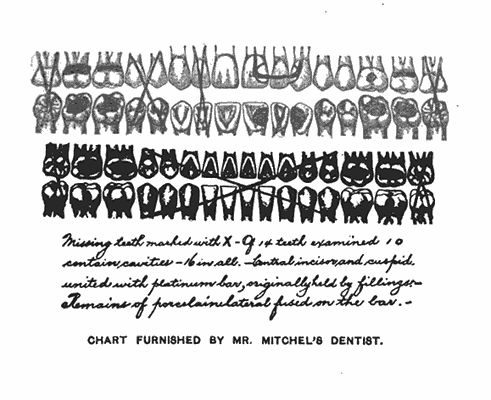
"That is sound reasoning," said Mr. Barnes.
"Very well. I had a statement published in the four leading dental magazines, accompanied by a facsimile of the chart made by my dentist, and I solicited correspondence with any dentist who could show a similar chart in his records."
"That was a good method, provided, of course, the dentist who did the work subscribed to one of these magazines."
"Of course the advertisement might not meet the eye of the dentist who treated the dead woman, but even though he were not a subscriber he might hear of this matter through some acquaintance, because, as I have said, this subject of identification through dental work is one that widely interests the dentists. However, success rewarded us. I received a letter from a dentist in one of the New Jersey towns, stating that he believed he could match my chart. I lost no time in visiting him, and, after examining his book, was satisfied that the person who had been cremated that day was an elderly, eccentric woman, named Miss Lederle, Miss Martha Lederle."
"Mr. Mitchel, you have done a remarkably clever bit of work, and though you have succeeded where I have failed, I must congratulate you. But tell me, after learning the name of the woman how did you trace her to this city?"
"I deserve no credit for that. It seems that Miss Lederle had long had a little fleshy tumor on the inside of her cheek, which had had an opportunity to grow because of the loss of a tooth. Her dentist often advised her to have it removed, lest it might become cancerous. She put it off from time to time, but recently it had grown more rapidly, and at last she called on the dentist and asked him to recommend a surgeon. He tells me that he gave her the names of three, one residing in Newark, and two in this city. Of the New York men, one was Dr. Mortimer."
"By Jove! Doctor Mortimer!" exclaimed Mr. Barnes. "I begin to see daylight. It was he who supplied the morphine powders, then?"
"Ah, then you know so much? Yes, Dr. Mortimer instigated the transfer of bodies. As soon as I charged him with murder, he thought it safest to tell me the truth and throw himself upon my mercy."
"Upon your mercy?" said Mr. Barnes, mystified.
"Yes; the man has not committed a crime, at least not the crime of murder. It seems that on the afternoon of the day before that fixed for the funeral of Mr. Quadrant, this Miss Lederle called at his office and requested him to remove the tumor from her cheek. He consented, and suggested the use of cocaine to deaden the parts. The woman insisted that she must have chloroform, and the doctor explained that in the absence of his assistant he would not care to undertake the administration of an anæsthetic. But the woman was persistent; she offered a liberal fee if the operation could be done immediately, since it had required so much time for her to bring her courage to the point of having the tumor removed; then the operation itself seemed so simple that at last the surgeon was overruled, and proceeded. He did cause the patient to remove her corset, and, her garments thoroughly loosened, she was placed on the operating-table. He says he administered very little chloroform, and had not yet attempted to operate when the patient exhibited dangerous symptoms. In spite of his most untiring efforts she succumbed, and he found himself in the dreadful position of having a patient die under an operation, with no witnesses present. He closed and locked his office and walked from the house in great mental agitation. He called at the Quadrants', and heard there that the coffin would not again be opened. Then a great temptation came to him. The woman had not given him her address, nor had she stated who had sent her to Dr. Mortimer, merely declaring that she knew him by reputation. There was no way to communicate with the woman's relatives except by making the affair public. He recalled that a similar accident to an old surgeon of long-established reputation, where several assistants had been present, had nevertheless ruined the man's practice. He himself was innocent of wrong-doing, except, perhaps, that the law forbade him to operate alone, and he saw ruin staring him in the face, just at a time, too, when great prosperity had appeared to be within his grasp. The undertaker, Berial, was an old acquaintance, indebted to him for many recommendations.
"The plan seemed more and more feasible as he thought of it, and finally he sought out Berial, and confided to him his secret. For a liberal fee the undertaker agreed to dispose of the body. Dr. Mortimer supplied him with a drug with which to overcome the watchman at the stables, so that the wagon could be taken out unknown. He himself visited the Quadrant house, and, under the plea of relieving Mark Quadrant of a headache, gave him also a dose of morphine. At the appointed time Berial arrived at the doctor's office and took away the woman's body, first replacing the corset, which, of course, they were bound to dispose of. Together they went to the Quadrants', and there exchanged the bodies. Subsequent events are known to you. Thus the truth has arisen, Phœnix-like, from the ashes of the dead. The question remaining is, what claim has Justice upon the doctor? Gentlemen, is it needful to disgrace that man, who really is a victim of circumstances rather than a wrong-doer? He tells me, Mr. Barnes, that he has not had a moment of mental rest since you asked him whether ashes could be proven to be the residue of a human body."