THE STORY OF LORD RODNEY.
Reading edition
BY JOHN CAMPBELL.
George Brydges Rodney was born at Walton-on-Thames in the year 1718. His father, Henry Rodney, was at the time of his son's birth commander of the yacht in which the king, attended by the Duke of Chandos, used to pass to and from Hanover; hence he was christened George and Brydges after the king and the duke, who stood godfathers to him. He entered the navy at fourteen years of age, and obtained command of a ship at twenty-four. He was made governor of Newfoundland in 1749, and in 1759 admiral of the blue. This same year he distinguished himself by destroying the stores prepared for the invasion of England at Havre de Grace. In 1761 he served in the West Indies and was made a baronet. In 1768 he was elected member of parliament for Northampton; but the cost of his election ruined him and he was obliged to seek a temporary asylum on the Continent. While here he received overtures from the French government, which he rejected; upon which the English government gave him command of the Mediterranean squadron. The two principal victories of his life were gained over the Spanish and French fleets in 1780 and 1782, in connection with his appointment to the West Indian squadron.
There were two naval objects which demanded the attention of the ministry at the commencement of the year 1780, the relief of Gibraltar and the protection of the West Indies. To secure both these Admiral Rodney was appointed to command a fleet in the West Indies, and en route to convoy a large supply of provisions and stores to Gibraltar. The admiral had been but a very few days at sea when he fell in with a Spanish fleet, bound from St. Sebastian to Cadiz: it consisted of fifteen sail of merchantmen under the protection of a fine new sixty-four gun ship, four frigates, mounting from twenty-six to thirty-two guns, and two smaller vessels; these ships of war belonged to the Royal Company of the Caraccas, and had been assigned to the others as a convoy. The whole fleet were captured; and on examining the cargoes of the merchantmen, the capture was ascertained to be extremely fortunate, as the greater part of them were laden with wheat, flour, and other stores, which the admiral of course destined for Gibraltar. On January 16th, about a week after this capture, he fell in with another Spanish squadron, consisting of eleven ships of the line, under the command of Don Juan Langara, off Cape St. Vincent. As the Spaniards, being inferior in force and favoured by the wind, endeavoured to escape, the British admiral changed the signal for a line of battle abreast to that for a general chase, with orders to engage as the ships came up. Night came on, but the pursuit was still continued, though the dangers of a dark and tempestuous night were increased by the vicinity of the shoals of St. Lucar. About four o'clock the headmost ships began to engage. Early in the action the Spanish ship St. Domingo, of seventy guns and seven hundred men, blew up, and all on board perished; the English ship opposed to her nearly suffering the same fate. The engagement did not terminate till two in the morning, when the Monarca, the headmost of the enemy's fleet, struck to the Sandwich, Admiral Rodney's own ship. Three others were also taken and carried safely into port; among these was the Phœnix, of eighty guns, Don Langara's ship. Two others had struck, but after the officers had been taken out, they were driven on shore by the tempestuous weather, and one of them was entirely lost. Two frigates and four ships of the line escaped; of the latter, two were much damaged in the action. Our loss amounted to thirty-two killed and one hundred and two wounded.
The convoy having been conducted safely to Gibraltar, and the provisions and stores having been landed there, Admiral Digby, taking under his charge the Spanish prizes and homeward bound transports, sailed for England on February 15th, 1780; and Admiral Rodney, with the remainder, proceeded to his station in the West Indies.
The great object of the French and Spanish forces in the West Islands at this time was the reduction of Jamaica. Hitherto foiled in attaining this object, they were in great hopes of being more successful in 1782. In order to frustrate their design, soon after his arrival in England, in the fall of the year 1781, Admiral Rodney was sent back to resume his command in the West Indies, with a reinforcement of twelve sail of the line. He sailed from the Channel in the month of January, 1782, and arrived off the island of Barbadoes on the 19th of the following month. Having formed a junction with Sir Samuel Hood he resolved to proceed with his whole fleet to St. Lucia; the most convenient station for watching the motions of the enemy. As soon as he arrived off this island he ordered some of his frigates to cruise, for the purpose of giving him the earliest intelligence of the movements of the enemy; and in the meantime took on board provisions and water sufficient to last him for five months.
The first object which Admiral Rodney had in view was to prevent, if possible, the junction of the French and Spanish fleets, as he had reason to believe that, if this junction were effected, Jamaica would fall a prey to the enemy. The Spanish fleet at this time were to leeward of the French.
On April 5th Admiral Rodney was informed that the French were embarking troops on board their ships of war; and on the 8th of the same month, at break of day, a signal was made from the Andromache that their fleet was coming out of Fort Royal and standing to the north-west. Admiral Rodney immediately made the necessary signal for weighing anchor and getting under weigh, and this was obeyed with so much promptitude and alacrity that the whole British fleet, consisting of thirty-six sail of the line, was clear off Grosislet Bay before noon. They proceeded, under as much sail as they could carry, in pursuit of the enemy, so that before daylight the next morning the French fleet was discovered under the island of Dominica. At this time both fleets were becalmed; the enemy got the breeze first, and taking advantage of it stood towards Guadaloupe. The breeze next favoured the van of the English fleet, under the command of Sir Samuel Hood, who stood after them with a press of sail; all this while the rear and the centre of Admiral Rodney's fleet were still becalmed. This circumstance, which to all appearance was unfavourable to the English, proved in the issue highly advantageous to them; for the Count de Grasse, who had determined to avoid an engagement, and to press forward in order to effect a junction with the Spanish fleet, perceiving the van of the English at a distance from, and unsupported by, the rear and centre, was tempted to engage; so as soon as Sir Samuel Hood's division came near enough the Count de Grasse bore down upon him with his whole force. Sir Samuel Hood was not dispirited; though at one period of this very unequal engagement his own ship, the Barfleur, had seven of the enemy's ships firing upon her, and during the greatest part of the action not less than three. The example of the Barfleur was followed by all the rest of the division, so that no advantage could be obtained over them. At length part of the centre got near enough to engage; and the breeze soon afterwards reaching the rear of the British fleet, the Count de Grasse withdrew his ships, and having the advantage of the wind was enabled to decline any further contest, notwithstanding all the endeavours of Admiral Rodney to continue it. During this partial engagement the Royal Oak and the Montague, the leading ships of the van, sustained considerable damage. Captain Boyne of the Alfred was killed. Two of the French ships were so disabled as to be obliged to take shelter in Guadaloupe.
The British fleet lay to all the night after the action for the purpose of repairing their damages, but the next morning made sail to the windward in pursuit of the enemy. But the pursuit seemed in vain, for on the morning of the 11th the French fleet had got so far to windward that some of their ships were scarcely visible.
About noon on April 11th one of the enemy's ships was seen in a disabled state, a great way to windward; Admiral Rodney now entertained hopes that he should either be able to capture her or to bring on a general engagement, if the Count de Grasse bore down to her support; he therefore ordered a general chase. Towards evening, one of the leading ships of the British approached so near the disabled ship of the enemy, that her capture was inevitable if she were not assisted. The Count de Grasse, perceiving her danger, bore down with his whole fleet for her protection. Admiral Rodney had now gained his object; for by nightfall the two fleets were very near each other: it was necessary, however, to put off the engagement till the next day, April 12th. Still, however, as during the night the French admiral might have drawn off his fleet, Admiral Rodney took such measures as effectually prevented this from taking place; so that when daylight broke he had the satisfaction to perceive that the Count de Grasse, even if so inclined, could not avoid a general engagement. The action was begun about half-past seven in the morning of the 12th by Captain Penny, of the Marlborough, the leading ship of the British van. The two fleets met on opposite tacks; the British ranging slowly along—there being but little wind—and close under the lee of the enemy's line, continuing a most tremendous fire, which the French received and returned with the utmost firmness. About noon, Sir George Rodney in the Formidable, having passed the Ville de Paris, the French admiral's ship, and her second—and during her passage directing against them a most tremendous and effective fire—stood athwart the line of the enemy, between the second and third ship astern of the Ville de Paris; she was immediately followed and supported by the Duke, Namur, and Canada; and the rest imitated their example. As soon as the Formidable had broken the line she wore round; and a signal being made for the van division to tack, the British fleet thus gained the wind and stood upon the same tack with the enemy. By this bold and masterly manœuvre the French line was completely broken and the whole thrown into confusion; the consequences were decisively advantageous and glorious to the British; for though the enemy still continued to fight with great gallantry, it was evident that the victory was with Admiral Rodney. The action hitherto had been chiefly supported by the van and centre of the British; for the rear under Sir Samuel Hood being becalmed, did not for some time get into the engagement; and when the breeze did spring up, it was so trifling that Sir Samuel Hood, in the Barfleur, took an hour and a half to reach that part of the enemy's line where it had been broken through by the Formidable. During all this time, however, he kept up a tremendous and well-directed fire.
As the French ships always carry a much larger complement of men than the British, and as, moreover, at this time they had on board a great number of troops, the carnage was extreme; notwithstanding this, however, and the certainty that they must ultimately be beaten, the Count de Grasse in the Ville de Paris and the other ships in the centre, withstood till the evening all the efforts of the various ships that attacked him. Nor was the gallantry of the British inferior to that of the French. Captain Cornwallis, of the Canada, especially distinguished himself; for, having obliged the Hector, a ship of the same force as his own, to strike her colours, he did not lose time by taking possession of her, but leaving her in charge of a frigate pushed on to the Ville de Paris, which he engaged for the space of two hours, notwithstanding her great superiority, and left her a complete wreck. The Count de Grasse, however, refused to surrender; and as it was supposed that he would not yield to any vessel that did not carry an admiral's flag, towards sunset Sir Samuel Hood poured from the Barfleur a most dreadful fire into the Ville de Paris. The Count de Grasse bore it for about ten minutes, when he surrendered: at this time there were only three men alive and unhurt on the upper deck, and of this number the count himself was one. Besides the Ville de Paris and the Hector, the Ardent, of sixty-four guns, which had been captured in the British Channel, was re-taken; the Cæsar and the Glorieux, of seventy-four guns each, also surrendered after they were made complete wrecks. The Diadem, early in the engagement, bore up to assist in protecting the Ville de Paris from the Formidable, but by a single broadside from the latter she was sunk.
Night, which must have been ardently wished for by the French, now came on; when the British admiral made the signal for his fleet to bring to, in order that he might secure his prizes. In the course of this night the Cæsar, one of the prizes, blew up by accident; and a British lieutenant and fifty seamen, with about four hundred prisoners, perished.
The Ville de Paris was the most important of the prizes; she was the largest ship in the French king's service. She had been a present from the city of Paris to Louis XV., and no expense had been spared to render the gift worthy of the city and of the monarch; the expense of building her and fitting her for sea is said to have been one hundred and fifty-six thousand pounds. On board of her there were, at the time of her capture, thirty-six chests of money, intended for the pay and subsistence of the men who were to have been employed in the expedition against Jamaica: in the other captured ships the whole train of artillery and the battering cannon, and travelling carriages meant for that expedition, were also found.
The loss of men in the British fleet in both actions, on April the 9th and 12th, was very small, amounting only to two hundred and thirty-seven killed and seven hundred and seventy-six wounded. The loss of the French is computed to have been three thousand slain and more than double that number wounded. In the Ville de Paris alone upwards of three hundred men were killed; and several other of the captured ships lost between two or three hundred.
Two sail of the line and three frigates were captured the following day, so that the total loss of the enemy amounted to eight sail of the line and two frigates; six of which were in possession of the British, one sunk and another blown up. The Count de Grasse was sent prisoner to England.
After his success, Sir Samuel Hood joined Admiral Rodney, who proceeded to Jamaica with his prizes; leaving Sir Samuel with twenty-five sail of the line to keep the sea and watch the motions of the enemy.
Admiral Pigot, having arrived from England to succeed Sir George Rodney on the West India station, the latter sailed from Jamaica in the beginning of August. The news of his victory gave great and universal joy in Great Britain, and the admiral was created an English peer, and a pension of £2,000 a year was conferred upon him. Sir Samuel Hood was created an Irish peer.
Lord Rodney died in 1792, and a memorial was erected to his memory in St. Paul's Cathedral by public subscription.
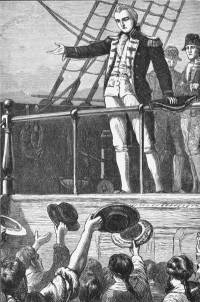
ADMIRAL DUNCAN ADDRESSING HIS CREW AFTER THE MUTINY AT THE NORE. See page 361. (View larger image)