Front matter (continued 2)
Reading edition
Some of the smoke hung in soot on the roof and walls of the cave, curling up so well at first that Rolf almost thought there must be some opening in the lofty roof which served as a chimney. But there was not; and some of the smoke came down again, issuing at last from the mouth of the cave. Rolf observed this; and, seeing the danger of his place of retreat being thus discovered, he made haste to finish his cookery, resolving that, if he had to remain here for any length of time, he would always make his fire in the night. He presently threw water over his burning brands, and hoped that nothing had been seen of the process of preparing his breakfast.
The smoke had been seen, however, and by several people; but in such a way as to lead to no discovery of the cave. From the schooner, Hund kept his eyes fixed on the islet, at every moment he had to spare. Either he was the murderer of his fellow-servant, or the islet was bewitched; and if Rolf was under the protection and favour of the powers of the region, he, Hund, was out of favour, and might expect bad consequences. Whichever might be the case, Hund was very uneasy; and he could think of nothing but the islet, and look no other way. His companions had at first joked him about his luck in getting rid of his enemies; but, being themselves superstitious, they caught the infection of his gravity, and watched the spot almost as carefully as he.
As their vessel lay higher up in the fiord than the islet, they were on the opposite side from the crevice, and could not see from whence the smoke issued. But they saw it in the form of a light cloud hanging over the place. Hund's eyes were fixed upon it, when one of his comrades touched him on the shoulder. Hund started.
"You see there," said the man, pointing.
"To be sure I do. What else was I looking at?"
"Well, what is it?" inquired the man. "Has your friend got a visitor—come a great way this morning? They say the mountain-sprite travels in mist. If so, it is now going. See, there it sails off—melts away. It is as like common smoke as anything that ever I saw. What say you to taking the boat, and trying again whether there is no place where your friend might not land, and be now making a fire among the birds' nests?"
"Nonsense!" cried Hund. "What became of the skiff, then?"
"True," said the man; and, shaking his head, he passed on, and spoke to the master.
In his own secret mind, the master of the schooner did not quite like his present situation. After hearing the words dropped by his crew, he did not relish being stationed between the bewitched islet and the head of the fiord, where all the residents were, of course, enemies. As there was now a light wind, enough to take his vessel down, he gave orders accordingly.
Slowly, and at some distance, the schooner passed the islet, and all on board crowded together to see what they could see. None saw anything remarkable; but all heard something. There was a faint muffled sound of knocks—blows such as were never heard in a mere haunt of sea-birds. It was evident that the birds were disturbed by it. They rose and fell, made short flights and came back again, fluttered, and sometimes screamed. But if they were quiet for a minute, the knock, knock, was heard again, with great regularity, and every knock went to Hund's heart.
The fact was that, after breakfast, Rolf soon became tired of having nothing to do. The water was so very cold that he deferred till noon the attempt to swim round the islet. He thought he had better try to mend his little craft than do nothing. After collecting from the wood in the cave all the nails that happened to be sticking in it, and all the pieces that were sound enough to patch a boat with, he made a stone serve him for a hammer, straightened his nails upon another stone, and tried to fasten on a piece of wood over a hole. It was discouraging work enough; but it helped to pass the hours till the restless waters reached their highest mark in the cave, when he knew that it was noon, and time for his little expedition.
It was too cold by far for safe swimming. All the snows of Sulitelma could hardly have made the waters more chilly to the swimmer than they felt at the first plunge. But Rolf would not retreat for this reason. He thought of the sunshine outside, and of the free open view he should enjoy, dived beneath the almost closed entrance, and came up on the other side. The first thing he saw was the schooner, now lying below his island, and the next thing was a small boat between him and it, evidently making towards him. When convinced that Hund was one of the three men in it, he saw that he must go back, or make haste to finish his expedition. He made haste, swam round so close as to touch the warm rock in many places, and could not discover, any more than before, any trace of a footing by which a man might climb to the summit. There was a crevice or two, however, from which vegetation hung, still left unsearched. He could not search them now, for he must make haste home.
The boat was indeed so near when he had reached the point he set out from, that he used every effort to conceal himself; and it seemed that he could only have escaped by the eyes of his enemies being fixed on the summit of the rock. When once more in the cave he rather enjoyed hearing them come nearer and nearer, so that the bushes which hung down between him and them shook with the wind of their oars, and dipped into the waves. He laughed silently when he heard one of them swear that he would not leave the spot till he had seen something, upon which another rebuked his presumption. Presently a voice, which he knew to be Hund's, called upon his name, at first gently, and then more and more loudly, as if taking courage at not being answered.
"I will wait till he rounds the point," thought Rolf, "and then give him such an answer as may send a guilty man away quicker than he came."
He waited till they were on the opposite side, so that his voice might appear to come from the summit of the islet, and then began with the melancholy sound used to lure the plover on the moors. The men in the boat instantly observed that this was the same sound used when Erlingsen's boat was spirited away from them. It was rather singular that Rolf and Oddo should have used the same sound; but they probably chose it as the most mournful they knew. Rolf moaned louder and louder, till the sound resembled the bellowing of a tormented spirit enclosed in the rock; and the consequence was, as he had said, that his enemies retreated faster than they came.
For the next few days Rolf kept a close watch upon the proceedings of the pirates, and saw enough of their thievery to be able to lay information against them, if ever he should again make his way to a town or village, and see the face of a magistrate. The worst of it was that the season for boating was nearly at an end. The inhabitants were day by day driving their cattle up the mountains, there to remain for the summer; and the heads of families remained in the farmhouses almost alone, and little likely to put out so far into the fiord as to pass near him. To drive off thoughts of his poor distressed Erica, he sometimes hammered a little at his skiff; but it was too plain that no botching that he could perform in the cave would render the broken craft safe to float in.
One sunny day, when the tide was flowing in warmer than usual, Rolf amused himself with more evolutions in bathing than he had hitherto indulged in. He forgot his troubles and his foes in diving, floating, and swimming. As he dashed round a point of a rock, he saw something, and was certain he was seen. Hund appeared at least as much bewitched as the islet itself, for he could not keep away from it. He seemed irresistibly drawn to the scene of his guilt and terror. Here he was now, with one other man, in the schooner's smallest boat. Rolf had to determine in an instant what to do; for they were within a hundred yards, and Hund's starting eyes showed that he saw what he took for the ghost of his fellow-servant. Rolf raised himself as high as he could out of the water, throwing his arms up above his head, fixed his eyes on Hund, uttered a shrill cry, and dived, hoping to rise to the surface at some point out of sight. Hund looked no more. After one shriek of terror and remorse had burst from his white lips, he sank his head upon his knee and let his comrade take all the trouble of rowing home again.
This vision decided Hund's proceedings. Half-crazed with remorse, he left the pirates that night. After long consideration where to go, he decided upon returning to Erlingsen's. He did not know to what extent they suspected him; he was pretty sure that they held no proofs against him. He felt irresistibly drawn towards poor Erica, now that no rival was there; and if mixed with all these considerations there were some thoughts of the situation of houseman being vacant, and needing much to be filled up, it is no wonder that such a mingling of motives took place in a mind so selfish as Hund's.
Hund performed his journey by night. He did not for a moment think of going by the fiord. Laboriously and diligently therefore he overcame the difficulties of the path, crossing ravines, wading through swamps, scaling rocks, leaping across water-courses, and only now and then throwing himself down on some tempting slope of grass, to wipe his brows, and to moisten his parched throat with the wild strawberries which were fast ripening in the sheltered nooks of the hills. It was now so near midsummer, and the nights were so fast melting into the days, that Hund could at the latest scarcely see a star, though there was not a fleece of cloud in the whole circle of the heavens. While yet the sun was sparkling on the fiord, and glittering on every farmhouse window that fronted the west, all around was as still as if the deepest darkness had settled down. Hund knew as he passed one dwelling after another—knew as well as if he had looked in at the windows—that the inhabitants were all asleep, even with the sunshine lying across their very faces.
Every few minutes he observed how his shadow lengthened, and he longed for the brief twilight which would now soon be coming on. There were a few extremely faint stars—a very few—for only the brightest could now show themselves in the sky where daylight lingered so as never quite to depart. A pale green hue remained where the sun had disappeared, and a deep red glow was even now beginning to kindle where he was soon to rise. But man must have rest, be the sun high or sunk beneath the horizon; so that Hund saw no face, and heard no human voice, before he found himself standing at the top of the steep rocky pathway which led down to Erlingsen's abode.
He found everything in a different state from that in which he had left the place. The stable-doors stood wide, and there was no trace of milk-pails. The hurdles of the fold were piled upon one another in a corner of the yard. It was plain that herd, flock, and dairy-women were gone to the mountain; and though Hund dreaded meeting Erica, it struck upon his heart to think that she was not here. He felt now how much it was for her sake that he had come back.
His eye fell upon the boat which lay gently rocking with the receding tide in its tiny cove; and he resolved to lie down in it and rest, while considering what to do next. He went down, stepping gently over the pebbles of the beach lest his tread should reach and waken any ear through the open windows, lay down at the bottom of the boat, and fell asleep.
Oddo was the first to come forth, to water the one horse that remained at the farm, and to give a turn and a shake to the two or three little cocks of hay which had been mown behind the house. His quick eye noted the deep marks of a man's feet in the sand and pebbles below high-water mark proving that some one had been on the premises during the night. He followed these marks to the boat, where he was amazed to find the enemy (as he called Hund) fast asleep. Oddo was in a great hurry to tell his grandfather (Erlingsen being on the mountain); but he thought it only proper caution to secure his prize from escaping in his absence.
He summoned his companion, the dog which had warned him of many dangers abroad, and helped him faithfully with his work at home; and nothing could be clearer to Skorro than that he was to crouch on the thwarts of the boat, with his nose close to Hund's face, and not to let Hund stir till Oddo came back. Then Oddo ran, and wakened his grandfather, who made all haste to rise and dress. Erica now lived in Peder's house. Hearing Oddo's story, she rushed out, and her voice was soon heard in passionate entreaty, above the bark of the dog, which was trying to prevent the prisoner from rising.
"Only tell me," Erica was heard to say, "only tell me where and how he died. I know he is dead—I knew he would die; from that terrible night when we were betrothed. Tell me who did it—for I am sure you know. Was it Nipen? O Hund, speak! Say only where his body is, and I will try—I will try never to speak to you again—never to——"
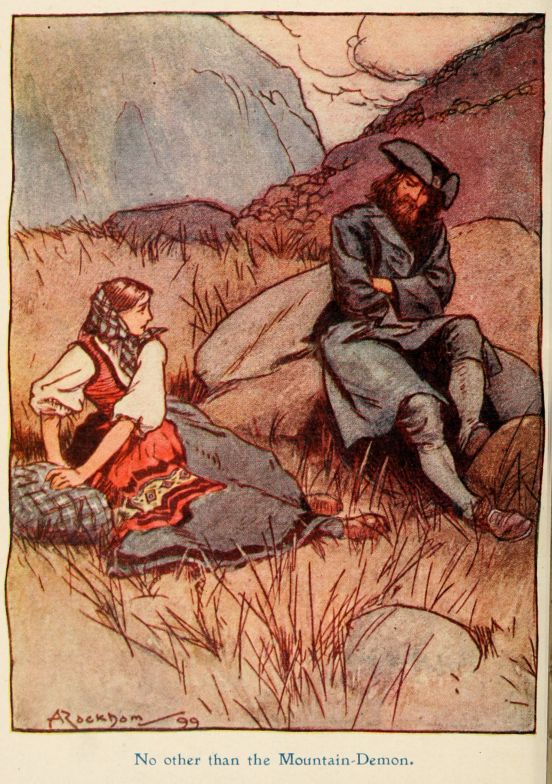
No other than the Mountain-Demon.
Hund looked miserable; he moved his lips, but no sound was heard mingling with Erica's rapid speech.
Madame Erlingsen, who, with Orga, had by this time reached the spot, laid her hand on Erica's arm, to beg for a moment's silence, made Oddo call his dog out of the boat, and then spoke, in a severe tone, to Hund.
"Why do you shake your head, Hund, and speak no word? Say what you know, for the sake of those whom, we grievously suspect, you have deeply injured. Say what you know, Hund."
"What I say is, that I do not know," replied Hund in a hoarse and agitated voice. "I only know that we live in an enchanted place, here by this fiord, and that the spirits try to make us answer for their doings. The very first night after I went forth, this very boat was spirited away from me, so that I could not come home. Nipen had a spite against me there—to make you all suspect me. I declare to you that the boat was gone, in a twinkling, by magic, and I heard the cry of the spirit that took it."
"What was the cry like?" asked Oddo gravely.
"Where were you, that you were not spirited away with the boat?" asked his mistress.
"I was tumbled out upon the shore, I don't know how," declared Hund; "found myself sprawling on a rock, while the creature's cries brought my heart into my mouth as I lay."
"Alone? Were you alone?" asked his mistress.
"I had landed the pastor some hours before, madame; and I took nobody else with me, as Stiorna can tell, for she saw me go."
"Stiorna is at the mountain," observed madame coolly.
"But, Hund," said Oddo, "how did Nipen take hold of you when it laid you sprawling on the rock? Neck and heels? Or did it bid you go and hearken whether the pirates were coming, and whip away the boat before you came back? Are you quite sure that you sprawled on the rock at all before you ran away from the horrible cry you speak of? Our rocks are very slippery when Nipen is at one's heels."
Hund stared at Oddo, and his voice was yet hoarser when he said that he had long thought that boy was a favourite with Nipen, and he was sure of it now.
Erica had thrown herself down on the sand hiding her face on her hands, on the edge of the boat, as if in despair of her misery being attended to—her questions answered. Old Peder stood beside her, stroking her hair tenderly, and he now spoke the things she could not.
"Attend to me, Hund," said Peder, in the grave, quiet tone which every one regarded. "Hear my words; and for your own sake answer them. We suspect you of being in communication with the pirates yonder; we suspect that you went to meet them when you refused to go hunting the bears. We know that you have long felt ill-will towards Rolf—envy of him—jealousy of him—and——"
Here Erica looked up, pale as ashes, and said: "Do not question him further. There is no truth in his answers. He spoke falsehood even now."
Peder knew how Hund shrank under this, and thought the present the moment to get truth out of him, if he ever could speak it. He therefore went on to say—
"We suspect you of having done something to keep your rival out of the way, in order that you might obtain the house and situation—and perhaps something else that you wish."
"Have you killed him?" asked Erica abruptly, looking full in his face.
"No," returned Hund firmly. From his manner everybody believed this much.
"Do you know that anybody else has killed him?"
"No."
"Do you know whether he is alive or dead?"
To this Hund could, in the confusion of his ideas about Rolf's fate and condition, fairly say "No;" as also to the question, "Do you know where he is?"
Then they all cried out—
"Tell us what you do know about him."
"Ay, there you come," said Hund, resuming some courage, and putting on the appearance of more than he had. "You load me with foul accusations, and when you find yourselves all in the wrong, you alter your tone, and put yourselves under obligation to me for what I will tell. I will treat you better than you treat me, and I will tell you plainly why. I repent of my feelings towards my fellow-servant, now that evil has befallen him——"
"What? Oh, what?" cried Erica.
"He was seen fishing on the fiord in that poor little worn-out skiff. I myself saw him. And when I looked next for the skiff, it was gone."
"And where were you?"
"Never mind where I was. I was about my own business. And I tell you, I no more laid a finger on him than any one of you."
"Where was it?"
"Close by Vogel islet."
Erica started, and in one moment's flush of hope told that Rolf had said he should be safe at any time near Vogel islet. Hund caught at her words so eagerly as to make a favourable impression on all, who saw, what was indeed the truth, that he would have been glad to know that Rolf was alive.
"I believe some of the things you have told. I believe that you did not lay hands on Rolf."
"Bless you! Bless you for that!" interrupted Hund, almost forgetting how far he really was guilty.
"Tell me then," proceeded Erica, "how you believe he really perished."
"I believe," whispered Hund, "that the strong hand pulled him down—down to the bottom."
"I knew it," said Erica, turning away.
"Erica—one word," exclaimed Hund. "I must stay here—I am very miserable, and I must stay here and work, and work till I get some comfort. But you must tell me how you think of me—you must say that you do not hate me——"
"I do hate you," said Erica with disgust, as her suspicions of his wanting to fill Rolf's place were renewed, "I mistrust you, Hund, more deeply than I can tell."
"Will no penitence change your feelings, Erica? I tell you I am as miserable as you."
"That is false, like everything else that you say," cried Erica. "I wish you would go—go and seek Rolf under the waters."
Hund shuddered at the thought, as it recalled what he had seen and heard at the islet. Erica saw this, and sternly repeated—
"Go and bring back Rolf from the deeps, and then I will cease to hate you."
As Erica slowly returned into Peder's house, Oddo ran past, and was there before her. He closed the door when she had entered, put his hand within hers, and said—
"Did Rolf really tell you that he should be safe anywhere near Vogel islet?"
"Yes," sighed Erica, "safe from the pirates. That was his answer when I begged him not to go so far down the fiord; but Rolf always had an answer when one asked him not to go into danger."
"Erica, you went one trip with me, and I know you are brave. Will you go another? Will you go to the islet and see what Rolf could have meant about being safe there?"
Erica brightened for a moment, and perhaps would have agreed to go; but Peder came in, and Peder said he knew the islet well, and that it was universally considered that it was now inaccessible to human foot, and that that was the reason why the fowl flourished there as they did in no other place. Erica must not be permitted to go so far down among the haunts of the pirates. Instead of this, her mistress had just decided that, as there were no present means of getting rid of Hund, and as Erica could not be expected to remain just now in his presence, she should set off immediately for the mountain, and request Erlingsen to come home.
Under Peder's urgency she made up her bundle of clothes, took in her hand her lure,[3] with which to call home the cattle in the evenings, bade her mistress farewell privately, and stole away without Hund's knowledge.
Wandering with unwilling steps farther and farther from the spot where she had last seen Rolf, Erica dashed the tears from her eyes, and looked behind her at the entrance of a ravine which would hide from her the fiord and the dwelling she had left. Thor islet lay like a fragment of the leafy forest cast into the blue waters, but Vogel islet could not be seen. It was not too far down to be seen from an elevation like this, but it was hidden behind the promontories by which the fiord was contracted. She looked behind her no more, but made her way rapidly through the ravine; the more rapidly because she had seen a man ascending by the same path at no great distance, and she had little inclination to be joined by a party of wandering Laplanders, still less by any neighbour from the fiord who might think civility required that he should escort her to the seater. This wayfarer was walking at a pace so much faster than hers that he would soon pass, and she would hide among the rocks beside the tarn at the head of the ravine till he had gone by.
Through the rich pasture Erica waded till she reached the tarn which fed the stream that gambolled down the ravine. The death-cold unfathomed waters lay calm and still under the shelter of the rocks which nearly surrounded them.
In the shadow of one of these rocks, Erica sank down into the long grass. Here she would remain long enough to let the other wayfarer have a good start up the mountain, and by that time she should be cool and tranquillised. She hid her face in the fragrant grass, and did not look up again till the grief of her soul was stilled. Then her eye and her heart were open to the beauty of the place which she had made her temple of worship, and she gazed around till she saw something that surprised her.
The traveller, who she had hoped was now some way up the mountain, was standing on the margin of the tarn, immediately opposite to her.
She sat up, and took her bundle and her lure, believing now that she must accept the unwelcome civility of an escort for the whole of the rest of the way, and thinking that she might as well make haste and get it over. The man approached and took his seat on the huge stone beside her, crossed his arms, made no greeting, but looked her full in the face.
She did not know the face, nor was it like any that she had ever seen. There was such long hair, and so much beard, that the eyes seemed the only feature which made any distinct impression. Erica's heart now began to beat violently. Though wishing to be alone, she had not dreamed of being afraid till now; but now it occurred to her that she was seeing the rarest of sights—one not seen twice in a century, no other than the mountain-demon.
She sprang to her feet, and began to wade back through the high grass to the pathway, almost expecting to be seized by a strong hand and cast into the unfathomable tarn, whose waters were said to well up from the centre of the earth. Her companion, however, merely walked by her side. As he did not offer to carry her bundle, he could be no countryman of hers.
They walked quietly on till the tarn was left some way behind. Erica found she was not to die that way. Presently after, she came in sight of a settlement of Lapps—a cluster of low and dirty tents, round which some tame reindeer were feeding. Erica was not sorry to see these, though no one knew better than she the helpless cowardice of these people; and it was not easy to say what assistance they could afford against the mountain-demon. Yet they were human beings, and would appear in answer to a cry. She involuntarily shifted her lure, to be ready to utter a call. The stranger stopped to look at the distant tents, and Erica went on at the same pace. He presently overtook her, and pointed towards the Lapps with an inquiring look. Erica only nodded.
"Why you no speak?" growled the stranger in broken language.
"Because I have nothing to say," declared Erica, in the sudden vivacity inspired by the discovery that this was probably no demon. Her doubts were renewed, however, by the next question.
"Is the bishop coming?"
Now, none were supposed to have a deeper interest in the holy bishop's travels than the evil spirits of any region through which he was to pass.
"Yes, he is coming," replied Erica. "Are you afraid of him?"
The stranger burst into a loud laugh at her question: and very like a mocking fiend he looked, as his thick beard parted to show his wide mouth, with its two ranges of teeth. When he finished laughing, he said, "No, no—we no fear bishop."
"'We!'" repeated Erica to herself. "He speaks for his tribe as well as himself."
"We no fear bishop," said the stranger, still laughing. "You no fear——" and he pointed to the long stretch of path—the prodigious ascent before them.
Erica said there was nothing to fear on the mountain for those who did their duty to the powers, as it was her intention to do. Her first Gammel cheese was to be for him whose due it was, and it should be the best she could make.
This speech she thought would suit, whatever might be the nature of her companion. If it was the demon, she could do no more to please him than promise him his cheese.
Her companion seemed not to understand or attend to what she said.
When Erica saw that she had no demon for a companion, but only a foreigner, she was so much relieved as not to be afraid at all.
The stranger pointed to the tiny cove in which Erlingsen's farm might be seen, looking no bigger than an infant's toy, and said—
"Do you leave an enemy there, or is Hund now your friend?"
"Hund is nobody's friend, unless he happens to be yours," Erica replied, perceiving at once that her companion belonged to the pirates. "Hund is everybody's enemy; and, above all, he is an enemy to himself. He is a wretched man."
"The bishop will cure that," said the stranger. "He is coward enough to call in the bishop to cure all. When comes the bishop?"
"Next week."
"What day, and what hour?"
Erica did not choose to gratify so close a curiosity as this. She did not reply; and while silent, was not sorry to hear the distant sound of cattle-bells—and Erlingsen's cattle-bells too. The stranger did not seem to notice the sound, even though quickening his pace to suit Erica's, who pressed on faster when she believed protection was at hand. And yet the next thing the stranger said brought her to a full stop. He said he thought a part of Hund's business with the bishop would be to get him to disenchant the fiord, so that boats might not be spirited away almost before men's eyes, and that a rower and his skiff might not sink like lead one day, and the man may be heard the second day, and seen the third, so that there was no satisfactory knowledge as to whether he was really dead. Erica stopped, and her eager looks made the inquiry which her lips could not speak. Her eagerness put her companion on his guard, and he would explain no further than by saying that the fiord was certainly enchanted, and that strange tales were circulating all round its shores, very striking to a stranger; a stranger had nothing more to do with the wonders of a country than to listen to them. He wanted to turn the conversation back to Hund. Having found out that he was at Erlingsen's, he next tried to discover what he had said and done since his arrival. Erica told the little there was to tell—that he seemed full of sorrow and remorse. She told this in hope of a further explanation about drowned men being seen alive, but the stranger stopped when the bells were heard again, and a woman's voice singing, nearer still. He complimented Erica on her courage, and turned to go back the way he came, and walked away rapidly.
The only thing now to be done was to run forwards. Erica forgot heat, weariness, and the safety of her property, and ran on towards the singing voice. In five minutes she found the singer, Frolich, lying along the ground and picking cloud-berries, with which she was filling her basket for supper.
"Where is Erlingsen?—quick—quick!" cried Erica.
"My father? You may just see him with your good eyes—up there."
And Frolich pointed to a patch of verdure on a slope high up the mountain, where the gazer might just discern that there were haycocks standing, and two or three moving figures beside them.
"Stiorna is there to-day, besides Jan. They hope to finish this evening," said Frolich; "and so here I am, all alone; and I am glad you have come to help me to have a good supper ready for them. Their hunger will beat all my berry-gathering."
"You are alone!" said Erica, discovering that it was well that the pirate had turned back when he did. "You alone, and gathering berries, instead of having an eye on the cattle!"
"But why are your hands empty?" asked Frolich. "Who is to lend you clothes? And what will the cows say to your leaving your lure behind, when you know they like it so much better than Stiorna's?"
Erica returned for her bundle and lure; and then proceeded to an eminence where two or three of her cows were grazing, and there sounded her lure. She put her whole strength to it, in hope that others besides the cattle might appear in answer, for she was really anxious to see her master.
The peculiar and far from musical sounds spread wide over the pastures and up the slopes, and through the distant woods, so that the cattle of another seater stood to listen, and her own cows began to move, leaving the sweetest tufts of grass and rising up from their couches in the richest herbage, to converge towards the point whence she called. The far-off herdsman observed to his fellow that there was a new call among the pastures; and Erlingsen, on the upland, desired Jan and Stiorna to finish cocking the hay, and began his descent to his seater, to learn whether Erica had brought any news from home.
Long before he could appear, Frolich threw herself down at Erica's feet.
"You want news," said Erica, avoiding as usual all conversation about her superstitions. "How will it please you that the bishop is coming?"
"Very much, if we had any chance of seeing him. Very much, whether we see him or not, if he can give any help—any advice. My poor Erica, I do not like to ask; but you have had no good news, I fear."
Erica shook her head.
"I saw that in your face in a moment. Do not speak about it till you tell my father. He may help you, I cannot; so do not tell me anything."
Erica was glad to take her at her word. She kissed Frolich's hand, which lay on her knee, in token of thanks, and then inquired whether any Gammel cheese was made yet.
"No," said Frolich, inwardly sighing for news. "We have the whey, but not sweet cream enough till after this evening's milking. So you are just in time."
Erica was glad, as she could not otherwise have been sure of the demon having his due.
"There is your father," said Erica. "Now do go and gather more berries, Frolich. There are not half enough."
It may be supposed that Erlingsen was anxious to be at home when he had heard Erica's story. He was not to be detained by any promise of berries and cream for supper. He put away the thought even of his hay, yet unfinished on the upland, and would hear nothing that Frolich had to say of his fatigue at the end of a long working day. He took some provision with him, drank off a glass of corn-brandy, and set off at a good pace down the mountain.
Scarcely a word was spoken (though the mountain-dairies have the reputation of being the merriest places in the world), till Erica and Frolich were about their cheese-making the next morning. Erica had rather have kept the cattle; but Frolich so earnestly begged that she would let Stiorna do that, as she could not destroy the cattle in her ill-humour, while she might easily spoil the cheese, that Erica put away her knitting, tied on her apron, tucked up her sleeves, and prepared for the great work.
"Frolich," said Erica, "is the cream good?"
"Stiorna would say that the demon will smack his lips over it. Come and taste."
"Do not speak so, dear."
"I was only quoting Stiorna——"
"What are you saying about me?" inquired Stiorna, appearing at the door. "Only talking about the cream and the cheese? Are you sure of that? Bless me! what a smell of the yellow flowers! It will be a prime cheese."
"How can you leave the cattle, Stiorna?" cried Erica. "If they are all gone when you get back——"
"Well, come then, and see the sight. I get scolded either way always. You would have scolded me finely to-night if I had not called you to see the sight."
"What sight?"
"Why, there is such a procession of boats on the fiord that you would suppose there were three weddings happening at once."
"What can we do?" exclaimed Frolich, dolefully looking at the cream, which had reached such a point that the stirring could not cease for a minute without risk of spoiling the cheese.
Erica took the long wooden spoon from Frolich's hand, and bade her run and see where the bishop (for no doubt it was the bishop) was going to land. The cream should not spoil while she was absent.
Frolich bounded away over the grass, declaring that if it was the bishop going to her father's, she could not possibly stay on the mountain for all the cheeses in Nordland. Erica remained alone, patiently stirring the cream, and hardly heeding the heat of the fire, while planning how the bishop would be told her story, and how he would examine Hund, and perhaps be able to give some news of the pirates, and certainly be ready with his advice. Some degree of hope arose within her as she thought of the esteem in which all Norway held the wisdom and kindness of the Bishop of Tronyem, and then again she felt it hard to be absent during the visit of the only person to whom she looked for comfort.
Frolich returned after a long while to defer her hopes a little. The boats had all drawn to shore on the northern side of the fiord, where, no doubt, the bishop had a visit to pay before proceeding to Erlingsen's. The cheese-making might yet be done in time, even if Frolich should be sent for from home to see and be seen by the good bishop.
The day after Erica's departure to the dairy, Peder was sitting alone in his house weaving a frail basket. He sighed to think how empty and silent the house appeared. Erica's light, active step was gone. Rolf's hearty laugh was silent, perhaps for ever. Oddo was an inmate still, but Oddo was much altered of late; and who could wonder?
From the hour of Hund's return, the boy had hardly been heard to speak. All these thoughts were too melancholy for old Peder; and, to break the silence, he began to sing as he wove his basket.
He had nearly got through a ballad of a hundred and five stanzas when he heard a footstep on the floor.
"Oddo, my boy," said he, "surely you are in early. Can it be dinner-time yet?"
"No, not this hour," replied Oddo in a low voice, which sank to a whisper as he said, "I have left Hund laying the troughs to water the meadow;[4] and if he misses me I don't care. I could not stay; I could not help coming; and if he kills me for telling you, he may, for tell you I must."
And Oddo went to close and fasten the door; and then he sat down on the ground, rested his arms on his grandfather's knees, and told his story in such a low tone that no "little bird" under the eaves could "carry the matter."
"O grandfather, what a mind that fellow has! He will go crazy with horror soon. I am not sure that he is not crazy now."
"He has murdered Rolf, has he?"
"I can't be sure. He is like one bewitched, that cannot hold his tongue. While I was bringing the troughs, one by one, for him to lay, where the meadow was driest, he still kept muttering and muttering to himself. As often as I came within six yards of him, I heard him mutter, mutter. Then when I helped him to lay the troughs, he began to talk to me. I was not in the mind to make him many answers; but on he went, just the same as if I had asked him a hundred questions."
"It was such an opportunity for a curious boy, that I wonder you did not."
"Perhaps I might, if he had stopped long enough. But if he stopped for a moment to wipe his brow (for he was all trembling with the heat), he began again before I could well speak. He asked me whether I had ever heard that drowned men could show their heads above water, and stare with their eyes, and throw their arms about, a whole day—two days after they were drowned."
"Ay! Indeed! Did he ask that?"
"Yes, and several other things. He asked whether I had ever heard that the islets in the fiord were so many prison-houses."
"And what did you say?"
"I wanted him to explain; so I said they were prison-houses to the eider-ducks when they were sitting, for they never stir a yard from their nests. But he did not heed a word I spoke. He went on about drowned men being kept prisoners in the islets, moaning because they can't get out. And he says they will knock, knock, as if they could cleave the thick hard rock."
"What do you think of all this, my boy?"
"Why, when I said I had not heard a word of any such thing, even from my grandmother or Erica, he declared he had heard the moans himself—moaning and crying; but then he mixed up something about the barking of wolves that made confusion in the story. Though he had been hot just before, there he stood shivering, as if it was winter, as he stood in the broiling sun. Then I asked him if he had seen dead men swim and stare, as he said he had heard them moan and cry."
"And what did he say then?"
"He started bolt upright, as if I had been picking his pocket. He was in a passion for a minute, I know, if ever he was in his life. Then he tried to laugh as he said what a lot of new stories—stories of spirits, such stories as people love—he should have to carry home to the north, whenever he went back to his own place."
"In the north, his own place in the north! He wanted to mislead you there, boy. Hund was born some way to the south."
"No, was he really? How is one to believe a word he says, except when he speaks as if he was in his sleep, straight out from his conscience, I suppose? He began to talk about the bishop next, wanting to know when I thought he would come, and whether he was apt to hold private talk with every sort of person at the houses he stayed at."
"How did you answer him? You know nothing about the bishop's visits."
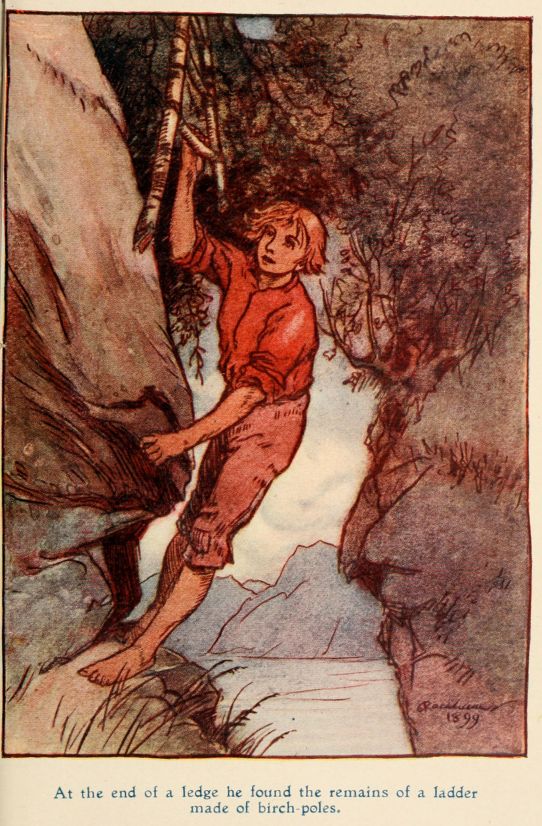
At the end of a ledge he found the remains of a ladder made of birch-poles.
"So I told him; but, to try him, I said I knew one thing, that a quantity of fresh fish would be wanted when the bishop comes with his train, and I asked him whether he would go fishing with me as soon as we could hear that the bishop was drawing near."
"He would not agree to that, I fancy."
"He asked how far out I thought of going. Of course I said to Vogel islet—at least as far as Vogel islet. Do you know, grandfather, I thought he would have knocked me down at the word. He muttered something, I could not hear what, to get off. By that time we were laying the last trough. I asked him to go for some more; and the minute he was out of sight I scampered here. Now, what sort of a mind do you think this fellow has?"
"Not an easy one, it is plain. It is too clear also that he thinks Rolf is drowned."
"But do you think so, grandfather?"
"Do you think so, grandson?"
"Not a bit of it. Depend upon it, Rolf is all alive, if he is swimming and staring, and throwing his arms about in the water. I think I see him now. And I will see him, if he is to be seen alive or dead."
"And pray how?"
"I ought to have said, if you will help me. You say sometimes, grandfather, that you can pull a good stroke with the oar still, and I can steer as well as our master himself; and the fiord never was stiller than it is to-day. Think what it would be to bring home Rolf, or some good news of him! We would have a race up to the seater afterwards to see who could be the first to tell Erica."
"Gently, gently, boy! What is Rolf about not to come home, if he is alive?"
"That we shall learn from him. Did you hear that he told Erica he should go as far as Vogel islet, dropping something about being safe there from pirates and everything?"
Peder really thought there was something in this. He sent off Oddo to his work in the little meadow, and himself sought out Madame Erlingsen, who, having less belief in spirits and enchantments than Peder, was in proportion more struck with the necessity of seeing whether there was any meaning in Hund's revelations, lest Rolf should be perishing for want of help. The story of his disappearance had spread through the whole region; and there was not a fisherman on the fiord who had not, by this time, given an opinion as to how he was drowned. But madame was well aware that, if he were only wrecked, there was no sign that he could make that would not terrify the superstitious minds of the neighbours, and make them keep aloof, instead of helping him. In addition to all this, it was doubtful whether his signals would be seen by anybody, at a season when every one who could be spared was gone up to the dairies.
As soon as Hund was gone out after dinner, the old man and his grandson put off in the boat, carrying a note from Madame Erlingsen to her neighbours along the fiord, requesting the assistance of one or two rowers on an occasion which might prove one of life and death. The neighbours were obliging; so that the boat was soon in fast career down the fiord, Oddo full of expectation, and of pride in commanding such an expedition, and Peder being relieved from all necessity of rowing more than he liked.
Oddo had found occasionally the truth of a common proverb—he had easily brought his master's horses to the water, but could not make them drink. He now found that he had easily got rowers into the boat, but that it was impossible to make them row beyond a certain point. He had used as much discretion as Peder himself about not revealing the precise place of their destination; and when Vogel islet came in sight, the two helpers at once gave him hints to steer so as to keep as near the shore and as far from the island as possible. Oddo gravely steered for the island notwithstanding. When the men saw that this was his resolution they shipped their oars, and refused to strike another stroke, unless one of them might steer. That island had a bad reputation, it was betwitched or haunted; and in that direction the men would not go. They were willing to do all they could to oblige; they would row twenty miles without resting with pleasure; but they would not brave Nipen, nor any other demon, for any consideration.
"How far off is it, Oddo?" asked Peder.
"Two miles, grandfather. Can you and I manage it by ourselves, think you?"
"Ay, surely; if we can land these friends of ours. They will wait ashore till we call for them again."
"I will leave you my supper, if you will wait for us here, on this headland," said Oddo to the man.
The men could make no other objection than that they were certain the boat would never return. They were very civil—would not accept Oddo's supper on any account—would remain on the watch—wished their friends would be persuaded; and, when they found all persuasion in vain, declared they would bear testimony to Erica, and as long as they should live, to the bravery of the old man and boy who thus threw away their lives in search of a comrade who had fallen a victim to Nipen.
Amidst these friendly words, the old man and his grandson put off once more alone, making straight for the islet. Of the two Peder was the greater hero, for he saw the most ground for fear.
"Promise me, Oddo," said he, "not to take advantage of my not seeing. As sure as you observe anything strange, tell me exactly what you see."
"I will, grandfather. There is nothing yet but what is so beautiful that I could not for the life of me find out anything to be afraid of."
Oddo rowed stoutly too for some way, and then he stopped to ask on what side the remains of a birch ladder used to hang down, as Peder had often told him.
"On the north side, but there is no use in looking for that, my boy. That birch ladder must have rotted away with frost and wet long and long ago."
"It is likely," said Oddo, "but, thinking that some man must have put it there, I should like to see whether it really is impossible for one with a strong hand and light foot to mount this wall. I brought our longest boat-hook on purpose to try. Where a ladder hung before, a foot must have climbed; and if I mount, Rolf may have mounted before me."
It chilled Peder's heart to remember the aspect of the precipice which his boy talked of climbing; but he said nothing, feeling that it would be in vain. This forbearance touched Oddo's feelings.
"I will run into no folly, trust me," said he. "I do not forget that you depend on me for getting home, and that the truth about Nipen and such things depends for an age to come on our being seen at home again safe. But I have a pretty clear notion that Rolf is somewhere on the top there."
"Suppose you call him, then."
Oddo had much rather catch him. He pictured to himself the pride and pleasure of mastering the ascent, the delight of surprising Rolf asleep in his solitude, and the fun of standing over him to waken him, and witness his surprise. He could not give up the attempt to scale the rock, but he would do it very cautiously.
Slowly and watchfully they passed round the islet, Oddo seeking with his eye any ledge of the rock on which he might mount. Pulling off his shoes that his bare feet might have the better hold, and stripping off almost all his clothes, for lightness in climbing and perhaps swimming, he clambered up to more than one promising spot, and then, finding that further progress was impossible, had to come down again. At last, seeing a narrow chasm filled with leafy shrubs, he determined to try how high he could reach by means of these. He swung himself up by means of a bush which grew downwards, having its roots firmly fixed in a crevice of the rock. This gave him hold of another, which brought him in reach of a third, so that, making his way like a squirrel or a monkey, he found himself hanging at such a height that it seemed easier to go on than to turn back. For some time after leaving his grandfather he had spoken to him, as an assurance of his safety. When too far off to speak, he had sung aloud, to save the old man from fears; and now that he did not feel at all sure whether he should ever get up or down, he began to whistle cheerily. He was pleased to hear it answered from the boat. The thought of the old man sitting there alone, and his return wholly depending upon the safety of his companion, animated Oddo afresh to find a way up the rock. It looked to him as like a wall as any other rock about the islet. There was no footing where he was looking, that was certain. So he advanced farther into the chasm, where the rocks so nearly met that a giant's arm might have touched the opposite wall. Here there was promise of release from his dangerous situation. At the end of a ledge he saw something like poles hanging on the rock—some work of human hands, certainly. Having scrambled towards them, he found the remains of a ladder made of birch poles fastened together with thongs of leather. This ladder had once, no doubt, hung from top to bottom of the chasm, and its lower part, now gone, was that ladder of which Peder had often spoken as a proof that men had been on the island.
With a careful hand Oddo pulled at the ladder, and it did not give way. He tugged harder, and still it only shook. He must try it; there was nothing else to be done. It was well for him now that he was used to dangerous climbing—that he had had adventures on the slippery, cracked glaciers of Sulitelma—and that being on a height, with precipices below, was no new situation to him. He climbed, trusting as little as possible to the ladder, setting his foot in preference on any projection of the rock, or any root of the smallest shrub. More than one pole cracked, more than one fastening gave way, when he had barely time to shift his weight upon a better support. He heard his grandfather's voice calling, and he could not answer. It disturbed him, now that his joints were strained, his limbs trembling, and his mouth parched so that his breath rattled as it came.
He reached the top, however. He sprang from the edge of the precipice, unable to look down, threw himself on his face, and panted and trembled, as if he had never before climbed anything less safe than a staircase. Never before, indeed, had he done anything like this. The feat was performed—the islet was not to him inaccessible. This thought gave him strength. He sprang to his feet again, and whistled loud and shrill. He could imagine the comfort this must be to Peder; and he whistled more and more merrily till he found himself rested enough to proceed on his search for Rolf. He went briskly on his way, not troubling himself with any thoughts of how he was to get down again.
Never had he seen a place so full of water-birds and their nests. Their nests strewed all the ground, and they themselves were strutting and waddling, fluttering and vociferating, in every direction. They were perfectly tame, knowing nothing of men, and having had no experience of disturbance. The ducks that were leading their broods allowed Oddo to stroke their feathers, and the drakes looked on, without taking any offence.
"If Rolf is here," thought Oddo, "he has been living on most amiable terms with his neighbours."
After an anxious thought or two of Nipen—after a glance or two round the sky and shores for a sign of wind—Oddo began in earnest his quest of Rolf. He called his name gently, then louder.
There was some kind of answer. Some sound of human voice he heard, he was certain; but so muffled, so dull, that whence it came he could not tell. It might even be his grandfather calling from below. So he crossed to quite the verge of the little island, wishing with all his heart that the birds would be quiet, and cease their civility of all answering when he spoke. When quite out of hearing of Peder, Oddo called again, with scarcely a hope of any result, so plain was it to his eyes that no one resided on the island. On its small summit there was really no intermission of birds' nests—no space where any one had lain down—no sign of habitation, no vestige of food, dress, or utensils. With a saddened heart, therefore, Oddo called again, and again he was sure there was an answer, though whence and what he could not make out.
He then sang a part of a chant that he had learnt by Rolf singing it as he sat carving his share of the new pulpit. He stopped in the middle, and presently believed that he heard the air continued, though the voice seemed so indistinct, and the music so much as if it came from underground, that Oddo began to recall, with some doubt and fear, the stories of the enchantment of the place. It was not long before he heard a cry from the water below. Looking over the precipice, he saw what made him draw back in terror: he saw the very thing Hund had described—the swimming and staring head of Rolf, and the arms thrown up in the air. Not having Hund's conscience, however, and having much more curiosity, he looked again, and then a third time.
"Are you Rolf, really?" asked he at last.
"Yes, but who are you—Oddo or the demon—up there where nobody can climb? Who are you?"
"I will show you. We will find each other out," thought Oddo, with a determination to take the leap and ascertain the truth.
He leaped, and struck the water at a sufficient distance from Rolf. When he came up again, they approached each other, staring, and each with some doubt as to whether the other was human or a demon.
"Are you really alive, Rolf?" said the one.
"To be sure I am, Oddo," said the other; "but what demon carried you to the top of that rock, that no man ever climbed?"
Oddo looked mysterious, suddenly resolving to keep his secret for the present.
"Not that way," said Rolf. "I have not the strength I had, and I can't swim round the place now. I was just resting myself when I heard you call, and came out to see. Follow me home."
He turned and began to swim homewards. Oddo had the strongest inclination to go with him, to see what would be revealed, but there were two objections. His grandfather must be growing anxious, and he was not perfectly sure yet whether his guide might not be Nipen in Rolf's likeness about to lead him to some hidden prison.
"Give me your hand, Rolf," said the boy bravely.
It was a real, substantial, warm hand.
"I don't wonder you doubt," said Rolf; "I can't look much like myself—unshaven, and shrunk, and haggard as my face must be."
Oddo was now quite satisfied; and he told of the boat and his grandfather. The boat was scarcely farther off than the cave, and poor Rolf was almost in extremity for drink. The water and brandy he brought with him had been finished nearly two days, and he was suffering extremely from thirst. He thought he could reach the boat and Oddo led the way, bidding him not mind his being without clothes till they could find him some.
Glad was the old man to hear his boy's call from the water; and his face lighted up with wonder and pleasure when he heard that Rolf was not far behind. He lent a hand to help him into the boat, and asked no questions till he had given him food and drink. He reproached himself for having brought neither camphor nor assafoetida, to administer with the corn-brandy. Here was the brandy, however, and some water, and fish, and bread, and cloud-berries. Great was the amazement of Peder and Oddo at Rolf's pushing aside the brandy, and seizing the water. When he had drained the last drop, he even preferred the cloud-berries to the brandy. A transient doubt thence occurred, whether this was Rolf after all. Rolf saw it in their faces, and laughed; and when they had heard his story of what he had suffered from thirst, they were quite satisfied, and wondered no longer.
He was all impatience to be gone. It tried him more now to think how long it would be before Erica could hear of his preservation than to bear all that had gone before. Being without clothes, however, it was necessary to visit the cave, and bring away what was there. In truth, Oddo was not sorry for this. His curiosity about the cave was so great that he felt it impossible to go home without seeing it; and the advantage of holding the secret knowledge of such a place was one which he would not give up. He seized an oar, gave another to Rolf; and they were presently off the mouth of the cave. Peder sighed at their having to leave him again; but he believed what Rolf said of there being no danger, and of their remaining close at hand. One or the other came popping up beside the boat every minute, with clothes, or net, or lines, or brandy-flask, and finally with the oars of the poor broken skiff, being obliged to leave the skiff itself behind. Rolf did not forget to bring away whole handfuls of beautiful shells, which he had amused himself with collecting for Erica.
At last they entered the boat again; and while they were dressing, Oddo charmed his grandfather with a description of the cave—of the dark, sounding walls, the lofty roof, and the green tide breaking on the white sands. It almost made the listener cool to hear of these things; but, as Oddo had remarked, the heat had abated. It was near midnight, and the sun was going to set. Their row to the shore would be in the cool twilight; and then they should take in companions, who, fresh from rest, would save them the trouble of rowing home.
When all were too tired to talk, and the oars were dipping somewhat lazily, and the breeze had died away, and the sea-birds were quiet, old Peder, who appeared to his companions to be asleep, raised his head, and said—
"I heard a sob. Are you crying, Oddo?"
"Yes, grandfather."
"What is your grief, my boy?"
"No grief, anything but grief now. I have felt more grief than you know of, though, or anybody. I did not know it fully myself till now."
"Right, my boy; and right to say it out too."
"I don't care now who knows how miserable I have been. I did not believe, all the time, that Nipen had anything to do with these misfortunes——"
"Right, Oddo!" exclaimed Rolf now.
"But I was not quite certain; and how could I say a word against it when I was the one to provoke Nipen? Now Rolf is safe, and Erica will be happy again, and I shall not feel as if everybody's eyes were upon me, and know that it is only out of kindness that they do not reproach me as having done all the mischief. I shall hold up my head again now—as some may think I have done all along; but I did not, in my own eyes—no, not in my own eyes, for all these weary days that are gone."
"Well, they are gone now," said Rolf. "Let them go by and be forgotten."
"Nay, not forgotten," said Peder. "How is my boy to learn if he forgets——"
"Don't fear that for me, grandfather," said Oddo, as the tears still streamed down his face. "No fear of that. I shall not forget these last days;—no, not as long as I live."
The comrades who were waiting and watching on the point were duly amazed to see three heads in the boat, on her return; and duly delighted to find that the third was Rolf—alive and no ghost. They asked question upon question, and Rolf answered some fully and truly, while he showed reserve upon others; and at last, when closely pressed, he declared himself too much exhausted to talk, and begged permission to lie down in the bottom of the boat and sleep. Upon this a long silence ensued. It lasted till the farmhouse was in sight at which one of the rowers was to be landed. Oddo then exclaimed—
"I wonder what we all have been thinking about. We have not settled a single thing about what is to be said and done; and here we are almost in sight of home, and Hund's cunning eyes."
"I have settled all about it," replied Rolf, raising himself up from the bottom of the boat, where they all thought he had been sleeping soundly. "My mind," said he, "is quite clear. The first thing I have decided upon is that I may rely on the honour of our friends here to say nothing yet. You have proved your kindness, friends, in coming on this expedition, but for which I should have died in my hole, like a superannuated bear in its den. This is a story that the whole country will hear of; and our grandchildren will tell it, on winter nights, when there is talk of the war that brought the pirates on our coasts. The best way will be for you to set me ashore some way short of home, and ask Erlingsen to meet me at the Black Tarn. There cannot be a quieter place; and I shall be so far on my way to the seater."
"If you will just make a looking-glass of the Black Tarn," said Oddo, "you will see that you have no business to carry such a face as yours to the seater. Erica will die of terror at you for the mountain-demon, before you can persuade her it is only you."
"I was thinking," observed one of the rowers, who relished the idea of going down to posterity in a wonderful story, "I was just thinking that your wisest way will be to take a rest in my bed at Holberg's, without anybody knowing, and shave yourself with my razor, and dress in my Sunday clothes, and show yourself to your betrothed in such a trim as that she will be glad to see you."
"Do so, Rolf," urged Peder. Everybody said "do so," and agreed that Erica would suffer far less by remaining five or six hours longer in her present state of mind, than by seeing her lover look like a ghastly savage, or perhaps hearing that he was lying by the roadside, dying of his exertions to reach her. Rolf tried to laugh at all this; but he could not contradict it.
All took place as it was settled in the boat. Before the people on a neighbour's farm had come in to breakfast, Rolf was snug in bed, with a large pitcher of whey by the bedside, to quench his still insatiable thirst. No one but the neighbours knew of his being there; and he got away unseen in the afternoon, rested, shaven, and dressed, so as to look more like himself, though still haggard. Packing his old clothes into a bundle, which he carried with a stick over his shoulder, and laden with nothing else but a few rye-cakes and a flask of the everlasting corn-brandy, he set forth, thanking his hosts very heartily for their care, and somewhat mysteriously assuring them that they would hear something soon, and that meantime they had better not have to be sought far from home.
As he expected, he met no one whom he knew. Nine-tenths of the neighbours were far away on the seaters; and of the small remainder, almost all were attending the bishop on the opposite shore of the lake. Rolf shook his head at every deserted farmhouse that he passed, thinking how the pirates might ransack the dwellings if they should happen to discover that few inhabitants remained in them but those whose limbs were too old to climb the mountain. He shook his head again when he thought what consternation he might spread through these dwellings by dropping at the doors the news of how near the pirate schooner lay. It seemed to be out of the people's minds now, because it was out of sight, and the bishop had become visible instead. As for the security which some talked of from there being so little worth taking in the Nordland farmhouses—this might be true if only one house was to be attacked, and that one defended; but half-a-dozen ruffians, coming ashore to search eight or ten undefended houses in a day, might gather enough booty to pay them for their trouble. Of money they would find little or none; but in some families there were gold chains, crosses, and earrings, which had come down from a remote generation; or silver goblets and tankards. There were goats worth carrying away for their milk, and spirited horses and their harness to sell at a distance. There were stores of the finest bed and table linen in the world, sacks of flour, cellars full of ale, kegs of brandy, and a mass of tobacco in every house. Fervently did Rolf wish, as he passed by these comfortable dwellings, that the enemy would cast no eye or thought upon their comforts till he should have given such information in the proper quarters as should deprive them of the power of doing mischief in this neighbourhood.
The breeze blew in his face, refreshing him with its coolness, and with the fragrance of the birch, with which it was loaded. But it brought something else—a transient sound which surprised Rolf—voices of men, who seemed, if he could judge from so rapid a hint, to be talking angrily. He began to consider whom, besides Oddo, Elringsen could have thought it safe or necessary to bring with him, or whether it was somebody met with by chance. At all events, it would be wisest not to show himself, and to approach with all possible caution. Cautiously, therefore, he drew near, keeping a vigilant watch all around, and ready to pop down into the grass on any alarm. Being unable to see anyone near the tarn, he was convinced the talkers must be seated under the crags on its margin; and he therefore made a circuit to get behind the rocks, and then climbed a huge fragment, which seemed to have been toppled down from some steep, and to have rolled to the brink of the water. Two stunted pines grew out from the summit of this crag; and between these pines Rolf placed himself, and looked down from thence.
Two men sat on the ground in the shadow of the rock. One was Hund, and the other must undoubtedly be one of the pirate crew. His dress, arms, and broken language all showed him to be so; and it was, in fact, the same man that Erica had met near the same place, though that she had had such an adventure was the last thing her lover dreamed of as he surveyed the man's figure from above.
This man appeared surly. Hund was extremely agitated.
"It is very hard," said he, "when all I want is to do no harm to anybody—neither to my old friends nor my new acquaintances—that I cannot be let alone. I have done too much mischief in my life already. The demons have made sport of me. It is their sport that I have as many lives to answer for as any man of twice my age in Nordland; and now that I would be harmless for the rest of my days——"
"Don't trouble yourself to talk about your days," interrupted the pirate, "they will be too few to be worth speaking of, if you do not put yourself under our orders again. You are a deserter—and as a deserter you go back with me, unless you choose to go as a comrade."
"And what might I expect that your orders would be, if I went with you?"
"You know very well that we want you for a guide. That is all you are worth. In a fight, you would only be in the way—unless indeed you could contrive to get out of the way."
"Then you would not expect me to fight against my master and his people?"
"Nobody was ever so foolish as to expect you to fight, more or less, I should think. No, your business would be to pilot us to Erlingsen's, and answer truly all our questions about their ways and doings."
"Surprise them in their sleep!" muttered Hund. "Wake them up with the light of their own burning roofs! And they would know me by that light! They would point me out to the bishop;—they would find time in their hurry to mark me for the monster they might well think me!"
"Yes; you would be in the front, of course," observed the pirate. "But there is one comfort for you—if you are so earnest to see the bishop, as you told me you were, my plan is the best. When once we lock him down on board our schooner, you can have him all to yourself. You can confess your sins to him the whole day long; for nobody else will want a word with either of you. You can show him your enchanted island, down in the fiord, and see if he can lay the ghost for you."
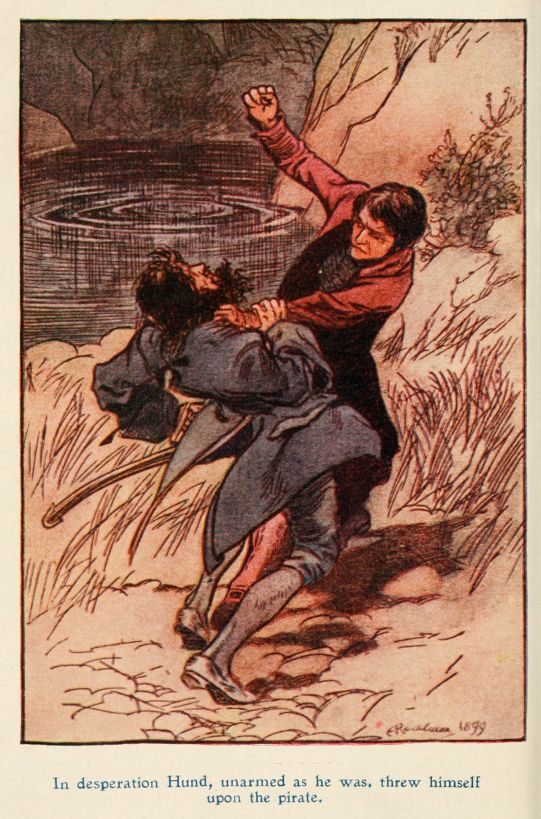
In desperation Hund, unarmed as he was, threw himself upon the pirate.
Hund sprang to his feet in an agony of passion. The well-armed pirate was up as soon as he. Rolf drew back two paces, to be out of sight, if by chance they should look up, and armed himself with a heavy stone. He heard the pirate say—
"You can try to run away, if you like; I shall shoot you through the head before you have gone five yards. And you may refuse to return with me; and then I shall know how to report of you to my captain. I shall tell him that you are lying at the bottom of this lake—if it has a bottom—with a stone tied round your neck, like a drowned wild cat. I hope you may chance to find your enemy there, to make the place the pleasanter."
Rolf could not resist the impulse to send his heavy stone into the middle of the tarn, to see the effect upon the men below. He gave a good cast, on the very instant; and prodigious was the splash, as the stone hit the water, precisely in the middle of the little lake. The men did not see the cause of the commotion that followed; but, staring and turning at the splash, they saw the rings spreading in the dark waters which had lain as still as the heavens but a moment before. How could two guilty, superstitious men doubt that the waters were thrown into agitation by the pirate's last words? Yet they glanced fearfully round the whole landscape, far and near. They saw no living thing but a hawk which, startled from its perch on a scathed pine was wheeling round in the air in an unsteady flight. The pirate pointed to the bird with one hand, while he laid the other on the pistol in his belt.
"Yes," said Hund, trembling, "the bird saw it. Did you see it?"
"See what?"
"The water-sprite, Uldra. Before you throw me in to the water-sprite, we will see which is the strongest."
And in desperation Hund, unarmed as he was, threw himself upon the pirate, sprang at his throat, and both wrestled with all their force. Rolf could not but look; and he saw that the pirate had drawn forth his pistol, and that all would be over with Hund in a moment if he did not interfere. He stood forward between the two pine stems, on the ridge of the rock, and uttered very loud the mournful cry which had so terrified his enemies at Vogel islet. The combatants flew asunder, as if parted by a flash of lightning. Both looked up to the point whence the sound had come; and there they saw what they supposed to be Rolf's spectre, pointing at them, and the eyes staring as when looking up from the waters of the fiord. How could these guilty and superstitious men doubt that it was Rolf's spectre, which, rising through the centre of the tarn, had caused the late commotion in its waters? Away they fled—at first in different directions; but it amused Rolf to observe that rather than be alone, Hund turned to follow the track of the tyrant, who had just been threatening and insulting him, and driving him to struggle for his life.
"Ay," thought Rolf, "it is his conscience that makes me so much more terrible to him than that ruffian. I never hurt a hair of his head; and yet, through his conscience, my face is worse than the blasting lightning to his eyes. Heigh-ho! Where is Erlingsen? It is nothing short of cruel to keep me waiting to-day, of all days; and in this spot, of all places—almost within sight of the seater where my poor Erica sits pining, and seeing nothing of the pastures, but only, with her minds' eye, the sea-caves where she thinks these limbs are stretched, cold and helpless, as in a grave. A pretty story I shall have to tell her, if she will only believe it, of another sort of sea-cave."
To pass the time he took out the shells he had collected for Erica, and admired them afresh, and planned where she would place them, so as best to adorn their sitting-room, when they were married. Erlingsen arrived before he had been thus engaged five minutes; and indeed before he had been more than a quarter of an hour altogether at the place of meeting.
"My dear master!" exclaimed Rolf, on seeing him coming, "have pity on Erica and me, and hear what I have to tell you, that I may be gone."
"You shall be gone at once, my good fellow! I will walk with you, and you shall tell your story as we go."
Rolf shook his head, and objected that he could not, in conscience, take Erlingsen a step further from home than was necessary, as he was only too much wanted there.
"Is that Oddo yonder?" he asked. "He said you would bring him."
"Yes; he has grown trustworthy of late. We have had fewer heads and hands among us than the times require since Peder grew old and blind, and you were missing, and Hund had to be watched instead of trusted. So we have been obliged to make a man of Oddo, though he has the years of a boy, and the curiosity of a woman. I brought him now, thinking that a messenger might be wanted to raise the country against the pirates; and I believe Oddo, in his present mood, will be as sure as we know he can be swift."
"It is well we have a messenger. Where is the bishop?"
"Just going to his boat, at this moment, I doubt not," replied Erlingsen, measuring with his eye the length of the shadows. "The bishop is to sup with us this evening."
"And how long to stay?"
"Over to-morrow night, at the least. If many of the neighbours should bring their business to him, it may be longer. My little Frolich will be vexed that he should come while she is absent. Indeed I should not much wonder if she sets out homeward when she hears the news you will carry, so that we shall see her at breakfast."
"It is more likely," observed Rolf, "that we shall see the bishop up the mountain at breakfast. Ah! you stare; but you will find I am not out of my wits when you hear what has come to my knowledge since we parted, and especially within this hour."
Erlingsen was indeed presently convinced that it was the intention of the pirates to carry off the Bishop of Tronyem, in order that his ransom might make up to them for the poverty of the coasts. He heard besides such an ample detail of the plundering practices which Rolf had witnessed from his retreat as convinced him that the strangers, though in great force, must be prevented by a vigorous effort from doing further mischief. The first thing to be done was to place the bishop in safety on the mountain; and the next was so to raise the country as that these pirates should be certainly taken when they should come within reach.
Oddo was called, and entrusted with the information which had to be conveyed to the magistrate at Saltdalen. He carried his master's tobacco-pouch as a token—this pouch, of Lapland make, being well known to the magistrate as Erlingsen's. Oddo was to tell him of the danger of the bishop, and to request him to send to the spot whatever force could be mustered at Saltdalen; and moreover to issue the budstick,[5] to raise the country. The pirates having once entered the upper reach of the fiord, might thus be prevented from ever going back again, and from annoying any more the neighbourhood which they had so long infested.
Erlingsen promised to be wary on his return homewards, so as not to fall in with the two whom Rolf had put to flight. He said, however, that if by chance he should cross their path, he did not doubt he could also make them run, by acting the ghost or demon, though he had not had Rolf's advantage of disappearing in the fiord before their eyes. They were already terrified enough to fly from anything that called itself a ghost.
The three then went on their several ways—Oddo speeding over the ridges like a sprite on a night errand, and Rolf striding up the grassy slopes like (what he was) a lover anxious to be beside his betrothed after a perilous absence.
This was the day when the first cheese of the season was found to be perfect and complete. Frolich, Stiorna, and Erica examined it carefully, and pronounced it a well-pressed, excellent Gammel cheese, such as they should not be ashamed to set before the bishop, and therefore one which ought to satisfy the demon. It now only remained to carry it to its destination—to the ridge where the first cheese of the season was always laid for the demon, and where, it appeared, he regularly came for his offering, as no vestige of the gift was ever to be found the next morning—only the round place in the grass where it had lain, and the marks of some feet which had trodden the herbage.
"Help me up with it upon my head, Stiorna," said Erica.
"I know why you will not let me carry the cheese," said Frolich, smiling. "You are thinking of Oddo with the cake and ale. Nobody but you must deposit offerings henceforward. You are afraid I should eat up that cheese, almost as heavy as myself. You think there would not be a paring left for the demon by the time I got to the ridge."
"Not so," replied Erica. "I think that he to whom this cheese is destined had rather be served by one who does not laugh at him. And it is a safer plan for you, Frolich."
And off went Erica with her cheese.
The ridge on which she laid it would have tempted her at any other time to sit down. It was green and soft with mosses, and offered as comfortable a couch to one tired with the labours of the day as any to be found at the farm. But to-night it was to be haunted; so Erica merely stayed to do her duty. She selected the softest tuft of moss on which to lay the cheese, put her offering reverently down, and then diligently gathered the brightest blossoms from the herbage around, and strewed them over the cheese. She then walked rapidly homewards, without once looking behind her. If she had had the curiosity and courage to watch for a little while, she would have seen her offering carried off by an odd little figure, with nothing very terrible in its appearance—namely, a woman about four feet high, with a flat face, and eyes wide apart, wearing a reindeer garment like a waggoner's frock, a red comforter about her neck, a red cloth cap on her head, a blue worsted sash, and leather boots up to the knee—in short, such a Lapland girl as Erica would have given a rye-cake to as charity, but would not have thought of asking to sit down even in her master's kitchen; for the Norwegian servants are very high and saucy towards the Laps who wander to their doors. It is not surprising that the Lapps, who pitch their tents on the mountain, should like having a fine Gammel cheese for the trouble of picking it up; and the company whose tents Erica had passed on her way up to the seater, kept a good look-out upon all the dairy people round, and carried off every cheese meant for the demon. While Erica was gathering and strewing the blossoms, this girl was hidden near; and trusting to Erica's not looking behind her, the rogue swept off the blossoms, and threw them at her before she had gone ten yards, trundled the cheese down the other side of the ridge, made a circuit, and was at the tents with her prize before supper-time. What would Erica have thought if she had beheld this fruit of so many milkings and skimmings, so much boiling and pressing, devoured by greedy Lapps in their dirty tent?
On her way homewards Erica remembered that this was Midsummer Eve—a season when her mother was in her thoughts more than at any other time; for Midsummer Eve is sacred in Norway to the wood-demon, whose victim she believed her mother to have been. Every woodman sticks his axe into a tree that night, that the demon may, if he pleases, begin the work of the year by felling trees or making a faggot. Erica hastened to the seater, to discover whether Erlingsen had left his axe behind, and whether Jan had one with him.
Jan had an axe, and remembering his duty, though tired and sleepy, was just going to the nearest pine-grove with it when Erica reached home. She seized Erlingsen's axe and went also, and stuck it in a tree, just within the verge of the grove, which was in that part a thicket, from the growth of underwood. This thicket was so near the back of the dairy that the two were home in five minutes. Yet they found Frolich almost as impatient as if they had been gone an hour. She asked whether their heathen worship was done at last, so that all might go to bed; or whether they were to be kept awake till midnight by more mummery?
Erica replied by showing that Jan was already gone to his loft over the shed, and begging leave to comb and curl Frolich's hair, and see her to rest at once. Stiorna was asleep; and Erica herself meant to watch the cattle this night. They lay crouched in the grass, all near each other, and within view, in the mild slanting sunshine; and here she intended to sit, on the bench outside the home-shed, and keep her eye on them till morning.
"You are thinking of the Bishop of Tronyem's cattle," said Frolich.
"I am, dear. This is Midsummer Eve, you know, when, as we think, all the spirits love to be abroad."
"You will die before your time, Erica," said the weary girl. "These spirits give you no rest of body or mind. What a day's work we have done! And now you are going to watch till twelve, one, two o'clock! I could not keep awake," she said, yawning, "if there was one demon at the head of the bed, and another at the foot, and the underground people running like mice all over the floor."
"Then go and sleep, dear. I will fetch your comb, if you will just keep an eye on the cattle for the moment I am gone."
As Erica combed Frolich's long fair hair, and admired its shine in the sunlight, and twisted it up behind, and curled it on each side, the weary girl leaned her head against her, and dropped asleep. When all was done, she just opened her eyes to find her way to bed, and say—
"You may as well go to bed comfortably; for you will certainly drop asleep here, if you don't there."
"Not with my pretty Spiel in sight. I would not lose my white heifer for seven nights' sleep. You will thank me when you find your cow, and all the rest, safe in the morning. Good-night, dear."
And Erica closed the door after her young mistress, and sat down on the bench outside, with her face towards the sun, her lure by her side, and her knitting in her hands. She was glad that the herd lay so that by keeping her eye on them she could watch that wonder of Midsummer night within the Arctic Circle, the dipping of the sun below the horizon, to appear again immediately. She had never been far enough to the north to see the sun complete its circle without disappearing at all; but she did not wish it. She thought the softening of the light which she was about to witness, and the speedy renewing of day, more wonderful and beautiful.
She sat, soothed by her employment and by the tranquillity of the scene, and free from fear. She had done her duty by the spirits of the mountain and the wood; and in case of the appearance of any object that she did not like, she could slip into the house in an instant. Her thoughts were therefore wholly Rolf's. She could endure now to contemplate a long life spent in doing honour to his memory by the industrious discharge of duty. She would watch over Peder, and receive his last breath—an office which should have been Rolf's. She would see another houseman arrive, and take possession of that house, and become betrothed, and marry; and no one, not even her watchful mistress should see a trace of repining in her countenance, or hear a tone of bitterness from her lips. However weary her heart might be, she would dance at every wedding—of fellow-servant or of young mistress. She would cloud nobody's happiness, but would do all she could to make Rolf's memory pleasant to those who had known him, and wished him well.
Her eyes rested on the lovely scene before her. From the elevation at which she was, it appeared as if the ocean swelled up into the very sky, so high was the horizon line; and between lay a vast region of rock and river, hill and dale, forest, fiord, and town, part in golden sunlight, part in deep shadow, but all, though bright as the skies could make it, silent as became the hour. As Erica found that she could glance at the sun itself without losing sight of the cattle, which still lay within her indirect vision, she carefully watched the descent of the orb, anxious to observe precisely when it should disappear, and how soon its golden spark would kindle up again from the waves. When its lower rim was just touching the waters, its circle seemed to be of an enormous size, and its whole mass to be flaming. Its appearance was very unlike that of the comparatively small, compact, brilliant luminary which rides the sky at noon. Erica was just thinking so, when a rustle in the thicket, within the pine grove, made her involuntarily turn her head in that direction. Instantly remembering that it was a common device of the underground people for one of them to make the watcher look away, in order that others might drive off the cattle, she resumed her duty, and gazed steadfastly at the herd. They were safe—neither reduced to the size of mice, nor wandering off, though she had let her eye glance away from them.
The sky, however, did not look itself. There were two suns in it. Now Erica really did quite forget the herd for some time, even her dear white heifer—while she stared bewildered at the spectacle before her eyes. There was one sun, the sun she had always known—half sunk in the sea, while above it hung another, round and complete, somewhat less bright perhaps, but as distinct and plain before her eyes as any object in heaven or earth had ever been. Her work dropped from her hands, as she covered her eyes for a moment. She started to her feet, and then looked again. It was still there, though the lower sun was almost gone. As she stood gazing, she once more heard the rustle in the wood. Though it crossed her mind that the wood-demon was doubtless there making choice of his axe and his tree, she could not move, and had not even a wish to take refuge in the house, so wonderful was his spectacle—the clearest instance of enchantment she had ever seen. Was it meant for good—a token that the coming year was to be a doubly bright one? If not, how was she to understand it?
"Erica!" cried a voice at this moment from the wood—a voice which thrilled her whole frame. "My Erica!"
She not only looked towards the wood now, but sprang forwards; but her eyes were so dazzled by having gazed at the sun that she could see nothing. Then she remembered how many forms the cunning demon could assume, and she turned back thinking how cruel it was to delude her with her lover's voice, when instead of his form she should doubtless see some horrid monster. She turned in haste, and laid her hand on the latch of the door, glancing once more at the horizon.
There was now no sun at all. The burnish was gone from every point of the landscape, and a mild twilight reigned.