Book 3 — THE UPPER RIVER (continued 2)
Reading edition
Ranelagh was not quite so ancient, and it encouraged a slightly better class of visitor: otherwise it was the counterpart of Vauxhall, as was Cremorne. It was famous, among other things, for its regatta. In 1775 this was a tremendous water-carnival. The River from London Bridge westwards was covered with boats of all sorts, and stands were erected on the banks for the convenience of spectators.
Ranelagh was demolished in 1805, but Vauxhall persisted right on till 1859, when it too came under the auctioneer’s hammer. Where Cremorne once stood is now the huge power-station so prominent in this stretch of the river; and the famous coffee-house kept by “Don Saltero” in the early eighteenth century was in Cheyne Walk.
Chelsea in its day has achieved fame in quite a variety of ways. Apart from its pleasure gardens it has come to be well-known for its beautiful old physic-garden; its hospital for aged soldiers, part of the gardens of which were included in Ranelagh; its bun-house; its pottery; and last, but by no means least, for its association with literary celebrities. Here have lived, and worked, and, in some cases, died, writers of such different types as Sir Thomas More, whose headless body was buried in the church, John Locke, Addison, Swift, Smollett, Carlyle—the “sage of Chelsea”—Leigh Hunt, Rossetti, Swinburne, and Kingsley. Artists, too, have congregated in these quiet streets, and the names of Turner and Whistler will never be forgotten.
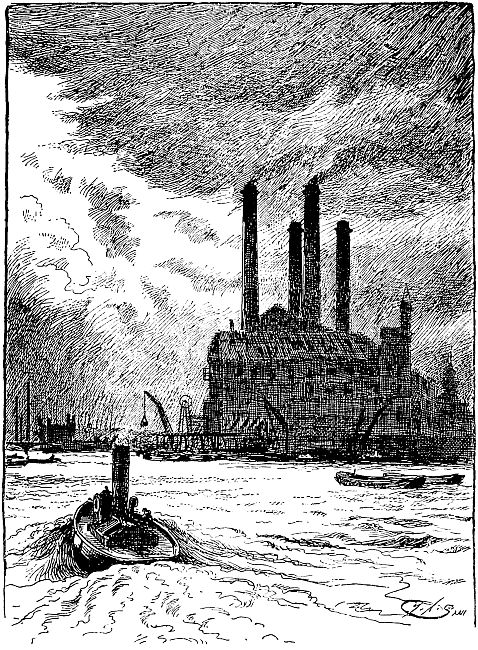
The Power-Station, Chelsea.
At Lambeth may still be seen the famous palace of the Archbishops of Canterbury, a beautiful building of red-brick and stone, standing in an old-world garden. Some parts of it are very old: one, the Lollards’ Tower, is an exceedingly fine relic of medieval building. Close at hand stands the huge pile of buildings which house the pottery works of Messrs. Doulton. For some reason or other Lambeth has long been associated with this industry.
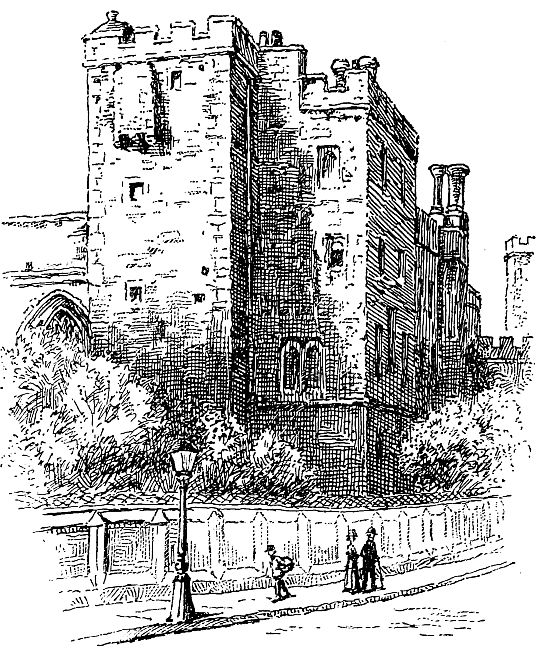
The Lollards’ Tower, Lambeth Palace.
As early as 1670 one Edward Warner sold potters’ clay here, and exported it in huge quantities to Holland and other countries, and various potters, some Dutch, settled in the district. All this stretch of the River seems to have been famous for its china-works in the past, for there were celebrated potteries at Fulham, Chelsea, and Battersea as well. Of these Battersea has passed away, and its productions are eagerly sought after by collectors, but Fulham and Lambeth remain, while Chelsea, after a long interval, is reviving this ancient craft.
Thus we have traversed in fancy the whole of this wonderful River—so fascinating to both young and old, to both studious and pleasure-seeking. The more we learn of it the more we are enthralled by its story, by the immense share it has had in the shaping of England’s destinies.
We started with a consideration of what those wonderful people the geologists could tell us of the River in dim, prehistoric days; and we feel inclined to turn once more to them in conclusion. For they tell us now that the Thames is growing less; that, just as in times past it captured the waters of other streams and reduced them to trickling nothings, so in turn it is succumbing day by day to the depredations of the River Ouse, which is slowly cutting off its head. Some day, perhaps, the Thames will be just a tiny rivulet, and the Port of London will be no more; but I think the tides will ebb and flow under London Bridge many times before it comes to pass.