APPENDIX
Reading edition
NEW FURLS ON REGIMENTAL STAFF
Lunéville Sector, February 21 to March 23, 1918.
Baccarat Sector, April 1 to June 21, 1918.
Esperance-Souain Sector, July 4 to July 14, 1918.
Champagne-Marne Defensive, July 15 to July 18, 1918
Aisne-Marne Offensive, July 25 to August 3, 1918
St. Mihiel Offensive, September 12 to September 16, 1918.
Essey and Pannes Sector. Woevre, September 17 to September 30, 1918.
Argonne-Meuse Offensive, October 13 to October 31, 1918
Argonne-Meuse Offensive Last Phase, November 5, to November 9, 1918.
LOSSES IN ACTION
Killed: 644 Wounded: 2,857. Total: 3,501.
Kilometers gained: 55.
Headquarters: 83 different places.
Number of days in contact with the enemy: 180.
LIST OF DECORATIONS[6]
DISTINGUISHED SERVICE CROSS WITH PALM
Colonel William J. Donovan
DISTINGUISHED SERVICE CROSS
Lieut.-Colonels Timothy J. Moynahan Charles A. Dravo Majors James A. McKenna (Deceased) Michael A. Kelly Thomas T. Reilley Van S. Merle-Smith Captains Richard J. Ryan Louis A. Stout First Lieutenants James B. McIntyre William M. Spencer John J. Williams Second Lieutenants Oliver Ames (Deceased) James S. D. Burns (Deceased) John J. Burke Andrew Ellett Chaplains Francis P. Duffy James M. Hanley George R. Carpentier Sergeants Co. C, Joseph W. Burns Co. A, John J. Dennelly Co. D, Joseph J. Lynch Co. C, Thomas P. O’Hagan Co. D, John J. Gribbon Co. B, Spiros Thomas Co. H, Bernard Finnerty (Deceased) Co. H, Eugene J. Sweeney Co. A, Thomas J. Sweeney Co. I, Michael A. Donaldson Co. C, Thomas O’Kelly Co. Hq., Thomas E. Fitzsimmons Co. K, John J. McLoughlin Co. M, John McLoughlin Co. M, G. Frank Gardella (Deceased) Co. M G, John F. Flint Co. H, Martin J. Higgins Co. San, Victor L. Eichorn Co. M G, Peter Gillespie Co. K, Edward J. Rooney Co. I, Edward T. Shanahan Co. K, Herbert A. McKenna Co. D, Richard W. O’Neill Co. C, Michael Ruane Co. H, Dudley Winthrop Co. A, Martin Gill Co. A, Matthew Kane Co. C, Archibald F. Reilly Co. C, Harry C. Horgan Co. H, Patrick Travers Co. C, William McCarthy Co. K, Peter J. Crotty (Deceased) Co. H, William O’Neill (Deceased) Co. C, Michael Cooney Co. L, Michael Fitzpatrick Co. D, Michael J. McAuliffe Corporals Co. C, Thomas F. O’Connor (Deceased) Co. M G, William J. Murphy Co. C, Frederick Craven Co. D, William P. White Co. E, Frederick Gluck (Deceased) Co. K, Victor Van Yorx Co. M, James E. Winestock Co. C, John Hammond Co. B, Matthew J. Brennan Wagoner Supply Co. Albert Richford Privates Co. K, William J. Bergen (Deceased) Co. G, Edmund Riordan (Deceased) Co. G, John McGeary (Deceased) Co. M, Robert Riggsby Co. D, Edward G. Coxe (Deceased) Co. K, Burr Finkle Co. H, Patrick Reynolds (Deceased) Co. C, John Teevan
DISTINGUISHED SERVICE MEDAL
Chaplain Francis P. Duffy
LEGION OF HONOR
Brigadier General Frank R. McCoy Colonel William J. Donovan Lieutenant Colonel Timothy J. Moynahan Major Michael A. Kelly First Lieutenant William Maloney
MEDAILLE MILITAIRE
Sergeant Co. I, Michael A. Donaldson Corporals Co. A, Matthew A. Kane Co. K, Burr Finkle Private Co. M, Robert Riggsby
CROCE DI GUERRA (ITALIAN)
Colonel William J. Donovan Sergeant Co. C, Michael Ruane
CROIX DE GUERRE
Brigadier Generals Frank R. McCoy John W. Barker Colonel William J. Donovan Lieutenant Colonels Charles A. Dravo Timothy J. Moynahan (Two Citations) Majors Henry A. Bootz Michael A. Kelly Captains Henry K. Cassidy Oscar L. Buck Kenneth Ogle Charles D. Baker (Deceased) Beverly H. Becker First Lieutenants John Norman (Deceased) Thomas C. P. Martin George F. Patton Second Lieutenants Arthur S. Booth W. Arthur Cunningham Henry W. Davis (Deceased) Raymond H. Newton Sergeants Co. A, William J. Moore Co. A, Daniel O’Connell Co. A, Spencer G. Rossell Co. B, Spiros Thomas Co. C, Eugene A. McNiff Co. Hq., Abram Blaustein Co. D, Thomas M. O’Malley Co. E, Carl Kahn Co. E, William E. Bailey Co. G, James D. Coffey Co. G, James Murray Co. C, Thomas P. O’Hagan Co. K, Leo A. Bonnard Co. D, Joseph J. Lynch Co. A, John F. Scully Co. G, Martin Shalley Co. H, Jerome F. O’Neill Co. H, Bruno Gunther Co. A, Joseph G. Pettit Co. A, Frank A. Fisher Co. B, Christian Biorndall Co. B, William P. Judge Co. D, Thomas H. Brown Co. E, Alfred S. Helmer Co. F, Theodore H. Hagen Co. H, John P. Furey Co. D, John Cahill Co. A, Michael Morley Co. B, Daniel J. Finnegan Co. C, James Barry Co. C, Michael Cooney Co. D, Dennis O’Connor Co. D, Patrick Grogan Co. C, Herman H. Hillig Co. A, Thomas Sweeney Co. C, Michael Ruane Co. D, John J. Gribbon Co. I, Michael A. Donaldson Co. A, Matthew A. Kane Co. Hq., Joyce Kilmer (Deceased) Corporals Co. F, John Finnegan (Deceased) Co. L, Lawrence G. Spencer (Deceased) Co. D, Marlow H. Plant Co. C, Bernard Barry (Deceased) Co. A, George A. McCarthy Co. B, Vincent J. Eckas Co. Hq., Charles S. Jones Co. B, Frank Brandreth Co. C, John J. Brawley Co. D, Harry H. DeVoe Co. E, James Quigley Co. A, Bernard McOwen (Deceased) Co. A, Matthew A. Rice (Two Citations) Co. K, Burr Finkle Cook Co. M, Robert Riggsby Private John Teevan
ORDER OF ST. LEPOLD (BELGIUM)
Second Lieutenant Thomas J. Devine
HEADQUARTERS, 165TH INFANTRY
(Old 69th N. Y.)
Remagen, Germany, March 28, 1919.
GENERAL ORDER. No. 12
To the Officers and the Men of the 165th Infantry, 42nd Division.
The following extracts from orders and letters commendatory of the 42nd Division and the 165th Infantry issued by our own Army and that of our illustrious Ally the French, indicate a deep appreciation of your worth as soldiers and pay a high tribute to your valorous conduct on the Fields of Battle.
William J. Donovan John P. Hurley, Capt. Adj., 165th Infantry.
March 21, 1918.
The Lieut. Colonel Commanding the 13th Group of Chasseurs reports that in the course of the double coup de main executed in the night of the 20-21 March, the conduct of the American detachment of the 165th Regiment has been particularly worthy of commendation, and that Officers and Soldiers have given proof of an enthusiastic bravery.
The General Commanding the 164th Division wishes to make known to all this appreciation, which justifies amply the confidence that we all have in our allies, a confidence doubled by the friendship and by the affectionate sympathy that the common life in the Sector has spontaneously brought into being.
General Gaucher, Commanding the 164th Division.
April 1, 1918.
From: Commanding General, First Army Corps. To: Commanding General, 42d Division, A. E. F. Subject: Commendations.
1. The Chief of the French Military Mission has forwarded to the Commander-in-Chief, A. E. F., copies of citations and proposals concerning three officers and eight enlisted men of the 165th Infantry.
2. The Commander-in-Chief charges me with the conveyance to these officers and soldiers his particular appreciation of their splendid conduct, which has won for them these citations from the French Army.
3. To the appreciation thus conferred by the Commander-in-Chief, the Corps Commander adds his own and desires that the foregoing be made known in a suitable manner to the officers and soldiers cited.
By direction, Malin Craig, Chief of Staff.
May 21, 1918.
The First Company, under Captain Edart, penetrated the German line on the night of May 19-20, 1918, and the following night it drove back with vigor the Germans who came out against us from their lines, thus maintaining our superiority in morale.
In the course of these operations the American Volunteers (from Second Battalion, 165th Infantry), who were attached to the Edart Company displayed the utmost dash and coolness, as well as a splendid comradeship in battle.
I have the honor to ask for them in recompense the authorization to cite them in my Regimental Order.
Colonel Jungbluth, Cdt. 67th R. I.
6th ARMY CORPS H. Q.
June 15, 1918.
At the moment when the 42nd U. S. Infantry Division is leaving the Lorraine front, the Commanding General of the 6th Army Corps desires to do homage to the fine military qualities which it has continuously exhibited, and to the services which it has rendered in the Baccarat sector.
The offensive ardor, the sense for the utilization and the organization of terrain, the spirit of method, the discipline shown by all its officers and men, the inspiration animating them, prove that at the first call, they can henceforth take a glorious place in the new line of battle.
The Commanding General of the 6th Army Corps expresses his deepest gratitude to the 42nd Division for its precious collaboration; he particularly thanks the distinguished Commander of this Division, General Menoher, the Officers under his orders and his Staff so brilliantly directed by Colonel MacArthur.
It is with a sincere regret that the entire 6th Army Corps sees the 42nd Division depart. But the bonds of affectionate comradeship which have been formed here will not be broken; for us, in faithful memory, are united the living and the dead of the Rainbow Division, those who are leaving for hard combats and those who, after having nobly sacrificed their lives on this Eastern Border, now rest there, guarded over piously by France.
These sentiments of warm esteem will be still more deeply affirmed, during the impending struggles where the fate of Free Peoples is to be decided.
May our units, side by side, contribute valiantly to the triumph of Justice and Right:
General Duport.
June 18, 1918.
To: Colonel McCoy, Commanding 165th Inf. Rgt. My Dear Colonel McCoy:
I greatly appreciate the kind thought you had in sending me your order No. 10 relating the numerous citations that have been granted to the 165th.
The old New York regiment has a great past of glory. I am sure it will be famous on the battlefields of France as it has been in America.
I also want to thank you for the kind farewell you gave Captain Mercier. I know this Officer feels sad in leaving your regiment. He will keep a precious recollection of the six months he spent with his gallant Irish comrades.
With the expression of my personal appreciation of your kindness and my best compliments,
I am, Sincerely yours, J. Corbabon, Major, Liaison Officer, 42nd Division.
4th ARMY H. Q.
July 16, 1918.
SOLDIERS OF THE 4TH ARMY
During the day of July 15th, you broke the effort of fifteen German divisions, supported by ten others.
They were expected according to their orders to reach the Marne in the evening: You stopped their advance clearly at the point where we desired to engage in and win the battle.
You have the right to be proud, heroic infantrymen and machine gunners of the advance posts who met the attack and broke it up, aviators who flew over it, battalions and batteries which broke it, staffs which so minutely prepared the battlefield.
It is a hard blow for the enemy. It is a grand day for FRANCE.
I count on you that it may always be the same every time he dares to attack you; and with all my heart of a soldier, I thank you.
Gouraud.
21ST ARMY CORPS,
July 17, 1918.
170TH DIVISION, General BERNARD, Commanding par interim the 170th Division. To the Commanding General of the 42nd U. S. Inf. Division.
The Commanding General of the 170th Infantry Division desires to express to the Commanding General of the 42nd U. S. Infantry Division his keen admiration for the courage and bravery of which the American Battalions of the 83rd Brigade have given proof in the course of the hard fighting of the 15th and 16th of July, 1918, as also for the effectiveness of the artillery fire of the 42nd U. S. Infantry Division.
In these two days the troops of the United States by their tenacity, largely aided their French comrades in breaking the repeated assaults of the 7th Reserve Division, the 1st Infantry Division and the Dismounted Cavalry Guard Division of the Germans: these latter two divisions are among the best of Germany.
According to the order captured on the German officers made prisoner, their Staff wished to take Chalon-sur-Marne on the evening of July 16th, but it had reckoned without the valor of the American and French combatants, who told them with machine gun, rifle and cannon shots that they would not pass.
The Commanding General of the 170th Infantry Division is therefore particularly proud to observe that in mingling their blood gloriously on the Battlefield of Champagne, the Americans and the French of today are continuing the magnificent traditions established a century and a half ago by Washington and Lafayette; it is with this sentiment that he salutes the Noble Flag of the United States in thinking of the final Victory.
Bernard.
21ST ARMY CORPS Hq.,
July 19, 1918.
GENERAL ORDER
At the moment when the 42nd American Division is on the point of leaving the 21st Army Corps, I desire to express my keen satisfaction and my sincere thanks for the service which it has rendered under all conditions.
By its valor, ardor and spirit, it has very particularly distinguished itself on July 15th and 16th in the course of the great battle where the 4th Army broke the German offensive on the CHAMPAGNE front.
I am proud to have had it under my orders during this period; my prayers accompany it in the great struggle engaged in for the Liberty of the World.
General Naulin, Commanding the 21st Army Corps.
6TH ARMY
P. C., July 26, 1918.
NOTE.
The PRESIDENT OF THE REPUBLIC, in the course of a visit to the 6th Army, expressed his satisfaction over the results obtained, as well as for the qualities of valor and perseverance manifested by all units of the Army.
The Commanding General of the 6th Army, is happy to transmit to the troops of his Army the felicitations of the PRESIDENT OF THE REPUBLIC.
Signed: General DeGoutte.
July 28, 1918.
From: Commanding General, 1st Army Corps, Am. E. F. To: Commanding General, 42nd Division, Am. E. F. Subject: Congratulations:
1. The return of the 42nd Division to the 1st Army Corps was a matter of self-congratulation for the Corps Commander, not only because of previous relations with the Division, but also because of the crisis which existed at the time of its arrival.
2. The standard of efficient performance of duty which is demanded by the Commander-in-Chief, American E. F., is a high one, involving as it does on an occasion such as the present complete self-sacrifice on the part of the entire personnel, and a willingness to accept cheerfully every demand even to the limit of endurance of the individual for the sake of the Cause for which we are in France.
3. The taking over of the front of the 1st Army Corps under the conditions of relief and advance, together with the attendant difficulties incident to widening the front, was in itself no small undertaking, and there is added to this your advance in the face of the enemy to a depth of five or more kilometers, all under cover of darkness, to the objective laid down by higher authority to be attained, which objective you were holding, regardless of the efforts of the enemy to dislodge you. The Corps Commander is pleased to inform you that the 42nd Division has fully measured up to the high standard above referred to, and he reiterates his self-congratulation that you and your organization are again a part of the 1st Army Corps., Am. E. F.
(Signed) H. Liggett, Major General, U. S. A.
6TH ARMY
P. C. August 9, 1918.
GENERAL ORDER.
Before the great offensive of the 18th of July, the American troops forming part of the 6th French Army distinguished themselves in capturing from the enemy the Bois de la Brigade De Marine and the village of VAUX, in stopping his offensive on the MARNE and at FOSSOY.
Since then, they have taken the most glorious part in a second battle of the MARNE, rivaling in order and in valiance the French troops. They have, in twenty days of incessant combat, liberated numerous French villages and realized across a difficult country an advance of forty kilometers, which has carried them beyond the VESLES.
Their glorious marches are marked by names which will illustrate in the future, the military history of the United States:
TORCY, BELLEAU, Plateau d’ENREPILLY, EPIEDS, Le CHARMEL, l’OURCQ, SERINGES et NESLES, SERGY, La VESLE and FISMES.
The new divisions who were under fire for the first time showed themselves worthy of the old war-like traditions of the Regular Army. They have had the same ardent desire to fight the Boche, the same discipline by which an order given by the Chief is always executed, whatever be the difficulties to overcome and the sacrifices to undergo.
The magnificent results obtained are due to the energy and skill of the Chiefs, to the bravery of the soldiers.
I am proud to have commanded such troops.
The General Commanding the 6th Army, DeGoutte.
Headquarters, 42nd Division,
AMERICAN EXPEDITIONARY FORCES, FRANCE,
August 13, 1918.
TO THE OFFICERS AND MEN OF THE 42ND DIVISION:
A year has elapsed since the formation of your organization. It is, therefore, fitting to consider what you have accomplished as a combat division and what you should prepare to accomplish in the Future.
Your first elements entered the trenches in Lorraine on February 21st. You served on that front for 110 days. You were the first American division to hold a divisional sector and when you left the sector June 21st, you had served continuously as a division in the trenches for a longer time than any other American division. Although you entered the sector without experience in actual warfare, you so conducted yourselves as to win the respect and affection of the French veterans with whom you fought. Under gas and bombardment, in raids, in patrols, in the heat of hand-to-hand combat, and in the long, dull hours of trench routine so trying to a soldier’s spirit, you bore yourselves in a manner worthy of the traditions of our country.
You were withdrawn from Lorraine and moved immediately to the Champagne front, where, during the critical days from July 14th to July 18th, you had the honor of being the only American division to fight in General Gouraud’s Army, which so gloriously obeyed his order: “We will stand or die,” and by its iron defense crushed the German assaults and made possible the offensive of July 18th to the west of Reims.
From Champagne you were called to take part in exploiting the success north of the Marne. Fresh from the battle front before Chalons, you were thrown against the picked troops of Germany. For eight consecutive days, you attacked skillfully prepared positions. You captured great stores of arms and munitions. You forced the crossings of the Ourcq. You took Hill 212, Sergy, Meurcy Farm and Seringes by assault. You drove the enemy, including an Imperial Guard Division, before you for a depth of fifteen kilometers. When your infantry was relieved, it was in full pursuit of the retreating Germans, and your artillery continued to progress and support another American division in the advance to the Vesle.
For your services in Lorraine, your division was formally commended in General Orders by the French Army Corps under which you served. For your services in Champagne, your assembled officers received the personal thanks and commendation of General Gouraud himself. For your service on the Ourcq, your division was officially complimented in a letter from the Commanding General, 1st Army Corps, of July 28th, 1918.
To your success, all ranks and all services have contributed, and I desire to express to every man in the command my appreciation of his devoted and courageous effort.
However, our position places a burden of responsibility upon us which we must strive to bear steadily forward without faltering. To our comrades who have fallen, we owe the sacred obligation of maintaining the reputation which they died to establish. The influence of our performance on our Allies and on our enemies can not be over estimated, for we were one of the first divisions sent from our country to France to show the world that Americans can fight.
Hard battles and long campaigns lie before us. Only by ceaseless vigilance and tireless preparation can we fit ourselves for them. I urge you, therefore, to approach the future with confidence, but above all, with firm determination that so far as it is in your power you will spare no effort, whether in training or in combat, to maintain the record of our division and the honor of our country.
Charles T. Menoher, Major General, U. S. Army.
Headquarters 42nd Division.
SUMMARY OF INTELLIGENCE.
October, 1918.
On October 18, 1917, one year ago today, the Headquarters and certain of the elements of the 42nd Division sailed for France....
The Division is now engaged in the most difficult task to which it has yet been set: The piercing at its apex of the “Kriemhilde Stellung,” upon the defense of which position the German line from METZ to CHAMPAGNE depends.
During its service in France, Division Headquarters has had its Post of Command at 23 different points in towns, woods and dugouts. The Division has captured prisoners from 23 enemy divisions, including three Guard and one Austro-Hungarian divisions.
Charles T. Menoher, Major General, U. S. Army.
HEADQUARTERS 42d DIVISION.
American Expeditionary Forces. France.
November 11th, 1918.
To the Officers and Men of the 42nd Division:
On the 13th of August I addressed you a letter summarizing the record of your achievements in Lorraine, before Chalons and on the Ourcq. On the occasion of my leaving the Division I wish to recall to you your services since that time and to express to you my appreciation of the unfailing spirit of courage and cheerfulness with which you have met and overcome the difficult tasks which have confronted you.
After leaving the region of Chateau Thierry you had scarcely been assembled in your new area when you were ordered to advance by hard night marches to participate in the attack of the St. Mihiel Salient. In this first great operation of the American Army you were instructed to attack in the center of the Fourth Army Corps and to deliver the main blow in the direction of the heights overlooking the Madine River. In the battle that followed you took every objective in accordance with the plan of the Army Commander. You advanced fourteen kilometers in twenty-eight hours. You pushed forward advance elements five kilometers further, or nineteen kilometers beyond your original starting point. You took more than one thousand prisoners from nine enemy divisions. You captured seven villages and forty-two square kilometers of territory. You seized large supplies of food, clothing, ammunition, guns and engineering material.
Worn though you were by ceaseless campaigning since February, you then moved to the Verdun region to participate in the great blow which your country’s armies have struck west of the Meuse. You took Hill 283, La Tuilerie Farm and the Cote de Chatillon and broke squarely across the powerful Kriemhilde Stellung, clearing the way for the advance beyond St. Georges and Landres et St. Georges. Marching and fighting day and night you thrust through the advancing lines of the forward troops of the First Army. You drove the enemy across the Meuse. You captured the heights dominating the River before Sedan and reached in the enemy lines the farthest points attained by any American troops.
Since September 12th you have taken over twelve hundred prisoners; you have freed twenty-five French villages; you have recovered over one hundred and fifty square kilometers of French territory and you have captured great supplies of enemy munitions and material.
Whatever may come in the future, the men of this Division will have the proud consciousness that they have thus far fought wherever the American flag has flown most gloriously in this war. In the determining battle before Chalons, in the bloody drive from Chateau Thierry to the Vesle, in the blotting out of the St. Mihiel Salient, and in the advance to Sedan you have played a splendid and a leading part.
I know that you will give the same unfailing support to whoever may succeed me as your Commander, and that you will continue to bear forward without faltering the colors of the Rainbow Division. I leave you with deep and affectionate regret, and I thank you again for your loyalty to me and your services to your country. You have struck a vital blow in the greatest war in history. You have proved to the world in no mean measure that our country can defend its own.
Charles T. Menoher, Major General, U. S. Army.
AMERICAN EXPEDITIONARY FORCES,
Office of the Commander-in-Chief.
France, March 22, 1919.
Major General Clement A. F. Flagler, Commanding 42nd Division, American E. F., Ahrweiler, Germany. My Dear General Flagler:
It afforded me great satisfaction to inspect the 42nd Division at Remagen on March 16th, during my trip through the Third Army, and to extend at that time to the officers and men my appreciation of their splendid record while in France.
The share which the 42nd Division has had in the success of our Armies should arouse pride in its achievements among all ranks. Arriving as it did on November 1, 1917, it was one of the first of our combat divisions to participate in active operations. After a period of training which lasted through the middle of February, 1918, it entered the Lunéville sector in Lorraine, and shortly afterwards took up a position in that part of the line near Baccarat. In July it magnificently showed its fighting ability in the Champagne-Marne defensive, at which time units from the 42nd Division aided the French in completely repulsing the German attack. Following this, on July 25th, the Division relieved the 28th in the Aisne-Marne offensive, and in the course of their action there captured La Croix Rouge Farme, Sergy, and established themselves on the northern side of the Ourcq. In the St. Mihiel offensive the division made a rapid advance of 19 kilometers, capturing seven villages. Later, during the Meuse-Argonne battle, it was twice put in the line, first under the 5th Corps and second under the 1st Corps, at which later time it drove back the enemy until it arrived opposite Sedan on November 7th.
Since the signing of the armistice, the 42nd Division has had the honor of being one of those composing the Army of Occupation, and I have only words of praise for their splendid conduct and demeanor during this time. I want each man to realize the part he has played in bringing glory to American arms and to understand both my pride and the pride of their fellows throughout the American Expeditionary Forces in their record. My good wishes accompany your command on its return to the United States, and my interest will remain with its members in their future careers.
Sincerely yours, (Signed) John J. Pershing.
OFFICERS WHO SERVED IN THE 165TH INFANTRY
Colonels
Barker, John W. (Promoted to Brigadier General) Donovan, William J. (Promoted from Major) Hine, Charles D. Howland, Charles R. McCoy, Frank R. (Promoted to Brigadier General) Mitchell, Harry D. (Promoted from Lieut.-Colonel)
Lieut.-Colonels
Anderson, Alexander E. (Promoted from Captain) Dravo, Charles A. Moynahan, Timothy J. (Promoted from Major) Reed, Latham R.
Majors
Bootz, Henry A. (Promoted from 1st Lieut.) Doyle, William T. (Promoted from Captain) Guggenheim, Robert M. (Promoted from 1st Lieut.) Kelly, Michael A. (Promoted from Captain) Lawrence, George J. McAdie, George (Promoted from Captain) McKenna, James A.[7] (Promoted from Captain) Mangan, John J. (Promoted from Captain) Meaney, Martin H. (Promoted from Captain) Merle-Smith, Van S. (Promoted from Captain) Powers, Walter E. (Promoted from Captain) Reilley, Thomas T. (Promoted from Captain) Stacom, William B. Kennelly, William (Promoted from Captain) Watson, James Zorn, Jay
Captains
Archer, James (Promoted from 1st Lieut.) Allen, Richard J. (Promoted from 2nd Lieut.) Baker, Chas. D.[10] (Promoted from 1st Lieut.) Becker, Beverly H. (Promoted from 1st Lieut.) Behrends, Jerome B. (Promoted from 1st Lieut.) Billings, Forest E. (Promoted from 1st Lieut.) Burns, Coleman (Promoted from 1st Lieut.) Buck, Oscar L. (Promoted from 1st Lieut.) Cavanaugh, William P. (Promoted from 1st Lieut.) Cooke, William C. (Promoted from 2nd Lieut.) Cassidy, Henry K. (Promoted from 2nd Lieut.) Conners, John F. (Promoted from 1st Lieut.) Connelly, Edmond J. (Promoted from 2nd Lieut.) Clifford, John J. (Promoted from 2nd Lieut.) Cooper, Jackson S. Dudley, Gerry B. DeLacour, R. B. (Promoted from 1st Lieut.) Elmer, Basil B. (Promoted from 1st Lieut.) Finn, James G. Foley, James L. (Promoted from 1st Lieut.) Given, William B. (Promoted from 1st Lieut.) Green, John A. (Promoted from 1st Lieut.) Graham, Walter R. Hurley, John P. Hudson, William E. Houghton, James T. (Promoted from 1st Lieut.) Grose, Howard (Promoted from 1st Lieut.) Josselyn, Ralph R. Kinney, Thomas A. (Promoted from 1st Lieut.) Landrigan, Alfred W. (Promoted from 1st Lieut.) Lyttle, John D. (Promoted from 1st Lieut.) Lawrence, Austin L. (Promoted from 1st Lieut.) O’Brien, Joseph F. (Promoted from 1st Lieut.) McKenna, William F. (Promoted from 1st Lieut.) McNamara, Francis J. (Promoted from 2nd Lieut.) McDermott, Thomas B. (Promoted from 2nd Lieut.) Mangan, James M. (Promoted from 2nd Lieut.) Martin, Arthur H. (Promoted from 1st Lieut.) Marsh, Frank (Promoted from 1st Lieut.) Smith, Samuel A. (Promoted from 1st Lieut.) Seibert, Kenneth C. Stout, Louis A. (Promoted from 1st Lieut.) Riggs, Francis P. Ryan, Richard J. Ogle, Kenneth (Promoted from 1st Lieut.) Prout, John T. (Promoted from 1st Lieut.) Gillespie, Francis H. Walsh, Michael J.[10] (Promoted from 1st Lieut.) Rowley, John F. (Promoted from 2nd Lieut.)
First Lieutenants
Allen, Harold L. Arnold, Howard W.[10] Bell, Ernest L. Board, Walter Benz, George A. Byrne, Bernard E. Baldwin, William W.[10] Boag, Joseph J. Burns, William J. Burke, John J. Brownstone, Michael Betty, Harold J. Carroll, Joseph V. Carson, Allen G. Cowett, Max P. Collier, James Crandall, H. W. Crawford, Henry E. Doris, Roscoe Damico, Joseph G. Dowling, Patrick J.[10] Everett, Eugene F. Force, Russell Fechheimer, John H. Friedlander, William M. Furbershaw, Arthur W. Goodell, Guy F. Guignon, Emile S. Hanley, James M. Howe, Paul D. Henry, John T. Heller, Abraham I. Horak, Frank Hutchinson, Warren B. Heinel, John P. Hurt, Paul A. Holmes, Merril J. Irving, Lawrence Johnson, Clarence E. Knowles, Ralph S. King, George I. Kirkland, John Kilcourse, John J. Ketcham, Ralph C. Kane, Bothwell B.[10] Keveny, John Korst, Donald F. Kelly, Henry E. Kirschner, William J. Lawrence, Andrew W. Leslie, J. Langdon Light, Wesley W. Leaper, Robert B. Levine, A. A. McNamara, Joseph D. McIntyre, James B. McCartney, A. R. McCormick, Charles A. McCormick, Edward J. McKeon, Andrew J. Martin, Thomas C. P. Martin, Reune Norman, John[10] O’Donohue, Joseph J. Orgle, Samuel Z. O’Sullivan, John F. Otto, George F. Patton, William H. Pierce, Charles H. Platt, Sherman T. Poore, John G. Perry, Donald A. Powers, Robert E. Robertson, Allen D. Stevens, Floyd L. Stone, Thomas F. Spencer, William M. Sims, Anthony J. Springer, Franklin H. Seidelmann, Joseph H. Smith, Francis Smith, Herman H.[10] Surber, Paul Stokes, Horace W. Schwinn, John M. Terry, Alvah L. Tarr, Marshall A. Trotter, L. S. Williams, Harry V. Williams, Allen R. Williams, John J. Wheeler, William D. Warren, George H. Young, Thomas H.[10]
Second Lieutenants
Ames, Oliver[10] Ahern, David H. Alexander, John M. Arenholz, William J. Beach, Clayton W.[10] Bocard, Fred J. Burns, Zenas T. Burns, James S. D.[10] Burns, Edwin J. Boone, Philip T. Bunnell, A. L. Bonner, Robert Brocard, Frank Brosnan, John J. Bracken, Benjamin Burke, John H. Cunningham, Arthur W. Carten, James E. Carleton, Howard C. Callahan, Andrew J. Crane, William D. Collier, James Crimmins, Clarence Crandall, Harold M. Carter, Franklin W. Daly, Edwin A.[10] Daly, Ewing P. Devine, Thomas J. Davis, Henry W.[10] DeAguerro, Miguel E. Ellett, Andrew L.[10] Elliott, Don Finn, William Flynn, Daniel K. Field, Eugene B. Graham, William H. Greff, Lester M. Goodwin, Schuyler Hutchinson, Roderick Hawes, Lincoln Hervey, Frank Henry, J. F. Huelser, Charles A. Johnston, Frank Johnson, Cortland Johnson, Clarence E. Jewell, William A.[10] Jackson, Thomas J. Kotz, George I. Kelly, William T. Koenig, Paul S. Katch, Joseph J. Laughlin, James C. Levenberg, Lawrence F. Lacy, Philip S. Larkin, John J. Lawson, Alexander Larney, Leo Lenoir, Frank Levy, Morris R. Lisiezki, Stanley K. Lanette, Kenneth McKnight, John McMullin, James C. McNulty, William McMullin, Frank Metcalfe, George T. Metcalfe, Earl K. McCarthy, Thomas J. Meyer, John L. Mixon, Robert Morthurst, Aloysius F. Mela, Alvin S. Monohan, John J. Monohan, Humphery J. Murphy, Frank M. Neary, Patrick Newton, Raymond Norris, Elton R. O’Connor, William L.[10] Orr, John P.[10] Parker, Charles Peace, Walter Philbin, Ewing Reynolds, Arthur W. Richardson, D. M. Rupe, Forest D. Rowe, Lester G. Shultes, Clarence L. Searles, William Sasser, Frank M. Scheffler, Edward S. Swift, Samuel S. Sherrell, William J. Stott, Gerald R.[10] Slayter, Russell B. Samuels, Charles G. Sears, Stephen C. Smith, McRae Smoot, Walter E. Shanley, Bernard Sharp, James W. Stovern, Gotfred Sleep, Leroy Strang, Albert L. Sasnett, Lucien Sipma, Edward Self, Frank M. Sebert, G. A. Sasser, F. Sense, W. J. Sipp, Paul Silliman, Harper Schert, Gustavious A. Temple, Francis C. Tucker, Milton H. Todd, Fred L. Tuttle, Malcolm W. Underhill, Charles A. Urban, Paul J. Vance, Vernon Vandiver, Basil A. Van Alstine, Frank Veach, Columbus H. Williams, Henry C. Winans, Chester B. Weller, Reginald Warner, Hunt Watkins, George F.[8] Worsley, Thomas H. Wallace, Williamson N. Wilkerson, Marcus E.
ROSTER OF SERGEANTS[9]
Sergeants—Co. A.
John J. O’Leary, 1st Sgt.—KIA. James J. Hughes, Sgt. Major, 83rd Brig. Joseph S. Higginson Martin V. Cook—Com. Charles Lanzner—KIA. Charles Schmidt Daniel O’Connell—Com. John F. O’Sullivan—Com. Michael J. Walsh Stephen L. Purtell Timothy J. Monohan, Sgt. Major Frank H. Squire Thomas J. Sweeney, 1st Sgt. William G. Moore—Com. C. Donald Matthews—A.C.S. Bernard J. White—Sgt. Major Spencer Rossell—A.C.S. Charles A. Underhill—Com. John F. Scully Patrick Ames—KIA. Hugh J. McPadden John H. Dennelly Clancy VanArsdale Lester Hanley—KIA. Frank J. Fisher William M. Walsh—KIA. Patrick J. Doolan—KIA. John A. McDonald—KIA. Edward J. Mooney Clyde G. Evans James J. Duff—KIA. William F. Ogilvie Frederick R. Stenson—KIA. George V. Armstrong Harold J. Henderson Michael Morley Joseph C. Pettit William Mehl Albert Kiley, Co. Clk. Harry Blaustein Edward P. Wylie
Sergeants, Co. B.
John O’Neill, 1st Sgt.—A.C.S., KIA. Michael C. Horgan James Taylor James Brogan—KIA. Ole J. Olsen Harry Ashworth John A. Donovan Speros Thomas John A. Sullivan Alexander Whalen Francis J. Lynch Henry J. Kiernan—KIA. William G. Braniff Patrick Kelly Edward J. Kelly Preston D. Travis Joseph Gilgar James J. Cullinan Thomas F. Brady William Thornton William S. Gilbert Vincent P. Mulholland, 1st Sgt.—A.C.S. James Donnelly—KIA. John J. Mahoney—KIA. Joseph D. Graham James E. Coyne Lawrence Steppello James Langan Matthew J. Brennan Martin Naughton Frederick Coyne, Co. Clk. Herbert P. McClymont Alfredo Menicocci John A. Donovan Frank A. Frederick—A.C.S. James Gilhooley Edward Kraemer—KIA. William F. Mallin, Bn. Sgt.-Major, A.C.S. Hugh E. Stengel John A. Sullivan Joseph Gilgar
Sergeants, Co. C.
William Hatton, 1st Sgt., Sgt.-Major, H. Q., 42nd Div. R. S. Powell, 1st Sgt.—A.C.S. Eugene B. Halpin, 1st Sgt., U. S. A. as instructor Thomas P. O’Hagan, 1st Sgt. John D. Crittenden—A.C.S. Thomas Halpin—A.C.S. James J. Grace Edward J. O’Connell James F. Nelson James Barry Joseph W. Burns James T. Burns Denis Cahill J. H. Casey Edward P. Clowe—KIA. Frank W. Colyer Walter S. Coon Nathaniel B. Crittenden Frank L. Curtis Daniel J. Davern John P. Duffy Frank L. Drivdahl Daniel S. Garvey—KIA. Herman Hillig Harry E. Horgan—KIA. Edward J. Kearin—KIA. Peter Keller John W. Knight John E. McAuliffe Eugene A. McNiff Hugo E. Noack Thomas O’Kelly George E. Richter Bernard Ryan—KIA. Matthew Synott—Com. Louis J. Torrey—KIA. Arthur C. Totten John F. Vermaelen—KIA. Anthony Gallagher Joseph Hennessey Michael Cooney Louis C. Dedecker Frederick R. Garrison Thomas P. McPherson Joseph Peisel Archibald F. Reilly Michael Ruane
Sergeants, Co. D.
Thomas H. Sullivan, 1st Sgt.—Com. Thomas W. Brown Colton C. Bingham, U. S. A., as Instructor John Cahill Martin E. Carroll Stephen J. Crotty Thomas J. Curtin, 1st Sgt.—KIA. John Curtin, Color Sgt. John Daly Harold J. Dibblee—Com. Edward J. Geaney, 1st Sgt.—A.C.S. John J. Gribbon—A.C.S. Patrick Grogan Joseph W. Halper, Co. Clk. Patrick J. Heaney John F. Ingram—KIA. Stanley W. Jones Thomas F. Keyes George H. Krick Joseph J. Lynch Denis McAuliffe Patrick J. McDonough Edward A. McIntee Martin McMahon John McNamara—KIA. John P. Mohr John F. Moran George R. Morton Lester J. Moriarty Hubert V. Murray, 1st Sgt.—A.C.S. Denis Murphy Denis O’Brien Denis O’Connor Daniel B. J. O’Connell, Reg. Sgt.-Major Thomas M. O’Malley Richard W. O’Neill Daniel J. O’Neill William J. Maloney—Com. Edward B. Smith Arthur C. Strang—Com. Joseph P. Tracy James S. Whitty Joseph L. Sheehan, 1st Sgt. James O’Brien Herbert DeWilde Dalton Smith Edgar T. Farrell Michael J. McAuliffe Martin J. Hurst Robert K. Niddrie
Sergeants, Co. E.
William L. Bailey, 1st Sgt.—U. S. A., as Instructor Thomas A. Carney—Com. Charles F. Finnerty—Com. William Lippincott—Com. William T. Kelly—Com. Andrew Callahan—Com. Frank Johnston, 1st Sgt.—Com. William Maloney Archibald Skeats Douglas McKenzie Frank E. Donnelly, 1st Sgt.—A.C.S. Bernard J. Kelly Hugh McKiernan John F. Riordan John A. Wilde William J. Foley James Moran Daniel Donohue Harold J. Carmody Michael Lynch—KIA. Lester Lenhart—KIA. William A. Halligan—Co. Clk. Leon Hodges John Schluter—A.C.S. Alban A. Delaney—A.C.S. James Hyland Carl Kahn Edward P. Scanlon, Reg. Sup. Sgt. Edward J. Vahey Alexander Smeltzer John Burke Michael Darcy Arthur J. Lefrancois James McCready Augustus Morgan Thomas J. Reidy Thomas Gaffney Alfred S. Helmer George S. Malloy Edward J. Rickert John J. Horan, Co. Clk.
Sergeants, Co. F.
Joseph V. Blake, 1st Sgt.—A.C.S. Timothy J. McCrohan, 1st Sgt.—A.C.S. James J. McGuinn Philip Gargan John J. Keane—Com. William F. Hanifin—Com. Herbert L. Doyle—Com. Joseph A. Wynne Michael J. Bowler, Bri. Sgt. Major—A.C.S. Edward A. Ginna Charles B. Echeverria—KIA. Joseph H. Trueman—A.C.S. Eugene Cunningham—A.C.S. Philip T. Boone—Com. Raymond A. Long William E. Boone John P. Mahon—Com. Thomas Leddy—A.C.S. Thomas J. Erb—KIA. Charles E. Denon—KIA. Michael Douglas—A.C.S. Patrick J. Wynne Malcolm F. Joy William Boland James J. McCormack John R. Butler Theodore H. Hagen Lawrence J. Whalen—KIA. Cornelius Behan James W. Brennan, 1st Sgt. James J. Bevan Leo J. McLaughlin John J. Gill Louis D. Edwards William Gracely Albert E. Curtis Maurice Fine Harold E. Dahl, Co. Clk. Timothy Keane
Sergeants, Co. G.
John H. Burke, 1st Sgt.—Com. John Meaney, 1st Sgt.—U. S. A. as Instructor Charles B. Grundy, 1st Sgt.—A.C.S. Frank W. Bull, 1st Sgt.—Com. Alfred H. Taylor, 1st Sgt. John McNamara, 1st Sgt. Charles J. Meagher, 1st Sgt. Charles Sulzberger—Com. Joseph McCourt John W. Farrell William Farrell Patrick Donohue Leroy T. Wells—Com. William Durk James P. Robinson—KIA. Denis Downing—KIA. Thomas Slevin John J. Conroy James Murray—Col. Sgt. James D. Coffey Edward McNamara Thomas T. Williamson Martin Shalley Denis O’Connor Denis Corcoran Thomas W. Ferguson—A.C.S. Martin Murphy Ralph Holmes Michael Hogan Denis Roe Carl G. Kemp—A.C.S. Kenneth B. Morford Irving Framan Roy L. Bull John W. Brogan Frank Malloy Patrick Regan Hugh Lee John J. McMahon Howard B. Gregory, Sgt.-Major, 42nd Div. John Ryan, Co. Clk. Franklyn Dorman, Co. Clk. Maurice Dwyer James J. Elliott James Regan Patrick Keane
Sergeants, Co. H.
Joseph E. Nash, 1st Sgt.—Com. Bernard Finnerty—KIA. Patrick F. Craig—Com. Robert V. Frye—Com. James J. Hamilton—KIA. Joseph Mattiello Patrick Neary—Com. Daniel J. O’Neill, 1st Sgt.—KIA. Jerome F. O’Neill, 1st Sgt.—A.C.S. George G. Ashe—Com. Daniel L. Dayton—Com. Reginald Mitchell—Com. John F. Tully—A.C.S. John F. O’Connor, 1st Sgt. Frank S. Condit James A. Dooley Miles V. Dowling John P. Furey Charles J. Gavin Bruno Gunther Martin J. Higgins James Hogan John Lynch Andrew Murray William J. Murray, Co. Clk. James F. O’Brien William O’Neill, 1st Sgt.—KIA. William Smythe James Todd Patrick Travers Michael Treacey Dudley M. Winthrop Frank A. Mader John J. Ryan William J. Fleming Patrick J. Dwyer John J. Walker Joseph O’Rourke—KIA. Eugene J. Sweeney
Sergeants, Co. I.
Henry K. Adikes William T. Beyer—Batt. Sgt.-Major Charles A. Connolly—KIA. Charles R. Cooper Patrick Collins—KIA. Martin Durkin William G. Dynan Otto Fritz Patrick Flynn Charles J. Ford—KIA. Alfred F. Georgi—Co. Clk. Charles H. Garrett Michael J. Jordan—A.C.S. William Harrison—KIA. James J. Hennessey—A.C.S. Edward P. Joyce—Batt. Sgt.-Major, A.C.S. John F. Joyce—Com. William Lyle William F. Lyons Leo Larney—Com. William McLaughlin—KIA. Richard McLaughlin John C. McDermott Hugh McFadden Patrick T. McMeniman, 1st Sgt.—U. S. A., as Instructor Frank McMorrow, 1st Sgt. Frank Mulligan Harold J. Murphy Wilfred Fee Joseph F. Neil Thomas P. O’Brien James Quilty William Reutlinger Patrick Rogan John J. Sheehan Edward Shanahan, 1st Sgt. Charles B. Stone—KIA. James Sullivan George Strenk James Warnock
Sergeants, Co. K.
Timothy J. Sullivan, 1st Sgt.—A.C.S. Francis Meade—A.C.S. James J. Mullen Claude Da Costa—A.C.S. John H. Embree—KIA. Frank Doughney—KIA. John L. Ross—KIA. John Gavaghan—KIA. Peter J. Crotty—KIA. Bernard J. McElroy—KIA. John J. McLoughlin William B. Montross John J. Gibbons James J. Sullivan Herbert F. McKenna—A.C.S. Patrick Boland Bernard Leavy Joseph M. Farrell—Com. Leo G. Bonnard—A.C.S. Wilfred T. Van Yorx—A.C.S. Herbert J. Kelly—A.C.S. Harold A. Benham John T. Vogel George F. Meyer George C. Sicklick Edward K. Rooney James F. Kelly Patrick J. Ryan Max Puttlitz Michael Costello, Co. Clk. Francis Caraher William P. McKessy John Naughton Cornelius Rooney Philip Hellriegel Oliver Atkinson Robert L. Crawford James J. Dalton James W. Daly Thomas M. Gleason Augustus F. Hughes
Sergeants, Co. L.
Eugene F. Gannon, 1st Sgt.—U. S. A., as Instructor John J. Ahearn Joseph Beliveau Christian F. Bezold Richard Blood Thomas F. Collins—Com., KIA. Raymond Convey—KIA. John J. Donoghue—A.C.S., KIA. Frank J. Duffy, Sgt.-Major, 42nd Div. Thomas E. Dunn Michael Fitzpatrick Lewis M. French Joseph A. Grace Thomas A. Heffernan, 1st Sgt.—A.C.S. George S. Kerr—KIA. Thomas Kiernan—A.C.S. Nicholas A. Landzert—KIA. John J. Larkin—Com. Patrick McCarthy Eugene McCue, 1st Sgt. Harry McDermott Hugh McGriskin John B. McHugh Arthur McKenny Thomas McLoughlin William E. Malinka—A.C.S. John J. Mulvey John E. Mullen James J. Murphy William J. Murphy George V. Murphy John J. Murphy Daniel O’Brien Thomas P. O’Donovan—KIA. Charles Peacox David Redmond—A.C.S. Valentine Roesel William Sheahan, Col. Sgt.—KIA. Charles Siedler—A.C.S. Walter F. Watson Fred G. Wittlinger, 1st Sgt. Bernard Woods John Southworth Patrick McCarthy Leo Mullin
Sergeants, Co. M.
John J. Kenny, 1st Sgt.—A.C.S. Joseph E. Jerue—A.C.S. Ambrose Sutcliff Francis Eustace, 1st Sgt. Denis McCarthy Richard J. McCarthy—A.C.S. Peter Cooney—KIA. Sydney A. DaCosta—A.C.S. David G. Morrison—Com. Charles Pfeiffer—Com. Howard D. Emerson, 1st Sgt.—A.C.S. James McGarvey, 1st Sgt.—Com. Frank J. Rogers—Com. William J. Francis—KIA. Patrick B. Hayes Herman H. VonGlahn—Com. Henry S. Fisher—A.C.S. James J. Hughes—A.C.S. Harry Messmer Frank May John Barrow James M. Major Patrick J. Clark Joseph A. Moran Fernand C. Thomas Edward F. Flanagan Francis X. McNamara John J. McLoughlin Thomas Courtney John O’Connor John B. Manson John J. Feeley James F. Shanahan Eddie I. Stevens—Co. Clk. Denis Donovan Daniel Flynn
Sergeants, Supply Co.
Joseph F. Flannery, Reg. Supply Sgt. Edward P. Scanlon, Reg. Supply Sgt. John J. Kennedy, Reg. Supply Sgt. Joseph Comiskey, 1st Sgt. Roland Ferdinando, 1st Sgt. James W. Henry Charles Feick James J. Heffernan William Nicholson James Murphy Walter Bishop Robert Goss Thomas S. Lacey—Com. William G. Fagan Harry Mallen Charles Larson James McMahon William J. Drennan—A.C.S. Robert Stanton—Co. Clk. Edward L. Callahan Bernard Lowe Arthur B. Nulty Frank Nelson—Co. Clk.
Sergeants, Headquarters Co.
Donald P. Adair William J. Arenholz—Com. Pendleton Beall—A.C.S. Abram Blaustein—Com. Leonard J. Beck Robert A. Blackford John F. Boyle Herbert E. Clarke Robert L. Clarke Stewart S. Clinton Gustav Cosgrove Richard J. Cray Fred W. Cudmore Ronald O. Dietz Robert Donnelly Francis Driscoll, U. S. A., as Instructor Lemist Esler, U. S. A., as Instructor William Evers—Band Alfred H. Fawkner—Com. William E. Fernie Thomas E. Fitzsimmons Lawrence J. Flynn—Band Jerome Goldstein Leonard P. Grant—Com. Constantine J. Harvey Gerald L. Harvey George D. Heilman Diedrich Heins Edward J. Hussey—KIA. Arthur C. Jaeger John V. Kerrigan Joyce Kilmer—KIA. Russell Klages George D. Kramer Robert N. Lee Charles Leister James Lynch—Band Thomas E. Lynch Thomas J. McCarthy, 1st Sgt.—Com. Samuel G. McConaughy Leonard Monzert—A.C.S. Thomas Mullady John J. Mullins, Sgt. Bugler William P. Murray—Band Frank Miller—Band Erwin L. Meisel William P. Neacy—A.C.S. James O’Brien Francis A. O’Connell, Col. Sgt.—Com. Denis O’Shea, 1st Sgt.—Com. Medary A. Prentiss—Com. Theodore C. Ranscht Michael Rendini Leslie B. Reynolds Kenneth G. Russell—Com. John J. Ryan, 1st Sgt. Walter T. Ryan William F. Shannon William J. Sieger James V. Smith Ambrose M. Steinert, Reg. Sgt.-Major Patrick Stokes—Band Albert L. Strang, Batt. Sgt.-Major—Com. Miles Sweeney—Band Thomas J. Taylor Walter F. Thompson—Co. Clk. Robert Taggart Harrison J. Uhl, Col. Sgt.—Com. George W. Utermehle Emmett S. Watson Roy A. West Marcus E. Wilkinson—Com. Charles F. Willermin Frederick T. Young Howard R. Young Henry E. Zitzmann—Band Leader Edward H. Jeffries—Com.
Sergeants, Machine-Gun Co.
A. Andrews Gerald Beekman Harry P. Bruhn—KIA. Thomas J. Berkley—Com. J. T. Brooks—KIA. Anthony J. Daly Thomas J. Devine—Com. Thomas F. Doherty William A. Drake—KIA. Victor M. Denis Maurice Dunn E. O. Ericksson—Com. Paul R. Fay John H. Flint Frank Gardella—KIA. J. J. Hagerty—Com. Peter Gillespie C. F. Hunt J. R. Keller L. Kerrigan Ralph C. Ketchum—Com. John Kilgannon James E. Ledwith Allen J. McBride—Com. John J. McBride, 1st Sgt. Harry J. McKelvey—Co. Clk. John T. Malvey T. J. Meredith K. F. Morey John Mulstein Maurice M. O’Keefe William Patterson Sidney F. Ryan William A. Sheppard, U. S. A., as Instructor John J. Spillane Joseph McCourt, 1st Sgt. Frank Stevens
Sergeants, San. Det.
Warren W. Lokker, Sgt. 1st Class William Helgers, Sgt. 1st Class Victor L. Eichorn Arthur Firman William F. Hayes William J. Maher Daniel McConlogue William K. McGrath Thomas V. Boland—Co. Clk.
FOOTNOTES:
IRISH NAMES
Since returning home I have read with great interest the unique historical study of Mr. Michael J. O’Brien on the part played by the Irish in the early history of the Colonies and particularly in the Revolutionary War, founded on an exhaustive examination of Irish names inscribed in army rosters and other records of the period. In order to avoid the suspicion of over-playing his hand, Mr. O’Brien had to confine himself to names like his own, which undeniably indicate Irish birth or descent. He must have passed over many names which are common in every group of Irish throughout the world.
If we take only the names which have become prominent in the recent endeavors to establish the independence of Ireland—De Valera and Marcoviecz do not sound particularly Irish (even the militant lady’s maiden name of Gore-Booth does not much improve the matter); and while Kelly, Ryan, Dunn and Duffy are to the manner born, there was a time when Walsh, Pearse, and Plunkett were foreign names, Norman or Danish; and Kent, McNeil and Griffiths might very well be respectively English, Scotch or Welsh.
In the Regiment we had some good men of Scottish descent, but we had a number who volunteered for the Regiment drawn by Irish race feeling, bearing the names of Johnston, Cowie, Wilson, Bailey, Armstrong, Saunders, Campbell, Thompson, Chambers, Gordon, Ross, Scott, Watson, Stewart, Christy, Finlay, Grimson, Hamilton, Barr, Graham, Gillespie, Black, Walker, Catterson, Robinson, Holmes, Grant, Dunbar, Fraser, Kirk, Patterson, Gould, Wylie, Robinson, Roberts, Donaldson, Ferguson, McMillan, McDonald, McGregor, McPherson, Ogilvie, Craig, Cameron, McAndrews, McLean, McKay, MacIntosh, not forgetting our Lieutenant Colonel Alexander Anderson.
We had three or four score Jews in the Regiment that went abroad but there was a Coen, a Leavy and a Jacobs who were Irish.
Other regimental names that do not sound Irish to the ears of the uninitiate but are familiar in every Irish group are Clifford, Duane, Clark, Freeman, Winters, Phillips, Williams, Cunningham, Curtis, Johnson, Gough, Harrison, Grace, Jones, Loftus, Medler, Matthews, Morrison, Newman, King, Crawford, Biggar, Bambrick, Ring, Rice, Blythe, Gray, Judge, Morgan, Caulfield, Gilbert, Gilgar, Campion, Booth, Humphreys, Cook, Hill, Parks, Hunt, Garland, Gill, Warren, Reed, Hurst, Jenkins, Rogers, Grimes, Summers, Smith, Green, Brown, White, Martin, Mason, Lowe, Roe, Wade, Woods, Goodman, Fleming, French, English, Holland, Thornton, Wall, Travis, Travers, Morgan, Fletcher, Clinton, Richards, Jennings, Lynn, Taylor, Reynolds, Grundy, Stanley, Turner, Edwards, Dean, Meade, Conville, Ward, Clayton, Eustace, Lavelle, Clyne, Battle, Nelson, Wynne, Coppinger, Morton, Oakes, Fullam, Lynott, Lynar, Lysaght, Long, Fennell, Tuers, Birmingham, Hetherington, Temple, Whitty, Granville, Howard, Bealin, Stanley, Vaughan, Adams, Nash, Coneys, Mylott, Brickley, Mitchell, Diamond, De Witt, Hopkins, Quigg, Igo, Taylor, Ferris, Ledwith, Forrestal, Lever, Hoey, Fox, Russell, Sutcliffe, Hillery, Fisher, Kent, Boyce, Bevan, Rothwell, Adkins, Courtney, Mannix, Orr, Harris, Farnan, Hackett, Hopkins, Gaynor, Gunn, Broe, Bush, Goss, Wilde, Cox, Seagriff, Marshall, Davis, Bergen, Singleton, Rankin, Webb, Small. Not all of the possessors of these names in the Regiment were bearers of the Irish racial tradition, but the great majority of them were.
Sometimes the English sounding name was imported directly from Ireland, and the man’s nationality was never in doubt after one heard him speak, as in the case of Mansfield, Bugler, Maddock, Elwood, and others. Sometimes all doubt was removed by the Christian name, as in the cases of Patrick Ames, Patrick Stokes, Patrick Thynne, Patrick Porteous, Patrick Carlisle, Patrick Benson, Patrick Travers, Patrick Fawcett, Patrick Gorham, Patrick Masterson, or Michael Goodman, Michael Douglas, Michael Bowler, Michael Gettings, Denis Richardson, Bernard Clinton, Robert Emmett Mitchell, Bernard Granville, Francis X. Goodwin, John J. Booth.
The future historian who writes of the part played by the Irish element in this war will have a good deal of trouble collecting his data, partly on account of the tendency to bestow on children what our grandparents would call “fancy” names, and partly through the intermarriage of women with Irish names to men whose names indicate a different racial descent. Especially when the religion is the same, the children are very definitely Irish in race feeling. All of the following had the Irish kind of religion, and most of them claim to be of Irish descent; George Lawrence, James Archer, Wilton Wharton, Colton Bingham, Sherwood Orr, Melvin King, Earl Withrow, Lester Lenhart, Archibald Skeats, Dudley Winthrop, Warren Dearborn, Hurlburt McCallum, Harold Yockers, Dallas Springer, Joyce Kilmer, Clifford Wiltshire, Pelham Hall, Elmore Becker, Everett Guion, Lester Snyder; while others in the same category bore names such as Dayton, Lovett, Lappin, Trayer, Shepherd, Harndon, Harnwell, Ashworth, Bradbury, Everett, Adikes, Keyes, Boone, Bibby, Beverly, Aspery, Cornell, Morthurst, Battersby, Dawson, Chamberlain, Cousens, Hasting, Blackburne, Griswold, Bagley, Forman, Myers, Nye, Firman, Weaver, Irons, Garrett, Kyle, Forms, Kear, Alnwick, Boomer, Dobbins, Ogden, Dresser, Frear, Bennett, Cooper, Gracely, Schofield, Fredericks, Walters, Voorhis, Chatterton, Kolodgy, Law, Vail, Field, Throop, Menrose, Hawk, Waddell, Drake, Flint, Elworth, Maryold, Knott, Hagger, Espy, Cuffe, Peel, Stiles, Willett, Leaper, Gauthier and Denair.
A number of volunteers were drawn to the old Irish Regiment by the bonds of a common faith. And in the course of two years spent amongst them it was an easier matter while performing my office as Chaplain to get a line on their personal beliefs than on their racial descent. We had for example Guignon, Bonnard, Pierre, Viens, and Pepin; Mendes, Echeverria, Rodriguez and Garcia; Gardella, Brangaccio, Georgi, Lorelli, Guida, Menicocci, Tricarico, Depietro and Speranza; Romanuk, Ragninny, Hovance, Sypoula, Puttlitz and Ivanowski, with plenty of names like Arenholz, Schmidt, Stumpf, Dietrich, Weick, Schmedlein, Schluter, Leudesdorf and Kahn. Some with names sounding just like these last ones were Irish on the distaff side, such as Almendinger, Winestock, Schwartz, Ettinger, Schroppel, Mehl, Rohrig, Peisel, Hans, Landzert, Clauberg, Ritz, Steinert, Messmer, Zimmerman, Finger, Richter, Herold, Schick, Buechner, Sauer, Beyer, Haerting, Meyer, Roesel, Willermin, Miller, Dryer, Hugo, Wilker, Fisher, Staber, Augustine, Dierenger, Morschhauser, Ritter, Haspel, Becker, and Grauer.
Two small groups of “Irish” struck my fancy—one with Scandinavian names like Drivdahl, Malmquist, and Larsen; and a few of the Vans; Van Pelt, Vanderdonck, Van Wye and Van Benschoten.
One way of estimating the character of the regiment would be to examine the lists of the dead, to find what names preponderate in them. In those lists we find seven men named Kelly; five McCarthy; four O’Neill, O’Brien, and Brennan; three Baker, Brown, Campbell, Cook, Cronin, Daly, Kane, Lynch, McDonald, McKeon, McLoughlin, Martin, Murphy, O’Connor, O’Rourke, Scanlan, Smith, Sullivan and Wynne; two Adkins, Allen, Ames, Boyle, Byrnes, Collins, Coneys, Connelly, Conway, Curtin, Dolan, Dunnigan, Donovan, Dougherty, Farrell, Fitzpatrick, Ford, Gavin, Geary, Gordon, Gray, Gunnell, Hamilton, Hart, Higgins, Johnson, Lane, Leonard McMillan, McKay, McKenna, McSherry, Mahoney, Minogue, Mitchell, Morrissey, Naughton, Peterson, Philips, Quinn, Reilly, Riordon, Robinson, Rooney, Ryan, Scott, Slattery, Thomson, Williams and Walsh.
OFFICERS OF THE NEW YORK CHAPTER RAINBOW DIVISION VETERANS
President, William J. Donovan. 1st Vice Pres., George J. Lawrence, 2nd Vice Pres., T. W. Ferguson, 3rd Vice Pres., John Farrell, Secretary, Daniel B. J. O’Connell, Treasurer, Timothy J. Moynahan, Financial Secretary, John McNamara, Historian, Francis P. Duffy, Chaplain, James M. Hanley.
BOARD OF TRUSTEES OF THE 165TH INFANTRY
Morgan J. O’Brien, Chairman, (former Presiding Justice of the appellate division.)
Daniel M. Brady, Vice Chairman, (President of Brady Brass Co.)
John Whelan, Treasurer, (former Corporation Counsel)
Joseph P. Grace, (President W. R. Grace & Co.)
Victor J. Dowling, (Supreme Court Justice)
John D. Ryan, (Chairman Anaconda Copper Co.)
James A. Farrell, (President U. S. Steel Corp.)
Thomas E. Murray, (1st V.P. New York Edison Co.)
James A. McKenna, (Public Accountant)
George McDonald, (Contractor)
Major Thomas T. Reilley, (165th Inf.)
Nicholas F. Brady, (Chairman Brooklyn Rapid Tr. Co.)
Clarence H. Mackay, (Pres. Postal Telegraph Co.)
John J. O’Keefe, (H. L. Horton & Co.)
Louis D. Conley, (former Col. old 69th)
Bryan L. Kennelly, (Real Estate Operator)
WOMEN’S AUXILIARY TO 165TH INFANTRY
U. S. A. Inc.
President. Mrs. George R. Leslie
Vice Pres. Miss Catherine A. Archer
Rec. Sec. Miss Elizabeth M. Hughes
Cor. Sec. Miss Louise Reilley
Fin. Sec. Miss Margaret Casey
Treas. Miss Nora A. Thynne
Trustees Mrs. Theresa Hughes
Mrs. William J. Grady
Miss May A. O’Neill
Miss Mary Duffy
Mrs. V. Merle-Smith
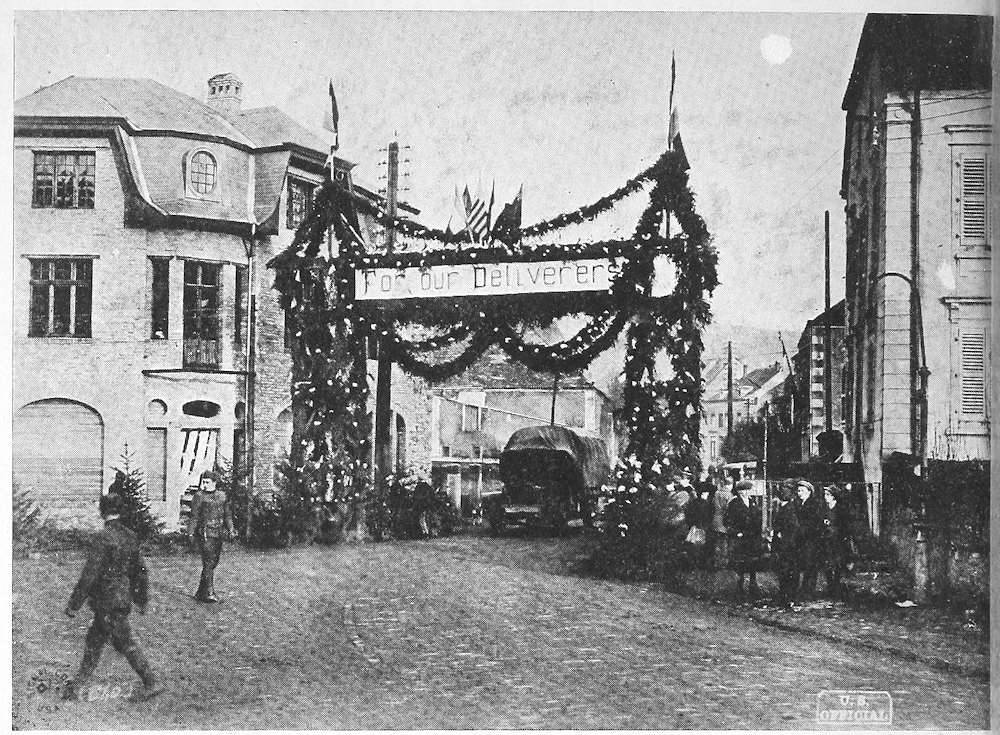
THE ENTRY INTO BELGIUM
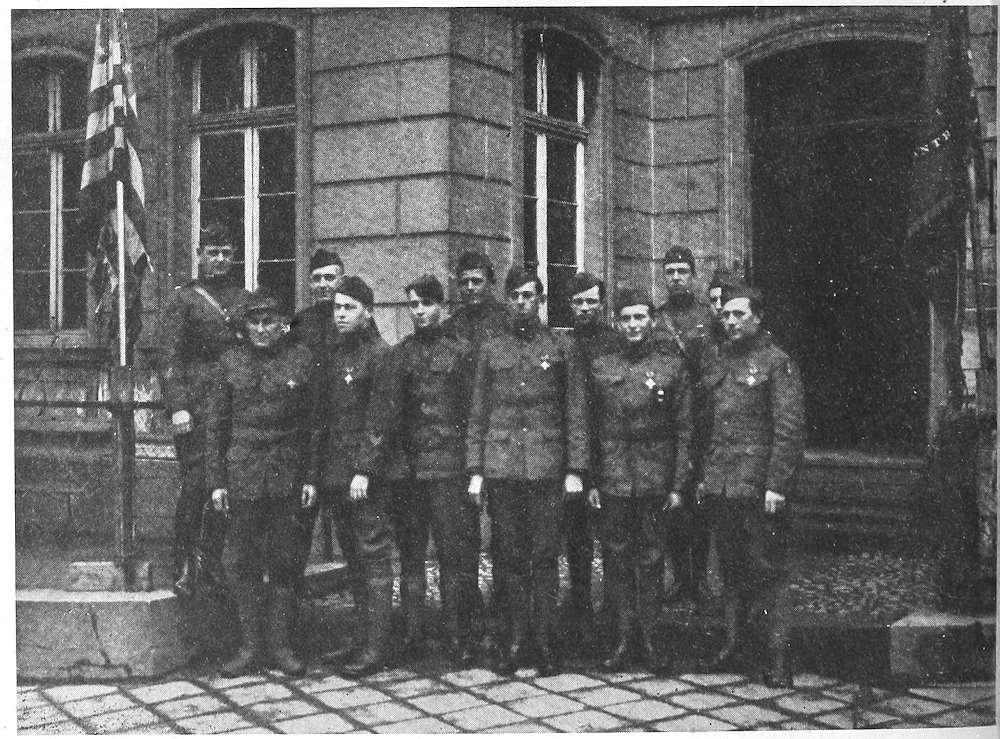
HEADQUARTERS AT REMAGEN GROUP OF RECIPIENTS OF D. S. C.
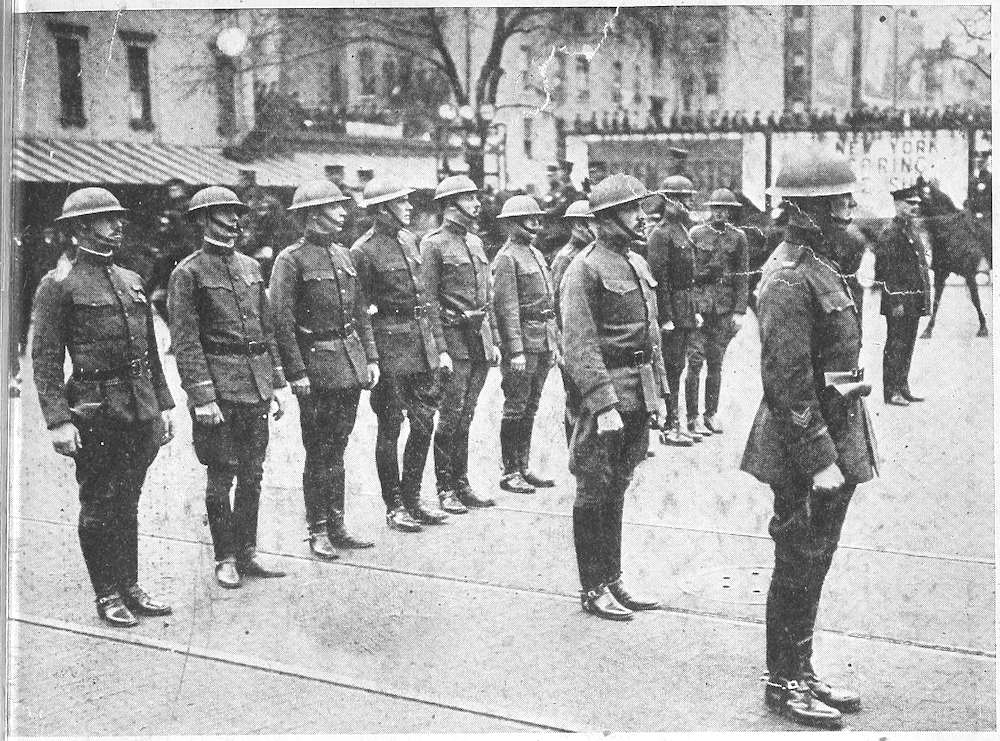
COLONEL DONOVAN AND STAFF REVIEWING PARADE AT 110TH STREET
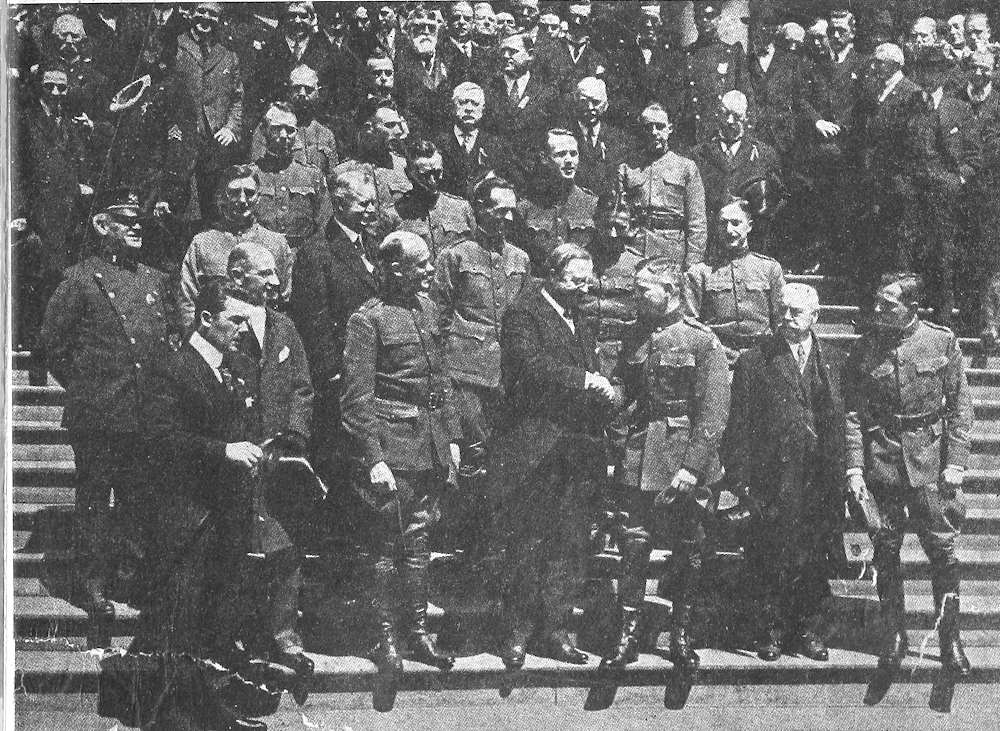
RECEPTION AT CITY HALL