Volume 1 — Chapter VI The Winter Night (continued 3)
Reading edition
“Wednesday, January 31st. The wind is whistling among the hummocks; the snow flies rustling through the air; ice and sky are melted into one. It is dark; our skins are smarting with the cold; but we are going north at full speed, and are in the wildest of gay spirits.
“Thursday, February 1st. The same sort of weather as yesterday, except that it has turned quite mild—7½° Fahr. below zero (-22° C.). The snow is falling exactly as it does in winter weather at home. The wind is more southerly, S.S.E. now, and rather lighter. It may be taken for granted that we have passed the 80th degree, and we had a small preliminary fête this evening—figs, raisins, and almonds—and dart-shooting, which last resulted for me in a timely replenishment of my cigarette-case.”
“Friday, February 2d. High festival to-day in honor of the 80th degree, beginning with fresh rye-bread and cake for breakfast. Took a long walk to get up an appetite for dinner. According to this morning’s observation, we are in 80° 10′ north latitude and 132° 10′ east longitude. Hurrah! Well sailed! I had offered to bet heavily that we had passed 80°, but no one would take the bet. Dinner menu: Ox-tail soup, fish-pudding, potatoes, rissoles, green pease, haricot beans, cloudberries with milk, and a whole bottle of beer to each man. Coffee and a cigarette after dinner. Could one wish for more? In the evening we had tinned pears and peaches, gingerbread, dried bananas, figs, raisins, and almonds. Complete holiday all day. We read aloud the discussions of this expedition published before we left, and had some good laughs at the many objections raised. But our people at home, perhaps, do not laugh if they read them now.
“Monday, February 5th. Last time we shall have Ringnes beer at dinner. Day of mourning.
“Tuesday, February 6th. Calm, clear weather. A strong sun-glow above the horizon in the south; yellow, green, and light blue above that; all the rest of the sky deep ultramarine. I stood looking at it, trying to remember if the Italian sky was ever bluer; I do not think so. It is curious that this deep color should always occur along with cold. Is it perhaps that a current from more northerly, clear regions produces drier and more transparent air in the upper strata? The color was so remarkable to-day that one could not help noticing it. Striking contrasts to it were formed by the Fram’s red deck-house and the white snow on roof and rigging. Ice and hummocks were quite violet wherever they were turned from the daylight. This color was specially strong over the fields of snow upon the floes. The temperature has been 52° Fahr. and 54° Fahr. below zero (-47° and -48° C.). There is a sudden change of 125° Fahr. when one comes up from the saloon, where the thermometer is at 72° Fahr. (+22° C.); but, although thinly clad and bareheaded, one does not feel it cold, and can even with impunity take hold of the brass door-handle or the steel cable of the rigging. The cold is visible, however; one’s breath is like cannon smoke before it is out of one’s mouth; and when a man spits there is quite a little cloud of steam round the fallen moisture. The Fram always gives off a mist, which is carried along by the wind, and a man or a dog can be detected far off among the hummocks or pressure-ridges by the pillar of vapor that follows his progress.
“Wednesday, February 7th. It is extraordinary what a frail thing hope, or rather the mind of man, is. There was a little breeze this morning from the N.N.E., only 6 feet per second, thermometer at 57° Fahr. below zero (-49.6° C.), and immediately one’s brow is clouded over, and it becomes a matter of indifference how we get home, so long as we only get home soon. I immediately assume land to the northward, from which come these cold winds, with clear atmosphere and frost and bright blue skies, and conclude that this extensive tract of land must form a pole of cold with a constant maximum of air-pressure, which will force us south with northeast winds. About midday the air began to grow more hazy and my mood less gloomy. No doubt there is a south wind coming, but the temperature is still too low for it. Then the temperature, too, rises, and now we can rely on the wind. And this evening it came, sure enough, from S.S.W., and now, 12 P.M., its velocity is 11 feet, and the temperature has risen to 43° Fahr. below zero ( -42° C.). This promises well. We should soon reach 81°. The land to the northward has now vanished from my mind’s eye.
“We had lime-juice with sugar at dinner to-day instead of beer, and it seemed to be approved of. We call it wine, and we agreed that it was better than cider. Weighing has gone on this evening, and the increase in certain cases is still disquieting. Some have gained as much as 4 pounds in the last month—for instance, Sverdrup, Blessing, and Juell, who beats the record on board with 13 stone. ‘I never weighed so much as I do now,’ says Blessing, and it is much the same story with us all. Yes, this is a fatiguing expedition, but our menus are always in due proportion to our labors. To-day’s dinner: Knorr’s bean soup, toad-in-the-hole, potatoes, rice and milk, with cranberry jam. Yesterday’s dinner: Fish au gratin (hashed fish) with potatoes, curried rabbit with potatoes and French beans, stewed bilberries, and cranberries with milk. At breakfast yesterday we had freshly baked wheat-bread, at breakfast to-day freshly baked rye-bread. These are specimens of our ordinary bills of fare. It is as I expected: I hear the wind roaring in the rigging now; it is going to be a regular storm, according to our ideas of one here.
“Saturday, February 10th. Though that wind the other day did not come to much after all, we still hoped that we had made good way north, and it was consequently an unwelcome surprise when yesterday’s observation showed our latitude to be 79° 57′ N., 13′ farther south instead of farther north. It is extraordinary how little inured one gets to disappointments; the longing begins again; and again attainment seems so far off, so doubtful. And this though I dream at nights just now of getting out of the ice west of Iceland. Hope is a rickety craft to trust one’s self to. I had a long, successful drive with the dogs to-day.
“Sunday, February 11th. To-day we drove out with two teams of dogs. Things went well; the sledges got on much better over this ice than I thought they would. They do not sink much in the snow. On flat ice four dogs can draw two men.
“Tuesday, February 13th. A long drive southwest yesterday with white dogs. To-day still farther in the same direction on snow-shoes. It is good healthy exercise, with a temperature of 43° Fahr. to 47° Fahr. below zero (-42° and -44° C.) and a biting north wind. Nature is so fair and pure, the ice is so spotless, and the lights and shadows of the growing day so beautiful on the new-fallen snow. The Fram’s hoar-frost-covered rigging rises straight and white with rime towards the sparkling blue sky. One’s thoughts turn to the snow-shoeing days at home.
“Thursday, February 15th. I went yesterday on snow-shoes farther northeast than I have ever been before, but I could still see the ship’s rigging above the edge of the ice. I was able to go fast, because the ice was flat in that direction. To-day I went the same way with dogs. I am examining the ‘lie of the land’ all round, and thinking of plans for the future.
“What exaggerated reports of the Arctic cold are in circulation! It was cold in Greenland, and it is not milder here; the general day temperature just now is about 40° Fahr. and 43° Fahr. below zero. I was clothed yesterday as usual as regards the legs—drawers, knickerbockers, stockings, frieze leggings, snow-socks, and moccasins; my body covering consisted of an ordinary shirt, a wolf-skin cape, and a sealskin jacket, and I sweated like a horse. To-day I sat still, driving with only thin ducks above my ordinary leg wear, and on my body woollen shirt, vest, Iceland woollen jersey, a frieze coat, and a sealskin one. I found the temperature quite pleasant, and even perspired a little to-day, too. Both yesterday and to-day I had a red-flannel mask on my face, but it made me too warm, and I had to take it off, though there was a bitter breeze from the north. That north wind is still persistent, sometimes with a velocity of 9 or even 13 feet, but yet we do not seem to be drifting south; we lie in 80° north latitude, or even a few minutes farther north. What can be the reason of this? There is a little pressure every day just now. Curious that it should again occur at the moon’s change of quarter. The moon stands high in the sky, and there is daylight now, too. Soon the sun will be making his appearance, and when he does we shall hold high festival.
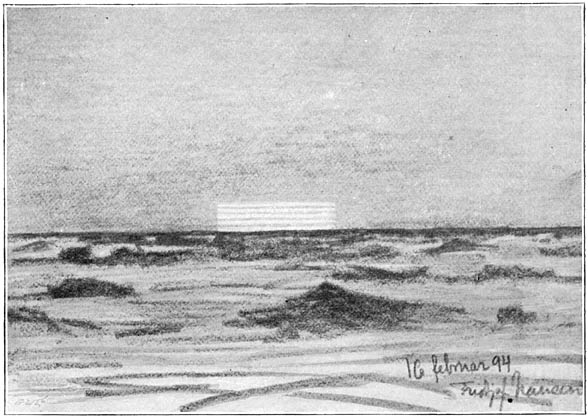
First appearance of the sun
“Friday, February 16th. Hurrah! A meridian observation to-day shows 80° 1′ north latitude, so that we have come a few minutes north since last Friday, and that in spite of constant northerly winds since Monday. There is something very singular about this. Is it, as I have thought all along from the appearance of the clouds and the haziness of the air, that there has been south wind in the south, preventing the drift of the ice that way, or have we at last come under the influence of a current? That shove we got to the south lately in the face of southerly winds was a remarkable thing, and so is our remaining where we are now in spite of the northerly ones. It would seem that new powers of some kind must be at work. “To-day another noteworthy thing happened, which was that about midday we saw the sun, or, to be more correct, an image of the sun, for it was only a mirage. A peculiar impression was produced by the sight of that glowing fire lit just above the outermost edge of the ice. According to the enthusiastic descriptions given by many Arctic travellers of the first appearance of this god of life after the long winter night, the impression ought to be one of jubilant excitement; but it was not so in my case. We had not expected to see it for some days yet, so that my feeling was rather one of pain, of disappointment, that we must have drifted farther south than we thought. So it was with pleasure I soon discovered that it could not be the sun itself. The mirage was at first like a flattened-out glowing red streak of fire on the horizon; later there were two streaks, the one above the other, with a dark space between; and from the main-top I could see four, or even five, such horizontal lines directly over one another, and all of equal length; as if one could only imagine a square dull-red sun with horizontal dark streaks across it. An astronomical observation we took in the afternoon showed that the sun must in reality have been 2° 22′ below the horizon at noon; we cannot expect to see its disk above the ice before Tuesday at the earliest: it depends on the refraction, which is very strong in this cold air. All the same, we had a small sun-festival this evening, on the occasion of the appearance of its image—a treat of figs, bananas, raisins, almonds, and gingerbread.
“Sunday, February 18th. I went eastward yesterday on snow-shoes, and found a good snow-shoeing and driving road out to the flats that lie in that direction. There is a pretty bad bit first, with hummocks and pressure-ridges, and then you come out on these great wide plains, which seem to extend for miles and miles to the north, east, and southeast. To-day I drove out there with eight dogs; the driving goes capitally now; some of the others followed on snow-shoes. Still northerly wind. This is slow work; but anyhow we are having clear, bright weather. Yes, it is all very well—we snow-shoe, sledge, read both for instruction and amusement, write, take observations, play cards, chat, smoke, play chess, eat and drink; but all the same it is an execrable life in the long-run, this—at least, so it seems to me at times. When I look at the picture of our beautiful home in the evening light, with my wife standing in the garden, I feel as if it were impossible that this could go on much longer. But only the merciless fates know when we shall stand there together again, feeling all life’s sweetness as we look out over the smiling fjord, and ... Taking everything into calculation, if I am to be perfectly honest, I think this is a wretched state of matters. We are now in about 80° north latitude, in September we were in 79°; that is, let us say, one degree for five months. If we go on at this rate we shall be at the Pole in forty-five, or say fifty, months, and in ninety or one hundred months at 80° north latitude on the other side of it, with probably some prospect of getting out of the ice and home in a month or two more. At best, if things go on as they are doing now, we shall be home in eight years. I remember Brogger writing before I left, when I was planting small bushes and trees in the garden for future generations, that no one knew what length of shadows these trees would cast by the time I came back. Well, they are lying under the winter snow now, but in spring they will shoot and grow again—how often? Oh! at times this inactivity crushes one’s very soul; one’s life seems as dark as the winter night outside; there is sunlight upon no part of it except the past and the far, far distant future. I feel as if I must break through this deadness, this inertia, and find some outlet for my energies. Can’t something happen? Could not a hurricane come and tear up this ice, and set it rolling in high waves like the open sea? Welcome danger, if it only brings us the chance of fighting for our lives—only lets us move onward! The miserable thing is to be inactive onlookers, not to be able to lift a hand to help ourselves forward. It wants ten times more strength of mind to sit still and trust in your theories and let nature work them out without your being able so much as to lay one stick across another to help, than it does to trust in working them out by your own energy—that is nothing when you have a pair of strong arms. Here I sit, whining like an old woman. Did I not know all this before I started? Things have not gone worse than I expected, but, on the contrary, rather better. Where is now the serene hopefulness that spread itself in the daylight and the sun? Where are those proud imaginings now that mounted like young eagles towards the brightness of the future? Like broken-winged, wet crows they leave the sunlit sea, and hide themselves in the misty marshes of despondency. Perhaps it will all come back again with the south wind; but, no—I must go and rummage up one of the old philosophers again.
“There is a little pressure this evening, and an observation just taken seems to indicate a drift of 3′ south.
“11 P.M. Pressure in the opening astern. The ice is cracking and squeezing against the ship, making it shake.
“Monday, February 19th. Once more it may be said that the night is darkest just before the dawn. Wind began to blow from the south to-day, and has reached a velocity of 13 feet per second. We did some ice-boring this morning, and found that the ice to port is 5 feet 11–⅝ inches (1.875 metres) thick, with a layer of about 1½ inches of snow over it. The ice forward was 6 feet 7½ inches (2.08 metres) thick, but a couple of inches of this was snow. This cannot be called much growth for quite a month, when one thinks that the temperature has been down to 58° Fahr. below zero.
“Both to-day and yesterday we have seen the mirage of the sun again; to-day it was high above the horizon, and almost seemed to assume a round, disk-like form. Some of the others maintain that they have seen the upper edge of the sun itself; Peter and Bentzen, that they have seen at least half of the disk, and Juell and Hansen declare that the whole of it was above the horizon. I am afraid it is so long since they saw it that they have forgotten what it is like.
“Tuesday, February 20th. Great sun festival to-day without any sun. We felt certain we should see it, but there were clouds on the horizon. However, we were not going to be cheated out of our festival; we can hold another on the occasion of really seeing it for the first time. We began with a grand rifle practice in the morning; then there was a dinner of three or four courses and ‘Fram wine,’ otherwise lime-juice, coffee afterwards with ‘Fram cake.’ In the evening pineapple, cake, figs, bananas, and sweets. We go off to bed feeling that we have over-eaten ourselves, while half a gale from the S.E. is blowing us northward. The mill has been going to-day, and though the real sun did not come to the festival, our saloon sun lighted up our table both at dinner and supper. Great face-washing in honor of the day. The way we are laying on flesh is getting serious. Several of us are like prize pigs, and the bulge of cook Juell’s cheeks, not to mention another part of his body, is quite alarming. I saw him in profile to-day, and wondered how he would ever manage to carry such a corporation over the ice if we should have to turn out one of these fine days. Must begin to think of a course of short rations now.
“Wednesday, February 21st. The south wind continues. Took up the bag-nets to-day which were put out the day before yesterday. In the upper one, which hung near the surface, there were chiefly amphipoda; in Murray’s net, which hung at about 50 fathoms’ depth, there was a variety of small crustacea and other small animals shining with such a strong phosphorescence that the contents of the net looked like glowing embers as I emptied them out in the cook’s galley by lamplight. To my astonishment the net-line pointed northwest, though from the wind there ought to be a good northerly drift. To clear this matter up I let the net down in the afternoon, and as soon as it got a little way under the ice the line pointed northwest again, and continued to do so the whole afternoon. How is this phenomenon to be explained? Can we, after all, be in a current moving northwest? Let us hope that the future will prove such to be the case. We can reckon on two points of variation in the compass, and in that case the current would make due N.N.W. There seems to be strong movement in the ice. It has opened and formed channels in several places.
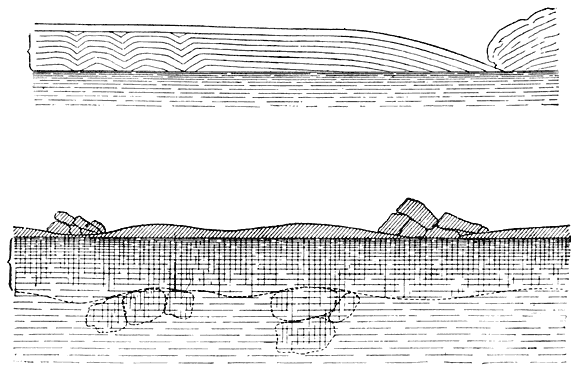
Diagrams of ice with layers
It was extraordinary too to see how this floe of over three yards in thickness was bent into great waves without breaking. This was clearly done by pressure, and was specially noticeable, more particularly near the pressure-ridges, which had forced the floe down so that its upper surface lay even with the water-line, while at other places it was a good half-yard above it, in these last cases thrust up by ice pressed in below. It all shows how extremely plastic these floes are, in spite of the cold; the temperature of the ice near the surface must have been from 4° Fahr. to 22° Fahr. below zero (-20° to -30° C.) at the time of these pressures. In many places the bending had been too violent, and the floe had cracked. The cracks were often covered with loose ice, so that one could easily enough fall into them, just as in crossing a dangerous glacier.
“Saturday, February 24th. Observations to-day show us to be in 79° 54′ north latitude, 132° 57′ east longitude. Strange that we should have come so far south when the north or northwest wind only blew for twenty-four hours.
“Sunday, February 25th. It looks as if the ice were drifting eastward now. Oh! I see pictures of summer and green trees and rippling streams. I am reading of valley and mountain life, and I grow sick at heart and enervated. Why dwell on such things just now? It will be many a long day before we can see all that again. We are going at the miserable pace of a snail, but not so surely as it goes. We carry our house with us; but what we do one day is undone the next.
“Monday, February 26th. We are drifting northeast. A tremendous snow-storm is going on. The wind has at times a velocity of over 35 feet per second; it is howling in the rigging, whistling over the ice, and the snow is drifting so badly that a man might be lost in it quite near at hand. We are sitting here listening to the howling in the chimney and in the ventilators, just as if we were sitting in a house at home in Norway. The wings of the windmill have been going round at such a rate that you could hardly distinguish them; but we have had to stop the mill this evening because the accumulators are full, and we fastened up the wings so that the wind might not destroy them. We have had electric light for almost a week now.
“This is the strongest wind we have had the whole winter. If anything can shake up the ice and drive us north, this must do it. But the barometer is falling too fast; there will be north wind again presently. Hope has been disappointed too often; it is no longer elastic; and the gale makes no great impression on me. I look forward to spring and summer, in suspense as to what change they will bring. But the Arctic night, the dreaded Arctic night, is over, and we have daylight once again. I must say that I see no appearance of the sunken, wasted faces which this night ought to have produced; in the clearest daylight and the brightest sunshine I can only discover plump, comfortable-looking ones. It is curious enough, though, about the light. We used to think it was like real day down here when the incandescent lamps were burning; but now, coming down from the daylight, though they may be all lit, it is like coming into a cellar. When the arc lamp has been burning all day, as it has to-day, and is then put out and its place supplied by the incandescent ones, the effect is much the same.
“Tuesday, February 27th. Drifting E.S.E. My pessimism is justified. A strong west wind has blown almost all day; the barometer is low, but has begun to rise unsteadily. The temperature is the highest we have had all winter; to-day’s maximum is 15° Fahr. above zero (-9.7° C.). At 8 P.M. the thermometer stood at 7° Fahr. below zero (-22° C.). The temperature rises and falls almost exactly conversely with the barometer. This afternoon’s observation places us in about 80° 10′ north latitude.
“Wednesday, February 28th. Beautiful weather to-day, almost still, and temperature only about 15° Fahr. to 22° Fahr. below zero (-26° to -30° 5′ C.). There were clouds in the south, so that not much was to be seen of the sun; but it is light wonderfully long already. Sverdrup and I went snow-shoeing after dinner—the first time this year that we have been able to do anything of the kind in the afternoon. We made attempts to pump yesterday and to-day; there ought to be a little water, but the pump would not suck, though we tried both warm water and salt. Possibly there is water frozen round it, and possibly there is no water at all. In the engine-room there has been no appearance of water for more than a month, and none comes into the forehold, especially now that the bow is raised up by the pack-ice; so if there is any it can only be a little in the hold. This tightening may be attributed chiefly to the frost.
“The wind has begun to blow again from the S.S.W. this evening, and the barometer is falling, which ought to mean good wind coming; but the barometer of hope does not rise above its normal height. I had a bath this evening in a tin tub in the galley; trimmed and clean, one feels more of a human being.
“Thursday, March 1st. We are lying almost still. Beautiful mild weather, only 2½° Fahr. below zero (-19° C.), sky overcast; light fall of snow, and light wind. We made attempts to sound to-day, having lengthened our hemp line with a single strand of steel. This broke off with the lead. We put on a new lead and the whole line ran out, about 2000 fathoms, without touching bottom, so far as we could make out. In process of hauling in, the steel line broke again. So the results are: no bottom, and two sounding-leads, each of 100 pounds’ weight, making their way down. Goodness knows if they have reached the bottom yet. I declare I feel inclined to believe that Bentzen is right, and that it is the hole at the earth’s axis we are trying to sound.
“Friday, March 2d. The pups have lived until now in the chart-room, and have done all the mischief there that they could, gnawing the cases of Hansen’s instruments, the log-books, etc. They were taken out on deck yesterday for the first time, and to-day they have been there all the morning. They are of an inquiring turn of mind, and examine everything, being specially interested in the interiors of all the kennels in this new, large town.
“Sunday, March 4th. The drift is still strong south. There is northwesterly wind to-day again, but not quite so much of it. I expected we had come a long way south, but yesterday’s observation still showed 79° 54′ north latitude. We must have drifted a good way north during the last days before this wind came. The weather yesterday and to-day has been bitter, 35° Fahr. and 36½° Fahr. below zero (-37° and -38° C.), with sometimes as much as 35 feet of wind per second, must be called cool. It is curious that now the northerly winds bring cold, and the southerly warmth. Earlier in the winter it was just the opposite.
“Monday, March 5th. Sverdrup and I have been a long way northeast on snow-shoes. The ice was in good condition for it; the wind has tossed about the snow finely, covering over the pressure-ridge as far as the scanty supply of material has permitted.
“Tuesday, March 6th. No drift at all. It has been a bitter day to-day, 47° Fahr. to 50° Fahr. below zero (-44° to -46° C.), and wind up to 19 feet. This has been a good occasion for getting hands and face frost-bitten, and one or two have taken advantage of it. Steady northwest wind. I am beginning to get indifferent and stolid as far as the wind is concerned. I photographed Johansen to-day at the anemometer, and during the process his nose was frost-bitten.
“There has been a general weighing this evening again. These weighings are considered very interesting performances, and we stand watching in suspense to see whether each man has gained or lost. Most of them have lost a little this time. Can it be because we have stopped drinking beer and begun lime-juice? But Juell goes on indefatigably—he has gained nearly a pound this time. Our doctor generally does very well in this line too, but to-day it is only 10 ounces. In other ways he is badly off on board, poor fellow—not a soul will turn ill. In despair he set up a headache yesterday himself, but he could not make it last over the night. Of late he has taken to studying the diseases of dogs; perhaps he may find a more profitable practice in this department.
“Thursday, March 8th. Drifting south. Sverdrup and I had a good snow-shoeing trip to-day, to the north and west. The snow was in splendid condition after the winds; you fly along like thistledown before a breeze, and can get about everywhere, even over the worst pressure-mounds. The weather was beautiful, temperature only 38° Fahr. below zero (-39° C.); but this evening it is quite bitter again, 55° Fahr. (-48.5° C.) and from 16 to 26 feet of wind. It is by no means pleasant work standing up on the windmill, reefing or taking in the sails; it means aching nails, and sometimes frost-bitten cheeks; but it has to be done, and it is done. There is plenty of ‘mill-wind’ in the daytime now—this is the third week we have had electric light—but it is wretched that it should be always this north and northwest wind; goodness only knows when it is going to stop. Can there be land north of us? We are drifting badly south. It is hard to keep one’s faith alive. There is nothing for it but to wait and see what time will do.
“After a long rest the ship got a shake this afternoon. I went on deck. Pressure was going on in an opening just in front of the bow. We might almost have expected it just now, as it is new moon; only we have got out of the way of thinking at all about the spring tides, as they have had so little effect lately. They should of course be specially strong just now, as the equinox is approaching.
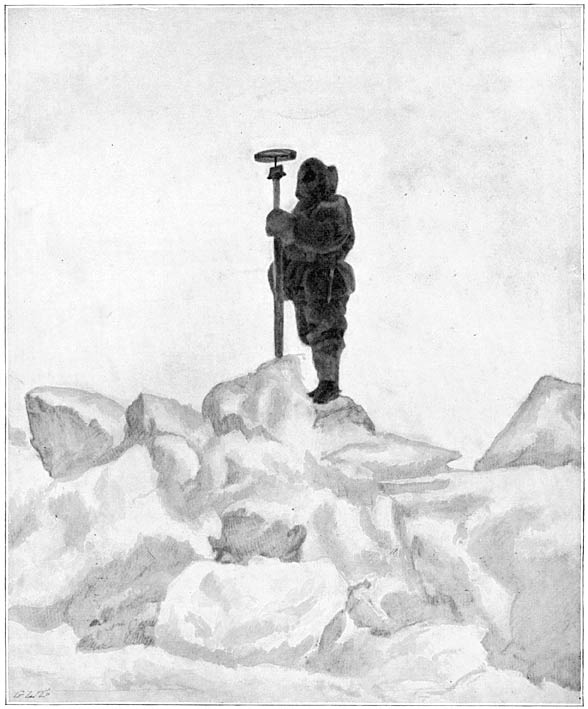
Johansen reading the anemometer
(From a photograph)
“Friday, March 9th. The net-line pointed slightly southwest this morning; but the line attached to a cheese which was only hanging a few fathoms below the ice to thaw faster, seemed to point in the opposite direction. Had we got a southerly current together with the wind now? H’m! in that case something must come of it! Or was it, perhaps, only the tide setting that way?
“Still the same northerly wind; we are steadily bearing south. This, then, is the change I hoped the March equinox would bring! We have been having northerly winds for more than a fortnight. I cannot conceal from myself any longer that I am beginning to despond. Quietly and slowly, but mercilessly, one hope after the other is being crushed and ... have I not a right to be a little despondent? I long unutterably after home, perhaps I am drifting away farther from it, perhaps nearer; but anyhow it is not cheering to see the realization of one’s plans again and again delayed, if not annihilated altogether, in this tedious and monotonously killing way. Nature goes her age-old round impassively; summer changes into winter; spring vanishes away; autumn comes, and finds us still a mere chaotic whirl of daring projects and shattered hopes. As the wheel revolves, now the one and now the other comes to the top—but memory betweenwhiles lightly touches her ringing silver chords—now loud like a roaring waterfall, now low and soft like far off sweet music. I stand and look out over this desolate expanse of ice with its plains and heights and valleys, formed by the pressure arising from the shifting tidal currents of winter. The sun is now shining over them with his cheering beams. In the middle lies the Fram, hemmed in immovably. When, my proud ship, will you float free in the open water again?
“‘Ich schau dich an, und Wehmuth,
Schleicht mir in’s Herz hinein.’
Over these masses of ice, drifting by paths unknown, a human pondered and brooded so long that he put a whole people in motion to enable him to force his way in among them—a people who had plenty of other claims upon their energies. For what purpose all this to-do? If only the calculations were correct these ice-floes would be glorious—nay, irresistible auxiliaries. But if there has been an error in the calculation—well, in that case they are not so pleasant to deal with. And how often does a calculation come out correct? But were I now free? Why, I should do it all over again, from the same starting-point. One must persevere till one learns to calculate correctly.
“I laugh at the scurvy; no sanatorium better than ours.
“I laugh at the ice; we are living as it were in an impregnable castle.
“I laugh at the cold; it is nothing.
“But I do not laugh at the winds; they are everything; they bend to no man’s will.
“But why always worry about the future? Why distress yourself as to whether you are drifting forward or backward? Why not carelessly let the days glide by like a peacefully flowing river? every now and then there will come a rapid that will quicken the lazy flow. Ah! what a wondrous contrivance is life—one eternal hurrying forward, ever forward—to what end? And then comes death and cuts all short before the goal is reached.
“I went a long snow-shoe tour to-day. A little way to the north there were a good many newly formed lanes and pressure-ridges which were hard to cross, but patience overcomes everything, and I soon reached a level plain where it was delightful going. It was, however, rather cold, about 54° Fahr. below zero (-48° C.) and 16 feet of wind from N.N.E., but I did not feel it much. It is wholesome and enjoyable to be out in such weather. I wore only ordinary clothes, such as I might wear at home, with a sealskin jacket and linen outside breeches, and a half-mask to protect the forehead, nose, and cheeks.
“There has been a good deal of ice-pressure in different directions to-day. Oddly enough, a meridian altitude of the sun gave 79° 45′. We have therefore drifted only 8′ southward during the four days since March 4th. This slow drift is remarkable in spite of the high winds. If there should be land to the north? I begin more and more to speculate on this possibility. Land to the north would explain at once our not progressing northward, and the slowness of our southward drift. But it may also possibly arise from the fact of the ice being so closely packed together, and frozen so thick and massive. It seems strange to me that there is so much northwest wind, and hardly any from the northeast, though the latter is what the rotation of the earth would lead one to expect. As a matter of fact, the wind merely shifts between northwest and southeast, instead of between southwest and northeast, as it ought to do. Unless there is land I am at a loss to find a satisfactory explanation, at all events, of this northwest direction. Does Franz Josef Land jut out eastward or northward, or does a continuous line of islands extend from Franz Josef Land in one or other of those directions? It is by no means impossible. Directly the Austrians got far enough to the north they met with prevailing winds from the northeast, while we get northwesterly winds. Does the central point of these masses of land lie to the north, midway between our meridian and theirs? I can hardly believe that these remarkably cold winds from the north are engendered by merely passing over an ice-covered sea. If, indeed, there is land, and we get hold of it, then all our troubles would be over. But no one can tell what the future may bring forth, and it is better, perhaps, not to know.
“Saturday, March 10th. The line shows a drift northward; now, too, in the afternoon, a slight southerly breeze has sprung up. As usual, it has done me good to put my despondency on paper and get rid of it. To-day I am in good spirits again, and can indulge in happy dreams of a large and high land in the north with mountains and valleys, where we can sit under the mountain wall, roast ourselves in the sun, and see the spring come. And over its inland ice we can make our way to the very Pole.
“Monday, March 12th. Slowly drifting southward. Took a long snow-shoe run alone, towards the north; to-day had on my wind breeches, but found them almost too warm. This morning it was 51.6° Fahr. below zero, and about 13 feet N. wind; at noon it was some degrees warmer. Ugh! this north wind is freshening; the barometer has risen again, and I had thought the wind would have changed, but it is and remains the same.
“This is what March brings us—the month on which my hopes relied. Now I must wait for the summer. Soon the half-year will be past, it will leave us about in the same place as when-it began. Ugh! I am weary—so weary! Let me sleep, sleep! Come, sleep! noiselessly close the door of the soul, stay the flowing stream of thought! Come dreams, and let the sun beam over the snowless strand of Godthaab!
“Wednesday, March 14th. In the evening the dogs all at once began to bark, as we supposed on account of bears. Sverdrup and I took our guns, let ‘Ulenka’ and ‘Pan’ loose, and set off. There was twilight still, and the moon, moreover, began to shine. No sooner were the dogs on the ice than off they started westward like a couple of rockets, we after them as quickly as we could. As I was jumping over a lane I thrust one leg through the ice up to the knee. Oddly enough, I did not get wet through to the skin, though I only had Finn shoes and frieze gaiters on; but in this temperature, 38° Fahr. below zero (-39° C.), the water freezes on the cold cloth before it can penetrate it. I felt nothing of it afterwards; it became, as it were, a plate of ice armor that almost helped to keep me warm. At a channel some distance off we at last discovered that it was not a bear the dogs had winded, but either a walrus or a seal. We saw holes in several places on the fresh-formed ice where it had stuck its head through. What a wonderfully keen nose those dogs must have: it was quite two-thirds of a mile from the ship, and the creature had only had just a little bit of its snout above the ice. We returned to the ship to get a harpoon, but saw no more of the animal, though we went several times up and down the channel. Meanwhile ‘Pan,’ in his zeal, got too near the edge of the lane and fell into the water. The ice was so high that he could not get up on it again without help, and if I had not been there to haul him up I am afraid he would have been drowned. He is now lying in the saloon, and making himself comfortable and drying himself. But he, too, did not get wet through to the skin, though he was a good time in the water: the inner hair of his close, coarse coat is quite dry and warm. The dogs look on it as a high treat to come in here, for they are not often allowed to do so. They go round all the cabins and look out for a comfortable corner to lie down in.
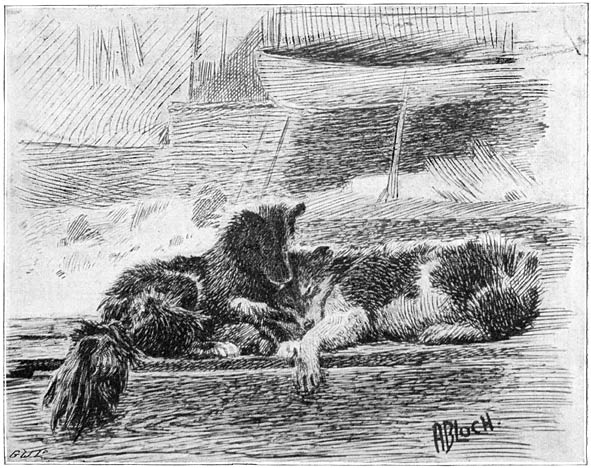
Two friends
(By A. Bloch, from a Photograph)
“Lovely weather, almost calm, sparklingly bright, and moonshine: in the north the faint flush of evening, and the aurora over the southern sky, now like a row of flaming spears, then changing into a silvery veil, undulating in wavy folds with the wind, every here and there interspersed with red sprays. These wonderful night effects are ever new, and never fail to captivate the soul.”
“Thursday, March 15th. This morning 41.7°, and at 8 P.M. 40.7° Fahr. below zero, while the daytime was rather warmer. At noon it was 40.5° and at 4 P.M. 39° Fahr. below zero. It would almost seem as if the sun began to have power.
“The dogs are strange creatures. This evening they are probably sweltering in their kennels again, for four or five of them are lying outside or on the roof. When there are 50 degrees of cold most of them huddle together inside, and lie as close to one another as possible. Then, too, they are very loath to go out for a walk; they prefer to lie in the sun under the lee of the ship. But now they find it so mild and such pleasant walking that to-day it was not difficult to get them to follow.
“Friday, March 16th. Sverdrup has of late been occupied in making sails for the ship’s boats. To-day there was a light southwesterly breeze, so we tried one of the sails on two hand-sledges lashed together. It is first-rate sailing, and does not require much wind to make them glide along. This would be a great assistance if we had to go home over the ice.
“Wednesday, March 21st. At length a reaction has set in: the wind is S.E. and there is a strong drift northward again. The equinox is past, and we are not one degree farther north since the last equinox. I wonder where the next will find us. Should it be more to the south, then victory is uncertain; if more to the north, the battle is won, though it may last long. I am looking forward to the summer; it must bring a change with it. The open water we sailed in up here cannot possibly be produced by the melting of the ice alone; it must be also due to the winds and current. And if the ice in which we are now drifts so far to the north as to make room for all this open water, we shall have covered a good bit on our way. It would seem, indeed, as if summer must bring northerly winds, with the cold Arctic Sea in the north and warm Siberia in the south. This makes me somewhat dubious; but, on the other hand, we have warm seas in the west: they may be stronger; and the Jeannette, moreover, drifted northwest.
“It is strange that, notwithstanding these westerly winds, we do not drift eastward. The last longitude was only 135° east longitude.
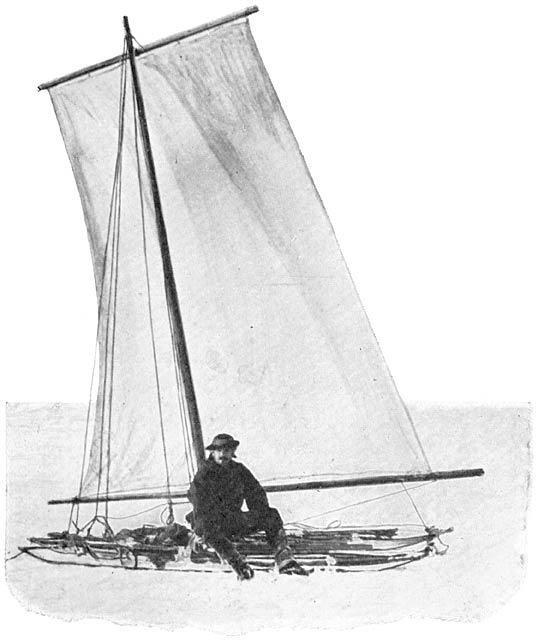
Experiment in sledge sailing
(From a Photograph)
“Maundy Thursday, March 22d. A strong southeasterly wind still, and a good drift northward. Our spirits are rising. The wind whistles through the rigging overhead, and sounds like the sough of victory through the air. In the forenoon one of the puppies had a severe attack of convulsions; it foamed at the mouth and bit furiously at everything round it. It ended with tetanus, and we carried it out and laid it down on the ice. It hopped about like a toad, its legs stiff and extended, neck and head pointing upward, while its back was curved like a saddle. I was afraid it might be hydrophobia or some other infectious sickness, and shot it on the spot. Perhaps I was rather too hasty; we can scarcely have any infection among us now. But what could it have been? Was it an epileptic attack? The other day one of the other puppies alarmed me by running round and round in the chart-house as if it were mad, hiding itself after a time between a chest and the wall. Some of the others, too, had seen it do the same thing; but after a while it got all right again, and for the last few days there has been nothing amiss with it.
“Good Friday, March 23d. Noonday observation gives 80° north latitude. In four days and nights we have drifted as far north as we drifted southward in three weeks. It is a comfort, at all events, to know that!
“It is remarkable how quickly the nights have grown light. Even stars of the first magnitude can now barely manage to twinkle in the pale sky at midnight.
“Saturday, March 24th. Easter Eve. To-day a notable event has occurred. We have allowed the light of spring to enter the saloon. During the whole of the winter the skylight was covered with snow to keep the cold out, and the dogs’ kennels, moreover, had been placed round it. Now we have thrown out all the snow upon the ice, and the panes of glass in the skylight have been duly cleared and cleaned.
“Monday, March 26th. We are lying motionless—no drift. How long will this last? Last equinox how proud and triumphant I was! The whole world looked bright; but now I am proud no longer.
“The sun mounts up and bathes the ice-plain with its radiance. Spring is coming, but brings no joys with it. Here it is as lonely and cold as ever. One’s soul freezes. Seven more years of such life—or say only four—how will the soul appear then? And she...? If I dared to let my longings loose—to let my soul thaw. Ah! I long more than I dare confess.
“I have not courage to think of the future.... And how will it be at home, when year after year rolls by and no one comes?
“I know this is all a morbid mood; but still this inactive, lifeless monotony, without any change, wrings one’s very soul. No struggle, no possibility of struggle! All is so still and dead, so stiff and shrunken, under the mantle of ice. Ah! ... the very soul freezes. What would I not give for a single day of struggle—for even a moment of danger!
“Still I must wait, and watch the drift; but should it take a wrong direction, then I will break all the bridges behind me, and stake everything on a northward march over the ice. I know nothing better to do. It will be a hazardous journey—a matter, maybe, of life or death. But have I any other choice?
“It is unworthy of a man to set himself a task, and then give in when the brunt of the battle is upon him. There is but one way, and that is Fram—forward.
“Tuesday, March 27th. We are again drifting southward, and the wind is northerly. The midday observation showed 80° 4′ north latitude. But why so dispirited? I am staring myself blind at one single point—am thinking solely of reaching the Pole and forcing our way through to the Atlantic Ocean. And all the time our real task is to explore the unknown polar regions. Are we doing nothing in the service of science? It will be a goodly collection of observations that we shall take home with us from this region, with which we are now rather too well acquainted. The rest is, and remains, a mere matter of vanity. ‘Love truth more, and victory less.’
“I look at Eilif Peterssen’s picture, a Norwegian pine forest, and I am there in spirit. How marvellously lovely it is there now, in the spring, in the dim, melancholy stillness that reigns among the stately stems! I can feel the damp moss in which my foot sinks softly and noiselessly; the brook, released from the winter bondage, is murmuring through the clefts and among the rocks, with its brownish-yellow water; the air is full of the scent of moss and pine-needles; while overhead, against the light-blue sky, the dark pine-tops rock to and fro in the spring breeze, ever uttering their murmuring wail, and beneath their shelter the soul fearlessly expands its wings and cools itself in the forest dew.
“O solemn pine forest, the only confidant of my childhood, it was from you I learned nature’s deepest tones—its wildness, its melancholy! You colored my soul for life.
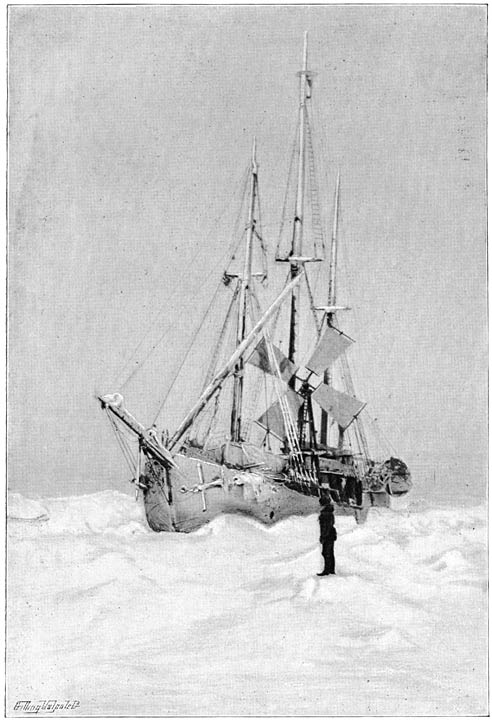
At the coming of the Spring. March, 1894
(From a photograph)
“Alone—far in the forest—beside the glowing embers of my fire on the shore of the silent, murky woodland tarn, with the gloom of night overhead, how happy I used to be in the enjoyment of nature’s harmony!
“Thursday, March 29th. It is wonderful what a change it makes to have daylight once more in the saloon. On turning out for breakfast and seeing the light gleaming in, one feels that it really is morning.
“We are busy on board. Sails are being made for the boats and hand-sledges. The windmill, too, is to have fresh sails, so that it can go in any kind of weather. Ah, if we could but give the Fram wings as well! Knives are being forged, bear-spears which we never have any use for, bear-traps in which we never catch a bear, axes, and many other things of like usefulness. For the moment there is a great manufacture of wooden shoes going on, and a newly started nail-making industry. The only shareholders in this company are Sverdrup and Smith Lars, called ‘Storm King,’ because he always comes upon us like hard weather. The output is excellent and is in active demand, as all our small nails for the hand-sledge fittings have been used. Moreover, we are very busy putting German-silver plates under the runners of the hand-sledges, and providing appliances for lashing sledges together. There is, moreover, a workshop for snow-shoe fastenings, and a tinsmith’s shop, busied for the moment with repairs to the lamps. Our doctor, too, for lack of patients, has set up a bookbinding establishment which is greatly patronized by the Fram’s library, whereof several books that are in constant circulation, such as Gjest Baardsens Liv og Levnet, etc., are in a very bad state. We have also a saddlers’ and sail-makers’ workshop, a photographic studio, etc. The manufacture of diaries, however, is the most extensive—every man on board works at that. In fine, there is nothing between heaven and earth that we cannot turn out—excepting constant fair winds.
“Our workshops can be highly recommended; they turn out good solid work. We have lately had a notable addition to our industries, the firm ‘Nansen & Amundsen’ having established a music-factory. The cardboard plates of the organ had suffered greatly from wear and damp, so that we had been deplorably short of music during the winter. But yesterday I set to work in earnest to manufacture a plate of zinc. It answers admirably, and now we shall go ahead with music sacred and profane, especially waltzes, and these halls shall once more resound with the pealing tones of the organ, to our great comfort and edification. When a waltz is struck up it breathes fresh life into many of the inmates of the Fram.
“I complain of the wearing monotony of our surroundings; but in reality I am unjust. The last few days, dazzling sunshine over the snow-hills; to-day, snow-storm and wind, the Fram enveloped in a whirl of foaming white snow. Soon the sun appears again, and the waste around gleams as before.
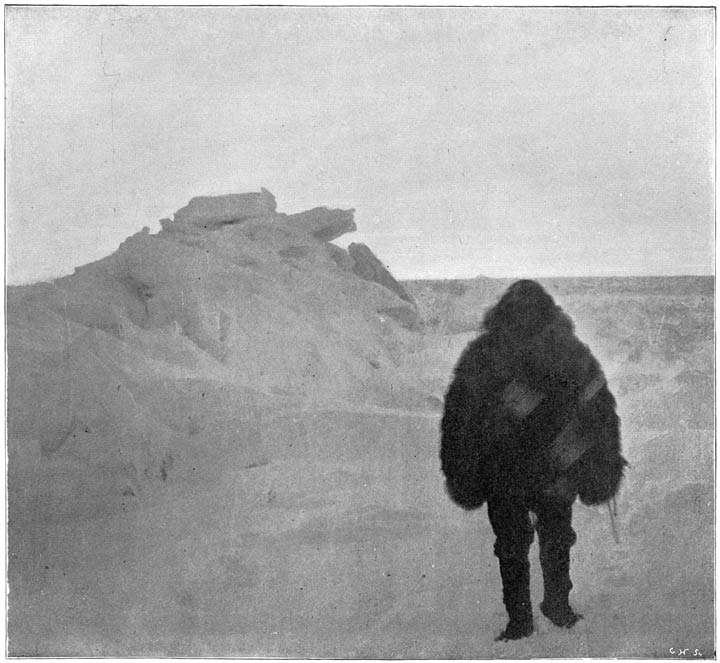
Returning home after sunset. March 31, 1894
(From a photograph)
“Here, too, there is sentiment in nature. How often, when least thinking of it, do I find myself pause, spell-bound by the marvellous hues which evening wears. The ice-hills steeped in bluish-violet shadows, against the orange-tinted sky, illumined by the glow of the setting sun, form as it were a strange color-poem, imprinting an ineffaceable picture on the soul. And these bright, dream-like nights, how many associations they have for us Northmen! One pictures to one’s self those mornings in spring when one went out into the forest after blackcock, under the dim stars, and with the pale crescent moon peering over the tree-tops. Dawn, with its glowing hues up here in the north, is the breaking of a spring day over the forest wilds at home; the hazy blue vapor beneath the morning glow turns to the fresh early mist over the marshes; the dark low clouds on a background of dim red seem like distant ranges of hills.
“Daylight here, with its rigid, lifeless whiteness, has no attractions; but the evening and night thaw the heart of this world of ice; it dreams mournful dreams, and you seem to hear in the hues of the evening sounds of its smothered wail. Soon these will cease, and the sun will circle round the everlasting light-blue expanse of heaven, imparting one uniform color to day and night alike.
“Friday, April 6th. A remarkable event was to take place to-day which, naturally, we all looked forward to with lively interest. It was an eclipse of the sun. During the night Hansen had made a calculation that the eclipse would begin at 12.56 o’clock. It was important for us to be able to get a good observation, as we should thus be able to regulate our chronometers to a nicety. In order to make everything sure, we set up our instruments a couple of hours beforehand, and commenced to observe. We used the large telescope and our large theodolite. Hansen, Johansen, and myself took it by turns to sit for five minutes each at the instruments, watching the rim of the sun, as we expected a shadow would become visible on its lower western edge, while another stood by with the watch. We remained thus full two hours without anything occurring. The exciting moment was now at hand, when, according to calculation, the shadow should first be apparent. Hansen was sitting by the large telescope when he thought he could discern a quivering in the sun’s rim; 33 seconds afterwards he cried out, ‘Now!’ as did Johansen simultaneously. The watch was then at 12 hrs. 56 min. 7.5 sec. A dark body advanced over the border of the sun 7½ seconds later than we had calculated on. It was an immense satisfaction for us all, especially for Hansen, for it proved our chronometers to be in excellent order. Little by little the sunlight sensibly faded away, while we went below to dinner. At 2 o’clock the eclipse was at its height, and we could notice even down in the saloon how the daylight had diminished. After dinner we observed the moment when the eclipse ended, and the moon’s dark disk cleared the rim of the sun.
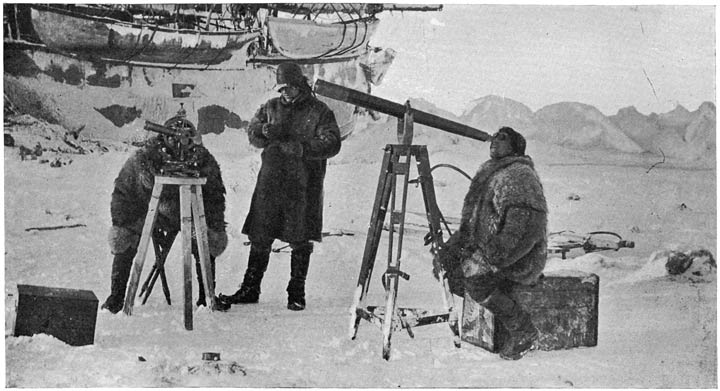
Observing the eclipse of the sun. April 6, 1894
Johansen Nansen Scott-Hansen
(From a photograph)
“Sunday, April 8th. I was lying awake yesterday morning thinking about getting up, when all at once I heard the hurried footsteps of some one running over the half-deck above me, and then another followed. There was something in those footsteps that involuntarily made me think of bears, and I had a hazy sort of an idea that I ought to jump up out of bed, but I lay still, listening for the report of a gun. I heard nothing, however, and soon fell a-dreaming again. Presently Johansen came tearing down into the saloon, crying out that a couple of bears were lying half or quite dead on the large ice hummock astern of the ship. He and Mogstad had shot at them, but they had no more cartridges left. Several of the men seized hold of their guns and hurried up. I threw on my clothes and came up a little after, when I gathered that the bears had taken to flight, as I could see the other fellows following them over the ice. As I was putting on my snow-shoes they returned, and said that the bears had made off. However, I started after them as fast as my snow-shoes would take me across the floes and the pressure-ridges. I soon got on their tracks, which at first were a little blood-stained. It was a she-bear, with her cub, and, as I believed, hard hit—the she-bear had fallen down several times after Johansen’s first bullet. I thought, therefore, it would be no difficult matter to overtake them. Several of the dogs were on ahead of me on their tracks. They had taken a northwesterly course, and I toiled on, perspiring profusely in the sun, while the ship sank deeper and deeper down below the horizon. The surface of the snow, sparkling with its eternal whiteness all around me, tried my eyes severely, and I seemed to get no nearer the bears. My prospects of coming up with them were ruined by the dogs, who were keen enough to frighten the bears, but not so keen as to press on and bring them to bay. I would not, however, give up. Presently a fog came on and hid everything from view except the bear-tracks, which steadily pointed forward; then it lifted, and the sun shone out again clear and bright as before. The Fram’s masts had long since disappeared over the edge of the ice, but still I kept on. Presently, however, I began to feel faint and hungry, for in my hurry I had not even had my breakfast, and at last had to bite the sour apple and turn back without any bears.
“On my way I came across a remarkable hummock. It was over 20 feet in height (I could not manage to measure it quite to the top); the middle part had fallen in, probably from pressure of the ice, while the remaining part formed a magnificent triumphal arch of the whitest marble, on which the sun glittered with all its brilliancy. Was it erected to celebrate my defeat? I got up on it to look out for the Fram, but had to go some distance yet before I could see her rigging over the horizon. It was not till half-past five in the afternoon that I found myself on board again, worn out and famished from this sudden and unexpected excursion. After a day’s fasting I heartily relished a good meal. During my absence some of the others had started after me with a sledge to draw home the dead bears that I had shot; but they had barely reached the spot where the encounter had taken place, when Johansen and Blessing, who were in advance of the others, saw two fresh bears spring up from behind a hummock a little way off. But before they could get their guns in readiness the bears were out of range; so a new hunt began. Johansen tore after them in his snow-shoes, but several of the dogs got in front of him and kept the bears going, so that he could not get within range, and his chase ended as fruitlessly as mine.
“Has good-luck abandoned us? I had plumed myself on our never having shot at a single bear without bagging it; but to-day...! Odd that we should get a visit from four bears on one day, after having seen nothing of them for three months! Does it signify something? Have we got near the land in the northwest which I have so long expected? There seems to be change in the air. An observation the day before yesterday gave 80° 15′ north latitude, the most northerly we have had yet.
“Sunday, April 15th. So we are in the middle of April! What a ring of joy in that word, a well-spring of happiness! Visions of spring rise up in the soul at its very mention—a time when doors and windows are thrown wide open to the spring air and sun, and the dust of winter is blown away; a time when one can no longer sit still, but must perforce go out-of-doors to inhale the perfume of wood and field and fresh-dug earth, and behold the fjord, free from ice, sparkling in the sunlight. What an inexhaustible fund of the awakening joys of nature does that word April contain! But here—here that is not to be found. True, the sun shines long and bright, but its beams fall not on forest or mountain or meadow, but only on the dazzling whiteness of the fresh-fallen snow. Scarcely does it entice one out from one’s winter retreat. This is not the time of revolutions here. If they come at all, they will come much later. The days roll on uniformly and monotonously; here I sit, and feel no touch of the restless longings of the spring, and shut myself up in the snail-shell of my studies. Day after day I dive down into the world of the microscope, forgetful of time and surroundings. Now and then, indeed, I may make a little excursion from darkness to light—the daylight beams around me, and my soul opens a tiny loophole for light and courage to enter in—and then down, down into the darkness, and to work once more. Before turning in for the night I must go on deck. A little while ago the daylight would by this time have vanished, a few solitary stars would have been faintly twinkling, while the pale moon shone over the ice. But now even this has come to an end. The sun no longer sinks beneath the icy horizon; it is continual day. I gaze into the far distance, far over the barren plain of snow, a boundless, silent, and lifeless mass of ice in imperceptible motion. No sound can be heard save the faint murmur of the air through the rigging, or perhaps far away the low rumble of packing ice. In the midst of this empty waste of white there is but one little dark spot, and that is the Fram.
“But beneath this crust, hundreds of fathoms down, there teems a world of checkered life in all its changing forms, a world of the same composition as ours, with the same instincts, the same sorrows, and also, no doubt, the same joys; everywhere the same struggle for existence. So it ever is. If we penetrate within even the hardest shell we come upon the pulsations of life, however thick the crust may be.
“I seem to be sitting here in solitude listening to the music of one of Nature’s mighty harp-strings. Her grand symphonies peal forth through the endless ages of the universe, now in the tumultuous whirl of busy life, now in the stiffening coldness of death, as in Chopin’s Funeral March; and we—we are the minute, invisible vibrations of the strings in this mighty music of the universe, ever changing, yet ever the same. Its notes are worlds; one vibrates for a longer, another for a shorter period, and all in turn give way to new ones....
“The world that shall be!... Again and again this thought comes back to my mind. I gaze far on through the ages....
“Slowly and imperceptibly the heat of the sun declines, and the temperature of the earth sinks by equally slow degrees. Thousands, hundreds of thousands, millions of years pass away, glacial epochs come and go, but the heat still grows ever less; little by little these drifting masses of ice extend far and wide, ever towards more southern shores, and no one notices it; but at last all the seas of earth become one unbroken mass of ice. Life has vanished from its surface, and is to be found in the ocean depths alone.
“But the temperature continues to fall, the ice grows thicker and ever thicker; life’s domain vanishes. Millions of years roll on, and the ice reaches the bottom. The last trace of life has disappeared; the earth is covered with snow. All that we lived for is no longer; the fruit of all our toil and sufferings has been blotted out millions and millions of years ago, buried beneath a pall of snow. A stiffened, lifeless mass of ice, this earth rolls on in her path through eternity. Like a faintly growing disk the sun crosses the sky; the moon shines no more, and is scarcely visible. Yet still, perhaps, the northern lights flicker over the desert, icy plain, and still the stars twinkle in silence, peacefully as of yore. Some have burnt out, but new ones usurp their place; and round them revolve new spheres, teeming with new life, new sufferings, without any aim. Such is the infinite cycle of eternity; such are nature’s everlasting rhythms.
“Monday, April 30th. Drifting northward. Yesterday observations gave 80° 42′, and to-day 80° 44½′. The wind steady from the south and southeast.
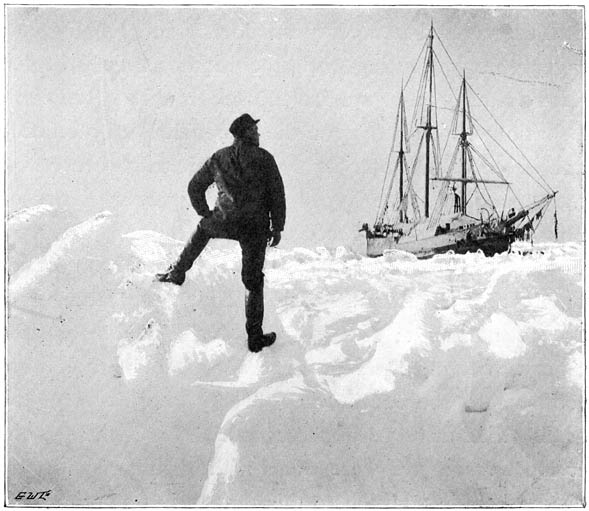
“It is lovely spring weather. One feels that spring-time must have come, though the thermometer denies it. ‘Spring cleaning’ has begun on board; the snow and ice along the Fram’s sides are cleared away, and she stands out like the crags from their winter covering decked with the flowers of spring. The snow lying on the deck is little by little shovelled overboard; her rigging rises up against the clear sky clean and dark, and the gilt trucks at her mastheads sparkle in the sun. We go and bathe ourselves in the broiling sun along her warm sides, where the thermometer is actually above freezing-point, smoke a peaceful pipe, gazing at the white spring clouds that lightly fleet across the blue expanse. Some of us perhaps think of spring-time yonder at home, when the birch-trees are bursting into leaf.”