INDEX.
Reading edition
INDEX.
PAGE
A
Ash pit, 70
Attachments for traction engine, 52
Automatic cut-off engines, 137
B
Babbitt boxes, how to, 189
Blast devices, 30
Blow-off devices, 30
Boiler and engine, test questions, 52
Boiler, attachments, 20
Boiler, heating surface of, 132
Boiler, how to manage, 56
Boiler, locomotive, 13
Boiler, questions, and answers, 95
Boiler, return flue, 15
Boiler, starting a, 57
Boiler, vertical, 17
Boiler, water for, 62
Boilers, 11
Boilers, how to fill with water, 24
Boilers, terms connected with, 17
Boss, 43
Box, a hot, 87
Boxes, how to babbitt, 189
Bridges, how to cross safely, 93
Buying an engine, 7
C
Clearance, 35
Clearance and lead, 134
Compound and cross-compound engines, 141
Compound engines, 124
Condensation and expansion, 134
Condenser, 35
Condensing engines, 140
Connecting rod, 34
Corliss engines, 138
Crank, 34, 41, 42
Cross-head, 33
Cushion, 35
Cylinder cocks, 50
Cylinder cocks, how to use, 83
Cylinder head, 33
Cylinder lubricators, 45
D
Differential gear, 46
Double eccentric, how to set valve, 82
E
Eccentric, 36
Eccentric rod, 36
Eccentric, slipping of, 83
Economy in running farm engine, 116, 130
Engine and boiler, test questions, 52
Engine, compound, 124
Engines, different types of, 137
Engine, how to manage, 77
Engine, simple, 32
Exhaust chamber, 35
Exhaust, the, 135
Exhaust nozzle, 35
Expansion and condensation, 134
Expansive power of steam, how to use, 122
F
Farm, engine, economy in running, 116, 130
Fire, starting, 70
Firing, economical, 67
Firing with coal, 68
Firing with straw, 69
Firing with wood, 69
Fly-wheel, 44
Friction, 126
Friction clutch, 47, 88
Fuel and grate surface, 130
Fusible plug, 48, 72
G
Gas and gasoline engines, 143
Gas engines compared with steam, 144
Gasoline engines, description of, 146
Gasoline engines, how to operate, 150
Gasoline engines, what to do when they don’t work, 153
Gauge, water, 20
Gauge, steam, 22
Governors, 40
Grain, weight per bushel, 192
Grate surface, 130
H
Heater, 67
Heating surface of a boiler, 132
High speed engines, 139
Hills, how to pass with engine, 94
Hole, how to get out of, 92
Hot box, a, 87
How energy is lost, 119
How heat is distributed, 120
I
Indicator, steam, 50
Injectors, 28-66
J
Journals, 41, 44
K
Key, gib, and strap, 42
Knock, what makes an engine, 79
L
Lap of a valve, 35
Lead, 35, 80
Lead and clearance, 134
Leaks, 136
Leaky flues, 73
License, questions asked applicants for, 173
Link gear, 37
Lubrication, 85
Lubricators, 44
M
Meyer valve gear, 40
N
Non-condensing engines, 140
P
Pillow blocks, 44
Piston, 33
Ports, 34
Practical points of economy, 130
Pulleys, how to key, 189
Pumps, boiler, 25, 63
Q
Questions and answers, 95, 173, 104
Questions and answers, the boiler, 95
Questions and answers, the engine, 104
Questions, test, on engine and boiler, 52
R
Reversing gear, 37
Road, how to handle traction engine on the, 91
S
Safety valves, 23
Sand patches, how to get over with engine, 93
Setting a valve, 35, 81
Shaft, 41
Smoke, 71
Spark arresters, 31
Sparks, 72
Stationary engines, 137
Steam-chest, 34
Steam cylinder, 33
Steam, how to use expansive power of, 122
Steam, properties of, 121
Steam valve, 34
Stuffing box, 35, 50
T
Threshing machines, how to run, 158 Attachments, 167 Balancing a cylinder, 170 Belting, 167 Concaves, 162 Conveyor extension, 164 Covering pulleys, 171 Cylinder, 161 Fan, 163 How to feed, 169 Self-feeder, 165 Separator, how to set, 160 Separator, care of, 171 Sieves, 164 Straw rack, 163 Tailings elevator, 165 Waste, 169 Wind stacker, 166
Theory of steam power, 116
Throttling engines, 137
Throttle, 34
Throw of an eccentric, 36
Traction engines, different makes, 193
Traction, engine, how, to handle on the road, 91
Traction, engine, how, to manage, 77
V
Valve gear, 36
Valve, how to set simple, 81
Valve seat, 34
Valve, setting, 35
Valve stem, 35
Valve, steam, 34
W
Whistle signals, code of, 191
Woolf reversing gear, 39
Y
Young engineers, points for, 95, 104, 110
“ANNOUNCEMENT”
A NEW WORK UP-TO-DATE, WILL BE PUBLISHED March 15th, 1903. A book every carpenter and builder, machinist, mechanic and apprentice will want. The life work of that well-known writer, Mr. Fred T. Hodgson.
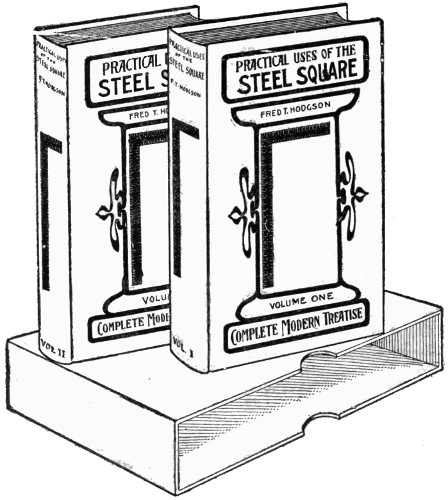
“PRACTICAL USES OF THE STEEL SQUARE”
A Modern Treatise by Fred T. Hodgson. An exhaustive work including a brief history of the Square; a description of many of the Squares that are now, and have been in the market, including some very ingenious devices for laying out Bevels for Rafters, Braces and other inclined work; also chapters on the Square as a calculating machine, showing how to measure Solids, Surfaces and Distances—very useful to builders and estimators. Chapters on roofing and how to form them by the aid of the Square; Octagon, Hexagon, Hip and other Roofs are shown and explained, and the manner of getting the rafters and jacks given; Chapters on heavy timber framing, showing how the Square is used for laying out Mortises, Tenons, Shoulders, Inclined Work, Angle Corners and similar work.
The work abounds with hundreds of fine illustrations and explanatory diagrams, which will prove a perfect mine of instruction for the mechanic, young or old.
Two large volumes, bound in fine cloth, printed on a superior quality of paper from new large type. Each copy bears the Union Label, being made entirely by Union labor.
PRICE, 2 Vols, in a Box, Cloth Binding $2.00
PRICE, 2 Vols, in a Box, Half-morocco Leather Binding 3.00
PUBLISHERS’ NOTE—We wish to state this work is entirely new and must not be mistaken for Mr. Hodgson’s former works on the “Steel Square,” which were published some twenty years ago. Be sure and ask for “Practical Uses of the Steel Square,” by Fred T. Hodgson, which bears the imprint of
Send for descriptive circulars.
FREDERICK J. DRAKE & CO., Publishers of Hodgson’s “Modern Carpentry,” “Common-Sense Handrailing,” etc.
Common-Sense Handrailings and How to Build Them
By FRED T. HODGSON
ILLUSTRATED
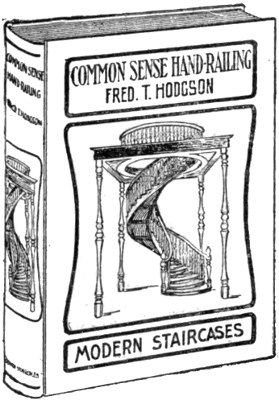
This new volume contains three distinct treatises on the subject, each of which is complete in itself. The system of forming the lines for obtaining the various curves, wreaths, ramps and face moulds for handrails are the simplest in use and those employed by the most successful handrailers. Mr. Hodgson has placed this unusually intricate subject before his readers in a very plain and easily understood manner, and any workman having a fair knowledge of “lines” and who can construct an ordinary straight stairway can readily grasp the whole system of “handrailing” after a small study of this work.
The building of stairs and properly making and placing over them a graceful handrail and suitable balusters and newel posts is one of the greatest achievements of the joiner’s art and skill, yet it is an art that is the least understood of any of the constructive processes the carpenter or joiner is called upon to accomplish. In but very few of the plans made by an architect are the stairs properly laid down or divided off; indeed, most of the stairs as laid out and planned by the architect, are impossible ones owing to the fact that the circumstances that govern the formation of the rail, are either not understood, or not noticed by the designer, and the expert handrailer often finds it difficult to conform the stairs and rail to the plan. Generally, however, he gets so close to it that the character or the design is seldom changed.
The stairs are the great feature of a building as they are the first object that meets the visitor and claims his attention, and it is essential, therefore, that the stair and its adjuncts should have a neat and graceful appearance, and this can only be accomplished by having the rail properly made and set up.
This little book gives such instructions in the art of handrailing as will enable the young workman to build a rail so that it will assume a handsome appearance when set in place. There are eleven distinct styles of stairs shown, but the same principle that governs the making of the simplest rail, governs the construction of the most difficult, so, once having mastered the simple problems in this system, progress in the art will become easy, and a little study and practice will enable the workman to construct a rail for the most tortuous stairway.
The book is copiously illustrated with nearly one hundred working diagrams together with full descriptive text.
12mo CLOTH, PRICE, $1.00
FREDERICK J. DRAKE 6 CO., Publishers 211-213 East Madison St., CHICAGO
Modern Carpentry A PRACTICAL MANUAL FOR CARPENTERS AND WOOD WORKERS GENERALLY
By Fred T. Hodgson, Architect, Editor of the National Builder, Practical Carpentry, Steel Square and Its Uses, etc., etc.
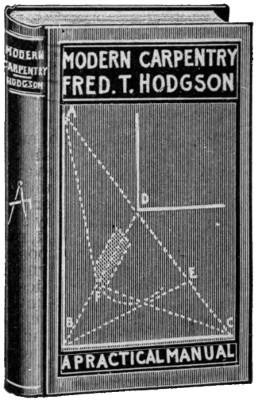
A new, complete guide, containing hundreds of quick methods for performing work in carpentry, joining and general wood-work. Like all of Mr. Hodgson’s works, it is written in a simple, every-day style, and does not bewilder the working-man with long mathematical formulas or abstract theories. The illustrations, of which there are many, are explanatory, so that any one who can read plain English will be able to understand them easily and to follow the work in hand without difficulty.
The book contains methods of laying roofs, rafters, stairs, floors, hoppers, bevels, joining mouldings, mitering, coping, plain hand-railing, circular work, splayed work, and many other things the carpenter wants to know to help him in his every day vocation. It is the most complete and very latest work published, being thorough, practical and reliable. One which no carpenter can afford to be without.
The work is printed from new, large type plates on a superior quality of cream wove paper, durably bound in English cloth.
Price $1.00
FREDERICK J. DRAKE & CO. 211-213 E. Madison St., Chicago.
Scientific Horse, Mule and Ox Shoeing
By J. G. Holmstrom, Author of Modern Blacksmithing

A standard treatise, adapted to the demand of Veterinarians, Farriers and the Amateur Horseshoer. Illustrated. The book is concisely written; no long articles over the experiments of others, but gives the best methods known up to date.
Although there are principles laid down in the book that will stand so long as the horse is a horse, the author does not lay any claim to infalibility
Among some of the valuable contents are:—
Anatomy of the Foot.
The Shoe and How to Make it.
Right and Wrong Filling.
How to Nail the Shoe.
How to Fit and Recalk Old Shoes.
Interfering.
Preparing the Foot for Shoeing.
Shoeing a Trotter.
Mule Shoeing.
Ox Shoeing.
Diseases of the Horse.
Hot and Cold Fitting.
How to Shoe Vicious Horses.
Kneesprung.
Stringhalt.
Contraction.
Sand Cracks, etc., etc.
Many of the fine illustrations used are reproduced by permission from books issued by the U. S. Department of Agriculture.
Large 12mo, Cloth, with Special Cover Design, $1.00
Sold by Booksellers generally, or sent postpaid upon receipt of price.
FREDERICK J. DRAKE & CO., Publisher. 211-213 East Madison St., CHICAGO
ALL TECHNICAL TERMS AVOIDED
Practical Telephone Hand Book and Guide to Telephonic Exchange
HOW TO CONSTRUCT AND MAINTAIN TELEPHONE LINES
By T. S. BALDWIN, M. A. Illustrated.
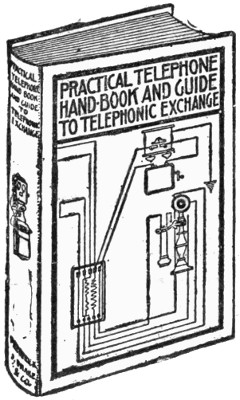
Containing chapters on “The Use of the Telephone, Series and Bridging phones, Line Construction, Materials to be used, Locating and Correction of Faults in Instruments and Lines.”
This is the best book ever published on Farm Telephones and has been the sensation of the past year in telephone circles. It is the only book ever issued which treats the subject exhaustively and comprehensively. It is of inestimable value to promoters of rural party lines because it contains all of the arguments that are necessary to show the advantages of rural party lines. It also tells how such lines should be constructed and cared for.
The great growth of the telephone industry during the past few years, and in response to the demand for a comprehensive book, giving a clear, terse idea of the different principles governing the construction, installation, care and management of the various telephones and their appliances, the Practical Telephone Hand Book has been compiled. It is written in a most clear and careful style and aims to give a complete review of the subject of telephony.
No expense has been spared in gathering valuable information, and it has been the aim of the author to make this treatise the most complete elementary book ever written on this subject for all persons interested in this great achievement of modern science.
The text is profusely illustrated by cuts of commercial apparatus and carefully prepared diagrams of circuits. No diagram is given without a full explanation. The apparatus and methods used in making all the tests required in commercial telephone work, including the exchange, are fully treated.
12 Mo. Cloth, fully illustrated, price $1.25
BOOKKEEPING SELF-TAUGHT
By PHILLIP C. GOODWIN

Few, if any of
Mr. Goodwin’s treatise on Bookkeeping is an entirely new departure from all former methods of self-instruction and one which can be studied systematically and alone by the student with quick and permanent results, or taken up in leisure moments with an absolute certainty of acquiring the science in a very short time and with little effort. The book is both a marvel of skill and simplicity. Every feature and every detail leading to the climax of scientific perfection are so thoroughly complete in this logical procedure and the analysis so thorough and deftly made that the self-teaching student is led by almost imperceptible, but sure and certain steps to the basic principles of the science, which the author in a most comprehensive and lucid style lays bare to intelligence of, even the most mediocre order.
The work is the most masterly exposition of the scientific principles of Bookkeeping and their practical application which has ever appeared in the English language, and it should be in the hands of every school boy or girl, every clerk, farmer, teacher and business or professional man; for a knowledge of Bookkeeping, even though it may not be followed as a profession, is a necessity felt by every person in business life and a recognized prime factor of business success.
In addition to a very simple yet elaborate explanation in detail of the systems of both single and double entry Bookkeeping, beginning with the initial transactions and leading the student along to the culminating exhibit of the balance sheet, the work contains a glossary of all the commercial terms employed in the business world, together with accounts in illustration, exercises for practice and one set of books completely written up.
12mo Cloth. Price $1.00.
Sent postpaid to any address upon receipt of price.
Frederick J. Drake & Co., Publishers 211-213 EAST MADISON ST., CHICAGO