CHINA.
Reading edition
There is no country in the world like China.
How different it is from Persia, where there are so few people; whereas China is crowded with inhabitants!
How different it is from England, where the people are instructed in the Bible, whereas China is full of idols.
China is a heathen country; yet it is not a savage country, for the people are quiet, and orderly, and industrious.
It would be hard for a child to imagine what a great multitude of people there are in China.
If you were to sit by a clock, and if all the Chinese were to pass before you one at a time, and if you were to count one at each tick of the clock, and if you were never to leave off counting day or night—how long do you think it would be before you had counted all the Chinese?
Twelve years. O what a vast number of people there must be in China! In all, there are about three hundred and sixty millions! If all the people in the world were collected together, out of every three one would be a Chinese. How sad it is to think that this immense nation knows not God, nor his glorious Son!
There are too many people in China, for there is not food enough for them all; and many are half-starved.
FOOD.—The poor can get nothing but rice to eat and water to drink; except now and then they mix a little pork or salt fish with their rice. Any sort of meat is thought good; even a hash of rats and snakes, or a mince of earth-worms. Cats and dogs' flesh are considered as nice as pork, and cost as much.
An Englishman was once dining with a Chinaman, and he wished to know what sort of meat was on his plate. But he was not able to speak Chinese. How then could he ask? He thought of a way. Looking first at his plate, and then at the Chinaman, he said, "Ba-a-a," meaning to ask, "Is this mutton?" The Chinaman understood the question, and immediately replied, "Bow-wow," meaning to say, "It is puppy-dog." You will wish to know whether the Englishman went on eating; but I cannot tell you this.
While the poor are in want of food, the rich eat a great deal too much. A Chinese feast in a rich man's house lasts for hours. The servants bring in one course after another, till a stranger wonders when the last course will come. The food is served up in a curious way; not on dishes, but in small basins—for all the meats are swimming in broth. Instead of a knife and fork, each person has a pair of chop-sticks, which are something like knitting-needles; and with these he cleverly fishes up the floating morsels, and pops them into his mouth. There are spoons of china for drinking the broth.
You will be surprised to hear that the Chinese are very fond of eating birds' nests. Do not suppose that they eat magpies' nests, which are made of clay and sticks, or even little nests of moss and clay; the nests they eat are made of a sort of gum. This gum comes out of the bird's mouth, and is shining and transparent, and the nest sticks fast to the rock. These nests are something like our jelly, and must be very nourishing.
The Chinese like nothing cold; they warm all their food, even their wine. For they have wine, not made of grapes, but of rice, and they drink it, not in glasses, but in cups. Tea, however, is the most common drink; for China is the country where tea grows.
The hills are covered with shrubs bearing a white flower, a little like a white rose. They are tea-plants. The leaves are picked; each leaf is rolled up with the finger, and dried on a hot iron plate.
The Chinese do not keep all the tea-leaves; they pack up a great many in boxes, and send them to distant lands. In England and in Russia there is a tea-kettle in every cottage. Some of the Chinese are so very poor that they cannot buy new tea-leaves, but only tea-leaves which ire sold in shops. I do not think in England poor people would buy old tea-leaves. Some very poor Chinese use fern-leaves instead of tea-leaves.
The Chinese do not make tea in the same way that we do. They have no teapot, or milk-jug, or sugar-basin. They put a few tea-leaves in a cup, pour hot water on them, and then put a cover on the cup till the tea is ready. Whenever you pay a visit in China a cup of tea is offered.
APPEARANCE.—The Chinese are not at all like the other natives of Asia. The Turks and Arabs are fine-looking men, but the Chinese are poor-looking creatures. You have seen their pictures on their boxes of tea, for they are fond of drawing pictures of themselves.
Their complexion is rather yellow, but many of the ladies, who keep in doors, are rather fair. They have black hair, small dark eyes, broad faces, flat noses, and high cheek-bones. In general they are short. The men like to be stout; and the rich men are stout: the fatter they are, the more they are admired: but the women like to be slender.
A Chinaman does not take off his cap in company, and he has a good reason for it: his head is close shaven: only a long piece behind is allowed to grow, and this grows down to his heels, and is plaited. He wears a long dark blue gown, with loose hanging sleeves. His shoes are clumsy, turned up at the toes in an ugly manner, and the soles are white. The Chinese have more trouble in whitening their shoes than we have in blacking ours.
A Chinese lady wears a loose gown like a Chinaman's; but she may be known by her head-dress, her baby feet, and her long nails. Her hair is tied up, and decked with artificial flowers; and sometimes a little golden bird, sparkling with jewels, adorns her forehead. Her feet are no bigger than those of a child of five years old; because, when she was five, they were cruelly bound up to prevent them from growing. She suffered much pain all her childhood, and now she trips about as if she were walking on tiptoes. A little push would throw her down. As she walks she moves from side to side like a ship in the water, for she cannot walk firmly with such small feet. The Chinese are so foolish as to admire these small feet, and to call them the "golden lilies". As for her finger-nails, they are seldom seen, for a Chinese lady hides her hands in her long sleeves; but the nails on the left hand are very long, and are like bird's claws. The nails on the right hand are not so long, in order that the lady may be able to tinkle on her music, to embroider, and to weave silk.
The gentlemen are proud of having one long nail on the little finger, to show that they do not labor like the poor, for if they did, the nail would break. Men in China wear necklaces and use fans.
What foolish customs I have described. Surely you will not think the Chinese a wise people, though very clever, as you will soon find.
Men and women dress in black, or in dark colors, such as blue and purple; the women sometimes dress in pink or green. Great people dress in red, and the royal family in yellow. When you see a person all in white, you may know he is in mourning. A son dresses in white for three years after he has lost one of his parents.
HOUSES.—See that lantern hanging over the gate. The light is rather dim, because the sides are made of silk instead of glass. What is written upon the lantern? The master's name. The gateway leads into a court into which many rooms open. There are not doors to all the rooms; to some there are only curtains. Curtains are used instead of doors in many hot countries, because of their coolness; but the furniture of the Chinese rooms is quite different from the furniture of Turkish and Persian rooms. The Chinese sit on chairs as we do, and have high tables like ours: and they sleep on bedsteads, yet their beds are not like ours, for instead of a mattrass there is nothing but a mat.
Instead of pictures, the Chinese adorn their rooms with painted lanterns, and with pieces of white satin, on which sentences are written: they have also book-cases and china jars. But they have no fire-places, for they never need a fire to keep themselves warm: the sun shining in at the south windows makes the rooms tolerably warm in winter; and in summer the weather is very hot. The Chinese in winter put on one coat over the other till they feel warm enough. In the north of China it is so cold in winter that the place where the bed stands (which is a recess in the wall) is heated by a furnace underneath, and the whole family sit there all day crowded together.
The Chinese houses have not so many stories as ours; in the towns there is one floor above the ground floor, but in the country there are no rooms up stairs.
It would amuse you to see a Chinese country house. There is not one large house, but a number of small buildings like summer-houses, and long galleries running from one to another. One of these summer-houses is in the middle of a pond, with a bridge leading to it. In the pond there are gold and silver fish; for these beautiful fishes often kept in glass bowls in England, came first from China. By the sides of the garden walls large cages are placed; in one may be seen some gold and silver pheasants, in another a splendid peacock; in another a gentle stork, and in another an elegant little deer. There is often a grove of mulberry-trees in the garden, and in the midst of the grove houses made of bamboo, for rearing silk-worms. It is the delight of the ladies to feed these curious worms. None but very quiet people are fit to take care of them, for a loud noise would kill them. Gold and silver fish also cannot bear much noise.
In every large house in China there is a room called the Hall of Ancestors. There the family worship their dead parents and grand-parents, and great-grand-parents, and those who lived still further back. There are no images to be seen in the Hall of Ancestors, but there are tablets with names written upon them. The family bow down before the tablets, and burn incense and gold paper! What a foolish service! What good can incense and paper do to the dead? And what good can the dead do to their children? How is it that such clever people as the Chinese are so foolish?
RELIGION.—You have heard already that the Chinese worship the dead.
Who taught them this worship?
It was a man named Confucius, who lived a long while ago. This Confucius was a very wise man. From his childhood he was very fond of sitting alone thinking, instead of playing with other children. When he was fourteen he began to read some old books that had been written not long after the time of Noah. In these books he found very many wise sentences, such as Noah may have taught his children. The Chinese had left off reading these wise books, and were growing more and more foolish.[6] Confucius, when he was grown up, tried to persuade his countrymen to attend to the old books. There were a few men who became his scholars, and who followed him about from place to place. They might be seen sitting under a tree, listening to the words of Confucius.
Confucius was a very tall man with a long black beard and a very high forehead.
Had he known the true God, how much good he might have done to the Chinese; but as it was he only tried to make them happy in this world. He himself confessed that he knew nothing about the other world. He gave very good advice about respect due to parents; but he gave very bad advice about worship due to them after they were dead.
Was he a good man? Not truly good; for he did not love God; neither did he act right: for he was very unkind to his wife, and quite cast her off. Yet he used to talk of going to other countries to teach the people. It would have been a happy thing for him, if he had gone as far as Babylon; for a truly wise man lived there, even Daniel the prophet. From him he might have learned about the promised Saviour, and life everlasting. But Confucius never left China.
He was ill-treated by many of the rich and great, and he was so poor that rice was generally his only food. When he was dying he felt very unhappy, as well he might, when he knew not where he was going. He said to his followers just before his death, "The kings refuse to follow my advice; and since I am of no use on earth, it is best that I should leave it." As soon as he was dead, people began to respect him highly, and even to worship him. At this day, though Confucius died more than two thousand years ago, there is a temple to his honor in every large city, and numbers of beasts are offered up to him in sacrifice. There are thousands of people descended from him, and they are treated with great honor as the children of Confucius, and one of them is called kong or duke.
There is another religion in China besides the religion of Confucius, and a much worse religion. About the same time that Confucius lived, there was a man called La-on-tzee. He was a great deceiver, as you will see. He pretended that he could make people completely happy. There were three things he said he would do for them: first, he would make them rich by turning stone into gold; next, he would prevent their being hurt by swords or by fire through charms he could give them; and, last of all, he could save them from death by a drink he knew how to prepare.
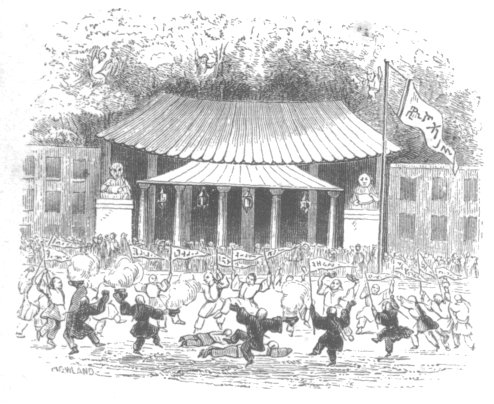
THE PRIESTS OF LA-ON-TZEE. See p. 83.
What an awful liar this man must have been! Yet many people believed in him, and still believe in him. There are now priests of La-on-tzee, and once a year they rush through hot cinders and pretend they are not hurt. You will wonder their tricks are not found out, seeing they cannot give any one the drink to keep them from dying. It is indeed wonderful that any one can believe these deceitful priests.
Their religion is called the "Taou" sect. Taou means reason. The name of folly would be a better title for such a religion.
There is a third religion in China. It is the sect of Buddha.[7] This Buddha was a man who once pretended to be turned into a god called Fo. You see he was even worse than La-on-tzee.
Buddha pretended that he could make people happy; and his way of doing so was very strange. He told them to think of nothing, and then they would be happy. It is said that one man fixed his eyes for nine years upon a wall without looking off, hoping to grow happy at last. You can guess whether he did. There are many priests of Buddha, always busy in telling lies to the people. They recommend them to repeat the name of Buddha thousands and thousands of times, and some people are so foolish as to do this; but no one ever found any comfort from this plan.
The priests of Buddha say that their souls, when they leave their bodies, go into other bodies. This idea is enough to make a dying person very miserable. One poor man, when he was dying, was in terror because he had been told his soul would go into one of the emperor's horses. Whenever he was dropping off to sleep, he started up in a fright, fancying that he felt the blows of a cruel driver hurrying him along: for he knew how very fast the emperor's horses were made to go. How different are the feelings of a dying man who knows he is going to Jesus.
He can say with joy,—
"For me my elder brethren stay,
And angels beckon me away,
And Jesus bids me come."
The Buddhists are full of tricks by which to get presents out of the people.
Once a year they cause a great feast to be made, and for whom? For the poor? No. For beasts? No. For children? No. For themselves? No. You will never guess. For ghosts! The priests declare that the souls of the dead are very hungry, and that it is right to give them a feast. A number of tables are set out, spread with all kinds of dishes. No one is seen to eat, nor is any of the food eaten; but the priests say the ghosts eat the spirit of the food. When it is supposed the ghosts have finished dinner, the people scramble for the food, and take it home, and no doubt the priests get their share.
The dead are supplied with money as well as with food, and that is done by burning gilt paper; clothes are sent to them by cutting out paper in the shape of clothes, (only much smaller,) and by burning the article; and even houses are conveyed to the dead by making baby-houses and burning them.
As an instance of the deceits of the priests, I will tell you of two priests who once stood crying over a pour woman's gate. "What is the matter?" inquired the woman. "Do you see those ducks?" the priests replied; "our parents' souls are in them, and we are afraid lest you should eat them for supper." The foolish woman out of pity gave the ducks to the cunning priests, who promised to take great care of the precious birds; but, in fact, they ate them for their own supper.
The Buddhist priests may be known by their heads close shaven, and their black dress. The priests of Taou have their hair in a knot at the top of their heads and they wear scarlet robes. There are no priests of Confucius; and this is a good thing.
All the religions of China are bad, but of the three the religion of Confucius is the least foolish.
There can be no doubt which of the three religions of China is the least absurd.
The religion of Taou teaches men to act like mad-men.
The religion of Buddha teaches them to act like idiots.
The religion of Confucius teaches them to act like wise men, but without souls.
THE EMPEROR.—There is no emperor in the world who has as many subjects as the Emperor of China: he has six times as many as the Emperor of Russia.
Neither is it possible for any man to be more honored than this emperor; for he is worshipped by his people like a god. He is called "The Son of Heaven," and "Ten Thousand Years;" yet he dies like every other child of earth. His sign is the dragon, and this is painted on his flags, a fit sign for one who, like Satan, makes himself a god.
Yet the emperor is also styled "Father of his people," and to show that he feels like a father, when there is a famine or plague in the land, he shuts himself up in his palace to grieve for his people; and by this means he gets the love of his subjects.
Once a year, too, this great emperor tries to encourage his people to be industrious by ploughing part of a field and sowing a little corn; and the empress sets an example to the women, by going once a year to feed silk worms and to wind the balls of silk.
The emperor wears a yellow dress, and all his relations wear yellow girdles.
But the relations of the emperor are not the most honorable people in the land: the most learned are the most honorable. Every one in China who wishes to be a great lord studies day and night. One man, that he might not fall asleep over his books, tied his long plaited tail of hair to the ceiling, and when his head nodded, his hair was pulled tight, and that woke him.
But what is it the Chinese learn with so much pains?
Chiefly the books of Confucius, and a few more; but in none of them is God made known: so that, with all his wisdom, the Chinaman is foolish still. The words of the Bible are true.
"The world by wisdom knew not God." Yet to know God is better than to know all beside.
There is a great hall in every town where all the men who wish to be counted learned meet together once a year. They are desired to write, and then to show what they have written; and then those who have written well, and without a mistake, have an honorable title given to them; and they are allowed to write another year in another greater hall; and at last the most learned are made mandarins.
What is a mandarin? He is a ruler over a town, and is counted a great man. The most learned of the mandarins are made the emperor's counsellors. There are only three of them, and they are the greatest men in all China, next to the emperor.
There are many poor men who study hard in hopes to be one of these three.
This is the greatest honor a Chinaman can obtain. But a Christian can obtain a far greater, even the honor of a crown and a throne in the presence of the Lord Jesus Christ at his coming.
The mandarins are all of the religion of Confucius, and despise the poor who worship Buddha.
ANIMALS AND TREES.—Once there were lions in China, but they have all been killed; there are still bears and tigers in the mountains and forests on the borders of the land.
There are small wild-cats, which are caught and fastened in cages, and then killed and cooked. There are tame cats, too, with soft hair and hanging ears, which are kept by ladies as pets.
There are dogs to guard the house, and they too are eaten; but as they are fed on rice only, their flesh is better than the flesh of our dogs. The dogs are so sensible that they know when the butcher is carrying away a dog that he is going to kill him, and the poor creatures come round him howling, as if begging for their brother's life.
The pig is the Chinaman's chief dish; for it can be fed on all the refuse food, and there is very little food to spare in China.
There are not many birds in China, because there is no room for trees. Only one bird sings, and she builds her nest on the ground; it is a bird often heard singing in England floating in the air,—I mean the lark.
In most parts of China men carry all the burdens, and not horses and asses.
A gentleman is carried in a chair by two men: and a mandarin by four. Yet the emperor rides on horseback.
THE THREE GREAT CITIES
Pekin on the north.
Nankin in the middle.
Canton on the south.
Pekin is the grandest.
Nankin is the most learned.
Canton is the richest.
At Pekin is the emperor's palace. The gardens are exceedingly large, and contain hills, and lakes, and groves within the walls, besides houses for the emperor's relations.
At Nankin is the China tower. It is made of China bricks, and contains nine rooms one over the other. It is two hundred feet high, a wonderful height.
Of what use is it? Of none—of worse than none. It is a temple for Buddha, and is full of his images.
At Canton there are so many people that there is not room for all in the land; so thousands live on the water in bouts. Many have never slept a single night on the shore. The children often fall overboard, but as a hollow gourd is tied round each child's neck, they float, and are soon picked up.
For a long while the Chinese would not allow foreigners to come into their cities. A great many foreign ships came to Canton to buy tea and silk; but the traders were forbidden to enter the town, and they lived in a little island near, and built a town there called Macao.
But lately the Chinese emperor has agreed to permit strangers to come to five ports, called Shang-hae, Ning-po, Foo-choo, Amoy, and Hong-Kong.
This last port, Hong-Kong, is an island near Canton, and the English have built a city there and called it Victoria.
THE TWO RIVERS.—There is one called Yeang-te-sang, or "the Son of the Ocean." It is the largest in Asia.
The other is the Yellow River, for the soft clay mixed with the water gives it a yellow color.
LAKES.—There are immense lakes, covered with boats and fishermen.
But the best fishers are the tame cormorants, who catch fish for their masters.
THE TWO GREAT WONDERS.—The great CANAL is wonder. It joins the two rivers; so that a Chinese can go by water from Canton to Pekin.
The great WALL is a greater wonder, but not nearly as useful as the canal.
This wall was built at the north of China to keep the Tartars out. It is one thousand five hundred miles long, twenty feet high, and twenty-five broad. But there were not soldiers enough in China to keep the enemies out, and the Tartars came over the wall.
The Emperor of China is a Tartar.
The Empress does not have small feet, like the Chinese.
It is the Tartars who forced the Chinese to shave their heads, for they used to tie up their hair in a knot at the top of their heads. Many of the Chinese preferred losing their heads to their hair. Was it not cruel to cut off their heads, merely because they would not shave them? But the Tartars were very cruel to the Chinese.
KNOWLEDGE AND INVENTIONS.—We must allow that the Chinese are very clever. They found out how to print, and they found out how to make gunpowder, and they found out the use of the loadstone. What is that? A piece of steel rubbed against the loadstone will always point to the north. The Chinese found out these three things, printing, gunpowder, and the use of the loadstone, before we in Europe found them out. But they did not teach them to us; we found them out ourselves.
But there are two arts that the Chinese did teach us: how to make silk, and how to make china or porcelain. And yet I should not say they taught us; for they tried to prevent our learning their arts; but we saw their silk and their porcelain, and by degrees we learned to make them ourselves. A sly monk brought some silk-worm's eggs from China hidden in a hollow walking-stick.
LANGUAGE.—There is no other language at all like the Chinese. Instead of having letters to spell words, they have a picture for each word. I call it a picture, but it is more like a figure than a picture. The Chinese use brushes for writing instead of pens; and they rub cakes of ink on a little marble dish, first dipping them in a little water, as we dip cakes of paint. There is a hollow place in the marble dish, to hold the water. What do you think the Chinese mean by "the four precious things?" They mean the ink, the brush, the marble dish, and the water. They call them precious because they are so fond of writing. Schoolmasters are held in great honor in China, as indeed they ought to be everywhere. Yet schools in China are much like those in Turkey, more fit for parrots than children; only Chinese boys sit in chairs with desks before them, instead of sitting cross-legged on the ground, as in Turkey. They learn first to paint the words, and next to repeat lessons by heart. This they do in a loud scream; always turning their backs to their masters while they are saying their lessons to him.
The first book which children read is full of stories, with a picture on each page. Would you like to hear one of these stories?
"There was a boy of eight years old, named Um-wen. His parents were so poor that they could not afford to buy a gauze curtain for their bed, to keep off the flies in summer. This boy could not bear that his parents should be bitten by the flies; so he stood by their bedside, and uncovered his little bosom and his back that the flies might bite him, instead of his parents. 'For,' said he, 'if they fill themselves with my blood, they will let my parents rest.'"
Would it be right for a little boy to behave in this way? Certainly not; for it would grieve kind parents that their little boys should be bitten. Poor little Chinese boys! They do not know about Him who was bitten by the old serpent that we might not be devoured and destroyed.
PUNISHMENT.—The Chinese are very quiet and orderly; and no wonder, because they are afraid of the great bamboo stick.
The mandarins (or rulers of towns) often sentence offenders to lie upon the ground, and to have thirty strokes of the bamboo. But the wooden collar is worse than the bamboo stick. It is a great piece of wood with a hole for a man to put his head through. The men in wooden collars are brought out of their prisons every morning, and chained to a wall, where everybody passing by can see them. They cannot feed themselves in their wooden collars, because they cannot bring their hands to their mouths; but sometimes a son may be seen feeding his father, as he stands chained to the wall. There are men also whose business it is to feed the prisoners. For great crimes men are strangled or beheaded.
CHARACTER.—A Chinaman's character cannot be known at first. You might suppose from his way of speaking that a Chinaman was very humble; because he calls himself "the worthless fellow," or "the stupid one," and he calls his son "the son of a dog;" but if you were to tell him he had an evil heart, he would be very much offended; for he only gives himself these names Thai he may seem humble. He calls his acquaintance "venerable uncle," "honorable brother." This he does to please them. The Chinese are very proud of their country, and think there is none like it. They have given it the name of the "Heavenly or Celestial Empire." They look upon foreigners as monkeys and devils. Often a woman may he heard in the streets saying to her little child, "There is a foreign devil (or a Fan Quei"). The Chinese think the English very ugly, and called them the "red-haired nation."
It must be owned that the Chinese are industrious: indeed, if they were not, they would be starved. A poor man often has to work all day up to the knees in water in the rice-field, and yet gets nothing for supper but a little rice and a few potatoes.
The ladies who can live without working are very idle, and in the winter rise very late in the morning.
Men, too, play, as children do here; flying kites is a favorite game. Dancing, however, is quite unknown.
The Chinese are very selfish and unfeeling. Beggars may be seen in the middle of the town dying, and no one caring for them, but people gambling close by.
The Chinese have an idea that after a man is dead the house must be cleansed from ghosts; so to save themselves this trouble, poor people often cast their dying relations out of their hovels into the street to die!
But in general sons treat their parents with great respect. They often keep their father's coffin in the house for three months, and a son has been known to sleep by it for three years. Relations are usually kind to each other, because they meet together in the "Hall of Ancestors" to worship the same persons. To save money they often live together, and a hundred eat at the same table.
The Chinese used to be temperate, preferring tea to wine. There are tea-taverns in the towns. How much better than our beer-shops! But lately they have begun to smoke opium. This is the juice of the white poppy, made up into dark balls. The Chinese are not allowed to have it; but the English, sad to say, sell it to them secretly. There are many opium taverns in China, where men may be seen lying on cushions snuffing up the hot opium, and puffing it out of their mouths. Those who smoke opium have sunken cheeks and trembling hands, and soon become old, foolish, and sick. Why, then, do they take opium? Many of them say they wish to leave it off, but cannot.
MISSIONARIES.—Are there any in China? Yes, many; and more are going there. But how many are wanted for so many people! Missionaries travel about China to distribute Bibles and tracts. One of them hired a rough kind of chair with two bearers. In this he went to villages among the mountains, where a white man had never been seen. The children screaming with terror ran to their mothers. The men came round him to look at his clothes and his white skin. They were much surprised at the whiteness of his hands, and they put their yellow ones close to his to see the difference. These mountaineers were kind, and brought tea and cakes to refresh the stranger.
An English lady went to China to teach little girls; for no one teaches them. She has several little creatures in her school that she saved from perishing: because the Chinese are so cruel as to leave many girl-babies to die in the streets; they say that girls are not worth the trouble of bringing up.
One cold rainy evening, Miss Aldersey heard a low wailing outside the street-door, and looking out she saw a poor babe, wrapped in coarse matting, lying on the stone pavement. She could not bear to leave it there to be devoured by famished dogs; so she kindly took it in, and brought it up.
It is a common thing to stumble over the bodies of dead babies in the streets. In England it is counted murder to kill a babe, but it is thought no harm in China. Yet the Chinese call themselves good. But when you ask a poor man where he expects to go when he dies, he replies, "To hell of course;" and he says this with a loud laugh. His reason for thinking he shall go to hell is, because he has not money enough to give to the gods; for rich people all expect to go to heaven. Mandarins especially expect to go there. If they were to read the Bible, they would see that God will punish kings, and mighty men, and great captains, and all who are wicked.
[6]
These are some of the sentences written in the old books:
"Never say, There is no one who sees me, for there is a wise Spirit who sees all."
"Man no longer has what he had before the fall, and he has brought his children into his misery. O! Heaven, you only can help us. Wipe away the stains of the father, and save his children."
"Never speak but with great care. Do not say, It is only a single word. Remember that no one has the keeping of your heart and tongue but you."
These sentences are like some verses in the Psalms and Proverbs; and, it may be, they were spoken first by some holy men of old.
Here is one more remarkable than all:—
"God hates the proud, and is kind to the humble."
[7]
The means by which the Buddhist religion entered China are remarkable. A certain Chinese emperor once read in the book of Confucius this sentence, "The true saint will be found in the West." He thought a great deal about it; at last he dreamed about it. He was so much struck by his dream that he sent two of his great lords to look for the true religion in the West. When they reached India, they found multitudes worshipping Buddha. This Buddha was a wicked man who had been born in India a thousand years before. The Chinese messengers believed all the absurd histories they heard about Buddha, and they returned to China with a book which had been written about him. Ah! had they gone as far as Canaan they might have heard Paul and Peter preaching the Gospel. Alas! why did they go no further, and why did they go so far, only to return to China with idols!