DU GUAY-TROUIN THE GREAT FRENCH “BLUE” (1673-1736)
Reading edition
“Self trust is the essence of Heroism.”—Plutarch.
DU GUAY-TROUIN THE GREAT FRENCH “BLUE” (1673-1736)
“He’s only a scurvy Democrat, his blood is hardly blue, Oh, Sacre Nom de Dieu! Sapristi! Eet is true! Yet, he fights like the Maid of Orleans, with dirk and halberd, too, Oh, Sacre Nom de Dieu! Sapristi! Eet is true! Then—what’ll you think, good gentlemen, you men of the kingly pack, Ye sons of Armand the Terrible, ye whelps of Catouriac, Shall he gain the royal purple? Shall he sit in the ranks with us? Shall he quaff of our golden vintage, shall he ride in the royal bus? Nay! Nay! For that would be te-r-r-ible! Nay! Nay! That ill-born cuss? Par donc! but that is unbearable! ’Twould result in a shameful fuss! Pray, let him remain a Democrat—The cream of the fleet for us.”
—Song of the French Royal Marine.—1695.
YOU must be a churchman, Rénee,” said the good Luc Trouin, turning to his little son. “I have always had a great ambition to have a child of mine in the church, and I feel that you are in every way qualified for the position of a prelate.”
But little Rénee hung his head.
“Look up, boy,” continued the amiable Frenchman. “I know that you are not now pleased with the idea, but—later on—after you have had more experience, I feel sure that you can thank Heaven that your good father started you in the right and proper direction.”
Still, little Rénee hung his head.
“Tut! Tut!” continued the old man. “You will leave, to-morrow, for the college at Rheims, and, after you have been there but a short time, I feel sure that you will like it. Tut! Tut!”
But still little Rénee hung his head.
Again came the amiable “Tut! Tut!” and the chuckling Luc Trouin wandered off into the garden to see how well the potatoes were growing.
But little Rénee still hung his head.
And—in spite of the fact that little Rénee went to the Divinity school at Rheims, he continued to hang his head. He hung his head for three years. Then, news was brought to him, one day, that the good Luc Trouin was dead, and, instead of holding his handkerchief to his eyes to wipe away the tears, as one would expect of him, little Rénee burst into loud laughter.
“At last,” cried he, “I can get away from the church and go to sea. At last my freedom has come!”
And it was not many hours before little Rénee was scudding away from the school of Divinity, like a clipper-ship under a full spread of canvas, before a rousing sou’west breeze.
For at least two hundred years before the birth of bad, little Rénee, the Trouin family had been well known and prosperous in the Breton seaport of St. Malo. For many years a Trouin had been consul at Malaga, Spain; and other members of the house had held excellent positions with the King, so little Rénee had no reason to be ashamed of his forebears, in spite of the fact that his people were of the “bourgeoisie:” ship-owners, traders, smugglers, privateers, and merchants. And, as they were of the “bourgeoisie,” they were somewhat looked down upon by the proud and haughty aristocrats who fawned about the weak and dissipated King.
Little Rénee was the son of Luc Trouin and Marguerite Boscher but he was called Du Guay-Trouin, in later years, and the reason for this is plain. For—in accordance with the custom of the time—he was sent to be nursed by a foster mother who resided in the little village of Le Gué. So he was called Trouin du Gué; which shortly became Du Guay-Trouin.
“I’ve come home, mother,” shouted little Rénee, when he had plodded his weary way which lay between his temporary prison and the house of his parents. “I’ve come home, mother, and I’m going to sea!”
But his mother did not take any too kindly to this bold and valiant idea.
“You must study law,” said she, with great firmness. And—in spite of the fact that little Rénee begged and pleaded—he was forced to give up his idea of seafaring life for the dry drudgery and routine of a clerk at law. He was now about sixteen years of age.
“The law is dry and my spirits are high,” youthful Rénee is said to have carolled as he spent his first few hours at a lecture, “and whatever may be I’m going to sea.”
At any rate, he soon got into trouble and engaged in three duels in his sixteenth year, in one of which his assailant gave him a serious wound. This was too much for even his stern mother to bear, so, summoning a family council, she gave forth the following opinion:
“Rénee has failed as a student of Divinity. Rénee has failed as a student of law. Rénee has entirely too high spirits. Rénee shall, therefore, be placed in one of the family ships and sent to sea.”
And to this decree Rénee is said to have cried: “At last! Hurray!” for he longed for action.
In a very short time little Rénee had a taste of that war and adventure which he craved, for a historian writes that:
“During the first three months of this cruise his courage was tried by a violent tempest, an imminent shipwreck, the boarding of an English ship, and the threatened destruction of his own vessel by fire. The following year, still as a volunteer, he displayed the greatest personal courage and won much fame in an engagement which his ship had with five merchant vessels.”
“Ah ha,” said little Rénee, “this is indeed life. I am having a good time.”
So well did those higher in command feel towards the youthful sailor, that, at the age of eighteen, he was actually put in charge of the ship Danycan of fourteen guns,—for France was at war with England, Holland, and Spain, and to him who could strike a quick and well-aimed blow there were “nice pickings” to be had. And the reckless young sea-dog found some “nice pickings” in Ireland, for, he landed an armed party upon the coast of County Clare, where he pillaged a village, burned two ships at anchor, and escaped to his own vessel with considerable booty and family heirlooms of the peasants, who said, “Och, Begorra! We’ll be afther that wild bhoy before many suns, and spank him for his unseemly whork.”
But the French cried “Voilà! Here, indeed, is a brave young Bourgeois,” and promptly raised him to the command of the Coetquen of eighteen guns, in which he soon went cruising, accompanied by a sister-ship, the St. Aaron.
Prowling around the English channel, the skulking sea-hounds soon came across two small English men-of-war with five valuable merchantmen under their sheltering wings.
“All ready for the attack!” shouted Du Guay-Trouin. “We’ll make mince-meat of those foreign hulks, in spite of the fact that they are protected by two men-of-war.”
And, crowding on all sail, his own vessel and the St. Aaron quickly bore down upon the Englishmen, who, seeing them approach, hove-to for action.
The engagement was short. After a few broadsides had been delivered, the English struck, the prizes were taken over, and all started for the coast of France. But suddenly a cry went up,
“Sail ho! Sail ho! off the starboard bow!”
“Ta Donc,” cried the surprised Du Guay-Trouin. “It is a big man-of-warsman and a Britisher too. We must give up our prizes, I fear. Clap on all canvas and we’ll hie us to shore.”
So all sail was hoisted, and, steering for the shoals and rocks off Lundy Island—where he knew that the heavy Englishman could not follow—Du Guay-Trouin soon outdistanced and outwitted the Centurion: a line-of-battle ship and a formidable opponent. The rich prizes had to be left behind.
Honorable appointments crowded upon the daring, young sea-dog, after this affair, and we find him successively in command of the Profond, of thirty-two guns; the Hercule, of twenty-eight guns, and the Diligente of thirty-six guns and two hundred and fifty sailors, which was a King’s ship borrowed for privateering and run on shares,—the monarch to have a certain part of the winnings.
Like partners in business the Diligente and Hercule now went cruising, and it was not long before the two harpies swooped down upon their prey in the shape of two Dutch East Indiamen, armed with twenty-five guns each, and manned by rotund-bodied Dutchmen. There was rich treasure aboard, and, with eagerness and zeal, the Frenchmen slapped on all canvas in pursuit.
Now was a hot chase. Mile after mile was passed, and slowly but surely the Frenchmen gained upon the lumbering foe. Then suddenly,—
Crash!
A ball screamed above the head of Du Guay-Trouin, and a Dutchman hove-to for battle.
“Crawl in close,” cried the valiant Frenchman, “and don’t let go a broadside until you can hit ’em below the water line. Try to scuttle the Dutch lumber merchant!”
His men obeyed him willingly and soon there was a muffled roar as the first broadside spoke in the still air. Another and another followed, and the Dutchman trembled like an aspen leaf.
“Hah,” shouted the enthusiastic Rénee, “up goes the white flag!”
Sure enough, the vessel struck, and aboard of her was the Dutch commodore. But the Hercule was beaten off by the second Dutchman, and, as the privateers boarded the captured vessel, the East Indiaman showed a clean pair of heels, under a cloud of bellying canvas.
Du Guay-Trouin was delighted. “On we go, Boys,” he cried, “for we’ll sail these waters until we strike another prize.” And this is what soon happened.
On May the 12th, the Diligente was cruising alone, when, suddenly six white dots appeared upon the horizon, and six British ships-of-the-line were soon closing in upon the venturous French navigator and his crew.
“Ye Gods,” cried the doughty Frenchman, “we’re in for it now, but we will give them a lively bout even though we’ll get the worst of it.”
And here is how he has described the battle:
“One of the English ships named Adventure first overtook me, and we maintained a running fight for nearly four hours, before any other of their ships could come up....
“At length my two topmasts were shot away; on which the Adventure ranged up alongside me, a short pistol-shot off, and hauled up her courses. Seeing her so near, it occurred to me to run foul of her and board her with my whole crew. Forthwith I ordered such of the officers as were near to send the people on deck, got ready the grapnels, and put the helm over.
“We were just on the point of hooking on to her, when unfortunately, one of my Lieutenants, looking out through a port and seeing the two ships so close together, took it into his head that there was some mistake, as he could not think that—under the circumstances—I had any intention of boarding; and so, of himself, ordered the helm to be reversed.
“I had no idea of what had been done, and was impatiently waiting for the two ships to clash together, ready to throw myself on board the enemy; but seeing that my ship did not obey her helm, I ran to the wheel, and found it had been changed without my order.
“I had it again jammed hard on; but perceived, with the keenest vexation, that the captain of the Adventure, having guessed by the expression of my face what I had meant to do, had let fall his courses, and was sheering off. We had been so near that my bowsprit had broken his taffrail; but the mistake of my Lieutenant made me lose the opportunity of one of the most surprising adventures ever heard tell of.
“In the determination I was in to perish or to capture this ship, which was much the fastest sailor of the squadron, it was more than probable that I should have succeeded, and should thus have taken back to France a much stronger ship than that which I abandoned. And, not to speak of the credit which would have attached to the execution of such a plan, it is quite certain that—being dismasted—there was absolutely no other way for me to escape from forces so superior.”
But closer—always closer—crowded the British war-dogs, and the valorous French seamen became panic stricken. “We are outnumbered and outfought,” cried many, and, deserting their guns, they fled below to the holds, in spite of the vigorous protests of Du Guay-Trouin.
“I was busy trying to put a stop to the panic,” says he. “I had cut down one and pistolled another, when, to crown my misfortune, fire broke out in the gun-room. The fear of being blown up made it necessary for me to go below; but, having got the fire put out, I had a tub full of grenades brought me, and began throwing them down into the hold.
“By this means I compelled the deserters to come up and to man some of the lower deck guns; but, when I went up on the poop, I found, to my astonishment and vexation, that some cowardly rascal had taken advantage of my absence to haul down the colors.
“I ordered them to be hoisted again; but my officers represented that to do so would be simply giving up the remnant of my ship’s company to be butchered by the English, who would give no quarter if the flag were hoisted again, after being struck for so long, and that further resistance was hopeless as the ship was dismasted.”
“Never give in, for”—cried Du Guay-Trouin, whose democratic blood was now up, but he did not finish the sentence as a spent shot then knocked him senseless. And—as he fell—the white flag went aloft, for his officers had not his fighting spirit.
“Ah ha,” laughed the English jack-tars. “We’ve got the French rascal at last, and we’ll hold him too.”
So little Rénee was imprisoned in a nice, dark dungeon,—the kind which the English used to put their poor debtors in. But—like a true man of courage—little Rénee escaped, took to a smuggler’s skiff, and made off to the coast of France, where he arrived on the 18th of June, 1694, and was received right boisterously by the Trouin family.
“My son,” spoke his aged mother, “you were indeed not intended for the law, for lawlessness seems to be your particular fancy.”
So the delighted Trouins put him in charge of a splendid privateersman mounting forty-eight guns, sailing under the simple name of Francois, and, as she forged valiantly into the English channel, her skipper chanted an old French song, which ran,—
“Sons of St. Malo, hark to my lay, With a Heave! Ho! Blow the man down. For we’ll capture a lugger ere close of the day, With a Heave! Ho! Blow the man down. “She’s filled with gold nuggets, her crew is asleep, Then board her, and take her, for dead men are cheap, We’ll spike them and pike them, like so many sheep. With a Heave! Ho! Blow the man down.”
It was not long before a sail was sighted, and, on the 12th day of January, 1695, the stout, little Francois overhauled a solitary timber ship, loaded with huge trees, bound to England from the good town of Boston in New England. She was an easy capture, and, Du Guay-Trouin smiled with joy when her skipper said:
“Three other lumber ships are in the offing. But they are under convoy of the frigate Nonsuch with forty-eight guns, and the Falcon with thirty-eight cannon. Look out my bold sea-dog, there’ll be trouble.”
But the French mariner laughed.
“It’s just what I’m searching for,” said he, and forthwith he swung the stout Francois in wide circles, with look-outs at every mast-head.
“Sail ho!” shouted the watch, next morn, and there, off the port bow, were the three merchantmen strung out in a line, with the two protecting gun-boats to windward.
Like a greyhound the Francois swept down upon them, and with the audacity of despair, the privateersman of St. Malo ranged alongside of the Falcon and opened fire. The engagement was short. In an hour’s time the guns of the Englishman were silent and a white pennon fluttered from the mizzen-mast.
The Nonsuch, meanwhile, had been ranging to windward in a vain endeavor to bring her guns to bear upon the Frenchman without crippling her own mate, and—as the Francois drifted away from the lurching Falcon—she bore down to within twenty yards, luffed, and spanked a rakish broadside into the privateer.
“Board her!” shouted Du Guay-Trouin. “Board her!” and, bringing the wheel close around, he swung the bow of the Francois into the side of the Englishman. But, as the sailors scampered to the bulwarks with cutlass and with dirk, a sheet of flame burst from the port-holes of the drifting Nonsuch. She was afire.
“Luff! Luff!” cried the keen-eyed French mariner, and the Francois drew away as the red flames curled upward with a cruel hiss.
With a swift turn the helm again spun over, under the quick hand of Du Guay-Trouin, and the Francois was jibed about in order to run under the port bow of the Englishman.
“Hold, Captain!” cried a French Lieutenant. “We, ourselves, are afire!”
As he spoke—a direful cloud of vapor rolled from the starboard quarter.
“Alack!” answered the now furious Rénee. “This puts an end to the fighting of this day, and we’d soon have had the second Britisher. All hands below and bucket out this fire!”
So, as night fell upon the rolling ocean, the Falcon lay drifting helplessly, while the Nonsuch and the Francois were burning like two beacons upon a jutting headland.
As day broke, the Francois filled away (for the fire had been extinguished after an hour’s toil) and ranged within striking distance of the Nonsuch. A broadside belched from her starboard guns and an answering roar came back from the cannon of the Englishman. The fore and main masts of the Nonsuch trembled for a moment—then tottered and fell—while the gallant Captain, struck in the chest by a flying piece of shell, fell dying upon the deck. Du Guay-Trouin again attempted to board, at this moment, but the third mast was shaking and he was forced to sheer off lest the tangle of yards and rigging should fall and crush his vessel. He hung within hailing distance of the crippled sea-warrior, and, seeing that his antagonist was now helpless, cried out through his trumpet:
“Run up the white flag, or I’ll give you a broadside that will sink you.”
No answering hail came from the deck of the battered Nonsuch, but the piece of a torn, white shirt was soon fluttering from the tangled rigging of the foremast. Thus the gallant Rénee had defeated two warships of equal strength, and had captured vessels with a rich and valuable cargo. Now, don’t you think that this fellow was a doughty sea rover? And, although the English made many excuses, the fact still remains that a single privateer had conquered double her own force in a fair and open fight upon the high seas.
The sturdy Francois could just barely drift into St. Malo—so badly crippled was she—but the rest came safely to port, in spite of a hard gale which blew down the masts of two of the lumber boats. And doughty Rénee refitted the Nonsuch, transferred his flag to her, called her the Sans-Pareil, and flung his flag defiantly from her mast-head in spite of the fact that she was “made in England.” All France was agog over his exploit.
Now, know you, that doughty Rénee was a “Blue;” a “Blue” being a man of the people (the bourgeoisie) who were not of aristocratic birth. And, as the French Royal Marine was the most exclusive body of officers in the world, birth and station being necessary for admittance therein, the titled office-holders threw up their hands when Du Guay-Trouin’s name was mentioned for a place of command, saying,—
“Why, he’s only a beastly Democrat. Pooh! Bah! We do not care to have such a fellow among us.” And they shrugged their shoulders.
The officers of the French Royal Marine wore red breeches, and, if by chance a democrat were given a commission, he had to appear in blue small-clothes throughout his entire career. Very few of the “Blues” ever came to be an Admiral, for the odds were too great against them.
But Rénee had done so bravely and well that a sword was sent him by the King, who wrote,—
“Should you wish a commission in the Royal Navy, good sir, it shall be yours.”
And to this, Du Guay-Trouin replied,—
“I feel that I can do better where I am, Most Gracious Majesty. I will remain a Privateer.” For Du Guay-Trouin wished to accumulate riches, as his forebears had done.
So, cruising down the coast of Ireland, he fell in with three East Indiamen, whom he captured with ease, and, piloting them to St. Malo, declared a dividend of two thousand pounds ($10,000) a share, to the stockholders in his staunch vessel. And the value of the shares was but one hundred pounds ($500) each. Would not the men of Wall Street love such a fellow in these piping times of peace?
A month later we find him cruising in the Bay of Biscay, where—in the dead of night—he ran into a great English fleet, roving about for just such vessels as the Sans-Pareil and eager for a broadside at the French privateer. But young Rénee—for he was now twenty-three—had not lost his nerve. “There was no time,” he wrote, “for hesitation. I had two valuable prizes with me and ordered them to hoist Dutch colors and to run away to leeward, saluting me with seven guns each as they went.
“Trusting to the goodness and soundness of the Sans-Pareil I stood towards the fleet, as boldly and as peaceably as if I had really been one of their number, rejoining them after having spoken the Dutchmen. Two capital ships and a thirty-six gun frigate had at first left the fleet to overhaul me; but, on seeing what I was doing, the ships returned to their stations; the frigate—impelled by her unlucky fate—persisted in endeavoring to speak the two prizes, and I saw that she was rapidly coming up with them.
“I had by this time joined the fleet, tranquil enough in appearance, though inwardly I was fuming at the prospect of my two prizes being taken by the frigate; and, as I perceived that my ship sailed much better than those of the enemy who were near me, I kept away little by little, at the same time forereaching on them. Suddenly, bearing up, I ran down to place myself between the prizes and the frigate.
“I should have liked to lay aboard of her and carry her in sight of the whole fleet; but her captain, being suspicious, would not let me get within musket-shot of him, and sent his boat to help me. But, when the boat was half way, her people made out that we were French, and turned to go back; on which, seeing that we were discovered, I hoisted my white flag and poured my broadside into the frigate.
“She answered with hers; but, not being able to sustain my fire, she hauled her wind, and with a signal of distress flying, stood to meet the captain’s ship, which hastily ran down towards us. As they stopped to render her assistance, and to pick up her boat, I was able to rejoin my prizes, and, without misadventure, to take them to Port Louis.”
Again France rang with acclaim for the hero of this bold exploit, and again the King offered a commission to the gallant sea-dog. But Du Guay-Trouin shook his head.
“Perhaps I will become an officer in the Royal Marine later on,” said he. “But not now. I am too happy and successful as a Privateer.”
He was quite right, for in March, 1697, was his greatest exploit.
While busily scanning the horizon for sail in the St. Jacques des Victoires, upon the thirteenth day of that auspicious month, he saw upon the horizon, a cluster of vessels. They drew near and proved to be the Dutch East India fleet convoyed by two fifty-gun ships and a thirty-gun sloop-of-war. With him was the Sans-Pareil of forty-eight guns, and the little sloop-of-war Lenore, mounting fourteen. The hostile squadron was formidable, and Du Guay-Trouin hesitated to attack.
In command of the Dutch vessels was Baron van Wassenaer, one of a family of famous sea-fighters from Holland, and he manœuvred his ships with consummate skill; always interposing his own vessel between the French privateer and his fleet of merchantmen.
“Ah-ha,” cried gallant Rénee, at this moment. “Here come some of my own boys.”
And—sure enough—from the direction of France, and boiling along under full canvas, rolled two privateersmen of St. Malo. Cheer after cheer went up from the deck of the St. Jacques des Victoires, as they pounded through the spray, for this made the contending parties about equal, although the Dutch boats were larger, heavier, and they had more guns aboard.
The Dutchmen now formed in line. In front was the flagship—the Delft—with her fifty guns glowering ominously from the port-holes; second was the thirty-gun frigate; and third, the other war-hound of fifty guns: the Hondslaardjiik. Through a trumpet Du Guay-Trouin shrilled his orders.
“The Sans-Pareil will attack the Hondslaardjiik,” cried he. “The two privateers will hammer the frigate, while I and the St. Jacques des Victoires will attend to the Delft. The Lenore will sail in among the convoy. Fight, and fight to win!”
A fine breeze rippled the waves. The two squadrons were soon at each others’ throats, and there upon the sobbing ocean a sea-fight took place which was one of the most stubborn of the ages.
As the Frenchmen closed in upon the Dutch, the Hondslaardjiik suddenly left the line and crashed a broadside into the St. Jacques des Victoires. It staggered her, but she kept on, and—heading straight for her lumbering antagonist—ran her down. A splitting of timber, a crunch of boards, a growl of musketry, and, with a wild cheer, the Frenchmen leaped upon the deck of the Dutch warship; Du Guay-Trouin in the lead, a cutlass in his right hand, a spitting pistol in the left.
Crash! Crackle! Crash! An irregular fire of muskets and pistols sputtered at the on-coming boarders. But they were not to be stopped. With fierce, vindictive cheers the privateers of St. Malo hewed a passage of blood across the decking, driving the Dutchmen below, felling them upon the deck in windrows, and seizing the commander himself by the coat collar, after his cutlass had been knocked from his stalwart hand. The Dutchman was soon a prize, and her proud ensign came fluttering to the decking.
But things were not going so well in other quarters. Disaster had attended the dash of the Sans-Pareil upon the Delft. An exploding shell had set her afire and she lay derelict with a cloud of drifting smoke above, when suddenly, Crash!
A terrible explosion shook the staunch, little vessel, her sides belched outward, and a number of sailors came shooting through the air, for a dozen loose cartridge boxes had been caught by the roaring flames. Helplessly she lolled in the sweep of the gray, lurching billows.
“Hah!” shouted Van Wassenaer, as he saw his work. “Now for the saucy Du Guay-Trouin,” and, twisting the helm of the Sans-Pareil, he soon neared the St. Jacques des Victoires, which was hanging to the Delft like a leech, firing broadside after broadside with clock-like precision, her sea-dogs cheering as the spars crackled, the rigging tore; and splinters ricochetted from her sides.
“Ready about!” cried Rénee, wiping the sweat from his brow, “and board the Hondslaardjiik. Now for Van Wassenaer and let us show the Dutchman how a privateer from St. Malo can battle.”
So, luffing around in the steady breeze, the privateersman rolled ominously towards the lolling Delft. A crash, a sputter of pistols, a crushing of timber, and grappling hooks had pinioned the two war-dogs in a sinister embrace. And—with a wild yell—the Frenchmen plunged upon the reddened decking of the flagship of the courageous Van Wassenaer, who cried, “Never give in, Lads! What will they think of this in Holland!”
There was a different reception than when the privateers rushed the Hondslaardjiik. The Dutch fought like wildcats. Three times the cheering, bleeding Frenchmen stormed the planking, and three times they were hurled back upon the slippery deck of their own ship; maddened, cursing, furious at their inability to take the foreigner. “The conflict was very bloody both by the very heavy fire on both sides, of guns, muskets, and grenades,” says Du Guay-Trouin, “and by the splendid courage of the Baron Van Wassenaer, who received me with astonishing boldness.”
“Bear away,” ordered the courageous Dutchman, at this juncture. “We must have time to recover and refit our ship.”
And—suiting the action to his words—the badly battered Delft filled, and crept well to leeward.
Meanwhile the two privateers of St. Malo had captured the frigate as she lay helpless; a white flag beckoning for a prize crew.
“The Faluere will attack the Delft,” shouted Du Guay-Trouin, running near the largest of these; a ship of thirty-eight guns. “I must have time to breathe and to refit.”
But stubborn Van Wassenaer was ready for his new antagonist. He received the privateer with such a furious fire that she turned tail and fled to leeward; her captain bleeding upon the poop, her crew cursing the blood which ran in the veins of the valorous Hollander.
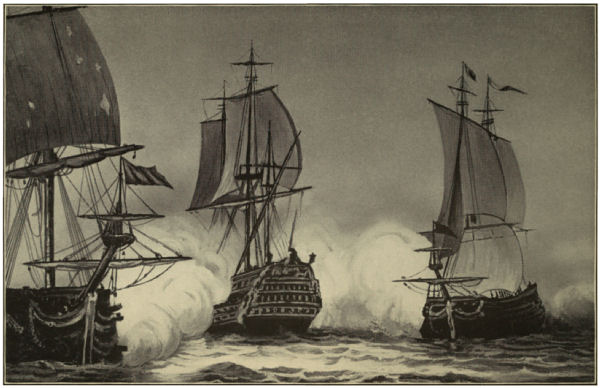
COMBAT BETWEEN DU GUAY-TROUIN AND VAN WASSENAER.
Du Guay-Trouin had now recovered his breath. Again the bellying canvas of the St. Jacques des Victoires bore her down upon the Delft, and again the two war-dogs wrapped in deadly embrace. Hear the invincible Frenchman’s own account of the final assault:
“With head down,” he writes, “I rushed against the redoubtable Baron, resolved to conquer or to perish. The last action was so sharp and so bloody that every one of the Dutch officers was killed or wounded. Wassenaer, himself, received four dangerous wounds and fell on his quarterdeck, where he was seized by my own brave fellows, his sword still in his hand.
“The Faluere had her share in the engagement, running alongside of me, and sending me forty men on board for reinforcement. More than half of my own crew perished in this action. I lost in it one of my cousins, first Lieutenant of my own ship, and two other kinsmen on board the Sans-Pareil, with many other officers killed or wounded. It was an awful butchery.”
But at last he had won, and the victorious pennon of the Privateer fluttered triumphant over the battered hulks which barely floated upon the spar-strewn water.
“The horrors of the night,” he writes, “the dead and dying below, the ship scarcely floating, the swelling waves threatening each moment to engulf her, the wild howling of the storm, and the iron-bound coast of Bretagne to leeward, were all together such as to try severely the courage of the few remaining officers and men.
“At daybreak, however, the wind went down; we found ourselves near the Breton coast; and, upon our firing guns and making signals of distress, a number of boats came to our assistance. In this manner was the St. Jacques taken into Port Louis, followed in the course of the day by the three Dutch ships-of-war, twelve of the merchant ships, the Lenore, and the two St. Malo privateers. The Sans-Pareil did not get in till the next day, after having been twenty times upon the point of perishing by fire and tempest.”
Thus ended the great fight of Rénee Du Guay-Trouin, whose blood, you see, was quite as blue as his breeches.
“Again,” wrote His Majesty the King, “do I offer you a commission in the Royal Navy, Du Guay-Trouin. Will you accept? This time it is a Captaincy.”
“I do,” replied little Rénee,—quite simply—and, at the next dinner of the officers of the Royal Marines, they sang a chorus, which ran:
“Oh, yes, he’s only a Democrat, his blood is hardly blue, Oh, Sacre Nom de Dieu! Sapristi! Eet is true! But he’s a jolly tar dog, with dirk and pistol, too, He fights like William the Conqueror, he fights! Egad! that’s true! A health to Rénee the terrible; soldier and sailor too.”